(Cover by Len de Lessio. Twilight Zone Magazine, October 1986.)
Who Goes There?
Robert McCammon made his debut in 1978, but didn’t really come to prominence until the latter half of the ’80s, in what was a meteor shower of both novels and short fiction. His longest and most ambitious novel up to that point, 1987’s Swan Song, won him a Stoker, and the next half-decade or so saw a turnout of one novel every year, each one being very well-received. At the beginning, McCammon’s work was decidedly horror, of the Southern Gothic variety (he was born and raised in Alabama), crossed with that rather nostalgic-whimsical style Stephen King became famous for. This mixing of influences arguably reached its climax with Boy’s Life in 1991, which is only nominally horror while at the same time being a mish-mash of several genres. By the time Gone South was published a year later, McCammon had become disillusioned with the horror publishing industry and quit the scene for about a decade, which no doubt hurt his chances at having long-term success, but from his perspective it was a necessary move. “Yellowjacket Summer” is simple, maybe a little too straightforward, but it shows McCammon during a time when he was compulsively writing spooky fiction by the mile. There’s some King in there, undeniably, but also a strong touch of the rural South that’s totally McCammon.
Placing Coordinates
First published in the October 1986 issue of Twilight Zone Magazine. The only notable reprint is in the McCammon collection Blue World and Other Stories, which is in print.
Enhancing Image
Right away something is kinda off with how McCammon tells this story, and it took me a day’s reflection to figure out exactly what it was: it’s the fact that we have a third-person limited narrator who switches perspectives between characters on a dime and without scene breaks. This is a problem for some people with a novel, but with a short story it’s pretty much a deal-breaker as far as technique goes. We’re in Georgia, in the middle of nowhere at some gas station, with a boy named Toby, who (the introductory blurb basically tells us) has a nasty trick up his sleeve. We soon switch perspectives to a family coming by the gas station where Toby’s at: Carla, the mom, plus her two kids, Joe and Trish. Perspective jumps to Carla, then Joe, then back again, all without a pause in the action, which I found distracting. I cross-examined the TZ printing with how it appears in Blue World, because scene or even chapter breaks might be added or removed for a story between its original printing and elsewhere; but no, I guess this is really how McCammon intended the story to be understood. I know this might come off as overemphasizing a certain flaw, but I do think it seriously gets in the way of what is otherwise a perfectly competent horror yarn about what it’s like to be stuck on the side of the road without cell cervice.
Anyway, what McCammon does do well here is evoke a certain time and place, which I’d already figured from reading Boy’s Life. What Stephen King does for New England, McCammon does for the Bible belt. Consider this description of the gas station: “The ancient-looking gas station, its roof covered with kudzu and its bricks bleached yellow by a hundred summer suns, was a beautiful sight, especially since the Voyager’s tank was getting way too low for comfort.” Ignore that obviously the gas station could not have been around for literally a hundred years, it’s the idea that counts. Now, when the family gets there Joe has to go pretty bad, and when you gotta go you gotta go. Right from the beginning we get the impression that Toby is kind of a bastard, but it’s the scene in the bathroom with Joe that we get our first real taste of Toby’s telepathic power over bees—yellowjackets, specifically. Why he has this power or how he got it, don’t know. This is not a story about the why or the how, and it’s not even a story that’s really “about” anything, other than the visceral horror of being confronted with one mean kid and an endless horde of bees. This is not a fun thing to read about, of course, especially if you’re allergic to bee stings. Thankfully Joe survives the encounter, but unfortunately this is just the beginning of the family’s troubles as they move from the gas station (not being able to get gas there), to a nearby cafe, which happens to be eerily deserted.
McCammon doesn’t strike me as someone who’s into giving incisive social commentary (Consider that Swan Song, a novel clocking in at over 800 pages, has a message that boils down to: “Nuclear war is bad.” Well of course it’s bad, Robert.), but if “Yellowjack Summer” is “about” anything, it’s about the maggot-gnawed husk that is rural America, or what used to be the American frontier. In Georgia we have Atlanta as the beacon of what we think of as civilizatuion, but there are pockets in this state (among others) that seem have been frozen solid decades ago, or gotten quietly left behind by the rest of the country. This story takes place in Capshaw, which is a town, but not much of one. Capshaw is one of many places in America which the country at large has long pushed under the kitchen rug, like some old bread crumbs one can’t be bothered to vacuum up.
Consider this:
The town was quiet except for the distant cawing of a crow. It amazed Carla that such a primitive-looking place should exist just seven or eight miles off the main highway. In an age of interstates and rapid travel, it was easy to forget that little hamlets like this still stood on the back roads—and Carla felt like kicking herself in the butt for getting them into this mess.
I should probably take a moment to bring up an obvious influence for this story, which is Jerome Bixby’s “It’s a Good Life.” Had McCammon read the original story as well as seen the Twilight Zone adaptation? Probably. It’s a rock-solid premise: What is a child suddenly got telepathic powers and bent a small town to his will? Toby doesn’t have the world-shattering capabilities of Anthony, but he’s older and more actively sadistic. It becomes clear that one reason why Capshaw is a mostly deserted town is because of Toby, and the few people remaining are too scared to leave. Emma, a rather gaunt woman who works at the cafe, has reached her breaking point by the time Carla arrives, which results in a pretty tense scene. I just wish I cared more. Maybe it’s because of the constantly shifting perspective and the underdeveloped setting, but I found it hard to get invested, even if McCammon has an eye for pacing and this is a smooth read.
There Be Spoilers Here
The good news is that while the yellowjackets do sting a lot, and the chances of getting to real civilization in a van that’s running on E are low, it turns out that evil children are not immune to getting run over with a fucking car. Good to see that child murder wins the day.
A Step Farther Out
Sorry I didn’t have much to say about this one, but sometimes that’s just how it is. I feel like I may have been a bit harsh toward McCammon, but I think it may have to do with his being stronger as a novelist than with short stories. I could be wrong, of course, and it’s possible that “Yellowjacket Summer,” which anyway hasn’t been reprinted much, may just be a relatively weak entry in his vast oeuvre.
Given that his career has stretched over half a century, and that he’s still active in fandom, I feel like I shouldn’t have to go much into Robert Silverberg. Author, editor, and fan personality, he’s one of those names that comes up a lot if you’re really getting into the history of the field. He started out in the ’50s and while he was super-prolific early on, it wasn’t until the late ’60s that his writing ascended to another level, earning him several awards in the process. When people talk about Silverberg they often refer to that late ’60s and early ’70s period, when he was at his most intense and experimental, while still being incredibly productive. Arguably his single finest novel, Dying Inside, came out of that fruitful period, and quite shamefully he did not get a Hugo or Nebula out of it.
As revered as Silverberg’s late ’60s/early ’70s period is, I do have a soft spot for ’80s Silverberg—a time when he took a bit of a break from writing novels and focused his passion more on short fiction, seemingly relaxing after the commercial success of Lord Valentine’s Castle. Genre historians don’t pay as much attention to this era of Silverberg, apparently because it’s not as demanding or anguished as his work from a decade prior, but its maturity and often calm self-assuredness is why I like it. “Not Our Brother” is a tale of terror that probably would’ve been more savage had it been written by a younger Silverberg, but it’s still an effective cautionary tale about the parasitic nature of tourism.
Placing Coordinates
First published in the July 1982 issue of Twilight Zone Magazine, which is on the Archive. If you want a source that’s both more readable and legit then good news, “Not Our Brother” was reprinted in Lightspeed, which you can read online for free. So you have no excuse!
Enhancing Image
Halperin is an independently wealthy man (he says at one point he makes money through “real estate,” although it’s unclear if he’s an agent or struck gold on an investment) who is really into collecting masks from exotic cultures. And I mean really into it. He travels to San Simón, a village in Mexico so obscure that Spanish is not even the villagers’ primary language, on the recommendation of Guzmán López, an antiquities dealer who of course shares Haplerin’s fondness for collecting. Guzmán knows the ways of the land and warns Halperin in advance that while the village’s yearly festivities are well worth observing, the village itself is very much not accustomed to outsiders. “Tourists don’t go there,” he says. “The road is terrible and the only hotel is a Cucaracha Hilton—five rooms, straw mattresses.” There is one other thing about the village that Guzmán is not totally upfront about discussing, but the setup is that Halperin is here for a rather unique festival, around the Day of the Dead.
Even for someone who has traveled a fair bit, the trip is still rough going for our hapless protagonist, who up to this point had stayed in more tourist-friendly (i.e., urban) parts of Mexico. To enter San Simón is almost like entering a dark and undiscovered corner of the world—back even to a Mexico that existed in pre-Christian times. “To come out of the pink-and-manicured Disneyland of plush Acapulco into this primitive wilderness was to make a journey five hundred years back in time.” Something Silverberg and I share is our immense fondness for Joseph Conrad, and it’s here that he evokes the metaphorical journey backward in time as written in Heart of Darkness. Now if you’ve read Heart of Darkness then you know it can certainly be problematic, but it’s also an effective and beautifully written anti-colonial tract. “Not Our Brother” smacks of bring written by a privileged white dude, but it’s also clearly working as criticism—possibly even self-criticism—of the affluent white European mindset that the world is your oyster and you’re free to take what you want.
While reading “Not Our Brother” I kept thinking about how indigenous readers would take it, since it reads as anti-colonial but from the colonizer’s perspective. No doubt in an ideal world such a story about a hidden part of Mexico would be written by a Mexican author, but this was 1982 and what the hell, Jews like Silverberg weren’t even considered “proper” white until a ways into the 20th century. You take what you can get. What makes things more difficult is that while the narration is in third-person, it sort of bleeds into Halperin’s thoughts, or maybe it’s the other way around. When Halperin enters the village and struggles to get even a word out of the locals he at one point thinks of them as “alien as Martians.” Then he corrects himself and considers that in this scenario he would be the Martian—a stranger who has come to Earth, but not bearing gifts. Halperin’s xenophobia is a character flaw, but it’s downplayed and not given as much attention as what turns out to be a kleptomania problem.
Sorry, I’m getting distracted slightly.
Getting used to this village seems like a lost cause, but then suddenly we’re introduced to Ellen Chambers, a fellow tourist. “She was about thirty, with close-cut dark hair and bright, alert eyes, attractive, obviously American,” so the narrator tells us, which is true enough; a Canadian would never have snuck up on Halperin like that. Ellen says the villagers aren’t hostile so much as shy around outsiders, since they come by so rarely. What are the odds then that there would be two Americans in this middle-of-nowhere part of the world? Indeed what are the odds. Halperin is a bit of a fool but he’s not totally blind, as he can sense that there’s something unusual about Ellen, thought he can’t put his finger on it. Like your typical horror protagonist, Halperin is a materialist who believes he lives in a world that is essentially godless and devoid of supernatural shenanigans. I myself am an atheist and you, the reader, are probably more or less in the same boat in the sense that you probably don’t believe in ghosts or demons or anything like that. Yet it’s funny: when we read tales of the supernatural we suddenly become god-fearing people—superstitious without skipping a beat. We can infer that something is wrong with Ellen by her behavior and by how inexplicable her appearance is; the difference between us and the schmuck we’re following is that we know we’re reading fiction.
Halperin’s hesitancy around Ellen that he can barely articulate will ultimately save him, but he’s also too unaware that he’s inside a horror story teo take in all the red flags. For one he should really consider the consequences of stealing decorative masks from the hotel. The funny thing about “Not Our Brother” is that the big reveal is so blatantly telegraphed (to the point where it’s impossible for me to not allude to it, even now) that we start to think the thing with Ellen might be a red herring, and thus we look toward the masks as harbingers of doom. We don’t know if the masks are cursed or what, but Halperin has to try to pretty hard to not, say, steal one of these things from his hotel room. Luckily he has a case of conscience. “He was a collector, not a thief. But these masks were gorgeous.” Silverberg rather implicitly is asking us: What’s the difference between a collector and a thief? Is it ever right to take cultural artifacts and put them in some museum hundreds or thousands of miles away, especially without the owner’s knowledge? Taking one of the masks home as a “souvenir” is a bad idea morally, but because we know we’re dealing with a world that involves vengeful or devious spirits that adds another layer to the tension.
The night of the village festival is approaching, and Guzmán tells our hapless protagonist about “amo tokinwan,” spirits who, depending on their mood, can be either benevolent or mischievous—or worse. These spirits are rather ghoulish, and can take on the form of people for one reason or another, during festivities. We of course expect one of these spirits to show up, assuming one hasn’t already appeared already, but most likely hidden under one of many elaborate masks. Amo tokinwan means “not our brother” in Nahuatl, and it not being Spanish (Nahuatl being the villagers’ primary language) only reinforces the notion that these customs are rooted in something that might be even older than Christianity. I’m not sure how much research Silverberg put into this story and I’m not even slightly an expert on this part of the world, so unfortunately I sort of have to take his work for it. If someone who is accustomed to rural parts of Mexico could hit me up and tell me if Silverberg is full of shit, that’d be cool. But now we’re getting to the climax, and just in time!
There Be Spoilers Here
That Ellen is one of these spirits does not come as a surprise; even the cover for this issue of Twilight Zone Magazine alludes to Ellen’s true nature, with her face being iolated and weirdly artificial-looking as if it were a mask. Which in a sense it is. Ellen’s human form is but a mirage, which Halperin finds out almost too late. The reveal is super-predictable, which is my big criticism of this story and something which stopped me from getting too into it, but it does make ironic sense. Of course the one person who presents a threat to Halperin is someone who doesn’t look like she’s one of the natives; that Halperin takes shelter in the one fellow tourist makes his near-death experience with her almost read as karmic. Lucky for him that he merely get into some hot foreplay because Ellen can really have her way with him (and it is both an erotically charged and hallucinatory scene), as Guzmán and a few villagers arrive just in time to scare off the spirit. Apparently the spirit had sucked out the soul of some American woman who had come to the village before and taken on her likeness.
The ending can almost read like an anti-climax given Halperin comes out of it fine, but it’s also made clear that his brush with the supernatural traumatized him and, perhaps, taught him to not tread where he doesn’t belong. “He buys only through galleries and does not travel much any more,” so the narrator tells us at the very end. I’m sure Silverberg considered killing off Halperin at the end, and had he written the story a decade earlier he probably would’ve gone that route; but that would’ve been even more predictable than what we got. Silverberg is not naturally a horror writer and so “Not Our Brother” reads at times more like a science-fictional anthropological study that one would expect from Ursula Le Guin or Chad Oliver. It’s a short novelette of just over 8,000 words, but Silverberg’s descriptions can be so long-winded and yet so readable that it feels a couple thousand words shorter than that.
A Step Farther Out
Is it scary? Not really. Like I said, Silverberg is not by nature a writer of spooky stories, which makes “Not Our Brother” seem more like testing new ground than a master practicing his craft. On top of the possible racism (I don’t think the story is racist, but it could be reasonably construed as that) there is a bit of misogyny thrown in, which—believe it or not, Silverberg used to be worse about that sort of thing. Go back and read his late ’60s/early ’70s material and you’ll notice a toxic mix of male chauvinism and a recurring distrust of women. The Silverberg of the ’80s that I’ve read is better about dealing with things like race and the relationship between men and woman, but that might be simply a product of Silverberg coming into respectable middle age. Yet it must be said that while “Not Our Brother” is unlikely to impress us, especially those well-acquainted with spooky shit, it’s a very readable and thoughtful work.
Do I really need to introduce you to Stephen King? Nah, I don’t. So this is not so much a cursory look at King’s life and works as my own personal experience with him, because I have to admit, I was slow to read King at all. A lot of people have probably read him in high school, but I didn’t read a single word of his until I was in college; that’s not a gloat or anything, that’s just the reality of the situation. Had I read King earlier I probably would’ve been more entranced. My first exposure to King was “The Gunslinger,” the short story that later became part of the novel of the same name, the first in his Dark Tower series. I remember basically nothing about it. But later I read Different Seasons, his novella collection (although I will die on the hill of arguing Apt Pupil and The Body are full novels), which was sort of a mixed experience but mostly positive, although honestly The Shawshank Redemption improves on its source material in several ways.
Then last year I read ‘Salem’s Lot, his second novel, and I was sort of impressed; I love the first half and while the second half is oddly not nearly as scary (it loses its foreboding tone once the vampire-hunting gets underway), I liked that too. Good novel, even if it proved to be ground zero for so many of King’s… well, let’s call them quirks. King has written a lot. Like a fuckton. Like it’s intimidating to see just how many novels he’s written, although his list of short works is more manageable. Point being, King inevitably repeats himself; he has a list of go-to tropes and plot devices, and probably even turns of phrase that he can resort to over and over. I don’t really blame him: Philip K. Dick had a set of formulae too. But it’s also easy to poke fun at King’s tendency to, for example, set a given story in his home state of Maine—although today’s tale is an exception.
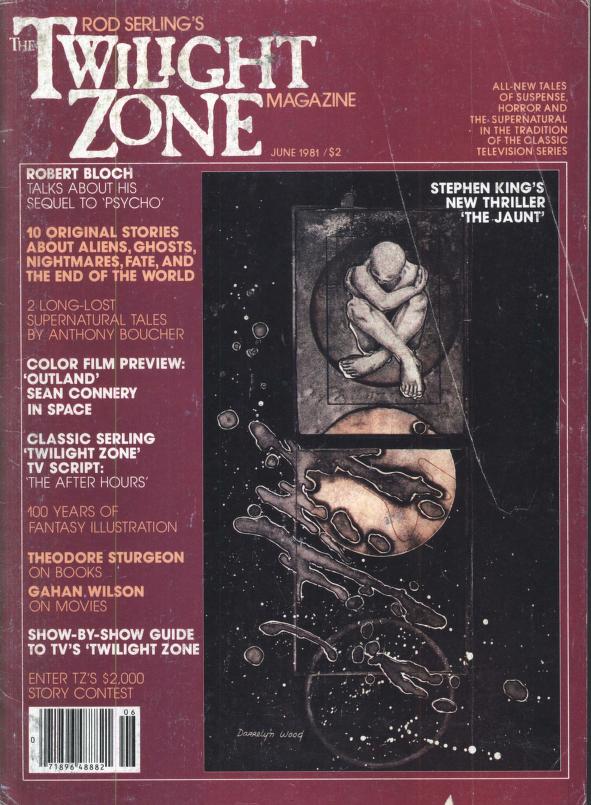
Despite being labeled a horror author, King has at least dabbled in pretty much every genre you can think of, including some good ol’ science fiction. “The Jaunt” is one of his more famous short stories (admittedly his short stories are not nearly as famous as his novels and novellas), and it’s the most pronounced example of him combining SF with horror in that both genres about equally play off each other here.
Placing Coordinates
First published in the June 1981 issue of Twilight Zone Magazine. Because this is a King story from his prime era it’s very easy to find in print. The obvious choice is Skeleton Crew, which contains, among other things, The Mist. (I don’t know why I got The Mist as a standalone paperback, that was a waste of money. Actually several of King’s novellas have been resold as standalone paperbacks despite being only marginally cheaper than the collections they appear in.) The weird thing about “The Jaunt” is that it hasn’t been anthologized much; in four decades it’s been anthologized in English only a couple times.
Enhancing Image
Mark is taking his family for a business trip; in the old days they would’ve taken a ship to Mars, but with the Jaunt they can fall asleep and wake up at their destination in what feels like seconds. The Jaunt (with a capital J) is a revolutionary method of transportation that has made moving things and people between planets as easy as possible. Mark has Jaunted before but his wife Marilys and son Ricky and daughter Patty have not before. As they’re waiting to get a hit of sleeping gas (you have to be rendered unconscious before Jaunting), Mark passes the time and indulges his kids’ curiosity by telling them the story of how teleportation was invented; the kids would know little bits and pieces already, but Mark decides to tell them enough of the story, if not all the grisly details.
A few things to note before we get into that origin story…
King would’ve written “The Jaunt” circa 1980, or maybe earlier, and indeed this could not have been written any later than the early ’80s with how much it explicitly references OPEC and the oil crisis in the ’70s—a rather specific period in American history that the characters in this far-future setting treat like it was a recent and life-changing happening. I find this funny, because while the oil crisis no doubt impacted millions of Americans who were there to live through it, even people born, say, 1990 and later would have basically no context or sense of attachment with that period. The story shows its age by using what was then a recent time in history and overestimating how people in the future would relate to said time. Jaunting would be considered a monumental breakthrough in transportation regardless of when it was invented, but while King’s decision to date the story may seem superfluous, it does what most if not all science fiction sets out to do: not to predict the future but to comment on the present.
Also, if you’re a seasoned SF reader then you probably thought of jaunting (lower case l) as depicted in Alfred Bester’s The Stars My Destination, which was by no means the first use of teleportation in SF but definitely had one of the most creative and influential uses. I figured, even before starting to read this one, that “The Jaunt” was harking to Bester’s novel, and that it would subvert our expectations about the mechanics of teleportation in some way since it’s clearly a horror story. Rather than let the reference go unspoken, though, King goes out of his way to let you know that he too manages to fit reading science fiction into his no doubt busy schedule. It’s one of those hat tips to fandom that makes me roll my eyes, but it also makes me wonder if “The Jaunt” would’ve gotten a Hugo nomination had it been published in an SF (and not horror) magazine.
Get this:
“Sometimes in college chemistry and physics they call it the Carew Process, but it’s really teleportation, and it was Carew himself—if you can believe the stories—who named it ‘the Jaunt.’ He was a science fiction reader, and there’s a story by a man named Alfred Bester, The Stars My Destination it’s called, and this fellow Bester made up the word ‘jaunte’ for teleportation in it. Except in his book, you could Jaunt just by thinking about it, and we can’t really do that.”
Anyway, about Victor Carew. The Carew story is when “The Jaunt” starts to grab my attention and as far as I’m concerned it’s the good SF-horror story that, like one of those Russian toys, is nestled inside a less scary and more cliched story. Carew was a scientist who struggled to retain autonomy while under government surveillance, using a barn as a makeshift laboratory and, like Jeff Goldblum’s character in The Fly, using this space to work on teleportation. The good news is that he finds that inanimate objects can be teleported from Portal A to Portal B with no issues; this alone would’ve revolutionized transportation, being able to move cargo between whole planets without a human driver. But of course this is sort of a cautionary tale and Carew does something that sounds reasonable but which will prove to have very mixed results: teleporting living things.
Having experimented on himself partly (he “loses” two fingers), Carew wonders if something can go through Portal A wholesale and come out of Portal B unscathed. Now, rather than experiment on people, Carew does the sane thing and tests Jaunting on animals—more specifically white mice. The mice (King erroneously calls them rats at one point) unfortunattely don’t fare well with teleportation: they come out the other end seemingly unharmed, but every one them dies soon after Jaunting. What’s more interesting is that if a mouse is put through Portal A tail-first and only partly subjected to the Jaunt, such that their head is still on the side of Portal A, they’re fine; if they’re put in head-first, however, with their head at Portal B and their tail at Portal A, they die even if they’re not completely teleported. Clearly then the mice dying has something to do with vision—what they’re seeing at that point between Portal A and B.
“What the hell is in there?” Carew wonders. Indeed.
I was wondering if King would go in a body horror or cosmic horror direction with this, and turns out it’s a bit of both. The body horror stems from how teleportation, if done gradually, reveals the insides of anything being teleported, such that we’re able to see the organs of the mice as they’re put slowly through the portal. The effect is uncanny and King, admirably, doesn’t dwell on it for too long, since he has another trick up his sleeve—that being the cosmic aspect. You see, teleportation takes a tiney fraction of a second, but during that incredibly brief time the subjective time it takes to Jaunt is enormous, although Carew does not realize this immediately. After all, the mice, aside from acting dazed when they come out the other end, don’t show any physical signs of being on the brink of death. What, then, could be killing them? Doesn’t matter, at least to the government, because Jaunting works and it’s about to change everything.
The results of the announcement of the Jaunt—of working teleportation—on October 19th, 1988, was a hammerstroke of worldwide excitement and economic upheaval. On the world money markets, the battered old American dollar suddenly skyrocketed through the roof. People who had bought gold at eight hundred and six dollars an ounce suddenly found that a pound of gold would bring something less than twelve hundred dollars. In the year between the announcement of the Jaunt and the first working Jaunt-Stations in New York and L.A., the stock market climbed a little over two hundred points. The price of oil dropped only seventy cents a barrel, but by 1994, with Jaunt-Stations crisscrossing the U.S. at the pressure-points of seventy major cities, OPEC solidarity had been cracked, and the price of oil began to tumble. By 1998, with Stations in most free world cities and goods routinely Jaunted between Toyko [sic] and Paris, Paris and London, London and New York, New York and Berlin, oil had dropped to fourteen dollars a barrel. By 2006, when people at last began to use the Jaunt on a regular basis, the stock market had leveled off seven hundred points above its 1987 levels and oil was selling for six dollars a barrel.
By 2006, oil had become what it had been in 1906: a toy.
Again I’m amused that King made the invention of teleportation so close to what would’ve then been the present day. What is he trying to say here? Genuine question, although I have to think it has to do with what was then (and still is, really) a mad search not only for alternative energy sources but to make those sources commercially viable. Sadly he doesn’t go deeper into the socio-economic implications of Jaunting (I imagine truckers would be mad about being out of a job), but he does enough that we’re given a juicy slice of how society in the future could be changed radically. And hell, even if you consider the negatives, the environmental consequences (there don’t seem to be any drawbacks in this regard) alone would make Jaunting a godsend not just for most people but for life on Earth generally.
A shame about those who Jaunt while still awake…
There Be Spoilers Here
Turns out Jaunting does have a physical effect on people, and there’s a reason why Carew is not able to see that by testing on the white mice. Apparently Jaunting while awake (although not when asleep, weird) turns your hair white (assuming it’s not already) while also aging you massively—physically, with the hair, but especially mentally. I’m embarrassed actually that it took until mere minutes prior to my writing this that the reason why Carew doesn’t see a physical change in the mice is that their coats are already white. In fairness the mice having their coats unchanged is a detail that’s unusually subtle by King’s standards, and it makes me think about how much better “The Jaunt” could’ve been had he put more of that storytelling discipline into action. I know I may sound unfairly harsh to the most popular horror author of all time, but King really does have moments where he’s able to push himself to the realm of true artistry, something higher than workmanlike technique; sometimes he really doesn’t, though.
(My favorite King short story is still “The Reach,” which is an unusually low-key outing for him, though that paid off with a World Fantasy Award win. It’s refined and effective as both a ghost story and simply as a work of fiction, and if you want prime King then I’d say that’s an example.)
So now we’re at the end. The time has come for Mark and his family to Jaunt to Mars; they get the gas and at first everything seems fine when they arrive at the other end. The only thing is that Ricky, being a dumbass, intentionally held his breath during the gassing and stayed conscious during the Jaunt, with predictably horrific results. Like with other people who supposedly stayed conscious during the Jaunt he comes out the other end with his hair snow-white, only this time, rather than being dazed like the mice, Ricky is laughing mad to the point of clawing his own eyes out while he cackles. Presumably Ricky will not live long, and to say this trip for the family proves traumatic would be an understatement.
A few questions:
Since the Jaunt has been proved to be potentially deadly, and in a dramatic fashion at that, you’d think there’d be more safety measures. I get that if “The Cold Equations” can work in spite of how implausible its situation is then so can “The Jaunt,” but with the former I get the feeling (well actually we know this from correspondence between John W. Campbell and author Tom Godwin) that the decision to forego measures that would’ve saved the girl in that story was deliberate, whereas in “The Jaunt” it feels like a way for King to sneak in a scary ending.
If all it takes for someone to stay awake during the Jaunt is so just hold their breath when being gassed, shouldn’t there be more cases like this? We’re given the impression that surely no one would be stupid enough to do that, given that Ricky is shown to be only a mildly stupid child, shouldn’t there be more cases of children dying from the Jaunt? I know that sounds morbid, but surely it’s no more morbid than quite a bit of what King’s written over the years.
Come to think of it, how come the attendants didn’t notice that Ricky wasn’t inhailing the gas? Couldn’t they tell? Shouldn’t there be some kind of backup measure to make sure that someone is unconscious before Jaunting? You have a two-step authentication process to check your damn bank statements on your phone, there should probably be something extra here. Not that the story as a whole doesn’t work, but the ending specifically would not be allowed to happen if even rudimentary safety measures were in place.
Children should probably not be allowed to Jaunt, right? It sounds like too much of a safety hazard. I know the obvious counter-argument would be that children are allowed in cars all the time and cars kill far more people in a year than sharks and airplane accidents combined (by like a lot), but there are also measures in place to try to minimize car fatalities. Granted, when “The Jaunt” was being written cars were far less safe than now and some people even today are reckless enough to cheat around using seatbelts. Still, the red tape for a Jaunting accident involving a child would be tremendous.
Anyway, even if I ignored the leap in logic, it’s too over the top for me to find scary. Ricky, a character whom we’ve gotten to know very little up to this point, does something monumentally stupid so that we can get a shocker ending. You could argue that it justifies the frame narrative, since otherwise the story just ends once Mark is done telling the story within the story, but I’d retort by saying that at least if the frame narrative is gonna be here at all then an ambiguous and moody ending would do better. We already had some body horror earlier that was creative and restrained enough that King left a good deal to the imagination. Personally I think we could’ve done without the frame narrative entirely; it’s not like Mark and his family are more compelling voices than Carew, and I was far more gripped by the substance of the story that’s being framed than how it was being framed.
A Step Farther Out
Kinda mixed on this one. There’s a pretty interesting SF-horror narrative nestled within a rather pointless frame narrative that not only verges on cornball but has a twist so obvious that it can be seen from orbit. It wouldn’t take too much to reframe the narrative in a documentary-like fashion, like Lovecraft’s “The Call of Cthulhu” and “The Dunwich Horror,” wherein we’re like witnesses to a series of realistic but supernatural events. Unfortunately that requires a degree of restraint that King fails to practice here, and the result is ultimately too overblown for me to be genuinely spooked by. On the bright side, it’s memorable! King is aware that readers, even in 1981, are well aware of teleportation as a genre chestnut and tries admirably to subvert our expectations regarding this technology. That he’s able to conjure something menacing out of tech that, realistically, would change society for the better, is a sign of talent. It’s just a shame that the execution renders the story not all that scary, and also maybe too self-conscious.
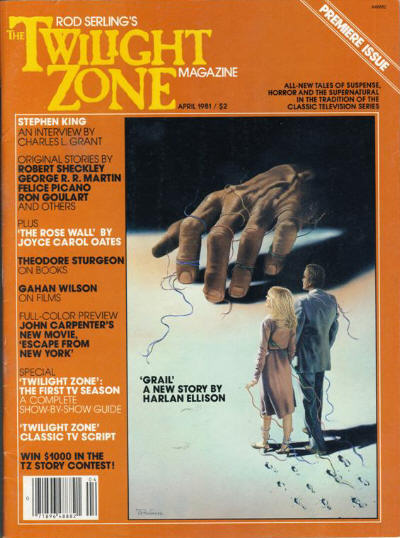
(Cover by Jim Warren. Twilight Zone Magazine, April 1981.)
Who Goes There?
Where to start with Harlan Ellison? He resented being called a science fiction writer, but in his defense, he wrote a lot more than just SF; he was one of the most important and most productive writers of genre fiction from the second half of the 20th century. SF, fantasy, horror, things not so easily categorized? Ellison did it. He got his start in the ’50s as a middling young author along the lines of Robert Silverberg at the start of his career, but the ’60s saw a profiund step up for him as he began refining his craft, not only putting out award-winners like “I Have No Mouth and I Must Scream” but also writing for shows like Star Trek and The Outer Limits. Of course, things are not nearly as simple as that. Ellison’s involvement with Star Trek proved a fiasco, and when he was not being unprofessional (his degree of procrastination was legendary) as a writer, he was being a thorn in a lot of people’s sides as a fandom personality.
Perhaps the most memorable controversy with Ellison, for me, is his inability to finish (or seemingly even to start) what was to be the concluding entry in a trilogy of anthologies, The Last Dangerous Visions. Dangerous Visions was a landmark original anthology, as was its sequel (said to be superior at least in some ways), Again, Dangerous Visions, both edited by Ellison, but Ellison’s lack of initiative with working on TLDV (which was announced in 1972 but never published) has spawned many justifiably vitriolic reactions. While some stories that were sold to Ellison have since been published elswhere, the majority of the stories submitted for TLDV have yet, after all these decades, to be released to the public in any capacity. With Ellison’s death in 2018, followed by his late wife Susan’s in 2020, not only will we never get TLDV as Ellison envisioned it, but it looks like the Ellison estate has been thrown in disarray recently.
With all this said, and taking all of Ellison’s shortcomings as a writer (not to mention as a person) into account, he’s still one of the Big Names™ of short fiction in modern times, not just in SFF but outside of it. “Grail,” as I’ll elaborate on shortly, is a good example of Ellison’s vigorousness as a storyteller, as well as someone who (I say this in a good way) wears his emotions on his sleeve.
Placing Coordinates
First published in the April 1981 issue of Twilight Zone Magazine, which is on the Archive and which also happens to be that magazine’s inaugural issue. Twilight Zone Magazine is exactly the kind of publication that would get some TLC on my blog, as it’s a bit quirky, a bit out of left field, and most importantly, it didn’t last that long. Oh, TZM did fairly well, and for the first half of its existence it was edited by T. E. D. Klein (this is like if you gave Thomas Ligotti a horror magazine), who while not the most prolific of authors proved quite the reliable editor. Unfortunately, despite some high-quality fiction and fancy packaging, and despite its numbers never tanking, TZM did not quite survive the ’80s. Another story I recgonized from this issue is George R. R. Martin’s “Remembering Melody,” which I will absolutely get around to reading/reviewing… at some point.
Where else to find “Grail”? There are Ellison stories which have been reprinted many times (frankly too many times), but “Grail” is not one of them—not helped by the fact that, for some reason, it has become considerably harder to find Ellison books in the wild in recent years. I don’t know what happened. It looks like even the most essential Ellison collection have gone out of print; you can find them on the second-hand market, but you won’t find new editions, and even used copies are inexplicably harder to acquire. Still, there are a few options. “Grail” was reprinted in the Ellison collection Stalking the Nightmare, which is very much out of print but thankfully is not hard to find used. If you like Ellison like I do then you may be interested in The Essential Ellison, which is a massive volume that collects short fiction and essays and which comes in two distinct editions. The older edition is easier to find, but it’s still something of a collector’s item.
Enhancing Image
Christopher Caperton (which sounds like a name someone made up) is a shy kid who grows up desperate to seek adventure, and seek it he does. From the time he’s a child and for the rest of his life, Chris is deeply concerned with one question: What is love? Baby don’t hurt me Not just familial love or even romantic love, but True Love, that most elusive of abstractions. What does it look like? Does it have a face? Is it possible for Chris to find The One? Despite his life experiences, and despite reading the works of every author under the sun on subject of love, he’s no closer to finding True Love. As an aside, I find it funny that apparently John Cheever knows even less about love than our protagonist, as I’m not sure if Cheever’s turbulent personal life and bisexuality were public knowledge in 1981 (probably was for the former but not the latter). Speaking of which, queerness doesn’t really come up in-story; it’s alluded to, but the narrator makes it very clear to us that Chris is, to paraphrase the protagonist of Silverberg’s Dying Inside, drearily heterosexual. Oh well.
As a young man Chris finds himself in Vietnam in the late ’60s running drugs with a woman named Siri, who is not as normal as she seems. The two become lovers as well as partners in crime, and when all is said and done this is probably the happiest relationship Chris ever has; unfortunately it doesn’t last long. A random artillery strike kills Siri, but before she dies, she spends an impressively long amount of time explaining to Chris this artifact that’s supposed to represent True Love, an artifact which Siri had been looking for for years but had sort of given up on recently. She didn’t find True Love, but she found the next best thing. Siri is an interesting character because she’s one of those story figures who doesn’t get much screentime (or pagetime?) but whose plot relevance is immense; in this case she’s the one who basically kicks the plot into gear and sends Chris on his quest. Of course her dying words do not just encompass “This thing exists, now go get it,” as she also gives Chris some very specific and very unusual instructions.
More on that in a minute.
Something I wanna say right now is that when I picked “Grail” as part of my spooky short story lineup for review, I was under the impression that it would be straight horror. Not so! There’s a bit of horror, primarily having to do with a certain character, but overall it much more reads as an adventure narrative with a philosophical bent. Still, it’s spooky enough to serve as the first cover story for Twilight Zone Magazine, and more importantly, it’s good enough a story to earn that position. I can’t properly explain it, but the vigor that’s apparent in Ellison’s writing makes even his lists (and there are a few times where he basically just lists things in “Grail”) engaging to read. You could theoretically write a 300-page novel with “Grail” as a blueprint and the novel would not feel stretched thin, but Ellison zeros in on only the most relevant of info, resulting in what almost feels more like a compressed novel than a short story.
In my review of C. M. Kornbluth’s “The Mindworm” I noted Kornbluth’s use of compression and how he was able to cram a lot of history and worldbuilding into a tight space, and Ellison does basically the same thing here—only maybe even more impressively. Get this, the bulk of the artifact’s history as Siri understood it:
Between 1914 and 1932 the object—while never described—turned up three times: once in the possession of a White Russian nobleman in Sevastopol, twice in the possession of a Dutch aircraft designer, and finally in the possession of a Chicago mobster reputed to have been the man who gunned down Dion O’Banion in his flower shop at 738 North State Street.
In 1932 a man visiting New York for the opening of the Radio City Music Hall just after Christmas reported to the police who found him lying in an alley on West 51st Street just below Fifth Avenue that he had been mugged and robbed of “the most important and beautiful thing in the world.” He was taken to Bellevue Hospital, but no matter how diligently he was interrogated, he would not describe the stolen article.
In 1934 it was reputed to be in the private art collection of the German architect Walter Gropius; after Gropius’s self-imposed exile from Nazi Germany it was reputed to have passed into the personal collection of Hermann Goering, 1937; in 1941 it was said to be housed with Schweitzer in French Equatorial Africa; in 1946 it was found to be one of the few items not left by Henry Ford at his death to the Ford Foundation.
Its whereabouts were unknown between 1946 and February of 1968. But Siri told Chris, her final love, that there was one sure, dangerous way of finding it. The way she had used originally to learn the hand-to-hand passage of the artifact that was True Love from the Palace of Minos to its present unknown resting place.
So now we get to the spooky character in “Grail,” which is the minor demon Surgat. Siri left instructions so that Chris could not only summon Surgat (supposedly a demon who can pick any lock) but also stay protected from the demon’s treachery. Because a demon doesn’t want to help you, it’s more like a form of indentured servitude. There’s a bit of a deal-with-the-devil narrative here, although it’s more a case of two people who clearly hate each other’s guts but are forced to work together. The first time Chris summons Surgat he’s naturally unnerved about the whole thing (How often does one get to draw pentagrams and summon demons?), but given the very recent death of Siri and everything that’s happened this marks the start of his evolution into a badass. Surgat opens the trove that contains Siri’s most secret things, having to do with her search for the artifact, but before he fucks off he takes Siri’s body as a… treat.
The implications are a wee bit concerning.
From here on out, Chris is on his own. The man who started out as a bit of a wimp is now on a quest to find True Love, and if there’s one thing he’ll do anything for, it’s love. It’s at this point that we get a few time skips (remember what I said about the compressed novel thing), jumping from the late ’60s through the ’70s as Chris wanders the globe, “a nameless, stateless person, someone out of a Graham Grene suspense novel.” Again I’m taken back by how Ellison is able to squeeze so much in here, making years pass by in mere words without making us feel like we’re missing out on too much. It helps, too, that while Chris is not the most complex of characters, his mission, his want, is deeply relatable, and we’re given enough context about his life to see why this would be so important to him.
There Be Spoilers Here
Even more than a decade of searching, Chris has tracked the artifact to what seems to be its most recent resting place, in the hands of some super-rich mogul (I don’t think we even get his name), who also happens to be on his deathbed. The mogul has the artifact locked behind a ridiculously convoluted security system (it would make Mission: Impossible look like a documentary), but this doesn’t stop Chris from summoning Surgat again and revealing the artifact anyway. The artifact, which is indeed a grail, reveals in its liquid the face of True Love, but it’s not what Chris has been expecting all these years. The final twist of the story is subtle, yet deeply tragic, and shows Ellison twisting the knife that he’s just thrust into us; he’s very good at that.
This is not the very end, technically, but it’s enough:
He looked down into the loving cup that was True Love and in the silver liquid swirling there he saw the face of True Love. For an instant it was his mother, then it was Miss O’Hara, then it was poor Jean Kettner, then it was Briony Catling, then it was Helen Gahagan, then it was Marta Toren, then it was the girl to whom he had lost his virginity, then it was one woman after another he had known, then it was Siri—but was Siri no longer than any of the others—then it was his wife, then it was the face of the achingly beautiful bride on the cover of Esquire, and then it resolved finally into the most unforgettable face he had ever seen. And it stayed.
It was no face he recognized.
Years later, when he was near death, Christopher Caperton wrote the answer to the search for True Love in his journal. He wrote it simply, as a quotation from the Japanese poet Tanaka Katsumi.
What he wrote was this:
“I know that my true friend will appear after my death, and my sweetheart died before I was born.”
I’m gonna keep it real with you: I thought this was devastating. Ellison has done sadistic endings many times before, his protagonists sometimes being defeated outright or achieving a sort of Pyrrhic victory, but “Grail” mixes that sadism with a genuine tragedy. When I say “tragedy” I mean it in the proper sense of the word, which is to say Chris, due to a combination of circumstances and his own flaws, fails nobly. When people call something tragic they simply mean to say something bad has happened (don’t worry, I do this a lot too), as opposed to what it really means, but Ellison understands real tragedy. These are words coming from a man who, due in part to his own personality flaws, had loved and lost over and over. His famous novella, “A Boy and His Dog,” perfectly captures Ellison’s brand of wounded-dog misogyny (that’s right, it is a misogynistic story, but it’s a psychologically arresting story specifically because of its apparent distrust of women), but “Grail” achieves a similar effect without the blatant woman-hating.
I can believe that “Grail” is a middle-career piece from Ellison, because I don’t think the Ellison who wrote “I Have No Mouth and I Must Scream,” the Ellison who was younger and not as adjusted to his fame, could have written it. This story, and especially this ending, reads to me as by someone who still has a lot of fire in his belly but who also has been in the game long enough to pair that fire with real craftsmanship and insight. Even “The Deathbird,” which might still be my favorite Ellison story, and which still reads as totally experimental, does not distill its disquieting effect as succinctly as “Grail” does. This story made me feel something.
A Step Farther Out
I was shocked to find that “Grail” is only ten pages long; mind you, this is in TZM, which is not only two-columned but has frustratingly small type. What impresses me is that Ellison is able to tell what is basically a man’s whole life story in that span, and it doesn’t feel rushed or like we’re missing important information. Like sure, it’s compressed, the whole thing is an exercise in compression, but it’s a fully developed tale of one man’s search for the impossible. Chris starts out as a socially awkward nobody before tragedy sends him on a path to becoming a globe-trotting badass, but at the cost of something he can’t put his finger on. The question of finding true love is an ages-old but still deeply relevant one for most people, including myself, and personifying it as something akin to the Holy Grail is probably not new either, but it’s how Ellison gives it its own history, its own sense of weight, that makes the ending tragic. Indeed the ending would be an existential nightmare, were it not so sad and relatable.
I was expecting something more horror-centric, but I can’t say I was disappointed with what I got. Ellison is, if nothing else, an emotionally potent writer (sometimes to the point of edgy tedium), and “Grail” is an example of the mature Ellison flexing his muscles. On the one hand I’m a little surprised it didn’t get more awards attention (though it was up for the coveted Balrog Award), and also that it hasn’t been reprinted more often. Oh sure, “‘Repent, Harlequin!’ Said the Ticktockman” can be reprinted literally a hundred times, but an objectively better and more layered story like “Grail” is apparently deemed a minor work by virtue of its lack of exposure. Well I’m gonna change that! Maybe not “change,” but I do wanna tell more people about this one; I think it’s a bit of a hidden gem.


 Science Fiction & Fantasy Remembrance