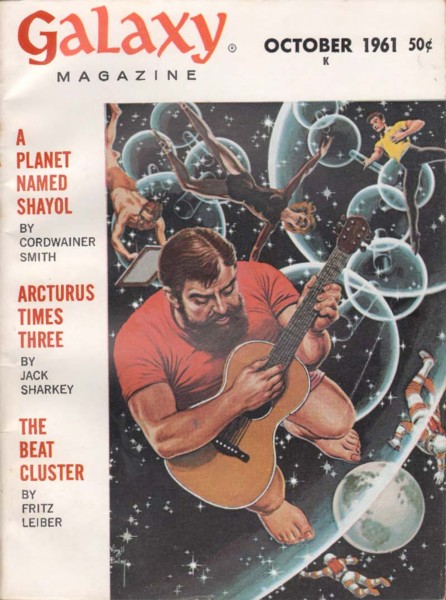
In the history of genre SF there are many ships that pass in the night, never to be seen or heard from again, one of these being Jack Sharkey. Sharkey had made his debut at the tail end of the ’50s and wrote a pretty considerable amount of short fiction over the next half-dozen years. For reasons I’m not sure about, because we don’t know much about Sharkey, he more or less disappeared from the field after 1965. As far as I can make out writing SF was just a temporary side gig for him, which is strange since he was most active at a time when the US magazine market was at low tide, with the bubble having burst in the back end of the ’50s. Even the SF Encyclopedia doesn’t have much to say about him. Nearly every genre outlet at the time bought his stuff, though, which means he must’ve made some impression. He also had a series of short stories that caught my attention, about a “space zoologist” named Jerry Norcriss, at a time when zoology and generally the study of animal life were still rather novel in modern SF. “Arcturus Times Three” is the first entry in this series.
Placing Coordinates
First published in the October 1961 issue of Galaxy Science Fiction. It was reprinted in Uncollected Stars (ed. Piers Anthony, Martin H. Greenberg, Barry N. Malzberg, and Charles G. Waugh). The copyright ran out, so it’s on Project Gutenberg. Surprisingly there was never a book collecting all of the Jerry Norcriss stories.
Enhancing Image
By the year 2097, man has voyaged to the stars, going where no one has gone before, to seek out new life and new civilizations, yadda yadda. However, making first contact in-person with intelligent life has proven to be a hefty gamble, perhaps heavy enough that a scientific alternative was called for; that alternative is the Space Zoologist, making capital-C Contact with alien life via telepathic mind-link, in which the zoologist will spend forty minutes at minimum inside the mind of an alien creature, walking (or slithering, or swimming) around in that creature’s shoes, sharing their brain, with the creature and zoologist’s personalities having a tug-of-war over the body. The catch, of course, is that if the creature were to die in those forty minutes, the zoologist dies with them, their body being a mindless husk. Why is this so? Well, the real reason is that otherwise there would be no potential bodily harm for the zoologist and thus your story would become boring rather quickly. Meet Jerry Norcriss, thirty-year-old Space Zoologist as well as space lieutenant, IN SPAAAAAACE. The mission is to survey some local wildlife on Arcturus Three, although the exact reason for this is not given until the end, so best not to think about it. The point is to stick Jerry’s mind in the heads of three random lifeforms, which he will not know anything about in advance and who are very likely to die within those forty minutes. Sounds simple enough, right?
I have a few issues. One has to think the mortality rate for Space Zoologist must be ridiculous, to the point where it might be more costly than to have a survey team come down and bring the party to the aliens. It also doesn’t occur to any of these people that sending robots would be preferable; surely it was not a novel idea, in 1961, to use robotic probes instead of humans to explore hostile environments. But then we wouldn’t have a story. At the same time, wouldn’t it make sense for the space crew to figure out some way to, I dunno, figure out what kind of lifeform Jerry would be sharing a head with in advance. It’s a shame, because the idea is a neat one, which borders on transhumanism. As the narrator tells us, “A man who has been an animal has infinitely more knowledge of that animal than a man who has merely dissected one.” Jerry’s interest in alien biology goes to a point where he doesn’t relate much to his fellow humans, and what little we find out about his character in this story (I assume we learn more in future entries, but not that much given the episodic nature of the whole thing) is just about enough to make us relate to him. I mean fuck, I don’t like hanging out with people that much either. With that said, this is not a cerebral or personal story, but an old-fashioned scientific adventure of the sort that would become increasingly rare as the ’60s progressed—or so retrospective views on the genre’s history would have it seem. Evidently there was still a sizable audience for this sort of thing.
As for the animals that Jerry takes control of, there’s a bit of variety between the three of them (get it, because it’s like a pun with the title, Arcturus Three and there being three animals…), with the first being this weird centipede creature that’s connected to another animals via its tongue; then there’s the most compelling sequence, where Jerry’s in the body of a “lion-thing,” somewhere between a lion and a bear, with its cub. The lion-thing’s instinctive behavior turns out to be as much that of a lemming’s as a lion’s, including a tendency to eat things that are very not good for it. Not that Jerry would know until he finds his tummy hurts real bad, on account of not being able to survey the territory beforehand. LIKE THEY SHOULD’VE FUCKING DONE. The only reason he gets out of it in one piece is having to do with time dilation, or rather Sharkey has his thumb on the scales so as to make sure his hero gets out okay. (In fairness, time would work differently on another planet. You say forty minutes, but how much is forty minutes on a planet that has a different gravity and rotation from Earth’s?) It’s all in good fun. We even get some fully intelligent aliens thrown into the mix, although their role is tertiary enough that one is quick to forget about them. This is a story where the journey matters much more than the destination, although I’m not sure if the journey was worth it.
There Be Spoilers Here
The most interesting part of this whole thing for me was the ending, which, after some rather lightweight planetary adventuring, reckons with a serious problem—that being the problem of colonization and the ensuing (and inevitable) ecological damage. On top of his awkwardness around people, Jerry feels more than a hint of shame about contributing to what will be a protracted and brutal colonization effort, in which the aforementioned animals will be displaced or killed outright, yet he also feels powerless to do anything about what is ultimately a systemic issue. He loves his job, and yet he doesn’t like what it costs for life in the universe. As the narrator says, clearly reflecting Jerry’s (and probably Sharkey’s) feelings, “People always were puzzled about how a Space Zoologist could stand being a creature other than a human being. And Space Zoologists always were puzzled about how a human being could stand being part of that conquering race called man.” I wish the rest of the story had something like this degree of seriousness, but it’s too little and a bit too late.
A Step Farther Out
I sat around for a couple days trying to organize my thoughts on this, which when such a thing happens is either from too much or too little material; in the case of “Arcturus Times Three” it’s the latter. Sharkey’s a competent storyteller with a clear interest in a certain science, but given how long this story is (it’s a solid novelette), it’s not quite enough meat on its bones. The alien creatures Sharkey describes are neat enough, but I got this consistent and burdensome feeling of wanting more, on top of the fact that I was much slower about reading this than I should’ve been. If I’m taking several breaks during your story that I should’ve been able to read in an hour or so, then something is definitely missing.
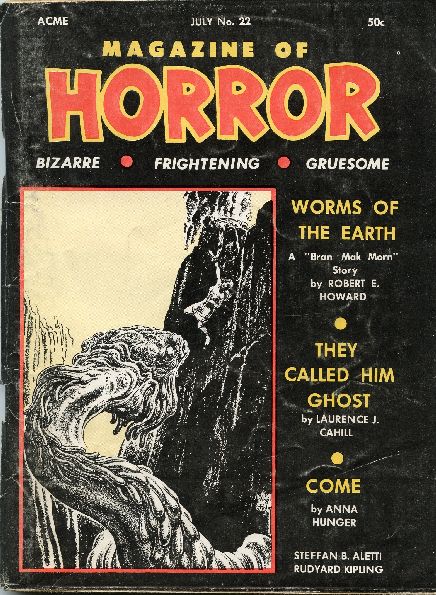
(Cover by Virgil Finlay. Magazine of Horror, July 1968.)
Who Goes There?
It’s not every day you get to talk about a Nobel winner for your genre fiction review blog, but here we are. Rudyard Kipling was born in 1865, right at the end of the year, to British parents in India. Kipling was one of the few real prodigies in prose writing; while it’s not too surprising he started writing poetry from a very young age (although he didn’t consider himself much of a poet), he also showed himself pretty much off the bat as a consummate writer of short stories. That he also got a job as a journalist while still a teenager goes to explain his professionalism, but also his (at least when he was young) unadorned style, such that his straightforwardness partly inspired the title of his first big story collection, Plain Tales from the Hills. He would later write The Jungle Books, Just So Stories, and other collections of stories. His 1901 novel Kim was one of the first modern espionage novels, sort of, although it’s much more than just an exotic spy thriller. To this day he’s the youngest to ever win the Nobel Prize for Literature, being just 41 at the time, an age that would be unthinkable for an author nowadays; but like I said, Kipling started early and he ended up writing a lot.
Kipling also wrote a good deal of genre fiction, pretty much of every stripe, including what we now call science fiction. Like seemingly every British writer of the late Victorian and Edwardian eras, though, he really had a soft spot for the supernatural horror story—granted that his supernatural stories weren’t always horror. But Kipling came from a generation of Britons who apparently loved telling and writing ghost stories, partly to make a bit of extra money but also for some gather-around-the-fire entertainment. “The Phantom ‘Rickshaw” was published on the eve of Kipling’s twentieth birthday; yet despite being a teenager when he wrote it, and despite a bit of roughness, it shows a very promising young writer who has already nailed down the basics to an eerie extent.
Placing Coordinates
First published in 1885, it first appeared in book form in The Phantom ‘Rickshaw and Other Tales in 1888, the same year as Plain Tales from the Hills. On top of the July 1968 issue of Magazine of Horror you can find it in H. P. Lovecraft Selects: Classic Horror Stories (ed. Stefan Dziemianowicz), The Big Book of Ghost Stories (ed. Otto Penzler), and The Body-Snatcher and Other Classic Ghost Stories (ed. Michael Kelahan). By all rights I should recommend the meaty tome Rudyard Kipling’s Tales of Horror and Fantasy, but having gotten a copy for myself, I have to say the proofreading is abysmal, to the point where there seems to be a typo every other page. Fine. You can read “The Phantom ‘Rickshaw” on Project Gutenberg.
Enhancing Image
This story technically has two narrators, the first being unnamed and presumably a fictionalized version of Kipling himself. The first narrator serves as a walking framing device, telling of the unfortunate demise of his friend Jack Pansay, who supposedly died of some wasting disease, but who according to his own written testimony (he wrote of his experiences in the last few months of his life), the cause is something quite different. Writing with “a sick man’s command of language,” the now-deceased Pansay tells us, in his own words, of the horror that befell him. A few things to say first, not the least being that even with this short opening section, which gives context to the switching of narrators, Kipling’s ear for dialogue is on-point. We only see him a few times, but the quack doctor Heatherlegh is memorable both for his quirkiness and his seeming incompetence, or rather cluelessness as to what could be ailing Pansay. Pansay himself is indicative of the kind of anti-hero Kipling was fond of writing for his early set-in-India horror yarns: the haughty Englishman who learns a harsh lesson. Some of Kipling’s characters live to put what they learned into practice, but Pansay is not one of them. (Of course, since we already know what has become of the main character, this is a rather hard story to spoil.)
A few years ago, Pansay had an affair with a married woman, one Agnes Wessington, fellow Briton traveling in India, and the two worked out well—for a while. But Pansay grew tired of her, which was not in itself unusual, as he confesses to us he tires of his partners sooner or later, the only problem being Mrs. Wessington did not feel the same way. “Ninety-nine women out of a hundred would have wearied of me as I wearied of them; seventy-five of that number would have promptly avenged themselves by active and obtrusive flirtation with other men. Mrs. Wessington was the hundredth.” Since it is surprisingly hard to ghost someone in the 1880s, Pansay struggles to get her off his back before making clear that he is no longer interested in the relationship. Mrs. Wessington doesn’t take the rejection well, although rather than plot revenge or running back to her husband, she simply… withers. Eventually she dies of a wasting disease, similarly to how Pansay goes, but it’s clear that what really killed her was a broken heart. Pansay feels a pang of remorse about this, mixed with a hateful resentment towards the poor woman, even after she has died—but he’ll learn the error of his ways soon enough. When Mrs. Wessington dies it had been a couple years since Pansay dumped her, and since then he’d moved on to another woman, Kitty Mannering. There’s no going back.
Mind you that despite being a ghost story, and despite the setup leading us to expect a certain chain of revenge, this is not a revenge narrative; rather it’s a narrative about guilt and misogyny. Pansay, in trying to rid himself of Mrs. Wessington, comes to loathe her but also pity her, these two very different emotions clashing, and so he mistreats her even as he tries to cement the bad news in her mind. “I was the offender, and I knew it. That knowledge transformed my pity into passive endurance, and, eventually, into blind hate—the same instinct, I suppose, which prompts a man to savagely stamp on the spider he has but half killed.” I was taken back by this a bit, because truth be told, as someone who considers themself a Kipling fan, issues of feminism and womanhood are not his strong suit—at least early on. He would later write some pretty memorable and well-rounded heroines in stories like “Mary Postgate” and “The Gardener,” but a childish sort of misogyny runs through some of his early fiction. Indeed woman-forsaking bachelorhood is treated as something to be aspired to (and conversely, something to be mourned when it is lost) in one of my favorite Kipling stories, “‘The Finest Stories in the World.’” Kipling, like pretty much every great writer, is someone with a few internal contradictions: he was a proud Englishman, but ended up marrying an American woman; he was a lifelong imperialist, with the belief that the British empire really had Indians’ best interests at heart, yet some of his writings come off as deeply ambivalent about government. To paraphrase George Orwell (who, like me, was a socialist and thus not a fan of Kipling’s politics), Kipling’s brand of conservatism doesn’t really exist in the US, UK, and Canada.
Of course, Kipling’s brand of misogyny is in itself sort of alien in today’s Anglosphere, in that he was not actively a woman-hater who believed women were basically property with legs; rather he believed in a softer kind of misogyny that modern-day liberals would probably find agreeable, in that he believed women and men are different on some fundamental level (a level that transphobes have a hard time defining, despite their “best” efforts), with women being fragile in some immaterial way. Granted that this is all told from Pansay’s POV, but Mrs. Wessington and Kitty are both depicted as overly emotional and temperamental, being more beholden to the id than the superego, whereas Pansay’s problem (aside from the titular ghostly ‘rickshaw that haunts him) is that he’s torn apart by having too active a conscience. Another way of looking at it is that Pansay didn’t have enough of a conscience before Mrs. Wessington’s death, but the haunting presence of her ‘rickshaw (a two-wheeled carriage, for those who forgot), with its spectral bearers (or “jhampanies” as they’re called), drives him to realize that he had indirectly killed someone who had meant him no harm. That the story is a bit overlong in getting to this point says that Kipling had not yet gotten down the flow of narrative pacing (a gift he would use with extreme prejudice in just a few years), but he’s getting there. “The Phantom ‘Rickshaw” is not a scary story, nor does it try that hard to be scary in the first place, but it’s compelling and psychologically thorny.
There Be Spoilers Here
Something I was thinking about while reading “The Phantom ‘Rickshaw” was a fallacy in first-person narrative writing that even hardened professionals make, which is that the narrator, telling a story in the past tense and thus something that has already happened, makes remarks on their story as if they were currently experiencing it, without time to think retrospectively on the events. At least here, though, Kipling averts the fallacy by having there be a time skip in Pansay’s writing; he has, after all, spent a fair amount of time writing about the thing which is now killing him. As the end looks to be nigh, Pansay comes to grips with the notion of dying, and also that he was in a way responsible for Mrs. Wessington’s death, his only concern being what will happen to him after he dies, since he is convinced that there is such a thing as a life after this one—a kind of afterlife which doesn’t look inviting, if it’s true. His final comment, and by extension the story’s final paragraph, is a haunting one, so I’ll just repeat it here: “In justice, too, pity her. For as surely as ever woman was killed by man, I killed Mrs. Wessington. And the last portion of my punishment is ever now upon me.”
A Step Farther Out
I was indulging myself a bit with this one, as an aforesaid Kipling fan, although I had not read “The Phantom ‘Rickshaw” before and there was a very real chance it would disappoint. (Truth be told, I’m not the biggest fan of Kim or the first Jungle Book.) But Kipling, even baby-faced Kipling, often delivers the goods, as he does here.
(Cover by Virgil Finlay. Famous Fantastic Mysteries, June 1948.)
Who Goes There?
We’re dealing with a reprint today, and fittingly it’s from the pages of Famous Fantastic Mysteries, which dealt mostly with reprints. We also have one of the “canonical” American authors with Jack London, who if you went through the American public education meatgrinder you very likely had to read at some point. London is a “literary” type who also wrote a good deal of adventure fiction and—though not as publicized—science fiction. Indeed London was one of the pioneering figures of American genre SF, to the point where he can be thought of as a precursor to the Gernsback revolution of the ’20s; it’s a wonder, then, why he was never reprinted in Gernsback’s Amazing Stories. He died young, in 1916 at forty years old, from a combination of drug abuse and severe (like eye-popping) alcoholism; but despite his early death he wrote at a mile a minute, such that while SF makes up only a fraction of his output, he still wrote enough of it (a few novels plus a couple dozen short stories) to fill multiple volumes.
“The Shadow and the Flash” was first published in The Bookman in 1903, the same year London put out his most famous work, the novella The Call of the Wild. London’s most famous stories, including The Call of the Wild, are mostly set in the Klondike, which London had actually ventured to as a gold prospector. Probably not incidentally these stories are also London’s least political, camouflaging his leftist streak; his most widely read (and said to be his best) SF novel is The Iron Heel, which is an explicitly socialist reaction to capitalist oligarchy. “The Shadow and the Flash” is not a political tract, but it does have a strong allegorical hue, working as a cautionary tale with regards to man’s relationship with the sciences. One could argue this in itself is a political statement, but London’s chief goal here is to entertain, which you have to admit he’s pretty good at.
Placing Coordinates
First published in 1903 and then reprinted in the June 1948 issue of Famous Fantastic Mysteries, which is on the Archive. It’s been collected in Moon-Face and Other Stories, The Scarlet Plague and Other Stories, The Science Fiction of Jack London, The Iron Heel & Other Stories, and honestly too many more to count. The most curious reprint might be Judith Merril’s first anthology, Shot in the Dark, which is comprised mostly of ’40s genre SF stories but which also contains a few pre-Gernsback items. It’s totally possible Merril became aware of the London story through its FFM appearance. Since London has been dead for a very long time his stuff is all in the public domain, so here’s the Project Gutenberg link.
Enhancing Image
The narrator begins by telling us about two of his friends, Lloyd Inwood and Paul Tichlorne, who are mutuals and somehow both very similar and total opposites, like yin and yang. “Both were high-strung, prone to excessive tension and endurance, and they lived at concert pitch.” The two were all but born to be rivals, a rivalry that goes back to the three dudes’ childhoods, and at one point they were even pining for the same girl, who sadly had to turn them both down on account of polygamy not being an option. I’m not kidding, she can’t choose between the men, claims to love both, but says that since polygamy is illegaly and polyamory is taboo, the trio must disperse. (Worth mentioning she uses the word “polyandry,” which is to say a woman taking on multiple male partners, whereas “polyamory” would not be coined until the 1990s. The more you know…) Point being Lloyd and Paul are two brilliant men, at least with regards to the sciences, who also happen to have a strong competitive streak and who hate each other’s guts. The narrator, being a comparatively average guy, is basically forced to watch as his oomfies get up to hijinks in the name of besting each other.
The rivalry culminates in a question Lloyd and Paul are set on answering: How does one achieve invisibility? The topic of invisibility seemed to hold a lot of water in London’s time, for reasons I can’t parse. Consider that over the course of the roughly 200-year history of science fiction as we recognize it, topics shift in and out of relevance—by that I mean areas of science (or more often pseudo-science) that writers gravitate toward. In the 1840s and ’50s hypnosis (or mesmerism as it was called then) was in vogue then, with Edgar Allan Poe and Nathaniel Hawthorne getting in on it, and indeed hypnosis would remain popular up to the dawn of the 20th century. Infamously there was an obnoxious influx of SF stories concerned with ESP in the ’30s through the ’50s, in no small part due to John W. Campbell’s obsession with it. (A point rarely brought up about “Who Goes There?” and something that wasn’t carried over to The Thing is that the alien is said to be able to mimic people’s personalities by way of ESP.) In the 1950s there was also the start of the UFO craze. In the 19th and early 20th centuries there seemed this fascination with invisibility—see such iconic stories as Fitz-James O’Brien’s “What Was It?,” Ambrose Bierce’s “The Damned Thing,” Algernon Blackwood’s “The Willows,” and of course Lovecraft’s “The Colour Out of Space.” Then we have this relatively obscure Jack London story, which tackles a possible scientific basis for invisibility.
The rivalling scientists complement each other more than either could anticipate, including down to how each tries to attain invisibility. Lloyd, for his part, aims for perfect blackness—an object so black that the human eye struggles to perceive it. This wouldn’t be a Jack London story without at least a bit of racism, so we’re met with a cringe-worthy scene where Lloyd takes the narrator to a boxing match and remarks that a black man, when in the shadows of the edges of the interior, seems practically invisible. So, a formula that would create perfect blackness so as to be imperceptible, although that does leave one problem Lloyd is unable to fix: the object’s shadow. Nothing he can do about that it seems, so it’s not “perfect” invisibility. Paul, on his end, tries a formula that would make an object perfectly transparent in the sense that light goes through it, and as such it would not only be invisible but cast no shadow—like a pane of glass, only more so. The problem, then, is different, in that like glass the invisible object is subject to color flashes, like a rainbow effect, such that the invisible object would give off brief flashes of color. Thus we have the title, the shadow and the flash—the imperfections in each man’s experiment. The narrator, not being a scientist, is astounded by all this, although he fears his friends may be verging on a point of no return—that these experiments could prove disastrous.
If “The Shadow and the Flash” is about anything it’s about the impossibility of attaining perfection, even if one tries bending the laws of known science. Each man’s invention is miraculous, but also flawed, without a solution that wouldn’t spawn yet another flaw. Each has what the other lacks. This follows a long tradition in science fiction of the sciences being a catalyst for man’s folly—an anti-science slant that goes back to Frankenstein and which can be often seen in the works of Michael Crichton. In this sense London’s story is very much a cautionary story; but at the same time it must be said there’s a tangible awe with how he and his scientists describe their discoveries, a thirst for knowledge that London seemed to share with his characters to some extent. Remember that London was an autodidact, a voracious reader who read up on seemingly every notable intellectual of the 19th century, for lack of a proper education; one can safely assume a strong curiosity is necessary for such a life. Like Lloyd and Paul, who are born risk-takers (we’re told of a childhood episode where the two nearly drowned themselves in one of their contests), London was an adventurer who probably didn’t imagine himself living to a fine old age. As such there’s an immediacy and ferocity in the writing that would make it read as exaggerated to a modern reader, but it would’ve fit well in a pulp magazine.
There Be Spoilers Here
The climax of this story is a bit of an odd one. The three meet up on a tennis court, wherein Lloyd and Paul are both invisible; mind you that both men are naked, and they seem to be pretty casual about this around the presumably straight narrator. (Fabric is too complex a material to make totally invisible, so it makes sense to strip and paint yourself with the experimental formula, right?) The two men get into a fight on the court (remember that this is two almost perfectly invisible men) that results, somehow, in them beating each other to death. It’s unclear how they could’ve killed each other at basically the same time or how they would’ve been able to even handle each other. There are a few logical questions that pop up throughout this story that it’s best to not think too hard about. For example we meet at one point a hunting dog Paul has made invisible and which the narrator accidentally fumbles into, except apparently the formula has made the dog perfectly silent as well as invisible, as it doesn’t make even the slightest sound until it makes direct contact with the narrator. I say this all in good fun, of course, because the science remains just plausible enough whilst providing a fast-paced and engrossing narrative. And anyway the narrator at least learns an important lesson. This whole tragedy could’ve been prevented had the boys agreed to be in an M/F/M throuple.
A Step Farther Out
Aside from a certain scene, “The Shadow and the Flash” holds up a surprising amount given its vintage. I mentioned at the beginning that it’s perplexing how London never appeared in Amazing Stories when that magazine was focused on reprints, since Hugo Gernsback was concerned with establishing a continuity with pre-pulp pioneers in the field like H. G. Wells and Edgar Allan Poe. Surely London’s contributions to SF are not to be overlooked! At the same time the fact that this story reads like proto-Gernsbackian and even proto-Campbellian goes to show how much American genre SF had changed between 1900 and 1950—or rather how much it didn’t change. It’s praise for the story but damning for the field as a whole.
(Cover by Virgil Finlay. Weird Tales, March 1953.)
Who Goes There?
When it comes to authors I’ve never read before I always feel a bit nervous when writing this section, because I have to give some context for an artist whose work I have next to no context for. This was not even gonna be my first Mary Elizabeth Counselman story, as I had planned at some point to cover her back in March as part of my Weird Tales tribute, but plans change and now I can’t even remember who I replaced her with. It’s a shame, because while she doesn’t get brought up as nearly as often as H. P. Lovecraft or even C. L. Moore, Counselman was clearly loyal to Weird Tales in its first incarnation, continuing to get published in it up to the bitter end. Doubly a shame because the first Counselman story I ended up reading, todays’ pick, is rather dull, and I don’t have much to say about it—although there are a few points of interest I’ll be sure to write about here. What the hell, I’m not getting paid to do any of this, and this work will not redeem me, nor will it probably turn me into a more understanding person.
Placing Coordinates
First published in the March 1953 issue of Weird Tales, which is on the Archive. I was surprised to find “Night Court” has been reprinted several times, most notably in Witches’ Brew: Horror and Supernatural Stories by Women (ed. Marcia Muller and Bill Pronzini) and Great American Ghost Stories (ed. Martin H. Greenberg, Frank D. McSherry, and Charles G. Waugh). It’s definitely a ghost story, but I wouldn’t call it great.
Enhancing Image
We follow Bob: Korean War veteran, 22-year-old husband-to-be, mostly upstanding citizen, and a bit of an asshole. Bob has the very bad habit of reckless driving—not road rage exactly, but an immense carelessness that, we’re told, has gotten him into big trouble a couple times already. If not for a certain family connection in the local legal system Bob would probably be seeing jail time, but thanks to a powerful uncle he just once again got no more than a slap on the wrist for running over an elderly black man (these are not the words used in-story, mind you). Unluckily for Bob, but perhaps for future potentials victims of his behavior on the road, Bob is about to take a detour against his will… into the Twilight Zone.
Jokes aside, this does read like it could be adapted (and perhaps elevated) into a classic Twilight Zone episode, although more because of its structure and moralism than the quality of the thing. Bob is a one-note character, a good-for-nothing who exists in the context of the story to be taught a lesson, but even so there are a couple things about him that struck me. For one, I’ve read a good deal of ’50s SFF at this point, and shockingly little of what I’ve read directly mentions the Korean War; indeed the only SFF author I can think of off the top of my head who’s a Korean War veteran would be Jerry Pournelle. Mind you that the cease fire would not be declared until several months after “Night Court” was published, so this was very much an ongoing conflict when Counselman wrote it. Also, making the villain protagonist of your story a military veteran pre-Vietnam is certainly a choice. Bob talks about how he’s supposedly a hero for “killing fourteen North Koreans” but is labeled a hazard for accidentally killing a couple people on the road. He may have PTSD, but this is sadly not elaborated upon.
After seemingly having run over a little girl whilst rushing to meet up with his fiancée, Bob gets pulled over by a highway patrolman—only this is not a normal man, going by appearances, his thick goggles obscuring his eyes but also giving him an almost skeletal look. “Bob squirmed under the scrutiny of eyes hidden behind the green glass; saw the lips move… and noticed, for the first time, how queerly the traffic officer held his head.” The officer’s neck is craned as if it had been broken or mangled, yet surely the officer still lives. Things only get weirder (although not that weird) when the officer, ignoring the girl under Bob’s car, takes Bob in to be judged at the night court—which is like normal court but sPoOoOoKy. We have, by this point, pretty thoroughly left the confines of everyday reality, hence the Twilight Zone comparison, although once I realized what kind of story this was I have to admit my mind sort of went on autopilot from hereon out.
I knew nothing about “Night Court” going into it other than that it would be a tale of the supernatural, entailing some kind of judgment, and these were not incorrect assumptions! Unfortunately what I got was also a PSA on how you should watch where you’re going on the road, and it’s like… I get it, this was back before we even had seat belt laws; cars were little more than metal death traps. At the same time, I’m legally blind, so I don’t have a driver’s license, let alone a car myself. You may recall in high school how you were taught about the perils of drunk driving and texting on your phone while driving, that sort of thing. As someone who is faaaaaaaar more likely to be the victim of a hit-and-run than a perpetrator, I feel qualified to say that while this is an important lesson to learn when you’re young in the real world, it does not make for compelling storytelling. We learn that the people overseeing Bob’s trial in the night court are all victims of auto accidents, including the old man he had recently killed, and I get that this makes sense—I just don’t find it that interesting or worthy of study.
In 1953 this was probably seen as more necessary to get across in writing, but after decades of TV PSAs I think we’ve moved well past the point where a story like “Night Court” feels worthy of note.
There Be Spoilers Here
I will say, though, that the twist was not one I was expecting. You would expect the girl Bob had run over to appear at the night court as his most recent victim, but actually the girl does not exist—yet. The judge says that the girl will be born years from now, and if Bob doesn’t change his ways then he will kill this girl somewhere down the line. This gets a single golf clap from me. Less interesting is that said girl is implied to be Bob’s future daughter at the very end, which I don’t think is a necessary touch. I was expecting the story to end in a more predictable but tragically ironic way, like Bob promising to better himself only to get killed in an accident by another reckless driver, but the ending we got was anti-climatic by comparison; not as predictable, true, but it also left me feeling a little empty. Maybe Counselman had become weary of conventional twist endings? I would’ve gone for something more gruesome is what I’m saying.
A Step Farther Out
Not that all ghost stories have to be scary, but when I’m reading one I expect to feel something in connection with the supernatural; not always fear, but often an uncertainty, a sense of mystery at the unexplainable. The Turn of the Screw is not what I would call scary, but it is effective and memorable as a psychological study and as an extended metaphor—a metaphor for what we’re not so sure about. For “Night Court” I felt either detached or a little annoyed at the preachiness of it, which strikes me as old-timey even for 1953. It’s not scary or eerie, certainly, but it also reads like Counselman is wagging her finger at the reader and expecting us to take an important life lesson away from it. I usually don’t like moralism in my fiction (which is funny, given I’m a big Twilight Zone fan), but I’m willing to forgive that if the message is given a humane (not to say delicate) touch—only “Night Court” is not in touch with what I would call the pains of the human condition.
(Cover by Lawrence. Famous Fantastic Mysteries, October 1946.)
Who Goes There?
When I reviewed Clark Ashton Smith’s “Genius Loci” some days ago, I said that Smith, H. P. Lovecraft, and Robert E. Howard were the defining authors during the “classic” period of Weird Tales, in the ’30s. This is not entirely true. I omitted a fourth name because I knew I was gonna get to her very soon, and now she’s getting her own introduction. C. L. Moore was one of the great practicioners of SFF in the ’30s and ’40s, and her rise to prominence was swift in a way that most authors’ are not. Her first professional sale, “Shambleau,” was published in Weird Tales in 1933, and it instantly made her a big deal to that magazine’s readership. During this early period, Moore created two series, both set in the same continuity (though this was not immediately known), named after their protagonists: Northwest Smith and Jirel of Joiry. The former leans toward planetary romance while the latter leans toward heroic fantasy, and this duality was a line Moore would walk for the rest of her career.
Things get complicated when Moore marries a fellow author, Henry Kuttner, in 1940, after the two had already collaborated on a story or two. Kuttner was a few years younger than Moore, and was a big fan of her work, soon exhanging letters with her and assuming (erroneously) at first that she was a man. Once misunderstandings were out of the way, they formed inarguably the biggest power couple in old-timey SFF, collaborating prolifically throughout the ’40s and writing together so seamlessly that they could not tell apart each other’s writing, and neither can anyone else. To this day there’s no agreement as to who wrote what or how much one contributed to the other’s writing, even when a story is credited to only one of them. “Daemon” is credited to Moore solo, and for reasons I’ll get into I believe firmly enough that Kuttner had basically nothing to do with its creation.
Placing Coordinates
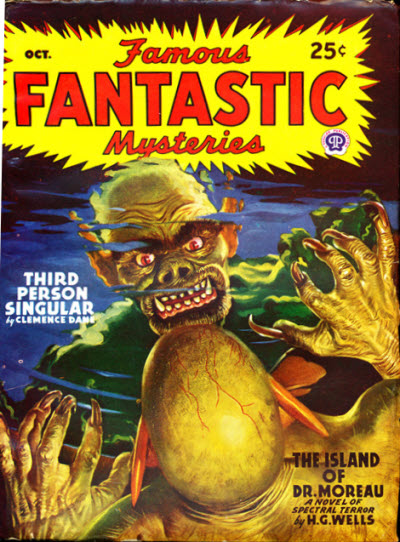
First printed in the October 1946 issue of Famous Fantastic Mysteries, which is on the Archive. FFM was primarily a reprint magazine without zeroing in on a specific genre, covering science fiction, fantasy, and even non-supernatural horror. In the October 1946 issue alone we have reprinted stories by H. G. Wells (a presumably abridged version of The Island of Dr. Moreau) and Bram Stoker, but “Daemon” was an original story. One need not look far to see why Moore would submit her fantasy-horror story to a reprint magazine: the magazine market for fantasy was quite small in the ’40s, with the only other notable outlet being a now past-its-prime Weird Tales. Now, why, when reading these stories for review, do I always try to read the original magazine version? Partly this is because sometimes there are revisions made between the magazine publication and the book publication, but also, there’s flavor when reading anything within the confines of a magazine issue. Take, for instance, Virgil Finlay’s interior illustration for “Daemon,” which as usual is stunning, and which we would not have gotten in a book reprint.
When it comes to reprints of “Daemon” we’re talking quality over quantity; none of the reprints seem to be, well, in print, but these volumes are both good collector’s items and easy enough to find. First we have The Best of C. L. Moore, part of a best-of series by Ballantine Books (Henry Kuttner also got one), and boy do I wanna get these two together. Then we have A Treasury of Modern Fantasy, edited by Terry Carr and Martin H. Greenberg, which might be the same book as Masters of Fantasy; it’s edited by the same people, and unless I’m missing something the contents are also the same. If you’re fond of Moore and Kuttner, at some point you have to get your hands on Two-Handed Engine: The Selected Stories of Henry Kuttner and C. L. Moore, a mammoth tome that collects all the essential short fiction by both authors, solo as well as in collaboration.
Enhancing Image
“Daemon” is a deathbed confession (not a spoiler, our narrator is upfront about this) told by Luiz o Bobo, his title apparently coming from his simplemindedness. Luiz, despite his own admitted lack of intelligence, has a special gift that may well be more of a curse: he sees these things that accompany other people, calling them daemons when they could just as easily be called ghosts. According to Luiz, everyone has a daemon on his shoulder—everyone except him. At the outset of the story we’re far more planted on the horror end of the horror-fantasy spectrum which “Daemon” plays with, and there’s some delicious eeriness at work here. “Do you know who stands beside you, padre, listening while I talk?” says Luiz at one point. The daemons themselves don’t seem to do anything exactly; they don’t have voices, they don’t talk, they can’t interact with the material world—at least not directly. As we’re to find out later, though, it’s maybe possible for a daemon to take possession of its host.
Luiz recalls the death of his grandmother, for a long time the only earthly person who treated with decency, and how her daemon changed as she was dying; it was an unusual event, as the daemon grew brighter, radiating a brightness that threatened to blind Luiz, before finally disappearing once his grandmother’s spirit has moved to—somewhere else. What this could signify, the daemon changing colors as its host nears the end of their life, we’re not given a clear answer on, but then Luiz is no rocket scientist. Actually, let me take a moment to talk about Luiz’s characterization, because this is easily the most interesting part of the story for me: Luiz is obviously neurodivergent. While “Daemon” is on its face a dark fantasy yarn about a man who gets shanghaied and then stranded on an island with a bunch of magical creatures, it’s more potently a tale of alienation, about a man who is unable to relate to other people in the conventional sense, who quite literally sees something “normal” people have that he lacks. Make sure to put a pin in this one.
Oh right, getting shanghaied. Luiz has a bad night at a saloon and finds himself an unwilling passenger on a trading vessel. As you do. The fact that Luiz is not very smart, and can’t even read, makes him an easy target. It’s here that we come across the closest the story has to a villain: the captain of the ship. The captain, who normally would not be the happiest or kindest of men, seems to have his violent urges heightened by a suitably evil-looking daemon which follows him around. The causal relationship between host and daemon is not clear, but it’s quite possible that a daemon’s disposition influences its host, with the captain’s daemon being a particularly nasty example. The captain’s daemon’s uncanniness is not helped by the fact that not only is it blood-red, it doesn’t seem to have eyes.
Now, most men have shapes that walk behind them, padre. Perhaps you know that, too. Some of them are dark, like the shapes I saw in the saloon. Some of them are bright, like that which followed my grandmother. Some of them are colored, pale colors like ashes or rainbows. But this man had a scarlet daemon. And it was a scarlet beside which blood itself is ashen. The color blinded me. And yet it drew me, too. I could not take my eyes away, nor could I look at it long without pain. I never saw a color more beautiful, nor more frightening. It made my heart shrink within me, and quiver like a dog that fears the whip. If I have a soul, perhaps it was my soul that quivered. And I feared the beauty of the color as much as I feared the terror it awoke in me. It is not good to see beauty in that which is evil.
Luiz does find one ally on the ship, called the Shaughnessy (we don’t get his actual name), a dying man from “a foreign land called Ireland” who apparently also comes from a very well-to-do family, and who stands as the only thing between Luiz and oblivion. The captain hates his guts and there will come a point when the Shaugnessy will not be around to protect him. This early-middle section of the narrative, with Luiz on the ship, is probably my favorite part; it’s atmospheric, exceptionally brutal, it’s set on the high seas (which I have a fondness for), and it elaborates on the disconnect Luiz feels with other people. It’s not so much that Luiz befriends the Shaughnessy as he sees the Shaughnessy as a guardian figure, since the most Luiz can hope for, realistically, is not be treated like garbage by others. This is not to say Luiz is a blank slate or a totally passive protagonist; nay, he’s quite active, even if he doesn’t articulate his internal anxieties vocally.
It’s here that Moore does something seemingly clever and really plants the seeds of doubt for us, as to whether Luiz is right or if he’s just delirious. The ship’s water gets tainted, which is pretty bad. “A man can pick the maggots out of his salt pork if he must, but bad water is a thing he cannot mend.” Not helping things is that a particularly brutal encounter with the captain results in Luiz getting what is probably a skull fracture (saying he heard his skull crack, which sounds horrific), and it’s amazing he doesn’t simply die on the ship. Hell, dying at this point might not be so bad. Luiz contemplates suicide, which in his predominantly Catholic homeland of Brazil would be deemed a mortal sin, but Luiz rationalizes that he can’t go to Hell if he doesn’t have a soul, but virtue of not having a daemon. Checkmate, Christians! But no, he does not kill himself, and it’s about here that things get very weird indeed.
Before we get to the spoilers section, I wanna return to something I said earlier, which is that “Daemon” is pretty discernibly a solo Moore effort and not a collaboration. Not that I want to downplay Kuttner’s talent (which happens too often, such as on ISFDB where works under just Kuttner’s name are far more likely to be listed as collaborations than with Moore), but I can’t find any Kuttner-esque elements here. More tellingly, this has the tone and polish of a Moore tale, in the sense that it’s deeply melancholy, even humorless, yet there is a real humanity to Luiz’s character that makes him relatable. I’m not sure why, but Moore tends to sympathize with the underdog, not in a self-congratulatory way, but in a genuinely empathetic way, where she manages to convey a character’s fears and aspirations. Kuttner was an excellent humorist, but Moore was almost like a poet, and “Daemon” reads in parts almost like a poem. Moore wears her emotions on her sleeves, which feels prescient given how often old-timey SFF authors are demeaned (sometimes rightly) as emotionally inept Tough Guys™.
There Be Spoilers Here
You may be thinking, what does that Virgil Finlay illustration have to do with the story? Well…
Luiz and the Shaughnessy get stranded on an island and it’s not some ordinary Robinson Crusoe island: it’s a magical island. The Shaughnessy kicks the bucket, but not before giving Luiz some instruction that he doesn’t do a good job explaining. That’s fine, since, probably unbeknownst to the Shaughnessy, Luiz is not left all lonesome after the fact; he quickly finds some friends. Luiz had aludded to nymphs, or as he called them, “ninfas” (I’m not joking when I say I had first misread it as ninjas), at the start of his confession, but now we’re actually getting to those. Finlay’s illustration shows one of these nymphs, called the orlead (who actually talks with Luiz), and a unicorn. Yeah, there’s a unicorn. This place fucking RULES. Admittedly, I don’t buy into the Eden-like nature of the island, as this pure place where there’s no pain (the Shaughnessy is pretty chill about dying), as it feels too idyllic, not to mention it casts doubt on Luiz’s story despite the fact that he’s telling the truth.
But soon there’s trouble in paradise, and the captain has landed in search of his castaways, most likely to do away with them. With the Shaughnessy already dead he need only worry about one now, but Luiz has the fantasy creatures of the island on his side. Okay, I should be a bit more specific here: these are, at least in part, Greek mythological creatures, hence the appearance of the humanoid goat-footed god Pan who comes in as a sort of deus ex machina. I have to admit the image of Pan chasing the captain (who can now see him, apparently) literally around the island until the captain, thoroughly exhausted, runs back to the place he started at, is funnier than it’s supposed to be. It’s weird, sure, and it’s not boring, but it’s a touch goofy.
I said before that a person’s daemon grows brighters as that person’s death nears, and while I’m not a fan of the turn towards action in the climax, I have to respect just how creepy the captain’s final moments are. We’re not totally sure what happens, because Luiz averts his eyes, but it’s clear that the captain, in the last moments of his life, becomes aware of the red-hot daemon that had been stalking him the whole time, and the way Moore writes his death is the closest the story comes to being genuinely scary, as opposed to just eerie.
Some knowledge deeper than any wisdom warned me to cover my eyes. For I saw its lids flicker, and I knew it would not be good to watch when that terrible gaze looked out at last upon a world it had never seen except through the captain’s eyes.
I fell to my knees and covered my face. And the captain, seeing that, must have known at long last what it was I saw behind him. I think now that in the hour of a man’s death, he knows. I think in that last moment he knows, and turns, and for the first time and the last, looks his daemon in the face.
I did not see him do it. I did not see anything. But I heard a great, resonant cry, like the mighty music that beats through paradise, a cry full of triumph and thanksgiving, and joy at the end of a long, long, weary road. There was mirth in it, and beauty, and all the evil the mind can compass.
After a detour into fantasy we’ve swung back around into horror, almost of the cosmic variety. There are things people are not supposed to see—like their own daemons. Weirdly, I find this aspect to be the least involving, as the scope of the story has by now thoroughly gone beyond Luiz’s psychology and grappled onto something that’s quite “spooky” by not very scary. For me “Daemon” works better as a horror-tinged character study than a straight horror yarn, and likewise I don’t find the stuff with Pan and the nymphs to be totally convincing, although Moore’s lyrical hand stays steady, and I have to admit there’s a bit of a sense of wonder with the island and its fantastical secrets. This isn’t pulp horror but rather something in the Unknown tradiction, and hell, “Daemon” could’ve been published there had it not gone bust in 1943. My point is that Moore can sure as hell write, even when she does something that conceptually I don’t think is the most interesting thing ever.
A Step Farther Out
After I finished “Daemon” I did something I’ve not done before for these reviews, and it’s really something I ought to do again: I looked up readers’ reactions. Not modern reviews of the story (I haven’t even checked if there are any), but FFM‘s letter column, which, as it turns out, was fairly active. Not on the same level as Planet Stories, mind you, but still, we’ve got some yays and nays from the peanut gallery! As far as I can tell reception to “Daemon” was pretty damn positive, although there is one comment that I found interesting, made by some bloke named R. I. Martini, in the February 1947 issue:
Miss Moore’s name is all too seldom in your table of contents, but when listed she inevitably brings forth a new and unique situation. “Daemon,” in that respect, held to standard, though somehow it didn’t have the scope or pimch anticipated. It was when she came to the “ninfas” that disillusionment as to its cIassic qualifications set in. Albeit the atmosphere was there, so saving whatever was left of the day.
I really loved the first half or so, when Luiz is on the ship, whereas I merely liked the second half, when he’s on the island. I think I get where Martini is coming from, because I can’t help but feel like something is lost once the nymphs come into play, and it’s basically spelled out that what happened to Luiz had to be fantastical and not a big hallucination as the result of, say, the brain damage he had undoubtedly suffered. Which is not to say my earlier evaluation of Luiz was rendered invalid by the second half, because I think his character still very much works on an allegorical level; I just wish the literal level was a bit more satisfying. Moore is still a strong writer on a sentence-by-sentence level, her penmanship bordering on the poetic—indeed I wouldn’t be surprised if her lyricism influenced George R. R. Martin’s early work. “Daemon” doesn’t feel like it comes from the ’40s, but rather feels a bit more timeless than that, like Moore is tapping into a study of human loneliness that remains relevant, and for that I admire it.



 Science Fiction & Fantasy Remembrance