Who Goes There?
I only first read Lois McMaster Bujold about a year ago, with the novella “The Mountains of Mourning,” a work that impressed me but didn’t bring me to dive deep into Bujold’s oeuvre so quickly. A lot of this has to do with Bujold’s work largely being connected to some series, or in the case of today’s novel the vast and not-so-chronological Vorkosigan universe. It would take too long to explain the backstory for this series, and anyway I haven’t read enough of it yet to be intimately familiar. Generally speaking it’s a space opera series which in parts follows members of the notorious Vorkosigan family, namely Cordelia and her son Miles. This series has won Bujold five out of her six Hugos (she is tied with Robert Heinlein for most Hugo wins for Best Novel, although Heinlein leads if we count Retro Hugos), and Falling Free, while not as renowned as some other entries, still won the Nebula for Best Novel. I’m enjoying it so far but I have to say this kind of novel winning the Nebula is a bit of an odd choice.
The premise is eye-catching right away, though, and I can already see how it would’ve gotten inducted into the Prometheus Hall of Fame, it being chiefly concerned with the rights of a race of genetically engineered humans. The quaddies, so called, are normal humans in most ways except they’ve been engineered to have four arms and no legs (or rather arms for legs), so as to make them more nimble in zero gravity; in fact they’re so monkey-like in their “natural habitat” that they’re sometimes called “chimps.” Yes, a company breeding a race of people for the sake of specialized labor sounds like a moral black hole, but that’s only the start of it!
Placing Coordinates
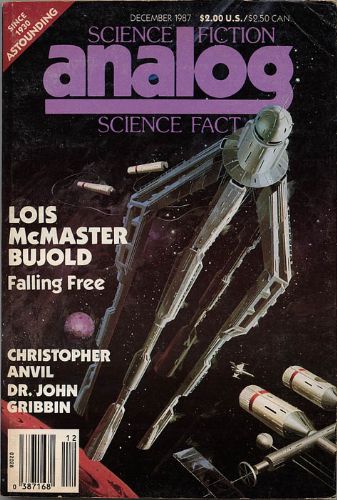
The first installment is in the December 1987 issue of Analog Science Fiction, which is NOT on the Archive but which can be found on Luminist. It’s still in print from Baen, both on its own and as part of the omnibus Miles, Mutants, and Microbes, which includes the novella “Labyrinth” and the later novel Diplomatic Immunity. Falling Free takes place a good deal before Miles’s birth but does apparently set up the backstory for “Labyrinth,” in which Miles meets the quaddies.
Enhancing Image
Leo Graf is a veteran engineer and inspector who has come to the Cay Habitat (named after its founder), a facility near the planet Rodeo, “the armpit of the universe,” on what amounts to a teaching assignment. Up to now the details had been kept foggy; Leo knows about “the Cay Project” but not what it entails. Dr. Cay himself had died a year ago, and in his place stands Bruce Van Atta, one of Leo’s former students, although it takes time for Leo to remember where they could have met before. What he manages to remember of Van Atta does not fill him with enthusiasm. “Was this sleek go-getter the same idiot he had kicked impatiently upstairs to Administration just to get him out from underfoot on the Morita Station project—ten, twelve years ago now?” And now this yuppie of the future is Leo’s supervisor for the Cay Project. What could go wrong here?
The question, though, remains as to whom Leo will be teaching while on the Habitat—a question that gets answered more suddenly and frightfully than Our Hero™ could’ve anticipated. We soon meet one of the young engineers on the Habitat, Tony, who is smart, spritely, willing to learn, about what you would hope for out of someone both young (only twenty years old) and talented. There is one problem: Tony doesn’t have any legs. Rather, he has an extra pair of arms where his legs would be, which nearly sends Leo into abject panic. Apparently nobody had told him in advance about the quaddies, the unusual denizens of the Habitat, and the people he is supposed to teach about welding in zero gravity. Leo thinks this condition is some kind of deformity, but Van Atta informs him that no, the quaddies (so they’re called) are supposed to be like this; they were genetically engineered by GalacTech, Leo’s company as well as the ones behind the Cay Project, in secret. This new race of people, who were at first created in test tubes but who have now taken to breeding naturally, “self-replicating” as Van Atta puts it, are designed to live and work in deep space.
Indeed Tony, who mind you is barely out of his teens and still one of the oldest of the quaddies, is already a father, raising his infant son Andy with his girlfriend Claire. All three are company property. The quaddies, strictly speaking, are not people, but assets of GalacTech; theoretically the company could have them killed without legal qualms if not for the fact that doing so would be blowing a lot of money. Leo’s viscerally troubled by the physiology of the quaddies but soon he becomes far more troubled by the fact that his own company has invented a new form of slave labor. Actually it’s a wonder that he’s not more disgusted by what’s going on, but then his job also depends on him keeping a cool head—or trying to. Things get thornier when we meet Dr. Sondra Yei, who has been working closely with the quaddies and conditioning them to not indulge in certain lines of thinking. At face value Yei is here to help prepare the quaddies for a life permanently cut off from 99% of humanity, but, although her intent doesn’t seem to be malicious, she seems to be here to reinforce a slave mentality.
Bujold doesn’t strike me as an ironist, but there’s a vicious bit of irony about Leo teaching the quaddies about safety procedures about shady company practices when they are literally the products of exploitation. How do you inform an audience about exploitation when said audience is slave labor and not even considered human by their creators? This sounds like a huge red flag, or rather a sign that maybe Leo should high-tail it out of there, but the conflict here is that yes, the situation is abhorrent, but Leo is also a devoted engineer who has been granted the opportunity to instruct a generation of people who were literally born and raised to be engineers. “The degree of censorship imposed upon the quaddies implied by Yei’s brief description made his skin crawl—and yet, the idea of a text that devoted whole sections to great engineering works made him want to stand up and cheer.” I know a few engineers and they’re all goddamn freaks; they see instruction manuals as a form of entertainment. Incidentally, despite the extreme dubiousness of the Cay Project, a love engineering still shines through, both in Leo’s thoughts and Bujold’s third-person narration. I mean if you put aside the slavery thing it’s really a technical marvel.
Leo being the protagonist is a logical choice since he’s the outsider in the narrative, a newcomer to the Habitat who at first doesn’t exactly side with either the people running the show or the quaddies, although it doesn’t take him long to sympathize far more with the latter. It helps that the quaddies are so innocent, despite the oldest of them already starting families and knowing a thing or two about sex and all that. Silver, a mutual friend of Tony and Claire’s, might be the most interesting of the ones we meet in how there is much more than meets the eye with her, but we’ll get to her more in the spoilers section. The characters—at least the ones we’re introduced to in this first installment—are largely at least understandable (you can understand someone’s motivations while still disagreeing with them), with only Van Atta being basically irredeemable. Of course Van Atta is a stand-in for the moral vacuum that is GalacTech. Actually I’m surprised a novel this ambivalent about corporate leeway was printed in Analog, but then again Bujold is a Baen regular despite apparently being liberal.
Right, so I should probably bring up why this novel blipped on my radar in the first place. True, I’d been meaning to get into Bujold, and a Nebula win is nothing to sneeze at, but I find it amusing that the people over at the Libertarian Futurist Society said, “Yes, this novel about the exploitation of a race of genetically engineered humans is the kind of shit we’re looking for in our mostly right-libertarian fiction.” I mean they have sometimes picked works by liberals and left-libertarians, but Falling Free doesn’t immediately stick out like, say, The Dispossessed, which is overtly a left-libertarian narrative. It’s less that Bujold is clearly arguing for the rights of man, whether that man has two arms or four (which I suspect is why it got picked anyway), and more the dimness with which she frames the creation of the quaddies. Van Atta may well be a Heinlein-esque figure in a different context, but here we see him as power-hungry and uncaring. If the story’s intend is to make us uncomfortable and even complicit in the mistreatment of the quaddies, but so far I think it’s a job well done.
There Be Spoilers Here
One problem with keeping a group of people in perfect isolation is that it’s impossible to do such a thing if there are outside forces; the other problem is that human nature is always at play, even if the humans came from test tubes. Tony and Claire wanna stay together, naturally, both because they love each other and for the sake of their son. The higher-ups don’t see it that way. In one has to be the most upsetting scene in the first installment, Dr. Yei informs the couple that they will soon be separated—not because they’ve done anything wrong but as some kind of “reward.” Claire’s done such a good job as a mother that she’s been granted permission for a second pregnancy ahead of schedule—with someone other than Tony as the father. “There is a Project-wide push to increase productivity. In all areas,” so Dr. Yei says. As for Tony, he will be shipped off and paired with a different quaddie woman for breeding. Dr. Yei justifies this monstrous procedure with the “Well it wasn’t my idea” justification; after all it was Dr. Cay’s idea and Dr. Cay is now dead, so who’s to blame really?
Meanwhile Silver has been getting intimate with normal humans on the sly—implicitly with Van Atta (or, more accurately, it’s implied she tolerates Van Atta’s behavior) and explicitly with Ti Gulik, one of the shuttle pilots who flies between the Habitat and Rodeo. There’s a great scene where Ti gives Silver a few books and a blouse as gifts, but Silver can’t accept the blouse since it would undoubtedly set off alarms that someone from outside the Habitat has been courting her. Sex between normal humans and quaddies is forbidden, or at least that’s an unspoken rule. Something that only just now occurred to me is that Van Atta clearly sees the quaddies as subhuman, even calling them “chimps” as times, but that doesn’t stop him from having an illicit affair with one—like a slave driver back in the old South. This comes back to bite him in a curious way at the end of the first installment. You see, the boss is coming in for a dog-and-pony show and three of the company’s prized assets have gone missing.
Knowing they’re to be forcefully separated, Tony and Claire take Andy with them as they hop on one of the shuttles (Ti’s shuttle, as it turns out) heading out as stowaways, they think heading for an orbiting station but which, due to a mix-up, is heading “Downside”—to Rodeo. The gravity nearly kills them but they manage to survive the trip, except now their problems are only just beginning. We get the deeply uneasy feeling that someone will get killed from all this. Bujold knows how to end an installment, with tensions having reached a fever pitch in all the plot threads; more impressively, I’m genuinely unsure as to where the novel will go from here. Granted, it could also be because I’ve been high-strung as of late, but I’ve found this to be an unusually tense and bleak novel for what is ostensibly hard SF.
A Step Farther Out
Falling Free was Bujold’s fourth novel, written during what must’ve been a white heat as it was her fourth novel in three years. True enough, she’s not trying to reinvent the English language here; this is not a novel you would read as a bit of prose poetry. The Nebula is often stereotyped as the award given to more “artsy” works, being a writer’s award, but there are a lot of populist novels that prove the exception (if there ever was a rule) and Falling Free is one of those accessible Nebula winners. Doesn’t matter, because unless Bujold fumbles the ball later on, I’m sold. I’ve been thinking about this novel for the past couple days and I’ll still be thinking about it when I read the next installment in a couple more.
See you next time.
 Science Fiction & Fantasy Remembrance