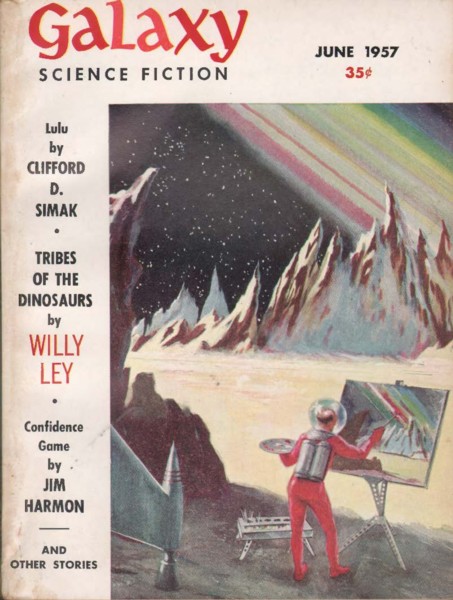
I don’t think I’ve read anything by Alan E. Nourse prior to today’s story, which isn’t surprising since his work seems to have fallen massively out of print, to the point where a decent portion of it has also fallen out of copyright. Nourse was one of many SF writers who came about in the early ’50s, some very young people (well, mostly men) who took advantage of the ballooning magazine market. It also helped that for some reason there were a lot of very talented writers, including Philip K. Dick, Robert Sheckley, and Algis Budrys, who were too young to have seen action in World War II but who had entered the field at almost the exact same time. By far the most productive period for Nourse was in the ’50s; once the balloon popped he mostly stopped writing SF, presumably to focus on his respectable day job as a physician. “Prime Difference” is very Galaxy and very 1950s, for both good and ill; it’s not exactly a forgotten gem, although it apparently warranted enough attention to get an X Minus One adaptation. It is on the one hand a deeply of-its-time story when it comes to its gender politics, but also those same gender politics are the point of the whole thing, rather than merely a byproduct of when Nourse wrote it.
Placing Coordinates
First published in the June 1957 issue of Galaxy Science Fiction. It remained stuck there for six decades before someone transcribed it for Project Gutenberg. I guess the copyright ran out.
Enhancing Image
George and Marge’s marriage is on the skids, but then it’s been that way for almost eight years now. It’s painfully obvious, at least to George, that it would be best for the best of them if they got a divorce, “but with the Family Solidarity Amendment of 1968, and all the divorce taxes we have these days since the women got their teeth into politics, to say nothing of the Aggrieved Spouse Compensation Act,” it wouldn’t be financially a good idea. I knew, from the first goddamn sentence, that this was gonna be one of those stories. Reading ’50s SF, there are some things you have to keep in mind if you wanna adapt to the somewhat different literary environment. Misogyny is rampant, although not the same sort of misogyny one would find in New Wave SF a decade later, which was more sexually explicit and in some ways somehow more revolting (to my sensibilities, anyway) than what you’d find in the average ’50s SF story. Marriage sucks, right? If you’re a white middle-class fellow in 1957 then marriage might be your top concern, along with tax season. It was the age of John Cheever, John Updike, and John O’Hara. A lot of Johns. It was the age we started to get the signature Ingmar Bergman drama. Marriage between dreary heterosexuals was the order of the day. What’s strange about the future as depicted in “Prime Difference” is not only that it’s completely the opposite of how gender relations in the ’60s would turn out, but also that it would perceptive in a totally different and unexpected way. See, George says that “the women” getting into politics made it harder for divorce proceedings, which… if anything is the opposite of what women in politics would want. Unless they’re conservative women. Of course this was before the birth control pill and second-wave feminism, and apparently Nourse did not suspect such a thing was gonna happen in just a few years; but at the same time he posited that white conservative women with money would pose a bigger problem than “the feminists.” This is a pretty thorny story, because George is a thorny and rather unlikable character, but it also argues in favor of no-fault divorce.
Then there are the Primes, which are lifelike robots, basically perfect replicas of their human counterparts—and illegal. It makes sense that robots that can pose as normal humans would be outlawed, given the possible repercussions, although how technicians in the black market are able to afford the resources, let alone build these things, is left up in the air. George is desperate to take a siesta from his wife and he finally gets to the point where he orders a Prime—specifically a Super Deluxe model, which is I guess more lifelike than the standard. Looking at George Prime, George can’t even tell the two of them apart. “The only physical difference apparent even to an expert was the tiny finger-depression buried in the hair above his ear. A little pressure there would stop George Prime dead in his tracks.” Put a pin in that. Now, I must confess that I found a stretch of “Prime Difference” to be a bit of a chore, in no small part because of how Nourse decided to tell it. George is the protagonist by virtue of being the perspectice character, “Prime Difference” being written in the first person. The problem is that George is a gaping asshole. He is! And not in an endearing or even often an entertaining way. This may well be the point (it probably is), but then why force us to tumble around inside this man’s head? It would’ve been more bearable, and its ending (which I do like) would’ve had more impact, had Nourse written “Prime Difference” in the third person. We also would’ve been able to understand Marge more, who as of now is given minimal personality. The idea is that George Prime will at times serve in the real George’s place for when the latter wants to go around fucking other women take a break from Marge, and Marge will not know the difference. The “problem” is that George Prime is so good at being the real thing that he’s actually superior to the real George in every way. You’ve seen this sort of plot trajectory with stories about androids before.
There Be Spoilers Here
That George Prime has been loving up on Marge, to the real George’s growing concern, is unsurprising; what’s more surprising is that Marge has had her own plan this whole time, albeit off the page. The ending implies that in a sense George and Marge were made for each other, in that they’re both conniving neurotics, but we only see one side of the story. “That Marge always had been a sly one,” George thinks once he realizes what she’s done, having run off with George Prime and replaced herself with Marge Prime, but we never get to see how that even could’ve happened. Of course George is only able to tell it’s a Prime by feeling for the little dent on Marge Prime’s head; that he figures it out pretty much immediately is a consolation. This is one of two possible endings I had anticipated, the other being that Marge finds out about the Prime and proceeds to kick George out of the house. But this way, everyone more or less gets what they want. Their marriage is “saved.” Mind you that Nourse was married for a few years at this point, although being in what I have to assume is a happy marriage doesn’t stop one from being a pessimist about the institution.
A Step Farther Out
Would I recommend it? Not really. It’s a frustrating read, even when compared to other stories about robotics from the period. Nourse wrote so much during the ’50s, though, that it’s quite possible that I caught him on an off day, or that readers thought well of “Prime Difference” at the time but time has not been kind to it.
A recurring thing that I totally did not intend with the author selected for this marathon thus far is that these people lived a long time. Fritz Leiber died at 81, Kurt Vonnegut died at 84, Katherine MacLean died at 94, and so on. About as impressive as MacLean’s longevity, and in some ways even more so, is that of L. Sprague de Camp, who was born in 1907 and died in 2000, being more or less active from 1937 until his death. De Camp technically entered the field before John W. Campbell took over Astounding, but he quickly became one of Campbell’s court jesters, his early fiction often being comedic in tone. He was a forerunner to what we now call hard SF, with a keen eye for historical and scientific accuracy (his first solo novel, Lest Darkness Fall, was a major inspiration for alternate history writers to come), or at least as he saw those things. Unlike most of the rest of Campbell’s stable in the late ’30s through the ’40s, de Camp was just as comfortable if not more so writing fantasy, which made him, along with (God help us) stablemate L. Ron Hubbard, an ideal fit for the short-lived fantasy magazine Unknown. Like a chameleon, de Camp would change his colors as the market demanded it, such that he was able to still thrive as the field changed radically in the ’50s. “A Gun for Dinosaur” is, on the one hand, an adventure story that harks back to the writings of H. Rider Haggard, but it’s also a grim cautionary tale that probably would not have seen print in Astounding. This is a rare case where I had heard the X Minus One adaptation long before reading the source material, which gave the impression, going in, that this would be a more straightforward story than it is.
Placing Coordinates
First published in the March 1956 issue of Galaxy Science Fiction. It’s been reprinted in The World That Couldn’t Be and 8 Other Novelets from Galaxy (ed. H. L. Gold), Dawn of Time: Prehistory Through Science Fiction (ed. Martin H. Greenberg, Joseph Olander, and Robert Silverberg), Dinosaurs! (ed. Jack Dann and Gardner Dozois), Timescapes: Stories of Time Travel (ed. Peter Haining), The Best Time Travel Stories of the 20th Century (ed. Martin H. Greenberg and Harry Turtledove), The World Turned Upside Down (ed. Jim Baen, David Drake, and Eric Flint), and the de Camp collections Rivers of Time and The Best of L. Sprague de Camp.
Enhancing Image
As you can guess, “A Gun for Dinosaur” is about using a time machine to hunt dinosaurs, since the big game of our current world has been all but exhausted and rich white dudes with guns have gotten bored with shooting lions, elephants, and black people for sport. The story takes place in presumably what would’ve then been the present day, but our narrator, Reginald Rivers, is a man who seems to be stuck outside of his time and place, having more in common with Allan Quatermain than a modern-day Englishman (for he is very English), being quite burly even in his middle age. De Camp tells the story in technically the second person, since Rivers is talking to one Mr. Seligman, whom we never hear a word from because Seligman is in the place of the reader, the result being that Rivers is narrating to us as if we were a character in the story. We know upfront that Rivers survives the adventure he’s about to tell us about, which even in the 1950s would’ve been thought of as an old-fashioned narrative technique; but it serves a purpose. The tension comes from the fact that while we know Rivers made it out alive, the same does not go for everyone who was around Rivers at the time, hence his telling this story to Seligman so as to why he refuses to take him on a trip hunting big dinosaurs. We’re introduced thus to two men who went on this trip, Courtney James and August Holtzinger, and given Rivers’s tone we can gather that something bad happened with these men, although we’re not told exactly what. We also have the Raja, an Indian hunter who functions as Rivers’s partner and fellow guide. So we have four characters who really matter, and we have our premise.
Since “A Gun for Dinosaur” is not an obscure story I decided to look up what other people have said about it after reading it for myself, and was a bit dismayed to find James Wallace Harris had already done a pretty thorough review of it, even bringing up a few points that I was going to as well. Turns out I’m not unique at all in thinking de Camp had probably written this story in response to Ray Bradbury’s even more famous “A Sound of Thunder,” which had been published a few years earlier. Both stories involve hunting dinosaurs for sport and how this might leads to issues with time travel, not to mention extreme risk for the hunter. For those of you who forgot, “A Sound of Thunder” (oh yeah, spoilers) is about a dumbass with money who goes back in time to hunt a T. rex, although he’s supposed to stay on a set path lest he causes the butterfly effect to kick in. Naturally he goes off the path and kills a butterfly, which somehow has a domino effect on what would be the present day. I’ve always found this to be implausible, since I could never for the life of me make sense of how this one innocuous event could have changed the future so radically; but then you could argue that’s the whole point of the butterfly effect: unintended consequences. I think it’s lazy writing on Bradbury’s part, though, since it feels like he’s asking the reader to do the author’s job for him. De Camp seemed to think the same thing, since he really goes out of his way to explain the mechanics of time travel in “A Gun for Dinosaur.” No butterfly effect here. The rules of the time safari (yes, one story that clearly took notes from de Camp’s is David Drake’s “Time Safari,” which I reviewed a hot minute ago) are pretty clear. The real question, then, is left up to human error.
James and Holtzinger suffer from cases of hubris, but in different ways. Neither of them is an experienced hunter, but whereas James in it for the sake of thrill-saking, Holtzinger did it because he’s a pretty average guy who wants to do something truly risky for once in his life. I feel like there are better ways of averting existential dread that going off hunting dinosaurs, but you do you. But basically Holtzinger means well. James, not so much. Not only is James even more incompetent with handling weaponry and hunting gear than Holtzinger, but he also seems to have a screw loose. (I’ve read enough “time travel dinosaur-hunting” stories to figure that one surefire trope is the affluent white man who has some undiagnosed mental illness.) Rivers, in telling this story to us, goes into quite a bit of detail about what it takes to go on one of these trips, especially the physical brunt of it—that being the main reason why women are not allowed. So yeah, both the story and the private company that hosts these safaris are sausage fests. James tries bribing his way into taking his mistress along for the ride, but Rivers wisely refuses; this ended up being good for both Rivers and the mistress, who very likely would not have survived. As you can see, there’s a bit of racism and sexism on display, although there’s some plausible deniability as to how much of it is Rivers’s and how much de Camp’s, not to mention that it does (unfortunately) make sense, given the rather heavy inspiration taken from Victorian-era adventure fiction.
You may be wondering, then, what makes “A Gun for Dinosaur” worth recommending to this day, since there are quite a few old-timey readers and authors who still swear by it. The key is at least twofold: the foreboding tone, which is established from the very beginning, and also de Camp’s attention to detail. As someone who’s been obsessed with dinosaurs since my earliest childhood, I firstly found interest in “A Gun for Dinosaur” as a snapshot of how we understood the prehistoric world some seven decades ago, long before Jurassic Park caused a profound increase in people becoming paleontologists. Paleontology was still a very niche discipline in 1956, and de Camp, while not a paleontologist himself, gave the field as much respect as he gave any of the other hard sciences, which is to say quite a bit. Granted that the science is laughably outdated, the world of the mid-Cretaceous as depicted in-story is remarkably consistent. The dinosaurs, from the big theropods (there’s a tyrannosaur, although Rivers is quick to point out it is not specifically a T. rex) to the duck-billed parasaurolophus, are thoroughly lizard-like, in both how they move and how they think. The speculation that dinosaurs, especially the theropods, were at least if not more akin to birds than reptiles was still a few decades off. Dinosaurs in this story, including the tyrannosaur, are lumbering brutes with shit for brains, who have to be shot in the heart rather than the head in order to go down. Rivers recommends using the comically large .600-caliber hunting rifle to take down the tyrannosaur, the sheer weight and kickback of the gun being a big reason why people under a certain weight and musculature are prohibited. This is, quite literally, not a game for lightweights.
There Be Spoilers Here
We know a tyrannosaur will show up, and so it does. The hunters’ efforts to take down the tyrannosaur ends up being a disaster, with Hortzinger sacrificing himself to save James’s “worthless life,” getting carried off by the big dinosaur screaming. It’s a rather disturbing sequence, in no small part because Rivers and the Raja try tracking down the wounded tyrannosaur in the hopes of at least recovering Hortzinger’s body; but alas, the trail of blood soon runs cold, with the tyrannosaur and its prey having seemingly vanished into the wilderness. This is the kind of casualty that would probably result in a lawsuit, if not for legal protections that hunting preserves pull in order to relieve themselves of responsibility. In fairness, it was a mix of lack of foresight and sheer stupidity that made them come to this conclusion. Rivers loses his cool with James once they get back to camp, which he now admits was a bad idea with hindsight. James threatens to kill Rivers and the Raja himself, in a moment of apparent insanity, but thankfully the two veteran hunters are able to overpower him. But that’s not where the story ends. Oh no, it would be too easy if Rivers simply brought back James to the present day and had him arrested. The actual ending is much bleaker, and truth be told I don’t recall if the X Minus One episode adapts this part of the story. Needless to say that de Camp takes the grimness of how “A Sound of Thunder” ended and kicks it up a notch, using a time paradox rather than the butterfly effect. It’s this bleaknesss, bordering on nihilism, that Brian Aldiss seemingly took and ran with when he wrote his own take on the “time travel dinosaur-hunting” story with “Poor Little Warrior!” a couple years after “A Gun for Dinosaur” was published.
A Step Farther Out
For decades “A Gun for Dinosaur” was a one-off story, although de Camp would eventually return to Reginald Rivers and his adventures in the early ’90s, possibly influenced by the immense success of Jurassic Park (the book), or maybe it was just serendipity. Despite having several sequels, albeit from a much older de Camp, I suspect there’s a reason why “A Gun for Dinosaur” is the only entry old-timey SF fans talk about. This was a surprisingly vicious, if a little too documentary-like, story about a couple men who got in way over their heads. The attention to detail, given what we knew about dinosaurs in the 1950s (which was not much, mind you), is admirable, and despite being a novelette I didn’t really feel its length. De Camp was at this point considered one of the “old guard,” but he had quite a bit of energy left to both humor the reader and make them think. It seems that when he wrote this story he wanted to write a better time-travel story than “A Sound of Thunder,” and—hot take—I think he did.
Katherine MacLean was born in 1925 and died relatively recently, in 2019, making her one of the longest-lived SF writers. Despite her longevity, though, MacLean wrote little fiction, and much of what she wrote was published in the ’50s, when she was quite young. This could be because the market for short SF saw a bubble that decade the likes of which it wouldn’t really see again until the 2010s. Clearly novels were not her preference, as she only wrote two solo novels, one of which (The Missing Man) is a fix-up. But in the ’50s MacLean was one of the most rigorous writers in the field, indeed one of the codifiers of hard SF, although her early stuff can be less defined by the hard sciences than the soft. She went to grad school for psychology, and today’s story is about sociology. “The Snowball Effect” might strike you as being only nominally SF; certainly it’s not SF of the robots-and-spaceships sort. But it’s definitely speculative fiction, which is not a label I like to use (I tend to see “speculative fiction” as a cop-out term), but this is a rare instance where it’s applicable. MacLean had made her debut in Astounding, but the newfangled Galaxy was a much better fit for her brand of satirical soft SF, so mostly she would stay there.
Placing Coordinates
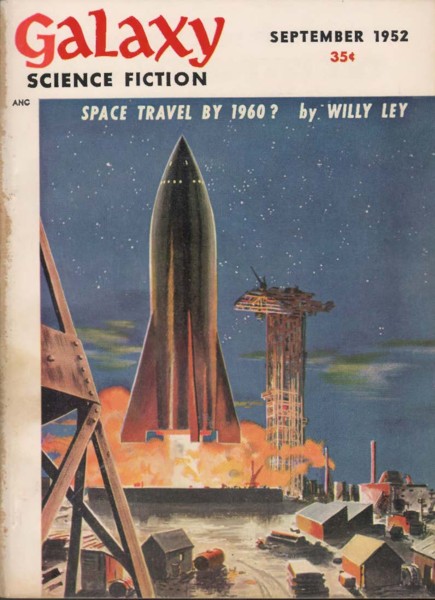
First published in the September 1952 issue of Galaxy Science Fiction. Reprinted in Second Galaxy Reader of Science Fiction (ed. H. L. Gold), The Penguin Science Fiction Omnibus (ed. Brian W. Aldiss), The Great SF Stories #14 (ed. Isaac Asimov and Martin H. Greenberg), The Ascent of Wonder: The Evolution of Hard SF (ed. David G. Hartwell and Kathryn Cramer), The Big Book of Science Fiction (ed. Ann and Jeff VanderMeer), and the MacLean collection The Diploids. The copyright ran out on it, so you can read it on Project Gutenberg with no issue.
Enhancing Image
Halloway is the president and dean of a university—somewhere. It’s unclear where exactly this university is. He’s dealing with a bit of a renegade professor, one Wilton Caswell, the head of the Sociology Department, which risks being gutted on account of a lack of interest from “the big-money men,” i.e., wealthy donors who actually keep the college running. Sociology doesn’t really appeal to them. “To them, sociology sounds like socialism—nothing can sound worse than that,” says Halloway. This is both a funny little bit of social commentary and perhaps some foreshadowing as well. You may recall about a year ago I reviewed MacLean’s “Pictures Don’t Lie,” which I liked quite a bit, especially with how it handled its twist ending. “The Snowball Effect,” which like the aforementioned story got adapted for X Minus One (I do recommend the X Minus One version of “The Snowball Effect,” by the way, it’s pretty faithful and in some ways more vividly depicts what MacLean was going for than what she could accomplish on paper), and both stories feel very much like they could be produced as stage plays, or for radio. Much of our time is spent either with just Halloway and Caswell or Halloway more or less by himself, as he keeps track of Caswell’s project. Caswell has a solution for his department, which comes down to a bet: Caswell can show his theory about the snowball effect for an organization and chart out said organization’s growth and lifespan over a six-month period. Sociology is, after all, the study of societies; but then damn near anything can count as a society—even a women’s sewing circle. By the end of the six months the Watashaw Sewing Circle, run by one Mrs. Searles, should have grown so as to vindicate Caswell’s studies, according to the plans and laws he laid out. “If Caswell’s equations meant anything at all, we had given that sewing circle more growth drives than the Roman Empire.”
Four months later and Halloway checks in on the Sewing Circle, only to find that such an organization does not exist anymore, and indeed has not for a minute; instead it’s been replaced by the Civic Welfare League, also run by Mrs. Searles. At first it seems like Caswell’s project had fallen through horribly, but quite the opposite has happened, with the former Sewing Circle having metamorphized and grown into a formidable charity organization seemingly overnight. The miraculous thing is that the CWL sprouted from the Sewing Circle without actually changing or amending the rules Caswell had laid out for the Sewing Circle, although the implication is that Caswell had designed the Sewing Circle so that it would, out of necessity, become something else so as to grow rapidly in numbers. He knew what he was doing. Halloway is more clueless, not helped by his struggling to get in touch with Mrs. Searles, who despite her importance to the plot remains a marginal figure. One reason I suspect MacLean was one of the few women to appear in Astounding (later Analog) with any regularity is that her style and preoccupation with male characters could be considered masculine. Certainly she stands out as distinctly pre-New Wave, being a generation (literarily, if not physically) apart from the second-wave feminist writers who would most forcefully bring the battle of the sexes to science fiction. Women both do and do not figure strongly into “The Snowball Effect,” because on the one hand the only characters with substantial dialogue, and whose perspectives we have any real insight to, are men; but then also you have the CWL, which at first is an all-women organization, and MacLean seems to be making a point about women’s roles in political activism, as historically women’s contributions to liberation movements and anti-war protests, have been quite profound. And then there’s Caswell, who despite having devised the project in the first place, is content to just watch it play out; you could say he only got the snowball tumbling downhill.
“The Snowball Effect” is a good deal less serious than “Pictures Don’t Lie,” indeed being the kind of social satire that Robert Sheckley would make his bread and butter (Sheckley made he debut the same year MacLean’s story was published); but while Sheckley had a misogynistic streak, MacLean’s story is slyly feminist in a way that male readers of the time probably would not have found too confrontational, while at the same time these readers would be subjected to some big ideas under the guise of a sci-fi comedy. Also by centering her story on men, with women being peripheral but at the same time pervasive, MacLean avoids what would become a bit of a stereotype with lady authors in the field during the pre-New Wave years, that being the centering of women’s roles as caregivers in what was being a middle-class sprawl. James Blish, in one of his books of criticism (I forget which one), makes the misogynistic but incisive comment that these lady authors, who tended to gravitate toward The Magazine of Fantasy and Science Fiction rather than Galaxy, were the “housewives” of the field. They wrote about women who lived day to day as moms and/or wives, their own existences hovering around the men and/or boys closest to them. An SFnal conflict may arise because the female protagonist’s idiot husband wants something, or her bratty son wants something, or maybe she herself wants something that she thinks will impress her husband or son. While women were literally at the center of such stories, their relationships with the male gender also took just as much center stage—mind you that the authors often did this with social commentary in mind, to say something about what it’s like to live as a (presumably) white middle-class woman under patriarchy. But while the dual protagonists of MacLean’s story are men, they end up being observers to a women-driven phenomenon, with the women in question mostly acting apart from their male peers.
There Be Spoilers Here
The CWL proves to be a huge success once the six months are up—if anything it might be too successful. What started as a ladies’ club has blossomed into something like an egalitarian democratic socialist society, a kind of mini-government whose chief concern is welfare. It’s the kind of thing the Fabians would’ve wanted. The CWL has gone well beyond Watashaw and by the end of the story they’ve opened up a branch in New York, open to women and men, be they rich or poor, handsome or ugly, yet still acting on the guidelines Caswell had set up for the Sewing Circle. Halloway’s jaw hits the fucking floor as he charts the rate of growth. “After the next doubling, the curve went almost straight up and off the page.” Caswell calculates that at the rate things are going the CWL will have effectively become a world government in about twelve years. There is a problem, of course, in that the project was set up such that once it stops growing for a long enough period it will dissolve. The implications are not exactly great, as presumably once this future world government reaches as many people as it can possibly recruit it will start crumbling. But by the time that happens it won’t be Caswell or Halloway’s problem anymore. The business will have gotten too big by then. Despite involving only a few characters and feeling like a stage production with how insular it is, the ending is comically large-scale.
A Step Farther Out
Sorry, I was supposed to post this yesterday, but there was an issue with WordPress that seemed to have to do with Google Chrome so I couldn’t fucking log into my account. (Thank you, Google, very cool.) I guess it was the kind of mishap that befits a comedy of this sort, although unlike my real-life experience with writing about “The Snowball Effect” I do certainly recommend the story itself. Being concerned with both social commentary and the soft sciences, it’s just the kind of story H. L. Gold wanted for his magazine, and it’s the kind of story one would have a hard time finding in Astounding, which was Galaxy‘s most direct rival. I should also read more MacLean—not that she wrote a lot.
Robert Sheckley debuted in 1952, the same year as Philip K. Dick and Algis Budrys, and quickly established himself as one of genre SF’s court jesters, especially in the recently launched Galaxy, which would print a good portion of Sheckley’s work throughout the ’50s. It was practically a match made in heaven: Galaxy was rather liberal and socially conscious, with a lot of fiction about average middle-class working people, and Sheckley was (or at least got pigeonholed as being) quite the urbanite. Galaxy leaned towards social commentary and Sheckley was only too happy to provide some social commentary of his own. He’s also an easy writer to dig into, in that one need not think too hard when writing about a Sheckley story. Once you’ve read a few Sheckley stories you can figure out a pattern of his that he was prone to, at least in his early years. Sheckley’s work at its best is major enough that he’s actually one of the few genre SF writers to have gotten a volume in NYRB Classics. Because he wrote a lot, he sometimes wrote bland or just plain bad stuff, for the sake of a paycheck, although “Skulking Permit” shows Sheckley at perhaps his most fun-loving.
Placing Coordinates
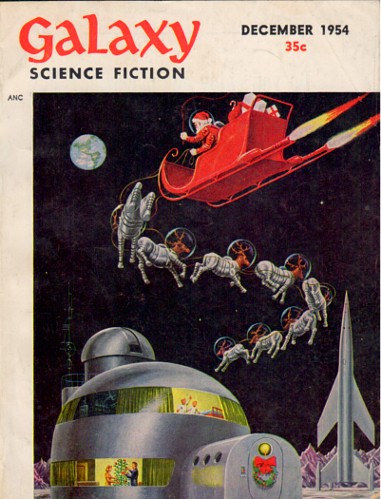
First published in the December 1954 issue of Galaxy Science Fiction. It was reprinted the following year in the Sheckley collection Citizen in Space, and would seemingly be included in every Sheckley collection going forward except for The Store of the Worlds: The Stories of Robert Sheckley. It would also be anthologized in Overruled! (ed. Hank Davis and Christopher Ruocchio). It also has an X Minus One adaptation.
Enhancing Image
The planetary colony of New Delaware has been doing pretty well for itself, except for the fact that contact with Earth has been cut for several decades—indeed, the people of New Delaware have had to fend for themselves for the past 200 years. But then one day, miraculously, contact is regained between the settlers and the government of Earth. This is not necessarily great news. Tom Fisher is a perfectly average fisherman and law-abiding citizen (but then there are no laws to break), who suddenly has found himself with a new job to do. See, the problem is that the apparently sole superpower on Earth has, after a couple centuries, become a totalitarian shithole, being overtly against free speech, democracy, and “aliens.” The people of New Delaware don’t even know what an alien is, although the planet does seem to have indigenous (albeit non-sentient) life of its own. Earth is gonna send an inspector, or rather the Inspector, with some armed men, to see that the people of the colony have conformed to Earth standards of living. The problem, then, is that there is no problem: New Delaware, while a small village and rather agrarian, is also something of a socialist utopia. There’s a mayor, simply called the Mayor, so presumably there’s a local government, but there’s no prison, nor are there pigs cops; and there’s no prison and no police because there’s no crime. There’s not been a murder (or at least a recorded one, for all we know) on New Delaware in 200 years. This is indeed the problem, because one of the ways the colony is supposed to conform to Earth standards is that there must be police, which means there must also be crime. But the village doesn’t have a criminal class.
The Mayor designates Tom as the village’s legalized, bona fide criminal, complete with a skulking permit—an authorization from the Mayor, in writing, to commit crimes. Yes, that includes murder. What could possibly go wrong? In the early years, there are basically two types of Sheckley story: humanity encountering a problem and only making the problem worse by trying to solve it, and humanity encountering a paradox in social norms and trying (in vain) to untangle this paradox. “Skulking Permit” very much fits in the latter category, but it’s a lot of fun. Sheckley pokes fun at the idea of a human civilization that is bereft of crime, and much more pointedly he pokes fun at the increasing militarization and paranoia in the US following the end of World War II. The Earth authority of the far future has gone down the rabbit hole of McCarthy-era anti-socialism (in other words, the rabbit hole we still find ourselves facing), to the point where the government of Earth has become actively genocidal and is looking to exterminate any intelligent alien life it can find. “Conformity” is the word of the day. The people of New Delaware must conform if they wish to regain partnership with the Earth authority, but conformity means actively making life in the village worse. In order to help the village meet standards for the Inspector, Tom must steal, cheat, skulk in places “of ill repute,” and yes, even kill (although thankfully sexual assault is not part of the deal), which are all things he has never done before. How do you introduce something as heinous as murder to a place that has never even known the word, among people who have never killed anything intelligent? Sheckley was one of the most persistent social critics among genre SF writers in the ’50s, although, probably intentionally, he never seemed to suggest an alternative to what he clearly saw as a slippery slope of totalitarianism in the US. New Delaware is not a valid alternative because, in true utopian fashion, it is by its nature impossible. The colonists, for some reason, have taught themselves over the course of generations of be as about as harmful to each other as baby birds. It’s more like Eden than a real place.
The convenient thing about Sheckley from a reader’s perspective, but not so from a reviewer’s, is that Sheckley was not what you would call a deep writer. His stories can be read almost like one can eat very good potato chips: they taste nice and provide some nice sodium, depending on your blood sugar, but they’re not terribly complicated. “Skulking Permit” has a loose plot and a cast of basically one-note characters, but this is fine—for one because it’s a comedy, but also the characters, while one step above cardboard, would be pretty colorful cardboard. Tom being an everyman works in service of the plot, since he is a totally unassuming guy who has to do some unsavory things for the sake of his village. Also, I’m not sure why he did this, but Sheckley gave characters last names that are professions; sure, you might think nothing of it at first, with Tom Fisher, but then you see Billy Painter, Ed Weaver, the Carpenter brothers, and so on. It’s a fucking cartoon, but for a quick read (or about as quick as you can be at 25 pages), I have to admit I chuckled quite a few times. The point of a Sheckley story is often to be funny, first and foremost, which I thought this was. It helps that, continuing with the cartoon comparison, some absurd things happen, such as the local tavern becoming more popular once it becomes known as a “place of ill repute,” or that the villagers aren’t even sure what a prison is supposed to look like, or that a group of villagers cheer like they’re at a baseball game when Tom finally steals something, or the fact that Tom “must” kill one of his fellow villagers but lacks a real motive to do so, being too friendly with everyone. It’s morbid, at least on paper, but in practice it’s perfectly upbeat, in typical Sheckley fashion.
There Be Spoilers Here
Of course, Tom can’t do it. He tries killing the Mayor, and actually comes pretty close, but the Mayor has recently gotten kicked upstairs to the position of General (a rank he doesn’t understand as the village doesn’t have a military) and tells Tom that since he’s a military figure now, to kill him would count as mutiny and not murder per se. Sure, whatever you say. Tom can’t even bring himself to kill the Inspector, someone he has never met and who’s basically an ambassador for a fascist hellscape; but even then, he simply doesn’t have that killer instinct—indeed none of the villagers have it. Seeing that the villagers are unable to kill and thus useless as would-be soldiers in an interplanetary war, the Inspector and his goons decide to just leave the planet and its “uncivilized” people in peace. This is an unusually happy ending for Sheckley, although in a bit of irony, since he was unable to prove himself as a killer, Tom sleeps “very badly” that night. New Delaware fails at becoming a “proper” society, but may have succeeded at retaining its innocence. There’s a lot you could unpack with what Sheckley is implying, but I’m sure he wanted us to enjoy it for what it is: a comedy.
A Step Farther Out
It’s a good fun read, that’s all I can really say.
Despite having lived an incredibly long life (she was born in 1925 and died in 2019), Katherine MacLean wasn’t the most prolific of writers. She only wrote five novels, only two of which are solo efforts, and one of those is a fix-up. On the short fiction front she didn’t write a whole lot more, although she did have a streak in the ’50s; about half her short fiction was published that decade. MacLean was one of the few lady writers to appear regularly in Astounding (she even debuted there), but like a lot of other writers she hopped on the Galaxy bandwagon, appearing in that magazine’s first issue. “Pictures Don’t Lie” is a prototypical Galaxy-type story, and not unlike another early Galaxy story I reviewed recently, Philip K. Dick’s “The Defenders,” it’s founded on a Big Twist™. Unlike Dick’s story, however, MacLean’s remains effective even when taking the twist into account. Also like the Dick it was adapted for radio as an X Minus One episode, and has even been adapted elsewhere, including an EC Comics adaptation. It’s one of her most reprinted stories for a good reason.
Placing Coordinates
First published in the August 1951 issue of Galaxy Science Fiction. It was reprinted in Invaders of Earth (ed. Groff Conklin), The Great SF Stories #13 (ed. Isaac Asimov and Martin H. Greenberg), The Prentice Hall Anthology of Science Fiction and Fantasy (ed. Garyn G. Roberts), as well as the MacLean collection The Diploids. It’s also fallen out of copyright, so you can read it on Project Gutenberg.
Enhancing Image
Joseph R. Nathen is a radio decoder for the American military, which during the Cold War would mean having a job that could potentially involve the difference between a frozen conflict and a hot one. But Nathen has found something a lot more incredible than signals from the other side of the Iron Curtain: he’s found signals of non-human intelligent life. “Squawking,” as he calls it, which needs to be slowed down, but the squawking is certainly not human, yet at the same time can be understood. Radio gives way to TV and it didn’t take long for Nathen to get a TV signal of the alien ship. He wanted pictures. “Pictures are understandable in any language,” he says. Nathen ends up being right about this—but also tragically wrong. But we’re getting ahead of ourselves. There are only three real characters in this story: Nathen, a journalist named Jacob Luke who’s mostly referred to as the Times man (which Times?), and Nathen’s correspondent on the alien ship, nicknamed Bud. There are a few other characters, mostly journalists who are only called by the outlets they work for (the Herald, the News, and so on), and the dialogue is almost entirely expositional; good thing Nathen is fluent in Expositionese. If this story has a flaw that would turn some readers off it’s that it seems in love with its own attempts at explaining its premise—so dense in exposition as to be hard to digest.
(The X Minus One adaptation does a pretty good job of streamlining the narrative, by giving us a solid viewpoint character [with the Times man] but also massively dialing back the scientific explanation for how the humans and aliens are able to communicate.)
Nathen had used the TV line to send the aliens the Rite of Spring segment of Fantasia, which the aliens not only received in a couple weeks but apparently enjoyed. At first this sounds like a match made in heaven with regards to first contacts: the aliens are not only able to respond back but can communicate, and according to Nathen their planet is “Earth-like.” The aliens seem to be humanoid, and the Earth team is able to receive TV images of the aliens on the ship. The question then remains: What could go wrong? There are a few warning signs, but the humans are unable to make heads or tails of what these abnormalities could mean. For one, the aliens move at a deliriously fast speed. “Something about the way they move…” As Nathen explains, while the images themselves are clear, the speed at which these images are relayed is hard to gauge. “When I turn the tape faster, they’re all rushing, and you begin to wonder why their clothes don’t stream behind them, why the doors close so quickly and yet you can’t hear them slam, why things fall so fast. If I turn it slower, they all seem to be swimming.” Something isn’t right. But still, the aliens intend to land on Earth, right outside the military base where the story’s happening—and soon.
The twist of this story is telegraphed pretty hard, but only with hindsight. I had the good fortune of not knowing the twist beforehand, so I was left with the genuine question of what the catch is—because there has to be a catch with a story like this. MacLean is clever here in that she turns the screw at just the right pace so that if you’re fast enough you can anticipate the twist, but there’s a good chance you won’t; but then you might reread the story and give yourself a pat on the back for taking note of what now reads as obvious foreshadowing. The title is ironic. It borders on postmodern—not in literary technique, obviously, but in how it shows that objective reality, or rather our notion of it, can be untrustworthy. Our perception of reality is based on our senses. The humans and aliens have differently calibrated perceptions and as such they don’t perceive the same space in the same way. When the alien ship comes to Earth the humans don’t see any sign of it by the landing pad, and Bud says the ship can’t see the humans anywhere despite surely having landed on Earth. The atmosphere, Bud says, is too thick—much thicker and soupier than Nathen said. The humans posit that the aliens might’ve landed on Venus by accident (this was when Venus was thought of as a gaseous swamp and not a hellworld), but this can’t be the case. Something has gone wrong, but they don’t know what.
There Be Spoilers Here
The aliens are on Earth alright, and they’re even somewhere near the landing zone—but the humans can’t see the aliens. Bud says that the ship has come under attack and that the humans have to find the ship fast if there’s hope of saving them. It’s there that Nathen and the Times man realize the missing piece of the puzzle—and at the same time realize it’s probably too late to save the ship. It’s one of those great “we’re fucked” moments in old-timey SF, a real sense of having passed the point of no return, like locking your doors after your house has already been robbed, or realizing that one girl you liked had a crush on you as well and you only realize this years after the fact. MacLean gives us a real zinger of a final line, which encapsulates the bizarre tragedy of the situation, for why the humans can’t see the ship—at least not with the naked eye: “We’ll need a magnifying glass for that.” The aliens move at such an odd speed and the atmosphere around them is so thick because they are, in fact, microscopic. The pictures didn’t lie, but they didn’t tell the whole story either. The humans thought they had made contact with likeminded aliens when in fact they were giants who had made contact with beings even smaller than ants, and neither side could figure this out until it was too late. This is how you do a twist ending.
A Step Farther Out
“Pictures Don’t Lie” is basically a tragedy, not caused by technology but aided by it. Even by the early ’50s there’ve been a ton of first contact narratives, such that it would take a bit of ingenuity to write a story of this type that’s truly memorable. MacLean was still very young, and early in her career at this point, but she did have that touch of ingenuity. More impressively it’s a story that raises questions about the utility of the brand-spanking-new technology called television, about how such technology might contribute to first contact with aliens—and how even with this new tech something could go wrong. It’s also a question of size and perspective. We always imagine aliens like how they appear in Star Trek, humanoids that happen to be the same size as humans. MacLean posits we might find life on another planet—or possibly in a grain of sand.
Philip K. Dick is arguably both the funniest and scariest writer to emerge from the early ’50s genre SF boom. He wanted to write full-time for a living, and as a result he wrote at a mile a minute; he would wrote some 120 short stories, about a quarter of which would be published in 1953 alone. “The Defenders” is one of those stories. I’ll say upfront that this is not top-tier Dick, although it is curious for a few reasons and I do have to recommend it. For one, this was the first Dick story to make the cover of a magazine, hence the memorable Ed Emshwiller illustration. It’s also one of only two Dick stories to get adapted for the SF radio series X Minus One, the other being the bone-chilling (and darkly humorous) “Colony.” “The Defenders” and “Colony” were published in Galaxy Science Fiction, which had partnered with X Minus One such that the latter often adapted stories from the former’s pages. Despite being so prolific in the ’50s, Dick only appeared in Galaxy a handful of times while H. L. Gold was editor, apparently because (as often happened with Gold) the two did not get along. Gold had a reputation for meddling with authors’ manuscripts, and indeed there’s a sense of meddling with today’s story. Gold shouldn’t feel too bad, though: Dick would appear in Astounding only a single time.
Another couple things. “The Defenders” reads like a companion piece to “Second Variety,” which I reviewed a minute ago. Both stories cover basically the same topic, and given that they were published five months or so apart it’s safe to say Dick wrote them in close succession; but apart from having similar premises they’re very different stories. More importantly is that Dick would cannibalize the premise and twist of “The Defenders” for the much later novel The Penultimate Truth, and if you know the twist of that novel then you can safely guess the twist of this story. I won’t say what the twist is here, but it’s not hard to figure out.
Placing Coordinates
First published in the January 1953 issue of Galaxy Science Fiction, which is on the Archive. “The Defenders” wouldn’t see book publication until Invasion of the Robots (ed. Roger Elwood). Other anthology appearances include There Will Be War (ed. John F. Carr and Jerry Pournelle), Battlefields Beyond Tomorrow: Science Fiction War Stories (ed. Martin H. Greenberg and Charles G. Waugh), and Sense of Wonder: A Century of Science Fiction (ed. Leigh Ronald Grossman). It’s also in *checks notes* every other Dick collection you can think of. To make things even better, it’s fallen out of copyright, so you can read it on Project Gutenberg here.
Enhancing Image
The Cold War went hot eight years ago, with Americans and Soviets having since burrowed underground, hunkering in shelters while the robots, “leadys,” continue to fight the good fight on the surface. The humans would do the fighting themselves, but nuclear fallout from the war’s beginning has rendered the surface uninhabitable—we know this because of newsreel footage and newspaper photos taken of the surface, the leadys keeping humanity updated on a war that seemingly has no end point. “Nobody wanted to live this way, but it was necessary.” Don Taylor is part of his bunker’s military personnel, although despite being in touch with the top brass the higher-ups don’t have a better idea of what’s going on aboveground than Taylor does. (I should probably take a moment to mention that Taylor’s wife, Mary, is in the classic Dick mold, in that she’s rather shrewish. Do not do a drinking challenge where you take a shot every time Dick writes a miserable couple wherein the husband has to put up with his unpleasant wife or ex-wife. What do you mean Dick was already divorced once at this point?) The higher-ups sometimes interrogate leadys to get a more direct line to what’s going on above, but this only goes so far. Nobody, at least on this side, has been to the surface in eight years.
The leadys are the most curious part of the story that isn’t the twist, being shown in the Emshwiller cover. They’re called “leadys” because their lead shells protect them from the radiation on the surface, although they have to be decontaminated every time one is brought underground. It’s also unclear just how they work in the ethical sense, since they’re programmed to not knowingly harm humans—or at least humans on the right side of the conflict, depending. This raises the question of what exactly the leadys are good for, aside from maybe fighting other leadys. Dick seems to conform to Asimov’s three laws of robotics, but he doesn’t delve deep into the matter. The humans bring down a leady for questioning one day and find, to their surprise, that the leady is not radioactive, nor does its chassis have the intense heat of radiation. Don and his superiors figure something must be up, although they can’t be sure what, since as far as they’ve been torn war continues to wage on the surface. But then why no radiation? It’ll be risky, but it looks like humans will be going to the surface for the first time since the war went hot—in leaded clothing, of course. Taylor, his superiors, and a platoon of men plan to go up, but a team of leadys tries to stop them—a fruitless effort, given that the leadys are programmed to not kill humans and so have no way to keep them from going through the Tube.
It’s hard to discuss “The Defenders” without also discussing the twist, but I do wanna point out a couple other things. As is typical of Dick’s early work (with exceptions), the characters aren’t really characters in the Shakespearian sense so much as they exist because the narrative demands human players. Moss and Franks, Taylor’s superiors, are basically interchangeable. Past their immediate circumstances we get to learn nothing about these people. But that’s not necessarily a bad thing. Dick would become far more ambitious in psychoanalyzing his characters later on, but even at this very early stage there are a few Dick hallmarks that are comforting for the returning fan, sure, but they also serve a purpose. We know life underground is miserable because despite being in a position of authority, Taylor’s life still kinda sucks. The standard Dick protagonist leads an unfulfilled and claustrophobic existence, and this applies even to characters with power, as if to show the hollowness of wanting to acquire power for the sake of itself. Also, as is typical of Dick, the prose is often beige and economical. “The Defenders” just barely qualifies as a novelette, and it feels even shorter than that. Again, not a bad thing. I would’ve had a worse time with this story, given its setup-twist nature, had it overstayed its welcome. I also wanna say the X Minus One adaptation is perfectly decent, much like the source material; it mostly sticks to the short story, with ultimately inconsequential deviations.
There Be Spoilers Here
In one of his books of genre criticism (I forget which one), James Blish lists “The Defenders” as an example of a story whose very existence hinges on its twist, although he doesn’t elaborate on this particular story. He’s undoubtedly accurate with the call, though. If you read early Galaxy you’ll come across a lot of great short SF—indeed some of the best of its kind, certainly in the context of the early ’50s. There were also a lot of setup-punchline stories, and while these weren’t necessarily bad, they could be tiring. Robert Sheckley made a name for himself at the outset with this type of story, but even then it’s clear that he eventually got tired of the routine. Dick could also fall into this trap, and “The Defenders” might be the most setup-punchline of his story; no wonder it would be printed in Galaxy, with Gold having a fondness (really too fond) for just this type of story. And if you know The Penultimate Truth then you already knew what was coming. It turns out the war had basically been over for almost as long as the humans had been living underground. The leadys had been working on reconstructing the surface world whilst feeding the humans (on both sides) false information. That’s right, fake news was a thing in the ’50s! On the one hand this is very much a Dick idea, one he would even return to later; but the execution and implication tell me that either this twist was half-baked or Dick originally had something else in mind but changed it (or maybe Gold changed it) for the sake of appearing in Galaxy.
To elaborate, if there’s one thing Dick does unconvincingly in my experience it’s a happy ending. I’m thinking of Eye in the Sky, arguably the best of his ’50s novels, which while still being an entertaining and mind-bending read, has a tacked-on happy ending that fails to convince. The leadys destroy the Tube and prevent the team of humans from returning underground, leaving them to cooperate with the Soviets for what will probably be several years. “The working out of daily problems of existence will teach you how to get along in the same world,” the top leady says. This is all swell, but it also assumes the leadys really do have the humans’ best interests at heart, which strikes me as fundamentally uncharacteristic for Dick. Contrast this with “Second Variety,” in which the Cold War goes hot, there’s a nuclear holocaust, but the robots are more sinister there. In “The Defenders” the leadys are like a benevolent dictatorship, or Plato’s philosopher king wrapped in iron. You can see what the problem is. This is really out of step with Dick’s generally ambivalent attitude toward robots and automation at large; it’s like he tried to write an Asimov or Simak robot story. And yet it must be said that the twist on its own is good enough that you could do a lot more with it, so it’s unsurprising that Dick would cannibalize it. Still, I found myself feeling underwhelmed by the reveal.
A Step Farther Out
When Dick started out writing professionally he submitted to seemingly every market in the early ’50s, and with a few exceptions he appeared in nearly every genre magazine that would’ve been active in 1953. Sometimes he phoned it in and sometimes you get the feeling the Philip K. Dick we recognize was still in utero. “The Defenders” is very early Dick and feels less Dick-y than the stories previously covered, and of the three it’s easily my least favorite. I recommend it still, but more as a sign of the time and place in which it was written than as a sign of Dick’s genius; for that I’d point towards “Second Variety,” which as I said earlier starts out very similarly to “The Defenders” but goes in a much darker direction. “The Defenders” is an indicative Cold War SF story that happens to have been written by someone who would move on to bigger and better things—something seasoned Dickheads would not find so impressive.
Nowadays we’re used to genre authors hopping across the border, so to speak, or even just mixing several genres together in a stew; you have “SF” authors writing fantasy with ease and vice versa. But 70 years ago there was not much cross-pollination, mostly due to there not being much of a market for fantasy then. Fritz Leiber started as one of the best fantasists of his generation, contributing regularly to Weird Tales and Unknown in the late ’30s and ’40s, but the SF magazine market started bubbling and by 1950 it became prudent to turn to writing SF. Some authors did not make the transition, but Leiber was one of those who became a good science-fictionist due to market forces; he had written some SF prior to 1950, but his material from this second phase of his career was decidedly stronger than what came before. It seemed only natural that he would be made Guest of Honor at the 1951 Worldcon, given his almost rebirth as one of the best SF short story writers of the period, and this rebirth was in no small part due to the premiere of what was, at least for a time, the best SF magazine on the market.
Galaxy Science Fiction, for at least most of the ’50s, was the gold standard for magazine SF—not just short SF, but even novels which ran as serials. While not always appealing to the hard SF crowd which continued to devour Astounding and while not as strictly “literary” as F&SF, Galaxy presented a new breed of SF which was socially conscious, which commented on what were then current conditions for real people, and which was more willing to discuss topics like gender roles, the growing suburban populace, and a wave of new technology which overwhelmed people’s minds in the years following World War II. Leiber, who was always a little more cosmopolitan than his fellows, spent 1950 to 1953 delivering a string of classic short stories in the pages of Galaxy, of which “The Moon Is Green” is one.
Placing Coordinates
First published in the April 1952 issue of Galaxy, which is on the Archive. Oddly it has not been reprinted that often, but there are options. There’s The Best Science Fiction Stories: 1953, edited by Everett F. Bleller and T. E. Dikty, which has a couple alternate titles, such as The Best Science Fiction Stories: Fourth Series. We also have The Great SF Stories #14, covering fiction published in 1952, edited by Isaac Asimov and Martin H. Greenberg. If you’re looking for more of a collector’s item then there’s The Leiber chronicles: Fifty Years of Fritz Leiber from Dark Harvest, although I’m not sure how pricey it would be to get online.
Most curiously this is the first story I’ve covered for my blog which got adapted for the legendary radio program X Minus One, which in the ’50s was probably the best introduction to short SF of the period. That episode is available on both the Archive and YouTube, although I recommend only listening to it after reading the story, since… well, it doesn’t entirely do justice to Leiber’s writing. It’s a bit less poetic and a bit more overblown is what I’m saying, along with the performances being uneven.
Enhancing Image
Effie and her husband Hank live in an apartment, which is normal; what’s not so normal is that this apartment is one of the few constructed on the surface. Most of what is left of humanity lives underground, but Effie and Hank live a privileged existence by virtue of Hank’s connections with the Central Committee—what is left of the government—while Effie is supposed to be fertile, although she and Hank have been unable to have a child all these years. The obvious implication is that Hank is impotent, but it must also be said that the world had gone to SHIT a good deal prior to the story’s beginning. The years following the bombings of Hiroshima and Nagasaki saw a nigh-endless wave of SF about the dangers of nuclear weapons, and “The Moon Is Green” is not even Leiber’s first go at the subject.
What makes “The Moon Is Green” different from a lot of other nuclear catastrophe stories of the period, especially ones prior to the coming of Galaxy, is that it’s more a domestic drama than an outright nuclear catastrophe story. Another thing that was unusual (for the time, anyway) is that we get a heroine in Effie, and unlike most female characters from this period in SF she’s not fickle or overly reliant on the men in her life, but someone with thoughts and dreams of her own. I know, totally radical. Mind you that by 1952 we had started to see an influx of women in the field, and for the first time it could be said that SF had a place for women among its many voices—though the ratio of men to women was still very much lopsided. Still, authors like Leiber dabbling earnestly in writing female protagonists was a sign of some profound changes.
Anyway, despite the fact that objectively life is pretty good for her (or at least it could be a whole lot worse), Effie is not satisfied with her life as essentially a first-generation Morlock. “A mole’s existence, without beauty or tenderness, but with fear and guilt as constant companions. Never to see the Sun, to walk among the trees—or even know if there were still trees.” She pines for pastoralism, for the simple pleasures of taking a stroll through the forest and gazing up at a full brightly lit moon during a clear night. Both Effie and the narration specifically describe her hunger as a hunger for beauty, which takes on almost a religious zeal; that she hopes to transcend her semi-buried existence will lead to tragedy. The problem is that she can’t go outside because the outside world is shrouded in radioactive dust, which will kill most things and what it doesn’t kill it would presumably make stranger.
So what to do? She’s unhappy but she can’t go anywhere, and at this point she doesn’t even like staying with her husband, whom she clearly sees as having become overly controlling and bureaucratic. Hank is not exactly a villain, but he’s pretty far from what we would call a model husband; he almost cares more about his relationship with the Central Committee than with his wife, and while his fears about death by radiation are not unjustified (what stops him from being a villain), he has become one of those no-fun-allowed people who has to do everything by the book. What separates the two, and what allows the real drama of the story to happen, is that Hank demands that Effie go with him to a Committe meeting, where he hopes to get his foot in the door as a small-time bureaucrat, but Effie refuses on the grounds that she has Covid she’s too sick to go. Relauctantly Hank leaves her behind, on the condition that she not do any funny business like touching the lead shutters of their apartment, which can carry radiation.
I wonder how long she’ll behave herself?
A more important question that will become more pronounced when we get to spoilers is: What is more important to life, its longevity or its quality? Because the two are not always the same. The main conceit of Joanna Russ’s We Who Are About To…, maybe the thorniest of all ’70s SF novels, is that life can only mean so much when there’s minimal pleasure to be taken from it. What’s the point of continuing to live after the bombs have gone off if you’re to become a burrower for the rest of your years? If the best you can hope for is that your children’s children will be able to enjoy what you could not (assuming there’s anything left) once there’s been enough radiation decay. You might have a long-term plan, but what do you do in the short term? Even the act of love-making might lose its luster.
In post-nuclear stories there’s a variety of possible obstacles for the characters, and you’d know this regardless of whether you’re a connoisseur of the subgenre or if you just play a lot of Fallout. In A Canticle for Leibowitz the biggest threat is the death of human knowledge; in The Road the biggest threat is the total loss of human empathy, never mind that the race is ultimately fucked in that novel and there’s no going back; in “The Moon Is Green” the biggest threat is the fact that regardless of who’s left, life underground or just barely above ground is quite shitty. There’s government, there’s a semblance of order, and some human culture remains, but at least in Effie’s mind there is no beauty left—only the machinery of human endeavor. Which is what makes what happens next tragic and yet vaguely hopeful.
There Be Spoilers Here
While Hank is out, Effie gets a visitor—from outside. How? Surely everyone who didn’t go underground died or turned rabid; but Patrick is not like most people. (He also sounds like a damn leprechaun in the X Minus One adaptation for some reason.) Somehow he and his cat have been able to survive in the outdoors this whole time, with Patrick himself seemingly bereft of mutations. Tempted by the prospect of life outside of her burrow, and the fact that Patrick is a charming enough fellow, Effie not only touches the shutters but opens her apartment window to meet Patrick face to face, exposing herself to the radioactive dust of the outside world. Why would she do this? Consider that it seems to be standard practice for the underground people to have Geiger Counters on them, to test for radiation easily, so paranoid are they about what’s left of civilization succumbing to its own failings. Yet Patrick claims that actually the radiation has decayed much faster than expected, and that actually it’s all fucking sunshine and rainbows outside civilization’s metal coffin.
Now, a few question. Why do these buildings on the surface have windows? Why are they comprised of materials which could transmit radiation? How come Effie and Hank didn’t divorce after failing to produce a child after several years? The last question is sort of answered by Hank eventually coming back and accusing of Effie having an affair with a colleague of his (Effie claims at one point to be pregnant, but from how I read it I took her as lying about it). I’m also not sure what Patrick would’ve lived off of all this time, given how much animal and even plant life would’ve died off in the interim, although given what he reveals later some radioactive sunflower seeds would probably not hurt him. Doesn’t quite explain the cat, but in typical ’50s post-nuclear fashion we just take mutated animals for granted. You’d think with how well-documented the bombings of Hiroshima and Nagasaki were that there would be more stories from this period about the actual effects of radiation on organic matter.
When Hank returned unexpectedly, however, the truth about Patrick comes out via a waving of the Geiger Counter. Contrary to what Patrick had said, the outside world was still smothered in radioactive dust that would be fatal to most living things, and in fact Patrick HIMSELF makes the Geiger Counter go off the damn charts. Appartently Patrick puts on an act in order to get some action with women who have locked themselves off from the outside, which is… actually even more horrifying than it sounds at first. Like how many times has he done this? How many people have died because of his need for companionship? Not that he makes a secret of being a harbinger of death once he’s outed, being “Rappacini’s [sic] child, brought up to date,” in reference to the famous Nathaniel Hawthorne short story. Hawthorne’s “Rappaccini’s Daughter” is one of the great 19th century SF stories (worthy of a future blog entry, I’d say), about a mad scientist’s daughter who, in being experimented on and living alongside poisonous plants, has become immune to the poison at the cost of now being poisonous herself.
The twist here is that while Patrick thinks himself a modern incarnation of that tragic woman, it is really Effie who takes after Rappaccini’s daughter, being the victim of her own circumstances, torn and ultinately brought down by the two most important men in her life. Leiber takes what was already potentially a feminist narrative (Hawthorne’s sympathies for the women of his time being prescient, all things considered) and alters the perspective to make that feminist angle more explicit. Leiber would explore the “woman’s angle” in later works such as The Big Time, albeit much quirkier in that case, but “The Moon Is Green” is a quite serious and quite effective early attempt at writing a woman’s perspective in a science-fictional context.
Having lost hope in the man who’s been with her and having been betrayed by the man who had teased her with a new way of living, Effie runs off on her own into the wasteland, for good or ill. In a lot of love triangles you would get rid of the hypotenuse by way of, say, death, or having the third wheel find someone else, but what makes “The Moon Is Green” subversive for its time is that Effie turns her back on both of the men in her life. Patrick leaves, knowing he won’t be able to bring Effie back, while Hank locks himself up again and tests himself with his Geiger Counter, his own immediate future hanging in the balance. Whether Effie dies or adapts to the wasteland is unknown, but even if she doesn’t adapt to the radiation she might think it best to die on her feet and with her lungs taking in the unclean air. All for just a slice of beauty, and a taste of freedom.
A Step Farther Out
Leiber’s short fiction from this period tends to be pretty damn solid, and “The Moon Is Green” is no exception. It could be that I’ve been reading a good number of his works in quick succession, but I’ve been noticing how many of Leiber’s stories read like plays. “The Moon Is Green” could very easily work as a one-act play: you’ve got one location, a total of three on-screen characters (four if you count the cat), and it’s not like you need fancy effects work to realize the setting or what happens in the climax. It’s very simple like that, but it also works. When I picked this one for review I knew basically nothing about it, not even it being a post-nuclear fable not entirely dissimilar to “Coming Attraction”; but whereas you could argue that that more famous story is tinged with misogyny, “The Moon Is Green” is one of Leiber’s more actively feminist efforts.
Effie is an active chaeacter with a sense of interiority, and she doesn’t want anything stereotypical like wanting to have a ton of kids or to be a good wife, but to escape from the cage of her daily life for something more freer and more beautiful. Her fate is left open, but Leiber supposes that, regardless of whether she lives or dies in the wasteland, it might be best for Effie to leave the men in her life and chase after her dream. Best of luck to her.



 Science Fiction & Fantasy Remembrance