Contains spoilers for a movie that is not only three decades old but one of the most famous movies of all time.
I’ve written about Jurassic Park before, which funnily enough makes it hard for me to figure out how to start this month’s editorial. Choosing the topic was also easy, considering the film’s 30th anniversary was this month, but I also kept searching for some excuse to not write about it; again, it would not be my first rodeo. This is how it is with your first love—with the thing that’s been more or less consistently a part of your makeup since the days when you still believed Santa Claus was real. Only a few works of art can lay claim to influencing how you would perceive other works of art for the rest of your life, and while these don’t necessarily come along in your formative years, being very young certainly helps. I’m pretty sure I saw Jurassic Park for the first time when I was all of three years old and since then I’ve watched it at least once a year. Hell, I saw it twice in theaters (once in 2D and once in 3D) during its 20th anniversary theatrical rerelease.
2013 is already a long time ago.
I don’t talk about movies much here, because this is mainly a literature blog, but I’ve seen a lot of movies (you can see this for yourself on my Letterboxd page); with that said, I still feel weird when I tell people Jurassic Park is my favorite movie. People tend to be very defensive and nostalgic about their favorite movies unless they’re the type to succumb to recency bias. (I know you love Everything Everywhere All at Once, but you should probably let that opinion sit and marinate for a while before telling people it’s your favorite movie ever.) I know people who will swear by movies that I personally don’t care for, but it’s hard (not to mention wrong) to knock passion for a work of art. I know people whose brain chemistry was changed irreversibly when they watched The Matrix for the first time back in 1999, and I know from experience that Jurassic Park had a similar effect on people. No movie in history has inspired more people to become paleontologists than this one. Despite its technophobia (which I’ll get to in a minute), Jurassic Park is about as convincing an argument for the wonders of science as any book written by the likes of Stephen Hawking or Carl Sagan.
This is, of course, a movie that was primarily made to entertain people; it was based on a commercial SF novel in the “technothriller” mode by one Michael Crichton, whose influence on people’s understanding of SF is actually quite understated despite his popularity. Even though Crichton has now been dead for 15 years his ghost continues to haunt even supposedly cerebral SF now being produced, with the much lawded (though, having seen the first season, I was less impressed) show Westworld sharing the basic premise with Crichton’s movie of the same name. Crichton’s first (and arguably best) SF novel, The Andromeda Strain, still serves as a textbook and often-cited example of the theme of man’s folly in the face of nature. Jurassic Park, the novel, reads in parts like a direct line to Crichton’s thoughts on the prospect of humanity fucking around and finding out with regards to meddling with the natural world. Crichton’s avatar, Ian Malcolm, is not a doctor like his creator, nor is he a giant (he is also, unlike both Crichton and his movie counterpart, losing his hair), but he does serve pretty blatantly as a puppet through which Crichton hares his ambivalence about genetic engineering. The cautionary tale is not an ambiguous one.
The novel, published in 1990, was optioned for a movie adaptation before it even saw release, and Steven Spielberg hopped right on it. Spielberg has been, for about half a century now, the biggest architect of people’s cinematic imaginings whose name is not George Lucas, and like Lucas his fondness for science fiction is unmistakable. He did not officially direct an SF movie until Close Encounters of the Third Kind in 1977, but Spielberg’s career from the outset was informed by genre maestros, not least of these being Rod Serling, whose Night Gallery a very young Spielberg worked on, and Richard Matheson, who wrote the screenplay (not to mention the short story) for Duel, Spielberg’s directorial debut. At first glance Crichton and Spielberg seem like they would make an odd couple, given the former’s pessimism and the latter’s notorious optimism, but they’re both undoubtedly gifted entertainers and they both see science fiction as a means to that end. A collaboration between the two was almost inevitable.
For Jurassic Park the film, Crichton co-wrote the screenplay with David Koepp, although from what I can tell Koepp did most of the heavy lifting in turning Crichton’s rather gory novel into a family-friendly script. Koepp, when he was on the ball, had an almost supernatural talent for writing blockbuster scripts that were just intelligent enough while being perfectly structured so as to keep audiences engaged. (Forgive me for using the past tense as if Koepp were dead when in reality he is very much alive, if over the hill.) This may sound controversial, but I think Jurassic Park is one of those film adaptations that largely improves on the source material (with a few concessions made), such that it holds up better overall. I still have a deep fondness for the novel, though I would say The Andromeda Strain and Sphere come closer to being Crichton’s best; it’s more that the novel is weighed down by copious amounts of exposition, along with Malcolm being the type to preach endlessly. Malcolm, on top of being blessed with an all-timer performance by Jeff Goldblum, is made less preachy and abrasive (if also not as clear in regards to his plot relevance) for the film.
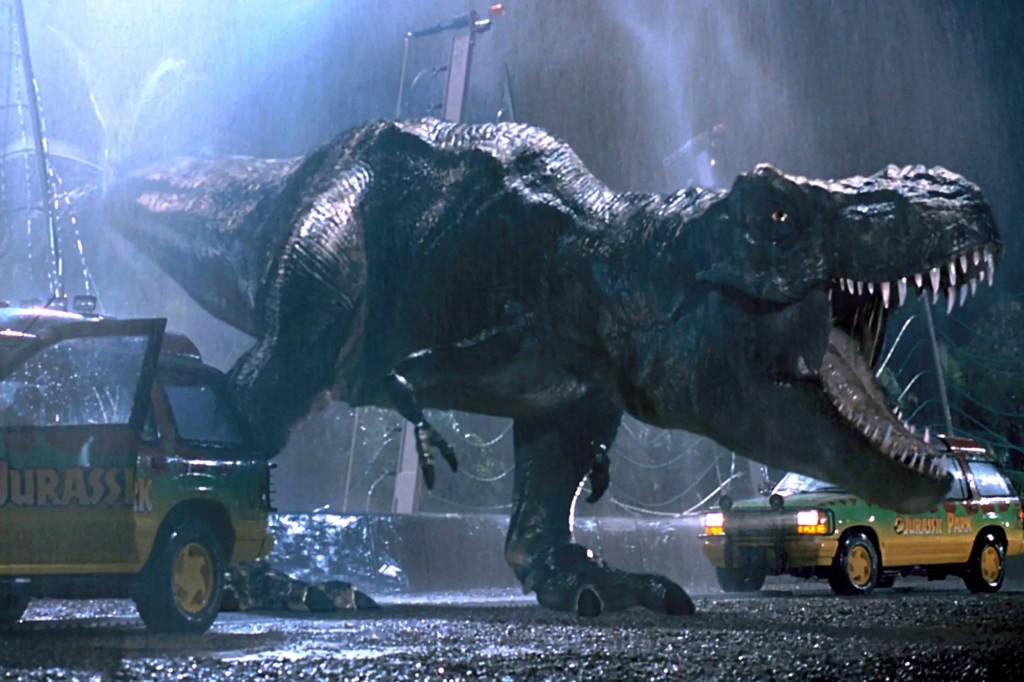
The film was shot in the summer of 1992 and finished filming ahead of schedule, despite some issues with the effects. Spielberg originally envisioned the dinosaurs as being animated via stop-motion, but they could not get the dinosaurs to look “realistic” no matter how fluidly animated. Ultimately the stop-motion effects would serve as a useful blueprint for what would turn out to be mostly a mix of puppetry and animatronics, with some computer-generated effects sprinkled in when nothing else would do. The film would be (and still is) remembered as revolutionizing CGI, but the truth is that CGI played a very small part in the final product. The dinosaurs themselves only have something like just under 20 minutes of screentime, a good portion of which is devoted to the T. rex breakout scene, and only a small fraction of that time involves computer effects. The most impressive effect is arguably the fully constructed T. rex animatronic, which can be seen at certain points and which is seamlessly intermingled with CG shots.
More important than seeing dinosaurs, however, is the idea of seeing dinosaurs, and this is where the real magic of Jurassic Park comes into play. Surely this film would not have won three Oscars (plus a Hugo for Best Dramatic Pressentation) and kicked off a perpetually lucrative franchise had it been a two-hour snoozefest with the occasional dinosaur jumping out of a closet. Despite the relatively sparse dino action, the film remains consistently provocative and entertaining. While some critics faulted it upon release for its lack of human drama, the human characters are certainly memorable in their own right, with some of the finest character actors in the industry at the time being recruited: Jeff Goldblum, Richard Attenborough, Samuel L. Jackson, Wayne Knight, Laura Dern, and the criminally underrated Sam Neill, among others. There is a genuine sense of awe when the visitors see a brachiosaurus for the first time—not just because the effects are convincing but also because the actors seem as star-struck as the audience. Ignoring the scientific inaccuracies (we know, for instance, that brachiosaurs did not have teeth), this was the first time moviegoers saw a sauropod that looked and acted like it could be the real thing.
There’s a certain long-running phrase in SF circles that, despite being around for decades and regarded by many as a cliche, has yet to have its stock value plummet: I’m of course talking about “sense of wonder.” SF as a genre can be said to have a special advantage over other genres in that it cranks out more “sense of wonder” moments than any other by far: the stargate in 2001: A Space Odyssey, the giant alien corpse with its chest opened in Alien, Neo dodging slow-motion bullets in The Matrix, the color palette changing as Our Heroess™ enter the Zone in Stalker. Those are just some movie examples, by the way. What exactly is sense of wonder? It seems impossible to quantify, which is probably true, and as such it’s hard to come up with a clean definition, although people know it when they see it. I think of sense of wonder as this: the sensation of opening a door to somewhere you’ve never been before. There is the sense, possibly a mix of joy and anxiety, of sailing into uncharted waters. Science fiction is my favorite genre in part because it’s the most wondrous genre; sense of wonder is its trade.
A work of science fiction need not be a masterpiece to have a great sense-of-wonder moment, since these are ultimately moments and not necessarily indicative of the whole picture, but it’s telling of Jurassic Park‘s magic that it has not one but several of these moments. The visitors seeing their first brachiosaurus is one example, as is (in a darker hue) the T. rex breaking out of its enclosure; then there’s the realization that, due to an oversight with what species of frog is being spliced with dinosaur DNA to fill the sequence gaps, the dinosaurs are actually transsexual and able to reproduce on their own. (That’s right, the movie said trans dinosaur rights.) In the book there’s a sense of foreboding with how the park has totally lost control of the thread, but in the movie this is somewhat replaced by a sense of amazement. Life had found a way, even against human-imposed limitationss. Ultimately it’s still a “man fucks around with nature and finds out” narrative, but Crichton’s pessimism has been downplayed in favor of wonderment at the possibilities of the natural world—to the movie’s benefit.
You could say that’s the promise of science fiction: the possibility of doors to things never seen before being opened. For any SF fan there comes a point, probably early in life, when some work of the genre just so happens to come along and make the promise that this is what science fiction is about and this is what science fiction is capable of doing. The work in question need not be of Shakespearean complexity, nor so involved in the depths of the human spirit, but it does offer an example of something that science fiction does more so than its brethren. I’m sure if you went back to the early 20th century you could find people who were inspired to persue some career path or to take up some social justice cause, or to even become SF writers themselves, because they read H. G. Wells’s The Time Machine when they were kids. God knows I became first enamored with SF as a genre of literature when I read Wells and Crichton in middle school, then later Philip K. Dick. But when I was a kid a certain door had been opened to me, with a certain movie promising me that this is what science fiction can do.
The promise is still being kept.
 Science Fiction & Fantasy Remembrance