What a year, huh? And we just started.
Since a lot of us are snowed in, or at least dealing with some pesky snow and ice (and ICE) in the midst of our everyday activities, we may as well pass the time by cozying up with some good reading. Or maybe not so good. Truth be told, I’m not so sure about the quality of what I’ll be tackling this month, with maybe one exception, the short story. Why yes, it’s been a while (a couple years) since I reviewed and quite enjoyed Philip José Farmer’s story “Mother,” which you may remember as being strange and pretty risqué for early 1950s SF. Farmer did write a sequel, “Daughter,” which from what I’ve heard is just as good if not better. As for choosing the obligatory item from Amazing Stories, to celebrate that magazine’s centennial, I decided to pick something from the rather neglected and maligned ’40s period. At the same time, Ross Rocklynne is not just some hack writer, so we’ll see. It had also been, for my money, too long since I’d scavenged the pages of If, namely for a serialized novel or novella, of which many were published in that magazine. For February it’s all sci-fi and all retro.
Now, there is an announcement I’d been wanting to make here, and maybe should have with last month’s review forecast, but now is as good a time. I recently launched a sister blog on Substack, Sketches from a Reader’s Album, which is not focused on genre fiction at all (although genre fiction will inevitably figure into it on occasion), but is like SFF Remembrance a review blog with the occasional editorial. At least that’s the idea. There I’ll be writing about literary fiction, nonfiction, and poetry, namely books that have won the National Book Award. (The National Book Award is sort of like to the Pulitzer Prize what the Nebula is to the Hugo, if you care for that sort of thing.) With both sites you can expect only so many posts a month, but they’ll be lengthy and hopefully entertaining.
As far as time frames go, we have one story from the 1940s, one from the 1950s, and one from the 1960s. Because I’ll be covering stories published in Amazing Stories in the 1920s and ’30s, we unfortunately will not be getting to more recent stuff until April at the earliest.
For the serial:
- Earthblood by Keith Laumer and Rosel George Brown. Serialized in If, April to July 1966. Such a collaboration sounds out of the blue, and honestly I’m not even sure how or why Laumer and Brown came together to work on a novel. But it’s not totally unexpected. Laumer and Brown made their debuts at almost the exact same time, at the tail end of the ’50s, and both were prolific during the pre-New Wave years. They were also very close in age. Sadly Brown died at just 41 years old in 1967, one year after Earthblood was published, while Laumer suffered a stroke in 1971 which left him unable to write for a time. I know little about Earthblood aside from it being an adventure novel, of the sort that was common in If in the ’60s.
For the novella:
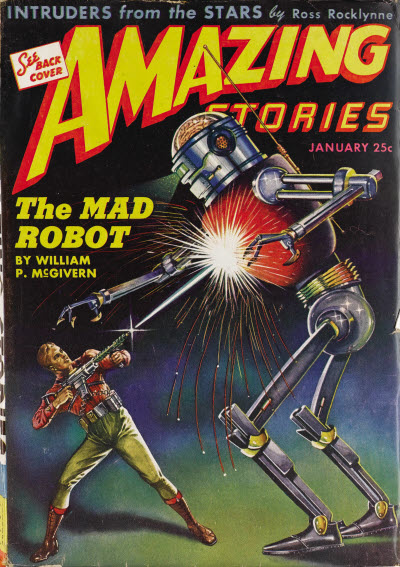
- “Intruders from the Stars” by Ross Rocklynne. From the January 1944 issue of Amazing Stories. Retro Hugo finalist for Best Novella. Rocklynne is one of those unexpected survivors from the pre-Campbell years, having made his debut in 1935 when he was just 22, and continuing up to the early ’50s before going on hiatus. (Like too many SF writers of his generation he became interested in Dianetics.) He eventually made a comeback in the late ’60s, and even appeared in Again, Dangerous Visions. Despite the Retro Hugo nomination, “Intruders from the Stars” has almost never been reprinted.
For the short story:
- “Daughter” by Philip José Farmer. From the Winter 1954 issue of Thrilling Wonder Stories. The SF market in the early ’50s was such that you could get your story published even if it was more daring than average, provided you accepted selling to one of the second-rate magazines. By 1954, Farmer had already become notorious for his novella “The Lovers,” about a sexually explicit (for the time) romance between an Earthman and an alien woman who is more bug-like than she appears. Early Farmer is pulpy in style, but he can be rather big and provocative with his ideas.
Hopefully you’ll read along with me.
 Science Fiction & Fantasy Remembrance