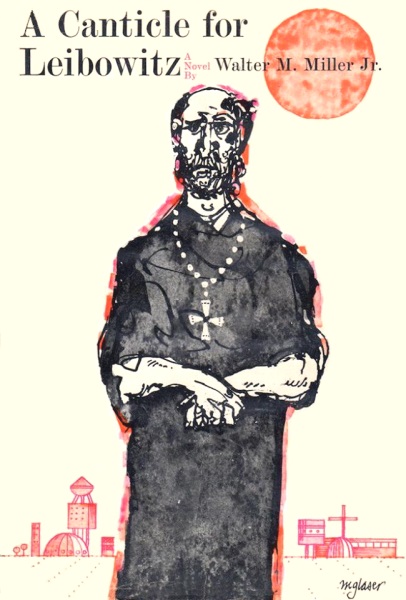
(A Canticle for Leibowitz. J. B. Lippincott. Cover by Milton Glaser.)
About a year ago I had read a couple books, which in hindsight I maybe should not have. But then maybe I should’ve. They were Mark Fisher’s Ghosts of My Life and Thomas Ligotti’s The Conspiracy Against the Human Race. You may know Fisher for his landmark book Capitalist Realism, and of course Ligotti is one of the most esteemed horror writers in living memory. Ghosts of My Life is the follow-up book to Capitalist Realism, being a collection of essays that have to do with (you guessed it) the bleakness of late capitalism, but with Fisher’s analyses of popular media in this context. It also has to do with Fisher’s long-standing battle with depression, which he ultimately lost. Ghosts of My Life was published in 2014, and Fisher committed suicide in 2017, around the same time as the publication of his third book, The Weird and the Eerie. Ligotti, thankfully, is still very much with us, although you might not assumed that since he hasn’t written much in the past decade or so. The Conspiracy Against the Human Race, published in 2010, was arguably Ligotti’s last big effort, and interestingly it’s both a nonfiction book and Ligotti’s single longest work. These are both books having to do, directly in the former case and more indirectly in the latter, with depression and pessimism, the former being more autobiographical and the latter being rather philosophical. I recommend them, but only if you’re the sort of person whose mindset is not easily influenced by media you interact with, otherwise they might be too much. I have to admit I’ve not been quite the same since then, but that has less to do with the books and more with the world around me as I was reading them.
These books don’t have much to do directly with science fiction, except for some media covered in Ghosts of My Life, but indirectly they relate to SF in that they speculate on the future—or rather the lack of it. There will, of course, strictly in how time moves, be “a future,” but Fisher and Ligotti posit that “the future,” subjectively, is shrinking, and that being alive in this present moment, we feel this strange paralysis, as if trapped in a quagmire or quicksand of in-the-moment horror. There’s future shock, and then there’s lack-of-future shock. There are psychological, political, and even ecological elements to this. Depending on where you live in the world, which can range in specificity from what continent to even what region of a certain country, you may be feeling any one or all three of these elements to varying degrees of severity. If you’re a farmer in India then you would be feeling, maybe to your despair, future-shrinking of the ecological kind. If you work customer service in the US then you’d be feeling future-shrinking of the psychological kind. Both of these are, of course, influenced by politics. There is always a political (capitalist) reason, although depending on your income and level of education you might not be aware of it, or you might be willfully ignorant of it. Someone living in an urban area in the so-called global north might be blissfully unaware that there is, in fact, a water crisis that’s been ravaging the global south, and which will at some point come for the rest of us. The air becomes just slightly more unclean with each passing year. We see record-breaking heat waves, whose record highs are then soon beat. There is (although I don’t think anyone wants to admit it) no liberal capitalist means of reversing climate catastrophe.
I don’t think it’s a coincidence that Fisher and Ligotti, in being keenly aware of the sticky situation humanity has made for itself, are both some flavor of socialist. Fisher posits that there was a point somewhere in the not-so-distant past where we could’ve prevented this while Ligotti thinks that, quite the contrary, the cards were always stacked against humanity, by virtue of the inherent curse (so Ligotti argues) of having been born in the first place. Science fiction doesn’t deal so much with philosophical pessimism, nor is it really much equipped to deal with that kind of philosophy, but it is equipped to deal with bad and lost futures. If anything science fiction is the genre which we can use to speculate on futures which can be prevented, or if not prevented then maybe coped with. The post-apocalypse, in which society as we know it has totally collapsed, leaving an orphaned and maybe savage humanity in its wake, is indeed a hallmark of the genre; and as Fisher famously said (in echoing Fredric Jameson), “It’s easier to imagine the end of the world than the end of capitalism.” There’s been no short of post-apocalyptic SF over the decades, although relatively little of it deals with a global machine which is slowly grinding down, rather than stopping suddenly. We do not live in a world that’s likely to experience “the deluge” of A Canticle for Leibowitz, or a civilization-ending virus (although the COVID-19 pandemic gave us a sort of test run for such a scenario) like in I Am Legend. SF during the Cold War reckoned with the possibility of the machine stopping because of nuclear devastation; and while this was plausible in the 1950s, it’s not so plausible now.
So the rules of the game have changed somewhat. Following the “end of history” in the years immediately after the Cold War ended, it was argued (most famously by Francis Fukuyama) that the world of politics had profoundly and irreversibly changed, that the dynamic between capitalism and Soviet-style socialism had come to an end. Since capitalism had come out the “winner,” it was clear (so these people argued) that such a system of money and government will be the status quo for the foreseeable future. In a sense this remains to be the case, even in [current year], given that socialism in China (having effectively replaced the Soviet Union on the world stage) does not provide an adequate alternative to capitalism—indeed it’s barely an alternative at all. During the Cold War there was no shortage of media (think Dr. Strangelove and the Modern English song “I Melt with You”) that posited the world might end because of The Bomb™, but now it’s far more likely the world might end because of the dollar. We live in a world where at the UN, time and again, the US and Israel have voted that food and shelter are not basic human rights. Even water has a price. Modern post-apocalyptic SF, if it’s to speak to readers now and in the future, should ideally reflect this change. There is a bit of a problem, naturally, in that such a kind of SF would presumably be made by those who are disillusioned with a system in which profit takes precedent over human lives. Anyone of pretty much any political leaning would say that of course nuclear war would be a bad thing, but far fewer would both express dissatisfaction with our system and also express a desire for an alternative.
Admittedly I haven’t read as much recent SF as I should, and even with this blog I’ve only been able to get a drop of water out of what has turned out to be a rather sizable pond. Very recently I reviewed Rebecca Campbell’s award-winning “An Important Failure,” which is about pursuing one’s lifelong passion in the midst of slow-burning environmental collapse. Most memorably I got to read Naomi Kritzer’s stunning (and surprisingly optimistic) “The Year Without Sunshine,” which tackles a plausible scenario in which a long-term and widespread power outage results in the formation of a makeshift socialist community. God knows how many novels and short stories are worth reading which cover similar ground, and that’s not even getting into the speculative articles. Not too many, I imagine, because, as I said, there would be fewer authors willing to tackle this subject in such a way; but at the same time there still probably isn’t enough, especially in perspectives from the global south. If we can’t even create the future then we can at least learn to live with the horrible, at times unbearable present. When we say the future is getting dimmer, we mean it’s getting bleaker, but also harder to perceive. Science fiction is not meant to be predictive, but it should tell us something about where we might be heading. I don’t where we’re heading myself. For all I know we might be heading nowhere, and fast. To paraphrase the opening line of Bernard Malamud’s The Assistant, it’s dark, even though night has ended.
(This post will be discussing spoilers for Carnival of Souls, including the twist ending, so if you haven’t seen the movie already I suggest you do just that before reading any further.)
I was supposed to write a review two goddamn days ago, except I realized that I had made a mistake and somehow gotten my own schedule wrong. I had read the first installment of Larry Niven and Jerry Pournelle’s Inferno, except I was actually supposed to read Arthur C. Clarke’s “Against the Fall of Night.” So, no review happened for the 3rd or the 4th. With any luck I’ll get around to Clarke’s novella sometime this month, and of course you can expect my review of Inferno (the first stretch) very soon, as in tomorrow or the day after. For now, let’s content ourselves with an editorial I had in mind for last month but couldn’t find the time or proper motivation for at the time, a not-review of a certain cult classic. Carnival of Souls is one of the best horror movies of the ’60s, almost in spite of itself, being made on a very low budget by a crew comprised of people who had not worked on a feature film before, and whose cast was similarly comprised of non-actors and people (including its lead actress) who would not have a future in movies. There’s a lot to say about it, but one can only say so much without giving away the whole plot, so it’s best to start at the ending and then slingshot back to the beginning. It’s that kind of movie.
Mary Henry is dead, to begin with. We start with a logo for Harcourt Productions, which I have to think was made specifically for this movie, since this is the only movie ever to be produced by this company. Before said logo can even fade to black we’re met with a jarring (maybe deliberate, maybe not) shift in the form of the opening scene: an impromptu drag race between two cars, one filled with dudes, the other filled with Mary and her gal pals. A few things are going on in this first scene, which seems to me an effort in disorienting the viewer. At the very beginning here, Mary doesn’t say anything, and she has kind of this quizzical expression on her face, as if she’s unsure about the race but is too shy to discourage her friends from taking part. Her skepticism is more than justified, since it takes all of about one minute for the race to go wrong, as the cars go across a rickety bridge and the girls’ car tips over into the river below. You would think the girls, if not killed from the impact, would at least drown, and you’d be right. A rescue team comes in, more to salvage the car than anything, and if you pay attention to the dialogue you can hear that they’ve been looking for three hours. Obviously nobody can be alive still.
Except for Mary—or so it seems.
(The film’s director as a ghostly visitor.)
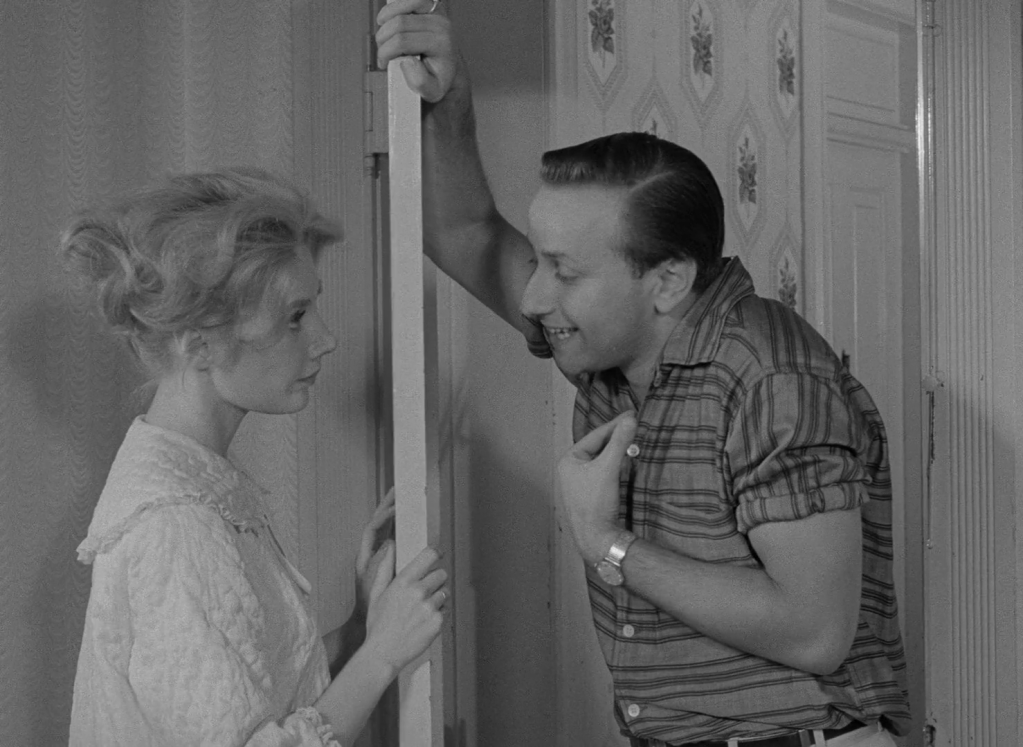
Wet from the river and caked with mud, Mary walks dizzily out of the water, as if some kind of ghoul emerging from a swamp, quite miraculously to everyone around her. It’s telling that when asked about what happened Mary can only say, “I don’t remember.” It’s her first line of dialogue, and in a striking formal decision it’s spoken offscreen. From this scene to the next there’s an unexplainable gap in time, and it’s only then that we see Mary talk for the first time. Having apparently recovered from the accident, Mary takes up a job as an organist for a church in Utah, despite being irreligious herself. The man at the organ factory doesn’t mind Mary’s disposition much, but the minister at the church where she’ll be working is more concerned. (We know that this must take place in fantasy land because somehow Mary is able to afford rent with a non-job like “church organist.”) Interestingly, the only woman of note that Mary interacts with throughout the rest of the movie is Mrs. Thomas, her landlady; otherwise she’s beholden to a handful of male figures. These men fall on a spectrum that ranges from uselessly benevolent to openly hostile, but the point is that they either try and fail to help her or are looking to make her day worse. The worst of these might be John, the neighbor in the apartment building, who unsubtly creeps on Mary and tries to get her in his bed at all costs. If this movie took place in modern times, John would be an incel and/or one of those guys who follows macho influencers for “dating advice.”
(Mary and a typically pushy John.)
Let’s take a step back to talk about the acting and directing, since this is a movie that does a lot with only a few resources, and also where a lot happens despite clocking in at just under 80 minutes. The director, Herk Harvey, had experience as a filmmaker from making PSA-type shorts about urban and industrial areas, with Carnival of Souls being his first and only narrative feature. He directed, produced, worked on the script with John Clifford, and even plays a major role as an actor here, as a pale-skinned ghostly man who stalks Mary throughout the film. Like I said earlier, the people acting in Carnival of Souls have never been in a movie before, with maybe an exception or two in there. This is quite a surprise with Candace Hilligoss as Mary, since she gives unquestionably one of the defining lead performances of ’60s horror, and her presence gives one the impression that she could’ve been in a hundred movies. The way she often stares off into the distance, dissociating, or sometimes how she cranes her neck like a flightless bird, gives one the impression of Mary being like a confused animal. The closest reference point I can think of with Hilligoss’s performance is Elsa Lanchester’s performance as the bride in Bride of Frankenstein, where similarly Lanchester plays a worried and at times frightened animal in human skin. Lanchester as the bride only shows up for a few minutes in her movie, nevertheless leaving a mark on people’s imaginations; but luckily for us we have a whole movie to spend with Hilligoss as Mary.
Harvey and his crew shot on location in Utah, on a budget of just over $30,000 in 1962 money, and since they obviously couldn’t afford sets they shot the scenes of the titular carnival at the Saltair Pavilion (specifically Saltair II), a resort that hit hard times during the Great Depression and which wss finally abandoned a few years before Carnival of Souls was shot. Securing a permit for shooting at Saltair II was cheap and easy. There are a few scenes set in urban locations, namely Salt Lake City, but the most memorable stuff in this movie has to do with the shabby apartment building Mary lives in and the industrial shithole just out her window, namely the abandoned carnival that haunts her dreams. The lack of sets, combined with harsh lighting and industrial locales, gives one the feeling that maybe David Lynch had taken notes from this movie during the long process of making Eraserhead. Mary, being a ghost unbeknownst to herself, lives in a world that itself comes off as ghostly. Of course, it is not the abandoned carnival which turns out to be haunted, but rather Mary. I have a soft spot for ghost stories in which a person instead of a place is haunted, either because the person is a member of the undead or attracts the undead like a magnet. Harvey and Clifford took inspiration from the Ambrose Bierce story “An Occurrence at Owl Creek Bridge,” which (spoilers for a short story that’s over a century old) is similarly about someone who seemingly survives being killed, only to find out afterward that they are a ghost. So we have a ghost who unwittingly haunts people, and who herself is haunted by a dead (abandoned) place. I know it can be a little hard to believe, given its cheap and grimy aesthetics, but this is an intelligently crafted film.
(An exterior shot of Saltair II.)
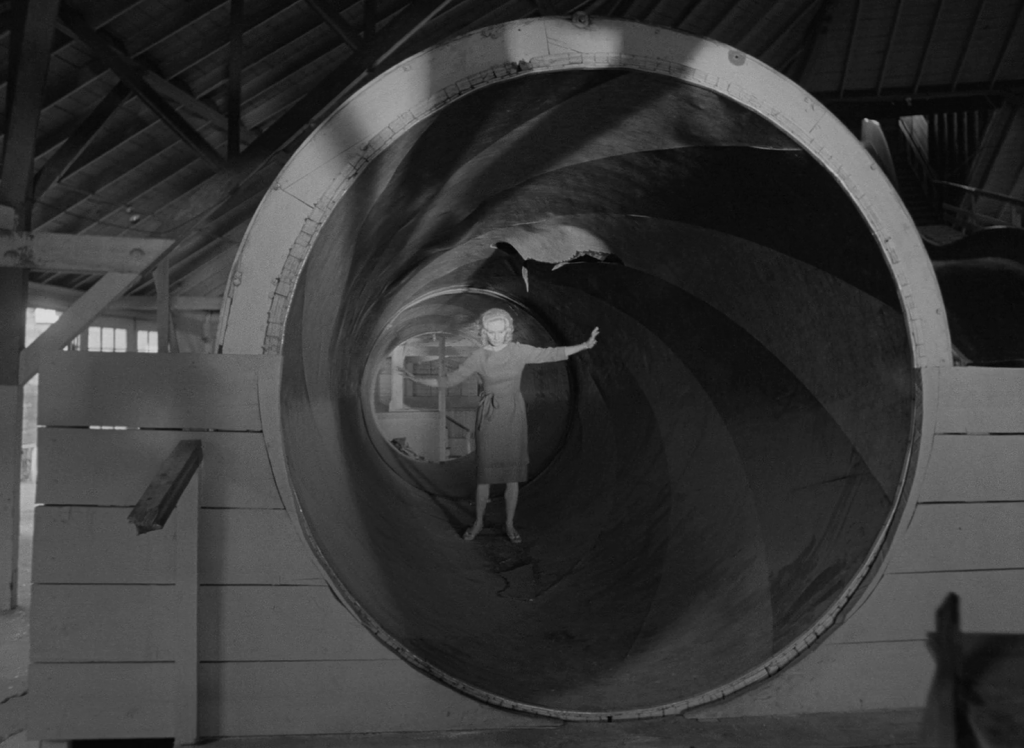
If taken literally, Carnival of Souls is a spooky story about a woman who thinks she has cheated death, but if you try even slightly you’ll find that this is a resonant and prescient study of a woman suffering from some undiagnosed mental illness, trying to live in a world dominated by “normal” people. It is at the very least explicitly about a woman who, following her accident, lives in a permanent state of disconnect from the rest of humanity, a kind of switch being flipped in her brain which she may or may not be able to flip back the other way. It’s ambiguous if Mary’s unusual mental state is something she had before the accident or if it’s brought on from trauma, but regardless she acts as if being around people for longer than short controlled bursts is a burden on her—to other people’s dismay. As the minister says during their first meeting, “But my dear, you cannot live in isolation from the human race, you know.” At first Mary is content to live on her own, with her crummy job and not having any friends, but eventually the loneliness does get to her; but at the same time she has some unwanted company, with John from the side of the living and the pale man from that of the dead. She quite literally phases in and out of reality at a few points in the movie, where people can’t see or hear her and she fully becomes a ghost. She’s stuck in a liminal position, between wanting but being unable to socialize with the living while also being scared of the ghosts she sees dancing at the carnival at night. During the daytime the carnival just a normal industrial area, totally empty of human life; but while there’s no ghost who can torment her here during the day, it’s eerily missing that human touch. It shouldn’t come as a surprise that the sequence at the halfway point of the movie, where Mary explores Saltair II, might be my favorite.
(Mary in a huge pipe, in one of the more memorable shots.)
The most helpful character is Dr. Samuels, a psychologist who just so happens to run into Mary during one of her daytime scares. (How is she paying for this? Is she paying for it? Does Samuels put their first session on the house? We don’t ask these questions when watching a movie.) The best thing he does is allow Mary to articulate her state of mind, especially her strange (to other characters) indifference to intimacy with those of the opposite sex. The language wasn’t around at the time, but the idea is that Mary is queer, by virtue of being asexual and possibly also aromantic. This quirk with her sexuality is treated as unusual, but not harmful, which for a movie of this vintage is pretty forward-thinking. Indeed what modern viewers might appreciate most about Carnival of Souls, more than what it’s able to accomplish on a tight budget and its capacity for genuine chills, is its sympathetic depiction of someone who is both mentally ill and outside the realm of cisgender-heterosexual normality. We have a complex figure with Mary, helped by Hilligoss’s nuanced performance, a woman who is tormented by men who either shun her or try to coerce her into unwanted sex—and that’s not even going into the literal ghouls following her. The ending of the movie is obviously meant to be taken as eerie, but Mary’s ultimate fate, as a ghost who gets dragged screaming into the afterlife, also has a tragic aspect. The “dead all along” twist has arguably been done with more elegance in one or two other movies, but the inevitability of it in Carnival of Souls is crushing.
Carnival of Souls is not a perfect movie by any means; on the contrary it’s pretty rough around the edges. Actually the whole movie is rough. The lighting is amateurish at times, the acting is a mixed bag (understandably), there are a few shots I can think of that could’ve used another take, and of course someone watching this today would find the twist to be pretty obvious—although this was not so much the case back then. As typically goes with B-movies, it languished in obscurity for a couple decades, until it was revived thanks to late-night TV airings and being discovered by the international arthouse crowd. Roger Ebert wrote a positive review of it in 1989. It’s now in the Criterion Collection. I’ve seen three or four times myself over the years, and each time I’ve found more small and subtle things about it to like. This is a pulpy exploration of mental illness via supernatural horror, which nowadays feels almost overdone as one of the genre’s many modes. But trust me, it’s a good one.
(Dark Forces. Cover by One Plus One Studio. The Viking Press, 1980.)
Something I don’t typically get to write about here is the topic of original anthologies, which is to say anthologies of short fiction comprised of material never before published. Of course, said fiction could later be reprinted in magazines, as has happened many times, but the implied purpose of an original anthology is fundamentally different from that of its sibling, the reprint anthology. Both involve similar work, with an editor trying to procure stories from authors or authors’ estates, as well as reading dozens upon dozens of stories, most of which end up not being worth printing. There’s the question of how many words/pages can be crammed between two covers. There’s the question of pricing, because an anthology will pretty much always be more expensive than a single magazine issue. Nowadays anthologies and magazines fill respective niches and try not to step on each other’s toes, since it’s no longer a problem of what can be printed in magazines, whereas in the days before Fortnite and even the internet there was the (true, at least up to a point) conventional narrative that editors and publishers of original anthologies were allowed to be more risqué than their magazine counterparts.
When Dangerous Visions hit shelves in 1967, its key appeal (at least for American readers) was that it was jam-packed with stories that could not be published in magazines of the era, on account of being too edgy, experimental, etc. You had a thick book (over 500 pages) from a mainstream publisher (Doubleday) with an all-star cast of authors, all of whom at least claimed to be putting forth their most mind-bending and transgressive material yet. You had such top talents as Philip K. Dick, John Brunner, Samuel R. Delany, Roger Zelazny, and so on, and commissioning this stuff could not have been cheap. The gambit paid off in spades, though. Dangerous Visions sold very well, remains in print to this day (a rarity for an anthology, especially an original one), and it even won a special Hugo. That Harlan Ellison, the editor, never quite recaptured that lightning, is beside the point. Not every story was a winner, but Dangerous Visions was the right book that entered the market at just the right time, serving as a harbinger of the New Wave. Just as importantly, publishers realized that there was some money to be made with original anthologies—maybe not on the same scale as Dangerous Visions, but rather cheap paperbacks of maybe half the size and half the number of stories; and maybe these books wouldn’t try to reinvent the wheel like their inspiration did, but instead took on more humble mission statements. You can have editors who are maybe not as discerning as Ellison was, who would also get the work done in a timelier fashion. It was a matter of quantity over quality.
There a meteor shower, or maybe a oversaturation, of original paperback anthologies from the late ’60s through much of the ’70s, until that particular bubble burst. These were books that often focused on science fiction, rather than fantasy or horror, although there was a trickle-down effect with those other genres. Still, standards had dripped, in large part (although he was not the sole offender) due to Roger Elwood’s extremely prolific tenure as editor for a few different publishers; the number of anthologies he edited between 1972 and 1976 alone is staggering. While he was able to procure work from big names, this work ran a good chance of being mid- to low-tier stuff that would’ve likely stayed on the shelf. A major exception was Epoch, which Elwood co-edited with Robert Silverberg, a lavish and well-received book, placing first in the Locus poll that year; but this is indeed an exception that proves the rule. By the end of the ’70s the market for original anthologies had inevitably gone into decline.
Meanwhile, in the waning days of the original anthology, Kirby McCauley made his living as a New York-based literary agent with some big talent on his hands. By 1980 he had already edited one well-received original horror anthology, with 1976’s Frights, which won the World Fantasy Award for Best Anthology/Collection. Frights was a hardcover original from St. Martin’s Press with a nice wraparound cover, but while McCauley procured stories by some of the top talent in horror at the time, including Ramsey Campbell and Robert Aickman, he found that he wanted to go one step further. The introduction for Dark Forces makes McCauley’s intentions with this bulky new anthology clear. McCauley’s inspiration was twofold, between August Derleth’s work as head of Arkham House and wanting to make a horror-themed counterpart to Dangerous Visions. Arkham House in its prime printed hardcover volumes with exquisite covers, all these being focused on horror, SF, and dark fantasy, from reprints of H. P. Lovecraft’s work to collections of never-before-published fiction by fresh young writers. McCauley grew up on books of horror that Derleth had edited, so in that way he overtly pays tribute to a fallen (Derleth had died in 1971) master of the field. The relationship that Dark Forces has with Dangerous Visions is more complicated, however, as there are a few major differences in how these books’ respective editors went about their businesses.
Consider that when Harlan Ellison edited Dangerous Visions, a process that took about two years, he was coming at it from the perspective of a reasonably successful author, which is to say he was a writer, first and foremost, as opposed to an editor or agent. This lack of experience with editing eventually came back to bite Ellison in the ass, with the shitshow that was the making of Again, Dangerous Visions, and far more infamously with The Last Dangerous Visions; but in the ’60s, it was novel for a writer with practically no editing experience to work with his fellow writers in such a way. Conversely, McCauley had already proven his ability with an original anthology, plus a couple reprint anthologies, and he was enough of a professional that he understood how to work with writers as people, and not just as practitioners of a certain craft. In the introduction he recounts his encouraging relationship with Stephen King while the latter wrote (first as a novelette, then ballooning into a long novella) The Mist. He also recounts having a get-together with Isaac Bashevis Singer in the latter’s apartment (they were both New Yorkers, and thus there had to be some inherent sense of kinship there), just months before Singer won the Nobel Prize for Literature. King and Singer are radically different in just about every way, in work ethic, style, and worldview, the former a flaming-liberal New Englander and the latter a conservative Polish-Jewish immigrant; yet McCauley makes it appear easy to work with both.
You may have noticed also that Singer is not a name that comes up much, if at all, in horror circles, because while a good portion of his fiction involves the supernatural, he’s not a “horror writer.” Thus we have another big difference between Dangerous Visions and Dark Forces, because while Ellison reached out to everyone in the SF field he could get his hands on, McCauley reached outside the field of horror and dark fantasy, the result being that there are authors in Dark Forces who are not primarily horror writers, and there are even a few who are known to be “literary” types. It’s not so unusual today, but back in 1980 it was a novelty for acclaimed novelist (and prolific tweeter) Joyce Carol Oates to appear in a horror anthology. You have some of the usual suspects of horror from that period (King, Campbell, even Robert Bloch late in his career, etc.), but you also have a really left-field choice like Davis Grubb, who was known at the time as author of The Night of the Hunter. You have writers like Edward Bryant and Joe Haldeman who, while they have sometimes written horror, are much more known for writing science fiction. You have a surprise appearance from Ray Bradbury, who by 1980 had long since entered the literary mainstream, and who also didn’t write much of anything at this point in his career. One can have gripes with who made it in and especially who didn’t (there are only two female authors here, Oates and Lisa Tuttle), but I can readily believe McCauley when he says he tried getting stories from everyone.
It’s also worth mentioning that McCauley didn’t construct Dark Forces with the intention of it being a boundary-pusher for the field of horror (he even explicitly says he didn’t want it to be “as revolutionary” as Dangerous Visions), and this ends up being to its benefit. True, there are a few stories here that may have been transgressive for 1980 (I’m thinking of Theodore Sturgeon’s tale of venereal agony, “Vengeance Is.,” and if I had a nickel for every “pregnant man” story in this book, I would have two nickels), but being extra-gross or what have you was not the name of the game. What might be Dark Forces‘s secret weapon and the biggest reason for its having aged pretty well is how its contents cover pretty close to the whole span of short horror literature up to circa 1980. While we don’t have much dark fantasy a la Robert E. Howard’s weird Conan stories, or the “extreme” horror that would start making the rounds in the proceeding years, there’s a great deal of variety in these 500 pages. We have traditional ghost stories such as Singer’s “The Enemy,” a rendering of the Sweeny Todd narrative with Robert Aickman’s “Mark Ingestre: The Customer’s Tale,” a cautionary tale of one unlucky busybody and a nest of vampiric creatures with Campbell’s “The Brood,” some rural “redneck” horror with Grubb and Manly Wade Wellman’s stories, and so on. There are also a couple non-supernatural tales of terror, as with Oates’s “The Bingo Master” (a personal fave of mine) and Bloch’s “The Night Before Christmas.” There are even a couple stories that fall into a certain genre that’s become rare in recent decades, that being the Christian allegory, with Gene Wolfe’s “The Detective of Dreams” and Russell Kirk’s “The Peculiar Demesne.”
And then there’s The Mist.
A story that “gets away” from the author, as it were, can sometimes be a bloated abomination, but in the case of The Mist we have one of King’s best and most tightly wound stories. Indeed King’s bad habits are pretty much absent here, and the fact that he’s able to reconcile ’50s B-movie monster action with genuine eeriness shows the level of craftmanship he’s capable of when he stops fucking around and focuses on what really matters. While the movie adaptation has a radically different ending (one that many, including King himself, prefer), I do have a soft spot for the novella’s ambiguity and cautious optimism. It was a simple choice for McCauley to put the longest story last, making The Mist the grand finale of Dark Forces, but it’s an example of how sometimes the simplest choice is also the best. Unlike the King collection Skeleton Crew, which sees The Mist as the protracted opening salvo, its position as the closing story of Dark Forces gives one the impression that the whole book had been building up to this moment. It was risky to include such a long story here (it takes up about 1/4 of the book), since if it failed then it would majorly tarnish what is otherwise a good read and leave a sour taste in the reader’s mouth; thankfully The Mist was a success, and has become one of King’s most beloved stories.
Dangerous Visions has, as far as I can tell, never gone out of print, although sadly the same can’t be said for Dark Forces. Anthologies, and especially original anthologies, have a bad tendency to have one or maybe two print runs, then go out of stock until the end of time. The only time Dark Forces has been reprinted this century was a super-expensive limited edition from Lonely Road Books in 2007. Bantam apparently did a paperback printing of Dark Forces in the early ’80s, but otherwise it’s only ever been published in hardcover in the US. It could be that Dangerous Visions was such a monolith at the time of its release, and has gone down as such an important entry in SF history, that its status (despite understandable attempts to knock it down a peg, especially as it continues to show its age more and more) has been more or less secured for the foreseeable future. Dark Forces is arguably a better book and set a better precedent (it served as an inspiration for Clive Barker to get into writing horror, and as we all know, the rest of that is history), but it also now reads, with hindsight, as one of the last big gasps for short fiction as a significant player in the realm of horror. Starting in the ’70s, both novels and movies started taking larger slices out of the pie in terms of what “mattered” for innovation and trends in horror, a field that historically largely hinged on the short story and novella. There would be major practicioners of the short horror story (see Barker, also Thomas Ligotti) to come after 1980, but Dark Forces celebrated (again, with hindsight) the short story as a form with authors who are, by and large, happiest and at their best when writing short stories and novellas.
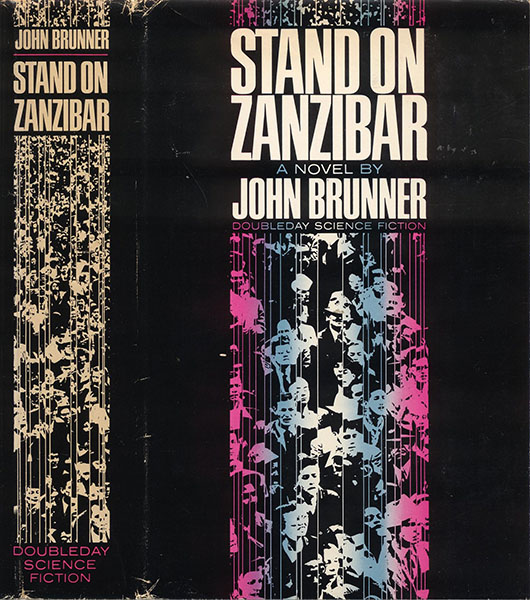
(Stand on Zanzibar. Cover by S. A. Summit, Inc. Doubleday, 1968.)
I’ve been in a bit of a rut recently, or rather I’m facing another bout of depression and lethargy when it comes to writing. I considered tackling something serious, but while we will no doubt get to a serious topic one of these days, such a thing requires more time and effort than what I’m currently able to afford. It’s also been a few months since I last did an Observatory piece. I have to admit I’ve slackened a bit when it came to this department. As such, you can think of this editorial as a warm-up exercise; if nothing else it should provide some food for thought. It’s actually a topic that’s been lingering in the back of my mind for a long time now, as like one of those fun little “what if” scenarios that you would not seriously contemplate, but rather would return to occasionally and twist and turn like a safety valve in your mind. It’s something to do as a distraction while there are some serious problems afoot.
I write about what I think of as the big three fantastic or unrealistic genres, those being science fiction, fantasy, and horror, as opposed to genres that historically rubbed shoulders with realism, namely Westerns and detective fiction. Nowadays I tend to read realistic or “literary” fiction (with some nonfiction thrown in there) in my free time a lot more often than genre fiction, in part because I wanna keep my efforts as a reviewer/blogger at least somewhat segregated from my efforts purely as a reader (I know people who review genre fiction for a living who, because of the time and effort required for the job, barely read anything except genre fiction, and that’s not the way I would like to live), but also I must confess I do often enjoy reading literary fiction more than genre fiction. Of course, the line between those two can be pretty blurry. A literary novel can have genre elements, and as you know I’ve reviewed works by authors on this very site who are typically found in literary and not genre spaces: Graham Greene, Robert Graves, G. K. Chesterton, to name a few. You have people like Jack London who are known primarily for their literary fiction, but who also wrote a good deal of genre fiction; and because for some the term “science fiction” hadn’t been coined yet, there was no effort to separate literary from genre. How do you put something in the SF ghetto if “SF” is not a label in your lexicon? But now that the label does exist, and has existed for almost a century at this point, some lines have been drawn in the sand.
Realistic or literary fiction is really an umbrella that could encompass practically every other genre, but only rarely does a work of genre fiction find its way into the literary canon; and in the case of SF, the number of SF works to worm their way into literary spaces is very small. You have 1984, Brave New World, Fahrenheit 451 and The Martian Chronicles, Frankenstein, the early novels and stories of H. G. Wells, The Handmaid’s Tale, and more recently the works of Octavia E. Butler. With the notable exception of Butler, whose reputation has been heightened to almost an extreme in the years following her death, you may notice that the SF works to have entered the so-called literary canon are the usual suspects. Also, with the exception of maybe Frankenstein, these are works that are far more revered for their historical and/or societal importance than for their literary merits. SF that enters literary spaces has historically been treated as more useful than beautiful, as more of a societal good than as an aesthetic achivement. There’s also the problem that SF, at its core, its unrealistic, which is to say it does not and cannot depict the highs and lows of society as they exist in the current year; it can extrapolate on society as it currently exists (and often does), but that’s not quite the same thing. Meanwhile a realistic novel typically tries to capture some facet (or maybe multiple facets) of current (or past, if it’s a historical novel) society. But as I said, a realistic novel can have traces of SF or even fantasy (we tend to call examples of the latter “magic realism,” which rather smacks of whimsy, but it’ll have to do) in its blood, but the genre element is not the focal point.
This brings us to the question of the Great Novel, by which I mean what is typically considered a country’s defining literary achievement. The Great Novel, for a given country or culture, is a work which ideally, through scope and attention to detail, captures a certain time and place with as much fullness as the author could manage. The Great Russian Novel is War and Peace, the Great French Novel is Les Misérables, the Great English novel is Middlemarch or Vanity Fair, and even Ireland has its clearly designated Great Novel with Ulysses. The Great American Novel is more up for debate, to the point where Wikipedia has a rather long list of candidates: to name some (but not all) we have Moby-Dick, The Great Gatsby, To Kill a Mockingbird, Gravity’s Rainbow, Blood Meridian, Beloved, and Underworld. While they vary greatly in length, subject matter, and perspective, it’s easy enough to understand why each of these novels would be a candidate, since they aim to be nothing less than a definitive look at a certain time and place with a certain point of view. Moby-Dick is “the definitive” novel on whaling and American port towns, The Great Gatsby is “the definitive” novel on the excesses and follies of the 1920s, Beloved is “the definitive” novel on black Americans’ traumatic relationship with chattel slavery, and so on. Of course I use quotation marks because these novels (except maybe Moby-Dick, which really did seem to close the door on whaling culture as far as representation in fiction goes) are by no means the only or ultimate statements on their respective subject matter. Also, a novel need not necessarily be of a certain length (The Great Gatsby is a mere 180 pages, after all) to tackle its subject properly, although length does help. The point is that these novels, in both scope and substance, give one an impression of a whole place or culture over a certain period of time.
In genre SF, there didn’t seem to be any concern about writing The Great SF Novel up until at least the 1950s, which makes sense considering the market restrictions of the time (the average SF novel at this time clocked in at about 200 pages or so) and the fact that SF criticism was in its infancy. The field, by the end of the ’50s, had barely crawled out of the primordial slime that was the height of the Campbell era, in which low-paying genre magazines dominated and getting published in hardcover or even in a mainstream magazine was considered the highwater mark for one’s career. In 1950, to be an SF writer and have your story printed in The Saturday Evening Post was basically the most you could hope for. But by the ’60s there was clearly a change in the air, perhaps incentivized by the magazine market shrinking; there were only a half-dozen or so genre magazines active in the US by 1960, such that it would no longer have been viable to make a living just writing short fiction at a mile a minute. Authors turned to writing novels, and it didn’t take long for there to not only be more novels as original paperback releases (and also hardcover), but some of these novels were quite big for the time. Even in its original cut-down form, Stranger in a Strange Land clocked in at just over 400 pages, which would’ve been nigh unthinkable just five years earlier. To think, 400 pages that’s mostly just people talking about sex, religion, cannibalism, and whatnot. The usual. The gambit paid off, though, with Robert Heinlein winning a Hugo for it and with Stranger in a Strange Land becoming one of the most popular SF novels of the ’60s, even gaining a mainstream readership. That Stranger is a huge and overwhelming book, tackling several topics with reckless abandon and often in exhaustive detail, did nothing to halt its sales figures.
(Stranger in a Strange Land. Cover by Ben Feder. G. P. Putnam’s Sons, 1961.)
Stranger was not Heinlein’s first mainstream success, for he already had several stories published in The Saturday Evening Post and a whole series of juveniles in a deal with Scribner’s, but Stranger (published by G. P. Putnam’s Sons) showed that an SF novel didn’t have to be just about one or two things, but could in fact have an almost encyclopedic thoroughness while still being a bestseller. In other words, the dam broke. The impact was not immediate, by throughout the ’60s there came a laxing attitude on publishers’ parts towards long and epic SF novels—some of which even threatened to have literary ambitions. I was doing a cursory search of essays and blog posts done on the idea of the Great Science Fiction Novel, and I basically found nothing, at least so far, which is weird to me because it’s so obvious that some authors in the ’60s going forward clearly wanted to write such a thing, whereas no such ambition seemed to exist beforehand. This is not to say there aren’t great SF novels to come out of the ’50s and early, quite the contrary, but typically the great SF novels from prior to the ’60s had scope or depth—not both. Meanwhile, by the end of the ’60s we had gotten Dune, Stand on Zanzibar, The Man in the High Castle, The Left Hand of Darkness, Heinlein’s Stranger in a Strange Land and The Moon Is a Harsh Mistress, and a few others I could name. Dune was so big that it originally appeared at two separate serials, totally eight installments, and it certainly feels like it. Frank Herbert famously had to go to Chilton to have Dune published in book form, with Chilton not being an SF or even normally a fiction publisher—not that this stopped Dune from selling enormously well. Dune, even being the first entry of a wide-spanning series, is a mind-numbing study of a fictional planet and its ecology, and how mankind might be able to live in such a hostile environment. Herbert’s novel was, at the time of its publication, the most ambitious and plausible hard SF (despite nowadays being marketed as akin to fantasy) novel on the market.
Did Heinlein and Herbert intend to write the Great Science Fiction Novel at the time? I’m not sure. I can think of at least one person who did, though. Clocking in at just under 600 pages, not too crazy by today’s standards but a real mammoth of a book for SF in 1968, John Brunner’s Stand on Zanzibar consciously takes cues from Modernist literature, to the point where it can be considered a late Modernist novel as much as an SF novel. Brunner was known for quantity rather than quality, even writing a few short low-effort novels during the time that he was working on Stand on Zanzibar, which probably made this novel’s scope and complexity come to most if not all readers as a shock. Here we’re presented with a 2010 that is both in some ways similar and dissimilar from the 2010 we actually lived through, in which the world is overpopulated, people are overstimulated, there seem to be mass shootings and terrorist threats every week, there are computers small enough to fit comfortably in one’s home, and it seems to also be the only SF novel of the era to not assume that the Soviet Union would survive into the 21st century. There’s a main storyline, but it’s interspersed with vignettes featuring unrelated characters, as well as advertisements and news stories that give us an idea of what is going on this strange new world. It’s an incredible read, if also exhausting and rather cold-hearted by design. Brunner really transcended himself with it, and the effort paid off—to an extent. Stand on Zanzibar won a Hugo, and remains in print to this day, but was not exactly a bestseller. Brunner wrote a handful of big novels about big topics, including The Jagged Orbit and The Shockwave Rider, but the effort he put into these novels did not result in sales figures to match. Ironically the person who at the time strove the hardest to write an all-encompassing all-consuming SF novel on par with a Moby-Dick or a Ulysses garnered inadequate reception for it, compared to what Heinlein and Herbert were able to accomplish.
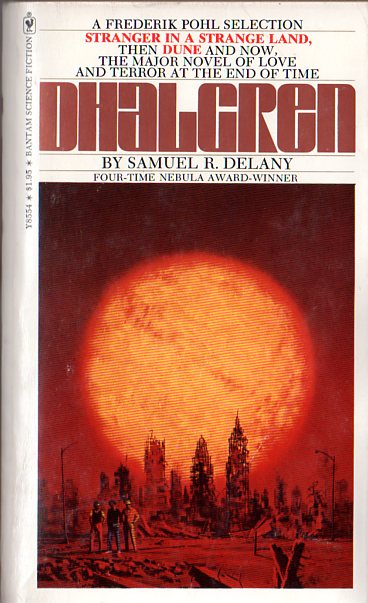
The average SF novel remained compact, on average, for a while, but you still got outliers (or abberations, if you hate long novels) with varying degrees of commercial success, not to mention success as attempts at being the Great Science Fiction Novel. The ’70s saw what might be the closest we’ve gotten to a synthesis between the Great American Novel and the Great Science Fiction Novel, in at least two instances: Gravity’s Rainbow and Dhalgren. Thomas Pynchon and Samuel R. Delany, the authors of these respective novels, were borderline prodigies of the form (Delany was 19 when he wrote his first novel), are both of the silent generation, both owing a clear debt to the Modernists, and both being arguably the most fit for taking on the task of writing an enormous and challenging literary novel that could also be taken as science fiction.
(Dhalgren. Cover by Dean Ellis. Bantam Books, 1975.)
Gravity’s Rainbow is… a lot of things. There’s something about a big mind-controlled octopus. Something about a young American having been trained from infancy to anticipate the locations of rocket strikes with his penis. Something about the end and immediate aftermath of World War II in Europe. Something about the extinction of the dodo. There’s a young witch (she says she’s a witch) in training. Totally mind-boggling novel, in that it’s a war novel, a kind of perverted nightmare, a stage musical, and also science fiction. It’s also 760 pages, published by The Viking Press, and was set to win (but was denied) the Pulitzer Prize. It was even nominated for the Nebula for Best Novel, but lost to Rendezvous with Rama. Then there’s Dhalgren, which in hindsight could be argued as the last big attempt at marrying genre SF with “high-brow” literary fiction. Delany pays homage to James Joyce pretty blatantly from the outset, to make it clear to us that this is a Serious™ novel. Well, it’s not that serious. Dhalgren is sort of a hangout novel, in which not much happens, but rather in which the isolated city of Bellona comes alive with quite a few memorable characters. As with Gravity’s Rainbow there’s a pornographic element to it. It’s also a goddamn beast in terms of length, clocking in at 879 pages in the original Bantam paperback edition. When Dhalgren came out in 1975, there wasn’t anything else quite like it in the field, and there also wouldn’t be anything like it thereafter. These two novels sold well, but got extremely mixed reactions, with Dhalgren also being up for a Nebula but losing to the relatively short and conventional (but very good, let’s be clear here) The Forever War.
Folks have typically considered the Nebula to be the writer’s award, which makes sense since it’s members of the SFWA basically voting on each other’s work, and professional authors are presumably more literarily knowledgable than readers. The Nebula going to Rendezvous with Rama and The Forever War over Gravity’s Rainbow and Dhalgren respectively however implies an aversion to works that might be considered too literary. Indeed, in the world of SF, much of the ’70s would be spent on doing away with much of both the good and bad parts of the New Wave while also co-opting just enough of it to give the pages of Analog a PG-13 and occasionally even an R-rated level of spiciness. The New Wave gave us some really bad literature; actually I would say 90% of New Wave SF was bad, but then, to paraphrase Theodore Sturgeon, 90% of everything is bad. At the same time, the New Wave years saw a collective sentiment that great SF that should also be Great Literature™, which is how we even got something like Stand on Zanzibar, or Delany’s earlier novels. The backlash to the New Wave caused SF to swerve in a retrograde direction. As Jonathan Lethem puts it in his article, “The Squandered Promise of Science Fiction”:
Fearing the loss of a distinctive oppositional identity, and bitter over a lack of access to the ivory tower, SF took a step backward, away from its broadest literary aspirations. Not that SF of brilliance wasn’t written in the years following [the ’60s], but with a few key exceptions it was overwhelmed on the shelves (and award ballots) by a reactionary SF as artistically dire as it was comfortingly familiar.
This is not to say great SF novels weren’t published after Dhalgren, obviously, or indeed after The Forever War, which may be the field’s equivalent of The Red Badge of Courage. But at least for a while after, it’d be hard to think of an SF novel that tries even inadvertently to be the Great Science Fiction Novel, which is to say a novel which is both unquestionably SFnal and which also depicts a fullness of human existence as seen in the likes of Stand on Zanzibar and even The Moon Is a Harsh Mistress. There’s Gene Wolfe’s The Book of the New Sun, although it’s a setting that can be easily confused for fantasy—a mix of SF and fantasy that Wolfe deliberately invokes. There’s Neuromancer, which is a sprawling mix of SF and detective fiction, but which nowadays strikes me and some other folks as pretty close to unreadable. There’s Cyteen, which is quite large and even won a Hugo, but I have to admit I’ve not gotten around to it yet. If there’s something like a modern candidate for the Great Science Fiction Novel the problem is that either the novel leans too heavily into SFnal territory or it’s simply a literary novel that happens to have a pinch of SF about it. I could be missing something, of course, and I’d be curious to see if anyone can bring up candidates for the Great Science Fiction Novel post-1975. I don’t read that much recent SF, and even for the sake of my blog I only tackle something like that occasionally; you could say I’m biased in favor of the classics.
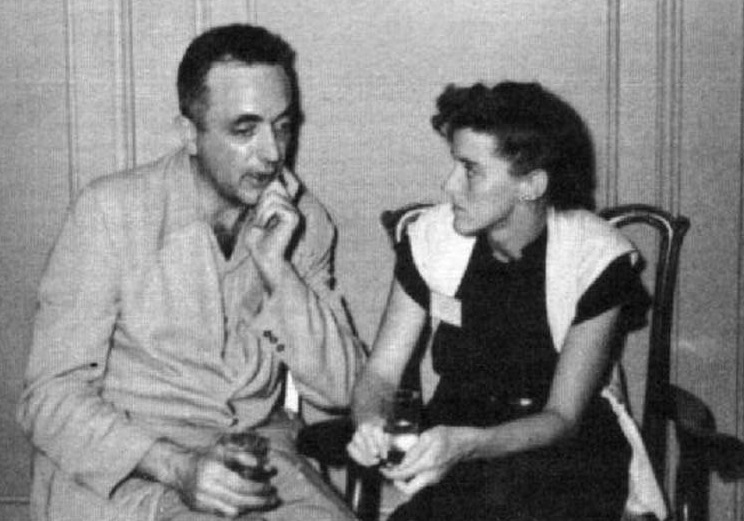
(Fritz Leiber and Katherine MacLean at the 1952 Worldcon.)
When you read and review old science fiction as a hobby, at some point you have to ask a certain question: “How come so many of these authors from fifty to a hundred years ago, who if fan letters are to be believed were seen as giants in their day, are obscure now?” This inevitably leads to some really boring follow-up questions, such as “What belongs in the science fiction literary canon?” and “Can there even exist such a canon in the first place?” These are boring questions in themselves, if only because they’re so old that the questions have crow’s feet and grey hairs, but they do at least imply something about SF literature that is arguably unique to it, which is that, far more than with fantasy or horror, the SF “canon” is fluid. There are exceptions, but even these exceptions (which I’ll get into) are far from immune to criticism, especially from younger fans, to the point where even the most rock-solid canonical author’s reputation could erode to the point where they’re, at best, considered something of a sore subject. We actually see this happening with Robert Heinlein and Isaac Asimov in real time, and I think it’s only a matter of time before Arthur C. Clarke’s reputation takes a serious hit—more for what seem to be a few skeletons in his closet than the importance of his writing. The reality is that the people (well, usually men) most influential in the development of SF as its own genre are only human, which is a diplomatic way of saying that these people have issues. That SF fandom has been, in all honesty, more proactive in recent years about how it should deal with canonical works and authors than some others is a testament to the fandom’s—and by extension the genre’s—ability to adapt to changing circumstances.
Of the genres that involve fantastic or supernatural events, SF is the youngest, the most rebellious, and the most likely to question its own masters. Unlike fantasy and especially horror, which are (in my opinion) implicitly conservative genres in that they’re prone to defending the status quo against all sorts of change (the oldest fear, as Lovecraft puts it, is fear of the unknown), SF at least ideally wants the status quo to be shaken and even shattered. There’s a reason why most notable works of dystopian and utopian fiction are SF and not fantasy: they look on the status quo that is our world and cast either a hopeful or pessimistic light, or in the case of something like Ursula K. Le Guin’s The Dispossessed, a cautiously optimistic light. The single most famous work of fantasy (at least of the 20th century), The Lord of the Rings, is ultimately a story wherein the good guys bring back the status quo as much as they’re able to; it’s a story about a “rightful” monarch returning to the throne that he very obviously “deserves.” Yet perhaps its closest SFnal equivalent, the Dune series, shows the other side of the coin, wherein a young ruler-to-be fulfills a prophecy and the results are catastrophic. Frank Herbert had his own issues, namely his homophobia, but his staunch ambivalence towards authority figures clashes with Tolkien’s belief that there’s a “correct” ruler and that the status quo is something worth fighting for. SF, at its core, is about rejecting authority, which makes the considerable swath of conservative SF fans a bit perplexing. It might be more accurate to say SF is all about changes, whether they be for good or ill. In horror especially, though I love that genre dearly, pretty much any change that comes the protagonist’s way is to be taken as a threat; but for SF this is not so. The question is, then, what do you do with a genre that’s always changing? Or rather, what do you do with its relics?
When E. E. “Doc” Smith made his debut in 1928 with The Skylark of Space, it changed what was possible, for nobody had ever seen a spacefaring adventure of this scale before. “Space opera” was not even in our lexicon yet. There’d been stories about traveling beyond Earth, for example going to Earth’s moon, but there wasn’t anything in SF up to that point that was on the same scale of what Smith was doing. Soon what seemed like a one-off thing at first became a series, and then came the Lensman series, and then the rest was history—up to a point. From the tail end of the ’20s to his death in 1965, Smith was immensely popular with SF fandom; and yet he remained totally unknown outside of that ultimately small pocket of readers. When Smith died, the wind did not change direction, nor did the sun shine any less bright, nor did the seas wax and wane any differently. There used to be people who loved reading E. E. Smith, but they’re all dead now. His work stands now as a bunch of museum pieces, I would say for the simple reason that he was not a good writer; he was innovative, but that’s not the same thing as being good, although we have a bad habit of thinking a work of art must be good to also be innovative. When Alexei and Cory Panshin wrote The World Beyond the Hill: Science Fiction and the Quest for Transcendence, a big Hugo-winning book that took over a decade for them to write, they felt the need to defend Smith, for fear that his reputation was going down the shitter, which it was. The World Beyond the Hill came out in 1989, and since then the SF world has very much moved beyond Smith. This is a case where someone was treated as canonical by the end of their life, only to gather dust and at times derision for decades afterward, for the straightforward reason that the author’s work does not hold up to modern scrutiny. Time has been unkind to E. E. Smith and some others of his ilk.
So someone loses their canonical status because they’re simply not that good a writer. It happens. But then what happens when you have someone who by all rights should retain that canonical status, yet who nowadays is somewhat and unjustifiably forgotten? There are too many examples of such a phenomenon to list. I said before that SF is prone to questioning its masters, as well as doing a good job of tossing aside work that no longer rings as good or true; yet SF is equally prone to forgetting its best. One of the most glaring examples of this has to be Fritz Leiber, whose fantasy work is still in print, albeit not that easy to find, but whose SF has been relegated to the museum. I’ve written about Leiber enough here already so that I don’t wanna repeat myself too much, but it’s hard to overstate, from the late ’30s until close to his death in 1992, how game-changing Leiber was. Not only was he an innovator in heroic fantasy, his Fafhrd and Gray Mouser series even getting parodied in Terry Pratchett’s Discworld series, but he was one of the finest wordsmiths of his generation when it came to SF, fantasy, and horror. Indeed he’s one of the few authors who handled all three genres with more or less equal craftsmanship. He won multiple Hugos, both during his life and also one or two Retro Hugos, and he’s also one of the few people to be a Guest of Honor at Worldcon more than once, in 1951 and again in 1979. Yet nowadays you’d be hard-pressed to find Leiber’s books, even at your local used bookstore, with many of his books straight-up being out of print. If Amazon and Goodreads numbers are anything to go by (and admittedly you should take a pinch of salt with those sources), barely anyone today reads Leiber. This is rather hard to justify. Mind you that the man was not perfect, between his alcoholism and at times messy relationships, and the fact that not everything he wrote was good (The Wanderer is enough proof of that); but surely he deserves better than this.
Sometimes an author falling into obscurity has nothing to do with the quality of their work or the moral fiber of their character; actually if anything we’ve learned that you can be a real piece of shit as a human being and millions of people will still read your books. (We really have to confront people more aggressively on why they feel justified supporting J. K. Rowling in any way.) It seems to me that losing canonical status has at least as much to do with bad timing, or circumstances beyond the author’s control, as it does with the author’s own actions. It could also have to do with the fact that SF fandom today is almost unimaginably larger and more varied in its makeup than even a few decades ago. Being hot shit among SF readers in 1980 does not carry the same weight as being hot shit among SF readers in 2025, because now there are so many more people from different backgrounds who read SF regularly. Fans tolerated or didn’t even know about Asimov’s harassing of female authors and fans when he was alive, but rest assured he would not be able to get away with such foolishness today. This is a good thing, mind you. We’re doing a much better job of holding each other accountable now than before. This then presents another problem, though. How do you rescue works and authors who once had canonical status from oblivion? Another problem is, what do we do with authors who nowadays are elder statesmen? Will someone who is considered a big deal today still be remembered in another twenty-to-thirty years? Will we forget about Ted Chiang, or John Scalzi, or Martha Wells? Will there be some invisible executioner with a line of riflemen, ready to take aim and fire? Who gets to be remembered? How much control do you have over your own legacy? One can certainly do a thing or two to demolish your own chances at being remembered (or at least remembered fondly), but securing said reputation might as well be left up to the directions of the wind.
When August Derleth and Donald Wandrei founded Arkham House in 1939, it was for the express purpose of preserving Lovecraft’s works, by way of giving them fancy hardcover editions. Lovecraft had died in 1937, in poverty and as an obscure figure in the grand scheme of American letters, and there was a pretty good chance he would’ve retained that obscurity (at least for a while) if not for Derleth and Wandrei’s efforts. Arkham House soon expanded its scope and brought other authors from the Lovecraft circle into book form, giving them similarly needed facelifts. Now Lovecraft is recognized as one of the most important writers of the 20th century, even getting a Library of America hardcover volume collecting his most essential work, and “Lovecraftian” horror is synonymous with cosmic horror. Yet there are other authors, like Henry S. Whitehead and Frank Belknap Long, whom Derleth and Wandrei had rescued temporarily, only to still languish in obscurity decades later. Someone with resources might come along to dig up your work after you’ve died and give it the “proper” treatment, but that doesn’t necessarily mean you’ll be canonized posthumously. There are too many factors going into one’s own assessment as a writer. I know this is a very “boomer” opinion to have, even though I’m only turning thirty this year, but it seems to me that people around my age who are earnest about SF are, in questioning the supposed masters of yore, too quick to throw the baby out with the bath water. As a fan myself there’s not much I can do about this, but at least I’m trying here.
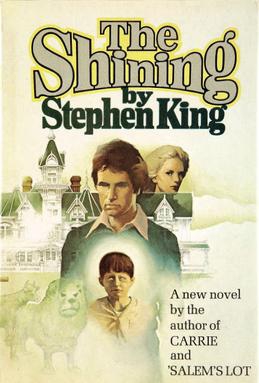
(The Shining. Cover by Dave Christensen. Doubleday, 1977.)
Aside from comedy, horror is the genre whose impact hinges most on its brevity, and indeed comedy and horror are rather closely linked, almost like twin siblings who have strikingly different personalities. Both traditionally rely on a setup followed by a punchline, preferably in quick succession. If you watch some third-rate horror movie you’ll likely be subjected to the “jump scare,” which itself plays out like a joke: there’s the setup (the growing sense of tension, either through a building musical score or the conspicuous lack of music, the person about to be jump-scared either knowing implicitly that something lurks around the corner or being totally ignorant of that lurking thing), followed by the punchline (the jump scare itself, typically accompanied by a scare chord from the music section). So, horror is tension plus time. The tension can only be sustained for so long, much like how the setup for a joke can only be sustained for so long before the audience gets impatient or bored, hence why historically horror has worked best and most often at short lengths. Surveying the history of horror literature in the Anglosphere as we recognize it, from the late 18th century to now, there’s no shortage of authors who wrote horror prolifically at short lengths. In the history of American literature especially the art of the modern short story can be traced back to Edgar Allan Poe and Washington Irving, who both often wrote either horror or fantasy of a weird if not outright horrific sort. Irving’s “The Legend of Sleepy Hollow” and “The Adventure of the German Student” by themselves may have inspired quite a few authors to try their hand at what we now call weird fiction, but then Irving wasn’t primarily a horror writer. Instead it was Poe who made his name as a master of horror in the short form, in the process also giving rise to the detective story, and even a fair amount of science fiction.
Poe’s most famous and arguably best story, “The Fall of the House of Usher,” came as a revelation when it was published in 1839—not so much for its innovation but in how it reshaped what had been for a couple decades seen as a literary school that had run its course: the capital-G Gothic narrative. I say “narrative,” but the Gothic story was, prior to Poe, typically of novella or novel length, the latter being more lucrative. The reality is that what was true in 1820 is more or less still true in 2025, which is that novels sell. With a few very notable exceptions (I’m looking at you, Ted Chiang), the rule is that if you wanna “make it” as a writer then you have to write novels. You can write short fiction on the side if you want, as like a hobby, but you must write at least a few novels. Preferably a series, if you can. And yet, despite the demands of capital, horror at novel length only existed sporadically in the time before Poe, and indeed for more than a century after his death. The horror novelist, i.e., someone who specializes at least somewhat in writing horror novels, simply did not exist yet. Consider what H. P. Lovecraft, in his seminal essay “Supernatural Horror in Literature,” thought of as the first true supernatural horror novel, that being Matthew Lewis’s The Monk. Lewis, the learned son of a diplomat, was only 19 when he wrote The Monk, a messy and rambling but also striking and entertainingly grotesque novel, published in 1795 or 1796 depending on the source. The Monk sparked controversy in the UK at the time, but it also sold well, to the point where it garnered the very young Lewis a reputation which he was not terribly keen on, being called “Monk” Lewis. While Lewis would continue writing, mostly for the stage, he never wrote a proper follow-up to The Monk; maybe he would have, had he not died young, at only 42.
There goes our first would-be horror novelist.
There was, of course, a close contemporary of Lewis’s who bordered on being a horror novelist, and may have been one had what she written been more in line with the genre. Ann Radcliffe is a name fans of Jane Austen would find as ringing a bell, if only because Austen satirizes her work rather playfully in the novel Northanger Abbey. Radcliffe was famous at the tail end of the 18th century for her Gothic novels, although actually she only wrote six of them before retiring from novel-writing at a relatively young age, and only one of them, The Mysteries of Udolpho, holds serious water in pop culture. Radcliffe’s novels are not horror as we understand the term, but more true to the title of that aforementioned novel, they’re meant to be taken as mysterious. The Gothic elements, from the castles to the Spanish Inquisition, certainly make these works rub shoulders with proper horror, but scaring her readers was not Radcliffe’s aim; rather she wanted to convey a sense of wonder and mystery, although many, including Lovecraft, fault her for providing at times convoluted rational explanations for what appear to be supernatural doings. In part due to Austen’s skewering of her work (albeit that it seemed to be affectionate) and partly from a rare case of pop culture osmosis having a negative effect on an artist’s reputation, Radcliffe’s work has only gotten reevaluated in the past couple decades, some 200+ years after publication. A couple decades after Radcliffe’s retirement, indeed around the time of Austen’s death, there were at least two one-off efforts from very different authors that would do what Radcliffe did not: Mary Shelley with Frankenstein and Charles Maturin with Melmoth the Wanderer. Lovecraft considered both but especially the latter to be the last and ultimately best out of the original Gothic tradition.
Mary Shelley needs no introduction, although it must be said that the stars seemed to align such that she would become one of the most important authors in all English literature, despite said importance hinging more or less on a single work. Shelley was the daughter of William Godwin and Mary Wollstonecraft, who were both famous in their time as proto-feminist and anti-authoritarian figures. Shelley herself married the now-famous Romantic poet Percy Bysshe Shelley, who sadly died very young in a shipwreck, just a few years after the publication of Frankenstein. The story of how Mary Shelley came to write Frankenstein is almost as famous as the novel itself, to the point where it’s recreated as the framing narrative in Bride of Frankenstein (weird choice, I know). The story goes that in 1816 Mary, Percy, Lord Byron, and John Polidori made a bet to see who could write the best horror story, although only Mary and Polidori actually managed to finish their contributions, the latter having written the pioneering vampire story “The Vampyre.” Frankenstein was published in 1818, with Mary Shelley revising it considerably in 1831; a good way to start an argument with fans of the book is to ask which version one should read first. Brian Aldiss later claimed, in Billion Year Spree among other places, that Frankenstein was the Big Bang moment for science fiction, the first proper SF story that set the standard for all to follow—a claim that certainly has firm ground for itself. But while Shelley wrote another major SF novel, The Last Man, Frankenstein remained her most substantial horror story, never mind the work she remains by far the most known for.
Charles Maturin was a very different case from Mary Shelley. An Irish Protestant clergyman of French heritage, Maturin mostly wrote in obscurity, and indeed Melmoth the Wanderer, widely considered his magnum opus, is the only thing of his you’ll likely to find in bookstores. Published in 1820, and inspired somewhat by what Maturin called “the Radcliffe romance,” Melmoth the Wanderer goes far beyond what Radcliffe or even Shelley had done, being at once a harrowing and genuinely eerie Gothic narrative and also bordering on an encyclopedic novel, being dense with allusions and references. One needs an edition that comes with notes when tackling this one. But while it is perhaps overstuffed with frame tales and almost cartoonish in its anti-Catholic sentiments (there’s a looooong sequence involving the Inquisition), there is, as Lovecraft says, “an understanding of the profoundest sources of actual cosmic fear.” Perhaps for the first time since The Monk, which is a religiously serious novel despite its grotesquery, there’s a tangible sense of fire-and-brimstone wrath in horror writing, made possible with Maturin’s novel. Maturin may have written a follow-up to Melmoth the Wanderer, had he not died only four years after its publication; as such it remains yet another one-off effort in the genre’s history, which at this point seems plagued by inconsistency. In the whole first half of the 19th century there was not a single writer, at least in the Anglosphere, who took up the mantle of writing horror consistently at novel length, and indeed there wouldn’t be one for a long while yet. Maturin’s own grand-nephew, the much more famous Oscar Wilde, himself wrote a rightly beloved horror novel, The Picture of Dorian Gray; but alas it would be his only novel, and anyway Wilde was not exactly a horror writer.
Looking back on the genre’s history, one would think horror literature stayed more or less dormant through the Victorian era and into the early 20th century, but this is far from true, for at short length the genre stayed very much alive and well through the years. There was a half-century period, from about 1890 to 1940, where the horror short story was arguably at the height of both its average quality and how much was being written, between those who specialized in horror and those who did not. The list, even if we’re just counting “literary” authors who wrote a fair number of short horror stories, is daunting: Ambrose Bierce, Henry James, Edith Wharton, Mary E. Wilkins-Freeman, Rudyard Kipling, H. G. Wells, John Collier, O. Henry, and so on. But then you also had those who did specialize in horror, at which point the list becomes near-endless. Yet none of these people wrote horror novels with any regularity—except maybe one. The closest we have to the first proper horror novelist is the semi-obscure William Hope Hodgson, whose books did not sell much when he was alive and whose untimely death on the battlefields of World War I meant he did not live to interact with the authors he would influence. Hodgson wrote four novels, but I’m especially considering the first three, which were written and published in quick succession, and which Hodgson considered what “may be termed a trilogy; for, though very different in scope, each of the three books deals with certain conceptions that have an elemental kinship.” These are The Boats of the “Glen Carrig,”The House on the Borderland, and The Ghost Pirates. I’ve read all three, and indeed despite very different settings (The House on the Borderland especially feels like an outlier), they do seem in conversation with each other; they’re also early examples of weird horror crossed with a romanticism that has not aged nearly as well. The Ghost Pirates, being easily the least romantic of the three, I would say is also the best from start to finish. Hodgson was a true innovator, but he also wrote for a living and it shows, not to mention his early death robbed us of more work.
It could be because the genre’s finest contributors tended to either stick to short stories and novellas or die tragically young, or both, but even during the height of Weird Tales, in the latter half of the 1920s through the ’30s, horror novels were still hard to come by. The editor of Weird Tales during this period, Farnsworth Wright, wasn’t keen on long serials, and as such you would only get maybe one full novel serialized in that magazine per year, sometimes not even that. Even when a novel runs in Weird Tales it is unlikely to find publication in book form anytime soon; there just wasn’t a market for new horror books in the ’30s. It’s perhaps telling that Lovecraft’s own three longest stories, The Case of Charles Dexter Ward, At the Mountains of Madness, and The Dream Quest of Unknown Kadath, had long journeys to publication, with only At the Mountains of Madness seeing print in Lovecraft’s lifetime, and only some five years after he had written it. His contemporaries didn’t do any better for the most part. Seabury Quinn, who in the ’30s was one of Weird Tales‘s most popular contributors, had his novel The Devil’s Bride serialized in 1932, yet it would not appear in book form until 1976. Robert Bloch’s first novel, The Scarf, languished in obscurity for decades and only got brought back into print literally this year. Bloch of course gained mainstream recognition for Psycho, the Alfred Hitchcock movie more so than the book itself; but while it is horror, Psycho is totally bereft of supernatural elements, making it an outlier in Bloch’s oeuvre. Frank Belknap Long wrote almost no horror at novel length. Robert E. Howard only managed to complete one novel, The Hour of the Dragon, which is a Conan story and not horror. When Wright stepped down as editor, shortly before his death, Weird Tales gave even less room to serials, with its new editor, Dorothy McIlwraith, focusing more strictly on short stories.
By the time the US entered World War II, the magazine market for both horror and fantasy was at a bit of a crossroads, and there was still no substantial book market for either; this trend continued into the post-war years, albeit there were a few spots of hope. In the ’50s Richard Matheson blessed us with semi-regular excursions into horror at novel length, including I Am Legend, A Stir of Echoes, and The Shrinking Man (primarily SF but definitely containing prominent horror elements), never mind his almost obligatory haunted-house novel Hell House in 1971. As with Bloch, however, Matheson wrote more prolifically elsewhere, be it short stories or writing film and TV scripts. Shirley Jackson, one of the most famous and controversial short story writers of her time, also found reasonable success with novels, and probably would have enjoyed the deluge of horror in the ’70s if not for her death in 1965. Indeed it wasn’t until the ’70s that the horror novel, having by this point become divorced from the magazine market while at the same time taking advantage of loosening censorship in multiple mediums, had begun truly to blossom in the sense that multiple authors were making a killing on the profession at the same time. Alongside Hell House in 1971 we also got William Peter Blatty’s The Exorcist, which you may have heard of. The Exorcist was not only a bestseller but spawned an even more popular movie that took home two Oscars, including one for Blatty’s screenplay. Horror, especially in the film world, was becoming nigh-ubiquitous, but for literature it would take one more push to make a powerhouse industry out of it.
In 1974, a sort of miracle happened. A young and often drunk writer from Maine in his twenties, named Stephen King, finally got his novel Carrie published, at Doubleday and under the shrewd editorship of one Bill Thompson. King had been writing horror stories since the tail end of the ’60s, and even got some published in respectable mainstream outlets prior to Carrie; but it was that first novel, which mind you is really a mix of horror and science fiction, which made him a star. However, it would’ve been one thing if King had written just Carrie before going back to short fiction; instead he did what previously mentioned authors did or could not do and came back soon with yet another bestseller in the form of ‘Salem’s Lot. Being one of the all-time classic vampire novels and arguably King’s first truly great novel, ‘Salem’s Lot was far more ambitious than Carrie, yet also showed a growing maturity in King’s writing and a fine-tuning when it came to building tension. By the time The Shining was published, not quite two years after ‘Salem’s Lot, it became apparent that King was a force to be reckoned with, for both his productivity and his commitment to writing horror that was accessible to the mainstream reader. I’ve given King a lot of shit, as I continue to do (I recently tried reading his overview of 20th century horror, Danse Macabre, and couldn’t get through it because I thought it was quite bad), but it would also be foolish to not give credit where credit’s due. It could be that King was on a creative streak in the ’70s, when he was young and hungry, or it could be that Thompson had edited his first four novels and provided a restraint latter-day King lacked, or it could be some combination; but regardless, King had emerged as almost an industry unto himself, a fact which shook the reading world.
By the end of the ’70s the horror novelist, as distinct from a novelist who sometimes writes horror, had come into existence, seemingly arbitrarily. Anne Rice made her novel debut with Interview with the Vampire in 1976, a very gay horror novel that also became a bestseller and which spawned a film adaptation, a TV adaptation, and a long-running book series. Peter Straub, who had made his debut in 1973 with the non-horror novel Marriages, languished in obscurity for a bit before making it big with Ghost Story in 1979, an atmospheric if also bloated horror novel about shape-shifting monsters. You may have heard of Straub if you’re a King fan because of their acclaimed collaborative novel The Talisman. (They also much later wrote a sequel, Black House, although we don’t talk about that one as much.) The ’80s saw such a growth in horror novels being published every year that the Horror Writers Association (HWA) was founded in 1985, and in 1987 would start giving out the Bram Stoker Award for several categories, it being the horror equivalent of the Hugo. The first year’s shortlist for Best Novel was so packed the the winner ended up being a tie between King’s Misery and Robert McCammon’s Swan Song. Indeed at this point you had Stephen King, Anne Rice, Peter Straub, Robert McCammon, Dean Koontz, Dan Simmons, Clive Barker, Ramsey Campbell, Tim Powers, and others who made a living off of writing novels which at least had prominent horror elements. The dam had burst open. These were not coming from small publishers either, like Arham House, but big names like Doubleday, Viking Press, and Pocket Books. When it comes to horror the big and small publishers have come to work parallel with each other, each covering ground the other will not, with the latter especially being good for short fiction and “the classics.” Regardless, it seems that nobody has dared look back.
It took close to two centuries, and indeed a few decades longer than it took with science fiction and fantasy, but long-form horror literature became its own industry, beholden to both critics and capital, for better or for worse. When David G. Hartwell assembled the landmark reprint anthology The Dark Descent in 1987, he envisioned it as a look back on the history of horror at it pertained to short fiction, since it had become apparent by the mid-’80s that the horror novel had overtaken the horror short story in the popular consciousness. The problem is that while the horror novel was and continues to be popular, there was no continuity of long-form horror up to that point, since as we can see, looking over this pretty lengthy piece of mine, the horror novel in English, for nearly 200 years, only existed sporadically. As Hartwell says in his introduction:
It is evident both from the recent novels themselves and from the public statements of many of the writers that Stephen King, Peter Straub and Ramsey Campbell, and a number of other leading novelists, have been discussing among themselves—and trying to solve in their works—the perceived problems of developing the horror novel into a sophisticated and effective form.
With the exceptions of a few novels which are unspeakably old at this point (Shelley’s Frankenstein, Stoker’s Dracula, and a couple others), the novels making up the horror “canon” have come about no earlier than 1950; and indeed recency bias has come into effect with horror far more profoundly than with science fiction, if only because there are so few horror novels published between 1900 and 1970 that one could even name, let alone think of as “canonical.” The horror novelist is a relatively new animal, being a mutation, somewhere between the Gothic novelist and the SF novelist. When King dies (hopefully later rather than sooner), we’ll have to reckon with his legacy with regards to his own body of work, but also the industry he helped create. It’s possible that in one year or in ten there will be a conspicuous King-shaped hole in horror writing, after Anne Rice and Peter Straub’s recent deaths. And Ramsey Campbell is looking quite old now, as is Dan Simmons, although Simmons is an asshole anyway. Hartwell himself died in 2016, and I’m not sure if he ever found a solution to the problem that is the still-young and uncertain world of horror novels as “serious” literature, which we are to study alongside examples of “canonical” SF and fantasy. It’s not a problem for me to think about much longer, since I tend to prefer short stories and novellas, but it’s food for thought.
Here it is, another Observatory post that’s a couple days late, along with a short story review that’s nowhere to be found. This case is especially painful for me because I respect C. L. Moore a lot, and I irked myself when I read her Jirel of Joiry story “Jirel Meets Magic” and found that I had not read it deeply enough to write a review that’d be worth a damn about it. Unlike the last time this happened, however, it really was because I felt unprepared to deal with Moore’s level of writing, since it must be said she was a better prose stylist than most of her contemporaries, especially in the ’30s. Since I don’t feel qualified to review more Jirel stories, at least for the foreseeable future, I do hope instead to cover a Kuttner-Moore story in February, as a way to return to both of those authors whom I like a great deal. For now, let’s talk about something else. This is a sequel to the Observatory post I wrote last month, “The Origins of Depression in Science Fiction,” which is actually one of my favorite editorials I’ve written thus far, even if it was not what you’d call a “pleasure” to write—rather it was a post I felt I had to write. Turns out that despite the aforementioned post being over 2,000 words long, I still have much more to say on the topic. When I wrote that earlier editorial I did it as a way to talk about my own struggles as a manic-depressive, but I also made an argument which boiled down to this: that the massive uptick in discussing mental illness through genre SF corresponded with, or perhaps was sparked by, the end of World War II, more specifically the use of atomic bombs on Hiroshima and Nagasaki. What had previously been only treated as theoretical suddenly became a harsh reality for SF writers, which caused a sea change for the field.
The strange thing about all this, if you think about it, is that while the Allies won World War II, vanquishing a few fascist regimes in the process, such a sense of victory did not show itself in SF writing in the months and years following the war’s end. Why weren’t these people happy? They won! Not only did they succeed in defeating the Nazis, but long-held speculations about the possibility (even the inevitability) of nuclear weapons had been vindicated overnight. It was the closest, at least up to that point, that science fiction had come to actually predicting the future and getting it right. Perhaps the person mostly keenly aware of this change in the moment was John W. Campbell, who famously got into some hot water with some federal agents because of a story he had published in the March 1944 issue of Astounding Science Fiction: Cleve Cartmill’s “Deadline.” Now, having read “Deadline” for myself, I can say it’s frankly not a very good story; but then it didn’t need to be. Cartmill, who at the time was a new writer, had, much with Campbell’s assistance, written a story that serves as a rather unsubtle allegory about the use of nuclear weapons against the Axis powers. It wouldn’t take a genius to figure that the US government was working on the atomic bomb, or at least some weapon of mass destruction, and that both the Axis powers and even America’s own allies (namely the Soviet Union) were keen on finding out what these scientists were cooking. The March 1944 issue of Astounding would’ve been on newsstands in February, a whole 18 months before the US dropped an actual atomic bomb on actual human beings. Compared to Street & Smith’s other magazines, Astounding did not have a big readership, but it would be their only genre magazine to survive the wartime paper rationing and I suspect Astounding‘s power for prophecy was a big reason why it was spared.
Despite the newfound vindication, however, it seems that a savage gale had swept across the ocean of science fiction with the war’s end, and Astounding, which up to 1945 tended to published some of the most optimistic fiction in the field, took on a darker hue. This change in mood was by no means unique to Campbell’s magazine, of course: every American SF magazine at the time, be it Starling Stories or its more juvenile sister magazine Thrilling Wonder Stories, got at least a bit darker in editors’ speculations and what fiction they were willing to print. During the war years, specifically 1942 to 1945, it was not uncommon to find what you might call a propaganda story in an issue of Astounding, about a character or group of characters going up against either an obvious analog (aha) for the Nazis or just the Nazis outright; and naturally these stories are about how we will or at least should beat Hitler and his goons. Off the top of my head I’m thinking of A. E. van Vogt’s “Secret Unattainable” and J. Francis McComas’s “Flight into Darkness.” Yet following the war’s end there came, over the next handful of years, a bunch of stories in Astounding and elsewhere that could not have been reasonably published (or indeed thought of) during the war, partly because of how bleak these new stories are, including but not limited to C. M. Kornbluth’s “The Little Black Bag” and “The Marching Morons,” T. L. Sherred’s “E for Effort,” A. E. van Vogt’s “Dormant,” Theodore Sturgeon’s “Memorial” and “There Is No Defense,” Jack Williamson’s “With Folded Hands…,” Arthur C. Clarke’s “History Lesson,” too many Ray Bradbury stories from this period to count, and about half of the stories that would comprise Clifford D. Simak’s City. Perhaps the most downbeat of all these post-war stories, in fact one of the darkest stories in the genre’s whole history (which is saying a lot), is Edmond Hamilton’s “What’s It Like Out There?,” which appeared in the December 1952 issue of Thrilling Wonder Stories. The kicker here is that Hamilton had written an early draft of this story a whole two decades earlier, but could not get it published then; but it found a home, seven years after World War II and in the midst of the Korean War.
(Funny aside about Sturgeon’s “There Is No Defense,” published in the issue of Astounding pictured above: Campbell, in the previous issue’s Of Times to Come section, had to tell readers that the upcoming Sturgeon story “is not about atomic bomb warfare,” despite what the title would naturally make people think. However, the Alejandro cover, which does not illustrate a particular story and which Campbell calls “purely symbolic,” showing an Olympian figure splitting the atom with what seems to be a pair of lightning bolts, tells me that “atomic bomb warfare” must’ve been on somebody’s mind. Given the timing, it’s not hard to see why.)
One could argue the latter half of the ’40s to the early ’50s marked a crucial turning point in the development of genre SF, as a kind of uniquely American form of fiction writing. Oh, there was of course SF written outside the US, before and after World War II; after all, arguably the biggest point of inspiration for Amazing Stories, when it launched in 1926, was H. G. Wells. There was another profoundly influential work of SF from the UK that arrived just in time to coincide with the collective turn toward depression and pessimism that American SF was seeing: George Orwell’s 1984. Rather than celebrate the defeat of Nazism, 1984 warns what was then the western side of the so-called Iron Curtain about totalitarianism—both of the Soviet variety and a more capitalistic American and British fascism. Orwell, in the wake of the war’s end and the start of the Cold War, saw not a new dawn for democracy in the “civilized” world but, to paraphrase him, a man (as in humanity) getting his faced stomped on by an authoritarian’s boot, forever. You know who seemed to agree with Orwell’s post-war pessimism? C. M. Kornbluth, and William Tenn, and Robert Sheckley, and Philip K. Dick, and Henry Kuttner, and so on. These are authors who either only debuted after the war’s end or had gotten lucky during the war years. (Kornbluth is a funny example in that he is both technically a pre-war writer and someone who, after taking a break from writing for several years, returned to a market that had changed drastically so as to better suit his perpetual bitterness.) We still got stories of daring invention and adventure, of man’s destiny as the owner of the universe, but we also got a good helping of stories that Campbell would not have approved. By the early ’50s the market had broadened such that even something as nihilistic as Tenn’s “The Liberation of Earth” got published in a pulpy magazine.
I’ve made it no secret that I find genre SF in the late ’40s through the ’50s very interesting, and not for the reasons people tend to idolize that period of American history. Sure, there was economic prosperity—for some people. The US quickly rose to the occasion as the leader of the Western allies, by virtue of largely of having escaped World War II unscathed compared to the UK and France. But there was racial strife, a revived paranoia that there’s a filthy communist lurking under ever bed, not to mention a forced marriage between Christianity and capitalism. As the Cold War kicked into high gear it was no longer enough to just be a good Christian in America (God forbid you were not a Christian to begin with), you had to also be a good capitalist, the problem being that worship of Christ and worship of the dollar make for uneasy bedfellows. Philosophically the two are like oil and water. Sadly, for almost eighty years at this point we’ve had to live with the suffocating, murderous reality of worshipping the dollar, seeing the rise of neo-liberalism and Christofascism, watching them spread and tangle like weeds in one’s garden. What’s not to be depressed about? The future is looking bleak. As famous as they are, generally optimistic writers like Robert Heinlein and Isaac Asimov are nowadays plagued by controversy, or even simply ambivalence from the modern SF reading crowd. It’s not uncommon to find an earnest SF reader under the age of forty nowadays who thinks Asimov is boring, or that Heinlein is too problematic; but these people would probably connect much more with someone like Kornbluth or Kuttner. Given that we’re constantly at risk of being torn down and obliterated by depression, since it seems clear to at least some of us that we’re living in the last days of industrial capitalism (or so we hope), we might not need a Heinlein or Asimov, but someone… darker.
(James Tiptree, Jr., real name Alice Bradley Sheldon [right] with her second husband, Huntington Sheldon [left]. Dated 1946.)
(Note: I shouldn’t have to say this, given the title of today’s post, but I’ll be discussing depression, mental illness generally, and suicide, including some real-life cases that have haunted our field.)
I was set to review Clare Winger Harris’s story “A Runaway World” today, but as you can see, this is not a review. I was also set to write my Observatory post for the 15th, but that didn’t happen either. Well, I’m doing it now. The truth is that when I read “A Runaway World” a couple days ago, two things occurred to me: that it wasn’t a very good story (in my opinion), and that I wasn’t sure what I would even write about it. This was a problem, because normally, even with stories that are sort of dull or not good, I’m able to articulate something such that I’m about to get at least a thousand-word review in; but this time I found myself pretty much totally divorced from the material I was supposed to be thinking and writing about. It then occurred to me that I was mentally unable to engage with the material. This is not to say that Harris was actually too “smart” a writer for me or that I had somehow missed the point of the thing, but that I was too much plagued with what a few centuries ago was called “the humors” to focus on what I was reading. I was too depressed. For the past four or five days, or almost a week at this point, I’ve slipped into a manic or depressive episode at least once during the day which left me basically unable to do anything except wish to crawl into a dark hole and cry in solitude, or to take my own life. I’m a manic-depressive. My therapist, whom I’ve been seeing for just under a year now, suspects I have bipolar disorder, specifically type II, which basically means that my mood shifts, for better or worse, tend to last a short time, a few hours instead of a few days like bipolar type I.
I was a fan of science fiction long before I was aware that there might be something “wrong” with me. One of the first books I ever read outside of the classroom was Kurt Vonnegut’s Slaughterhouse-Five, which in hindsight should have been a red flag. I read quite a bit of Vonnegut in high school: Slaughterhouse-Five, The Sirens of Titan, Mother Night, Cat’s Cradle, and even Breakfast of Champions, that really weird one that barely counts as a novel (not to be confused with Timequake, which isn’t really a novel at all). Breakfast of Champions especially stuck out to me when I read it at the time, for its weirdness but also Vonnegut’s candidness about his own long-term battle with depression, his family’s history of depression (the fact that his mother had killed herself), his PTSD, his disgust with the glorification of war in American culture, and so on. Vonnegut would live to a ripe old age, despite his “best” efforts (he somewhat jokingly claimed to smoke unfiltered cigarettes over many years as a way of killing himself), although it wasn’t cancer or a heart attack that got him but a trip down the stairs. It’s almost comedic, in a way I’m sure he would’ve approved of. Vonnegut ultimately won against his war with depression, in the sense that he allowed circumstance to take him rather than his own hand—for the difference between victory and defeat for every depressive is the question of whether to kill yourself or to leave your fragile little existence in the hands of the gods. Indeed, according to Albert Camus, the question of whether to kill yourself may be the only important question. Camus himself was not suicidal, on the contrary having a real lust for life; and yet as William Styron points out in his short but telling memoir, Darkness Visible, Camus became a passenger with someone he knew to be a reckless driver, in the car accident that would kill him, “so there was an element of recklessness in the accident that bore overtones of the near-suicidal, at least of a death flirtation.” Styron wrote Darkness Visible as a way to cope with his clinical depression, but like Vonnegut he chose to reject suicide.
Some other writers, including several prominent ones in the history of science fiction and fantasy, did not reject suicide. Robert E. Howard, James Tiptree, Jr., Walter M. Miller, Jr., Thomas M. Disch, H. Beam Piper, and some others I could mention, gave into some kind of psychological malady that had been pushing them to the brink. Howard is probably the most famous example out of all of them, and he was only thirty when he died. Supposedly Howard hated the idea of aging such that he wished not to live to an old age, which for someone so young is not in itself an unusual line of thinking. One has to admit that there’s also also an increasing sense of melancholy and foreboding in terms of tone, with Howard’s writing as he got closer to the day he chose to put a gun to his head; but this, by itself, is also not enough of a sign to have caused worry in those who knew Howard at the time. Sure, “Beyond the Black River” is a much more melancholy entry in the Conan series than “The People of the Black Circle,” which was published a year prior, but conveying melancholy through fiction is by no means a sign that the author is suicidal. As you may know, especially if you’re a fan of pre-Tolkien fantasy, Howard had a history of being sort of a moody fellow, but what pushed him into a more extreme mindset was his mother’s long-term illness and her impending death. There have been attempts to analyze Howard’s relationship with his mother, some of them in poor taste, but I’ll just say that what we know for certain is that Howard struggled to imagine a life for himself without his mother in it. As his mother’s illness reached its bitter end, Howard, like a lot of suicides who go through with the act, gave little clues to those closest to him as to what he was planning. But nobody took the hint until it was too late.
Howard’s suicide would haunt the pages of Weird Tales, his most frequent outlet, for years, not least because reprints and unpublished work from Howard would appear in that magazine after his death; and indeed hitherto unpublished work by Howard would appear sporadically over the next few decades, as if unearthed or discovered in some dusty tomb, giving one the sense that despite having been dead for almost ninety years now, we still feel the ripples of this man’s decision to cut his life and career short. Of course, while Howard suffered from insecurities, having to do with masculinity and other things, he was not (at least as far as I can tell) a long-term depressive; rather his suicide came about from a mix of material circumstances and something gone amiss in his own mind. Mind you that when I discuss depression here I am not exactly referring to depression in a clinical sense, like how a therapist or psychiatrist would use the term; rather I am using the word as laymen would have understood it for centuries for now, or for as long as the idea of depression has been understood in recorded history. By this I mean that depression at its core is the sense that the outside world, the material world, seems to shrink and become insignificant as one’s own sense of self-worth declines—a kind of self-loathing narcissism, or a snake eating its own tail. People who are unsympathetic to depressives (i.e., people who to some degree lack empathy for others) will say something along the lines of: “People with depression are so self-centered.” In a way this statement is true, although probably not in the way the empathy-deficient person imagines. The problem with depression is that due to the nature of the illness, there is be a barrier between the depressive and the people around them, who presumably are not also depressives. The result is that the depressive feels that they have no choice but to gaze inward, and to see an abyss; it’s self-obsession, but also self-hatred.
(Robert E. Howard in 1934, two years before his death.)
The other problem with depression, particularly those like myself who are depressives and also fans of SF, is that depictions of depression in SF seem to be nonexistent prior to maybe the 1950s. You can find a few examples, very scant and spread apart, but the exceptions if anything prove the rule. This is especially true of genre SF, in the American tradition, which does bring me back to the story I was supposed to review today. To make a long story short, “A Runaway World” is about Earth and Mars mysteriously being jettisoned from the solar system, in a scheme that has to do with radio waves and making alien contact. Or something like that. It’s an early example of a natural (or in this case, rather unnatural) catastrophe narrative that also runs adjacent to the Big Dumb Object™ narrative. It’s confusingly written and Harris’s prose is pulpy, to say the least, such that other than the fact that it’s apparently the first story by a female writer published under her own name in a genre magazine, there’s really nothing special about it. “A Runaway World” does serve, however, as a perfectly fine example of the kind of SF that normally saw print in the ’20s and ’30s, when genre SF saw print in Weird Tales and Amazing Stories; and, if we’re being perfectly honest, this technology-driven (i.e., material-driven) breed of SF would continue during the “golden age” of Astounding Science Fiction under John W. Campbell’s editorship. These stories are not really concerned with spirituality or even psychology, but are instead about people doing things, so in this way they are strictly materialist. There’s a material problem that requires a material solution. Now is not the time to ponder one’s own neurosis, or even the feelings of others. Something is to be done, physically. Characters in these old pulp stories can now strike us as weirdly inhuman, and while flat characterization is the surface criticism one should make, the lack of psychological depth is intrinsically tied with that characterization. These characters feel like cardboard because there’s nothing inside. As Gertrude Stein said, “There is no there there.”
Surely at least some of the authors who contributed to the early years of genre SF felt depression, anxiety, PTSD, and so on; but if they did in their personal lives then they dared not express such troubles in their fiction. Characters in the early stories of E. E. Smith, Murray Leinster, Raymond Z. Gallun, Isaac Asimov, and Robert Heinlein are (at least as far as the authors seem to think) perfectly reasonable and mentally fine-tuned fellows. Hal Clement, who made his debut during the height of Campbell’s powers, might be most “guilty” of this, as his characters, while being ostensibly human, do not have any human (in the psychological, Shakespearean sense) concerns to speak of. Mental illness and even just moments of mental disorder (say a nervous breakdown or an anxiety attack) were simply not things one was to write about if one wrote for the magazines in those days. Between the years of 1926 (when Amazing Stories launched and, incidentally, when “A Runaway World” was published) and circa 1945, one simply did not write or talk about mental illness anywhere near science fiction; and if you felt tempted then it was something between you and your therapist. Or God. Whichever you preferred. Yet in 1926 there were people, in the “literary” world, who wrote about their own mental illness, if only when projected onto their characters. The first examples to come to my mind are Virginia Woolf (suicide by drowning) and Ernest Hemingway (suicide by gunshot), who were both haunted by an inner sickness, among other things. But there was no one even close to a Woolf or Hemingway in the early days of genre SF—not just in writing skill but also giving a language to the array of mental pains that afflict far too many of us in the real world. I did, however, mention before that this streak of psychological emptiness in SF lasted from about 1926 to 1945, and there’s a reason for that.
World War II happened, and with it came a number of profound changes in the field. The once-hypothetical scenario of nuclear weapons became very much a reality overnight. Entire cities on fire. The enemy of the week went from being fascism to Soviet communism. There was the vast moral quandry of the Holocaust. There were also quite a few men who served in the war who came home, and decided to start writing science fiction. Kurt Vonnegut was one such veteran, whose experiences as a POW and subsequent PTSD inspired Slaughterhouse-Five. There was Walter M. Miller, who served as a bombardier, and who also suffered from PTSD and depression. There was C. M. Kornbluth, who saw action near the end of the war and whose already-weak heart was further weakened by the strain. Those who saw the horrors of World War II firsthand, and indeed those who grew up in the war’s aftermath (Philip K. Dick, Robert Sheckley, Robert Silverberg, etc.), seemed to take a much dimmer view of the human condition than the first generation of genre SF writers. Hal Clement served in the way and didn’t seem particularly bothered by his wartime experiences, but I see that as the exception that proves the rule. I have a bit of a hypothesis, although obviously you’re free to disagree with it: that one of the ways World War II impacted SF is how it made those us in the field aware that some of us, individually, are damaged inside. Before and during World War II the sentiment of the average SF story was, “There’s something wrong with the world,” but after the war it got amended to say, “There’s something wrong with the world, and me as well.” It’s hard to imagine a novel like A Canticle for Leibowitz, or Do Androids Dream of Electric Sheep?, or the stories of James Tiptree (possibly the most disturbed of all SF writers), could have been published in a landscape where depression were treated as if it did not exist.
(Cover by Margaret Brundage. Weird Tales, September 1941.)
I was supposed to write my review of “Beyond the Threshold” by August Derleth for today, but I could not find it in myself to do so. For one I have to admit I’ve been feeling horribly drained from the business of moving into my apartment, which I still haven’t totally finished with yet. I’ve barely slept for the past few weeks, hence the lack of a mid-month editorial post in October. Anyway, this isn’t a review. If you want my opinion on the story, it’s middling. Derleth was a pretty good editor but a second-rate writer, from the weird fiction of his that I’ve read, and “Beyond the Threshold” explicitly tips its hat to Lovecraft and the Cthulhu Mythos (a name Lovecraft himself did not use) without doing anything meaningfully extra. It has a bit of that rural Wisconsin atmosphere, but mostly does away with it in favor of a typical old-dark-house-has-dark-secrets narrative. If you want a take that’s a bit more in-depth you’ll have to wait a couple weeks, as I am really doing a proper (albeit short) review of this story for Galactic Journey, as part of the chunky anthology Tales of the Cthulhu Mythos. I’ll be reviewing more than half the stories in that book, so keep an eye out for that. Hopefully I will have also regained my writing energy by then.
Unfortunately I’m not here to talk about fiction, really. In the morning, today, November 6th, Americans woke up to find that the improbable (not the impossible, because I think we all understood the chance of this happening was very real) had happened. Now, I don’t make my politics a secret on here; after all it’s my blog and nobody else’s. Over the past couple years my views have shifted farther left: back in August 2022, when I posted my first review here, I think I considered myself a fellow traveler, but now I would say I’m a libertarian socialist. I used to be a libertarian of the American sort (we all make mistakes, huh), but now I’m a libertarian in the tradition of Ursula K. Le Guin, William Morris, and Oscar Wilde. I’m ambivalent about the state’s capacity to help marginalized groups and I’m even more ambivalent about marginalized people’s rights being secured through electoral means. Yesterday we had the chance to prove that we are above electing the king of the yuppies (that he’s also very likely a rapist is pretty significant, but which mainstream news media has treated as almost incidental) back into office, but we failed. The Democratic establishment failed its voter base and its voter base in turn failed the most vulnerable people in this country. Indeed it’s a collective failure of liberalism in the US that we have not seen since—well, the 2016 election. We’ve been told (accurately) that Trumpism is an American blue-collar sort of fascism, yet if this is true then liberalism has failed to stop fascism—again.
To be clear, and I shouldn’t have to say this given what I had just said but I’ll do it anyway, I don’t like Kamala Harris, as both a politician and person. I think she’s a weasel, a centrist with a few progressive sympathies but ultimately someone who tried really hard to cater to “moderate” conservatives, a plan which literally did not work. It was a huge gamble, because calling Dick Cheney brat (how do I even explain to people of the future what “being brat” means) alienated a lot of left-liberal people, understandably. Who the actual fuck voted for Trump in 2016 and 2020 but then Harris in 2024? Who of that demographic was persuaded? Cuddling up with neo-conservatives while also ignoring (at best it was ignoring) the concerns of Palestinian-Americans and Arab-Americans at large was not a good move! I know, this may seem like a controversial opinion, but as someone who basically was radicalized by Israel’s siege of Gaza, I think the Biden (later Harris) campaign leaving Arab-Americans in the dust was very bad. Islamophobia has been a major problem in this country since at least 9/11, and it has not really gotten better. Sure, we have a few Muslim members of congress, but look at how the Biden administration has defended them against harassment, or rather how the Biden administration has not: it’s disgraceful. I say this as someone who, back when I was a right-libertarian and edgy atheist (I’m much softer on religion nowadays), also had Islamophobic tendencies; so I know very well what it looks like. Large swaths of the population see Muslims as subhuman, and unfortunately those people will be totally without shame about it.
We have failed queer people (so that includes me), we have failed people with disabilities (also includes me), we have failed the working class, we have failed black Americans, we have failed Muslim Americans, we have failed the women of this country, and of course we have failed ourselves. What do we do with this information? How does it relate to this blog, which is after all a genre fiction review fan site? Because I’m not here to write political tracts, I’m generally someone who reads for the pleasure of it. As a leftist I still enjoy right-leaning writers like Robert Heinlein, Poul Anderson, Larry Niven, and so on. I don’t believe in abstaining from reading fiction by authors with very different political views, or at least I try to hold myself to that belief; obviously there’s a limit for everything. But, I’m queer, and my partners are all queer, and so are quite a few of my friends. I had to talk one of my partners through a panic attack over the phone last night. We live in a country that basically wants us dead, because most of the American population is homophobic and/or transphobic. This has been the case since forever, but it’s impossible to ignore now, with social media and the little slivers of mainstream visibility queer people get. It’s not even about resisting the incoming Trump administration, it’s simply about coping, and finding ways to support marginalized people, even if these are small things like donating to someone’s GoFundMe. God knows I’ve been supporting some of the fellow queer people in my life for a minute now. I’ve said before that I use this blog as a coping mechanism, because I have a history of depression and anxiety, and that hasn’t changed.
Here’s the thing, and this happened after Trump won in 2016 as well: the people who voted him in, who are really fucking stoked about him winning, are not gonna be any happier in the long run. If anything, with the exception of the rich (because the rich will evade basically any kind of retribution, even climate disaster [for now]), these Trumpists are gonna be made more miserable, if for no other reason than that Trump is such a toxic personality that mere exposure to him and his fucking yapping for long enough will do something horrid to one’s psyche, even if that person is pro-Trump. I’ve seen it happen first-hand, it’s a very creepy phenomenon, but Trumpists also don’t wanna admit that their own guy, whom they treat like a demi-god, makes them feel miserable. And we’re not even getting into his “economic plan” to combat inflation, because assuming that actually happens we’re all gonna be feeling that a year from now. In a way I’m morbidly curious about the future, with how bleak and yet how cloudy it is. I talk about the past all the time here because the past is never dead, and like a shambling corpse that has risen from the grave it terrorizes us despite not having a pulse. If the past is a zombie then the future is a horror that has not yet been birthed, and I’m not sure which is worse. The only thing I can say is that I hope to stay alive, despite my own thoughts of suicide.
(Cover by Atun Purser. Journey Planet, September 2024.)
Note #1: A few months ago I was asked to write an article for the lauded fanzine Journey Planet, which was putting together an issue centered around the theme of labor rights in genre fiction. Truth be told, I was scrambling for a juicy idea until I remembered that I had covered Richard Matheson’s 1956 boxing-of-the-future story “Steel” early this year, and I still had quite a bit to say about it. You can read the Journey Planet version of this editorial here, as well as articles and even a few short stories by writers who put in a lot more work than I did. I didn’t simply copy-paste my article here, as I did make some small changes, to expand on a couple things and to make the whole thing fit more with the conversational tone of this blog. I also removed the Commonwealth spelling that was forced upon me by a couple of dastardly Canadians. I’m an American, goddamnit!
Note #2: I shouldn’t have to say this, but I’ll be discussing spoilers for the short story “Steel,” and by extension the Twilight Zone adaptation starring Lee Marvin. The two are basically 1:1 in terms of plot. I will not, however, be discussing the 2011 film Real Steel, which is a much looser adaptation of Matheson’s story.
Many of Richard Matheson’s most famous stories involve alienation, and this is something that can be traced throughout pretty much his whole career. The unnamed child in his very first short story, “Born of Man and Woman,” is rendered unable to adapt to normal domestic life because of an odd mutation. The tortured protagonist of “Nightmare at 20,000 Feet” (one of William Shatner’s finest roles) feels estranged from the people around him, including his own wife, after he has suffered a nervous breakdown. Scott Carey, the anti-hero (there’s very little “heroic” about him) of Matheson’s novel The Shrinking Man, finds his marriage eroding after a freak incident causes him to shrink to the size of an ant. The traveling salesman of Duel is already separated from the rest of humanity, stuck on a deserted and seemingly endless stretch of highway with only the radio for companionship, when a faceless trucker starts tormenting him. Similarly, “Steel” Kelly, a former boxer who had at one point made a name for himself, has been relegated to owning a robot built expressly for boxing in Matheson’s 1956 short story “Steel.” This is a very fine story, but more importantly it continues to feel prescient, not least because boxing has been all but replaced by MMA nowadays. It’s a story about the athlete-as-worker, the athlete-as-machine, and about a possible (even plausible) future in which the professional athlete has been reduced to a product.
“Steel” was first published in the May 1956 issue of The Magazine of Fantasy and Science Fiction, the same year as The Shrinking Man (it was a good year for Matheson), and it reads as an outlier in what is already a pretty diverse body of work—not thematically but rather in how it attempts to speculate on how human (read: American) culture might change in the future. Matheson’s science fiction is usually set in The Now™, with an average person being thrown into an SFnal situation through some accident or coincidence; so it shouldn’t be surprising that more often than not Matheson wrote horror or fantasy instead. As the man himself admitted in an interview, in the September 1981 issue of Twilight Zone Magazine, “I never even knew what science fiction was until I sold my first story.” He was not what you would call an SF writer by inclination, which makes the genuinely speculative nature of “Steel” so different. (Even I Am Legend, published in 1954 and set in 1976, engages in very little speculation about society’s future, on account of the human populace having come down with a bad case of vampirism, and thus there’s no human culture left—at least of the non-vampire variety.) “Steel” is also unusual for Matheson in that it directly touches upon the question of labor—more specifically alienation from one’s own labor—as it may pertain to a future (but not too in the future) America. Kelly’s conflict is external (he needs money), but also internal (he needs to reconnect with the work from which he has been alienated).
The year is 1980 (I know, the futuristic year of 1980) and boxing between humans has been outlawed in the US for about a decade. “Steel” Kelly was a heavyweight and a reasonably respected boxer a decade ago (“Called me ‘Steel’ cause I never got knocked down once. Not once. I was even number nine in the ranks once.”), but since then he’s gotten older, has started losing his hair, and has taken to the road with Pole, his friend and the team’s mechanic, with their boxing robot, Battling Maxor. The initial problem is that Maxor is in dire need of repairs, requiring money the two men don’t have. Even if they were to repair the robot it’s still a B-2, set to go up against a B-7. Maybe five years ago Maxor would’ve done fine, but now he’s little more than a bucket of bolts; but if Kelly and Pole back out of the match now they don’t get any money. Their robot is badly outdated, and even ignoring that, it would barely be able to get in the ring. Kelly has been having a bad day, not helped by reminiscing openly about when he was in Maxor’s position, and it looks like he’s stuck in a corner. There is, of course, one possible alternative: get in the ring posing as Maxor. The robot has not been in a public match in three years, and apparently this is a future where people don’t record sports matches, so it’s a safe bet that nobody in the audience knows what Maxor looks like.
Kelly is a classic Matheson protagonist, in that he feels cut off from his fellow man and has a bit of a temper; even his friendship with Pole seems to be strained by the bad luck the two have been having, on top of Kelly clearly feeling demeaned by being the “manager” of his own replacement. A question we must ask ourselves is this: If an athlete is a worker, then can the athlete be replaced? I do wonder how many of us think of professional athletes as workers, despite the pay being real and the bodily risk certainly being no less real. I wonder how many people think, subconsciously, of athletes as products—or machinery. The real problem is that regardless of whether the athlete is more akin to a human worker or a machine, we still have to wonder if such a worker/machine can or even should be replaced. God knows an increasingly large portion of the labor market has been replaced by automation. Carpenters and blacksmiths must have felt this inner turmoil, at their own livelihoods being rendered obsolete, decades ago, and yet they probably weren’t listened to. Most carpenters’ hands have been replaced by machinery, so why not an athlete’s entire body? In the heat of the moment, with hard cash on the line, the prospect of getting back in the ring—even if he were to go down in the first round—appeals to Kelly. He hungers to return to doing what he loved most, to the point that the prospect of a robot beating the shit out of him doesn’t faze him much. The robots, while not sentient, are lifelike enough that if he acts right, he can dupe the audience. “Even from ringside the flesh tones looked human. Mawling had a special patent on that.” And hell, when he inevitably starts sweating that can be explained by Maxor having an oil leakage. Happens with old models. (This part isn’t explained in the TZ adaptation, such that Kelly visibly sweating comes off as a bit of a plot hole.)
Indeed, the plot is only allowed to happen because Kelly takes advantage of the fact that the robots have only gotten more convincing with each iteration, to the satisfaction of the audience. We’re never told why human boxing was made illegal, but given how physically grueling this sport in particular can be it’s not hard to imagine what spurred legal action. When “Steel” was adapted for an episode of The Twilight Zone, the in-story year had been moved from 1980 to “circa 1974,” even though the episode would air in 1963. In the TZ episode, human boxing was outlawed in 1968, a mere five years after the episode would have aired—which sounds outlandish, but consider that in 1962 welterweight boxer Emile Griffith practically beat opponent Benny Paret to a pulp, the latter dying of his injuries several hours after the match. The possibility of boxing being outlawed must have seemed very much that in the moment—a possibility. Yet while there are valid safety concerns with regards to boxing, Matheson paints a depressing picture of what a future where boxers are forcibly removed from their profession might look like. Even the audience members, while having become accustomed to the robot replacements, clearly miss the days when it was man against man in the ring, back when the ring had a referee and when fighters were able to get back up when they were knocked down. “The new B-nine, it was claimed by the Mawling publicity staff, would be able to get up, which would make for livelier and longer bouts.” The robots seem to get closer to emulating the humans they’ve replaced accurately, but Matheson implies there will always be that human touch missing from the equation. Kelly and his kind can’t be replaced completely.
Of course, Kelly goes down in the first round; and because he’s posing as a B-2 he can’t get back up. Not that he could have reasonably expected to beat a robot—simply speaking as a human, never mind that he’s no longer a spring chicken. Despite losing the match, getting a rib or two broken, plus getting only a fraction of the pay they were supposed to earn (you get paid just for getting in the ring, but going down in the first round nabs you the lowest payout), Kelly feels vindicated in a way that is perhaps hard for a man of his disposition to articulate—a kind of spiritual victory. Something about the capacity of the human spirit to persevere. It could be that when Matheson wrote “Steel” he merely wanted to incorporate a popular sport (at the time) into a fable about a unique quality—a je ne sais quoi—in humans when compared to their would-be robot counterparts. The athlete is a worker, and the worker, in his heart, wants liberation; we can accept nothing less. We cannot accept this divorce, between ourselves and our labor. This may not have been intended, but I would say boxing was the perfect sport to use for such a story, as it’s a deeply individualistic and physically intimate sport. Kelly’s struggle would not have hit quite as hard if this was about baseball or American football. There’s a degree of ambiguity to this story’s ending, as to what will become of Kelly and Pole after this, or what they could possibly do next; but that would be missing the point, I think. Kelly lost the fight, but he’s gone to prove he’s not quite out of a job yet. 1980 is behind us, if only physically, but “Steel” is one of those rare SF narratives that seems determined to project its concerns perpetually into the creeping and possibly condemned future—our future.