(Cover by Margaret Brundage. Weird Tales, September 1941.)
I was supposed to write my review of “Beyond the Threshold” by August Derleth for today, but I could not find it in myself to do so. For one I have to admit I’ve been feeling horribly drained from the business of moving into my apartment, which I still haven’t totally finished with yet. I’ve barely slept for the past few weeks, hence the lack of a mid-month editorial post in October. Anyway, this isn’t a review. If you want my opinion on the story, it’s middling. Derleth was a pretty good editor but a second-rate writer, from the weird fiction of his that I’ve read, and “Beyond the Threshold” explicitly tips its hat to Lovecraft and the Cthulhu Mythos (a name Lovecraft himself did not use) without doing anything meaningfully extra. It has a bit of that rural Wisconsin atmosphere, but mostly does away with it in favor of a typical old-dark-house-has-dark-secrets narrative. If you want a take that’s a bit more in-depth you’ll have to wait a couple weeks, as I am really doing a proper (albeit short) review of this story for Galactic Journey, as part of the chunky anthology Tales of the Cthulhu Mythos. I’ll be reviewing more than half the stories in that book, so keep an eye out for that. Hopefully I will have also regained my writing energy by then.
Unfortunately I’m not here to talk about fiction, really. In the morning, today, November 6th, Americans woke up to find that the improbable (not the impossible, because I think we all understood the chance of this happening was very real) had happened. Now, I don’t make my politics a secret on here; after all it’s my blog and nobody else’s. Over the past couple years my views have shifted farther left: back in August 2022, when I posted my first review here, I think I considered myself a fellow traveler, but now I would say I’m a libertarian socialist. I used to be a libertarian of the American sort (we all make mistakes, huh), but now I’m a libertarian in the tradition of Ursula K. Le Guin, William Morris, and Oscar Wilde. I’m ambivalent about the state’s capacity to help marginalized groups and I’m even more ambivalent about marginalized people’s rights being secured through electoral means. Yesterday we had the chance to prove that we are above electing the king of the yuppies (that he’s also very likely a rapist is pretty significant, but which mainstream news media has treated as almost incidental) back into office, but we failed. The Democratic establishment failed its voter base and its voter base in turn failed the most vulnerable people in this country. Indeed it’s a collective failure of liberalism in the US that we have not seen since—well, the 2016 election. We’ve been told (accurately) that Trumpism is an American blue-collar sort of fascism, yet if this is true then liberalism has failed to stop fascism—again.
To be clear, and I shouldn’t have to say this given what I had just said but I’ll do it anyway, I don’t like Kamala Harris, as both a politician and person. I think she’s a weasel, a centrist with a few progressive sympathies but ultimately someone who tried really hard to cater to “moderate” conservatives, a plan which literally did not work. It was a huge gamble, because calling Dick Cheney brat (how do I even explain to people of the future what “being brat” means) alienated a lot of left-liberal people, understandably. Who the actual fuck voted for Trump in 2016 and 2020 but then Harris in 2024? Who of that demographic was persuaded? Cuddling up with neo-conservatives while also ignoring (at best it was ignoring) the concerns of Palestinian-Americans and Arab-Americans at large was not a good move! I know, this may seem like a controversial opinion, but as someone who basically was radicalized by Israel’s siege of Gaza, I think the Biden (later Harris) campaign leaving Arab-Americans in the dust was very bad. Islamophobia has been a major problem in this country since at least 9/11, and it has not really gotten better. Sure, we have a few Muslim members of congress, but look at how the Biden administration has defended them against harassment, or rather how the Biden administration has not: it’s disgraceful. I say this as someone who, back when I was a right-libertarian and edgy atheist (I’m much softer on religion nowadays), also had Islamophobic tendencies; so I know very well what it looks like. Large swaths of the population see Muslims as subhuman, and unfortunately those people will be totally without shame about it.
We have failed queer people (so that includes me), we have failed people with disabilities (also includes me), we have failed the working class, we have failed black Americans, we have failed Muslim Americans, we have failed the women of this country, and of course we have failed ourselves. What do we do with this information? How does it relate to this blog, which is after all a genre fiction review fan site? Because I’m not here to write political tracts, I’m generally someone who reads for the pleasure of it. As a leftist I still enjoy right-leaning writers like Robert Heinlein, Poul Anderson, Larry Niven, and so on. I don’t believe in abstaining from reading fiction by authors with very different political views, or at least I try to hold myself to that belief; obviously there’s a limit for everything. But, I’m queer, and my partners are all queer, and so are quite a few of my friends. I had to talk one of my partners through a panic attack over the phone last night. We live in a country that basically wants us dead, because most of the American population is homophobic and/or transphobic. This has been the case since forever, but it’s impossible to ignore now, with social media and the little slivers of mainstream visibility queer people get. It’s not even about resisting the incoming Trump administration, it’s simply about coping, and finding ways to support marginalized people, even if these are small things like donating to someone’s GoFundMe. God knows I’ve been supporting some of the fellow queer people in my life for a minute now. I’ve said before that I use this blog as a coping mechanism, because I have a history of depression and anxiety, and that hasn’t changed.
Here’s the thing, and this happened after Trump won in 2016 as well: the people who voted him in, who are really fucking stoked about him winning, are not gonna be any happier in the long run. If anything, with the exception of the rich (because the rich will evade basically any kind of retribution, even climate disaster [for now]), these Trumpists are gonna be made more miserable, if for no other reason than that Trump is such a toxic personality that mere exposure to him and his fucking yapping for long enough will do something horrid to one’s psyche, even if that person is pro-Trump. I’ve seen it happen first-hand, it’s a very creepy phenomenon, but Trumpists also don’t wanna admit that their own guy, whom they treat like a demi-god, makes them feel miserable. And we’re not even getting into his “economic plan” to combat inflation, because assuming that actually happens we’re all gonna be feeling that a year from now. In a way I’m morbidly curious about the future, with how bleak and yet how cloudy it is. I talk about the past all the time here because the past is never dead, and like a shambling corpse that has risen from the grave it terrorizes us despite not having a pulse. If the past is a zombie then the future is a horror that has not yet been birthed, and I’m not sure which is worse. The only thing I can say is that I hope to stay alive, despite my own thoughts of suicide.
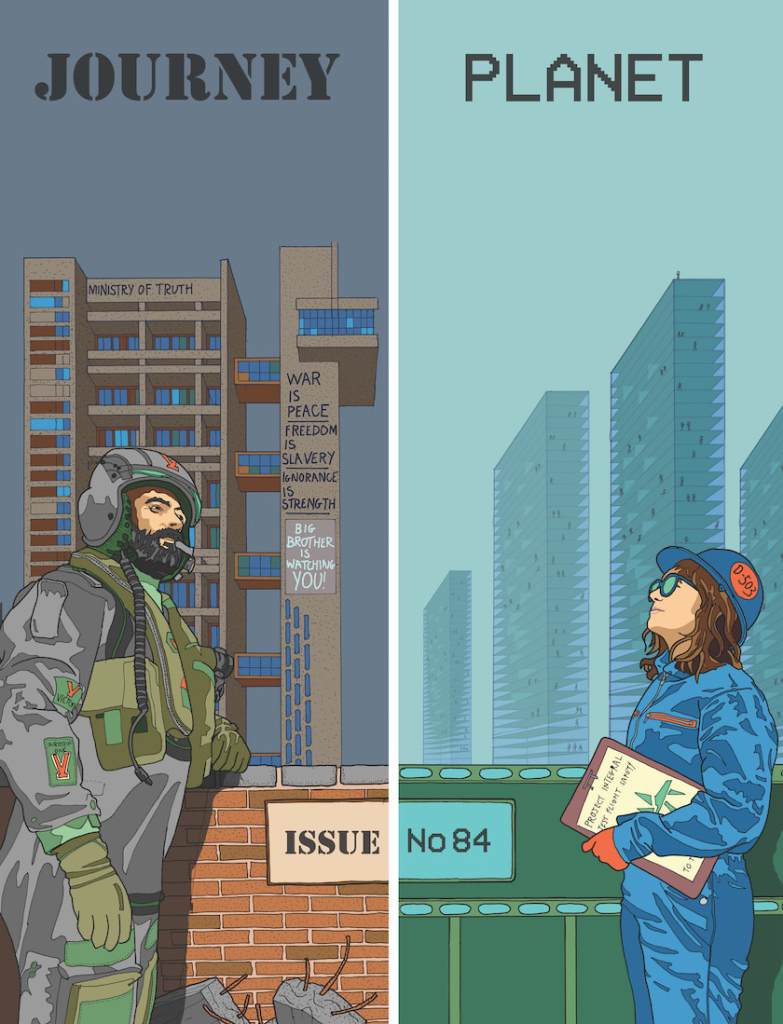
(Cover by Atun Purser. Journey Planet, September 2024.)
Note #1: A few months ago I was asked to write an article for the lauded fanzine Journey Planet, which was putting together an issue centered around the theme of labor rights in genre fiction. Truth be told, I was scrambling for a juicy idea until I remembered that I had covered Richard Matheson’s 1956 boxing-of-the-future story “Steel” early this year, and I still had quite a bit to say about it. You can read the Journey Planet version of this editorial here, as well as articles and even a few short stories by writers who put in a lot more work than I did. I didn’t simply copy-paste my article here, as I did make some small changes, to expand on a couple things and to make the whole thing fit more with the conversational tone of this blog. I also removed the Commonwealth spelling that was forced upon me by a couple of dastardly Canadians. I’m an American, goddamnit!
Note #2: I shouldn’t have to say this, but I’ll be discussing spoilers for the short story “Steel,” and by extension the Twilight Zone adaptation starring Lee Marvin. The two are basically 1:1 in terms of plot. I will not, however, be discussing the 2011 film Real Steel, which is a much looser adaptation of Matheson’s story.
Many of Richard Matheson’s most famous stories involve alienation, and this is something that can be traced throughout pretty much his whole career. The unnamed child in his very first short story, “Born of Man and Woman,” is rendered unable to adapt to normal domestic life because of an odd mutation. The tortured protagonist of “Nightmare at 20,000 Feet” (one of William Shatner’s finest roles) feels estranged from the people around him, including his own wife, after he has suffered a nervous breakdown. Scott Carey, the anti-hero (there’s very little “heroic” about him) of Matheson’s novel The Shrinking Man, finds his marriage eroding after a freak incident causes him to shrink to the size of an ant. The traveling salesman of Duel is already separated from the rest of humanity, stuck on a deserted and seemingly endless stretch of highway with only the radio for companionship, when a faceless trucker starts tormenting him. Similarly, “Steel” Kelly, a former boxer who had at one point made a name for himself, has been relegated to owning a robot built expressly for boxing in Matheson’s 1956 short story “Steel.” This is a very fine story, but more importantly it continues to feel prescient, not least because boxing has been all but replaced by MMA nowadays. It’s a story about the athlete-as-worker, the athlete-as-machine, and about a possible (even plausible) future in which the professional athlete has been reduced to a product.
“Steel” was first published in the May 1956 issue of The Magazine of Fantasy and Science Fiction, the same year as The Shrinking Man (it was a good year for Matheson), and it reads as an outlier in what is already a pretty diverse body of work—not thematically but rather in how it attempts to speculate on how human (read: American) culture might change in the future. Matheson’s science fiction is usually set in The Now™, with an average person being thrown into an SFnal situation through some accident or coincidence; so it shouldn’t be surprising that more often than not Matheson wrote horror or fantasy instead. As the man himself admitted in an interview, in the September 1981 issue of Twilight Zone Magazine, “I never even knew what science fiction was until I sold my first story.” He was not what you would call an SF writer by inclination, which makes the genuinely speculative nature of “Steel” so different. (Even I Am Legend, published in 1954 and set in 1976, engages in very little speculation about society’s future, on account of the human populace having come down with a bad case of vampirism, and thus there’s no human culture left—at least of the non-vampire variety.) “Steel” is also unusual for Matheson in that it directly touches upon the question of labor—more specifically alienation from one’s own labor—as it may pertain to a future (but not too in the future) America. Kelly’s conflict is external (he needs money), but also internal (he needs to reconnect with the work from which he has been alienated).
The year is 1980 (I know, the futuristic year of 1980) and boxing between humans has been outlawed in the US for about a decade. “Steel” Kelly was a heavyweight and a reasonably respected boxer a decade ago (“Called me ‘Steel’ cause I never got knocked down once. Not once. I was even number nine in the ranks once.”), but since then he’s gotten older, has started losing his hair, and has taken to the road with Pole, his friend and the team’s mechanic, with their boxing robot, Battling Maxor. The initial problem is that Maxor is in dire need of repairs, requiring money the two men don’t have. Even if they were to repair the robot it’s still a B-2, set to go up against a B-7. Maybe five years ago Maxor would’ve done fine, but now he’s little more than a bucket of bolts; but if Kelly and Pole back out of the match now they don’t get any money. Their robot is badly outdated, and even ignoring that, it would barely be able to get in the ring. Kelly has been having a bad day, not helped by reminiscing openly about when he was in Maxor’s position, and it looks like he’s stuck in a corner. There is, of course, one possible alternative: get in the ring posing as Maxor. The robot has not been in a public match in three years, and apparently this is a future where people don’t record sports matches, so it’s a safe bet that nobody in the audience knows what Maxor looks like.
Kelly is a classic Matheson protagonist, in that he feels cut off from his fellow man and has a bit of a temper; even his friendship with Pole seems to be strained by the bad luck the two have been having, on top of Kelly clearly feeling demeaned by being the “manager” of his own replacement. A question we must ask ourselves is this: If an athlete is a worker, then can the athlete be replaced? I do wonder how many of us think of professional athletes as workers, despite the pay being real and the bodily risk certainly being no less real. I wonder how many people think, subconsciously, of athletes as products—or machinery. The real problem is that regardless of whether the athlete is more akin to a human worker or a machine, we still have to wonder if such a worker/machine can or even should be replaced. God knows an increasingly large portion of the labor market has been replaced by automation. Carpenters and blacksmiths must have felt this inner turmoil, at their own livelihoods being rendered obsolete, decades ago, and yet they probably weren’t listened to. Most carpenters’ hands have been replaced by machinery, so why not an athlete’s entire body? In the heat of the moment, with hard cash on the line, the prospect of getting back in the ring—even if he were to go down in the first round—appeals to Kelly. He hungers to return to doing what he loved most, to the point that the prospect of a robot beating the shit out of him doesn’t faze him much. The robots, while not sentient, are lifelike enough that if he acts right, he can dupe the audience. “Even from ringside the flesh tones looked human. Mawling had a special patent on that.” And hell, when he inevitably starts sweating that can be explained by Maxor having an oil leakage. Happens with old models. (This part isn’t explained in the TZ adaptation, such that Kelly visibly sweating comes off as a bit of a plot hole.)
Indeed, the plot is only allowed to happen because Kelly takes advantage of the fact that the robots have only gotten more convincing with each iteration, to the satisfaction of the audience. We’re never told why human boxing was made illegal, but given how physically grueling this sport in particular can be it’s not hard to imagine what spurred legal action. When “Steel” was adapted for an episode of The Twilight Zone, the in-story year had been moved from 1980 to “circa 1974,” even though the episode would air in 1963. In the TZ episode, human boxing was outlawed in 1968, a mere five years after the episode would have aired—which sounds outlandish, but consider that in 1962 welterweight boxer Emile Griffith practically beat opponent Benny Paret to a pulp, the latter dying of his injuries several hours after the match. The possibility of boxing being outlawed must have seemed very much that in the moment—a possibility. Yet while there are valid safety concerns with regards to boxing, Matheson paints a depressing picture of what a future where boxers are forcibly removed from their profession might look like. Even the audience members, while having become accustomed to the robot replacements, clearly miss the days when it was man against man in the ring, back when the ring had a referee and when fighters were able to get back up when they were knocked down. “The new B-nine, it was claimed by the Mawling publicity staff, would be able to get up, which would make for livelier and longer bouts.” The robots seem to get closer to emulating the humans they’ve replaced accurately, but Matheson implies there will always be that human touch missing from the equation. Kelly and his kind can’t be replaced completely.
Of course, Kelly goes down in the first round; and because he’s posing as a B-2 he can’t get back up. Not that he could have reasonably expected to beat a robot—simply speaking as a human, never mind that he’s no longer a spring chicken. Despite losing the match, getting a rib or two broken, plus getting only a fraction of the pay they were supposed to earn (you get paid just for getting in the ring, but going down in the first round nabs you the lowest payout), Kelly feels vindicated in a way that is perhaps hard for a man of his disposition to articulate—a kind of spiritual victory. Something about the capacity of the human spirit to persevere. It could be that when Matheson wrote “Steel” he merely wanted to incorporate a popular sport (at the time) into a fable about a unique quality—a je ne sais quoi—in humans when compared to their would-be robot counterparts. The athlete is a worker, and the worker, in his heart, wants liberation; we can accept nothing less. We cannot accept this divorce, between ourselves and our labor. This may not have been intended, but I would say boxing was the perfect sport to use for such a story, as it’s a deeply individualistic and physically intimate sport. Kelly’s struggle would not have hit quite as hard if this was about baseball or American football. There’s a degree of ambiguity to this story’s ending, as to what will become of Kelly and Pole after this, or what they could possibly do next; but that would be missing the point, I think. Kelly lost the fight, but he’s gone to prove he’s not quite out of a job yet. 1980 is behind us, if only physically, but “Steel” is one of those rare SF narratives that seems determined to project its concerns perpetually into the creeping and possibly condemned future—our future.
So the Hugos just happened. If you have the time and money you can see these things in-person for yourself, like the relatively lucky few who got to fly out to Glasgow this year. There are other awards given at Worldcon that are not Hugos despite being given at the same ceremony, namely the Astounding Award and the Lodestar. I’ve done a piece or two on the Hugos before, and while this is by no means an awards-oriented blog, the Hugos are inherently interesting if you’re into fandom because they give an impression as to what fellow genre enthuiasts are digging at the moment. The Hugo winners and nominees of each year serve as time capsules of a sort, since tastes change over time and there are circumstances behind each Worldcon that might influence who gets the phallic trophy and who misses the final ballot by a single vote. Speaking of which, I had a supporting membership for this year’s Worldcon, so I got to vote! One of the movies for the Best Dramatic Pressentation (Long Form) Hugo I nominated was Godzilla Minus One, one of my favorite movies from last year, and which made history by winning the Oscar for Best Visual Effects earlier this year. The film opened theatrically in the US back in December, and while it was originally supposed to have a very limited theatrical run here, reception was so strong that it ended up getting decent coverage. Yet, at least for the Hugos, this turned out to not be enough, as it missed the final ballot by one vote.
Not that I expected Godzilla Minus One to win, but the fact that it missed the final ballot in favor of *checks notes* Nimona? and The Wandering Earth II? I thought Nimona was… fine. I watched The Wandering Earth and thought it was terrible, and got about ten minutes into its sequel before realizing I wouldn’t survive it. Was not a fan of Barbie, which I know is a hot take. Spider-Man: Across the Spider-Verse is objectively a masterpiece of animation, but the bad PR surrounding it following its release meant it was an unlikely choice (I do suspect said bad PR contributed to it not winning the Oscar for Best Animated Feature, on top of one of the directors not being nominated due to some asinine rule about how many people on a film can be nominated in that category). I loved Poor Things, but while it was an awards darling it’s a little too niche—and not niche in such a way that would cater to Hugo voters. Then there’s the winner, Dungeons & Dragons: Honor Among Thieves, which I liked a good deal more than I expected to! I think I put it second or third on my slate, but I would say of the nominated films this might’ve been the most respectable choice. (I also put Oppenheimer on my slate, although I always knew that was a long shot since it’s not a genre movie but rather a movie partly about the sciences.) I expected Barbie to win and to have myself promptly groan at its winning, but then I remembered there’s a vocal minority of people who think it severely overrated. Barbie winning as many Oscars as Godzilla Minus One (the former underperformed while the latter was an underdog) should’ve been a winning sign. Again, missed the final ballot by a single vote!
Something about the Hugos and Worldcon generally is that this is supposed to be an international affair, which is why Worldcon is held in different countries (although next year’s Worldcon and the one after that are both gonna happen in the US, so…), with just last year’s Worldcon happening in China. The problem is that while there have been concerted efforts to avoid this, Worldcon is still very Anglocentric—only now it seems to be split between the Anglosphere and China. The Wandering Earth II certainly only made the final ballot becaue of Chinese backing (the quality of the film really doesn’t indicate it as awards-worthy), which is a shame because unless I’m forgetting something it would be only the fourth or fifth non-English movie to get nominated for Best Dramatic Presentation since the Long Form subcategory was introduced in 2003. The way it works is that Short Form is basically reserved for episodes of TV (on paper it’s for media under an hour long) while Long Form is for feature films and whole seasons of TV (with like one or two exceptions if you go digging around). Now, I see a big problem with movies competing with TV seasons, since we’re having to compares, say, a two-hour movie with eight hours of TV, but that’s not really what I’m here to talk about today. Thing is, like I said, out of the dozens of movies nominated for Best Dramatic Presentation (Long Form), only a handful were made outside the Anglosphere, and only one managed to win, which was Pan’s Labyrinth back in 2007. Pan’s Labyrinth was such a titan of a movie, a critical darling that got mainstream recognition at the time, to the point where it was kind of a breakthrough moment for Mexican cinema on the international stage. It was that extremely rare non-English movie to have sway with English-speaking veiwers; in other words, it’s the exception that proves the rule.
Godzilla Minus One got quite a bit of mainstream attention in the Anglosphere, although not enough to tip the scales such that it was able to get nominated, while The Wandering Earth II got in through a concerted effort from a section of fandom. Fandom politics! Don’t you love it? Of course the question becomes, “Why should a movie have to get enough exposure in the Anglosphere to get attention at the Hugos? Isn’t this whole thing supposed to ignore national barriers?” Sure, but statistically we know that to not be the case. The past decade has also seen a kind of snowball effect with Chinese SF fandom such that the Chinese portion has almost as much sway now as voters from the US. You could say this is better than nothing, but it also threatens to form a divide rather than collaboration between people from opposite ends of the world. The numerous issues around the Chengdu Worldcon don’t help, but I don’t even feel like getting into that; if I went into what went wrong we would be here all day. The point is that while the people in charge have been trying to make Worldcon more inclusive and international with each year (a good thing), some wrinkles still need to be ironed out, and there are some limitations I fear we don’t have a solution to, namely the fact that if a movie isn’t in English and isn’t readily available in North America before the voting deadlines, you’re shit out of luck. If we were to list genre movies from abroad that should’ve been shoe-ins for at least a nomination, but didn’t make it because not enough people in the Anglosphere would’ve even known about them at the time, the list would be almost infinite. Instead we have something like Wonder Woman (2017), which wasn’t even worthy of a nomination, let alone winning. Does anyone know if The Old Guard is any good?
Yet even if we were to knock down country and language barriers, there’s still the question of capitalism. If you didn’t catch Godzilla Minus One during its ssomewhat brief theatrical run in the US you then had to wait for VOD or streaming. A big reason I suspect Nimona made the final ballot was because, yes, enough people liked it, but it’s also a Netflix original. Availability was never an issue. In fairness, Godzilla Minus One is more readily available than most international films, and while we’re on the topic of Netflix, you can watch it as well as the Minus Color version there, the standard version having been added to Netflix in June—a few months after the nominating period for this year’s Hugos had ended. This is bullshit! I even wrote a quasi-review for this movie back in December, as a way to promote it to fellow fans since it was still in theaters at the time. Clearly this was not enough. This movie became enough of a dark horse in the months between its theatrical run and the Oscars to take home an award, but Hugo voters did not quite get behind it enough. Do we have ourselves to blame for this? Have we gotten to the point where even if a movie gets a decent theatrical run it’s still kneecapped if it doesn’t have enough of a theatrical run or if it doesn’t land on streaming soon enough? Dungeons & Dragons: Honor Among Thieves released way back in March 2023, and while its box office numbers were ehhh, it did get good reviews and audience word-of-mouth was promising; perhaps more importantly it landed on streaming by the end of May, and even now it’s pretty easy to find. Honor Among Thieves had a whole year to amass a cult following, such that it was able to make the final ballot and finally to win the Hugo, and it’s a worthy winner!
You could say I’m peeved that arguably the best entry in a long-running film series since the first installment was denied an honor, and you’d be right. Godzilla Minus One came to those of us lucky enough to see as something of a revelation, masterfully towing the line between moral allegory, historical melodrama, and yes, a giant monster spectacle. Even as a long-time Godzilla fan I was stunned by what this movie managed to accomplish, and lemme tell you I was fucking stoked when it took home that Oscar. A somewhat niche but passionate sect of genre fandom felt vindicated that night. Incidentally Godzilla Minus One is the only non-English film to win the Oscar for Best Visual Effects, in the 80+ years this category has existed. Again, I’m sure it wouldn’t have won, but it would’ve been nice if it had joined the very small group of non-English films to be recognized at the Hugos with a nomination. As Worldcon becomes more worldly (aha) we may see fewer egregious snubs like this in the future—so I hope.
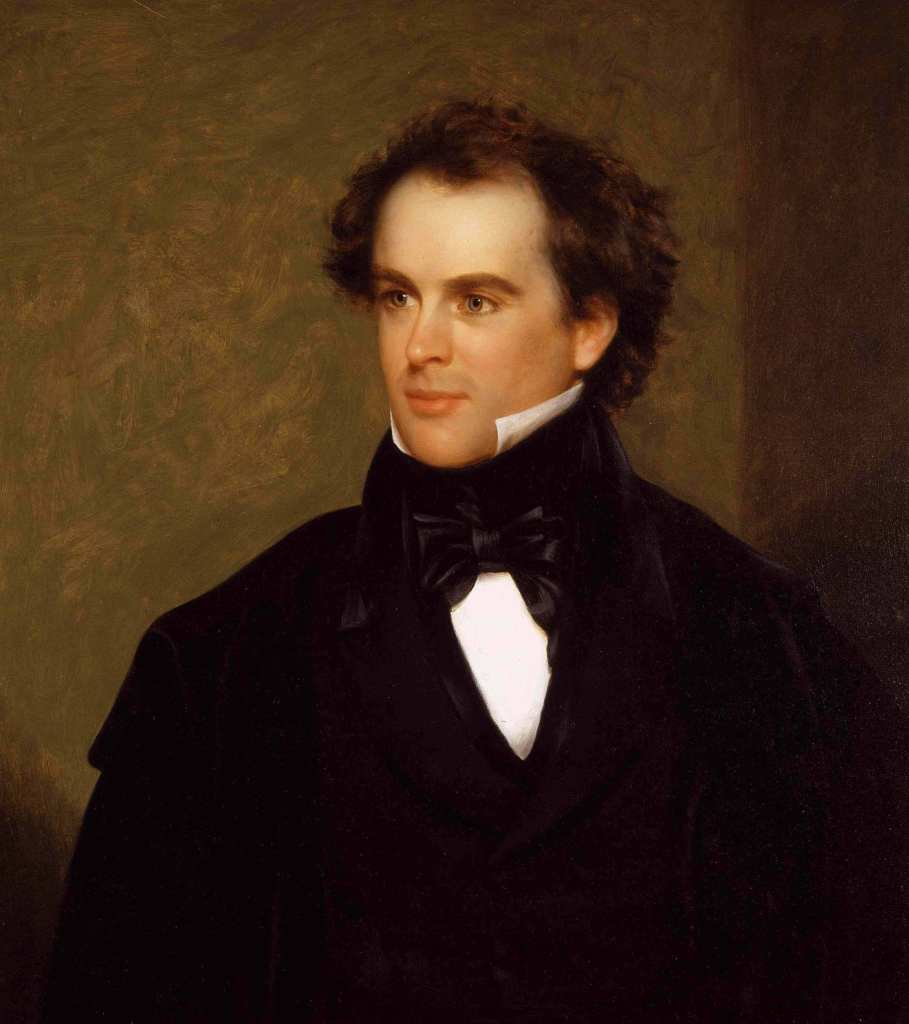
(Portrait of Nathaniel Hawthorne, by Charles Osgood. Circa 1841.)
(Contains spoilers for “The Birthmark,” “Rappaccini’s Daughter,” and “The Artist of the Beautiful.”)
We’re here to talk about some “classic literature,” which I understand tends to fall outside genre confines for a lot of people. After all, genre SF, or indeed science fiction as a codified genre, did not exist in Nathaniel Hawthorne’s lifetime; and yet he, along with a few contemporaries, contributed massively to what we now call science fiction. Hawthorne is one of the undisputed canonical American authors, and he was also one of the first, having been born on July 4th, 1804, at a time when the US had not even started really to foster its first generation of “canonical” literature. When Hawthorne started writing his first major work in the 1830s the literary landscape in the US was basically at the stature of a toddler; and despite having already written a novel (one that nobody talks about and which Hawthorne went out of his way to disown), he would dedicate two decades of his life to mastering just the short story. The Scarlet Letter is one of the most famous (if divisive) American novels of all time, but when it was published in 1850 Hawthorne had already garnered a reputation as a master of short fiction; and like his direct contemporary Edgar Allan Poe he often wrote stories that would now be considered horror, fantasy, and/or SF. There’s a reason Lovecraft, in his “Supernatural Horror in Literature,” singled out Hawthorne as a major pioneer in weird fiction, even calling his borderline supernatural novel The House of the Seven Gables a masterpiece.
If I were to talk about Hawthorne’s horror fiction then I would really have my work cut out for me, given how much of his material is horror; but today we’re here to talk about three of his short stories, all of which could be considered SF, and all of which involve some kind of mad-scientist figure. The truth is that had Mary Shelley not beaten him to the punch by a few decades then the popular conception of the mad scientist would probably be much more based on Hawthorne’s conceptions—and to a degree those conceptions have still left a footprint on the popular consciousness. Had things gone a bit differently we might call a scientist who plays God a Rappaccini instead of a Frankenstein. The three stories—”The Birthmark,” “Rappaccini’s Daughter,” and “The Artist of the Beautiful”—were all published over a span of two years (1843 and 1844), and the SF Encyclopedia singles them out as masterpieces of early SF. There’s a good reason for this. While not officially connected with each other in any way, the three stories are thematically conjoined at the hip, on top of featuring variations of the same character type: the scientist in search of perfection. These are also stories that happen to show Hawthorne at the top of his game, being some of his most tightly composed and insightful work, and showing a seriousness that would be missing in the early days of genre SF a century later. Mind you that this is not a review: I very much recommend all three stories. We’re gonna be doing some analysis, specifically in how Hawthorne conceptualizes scientist characters at a time when “the sciences” as different fields of discipline were only then starting to splinter, and indeed some hadn’t even been founded yet. This was a time before Darwin’s theory of evolution and our modern understanding of genetics, for example, such that “science” in 1843 might now sound almost like mysticism.
I read each of these stories in order of how they appeared in the Hawthorne collection Mosses from an Old Manse, so let’s talk about “The Birthmark” (or “The Birth-Mark” as it’s also titled) first. This is one of Hawthorne’s most reprinted stories, and given its simplicity and economy of style it’s easy to see why it’d be one of the more popular choices. There are only two main characters (plus a singular supporting character I’ll get to in a minute), trapped together in basically one room. Aylmer is a research scientist, living at some point in the late 18th century, with his wife Georgiana, a perfectly submissive woman who nonetheless is insecure about a hand-shaped birthmark on her cheek which renders her, at least to her husband, just imperfect enough as to be tragic. We’re told Georgiana is as conventionally attractive a woman as one can think, almost perfect in her beauty—almost. This single imperfection (clearly supposed to be the hand of Nature on her cheek) is enough to make Aylmer neurotic, and to propose a series of experiments in order to remove the birthmark, which Georgiana agrees to. Aylmer’s assistant, Aminadab, suggests that the experiment would be a bad idea, but remains loyal to his master. Aminadab is a curious figure, since he has to be one of the first examples of the mad scientist’s impish assistant in SF, serving as a predecessor to the likes of Fritz in the 1931 Frankenstein movie and Igor elsewhere. (Remember, Dr. Frankenstein did not have such an assistant in the novel.) Of course, Aminadab is not very impish; if anything he serves as a symbol of “earthy” wisdom to contrast with Aylmer’s blinding bookishness. Aylmer is not evil by any means, but he turns out to be tragically misguided, perhaps driven by the fact that he loves his work more than his wife, or as the narrator posits, he is unable to untangle his love for his wife from his love for science.
“The Birthmark” is a parable that has quite a bit going on within its almost brutally simple confines. It’s a story about man’s vain pursuit to overthrow Nature (and for Hawthorne it’s always Nature with a capital N), which will become a bit of a running theme here. It’s also about the futile pursuit of obtaining perfection, which of course Aylmer and Georgiana can’t have. Aylmer’s borderline abuse of his wife and the narrative’s sympathy for Georgiana’s insecurity arguably reads as proto-feminist, especially now that we’ve become much more aware of women having unrealistic beauty expectations thrust upon them; indeed the seeming “need” for perfect beauty is so prevalent that despite the quasi-Shakespearean dialogue and dense expository paragraphs, very little has aged about any of these stories in terms of their concerns. Of course Aylmer is able to remove the birthmark, but Georgiana quickly becomes ill and dies on the operating table; obviously if we’re being pedantic the removal of the birthmark shouldn’t have been able to kill her, but it’s meant to be symbolic. Prior to the climax, Georgiana alluded to being connected with the birthmark in some spiritual fashion, such that if the birthmark were extinguished then her a soul might go with it—a possibility Aylmer doesn’t quite heed. For a brief moment he renders Georgiana “perfect,” but as will become apparent if one reads his other fiction, Hawthorne thinks of perfection as something that can only last for a single moment—if it’s possible at all. Aylmer is a tragic hero in that he has good intentions, or at least thinks he has good intentions, but is unable to do away with Nature’s imperfection.
Now we have possibly Hawthorne’s most famous short story with “Rappaccini’s Daughter,” which despite being a fair bit longer than either of the other stories is still very much a parable. I should probably mention that I suspect the biggest reason why more people don’t enjoy Hawthorne nowadays is that he was not a realist; he often wrote in the allegorical mode, itself having apparently gone out of fashion in recent decades. Nobody likes being moralized at, and Hawthorne did quite a bit of moralizing; but he was also very good at it, such that his skill goes undervalued now. It’s quite possible that had Frankenstein not been published a quarter-century earlier that our conception of what a “mad scientist” even looks like might’ve been more informed by Hawthorne’s Rappaccini—an ironic fact, considering Rappaccini himself barely appears in his own story and we don’t even get any dialogue from him until the climax. We do, however, see a great deal of Rappaccini’s work, including his experimental botanical garden, an “Eden of poisonous flowers,” and his daughter Beatrice, who manages said Eden. We move off to Italy, where a young man named Giovanni gets caught in a rivalry between two physicians, Baglioni and Rappaccini, and Giovanni himself becomes deeply fascinated with Beatrice. I could be wrong, but this might be the earliest example of the “mad scientist’s beautiful daughter” trope in fiction; I certainly struggle to think of anything that could’ve predated it. There is a problem with Beatrice, aside from the fact that she’s socially inept: she’s poisonous, such that even her breath can kill. After years of exposure to the garden Beatrice has become immune to the poisonous plants around her—the tradeoff being that she has become poisonous to everything else. Well, nobody’s perfect.
Of Hawthorne’s mad scientists, Rappaccini is by far the most villainous and the least human, so it’s fitting he’s the only one who serves as a proper antagonist. Rappaccini’s sinister nature is amplified by the fact that we get to know very little about how this whole situation came to be. We never find out what became of Mrs. Rappaccini and we never get a clear answer as to why Rappaccini would use his own daughter as a kind of living experiment, or why he built his garden so that it would resemble a kind of inverted Eden—a place where nothing is allowed to live except that which kills. Maybe the point of making Beatrice immune to the poisonous plants of the garden was to make her, quite literally, immune to what Rappaccini considers the evils of the world—the killing things which Nature produces. Beatrice has become so perfectly immune, and herself so perfectly poisonous, that the result is idealistic—if only in a way that would strike the average person as perverse. Not that Hawthorne’s writing tends to be subtle, but “Rappaccini’s Daughter” might be one of his most overtly religious works in how intensely (and masterfully) it harks to Biblical mythology, to such a degree that even the verbose style of the prose seems to be the spawn of Milton and the King James Bible. (Naturally there are also references to The Divine Comedy.) Rappaccini is a man who clearly thinks of himself as akin to God—a demiurge who has created an inverted and treacherous Eden of his own. If Rappaccini is the demiurge, a counterfeit God, then Baglioni is like the snake in Eden, but made ultimately good, such that his foiling of his rival involves making Giovanni immune to Beatrice’s own poison—an antidote that, tragically, results in her death. The villainous striving for perfection, the “paradise” of the garden, has been lost.
(Cover by E. M. Stevenson. Weird Tales, July 1926.)
The last of these stories is not as famous as the others, nor was it reprinted in genre magazines as a classic—all a shame, since it’s arguably the strongest of the bunch. I was stunned a bit when I had first read “The Artist of the Beautiful” a year or so ago, which as its title suggests is an incredibly tender parable. It must be said, though, that the protagonist of this one is not, strictly speaking, a scientist. Owen Warland is young watchmaker who has just finished his apprenticeship under Peter Hovenden, a capable but conventional-thinking watchmaker who doesn’t see the value in Owen’s idealism. Working on little machines is all well and good, but Owen wants to make something beautiful, something with real aesthetic value that will stick in the mind long after its practical function has expired. In other words, he wants to be an artist. In “The Birthmark” we saw the scientist-as-destroyer; in “Rappaccini’s Daughter” we saw a villainous take on the scientist-as-creator; but in “The Artist of the Beautiful” we see the scientist-as-artist. Indeed it’s here, in this tightly constructed little story, that Hawthorne most neatly marries art with the sciences. Owen’s growing obsession with making something small and yet perfect could serve as analogous with Hawthorne’s own obsession with perfecting the short story. After all, “the beautiful idea has no relation to size.” This proves to be a very hard task for Owen, though, and he gives up a lot to achieve his vision, having lost his chance with Peter Hovenden’s daughter Annie and having become an outcast. There are false starts, and he even gives up watchmaking to focus on his secret project, mooching off an inheritance in the meantime. For all intents and purposes, Owen shuts out the human world; but the same can’t be said of Nature, which he becomes more fascinated with…
The scientists of the previous two stories thought that in some way they could conquer Nature—Aylmer to remove Nature’s imperfections and Rappaccini to bend Nature to serve his own ends. If Owen is redeemed by anything it’s his willingness to acknowledge Nature’s—maybe “superiority” is not the right word, but Nature’s status as the immovable object, not to be destroyed or pushed aside by human hands. So rather than try to conquer Nature, Owen instead takes inspiration from it, perhaps with the expectation that he won’t be able to reach perfection—but he can get very close, if only for a prolonged moment. Even if only a few people get to see his creation before it falls apart in their hands. The mechanical butterfly, an early example of a robot in fiction, is tiny, yet perfectly designed. It has no practical utility, but it exists seemingly for the sake of being a wonderful little work of art, not to mention what would’ve been a technological marvel. Post-industrial technology rarely comes up in Hawthorne’s fiction, partly because he actually lived through the industrial revolution and partly because his fiction tends to take place in what would’ve been the distant past, even from the perspective of 1840s New England. Owen’s mechanical butterfly thus stands out as a rare example for Hawthorne of what we even today would call modern technology, but it’s also an example of science and art coming together to imitate Nature—not to replace it but to take inspiration from it. The ending is bittersweet, as Owen’s creation which he had toiled over for months crumbles, but it strikes me as a kind of spiritual victory for the “scientist” here. If Aylmer was misguided and Rappaccini villainous, then Owen, the scientist-as-artist, comes out the victor.
Hawthorne wrote more SF than just these three stories, of course, although SF would still only take up a small fraction of his output, for I think at heart he was really a horror writer. There is some overlap between the genres he played with, though, and it shouldn’t be too surprising that “The Birthmark” and “Rappaccini’s Daughter” were reprinted in Weird Tales. Poe certainly wrote more SF, but far more than Poe I think Hawthorne set a standard for how we (people who, for the most part anyway, are not scientists at all) think about scientist characters in SF. Poe’s protagonists are often misfits, adventurers, schemers, and other archetypes Poe may or may not have admired; but Hawthorne’s protagonists tend to be more bookish, dour, isolated from human contact, like the man himself. No doubt Hawthorne saw some of himself in Owen Warland, and he may have even seen a bit of himself in Aylmer. More than with scientists as people, though, Hawthorne was arguably the first (after Mary Shelley, obviously) to write science fiction in which the sciences matter even close to as much as the action and themes of the story. In “Rappaccini’s Daughter” alone we have a physician who is also a botanist, and while he stays offscreen for most of the story we do see clearly the fruits of his labor. In the days before we even knew of Darwinian evolution, Hawthorne had given us some ideas as to what a world ruled by scientists, by the seeking-after-knowledge above all else, might look like—and it didn’t look very promising.
I’m of the position that it’s perfectly fine to like art one finds “problematic,” which is how I’m able to say I like Robert Heinlein’s Starship Troopers while also finding the arguments he makes in that novel deeply flawed and at times repugnant. I’m saying this upfront as I wanna make it clear, before I get into the really dirty stuff, that this is not an essay in which I merely shit on such a famous novel, call Heinlein a fascist, and so on, which seems to have been a favorite pastime for left-leaning science fiction fans for the past sixty-odd years. Starship Troopers is, in a sense, evergreen, because it was controversial at the time of its publication and it continues to draw heated discussion from people who often either have not read it or have read it but misremember it to a tragic degree, even conflating details unique to the novel with the very loose film adaptation. I’ve read this novel twice, once when I was about sixteen and again a couple years ago, finding on that second reading that I had, in fact, forgotten most of it. Starship Troopers is one of the most famous and misremembered “canonical” SF novels; and unfortunately, no matter how you look at it, it also set a horrible precedent from which the genre still has not recovered. It’s totally possible the genre will never recover from such an impact so long as there are creative minds in the field (and by extension likeminded readers) who believe in Heinlein’s argument: that sometimes extermination is the only option.
Let’s wind back the clock a bit, since there’s a buffet of context for how such a unique and thorny novel like Starship Troopers happened. Such a work of art does not simply fall out of the sky, or emerge from the primordial slime that is the Freudian unconscious, but is basically the result and summation of an artist’s political evolution. Heinlein is one of the most complicated writers in all of science fiction and the fact that there are multiple biographies on him has done little to make his complexity more manageable. The reality is that Heinlein contains multitudes, and that when two people discuss Heinlein there’s a good chance each of them is not talking about quite the same person. Some basic facts that we all know: that Robert Anson Heinlein was born in Missouri in 1907; that he served in the Navy for five years when the country was in peacetime and was discharged because of severe illness; that illness would plague him pretty much all his adult life, to the point where he was on the brink of death more than once; that he married three times, the second (to Leslyn MacDonald) and third (Virginia Gerstenfeld) playing profound roles in his life; that he seemed interested in “free love” as early as the ’30s; that he started out as a New Deal Democrat and a fellow traveler to democratic socialist causes before drifting rightward; that he didn’t see publication until he was in his thirties, although he had written a whole novel before his first sale. But we’re just getting started.
The conventional narrative is that Heinlein started out as pretty liberal and then, over the course of the ’40s, became a right-winger, albeit one with some very unconventional ideas. He supported Barry Goldwater and later Ronald Reagan, and yet there are scenes in Stranger in a Strange Land and some later novels that would surely make a Reagan Republican break out in hives. In the late ’40s he got into a deal with Scribner’s to write SF aimed at younger readers, which turned out to be a splendid partnership for both parties: Scribner’s got what many now call Heinlein’s overall strongest work, and Heinlein got to feel the legitimacy of a mainstream publisher. The first of such novels, Rocket Ship Galileo, was published in 1947, and indeed 1947 turned out to be a major year for Heinlein on multiple fronts: it was the year he returned to writing fiction (after a five-year hiatus), made his deal with Scribner’s, appeared in the Saturday Evening Post for the first time (another big achievement for a genre writer), and divorced Leslyn so he could marry Virginia. (Heinlein and Virginia had met as part of their jobs during World War II, and it’s likely Virginia’s conservatism had influenced Heinlein in his changing politics.) Heinlein’s career is sometimes split into three or four phases, depending, but I go with the latter as I find there to be a break between his run at Scribner’s (1947-1958) and the publication of Starship Troopers. Of course, Starship Troopers began life as another “juvenile” for Scribner’s, but Heinlein had other plans.
Reading the juveniles, you get hints of Heinlein’s eccentric conservatism but there’s nothing in these books that would magically convince some teenager to vote for Trump (or whatever oligarch the Republicans cough up in four years); these are mostly “apolitical” reads. Even something overtly political like Between Planets only gives us a faint glimmer of the madness that is to come later. At first Starship Troopers seems to follow in the footsteps of those juveniles, being about a young man who comes of age and contributes to saving humanity (or perhaps not) in the process. Johnny Rico is like the protagonists of Heinlein’s juveniles, except for a couple things, like the fact that he’s not white but Filipino (you may recall he’s played by the lily-white Casper Van Dien in the movie), and the fact that he ultimately doesn’t do much of anything heroic. Come to think of it, Rico barely does anything in the book, which is one of several things that struck me on that second reading. Still, he’s a good American boy who doesn’t go chasing after girls, and while he starts out as mildly rebellious he comes to learn the “value” of military discipline. The book is essentially split into two sections we jump back and forth across: scenes where stuff happens and scenes where fucking nothing happens. Funnily enough, people tend to forget about the former and focus on the latter when discussing the political implications of this book. In a sense this is fair enough, since the scenes where Jean V. Dubois (the obvious Heinlein stand-in) quite literally lectures at Rico are where the book’s politics become hardest to ignore.
Dubois is not so much a character as he is Heinlein trying to articulate his position on what was, in the late ’50s, a simmering Cold War. He’s a teacher of “history and moral philosophy” who shit-talks Marx and pacifism, being one of many examples that dispels the myth of higher education being filled with leftists. (I remember I took a public speaking course in my last year of college, and our professor was also a local pastor and openly conservative. I wonder how he’s doing now.) See, the conflict at the heart of the novel is that humanity is at war with the “bugs,” a highly intelligent and ferocious alien race that, like this humanity of the future, is set to colonize the stars. There’s no room for diplomacy between the races—no middle ground. Dubois boils the war down to this: only one of these races can survive. The logical conclusion, then, is that the bugs must be exterminated. Genocide. Of course Dubois’s argument (and by extension Heinlein’s) is that since the bugs “clearly” want humanity exterminated as well, this is only fair. If we’re to take this argument and apply it to any real-world situation, the optics are very bad. It is worth mentioning, however, that Heinlein was responding to a nuclear disarmament campaign, and indeed the question of whether the US should continue above-ground hydrogen bomb testing was a tough one in the ’50s. If you know me at all then you can guess which side I fall on, and you can also tell it’s not the same side as Heinlein.
(A lily-white Casper Van Dien in Starship Troopers, 1997.)
Before World War II had even ended, a race had begun between the US and Soviet Union to build not only the atomic bomb but a nuclear arsenal. Once the Cold War kicked in there was the question of the possibility of nuclear holocaust, but also whether either side of the Iron Curtain would dismantle its nuclear weapons program. A year prior to the publication of Starship Troopers, Heinlein wrote an essay titled “Who Are the Heirs of Patrick Henry?,” so named after one of the Founding Fathers, in which Heinlein argues in favor of nuclear testing. His concern with nuclear holocaust at the hands of them no-good Russians seemed to inspire his working on Starship Troopers, but it’s here that we quickly run into a problem. If the bugs are meant to be analogous to the Soviets, then what is Heinlein suggesting? That the Cold War turn hot? That we nuke Moscow? Sounds outlandish, but as of right now we’ve also had at least one major politician suggest that nuking the Gaza strip might be a good idea. Was Heinlein being a genocidal maniac, or was he muddying his own argument? I’m inclined towards the former, but I also think consequences matter about as much as intent, and the harsh reality is that, regardless of whether he meant it, the result is that Starship Troopers unequivocally argues in favor of genocide. It’s a novel that states, pretty explicitly, that brute force is the only way to resolve the conflict, and also that brute force has solved more problems than anything else in human history. Rico, as part of his arc, comes to believe this.
“Genocide” is a word that conservatives and many liberals hate, for reasons that make no sense to those who properly value human life. It’s a word that implies culpability on a mass scale, and as you know, reactionaries try not to believe in systems or the masses—only individual “bad actors.” The 20th century, which Heinlein was constantly in dialogue with, was also the century that codified our understanding of genocide—the systematic murder of an entire people. The Belgian murdering and mutilating of the Congolese, the American slaughtering and assimilating of native tribes, the Ottomans rounding up Armenians like cattle, the Germans exterminating the Herero and Nama peoples in Africa, indeed the Germans exterminating Jews, Romani, and others groups; and of course, the Israelis exterminating and displacing Palestinians since the ’40s. Genocide has also had a fruitful (far too fruitful) history in SF. The space operas of E. E. Smith and Edmond Hamilton often posit that mass murder on a planetary scale might be the only way to resolve the conflict of the week. In Star Wars, entire planets get blown to bits and Our Heroes™ react mildly, if they verbally acknowledge the enormous loss of life at all. Starship Troopers itself was a major forerunner to what we now call military SF, and its influence is such that you can see its DNA in everything from giant robot anime to Warhammer 40K. Even those who take the opposite position of Heinlein and respond to his novel are prone to do so using Heinlein’s tools. Thus the novel’s insane bloodlust is now part of SF’s own DNA, by virtue of being so popular and, ultimately, a compelling (if muddy) argument that makes it sound as if mass murder were perfectly reasonable.
Unfortunately the cat’s been out of the bag since 1959. Starship Troopers was serialized in The Magazine of Fantasy and Science Fiction in abridged form as Starship Soldier, then published in book form a month after the serial’s first installment by G. P. Putman’s Sons (Scribner’s had rejected the book and so Heinlein’s relationship with them ended). The book was immediately controversial but just as immediately amassed a devoted readership, resulting in it winning the Hugo for Best Novel the following year. It has never gone out of print. It remains one of the most famous SF novels of all time. The irony with Starship Troopers is that while it is very much in favor of militarism, to the point of imagining a “utopia” where only people who’ve served the government get the vote, it’s also in other ways a progressive novel for its time. Rico is non-white and isn’t written stereotypically at all. The society of the novel seems pretty egalitarian and even post-racial. Women serve in the military, which wasn’t even a thing in the US at the time. Even so, conservatives love this novel because it is gleefully pro-war and (I suspect) because it argues that even in a post-racial society, humanity has the right to relegate some race of intelligent beings to the status of “other”—or even “subhuman.” No doubt Israel’s defenders think of Palestinians as like Heinlein’s bugs; it’s a line of thought that humanity has been paying for, in blood. I think Starship Troopers is a good novel; I enjoy reading it; I also wish Heinlein, for our sakes, had never written it.
(Contains spoilers for “The Ash-Tree,” “A Warning to the Curious,” and “‘Oh, Whistle, and I’ll Come to You, My Lad.’”)
Montague Rhodes James was born in 1862 and died in 1936, incidentally the same year as Rudyard Kipling; and with that, English literature lost two of its finest writers of the supernatural. It wasn’t the only thing they had in common: they were both conservatives of a breed that seemed to die out following the erosion of the British empire, both given to a distrust of women (Kipling more explicitly), both seeming to be relics of a prior age—a status which makes them a bit of a challenge for modern readers. More endearingly, both were consummate and compulsive storytellers. Kipling read stories to his children while James often wrote his stories with the intention of reading them aloud to his friends, which he would then do at Christmastime gatherings. They can’t help it; it’s like a second language for them. But whereas Kipling wrote almost every kind of story then conceivable (adventure, fantasy, science fiction, horror, you name it), James wrote only one kind of story: the ghost story. As he admits in “Stories I Have Tried to Write,” a brief but telling essay, “I never cared to try any other kind.” It’s a good thing he was perfect for such a niche job.
I’ve been reading some M. R. James as of late, or in a few cases rereading. I’ve said before that I’m a bit of a slow reader, and even then I struggle to retain information; but there’s also a pleasure in rereading something juicy, and James’s writing often demands closer examination. It’s occurred to me that James really was one of the best horror writers of his time, and he did this despite (by his own admission) being adept at only one specific kind of story. If you read five M. R. James stories in one day (which I wouldn’t recommend, because each requires at least some time to digest) then you will at some point feel like you’re reading five variations on the same story—the primordial M. R. James story which may not exist. “‘Oh, Whistle, and I’ll Come to You, My Lad’” and “A Warning to the Curious” were written more than a decade apart, but read like the offspring of the same mother—or, to evoke the things lurking in the ash tree at the climax of that story, siblings in the same brood, belonging to the same monstrous spider-queen. To make a more film-nerd comparison, James’s fiction is sort of like the movies of Yasujirō Ozu, in that both artists seemed preoccupied with toying with the same set of ideas, creating works that are similar enough to each other, with subtle and at times profound differences.
In James’s case there is a tangible obsession with the distant past—in many cases the positively ancient past. This wasn’t just a hobby for the man, mind you. James was one of those writers who wrote relatively little fiction (his complete set of ghost stories has been printed in volumes under 500 pages) because he had a day job that both covered his ass financially and was respectable. He spent pretty much his whole adult life in academia, at a few different colleges, from undergrad all the way to senior positions. He was a professional medievalist, and he did not fuck around when it came to uncovering artifacts and works of architecture. If he were alive today he might be one of those “lost media” YouTubers, but ya know, more cultured. Something to keep in mind about James is that, being a Briton and living in the UK most of his life (he did like to travel), he had a first-hand conception of the ancient that filthy Americans like myself simply don’t have. For Americans the “ancient” past goes back to about the 1600s, but for someone who’s traveled through the UK and continental Europe this conception of the past goes back several more centuries. In this sense his story “The Ash-Tree” might be one of his most well-known, at least for American readers, because of its dealings with Puritans and the persecution of alleged witches—things Americans are likely to know about. Fans of Nathaniel Hawthorne will be sure to seek out this one especially.
But more often than not the terrors that haunt James’s protagonists are unspeakably old and ethereal, perhaps more monster than man. Not only are the living characters unable to communicate with these apparitions, but they’re barely even able to understand their existence in the physical world. You may be thinking there are only so many ways one can write about ghosts, or even imagine ghosts; but even comparing James to Kipling, or Montague Rhodes to Henry (that other great ghost story writer), shows that there’s more than one way to skin a cat. Indeed, unlike the popular conception of ghosts up to the Edwardian period, James’s (I’m talking about M. R. now) ghosts are decidedly meaner, crueler, more unreasonable, and more impenetrable. Or, to quote H. P. Lovecraft in “Supernatural Horror in Literature,” in which he articulates James’s virtues better than I could:
In inventing a new type of ghost, [James] has departed considerably from the conventional Gothic tradition; for where the older stock ghosts were pale and stately, and apprehended chiefly through the sense of sight, the average James ghost is lean, dwarfish, and hairy—a sluggish, hellish night-abomination midway betwixt beast and man—and usually touched before it is seen. Sometimes the spectre is of still more eccentric composition; a roll of flannel with spidery eyes, or an invisible entity which moulds itself in bedding and shews a face of crumpled linen.
That latter description, by the way, applies to the ghost at the center of what is arguably James’s masterpiece, “‘Oh, Whistle, and I’ll Come to You, My Lad.’” This story, one of the finest ghost stories of all time, also happens to be a perfect encapsulation of James’s wants, fears, virtues, and limitations; it is a microcosm of everything relevant to and about M. R. James. We follow an academic, Professor Parkins, journeys to the coastal town of Burnstow (based on the real town of Felixstowe) for vacation, where he ends up golfing with a fellow at the same inn who mostly goes simply by “the Colonel.” Parkins gets word that there’s an attraction within walking distance of the inn that may be of interest to him: the site of a Templar preceptory, now mostly buried. The site would be at least 600 years old, and yet, England itself being such an old country, there might be something worth digging for. One day Parkins goes to the site as part of his beach walk, and digs out a whistle that, despite being caked in and clogged with dirt, remains miraculously intact. There’s writing on the whistle, in Latin, which Parkins can only partly make out, but which he translates as, “Who is this who is coming?” Having cleaned the whistle, and out of curiosity, he decides to use it. This is a mistake. The whistle’s owner has been dead for centuries, and yet upon Parkins’s discovering the whistle has been brought back into this world—first as a vague human-shaped specter that stalks Parkins on the beach and later taking possession of the aforementioned “crumpled linen.” This might be the only time in history the stereotypical bedsheet ghost is made threatening.
Everything is neatly laid out for us. We have an intellectual but sort of hapless protagonist, a pastoral locale that seems inviting but which houses an ancient evil (locations in James stories always seem either to be wide open spaces or storied buildings like cathedrals and old colleges, no in-between), a spirit of the distant past which is catapulted into the present by some cursed object, and ultimately an anti-intellectual message. For James, the past seems to always be just one bad move away from resurfacing, on a collision course with the present unbeknownst to the latter. The central character of “A Warning to the Curious” takes what is supposedly the last buried crown on England’s coasts, made to stave off foreign enemies, and draws the unwanted attention of something—and, even after returning the ancient crown to its rightful place, he pays for his transgression. Similarly the latest in a line of Puritan landowners falls prey to a witch’s curse that his ancestor had brought upon the family in “The Ash-Tree,” with the witch continuing to wreak vengeance long after her execution. According to James, the past is never dead—merely dormant. In cosmic horror a rule of thumb is to never alert the eldritch horror to your presence, but while James’s ghost stories are not cosmic, they do have a similar rule: do not wake that which is sleeping. All things considered, Parkins gets off lightly.
It’s funny to think that James would revolutionize the ghost story, since he was about as far removed from the revolutionary as is possible. He was a reactionary, a staunch anti-Modernist, a misogynist, and if contemporary accounts are to be believed, a bit of a man-child. He had no sense of worker solidarity, wasn’t remotely interested in making the world a better place, and seemed to be a walking goldmine of useless trivia (again, think “lost media” YouTuber); and yet it could be argued that this sheltered lifestyle, this state of being perpetually knee-deep in the past, had nurtured James’s writing rather than hindered it. Sure, you (possibly left-leaning reader—or maybe not) and I find the politics of, say, H. G. Wells, a lot more agreeable, but I don’t think Wells (at least young Wells) could’ve written such a menacing work of horror as “‘Oh, Whistle’” or “Count Magnus” or “Casting the Runes.” I’ve been having this thought, or rather question, tumbling around in my head lately: Is horror a conservative genre? Very loaded question, probably worthy of its own editorial at a later date. Historically some of the great horror writers were conservative, and certainly the best writers of ghost stories in particular have tended to be right-wing. It could be because conservatives go through life already being stalked by phantoms—by the specters of queerness, feminism, socialism, and what have you. M. R. James is a rare case where his artistry was often fabulous because of his backwards politics, and more specifically because of his crippling fear of the present.
(I wrote a lengthy Letterboxd review of Dune: Part Two when I first saw it, and since I figured I would make many of the same points here as there I could reuse that review—with some revisions. Needless to say I’ll be spoiling both parts of Denis Villeneuve’s Dune, as well as Frank Herbert’s Dune and Dune Messiah.)
You can’t seriously discuss Dune without spoiling it, but then Dune is kinda hard to spoil. If you’ve read the book or seen the ill-fated David Lynch adaptation then you already know the plot beats—up to a point. Even if you weren’t already familiar with the source material, the broad strokes of the plot aren’t hard to predict. Dune has been a sacred cow among genre fans for over half a century, and I’m pretty sure its success lies less in the story it tells (although I’m informed the series gets increasingly unhinged) and more in the manner of the telling. I’d argue Frank Herbert was not a great line-for-line writer, but he had a knack for worldbuilding, such that any adaptation of Dune has the unenviable task of making all this lore digestible. Dune: Part One (I’m calling it that now) was reasonably faithful to the book, albeit with some streamlining; but while, broadly speaking, Part Two does the same, there are some major deviations that have a ripple effect, resulting in an ending that feels profoundly different from the book’s, not to mention leads much more smoothly into Dune Messiah. Of course, there are changes that necessitate the inevitable Dune Messiah movie being quite different from its source material right out the gate.
Denis Villeneuve and his co-writer Jon Spaihts turn what was, on a casual reading, a very happy ending in Herbert’s book into something much more sinister. Paul Atreides transforms into a villain the likes of which even Baron Harkonnen could only dream of being. This has always been true, really, because the jihad Paul inspires kills billions through war and famine, and this has always been the case. The implications are very different, though. In the books the jihad grows into something far beyond Paul’s control, picking up an inertia that he’s blind to until it’s too late. Dune Messiah is Paul realizing he has inadvertently become Space Hitler™. (Have we mentioned this is basically a retelling of Oedipus Rex, minus the mother-fucking?) In Villeneuve’s Dune, Paul not only becomes Space Hitler™ by the point at which the first book ends (in the book he retains his heroism), but becomes Space Hitler™ knowing in advance that his actions will lead to mass death on an interplanetary scale. And he doesn’t seem to care anymore. He has given in completely to the “prophecy” which he and his mother Jessica actively played into, has given up Chani, and willingly becomes ruler of the known universe because, at the end, he is a bastard.
Dune: Part Two might be the most fatalistic blockbuster ever made. With Hollywood filmmaking there’s always a sense of the outcome being preordained, of the good guys winning and whatnot, but this movie turns such an expectation on its head by making it clear to the audience partway through that Paul, the hero of the story, will turn evil. Paul learning the ways of the Fremen takes about five years in the book; enough time passes that he and Chani have a son. But in the movie the timespan is crunched from five years to maybe five months. This time crunch is controversial among fans of the book, and I can see the argument, but ultimately I think it works in favor of the film’s sense of fatalism. The results of the time crunch are profound: Paul and Chani never have Leto (the first time), Paul’s sister Alia isn’t even born by the movie’s end, and the Fremen becoming violently militant becomes less something that happens without Paul even noticing at first and more a train coming right towards him at full speed. The jihad becomes a rocket that has not quite reached its target but is getting there, second by second, guaranteed to hit its mark.
This is not a perfect movie, but it is very interesting, especially for someone who has read the first two Dune books. I know Villeneuve wants to adapt Messiah but then stop there, and I suspect how he’s gonna wrap things up neatly there so as to make a trilogy out of this adaptation. It’s funny because by making Chani a denier of the prophecy, by not having her be all but married to Paul, indeed by having them break up at the end (she looks so dejected; it really is one of the most vivid depictions of heartbreak I’ve seen in a major Hollywood production), she seems to be set up as the real hero of Messiah. Which hey, might be good for her in the long run! If you’ve read Messiah then you know things do not turn out well for Chani, so her getting cucked here might be for the best. I will say, having Chani only show up at the end of Part One and having their relationship start from there means the romance in Part Two is a bit rushed. It’s a quibble, but I understand if people get bent out of shape over it.
Speaking of which, it boggles my mind that this is only about ten minutes longer than Part One, since way more happens. If people thought Part One was slow (I didn’t) then Part Two should be understood as course correction. This is a packed 166 minutes. This is still like 25 minutes shorter than Avatar: The Way of Water but feels about the same length (because nothing happens in that movie, for all its length). Incidentally, this is an anti-Avatar, thematically. You could like both movies, but understand that Avatar and its sequel play the white savior narrative completely straight while Dune very much subverts said narrative. Paul is the foreigner who will save the Fremen, fulfill their prophecy, and help them take back their home planet. Oh, he’ll save them alright—at the expense of much of life in the known universe. I know people have memed about it, but this is the most sinister character arc in a Hollywood Blockbuster since the Star Wars prequels; but ya know, with writing that doesn’t suck and without the audience already knowing the hero-turning-villain will ultimately redeem himself. I’m honestly unsure if Paul will reckon with the damage he’s done in the Dune Messiah movie.
What’s funny is that looking back on both parts, the most decent members of House Atreides are Duke Leto and Duncan Idaho, both of whom die in Part One (although I assume the latter will return in Dune Messiah). Leto dies about halfway through Part One, having been ambushed by the Harkonnens in the middle of the night. What’s interesting about Leto is that despite his position of authority he does seem like a genuinely good man: he loves Jessica as if she were his legal wife, he cares for his son deeply despite Paul technically being a bastard, he doesn’t seem to have any beef with the Fremen, and he really does wanna make the best of a bad situation by setting up a colony on Arrakis. He wants to colonize the planet “the right way,” and dies for it, his efforts getting wiped out literally overnight. The films posit there is no “right way” to colonize; if you fail then so much the worse for you, but if you succeed then mass death is virtually guaranteed. Westerners have been trying to colonize parts of the world since the 16th century, resulting in the eradication of indigenous peoples (we see one such example in progress with the Palestinian genocide), yet despite centuries of evidence to the contrary we still think there’s a “right” way.
Do I like Part Two more than Part One? Hmmmm. I still think my favorite stretch out of all of Villeneuve’s Dune is the first hour of Part One. Ya know, the stretch of that movie that has no fucking action to speak of and which people complain is too slow. I know, weird, but the best moments in these movies show Villeneuve as someone who keenly understands visual storytelling, worldbuilding, and also just science fiction as an ethos. He’s a genuine fan of the genre and you can feel it in each of his SF movies. I still think Arrival is his best (it’s arguably the best SF movie of the 2010s), but I’m also curious how he will try to make Rendezvous with Rama compelling for modern movie audiences. (I like the novel a lot, but modernizing it and giving it a sense of actual stakes will be a challenge.) He will get at least a Best Director nomination at the Oscars next year and I will eat a fucking shoe Werner Herzog-style if he doesn’t.
The fact that Dark Souls became a meme a hot minute ago has probably done much to undermine the fact that it’s one of the most important video games to come out of the 2010s. You wouldn’t know this just from looking at sales numbers, but there’s a reason why Elden Ring (the latest in the “franchise,” which is really more a coalition of games developed by FromSoftware with shared elements of a certain design philosophy) is one of the highet selling games of all time. There’s also a reason why the Soulsborne (a portmanteau of Dark Souls and Bloodborne) games have such a devoted (at times rabid and frankly annoying) fanbase. I’m gonna make some people feel very old when I say that when Dark Souls came out thirteen years ago it came to a lot of people as a revelation; it came as such a tidal wave that it forever changed how people understand action RPGs, or even what it means to make a genuinely challenging game in an age where big-budget gaming has become increasingly homogenized and “safe.” When it came time to write listicles and thinkpieces about the most important games of the 2010s, Dark Souls was obligated to be part of the conversation.
There’s just one problem: Demon’s Souls already did (albeit with rougher edges) most of what made Dark Souls special.
I remember when Demon’s Souls came out in the US (published here by Atlus, which is very weird to see in a Soulsborne game), and I remember this because I had just gotten my PS3 (I think for Christmas) and Demon’s Souls was one of those games that consistently made best-of-the-year lists, especially for PS3 exclusives. Demon’s Souls came out in Japan in February 2009 and in North America that October; so yeah, it’s fifteen years old now, and I’m sure some people are really feeling their age at this moment. Of course when I played Demon’s Souls for the first time many years ago I couldn’t get into it. I couldn’t even get past the first level, although of course now I can get through both the tutorial and that first level dying maybe once or not at all. One of the things that caught people’s attention with this game at the time was that it was much harder than the average RPG, although in hindsight it’s the shortest and arguably easiest of the Soulsborne games. (I wanna take a second to differentiate Soulsborne from Souls-like, the former being Souls-like games developed by FromSoftware and Souls-like at large being a subspecies of action RPG.) It’s a game that consistently punishes you for rushing head-first into danger.
The difficulty was such a talking point in contemporary reception that it threatened to overshadow all the other ways Demon’s Souls was unlike any other action RPG at the time, and if I went in-depth with every point on such a list we would be here all day. So I’ll stick to what makes Demon’s Souls such a unique game to me in particular, as someone who has played through it a few times with different builds at this point. First off, what is this game even about? One of many precedents Demon’s Souls set for future entries was a near total lack of plot. A scourge has come over the kingdom of Boletaria, brought on by some eldritch horror, and it’s your job as an adventurer to seal away said horror and save what remains of Boletaria. Interestingly your character gets slightly more backstory than in most future Soulsborne games. In Dark Souls and Bloodborne you’re some random shlub who gets picked to save the day, but in Demon’s Souls we’re told at the outset that you’re some brave warrior who has done your fair share of adventuring. This still falls more in line with traditional Western RPGs, wherein your character is a blank slate (bonus points if you have a case of magical amnesia), as opposed to JRPGs, wherein your character (or characters more often) has a personality, backstory, and even a canonical name.
Despite being Japanese-developed, Demon’s Souls is heavily Western-influenced, in both its aesthetics and game design, although there are some mechanics here that seemingly have no predecessor. Boletaria is very much a medieval setting, albeit one that has been made practically vacant due to the scourge. You have a hub level, the Nexus, in which you can level up, buy and store items, and so on; and in the Nexus you have five “archstones” which take you to different parts of Boletaria: Boletarian Palace, Stonefang Tunnel, the Tower of Latria, the Shrine of Storms, and the Valley of Defilement. Each of these archstones has a few levels plus a few bosses, with you only getting a “checkpoint” once you defeat a boss. Unlike most RPGs, including future Soulsborne games, Demon’s Souls doesn’t have an interconnected world or a continuous dungeon but rather is split into sections that the player can tackle mostly in any order. Once you get past the first level of Boletarian Palace (it’s really the second tutorial level after the first one), there’s nothing stopping you from heading to the Shrine of Storms or the Valley of Defilement next. Other than Boletarian Palace’s first level the other archstones’ first levels are similar in difficulty—which is to say difficult.
Most RPGs give you a party to work with, but Demon’s Souls and its kin have you playing a lone wolf—for the most part. The only other Japanese-developed RPGs I can think of that give you only one character are Vagrant Story (an editorial for another day, to be sure), and of course previous FromSoftware RPGs like King’s Field and Shadow Tower. For Western examples you have the Diablo series (if you’re not in multiplayer) and the Ultima series, especially Ultima Underworld. Incidentally Vagrant Story, Shadow Tower, Diablo, and Ultima Underworld are all dungeon-crawlers; and while Demon’s Souls is not a dungeon-crawler, it does take some notes from that kind of action RPG whilst adding a few twists. For one, combat is totally in real time, with the player working with melee weapons, ranged weapons (which I’ve never really used), and offensive magic spells. You also have miracles, which are like spells (if you have high magic then you go for magic, and if you have high faith then you get miracles), but they serve much more of a supporting role. New Soulsborne fans will be surprised by shields actually being quite useful in this game; you could dodge your way out of every attack, if your equip load is light enough, but using a shield to block attacks is perfectly valid here.
Let me tell you a little bit about my most recent playthrough, which sadly I started but could not finish by the time I had to write this editorial. If you wanna know a little bit about how I tend to play RPGs then this will be a useful guide. When playing an RPG, especially Western, I often go for a strength build on my first playthrough, trying to keep combat as close to pure melee as I can. You can tell how well-balanced a game is by how it treats strength builds. You have quite a few classes in Demon’s Souls and a few of them have pretty good strength stats; mind you that magic in this game is kinda broken, so if you wanna play on “easy mode” then I suggest Magician or Royalty. For this playthrough I went with Temple Knight, which has very good strength, endurance, dexterity, and faith, but has low intelligence and an even worse magic stat. Clearly we’re not gonna be casting spells, but we are gonna wanna level up that intelligence since spells and miracles both hinge on that stat. The temple knight is one of the slowest but sturdiest classes, and because you have high endurance you can attack multiple times consecutively. Barbarian has the highest starting strength stat, but Knight and Temple Knight are not far behind.
I named my temple knight Bubbus.
(From Demon’s Souls, 2009.)
Something ingenious Demon’s Souls does at the outset is it makes the tutorial optional, but it also rewards the player for going through it if they can defeat the boss at the end. Defeating Vanguard (the tutorial boss) is very much possible but a first-time player is highly unlikely to do it, in which case you die and get sent to the Nexus (you die regardless, either to Vanguard or Dragon God if you beat the former); but if you beat Vanguard then you get some very good loot that’ll help you in the early game. This is a reward for experienced players. Once you’ve done that, you go to the first level of Boletarian Palace, which is like a more in-depth and much more challenging tutorial. It’s also here that you can farm health items if you’re good enough, which is maybe not to the game’s advantage. Demon’s Souls is short, in that an experienced player can get through it in ten hours or so, but it’s also very exploitable. You have a health item, called grass, and you can stockpile this shit pretty quickly depending on how good you are. There’s also a stupidly broken accessory, the Thief’s Ring, that you can get in that first level pretty easily. And there’s the Cling Ring, which if you will never take off if you’re playing the PS3 version, because…
While Demon’s Souls is relatively easy in the ball-busting world of Souls-likes, it does do some dickish things to the player that even later installments would backpedal on. See, when you die at the end of the tutorial and go to the Nexus, you lose your human body. When you lose your human body you go into soul form, and in soul form you have half your health removed, getting back your human form when you beat bosses. So you wanna get back your human form as fast as possible, right? Not necessarily. Something super-dickish this game in particular has is World Tendency, which on the PS3 version (whose servers shut down years ago) makes the game almost unplayable. Each archstone is subject to this arcane thing called World Tendency, in which the difficulty of a given level can go up or down depending on the color of that archstone’s world tendency. Every time you die as a human, that archstone’s world tendency darkens, and as it darkens enemies will get tougher, and if it gets dark enough the level will spawn black phantoms on top of the normal enemies. You really don’t wanna deal with those black phantoms. In soul form your deaths do no affect World Tendency, so you’re incentivized to stay in soul form with your health cut in half. The Cling Ring brings up your health cap from half to about two thirds, so it’s a big help if you’re in soul form.
In the old days, when the servers were up, you would invade other people’s worlds in order to balance out your own World Tendency, on top of beating bosses; but since the servers are down, if you’re playing the original you’ll have to kill yourself in the Nexus to get into soul form as soon as possible. It’s weird. And about that multiplayer. You can only experience this by playing the remake now, but Demon’s Souls had a truly unique multiplayer that had never been done before and which would become a Soulsborne staple. You don’t play with other players directly, for the most part, but you do get to leave messages in the world and in turn can read messages other players have left behind. You can also read players’ bloodstains to see how they died, which can be useful in situations where there might be a trap or an ambush waiting for you. As for direct confrontations, you can invade other players’ worlds or summon them to your own. You can summon a player if you need help with a boss fight or you can invade to fight another player, primarily to balance World Tendency. Of course you yourself can be summoned or invaded. This was a big fucking deal in 2009, and it helped make a game as desolate as this one seem less lonely.
Said loneliness does have its own charm, though. What keeps bringing me back to Demon’s Souls, despite it not being my favorite Soulsborne game (that would be Bloodborne), is its atmosphere and immersion. “Atmosphere” and “immersion” are tired go-to words when people write about video games, but they’re useful words and sadly we have few options for substitutes. Let’s say, in more dude-ish language, that Demon’s Souls has some immaculate vibes. The archstones are different in their enemy variety and level design, but they also run the gamut from classic medieval fantasy to borderline Lovecraftian horror. My personal favorite, in terms of atmosphere, is the Tower of Latria, in which the game takes on a deeply creepy aura: the Tower is a prison, set many stories aboveground, and when you do get down to the surface it’s a swamp with some of the weirdest-looking enemies in the game. That the game has basically no music outside of the intro and boss fights means the sounds you hear are all diegetic. What seals the deal is that each archstone’s world feels like a real place: Boletarian Palace has you breaking into a castle from the front, and it’s designed such that it feels less game-y and more like a real medieval castle with pathways and defensive measures that make sense. While each archstone’s progression is linear, there’s not too much railroading, and the detours you can make are also practical.
Demon’s Souls, despite being horror-tinged at points, is as close to a straight heroic fantasy adventure as the Soulsbourne series gets; it helps that it has a relatively happy ending for the series. (There is a second, “bad” ending, but you probably wouldn’t even think it’s an option on a blind playthrough, as you have to go out of your way to get it.) You might be the Chosen Undead in Dark Souls or the Tarnished in Elden Ring (the latter, as far as I can tell, being the most heroic in the series since Demon’s Souls), but in Demon’s Souls you play a certified badass who ultimately wants to do good. There’s a bit of moral ambivalence in there (namely with Maiden Astraea, one of the bosses), but the player’s goal is unambiguously good—exemplified by the Maiden in Black, who levels you up, is a total sweetheart, and whom I totally do not have a crush on. You get to save the day, and because this game can be hard as balls for the uninitiated you will feel you’ve earned your keep. But it’s also lonely at the top. There’s a quiet desolation here that none of the other Soulsborne games quite capture, and even the 2020 remake fails to replicate the original’s vibes. If you have a PS3 (my readers are at least in their thirties so I don’t know if you fellas even game much), get a copy of the original Demon’s Souls and see what I’m talking about.
(Clark Ashton Smith, as sketched in the October 1930 issue of Wonder Stories. Artist uncredited.)
It’s the first editorial of the year, and yeah, I know it’s a bit late to be seeing this. Clark Ashton Smith’s birthday is January 13, so a couple days ago. He was born in 1893 in California, and he would more or less live there for the rest of his life. He never ventured too far, and in the ’20s and ’30s he would care for his ailing parents, hence his turning to writing fiction. So the story goes. Smith never gave interviews, and we still don’t have a biography of him, but we do have copious letters he wrote to H. P. Lovecraft, Robert E. Howard, August Derleth, and others. With only one serious rival (whom I’ll get to), Smith was, for my money, the best line-for-line writer to appear in Weird Tales during its 1930s heyday; and he appeared in that magazine A LOT. Despite being formidable in both quality and quantity, though, Smith is somewhat forgotten today unless you’re a weird fiction enthusiast; certainly he lacks the mainstream recognition of Lovecraft and Howard. You’d be hard-pressed to find Clark Ashton Smith studies in academia and you’d be as hard-pressed to find Clark Ashton Smith fanclubs.
How Smith’s reputation failed to pick up a posthumous second wind like what happened with Lovecraft and Howard is a mystery that has a few clues, but after all it might not even be a mystery. Certainly Smith becoming semi-obscure by the time of his death is the same fate that befalls most authors—those, anyway, who garnered any reputation in the first place. It’s the singing quality of his prose and the striking power of his writing that makes this fate seem unjust, though. This dissonance between his deserving recognition and not getting said recognition was solidified by Smith “winning” the Cordwainer Smith Rediscovery Award in 2015, an award reserved for authors whom the folks at Readercon believe to be worthy of recovering from the dust piles of history. Even Lovecraft agrees with me and the Readercon people: he singles out Smith as one living master of weird fiction in his seminal essay “Supernatural Horror in Literature.” It’s funny, because in some ways Lovecraft and Smith were very different, the former zeroing in on a rather niche subgenre of horror while the latter was content to hop across genres if it meant an extra paycheck.
Going back to the beginning, Smith tarted out as a poet; as a teenager he caught the attention of some notable personalities in the local California literary scene, even running into Ambrose Bierce. Smith was an autodidact who accrued an enormous amount of knowledge and even learned a couple extra languages from being a voracious reader. He would read encyclopedias and dictionaries front to back. He read seemingly everything he could get his hands on. Even without a proper education, Smith would come to have a much larger vocabulary than the vast majority of people who read his stories in the pulps, hence his (in)famous prose style. Smith dabbled in short fiction during his early days as a poet, but it was not until the late ’20s that he went full steam ahead on writing short fiction. Smith wrote something like a hundred short stories between 1929 and 1934—enough for a lifetime, compressed into five years. All told, Smith put out more fiction than Lovecraft (who, incidentally, did not write a whole lot during that same period), and he probably matched Howard in productivity for a short time there. He appeared in ten out of twelve issues of Weird Tales in 1934 alone, making him an almost omnipresent force.
Unlike Lovecraft, who turned up his nose at anything he deemed less dignified than Weird Tales (he was apparently cross when August Derleth sold At the Mountains of Madness to Astounding Science Fiction), Smith was not so picky; he would sell to Weird Tales the most, but he also appeared in Wonder Stories, the short-lived Strange Tales, and even Astounding. Of course, given how much he was writing, Smith could not afford to sell to only one outlet. And unlike Lovecraft, who didn’t seem to think of some of his work as science fiction, and Howard, who straight up never wrote science fiction, Smith was fine with playing into the recently founded pulp SF market, hence his appearing in Wonder Stories almost as often as Weird Tales. Smith had created several series, although it would be more accurate to call them settings: Zothique (a far-future wasteland which anticipates Jack Vance’s The Dying Earth), Hyperborea (a prehistoric Earth not dissimilar from Howard’s fantasies), and Averoigne (an alternate medieval France that has been infested with vampires, ghouls, and the like) are the big ones. When not setting his fiction on some fantastically altered Earth, Smith sometimes resorts to picking Mars or some other planet as the venue.
It’s worth mentioning, of course, that while Smith did play to the expectations of pulp readers for the sake of a paycheck, he did not do much to dumb down his language even with his most uncharacteristic work, which must’ve come as a shock to many at the time. The reality is that even many of the “classic” SF stories of the ’30s are semi-literate; they had other redeeming qualities, but you did not go to such fiction expecting to enjoy the prose for its own sake. Those who complain about the lack of literary flashiness in pre-New Wave SF writing would scarely survive a bout with SF as published in the pulps circa 1934. Read a randomly picked Smith story, on the other hand, and you’ll notice two things: you’ll find at least one word you do not recognize, and you’ll probably get swept up in the rhythm of Smith’s style. I’m a highly colloquial writer as opposed to a poetic one, so rather than try to lecture on what makes Smith’s prose different, I’ll simply provide a couple examples. The first is from the most recent story of his I’ve reviewed, “The Door to Saturn.” The wizard Eibon has used a magical door, courtesy of the god Zhothaqquah, to escape a pack of zealots, and upon entering Saturn (Cykranosh) encounters a strange creature:
He turned to see what manner of creature had flung the shadow. This being, he perceived, was not easy to classify, with its ludicrously short legs, its exceedingly elongated arms, and its round, sleepy-looking head that was pendulous from a spherical body, as if it were turning a somnambulistic somersault. But after he had studied it a while and had noted its furriness and somnolent expression, he began to see a vague though inverted likeness to the god Zhothaqquah. And remembering how Zhothaqquah had said that the form assumed by himself on Earth was not altogether that which he had worn in Cykranosh, Eibon now wondered if this entity was not one of Zhothaqquah’s relatives.
The second example is not from a story I’ve reviewed, but one I had read over a year ago which helped make me a Smith fan. This is from “The Dark Eidolon,” one of Smith’s best and most bombastic stories—a real scorcher of a tale, a dark fantasy epic in miniature. The wizard Namirrha, having accrued an unspeakable amount of power in his decades-long quest for revenge, has summoned the literal horses of the apocalypse to decimate the city of Ummaos, reveling in the destruction even as it will likely cost him his own life in the process:
Like a many-turreted storm they came, and it seemed that the world sank gulfward, tilting beneath the weight. Still as a man enchanted into marble, Zotulla stood and beheld the ruining that was wrought on his empire. And closer drew the gigantic stallions, racing with inconceivable speed, and louder was the thundering of their footfalls, that now began to blot the green fields and fruited orchards lying for many miles to the west of Ummaos. And the shadow of the stallions climbed like an evil gloom of eclipse, till it covered Ummaos; and looking up, the emperor saw their eyes halfway between earth and zenith, like baleful suns that glare down from soaring cumuli.
This shit is EPIC.
I wish I had something more sophisticated to say, but Smith’s work at its best conveys a sense of scale and a dark majesty in the span of twenty to forty pages that most novels fail to match up with, let alone other short fantasy stories of the time. Robert E. Howard was unlikely to use “somnolent” and almost certainly never used “somnambulistic,” let alone in combination with “somersault,” achieving the effect Smith pulled here. Lovecraft was also one to pull obscure words out of his ass, but he also never wrote a story featuring (among other things) a revenging sorcerer, an army of giant skeletons, and horses the size of skyscrapers which trample a whole city underfoot; and this is all in the same story! I’m just saying, read “The Dark Eidolon,” it kicks ass. You could say Smith dared to kick ass in a way Lovecraft had no interest in, and which Howard could only match via a different school of writing, that being the propulsion of action writing. Howard thrilled us with tales of musclebound men fighting demons and giant snakes, rescuing damsels and the like, but Smith thrilled us with his use of language. Reading a lumbering Smith paragraph, with its parenthetical asides and protracted sentences chain-linked with semi-colons, peppered with words you might not have ever seen before but whose meaning you can gather from context, can be like reading an incantation in a forbidden spell book. If Howard was a literary swordsman, then Smith was a literary sorcerer.
(Cover by H. W. Wesso. Strange Tales, October 1932.)
There is, of course, at least one writer in Weird Tales in the ’30s who I think matched Smith on almost the same wavelength: C. L. Moore. Being nearly twenty years Smith’s junior, Moore was very young when she hit the scene in 1933, but her first professional story, “Shambleau,” was an immediate success, and in just a couple years Moore garnered a reputation as a sort of prose poet, never mind a writer of immense depth. Moore’s Jirel of Joiry is one of the most memorable old-school sword-and-sorcery characters (she should by all rights be as influential as Conan, but sadly she is not), probably a bigger achievement than any of Smith’s characters individually (although Eibon and Maal Dweb are very fun and dastardly sorcerers), and despite her youth she could at times go toe-to-toe with Smith’s poetic strength. Imagine being a Weird Tales reader circa 1934 and seeing both Moore and Smith’s names in an issue’s table of contents. Both of these writers, for the rather brief time they were direct contemporaries, must surely have expanded the language of many readers, and by extension their minds. Moore is another writer who deserves to be popular with modern readers and for some reason is not; but that is a story for a later date.
Aside from being pessimists with a penchant for penning brooding passages, Smith and Moore were also both more open go writing about sex their most of their contemporaries—I don’t mean sex as a source of titillation, but as it pertains to human psychology. Lovecraft was probably asexual, and so avoided the topic when he could, and Howard, while he did sometimes write about erotic love (never mind his attempts at titillating the reader), was not given to jealousy, forbidden lust, and other psychosexual matters. Moore’s Jirel of Joiry experiences a crisis of conscience when she realizes (after she has killed him out of vengeance) that she is profoundly attracted to the man who had sexually assaulted her. Smith’s characters likewise are at times met with these conflicts between mind and flesh. Jealousy and temptation are especially common. I’ve noticed, after reading enough of his fiction, that Smith was fond of using flowers as symbols for two things at the same time: an ideal and tempting beauty, and a horrific malice which lurks under said beauty. For example, in his story “Vulthoom” (review here), the protagonists are met with an eldritch being in the Martian underground who, seemingly in an effort to tempt Our Heroes™ over to its side, takes on the appearance of an androgynous beauty within a massive flower. Much like Smith himself, who was a notorious womanizer (he only married after his sixtieth birthday), characters in Smith’s writing think about sexual attraction, and this thinking-about-sex plays into their psychologies.
Why did Smith never pierce the mainstream consciousness? There are a few reasons for this. For one, the fact that he never wrote a novel in adulthood (he did write one as a teenager, but it was only published decades after his death and I don’t know anyone who cares to read it), does hurt him, as it would anybody. Unfortunately novels have always sold far more than short stories; you’ll find many stories of SFF writers in the ’50s who take up novel-writing in an effort to make that extra cash. Even Howard, who died so young, wrote a novel with The Hour of the Dragon. Another is that while Lovecraft and Howard were very good at writing a certain type of story, Smith is harder to pin down—that is to say it’s harder to come up with a single “encapsulating” Smith story to hand off to some newcomer. Someone curious about Lovecraft would do well to start with “Dagon” or “The Rats in the Walls,” but an unaccustomed reader might find the sheer awesomness of “The Dark Eidolon” or “The Maze of the Enchanter” off-putting. Even when compared to Lovecraft, who by no means was a slacker in the language complexity department, Smith’s prose is positively purple. The truth is that Smith is at his best when his language is at its most pyrotechnic; an “easy-to-read” Smith story is a relatively boring one. Lastly, Smith was not exactly an innovator, nor did he write extensively on the history of weird fiction; as such he was neither a pioneer nor chronicler of the form.
As you know, Smith’s output slowed to a trickle after 1934; once his parents died he no longer had the financial strain that had pushed him to try writing for a living. He could be coaxed to write a short story now and again thereafter, and strictly from a modern perspective it might seem like he actually wrote a decent amount after 1934. He always remained a poet. Being restless as an artist, he would also take to sculpting and illustrating, although his reputation stands on his prose and poetry. Smith died in 1961, having outlived some of his contemporaries by a good margin, but in the context of weird fiction and American fantasy it’s easy to think he had “died” around the same time as Lovecraft and Howard. Much like how Moore’s story as a writer basically came to an end with the death of her first husband, Henry Kuttner, Smith’s winding-down as a writer of some of the darkest and gnarliest (and at times funniest) fantasy can be said to coincide with Weird Tales‘s subtle decline towards the end of the 1930s. Many writers have tried (and a few have even succeeded) to sound like the next H. P. Lovecraft, but I don’t know anyone who has tried to sound like the next Clark Ashton Smith. Maybe he was a sorcerer without an apprentice.
WARNING: This is not, strictly speaking, a review, but it does discuss major spoilers for Godzilla Minus One, including the ending.
When Godzilla Minus One came to American theaters in late November, Toho had initially given it a one-week wide theatrical run, which basically meant that it was playing in a theater near you, but time was VERY limited. Strong box office numbers (for a non-English movie) and even stronger word of mouth have caused Toho to change their mind, and as of December 15 (more than a week after it was supposed to leave) the movie is being put in even more theaters. I know quite a few people who’ve seen it and reception has been very positive across the board. I personally think it’s the best entry in the series since the 1954 film, which means it’s the best Godzilla movie in nearly seventy years. Aside from it being just a great film, it implicitly makes the argument that Godzilla, despite his vintage and the fact that he’s been in a good deal of schlock, is still relevant.
There’s probably not a character in film history who has persisted to the same degree as Godzilla, nor one who has worn as many hats. Sure, you could say King Kong was famous back then (incidentally Kong’s 90th anniversary is this year) and remains famous now, but Kong as a film presence has only been around in little blips, getting a movie every once in a blue moon. And why not? How much can you do with an abnormally large ape? Then again, how much can you do with a giant radioactive dinosaur? This is what makes Godzilla so perplexing: his versatility. Let’s compare kaiju. Kong (at least the movies I’ve seen him in) is always a violent but ultimately tragic creature who has a touch of the human about him. Mothra is always a stand-in for Nature (capitalized), a perpetual force for good, and one of Earth’s guardians. King Ghidorah is (with one notable exception) always a tyrannical monster who came down from the stars in a ball of lightning and doom. These are monsters with multiple movies under their belts, spread across decades and realized by a variety of creative voices.
Godzilla started out as a villain, essentially, but at the same time a victim of the thing which gave him his atomic breath. The first Godzilla film was an allegory of post-war trauma, released just under a decade after the atomic bombs had been dropped on Hiroshima and Nagasaki, not to mention the firebombing of Tokyo. Godzilla decimates a city, but he is also scarred by nuclear test bombings in the Pacific ocean and ultimately killed by a weapon of mass destruction at least as terrible as the A-bomb. Thing is, that’s not the only role he was fit for. There are quite a few entries in the series where Godzilla is a villain, but there are also cases where he plays a heroic or neutral role. In Invasion of Astro-Monster he and Rodan are brought in to stop King Ghidorah, who is clearly the bigger threat. In Son of Godzilla he’s a loving (if stern) father (never mind who the mother could be). In Godzilla vs. Hedorah he’s a Captain Planet-like figure who fights what amounts to a giant walking piece of shit. In All Monsters Attack he’s the figment of a child’s imagination; the child does not fear Godzilla but, evidently having seen Son of Godzilla, looks up to him as a role model.
Even when Godzilla plays the villain it’s often not for the same purpose. In Mothra vs. Godzilla he’s the villain because he just wants to be an asshole. In Godzilla, Mothra and King Ghidorah: Giant Monsters All-Out Attack (rolls off the tongue, doesn’t it) he’s the specter of imperial Japanese militarism. In The Return of Godzilla he inadvertently unites the US and Soviet Union during one of the Cold War’s hot spots. In the 1954 film, Godzilla vs. King Ghidorah, and most recently Minus One he’s a victim as much as he is a perpetrator; though he’s ultimately still a monster that must be stopped, there’s something deeply tragic about him in these movies. In Minus One he’s basically a deranged animal. At the beginning of the film, set in the final months of World War II, he’s a dinosaur—unusually large and not based on any real species, but also not radioactive. A nuclear bomb being dropped in the Pacific, however, transforms Godzilla into something else. Not only does he grow to the size of a building but he now has his atomic breath, which in this movie launches what may as well be mini-nukes. Thing is, Godzilla is hurt by his own power; if not for his newfound fast-regeneration ability his atomic breath would surely kill him.
(You may be wondering why I haven’t mentioned Shin Godzilla, which after all was the last live-action Japanese entry in the series before Minus One. Well, I haven’t seen it yet; in fact it’s the only live-action Godzilla movie I’ve yet to see. I’ll get to it eventually, but don’t underestimate my capacity to spite Hideaki Anno fans. Anyway…)
Much has been made of the fact that the human narrative in Minus One is largely what it owes its success to. This is not strictly an unusual occurrence in the series; people who act like this is the first time a Godzilla movie has had a compelling human narrative since the 1954 film are in for a rude awakening. True, some of these movies have dull human scenes, but some also have a good deal of human interest and emotional depth. Godzilla vs. Biollante and Giant Monsters All-Out Attack come to mind immediately. It’s not that the human narrative in Minus One is compelling (although it is) so much as that Godzilla’s function as a character and symbol works in tandem with the plot he’s an accessory to. Yes, the film looks great (especially given it was apparently made on an EVEN LOWER budget than the alleged $15 million people have claimed), but it succeeds as a movie because it abides Theodore Sturgeon’s criteria for a good science fiction story: it’s a story with human problems and a human solution but with a science-fictional element that’s necessary for the story to work.
Consider: The story revolves around Koichi, who at the outset is a kamikaze pilot, meaning he is expected to crash his plane into the enemy. The Zero, the Japanese fighter plane during the war, did not have an eject button. While stationed on Odo Island (harking to the island of the same name in the 1954 film), Koichi and the engineers stationed there are terrorized one night by a hulking dinosaur. Koichi has the chance to at least hurt Godzilla with his plane’s guns, but his nerves buckle and he watches as the monster turns the camp to ruins, leaving only one of the engineers alive. Koichi survives the war, but as a kamikaze pilot who didn’t kill himself he is a walking disgrace, never mind he evidentally suffers from PTSD. His parents died during the war. Tokyo has become in parts a bombed-out slum. Japan is now under American occupation. Aside from the first scene this could still be a grounded drama about found family, what with Koichi helping raise a child with a young woman named Noriko (the child is not hers, but rather is implied to be a war orphan), but Our Hero™ needs something extra to make him realize his life still has value.
We would still have a movie here without Godzilla in it, but it would be a fundamentally different movie then, and probably not as exceptional. Godzilla is the destroyer here, but he’s also (not by his intention, of course) a redeemer, giving a bunch of war veterans a second chance—an opportunity for them to do right by humanity after having fought for a government that did not put much stock in human life. It’s a rather overt anti-government and anti-militarism message, and make no mistake, Minus One is a melodrama whose emotions are all in primary colors. What makes it work, though, is that Godzilla’s presence not only supports the film’s thesis but feeds into Koichi’s character arc; without Godzilla there to put Koichi’s faith in himself to the test the climax would not be as profound. And yes it helps that the scenes of kaiju action are handled with a sure touch. The sequence where Godzilla rampages through the Ginza district of Tokyo, leading to what we think is Noriko’s death, is one of the standout moments in blockbuster filmmaking from recent years. It’s moving, though, partly because of the spectacle but also the fact that Godzilla, in his current state, is the product of militarism—a walking weapon of mass destruction.
Director/writer Takashi Yamazaki has been pretty upfront about a) having wanted to make a Godzilla movie for a minute now, and b) what inspired him when making Minus One. Sure, it’s a sort of Fruedian return-to-the-womb moment for the series. Godzilla munching on a train during the Ginza rampage very much harks back to the 1954 movie. But this is not even the first time the series has gone back to its roots. The Return of Godzilla, Godzilla 2000, and Shin Godzilla are, at least on paper, back-to-basics movies, as is Minus One. When the 1954 film hit theaters Japan was only two years out of the American occupation; the memories of abject horror from the war were still fresh in the minds of those who saw that film. Minus One returns to the same well but nearly seventy years removed and tweaking things to great effect, proving that somehow, after all the hats he’s put on over the years, the film world still needs Godzilla. Some will take issue with this movie’s ending, which is a sequel hook, but not only would I like a sequel but I think that in terms of this film’s placement in the series it makes sense. While Godzilla seems to have been defeated, his regenerating and still-beating heart in the final shot tells us the end (thankfully) is not yet.