(Cover by H. W. Wesso. Strange Tales, January 1932.)
My schedule is not what it used to be, although I’m not sure if that’s my new living conditions, work slowly growing down on me, the real-world turmoil happening just outside of view, or some combination. I used to run this blog as a way of escaping temporarily from the drudgery of my everyday existence, between my job and living with my parents; but since I moved out four months ago, the scales have shifted in balance quite a bit. Writing for this blog no longer feels like an escape, but just more work that I have to do. I must write every couple days or else… what? What would happen if I took a break for, say, a month? Most likely my skill at writing would wither, if only a bit. Writing is like any other skill in that if you don’t do it for long enough then you sort of forget how to do it in the first place. It’s why I always find it amazing whenever an artist, be they a writer, filmmaker, musician, or whatever, takes a hiatus from the craft, then returns years later, seemingly out of hibernation, as if nothing had happened. Do you think Terrence Malick had to remember what it’s like to direct a movie when he was making The Thin Red Line, or if Robert Fripp, after not playing guitar for a couple years, had to refamiliarize himself with the damn thing when recording for David Bowie’s “Heroes”? Really this mindset can be applied to any skill, even one as worthless and solitary as writing.
I just remembered a depressing thought I had the other night, during one of my shifts, which is that I might be witnessing the death of human creativity in my lifetime. I’m not talking about creativity on an individual level, since I think it’s obvious that so long as humankind exists there will be artists, probably living on the margins, for the same reason there will always be Palestinians and Kurds and Chechens and what have you. I’m talking about a collective resentment towards creativity that has, at least in the US and UK, been building up since the Reagan and Thatcher years, if not earlier. Fascism, be it Christofascism or neo-liberalism of the Reagan-Clinton sort, is at its core a rejection of the human mind’s ability, indeed its incessant urging, to grow and progress. There is a Freudian return-to-the-womb desire inherent in fascism, except on a systemic level. The fascist wants to stop the future from happening—not a good or bad future, but the future as a concept. You can at least give the Chinese credit for envisioning a future, although if we’re being honest it’s a rather bleak one. In a more just world “AI” would be used only to make soul-crushing labor easier to stomach for human workers, but instead the right-wing technocrats who have increasingly gotten a stranglehold on government and commerce think such incredible technology should rather be used for kneecapping the human imagination. It’s possible that in just a decade or two the artist will be treated like how drug addicts and the homeless are treated today, which is to say the artist will be treated in the mainstream as at best a nuisance and more often as a threat to “the status quo.” We are undoubtedly on the path to that conclusion, and really it’s been a long time coming.
So what can I do? I talk a lot about art and artists, because I’m of the firm belief that without art human existence is really not worth it. Evelyn Waugh said that without God human existence is “unintelligible and unendurable.” I mostly agree with that sentiment. I write about art, even bad art, even the pulpy stuff, because I think there must be some value in it, and because God knows there isn’t much value elsewhere. Speaking of which, I decided it’s been too long since I last covered material from the pre-Campbell years that isn’t from the pages of Weird Tales. (I can’t help it that on average Weird Tales aged a lot better than its SF contemporaries.) So, I’m doing something a bit different this month. The serial, along with both novellas, will be from the pre-Campbell ’30s. I’m also finally checking the E. E. Smith box off my list, although not by reading a Skylark or Lensman novel but a standalone that caught my eye if only because of its convoluted publication history. The two short stories are from lady writers, one of whom you might’ve heard of if you’re really into crime fiction, while the other is totally obscure. See, the news is not all bad. Spring is finally here, and while my allergies may be kicking in I’m no longer freezing to death.
I’ve done enough yapping. What will I be reading? We have three stories from the 1930s and two from the 1950s.
For the serial:
Triplanetary by E. E. Smith. Serialized in Amazing Stories, January to April 1934. Smith was immensely popular in SF fandom during his lifetime, and yet despite a few attempts to resurrect his reputation he has since then been relegated to something of a sideshow attraction. Along with Edmond Hamilton he was one of the pioneers of space opera, with his novel The Skylark of Space especially laying the groundwork for future entries in that subgenre. The magazine version of Triplanetary was a standalone novel that Smith later retooled so as to make it a prequel in the Lensman series.
For the novellas:
“Proxima Centauri” by Murray Leinster. From the March 1935 issue of Astounding Science Fiction. I actually don’t remember if I’ve read this one before, so I’m counting it as a new read. Anyway, Leinster is curious if only because he’s one of the few writers from the Gernsback era to survive the coming of Campbell; not only that, but he actually hit his creative peak in the ’40s and ’50s.
“Wolves of Darkness” by Jack Williamson. From the January 1932 issue of Strange Tales. Williamson had one of the longest careers of any writer, inside or outside of SF, debuting in 1928 and remaining active until his death in 2006. “Wolve of Darkness” stands out as, if I remember right, getting Williamson his single biggest paycheck for a story up to that point, as he says in his autobiography.
For the short stories:
“The Pilot and the Bushman” by Sylvia Jacobs. From the August 1951 issue of Galaxy Science Fiction. This is now the third time I’ve nabbed a story from this issue of Galaxy. I unfortunately have next to nothing to say about Jacobs since we know basically nothing about her, not even when and where she was born. She wrote a handful of SF stories in the ’50s and ’60s and then vanished.
“The Muted Horn” by Dorothy Salisbury Davis. From the May 1957 issue of Fantastic Universe. This is a case where looking at an author’s ISFDB page can be deceiving, since going by it one would think Davis wrote very little; but actually she was a prolific crime novelist, and was even President of the Mystery Writers of America when she wrote this story, which is apparently horror.
Who was the first author to win two Hugos for fiction in the same year? George R. R. Martin. Which is wild to think about, because this was in 1980, and nobody outside SF fandom knew who Martin was at this point; nobody knew he would eventually become one of the most famous authors in living memory, and also that he would have possibly the most famous (or infamous) case of writer’s block for all the world to see. So who was the second person to win two Hugos for fiction in the same year? Believe it or not, it happened only one year after GRRM pulled this amazing feat, although nowadays far fewer people know who Gordon R. Dickson is. Dickson was born and raised in Canada (Alberta), but his family moved to the US when he was a teen and he stayed there for the rest of his life. I like Dickson in a similar way to how I like Clifford Simak, which is to say I see their works often as like comfort food. The same can be said for Poul Anderson. Incidentally Dickson and Anderson were besties, to the point where they had a long-running series, about the teddy bear alien race called the Hoka, that they wrote together. Dickson was less of a jingoist than Anderson; actually I’m not even sure if Dickson was of the pro-war sort, since reading some of his Dorsai series and other stories, including today’s story, he didn’t seem keen on warfare. I said at the beginning of the month that “The Man in the Mailbag” was a standalone, but this turned out to be a bit inaccurate, since it’s actually the first entry in a short series involving the Dilbians, a race of aliens that are sort of a cross between gorillas and bears. “The Man in the Mailbag” was much expanded into the short novel Spacial Delivery, which I haven’t read, although I did read Spacepaw, its sequel.
Placing Coordinates
First published in the April 1959 issue of Galaxy Science Fiction. It could be because Dickson cannibalized it for a novel, but “The Man in the Mailbag” has only been reprinted three times: in The Good Old Stuff and by extension The Good Stuff (ed. Gardner Dozois), and the Dickson collection Steel Brother. These are all out of print.
Enhancing Image
John Tardy (yes, that’s his name) has been tasked with rescuing Ty Lamore, a human sociologist who’s been studying the Dilbians on their home planet and who has apparently been kidnapped by the Streamside Terror, one of said Dilbians. Humans on Dilbia have their own name, but also a Dilbian name, or rather a name the Dilbians give them: Lamore’s is Greasy Face. Tardy will get one of his own, but we’ll get to that in a bit. The Dilbians themselves are a curious race, in their customs but also how they look, being eight-to-ten-foot-all giants covered in fur, being, as I said, somewhere between a gorilla and a bear, albeit one that walks totally upright. There seems to be some disagreement with illustrators as to how gorilla- or bear-like the Dilbians are, since here Wallace Wood’s interiors paint them as akin to Bigfoot, whereas various book covers for Spacial Delivery and Spacepaw (and the omnibus collection The Right to Arm Bears) depict them as anywhere from uncannily human-like gorillas to just grizzly bears that always walk on their hind legs. The introduction for “The Man in the Mailbag” in Steel Brother says that the Dilbians were inspired by Dickson’s non-violent encounter with a bear while growing up in Alberta. Also, The Right to Arm Bears depicts the Dilbians as, well, carrying guns, but having read my fair share of this series by now I can say the Dilbians are not keen on using guns; if they resort to violence, which they do on occasion, they much prefer hand-to-hand—or rather paw-to-paw.
So, despite its length the plot is pretty straightforward, although how Tardy meets with the Terror (he’s usually just called that rather than by his full name) is a different question. Tardy, despite being an Olympian (“decathlon winner in the Olympics four years back”), is still a tiny human in a world whose dominant race is a bunch of hairy giants. The solution is for a friendly Dilbian, named the Hill Bluffer, whom we do meet again in Spacepaw, to carry Tardy in a mailbag, which is apparently big enough to carry an adult human—mind you it’s a Dilbian mailbag, and the Hill Bluffer himself is big enough that he’s able to carry Tardy with ease. Tardy has a wrist-phone (it’s basically a cell phone, although one then has to wonder how he gets cell service on a planet that’s almost entirely rural) that keeps him in touch with Joshua Guy, the human ambassador at HQ. The idea is that Tardy will rescue Lamore without having a physical confrontation with the Terror—for one because such a confrontation would almost surely result in Our Hero™ getting beaten to a pulp. Something I’ve noticed about Dickson is that for someone who gets labeled as vaguely conservative his work often comes off as anti-war, and even sympathetic to pacifism up to a point. In the stories featuring Dilbia, one of the recurring elements is the notion that it’s best for everybody to avoid violence. It’s also best to avoid making rash decisions, since the biggest points of conflict in this story are when characters made decisions that fall outside of “the plan.” There’s a female Dilbian named Boy-Is-She-Built (call me immature, but I think this name is funny) who ends up stealing Tardy’s wrist-phone, which cuts him off from HQ about halfway through the story.
(Interior art by Wallace Wood.)
The plot itself is rather minimal, I suspect so that Dickson gives himself a lot more space for worldbuilding. The Dilbians are about on par with humans and in some ways objectively superior (for one they’re physically stronger than humans on average), but they’re also a culture that’s rooted in honor and one’s own reputation, hence one’s name being assigned by an outside consensus rather than choosing your own name. There’s a Dilbian named Two Answers because he’s known for tending to come up with two answers to a problem. Joshua Guy, the ambassador, got the Dilbian name of Little Bite because of an embarrassing incident involving—well, you can guess. The Dilbians think of humans as cute, in a condescending way, calling them “Shorties,” which can rub the humans the wrong way, but mind you that the humans are here on the Dilbians’ home world and the Dilbians did not invite them. The series, while not all that serious (my big issue with “The Man in the Mailbag” [and by extension Spacial Delivery] and Spacespaw when taken together is that they’re similarly plotted), does deal with a few serious topics, namely colonialism and the clashing of cultures. When I started this story I thought maybe it would’ve fit better in Astounding than Galaxy, given its rather lighthearted and adventure-minded tone; but then it occurred to me that given how Dickson insists humans (white people) ought to treat the Dilbians’ (indigenous people’s) customs with respect, such a notion would’ve probably rubbed John W. Campbell the wrong way. The gender politics are not quite as forward-looking, as the only notable female characters, Ty Lamore and Boy-Is-She-Built, are mostly kept offscreen and are given to flights of fancy when in on the action; but still, they’re shown to be about as capable as their male counterparts.
On the one hand, even for 1959 this feels a bit old-fashioned in the sense that it harks back to an earlier era of planetary adventure SF, which only sometimes appeared in Galaxy under H. L. Gold’s editorship; but also Dickson is a decidedly more humane storyteller than some of his peers, including Poul Anderson and even Hal Clement, which from a modern perspective makes him seem like a breath of fresh air even if he’s not exactly an S-tier writer. I’ve been thinking about the good-but-not-great writer in SF a fair bit, recently, of the likes of Dickson and Simak; maybe I should write an editorial on the subject…
There Be Spoilers Here
Once Tardy finally does meet with the Terror, a court session happens, of a sort, since there’s a bit of a convoluted case of the Terror having stolen one of the “Shorties” but also Tardy having to fight for his right to rescue Lamore. If the humans had only their way then they could’ve left by this point, leaving the Terror with nothing, but that might’ve caused bigger problems by virtue of tarnishing the Terror’s reputation. A Dilbian’s honor is their livelihood. The humans, being outsiders, will have to play by the Dilbians’ rules. Tardy will have to earn his Dilbian name of Half Pint. One of the elders, named One Man, gives a short monologue near the end that proves pertinent to the situation, but it could also apply to any scenario involving a colonizing force and an indigenous population:
You just don’t come in and sit down at a man’s table and expect him to take your word for it that you’re one of the family. As I said to you once before, who asked you Shorties to come here, anyway, in the first place? And what made you think we had to like you? What if, when you were a lad, some new kid moved into your village? He was half your size, but he had a whole lot of shiny new playthings you didn’t have, and he came up and tapped you on the shoulder and said, ‘C’mon, from now on we’ll play my sort of game!’ How’d you think you’d have felt?”
Of course, Tardy wins his fight with the Terror, through some ingenious means, and despite ostensibly being a battle to the death both men come out of it alive. The truth is that they weren’t supposed to kill each other anyway, as the mission to rescue Lamore was a big test to see if there was a human on the planet who could stand toe-to-toe with the Dilbians. There were a few hiccups, such as Tardy losing his wrist-phone, but he was not supposed to be in that much danger. See? Everybody gets a happy ending. With hindsight it’s easy to see Dickson’s view of colonial relations as being too optimistic, if anything, but he was looking in the right direction, which is more than can be said of a lot of old-timey SF.
A Step Farther Out
I was getting a bit of déjà vu reading “The Man in the Mailbag” since Spacepaw more or less follows the same plot trajectory, which I understand is not this story’s fault, although it is Dickson’s fault for reusing it. He had bills to pay, ya know. I would probably like Spacial Delivery more than its sequel, although I do have to wonder how, even given how short Spacial Delivery is, you’re supposed to make a novel out of a short story that already feels reasonably self-contained. Ah well, this has been a fun crash course in fiction from the pages of ’50s Galaxy; and incidentally the last stop on our tour foreshadows the more adventure-oriented turn the magazine would take once Frederik Pohl becomes its new editor. As to what that’s gonna look like exactly, I’ll find out in July.
As we near this marathon of stories from the first decade of Galaxy, I feel it’s now best to bring up Frederik Pohl, who in just a couple years would take over H. L. Gold’s position as editor in all but name before officially taking the magazine. Pohl is one of the most curious figures from old-timey SF, although he was one of the longest lived, having died in 2013. He worked in practically every stage of development in the world of SF writing, from author to editor to literary agent. I seriously recommend tracking down a copy of Pohl’s The Way the Future Was, which might be the single best memoir about the world of genre SF from the ’40s to the ’60s, from the perspective of someone who had lived through it. He officially became editor of Galaxy and If in 1961/1962 and would win the latter magazine three consecutive Hugos. He’s also pretty good as a writer, especially at short lengths, although his Hugo- and Nebula-winning novel Gateway is also one of the very best SF novels of the ’70s. He was a key member of the Futurians, a mostly left-leaning New York fan group that came about in the late ’30s, and which would serve as an entry point for some of the finest creative minds in the field, including C. M. Kornbluth, who himself was only a teenager when the group started.
Kornbluth was very young when he started writing professionally, but he needed that head start since he would also die tragically young, from a weak heart at the age of only 34. In fact today’s story, “Nightmare with Zeppelins,” would have been one of the last stories Kornbluth completed before his death in March 1958. The conventional narrative is that in the ’50s Kornbluth was the better writer at short lengths, while both authors at this point had their blind spots when writing novels. Pohl and Kornbluth were at their best together when writing novels, though, since they were able to make up for each other’s weaknesses; sadly they wrote only a few short stories together, not counting posthumous efforts wherein Pohl would work off a fragment or outline from the departed Kornbluth. One of these posthumous efforts, 1972’s “The Meeting,” won Kornbluth a Hugo more than a dozen years after his death, so that’s nice.
Placing Coordinates
First published in the December 1958 issue of Galaxy Science Fiction. It’s been reprinted in The Fifth Galaxy Reader (ed. H. L. Gold) and the Pohl-Kornbluth collections The Wonder Effect and Our Best: The Best of Frederik Pohl and C. M. Kornbluth.
Enhancing Image
Harry Lewes is a very old gentleman living in London during World War I, apparently having connections with H. G. Wells and George Bernard Shaw, the implication being that like those men, Lewes is or at least was a Fabian—that is to say basically a democratic socialist of the British sort. As far as I can make out, Lewes is a character of Pohl and Kornbluth’s invention, although I do have to wonder if they took inspiration from a certain historical figure. Anyway, Lewes is writing his autobiography, or rather an essay in place of a proper book, to recount something quite traumatic that had happened to him back in 1864, and which makes him worry about the German zeppelins looming overhead and a possibly more destructive war in the future. As a very young man Lewes had taken up an assignment from one Carlotta Cox (who also seems to be fictitious), a do-gooder who wanted Lewes to voyage out to “darkest Africa” and study some of the local peoples, in the name of combatting racism against black Africans. Her intentions are good. It doesn’t help either that, as Lewes notes, the American Civil War was happening at this time, which make no mistake was ultimately about the spreading of chattel slavery to the western territories. (People who say the American Civil War wasn’t about slavery and systemic persecution of black people are at best tragically misinformed.) However, once Lewes gets to the continent he nearly dies and is only saved by Herr Faesch, a “hardy Swiss” with his legion of native workers. While Lewes had by this point nearly died from illness, it wasn’t that near-death experience that haunts him to this day, as we discover in this taut little narrative.
(By the way, I do not suggest looking up this story on ISFDB, since whoever wrote the synopsis thought it was a good idea to give away the entire plot. Since it clocks in at under ten pages, however, and since its ending plays such a crucial role in understanding what Pohl and Kornbluth were going for, it’s hard to discuss without spoiling.)
When it comes to collab stories I often wonder about the process behind it, especially who was the main creative force behind it. Is this more of a Pohl story or a Kornbluth story? Both authors were, at this point, writing some of the most pessimistic genre SF the field has ever seen, and indeed one of the darkest SF stories from this period is Pohl’s own “The Census Takers” (review here). There is, however, a deep-running sense of dramatic irony here that feels very Kornbluth, albeit mixed with a prose style that mimics English writing from the Edwardian and late Victorian eras. “Nightmare with Zeppelins” on the one hand harks back to Wells in his prime (Wells being an important figure in-story, especially thematically, although he never actually appears to take part in the action), but it also is clearly written from a time Wells did not live to see, which was the Cold War at its height. That this is a Cold War-era story is a fact the authors can hardly be bothered to keep on the subtextual level; it becomes pretty obvious that while Lewes himself doesn’t name it, he is clearly looking into the future and seeing a world forever changed by the atomic bomb. Speaking of late Victorian and Edwardian shenanigans, an obvious point of reference for this story is Joseph Conrad’s Heart of Darkness, what with Herr Faesch being a Kurtz-like figure (albeit more benevolent than Kurtz) with his loyal band of black workers, the physically feeble but still dominant white figure who looms over a colonized Africa. But whereas Charles Marlow, the “hero” of Conrad’s novella, intentionally made his way along the Congo river to meet Kurtz, Lewes runs into Herr Faesch quite by accident. That Herr Faesch is less hateful and consumed by colonizer derangement syndrome than Kurtz, however, does not mean he hasn’t gone mad.
Herr Faesch runs a mine in this little corner of the continent, although it isn’t gold he’s mining but nuggets of Uranium-235, the properties of which he does not and sadly cannot understand fully. U-235, as you know, is the element crucial to the making of the nuclear fission bomb, which would be used on Hiroshima and Nagasaki; there’s a whole lot more to it, but that is really the gist of it. Early in the story Lewes talks about what Wells called a “radium bomb,” or a continuously exploding bomb; and it’s no coincidence that Wells around this time would’ve written The World Set Free, an otherwise obscure late novel of his that has gained some notoriety for anticipating something like nuclear weapons—in 1914. Mind you that despite being very much on the left, Wells, like most British intellectuals at the time, supported the UK’s participation in World War I. He reasoning seemed to be that with the right innovations in firepower, war as was understood would be rendered obsolete, feeding into the notion that World War I was “the war to end all wars.” There may be some grim irony in the fact that Wells lived long enough to witness the dropping of the atomic bomb, an event which struck him with profound horror, along with the realization that mankind is more likely to drive itself to extinction with such weaponry than it is to achieve world peace with said weaponry. It also doesn’t take a rocket scientist to get the feeling that Pohl and Kornbluth were hugely pessimistic about the use of nuclear weapons, in that they probably felt the US’s use of atomic bombs against Japan was morally reprehensible.
What’s impressive about “Nightmare with Zeppelins” is that it connects the dots between three very different periods of American-European history, positing that the so-called scramble for Africa in the latter half of the 19th century, the UK’s needless participating in World War I, and the years immediately following the end of World War II share a kinship that paints humanity in a dark light. It draws a direct line from European countries’ colonizing of Africa to the US committing some of the most heinous war crimes of the 20th century against Japanese civilians. The dramatic irony gets to be rather on-the-nose, in that it becomes impossible to ignore what Lewes himself is incapable of noticing, but the point that Pohl and Kornbluth wanted to make still gets across. This is a finely tuned little nugget of pessimistic Cold War-era SF.
There Be Spoilers Here
While he’s recovering in one of the tents, in what turns out to be a safe distance from the mine, Lewes gets the feeling that something horrible is about to happen, although he can’t put his finger on it. Then, one day, the mine explodes, with Herr Faesch and some of his workers inside it, the explosion forming a little mushroom cloud that can be seen from Lewes’s tent, himself only escaping injury because he happened to be covered against the blast at the time. Looking back on this, Lewes is both right and tragically wrong about the future of warfare, hoping in vane that the cursed nuggets of U-235 may never be used to build a new weapon, and that airships in the sky may never be used to drop such a weapon on people’s heads. It leans a bit too much into dramatic irony, but still the final passage is haunting, so I’ll quote it here, as Lewes writes in his essay:
One thing is sure: Count Zeppelin has made it impossible for Herr Faesch’s metal ever to be used for war. Fighting on the ground itself was terrible enough; this new dimension of warfare will end it. Imagine sending dirigibles across the skies to sow such horrors! Imagine what monstrous brains might plan such an assault! Merciful heaven. They wouldn’t dare.
If only he could know how wrong he is.
A Step Farther Out
I’d been curious about reading “Nightmare with Zeppelins” for a few years now, just going by its title, although thankfully I did not look up a synopsis before reading it. I really like Pohl and Kornbluth as writers individually, but together they pulled a Voltron and became one of the most socially keen-eyed SF writers of the ’50s. One has to wonder what might more they could’ve done had Kornbluth not died so young, since Pohl’s digging up his departed friend’s notes really doesn’t do the duo justice. It’s not a masterpiece exactly, but I do recommend it.
(The Shining. Cover by Dave Christensen. Doubleday, 1977.)
Aside from comedy, horror is the genre whose impact hinges most on its brevity, and indeed comedy and horror are rather closely linked, almost like twin siblings who have strikingly different personalities. Both traditionally rely on a setup followed by a punchline, preferably in quick succession. If you watch some third-rate horror movie you’ll likely be subjected to the “jump scare,” which itself plays out like a joke: there’s the setup (the growing sense of tension, either through a building musical score or the conspicuous lack of music, the person about to be jump-scared either knowing implicitly that something lurks around the corner or being totally ignorant of that lurking thing), followed by the punchline (the jump scare itself, typically accompanied by a scare chord from the music section). So, horror is tension plus time. The tension can only be sustained for so long, much like how the setup for a joke can only be sustained for so long before the audience gets impatient or bored, hence why historically horror has worked best and most often at short lengths. Surveying the history of horror literature in the Anglosphere as we recognize it, from the late 18th century to now, there’s no shortage of authors who wrote horror prolifically at short lengths. In the history of American literature especially the art of the modern short story can be traced back to Edgar Allan Poe and Washington Irving, who both often wrote either horror or fantasy of a weird if not outright horrific sort. Irving’s “The Legend of Sleepy Hollow” and “The Adventure of the German Student” by themselves may have inspired quite a few authors to try their hand at what we now call weird fiction, but then Irving wasn’t primarily a horror writer. Instead it was Poe who made his name as a master of horror in the short form, in the process also giving rise to the detective story, and even a fair amount of science fiction.
Poe’s most famous and arguably best story, “The Fall of the House of Usher,” came as a revelation when it was published in 1839—not so much for its innovation but in how it reshaped what had been for a couple decades seen as a literary school that had run its course: the capital-G Gothic narrative. I say “narrative,” but the Gothic story was, prior to Poe, typically of novella or novel length, the latter being more lucrative. The reality is that what was true in 1820 is more or less still true in 2025, which is that novels sell. With a few very notable exceptions (I’m looking at you, Ted Chiang), the rule is that if you wanna “make it” as a writer then you have to write novels. You can write short fiction on the side if you want, as like a hobby, but you must write at least a few novels. Preferably a series, if you can. And yet, despite the demands of capital, horror at novel length only existed sporadically in the time before Poe, and indeed for more than a century after his death. The horror novelist, i.e., someone who specializes at least somewhat in writing horror novels, simply did not exist yet. Consider what H. P. Lovecraft, in his seminal essay “Supernatural Horror in Literature,” thought of as the first true supernatural horror novel, that being Matthew Lewis’s The Monk. Lewis, the learned son of a diplomat, was only 19 when he wrote The Monk, a messy and rambling but also striking and entertainingly grotesque novel, published in 1795 or 1796 depending on the source. The Monk sparked controversy in the UK at the time, but it also sold well, to the point where it garnered the very young Lewis a reputation which he was not terribly keen on, being called “Monk” Lewis. While Lewis would continue writing, mostly for the stage, he never wrote a proper follow-up to The Monk; maybe he would have, had he not died young, at only 42.
There goes our first would-be horror novelist.
There was, of course, a close contemporary of Lewis’s who bordered on being a horror novelist, and may have been one had what she written been more in line with the genre. Ann Radcliffe is a name fans of Jane Austen would find as ringing a bell, if only because Austen satirizes her work rather playfully in the novel Northanger Abbey. Radcliffe was famous at the tail end of the 18th century for her Gothic novels, although actually she only wrote six of them before retiring from novel-writing at a relatively young age, and only one of them, The Mysteries of Udolpho, holds serious water in pop culture. Radcliffe’s novels are not horror as we understand the term, but more true to the title of that aforementioned novel, they’re meant to be taken as mysterious. The Gothic elements, from the castles to the Spanish Inquisition, certainly make these works rub shoulders with proper horror, but scaring her readers was not Radcliffe’s aim; rather she wanted to convey a sense of wonder and mystery, although many, including Lovecraft, fault her for providing at times convoluted rational explanations for what appear to be supernatural doings. In part due to Austen’s skewering of her work (albeit that it seemed to be affectionate) and partly from a rare case of pop culture osmosis having a negative effect on an artist’s reputation, Radcliffe’s work has only gotten reevaluated in the past couple decades, some 200+ years after publication. A couple decades after Radcliffe’s retirement, indeed around the time of Austen’s death, there were at least two one-off efforts from very different authors that would do what Radcliffe did not: Mary Shelley with Frankenstein and Charles Maturin with Melmoth the Wanderer. Lovecraft considered both but especially the latter to be the last and ultimately best out of the original Gothic tradition.
Mary Shelley needs no introduction, although it must be said that the stars seemed to align such that she would become one of the most important authors in all English literature, despite said importance hinging more or less on a single work. Shelley was the daughter of William Godwin and Mary Wollstonecraft, who were both famous in their time as proto-feminist and anti-authoritarian figures. Shelley herself married the now-famous Romantic poet Percy Bysshe Shelley, who sadly died very young in a shipwreck, just a few years after the publication of Frankenstein. The story of how Mary Shelley came to write Frankenstein is almost as famous as the novel itself, to the point where it’s recreated as the framing narrative in Bride of Frankenstein (weird choice, I know). The story goes that in 1816 Mary, Percy, Lord Byron, and John Polidori made a bet to see who could write the best horror story, although only Mary and Polidori actually managed to finish their contributions, the latter having written the pioneering vampire story “The Vampyre.” Frankenstein was published in 1818, with Mary Shelley revising it considerably in 1831; a good way to start an argument with fans of the book is to ask which version one should read first. Brian Aldiss later claimed, in Billion Year Spree among other places, that Frankenstein was the Big Bang moment for science fiction, the first proper SF story that set the standard for all to follow—a claim that certainly has firm ground for itself. But while Shelley wrote another major SF novel, The Last Man, Frankenstein remained her most substantial horror story, never mind the work she remains by far the most known for.
Charles Maturin was a very different case from Mary Shelley. An Irish Protestant clergyman of French heritage, Maturin mostly wrote in obscurity, and indeed Melmoth the Wanderer, widely considered his magnum opus, is the only thing of his you’ll likely to find in bookstores. Published in 1820, and inspired somewhat by what Maturin called “the Radcliffe romance,” Melmoth the Wanderer goes far beyond what Radcliffe or even Shelley had done, being at once a harrowing and genuinely eerie Gothic narrative and also bordering on an encyclopedic novel, being dense with allusions and references. One needs an edition that comes with notes when tackling this one. But while it is perhaps overstuffed with frame tales and almost cartoonish in its anti-Catholic sentiments (there’s a looooong sequence involving the Inquisition), there is, as Lovecraft says, “an understanding of the profoundest sources of actual cosmic fear.” Perhaps for the first time since The Monk, which is a religiously serious novel despite its grotesquery, there’s a tangible sense of fire-and-brimstone wrath in horror writing, made possible with Maturin’s novel. Maturin may have written a follow-up to Melmoth the Wanderer, had he not died only four years after its publication; as such it remains yet another one-off effort in the genre’s history, which at this point seems plagued by inconsistency. In the whole first half of the 19th century there was not a single writer, at least in the Anglosphere, who took up the mantle of writing horror consistently at novel length, and indeed there wouldn’t be one for a long while yet. Maturin’s own grand-nephew, the much more famous Oscar Wilde, himself wrote a rightly beloved horror novel, The Picture of Dorian Gray; but alas it would be his only novel, and anyway Wilde was not exactly a horror writer.
Looking back on the genre’s history, one would think horror literature stayed more or less dormant through the Victorian era and into the early 20th century, but this is far from true, for at short length the genre stayed very much alive and well through the years. There was a half-century period, from about 1890 to 1940, where the horror short story was arguably at the height of both its average quality and how much was being written, between those who specialized in horror and those who did not. The list, even if we’re just counting “literary” authors who wrote a fair number of short horror stories, is daunting: Ambrose Bierce, Henry James, Edith Wharton, Mary E. Wilkins-Freeman, Rudyard Kipling, H. G. Wells, John Collier, O. Henry, and so on. But then you also had those who did specialize in horror, at which point the list becomes near-endless. Yet none of these people wrote horror novels with any regularity—except maybe one. The closest we have to the first proper horror novelist is the semi-obscure William Hope Hodgson, whose books did not sell much when he was alive and whose untimely death on the battlefields of World War I meant he did not live to interact with the authors he would influence. Hodgson wrote four novels, but I’m especially considering the first three, which were written and published in quick succession, and which Hodgson considered what “may be termed a trilogy; for, though very different in scope, each of the three books deals with certain conceptions that have an elemental kinship.” These are The Boats of the “Glen Carrig,”The House on the Borderland, and The Ghost Pirates. I’ve read all three, and indeed despite very different settings (The House on the Borderland especially feels like an outlier), they do seem in conversation with each other; they’re also early examples of weird horror crossed with a romanticism that has not aged nearly as well. The Ghost Pirates, being easily the least romantic of the three, I would say is also the best from start to finish. Hodgson was a true innovator, but he also wrote for a living and it shows, not to mention his early death robbed us of more work.
It could be because the genre’s finest contributors tended to either stick to short stories and novellas or die tragically young, or both, but even during the height of Weird Tales, in the latter half of the 1920s through the ’30s, horror novels were still hard to come by. The editor of Weird Tales during this period, Farnsworth Wright, wasn’t keen on long serials, and as such you would only get maybe one full novel serialized in that magazine per year, sometimes not even that. Even when a novel runs in Weird Tales it is unlikely to find publication in book form anytime soon; there just wasn’t a market for new horror books in the ’30s. It’s perhaps telling that Lovecraft’s own three longest stories, The Case of Charles Dexter Ward, At the Mountains of Madness, and The Dream Quest of Unknown Kadath, had long journeys to publication, with only At the Mountains of Madness seeing print in Lovecraft’s lifetime, and only some five years after he had written it. His contemporaries didn’t do any better for the most part. Seabury Quinn, who in the ’30s was one of Weird Tales‘s most popular contributors, had his novel The Devil’s Bride serialized in 1932, yet it would not appear in book form until 1976. Robert Bloch’s first novel, The Scarf, languished in obscurity for decades and only got brought back into print literally this year. Bloch of course gained mainstream recognition for Psycho, the Alfred Hitchcock movie more so than the book itself; but while it is horror, Psycho is totally bereft of supernatural elements, making it an outlier in Bloch’s oeuvre. Frank Belknap Long wrote almost no horror at novel length. Robert E. Howard only managed to complete one novel, The Hour of the Dragon, which is a Conan story and not horror. When Wright stepped down as editor, shortly before his death, Weird Tales gave even less room to serials, with its new editor, Dorothy McIlwraith, focusing more strictly on short stories.
By the time the US entered World War II, the magazine market for both horror and fantasy was at a bit of a crossroads, and there was still no substantial book market for either; this trend continued into the post-war years, albeit there were a few spots of hope. In the ’50s Richard Matheson blessed us with semi-regular excursions into horror at novel length, including I Am Legend, A Stir of Echoes, and The Shrinking Man (primarily SF but definitely containing prominent horror elements), never mind his almost obligatory haunted-house novel Hell House in 1971. As with Bloch, however, Matheson wrote more prolifically elsewhere, be it short stories or writing film and TV scripts. Shirley Jackson, one of the most famous and controversial short story writers of her time, also found reasonable success with novels, and probably would have enjoyed the deluge of horror in the ’70s if not for her death in 1965. Indeed it wasn’t until the ’70s that the horror novel, having by this point become divorced from the magazine market while at the same time taking advantage of loosening censorship in multiple mediums, had begun truly to blossom in the sense that multiple authors were making a killing on the profession at the same time. Alongside Hell House in 1971 we also got William Peter Blatty’s The Exorcist, which you may have heard of. The Exorcist was not only a bestseller but spawned an even more popular movie that took home two Oscars, including one for Blatty’s screenplay. Horror, especially in the film world, was becoming nigh-ubiquitous, but for literature it would take one more push to make a powerhouse industry out of it.
In 1974, a sort of miracle happened. A young and often drunk writer from Maine in his twenties, named Stephen King, finally got his novel Carrie published, at Doubleday and under the shrewd editorship of one Bill Thompson. King had been writing horror stories since the tail end of the ’60s, and even got some published in respectable mainstream outlets prior to Carrie; but it was that first novel, which mind you is really a mix of horror and science fiction, which made him a star. However, it would’ve been one thing if King had written just Carrie before going back to short fiction; instead he did what previously mentioned authors did or could not do and came back soon with yet another bestseller in the form of ‘Salem’s Lot. Being one of the all-time classic vampire novels and arguably King’s first truly great novel, ‘Salem’s Lot was far more ambitious than Carrie, yet also showed a growing maturity in King’s writing and a fine-tuning when it came to building tension. By the time The Shining was published, not quite two years after ‘Salem’s Lot, it became apparent that King was a force to be reckoned with, for both his productivity and his commitment to writing horror that was accessible to the mainstream reader. I’ve given King a lot of shit, as I continue to do (I recently tried reading his overview of 20th century horror, Danse Macabre, and couldn’t get through it because I thought it was quite bad), but it would also be foolish to not give credit where credit’s due. It could be that King was on a creative streak in the ’70s, when he was young and hungry, or it could be that Thompson had edited his first four novels and provided a restraint latter-day King lacked, or it could be some combination; but regardless, King had emerged as almost an industry unto himself, a fact which shook the reading world.
By the end of the ’70s the horror novelist, as distinct from a novelist who sometimes writes horror, had come into existence, seemingly arbitrarily. Anne Rice made her novel debut with Interview with the Vampire in 1976, a very gay horror novel that also became a bestseller and which spawned a film adaptation, a TV adaptation, and a long-running book series. Peter Straub, who had made his debut in 1973 with the non-horror novel Marriages, languished in obscurity for a bit before making it big with Ghost Story in 1979, an atmospheric if also bloated horror novel about shape-shifting monsters. You may have heard of Straub if you’re a King fan because of their acclaimed collaborative novel The Talisman. (They also much later wrote a sequel, Black House, although we don’t talk about that one as much.) The ’80s saw such a growth in horror novels being published every year that the Horror Writers Association (HWA) was founded in 1985, and in 1987 would start giving out the Bram Stoker Award for several categories, it being the horror equivalent of the Hugo. The first year’s shortlist for Best Novel was so packed the the winner ended up being a tie between King’s Misery and Robert McCammon’s Swan Song. Indeed at this point you had Stephen King, Anne Rice, Peter Straub, Robert McCammon, Dean Koontz, Dan Simmons, Clive Barker, Ramsey Campbell, Tim Powers, and others who made a living off of writing novels which at least had prominent horror elements. The dam had burst open. These were not coming from small publishers either, like Arham House, but big names like Doubleday, Viking Press, and Pocket Books. When it comes to horror the big and small publishers have come to work parallel with each other, each covering ground the other will not, with the latter especially being good for short fiction and “the classics.” Regardless, it seems that nobody has dared look back.
It took close to two centuries, and indeed a few decades longer than it took with science fiction and fantasy, but long-form horror literature became its own industry, beholden to both critics and capital, for better or for worse. When David G. Hartwell assembled the landmark reprint anthology The Dark Descent in 1987, he envisioned it as a look back on the history of horror at it pertained to short fiction, since it had become apparent by the mid-’80s that the horror novel had overtaken the horror short story in the popular consciousness. The problem is that while the horror novel was and continues to be popular, there was no continuity of long-form horror up to that point, since as we can see, looking over this pretty lengthy piece of mine, the horror novel in English, for nearly 200 years, only existed sporadically. As Hartwell says in his introduction:
It is evident both from the recent novels themselves and from the public statements of many of the writers that Stephen King, Peter Straub and Ramsey Campbell, and a number of other leading novelists, have been discussing among themselves—and trying to solve in their works—the perceived problems of developing the horror novel into a sophisticated and effective form.
With the exceptions of a few novels which are unspeakably old at this point (Shelley’s Frankenstein, Stoker’s Dracula, and a couple others), the novels making up the horror “canon” have come about no earlier than 1950; and indeed recency bias has come into effect with horror far more profoundly than with science fiction, if only because there are so few horror novels published between 1900 and 1970 that one could even name, let alone think of as “canonical.” The horror novelist is a relatively new animal, being a mutation, somewhere between the Gothic novelist and the SF novelist. When King dies (hopefully later rather than sooner), we’ll have to reckon with his legacy with regards to his own body of work, but also the industry he helped create. It’s possible that in one year or in ten there will be a conspicuous King-shaped hole in horror writing, after Anne Rice and Peter Straub’s recent deaths. And Ramsey Campbell is looking quite old now, as is Dan Simmons, although Simmons is an asshole anyway. Hartwell himself died in 2016, and I’m not sure if he ever found a solution to the problem that is the still-young and uncertain world of horror novels as “serious” literature, which we are to study alongside examples of “canonical” SF and fantasy. It’s not a problem for me to think about much longer, since I tend to prefer short stories and novellas, but it’s food for thought.
I don’t think I’ve read anything by Alan E. Nourse prior to today’s story, which isn’t surprising since his work seems to have fallen massively out of print, to the point where a decent portion of it has also fallen out of copyright. Nourse was one of many SF writers who came about in the early ’50s, some very young people (well, mostly men) who took advantage of the ballooning magazine market. It also helped that for some reason there were a lot of very talented writers, including Philip K. Dick, Robert Sheckley, and Algis Budrys, who were too young to have seen action in World War II but who had entered the field at almost the exact same time. By far the most productive period for Nourse was in the ’50s; once the balloon popped he mostly stopped writing SF, presumably to focus on his respectable day job as a physician. “Prime Difference” is very Galaxy and very 1950s, for both good and ill; it’s not exactly a forgotten gem, although it apparently warranted enough attention to get an X Minus One adaptation. It is on the one hand a deeply of-its-time story when it comes to its gender politics, but also those same gender politics are the point of the whole thing, rather than merely a byproduct of when Nourse wrote it.
Placing Coordinates
First published in the June 1957 issue of Galaxy Science Fiction. It remained stuck there for six decades before someone transcribed it for Project Gutenberg. I guess the copyright ran out.
Enhancing Image
George and Marge’s marriage is on the skids, but then it’s been that way for almost eight years now. It’s painfully obvious, at least to George, that it would be best for the best of them if they got a divorce, “but with the Family Solidarity Amendment of 1968, and all the divorce taxes we have these days since the women got their teeth into politics, to say nothing of the Aggrieved Spouse Compensation Act,” it wouldn’t be financially a good idea. I knew, from the first goddamn sentence, that this was gonna be one of those stories. Reading ’50s SF, there are some things you have to keep in mind if you wanna adapt to the somewhat different literary environment. Misogyny is rampant, although not the same sort of misogyny one would find in New Wave SF a decade later, which was more sexually explicit and in some ways somehow more revolting (to my sensibilities, anyway) than what you’d find in the average ’50s SF story. Marriage sucks, right? If you’re a white middle-class fellow in 1957 then marriage might be your top concern, along with tax season. It was the age of John Cheever, John Updike, and John O’Hara. A lot of Johns. It was the age we started to get the signature Ingmar Bergman drama. Marriage between dreary heterosexuals was the order of the day. What’s strange about the future as depicted in “Prime Difference” is not only that it’s completely the opposite of how gender relations in the ’60s would turn out, but also that it would perceptive in a totally different and unexpected way. See, George says that “the women” getting into politics made it harder for divorce proceedings, which… if anything is the opposite of what women in politics would want. Unless they’re conservative women. Of course this was before the birth control pill and second-wave feminism, and apparently Nourse did not suspect such a thing was gonna happen in just a few years; but at the same time he posited that white conservative women with money would pose a bigger problem than “the feminists.” This is a pretty thorny story, because George is a thorny and rather unlikable character, but it also argues in favor of no-fault divorce.
Then there are the Primes, which are lifelike robots, basically perfect replicas of their human counterparts—and illegal. It makes sense that robots that can pose as normal humans would be outlawed, given the possible repercussions, although how technicians in the black market are able to afford the resources, let alone build these things, is left up in the air. George is desperate to take a siesta from his wife and he finally gets to the point where he orders a Prime—specifically a Super Deluxe model, which is I guess more lifelike than the standard. Looking at George Prime, George can’t even tell the two of them apart. “The only physical difference apparent even to an expert was the tiny finger-depression buried in the hair above his ear. A little pressure there would stop George Prime dead in his tracks.” Put a pin in that. Now, I must confess that I found a stretch of “Prime Difference” to be a bit of a chore, in no small part because of how Nourse decided to tell it. George is the protagonist by virtue of being the perspectice character, “Prime Difference” being written in the first person. The problem is that George is a gaping asshole. He is! And not in an endearing or even often an entertaining way. This may well be the point (it probably is), but then why force us to tumble around inside this man’s head? It would’ve been more bearable, and its ending (which I do like) would’ve had more impact, had Nourse written “Prime Difference” in the third person. We also would’ve been able to understand Marge more, who as of now is given minimal personality. The idea is that George Prime will at times serve in the real George’s place for when the latter wants to go around fucking other women take a break from Marge, and Marge will not know the difference. The “problem” is that George Prime is so good at being the real thing that he’s actually superior to the real George in every way. You’ve seen this sort of plot trajectory with stories about androids before.
There Be Spoilers Here
That George Prime has been loving up on Marge, to the real George’s growing concern, is unsurprising; what’s more surprising is that Marge has had her own plan this whole time, albeit off the page. The ending implies that in a sense George and Marge were made for each other, in that they’re both conniving neurotics, but we only see one side of the story. “That Marge always had been a sly one,” George thinks once he realizes what she’s done, having run off with George Prime and replaced herself with Marge Prime, but we never get to see how that even could’ve happened. Of course George is only able to tell it’s a Prime by feeling for the little dent on Marge Prime’s head; that he figures it out pretty much immediately is a consolation. This is one of two possible endings I had anticipated, the other being that Marge finds out about the Prime and proceeds to kick George out of the house. But this way, everyone more or less gets what they want. Their marriage is “saved.” Mind you that Nourse was married for a few years at this point, although being in what I have to assume is a happy marriage doesn’t stop one from being a pessimist about the institution.
A Step Farther Out
Would I recommend it? Not really. It’s a frustrating read, even when compared to other stories about robotics from the period. Nourse wrote so much during the ’50s, though, that it’s quite possible that I caught him on an off day, or that readers thought well of “Prime Difference” at the time but time has not been kind to it.
A recurring thing that I totally did not intend with the author selected for this marathon thus far is that these people lived a long time. Fritz Leiber died at 81, Kurt Vonnegut died at 84, Katherine MacLean died at 94, and so on. About as impressive as MacLean’s longevity, and in some ways even more so, is that of L. Sprague de Camp, who was born in 1907 and died in 2000, being more or less active from 1937 until his death. De Camp technically entered the field before John W. Campbell took over Astounding, but he quickly became one of Campbell’s court jesters, his early fiction often being comedic in tone. He was a forerunner to what we now call hard SF, with a keen eye for historical and scientific accuracy (his first solo novel, Lest Darkness Fall, was a major inspiration for alternate history writers to come), or at least as he saw those things. Unlike most of the rest of Campbell’s stable in the late ’30s through the ’40s, de Camp was just as comfortable if not more so writing fantasy, which made him, along with (God help us) stablemate L. Ron Hubbard, an ideal fit for the short-lived fantasy magazine Unknown. Like a chameleon, de Camp would change his colors as the market demanded it, such that he was able to still thrive as the field changed radically in the ’50s. “A Gun for Dinosaur” is, on the one hand, an adventure story that harks back to the writings of H. Rider Haggard, but it’s also a grim cautionary tale that probably would not have seen print in Astounding. This is a rare case where I had heard the X Minus One adaptation long before reading the source material, which gave the impression, going in, that this would be a more straightforward story than it is.
Placing Coordinates
First published in the March 1956 issue of Galaxy Science Fiction. It’s been reprinted in The World That Couldn’t Be and 8 Other Novelets from Galaxy (ed. H. L. Gold), Dawn of Time: Prehistory Through Science Fiction (ed. Martin H. Greenberg, Joseph Olander, and Robert Silverberg), Dinosaurs! (ed. Jack Dann and Gardner Dozois), Timescapes: Stories of Time Travel (ed. Peter Haining), The Best Time Travel Stories of the 20th Century (ed. Martin H. Greenberg and Harry Turtledove), The World Turned Upside Down (ed. Jim Baen, David Drake, and Eric Flint), and the de Camp collections Rivers of Time and The Best of L. Sprague de Camp.
Enhancing Image
As you can guess, “A Gun for Dinosaur” is about using a time machine to hunt dinosaurs, since the big game of our current world has been all but exhausted and rich white dudes with guns have gotten bored with shooting lions, elephants, and black people for sport. The story takes place in presumably what would’ve then been the present day, but our narrator, Reginald Rivers, is a man who seems to be stuck outside of his time and place, having more in common with Allan Quatermain than a modern-day Englishman (for he is very English), being quite burly even in his middle age. De Camp tells the story in technically the second person, since Rivers is talking to one Mr. Seligman, whom we never hear a word from because Seligman is in the place of the reader, the result being that Rivers is narrating to us as if we were a character in the story. We know upfront that Rivers survives the adventure he’s about to tell us about, which even in the 1950s would’ve been thought of as an old-fashioned narrative technique; but it serves a purpose. The tension comes from the fact that while we know Rivers made it out alive, the same does not go for everyone who was around Rivers at the time, hence his telling this story to Seligman so as to why he refuses to take him on a trip hunting big dinosaurs. We’re introduced thus to two men who went on this trip, Courtney James and August Holtzinger, and given Rivers’s tone we can gather that something bad happened with these men, although we’re not told exactly what. We also have the Raja, an Indian hunter who functions as Rivers’s partner and fellow guide. So we have four characters who really matter, and we have our premise.
Since “A Gun for Dinosaur” is not an obscure story I decided to look up what other people have said about it after reading it for myself, and was a bit dismayed to find James Wallace Harris had already done a pretty thorough review of it, even bringing up a few points that I was going to as well. Turns out I’m not unique at all in thinking de Camp had probably written this story in response to Ray Bradbury’s even more famous “A Sound of Thunder,” which had been published a few years earlier. Both stories involve hunting dinosaurs for sport and how this might leads to issues with time travel, not to mention extreme risk for the hunter. For those of you who forgot, “A Sound of Thunder” (oh yeah, spoilers) is about a dumbass with money who goes back in time to hunt a T. rex, although he’s supposed to stay on a set path lest he causes the butterfly effect to kick in. Naturally he goes off the path and kills a butterfly, which somehow has a domino effect on what would be the present day. I’ve always found this to be implausible, since I could never for the life of me make sense of how this one innocuous event could have changed the future so radically; but then you could argue that’s the whole point of the butterfly effect: unintended consequences. I think it’s lazy writing on Bradbury’s part, though, since it feels like he’s asking the reader to do the author’s job for him. De Camp seemed to think the same thing, since he really goes out of his way to explain the mechanics of time travel in “A Gun for Dinosaur.” No butterfly effect here. The rules of the time safari (yes, one story that clearly took notes from de Camp’s is David Drake’s “Time Safari,” which I reviewed a hot minute ago) are pretty clear. The real question, then, is left up to human error.
James and Holtzinger suffer from cases of hubris, but in different ways. Neither of them is an experienced hunter, but whereas James in it for the sake of thrill-saking, Holtzinger did it because he’s a pretty average guy who wants to do something truly risky for once in his life. I feel like there are better ways of averting existential dread that going off hunting dinosaurs, but you do you. But basically Holtzinger means well. James, not so much. Not only is James even more incompetent with handling weaponry and hunting gear than Holtzinger, but he also seems to have a screw loose. (I’ve read enough “time travel dinosaur-hunting” stories to figure that one surefire trope is the affluent white man who has some undiagnosed mental illness.) Rivers, in telling this story to us, goes into quite a bit of detail about what it takes to go on one of these trips, especially the physical brunt of it—that being the main reason why women are not allowed. So yeah, both the story and the private company that hosts these safaris are sausage fests. James tries bribing his way into taking his mistress along for the ride, but Rivers wisely refuses; this ended up being good for both Rivers and the mistress, who very likely would not have survived. As you can see, there’s a bit of racism and sexism on display, although there’s some plausible deniability as to how much of it is Rivers’s and how much de Camp’s, not to mention that it does (unfortunately) make sense, given the rather heavy inspiration taken from Victorian-era adventure fiction.
You may be wondering, then, what makes “A Gun for Dinosaur” worth recommending to this day, since there are quite a few old-timey readers and authors who still swear by it. The key is at least twofold: the foreboding tone, which is established from the very beginning, and also de Camp’s attention to detail. As someone who’s been obsessed with dinosaurs since my earliest childhood, I firstly found interest in “A Gun for Dinosaur” as a snapshot of how we understood the prehistoric world some seven decades ago, long before Jurassic Park caused a profound increase in people becoming paleontologists. Paleontology was still a very niche discipline in 1956, and de Camp, while not a paleontologist himself, gave the field as much respect as he gave any of the other hard sciences, which is to say quite a bit. Granted that the science is laughably outdated, the world of the mid-Cretaceous as depicted in-story is remarkably consistent. The dinosaurs, from the big theropods (there’s a tyrannosaur, although Rivers is quick to point out it is not specifically a T. rex) to the duck-billed parasaurolophus, are thoroughly lizard-like, in both how they move and how they think. The speculation that dinosaurs, especially the theropods, were at least if not more akin to birds than reptiles was still a few decades off. Dinosaurs in this story, including the tyrannosaur, are lumbering brutes with shit for brains, who have to be shot in the heart rather than the head in order to go down. Rivers recommends using the comically large .600-caliber hunting rifle to take down the tyrannosaur, the sheer weight and kickback of the gun being a big reason why people under a certain weight and musculature are prohibited. This is, quite literally, not a game for lightweights.
There Be Spoilers Here
We know a tyrannosaur will show up, and so it does. The hunters’ efforts to take down the tyrannosaur ends up being a disaster, with Hortzinger sacrificing himself to save James’s “worthless life,” getting carried off by the big dinosaur screaming. It’s a rather disturbing sequence, in no small part because Rivers and the Raja try tracking down the wounded tyrannosaur in the hopes of at least recovering Hortzinger’s body; but alas, the trail of blood soon runs cold, with the tyrannosaur and its prey having seemingly vanished into the wilderness. This is the kind of casualty that would probably result in a lawsuit, if not for legal protections that hunting preserves pull in order to relieve themselves of responsibility. In fairness, it was a mix of lack of foresight and sheer stupidity that made them come to this conclusion. Rivers loses his cool with James once they get back to camp, which he now admits was a bad idea with hindsight. James threatens to kill Rivers and the Raja himself, in a moment of apparent insanity, but thankfully the two veteran hunters are able to overpower him. But that’s not where the story ends. Oh no, it would be too easy if Rivers simply brought back James to the present day and had him arrested. The actual ending is much bleaker, and truth be told I don’t recall if the X Minus One episode adapts this part of the story. Needless to say that de Camp takes the grimness of how “A Sound of Thunder” ended and kicks it up a notch, using a time paradox rather than the butterfly effect. It’s this bleaknesss, bordering on nihilism, that Brian Aldiss seemingly took and ran with when he wrote his own take on the “time travel dinosaur-hunting” story with “Poor Little Warrior!” a couple years after “A Gun for Dinosaur” was published.
A Step Farther Out
For decades “A Gun for Dinosaur” was a one-off story, although de Camp would eventually return to Reginald Rivers and his adventures in the early ’90s, possibly influenced by the immense success of Jurassic Park (the book), or maybe it was just serendipity. Despite having several sequels, albeit from a much older de Camp, I suspect there’s a reason why “A Gun for Dinosaur” is the only entry old-timey SF fans talk about. This was a surprisingly vicious, if a little too documentary-like, story about a couple men who got in way over their heads. The attention to detail, given what we knew about dinosaurs in the 1950s (which was not much, mind you), is admirable, and despite being a novelette I didn’t really feel its length. De Camp was at this point considered one of the “old guard,” but he had quite a bit of energy left to both humor the reader and make them think. It seems that when he wrote this story he wanted to write a better time-travel story than “A Sound of Thunder,” and—hot take—I think he did.
What do we know about Evelyn E. Smith? She was born in 1922 and died in 2000, so she lived a pretty long time. She was apparently a lifelong New York denizen. She had a spurt of productivity with writing short stories in the ’50s, but by the mid-’60s had given up short fiction in favor of novels. The last years of her life were spent writing a series of mystery novels, starring Miss Melville. Given that she wrote a couple non-fiction books on witchcraft and spiritualism (under a pseudonym), and that such things figure into some of her short fiction, it’s possible that like her close contemporary Margaret St. Clair she may have converted to neo-paganism. I’m not sure. Her short SF and fantasy has rarely been collected over the years, and seems to be in enough neglect that much of it has fallen out of copyright. This is all a shame, because from what I’ve read of Smith she was one of the funniest SFF writers of the ’50s, having the sharpness of wit and enough silliness that she fell right in with other satirists of the period such as Robert Sheckley and C. M. Kornbluth. It would make sense, then, that more than half of her short stories appeared in Galaxy and its short-lived sister magazine Beyond Fantasy Fiction. Being a New Yorker with an irreverence for post-war societal norms, she was just the kind of writer H. L. Gold wanted. Her work still remains to be given the reevaluation it deserves.
Placing Coordinates
First published in the June 1955 issue of Galaxy Science Fiction. It would not appear in book form until Rediscovery: Science Fiction by Women (1953-1957) (editor not credited), in 2022. I mentioned that many of Smith’s stories have fallen out of copyright, and “The Princess and the Physicist” is one of them. You can read it on Project Gutenberg.
Enhancing Image
Centuries ago, spacefaring humans came to the secluded planet of Uxen, which had been home to only a single sentient lifeform: Zen. Zen the Terrible, Zen the All-Powerful, Zen the Encyclopedic, etc. Smith tells this story from the perspective of Zen, who is a corporeal and quasi-omniscient being who, despite technically having a body, we get few descriptions of. When the human settlers came, they struck a deal with Zen, such that the lonesome alien would basically do their bidding—a deal he ended up not being too happy about. Since then, the culture on Uxen seems to have evolved into a cross between steampunk (I’m specifically thinking the world of Final Fantasy VI) and medieval, despite the presence of spaceships. There’s a monarchy, complete with a king and the king’s beautiful daughter, Iximi, along with a religious faction. The Uxenach have only a loose connection with Earth, with an Earth ship only coming in on occasion; but still, there are murmurings of wanting independence from Earth, which Iximi is even sympathetic to. Two Earth scientists, Alpheus Kendrick Lamar and his assistant Peter Hammond, are the latest visitors, who are looking to stay for a time with their robot servamt.
Soon we have a battle of wills, between the princess, the scientists, and Zen, who as a third party looks upon the situation and wonders if there might be something for him in all this. The king explains to the scientists that Zen is “Uxen’s own particular, personal and private god,” which is his way of saying Zen is their almighty errand boy. Smith satirizes the relationships societies have with their dominant religious beliefs: she posits that had the God of Abraham been corporeal and able to speak at any time, it’s unlikely that his worshipers would treat him all too well. Tons of people being needy, and complaining about goddamn everything. And yet, it’s not all bad. Society on Uxen has, over the course of almost countless generations, built up a belief system around Zen, who after all is an alien and not really a god. Indeed he’s like one of those energy beings that show up a little too often in Star Trek; there are so many different races in the Star Trek universe that are semi-corporeal, with reality-warping powers, that one sometimes wonders how said universe has not collapsed in on itself. Where Zen came from is, perhaps wisely, never answered; he may well be the only member of his race. Something else that goes unexplained is how the Uxenach practice their religion, since they have their own little quirks and ways of respecting (or paying begrudging homage) their deity, including salutes for different contexts such as “the secular xa” and “the high xa,” which Smith does not describe. It’s a nicely set-up world wherein Smith doesn’t linger on anything not directly related to the plot. I also somehow doubt that someone who believes in an all-merciful and all-loving God would have written a story this ambivalent about religious practices.
“The Princess and the Physicist” is a short novelette, actually shorter than I was expecting, and it does fly by quickly. The plot is simple: the Uxenach sabotage the scientists’ robot so that they have no choice but to take on a local for the role, which they’re justifiably ambivalent about. Thus Iximi will pose as a beautiful local girl in the hopes that the scientists hire her so that she may spy on them. There’s a pretty funny scene in which the scientists are judging the women who’ve applied for the job, and Kendrick points out that someone as prim and proper as Iximi would probably make a poor housekeeper, since her beauty and neatness imply she is not used to doing the unforgiving work of looking after a couple of slobs. Guj, the prime minister of Uxen, tries desperately to convince the scientists to take in Iximi, which eventually works out, although it ends up not being that simple, what with Zen also having conflicting loyalties. On the one hand he admires the scientists for their reverence and lack of neediness with him, but he also figures that if the Uxenach don’t get their way then that’ll become his problem as well. One thing Zen really likes that the Earthmen have brought with them is tobacco, which if smoked provides a nice “incense.” While Zen spends much of his time as like a fly on a wall, he still has needs, ya know. There’ve been notable examinations of man’s relationship with gods and godlike figures via genre fiction, from Star Trek to (God help us) American Gods, but a more accurate title for “The Princess and the Physicist” would’ve been “God Needs Prayer.” The princess and scientists, while important, are still only secondary to the grumpy alien that watches over them. It’s a lot of fun. This is a pessimistic but not too serious satire about a petty god and his equally petty followers.
There Be Spoilers Here
Turns out the assistant, Peter Hammond, had figured out quickly that something was off about the princess, by virtue of—get this—seeing a portrait of her in the kingdom’s hallways prior to the hiring. Iximi admits her cover was a pretty easy one to blow. The good news is that Kendrick, despite his appearance of being smart and learned, is actually quite slow on the uptake. Even better news is that Hammond only mentions this after Iximi infiltrates the scientists’ lodging because he sympathizes with the people’s wish to be rid of Earth influence. In a moment that I have to admit feels implausible, and which I would take bigger issue with if the story wasn’t a comedy, the princess and the physicist admit both their love for each other and their loyalty to cause of independence. This last stretch of the story is pretty abrupt, which does make me wish it were longer, more fleshed out. Just a little bit. Zen also steps in and proposes an ultimatum with the young lovers, so that the independence of Uxen benefits him as well. What we then have is a kind of satirical recreation of bits from the Old Testament, in which God agrees with the Israelites to have six days of work, followed by a day of rest. In the case of Zen and the young lovers the idea is that the people of Uxen will have to work without Zen’s intervention for six days, and then on the seventh (actually it’s a Thursday), Zen will do whatever his followers ask. It seems like a fair deal.
A Step Farther Out
When I reviewed Smith’s “The Agony of the Leaves” last year, I bemoaned the fact that it was the first story of hers I had read, and that I ought to check out more of her stuff. Sadly I’ve not done this very much, in no small part because collections of her work (her stories were never collected in her lifetime, despite how long she had lived() are not exactly easy to find. Incidentally “The Agony of the Leaves” and “The Princess and the Physicist” appear in the same anthology. However, enough of her short fiction is on Project Gutenberg that you could do a crash course if you really wanted. And you probably should. Smith was pretty funny, in a kind of proto-feminist way that her male peers were not.
Kurt Vonnegut is one of the most important authors in American history, despite having origins which might lead one to believe he would’ve ended up like most SF writers: forgotten, if sometimes admired. He served in World War II and famously wound up as a POW in Dresden, being there when the Allies bombed that city. His wartime experiences and subsequent PTSD would be dramatized in his novel Slaughterhouse-Five. But long before that novel, which cemented Vonnegut as America’s satirist of most distinction in the years following World War II, he made his SF debut in 1952 with his novel Player Piano, a much more conventional bit of ’50s satirical SF, which on its own did not indicate the lustrous future its author was to have. Vonnegut was ambivalent about being called a “sci-fi” writer, and indeed some of his novels, like Mother Night and God Bless You, Mr. Rosewater, are not SF at all; but still, at least half his novels are certainly SF, as are some of his most reprinted short stories. “The Big Trip Up Yonder” is not one of Vonnegut’s more well-known stories, it must be said not without good reason (it’s fine, but it’s nowhere near the man at the height of his powers), but it does showcase Vonnegut’s savage wit and his keenness of perception when it comes to post-war American culture.
Placing Coordinates
First published in the January 1954 issue of Galaxy Science Fiction. It’s since been reprinted in Assignment in Tomorrow (ed. Frederik Pohl) and the Vonnegut collection Welcome to the Monkey House. I guess he didn’t renew the copyright, because it’s on Project Gutenberg.
Enhancing Image
The Fords have gathered round the patriarch of the rather large family, Gramps, who’s on his death bed—not from old age, but because Gramps has decided he’ll be taking “the Big Trip Up Yonder” soon, which is to say he is choosing to die. In the year 2185, nobody dies of old age anymore, at least in the US, thanks to a miraculous invention called anti-gerasone, which, if taken regularly as instructed, would make it so that one could live virtually forever, and look young doing it. This has led to a quasi-dystopian future in which overpopulation has run rampant, since far fewer people die now, to the point where whole families are crammed together in apartment buildings, with basically no privacy to speak of. Gramps’s bedroom would be totally normal in our world if not for the fact that he has the luxury of keeping his own bedroom, whereas everyone else in his family must huddle together like rats. As a certain Goodreads reviewer pointed out with this story, one has to wonder how, what with the lack of privacy, anyone has sex or jerks off in this world. There are many questions raised implicitly from what few detailed Vonnegut gives about this future society, and for better or worse he doesn’t really answer any of them. Anyway, it’s time for Gramps to read out and revise his will—again. He’s done this many times before. Lou, Gramps’s grandson, was due to become the new patriarch of the family, but this time he gets cut out of the will, “causes for which were disrespectfulness and quibbling.” This is not an exaggeration. Gramps cuts people out of his will and puts them back in depending on how he’s feeling at the moment, which you could say makes him a tyrant. It’s hard to feel bad for him when we discover that Mortimer, Gramps’s great-grandnephew, is conspiring to send the old man off the grave a bit prematurely by diluting his anti-gerasone. Lou sees this scheme, but is conflicted as to what to do about it, since he’s not exactly fond of the old man either.
Thus we have our conflict.
Much of “The Big Trip Up Yonder” is concerned with Lou and his wife Emerald. Lou looks to be a man of about thirty, but is 103; his father Willy looks only slightly older, but is 142. Gramps himself is close to 200 years old, but looks to be in his seventies—not young like the rest of his family, on account of already being old when anti-gerasone was invented. Apparently anti-gerasone is like the polio vaccine in that if you already have polio, oh well, what’s done is done. It stops aging, but doesn’t reverse it. For reasons I’ve not much bothered to look into, overpopulation became a major “concern” for a lot of white middle-to-upper-class people people in the post-war years, such that there seemed to be a Malthusian bug going around. While nowadays overpopulation is typically treated as a right-wing concern, much like with eugenics this was more or less a bipartisan things back in the day. (The number of left-wing intellectuals who supported eugenics in the early 20th century is, let’s say disconcerting.) Vonnegut was a leftist, of a sort, being a socialist and also a philosophical pessimist; but this didn’t stop him from having worries about there being (supposedly) too many damn people on this planet. In fairness to Vonnegut, the problem of overpopulation in “The Big Trip Up Yonder” has not to do with race or class, but simply man’s fear of dying from old age. Vonnegut himself would’ve only been about thirty when he wrote this story, but even at that time he seemed to be thinking quite hard about the prospect of aging, and the inherent feebleness that comes with old age. Gramps certainly comes off as antagonistic, but to be fair to him, he is surrounded by his much younger-looking family, day in and day out, in a world that seems to be only getting more cramped each day. It’s a story that is perhaps half-baked, in that it doesn’t follow through on all the ideas it presents, nor does it do much to develop its characters (not that Vonnegut usually cared to make his characters all that human), but it does hint at a fierce intellect and future greatness.
There Be Spoilers Here
Unexpectedly, Gramps has left his bedroom—indeed he’s gone off the reservation, so to speak. He left a note behind, with the final revision of will, and with the implication that he’s gone off to commit suicide, having gotten fed up with his family. His will says that there will be no new patriarch, but that the Fords will instead “share and share alike,” which confuses and worries members of the family. What the hell could this mean? Soon a fight breaks out, which then turns into a literal riot in the streets. The Fords are arrested, but really they shouldn’t feel too bad, since jail, at least in some ways, turns out to be better than the outside world. After all, each person gets their own bed, in their own cell, which would come off as a luxury after what they’ve had to deal with. Turns out Gramps also faked his death, since he returns to the apartment, after the arrests, with a gentle and oddly youthful smile on his face. A new version of anti-gerasone is about to hit the market: at just a bit of a higher cost, someone can now reverse their aging! You could say it’s a happy ending, since everyone involved gets more or less what they wanted: the Fords each get to have spaces of their own, at least for a time, and Gramps gets to take a break from his pesky family. Mind you that Vonnegut’s sentiments when it comes to family are, I suppose in keeping with his other views, pretty pessimistic. There’s a story of his, might’ve been “The Big Space Fuck,” in which children can actually sue their parents for having allegedly ruined their lives—not through actual abuse, but just lousy parenting. For someone who raised quite a few children (both biological and adopted), Vonnegut didn’t think much of the nuclear family model—a pessimism towards post-war (sub)urban life that would’ve fit right in with Galaxy in the ’50s.
A Step Farther Out
It was hard for me to be objective with this one, since I do have a nostalgic attachment to Vonnegut. I remember reading Slaughterhouse-Five for the first time when I was 13; it was one of the first “serious” novels I’d ever read of my own volition. However, I’ve not actively read Vonnegut since college, for reasons that can be hard to parse. It could be that I’ve moved on from Vonnegut’s cartoonishly misanthropic view of humanity (I’ve instead moved on to an even darker sort of pessimism, somehow), or that I find his less savory qualities, like his tendency towards misogyny, more grating now. It could also be that Vonnegut intentionally wrote in a beige style, with short, punchy paragraphs, and vocabulary that a 5th grader could understand. He’s both simply and complex as a writer, in a way that would endear him to a mainstream literary audience. My relationship with him is more mixed now, which is reflected in my mild ambivalence towards “The Big Trip Up Yonder.” I probably would’ve loved it years ago, when I was less mature and also less familiar with ’50s SF.
Fritz Leiber is one of the great chameleons of 20th century genre fiction, being more or less equally talented in writing SF, fantasy, and horror, with Leiber’s use of the genres not being mutually exclusive. That he was also one of the great prose stylists among genre writers in his lifetime is made more impressive by the fact that he was one of the “old guard,” having debuted in the field in 1939. He had a short but intense correspondence with H. P. Lovecraft shortly before the latter’s death, making him one of the last members of the Lovecraft circle to have known the man himself; and indeed Leiber wrote a few Cthulhu Mythos stories. His jack-of-all-trades approach, combined with his prolificity and longevity, make him a favorite on this site. I will never even come close to running out of Leiber stories to talk about. Today’s story, “A Bad Day for Sales,” is brief but potent, being grim but still humorous social commentary of the sort that H. L. Gold, the first editor of Galaxy, loved. Leiber had a streak of productivity in the early ’50s that coincided with Galaxy’s launch and arguably its very best years, even appearing in the first issue. This is quite a short story, only about 2,250 words, so I won’t keep you long today, but I very much recommend it.
Placing Coordinates
First published in the July 1953 issue of Galaxy Science Fiction. It’s been reprinted in Shadow of Tomorrow (ed. Frederik Pohl), Second Galaxy Reader of Science Fiction (ed. H. L. Gold), Fifty Short Science Fiction Tales (ed. Isaac Asimov and Groff Conklin), Nightmare Age (ed. Frederik Pohl), Science Fiction of the Fifties (ed. Martin H. Greenberg and Joseph Olander), The Arbor House Treasury of Science Fiction Masterpieces (ed. Martin H. Greenberg and Robert Silverberg), Robots Through the Ages (ed. Bryan Thomas Schmidt and Robert Silverberg), and really too many times to count. It’s also out of copyright, so you can read it on Project Gutenberg.
Enhancing Image
New York City in the future is different, but not so much; really in some ways it’s more recognizable to us now than it would have been in 1953. In Times Square, advertisements take up the whole sides of buildings—only they’ve gone digital, with people “watching the fifty-foot-tall girl on the clothing billboard get dressed, or reading the latest news about the Hot Truce scrawl itself in yard-high script.” That “Hot Truce” will come into play later, although given the brevity of the story one is unlikely to forget about it. In the first few paragraphs we’re introduced to three major themes in Leiber’s fiction: sex, death, and post-war consumerism. Then there’s the latest advancement in advertising technology, a Roomba robot named Robie, a sentient vending machine with legs—or rather treads. Robie is not humanoid, but rather looks like a tortoise had sex with a tank. “The lower part of Robie’s body was a metal hemisphere hemmed with sponge rubber and not quite touching the sidewalk. The upper was a metal box with black holes in it.” Robie is the first in what may become a line of sales robots like himself, assuming the investors are impressed enough; he doesn’t go around selling cars or property, but small things, including fashion items and even candy for children. A crowd quickly gathers around Robie and this is where the action is set, as if on a stage. Leiber’s background in theatre figures into several of his stories, most notably his Hugo-winning novel The Big Time, but “A Bad Day for Sales” also feels like a one-act play.
(Interior art by Ed Emshwiller.)
Robie offers treads to come kids who come by, a boy and a girl at different times, although in maybe the funniest bit in the story Robie, apparently unsure at first as to the girl’s gender, offers her a nudie magazine. Also a “polly-lop,” which at first I thought was a typo but it’s repeated a few times consistently so I guess not. The girl’s mother is looking for her. Robie’s attempts at appealing to his customers depending on age and gender very much feel like a precursor to what have become “personalized” ads in the internet age. Companies asking to know your age, gender, tracking your location so they know where you are on the map, etc. It’s creepy, no doubt, but also Robie is by no means a malevolent robot; he’s merely doing what he was programmed to do, which is to pull in customers. Certainly he’s not as invasive of people’s privacy as his real-world descendants would become. This portrait of NYC is, on the one hand, very of its time, but it also tracks rather closely with how consumerism will progress (or maybe devolve) in the US, with an increasing reliance on AI and machinery, because I guess for companies it costs less time and money in the long run to do things this way than to hire real people. Leiber’s doing what conventionally a good SF writer ought to do, which is to observe cultural trends in his own time and place, and then extrapolate on them.
It’s hard to talk about this story too much without getting into spoilers, or more specifically the abrupt change in tone it goes through—although tonally it’s not that big of a change. What started as a satirical slice-of-life narrative soon turns into something quite different, which honestly I should have expected but somehow did not. The title clearly has a double meaning, since for one Robie has a hard time selling his junk to people in the crowd, but also his day (or rather the day of everyone around him) is about to get much worse. Leiber’s very clever about all this.
There Be Spoilers Here
Leiber does something he could’ve done in 1953 but probably not 2003 (because he was dead by then, but also because of 9/11): he bombs New York. Specifically the “Hot Truce” mentioned at the beginning apparently fell through, because the enemy (whoever it is) has a nasty surprise for these New Yorkers. Get a load of this:
(But way, way up, where the crowd could not see, the sky was darker still. Purple-dark, with stars showing. And in that purple-dark, a silver-green something, the color of a bud, plunged down at better than three miles a second. The silver-green was a newly developed paint that foiled radar.)
And yes, it is in parentheticals, the only paragraph in the story to be designated at such. I’m not sure if the bomb is a nuke or not, but it does enough damage that Times Square gets turned into rubble seemingly in an instant, with Robie being surrounded by the bodies of the dead and dying. Robie himself is fine, of course, albeit damaged. The little girl mentioned earlier is fine too, thankfully. “A white dress and the once taller bodies around her had shielded her from the brilliance and the blast.” This is… grim. At least she’s reunited with her mom at the end, so it’s not totally bleak. There are a few survivors, a rescue team arrives at the very end, and a little inconvenience like a bomb dropping on Manhattan doesn’t stop Robie from doing what he does best—indeed the only thing he knows how to do. Even with fewer customers, on account of mass murder, the machinery of modern capitalism will keep trudging onward.
A Step Farther Out
The fact that I very rarely see Leiber books in the wild, even in used condition (a lot of his books, from what I can tell, are out of print), is depressing. The conventional narrative is that Leiber wasn’t as good an SF writer as he was with fantasy and horror, but once we take out The Wanderer (it’s quite bad), Leiber was still one of the best SF writers of his time. He had a sense of humor and a keenness of perception, along with a fluidity of style, that put him head and shoulders above most of his peers. (This sharp eye for cultural trends shows through even when he isn’t writing SF, see “The Girl with the Hungry Eyes,” which is ostensibly horror but reads as kin to his socially conscious SF.) “A Bad Day for Sales” is a very good introduction to what Leiber’s SF—a view of the future that continues to feel bleak, specifically because it feels true.
Katherine MacLean was born in 1925 and died relatively recently, in 2019, making her one of the longest-lived SF writers. Despite her longevity, though, MacLean wrote little fiction, and much of what she wrote was published in the ’50s, when she was quite young. This could be because the market for short SF saw a bubble that decade the likes of which it wouldn’t really see again until the 2010s. Clearly novels were not her preference, as she only wrote two solo novels, one of which (The Missing Man) is a fix-up. But in the ’50s MacLean was one of the most rigorous writers in the field, indeed one of the codifiers of hard SF, although her early stuff can be less defined by the hard sciences than the soft. She went to grad school for psychology, and today’s story is about sociology. “The Snowball Effect” might strike you as being only nominally SF; certainly it’s not SF of the robots-and-spaceships sort. But it’s definitely speculative fiction, which is not a label I like to use (I tend to see “speculative fiction” as a cop-out term), but this is a rare instance where it’s applicable. MacLean had made her debut in Astounding, but the newfangled Galaxy was a much better fit for her brand of satirical soft SF, so mostly she would stay there.
Placing Coordinates
First published in the September 1952 issue of Galaxy Science Fiction. Reprinted in Second Galaxy Reader of Science Fiction (ed. H. L. Gold), The Penguin Science Fiction Omnibus (ed. Brian W. Aldiss), The Great SF Stories #14 (ed. Isaac Asimov and Martin H. Greenberg), The Ascent of Wonder: The Evolution of Hard SF (ed. David G. Hartwell and Kathryn Cramer), The Big Book of Science Fiction (ed. Ann and Jeff VanderMeer), and the MacLean collection The Diploids. The copyright ran out on it, so you can read it on Project Gutenberg with no issue.
Enhancing Image
Halloway is the president and dean of a university—somewhere. It’s unclear where exactly this university is. He’s dealing with a bit of a renegade professor, one Wilton Caswell, the head of the Sociology Department, which risks being gutted on account of a lack of interest from “the big-money men,” i.e., wealthy donors who actually keep the college running. Sociology doesn’t really appeal to them. “To them, sociology sounds like socialism—nothing can sound worse than that,” says Halloway. This is both a funny little bit of social commentary and perhaps some foreshadowing as well. You may recall about a year ago I reviewed MacLean’s “Pictures Don’t Lie,” which I liked quite a bit, especially with how it handled its twist ending. “The Snowball Effect,” which like the aforementioned story got adapted for X Minus One (I do recommend the X Minus One version of “The Snowball Effect,” by the way, it’s pretty faithful and in some ways more vividly depicts what MacLean was going for than what she could accomplish on paper), and both stories feel very much like they could be produced as stage plays, or for radio. Much of our time is spent either with just Halloway and Caswell or Halloway more or less by himself, as he keeps track of Caswell’s project. Caswell has a solution for his department, which comes down to a bet: Caswell can show his theory about the snowball effect for an organization and chart out said organization’s growth and lifespan over a six-month period. Sociology is, after all, the study of societies; but then damn near anything can count as a society—even a women’s sewing circle. By the end of the six months the Watashaw Sewing Circle, run by one Mrs. Searles, should have grown so as to vindicate Caswell’s studies, according to the plans and laws he laid out. “If Caswell’s equations meant anything at all, we had given that sewing circle more growth drives than the Roman Empire.”
Four months later and Halloway checks in on the Sewing Circle, only to find that such an organization does not exist anymore, and indeed has not for a minute; instead it’s been replaced by the Civic Welfare League, also run by Mrs. Searles. At first it seems like Caswell’s project had fallen through horribly, but quite the opposite has happened, with the former Sewing Circle having metamorphized and grown into a formidable charity organization seemingly overnight. The miraculous thing is that the CWL sprouted from the Sewing Circle without actually changing or amending the rules Caswell had laid out for the Sewing Circle, although the implication is that Caswell had designed the Sewing Circle so that it would, out of necessity, become something else so as to grow rapidly in numbers. He knew what he was doing. Halloway is more clueless, not helped by his struggling to get in touch with Mrs. Searles, who despite her importance to the plot remains a marginal figure. One reason I suspect MacLean was one of the few women to appear in Astounding (later Analog) with any regularity is that her style and preoccupation with male characters could be considered masculine. Certainly she stands out as distinctly pre-New Wave, being a generation (literarily, if not physically) apart from the second-wave feminist writers who would most forcefully bring the battle of the sexes to science fiction. Women both do and do not figure strongly into “The Snowball Effect,” because on the one hand the only characters with substantial dialogue, and whose perspectives we have any real insight to, are men; but then also you have the CWL, which at first is an all-women organization, and MacLean seems to be making a point about women’s roles in political activism, as historically women’s contributions to liberation movements and anti-war protests, have been quite profound. And then there’s Caswell, who despite having devised the project in the first place, is content to just watch it play out; you could say he only got the snowball tumbling downhill.
“The Snowball Effect” is a good deal less serious than “Pictures Don’t Lie,” indeed being the kind of social satire that Robert Sheckley would make his bread and butter (Sheckley made he debut the same year MacLean’s story was published); but while Sheckley had a misogynistic streak, MacLean’s story is slyly feminist in a way that male readers of the time probably would not have found too confrontational, while at the same time these readers would be subjected to some big ideas under the guise of a sci-fi comedy. Also by centering her story on men, with women being peripheral but at the same time pervasive, MacLean avoids what would become a bit of a stereotype with lady authors in the field during the pre-New Wave years, that being the centering of women’s roles as caregivers in what was being a middle-class sprawl. James Blish, in one of his books of criticism (I forget which one), makes the misogynistic but incisive comment that these lady authors, who tended to gravitate toward The Magazine of Fantasy and Science Fiction rather than Galaxy, were the “housewives” of the field. They wrote about women who lived day to day as moms and/or wives, their own existences hovering around the men and/or boys closest to them. An SFnal conflict may arise because the female protagonist’s idiot husband wants something, or her bratty son wants something, or maybe she herself wants something that she thinks will impress her husband or son. While women were literally at the center of such stories, their relationships with the male gender also took just as much center stage—mind you that the authors often did this with social commentary in mind, to say something about what it’s like to live as a (presumably) white middle-class woman under patriarchy. But while the dual protagonists of MacLean’s story are men, they end up being observers to a women-driven phenomenon, with the women in question mostly acting apart from their male peers.
There Be Spoilers Here
The CWL proves to be a huge success once the six months are up—if anything it might be too successful. What started as a ladies’ club has blossomed into something like an egalitarian democratic socialist society, a kind of mini-government whose chief concern is welfare. It’s the kind of thing the Fabians would’ve wanted. The CWL has gone well beyond Watashaw and by the end of the story they’ve opened up a branch in New York, open to women and men, be they rich or poor, handsome or ugly, yet still acting on the guidelines Caswell had set up for the Sewing Circle. Halloway’s jaw hits the fucking floor as he charts the rate of growth. “After the next doubling, the curve went almost straight up and off the page.” Caswell calculates that at the rate things are going the CWL will have effectively become a world government in about twelve years. There is a problem, of course, in that the project was set up such that once it stops growing for a long enough period it will dissolve. The implications are not exactly great, as presumably once this future world government reaches as many people as it can possibly recruit it will start crumbling. But by the time that happens it won’t be Caswell or Halloway’s problem anymore. The business will have gotten too big by then. Despite involving only a few characters and feeling like a stage production with how insular it is, the ending is comically large-scale.
A Step Farther Out
Sorry, I was supposed to post this yesterday, but there was an issue with WordPress that seemed to have to do with Google Chrome so I couldn’t fucking log into my account. (Thank you, Google, very cool.) I guess it was the kind of mishap that befits a comedy of this sort, although unlike my real-life experience with writing about “The Snowball Effect” I do certainly recommend the story itself. Being concerned with both social commentary and the soft sciences, it’s just the kind of story H. L. Gold wanted for his magazine, and it’s the kind of story one would have a hard time finding in Astounding, which was Galaxy‘s most direct rival. I should also read more MacLean—not that she wrote a lot.
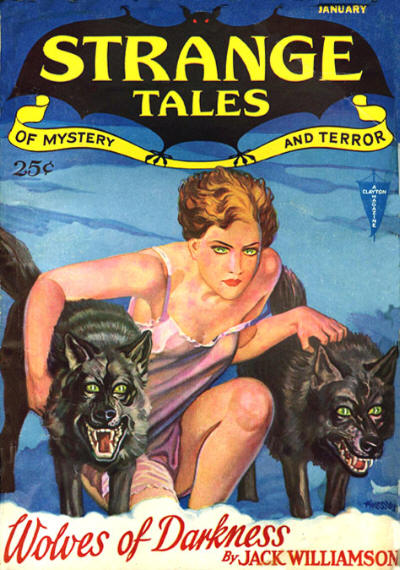
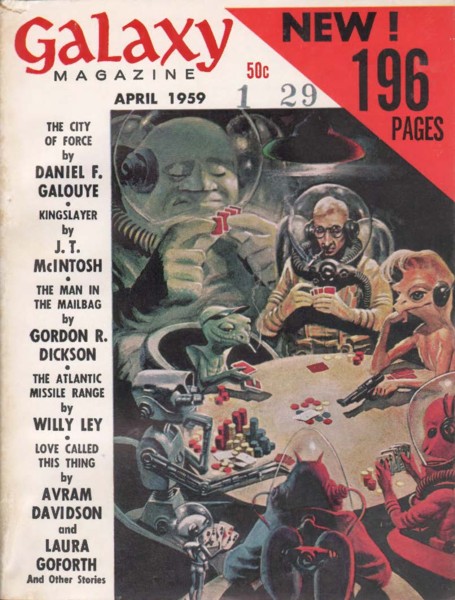


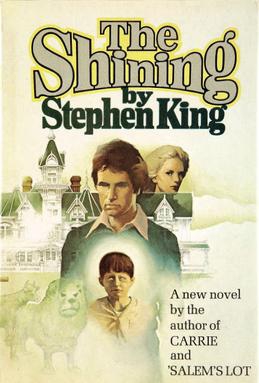

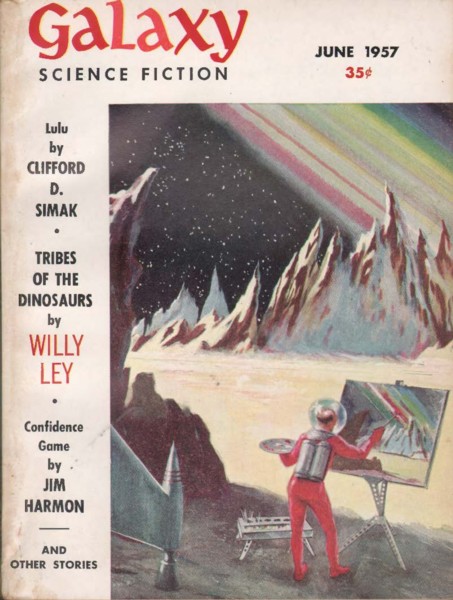

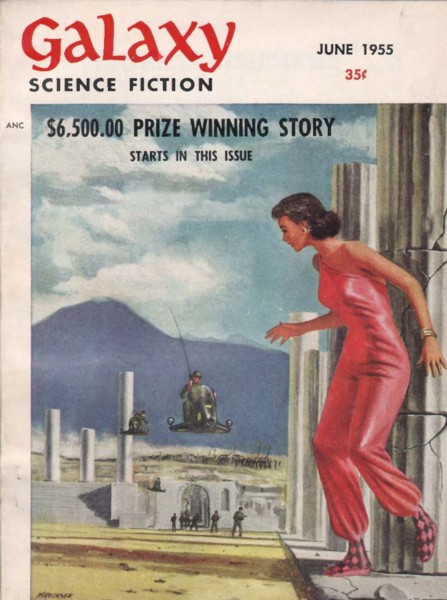


 Science Fiction & Fantasy Remembrance