We seem to be living in a world of shit, or at least it’s easy to think that way. The irony is that the people who think this the most are also probably (being queer and disabled I’m actually not sure how I’m gonna turn out) the ones most likely to come out of all this bullshit unharmed—in body, if not in soul or mind. But, the show continues. I thought I had more to say for this month’s forecast, and at this point I think it’s fair to say my Things Beyond posts have become like actual weather forecasts (I predict, but that doesn’t mean the thing will 100% happen); but still, aside from a couple things I’m sure we all know about already, the past month has been uneventful. I got my purchases for Worldcon at basically the last minute, so I’ll be seeing what I can see of the con virtually if not in person, and with any luck I’ll even be on a couple panels, as one of those inside-a-computer people. I’ve been slowly but surely moving “up” in the world of fandom.
Anyway, for decades we’ve got two stories from the 1920s, one from the 1940s, one from the 1970s, one from the 1990s, and one from the 1890s. As for the stories themselves, we have…
For the serial:
Sunfire by Francis Stevens. Serialized in Weird Tales, July-August to September 1923. Francis Stevens is the androgynous-sounding pseudonym of one Gertrude Bennett, who for just a few years wrote prolifically for the pulp magazines, apparently to help pay the bills. Once her sickly mother died, she stopped writing fiction, with Sunfire being the last story of hers published. It would take more than seventy years for this story to appear in book form.
A Story of the Days to Come by H. G. Wells. Serialized in Amazing Stories, April to May 1928. First published in 1899. Wells is perhaps the most crucial pioneer of science fiction; aside from maybe Edgar Allan Poe he stands as arguably the genre’s nucleus. This is made more remarkable since Wells wrote his most famous work over the span of only about a decade. This story comes from said decade of greatness, but I guess due to its length it remains overlooked.
For the novellas:
“The Glowing Cloud” by Steven Utley. From the January 1992 issue of Asimov’s Science Fiction. Utley was born in Kentucky, at Fort Knox (he was a military brat), before moving to Texas (Austin), and then finally Tennessee. He wrote prolifically in the ’70s, all of it short fiction, as one of the post-New Wave generation. He then fell mostly silent in the ’80s before reemerging in the early ’90s.
“To Fit the Crime” by Joe Haldeman. From the April 1971 issue of Galaxy Science Fiction. Haldeman, like Utley, came about during the post-New Wave era; he had spent the New Wave years in college, and then in Vietnam, where he got damn near killed. Once his wounds healed enough he got to work writing SF. This story here is the first in a loose series, starring Otto McGavin.
For the short stories:
“When the Bough Breaks” by Henry Kuttner and C. L. Moore. From the November 1944 issue of Astounding Science Fiction. Retro Hugo nominee for Best Novelette. I had missed the boat on reviewing Moore solo last month, and I can’t review Kuttner solo next month either; so together here they go. Kuttner and Moore were of course married, and they’re also two of my favorite writers.
“The End of the Party” by Graham Greene. From the December 1950 issue of Worlds Beyond. First published in 1932. Greene was famous in his day as both a serious novelist and a writer of espionage thrillers, although the two were not mutually exclusive. He also occasionally dabbled in supernatural horror, with this story being one of his own personal favorite works despite its age.
(Cover by Frank Kelly Freas. Astounding, December 1957.)
The Story So Far
Thorby, once a slave a Jubbulpore, a city where slavery is alive and well, then taken in and educated by a “beggar” named Baslim, has since grown up to become a surprisingly intelligent (albeit not wise) young man. He joined the Free Traders for a time, under the foster care of Captain Krausa and the tyrannical matriarch Grandmother, only for the latter to die and Thorby to leave the Free Traders. A philosophical dialogue with Dr. Mader, the only passenger aboard the Free Trader ship Sisu (also probably my favorite scene in the whole novel, it’s at the end of Part 2), convinces Thorby he had left one kind of slavery only to enter another. After some digging on Krausa’s part a few things come to light for both parties: that Baslim was a colonel in the Terran Hegemony’s space navy, who covertly partook in anti-slavery operations, and that Thorby is not descended from the Free Traders but instead is the son of the presumably deceased former owners of Rudbek and Associates. Thorby’s birth name is Thor Bradley Rudbeck (get it? Thor Bradley? Thorby?), and since his parents are missing or dead that makes him the legal heir to the company, with all its money and influence. Small problem: John Weemsby, an in-law to the Rudbeks, has been in charge of the company for years, with his stepdaughter Leda thus being the heir prior to Thorby’s unexpected reappearance.
Enhancing Image
So, Thorby and Leda are cousins, of a sort; they’re not actually blood-related. Given that Leda is supposed to be only a bit older than Thorby, and given the strange chemistry between them, it must’ve taken Heinlein an exceeding amount of willpower to not indulge in some pseudo-incest. Of course this isn’t even the first time in Citizen of the Galaxy that pseudo-incest (I say “pseudo-” because for my money’s worth I say it’s only the real deal if they’re related enough by blood) is a bullet that Thorby dodges, although, as with Mata on the Sisu earlier in the novel, Thorby’s total lack of interest in sex “saves” him. We know that this is not how most teen (or maybe by the end of the novel he’s in his earlier twenties) boys think, but a) Thorby is not like most teen boys, and b) it’s implicitly accepted as part of the deal when reading a Heinlein juvenile. Actually, as far as the Heinlein juveniles that I’ve read so far go, Citizen of the Galaxy might be the least realistic in that it takes the most breaks from reality, but also it’s the least concerned with hard science. Part of the reason for Heinlein writing these novels in the first place was to teach young readers some facts (or what Heinlein considered facts, which is not the same thing) about space and other things. Some of these novels, despite being aimed at teenagers, border on what we now call hard SF. Citizen of the Galaxy is pretty flaccid loose with its science; if you went in worried about having to deal with numbers and calculations, don’t be, because there are basically none to speak of. Spaceships in this novel go however fast they fucking feel like, and time dilation seems to be a non-issue. Space as we understand it is a non-factor in the characters’ problems, which even for 1957 is pretty soft.
Instead this novel is concerned with other things, like the slave trade, and also, strangely enough, the minutia of running a business. Business majors (the few business majors who have any interest in reading real literature) will get a kick out of the last installment of this book. Citizen of the Galaxy switches gears a few times throughout, from far-future thriller to planetary advneture to, finally, a sort of legal drama. Readers in 1957 were probably not expecting this novel to end up where it does, for better or worse. Truth be told I found it to get a bit worse as it goes along, or rather I think it peaks when Thorby is with “the People” and then gets bogged down from there. Whereas the first two installments gave us some intriguing characters, from the enigmatic Baslim (even if he is clearly a stand-in for Heinlein) to the tough-minded but feeble-bodied Grandmother, the cast of the novel’s latter half is more of a mixed bag. Leda is a curiously hard-nosed young woman and one of Heinlein’s more compelling female characters, in a novel that might actually have his strongest roster of girls/women, but Weemsby is a weak villain—if you can even call him that. He’s obviously not a good person, and also is an opportunistic businessman (but then aren’t they all) who profits off the slave trade, but he never does anything particularly bad onscreen, or… on-page. The back end is chiefly concerned with what is basically a battle of wills (or rather a will, sorry for the pun) between Thorby and Weemsby, which is not as compelling (as least to me) as it sounds. Some readers will get more out of it, but a common gripe with this novel is that the ending is weak, as indeed it is, tapering off as soon as Leda hands over the business to Thorby on a silver platter. The implication is that Thorby and Leda may after all engage in some pseudo-incest, but only after the book has ended, so as to spare young readers’ virgin eyeballs.
Let’s talk about the cheery topic of slavery, and how Heinlein clearly opposes it but also tries to reconcile abolitionism with capitalism. This is heavy subject matter for a novel aimed at young readers, but then again Heinlein was not above covering dark subject matter in some of his previous juveniles. The catastrophe that happens in the back end of Farmer in the Sky might be the single bleakest stretch of writing out of Heinlein’s whole career, and again this is a novel written for high schoolers. With Citizen of the Galaxy the strange thing is more that slavery, which in this spacefaring future has made a big comeback, at least in some societies, is presented as a problem that requires a solution, as opposed to what slavery apologists tend to argue, which is either that slavery is really not that big an issue or that sure, slavery is a big issue, but it’ll inevitably get phased out on its own and we really shouldn’t do anything about it. As with most if not all right-wing beliefs, the defense of slavery, as with the defense of racism, or homophobia or transphobia, is founded on a contradiction or series of contradictions. Slavery apologists, both in Heinlein’s time and today, will very rarely argue that slavery, as it existed in the CSA, should still be around, and they may even be “happy” that it is no longer a thing; but then they’ll say that actually it should have been “left up to the states,” or that the Union (which did have a couple slave states on its side, mind you) should not have fought the CSA over slavery (although the CSA had technically fired the first shot), or even (actually this might be the most common argument) that the Civil War was not about slavery at all but about some other bullshit. So “of course” slavery is bad, but according to apologists it’s not bad enough to abolish.
Heinlein was nothing if not a man of contradictions. He started out as a progressive in the ’30s before shifting farther right, especially upon marrying Virginia, his third and last wife. One of the few things that remained consistent throughout Heinlein’s adult life was his fierce individualism, which also happened to conflict with his lifelong adoration of the military—not just the US military but the idea of the military. He served in the US Navy for five years, albeit during peacetime so it’s not like he saw combat, so he certainly had a rose-tinted view (despite the chronic illness) of such things. He also became increasingly a fierce capitalist, although truth be told he always had a quite cheritable view of capitalism, even from his earliest published stories. One of Heinlein’s more memorable characters is D. D. Harriman, the man who sold the moon, a legendary businessman who is responsible for landing the first people on the moon’s surface, despite being unqualified to go there himself. (No doubt Elon Musk sees himself as a Harriman-like figure, and he’s explicitly and repeatedly paid homage to Heinlein, although for what it’s worth I’m not sure Harriman would have been a screaming antisemite and transphobe, not to mention a cuckold.) Citizen of the Galaxy ends with Thorby, having now claimed what is “rightfully” his, vowing to do what he can to disrupt the slave trade, having already made the order to pull Rudbek and Associates out of it. This now reads as a little overly optimistic. It’s also a bit contrived that Thorby just so happens to have descended from what amounts to royalty; it’s like how Rey starts out as a peasant girl in The Force Awakens but then discovers she’s Palpatine’s granddaughter. We feel cheated somehow because we’ve been denied our working-class hero.
A Step Farther Out
Given its reputation I have to say I was a bit disappointed with Citizen of the Galaxy, as it might not even be my second favorite of the Heinlein juveniles I’ve read (I prefer Between Planets and Farmer in the Sky). I would also have to look into if Heinlein had written it with the hope of a serial run, since it does split pretty neatly into four parts; unfortunately those parts are also rather disjointed. Heinlein’s juvenile’s are beloved among older readers to this day in part because they’re some of his least problematic/uncomfortable works, and while Citizen of the Galaxy does walk a fine line with its subject matter, it does handle it better than many SF novels from the same period; indeed, it handles the issue of slavery and individual freedom better than some of Heinlein’s adult novels. As I’ve gotten older and my politics and reading tastes have shifted I’ve become more conflicted on Heinlein—but then so does everyone who isn’t a moronic sycophant.
(Cover by Chesley Bonestell. F&SF, February 1956.)
Who Goes There?
I’m not sure if anyone can claim to have a more varied career than Frederik Pohl, who across a career of seven decades took part in the field as a writer, editor, critic, and literary agent, such that he understood basically every step of the writing and publication process. He made his debut in the late ’30s, and early on he was most active as a fan and editor, being in charge of a couple low-budget genre magazines which nevertheless acted as a training ground for some very important writers, such as Isaac Asimov and C. M. Kornbluth. Whereas some great authors specialize in one or two things, going off the rails when they deviate from their specialties, Pohl was much more of a jack of all trades. He’s one of the few people who’s won Hugos for both writing and editing. His memoir, The Way the Future Was, is a surprisingly vulnerable and self-critical account of his early days in SF fandom and making it as a professional. He was already a magazine and anthology editor of renown when he took over If and Galaxy Science Fiction in the ’60s, having already assisted H. L. Gold for some years at that point. His Hugo-winning novel Gateway is still one of the best of its kind, being a deep character study, a gripping space adventure/mystery, as well as a vicious and black-hearted critique of capitalism. Pohl died in 2013, at the age of 93, making him one of the last of the old guard to leave this realm.
Now, you may recall I was set to review a different Pohl story; actually it was a novella, called “In the Problem Pit.” Due to outside circumstances not having to do with the story itself I could barely even begin to read it, let along write a review about it. I may yet read it and write about it in the future, eventually, but that day is not today. Still, I did not want a repeat of what happened when I read C. L. Moore’s “Jirel Meets Magic” earlier this month, so I was determined to read and review a Pohl story, even if it wasn’t a novella. I dug up “The Census Takers,” which comes from a quite different period in Pohl’s career, and it was Anthony Boucher’s introductory blurb for it in F&SF that caught my attention. Boucher calls it “one of the most extraordinary jobs of effective conciseness in all of science fiction,” and I have to say I do think that praise is pretty much warranted. “The Census Takers” is brief, but it’s a dense and mean little bastard of a story, one I would consider something of a hidden gem.
Placing Coordinates
First published in the February 1956 issue of The Magazine of Fantasy and Science Fiction; incidentally this was also Pohl’s first appearance in F&SF. It was then reprinted in The Best from Fantasy and Science Fiction, Sixth Series (ed. Anthony Boucher), Nightmare Age (ed. Frederik Pohl), No Room for Man: Population and the Future Through Science Fiction (ed. Ralph S. Clem, Martin H. Greenberg, and Joseph D. Olander), and the Pohl collections The Case Against Tomorrow and The Best of Frederik Pohl.
Enhancing Image
The narrator is Area Boss of a team of some 150 Enumerators, who over the course of six weeks are supposed to take the yearly census of a given area, called a Census Area. The story takes place somewhere in the US, although Pohl is vogue as to where (Denver gets mentioned at one point, so maybe it’s Colorado), and he’s also vague as to when this is taking place. It’s definitely the future, but there are basically no references to technology, such that the story doesn’t easily date itself. The narrator is also unnamed (sort of, we’ll get to that later), but for the short time we’re stuck with him it doesn’t take long to figure out the kind of person he is: a real no-nonsense asshole type. Manager material. The story is concerned with an incident that happened with one of the narrator’s Enumerators not too long ago, Witeck, who’s also a good friend of the narrator. “We were Enumerators together, and he was as good a man as you ever saw, absolutely nerveless when it came to processing the Overs.” Of course, one day he cracked. Supposedly. The problem is that whereas in our world a census taker’s purpose is simply to help estimate a certain area’s population, the census takers of this story have to verify if a CA is Over or Under—and if there’s even one Over in a CA then it’s a problem. A CA’s population can’t be Over or Under according to Regional Control, and if someone if Over it’s implied they get executed (an Enumerator’s “processor” is actually a gun, although this is not revealed to us right away). So two problems arise, the first being that Witeck claims to have picked up a guy without an ID or blue card who in turns claims to be some ambassador—from the interior of the planet. On the narrator’s end, he has to deal with a father and his wife and five kids, who have attempted to “Jump,” i.e., move out of the CA before the Enumerators come in.
In case you couldn’t tell, the future America of Pohl’s story is some kind of Malthusian nightmare in which the government keeps the population strictly controlled on an area-by-area basis. A CA’s population should not be Under but it especially should not be Over. Having children has apparently become seen as a necessary evil, as people on the census team are not allowed to have children and the narrator, with rather open disdain, calls parents “breeders,” regardless of whether they have one child or five. (As I was reading it I kept thinking of how some queer folks, back in the day, would call people in heterosexual relationships “breeders” as a derogatory thing, although I’m not sure if this was a thing in urban queer spaces in the ’50s, complicated further because Pohl absolutely would’ve been aware of such spaces.) Malthusianism, named after 18th century economist Thomas Malthus, is basically the belief that resources cannot keep up with population growth, i.e., there ain’t enough room in this world for all of us and at some point the bottom will fall out. In the ’50s and ’60s the belief that population growth was some big fucking problem was pretty popular among intellectuals, even left-leaning ones, resulting most famously in SF novels such as Harry Harrison’s Make Room! Make Room! and John Brunner’s Stand on Zanzibar. Aldous Huxley, in the last decade or so of his life, became pretty vocally concerned about overpopulation and people took this seriously. I’ve read enough of Pohl’s non-fiction to get the impression he didn’t agree with such a worldview, but even if I hadn’t done the homework in advance, one gets the feeling just from reading “The Census Takers” that he had a bone to pick with Malthusianism. The census takers in-story are basically border patrol, or ICE, which is to say they’re inhuman monsters who, at best, split a family apart if something is out of order; so they’re border fascists, or rather population fascists. For such a short story, this is quite bleak…
Speaking of bleakness, in most stories the narrator would probably be the villain, but here Pohl puts us in his shoes and makes us walk around in them for a bit. This dude is a prick, not that he claims to be a beacon of kindness and selflessness. His treatment of Witeck is understanding, at first, but he quickly loses patience and tells the man to do his job, regardless of the possibility of his claims being true or even if he really is having a mental breakdown like the narrator thinks. Then there’s Carias, the narrator’s “right-hand man,” who doesn’t do much better, especially once he starts backing up Witeck’s claims. The narrator has no patience for such things and he’s already trying not to “process” the father who tried Jumping with his family where he stands. The narrator and Witeck have, by this point, killed or at least deported hundreds, if not thousands of people over the years of census-taking, and it seems today might be the day everything breaks. Mind you that Pohl was always to some degree on the left, certainly more progressive than the average liberal of the time—ironic, considering he would later cry out against the New Wave. Both politically and literarily Pohl gets a lot of work done with so few words, implying more often than stating things outright while also establishing the world of the story. Some points are left ambiguous, intentionally, but we get what Pohl is going for, which is to show the inherent inhumanity of playing border patrol, or playing population control. Of course, the most ambituous (indeed, the closest to mirror the world of “The Census Takers”) Malthusian project in the real world would be China’s one-child policy. One need only extrapolate a bit further beyond that accursed policy to see where Pohl is taking us. In the ’50s, the SF market was broad enough that a dark little nugget like “The Census Takers” could see print, and thank goodness for that.
There Be Spoilers Here
The situation with the “ambassador” gets to the point where Witeck feels the need to call the narrator by his first name: Jerry. “It was the first time in ten years, since I’d been promoted above him, that Witeck had dared call me by my first name.” This convinces Jerry that Witeck really has lost it, relieving him of his post and processing the so-called ambassador, who in turn, as if putting a hex on Jerry, says that the people on the surface of the globe will be wiped off the face of it. The people living at the Earth’s core will have their day. This is implied to be the case (or it could just be a few coincidences) when a series of natural disasters, from a tsunami to a volcanic eruption to geysers in Yellowstone Park, delay Jerry going on vacation. Witeck dies soon after being let go, supposedly a suicide, although as Carias points out he didn’t use his gun on himself. Strange. There are one or two loose ends, or rather dark corners that Pohl intentionally refrains from shining a light on. The effect is a little nightmarish.
A Step Farther Out
When I found this story I knew nothing about it, not least because it hasn’t been in print since the ’90s and thus remains sort of a hidden gem. I didn’t think it would read as timely as it did. Of course, it’s true that since the 19th century, even before the tightening of the US’s immigration policy in the 1920s, immigrants and migrant workers have had a tough lot in this country. The ruling class, serving patriarchy and white supremacy (what counts as “white” has expanded quite a bit over the past century), sees migrants as cheap and easily exploitable labor; and if there’s an issue, if someone were to raise a fuss, then that can be easily dealt with. Pohl was one of the great social commentators of ’50s SF, in a decade that seemed to be blessed with almost a surplus of great social commentators. “The Census Takers” is, as told from the oppressor’s (the capitalist’s, the white supremacist’s, the Zionist’s) point of view, a shot out of hell, a cry of impending vengeance on the part of the migrants and other dispossessed peoples; because at some point, sooner or later, such people will have no choice but to have their revenge or die under the oppressor’s boot. It’s only a matter of time before we too, in our world, see those we treat as subhuman, be they “south of the border” or halfway around the world, have their day of justice.
(Cover by Frank Kelly Freas. Astounding, November 1957.)
The Story So Far
Thorby is a teen boy with no last name and of unknown heritage who, in the first installment, got sold off to an old beggar named Baslim—the twist being that Baslim is no beggar, but a wise man with far more resources and connections than he lets on. At the end of Part 1, Thorby was separated from Baslim, who died offscreen, having been cornered by the Sargon’s goons and opting to kill himself rather than be interrogated and then executed. Part 2 saw Thorby on a ship, the Sisu, captained by a man named Krausa but really run by Grandmother, the ship’s matriarch and chief officer. Grandmother is quite old, to the point of being bedridden, but she’s quite a bitch, and much of Part 2 is concerned with Thorby adapting to life on the ship but also being caught in the crossfire between Krausa and Grandmother, in a battle of wills. One side wants to keep Thorby onboard as a useful mathematician, Thorby having been given a crash course in maths (as the Brits say) by Baslim, while the other wants Thorby married off to some girl on the ship as soon as possible so that he becomes a proper member of “the People,” that is to say the Free Traders, a cluster of nomadic peoples who roam the stars in the name of freedom and fair trade. Thorby, as is typical for a Heinlein juvenile protagonist, isn’t very interested in girls despite his age, which doesn’t stop him from befriending a younger girl, Mata. The tragic part is that Mata has a crush on Thorby and Thorby can’t just go with any girl, but rather has to marry someone who, like him, was adopted by the ship; for someone who was “adopted” to marry someone who was born on the ship would be taboo. The higher-ups, fearing Thorby might reciprocate Mata’s feelings, decide to ship the latter out.
Enhancing Image
Before getting into the plot of Part 3, let’s talk about what Citizen of the Galaxy is, aside from being a planetary adventure novel aimed at teen boys in the latter half of the ’50s. I’m not sure if Heinlein wrote this novel with the hope of it getting serialized, on top of getting Scribner’s to publish it in book form, but it does read as if intended to be taken in installments; or maybe I’m just saying this before I’ve not yet read it as a book. The thing about Citizen of the Galaxy, which makes it rather unique among Heinlein’s juveniles but also somewhat to its detriment, is that it’s overtly a picaresque novel. For those of you who forgot, a picaresque novel is a kind of narrative, typically comedic, in which a boy or young man goes out to see the world and gets into a series of adventures (or more often misadventures). It was a popular form in 18th and 19th century English literature, probably in no small part because novels in the UK and France were often first published as serials, and the episodic and amorphous structure of the picaresque novel was built well for serialization, in which readers could catch up with their favorite rascal month after month. By the time Heinlein wrote Citizen of the Galaxy the picaresque form had long since fallen out of fashion, I suspect because of the decline of serialized novels in magazines, and also the lack of seriousness associated with the form (I wouldn’t call it a genre). There were still some notable examples around this time, like Saul Bellow’s The Adventures of Augie March and John Barth’s The Sot-Weed Factor, the latter being consciously written as an homage to 18th century picaresque novels like Tom Jones. Citizen of the Galaxy itself pays homage to one of the last of the “classic” picaresque novels, Rudyard Kipling’s 1901 novel Kim.
So we have a novel about one boy’s education and quest for self-discovery, although it’s worth mentioning that up to this point Thorby has not been very active in shaping events in his life. Three quarters into this novel and my major problem, if I had to say I had one, is that Thorby himself is not a very interesting protagonist; but then who the hell is interesting at 16 or 17? When you were in high school you barely fucking qualified as a sentient mammal, let alone as a person. No, instead it’s the people around Thorby, mostly the adults in his life, who draw our interest. In Part 1 we had the walking enigma that was Baslim, as well as the well-meaning old lady Mother Shaum who briefly looks after Thorby before he hops aboard the Sisu. Since then we’ve been left with Captain Krausa, Grandmother, and Dr. Mader, the last acting as an exposition machine but also a viewpoint that would land closest to the reader’s, so that we have someone relatively normal who can explain to both Thorby and us the ways of the Free Traders. Grandmother and Dr. Mader are unusual for Heinlein and especially unusual for genre SF of the time in that they’re strong-willed women who don’t take shit from anyone while also staying bachelorettes (although in Grandmother’s case that’s more because she’s very old and an invalid). But because this is the third installment and the novel’s trajectory is rather spotty, with Heinlein picking up Thorby from one situation and then putting him down in another, Our Hero™ has to be separated from the adults in his life somehow. First thing is that Grandmother dies. This in itself is not unusual, even for a Heinlein juvenile, since if you read enough of these things you start to realize adult characters who play mentor to the teen protagonist tend to not be long for this world; rather it’s how we’re told of Grandmother’s death that’s a bit shocking. The old bitch dies her sleep while the Sisu has docked on the planet Woolamura, but what’s unusual is that we’re told of her death several pages before the characters find out for themselves. Is this dramatic irony? It’s an odd choice from Heinlein, to tell us of a character’s death before it actually happens, but somehow it works.
Grandmother’s death is also convenient because it means Thorby is no longer in danger of getting married to some girl on the ship (and by extension the Sisu) any time soon. This then leads to another problem, though, that being that Krausa discovers that Thorby is, in fact, not descended from the Free Traders; he’s also found, via messages from Baslim as recited by Thorby (the old beggar having conditioned the boy to repeat these messages in specific circumstances), that he is no longer to be foster father to the boy. The Free Traders are super-capitalists, but they’re also “honorable” in that they follow through on a favor (although they call it a “debt”) to the letter. Thorby’s business with the Sisu is reaching its end. It turns out that Thorby is not one of the People, but the lost heir to a goddamn upper-class family, his “true” name being Thor Bradley Rudbek. Truth be told, I’m not keen on this twist, for one because it turns Thorby from just another kid into suddenly a member of the ruling class, albeit someone who is very much open to exploitation. But there’s also with how Heinlein reveals this, which really shows the novel’s episodic structure to its detriment. We feel, by the end, like we’re reading a different novel than what we started with. It’s also in the back end of Part 3 that we’re introduced what seems to be a human antagonist, in the form of John Weemsby, whichm given that we’re more than halfway through the novel at this point, is a bit odd. Between Part 2 and 3 a couple years have apparently passed and Thorby is now at least old enough to have become a guardsman for the Terran Hegemony, while secretly running for an anti-slavery operation. (I think more so than a lot of Heinlein novels, and especially for something published in Astounding, this book really hates slavery. Wonder what the very racist John W. Campbell thought of that.) I do feel it’s during this stretch where the novel loses me a bit, although it does pick up again by the end of the installment.
A Step Farther Out
Three quarters in and I’m not sure I would call Citizen of the Galaxy my favorite Heinlein juvenile so far. The plot is not as cohesive as, say, Between Planets, nor is the conflict as urgent here as in that novel. Thorby is a bit of a cypher, although I understand that’s probably the point given how he’s been railroaded by higher powers up to this point, and indeed this railroading is part of the conflict. Heinlein was working within the constrains of genre SF writing of the period, although he also helped broaden horizons via his deal with Scribner’s. In the ’40s and ’50s he was, while certainly being open to criticism, at the very least a more ambitious storyteller than nearly all of his contemporaries. Citizen of the Galaxy is flawed, but it’s also (so it seems clear to me) one of the most ambitious of Heinlein’s juveniles—even more than the written-for-adults Double Star.
Here it is, another Observatory post that’s a couple days late, along with a short story review that’s nowhere to be found. This case is especially painful for me because I respect C. L. Moore a lot, and I irked myself when I read her Jirel of Joiry story “Jirel Meets Magic” and found that I had not read it deeply enough to write a review that’d be worth a damn about it. Unlike the last time this happened, however, it really was because I felt unprepared to deal with Moore’s level of writing, since it must be said she was a better prose stylist than most of her contemporaries, especially in the ’30s. Since I don’t feel qualified to review more Jirel stories, at least for the foreseeable future, I do hope instead to cover a Kuttner-Moore story in February, as a way to return to both of those authors whom I like a great deal. For now, let’s talk about something else. This is a sequel to the Observatory post I wrote last month, “The Origins of Depression in Science Fiction,” which is actually one of my favorite editorials I’ve written thus far, even if it was not what you’d call a “pleasure” to write—rather it was a post I felt I had to write. Turns out that despite the aforementioned post being over 2,000 words long, I still have much more to say on the topic. When I wrote that earlier editorial I did it as a way to talk about my own struggles as a manic-depressive, but I also made an argument which boiled down to this: that the massive uptick in discussing mental illness through genre SF corresponded with, or perhaps was sparked by, the end of World War II, more specifically the use of atomic bombs on Hiroshima and Nagasaki. What had previously been only treated as theoretical suddenly became a harsh reality for SF writers, which caused a sea change for the field.
The strange thing about all this, if you think about it, is that while the Allies won World War II, vanquishing a few fascist regimes in the process, such a sense of victory did not show itself in SF writing in the months and years following the war’s end. Why weren’t these people happy? They won! Not only did they succeed in defeating the Nazis, but long-held speculations about the possibility (even the inevitability) of nuclear weapons had been vindicated overnight. It was the closest, at least up to that point, that science fiction had come to actually predicting the future and getting it right. Perhaps the person mostly keenly aware of this change in the moment was John W. Campbell, who famously got into some hot water with some federal agents because of a story he had published in the March 1944 issue of Astounding Science Fiction: Cleve Cartmill’s “Deadline.” Now, having read “Deadline” for myself, I can say it’s frankly not a very good story; but then it didn’t need to be. Cartmill, who at the time was a new writer, had, much with Campbell’s assistance, written a story that serves as a rather unsubtle allegory about the use of nuclear weapons against the Axis powers. It wouldn’t take a genius to figure that the US government was working on the atomic bomb, or at least some weapon of mass destruction, and that both the Axis powers and even America’s own allies (namely the Soviet Union) were keen on finding out what these scientists were cooking. The March 1944 issue of Astounding would’ve been on newsstands in February, a whole 18 months before the US dropped an actual atomic bomb on actual human beings. Compared to Street & Smith’s other magazines, Astounding did not have a big readership, but it would be their only genre magazine to survive the wartime paper rationing and I suspect Astounding‘s power for prophecy was a big reason why it was spared.
Despite the newfound vindication, however, it seems that a savage gale had swept across the ocean of science fiction with the war’s end, and Astounding, which up to 1945 tended to published some of the most optimistic fiction in the field, took on a darker hue. This change in mood was by no means unique to Campbell’s magazine, of course: every American SF magazine at the time, be it Starling Stories or its more juvenile sister magazine Thrilling Wonder Stories, got at least a bit darker in editors’ speculations and what fiction they were willing to print. During the war years, specifically 1942 to 1945, it was not uncommon to find what you might call a propaganda story in an issue of Astounding, about a character or group of characters going up against either an obvious analog (aha) for the Nazis or just the Nazis outright; and naturally these stories are about how we will or at least should beat Hitler and his goons. Off the top of my head I’m thinking of A. E. van Vogt’s “Secret Unattainable” and J. Francis McComas’s “Flight into Darkness.” Yet following the war’s end there came, over the next handful of years, a bunch of stories in Astounding and elsewhere that could not have been reasonably published (or indeed thought of) during the war, partly because of how bleak these new stories are, including but not limited to C. M. Kornbluth’s “The Little Black Bag” and “The Marching Morons,” T. L. Sherred’s “E for Effort,” A. E. van Vogt’s “Dormant,” Theodore Sturgeon’s “Memorial” and “There Is No Defense,” Jack Williamson’s “With Folded Hands…,” Arthur C. Clarke’s “History Lesson,” too many Ray Bradbury stories from this period to count, and about half of the stories that would comprise Clifford D. Simak’s City. Perhaps the most downbeat of all these post-war stories, in fact one of the darkest stories in the genre’s whole history (which is saying a lot), is Edmond Hamilton’s “What’s It Like Out There?,” which appeared in the December 1952 issue of Thrilling Wonder Stories. The kicker here is that Hamilton had written an early draft of this story a whole two decades earlier, but could not get it published then; but it found a home, seven years after World War II and in the midst of the Korean War.
(Funny aside about Sturgeon’s “There Is No Defense,” published in the issue of Astounding pictured above: Campbell, in the previous issue’s Of Times to Come section, had to tell readers that the upcoming Sturgeon story “is not about atomic bomb warfare,” despite what the title would naturally make people think. However, the Alejandro cover, which does not illustrate a particular story and which Campbell calls “purely symbolic,” showing an Olympian figure splitting the atom with what seems to be a pair of lightning bolts, tells me that “atomic bomb warfare” must’ve been on somebody’s mind. Given the timing, it’s not hard to see why.)
One could argue the latter half of the ’40s to the early ’50s marked a crucial turning point in the development of genre SF, as a kind of uniquely American form of fiction writing. Oh, there was of course SF written outside the US, before and after World War II; after all, arguably the biggest point of inspiration for Amazing Stories, when it launched in 1926, was H. G. Wells. There was another profoundly influential work of SF from the UK that arrived just in time to coincide with the collective turn toward depression and pessimism that American SF was seeing: George Orwell’s 1984. Rather than celebrate the defeat of Nazism, 1984 warns what was then the western side of the so-called Iron Curtain about totalitarianism—both of the Soviet variety and a more capitalistic American and British fascism. Orwell, in the wake of the war’s end and the start of the Cold War, saw not a new dawn for democracy in the “civilized” world but, to paraphrase him, a man (as in humanity) getting his faced stomped on by an authoritarian’s boot, forever. You know who seemed to agree with Orwell’s post-war pessimism? C. M. Kornbluth, and William Tenn, and Robert Sheckley, and Philip K. Dick, and Henry Kuttner, and so on. These are authors who either only debuted after the war’s end or had gotten lucky during the war years. (Kornbluth is a funny example in that he is both technically a pre-war writer and someone who, after taking a break from writing for several years, returned to a market that had changed drastically so as to better suit his perpetual bitterness.) We still got stories of daring invention and adventure, of man’s destiny as the owner of the universe, but we also got a good helping of stories that Campbell would not have approved. By the early ’50s the market had broadened such that even something as nihilistic as Tenn’s “The Liberation of Earth” got published in a pulpy magazine.
I’ve made it no secret that I find genre SF in the late ’40s through the ’50s very interesting, and not for the reasons people tend to idolize that period of American history. Sure, there was economic prosperity—for some people. The US quickly rose to the occasion as the leader of the Western allies, by virtue of largely of having escaped World War II unscathed compared to the UK and France. But there was racial strife, a revived paranoia that there’s a filthy communist lurking under ever bed, not to mention a forced marriage between Christianity and capitalism. As the Cold War kicked into high gear it was no longer enough to just be a good Christian in America (God forbid you were not a Christian to begin with), you had to also be a good capitalist, the problem being that worship of Christ and worship of the dollar make for uneasy bedfellows. Philosophically the two are like oil and water. Sadly, for almost eighty years at this point we’ve had to live with the suffocating, murderous reality of worshipping the dollar, seeing the rise of neo-liberalism and Christofascism, watching them spread and tangle like weeds in one’s garden. What’s not to be depressed about? The future is looking bleak. As famous as they are, generally optimistic writers like Robert Heinlein and Isaac Asimov are nowadays plagued by controversy, or even simply ambivalence from the modern SF reading crowd. It’s not uncommon to find an earnest SF reader under the age of forty nowadays who thinks Asimov is boring, or that Heinlein is too problematic; but these people would probably connect much more with someone like Kornbluth or Kuttner. Given that we’re constantly at risk of being torn down and obliterated by depression, since it seems clear to at least some of us that we’re living in the last days of industrial capitalism (or so we hope), we might not need a Heinlein or Asimov, but someone… darker.
(Cover by Ed Emshwiller. Astounding, October 1957.)
The Story So Far
On the planet Jubbul, in the city of Jubbulpore, a boy is sold at auction. Thorby is a slave, in a distant future where slavery has made a big comeback, of unknown ancestry, but luckily for him his buyer is the beggar Baslim, who takes the boy in as if he were a son. Of course, Baslim only appears to be a beggar, for he turns out to be a very wise and well-connected man, who has a lot more resources than he lets on. Baslim teaches Thorby the ways of acting a beggar, which involves knowing several languages, as well as how to get what you want through morally grey means; but considering Baslim is just one man he provides the boy with a very fine education. Aware that his death is imminent, however, given his connections to the abolutionist movement, Baslim nudges Thorby in the direction of a skipper who commands one of the so-called Free Traders, ships that roam freely throughout the galaxy in the name of pursuing trade, not to mention abolitionist causes. After one of his courier jobs, Thorby finds out that Baslim is dead, having been cornered by police but opted to commit suicide via poison rather than be “shortened.” Eventually Thorby finds one Captain Krausa, of the Sisu, a Free Trader, and he gets smuggled aboard the ship, presumably never to see Jubbul again. This brings us more or less up to speed.
Enhancing Image
A new setting means a new cast of characters, and Heinlein does not disappoint. The Sisu is a much cleaner but more cramped space than Jubbulpore, which means everyone knows everyone else. Despite his education under Baslim, Thorby quickly finds that the social dynamics of the ship are totally out of his realm of expertise. The ship’s crew is like one big foster family, and that’s not even really an exaggeration: everyone has a rank on the ship, but also everyone has familial relations to each other, which can make things confusing. You might outrank someone, but be of lower familial standing. Most of Part 2 of Citizen of the Galaxy is Thorby getting acquainted with his new foster family, namely Captain Krausa, Grandmother Krausa, Jeri Kingsolver, Jeri’s sister Mata, and Dr. Margaret Mader, the only non-relative aboard the ship and a fluent speaker of Expositionese. If you really wanted to you could certainly do a feminist reading of this novel and put together the jigsaw puzzle of how women figure into Thorby’s life, often as guiding authority figures, because there’s a surprising number of them for a Heinlein story. Heinlein had a, let’s say complicated relationship with women: he was by no means a feminist, but at the same time he wrote women in authority positions at a time when this was decidedly uncommon in genre SF. This had some real-world precedent, considering that when Heinlein met Virginia, his third and final wife, she actually outranked him in the military (needless to say she was not in a combat position), and it can hardly be doubted that Virginia would influence her husband in a few ways, not least with her conservative politics.
In the first installment Thorby took shelter with the help of Mother Shaum, after Baslim’s death, and in the second installment he has at least two new women to lord over him, namely Grandmother and Dr. Mader. While Captain Krausa is skipper and at least on paper in charge of the ship, he goes through Grandmother and she is effectively the ship’s matriarch. It would be fair to say that while Captain Krausa ranks top in terms of ship’s rank, Grandmother is the highest ranking member of the ship’s family. There’s kind of a push-pull seesaw effect with the ship’s hierarchy that Thorby has to learn to live with if he wants to at some point become an honorary member of “the People.” When it comes to joining the People and really entering the life of a Free Trader there are a few ways of doing it, such as marrying a member of the People, or being born on a Free Trader ship, or you have exceptions like Baslim who are considered honorary members despite not doing either of the aforementioned things. Thorby is somewhere in his teens, and while he’s not quite ready to be looking for a wife, it’s an idea Grandmother and Captain Krausa put in his head. As is typical of Heinlein’s juvenile protagonists, Thorby is not only ignorant of romance and sex but doesn’t seem to have any initiative with them, which as we all know is a totally realistic mindset for a teen boy to have. (There are teen boys who find that they’re asexual, which is perfectly valid, I’m simply saying that the vast majority of dudes between the ages of fourteen and eighteen are terminally horny scoundrels.) What makes Thorby’s dilemma different from most of his fellow juvenile heroes is that the question of romance/sex comes up in the first place, whereas normally Heinlein (lest he provoke his editor’s wrath) would leave such matters to the wayside.
Another preoccupation of Heinlein’s that normally would stay completely out of his juveniles is the topic of incest, but Citizen of the Galaxy does delve into the topic. Granted that no “real” incest is featured here, something that complicates the prospect of Thorby finding a wife among the People is that he can marry a girl who was taken aboard ship as a foster child, like himself, but he can’t marry someone who was born into it. Mata was born into it, which means she’s one of the girls who would be off limits for Thorby—a problem for Mata, if not Thorby, given that she’s also formed a crush on him. The solution the top brass on the Sisu come up with is to ship Mata out, as they consider it too much a risk for her to stay, even if separating her from her brother is a sadistic choice. Thorby has been so oblivious to Mata’s yearning for him that he has no idea something is amiss until it’s too late, and there’s nothing he can do to get Mata back. Normally Heinlein’s juvenile heroes having a total blind spot for romance does nothing to hinder them in their journeys, but in the case of Thorby it’s played for tragedy. Reading Heinlein’s juveniles in order, one gets the impression that he was gradually becoming frustrated with the restrictions his editor at Scribner’s imposed on him, to the point where Starship Troopers, which was originally meant to be another entry in this series, went off the rails. By 1957 he has been writing these juveniles long enough that he maybe sensed he stood in danger of repeating himself, or slipping into formula. Not only are there little subversions in the plot’s trajectory, but by the end of Part 2 we’re hit with hard questions about slavery and freedom that one would not expect from a novel aimed at teenagers.
A Step Farther Out
The plot loosens up a bit, as this installment serves first and foremost to introduce us to a new setting and group dynamic; but by the end, or about halfway through the novel, it’s become clear that Heinlein has something else in mind than just, say, an SFnal retelling of Kim. Reading Citizen of the Galaxy on an installment-by-installment basis, I would also say Part 2 starts off rather shaky, since it is such a switching of gears after Part 1, but that it ramps up such that I have to say I was genuinely engrossed by the end of this installment. Let’s see where it goes.
In the latter half of the ’60s there were basically two factions among genre SF writers: the New Wavers and the old school. Lines were drawn along literary but also political lines, although it was by no means a clean split, since while the New Wave was considered generally left-wing there were a few notable right-wing New Wavers, including Gene Wolfe and R. A. Lafferty. But the old school was for the most part steadfastly right-wing, including among those who were actually not old enough to have been part of the “old” school. One of the best and brightest of these new recruits to the anti-New Wave side was Larry Niven, who is still very much alive and who had made his debut in 1964, being one of Frederik Pohl’s biggest discoveries. At a time when hard SF ran the risk of becoming irrelevant (Analog was easily the most anti-New Wave magazine, and while its sales numbers were good it was also the least relevant of the big SF magazines in the late ’60s.), Niven emerged and made it seem cool again. Early Niven was snappy, wondrous, had a knack for concocting strange alien beings and cultures, and was not afraid to mix and match different genres. “The Organleggers” is an SF-mystery hybrid, and the first entry in a series starring the ARM detective Gil Hamilton. Niven, who would’ve been barely out of his twenties at the time, gave himself the challenge of writing a compelling SF mystery that would work as both science fiction and a mystery.
Placing Coordinates
First published in the January 1969 issue of Galaxy Science Fiction. It would be titled “Death by Ecstasy” thereafter. For reprints we have World’s Best Science Fiction: 1970 (ed. Terry Carr and Donald Wollheim), Supermen (ed. Isaac Asimov, Martin H. Greenberg, and Charles G. Waugh), and several Niven collections, the most pertinent of these being The Long ARM of Gil Hamilton.
Enhancing Image
Gil Hamilton has been called in to investigate an unusual death—not as a detective, but as the deceased’s next of kin. He finds Owen Jennison in his apartment, sitting in his armchair, grinning, and very much dead. Starved to death. Jennison must have been in his apartment by himself for weeks, starving to death and smiling the whole time. Hamilton and Jennison are old friends; they used to be asteroid miners together, which, says Hamilton, would make two men about as close to each other as one can get while still being platonic. In a rather proto-cyberpunk move for the time, Jennison has an implant in his skull, that would explain the uncanny grin: at least in the last weeks of his life he’d become a “current” addict, which is to say the pleasure centers of his brain would’ve been stimulated until he couldn’t think straight, indeed couldn’t really do anything else. Some people get addicted to drugs or drinking (or, shit, you could get addicted to just about anything under the right circumstances), but in the year 2123 there are also those get a “droud,” a cylinder implanted in their skull that gets them addicted to current. The rule of thumb is that current addicts have only themselves to blame since they can’t get a droud installed without being aware of the inevitability of addiction. They become like zombies, that is to say barely functional human beings. But they asked for it. Addiction is what you’re signing up for. At the same time none of this sits right with Hamilton. Why would Jennison choose to end his own life in such a way? It’s strange, and very drawn out, although in fairness it would not have been painful from Jennison’s point of view.
So something fishy is going on, and there we have our mystery. Either Jennison killed himself (Hamilton sees this as unlikely), or someone had gotten him addicted to current and hooked him up such that he could not escape. Unsurprisingly somebody wanted Jennison dead. There are a few factors that make this case a science-fictional one, that both make Hamilton’s job easier and hinder him. Had this been a normal mystery set on the Earth of today it would’ve been half the length, but Niven spends a good deal of time establishing both Hamilton’s backstory and the world in which he works, because this is not the Earth of today. It’s here that I should bring up the issue of organlegging, since it forms the crux of the mystery. For reasons I don’t really understand Niven seemed to have a hyperfixation on organ transplants at this time, since as how he had just written another story about this topic, “The Jigsaw Man,” for Dangerous Visions. The first successful heart transplant happened in December 1967, several months after Dangerous Visions was published, and Niven probably wrote “The Organleggers” around the same time. He seemed to be concerned with the practical issue of where to get these organs, of how much demand there might be and who would be able to meet such a demand. In the world of “The Organleggers” demand has risen to what I have to admit sounds like a ludicrous degree, with people requesting organ transplants even when they don’t need them—often just wanting younger organs for themselves, presumably so they can live longer. The government’s response to this is to make the death penalty a sentence for rather minor offenses, so that you have more criminals whose organs can be harvested. Yet this is still not enough, as there’s also a fruitful black market for illicit organ-harvesting.
There’s quite a bit to unpack with the political implications of the world Niven has set up, not least because Niven himself is a conservative. I suspect he gave up on the Gil Hamilton series by the early ’80s because it must’ve become clear to him that the future he depicted, in which human life is valued based on the condition of one’s organs and that people would be scrambling to get organ transplants, did not and would not come to pass. I mean, that’s good news for real-world people, but I can see how that would knock the wind out of one’s sails as an SF writer. (Of course that doesn’t stop right-wing nutjobs from coming up with conspiracy theories about how Planned Parenthood harvests the body parts of aborted fetuses for some black market, or what have you.) So conditions are a bit dystopian. So what? Our conditions are about as dystopian. The right to own property and capital are held to a higher priority than, say, having breathable air. This is all complicated by Niven probably supporting some form of the death penalty, which is strange to me because, given Niven’s right-libertarian sentiments, the government being able to murder basically whoever it wants strikes me as very not libertarian. But, it’s not all bad. Psi powers have become somewhat commonplace, to the point where Hamlton and Julie, his connection to ARM HQ, have them, Hamilton having a limited but very useful telekensis while Julie is a wide-ranging telepath. Niven is funny about ESP; he seems to think it’s the cat’s meow. One of the small ironies of old-timey SF is that Niven never appeared in Campbell’s Analog, despite at least theoretically the two being perfect for each other. Apparently the reason Niven did not appear in Analog until after Campbell’s death is that the two just didn’t get along on a personal level, which is funny to me. So, ARM is an acronym, and it’s kind of a forced joke on Niven’s part because it also refers to Hamilton’s invisible third arm, which is telekinetic.
Niven gave himself the challenge of writing a murder mystery that could not be done in a realistic setting, and I do think he more or less succeeded, albeit with the caveat that at least with “The Organleggers,” the mystery itself is the least interesting part of the equation. This is a problem SF mysteries have had at least since the time of Asimov’s The Caves of Steel, where similarly the set-up and resolution of the mystery are the weakest links of that novel. Writing a good SF story and writing a good mystery are two different skills, and while there have been authors who were able to do both, they usually did so by writing the two genres totally separately. You may have noticed that up to this point I’ve mostly neglected to get into the actual plot of “The Organleggers,” and that’s partly because there isn’t as much of a plot in the strict sense as you would expect out of a novella, but also I have to confess I’ve been horribly depressed these past few days. I had a respiratory infection for about a week, which would’ve lasted longer had I not been proactive in seeing a doctor and getting prescriptions for it; but then, once I started to emerge from my sickness-and-meds-induced haze, I found that I’ve become even more susceptible to “the humors” than usual, which is saying a lot. I really had to coax myself into writing this review, which I wasn’t even sure I could hand in by the deadline (today) at first. The words simply would not come to me for a while. Even the experience of reading Niven’s story now feels to me like a haze, although that really couldn’t be pinned on the story, since I’ve been reading a lot recently and yet I’ve been getting little to no pleasure out of anything. Barely anything feels good to me at the moment. A dark cloud has been hanging over me.
So I’m sorry that this is not quite the review you were hoping for. In all fairness, even without the depression, I still would’ve focused more on the world-building than the plot, since I believe that’s what Niven gave priority, and anyway he does a pretty good job of it. I can poke fun at his politics, and if I really wanted to I could poke holes in the gender implications of this story (I mentioned Julie earlier, but she’s off-screen the whole time and otherwise it’s a bit of a sausage fest), or how it doesn’t hold up when taken as predictive; but science fiction doesn’t exist to be predictive. What matters most is that Niven, especially early in his career, had a formidable imagination, such that he could make things that are totally implausible when one steps back and thinks about them (his Known Space stories have quite a few goofy ideas, but they’re still “hard SF”) seem likely, or even inevitable. It’s a talent most SF writers don’t have. It helps also that Hamilton, while being a somewhat morally grey agent for the UN (ARM is a UN organization, not part of the US), fits the bill of the smooth-talking noir detective. Had Raymond Chandler lived long enough and tried his luck at writing SF he could’ve conceivably come up with the Gil Hamilton series. It’s a shame Niven has spent much of his career up to this point complaining about liberals and environmentalists.
There Be Spoilers Here
See the above.
A Step Farther Out
I could have gone into this with skewed expectations, for one because I had already read a later entry in the series, “ARM,” which I do think is stronger, namely for its heavier reliance on worldbuilding and its less obvious conclusion. There’s also the aforementioned problem of my depression, which has decided to creep more thoroughly into my life in the past couple days, for seemingly no other reason than to make up for the fact that I’m no longer feeling the worst of my respiratory infection. Physical sickness replaced by mental sickness; in most cases the former is preferable. At the same time it’s a shame Niven only wrote four Gil Hamilton stories; but then he also stopped the series around the same time people agree he jumped the shark (circa 1980), so maybe it was for the best. I’m sorry, I wish I had more to say on the story itself.
(Cover by H. R. Van Dongen. Astounding, September 1957.)
Who Goes There?
The story of how Robert Heinlein came to be one of the most important (and controversial) figures in American science fiction borders on mythology, not helped by the fact that Heinlein came pretty close to not pursuing a career as an SF writer. Born in 1907, in Missouri, Heinlein had a stint in the Navy for five years, during peacetime, although he would be relieved from duty due to chronic illness (such illness would torment him off and on pretty much for the rest of his life), then getting involved in democratic socialist politics in Califonia during the Great Depression. By the time he made his debut in 1939 it was on the eve of his 32nd birthday and he had already, unbeknownst to everyone, written a full novel, although it would go unpublished until after his death. While he was a true believer in SF and enjoyed reading it since before the term “science fiction” was even coined, Heinlein had to be coaxed into writing more by Astounding‘s young new editor at the time, John W. Campbell. Heinlein seemed to doubt the financial viability of writing for a living, let alone writing SF, but Campbell paid on acceptance rather than publication and the paychecks were good, all things considered. In some ways the two men were very different, Campbell being an authoritarian and a puritan while Heinlein was philosophically a libertarian at heart and, it must also be said, a bit of what we used to call a man-whore; but they were undoubtedly intelligent men who managed, if only for a limited time, to bring out the best in each other. This relationship would eventually turn sour, but that’s a story for another time—the point being that Heinlein was here to stay.
Heinlein’s rise to fame in what was admittedly a very insular field at the time was so fast that after only two years of being published he appeared as the guest of honor at the 1941 Worldcon, the last one held before Worldcon went on its World War II hiatus. Early Heinlein still reads well for the most part; not all of those stories were winners (for one I think “Waldo” is overrated and undeserving of its Retro Hugo win), but the best ones showed a talent not quite like anyone else. Heinlein arguably reached the height of his craft when, following the end of World War II, he signed a deal with Scribner’s wherein he would write a “juvenile” SF novel every year or so, aimed at teen boys. These constitute Heinlein’s most universally beloved work, and after reading a few of them I find it easy to see why: they combine plausible (which is not to say always accurate) scientific prompting with a surprising emotional dexterity, not to mention the restrictions Scribner’s imposed on Heinlein mean his worst habits are basically left off the table. Citizen of the Galaxy was one of the last of these juveniles, and is also one of those I’ve not been able to read before.
Placing Coordinates
Citizen of the Galaxy was serialized in Astounding Science Fiction, from September to December 1957, pretty much simultaneously with its book publication. This is one of Heinlein’s most popular juveniles, if Goodreads numbers are anything to go by, so it’s a bit strange to me that aside from an ebook edition it seems to be out of print. The last English paperback release was from Pocket Books, in 2005.
Enhancing Image
The opening stretch of this novel is both simple and not so much, in part because the very beginning is both masterly in its set-up and rather dense. The first line of Citizen of the Galaxy is one of the most famous of any Heinlein novel, with good reason, such that I won’t bother to repeat it here, only to say that Our Hero™ is Thorby, a frail and beaten youth who’s being sold at auction. In the future world (or worlds) of the novel, chattel slavery has apparently made a big comeback; and while some other writers may only have this serve as background flavor, or just as a way to kick off the plot, the topic of chattel slavery indeed seems to be what drives the whole plot. Thorby is an uncivilized young boy with no last name, who has gone through a few owners before, with scars on his back to show for it. He has quite the temper, and understandably has a hard time getting along with adults, seeing as how everyone he has known in his short life thus far has taken advantage of him. That all changes today when Baslim, a beggar with one eye and one leg, buys Thorby at a very low price; but while Baslim claims to be a beggar and looks the part, he soon reveals to Thorby that the act is simply that: an act. Sure, his disabilities are genuine, but Baslim is a lot more resourceful, along with having a lot more resources, than an actual poor man on the street. Having bought Thorby his freedom, Baslim takes the boy as his adopted son and wastes no time in a) teaching Thorby to be at least a bit civilized, and b) teaching him the ways of the “trade.” Thorby, while starting off much worse than other Heinlein juvenile protagonists, starts on an arc similar to those of his brethren in that he receives an education—only here it also involves being a runner for Baslim.
I should probably point out the elephant in the room and say that Heinlein was very much indebted to Rudyard Kipling, and that influence is especially transparent with Citizen of the Galaxy, which aims in part to be a riff on Kipling’s 1901 novel Kim. Now, it’s been a minute since I’ve read Kim, and truth be told when I did read it I found the dialogue a bit too impenetrable at the time, what with Kipling’s use of colloquialisms and cultural references to an India that would now be alien to all of us. Similarly the dialogue in Heinlein’s novel is more colloquial than is the norm for this author, in that while yes, Baslim is very much a mentor figure of the sort that Heinlein was a little too fond of writing, he’s shown to care genuinely about Thorby. Of course, the old man has both personal and political reasons for treating the boy as both a son and a pupil: he’s teaching Thorby to be street-smart, but it helps that Baslim turns out (unsurprisingly) to have anti-slavery connections. Heinlein, before he went off the deep end with later novels like Stranger in a Strange Land and Time Enough for Love, seemed content to present perfectly uncontroversial opinions in his work, especially his juveniles where his editor at Scribner’s would be watching him like a hawk. The previous Heinlein novel to run in Astounding, Double Star, was one of his “adult” novels (it also, incidentally, won him his first Hugo), but it had the unassuming message that racism is bad. Similarly Citizen of the Galaxy has the ice-cold take that chattel slavery is bad. (Of course, given how many politicians in US congress, both now and at the time of this novel’s publication, are Confederacy apologists, maybe it’s not that cold a take.) Mind you that this was written in the midst of Jim Crow and the Voting Rights Act was still a ways off. It may seem a little straightforward now, but the world of this novel is murky enough that I’m not too surprised it was basically marketed as both for teen readers in book form and for adults in Astounding.
But still this is, on top of being a space adventure (we start off on the planet Jubbul, which is clearly taking after a Kipling-esque India of the 19th century), a bildungsroman, or a novel of education. Baslim teaches Thorby to be a citizen of the galaxy in that he teaches Thorby multiple disciplines in a maybe implausibly short amount of time. This feeds into Heinlein’s idea of the competent man, an idea which has long since become a cliche in hard-nosed SF writing and I think justifiably derided in some circles. The idea goes that a man (it’s typically a man) should be a jack of all trades, or have competent (if not expert) knowledge in as many fields of study as he can muster. Heinlein’s competent man should know his multiplication tables, how to cook a meal, how to fish on the high seas, how to trade in the stock market, how to replace a flat tire, how to haggle, and so on. He should be able to name animals as if he were Adam in the garden. As he works with Thorby, though, Baslim seems acutely aware that, being a mentor figure in a Heinlein juvenile, his days are numbered. He not so subtly prepares Thorby for the worst, as if waving a big sign saying “I WILL DIE SOON,” but the boy tries not to take the hint. So, the old man comes up with an idea, which will turn out to be a final job he has for the boy, in which Thorby is to meet one of five contact, doesn’t really matter which one. Baslim, sensing that his death is imminent, basically puts down a bread crumb trail for Thorby wherein the boy meets one Captain Krausa, who, like Baslim, is secretly working against the slave trade in this part of the galaxy.
There Be Spoilers Here
I feel little like covering the back end of this installment, for one because a combination of my recent illness and my prescriptions for said illness have made it such that I’ve been struggling to think straight, truth be told; but also it’s not hard to figure out the roles of Thorby, Baslim, Captain Krausa, and even the bitchy old woman Thorby befriends before he leaves aboard the Sisu at the end. Baslim dies offscreen; he was to be “shortened,” or executed by police, but he had apparently opted to take Socrates’s lead and killed himself via poison before they could torture answers out of him. This is a fun read for the whole family. I would just like to take a moment and say that, going forward, both with this serialized review and generally covering Heinlein going forward, that while I still respect the man a ton, despite his many faults, I cannot stand to be around most of the people who claim to be his fans. It doesn’t help that the most famous of these right-wing Heinlein fans is also the richest man on the planet, a total rube who absorbs and then messily regurgitates every reactionary and outright fascist viewpoint that comes his way as if he were a human sponge. I think you pitiful fucking wastes of human flesh and bone ought to feel ashamed of yourselves—or maybe feel ashamed of something, if not necessarily your own character. Feel ashamed of the fact that nobody in your personal life really wants to spend time with you, because everyone you know at least secretly finds you repulsive. Maybe feel ashamed of the fact that you are one of the reasons why Heinlein is gradually being treated more and more like a black sheep, or that creepy uncle nobody likes to talk about, in SF fandom despite his monumental important. Consider for a moment that I don’t like you and that I would prefer you not keep reading this.
A Step Farther Out
Unfortunately I was not able to give this the deep-read treatment I wanted to, on account of a respiratory infection for close to a week now. Rest assured however that I’ll be good as new and looking forward to the next installment, which I should be able to write more about.
Most importantly, right-wing Heinlein fans can FUCK OFF.
(Cover by Maciej Rebisz. Clarkesworld, December 2016.)
Who Goes There?
One might think at first glance that Eleanor Arnason is a relatively new writer in the field, given how prolific she’s been as a short fiction writer for the past decade; but no, she has in fact been around for a long time. Arnason was born in New York in 1942, but her family moved several times before finally settling in Minnesota. She made her fiction debut in 1973 with “A Clear Day in the Motor City,” and was one of those post-New Wave writers who brought her own idiosyncratic worldview to the table, namely feminism and a focus on labor rights that would make her at the very least a fellow traveler to leftist causes. Evidently, going by today’s story, Arnason did not give up her radical views in favor of a mellowed-out and defeated liberalism (or even worse, a shift towards reactionary politics), like so many of her contemporaries, but continues to hope for a future in which humanity is freed from socio-economic tyranny. As to why she has written more short fiction in the 2010s and into the 2020s as opposed to the previous few decades, the answer is surprisingly straightforward: she retired from her day job in 2009 and decided to focus on writing. For those of you wondering if it’s too late to start writing, just know it isn’t.
Placing Coordinates
First published in the December 2016 issue of Clarkesworld, which you can read online. It has been reprinted only once, in The Year’s Best Science Fiction: Thirty-Fourth Annual Collection (ed. Gardner Dozois).
Enhancing Image
Since “Checkerboard Planet” takes place in a long-running series about location scout Lydia Duluth, we can infer that Lydia will come out of this ordeal in one piece—as to whether that applies to anyone else is a different question. The first scene is the weakest, if only because of the fact that it’s pretty much all exposition, and also Arnason refrains from describing the scene in any real detail. It could be that she expects us to know what’s already going on if we had read an entry in this series beforehand, but for the first-time reader it’s a bit confusing. Lydia converses with what appears to be an AI named Mantis—an AI in the true sense of the word, that is to say a sentient computer, rather than an LLM or something like that. The AIs have taken off to the point where they’re not only considered their own faction but have a good deal of power in intergalactic politics. Officially Lydia works as a scout for Stellar Harvest, a production company that does holo-vids set in exotic locales, but the AIs are asking her to also do a bit of corporate espionage. The planet of the story’s title has an unusual property, in that like the biomes in Minecraft (this is a stupid comparison, sorry), it has “bio-systems” that are cleanly divided into squares, and are so big that they can be seen from space. They also seem to be organic, despite this being an impossibility; they’re organic squares, but they must’ve been crafted by some sentient force. A corporation called Bio-Innovation has paid good money to explore this planet and has turned it into a “company planet,” like in the old days of the frontier where whole towns would be upraised for the purposes of farming resources, run by companies rather than government or the workers. In other words, it’s becoming a capitalist hellhole.
The idea is that Lydia will infiltrate and get her boots on the ground posing as a Bio-In (it’s usually shortened to that) employee, which is surprisingly easy to do, and once she’s there, merely to observe. Take notes. She has an AI implanted in her skull that she talks to, and which can record everything she sees and hears. Of course, when she actually lands on the planet it doesn’t take her long to get another job from company higher-ups (Bio-In, not Stellar Harvest) in which she is supposed to spy on Hurricane Jo Beijing, who runs a nail parlor but whom the top brass at Bio-In suspect is secretly a labor organizer. Unsurprisingly, the work on this planet under Bio-In is not unionized. Lydia and Jo know each other: they used to be friends, and they were even at different points in a relationship with the same man. Lydia is also well aware that Jo is an old-school labor rights fanatic who now lives on the checkerboard planet under an alias. It’s possible Jo could’ve left her protesting days behind her, but Lydia suspects not. Then there’s the mystery of what could be making the square bio-systems in the first place. There are a few threads here, and also the seed for a nice internal conflict for Lydia in which her personal loyalties are put to the test. She’s given two jobs which end up being mutually exclusive, not to mention ratting out Jo would make her a scab of sorts. Which comes first, her job as an explorer or her sympathy for her fellow workers? Then there’s her complicated relationship with Jo. One thing I feel I should point out, because it is a quibble I have with the story, is the treatment of Jo’s queerness. You see, Jo is very butch, to the point where she used to work as a lumberjack; she’s also a trans woman, although Lydia’s treatment of this is a bit more crass than prederred, saying a few times Jo “used to be a man.” This would’ve been fine a few decades ago, but now it reads as erring on the side of insensitive.
On the one hand this is an old-fashioned story about planetary exploration, about finding what could be giving the environment a single strange characteristic, but it’s also a pretty overtly left-leaning narrative about labor rights and the inhumanity of working without representation. It’s easy to tell Bio-In will emerge as the villain long before the climax, but what’s more curious is how Arnason tries, in the interim, to illustrate the connection between workers’ rights and animal rights. Lydia’s jobs are mutually exclusive because one involves observing nature while the other involves ratting out someone who cares about the same thing, and she can’t do one without compromising the other. The AIs merely want to understand native life on the checkerboard planet (so noninterference) while Bio-In is aiming to profit off said native life. (Of course, with the ongoing discussions about LLMs and such things in the past few years, “Checkerboard Planet” now reads a bit differently than it would have on publication, with Arnason’s optimistic framing of the AIs now seeming a bit overly optimistic. Funny how much a story can show its age after just a decade.) Despite that thing about the AIs, though, as well as the language surrounding Jo’s queerness (for what it’s worth, Jo herself is a totally sympathetic character) this is otherwise is a very forward-looking story, in which Lydia realizes that, though she would be endangering her own life, she must betray the company she’s come in to work for in order to keep her integrity. The conclusion is obvious from the reader’s perspective, but then, nobody said sticking it to “the man” would be easy. On paper Lydia’s choice is an easy one, but we would probably feel differently if one of us was put in her shoes.
There Be Spoilers Here
Since we know in advance that Lydia will come out of this particular pickle fine, and because it’s not hard to figure out who the bad guy is, this is rather a hard story to spoil. It turns out, however, that the native lifeforms on this planet are actually extensions of a single vast intelligence, which has been gaining (via mimicry) sentience at an exceedingly fast rate. This is convenient for Lydia and Jo, who convince the vast alien intelligence to take care of the bad guys for them. I was reminded of another short story’s twist with this one, although I won’t say what it is, only to say it’s a Michael Swanwick story that I almost reviewed but decided not to. Incidentally I feel pretty much the same about both stories, in that I enjoyed them but am unlikely to remember much about them. In Arnason’s favor, the leftist politics of “Checkerboard Planet” do make it more memorable.
A Step Farther Out
I respect Arnason’s attempt at marrying an old-school planetary narrative with a call for workers’ rights, considering that historically science fiction in the US has been quite hostile to organized labor. I can say, since we have at least one reliable source for tracking representations of labor in SF, that even more left-leaning writers like Isaac Asimov seemed to assume the worst of unions. This is unfortunate. I should read more Arnason, probably her older work since she’s been active since the ’70s.
(Cover by Margaret Brundage. Weird Tales, July 1935.)
Happy New Year. Blow confetti. Get drunk. Maybe kiss and cuddle a friend or significant other of yours. Although of course you would’ve done that last night. A lot of stores are closed today, because work sucks and the reality is that with a few notable exceptions nobody really wants to work. I hope this message finds you well. There will be a couple changes to this site, which mind you does not mean bad news at all. Frankly those of you who frequent here might not even notice the one “negative” change, that being the fact that given my current life circumstances I can no longer guarantee that a post will be finished on the date I expect it to be. For two years I kept to a pretty strict release schedule with my posts, but after moving into my own place, with all the pros and cons that come with that, I would expect more posts to get delayed by, say, a day, if I were in your position. Occasionally I might not even be able to post a review that I said I would; this happened a few times actually, since November, and I think it’s time to acknowledge that while I try to be prolific, I can only do so much, from a mix of life changes and depression. Also that’s why I’m reviewing a story I was supposed to write about in November, but never got around to even reading it, that being Eleanor Arnason’s “Checkerboard Planet.”
Now, in good news…
The serials department is back, after I had announced at the start of last year that I would only be covering short stories, novellas, and complete novels in 2024. I had thought about what would be the first serial to commemorate the department’s coming back from hiatus, and ultimately I figured it had to be something big. Thus I went with a Robert Heinlein novel I’ve not read before, and truth be told Heinlein’s juveniles are a bit of a blind spot for me in my knowledge of his work; I’ve read a few of them, my favorite probably being Between Planets, but I should certainly read more. It’s also been too long since I last covered Heinlein here.
In other good news, we have another magazine to pay tribute to this year, albeit not on quite the same scale as what I did with F&SF. As you may or may not know, Galaxy Science Fiction launched with the October 1950 issue, making October (or September, depending on how you look at it) of this year its 75th anniversary. Along with F&SF, Galaxy played a pivotal role in reshaping who and what got published in genre SF following Astounding‘s near-stranglehold on the field the previous decade. Especially in the ’50s, a disproportionate number of now-classic stories and novels first saw print in the pages of Galaxy, under the ingenious (if also tyrannical) editorship of H. L. Gold. Unfortunately Galaxy had a bit of a rough history after its first decade, going through a few editors and experiencing declining sales before finally being put out of its misery in 1980. It only lasted thirty years, which admittedly is still better than what most SFF magazines get, but during that time it was arguably the finest magazine of its kind. So, in March, July, and October, as with last year, I’ll be reviewing only short stories, this time from the ’50s, ’60s, and ’70s respectively, and all from Galaxy. I’ll also be reviewing one short story, novella, or serial from Galaxy every month apart from that. This should be a good deal of fun.
Now what do we have on our plate?
For the serial:
Citizen of the Galaxy by Robert Heinlein. Serialized in Astounding Science Fiction, September to December 1957. Heinlein is that rare author who really needs no introduction, but who no doubt deserves one. He made his debut in 1939, at the fine age of 32 but having already entered the field more or less fully formed as a writer; it helps that he had already written a novel, albeit one that had initially gone unpublished, at this point. From the late ’40s to the end of the ’50s he wrote a series of “juveniles,” which helped lay the groundwork for we would now call YA SF. Citizen of the Galaxy was one of the last of these juveniles, and as far as I can tell its serialization occurred more or less simultaneously with its book publication.
For the novellas:
“The Organleggers” by Larry Niven. From the January 1969 issue of Galaxy Science Fiction. Reprinted thereafter as “Death by Ecstasy.” One of those old-fashioned planet-builders who appeared just as the New Wave was getting started, Niven very much follows in the footsteps of Poul Anderson and Jack Vance. “The Organleggers” is the first in a series of SF-detective stories starring Gil Hamilton.
“In the Problem Pit” by Frederik Pohl. From the September 1973 issue of The Magazine of Fantasy and Science Fiction. Pohl is one of those people who can claim to have taken part in pretty much every aspect of SF publication, from author and editor to literary agent. He edited Galaxy and If in the ’60s, to much acclaim, but in the early ’70s he gave up editing returned to writing fiction regularly.
For the short stories:
“Checkerboard Planet” by Eleanor Arnason. From the December 2016 issue of Clarkesworld. Judging from her rate of output you might think Arnason a more recent author, but in fact she was born in 1942 and made her debut back in 1973. She’s been an activist for left-liberal causes since the ’60s but did not start writing full-time until 2009, hence her recent uptick in productivity.
“Jirel Meets Magic” by C. L. Moore. From the July 1935 issue of Weird Tales. Moore might not be a mainstream figure in genre fiction, but she and her first husband, Henry Kuttner, have a strongly passionate following among older readers. With justification. She’s a favorite of mine. It’s been almost two years since I reviewed the first two Jirel of Joiry stories, which is far too long a wait.
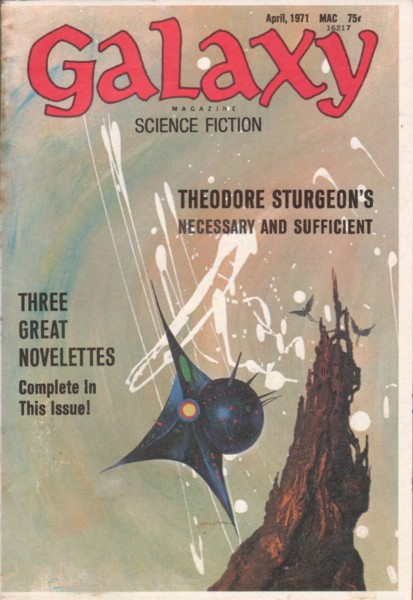

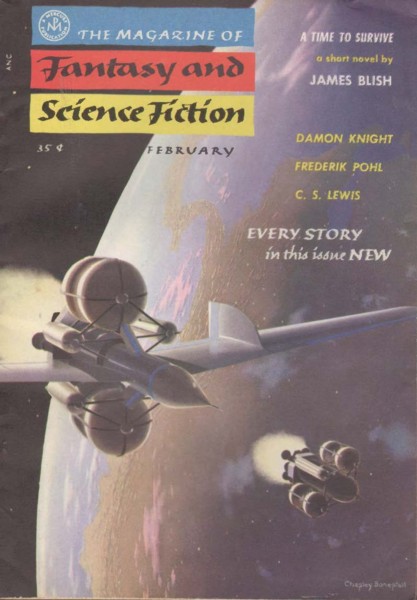
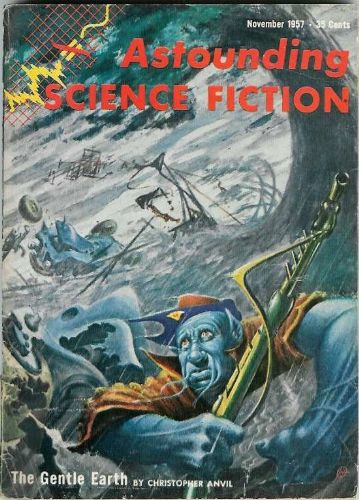


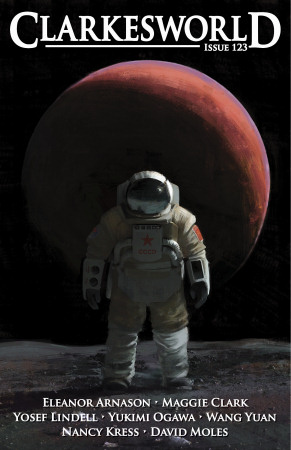
 Science Fiction & Fantasy Remembrance