(Cover by Chris Moore. Science Fiction Age, March 1998.)
Who Goes There?
It seems like a lot of SF writers now living prefer to keep to themselves, with a few notable exceptions—Cory Doctorow being one of those exceptions. Over the past couple decades he has become arguably more notable as a personality and commentator on the state of copyright in our post-internet age than as an SF writer. On top of his fiction he’s been a prolific non-fiction writer and editor, including being a former co-editor of Boing Boing and having articles published in the likes of Wired and Asimov’s Science Fiction. He did something that was pretty audacious with his first novel, Down and Out in the Magic Kingdom, in that he used a Creative Commons license to make it digitally available online, for free(!), simultaneously with its commercial print publication. This was back in 2004, mind you. He’s a bit of a character. While Doctorow hasn’t yet won a Hugo or Nebula, he’s tied for the most number of Prometheus Award wins; given his democratic socialist politics this is a bit ironic. Still, it’s true that few people have fought more staunchly against the horrors of DRM and top-down surveilance, and in that sense “freedom” is a big word in his vocabulary. Despite “Craphound” being a very early story for Doctorow, he clearly has soft enough a spot for it to have named his own website after it.
He’s from Toronto, but let’s not hold that against him.
Placing Coordinates
First published in the March 1998 issue of Science Fiction Age. It was then reprinted in Northern Suns (ed. Glenn Grant and David G. Hartwell), The Year’s Best Science Fiction: Sixteenth Annual Collection (ed. Gardner Dozois), Before They Were Giants: First Works from Science Fiction Greats (ed. James L. Sutter), The Big Book of Science Fiction (ed. Ann and Jeff VanderMeer), and the Doctorow collection A Place So Foreign and Eight More. Because Doctorow makes his work available online for free, with some copyright trickery (that I can’t be bothered to explain), you can read “Craphound” totally legit on Project Gutenberg.
Enhancing Image
“Craphound” takes place in what seems to be a then-present Canada, which means that despite presumably taking place in the ’90s it culturally feels more like the ’80s. To make matters worse, Jerry, our narrator, is a sucker for ’50s nostalgia, from pop culture to useless knick knacks—the remains of a bygone era. As is expected I suppose for a story written by a young person (Doctorow would’ve only been 25 or 26 at the time), about a similarly young character, there’s a pining for a past the author/protagonist did not actually live to experience. It’s also worth mentioning that if “Craphound” is set in the present then it’s a present with a big difference—namely that mankind and intelligent alien life have long since made contact. Indeed Jerry’s best bud is one of the aliens, named Craphound; that’s the name Jerry gave Craphound, not his actual name. Of course, Jerry and Craphound are both craphounds, in that they’re dumpster divers, finding old crap as yard sales and whatnot and then reselling them elsewhere at a higher price. People (especially old people, if we’re being honest) sometimes give away old stuff of theirs without knowing the thing’s market value, which is where craphounds come in. I mean, it’s a living; at least they’re not landlords. It helps also that thee two are redeemed by their genuine friendship.
Conflict enters the picture when the two buddies find a yard sale run by a couple of “blue-haired old ladies,” with the top find being a trunk full of Wild West apparel and toys, tossed-aside belongings for a guy who was once a kid, or rather liked to play as “Billy the Kid,” but who would be a grown-ass man now. (Remember how Westerns were inexplicably really popular in the ’50s? What was up with that? Remember Bonanza? Have Gun—Will Travel…?) Jerry likes what he sees, but Craphound is nothing less than enraptured, and the two have a kind of bidding war over the trunk, with Craphound winning out, albeit by paying a ridiculous amount. This strains the two’s friendship, not least because it violates an unwritten rule among craphounds, in that when fellow craphounds are at a yard sale or whatever at the same time they ought to refrain from getting into a bidding war. There’s a time and a place for bidding, and that’s an auction house, not some granny’s front yard. Doesn’t help either that Jerry does his business as a way of making a living while Craphound is doing it for fun, already being unspeakably rich, having “built his stake on Earth by selling a complicated biochemical process for non-chlorophyll photosynthesis to a Saudi banker.” Others of Craphound’s race have similarly become members of the top 1% on Earth by selling their technology, or at least some of it, for prices the richest of humanity would be pay a pretty penny for. The friendship between Jerry and Craphound is thus troubled by a difference in species, cultural priorities, but also class. An older and wiser Doctorow might’ve interrogated Craphound’s vulture-like attitude with human culture more unsparingly, or indeed framed Jerry’s own capacity for selfishness more harshly, but ultimately this is a story that, while playing tug-of-war between optimism and pessimism in humanity’s relationship with capital, ultimately goes for optimism.
That’s not to say “Craphound” doesn’t evaluate its own late-capitalist landscape, which at times can border on apocalyptic, the very much Canadian Jerry obsessing over American pop culture of the past, Craphound himself being like a wealthy tourist. Jerry becomes fixated on someone else’s past, that of the man he only knows as “Billy the Kid,” the former owner of the trunk, whose contents have memories attached to them which are not Jerry’s own. He does, by sheer chance at a sale, meet a strapping 30-year-old upstart named Scott, who co-runs a firm and who matches the description Billy’s mother had given. Despite already being rather wealthy Scott is himself a fellow craphound, and over the course of about a week, the two strike up a friendship, their meeting place called the Secret Boutique, a second-hand market, Scott being a kind of a replacement for Craphound. Perhaps the strangest moment between these two, representing Jerry’s capacity for occasional selflessness (and I suspect remorse over his bitter treatment of Craphound the last time they were together), is when Jerry buys a Native American headdress for five dollars, intending to sell it somewhere else at a much higher price, only to sell it back to Scott/Billy for the same amount. This act of kindness must be at least partly fueled by the fact that Jerry’s convinced Scott/Billy is his man, so to speak. “As I said it, I was overcome with the knowledge that this was ‘Billy the Kid,’ the original owner of the cowboy trunk. I don’t know why I felt that way, but I did, with utter certainty.” Again there’s a cynical undertone to all this, these lily-white Canadians hawking over junk and often caricatured representations of indigenous peoples; that we never get to meet an indigenous character may or may not add to the subtle bleakness.
There Be Spoilers Here
Bad news: Scott/Billy turns out to not be Billy after all. This changes surprisingly little, although it does coincide with Jerry realizing that maybe his own childhood memories are more important than leeching off of other people’s memories. The good news is that Craphound is back, and the two buddies reconcile while at an auction sale, which is perhaps fitting. In this story friendships are formed and reformed, which provide the external conflict, but this is also about Jerry’s internal conflict, his sense of nostalgia and hungering for a past which is not necessarily his. I’m referring to “nostalgia” in the proper sense of the word, which is a kind of homesickness, as opposed to a kind of euphoria as people often think of it. Jerry spends most of the story homesick, except the home in question is not concrete but abstract. He comes to a realization that’s put pretty beautifully, maybe too beautifully given how colloquial his speech is otherwise; but still it’s one of those little passages I can imagine Doctorow smiled at while he was writing it. Hell, writing is such a solitary business, you may as well take pride in it. So here it is:
I understood that an alien wearing a cowboy hat and sixguns and giving them away was a poem and a story, and a thirtyish bachelor trying to spend half a month’s rent on four glasses so that he could remember his Grandma’s kitchen was a story and a poem, and that the disused fairground outside Calgary was a story and a poem, too.
That last one is referring to the fact that some of these aliens, or “extees,” are so rich that they buy up property on Earth, presumably in the hopes of turning a profit on it—being craphounds on a considerably larger scale than what Jerry does. In a different story (I suspect James Tiptree, Jr. would have a fun time with this premise) I can imagine such a turn of events becoming something quite shadowy, but Doctorow (or at least Jerry) wants to think the aliens know what they’re doing. The result is an ending that one would call cautiously optimistic.
A Step Farther Out
“Craphound” wasn’t Doctorow’s first published story, but it was the first to pick up traction with reprints, and it’s not hard to understand why. Aside from being a uniquely Canadian story (we even get a Tim Horton reference) at a time when genre SF was overwhelmingly American and British, it comes off as almost post-cyberpunk, despite the lack of futuristic technology in the humans’ lives. It feels like post-cyberpunk in the sense that the great technological shift has not only married late capitalism already but has seemingly passed over the average person’s head. The aliens have left their table scraps, in the form of basically patenting little pieces of their own tech, and yet humanity at large seems no better off for this. On a macro scale this sounds bleak, but Doctorow posits that at least on a micro scale, on an individual basis, there’s room for hope. There has to be room for hope. Which is something we all think about, probably.
(Cover by J. K. Potter. Asimov’s, September 1985.)
Who Goes There?
Kim Stanley Robinson debuted at the tail end of the ’70s, but as with William Gibson, Bruce Sterling, Connie Willis, and some others, he really came into his own in the ’80s. Nowadays he’s known for his leftist utopian novels and commentary, especially having to do with averting climate disaster, and indeed he’s one of the few living SF writers I can think of who’s over the age of sixty and also openly a socialist. He follows a lineage in the field that’s home to H. G. Wells and Ursula K. Le Guin, but he writes much more hard-nosed SF than either of them; it’s useful to think of him as the left-wing equivalent of a Poul Anderson or Larry Niven. This is to say that a good deal of Robinson’s wordage is spent on the mechanics of the worlds he builds, to the point where the mechanics can often overtake plot and character. His Mars trilogy (Red Mars, Green Mars, and Blue Mars) won major awards and stands collectively as one of the defining SF works of the ’90s. “Green Mars,” despite sharing a name with one of those aforementioned novels, has nothing to do with the Mars trilogy, other than the fact that Robinson would reuse a few ideas from this earlier novella. At this point Robinson had already shown his ambitions at novel length with The Wild Shore and Icehenge, with “Green Mars” feeling thematically akin to the latter, only on a much smaller scale.
Placing Coordinates
First published in the September 1985 issue of Asimov’s Science Fiction. It was then reprinted in The Year’s Best Science Fiction: Third Annual Collection (ed. Gardner Dozois), one half of a Tor Double with Arthur C. Clarke’s “A Meeting with Medusa,” and the Robinson collection The Martians. Given that it’s a solid 30,000-word novella it might be a bit too long to be reprinted more often.
Enhancing Image
Roger Claybome has had enough of politics on Mars, which is understandable given that a) he’s several centuries old at this point, and b) he’s a member of the Reds, conservationists who believe Mars’s pre-human ecological state should’ve been kept intact. The Greens, those who believe in terraforming Mars, have long since won the “war,” so to speak. It’s just taken 27 years for Roger to admit he’s lost.
Too many opponents, too many compromises, until the last unacceptable compromise arrived, and [Roger] found himself riding out of the city with Stephan, into the countryside he had avoided for twenty-seven years, over rolling hills covered by grasses and studded by stands of walnut, aspen, oak, maple, eucalyptus, pine: every leaf and every blade of grass a sign of his defeat. And Stephan wasn’t much help; though a conservationist like Roger, he had been a member of the Greens for years.
He’s become like a fish out of water, and he’ll continue to feel that way once he meets up with the rest of the time. Olympus Mons, a volcano that stands as the Mount Everest of Mars, is something that needs climbing, and for Roger there may even be remnants of the Mars he once knew up there, at the very top. Something neat Robinson does here that he also did in Icehenge is making the characters nigh-immortal, with people living a thousand years at a time; how this is made possible is not made clear, but it is the future and Robinson knows we don’t really need to know the science behind it. The result is that Roger and his contemporaries were of the generation that started colonizing Mars, back when it was like one vast desert, so rather than have a sense of nostalgia pushed on them by previous generations they lived to see the planet change before their very eyes. Despite having been part of the Martian government for three decades (a long time for us normal humans, surely), Roger looks like he’s barely reached middle age. This crunching of the passing of time is especially convenient for a novella, which doesn’t have the space of an epic novel.
Both the physical and narrative trajectory is mostly upward, and I have to say it’s pretty neat we get an illustration of the expedition, with camp locations and all that. The human members of the expedition are for the most part not as vividly drawn, sad to say, with the only exceptions being Eileen, a former short-term lover of Roger’s (it was long enough ago that she doesn’t remember their time together, although he does), and the terminally grumpy Marie, who sadly is left with that one defining trait. The other team members are basically expendable. It probably doesn’t help (although it does make the narrative more focused) that this is all told from Roger’s POV. From the start Robinson sets up Roger and Eileen’s unexpected reunion as the basis for romantic/sexual tension, but to his credit he also uses this tension to contrast our two leads, as they not only differ sharply in personalities but also worldviews. The budding romance serves a symbolic purpose which will become gradually more apparent as Roger’s character develops, which is what we call doing two things at once, i.e., good writing. Eileen herself is the closest we get to Robinson’s mouthpiece here, which is to say she vomits up what is clearly supposed to be the story’s thesis, that having to do with our perception of the past. As Eileen says, “Our past is never dead,” and then does the philosophy student thing (although chronologically she’s much older than college-age) of asking Roger if he’s read Jean-Paul Sartre. Roger says he’s much more of a Camus fan, actually. Okay, no, he just says he hasn’t read Sartre. Then she brings up Heidegger and that’s when we know we’re really in trouble. I won’t recite their whole conversation, because I’m not a philosophy major (although my Philosophy 101 professor tried hard to convince me), so we’ll move on.
Much of this story is about nostalgia and how we connect important moments in our lives, often distant memories, to places that were totally incidental. Roger has an intense fondness for Mars when it was red because he has childhood memories here that mean a lot to him, but which he is unable to recapture. He contrasts his own fond memories on the surface of the Martian desert with the minor character Pip from Moby-Dick, at the same time likening himself to the precocious and often depressed Pip of Great Expectations, two comparisons that link Roger as a literary figure but which also show a kind of latent narcissism in himself, that he should think himself comparable to characters in iconic works of literature. The comparison with the Pip of Moby-Dick does fit, though. For those of you who forgot, Pip is the cabin boy who at one point goes overboard and stays on the wide ocean, staring into its bleak depths, for an hour or so before being rescued, by which point the experience had driven him insane. (This is also a reminder that Moby-Dick is arguably cosmic horror.) Yet the two characters’ experiences could not be more different. “Someone had lived an hour very like his day on the polar desert, out in the infinite void of nature. And what had seemed to Roger rapture, had driven Pip insane.” And here Roger is again, surrounded by nature, with only half a dozen or so fellow humans for company—only this time it’s a nature that’s been perverted, a nature he doesn’t recognize. One person’s Eden is another person’s Hades. Roger wonders if his intense nostalgia and Pip’s madness are two sides of the same coin—the sensation that something has been lost, only coming from emotionally opposite directions.
The plot is simple—maybe too simple, given how long this novella is; but to compensate Robinson lovingly describes the cliffsides of Olympus Mons and the growing vegetation there, small signs of animal life, as the climbers ascend and the atmosphere gets thinner, like how it is on one of the tallest mountains on Earth. The campsites, the caves, the conserving of oxygen tanks and food supplies, it all becomes like a mountain-climbing story you might read today, or what Jack London might’ve written about. What the characters (aside from Roger and maybe Eileen) lack in depth the setting more than makes up for it, and not only that but the traversing of said setting. This is an adventure narrative, albeit an introspective one, and Robinson does his best to give the reader an impression of what it would be like to scale the tallest volcano on Mars.
Consider:
Verticality. Consider it. A balcony high on a tall building will give a meager analogy: experience it. On the side of this cliff, unlike the side of any building, there is no ground below. The world below is the world of belowness, the rush of air under your feet. The forbidding smooth wall of the cliff, black and upright beside you, halves the sky. Earth, air; the solid here and now, the airy infinite; the wall of basalt, the sea of gases. Another duality: to climb is to live on the most symbolic plane of existence and the most physical plane of existence at the same time. This too the climber treasures.
If Roger can’t take solace in a transformed Mars then at least he can take comfort in being an expert climber. There’s an incident with Frances, one of the other climbers (I wanna say she’s a redshirt, but that’s a bit mean), who gets an arm broken and has been escorted down to base for rescue, which itself is no easy feat. By this point the party has broken up into small groups, leaving only Roger and Eileen with each other as they ascend the volcano the rest of the way. Incidentally, as the human interference has lessened and the roughness of the setting has increased, Our Heroes™ find it easier and easier to communicate with each other, as if their growing isolation from the rest of the expedition is correlating with what might be a rekindling relationship. On one last note before we get to the climax, I think it’s worth reminding the both of us that the life we see on Mars is not native to it—at least not originally: the flora and fauna brought over have been given centuries of genetic engineering and adaptation. Nothing is the same anymore, but then again that means there’s room for growth, both for life on the planet and Roger’s own view towards it. The past haunts the present, but the past doesn’t have to mean just one thing to everyone; it’s possible to revise it, or at least to gain a different understanding of it.
There Be Spoilers Here
Just one line from Eileen: “Maybe I do remember you.”
A Step Farther Out
It’s a bit overlong, and I have to question the logistics of turning Mars green in just a few centuries; but still, it’s riveting, as personal as it is political. One of Robinson’s career-long obsessions has been our relationship with history, and the capacity for revisionism. Needless to say he agrees with Sartre, that history, or rather our understanding of it, is not fixed. This is unsurprising given Robinson’s leftist sympathies and academic background (he had recently earned his PhD when “Green Mars” was published), but what’s more surprising is how he’s able to synthesize his views on history with a planetary adventure narrative which has, within its confines, at least one character in the Shakespearean sense. That Roger is the only character here with a sense of an interior life would be a problem if this were a novel, but thankfully the novella mode is right for such a thing.
There seemed to be a point in the ’90s when Kathe Koja could lay claim to being the best horror writer in the business, and certainly her output at this time was hard to argue with. She debuted in the late ’80s, as part of a wave of extreme and body-focused horror writers (think Clive Barker), although she also has quite a snarky sense of humor that tends to stop her fiction from becoming a black hole. In the 21st century her output has generally slowed down and she’s turned more to YA, which might partly explain why she has not been given the amount of attention she deserves. In a better world Koja would be awaking millions of readers to her unique style and explorations of the human body’s relationship to the external world, but instead we’ll have to awaken ourselves to her. Unfortunately most of her novels are not exactly easy to find in the wild. “Angels in Love” is a short but finely tuned story, packed with tension and perversion, more of a character study than a conventional horror narrative. This was published the same year as Koja’s first novel, The Cipher, and if you were on the look-out in 1991 it would’ve been hard to deny the talent on display.
Placing Coordinates
First published in the July 1991 issue of The Magazine of Fantasy and Science Fiction. It’s since been reprinted in The Year’s Best Science Fiction: Ninth Annual Collection (ed. Gardner Dozois), The Year’s Best Fantasy and Horror: Fifth Annual Collection (ed. Ellen Datlow and Terri Windling), The Weird: A Compendium of Strange and Dark Stories (ed. Ann and Jeff VanderMeer), and the Koja collection Extremities. That Dozois reprint is funny considering it’s arguably not SF.
Enhancing Image
The next-door neighbors are being loud, which is not normally something Lurleen would mind—except that the neighbors are fucking. Not the usual kind of fucking, but something more vigorous and yet mysterious. A rhythmic thumping that isn’t bed springs, and she’s not hearing the people’s moans exactly. “Lying there listening, her own bones tingled, skin rippled light with goose bumps, speculation: who made those strange, strange sounds?” It has to be sex. What else could it be? Of course Lurleen is interested, at least in part because she’s bored with her day-to-day life, working at a record store for a boss (Roger) she doesn’t like. Bored and lonely. This was also in the days before high-speed internet, so if you wanted to jerk it as a way of passing the time or to relieve pressure you had to resort to print, film, or your imagination. In this sense “Angels in Love” shows its age, in that it presumably had to take place in a pre-internet world, in the world of the erotic thriller—Fatal Attraction, Basic Instinct, Brian De Palma movies, and so on. The erotic thriller (and “Angels in Love” could be understood partly as an example of such a thing) is a subgenre that basically doesn’t exist anymore, due to a few factors: the availability of online porn, but also moviegoers seem to be more squeamish now than thirty years ago. This is a graphic and indeed borderline pornographic story, but the eroticism is very much there for a purpose, not to mention it helps build tension. There’s a reason the erotic thriller was popular for a while, which is the overlap between feeling horny and feeling scared—the heightened blood pressure and senses being needed for both.
I guess people spying on their neighbors the old-fashioned way, by eavesdropping or using a pair of binoculars, was more acceptable back then. Not to say what Lurleen’s doing is good, but she’s framed such that it’s easy to sympathize with her despite her perversion. After all, she’s clearly lonely and sexually deprived, her boss is a pain in the ass, the men she meets outside of work tend to be pigs. She wants to be desired but not objectified, which almost sounds like a paradox, because how do you present yourself in an interaction as desirable without also becoming a slab of meat to the other party? She knows Roger objectifies her, she knows the clerk at the store objectifies her, she knows the dumb muscle she picks up at bars sees her the same way. But here the tables have turned, as she objectifies her neighbors without even seeing them first—although she soon works to change that. “It came to her that she had never really seen that next-door neighbor of hers.” The girl next door is Anne, and Lurleen is surprised to find that the woman who’s been having such amazing sex (or so Lurleen thinks) is so… boring. Not obnoxious or messy, but bland. Beige. When they finally meet Lurleen is put off by how normal Anne is—so unassuming, actually, that she becomes an uncanny figure. The mystery then becomes with regards to the man Anne is seeing, assuming it’s the same man (and assuming it’s a man, which Lurleen does) every time Lurleen spies on them. So Anne is boring, but then what about the man she’s seeing?
The subtle horror of “Angels in Love” works in two ways: the mystery of the next-door neighbor, but also the lengths Lurleen goes to in finding out her neighbor’s private life. She starts acting in ways that are undeniably creepy, and were she not the perspective character it would be easy to understand Lurleen as a villain. This is not a case of unintended dissonance between the protagonist’s actions and what the reader expects of them, but part of the story’s design. Lurleen is an anti-heroine, and in just a handful of pages Koja makes sure we know this. There’s an especially creepy passage where she takes her eavesdropping to levels that would be considered unacceptable, even by most perverts:
She began to stalk Anne, never thinking of it in so many words, but as sure and surely cautious as any predator. Waiting, lingering in the hallway after work, for Anne to come home from whatever unfathomable job she did all day. Never stopping to talk, just a smile, pleasant make-believe. She made it her business to do her laundry when Anne did hers; at the first whoosh and stagger of the old machine, Lurleen was there, quarters in hand; her clothes had never been so clean; she had to see. Any jockey shorts, bikini underwear, jockstraps, what? She meant to take one if she could, steal it before, before it was clean. Smell it. You can tell a lot about a man.
This is a cosmic horror story ultimately, and we’ll get to that part, but Koja understands that often the scariest thing is human behavior—something that can be found in everyday life, no science fiction or fantasy needed. Lurleen’s growing obsession with Anne and her mystery boyfriend escalates at a rate that makes enough sense and at the same time doesn’t feel rushed, given how short this story is. It has to do with stalking, and getting too interested in other people’s lives, but it also has to do with misogyny, both how the male characters view the women and Lurleen’s own internalized misogyny against Anne, whose only crime is being a “sorry-looking bitch.” She wonders how such an “empty” person could have such a stud muffin in her bed on a regular basis, as opposed to Lurleen’s bed. Because she obviously deserves him more, right? And yet she also wonders, given Anne’s own blandness, “Could a man want a woman to be nothing? Just a space to fill? Lurleen had known plenty of guys who liked their women dumb—it made them feel better—but anyway, Anne didn’t seem dumb, just empty.” Is wanting a woman to be “just a space to fill” at the core of misogyny? Is that what it comes down to? Maybe it’s as simple as that. Maybe Anne is with this mystery man because she’s such easy pray. Lurleen’s about to find out.
There Be Spoilers Here
Cosmic horror is ultimately about the terror of discovering something you shouldn’t have—of fucking around and finding out. Lurleen fucks around and she finds out. In a way the conclusion is totally predictable; if anything it’s a release after the building tension and the escalating of Lurleen’s creepy behavior. We know that at some point this story has to enter SFF territory at some point, and so it does on the final page. During one of their bouts Anne and her boyfriend suddenly stop, seemingly mid-thrust, which concerns Lurleen enough that she rushes over next door to see what’s going on. What she encounters is hard to describe, and there’s a certain degree of ambiguity in the situation. “His body beautiful, and huge, not like a man’s, but so real it seemed to suck up all the space in the room, big elementary muscles, and he was using them all.” Anne’s back is bent at an unnatural angle and some liquid “like spoiled black jelly” is leaking from her mouth. Is she dead? Is fucking what the two had actually been doing this whole time? How long has this been going on? We never learn, and neither will Lurleen, maybe. The creature takes notice of her, and the story ends before we find out what becomes of either of them. We do know that Lurleen has just stepped over a line she shouldn’t crossed, and that she has gained the notice of something whose attention you don’t really want. I do have to wonder if maybe Koja had taken inspiration from Clive Barker’s The Hellbound Heart, or Hellraiser, in making the “angel” of the story a supreme sadist—a supernatural creature whose definition of pleasure includes immense pain. Maybe it was an angel, long ago, but it had gone bad.
(Cover by McKenna. Worlds of Tomorrow, February 1964.)
Who Goes There?
From about 1960 to the mid-’80s, R. A. Lafferty stood out as one of the true mavericks of the field, having a style that would be nigh-impossible to emulate. He has a reputation as something of a writer’s writer, not helped by many vocal Lafferty fans being writers themselves. It’s not that Lafferty was a poet (although he did have a capacity for poetry, unlike most SFF writers) or a mean wordsmith, but that nobody else wrote quite like him at the time. He got lumped in with the New Wavers, even appearing in Dangerous Visions, which in hindsight was a bit odd, given a) he was a good generation older than the New Wavers, and b) he was an outspoken conservative in what was considered a generally left-leaning movement. I don’t consider myself a Lafferty fan, because I tend to find his quirkiness and old-school Catholicism a bit stifling. It came as a bit of a shock to me, then, that I quite liked today’s story, which is an early and somewhat obscure Lafferty tale. “The Transcendent Tigers” predates the New Wave by a couple years, but it’s one of those stories that anticipates the movement. It’s also a darkly funny and pessimistic story, even for Lafferty.
Placing Coordinates
First published in the February 1964 issue of Worlds of Tomorrow, which is on Internet Archive. It was reprinted in Young Demons (ed. Roger Elwood and Vic Ghidalia) and the Lafferty collections Strange Doings and The Man with the Speckled Eyes. It also appeared on Sci Fiction, which you can read free of charge with the power of the Wayback machine. Surprised this one hasn’t been reprinted more often.
Enhancing Image
Carnadine is a little girl who gets four presents for her birthday: a white rubber ball that’s hollow inside, a green plastic frog, a red cap, and a wire puzzle. “She immediately tore the plastic frog apart, considering it a child’s toy. So much for that.” As for the other gifts, however, she makes good use of them—indeed better use than her parents had expected. When she wears the red cap she can turn the rubber ball inside out without tearing it and is able to solve the wire puzzle—the problem being that both of these things should be physically impossible. While most of the gifts are from her parents and friends of the family, nobody knows who got Carnadine the red cap, which should tell you immediately that something malicious is brewing. Carnadine is only nominally the protagonist of the story: for one she’s a sociopath (as is typical of young children), but also much of the story doesn’t focus on her. Lafferty breaks a few rules when it comes to writing short stories, just on a regular basis, but here he does it especially effectively. The third-person narrator strays from Carnadine’s story to give us a kind of bird’s-eye view of strange things happening around the world, including speculation on a new “Power” that could make or break humanity. Lafferty gives this otherwise absurd narrative a sense of genuine speculation by interspersing Carnadine’s story with passages from fictional academic journals and news sources, almost like what John Brunner would do in Stand on Zanzibar, only on a micro scale. We do eventually get an explanation for the red cap, but by then it’ll be too late—for the characters.
Meanwhile, Carnadine has taken to “sharing the wealth” a bit and has decided to found a club, the Bengal Tigers, a club so exclusive that at first she’s the only member. “It had only one full member, herself, and three contingent or defective members, her little brother Eustace, Fatty Frost, and Peewee Horn. Children all three of them, the oldest not within three months of her age.” Nobody knows about the Bengal Tigers, but pretty soon people are gonna feel the effects of the kids sharing their red cap. This strange red cap apparently grants one ESP, along with heightened intelligence, which in the case of Carnadine turns her from someone who was already a brat into a super-brat. Even in 1964 “The Transcendent Tigers” would’ve been another in a long line of stories about kids with ESP, although typically these kids would discover a sense of heroism along with their psychic powers. Carnadine does not. On paper this is a very dark story, but it’s lightened by Lafferty’s sense of humor and especially how quippy the narrator is. Humor usually benefits from brevity, so it helps that Lafferty packs a fair amount into a short space it’s still that: a short space. Scenes go by quickly, we jump back and forth between Carnadine and the aforementioned bird’s-eye view, and while in the past I’ve found Lafferty’s prose a bit too labyrinthine that’s not an issue here, his style here being much punchier and to the point than what I would say is the norm for him. Despite “The Transcendent Tigers” only being ten pages long I chuckled several times during it, which I have to admit is unusual in my experiences with Lafferty; but also that goes to show its effectiveness as a comedy, albeit a pretty morbid one. By the end you’ll wish Carnadine would fall off a cliff.
This is also an example of liking a work of art while at the same time disagreeing with the artist’s politics as expressed in their art, something I wish more people were capable of doing! I said before that Lafferty was an old-fashioned Catholic, even for the time, and while Christianity never comes up in the story I do think Lafferty is making an argument that falls in line with his conservatism. I have a bit of a hypothesis about what separates right-wing Christianity from left-wing Christianity, and it has to do with who can be saved: right-wing Christians believe that maybe individuals can see the gates of Heaven, but not groups, whereas left-wing Christians believe humanity as a cluster of groups deserves to be saved. It basically has to do with optimism vs. pessimism, and I do think Lafferty was a pessimist—only that his sense of humor tended to soften what I think was a pretty dim view of humanity. Throughout “The Transcendent Tigers” there’s speculation from intellectuals about an as-yet-undiscovered power which could blow even nuclear power out of the water, sheerly from its capacity to allow man to change his very environment without the use of industry. A single man could literally move mountains with this hypothetical power, and these intellectuals wonder if humanity would be ready for such a thing, should it come along. Lafferty argues we’re not, and that if we were to encounter such a power we either wouldn’t know what to do with it or use it for bad ends as soon as possible. The Bengal Tigers have such a power, and it doesn’t take them long to start using it for very bad ends.
There Be Spoilers Here
On a planet “very far out,” a race of energy beings (Is it just me or was this beyond-matter kind of alien race really popular around the time of the original Star Trek series?) discusses having found a valid candidate on Earth for a way to manifest immense power in the form of a red cap. One of the aliens says he managed to find only one candidate on the whole planet, one who had perfect assurance, “one impervious to doubt of any kind and totally impervious to self-doubt.” That person was Carnadine. As the other alien in the conversation point out, however, the candidate didn’t need only perfect assurance, but other qualities, although we’re not really told what those other qualities are. Carnadine is perfectly self-assured because there’s nothing more egotistical than a child, but she also totally lacks empathy and self-restraint, which are important qualities if one wants to be a functional human being in our society! Or at least those should be important qualities; turns out the most financially success tend to lack empathy at the very least. So the test with the red cap looks to be a loss on Earth, but as one of the aliens points out, worst case scenario humanity destroys itself and the virus of the red cap will have quarantined itself.
And it does.
In the course of ten pages we go from a young girl getting a strange gift to her literally destroying cities with said gift. The body count is immeasurable. To say a lot of people get killed would be an understatement. Carnadine and the other members of the “club” use a map of the US to stick needles on cities, like voodoo on a mass scale, New Orleans, Baltimore, San Antonio (“There were some of us who liked that place and wished that it could have been spared.”), and so on down the line. The situation escalates so much in such a short space that it becomes funny in a fucked-up way, having just the right cadence for a dark joke. Had Lafferty written this as a serious story (although I do think he’s trying to make a serious point with it, which is not the same thing) it would surely be one of the bleakest SF short stories of the ’60s. But thankfully it’s not serious.
A Step Farther Out
Sorry for another short review (by my standards), but then this is a concise story, and a very nicely constructed one at that. Lafferty has surprised me a couple times and this is one of them. When to authors I’m not personally fond of I’m always (maybe not “always,” I do have limits, but you know what I mean) up for giving them another chance. I mean for fuck’s sake I’ve read more than one Piers Anthony novel and I’m looking to read another one soon. Lafferty is a much better writer than Anthony, even if he can be too much for me, so we’ll be seeing him here again eventually—so in like, a year, maybe two years depending.
(Cover by Gerard Quinn. Science Fantasy, February 1963.)
Sometimes I get confused by my own schedule, which is to say the rotation method I used is one I’m not sure I always abide. Do I do eight reviews this month, or nine? How many days are in September? Thirty. But that doesn’t matter now. August was a pain and a half for me, for a few reasons. I went on vacation with family, which wasn’t all sunshine and rainbows (although I at least got PTO from that), not helped by there being I guess you could say a changing of the guard in my polycule. One of my partners dumped me. We’d been together about three months, and it was a pretty intense pairing. They (I say that because they’re non-binary) ultimately didn’t feel comfortable being with someone who is polyamorous. That’s the short of it. It sucks, and I’m still feeling sore from it, although I suppose this is the kind of loss you have to accept with a polycule. But it hasn’t been all bad! We did also welcome a new member recently, and she’s very cute. She’s not used to polyamory (the last polycule she was in didn’t work out), but she’s patient and so far things have been going pretty well for us.
On to shit that matters more, the Hugos happened this past month, and I actually got to vote in them—not that it mattered too much. I only felt qualified to vote in about half a dozen categories, although I did vote in Best Short Story (the #1 on my slate didn’t win :/), and I think this was also the first time I was poised to review a Hugo nominee which then went on to win by the time my review was published (Naomi Kritzer’s “The Year Without Sunshine,” a very fine pick). Next year’s Worldcon is to be held in Seattle, which hey, that’s only on the other side of the country for me. I should get to work on attending, since I can feasibly do that. Worldcon 2026 is also gonna be held in LA, so that’s… two American Worldcons in a row. That’s a bit weird. But I can’t complain too much.
As for this months reviews, we have a few birthdays! John Brunner would be celebrating his 90th birthday on the 24th (had he not died in 1995), which is crazy considering one would think he was maybe a decade older. Stephen King (who is very much alive) is celebrating his 77th birthday on the 21st. Something I’ve started to think about is the decades I’m pulling from with my story choices, because given how the magazine market has ebbed and flowed over the years there are a few boom periods that would get more attention than others. It shouldn’t come as a surprise that I’ve had to try to not pick material from the ’50s too often, and indeed there are no ’50s stories this month! We have three from the ’60s, two from the ’80s, two from the ’90s, and one from the 2020s. A couple these would be horror outings, as a prelude to next month’s shenanigans.
Now let’s see…
For the novellas:
“Green Mars” by Kim Stanley Robinson. From the September 1985 issue of Asimov’s Science Fiction. Robinson is one of the most respected living SF writers, for his hard-science credentials but also for being one of the few openly leftist writers in the field over the age of sixty. Worth mentioning that this novella has nothing to do with Robinson’s award-winning Mars trilogy, although it does apparently share continuity with a few other stories set on Mars—just not the Mars of that trilogy. And also I heard Robinson would take some ideas from this early Mars story and reuse them for the trilogy.
“Some Lapse of Time” by John Brunner. From the February 1963 issue of Science Fantasy. Low-key one of the more tragic figures in classic SF, Brunner was something of a prodigy, making his debut while still a teenager. He also wrote full-time in the ’50s and ’60s, at a time when that wasn’t considered all too viable for genre writers, and money was an issue. Brunner wrote so much that a lot of his short fiction hasn’t been collected more than once, or at least not in my lifetime. “Some Lapse of Time” has not seen print since Lyndon B. Johnson was in office, so let’s see if it’s a hidden gem or not.
For the short stories:
“The Transcendent Tigers” by R. A. Lafferty. From the February 1964 issue of Worlds of Tomorrow. Lafferty has a reputation as something of a writer’s writer, and there’s a reason for this: nobody writes quite like Lafferty. I’m not a fan of him, because I often find him overly quirky, but I’m all for giving authors another chance. I went out of my way to pick a relatively obscure Lafferty story.
“Angels in Love” by Kathe Koja. From the July 1991 issue of The Magazine of Fantasy and Science Fiction. I’ve only read short stories by her so far (I do have The Cipher, her first novel, on my shelf), but I can already say Koja is becoming one of my favorite horror writers. She’s turned more to YA in recent years, but her early stuff is vicious, snarky, and at times genuinely disturbing.
“Craphound” by Cory Doctorow. From the March 1998 issue of Science Fiction Age. Acclaimed as both a writer and commentator on the state of tech and surveillance, Doctorow has probably kept a thumb on the pulse of the post-internet zeitgeist more than any other living SF writer. “Craphound” is a very early story, but Doctorow thinks fondly enough of it to have named his blog after it.
“Crazy Beautiful” by Cat Rambo. From the March-April 2021 issue of The Magazine of Fantasy and Science Fiction. Rambo is a no-nonsense Texan who’s been active in the field for the past twenty years, more or less. They’ve been most prolific as a short story writer and editor, but have also recently taken to writing novels. Their latest novel, Rumor Has It, is due out from Tor later this month.
“Beachworld” by Stephen King. From the Fall 1984 issue of Weird Tales. Really needs no introduction, but let’s do it. King started writing in the ’60s, a fact people tend to forget because Carrie, his first novel, didn’t come out until 1974. Then the rest was history. He’s known firstly as a horror writer, but he’s also ventured into basically every genre under the sun, “Beachworld” being SF-horror.
“David’s Daddy” by Rosel George Brown. From the June 1960 issue of Fantastic. Brown made her debut in 1958 and quickly established herself as a short fiction writer; a large portion of her fiction would be published between 1958 and 1963. In one of SF’s many lost futures, Brown could’ve gone on to fit in with the New Wave feminists, had she not died in 1967, at only 41 years old.
(Cover by Lawrence. Famous Fantastic Mysteries, March 1944.)
Who Goes There?
One of the most beloved Christian apologists of his era, G. K. Chesterton came to prominence in the Edwardian era as a kind of jack of all trades when it came to writing, being a prolific essayist, poet, and short story writer. His Father Brown mysteries were pretty popular during Chesterton’s life and remain very much in print. (Curiously Chesterton came up with his Catholic priest detective character long before he himself converted to Catholicism.) His religious treatises Heretics and Orthodoxy were partly responses to avowed atheists of the era, such as George Bernard Shaw (Chesterton and Shaw were good friends, for the record), and partly to help those who considered themselves defenders of the faith in what was becoming a more secular England. You don’t have to be Catholic, or even Christian (as indeed I’m not), to enjoy Chesterton’s writing, since he tended to be very funny, and had kind of an Oscar Wilde-esque penchant for zingers. He’s a much finer prose stylist than H. G. Wells, his close contemporary, friend, and in some ways his foil. He also wrote his fair share of fantasy, including what is perhaps his single most famous work, The Man Who Was Thursday: A Nightmare, one of the great novels of the 20th century.
Of course, how The Man Who Was Thursday counts as fantasy can be a point of contention with people, to the point where folks in the Famous Fantastic Mysteries letters column were wondering if it might even qualify as fantastic enough—although they enjoyed the novel as a whole. 1908 would be a bit of an annus mirabilis for Chesterton, as it saw the publications of both The Man Who Was Thursday and Orthodoxy, and despite being on its face an espionage novel (an early example of that genre) The Man Who Was Thursday might be as concerned with Christianity as Chesterton’s religious tracts. This is a reread for me, although I have to admit I mostly just stuck to the complete text rather than its FFM publication. I said in an earlier post that the novel’s FFM printing seems to be unabridged, but doing a side-by-side comparison between the Project Gutenberg text and FFM version for random passages show that the novel has been subtly abridged, from about 57,000 words to maybe 55,000—a difference the casual reader might not notice. Chapters and scenes remain intact, but sentences and even parts of sentences are occasionally tossed out the window, I have to assume for length but also for little flourishes that the editor (Mary Gnaedinger) might’ve considered a little too verbose.
Placing Coordinates
First published in 1908 and reprinted in the March 1944 issue of Famous Fantastic Mysteries, which for some reason is not on Internet Archive. It is on Luminist at least, so there’s that. I will say, however, that aside from the novelty of Lawrence’s interiors (which are quite good) and a slightly altered text, I would simply read it on Project Gutenberg, it being in the public domain and all. Paperback copies are also not hard to find in the wild, this being a fairly well-known classic novel.
Enhancing Image
The Man Who Was Thursday is a masterpiece, and when it comes to novels as fine and yet weird as this one the question we have to ask ourselves is not “How did he do it?” but rather “How did he get away with it?” How did Chesterton get away with writing this? It’s what we would now call trippy, there’s certainly a hallucinatory effect that intensifies as the novel progresses; but it’s also a deeply Christian and at the same time political novel. Not only is anarchism mentioned but it’s the political ideology that takes center stage, at a time when anarchism in the US and England was gaining some very bad mainstream press, most infamously (at least for Americans) with Leon Czolgosz assassinating William McKinley in 1901. This novel was written in the 1900s, and presumably is set in that decade, what with there being “motor-cars” that predate the Ford Model T. So Chesterton introduces us to Saffron Park, a London suburb. These are not, however, the fog- and mud-covered streets of London as described at the beginning of Charles Dickens’s Bleak House; instead it’s a whimsical and implicitly fantastic introduction that hints at the madness to come. We’re introduced to Gabriel Syme, not as you would normally describe the protagonist in a narrative, but like the subjective viewpoint in a lucid dream—an angle Chesterton is going for quite deliberately. Between the novel’s subtitle and this opening passage about the people of Saffron Park it’s clear, at least with hindsight, that Chesterton is setting us up for something, only we’re not given to thinking anything is amiss at first. Not even Syme suspects what he’s in for, poor bastard. I could quote the whole passage, but I won’t.
We meet Syme and his friend/rival Lucian Gregory, who considers himself not only an earnest poet but a genuien anarchist—possibly the realest. Syme claims Gregory is full of shit, and so Gregory takes him on a journey to prove that he is, indeed, the realest. Gregory is quite the character, and I’m gonna frontload this review with discussion of him since once we get through the first few chapters we won’t see him again until the very end of the novel. It isn’t apparent at first, but Gregory will serve a major symbolic purpose, on top of being reponsible for kicking off the plot, being a tenacious red-haired man, someone who considers himself both a genuine creator (a poet, or an artist) and a genuine destroyer (anarchist) “a walking blasphemy, a blend of the angel and the ape.” He is contrasted with his sister Rosamond, who similarly has fiery red hair but whose demeanor is much kinder; she’s a minor character, and like Gregory she’s gonna be absent for most of the novel, but we’ll eventually get back to her. Indeed we have no choice but to remember Rosamond, as she will be the only female character of any importance. I said this is a great novel, I didn’t say it would be all that egalitarian. As for Syme and Gregory, whom Chesterton calls at one point “these two fantastics” (these are not realistic characters, or even actors on a stage, but water-colored figures in a fairy tale), the two take a trip to what turns out to be the entrance to a secret lair, with a password and everything. The password in question is “Mr. Joseph Chamberlain,” which is funny considering Gregory and other anarchists would have to recite the name of a notorious conservative politician of the time.
Political humor. Tehe.
Before we continue with the plot, I wanna stop for a moment to illustrate how the FFM printing occasionally removes sentences or sentence fragments, seemingly to achieve a punchier effect in places where Chesterton is being verbose, such that these passages would be considered the least necessary. Readers wouldn’t have missed out on much, but what they did miss would’ve often been little juicy nuggets of prose. Take this passage for example, in which Syme and Gregory are traversing the secret passage which leads to the Council’s hideout. I’ve bracketed the section which the FFM printing excludes:
They passed through several such passages, and came out at last into a queer steel chamber with curved walls, almost spherical in shape, but presenting, with its tiers of benches, something of the appearance of a scientific lecture-theatre. There were no rifles or pistols in this apartment, but round the walls of it were hung more dubious and dreadful shapes, things that looked like the bulbs of iron plants, or the eggs of iron birds. They were bombs[, and the very room itself seemed like the inside of a bomb. Syme knocked his cigar ash off against the wall, and went in.]
Sure, we don’t need to know that last fragment, as it doesn’t further the plot or action, but it sounds better than simply “They were bombs.” Anyway, Gregory is convinced he’s gonna be the new Thursday in the Council of the Days, a league of European anarchists, the best and most fiendish the movement has to offer. Each member of the Council takes on an alias after a day of the week, and the previous Thursday died recently. There’s gonna be a vote tonight. Syme and Gregory have each sworn a secret to each other, which each party is to keep to himself—a tragic development for Gregory, given Syme’s secret is that he’s actually an undercover cop. Gregory just led a cop into a den of anarchists. What a dumbass. But all is not lost, as Syme is not only here by himself, unable to call for backup, but he’s also sworn that he’d keep the hideout a secret. Since these men are English, their word turns out to be good enough. The Man Who Was Thursday is a uniquely British novel in several ways, not the least of them being that if this were an American story Syme wouldn’t give a fuck about keeping a secret with a man who evidently sees him as an adversary once he reveals his true identity. To make matters worse, while Gregory is poised to become the new Thursday, Syme comes in with an improvised speech that blows Gregory’s out of the water, and the despite the fact that surely nobody at the meeting would have seen Syme before he wins the vote and becomes the new Thursday. More or less on a whim, it sseems. Gregory is not happy about this, and it’s hard to blame him considering once Syme becomes Thursday Gregory will vanish from the narrative until the end.
Syme is the main character, so let’s talk about him. Syme is not your conventional hero, or even much of a heroic figure. I’m not just saying this because he’s a cop. Having descended from a line of eccentrics, Syme has become neurotic about his family of nonconformists and has gone in the total opposite direction—of being in favor of order to the point of lunacy. We’re treated to what I remember as being the only conventional flashback in the whole novel, in which we’re given Syme’s backstory, how he had a chance meeting with an unusually philosophically-minded policeman, and of his encounter with a mysterious man in “the dark room,” evidently not seeing the man’s face but being given the lofty job of policeman. His job thus was to go undercover and infiltrate the Council of the Days, to put a stop to the anarchist movement in England from the inside. This is a bit of an unusual scene since it breaks away from what is otherwise is a more or less linear narrative, but we do get an explanation for Syme’s strange obsession with the anarchists, not to mention we get some really good lines from the cop he talks to. A little quibble I have with this book, which I think comes close to perfect on the whole, is that the pacing does go kind of sideways. The first two chapters are a perfect setup-payoff affair, totally engrossing and with a promising of escalating tension, only for the narrative to jump backwards abruptly momentarily. I also have to admit that once Gregory leaves the novel and we’re introduced to the Council that the plot sort of funnels, or rather that there’s a snowball effect in which you have a straight shot to the climax over the course of about a hundred pages. Most of this novel can feel like one long chase sequence.
So we meet the Council, who will accompany Syme as main characters for the rest of the novel, although some members get more attention than others. It’s a bit of an ensemble effort, and Chesterton doesn’t give himself too much wordage. With how many ideas it throws at the reader The Man Who Was Thursday could’ve easily been double its length if published today, but Chesterton, being accustomed to short-length works like poems and essays, wasn’t much of a novelist, or rather he didn’t have the prolonged stamina expected of the writer who thinks themself a novelist first. Instead he hits the reader with a shotgun blast of symbols and characters. None of the members of the Council is very developed, individually, but they prove to be greater than the sum of their parts. There is, of course, Sunday, the head of the Council, an almost impossibly large man with a face that could take up the whole sky—a character not too dissimilar from Chesterton, for his physical largness but also his charima. There’s Monday, only otherwise known as the Secretary, who acts as Sunday’s right-hand man and most devoted follower, and who delivers one of the novel’s most memorable lines: “A man’s brain is a bomb.” There’s Gogol as Tuesday, a cartoonish Pole among mostly Englishmen—although it turns out that “Gogol” is, in fact, a Cockney policeman in disguise. There’s the Marquis de St. Eustache as Wednesday, a noble Frenchman who acts as if he jumped out of one of Alexandre Dumas’s novels. There’s my personal favorite, Professor de Worms as Friday, who’s so old and dicrepit that Syme wonders how he even made it to the Council meeting. Finally there’s Dr. Bull as Saturday, a young and mischievous yet enigmatic fellow whose “smoked spectacles” hide his eyes. These are basically cartoon characters, but whereas that would be considered shallow writing in realistic fiction, Chesterton uses the men’s broad-strokes characterizations for humor, as well as symbolic purposes.
Sunday outs Gogol as an undercover cop at the meeting, although despite Gogol being a cop Sunday doesn’t have him killed or anything; in what I have to admit is a confusing turn of events Sunday just… lets Gogol go free? The poor Cockney has a fall down the stairs by accident, but he’s fine, and we even see him much later in the novel safe and sound. But since Gogol is the first Council member to be outed as a cop he also gets the least time to shine; it’s a good thing, then, that his one scene where he’s the focus is pretty funny. I’m sorry, did I say “first” Council member to be outed as a cop? Well that’s because Syme and Gogol aren’t the only cops in the Council. It’s hard to say what counts as spoilers for this novel, since I’ve seen people argue that even the ending doesn’t really count as a spoiler, seeing as how the subtitle anticipates. It’s also easy to see, on a second reading, how Chesterton sets up his novel as a work of fantasy (albeit surreal rather than “high” or “low” fantasy) from the very beginning. Certainly the series of events here soon proves to be improbable, if not outright fantastic. What are the odds of there being multiple policement undercover in the Council of Days, and that these cops would be unaware of each other’s missions? Syme didn’t know who Gogol really was, and after some investigating he comes to find he didn’t know who Professor de Worms was either—not a horribly old nihilist but a relatively young actor who took on the role of a real man he once met named Professor de Worms. Wilks, the cop who has been impersonating de Worms, uses makeup and body language for the sake of a performance. Like Syme, Wilks is a man of order who has such a disdain for disorder (or, as he says, nihilism) that he comes out looking half insane for it. Chesterton seems to be saying that police and anarchist, both driven in their ideals to the point of mania, are two sides of the same coin. It goes to explain why Syme and Gregory are opposites, yet they have an affinity for each other that will come back into play at the very end.
Before we get waist-deep in the plot, or rather the prolonged chase sequence as I had mentioned, let’s talk a bit more about Chesterton’s faith and politics, and how they figure into what is a deeply religious and political novel. Chesterton is now known as a Catholic apologist, although he didn’t convert to Roman Catholicism until fairly late in life, a good 14 years after The Man Who Was Thursday was published; he was, however, already a devout Anglican who had written essays and books aimed at Christian readers, regardless of denomination. One reason I suspect this novel works with readers who may or may not share Chesterton’s faith is that while the dialogue and even character functions are laced rather strongly with Biblical meaning (Rosamond is a walking symbol of Christian grace), it’s not a work that gets stuck in the quagmire of church minutia. Just as an example, you have to admit that if you’re a secular (or even non-Catholic) fan of Gene Wolfe that his work can occasionally be stifling with its uniquely Catholic symbolism. Or to use another example, A Canticle for Leibowitz is a very good novel, but its dead give-aways as a pre-Vatican II novel meant it became dated just a few years after publications. The Man Who Was Thursday has no such issues, and while Chesterton’s both-sidesing of police and anarchists can come off a bit centrist in a way, the notion that police are not embodiments of good necessarily (Syme notes at one point, with dismay, that one of the police’s functions is to terrorize London’s working class) can actually be taken as a progressive stance. Granted, Chesterton’s framing of anarchism is unflattering (especially given Gregory’s symbolic purpose, which we’ll get to), but it could be a lot worse for 1908.
There Be Spoilers Here
Three, then four, and so on, Syme discovering that each man in the Council is an undercover cop, such that ultimately everyone in the Council (even the Secretary) who isn’t Sunday is secretly a cop—yet none of these knew any of the others were police. Each man admits to having been recruited into the service by a man in a dark room, a man none of them can identify. Each man has taken on a disguise, and each encounter has that disguise peeled back to reveal a man of nobility—if also eccentricity. Professor de Worms is shown to be a stage actor underneath his old-man makeup, the Marquis is shown to not be quite as statuesque a man as thought since much of his bulk turns out to be padding, Dr. Bull’s eerie spectacles come off to reveal a youthful innocence, and so on. Each man is not quite what he appears to be, which is fitting considering the climax of the novel takes place at a masquerade, whose unlikelihood by this point goes unopposed given how the action has escalated into unlikelier and unlikelier territory. I called much of this novel a chase sequence, but it could also be likened to tumbling down a rabbit hole. The Alice’s Adventures in Wonderland comparison is apt, and it’s one Chesterton all but explicitly makes.
I said I would refrain from quoting whole passages, indeed a hard task with such a quotable novel, but I’ll make an exception with perhaps the finest of Sunday’s monologues—or at least I feel justified in quoting most of it here. It’s a badass and memorable passage, not least because of its surrealism. Up to this point Sunday has come off as a larger-than-life figure, but as the novel approaches its final stretch it’s become clear that Sunday is no ordinary man—indeed that he might not be strictly human. What is Sunday, then? A common interpretation is that Sunday is God, although it must be said that if he’s meant to be God then he is not the merciful father figure of the gospels, but the somewhat conniving God who makes a bet with Satan over whether Job will give up his faith. Sunday is not an anarchist, but then he’s also not a cop; rather he seems to be playing both sides against each other, order against disorder, to see who will come out on top. In this light it’s hard to call him a villain, but then he’s certainly not heroic. Maybe he’s beyond human conception of good and evil?
Anyway, here it is:
“You want to know what I am, do you? Bull, you are a man of science. Grub in the roots of those trees and find out the truth about them. Syme, you are a poet. Stare at those morning clouds. But I tell you this, that you will have found out the truth of the last tree and the top-most cloud before the truth about me. You will understand the sea, and I shall be still a riddle; you shall know what the stars are, and not know what I am. Since the beginning of the world all men have hunted me like a wolf—kings and sages, and poets and lawgivers, all the churches, and all the philosophies. But I have never been caught yet, and the skies will fall in the time I turn to bay. I have given them a good run for their money, and I will now.”
Right before taking off in a hot air balloon (yes, there’s a chase involving a hot air balloon) Sunday finishes with perhaps the biggest revelation in the novel other than the ending: “I am the man in the dark room, who made you all policemen.” After the chase with the hot air balloon, plus another chase involving Sunday on an escaped elephant, the men of the Council finally meet their tormenter face-to-face at a masquerade, one in which each of the men has been given a suit whose design corresponds with a day of the creation in Genesis. (These colorful outfits are lovingly depicted on the FFM cover, by the way, with Syme and company on a chess board, with massive hands [presumably Sunday’s] manipulating them.) Then there’s Sunday, and most surprisingly (for Syme anyway) there’s Gregory, who reappears quite literally in these last few pages. If Monday through Saturday are days of the creation and Sunday is God, then Gregory, the one genuine anarchist, is shown to be analogous to Satan. (Remember the red hair?) The very fabric of reality seems to be tearing itself apart at this point, the action becoming so heightened that the novel threatens to break through some kind of wall, from the unlikely into the impossible.
Then Syme wakes up.
The subtitle, A Nightmare, turns out to be quite literal. Of course, if this novel is supposed to be a nightmare then it’s a weirdly funny one—not horror but surreal and maybe discomforting comedy. The “it was all a dream” ending tends to be disparaged, and for good reason, a major exception being the ending of this novel, which is perhaps the most befuddling part of the whole thing. Something I wanna point out is that to my recollection The Man Who Was Thursday has only one scene break, which happens at the very end, as Syme suddenly wakes up and finds that he’s been walking and in the middle of a conversation with Gregory—only this doesn’t seem to be the Gregory of the dream. The meaning behind this one scene break, which divides the nightmare from reality, is lost in the FFM printing, wherein for some reason the editors thought it necessary to provide more conventional scene breaks. This ending is very strange, not least because of how brief it is (only half a magazine page) and how there isn’t any dialogue here. It’s ambiguous how different Syme and Gregory are from their dream counterparts, but at the very least they’re good friends in the real world. We had been reading a fantasy novel this whole time, but we didn’t know it, and neither did Our Hero™. Despite the experience of having had such a vivid dream, and somehow in the middle of a conversation, Syme feels awoken in more ways than one, as if suddenly made aware of the performance of a miracle, or as if “in possession of some impossible good news.” Even if the whole adventure with the Council of Days didn’t happen in the real world, the Christian significance of it left its mark on Syme. We even meet Rosamond again, for the first time in over a hundred pages, that symbol of grace with the “gold-red” hair (compared with Gregory’s flaming redness) who, naturally, we see tending a garden—her little Eden.
A Step Farther Out
You could go on for a while about this novel, as despite its brevity Chesterton is playing with a few layers, not to mention that’s simply a very entertaining (and increasingly fucking wild) ride from start to finish. The Man Who Was Thursday is at once a spy novel involving a council of anarchists and also an Alice in Wonderland-esque journey backwards to the beginnings of Judeo-Christian theology. It works because even if you disagree with Chesterton’s religious views (as indeed I disagree), not to mention his not-totally-flattering depiction of anarchism, it still has the capacity to entertain and provoke thought. I’ve read it twice now and I can say it’s easily the best novel I’ve covered on this site, and was probably the best novel ever printed in Famous Fantastic Mysteries. It’s fairly accessible for an Edwardian novel, but it’s also very unusual in that it’s not a realistic novel at all. Reading The Man Who Was Thursday is like getting drunk and then taking an edible, and then an hour later some dude walks in and starts reading Bible passages aloud at you after the edible’s taken effect.
Rich Larson is probably the youngest author I’ve covered on this site; he’s only a few years older than me, but he’s been mighty busy for the past decade and change, mostly in the realm of short fiction. His debut back in the early 2010s coincided with the proliferation of online magazines, in a boom for the market not seen since the ’50s. (Ironically today’s story appeared in one of the old guard.) While he has not yet garnered a Hugo or Nebula nomination it’s only a matter of time before his work is given major awards recognition, as he has made first in the Asimov’s readers’ poll multiple times and has been featured in multiple best-of-the-year anthologies. His 2015 story “Ice” was adapted into a Love, Death + Robots episode, and his most recent novel, Ymir, came out in 2022. By Larson’s own admission much of his fiction can be considered a continuation of cyberpunk, with some transhumanist elements. “There Used to Be Olive Trees” is a coming-of-age narrative set in the far future, on an Earth that seems to be recovering from a worldwide catastrophe; and while it isn’t cyberpunk exactly it does have one or two elements of that subgenre.
Placing Coordinates
First published in the January-February 2017 issue of The Magazine of Fantasy and Science Fiction, which is not available online. If you want a copy you’ll have to hunt for a used copy or take your chances with F&SF‘s website. It’s been reprinted in The Year’s Best Science Fiction: Thirty-Fifth Annual Collection (ed. Gardner Dozois) and Wilde Stories 2018: The Year’s Best Gay Speculative Fiction (ed. Steve Berman).
Enhancing Image
Valentin is 16 years old and is one of the lucky few in “the Town” to have been fitted with an implant, or “godchip,” on his forehead, which should allow him to make contact with the Town’s “machine god.” The problem is that for those with implants there’s a test, or “prueba,” a kind of rite of passage one’s expected to pass with the first or second try; for Valentin he’s on his fourth attempt, which is unheard of. For reasons totally beyond him he’s been unable to talk with the Town’s god, and so he’s been sent out into the wilderness again, with just some provisions and most usefully his “nanoshadow,” a skin suit that will help him with the harsh climate. This sounds like a lot of setup for a story that will ultimately involve only two characters, more or less, plus a character (Javier, Valentin’s overseer) who is mentioned but remains offscreen, and it does seem a bit frontloaded! This is a solid novelette and it feels both simple and a little overly complicated, since once we meet the second main character the narrative turns into a Jack London-esque surviving-in-the-wilderness tale with technology playing a peripheral role. Soon after leaving the Town, Valentin meets a “wilder,” one of those people who lives outside what remains of civilization, a fellow teen boy named Pepe. The two don’t get along at first, which is understandable since Valentin’s implant and equipment make him a juicy target for wilders more vicious than Pepe.
Minding that Larson would’ve only been 23 or 24 when he wrote this, it’s a fine job that has enough meat on its bones to imply a larger world. I said Larson is a cyberpunk fan, and there are a few cues taken from that subgenre here, despite it falling much more into post-apocalyptic SF. The nanoshadow, which Valentin is unable to use for most of the story, would very much fit in with a cyberpunk narrative—the big difference being that the dystopian cityscape that would normally be host to cyberpunk is mostly no more. The Spain of the story has long since been ruined, and even in the wilderness there isn’t a lot that could sustain human life. Understandably, for someone who has spent his whole life in what amounts to a bubble, Valentin takes a fascination to Pepe, and this fascination might well be reciprocated. I’m not counting it as a spoiler, because something doesn’t sit right with me when it comes to treating characters’ sexualities as plot revelations, so I’ll say here that the reluctant friendship formed between Valentin and Pepe burns slowly into something romantic—or maybe just sexual. It’s hard to say. Our insights into Valentin’s mind tell us he finds Pepe very much attractive, but it’s never elaborated on if this has to do with Pepe’s looks or if it’s merely the fact that he’s interacting with someone around his own age who doesn’t see him as just a “prophet” in training. The queerness is shown but not discussed at all, and I’m not sure how to feel about this. Maybe taboos regarding homosexuality have become a non-issue now that the world has basically ended. Values change with time and circumstances. It’s not a bad depiction of queerness, but I wish there was more to it.
The plot borders on nonexistent, but we do have goals for both of the main characters which happen to intertwine. Valentin has to go to what is called the autofab, to speak with the god of the Town, and Pepe also wants to go to the autofab—only not for the same reason. At some point in the past humanity invented truly sentient AI, and these AI personalities may have become too powerful, to the point where they can interfere with the material world with a mere thought—or, in the case of Valentin and other prophets, with a bit of coaxing. Knowledge of how these AIs came about seems relegated to the Town and other strongholds of civilization, although interestingly I don’t recall us getting an explanation of how Earth came to be ruined and if the AIs had something to do with it. This story was written a few years before “AI” (machine learning) became a hot-button issue, so I have to wonder if Larson would’ve gone about the AI things if he had written this more recently. It makes sense that a humanity that’s mostly been thrown back to barbarism would see AIs as gods, but as with the relationship between Valentin and Pepe this idea feels underdeveloped. I’ve read that when it comes to first drafts Larson likes to write the whole thing in one long sitting, which admittedly is how I tend to go about my own writing (he who casts the first stone yadda yadda), but “There Used to Be Olive Trees” reads like it could’ve been polished more.
There Be Spoilers Here
When we do finally meet the “god” in the autofab, it comes off as sort of an anti-climax. The world opens up at the end a bit, but aside from Valentin’s own personal uncertainty as a prophet the story doesn’t end so much as it comes to a sudden halt. His relationship with Pepe goes unresolved, and the phrasing at the very end implies the possibility of a sequel, although as far as I can tell Larson never wrote one.
A Step Farther Out
“There Used to Be Olive Trees” is a robust and somewhat queer story that doesn’t have any glaring problems, but conversely it’s the kind of story I would consider unexceptional. It doesn’t help that while the title implies climate catastrophe and it’s something that clearly lingers in the background of the narrative, climate change is not really a topic that comes up for the characters, nor does the desolation of the setting seem to have much weight on their minds. Similarly the relationship between Valentin and Pepe is allowed to develop, but only up to a point, and I do have to wonder if the story’s queerness, or rather it’s playing with gender, could’ve been much expanded on, for the characters’ sakes but also to tie their budding relationship more into the plot. It’s a functional story that ultimately falls short an inch or two of its potential.
Naomi Kritzer debuted at the tail end of the ’90s, and for a while seemed to fly under the radar; but in the 2010s her career saw a rise to prominence the likes of which is unusual for someone who had been in the game for a hot minute. She won a Hugo for her 2015 story “Cat Pictures Please,” one of the defining SF short stories of the 2010s in my opinion, and in the past decade she’s enriched the field with a keen understanding of human communities, sociology, and psychology. Her fiction can often read as only nominally SF in the sense that the world depicted is mostly the one we now recognize, only then changed by a single but major factor; conversely you could argue the grounded nature of much of her fiction, the plausibly speculative nature of it, would make it very definitively SFnal. “The Year Without Sunshine,” which won the Nebula for Best Novelette earlier this year and more recently the Hugo for the same category, is an example of such SF, to the point where the SFnal element of the story is not immediately apparent. This is a dark but also quite hopeful depiction of a future which is not far off at all—not tomorrow, but maybe next year.
Placing Coordinates
First published in the November-December 2023 issue of Uncanny Magazine, which you can read here. Since it’s such a recent story it has not been reprinted anywhere so far.
Enhancing Image
The problem firstly is that the sun seems to have been blocked out by a perpetual cloud; how far-reaching this environmental change is and what even caused it remain unclear. The secondary problem is that power’s gone out—not for a few hours or days but for weeks at a time. We’ve all gone through power outages, but most of us don’t know what it’s like to be without electricity and internet for long enough that more “primitive” methods of communication and sustaining power become necessary in a life-or-death sense. Alexis, the narrator, is not in any immediate danger, although getting in touch with her neighbors makes her realize that one or two people in her neighborhood need electricity to survive. One older couple, Clifford and Susan, live with the latter hooked up to oxygen, Susan suffering from emphysema. Clifford had bought a small generator for Susan’s oxygen concentrator, but once that generator runs out of fuel Susan’s probably not gonna live much longer. Thus the plot hinges on Alexis and other neighbors coming together to find some way for Susan to stay on oxygen, in a society without power, connection to the outside world, and even with the government rationing medicine such that anything deemed less than absolutely essential becomes a rarity. This is a simple plot, if you think about it, but Kritzer makes it work.
The very beginning of the story almost reads like a red herring, with the action taking place in Minneapolis, in circumstances that almost (but not quite) read like what people in that city had to go through back in 2020, between COVID lockdown and the George Floyd protests. Indeed I’m convinced Kritzer could not have written “The Year Without Sunshine” any earlier than the end of 2020, and in that sense this is a story that very much feels of its time—up to a point. Of course it turns out the pickle Alexis and company find themselves in is a bit more severe and all-encompassing than a virus; incidentally COVID is alluded to at the beginning, but I don’t recall it being mentioned by name. After the power and internet go out for long enough one of Alexis’s neighbors, Tanesha, sets up a “WHATSUP” booth, where people can leave notes for each other, but also trade items and services, “coffee for condoms, cat food for diapers, a bike repair for a plumbing repair.” Because it turns out everyone has something of value to someone else, and everyone has at least one skill that would make them valuable to a community. Ostensibly this is a story about climate disaster, but it gradually reveals itself to be about building community; to some extent it reminds me of Stephen King’s The Mist, but I’m gonna go out on a limb and say Kritzer has a lot more faith in organizing and direct action than King does. Should note that “The Year Without Sunshine” might be the most overtly left-leaning story I’ve covered here in a minute, which isn’t to say it’s preachy, but it does help if your politics are in the same general area as Kritzer’s. Good thing, I suppose, that her politics are similar to mine, at least if her fiction is anything to go on.
“The Year Without Sunshine” could’ve easily been thinly disguised theory-as-narrative, but Kritzer trusts us to understand what she’s going for with how her characters interact with each other and how they try to make things work in a world that seems on the verge of ending. Granted that Alexis has an “eat the rich” shirt (which, in a humorous moment, she reflects that she shouldn’t be wearing casually in a city where there are trigger-happy right-wingers), it’s not hard to figure out that Our Heroine™ is somewhere on the left; but she spends very little time theorizing and much more on trying to find a practical solution to a practical problem. We see how society has broken down somewhat after the sun and internet have gone out, and how the implicit divide between the city proper and the suburbs have become more stark. I say this as someone who’s spent pretty much his whole life in the suburbs, so I can be self-deprecating about it, but let’s say suburbanites don’t come off well in this story. There’s a haunting scene where Alexis and company venture out to the edge of the suburbs, in search of resources, and they don’t like what they find:
The roads were quiet—mostly bikes and walkers, a few city buses. Everyone, including us, had parked cars sideways to block the streets leading into their neighborhoods, then left them there, then had the gasoline salvaged or looted out of them so the cars definitely weren’t going anywhere. Traffic on the roads picked up when we got to the edge of the suburbs, even though all the gas stations were still closed. Also, in addition to the car barricades, we saw something hanging from the streetlight that for a second I thought was a body. It wasn’t a body: it was a mannequin, though, so it was definitely supposed to look like a body. It had a sign around its plastic neck saying LOOTER.
Quite a few people are willing to band together, even just to help one of their own—but evidently not everyone. “The Year Without Sunshine” doesn’t have a “villain,” properly speaking, but the good guys find themselves stuck between two antagonistic forces, first the government and then those in the community who see themselves as better than their neighbors—the social Darwinists who think property matters more than human life. We all know those people. I’m sure it’s a coincidence, but I think it’s funny that such an overtly left-libertarian story would win a Hugo at a Worldcon held in Scotland. The government’s presence dissolves over the course of the story to the point where there doesn’t seem to be any law enforcement or oversight at the end, or at least such presence becomes more peripheral as the community becomes more of a proper commune—and pretty much all this happens in the service of helping one person with a severe disability. It’s also worth mentioning that while Susan’s disability serves as the crux of the conflict, she’s still very much allowed to exist as her own person, as opposed to a woe-is-me signal for the able-bodied characters—something which still happens too often in fiction. In a commune (and a commune should be the desired final outcome for leftists, mind you, with the state having dissolved or gone into exile), the more capable should look after the less capable, but even the less capable have ways of contributing.
There are debates, of course. People have started using bikes way more often, and you can even generate enough power for a small generator if you have enough people biking, like hamsters on wheels, but how would you convince people to do such a thing without pay? As Alexis finds out, it’s actually not that hard to convince several people to take shifts for such a thing if it means helping someone else materially. She thought some form of payment would be necessary (in a world where paper money was not basically worthless), “but it turned out to be exactly like ripping up yards to plant potatoes, people were willing to just do it.” A tougher question was how the commune would protect their resources, because nothing is free and resources have become more finite than before. Should they use lethal force to protect resources? Should the commune form its own militia? As nice as pacifism is as an ideal it’s not very practical, sad to say. Something has to give. I’m not totally convinced the commune in this story is realistically able to find a quasi-pacifist solution like it does here (basically using non-aggression as a foundation and refraining from using guns as a first resort), but it does feed into the story’s overall optimism about people working together, even in a borderline apocalyptic scenario. Science fiction historically has sorely been lacking in humanism, but that’s really a topic for another time, the point being that Kritzer’s brand of libertarianism or anarchism very much goes against the norm in American SF.
There Be Spoilers Here
I don’t wanna spoil this one much, as it’s so recent, but I will say that while the conflict does eventually escalate it doesn’t go in quite the direction you might assume. Safe to say Kritzer’s view of humanity is more optimistic than average, and also despite what the grimness of the story’s title would imply. Read it for yourself and see!
A Step Farther Out
I don’t like to review stories I deem too new; an unofficial rule here is I would prefer to wait at least a year after a story’s publication. “The Year Without Sunshine” is not quite a year old yet, so I’m making an exception with this. I’ll be honest and say that I don’t like to give in to recency bias, not to mention that with recent works by authors who are very much alive and active there’s an implicit urge to coddle the work in question, especially if you’re getting paid for your review. Well nobody’s fucking paying me. When I was catching up on stuff for this year’s Hugos, which I was voting for, I have to admit I wasn’t impressed with what would be Kritzer’s other Hugo-winning story this year, “Better Living Through Algorithms.” I thought it was fine, but nothing special. “The Year Without Sunshine” does, however, go to much farther lengths, being more thought-provoking but also tapping more into Kritzer’s trademark humanism. It barely counts as SF, depending on how you look at it, but for how it sums up what the 2020s have been like so far I think it’s essential reading.
Clifford Simak had already been around for two decades when Galaxy premiered with the October 1950 issue, and this brave new magazine seemed to give the veteran writer’s career a second wind—or at the very least coincided with it. The ’50s would be a golden age for Simak (like with a lot of fellow genre writers), with the early ’50s alone seeing four novels from him (as opposed to just one in the previous twenty years combined), including his masterpiece City. Simak wrote a truly enormous amount of short fiction this decade, on top of the novels, and his outlet of choice was Galaxy. The reasons as to why Simak preferred Galaxy over the competition aren’t totally clear; it could be (I think I recall this) that he came to find John W. Campbell’s meddling to be too exhausting, although he still occasionally contributed to Astounding/Analog in the ’50s and ’60s. Simak has been sort of pigeonholed as a vaguely conservative writer, mostly due to his focusing on rural settings and peoples (that he’s a pastoralist can’t be denied), but a deeper reading of his fiction and reading the tragically few interviews we have with him show him to be a more complicated person. (We’re talking about someone who claimed to reread The Grapes of Wrath every year.) “Dusty Zebra” sounds at first like it might be a straightforward bartering-saves-the-day narrative, similar to Simak’s own “The Big Front Yard” (reviewed here), but it’s more of a humorous cautionary tale.
Also, I’m sorry that this is being posted later in the day than what would be ideal. My daily life has not been great.
Placing Coordinates
First published in the September 1954 issue of Galaxy Science Fiction, which is on the Archive. It has been reprinted in Alpha 9 (ed. Robert Silverberg) and the Simak collections The Worlds of Clifford Simak and Dusty Zebra and Other Stories.
Enhancing Image
Joe is a business-minded family man, whose son Bill happens to be even more business-minded (ripping off other schoolkids by trading junk for things with actual value), and one day while looking for stamps in his work desk he finds out something very odd: there’s a tiny dot on the desk, and if an object passes through it it goes—somewhere. Seemingly vanishes into thin air. And yet something takes its place. Joe puts random crap on the dot and gets back neat little gadgets, like a pen that also transforms into a fishing rod, and especially there’s the dust-collector, a kind of vacuum that sucks up dust and makes it disappear. Where does the dust go? Not sure. Joe encourages Bill’s schoolyard trading, so it makes sense that he would be interested in what turns out to be an trans-dimensional portal, the only problem then being that while Joe has business sense he doesn’t have technical sense; so in comes Lewis, the next door neighbor, who can explain the gadgetry and mechanics of the strange little dot. (Something you may notice about Simak is that a lot of the time his protagonists are not scientists at all, but they happen to be friends with someone who is scientifically minded and who can explain the SFnal elements of the story.) Before long Joe and Lewis form a business partnership around the trading, complete with a deliberately convoluted contract, and of course Joe tries to lessen Lewis’s share at every opportunity. Simak protagonists are often well-meaning, but they can also at times fall on the anti-hero end of the spectrum, which Joe very much is; not that he’s evil or anything, but he’s a capitalist at heart, maybe a little less human than the average Simak protagonist.
The recurring trade-off throughout the stories is that for some reason the person (called “the Trader”) on the other side of the portal really likes these cheap zebra bracelets that Joe happened to have, and in return for this seemingly useless trinket the humans get a dust-collector in return. The humans find that they can trade in the useless garbage for some pretty useful items, which can then be turned for a profit. We never do learn where the dot came from, who’s responsible for it, or even what the Trader looks like. This is all rather inexplicable, although there’s just enough scientific mumbo jumbo thrown in to keep this away from being fantasy. A lot of Simak’s stories can be thought of less as hard-nosed SF and more like machine fables, in which technology figures into the setting and moral of the story, but the actual plausibility of the tech is a distant second. The dot-as-portal is ridiculous, and also this seems like a very easy way to send over a deadly weapon, or an object that could carry diseases. If we’re to take the Trader as an alien, though, it makes sense that such a figure would be more or less benign in Simak’s book. I often think of Simak as an anti-Lovecraft figure, in that when Simak characters encounter the unknown it’s very rare for the unknown to pose a serious threat. Simak’s aliens, including the Trader, are often curious creatures who can be reasoned with on some level, such as, for instance, bartering being the common ground between humanity and the aliens in “The Big Front Yard.” I assumed “Dusty Zebra” would be a similarly straightforward first-contact story in which bartering is shown as a force for good; and while the bartering itself turns out to be fine, the get-rich-quick scheme Joe and Lewis concoct will have consequences neither of them would’ve wanted or expected.
So about the zebra bracelets. How do the humans and the Trader, well, trade? How do they understand each other? Short answer is, they don’t—at least not beyond a picture book language that even a toddler can understand; but this rudimentary language turns out to be just enough. Joe and company get the bright idea to use one of Bill’s picture books (one showing items as standing in for letters of the alphabet, so A is for apple, etc.) to show the Trader what they have for inventory, and the Trader sends the book back with the desired item marked. One problem: they forgot (or didn’t notice) that the item on the Z page is a zebra—and the Trader wants one of those. Now you may be thinking, that’s a whole-ass animal. Where you would even get one for sale? But as Joe says, after taking some “advice” from Bill, “[The Trader] doesn’t know a zebra is an animal, or, if he does, how big it is!” This is of course an example of ripping someone in a deal off, but as Joe rationalizes, if the Trader can’t tell the difference then what harm is being done? “If the Trader had any qualms about what was happening, he gave no sign of it. He seemed perfectly happy to send us dust collectors so long as we sent him zebras.” This is a partnership that seems to be working, for now. A certain question does linger, though: Where does all the dust that the dust-collectors pick up go? Conceivably it has to go somewhere, and the Trader doesn’t seem to be getting the dust back…
There Be Spoilers Here
Our Anti-Heroes™ have been making a killing on the gadgets, only the problem is that they can’t figure out how to reverse engineer them so as to manufacture them themselves. To really make a killing on the dust-collectors you would need at least a few thousand, but how would you get them? The Trader apparently wants more zebra bracelet charms in exchange for the dust-collectors, and those charms have since been discontinued. In what is admittedly a far-fetched turn of events Joe (this is after making a great deal of money) is able to make a deal with the charm manufacturer, and soon enough the house gets filled with literally thousands of the damn things. The good news is that they get more dust-collectors! In fact too many of them. So, there seems to be a third party in this, or so Joe suspects: clearly the dust must be going somewhere, and in the last stretch of the story it all comes back—pounds of the stuff across multiple households. Joe’s house alone gets filled with dust that seems to have come from another dimension, but maybe not the Trader’s. Then the dot vanishes. We never do find out why the Trader cuts off communication or what he could be doing with all those zebra charms. Maybe he (or they) realized he had gotten ripped off and decided some payback was needed. Or maybe there’s another dimension all the dust goes to and they didn’t like that very much. Point being that a combination of lawsuits and being unable to replicate the gadgets brings Joe and company pretty much back to square one by the end. I like how there’s some mystery retained with the Trader by the end, so that not only did the humans pay for their profit-seeking but that they’re also left wondering what could be going on in those other dimensions.
A Step Farther Out
In a way this is minor Simak, in that it doesn’t take itself very seriously. It’s also not very SFnal, indeed bordering on fantasy—possibly even cosmic horror. Or rather cosmic humor. It’s a story about some entertaining if also unlikable people who think they can get something with minimal effort and reap the benefits. Had this been a Henry Kuttner or C. M. Kornbluth story the ending would’ve been much more unforgiving towards the humans, but ultimately it was written to be in good fun. Simak is not dead-serious that often, but just because he tends to be on the lighthearted (or at least forgiving) side doesn’t mean he can’t make a solid point. I actually think we still don’t give him enough credit.
Walter Jon Williams made his debut at the start of the ’80s, and unlike most writers he began as a novelist before moving into short stories. He was already in his thirties when he sold his first short story, but the good news is that he was so adept at it from the outset that by the end of the ’80s he had emerged as one of the field’s major talents at short lengths. I especially recommend his 1987 story “Dinosaurs,” which is not about dinosaurs at all, but rather a far-future humanity that’s become so alien from us that they may as well be a different race. His affiliation with the cyberpunk movement (which coincided with his own emergence) gives one the impression he couldn’t have come about earlier than the ’80s, although Williams is not purely a cyberpunk writer. Williams’s writing is elegant and yet moody enough that it makes sense he would’ve written a distant sequel to a Roger Zelazny story, Williams’s “Elegy for Angels and Dogs” being a sequel to Zelazny’s classic “The Graveyard Heart.” “Surfacing” is itself a moody and rather dense novella, about alien contact, language, mental illness, and a future humanity that seems on its way to conquering the stars. It also has whales, and who can say no to that?
Placing Coordinates
First published in the April 1988 issue of Asimov’s Science Fiction, which is on the Archive. It was reprinted in The Year’s Best Science Fiction: Sixth Annual Collection (ed. Gardner Dozois), The Mammoth Book of Modern Science Fiction: Short Novels of the 1980s (ed. Isaac Asimov, Martin H. Greenberg, and Charles G. Waugh), The Best of the Best Volume 2: 20 Years of the Year’s Best Short Science Fiction Novels (ed. Gardner Dozois), and The Best of Walter Jon Williams.
Enhancing Image
Anthony is a 26-year-old scientist on some far-off planet, although he’s not along, for he’s brought humpback whales as translators of a sort—or as middle men. These whales, one of whom is named Two Notches (actually his name is longer than that, but let’s keep it simple), were imported to this planet, but have adapted to it splendidly. Anthony has very few in the way of humanoid friends, but he gets along with the humpbacks, even having a translation system via computer that allows him to talk to them; turns out the whales have a name for Anthony as well, “He Who Has Brought Us to the Sea of Rich Strangeness.” The real reason Anthony is here, though, is to study the Deep Dwellers, and possibly even to see one in its entirety. The Dwellers are like the giant squid on Earth: a truly massive marine animal that was once thought to be merely legend, but whose existence has been scientifically proven as of late. The problem is that nobody is totally sure what a Dweller looks like, only having parts of dead Dwellers to go on. The Dweller, so it’s suspected, is whale-like, but also with tentacles—and larger than even the blue whale. Thus the humpbacks are the closest the Dwellers would have to relatives (however distant) that can also communicate with humans. Anthony doesn’t mind the solitude of being on a boat by himself all day, not being much of a fan of other people.
Can you tell this was written in the years following the sudden popularity of whales? Incidentally the Roger Payne album Songs of the Humpback Whale (sold over a hundred thousand copies despite literally being whale noises) coincided with the hippie movement right before it went into decline, with “Save the Whales” becoming one of the big movements of the ’70s. Read some disco-era SF and notice how suddenly people give a fuck about whales. It’s a bit weird, with hindsight. Otherwise this story doesn’t show its age at all, and even then, why complain about a planetary SF adventure where whales are on the side of the good guys? Anthony himself is less appealing. On the one hand it makes sense someone who spends hours of his day, every day, with animals would be a bit misanthropic. (Meet any veterinarian and there’s a good chance they’re pessimistic enough about the human condition to make Mark Twain blush.) I can also see how Gardner Dozois, the editor of Asimov’s at the time, would’ve latched onto “Surfacing” enough to reprint it twice, as Anthony is a very Dozois-like protagonist. I do think that because Anthony is such a downer, a moodiness that infects the rest of the story, the downbeat nature of the story now reads as a bit been-there-done-that. I don’t think we, in [CURRENT YEAR], have yet properly reckoned with the fact that Dozois is the most influential SF editor of the past forty years, and that the reason why so much short SF is downbeat (to the point of tedium) is like that is at least partly because of his influence. My point is that I can tell you I would’ve liked “Surfacing” more in 1988.
At the beginning of the story we get a newsfeed of a famous Kyklops, named Telamon, making a tour of the planet. The Kyklops are basically a race of energy beings, like of many such races found in the Star Trek universe; they lack solid bodies of their own, instead using the bodies of others like puppets, including humans. This is important to keep in mind for later, although given how quickly this little scene comes and goes it’s easy to forget about its importance. Maybe this was by design, but I do wish the Kyklops were set up better so that them becoming relevant to the plot much later feels less random, since the first time we see them it comes off as insignificant and the reader is likely to forget.
While Anthony is easily the main character, and the setting rather desolate, this is not a one-man show—more like a two-people show. Anthony meets Philana, who despite being only 21 (this is especially conspicuous in a world where, for reasons I don’t recall being given, humans can now live centuries at a time) has own her yacht, which she uses to talk to the whales as well—particularly the females, which it turns out is a special skill. Anthony can talk to males and Philana the females. Each has what the other lacks. By the way, I said that aside from the timely fixation on whales this story doesn’t show its age, but that’s not entirely true.
Get a load of this:
It was harder to talk with the females; although they were curious and playful, they weren’t vocal like the bulls; their language was deeper, briefer, more personal. They made no songs. It was almost as if, solely in the realm of speech, the cows were autistic. Their psychology was different and complicated, and Anthony had had little success in establishing any lasting communication. The cows, he had realized, were speaking a second tongue: the humpbacks were essentially bilingual, and Anthony had only learned one of their languages.
No comment needed.
Okay, there’s a lot to unpack with that one passage, but let’s not.
I said before that Williams’s writing can at times come off as Zelazny-esque, and “Surfacing” has a relatively subtle example of this with the budding relationship between Anthony and Philana, the brooding young man with the spritely young woman, with allusions to mythology (locals call the Dwellers Leviathans) that you’d expect from Zelazny; yet there’s something to be said for how capable Philana is, despite her age. Of course, it turns out that Philana’s skills and her apparent wealth have a catch, or rather came at a hefty price. More on that later. “Surfacing” is at one point a love story, and also about trying to make contact with an alien species—possibly even more than one. Anthony has a direct line to the humpbacks but unfortunately the same can’t be said for the Dwellers, whose language is much trickier. A neat thing Williams does here is he shows us lines from the Dwellers that are basically dialogue trees, with branching paths and ambiguities with what words could mean. The Dwellers also have an issue with pronouns, not because of gender but because they have this problem with subjectivity. It would’ve been a pain in the ass to print, not to mention these dialogue trees take up a lot of space on the page, so I can see why Williams only does them a handful of times. Still, it’s neat. It helps that we get to know little about the Dwellers until the very end.
I’m getting ahead of myself.
There Be Spoilers Here
Philana is a puppet for Telamon, that Kyklops mentioned earlier, which comes to Anthony as a real shock considering the first time he sees Telamon take over Philana’s body the two are having sex, and Anthony isn’t sure why Philana starts acting very strangely—and violently. Telamon is “a decadent,” as Philana puts it, which is to say he’s a bit of a sadist and pervert. He does things often out of boredom. Telamon becomes the closest the story has to a villain, although he doesn’t really enter the plot until the back half. The thing about the Kyklops is that they’re energy beings, but they’re also basically immortal, and unspeakably old. Telamon (or Jockstrap as Anthony takes to calling him) is so much older than his human host that the gap is all but unfathomable. So you have a dirty old man who can’t be killed through conventional means and who can also teleport matter at will, sending the pesky Anthony anywhere he likes—indeed he can kill Anthony with a mere thought. Obviously this is a losing battle; aside from dishing out some snark there’s very little Anthony can do. To make matters worse, Telamon can take over Philana’s body whenever he likes, and the best Anthony can hope for is to look for the signs. There are at least a couple ways of looking at Philana and Telamon’s relationship. We can understand Philana as, metaphorically anyway, someone living with mental illness, more specifically a personality disorder that gives her blackouts when Telamon’s in control; for better or worse she doesn’t remember these episodes. Telamon can also be thought of as like Philana’s abusive sugar daddy, since he does provide for her, at what many would consider too hefty a price.
So Anthony can’t beat Telamon directly, fine; but he can outmatch his rival in a way that has to do with what he loves doing most. I was rather confused at first by this story’s open-ended climax, since it’s not clear what we’re meant to take away from Anthony contacting the Dweller he’s been studying and coaxing it into rising to the surface—a maneuver that may or may not kill the damn thing, never mind Anthony and Philana. We already figured Dwellers were massive, but this turned out to be something else, with the Dweller being host to a variety of deep-sea organisms. “The Dweller was so big, Anthony saw, it constituted an entire ecosystem.” As frightened as they are astounded, Our Heroes™ make contact with a creature whose entirety no one had ever seen before. What happens after this point is totally unclear. Maybe Telamon will give up Philana, on account of Anthony proving himself an exceptional scientist, doing something Telamon himself never could. The plotline with Anthony studying the Dwellers gets resolved satisfactorily, but the same can’t be said for the “love triangle” (if you really wanna call it that), which perhaps deliberately is left hanging.
A Step Farther Out
Occasionally you’ll get an SF story about the ocean, but Williams is one of the few writers I’ve seen to tackle the inherent alienness of the high seas. There’s a dash of Moby-Dick in there (as there should be with any oceanic narrative written after 1920), but Williams combines a high-seas adventure (with WHAAAAALES) with psychology such that ultimately this is not a story that would be possible without a few SFnal elements. I’ve had a few days to think about it, and I’d say it’s worth a look if you’re up for summerly reading—while we still have a month of summer left.




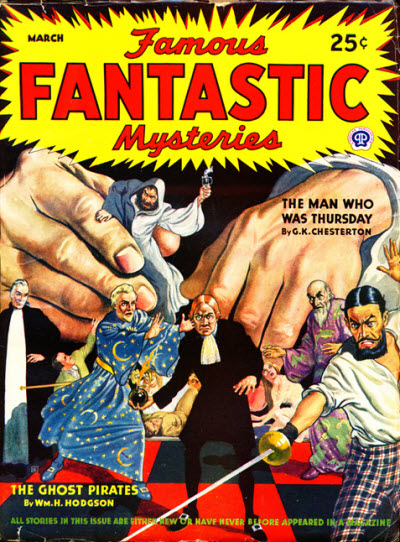


 Science Fiction & Fantasy Remembrance