Science Fiction & Fantasy Remembrance

Celebrating the genre magazines, one story at a time…

  • About
  • Serial Reviews
  • Novella Reviews
  • Short Story Reviews
  • Complete Novel Reviews
  • Things Beyond
  • The Observatory
  • The Author Index
  • Short Story Review: “The Rules of the Road” by Norman Spinrad

    July 18th, 2025
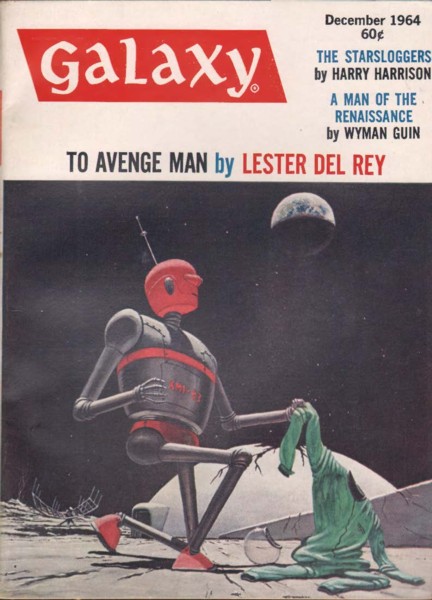
    (Cover by McKenna. Galaxy, December 1964.)

    Who Goes There?

    Norman Spinrad has had a long and winding career over the past sixty-odd years; in fact he’s the only author we’re covering this month who’s still alive, at least last time I checked. Spinrad was born in 1940, in NYC, and he made his debut in 1963, just before the New Wave kicked into high gear. He’s one of the few prominent New Wavers who did not already have a career by the end of the ’50s. He stirred up controversy a few times, most notably with the novel Bug Jack Baron, which was serialized in New Worlds and which the UK parliament took an issue with on grounds of obscenity. They say all publicity is good publicity, but in the case of Bug Jack Baron the controversy actually contributed to New Worlds (already a small operation under Michael Moorcock) downsizing and ultimately evaporating by the early ’70s. There’s also his novel The Iron Dream, a kind of fictional novel as written by Adolf Hitler in an alternate timeline where Hitler became a hack genre writer instead of, ya know. Spinrad’s later outings are less incendiary. Star Trek fans might recognize his name because he wrote one of the better episodes of the original series, “The Doomsday Machine.” 1964 was Spinrad’s first big year as it saw multiple short stories of his in print, with “The Rules of the Road” sadly being minor Spinrad, being competent but otherwise unindicative of the career he would have.

    Placing Coordinates

    First published in the December 1964 issue of Galaxy Science Fiction. It’s been reprinted in First Step Outward (ed. Robert Hoskins) and the Spinrad collection The Last Hurrah of the Golden Horde.

    Enhancing Image

    Sorry that this will be a shorter review than usual. The story itself is quite short and I didn’t have much to say about it. Sometimes a short story can be densely packed with nuance and flavor so that I’d have more to write about, but this is not the case here.

    A giant silver dome has appeared in Yucca Flats, which you may recall has a long history of US military involvement of the nuclear variety. (Its name is also associated with a certain infamously bad ’60s sci-fi movie, but putting that aside…) The dome appeared seemingly overnight and is obviously alien in origin, or else how could it be here. The top brass suspect the dome is some kind of ship, or maybe a “giant mousetrap” for human visitors, being perhaps a deadly labyrinth on the inside. Ten men have already been sent into the dome, and none have come out. The military begrudgingly concludes that it’ll take more than just a soldier or a normal civilian for the job, hence we’re introduced to Bert Lindstrom, a mercenary who’s gotten by on being very lucky—or rather Lindstrom has a borderline supernatural capacity to calculate risk. Risk, for Lindstrom, is indeed the name of the game. He’s a daredevil, but he’s an unusually rational kind of daredevil. Measuring risk is what gives Lindstrom’s life a sense of purpose, and pretty quickly we get that he’s a kind of anti-hero; other than that we find out nothing else about him.

    “The Rules of the Road” feels both really short and somehow also protracted, because the premise is so simple and because most of it is effectively a one-man show, albeit with a voice from offscreen talking to Lindstrom, like the stage director hollering at the actors from just outside of the audience’s peripheral vision. It’s an adventure narrative, sure, but there’s actually not that much action, with Spinrad spending more time on Lindstrom’s state of mind as he enters the dome and tries to figure out what traps could be hidden inside it. There’s a bit of scenery porn, and also we do get the sense that something is at stake, although exactly what is not made clear at first. Now, if you’ve read your fair share of pre-New Wave ’60s SF then you may be thinking that this sounds a bit like Algis Budrys’s Rogue Moon, albeit without the melodramatic human drama that propels that novel’s plot, which Spinrad absolutely would have read by this point. I’ve seen people complain about Rogue Moon being far more about the people outside of the deadly labyrinth on the moon than about the labyrinth itself, but “The Rules of the Road” is what that same basic plot might look like if you removed the human element. This is to say that Spinrad’s story has the bones of what should be a compelling little adventure story, but lacks the warmth and intellectual stamina of Budrys’s novel. Mind you that Budrys was not the only author whose footsteps Spinrad seemed to follow, but in order to get to that we’ll be talking about the climax…

    There Be Spoilers Here

    That the dome is an alien construction is obvious, but what’s less obvious is the nature of the aliens who had constructed it. Are they here to put humanity through some kind of rite of passage, or are they here merely to toy with humanity as a kind of plaything? It turns out to be the former. As the alien host, who we hear but do not see, explains, the universe as we see it is actually an illusion, with our three-dimensional perception being a smokescreen for a universe whose “true” nature would turn the average person’s brain to mush. The true universe is “the road” the humanity will have to learn to navigate if it wants to be on par with the aliens, who clearly are supposed to be far more advanced than us. This is a reveal that would not have been out of place in the pages of Astounding a couple decades earlier, to the point where I feel like A. E. van Vogt had written just the same kind of story as this, with more pyrotechnics and a real sense of hallucinogenic wonder at the vastness of the universe. The big problem with Spinrad’s story, aside from its uneven pacing, is that it’s maybe too sober and rational, too casual about the cosmic potential of its premise. It’s “far out” on paper, but Spinrad did not write it as such. When Lindstrom returns from the dome, having apparently been transformed into “something other than human,” we don’t feel much of anything about it.

    A Step Farther Out

    Reading very early Spinrad you probably wouldn’t get the impression that he would write something decidedly transgressive like Bug Jack Baron a handful of years later, or that he would be one of the more accomplished New Wavers generally. When read the early stuff of, say, R. A. Lafferty or Roger Zelazny, you could see how they would later rub shoulders with the New Wave, but this is not so with Spinrad. “The Rules of the Road” reads like A. E. van Vogt at a discount, albeit if van Vogt also had a firmer grasp of English. It’s clearly magazine filler, which is a shame.

    See you next time.

  • Short Story Review: “Think Blue, Count Two” by Cordwainer Smith

    July 15th, 2025
    (Cover by Jack Gaughan. Galaxy, February 1963.)

    Who Goes There?

    Cordwainer Smith was a pseudonym for Paul Linebarger, who wrote SF under as Smith so as to separate that career from his day job as, ya know, working for the US government. Linebarger, as Smith, had one of the most idiosyncratic careers of any writer in the field at the time, this despite his dying relatively young (at just 53) and not having his work pubished regularly until the last half-dozen years of his life. He made his debut, as an adult, with “Scanners Live in Vain” in 1950, after five years of struggling to find a publisher for it, and he would not see print again until 1955 with “The Game of Rat and Dragon.” Smith’s stuff was a little too weird for what was otherwise a highly permissive time in the field’s history; but he had found a couple cheerleaders in the forms of Frederik Pohl and Damon Knight. Pohl and Knight really dug Smith’s material, to the point where Smith appeared in all three issues that Knight had edited for If. “Scanners Live in Vain” would’ve surely wallowed in obscurity longer than it did had Pohl not included it in one of his hardcover anthologies in the early ’50s. From the beginning until his death in 1966, Smith was a “writer’s writer” whose quirks ensured that he would always have a cult following.

    When Pohl took over Galaxy and If circa 1961, he made a deal with Smith to have first dibs on Smith’s material going forward, and indeed with a few exceptions all of Smith’s work published from about 1962 until his death saw print in Galaxy or If. “Think Blue, Count Two” is, like nearly all of Smith’s fiction, set in the Instrumentality of Mankind universe, a mind-boggling future history that sadly Smith did not live to finish. You have a far future with comically large spaceships, genetically engineered animal-people, and an interplanetary government that is somehow both omnipresent and whose agents we don’t actually see. This is all conveyed with a style that is rather tell-y and stilted, in a way that either you’ll like or you won’t. Also even by the standards of old-timey writers, Smith was a big fan of cats. Like really. Like he was kind of a proto-furry.

    Placing Coordinates

    First published in the February 1963 issue of Galaxy Science Fiction. It was reprinted in Elsewhere and Elsewhen (ed. Groff Conklin) and the Smith collections The Instrumentality of Mankind and The Rediscovery of Man: The Complete Short Fiction of Cordwainer Smith.

    Enhancing Image

    “Think Blue, Count Two” is set fairly early in the Instrumentality timeline, taking place sometime after “Scanners Live in Vain” but before “The Game of Rat and Dragon.” Unfortunately Smith lost his notebook that had a mapped-out timeline for his future history, so the best we have is guess work. This makes it even harder to find an entry point for the series. Smith’s style of narration is unconventional no matter how you look at it, since despite the action taking place in the far future, the narrator acts as if said action had already happened in the distant past. We have a future history that is self-mythologizing, and also a far-future humanity whose use of English is a bit different from ours. Smith was fluent in multiple language (something like five or six, which is ridiculous and nigh-incomprehensible by today’s standards), and his childhood being partly spent in China in the early years of the 20th century seemed to shape his understanding of language. Not to say he’s a master stylist, a la Fritz Leiber or Ted Sturgeon if we’re talking contemporaries, but rather he has more in common with J. R. R. Tolkien, for both his worldbuilding and his understanding of linguistics. Smith’s future history is weird and densely packed. As for this story we’re actually told the basic plot right at the beginning, before anything actually happens, although it’s easy to overlook this. “A young man, bright of skin and hair, merry at heart, set out for a new world. An older man, his hair touched with gray, went with him. So, too, did thirty thousand others. And also, the most beautiful girl on earth.” But we won’t be introduced to the girl or the men she’ll be accompanying for a minute.

    See, space travel in the Instrumentality universe is a big gamble, and at best still takes a lot of work. Most writers of the period depicted space travel as being convenient to the point of straining one’s suspension of disbelief; there’s always some workaround for the speed-of-light problem, not to mention time dilation is usually not factored into things. Not to mention ships would require a truly monstrous amount of energy and propulsion to get through space. Someone like Poul Anderson would make a game out of how spaceships might work. As for Smith, these ships are impossibly large hulking machines, but also space travel is shown to be quite horrible. The whole plot of “Think Blue, Count Two” kicks off because some technicians are prepping a colony ship for a voyage to a distant planet, in a journey that would take centuries of objective time, without repeating the disaster of Old Twenty-two. Basically what happened on Old Twenty-two is that something happened with the sailor (the ship’s human navigator) that required some of the passengers be awoken from cold sleep. “They did not get on well with one another. Or else they got on too horribly well, in the wrong way.” We don’t get specifics, but the gist of it is that all hell broke loose and life aboard Old Twenty-two descended into death and debauchery. For this next trip, the technicians and the “psychological guard” (Smith doesn’t really explain what a psychological guard, but it’s like a psychologist and an engineer rolled into one job) have a safeguard in the form of Veesey, a 15-year-old girl who does not stand out at all aside from her beauty. In fact, Veesey doesn’t have any special skills, except for one thing: she’s to play the daughter role, so that no adult should wanna harm her.

    Now, this next part is very weird, so bear with me: Veesey, while she’s in cold sleep, is mind-linked with a laminated mouse brain that is both dead and alive, or rather the mouse is dead but its brain is active—indeed the brain, which is wrapped in plastic, will be active for literally thousands of years assuming it’s never destroyed. Veesey’s telepathic link with the mouse brain (yeah) relies on her unconsciously memorizing a certain TV serial, as well as a nursery rhyme, which goes like this:

    Lady if a man
    Tries to bother you, you can
                Think blue,
                Count two,
    And look for a red shoe.

    If Veesey need ever recite the rhyme, help will come to her aid. How help would come to her aid is not explained, and anyway saying it now would be giving away a big spoiler. You might have noticed that we’re a bit of a ways into the review and, if you’ve read the story already and have it fresh enough in your mind, I’ve barely even tackled the plot. The pacing here is a bit wonky, which truth be told is a problem I often have with Smith, which might have to do with his peculiar style. There is a lot of setup, to the point where we don’t actually get on the ship and are introduced to Veesey’s two male companions until at least a quarter in; but then you might argue we need the setup, or else what follows will not make any damn sense to us. I will say, this really should not be your first Smith or Instrumentality story. I would recommend starting with “Scanners Live in Vain” or “The Game of Rat and Dragon,” or maybe “The Burning of the Brain.” For one, Smith mentions the Scanners offhandedly at the beginning of “Think Blue, Count Two,” and if this is your first Smith story then you would have no clue what a Scanner is, because Smith doesn’t explain it. In fact there is a lot that Smith can’t be bothered to explain, whether it be the jargon or mechanics of his future history. It also doesn’t help that despite psychology figuring very much into the workings of the Instrumentality universe (yeah, you’ve got psi powers and the like), we don’t get much insight into how characters think or how they mentally interact with this strange world around them. As such, there is no singular one-size-fits-all Instrumentality story; but on the plus side, the more of this series you read, the more rewarding it becomes, since these stories piggyback off each other.

    Now, Veesey is put in cold sleep and sent aboard, along with 30,000 other passengers. The ship is maintained by the sailor along with a team of robots, but while the robots can do a great deal, a very small number of passengers will have to be awakened if the sailor were to die or become incapacitated. So of course, in seemingly no time at all, the sailor dies; whether it be suicide or an accident is not revealed until later. Veesey thus wakes up, along with two male passengers, the young and handsome Trece and the older and deformed (something had gone wrong with his cryo-chamber) Talatashar. The humans enter and awaken from cold sleep periodically (it would seem like days to them while centuries pass by outside the ship) to help with issues the robots are unable to deal with themselves. That’s the idea. Since this is a story and a story typically requires drama, though, the humans run into problems that are unrelated to the ships—namely that while machinery might be running fine, there’s always the chance for human error and human folly. There’s also the problematic aspect of the equation, which is that every adult (who are bare minimum a decade older than her) wants to get in Veesey’s pants, despite her very young age. I wanna say this sort of thing only happens in this one Smith story, but I’m also thinking of the questionable age-gap relationship at the heart of “On the Storm Planet,” which otherwise is one of Smith’s best. Granted that nothing explicit happens on the page (because this is still magazine SF in the early ’60s), it doesn’t take long for Veesey and Trece to start a sexual relationship.

    There Be Spoilers Here

    While Veesey and Trece’s relationship progresses, Talatashar becomes kind of an incel, resenting Veesey’s casual pull on his male friend. The result is jealousy that heightens into Talatashar entering a blind rage and going on a rather Elliot Rodger-esque rant about how women are so purely evil that they’re not even aware of their evilness. Yeah, it would be a comical level of misogyny if not for the fact that we now have guys going on shooting sprees basically because they have some awful personalities that they’re unable to get any pussy. Misogyny is the big catalyst for tensions between the three humans escalating, which I’ll be honest, I did not expect considering Smith was a lot of things, but a feminist was not one of them. (Mind you that while he was definitely a right-winger, Smith wasn’t entirely right-wing: for one he seemed to sympathize with the Civil Rights movement, with the Underpeople [the aforementioned genetically engineered animal-people] clearly being an allegory for a oppressed underclass.) Thankfully Veesey is not in any real danger, since all she has to do is think of the nursery rhyme that’s been burned into her brain and the dead-alive mouse brain does its job. A series of holograms comes alive and tell Talatashar to quit being such a bitch baby or else they’ll kick his shit in—a threat that, surprisingly, he ends up taking to heart. The holograms, despite being effectively ghosts, are able to trick the humans’ minds so as to make them think these ghostly doings are for real, to the point where Sh’san, the lead hologram, can apparently fire a “gun” at someone’s head and said head would actually be blown to bits. You have to admit that’s pretty cool.

    So, all’s well that ends well. The three humans and their 30,000 fellow passengers reach the planet with the ship in one piece. Of course, Trece dumps Veesey, letting her know that it’s actually not too kosher for a 20-something to be dating a 15-year-old. (He says this after they’ve had sex multiple times, but better late than never, I guess.) Talatashar is much more chill now, having gone over his bout of space-induced insanity, and the technicians waiting for them at the immigration station even repaired his face so he looks reasonably handsome now. This is one of those Smith stories that has a straight-up happy ending, which is not something I would suggest getting used to with Smith.

    A Step Farther Out

    At some point I’m gonna review a Smith story here that involves the Underpeople, who are quite interesting conceptually, although they don’t actually appear in that many Instrumentality stories. The last Smith story I reviewed, “Drunkboat,” had its points but wasn’t very good, in my opinion, although “Think Blue, Count Two” is better. The appeal of Cordwainer Smith lies in the fact that he’s one of the best and most eccentric old-timey SF writers when it comes to space opera, or more generally space adventure. “Scanners Live in Vain” does not read like any other space adventure story of the time, and similarly “Think Blue, Count Two” takes what is basically a love triangle IN SPAAAAACE and puts a novel spin on it. This is the kind of story you should check out once you’ve become at least a bit acclimated with the Instrumentality series.

    See you next time.

  • Short Story Review: “Sodom and Gomorrah, Texas” by R. A. Lafferty

    July 11th, 2025
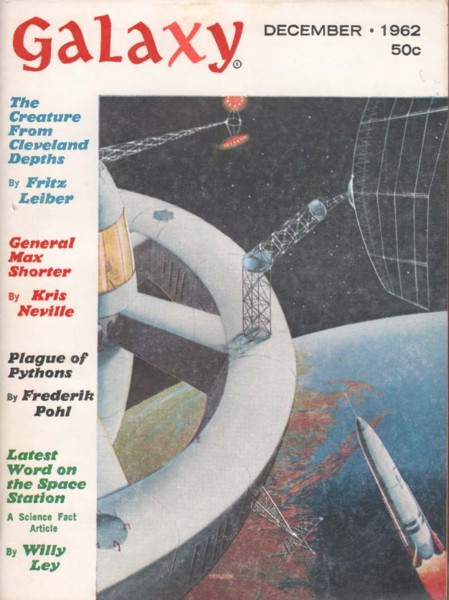
    (Cover by Dember. Galaxy, December 1962.)

    Who Goes There?

    I’ve been meaning to dig more into R. A. Lafferty’s early work, which is the stuff that tends to get overlooked when I see people evaluating his legacy. Lafferty is pretty divisive among readers, probably more so today than half a century ago: either you’re a fan of his stuff or you ain’t. I’m not a fan myself, really, but I’ll try anything once (or even twice). In the case of Lafferty it’s mainly because he’s Quirky™ that he has a love-him-or-hate-him reputation, although this same quirkiness also threw him into the midst of the New Wave, despite being politically and socially conservative and also already middle-aged, being about a generation older than most of his fellow New Wavers. He appeared in Dangerous Visions, because of course he did. He was also one of the most frequent contributors to Damon Knight’s Orbit series. Lafferty had made his debut in the late ’50s, but not many people know this. Also, I should mention that this will be a shorter review than usual, both because “Sodom and Gomorrah, Texas” is very short and also because there’s not much I can say about it.

    Placing Coordinates

    First published in the December 1961 issue of Galaxy Science Fiction. It’s been reprinted in the Lafferty collection Strange Doings, and has fallen out of copyright, so it’s on Project Gutenberg.

    Enhancing Image

    The tragedy of the situation is that Manuel is too thorough at his job, which is not the same thing as being good at one’s job. The state authorities hire Manuel as a census taker, which (the narrator tells us upfront) is a decision that will lead to the deaths of thousands. We’re basically told how the story will end at the beginning, but are not given context. The official who gives Manuel his job tells him to count all the people in the Santa Magdalena (which as far as I can tell is not a real place), a little mountain area on the outskirts of High Plains, Texas. The job should’ve been an easy one, since there aren’t many people in that area—or at least there aren’t many normal people. Unfortunately, Manuel knows something that the official does not. “The official had given a snap judgement, and it led to disaster. It was not his fault. The instructions are not clear. Nowhere in all the verbiage does it say how big they have to be to be counted as people.” So Manuel takes his mule, named Mula, into the desert, and three days later he returns to High Plains, his papers filled with names—thousands of them. Thousands more than there should be. Also, quite strangely, Manuel and his mule seem to have aged by decades, despite not being gone nearly that long. Manuel claims he had aged 35 years while doing the census, and he might be right about that. He also seems to have shrunk in size, to the size of—well, it’s a slur that Lafferty uses, which I will not repeat here.

    There’s a large cratr near High Plains, about the size of where a small town might’ve been, and the crater (nobody knows what caused it) had long since been christened as Sodom. Now, Lafferty knew his Bible, and even if you don’t then you should still figure that if there’s a Sodom, there must also be a Gomorrah. These are the twin cities of the plain that God decided to blow to kingdom come, on account of their collective wickedness. The author (or maybe authors) of Genesis did not make it clear just what it was that the people of Sodom and Gomorrah were guilty of, but a common historical interpretation is that they indulged a little too much in old-fashioned sodomy—you know that’s where the word comes from. Of course, Lafferty is being ironic, since the people of High Plains and whatever Sodom used to be are not guilty of any crime worthy of a Biblical smackdown; but rather these people fall victim to a classic bureaucratic fuck-up. You could say it was a little misunderstanding. The problem is that Manuel knew about the little people who lived in the Santa Magdalena; by little we mean about the size of action figures, or Jonathan Swift’s Lilliputians. Manuel, who we’re told is quite stupid (he is apparently illiterate and can’t read a map), respects the little people, but irks them something fierce when he tries counting them as part of the census. Hilarity ensues.

    How much you like Lafferty will depend on your own sense of humor, as well as if you can get behind his callousness as well as his religious ferocity. There’s an immense sadism in a lot of Lafferty’s writing, which is sometimes played for laughs, such as here, as well as the last Lafferty story I reviewed, “The Transcendent Tigers.” “Sodom and Gomorrah, Texas” is not as good as “The Transcendent Tigers,” for one because it’s not as funny, but also I feel like Lafferty has less of a point to make. The former is so short that we barely have time to understand any of these characters, and Lafferty doesn’t escalate the catastrophe like he does in his best/funniest work. I would describe this story as “cute,” which is to say it has the same energy as a decent joke that makes you exhale from your nostrils but doesn’t actually make you laugh. I do sometimes wonder why Lafferty had such a sadistic streak, but then again virtually every Catholic writer I know has a perverted preoccupation when it comes to death and human suffering. I’ve also seen criticisms of Lafferty for having misogynistic tendencies, but since there aren’t any female characters of note here, there is at least that.

    There Be Spoilers Here

    Manuel dies, seemingly from a mix of rapid aging and having lost his marbles, which then has the perspective change to that of Marshal, the census chief of High Plains. One night Marshal gets a visitor in the form of one of the little people, although Marshal’s not totally convinced it isn’t a hallucination. The little guy is upset about Manuel’s census list and wants it back, but it’s too late. The truth is that what had caused Sodom was that the people who lived there (this was a few hundred years ago, so says the little dude) had found out about the little people. The whole town had been blown up, from what the little dude reveals to be some kind of explosive “the size of a grain of sand.” Marshal does not take the warning seriously and—well, you already know the rest. The change in perspectives bugged me a bit, being that this is such a short story, and also there’s the fact that the back end suddenly becomes heavy on dialogue compared to the rest of it. The result almost reads like a rough draft.

    A Step Farther Out

    “Sodom and Gomorrah, Texas” is both early and minor Lafferty, in that it’s good for a chuckle but not much else. I suspect Fred Pohl accepted it because he liked it enough, and because of its lenght he thought it would be a good little piece to fill out an issue. Back in the days before online magazines, it was common practice to accept minor stories for the sake of filler, which is not something online magazine editors have to think about. There’s filler by the usual suspects when it comes to this sort of thing, but then there’s also filler by major writers. Lafferty was not a major writer yet in 1962, but he was on his way there.

    See you next time.

  • Short Story Review: “Arcturus Times Three” by Jack Sharkey

    July 8th, 2025
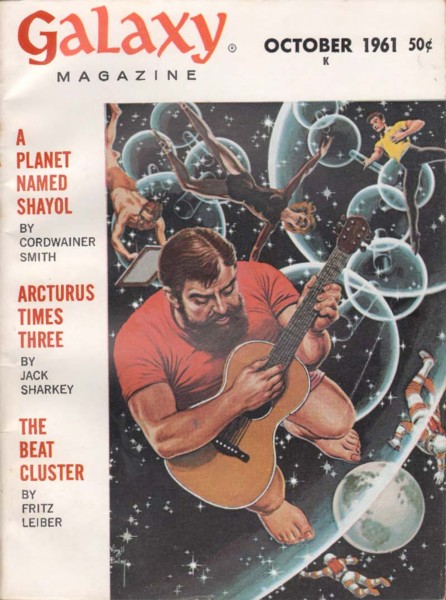
    (Cover by Virgil Finlay. Galaxy, October 1961.)

    Who Goes There?

    In the history of genre SF there are many ships that pass in the night, never to be seen or heard from again, one of these being Jack Sharkey. Sharkey had made his debut at the tail end of the ’50s and wrote a pretty considerable amount of short fiction over the next half-dozen years. For reasons I’m not sure about, because we don’t know much about Sharkey, he more or less disappeared from the field after 1965. As far as I can make out writing SF was just a temporary side gig for him, which is strange since he was most active at a time when the US magazine market was at low tide, with the bubble having burst in the back end of the ’50s. Even the SF Encyclopedia doesn’t have much to say about him. Nearly every genre outlet at the time bought his stuff, though, which means he must’ve made some impression. He also had a series of short stories that caught my attention, about a “space zoologist” named Jerry Norcriss, at a time when zoology and generally the study of animal life were still rather novel in modern SF. “Arcturus Times Three” is the first entry in this series.

    Placing Coordinates

    First published in the October 1961 issue of Galaxy Science Fiction. It was reprinted in Uncollected Stars (ed. Piers Anthony, Martin H. Greenberg, Barry N. Malzberg, and Charles G. Waugh). The copyright ran out, so it’s on Project Gutenberg. Surprisingly there was never a book collecting all of the Jerry Norcriss stories.

    Enhancing Image

    By the year 2097, man has voyaged to the stars, going where no one has gone before, to seek out new life and new civilizations, yadda yadda. However, making first contact in-person with intelligent life has proven to be a hefty gamble, perhaps heavy enough that a scientific alternative was called for; that alternative is the Space Zoologist, making capital-C Contact with alien life via telepathic mind-link, in which the zoologist will spend forty minutes at minimum inside the mind of an alien creature, walking (or slithering, or swimming) around in that creature’s shoes, sharing their brain, with the creature and zoologist’s personalities having a tug-of-war over the body. The catch, of course, is that if the creature were to die in those forty minutes, the zoologist dies with them, their body being a mindless husk. Why is this so? Well, the real reason is that otherwise there would be no potential bodily harm for the zoologist and thus your story would become boring rather quickly. Meet Jerry Norcriss, thirty-year-old Space Zoologist as well as space lieutenant, IN SPAAAAAACE. The mission is to survey some local wildlife on Arcturus Three, although the exact reason for this is not given until the end, so best not to think about it. The point is to stick Jerry’s mind in the heads of three random lifeforms, which he will not know anything about in advance and who are very likely to die within those forty minutes. Sounds simple enough, right?

    I have a few issues. One has to think the mortality rate for Space Zoologist must be ridiculous, to the point where it might be more costly than to have a survey team come down and bring the party to the aliens. It also doesn’t occur to any of these people that sending robots would be preferable; surely it was not a novel idea, in 1961, to use robotic probes instead of humans to explore hostile environments. But then we wouldn’t have a story. At the same time, wouldn’t it make sense for the space crew to figure out some way to, I dunno, figure out what kind of lifeform Jerry would be sharing a head with in advance. It’s a shame, because the idea is a neat one, which borders on transhumanism. As the narrator tells us, “A man who has been an animal has infinitely more knowledge of that animal than a man who has merely dissected one.” Jerry’s interest in alien biology goes to a point where he doesn’t relate much to his fellow humans, and what little we find out about his character in this story (I assume we learn more in future entries, but not that much given the episodic nature of the whole thing) is just about enough to make us relate to him. I mean fuck, I don’t like hanging out with people that much either. With that said, this is not a cerebral or personal story, but an old-fashioned scientific adventure of the sort that would become increasingly rare as the ’60s progressed—or so retrospective views on the genre’s history would have it seem. Evidently there was still a sizable audience for this sort of thing.

    As for the animals that Jerry takes control of, there’s a bit of variety between the three of them (get it, because it’s like a pun with the title, Arcturus Three and there being three animals…), with the first being this weird centipede creature that’s connected to another animals via its tongue; then there’s the most compelling sequence, where Jerry’s in the body of a “lion-thing,” somewhere between a lion and a bear, with its cub. The lion-thing’s instinctive behavior turns out to be as much that of a lemming’s as a lion’s, including a tendency to eat things that are very not good for it. Not that Jerry would know until he finds his tummy hurts real bad, on account of not being able to survey the territory beforehand. LIKE THEY SHOULD’VE FUCKING DONE. The only reason he gets out of it in one piece is having to do with time dilation, or rather Sharkey has his thumb on the scales so as to make sure his hero gets out okay. (In fairness, time would work differently on another planet. You say forty minutes, but how much is forty minutes on a planet that has a different gravity and rotation from Earth’s?) It’s all in good fun. We even get some fully intelligent aliens thrown into the mix, although their role is tertiary enough that one is quick to forget about them. This is a story where the journey matters much more than the destination, although I’m not sure if the journey was worth it.

    There Be Spoilers Here

    The most interesting part of this whole thing for me was the ending, which, after some rather lightweight planetary adventuring, reckons with a serious problem—that being the problem of colonization and the ensuing (and inevitable) ecological damage. On top of his awkwardness around people, Jerry feels more than a hint of shame about contributing to what will be a protracted and brutal colonization effort, in which the aforementioned animals will be displaced or killed outright, yet he also feels powerless to do anything about what is ultimately a systemic issue. He loves his job, and yet he doesn’t like what it costs for life in the universe. As the narrator says, clearly reflecting Jerry’s (and probably Sharkey’s) feelings, “People always were puzzled about how a Space Zoologist could stand being a creature other than a human being. And Space Zoologists always were puzzled about how a human being could stand being part of that conquering race called man.” I wish the rest of the story had something like this degree of seriousness, but it’s too little and a bit too late.

    A Step Farther Out

    I sat around for a couple days trying to organize my thoughts on this, which when such a thing happens is either from too much or too little material; in the case of “Arcturus Times Three” it’s the latter. Sharkey’s a competent storyteller with a clear interest in a certain science, but given how long this story is (it’s a solid novelette), it’s not quite enough meat on its bones. The alien creatures Sharkey describes are neat enough, but I got this consistent and burdensome feeling of wanting more, on top of the fact that I was much slower about reading this than I should’ve been. If I’m taking several breaks during your story that I should’ve been able to read in an hour or so, then something is definitely missing.

    See you next time.

  • Short Story Review: “Something Bright” by Zenna Henderson

    July 4th, 2025
    (Cover by Ed Emshwiller. Galaxy, February 1960.)

    Who Goes There?

    Our first ’60s Galaxy story for this retrospective is by someone who actually did not appear in Galaxy often. The last time I covered Zenna Henderson it was as part of a retrospective on F&SF, the magazine which seemed to be Henderson’s preferred outlet. Henderson made her debut in 1952, as part of a wave of female writers who would help shape ’50s SF as being a very different ball game from the previous decade—indeed also the decade to come after, since there wouldn’t be as many active female SFF writers in the ’60s. Henderson specialized in short fiction, and one reason she lost traction by the end of the ’60s is that she refused to change her tune with the market; her single “novel,” Pilgrimage: The Book of the People, is a fix-up. Given her day job as a schoolteacher, it makes sense that her fiction tends to focus on relationships between adults (specifically parents and teachers) and children, with children especially getting attention, which for the time was novel. SF at the time was, let’s say averse to understanding the day-to-day lives of children, but Henderson’s fiction was a major exception. Today’s story, “Something Bright,” is a standalone work (Henderson’s fiction can be split into two groups: standalone stories and those about “The People”) that I found a good deal more compelling than “Subcommittee,” the last Henderson story I reviewed. This is a good one, and it’s understandably one of her more reprinted stories.

    Placing Coordinates

    First published in the February 1960 issue of Galaxy Science Fiction. It was reprinted in The 6th Annual of the Year’s Best S-F (ed. Judith Merril), The Seventh Galaxy Reader (ed. Frederik Pohl), Galaxy: Thirty Years of Innovative Science Fiction (ed. Martin H. Greenberg, Joseph D. Olander, and Frederik Pohl), and the Henderson collections The Anything Box and Believing: The Other Stories of Zenna Henderson.

    Enhancing Image

    The exact year is not given, but right away we’re told that “Something Bright” takes place during “the Depression,” so probably anywhere between 1930 and 1935. Anna is an adult now, but she’s telling us about a strange thing that happened to her when she was eleven years old, living in a “court” that her family shared with an older couple, the Klevitys. Mr. Klevity isn’t around (in fact he doesn’t appear until the story’s end), but Mrs. Klevity is, especially whenever Anna’s mom has to go out for errands. Obviously there is something off about the Klevitys, not least because they somehow have fresh eggs every morning, in an economy where even eggs are treated as a delicacy. The SFnal twist is by itself easy to detect in advamce, to the point where it hardly even counts as a twist; but it’s what Henderson does around the twist that makes it a pretty good story. As such I’m gonna work on the assumption that you, the reader, have already figured out that the Klevitys are aliens in disguise, become come on, we’re all adults here, and the fact that Henderson waits until the back end to confirm our suspicions is merely a formality. This is a story about childhood and memory, far more than it is a story about aliens, yet the SFnal element is integral to its makeup. Both in style and substance it would strike the average reader as “literary”—except for the part about the aliens, of course.

    The key ingredient that elevates “Something Bright” is the sense that while it is not autobiographical at face value, there is the strong sense that Henderson is writing about personal experiences that she herself probably had first-hand knowledge of. I’m not sure how much Henderson and Anna share in terms of personality, but we do know that they both spent at least some of their formative years during the Depression, and incidentally each is an older child in a family with five kids. When Henderson/Anna asks at the beginning, “Do you remember the Depression?” she’s being at least partly rhetorical: she absolutely does remember. Despite being only about a dozen pages, the setting is vividly set, with Anna lamenting being the eldest of five kids in a home that amounted to two rooms, in which nobody had any privacy, least of all her mother. We’re not told directly what happened with Anna’s dad, that I can recall anyway, but at one point it’s implied he either went off in search of work or abandoned the family outright. Anna’s mom is effectively a single parent, but that’s where Mrs. Klevity comes in. It would have been commonplace, during the Depression, for kids to either be left to fend for themselves much of the time or to be kept under watch by multiple people who were not their biological parents—out of economic necessity more than anything. You may remember in To Kill a Mockingbird that Scout and her brother Jem are left to their own devices for way longer than what would nowadays be considered a good idea, on account of their single dad only being able to do so much.

    “Something Bright” must’ve struck a cord at the time, on account of being reprinted multiple times within just a few years, but it also speaks to today’s post-COVID environment. The economic fallout from the COVID-19 pandemic is, along with the housing market crash of 2008, the closest we have to a modern-day analog to the Great Depression. These are times in which the machinery of capitalism comes almost to a grinding halt, in which the system “failed” (but, on the other hand, if we’re to take capitalism as a system that works to benefit a rich minority at the expense of the majority, then it more or less kept working as intended), and in which even the nuclear family as a viable model for child care seemed on the brink of becoming a thing of the past. Ironically the nuclear family, which conservatives love to hold up as being traditional and “natural,” has, for practical reasons, been in fact a fairly modern phenomenon. The idea that two parents would take care of their own biological kids was unviable for many during the Depression, during which you’d be lucky if even one of your parents had a steady job, and said job was unlikely to both pay the bills and feed everyone. Thus in this story we’re given a depiction of a nontraditional family setup, in which the father figure is absent and so Anna and her siblings are left with at least one adult figure in their lives who is a constant and yet is not related to them. Mrs. Klevity sticks out in Anna’s memory not just for her strangeness and her conspicuous and yet unexplained ability to provide for both herself and her husband (Anna points out that the Klevitys have three rooms to themselves, compared to Anna’s two), but also the fact that she at least temporarily acted as a surrogate parent.

    There Be Spoilers Here

    The back end of “Something Bright” takes a turn towards horror, although it doesn’t quite go there, because it turns out Anna is not in any real danger. Her first encounter with Mrs. Klevity without the disguise, which she hears but does not see, is genuinely chilling, not to mention an unexpected bit of restraint of Henderson’s part. We figured in advance that the Klevitys were not strictly speaking human, but how this reveal is made is what makes the twist memorable despite its predictability. That Anna ultimately helps Mrs. Klevity and her husband (who only shows up at the end to find that his wife has flown the coop, so to speak) go back to wherever it is they came from, and gets something material out of it (the Klevitys leave behind their half of the court and bestow it to Anna’s family, in a thank-you note), makes for a pretty upbeat conclusion. Yet despite it being a happy ending, there’s still a strong eeriness about the whole thing, as if Anna, who is telling us this story many years after the fact, is trying to explain some peculiar childhood trauma that had happened to her. I have to wonder what the context could be that Anna is telling this story to us, since this is not the kind of thing you’d tell to just anyone, but this is a quibble. Then again, when you’re looking back on childhood memories, the line between what really happened and one’s own imagination can be hard to separate. I barely remember my own childhood, as an autistic person who also dissociated a lot, to the point where a lot of what I “remember” might not have actually happened. Our own histories become stranger and more disconnected as time passes, to where they no longer seem real to us.

    A Step Farther Out

    Henderson working with children as part of her day job is very much reflected here, as it captures a genuineness about childhood experience that very few SF stories at the time had even attempted. The twist is obvious, to the point where I don’t even count it as a spoiler really, but the twist is not why we’re here. When I read “Subcommittee” I was ambivalent about its glorifying of the nuclear family, which probably did not read as old-hat in the early ’60s but which now reads as stuffy and too old-fashioned; but “Something Bright” shows us an alternative family dynamic and doesn’t do anything to demonize it. It also helps that Anna is a likable narrator who relates her past experiences such that you get a vivid impression of what her childhood was like, even if you didn’t (and indeed most people in the US don’t now) go through exactly what she did. I recommend it! It’s very good proto-feminist pew-New Wave SF.

    See you next time.

  • Things Beyond: July 2025

    July 1st, 2025
    (Cover by John Pederson, Jr. Galaxy, October 1965.)

    As far as I can tell there’s no book dedicated to the history of Galaxy Science Fiction, although we do have several books that delve into this magazine’s strange history to one degree or other. The best that I’ve read myself would probably be Frederik Pohl’s The Way the Future Was, in which Pohl’s gives us some insight into working as a writer, an agent, and eventually an editor. H. L. Gold edited Galaxy for about a decade, but a car accident that left him in a good deal of physical pain incentivized someone taking over Galaxy and If (Gold was also editor of the latter, briefly). Pohl was already acting as Gold’s assistant by the end of 1960, but by the end of 1961 Pohl had emerged as editor of Galaxy in both name and function. While they had originally started as competitors, Galaxy and If became sister magazines, housed under the same publisher, and Pohl had control of both for most of the ’60s. Despite publishing quite a few award-winning stories during this time, Galaxy never again won the Hugo for Best Professional Magazine, and when Pohl did win three back-to-back Hugos for that category it was for his work on If. Despite initially having the reputation of being Galaxy‘s lesser and trashier sister, If amassed a more devoted following during this decade, somewhat to Galaxy‘s detriment.

    I’ll be honest and say that I toyed with what stories I would be covering this month up until the very last minute (that is to say today), not because Galaxy wasn’t publishing enough worthy material during the ’60s, but because it was indeed such a strange time for the magazine. Galaxy under Gold had, for better or worse, a rather strong identity, with a stable of authors associated with it; but Pohl’s Galaxy is harder to define, its material having less of an emphasis on sociological and psychological SF and more being geared towards adventure fiction. There’s something oddly retrograde about Galaxy (even more so with If) under Pohl, not helped by Pohl himself being a vocal critic of the New Wave. This is a bit ironic considering Pohl was politically progressive and rather keen-eyed when it came to making observations on the goods and bads of the industry.

    At the end of the ’60s there was another changing of the guard, with Pohl stepping out of both Galaxy and If, indeed leaving magazine-editing altogether, to focus on writing fiction again. Ejler Jakobsson, a Finnish immigrant who was actually nearly a decade older than Pohl and who had been working in the field for about as long, took over both magazines. I’m not covering anything from Jakobbson’s tenure this month; for that we’ll have to wait until October, when I tackle the ’70s. As for what I’m tackling this month, I intentionally decided to go for a roster of authors that is a bit less star-studded than when I covered the ’50s. We’re reaching for deeper cuts, for the most part, although whether this pays off is something only future me will know about.

    Now, as for the stories:

    1. “Something Bright” by Zenna Henderson. From the February 1960 issue. I’ve covered Henderson before, and while I wasn’t impressed with “Subcommittee” I’m always willing to give any author another try. What’s curious is to see Henderson out of her natural habitat, since she contributed far more prolifically to F&SF, whose lightness of scientific rigor probably appealed to her more.
    2. “Arcturus Times Three” by Jack Sharkey. From the October 1961 issue. Sharkey debuted in 1959 and wrote basically nonstop for every outlet that would have him until the second half of the ’60s, by which point he seemed to vanish from the face of the earth. The closest I can find to a reason as to why this happened is that Sharkey was more a playwright who treated writing SFF as a side gig.
    3. “Sodom and Gomorrah, Texas” by R. A. Lafferty. From the December 1962 issue. People tend to overlook Lafferty’s pre-New Wave years, which is funny because what early Lafferty I’ve read is still in keeping with his more famous (or infamous) material. Despite being a devout Catholic and politically conservative, Lafferty fit right in with the likes of Harlan Ellison and Kate Wilhelm.
    4. “Think Blue, Count Two” by Cordwainer Smith. From the February 1963 issue. Speaking of authors who very much influenced the New Wave despite differing politics, Cordwainer Smith is the pseudonym of Paul Linebarger, who had US government connections as well as an admiration for Chiang Kai-shek. This didn’t stop him from being one of the most unique SF writers of his day.
    5. “The Rules of the Road” by Norman Spinrad. From the December 1964 issue. People most recognize Spinrad not for any one of his stories or novels, but for having written “The Doomsday Machine,” one of the more memorable Star Trek episodes. He debuted in 1963, just in time to hit his stride when the New Wave came around, even appearing in Dangerous Visions a few years later.
    6. “Shall We Have a Little Talk?” by Robert Sheckley. From the October 1965 issue. Sheckley was most prolific during the ’50s, and while he didn’t make his debut in Galaxy he still became heavily associated with that magazine. It’s easy to pigeonhole Sheckley as someone who only seems to write ironic social satire, which is understandable given he wrote so much of it early in his career.
    7. “The Body Builders” by Keith Laumer. From the August 1966 issue. Like Sharkey, Laumer debuted in 1959 and became a somewhat popular figure during the ’60s, although unlike Sharkey we know why Laumer’s career declined afterward. Laumer suffered a stroke in 1971, and while he recovered somewhat he apparently never wrote as well or as prolifically as during his golden years.
    8. “Eeeetz Ch” by H. H. Hollis. From the November 1968 issue. Hollis was a pseudonym for Ben Neal Ramey, who presumably took on the name so as to separate his SF writing from his day job as a lawyer. I’ve never read any Hollis before, not that he wrote much. The study of cetaceans really took off in the ’60s, hence this story.
    9. “The Weather on Welladay” by Anne McCaffrey. From the March 1969 issue. We have another story revolving around cetaceans, but unlike Hollis I am actually familiar with McCaffrey’s game. By the end of the ’60s McCaffrey had emerged as one of the most popular writers in the field, with her Pern and much smaller Ship series amassing followings, although I’m not really a fan of either.

    Won’t you read with me?

  • Novella Review: “Undergrowth” by Brian W. Aldiss

    June 28th, 2025
    (Cover by Ed Emshwiller. F&SF, July 1961.)

    Who Goes There?

    Brian Aldiss is what the SF Encyclopedia calls a leading “man of letters” in the field, which is to say he’s adept at both fiction and nonfiction, being one of the field’s great jack-of-all-trades writers. He won a Hugo for the stories comprising Hothouse (strangely as a series of short stories and not for the novel version), but he also won a Hugo for the hefty nonfiction book Trillion Year Spree (co-authored with David Wingrove), which is an opinionated overview of genre SF history, and which is itself a revamped version of the earlier Billion Year Spree. Aldiss had a combative personality and whereas authors nowadays, being their own PR staff, are incentivized to play nice with fellow authors in public, Aldiss made no secret of how he felt about his peers. He debuted a whole decade before the New Wave kicked off, but fit right in with that movement, being probably more influenced by William S. Burroughs than Edgar Rice Burroughs. In other words, despite being born in 1925 and debuting in the ’50s, Aldiss’s fiction can come off as pretty literary—sometimes a little too literary. I’ve been trudging through the Hothouse stories for the past several months, and now it’s time to tackle the third and longest story so far. Mind you that I don’t have a great deal to say about “Undergrowth,” so bear with me.

    Placing Coordinates

    First published in the July 1961 issue of The Magazine of Fantasy and Science Fiction. It has never been reprinted on its own, which makes sense since it’s the third entry in a series.

    Enhancing Image

    I actually didn’t know it had already been what, seven months since I reviewed “Nomansland”? It’s been way longer than I had assumed. Granted, these stories are similar enough to each other that to write about them in quick succession would’ve been a chore for me. The Hothouse series can be considered a picaresque of sorts, in which a young person (Gren) goes off on a series of adventures in the name of self-discovery. It becomes apparent by the end of “Nomansland” that Gren is to be our main character throughout the series, and that conversely anyone not named Gren can expect to have a short life and a brutal death. The beginning of “Undergrowth” briefly recaps what happened in the previous story, although I have to assume this opening passage is removed for the novel version since it would certainly strike the reader as redundant. These stories make up a serial in all but name, albeit published a couple months apart at somewhat irregular intervals. It would be necessary to remind the reader of what the fuck is happening, especially since the world Aldiss establishes is so multifaceted, so this recap bit was the best he could’ve done. Gren and his companion Poyly are exiled from their small group of humans and, just when it seems all hope is lost, they come across the morels, a race of sentient fungi that communicate telepathically with the host in a symbiotic relationship. Gren and Poyly get some free hats and head off, out of what is clearly an homage to Eden, with their talking fungus buddies on their heads.

    Each story in Hothouse leans into a different subgenre, or so it seems. Generally I would call it science-fantasy, in that while it’s ostensibly SF it so brazenly goes against known laws of physics and biology that it’s clear Aldiss did not intend the world of Hothouse to be an extrapolation of our world, or indeed our universe. In “Hothouse” we’re introduced to mankind in a world where mankind has been relegated to the bottom of the food chain, wherein bugs and carnivorous vegetation have long since taken the top spot. The result is a kind of pseudo-documentary, or rather pseudo-nonfiction, being about as much a sociological study as it is adventure fiction. “Nomansland” downplays the sociological aspect and zooms in to focus on Gren, a teen boy among a group of people who are even younger and dumber than he is; and, more strangely, “Nomansland” has a gothic horror angle, complete with a dark castle built by termites (sorry, termights). Now that we’ve met the morels, one of whom becomes Gren’s headmate so that he always has someone to talk to, the series switches gears yet again. This time it becomes more like a “lost race” adventure of the sort that was popular in the late 19th and early 20th centuries. We’re introduced to the herders, a tribe of humans who live in a congealed lava pit and fear what they call the Black Mouth. One of these herders, Yattmur, serves as Gren and Poyly’s guide to the tribe’s ways and later as a companion. We’re given insight into Gren’s thought processes, but not so with Poyly and Yattmur, the result being that we’re stuck in the male protagonist’s shoes whilst only the female characters’ actions are known to us. I would have very little to tell you about Poyly as a person; she spends much of her time being a load despite having a morel like Gren, which should have granted her more intelligence.

    The first revelation to come in this story is that the morels and mankind have a shared history that goes back centuries, indeed back to when mankind was a young fledgling species. This seems to be an alternate reality in which mankind’s evolutionary history is inextricably connected with morels, the latter being like beacons of intelligence but without bodies of their own to command. The central conflict of Hothouse can be considered to be one between thought and action, or rather the tug-of-war between humanity’s capacity for unique thought and our place as animals. In “Hothouse” the humans we read about are little more than animals you’d find in a zoo, having rituals and ways of communicating, but without anything that you would call civilization and without that Shakespearean capacity for interiority. These people do not have thoughts by default; it’s only with the morels that they’re able to recapture what was once a common human ability, which is the ability to think. Or rather Gren’s ability to think. Conversely the other humans they meet, namely the herders and later the Fishers (the latter being a tribe of cowardly people who have tails, these tails in fact being connected with a parasitic tree), who act much in the way Gren’s tribe had acted before Gren got his funny fungus on his head. This is a story about discovering intelligence in a world that is overwhelmingly based in instinct, as in being opposed to intelligence. That Aldiss is interested in a boy gaining this intelligence but is not so interested in the women (well, they’re young girls) Gren meets is a blotch on what is otherwise clearly the work of someone who knows what he’s doing.

    There Be Spoilers Here

    Once Gren’s freed the Fishers of their parasites, he becomes their new leader, and by extension he also leads Poyly and Yattmur. The back end of “Undergrowth” takes the form of a seafaring adventure, in which at one point Poyly accidentally gets thrown overboard and drowns. It’s a scene that’s striking for its brevity and its sheer violence, as Aldiss kills Poyly off about as sadistically as any other character thus far, but we also get the most memorable line from this story, coming from Gren’s morel: “Half of me is dead.” It’s the one moment in “Undergrowth” where loss as humans experience it is experienced, and Gren isn’t even the one who most profoundly expresses this sense of loss. But that’s okay, since it’s implied that Yattmur will replace Poyly as Gren’s girlfriend, given enough time. On the one hand I appreciate that Aldiss is willing to kill anybody for the right effect, and in keeping with the savagery of the world he has created, but also fridging Poyly like this is a bit concerning in the context of a narrative that treats women as accessories.

    A Step Farther Out

    Hopefully it won’t take me as long to tackle the next story in the series, although I can’t guarantee anything. It took me a whole week to hunker down and write anything more substantive than a paragraph for this site, and it took some locking-in to do so. I’ve recently come to feel resentful of what I so, this being supposedly a hobby. Ya know, something to take the edge off, for when I’m not working. But Aldiss is not someone you read casually; he’s more intellectual than most of his peers and he wants you to know this. The Hothouse stories were evidently big hits with American readers, but while they do focus more on adventure, with a good deal of violence thrown in, Aldiss is not half-assing it.

    See you next time.

  • Short Story Review: “When I Was Miss Dow” by Sonya Dorman

    June 21st, 2025
    (Cover by Gray Morrow. Galaxy, June 1966.)

    Who Goes There?

    Despite living to quite an old age, Sonya Dorman only wrote a couple dozen SF stories, probably because she was more a poet than a writer of short fiction. She appeared in the pre-New Wave ’60s when she was pushing forty, so for those of you who are unsure about trying your luck as a writer at such-and-such an age, don’t be. She was one of the few women to appear in Dangerous Visions, with the story “Go, Go, Go, Said the Bird,” although by far her most reprinted story is “When I Was Miss Dow.” Now, I have read “When I Was Miss Dow” before, and I know I have because it’s in one of the below-mentioned anthologies I’ve read from cover to cover; but if you pointed a gun to my head and told me to recap the plot of this story prior to rereading it, you would have blood on your hands. I was originally gonna review a different Dorman story, “Journey,” but upon reading it one-and-a-half times I found a problem: I had basically nothing to say about it. On the other hand, a reread of “When I Was Miss Dow” was certainly in order, and given that a decent amount has been written about it already, I figured I should throw my hat into the ring. Why not.

    Placing Coordinates

    First published in the June 1966 issue of Galaxy Science Fiction. It has been reprinted in Nebula Award Stories Number Two (ed. Brian Aldiss and Harry Harrison), SF 12 (ed. Judith Merril), Women of Wonder (ed. Pamela Sargent), The Norton Book of Science Fiction: North American Science Fiction, 1960-1990 (ed. Brian Attebery and Ursula K. Le Guin), and The Future Is Female!: 25 Classic Science Fiction Stories by Women, From Pulp Pioneers to Ursula K. Le Guin (ed. Lisa Yaszek).

    Enhancing Image

    When I read “Journey” I found myself stuck between a rock and a hard place for a couple days because, frankly, I didn’t know what I could say about it that would justify a whole review around it. Thankfully “When I Was Miss Dow” does not have this issue, being a brief but compact and multifaceted short story that has a few layers to it; that it came pretty close to getting a Nebula nomination is understandable, and actually given that only three stories made the cut that year (not sure why there were so few nominees), some extra space certainly could’ve been made for it. What is the plot, then? Humans have come to some remote planet to form a colony, encountering a sentient race that already lives there—the problem being that said race is a bunch of blobs, single-sexed (apparently all male), and also single-lobed, which is a strange detail. The narrator, who does not have a name, is a young scholar among his people who is given an assignment by his Uncle (with a capital U) and the “Warden of Mines and Seeds” to go undercover as a human woman by the name of Martha Dow. These blobs are not only quite intelligent but also Protean, able to morph into just about any shape one can imagine, which includes mimicking not only the look but even the internal organs of a human being. As Martha Dow the narrator is to work as an assistant to Dr. Arnold Proctor, a gruff middle-aged man and the human colony’s lead biologist. This is the narrator’s first time mimicking a human, which means first time mimicking the human brain’s two lobes. I’m sure that nothing dramatic will happen here.

    For being present in only one short story which itself only runs about a dozen pages, the aliens in “When I Was Miss Dow” are lovingly realized. There are few cases, even during the New Wave ’60s, of alien races which are about as intelligent as humans and yet decidedly not humanoid, yet Dorman’s aliens are of a rare sort. Within those dozen pages we’re enlightened as to where they live, how they live, how they reproduce (or rather, how they do not), what social relations they have, what they do for leisure, and of course, how they think. The narrator, who henceforth I’ll refer to as Dow, is used to taking on the likenesses of others, but there’s something very different about this assignment, as it takes little time for the narrator and Dow’s personalities to start merging. This is obviously a story about gender and identity, which for SF in 1966 is actually a novelty; not that it was the first to ever explore these issues from an implicitly feminist perspective, but that its observations on gender and its relationship with one’s self-perception still read as true to the human condition. A lot of stories from the era, and indeed for a while after, that explore gender do so in ways that now read as dated, be it in ways that are misogynistic and/or transphobic. “When I Was Miss Dow” basically doesn’t have this issue. The narrator’s identity crisis is implied to sprout from mimicking Martha Dow’s second lobe, in which the two personalities have a silent tug-of-war match, but other than that the crisis comes down to psychology rather than biology. The biological essentialism that much old-school genderqueer fiction runs into is more or less absent here, as this is ultimately a character study about a “he” who finds that he may not be strictly a “he” after all, but perhaps genderfluid. By using a Protean alien as her case study, Dorman seems to be arguing that gender itself is Protean, in that it is not necessarily fixed in place.

    Let’s talk about sexual orientation. Since the aliens seem to reproduce asexually, they aren’t heterosexual or homosexual (or even bisexual) by default, but instead their orientation seems to be influenced by the biological makeup of the beings they mimic. (This is mostly just speculation on my part, so don’t take my word for it.) Dow makes no mention of finding anyone of any sexuality attractive beforehand, but once they meet Dr. Proctor they become smitten with him rather quickly—an attraction that Dr. Proctor is about as quick to reciprocate. Dow, outside of the Martha Dow personality, is male, yet takes on the form of a human woman. Does Dow-the-alien, who is male, find Proctor attractive, or is that more the work of Dow-the-human? It would be hard to argue that this is not in some way a queer romance, although Proctor is blissfully unaware that the woman he’s become smitten with is actually a slimy alien in disguise. Dow themself is unsure about which side of their brain has more power, yet funnily enough they do not question if their attraction to Proctor would be considered gay or straight, or even if it’s taboo somehow. The real problem is that Dow doesn’t know how much control they have over themself, even down to their own thoughts. “I’m suffering from eclipses: one goes dark, the other lights up, that one goes dark, the other goes nova.” I should probably also mention that the prose here is stylish without becoming overbearing, such that it makes sense that Dow normally works as a scholar. There’s a sense of controlled expertise with the English language, which also makes sense since, as you may recall, Dorman seemed to think of herself as more of a poet. There’s a poet’s sensibility about “When I Was Miss Dow” that, unusually for the New Wave era, is balanced by a genuinely compelling narrative.

    I do have a couple quibbles, because there is no such thing as a perfect story. (Just to prove my point, Herman Melville’s “Bartleby, the Scrivener” is pretty close to a perfect short story, although I always felt like that last scene at the very end was unnecessary.) For one, it’s awfully convenient that the planet the humans have landed on is pretty Earth-like, and also that the aliens have no issue learning human language. There’s an indigenous animal called a koota that may as well be somewhere between a dog and a horse; we’re only given scant descriptions of it, and I must confess I didn’t find the relationship Dow has with their aging koota to be that compelling. Dorman is of course drawing a parallel between the old koota’s fixed biology and Dow’s ability to shapeshift, along with the fact that Proctor himself is visibly aging; it’s not a subtle parallel, in a story that otherwise thrives on subtlety. I’m also not sure about Proctor having a relationship with Dow, since despite Dow called him a man of “perfect integrity” I’m pretty sure it would be considered sexual harassment (or at least morally dubious) for someone in Proctor’s position to have a romantic/sexual relationship with his assistant. The Warden gives Dow shit over the relationship, but more because of the lack of professionalism on Dow’s part than anything. I gotta tell ya, work culture has changed over the past sixty years.

    There Be Spoilers Here

    As Dow and Proctor’s relationship progresses, and as the latter teaches the former more about how to live as a human (although he isn’t aware of this), Dow becomes more detached from their original personality. The Martha Dow personality has taken such a strong hold that the narrator feels they might not ever be able to go back. They have long since taken to called Proctor “Arnie” rather than his last or even his first name. They like things as they are a little too much. “If I’m damaged or dead, you’ll put me into the cell banks, and you’ll be amazed, astonished, terrified, to discover that I come out complete, all Martha. I can’t be changed.” Of course, everything has to come to an end. Proctor dies one night, apparently from a heart attack. Natural causes. These things happen. Dow’s way of life is over. She tried bargaining for Proctor to be somehow resurrected with the aliens’ pattern-making chambers, but it’s not possible, and anyway even if it was the higher-ups wouldn’t approve of it. The Warden, who was due for “conjunction” (the aliens’ cycle of death and rebirth) anyway, “dies” and comes out a nephew. At the end, after everything that could be done had been, the narrator reflects that every lifeform, from the humans to the kootas to their own race, has such a cycle of death and rebirth. The narrator lets go of the Dow personality and reverts to their original state, but it’s ambiguous if they’ve totally shaken off what had been, if only temporarily, part of themself. As they say, “I’m becoming somber, and a brilliant student.” What they feel at the end could be considered gender dysphoria, with the reverting to their original state as being analogous to detransitioning. The sad part is that if we are really meant to take the narrator letting go of the Martha identity as detransitioning, then it was clearly a choice not made of their own volition; if they could they would probably stay in that form forever. Martha Dow was a part of them, but they couldn’t keep her.

    A Step Farther Out

    I didn’t like “Journey” very much partly because I felt like it didn’t give me much to chew on, but also I don’t think it worked as science fiction. Good SF, or at least what Theodore Sturgeon considered good SF (and Sturgeon, like Dorman, had a poet’s gentleness), should present an SFnal problem with a human solution. “Journey” could just as easily have been written as a Western (although the market for literary Westerns basically did not exist in the ’70s), but “When I Was Miss Dow” cannot work as anything other than science fiction. It has some big ideas but is also prone to introspection. It’s, simply put, one of the best SF short stories of the ’60s, and unlike some other favorites of mine from that era I don’t feel the need to put a “this is a bit problematic or outdated” asterisk next to it. I don’t know why it just went in one ear and out the other for me the first time I read it, that was my bad. Please check this one out.

    See you next time.

  • Serial Review: Doorways in the Sand by Roger Zelazny (Part 3/3)

    June 17th, 2025
    (Cover by Andrei Sokolov. Analog, August 1975.)

    The Story So Far

    Fred Cassidy has been going to college for the past 13 years and has not gotten a degree yet, because he doesn’t want one. He’s been exploiting a loophole in his uncle’s will, which says that he’s to mooch off an allowance until he gets his degree. Well. Aside from his latest academic adviser pushing him out the door, he has a much bigger problem on his hands, which is that a precious alien artifact called the star-stone has gone missing, and Fred’s the only person who can get it back. Why? Because Fred and his former roommate, Hal, had a replica of the stone, which through a convoluted series of events involving Paul Byler, Fred’s former geology professor, had gotten swapped out with the real thing. Multiple parties want the stone, including a much-angered Paul, a couple of hired goons, and some interplanetary alien cops. Mind you that these aliens are not all of the same race, but rather are members of a coalition of intelligent races that came into contact with humanity and made a deal with us. As part of a non-aggression deal the alien coalition had given the UN a couple artifact, including the stone, while the UN handed over the genuine Mona Lisa and the British Crown Jewels. Of course, since the stone’s gone missing, said non-aggression deal threatens to go down the shitter. Fred finds allies in two alien cops named Ragma and Charv, whom we first meet disguised as mammals out of the Australian outback. There’s another still-friendly but less useful alien in disguise named Sibla, who tries probing Fred’s mind but has a hard time doing so, on account of Fred being drunk. Getting plastered is useful for when you’re up against possibly nefarious telepaths.

    Another ally of Fred’s is a mysterious voice that communicates with him inside his head, but only when he’s drunk; on the one hand this might be an elaborate hallucination, but also the presence is coming from somewhere. The presence advises Fred to get a hold of the Rhennius machine, which is the other artifact the alien coalition had given to humanity. Activating the Rhennius machine has something to do with the presence and may be a clue to getting the star-stone. Fred runs into Merimee, an eccentric scientist (like Paul) who’s also an old buddy of Fred’s uncle’s. Turns out the Rhennius machine reverses one’s perceptions, including sight and even taste. Signs appear to be written backward (a neat little typographical trick on Zelazny’s part) and what tasted good before now tastes bad (and vice versa). In what now must seem like a permanent stupor, ironically relieved by drinking copious amounts of alcohol, Fred crashes at Hal’s place after the latter confesses to having a spat with his wife Mary. The problem, the two lads find out, is that Mary has been kidnapped by the aforementioned hired goons. The second installment with a threeway confrontation between Fred/Hal, the goons, and Paul, who has shown up with an agenda of his own. Mary, for someone who probably has little to no idea what’s going on, is taking this all rather well. Meanwhile, Fred takes a bullet to the chest for his troubles, so how he survives this is a good question.

    Enhancing Image

    When I finished this novel I thought of it as being Zelazny’s beer-and-wine novel, because of how much drinking there is; but at the same time it should be mentioned that there’s ultimately as much casual smoking here as in other ’60s and ’70s Zelazny works. (He eventually quit smoking, but up until the ’80s Zelazny seemed to share the popular French view on smoking.) Doorways in the Sand is less intellectual than some earlier Zelazny novels, and indeed comes off as less sober, not helped by us being stuck in Fred’s shoes the whole time—yes, even during the recap sections. This is the kind of book you would read to see the New Wave’s influence on SF writing in a less demanding and less serious mode. The irony is that because it’s less serious than, say, the average Robert Silverberg novel from around the same time, this novel has aged better than most of its peers. The comedy is of an old-school slapstick sort, including the occasional pun; and while there’s a bit of language, there isn’t much of it, not to mention that there’s also very little in the way of sex stuff, which otherwise reared its head a little too often in novels from the ’70s. Even for 1975 the conceit of the plot is rather old-fashioned, but it’s heightened by Zelazny’s sense of humor and his playing with typography and perspective. Also helping is Fred being one of Zelazny’s more charming protagonists, admittedly having to compete with some of the more insufferable and egotistical protagonists in New Wave-era SF. Fred is a lazy bum who wants to mooch off his uncle’s allowance forever, but at the same time he likes to have fun and he’s not in favor of rubbing his education in people’s faces.

    Now as to how Fred survived the end of the last installment, the explanation is basically this: his heart wasn’t in the right place. He was shot in what would have been his heart, but it had accidentally missed. What’s no less miraculous is that not only does Fred survive but he seems to have acquired Wolverine healing powers, since the gaping wound in his chest has healed itself in beyond record time. This has to do with the Rhennius machine, but it also has to do with the stone and where it is. The big twist of the novel is twofold: that the stone is actually sentient, and that it’s been lurking inside Fred during the events of the novel as a symbiote. The star-stone, also called Speicus, is like an organic computer that processes information, hence its ability to communicate with Fred. As to how Fred got the stone inside him in the first place, it has to do with a party and—you guessed it—a little too much drinking. Fred’s only able to recall this happening at all while under a mix of interrogation and the star-stone being “turned on,” (in context it’s one of Zelazny’s classic puns) because he was almost dead drunk at the time. The stone is a benign parasite whose livelihood depends on its host also being alive, hence its working to protect Fred. Bit of a deus ex machina for how Fred is able to survive everything that’s happened to him, but I would mind if it more if it was a more serious story, but thankfully Doorways in the Sand is not a very serious novel. We’re talking about a novel where a guy with a fetish for climbing heights (I’m not kidding) has been getting by as a college undergrad for 13 years because his uncle’s in cold sleep—that is, until said uncle returns from his nap in this installment.

    This is a novel about finding an important dingus, but it’s also a novel about education. Doorways in the Sand is not a bildungsroman, namely because Fred is an adult (he’s about thirty years old), but this is still ultimately about a man’s education. Fred is so determined to be a student forever that he almost quite literally has to have his degree (it’s actually a PhD and not a bachelor’s degree, the college finding a loophole to give him a degree without having him properly graduate) and a job handed to him. If this novel is about anything (granted that it certainly is not About Something™, in that it does not ask serious questions or make observations about the human condition), it’s about knocking down the wall between what we think of as “education,” which is really an institution separated from the outside world, and of course said outside world. Fred has to gain some real-world experience in an unusually hard way, which involved nearly getting killed a few times (as I said in a previous installment review, Fred fulfills one of the classic detective tropes by getting the shit beaten out of him), but ultimately this trial-by-combat worked out for him. He has a PhD and a job with the UN, and as he says close to the novel’s end, “The fool delivered the final blow.” Fittingly for a comic novel, the “fool” comes out on top. On a totally surface level, like how one might enjoy gourmet chocolate (just watch those calories), this is one of Zelazny’s most satisfying novels.

    A Step Farther Out

    In his review of Doorways in the Sand, Spider Robinson expressed mild disappointment with what was then Zelazny’s latest novel while also acknowledging that it was quite good—had nearly anyone else’s name been attached to it. After Zelazny’s run of winning awards and critical appraisal left and right in the ’60s, the ’70s were shakier ground for him, partly because of his Amber series, but also, following the burning-out of the New Wave movement in the early ’70s, Zelazny’s SF no longer seemed so impressive. It’s a shame, because when taken as the somewhat unserious novel that it is, Doorways in the Sand is quite fun. Zelazny himself was fond of it, and if you’re looking for a zany and fast-moving SF-detective novel then it’s easy to see his fondness for it.

    See you next time.

  • Novella Review: “Fool to Believe” by Pat Cadigan

    June 13th, 2025
    (Cover by Hisaki Yasuda. Asimov’s, February 1990.)

    Who Goes There?

    Pat Cadigan is one of the most important writers behind the cyberpunk movement in the ’80s and early ’90s, although she doesn’t come up in conversation nearly as often as William Gibson or Bruce Sterling, probably because she’s more adept at short lengths than as a novelist. She actually made her debut a good bit before her rise to prominence in the ’80s, being an editor for one issue of the sword-and-sorcery magazine Chacal, as well as the SFF magazine Shayol. Speaking of Gibson, one strange way the two have crossed paths is that Cadigan wrote a novelization of Alien 3—not the film or the film’s script, but Gibson’s script which had gone unused, in the midst of that movie’s notoriously troubled production. She has written several film novelizations over the years, including, of all things, a novelization of Jason X. But it’s her association with cyberpunk that has secured her legacy. She even edited one of the better anthologies focused on the movement, The Ultimate Cyberpunk. “Fool to Believe” itself would serve as the germ for Cadigan’s 1992 novel Fools, although she had written the former first with the initial intent of it being a standalone story.

    Placing Coordinates

    First published in the February 1990 issue of Asimov’s Science Fiction. “Fool to Believe” has never appeared in book form, possibly because Fools has rendered it obsolete; unfortunately Fools itself is very much out of print, so neither is all that accessible.

    Enhancing Image

    Sorry for the wait, but I decided to take a bit of a mini-vacation from working on this site. I was feeling burnt out a little, although I have to admit it doesn’t help that “Fool to Believe” is a vast and nigh-indecipherable story which uses its length to good effect. It’s easily the longest Cadigan story I’ve read so far, and aside from “Pretty Boy Crossover” it’s the straightest example of cyberpunk coming from her that I’ve read. Apparently “Fool to Believe” (and by extension Fools) is set in the same continuity as Cadigan’s first novel, Mindplayers, although while Gardner Dozois’s introduction says this, ISFDB does not acknowledge the two as being in the same series. Maybe somebody should get on that? This is a detective story, which is unsurprising given that cyberpunk is basically the bastard child of science fiction and detective fiction. When you read Neuromancer you’re seeing Raymond Chandler’s influence at work, including a propensity for murky plotting. I’m gonna be upfront and say I barely understood what the fuck was happening in “Fool to Believe,” it being the kind of story one really ought to read twice, and unfortunately I was only able to get through it once. If I had my physical copy of this issue of Asimov’s on me I might’ve been able to do a second reading, but most of my SFF magazines are still at my parents’ house. Oh well. Cadigan is hunting intellectual big game and she crams a lot (maybe too much) into sixty magazine pages. I can see why she decided at some point to expand the thing into a novel.

    What is the plot? Or rather, what is the premise? This is a murder mystery, of sorts, although a murder strictly speaking hasn’t happened. An up-and-coming actor named Sovay has had his mind wiped, his body technically alive but now a hollowed-out shell that will probably get refitted with a new personality. Personalities mean about as much as bodies in this future, wherein on top of the usual organ transplants you also have personality transplants—sometimes voluntarily, but sometimes not. There’s the regular police, but then there’s the Brain Police, having been founded to deal with such crimes as the involuntary wiping of people’s brains. (In one of the more unsettling little touches of how the Brain Police work, they remove the hollowed-out Sovay’s eyeballs, since apparently people change eyes in this world almost like one would change shoes, and linking and wiping minds is done via the optic nerve.) The mystery then is who wiped Sovay’s mind and who bought his personality.

    As Mersine explains:

    The involuntary mindwipe—mindsuck—is just as gone, except the trappings of a live body remain to confound the survivors. A mindsuck is interred not in a grave but in a special quarantine to allow the development of a new mind and personality. Sometimes the new person is a lot like the old one. Most of the time, however, it’s only spottily reminiscent of the person that had been, as though the suck had freed an auxiliary person that had always been there, just waiting for the elimination of the primary personality.

    Mersine herself is part of the Brain Police, so this case falls to her. Her job is to go undercover and coax information out of people working in the criminal underworld, specifically the black market for personalities. She’s fitted with a second personality for this job, an “imp” (a personality implant) named Marya, who’s a “memory-junkie” and so is familiar with how the black market works—or rather she has memories of the black market. Cadigan depicts the alternating of the two personalities in a simple but effective way, not only changing fonts (actually it might be the same font for Marya but bolded, I’m not sure) but changing tenses, with Mersine narrating in the past tense while Marya narrates in the present tense. This changing of tenses, especially for first-person narration, is an odd choice that takes some getting used to, but given what happens near the end of the story I can see why they’re different. The metaphysical implications of mindswapping and mindsucking in “Fool to Believe” are a bit disturbing, since typically we think of the human body and the human personality as separate, to an extent, but ultimately necessary to each other’s existence. What qualifies as the soul and where does it lurk? The ancient Egyptians thought it was in one’s heart, but modern medicine has taught us that a person can survive without the heart they were given at birth—indeed, they can continue to live and be “themselves” with damn near every organ replaced. Except for the brain. The human personality seems to boil down to a working brain and at least one of the senses, which for the purposes of “Fool to Believe” is the sense of vision. Thus this is a story about personality and perception.

    There is not a plot so much as there is a network of characters whose interests intersect and run at odds with each other, thus giving the appearance of a plot. I’m not sure if this is a negative criticism or just stemming from me being a dumbass who didn’t read the story thoroughly enough, but while the setting of “Fool to Believe” is gripping and at times disturbing, the actual mystery surrounding Sovay is not. We have quite a few characters, but aside from Marya each of them is only drawn so vividly. We’ve got Rowan, Sovay’s wife (or widow, it’s ambiguous when it comes to cases like this), who from the beginning acts suspiciously and who might have been plotting behind her husband’s back. We have Coney Loe, who’s arguably the closest the story has to a villain, a “hype-head” who peddles mind-altering procedures like one peddles drugs. I should probably take this as an opportunity to talk about mental illness in the context of “Fool to Believe,” namely what used to be called multiple personality disorder. Damn near everybody here has some kind of mental disorder, but it depression, mania (there’s a parlor for experiencing religious mania called Sojourn For Truth, which I might add is a good pun), schizophrenia, or what is now called dissociative identity disorder. Mersine is basically made to have DID, if only temporarily, but the effect sharing a head with Marya has on her psyche is considerable. The two personalities, both being quite individual and assertive, regularly alternate as to who gets to be the dominant personality, and the switching is not always voluntary. Of course, since personalities can be transplanted from body to body, and even appear in multiple bodies at the same time, this raises the question of if Mersine has always been in control of the body she currently has.

    There Be Spoilers Here

    After figuring out the conspiracy behind Sovay’s mindsucking (basically having his mind held for ransom, which Rowan was willing to pay with anything or anyone to get back) and narrowly avoided getting mindsucked herself, Mersine/Marya has encountered an existential problem: neither of them is the original personality behind Mersine’s body. Mersine goes dormant, leaving Marya in charge of the body. She decides to quit the force, although technically she chooses not to renew her contract, since it was about to expire anyway. The case proved to be too much. In fairness, being on the Brain Police sounds like a huge—well, you can guess what I’m about to say. The sharing of the minds ends up being permanent. The only question then is, what happens next? I assume Fools answers that question, in that it follows Mersine/Marya after this case, but we’ll have to wait and see. I’m intrigued enough that I might seek it out.

    A Step Farther Out

    When I finished reading “Fool to Believe” I was worried I wouldn’t have much to write about, hence another reason why this review got delayed—not because there wasn’t enough to write about, but simply because I didn’t understand what I was dealing with well enough. Cadigan is a challenging writer at times, which makes me wonder what her novels (well, her originals, not the novelizations) read like. I do not recommend getting into her with “Fool to Believe,” instead going for something that’s shorter and more satisfying on a conventional level, like “Roadside Rescue” or “Pretty Boy Crossover.” This has also been an object lesson in how if I have a physical copy of a story on hand, I really should go for that rather than trudge through a digital copy.

    See you next time.

←Previous Page
1 … 5 6 7 8 9 … 42
Next Page→

Blog at WordPress.com.


Loading Comments...
 

    • Subscribe Subscribed
      • Science Fiction & Fantasy Remembrance
      • Join 139 other subscribers
      • Already have a WordPress.com account? Log in now.
      • Science Fiction & Fantasy Remembrance
      • Subscribe Subscribed
      • Sign up
      • Log in
      • Report this content
      • View site in Reader
      • Manage subscriptions
      • Collapse this bar