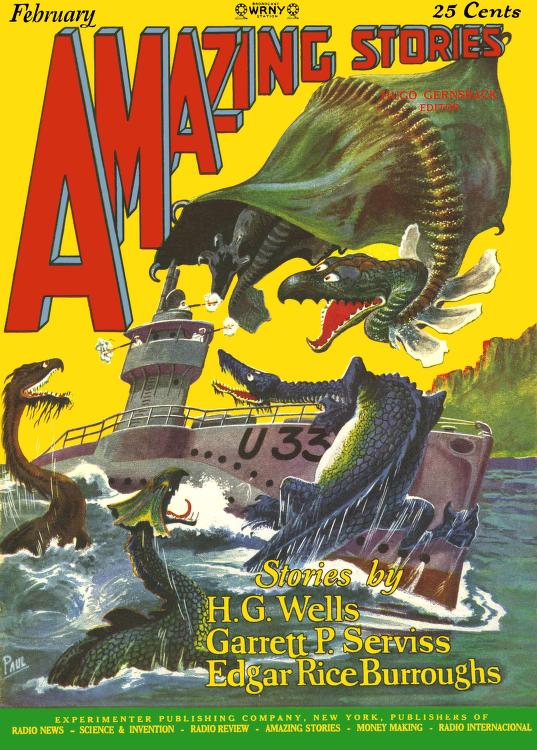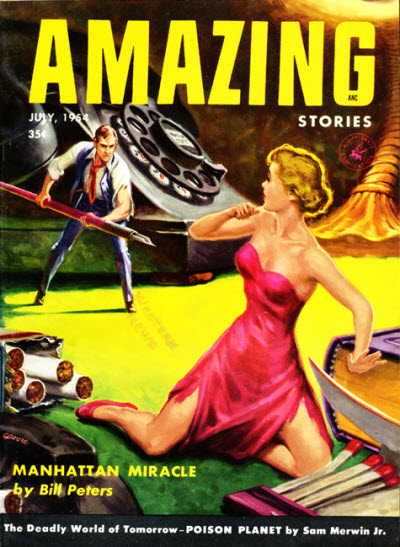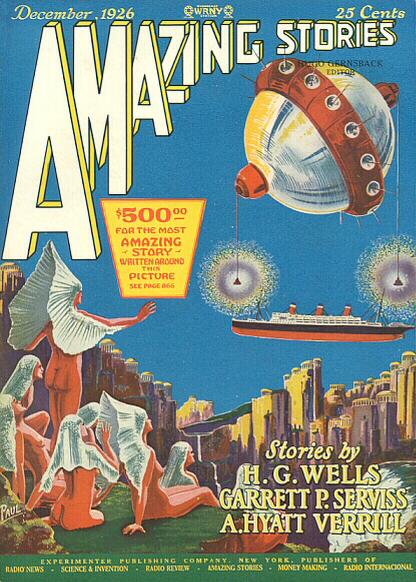
(Cover by Frank R. Paul. Amazing Stories, February 1927.)
Since it’s now the new year for everyone, it’s only natural that we have some new things to look forward to or new things to do. I have a few New Year’s resolutions myself: some movies on my watchlist, quite a few video games I hope to get around to playing. I have hundreds of games in my backlog and even more books to be read in my personal library. I have multiple hobbies, which is something I would recommend to everyone. Unfortunately another thing on my to-do list for 2026 is to either get a second job or to try my hand at writing professionally, which would take time away from this hobbies, including this here blog.
Truth be told, I’ve been winding down productivity here for a minute, so this shouldn’t come as a surprise. I’m seemingly incapable of uploading posts “on time” (but of course who’s keeping time except for myself), and I’ve been missing one or even two reviews every month for the past several months. I wouldn’t be too worried, for the few of you who read this, since I’m not gonna be shutting down this site—just lowering my productivity. Granted, for the first couple years I ran this site I was writing at a feverish pace; in hindsight I’ve not really sure how I did that while also having a day job. In 2023 and 2024 I wrote over 200,000 words a year, according to the stats, which is a lot for one person. There was less wordage for 2025, and now for 2026 you can expect fewer posts as well. But this is like being on a flight and going from 20,000 feet to 10,000 feet.
Now, as you may know, Amazing Stories turns 100 this year. It was revived (again) not too long ago as basically a fanzine, but I would like to celebrate Amazing Stories as a professional magazine, which still means going through material that spans seven decades or so. It’s a lot, not helped by the fact that it has a pretty messy history as far as changes in editorship and publisher go. Except for maybe the beginning of its life it always played second fiddle to competing magazines, but it survived (sometimes even thrived) for an impressive stretch of time, given the circumstances. So, every month (except for March, July, and October, where you can expect short-story marathons) I’ll be covering a serial, novella, or short story from the pages of Amazing Stories. This should be interesting.
With the exception of the aforementioned months we’ll be doing only one serial, one novella, and one short story every month from now on, plus at least one editorial. Anyway, we have one story from the 1900s, one from the 1930s, and one from the 1950s.
For the serial:
The First Men in the Moon by H. G. Wells. Serialized in Amazing Stories, December 1926 to February 1927. First published in 1901. Feel like it would be criminal to pay tribute to Amazing Stories without bringing up Wells at least once, possibly even twice, since he was heavily associated with the magazine in its first few years. Wells himself is arguably the most important SF writer to have ever lived, with his influence being felt to this day practically everywhere you look. Any given SFnal premise likely has its roots in something Wells did over a century ago. This is even more impressive when you consider that Wells at the height of his powers lasted only half a dozen years or so. The First Men in the Moon is one of the last of his classic novels.
For the novella:
“The Gulf Between” by Tom Godwin. From the October 1953 issue of Astounding Science Fiction. Godwin became somewhat famous in SF circles for exactly one story, “The Cold Equations,” which he wrote pretty much in collaboration in John W. Campbell. It might surprise some people that Godwin had in fact written other stuff, and I admit I’m part of the problem because I don’t think I’ve read any Godwin aside from “The Cold Equations.” But I’m gonna fix that. “The Gulf Between” was Godwin’s first story, and it’s notable, if for no other reason than that the cover it inspired would later be reworked as the iconic cover for a certain Queen album.
For the short story:
“The Cairn on the Headland” by Robert E. Howard. From the January 1933 issue of Strange Tales. Over the course of about a dozen years, Howard wrote nonstop for every outlet that would accept his work, and he was not just a fantasy writer, also writing horror, Westerns, sports stories, and non-supernatural adventure pulp. He wrote everything except for SF, which he didn’t seem to have an interest in. Conan the Cimmerian occupied much of Howard’s later years, to the point where he began to resent his creation, but this didn’t stop him from doing standalone yarns like this one.
(Cover by Clarence Doore. Amazing Stories, July 1954.)
Who Goes There?
Philip K. Dick is one of the most important SF authors to ever live, and this is despite dying at 53 with a string of failed marriages and financial hardship left behind him. He was the first genre SF writer to get a Library of America volume, preserving some of his novels with fancy hardcover editions. The Philip K. Dick Award, given annually to the best SF novel first published in paperback, is still going to this day. Stanislaw Lem considered Dick to be the only American SF writer at the time (we’re talking the ’60s and ’70s) worth taking seriously. Whereas most authors would see their reputations taken a dent or two in light of certain transgressions, with Dick his mental illness and bad habits (namely his misogynistic streak and toxic behavior with friends, especially later in his life) are part of the “charm” for Dick fans. Indeed the fact that Dick was a hot mess is the name of the game. But before he became one of the most acclaimed novelists in the field he was one of the most acclaimed (and prolific) short story writers. 121 short stories and novellas, about half of which were written over the span of just a few years. “Breakfast at Twilight” is a Cold War parable, and one of the most solid (he wrote several) that Dick wrote.
Placing Coordinates
First published in the July 1954 issue of Amazing Stories. It was then reprinted in the November 1966 issue of Fantastic. For anthology appearances we have Amazing Science Fiction Anthology: The Wild Years 1946-1955 (ed. Martin H. Greenberg). As for Dick collections there are almost too many to count, but the big one is Second Variety, also titled We Can Remember It for You Wholesale and Other Classic Stories, which is the second in the book series collecting Dick’s short fiction.
Enhancing Image
The McLeans are a normal family who live just outside the city. Tim is an accountant, his wife Mary keeps house, and then there are their three kids, those being their son Earl, along with two daughters whose names are not important enough. One fine morning they’re having breakfast and the kids head off to school, only to discover there’s no school to go to—indeed there doesn’t seem to be anyone around for miles. The sky has also gone dark and the air is thick with a mix of fog and ash. Looks like the McLeans aren’t going anywhere after all, and this ends up being doubly the case when a group of soldiers come knocking at their door. The soldiers, unsure of how a house has remained in this landscape intact, accuse the McLeans of being “geeps” in disguise at first, which is to say Soviet infantry. The Cold War has apparently gone hot, with the Soviets having effectively invaded the US via a mix of “geeps” and “roms,” the latter being “robot operated missiles,” what basically amount to armed drones. The captain of the troops considers burning the whole place down with the McLeans inside, given that they don’t have their papers or their masks; but at the same time the whole situation is so inexplicable that the captain decides to call in a “polic” (a political commissioner) to investigate. The McLeans find that their house has somehow been launched seven years into the future, to the year 1980, three years after the Cold War escalated.
(By the way, the introductory blurb in the story’s original appearance is inaccurate, as it says “a hundred years” into the future. This is way off, which makes me think Dick didn’t write it.)
“Breakfast at Twilight” is a nicely self-contained little piece that honestly reads like it could’ve worked just as well for radio or a half-episode TV episode; that it has apparently never been adapted to another medium is a little perplexing. We get one location plus a small group of characters: the McLeans, the soldiers, and then Douglas the political commissioner. Very Twilight Zone vibes with this one, although it was published five years before that series. Dick’s beige prose style works in his favor, as we waste no time in establishing the premise and what’s at stake, and while most of the dialogue is expositional, it’s a lot to digest in only about a dozen pages. Given that Dick wrote quite a few stories about how the Cold War might escalate, he was kind of a pro at this sort of thing; but whereas “Second Variety” and “The Defenders” are from military points of voice, and “The Minority Report” uses policing as an allegory for the Cold War, “Breakfast at Twilight” is more about how civilians might cope with an American that has been all but torn asunder by bombs and boots on the ground. The future that the McLeans see is not that far from where they once were, and understandably they’re horrified not only by the physical destruction of the environment, but the US sliding into fascism in the name of combatting Soviet communism. Dick’s politics were honestly all over the place, but one thing he remained consistent on was being against McCarthyism and general alarmism when it came to the Soviets. The US of the near-future is not only in shambles but has devolved into a fiercely anti-intellectual and utilitarian culture, in which even certain books have been burned publicly (Douglas suggests Tim ditch the Dostoevsky in his library).
The creepiest part is that we have no clue who is even winning in this war, with the implication that whoever comes out on top will have experienced a pyrrhic victory. Earl, who’s depicted as being the most pro-war of the family (that the rash and naive son would be the most enthusiastic is, of course, a dig at ’50s jingoism), asks the soldiers more than once who is winning in this war, and nobody answers him. It’s a big thing that goes unsaid, and while Dick is not the most subtle of writers, he’s capable of some really insightful moments that cut with a trained surgeon’s precision. Now, we get an explanation for how the McLeans’ house got sent forward (or is it backward?) in time, having to do with radio and nuclear radiation, but it’s a nonsensical “sci-fi” thing that’s only there because it has to be. Dick was not a “hard” SF writer in that he was not concerned with the mechanics, or rather he saw the semblance of mechanics as a means to an end. I would take more issue with the SFnal conceit here being more or less arbitrary if the results weren’t worth it. The dilemma the McLeans then face is whether to go with the soldiers and basically become slave labor for a fascist shithole, but at leasr being safe in the short term, or remaining in the house in the slim hope that it might shuffle back to its original point in time before the Soviets are due to bomb the joint tonight. So you’ve got a bad situation vs. possibly an even worse situation, but the McLeans decide to stay.
There Be Spoilers Here
Tim gathers the family in the basement and the family makes it out by the skin of their teeth, with the house being sent back in time spontaneously just like they’d hoped. This in itself is predictable, because like, either their plan was gonna work or it wasn’t. What happens once Tim and his family emerge from the wreckage of their home (everything above the basement had gotten blasted to shit), is however quite different, and also haunting. See, the problem is that while the family narrowly avoided getting bombed, the war that they suddenly found themselves in is still happening in the future; not only that, but the war has already started. It began years ago, only soon it’s gonna go hot. The war is already happening. We then get a kind of internal monologue from Tim, who may as well be Dick’s mouthpiece in this instance, and it’s a good one:
It’s war. Total war. And not just war for me. For my family. For just my house.
It’s for your house, too. Your house and my house and all the houses. Here and in the next block, in the next town, the next state and country and continent. The whole world, like this. Shambles and ruins. Fog and dank weeds growing in the rusting slag. War for all of us. For everybody crowding down into the basement, white-faced, frightened, somehow sensing something terrible.
It’s an ending that’s not as much of a downer as what happens in “Second Variety,” but it’s no less fatalistic. Imagine living in 2018 and suddenly getting sent to 2025, and having to catch up on… more than a few things. Then you’re sent back to 2018. What would you do? Can you do anything to ease the sense of oncoming horror? On paper it’s a standard ending for this type of story, but it’s elevated by Dick’s unique intensity of paranoia, which captures the borderline apocalyptic feeling people were experiencing in the ’50s and at other points.
A Step Farther Out
Dick wrote quite a few short stories that are gimmicky and/or forgettable, but “Breakfast at Twilight” is not one of those. This is a taut and serious-minded story about a future that was quite possible at the time, and even if the Cold War never escalated to a certain point like Dick feared, it’s a paranoia that speaks to any age in which the government and ruling class could screw everyone over at any moment. We are unfortunately being forced to live in “interesting times.” This is also an effective companion piece to “Second Variety,” arguably more so than with “The Defenders,” which Dick had more explicitly written in tandem with that story. Dick’s stories (same goes for his novels) tend to riff on the same basic ideas over and over, so that they can often be compared with each other.
(Cover by Leo Morey. Amazing Stories, January 1934.)
Who Goes There?
There were once people who loved reading E. E. Smith, but they’re all dead now. Even at the time of his own death in 1965, Edward E. Smith was something of a dinosaur, albeit one treated with reverence within SF fandom, even if he remained totally unknown outside of it. Smith, as you might know, was perhaps the chief innovator of space opera; when his debut novel, The Skylark of Space, was serialized in 1928, there was nothing else quite like it on the market. The closest for comparison would have been Edmond Hamilton’s Interstellar Patrol series, but there was nothing on the scale of what Smith was doing. Unfortunately, to cop a line from Alexei and Cory Panshin’s review of The Best of Stanley G. Weinbaum, time has long since swallowed up what were once Smith’s virtues—an assessment that I think befits Smith a lot more than Weinbaum, for the record. You can still read and enjoy Weinbaum just fine, assuming you’re not of the sort that requires your SF to be dead serious; but with Smith, even if one were to keep an open mind, it can be a real challenge. Smith just wasn’t a good writer, sad to say, really in any sense of the word, except he did have a sixth sense for scale and action, mostly in the depths of space. Even Hamilton, Smith’s closest contemporary, holds up better to modern scrutiny, especially since he did end up evolving with the times, whereas Smith did not. Thus we have someone whose work strikes even the most retro-friendly of modern SF readers as a museum piece.
Why did I pick Triplanetary as my first Smith to cover here, then? The novelty of it was tempting. You see, along with the Skylark series there was the even grander Lensman series, which occupied Smith for much of the ’30s and ’40s. Smith didn’t see any of his novels get published in book form, however, until after the end of World War II, by which point some of these novels had not seen the light of day since they ran as serials more than a decade earlier. When Smith took hold of Triplanetary for book publication he revised and expanded it so as to make it almost unrecognizable from its serial version, to the point that whereas the serial version of Triplanetary is a standalone novel, the book version was retrofitted to be a prequel entry in the Lensman series. The book version is also about 1.5x the length of the serial version. The two are so different that they have separate ISFDB pages. Like I said, it’s the novelty of the thing.
Placing Coordinates
Triplanetary was serialized in Amazing Stories, January to April 1934. Smith had apparently hoped to sell it to Astounding, but that magazine went through a change in both editor and publisher, not to mention it’d gone on hiatus for about six months. The serial version of Triplanetary would remain stranded there for more than seventy years, until it was transcribed for Project Gutenberg in 2007. A few small publishers have since made this version of the novel available in book form, making sure to differentiate it from its book counterpart.
Enhancing Image
The space liner Hyperion is going on its merry way—or maybe not so merry, as the crew is aware that two ships from the Triplanetary League have gone missing in this part of space recently. Not destroyed, but simply vanished without a trace. (The Triplanetary League is a coalition of Earth, Mars, and Venus, from that distant time when Venus was thought to be hostile to human life, sure, but theoretically livable.) Conway Costigan is First Officer of the Hyperion, but also a member of the Triplanetary Secret Service, so he’s like if Spock and Jason Bourne were the same guy. Unfortunately, a pirate must’ve snuck aboard ship and taken on a disguise, as there’s an outbreak of Vee-Two gas, which incapacitates the crew. Costigan only has enough time to save himself and a single passenger, Clio Marsden, getting them into a lifeboat and reviving her. Costigan explains to Clio that Vee-Two is strictly forbidden, something she apparently already knows. (There’s quite a bit of dialogue wherein characters explain things to each other that they already know.) “The penalty for using it or having it is death on sight. Gangsters and pirates use it, since they have nothing to lose, being on the death list already,” says Costigan. Looking into Smith’s works, the death penalty was something he was just really keen on, to the point where he seemed to support its use even for drug dealers—a view that I wanna say has not aged well, but it looks like modern American conservatives are about as enthusiastic about capital punishment. History doesn’t repeat, but it does rhyme. Costigan heads back into the bowels of the Hyperion to track down the pirate, with a gas mask, space armor, and a nifty weapon on a tripod that’s so powerful that it not only jibs the pirate but turns him into a cloud of mist. This scene, the strongest in the installment, understandably provides the image for Leo Morey’s cover for the issue.
You can accuse Triplanetary of a lot of things, but it is certainly not slow in its pacing, unless you’re talking about the book version. I’ve gathered that the biggest change Smith made was that he wrote six chapters of backstory to pad out the beginning of the book version, working mainly to wedge Triplanetary into the Lensman continuity. I don’t know how anyone is supposed to survive a single chapter of lore written by E. E. Smith, let alone six. The serial version, for all the bad writing on display, wastes the reader’s time as little as possible. In the course of three chapters we’re introduced to the hero, the (probable) love interest, the villain, and what’s at stake. Speaking of which, when it looks like the Hyperion’s troubles are over, the crew is taken hostage by a ship that appears to be invisible, with Costigan, Clio, and Captain Bradley meeting face to face with the owner of an artificial “planetoid” (listen, it’s not the Death Star, got it?), named Roger. Yes, Roger. That’s his name! We know this is about as old-school a space opera as you can get because tractor beams are mentioned. Roger is a mad scientist, although he considers himself not to be mad but perfectly calm and collected; indeed he doesn’t do a Bond villain laugh or anything like that, but rather is calculated in his malice. Even his threat to rape Clio (I suspect it’s implied rather than explicit because of censorship) is stated in so many words, rather than bluntly put. Much of Roger’s workforce is also robotic, rather than flesh-and-blood people, despite what the pirate in the first chapter would make us believe. Thankfully Costigan, being a badass secret agent, has a plan for getting at least himself and the others out of prison. They escape, thanks to some tech that somehow Roger’s goons were unable to detect, but their victory is short-lived as there turns out to be yet another villain, apparently alien, even bigger of a threat than the mad scientist.
Oh, it’s bad.
Putting his ridiculously bland name aside, Roger’s actually not a bad villain. Smith doesn’t bother much with describing his characters physically, but he does give Roger special treatment:
Not only was [Roger] dressed entirely in gray, but his heavy hair was gray, his eyes were gray, and even his tanned skin seemed to give the impression of grayness in disguise. His overwhelming personality radiated an aura of grayness—not the gentle gray of the dove, but the resistless, driving gray of the super-dreadnaught; the hard, inflexible, brittle gray of the fracture of high-carbon steel.
Mind you that this all happens, with Costigan and company getting attacked by pirates and then introduced to Roger, in the first chapter. If the book version of Triplanetary suffers from being too slow, as in frontloaded with exposition, then the serial version might have the opposite problem. And yet, despite having breakneck pacing, Smith still finds room to insert dialogue that is, let’s say redundant. For example Roger spends rather too much time saying, indirectly, that he plans to make a sex toy out of Clio, if only because she’s apparently too slow on the uptake to get his point. A common criticism I’ve seen when reading about Smith is that his characters don’t talk like real people, or even people you’d read about in SF published a decade later, but almost like old-school comic book characters. It’s writing in the old pulp tradition, although even within that context I’d still say Smith is more stilted than, say, Edgar Rice Burroughs, who for all his faults went out of his way to not irritate the reader unless one thought about his racism or dodgy science too deeply. Three chapters in and we have one character who feels like he has real presence, except Roger turns out to not even be the greater-scope villain, if the third chapter’s anything to go by.
There Be Spoilers Here
My eyes started glazing over towards the end, although I’m not sure how much of that was the quality of the novel and how much was the awful mood I’ve been in lately. I’ll let you know.
A Step Farther Out
On the one hand I believe that once I start writing about a serial then I really ought to finish it, as I probably will in this case. I’ll be honest with you, though, it’s been rough going already and we’re only a quarter into it. Maybe I just like Smith as a writer; something about him, aside from his obvious faults, bugs me. I tend to be generous with old-timey SF, even of the pre-Campbell sort, but this might be the threshold for me. But, it’s also possible that this is as bad as it gets.
(Cover by Frank R. Paul. Amazing Stories, May 1928.)
The Story So Far
London, circa 2100. The world has in some ways changed radically since Wells wrote this story in the 1890s, but in other ways it has not. Class division persists, and has somehow gotten even more pronounced. People, at least in the UK, have mostly abandoned the countryside and huddled together in cities, with the cities becoming more vertically oriented. The richest folks live on the top floors of skyscrapers while the poorest of the lot live on the ground. Denton, an attendant on a commercial flying machine, has love affair with the upper-class young lady Elizabeth, whose father very much disapproves of their courting. The father, Mwres (descended from a man named Morris, an upper-class twit like himself), would prefer his daughter go with Bindon, a colleague of his, and he even hires a hypnotist to wipe Elizbeth’s memory of Denton so that she forgets all about him. Denton eventually undoes the conditioning and the two lovers escape the city, in the hopes that making it in the countryside would be preferable. It’s not really. The end up chapter three, or the first installment, sees the lovers returning to the city, but without much means of enjoying even a middle-class existence. Life will continue to be grueling for a bit yet.
Enhancing Image
The fourth chapter, “Underneath,” sees the young lovers at the bottom of the socio-economic ladder, at least in London. I mean I suppose it could be worse: they could be immigrants, for one thing. Truth be told, my eyes glazed over for much of this chapter, if only because much of it is like a Socratic dialogue, and sad to say Wells’s dialogue is not very memorable here. The humor and wry observations on the future often come through in the narration, which is quite a different thing. More memorable is the final chapter, “Bindon Intervenes,” which introduces us to the failed suitor in earnest, after only really hearing about him up to this point. Despite only coming around near the story’s climax, Bindon stands as the most developed character here, which strikes me as backwards. It’s clear that Wells intended Bindon to serve as Denton’s dark reflection, a man who is similarly romantic in a world that has left romance to the wayside, but who lacks Denton’s working-class charm; in effect he is like Denton if he was a proto-incel. Despite ostensibly being the antagonist, having conspired with Elizabeth’s dad, there’s something pitiable about Bindon that makes him a somewhat tragic figure. Not helping matters is he finds out he terminally ill, with not long to live. It would’ve been nice had Wells given us insight into Bindon’s character much earlier in the story beyond hearsay. As it stands this gear-switching in the final chapter comes about too little, too late, and like other parts of the story it feels undercooked.
Oh, and the ending sucks. I understand that it’s supposed to be ironic, but it’s bad storytelling to have your heroes get what they want through no real action or effort of their own. Bindon dies and Elizabeth inherits his fortune, on account of the cucked man having a change of heart as he’s come to realize he would die soon anyway. The conflict basically takes care of itself and Our Heroes™ get their happily-ever-after. This is unspeakably lame; I almost always hate it when writers pull this shit, and in 1899 Wells would’ve known better than to end on such a note.
A Step Farther Out
Sad to say this is not a hidden masterpiece or a semi-forgotten classic in Wells’s body of work, although it does have its points. A Story of the Days to Come feels like a microcosm of Wells’s chief concerns as both a satirist and a genuine speculator on the future, but it’s too long to have the punch of his best short stories and too short to be given the same depth of ideas as his best novels, or even the similarly-lengthed The Time Machine. Wells was one of the few true pioneers of science fiction, in the sense that he wrote about things that had never actually been put to paper before and broadened people’s horizons more than most of his descendants; but being on the cutting edge also meant that sometimes he, well, got cut. It’s the price one must pay for innovation.
(Cover by Frank R. Paul. Amazing Stories, April 1928.)
Who Goes There?
Herbert George Wells was born in 1866 and died in 1946, just short of his 80th birthday but just long enough to have seen the end of World War II. Wells is one of the most important writers of SF to have ever lived—maybe the most important. To be an SF fan and not read at least a bit of H. G. Wells would be like being a horror fan and not having read any H. P. Lovecraft, or being an English major and not engaging with Shakespeare or the King James translation of the Bible at all: it’s basically unthinkable. Wells’s influence is made more remarkable when you consider that SF was by no means the only genre he wrote in, although his non-SF work has been thrown into the dustbin of history, and also that he wrote pretty much all of his most important work in the field in the span of about a decade, between 1895 and 1905. While he was still writing, albeit very little SF at this point, in the 1920s, Wells’s presence in the earliest genre magazines, namely Weird Tales and Amazing Stories, was entirely through reprints. Indeed he seemed to appear in nearly every issue of Amazing Stories while Hugo Gernsback had control of that magazine. A Story of the Days to Come was first published in 1899 as five related stories, which then became its chapters. This is a novella, about as long as The Time Machine, but it’s nowhere near as well-known as Wells’s most famous novels or even short stories, I suspect because while it’s certainly ambitious, it lacks the iconic characters, ideas, and even plot momentum of those other works. This is a story that will be rather hard to talk about in terms of plot beats, so that, combined with depression (it took me nearly an hour to get out of bed this morning), made writing about this story a bit of a challenge.
Placing Coordinates
First published as five stories in 1899, in Pall Mall Magazine. It was then serialized in the April and May 1928 issues of Amazing Stories. It’s also been reprinted in The Science Fiction Century (ed. David G. Hartwell) and the Wells collections Tales of Space and Time and The Complete Short Stories of H. G. Wells. Tales of Space and Time has been in the public domain since forever, so you can read it on Project Gutenberg.
Enhancing Image
We start with less of a character and more of an archetype, in the form of Mr. Morris, of the late Victorian era, and his distant descendant, Mwres, who are both perfectly conservative and upstanding men of their times and shared place—that being London of the 19th and 22nd centuries, respectively. Morris/Mwres is totally unconscious about class, cares nothing for the poor, attends church regularly but without passion, and can hardly be bothered to read anything. Indeed Mwres uses a “phonograph,” which here functions like a laptop or audiobook, to consume information, rather than reading the newspapers like his ancestor. Nobody reads anymore. Mwres meets with a hypnotist so that he might do something about his daughter Elizabeth, who is 18 at the story’s beginning and thus of marrying age. Mwres wants Elizabeth married off to a colleague of his, Bindon, a much older man, “plain little man, you know, and a bit unpleasant in some of his ways, but an excellent fellow really.” But Elizabeth, being a romantic and having indulged in many “romances” (tales of adventure), has set her sights on Denton, “a mere attendant upon the stage on which the flying-machines from Paris alight,” who like Elizabeth is a romantic in a future society which has all but abandoned things like poetry and romance of the lovey-dovey sort. Also, both Elizabeth and Denton can read and write, which bothers Mwres. The hypnotist thus messes with Elizabeth mind such that she forgets all about the young man she’s so smitten with, and it’s up to Denton to figure out why his girlfriend doesn’t recognize him the next time the two of them cross paths and how to undo the hypnotism.
As you can see, this is rather satirical. Morris/Mwres is a obviously dig at the conformist, or the “moderate conservative,” someone who might vote Labour but only so long as the party doesn’t get too woke. Wells was a socialist; more specifically he was a Fabian, or what we’d now call a democratic socialist. He was also a technophile, although his feelings on the possibility of technological progress bettering mankind soured as he grew older. Even in A Story of the Days to Come there’s an ambivalence about technology’s place in human progress, although as we’ll see, the “primitivist” option is also shown to be inadequate. If anything tech is shown to be more or less neutral here, more a tool that worsens an already-existing problem—that being the problem of capitalism and class division. This whole fucking plot gets going because the upper-class Mwres, who despite being rich is shown to be an ignoramus, sees the middle-to-lower-class Denton as unfitting for his daughter; and of course Elizabeth has no real say in the matter. Hypnotism, or mesmerism as it was also called at the time, was treated as a big deal in the 19th century, such that in Wells’s story it has become such an advanced practice as to render psychology obsolete. Mind you that psychology as one of the soft sciences was only in its infant stage when Wells wrote A Story of the Days to Come, such that Freud’s The Interpretation of Dreams hadn’t even been published yet. The automobile had also not yet become commercially viable enough at the time to be a common presence, and you can sort of feel its absence in this story. Conversely, “flying-machines” have become a preferred mode of commercial travel in-story, despite the first working airplane still being a few years off in the real world. Granted, people had speculated on flying-machines for literally centuries at this point, and Wells would even see the beginnings of commercial flying in his lifetime. My point is that while this story takes place circa 2100, it still reads as if written from the perspective of someone living in 1900—which may very well be the point. The narration, while ostensibly third-person, is very much targeted at a Victorian readership.
This is all intriguing, after the fact, but one issue I had while actually reading A Story of the Days to Come is that from a plotting standpoint this is far from Wells’s best work. A rule of thumb with writing short fiction is that you wanna stick to one perspective: it could be a first-person narrator, or a bird’s-eye-view third-person narrator, but the idea is we should stuck in the head of only one character. You can get away with changing perspectives in a novel, but for short fiction it’s a dangerous game. Wells violates this rule by switching us between at least three perspectives in these first three chapters (the first installment), between the omniscient third-person narrator, Mwres, and Denton. It makes scene and chapter breaks surprisingly confusing, made worse because Mwres and Denton meet the same hypnotist at different points. By the way, it is massively convenient that Denton, after having been dismayed by Elizabeth apparently forgetting all about him, goes to the same hypnotist that Mwres had consulted to brainwash Elizabeth in the first place. Of course Denton uses a little man-handling to get what he wants and make the hyptotist undo the conditioning on Elizabeth, so that the two can be together again—the new problem now being that there’s no going back. They’ve gone against Mwres’s wishes and will not have to live almost like fugitives, since Elizabeth only has as much as what her old man lets her and Denton doesn’t have many prospects of his own. They live at Denton’s place, for a bit, but having become disillusioned with city life, and also being very low on cash, they decide to hit the road and head out to a place very few people live in now: the countryside. It’s a shame Wells didn’t live long enough to have read Clifford Simak’s City, he probably would’ve been very keen on it. Then again, I’m not sure how much SF Wells actually had read, since he seemed irked by the newfangled label.
There Be Spoilers Here
The England of the future is somewhat dystopian, and one way Wells implies this is the fact that “countryside” has mostly been reclaimed by the natural world. Where once there were whole societies of peasantry in the English countryside, now there’s only the stray farmer or shepherd. As with Clifford Simak’s fiction, humanity is shown as being in decline by virtue of having cut itself off from the natural world; man seems to be degrade further the more “unnatural” he becomes. A shepherd meets Denton and Elizabeth as they start their new lives as would-be farmers, and tells them (correctly) that they won’t last long in the countryside; they simply weren’t raised to adapt to this kind of lifestyle. But they do give the whole thing the good old college try, as it were, and honestly the attempt could’ve turned out worse. They both could’ve died easily, between the elements and wild animals; but what finally pushes them to move back to the city is the issue of trespassing, and damn near getting killed by a pack of dogs. (Wells, given his politics, wasn’t keen on private property.) It’s at this point that the first installment ends, with Our Heroes™ having lost the battle, but maybe not the war. We’ll have to wait and see about that. I do wish I cared more about Denton and Elizabeth as people, although obviously I do wanna see them overcome a system that has been built up over generations to keep them apart. With Wells, his characters tend to serve his ideas, rather than the other way around, which is how SF has mostly been written for the past century.
A Step Farther Out
I’m a bit ambivalent about A Story of the Days to Come so far, although David G. Hartwell thought it enough of a hidden gem that he says so in his introduction for it in The Science Fiction Century. The problem is that it works better as almost a fictionalized essay rather than a “story.” Wells at his best is still no Shakespeare when it comes to style or developing characters, but he can be really good at plotting and hitting the reader with ideas that, at least in the last days of the Victorian era, they might not have ever considered before. Wells wrote with the primary purpose of opening people’s minds to a whole new realm of possibilities, which he believed in as both an SF writer and a socialist. That the politics of genre SF (we’re talking about the views of authors and editors) during its early years, from the 1920s to about 1950, would be a lot more reactionary than Wells, is beside the point. You could argue A Story of the Days to Come is SF in its purest form, that being it’s devoted to speculating on the future, and cannot be confused for any other genre. For better or worse.
(Cover by Lloyd Birmingham. Amazing Stories, October 1963.)
Who Goes There?
Cordwainer Smith had such a colorful life that you could probably make a movie out of it. Where to even start? Real name Paul Linebarger, Smith was born to American missionaries who often traveled around the globe, such that Smith went from school to school and didn’t have much time to make any friends in his youth. Of all the places he visited China seemed to leave by far the biggest impression, with his father even being involved in Chinese politics in the early 20th century. Smith was Sun Yat-sen’s godson, although Sun Yat-sen died when Smith would’ve been only twelve. The Christianity of both his parents and godfather would also have an influence on Smith’s work, although he was by no means didactic about it. He came up with the name “Cordwainer Smith” to create a thick degree of separation between his life working in government and his SF writing. While he’s now most known for his SF, Smith (as Linebarger) wrote the first major text on psychological warfare, literally titled Psychological Warfare, as well as non-fiction works on East-Asian geopolitics. Under the pseudonym “Felix C. Forrest” (a reference to his Chinese name) he also wrote espionage novels, although good luck finding those nowadays.
Smith was one of the most idiosyncratic writers of his era, inside or outside of SF, and one has to wonder what more he could’ve done during the height of the New Wave (he died in 1966). His first SF story as an adult, “Scanners Live in Vain,” was published in 1950, but Smith wouldn’t get consistently published until the last half-dozen or so years of his life, in no small part thanks to Frederik Pohl. From circa 1961 onward Pohl had first dibs on Smith’s fiction, such that “Drunkboat” is one of the few Smith stories from this era to not be published in any of Pohl’s magazines—which means he must’ve rejected it. I can see why: it’s kind of a hot mess. But it’s the kind of noble failure that showcases a unique talent, and the individual components are very much worth your interest.
Placing Coordinates
First published in the October 1963 issue of Amazing Stories, which is on the Archive. It’s been reprinted quite a few times, in The 9th Annual of the Year’s Best SF (ed. Judith Merril), Amazing Stories: 60 Years of the Best Science Fiction (ed. Isaac Asimov and Martin H. Greenberg), and the heckin’ chonker The Science Fiction Century (ed. David G. Hartwell). Of course it’s also in The Rediscovery of Man: The Complete Short Science Fiction of Cordwainer Smith. Now, it’s come to my attention that most of Smith’s work has fallen out of copyright—in Canada. This story is on the Canadian version of Project Gutenberg. I’m not advising you do this, but if you (as a non-Canadian) were to use a VPN and disguise yourself as one of the filthy, unwashed denizens of Toronto…
Enhancing Image
This is a hard story to spoil, if only because Smith spoils it for us, right at the beginning. We’re told that Artyr Rambo (yes, that is his name) was a man looking for his beloved, Elizabeth, apparently separately by many light-years, and he would do anything to get to her, including hopping aboard a rocket ship “of an ancient design” with the letters IOM (Instrumentality of Mankind) on its side and jaunting his way over to the hospital where she’s being kept. We know from the start that Rambo succeeds, that he and Elizabeth are reunited, and that Rambo himself has since gone down as a legend. The story, as such, is written like an oral telling of something ancient, mythical, and probably fabricated, but which serves an inspirational purpose. We know how this story starts and ends, but without context and without what will turn out to be a frenzied middle that will take a fair bit of explaining. Rambo winds up naked and unconscious, but apparently alive, just outside the Old Main Hospital where Elizabeth is being kept—or rather her body is. (Death does not have the same ramifications at this point in the Instrumentality history as it does for us.) How he got there, without his rocket ship anywhere in sight, is the mystery that will drive the plot. But of course I’ve already mentioned “jaunting”…
“Drunkboat” starts basically as a hospital drama, with the doctors trying to get the comatose Rambo to response—then later realizing that trying to get a response from him may leave everyone worse off. One of the doctors, Grosbeck, even suggests killing Rambo once it becomes clear that there’s something monstrously wrong with the patient, but Vomact, the chief doctor, vetoes the decision. This will have disastrous consequences short-term, but his survival will turn Rambo into a legend and so revolutionize space flight. (Smith also adds in parenthetical asides, like this one, telling us about things that haven’t happens in-story yet, or things Rambo would not have known about at the time.) So there’s a problem. Rambo is comatose and yet seems to have powers beyond human understanding; he’s able to do things by some external force, which will eventually spark the story’s climax. (But aren’t I getting ahead of myself again?) A lot of damage could’ve been prevented had Rambo stayed conscious and been able to tell the doctors what he wanted. “Not till much later did people understand what Rambo had been trying to do—crossing sixty mere meters to reach his Elizabeth when he had already jumped an un-count of light-years to return to her.” Rambo, unbeknownst to everyone at the hospital, was a guinea pig for Crudelta, one of the Lords of the Instrumentality, and he was a test subject for discovering “space-three”—a test that proved to be, if anything, too successful. Space-three (it’s written a few different ways, but I’m calling it that for consistency’s sake) is a word that comes up in several Instrumentality stories, but here we actually get something like an explanation.
You may think this is all a bit confusing. It is. Smith crams a lot of his future history into this novelette, such that it feels longer than it is, if only by virtue of feeling overstuffed. We’re told, mostly in a casual way, that this is a distant future where humanity has spread across many planets, being ruled by the Instrumentality which is a technocratic aristocracy (or an aristocratic technocracy), complete with computers and robots. The underpeople, a coalition of half-human half-animal genetically engineered humanoids made for slave labor, are only mentioned in passing in “Drunkboat,” and if you were to read just this story you wouldn’t know that the underpeople are arguably the most important factor in Smith’s future history. You wouldn’t even know what the underpeople are just from reading “Drunkboat.” On the one hand this makes Smith’s writing hard to make sense of at times, and is a problem not unique to this story but rather something that makes the barrier of entry for Smith’s writing a rather high one; but then I love how there are details on the margins of the story that hint as a much larger universe—so large that a couple dozen short stories and novellas, plus a novel, Smith couldn’t “finish” the future history. He gives the impression of something impossibly distant in our future, yet something so old in his future that Rambo’s story is told like one of Homer’s epics. It doesn’t work totally here, but you have to admire the ambition.
Reading “Drunkboat,” the only example in SF it reminded me of that would’ve predated the story is one of the most influential and experimental of all ’50s SF novels: Alfred Bester’s The Stars My Destination. Granted that Rambo is not a snarling brute like Bester’s Gully Foyle, but still he causes a lot of damage (including a dozen people killed “irrevocably,” their bodies being vaporized and so irretrievable) in the name of a rather self-centered goal: getting back with Elizabeth. There’s also the question of jaunting, Bester’s word for teleporting across space in his novel that I’ll use here; Smith has a different word for it, but it’s basically the same thing. I’m not sure if Smith had read Bester’s novel, but he likely did, and who can blame him? Bester’s novel and the Instrumentality future history do share a fair bit in common: they see humanity using spaceships (and later teleporting) to conquer the stars, and yet the aristocracy is maybe more powerful than ever before. Corruption is everywhere. Human life is treated callously. In Smith’s world slavery has come back in a big way. Both robots and the underpeople are treated as expendable. There’s a pessimism (but also a Christian-coded hope of liberation) in Smith’s world that might’ve been off-putting in the ’50s (hence him struggling to find outlets then), but which anticipated the New Wave. I’m a lot more interested in the world of the story than the story itself. Maybe the story is not really the point.
There Be Spoilers Here
If “Drunkboat” had a fatal flaw, other than being cluttered, it’s that it switches gears abruptly a couple times, such that I’m not sure what I would classify it as other than SF generally. I said before it starts as a hospital drama, but then suddenly (and I think unconvincingly) it turns into proto-military SF before finally turning into sort of a courtroom drama. I would have less of a problem with this trajectory if the story was longer, possibly novella-length, but as is it’s a jumble wherein the components are easy to lose track of. It doesn’t help either that Rambo, the protagonist, is unconscious for most of the story. Granted, Frankenstein’s monster didn’t talk much either. Crudelta is a curious villain (if you can call him that), but he only really gets a chance to shine in the last stretch. Elizabeth barely even qualifies as a character, and when she gets a case of killed-and-then-revived amnesia (in-story a person getting killed and then brought back may as well be a different person since they get amnesia and are likely to form a different personality) it’s more like something inconvenient that Rambo has to get used to rather than tragic. (After reading a fair bit of Smith I do have to wonder if he was only capable of writing women as either shrewish, aloof, or submissive.) It’s implied that Crudelta will not face punishment for his inhuman treatment of Rambo, but that’s not really a criticism. After all, Rambo doesn’t have too much to complain about, for he has come back a demigod who can start a literal war with just his manipulation of space-three.
A Step Farther Out
The problem I encountered with “Drunkboat” was I found it a lot more fun to think about than to read. This is less a functioning self-contained story and more a neat bit of world-building that happens to have a really tangled plot at its center. If this is your first Instrumentality story then there are small details here that Smith doesn’t elaborate on and which will probably not make any sense to you. Even after having read a decent portion of Smith’s fiction (there isn’t a whole lot of it), my brain still ached a bit by the end. And yet I have to recommend “Drunkboat” as a curiosity. For both better and worse, nobody in the pre-New Wave days wrote like Cordwainer Smith, such that even his failures are worth it.
(Cover by Edward Valigursky. Amazing Stories, May 1959.)
Who Goes There?
From the ’50s until Arkady’s death in 1991, the Strugatsky brothers were almost certainly—along with Stanislaw Lem—the most internationally acclaimed SF writers to come out of the Soviet Union. There are a few reasons for this. No doubt during the Cold War there was a push to translate Soviet fiction that badmouthed practices in that coalition, and usually could get away with it since the censors apparently didn’t pay as much attention to genre fiction as “serious” literature. Even so, the Strugatsky brothers sometimes ran afoul of censors, with their novel The Doomed City being written in 1972 but not published until 1989 as censorship was loosening. Their 1972 novel Roadside Picnic is one of the most famous non-English SF novels of all time, helped by an extremely loose but equally fascinating film adaptation in Andrei Tarkovsky’s Stalker.
In the introductory blurb, Norman Lobsenz (I think it’s Lobsenz) says “Initiative” is the first Soviet SF story ever to see publication in the SF magazines. This might be true, although I’m not ready to tumble down that particular rabbit hole. I’m not sure whose decision it was, Lobsenz’s, Goldsmith’s, or Rutley’s, but despite giving us a direct translation of the title (“Spontaneous Reflex”) in said blurb, the story itself is named “Initiative.” In fairness “Initiative” does sound better in English than “Spontaneous Reflex,” and basically conveys the same meaning in fewer syllables. “Initiative” was first published in the Russian in 1958, and was one of the Strugatsky brothers’ first published stories.
Placing Coordinates
From the May 1959 issue of Amazing Stories, which is on the Archive. Finding reprints for stories in translation can be a bit tricky. For example, “Initiative” was never reprinted in book form—at least under that title. As “Spontaneous Reflex” it was reprinted in what seems to be the same anthology under two different titles, A Visitor from Outer Space and Soviet Science Fiction (editor not credited). As “The Spontaneous Reflex” it appeared in Red Star Tales: A Century of Russian and Soviet Science Fiction (ed. Yvonne Howell). See what I mean?
Enhancing Image
Urm (“Universally Reacting Mechanism”) is a robot—a metal giant that does not wanna harm anyone, the only problem being that it’s bored. “The Master” has gone away and apparently nobody has been left on-site to watch over Urm and make sure he doesn’t get into any funny business. Suppose you’re a machine with arms and legs, and some capacity to make decisions on your own? You might wanna get a hobby or two. You might even become curious. Urm takes it upon himself to explore what seems to be a nuclear power plant (we’re not given many details), scaring an assistant or two and accidentally getting himself irradiated—which is fine, because Urm is virtually indestructible. He leaves the site “a contaminated and a wiser robot,” news of which the underlings at the plant are quick to bring to Urm’s makers, namely Nikolai Petrovich and Piskunov. (I don’t think we ever get Piskunov’s first name, although the authors felt it necessary to give us Petrovich’s first and last name almost every time.) To make matters worse, this is in Siberia, and there’s a snowstorm going on.
I would be intereted to discuss this story with someone who actually has a background in robotics, since it posits a few questions about artificial intelligence, albeit not very seriously. The Strugatsky brothers are known for having a cynical sense of humor, and at least in this early story their humor reads like a similar-looking branch to Robert Sheckley’s—but not belonging to the same tree. Two comedic voices in genre SF that formed around the same time but totally parallel to each other. But whereas early Sheckley can often be summed up as the man’s folly when inventing or confronted with a scientific revelation (the situation will always get worse, and often it ends very grimly), the Strugatsky brothers are a bit more forgiving. “Initiative” is a comedy of errors, but it’d be more accurate to say it’s a comedy of one error, even if it’s a big one. Piskunov and his team had designed Urm for a specific purpose (we’ll get to that in spoilers), but failed to consider the cognitive limitations of a being that a) practically a newborn, and b) only semi-sentient. It’s less that Urm doesn’t act according to his programming and more that his programming is flawed in ways not predicted.
The human characters don’t really matter here other than as physical stand-ins for man’s hubris; they’re little more than cardboard, and that’s fine because the story compensates in other ways. Urm is pretty interesting as a plausible depiction of a self-aware robot, since unlike Asimov’s robots he’s never overcome with delusions of religious zeal or godhood, nor does he particularly dislike humans. He also, we’re told, doesn’t have a sense of self-preservation, such that a man on the street firing a gun at him in terror doesn’t phase him at all—never mind that it would probably take a literal tank to destroy him. Of course what makes him so special, and why Piskunov is determined to capture him rather than destroy, is his brain, “an extremely complicated and delicate network of germanium and platinum membranes and ferrite.” There’s some debate as to how much Urm’s actions are of his own initiative (ha) and how much it’s him simply reacting to stimulation; after all, “reacting” is part of his name. Like a toddler his absorbs information without actually trying to understand it.
Here we see a somewhat juvenile prototype of what would become a recurring theme for the brothers, that being human cognition and its relationship with ethics. Because Urm had been programmed to take interest in tangible things but not ethics and morals, and because it has no real sense of self past a need for stimulation, it’s not fully sentient. It’s not immoral (it doesn’t even cause that much trouble, ultimately) so much as amoral. The Strugatsky brothers seem to be arguing that it’s not possible to be truly self-aware while also being totally divorced from morality. This is a basic premise, and anyone who ascribes to religious faith, or indeed anyone who leans somewhere on the left politically already knows this; whether they choose to do anything good or constructive with the fact that their capacity to think is linked inextricably with the capacity for moral understanding is a different question. Like any self-proclaimed leftist who indulges in racism, classism, misogyny, or transphobia, Urm runs into a problem because there’s a connection not being made in his thinking—although in fairness to Urm this is because the connection can’t be made.
There Be Spoilers Here
With the help of some construction equipment the crew are able to trap Urm and have him turned off, and nobody even had to die to make this happen! It’s also here that we’re finally told why such a robot would be invented in the first place. “Initiative” takes place not far in the future (everything is recognizably “modern”), but enough in the future that it’s clear the Space Race is in full swing. Makes sense: this story was published in Russia about a year after Sputnik. Unlike way too many American SF stories of the time (and until about the ’70s, it turns out), the scientists here got the bright idea to send robots to probe planets in the solar system instead of humans. Urm was made of very tough stuff because he’s supposed to set foot on Venus at some point; this was before it became known to everyone that Venus is too inhospitable a place, even for specially armored robots like Urm. You could date this story, from it being obviously written in the early days of the Space Race, but ultimately the Strugatsky brothers are more interested in thought experiments immerging from the tech than the tech itself—as tends to be the case with good science fiction.
A Step Farther Out
I liked it, and unlike early Sheckley there’s a good deal to chew on here despite the comedic tone. (I like Sheckley, but if we’re being totally honest, once you’ve read a few early Sheckley storie you can predict where they’re going.) This is still much smaller in scale than the intellectual big game the brothers would be hunting a decade or so down the road, but it marks the beginning of what would be a very fruitful creative friendship. That the brothers almost always worked together, what with Boris only writing two novels after Arkady died despite outliving him by two decades, shows a fluidity of style and work ethic. If you were an American genre reader and had picked up the May 1959 issue of Amazing Stories, the prospect of reading a Soviet SF story in translation would’ve been novel, but it also would’ve presented a story that was a bit more cerebral than what American genre readers at the time would’ve expected.
(Cover by Frank Kelly Freas. Amazing Stories, May 1983.)
Who Goes There?
William F. Wu is almost certainly one of the first Asian-American authors to contribute to genre SFF with any regularity, although despite this he’s now a pretty obscure figure; it probably doesn’t help that he’s written little fiction since the turn of the millennium. Wu got started in the late ’70s and would come out a decade later with some big awards nominations, including a Hugo, Nebula, and World Fantasy nomination for “Wong’s Lost and Found Emporium.” He got another Hugo nomination for his 1985 vignette “Hong’s Bluff,” which I reviewed for Young People Read Old SFF. Thus this is not my first run-in with Wu, and my little exposure to him tells me we share a fondness for Westerns and the romanticized image of the American frontier. I may have to find Hong on the Range.
This is now the second story I’ve covered to get turned into a Twilight Zone episode—this time for the ’80s series.
Placing Coordinates
First published in the May 1983 issue of Amazing Stories, which is on the Archive. It was first reprinted in The Year’s Best Fantasy Stories: 10 (ed. Arthur W. Saha), and collected in the Wu volume Wong’s Lost and Found Emporium and Other Oddities. Since it got adapted for The Twilight Zone it’s only natural that it would appear in New Tales from the Twilight Zone (ed. Martin H. Greenberg). These, sadly, are all out of print, and despite its awards attention this story has not been collected in anything since the ’90s; and mind you, it’s Wu’s most popular story.
Enhancing Image
Wong is a dock worker for a New York Chinatown who also happens to be—let’s call him the substitute overseer of a very strange shop. Of course, Wong didn’t ask for this job and he’s not getting paid for it; the real owners of the shop have gone missing and Wong, for reasons unclear to himself, decided to take their place until they return. If they return. It’s a big place that expands to accommodate its stock seemingly endlessly. “The shop was very big, though crammed with all kinds of objects to the point where every shelf was crowded and overflowing.” There are crates everywhere, even ones hanging from the ceiling, filled with all kinds of junk.
True to what the title would make you think, it’s indeed a lost and found center where people can find lost items—and even belongings of theirs that are far more abstract. The story starts out with Wong helping out a much older woman (she has a name, but it doesn’t matter) look for a lost chance at becoming an artist in her youth—a lost opportunity that has taken the form of a bottle’s contents. The way it works is that if it’s a physical item that has been lost then it can found as a solid or liquid object in one of the many boxes; but if it’s an idea, like a decision not made or a part of one’s personality, then it would take the form of a gas that must be inhaled to take effect. The latter is harder to get a hold of, as once the bottle is opened and the vapors come out, the person has only one chance to capture it. Sadly for the old lady she fumbles her bottle and fails to take in the vapor. This all sounds pretty high-concept, although I have to admit Wu doesn’t do a lot with it in the story itself.
There’s not a lot of plot to go over, as this is little more than a vignette, but let’s talk about the mechanics of the shop since I suspect that’s the reason readers took such a liking to it. Wong has been working and basically living in this shop off and on for the past couple months, living off of food scraps, which would be impossible considering his responsibilities to his real job if not for the fact that time moves differently in the shop. “The dual passages of time in here and outside meant that I had spent over two months here, and I had only spent one week of sick days and vacation days back in New York, on the other side of one of the doors.” Even with that time dissonance, though, he’s just about at the end of his rope, losing his patience with people he helps but also knowing he only has so much time he can spend here. The real problem—the internal conflict, since there’s not much of an external one—is that Wong is a bit of an asshole, despite his “job.”
This comes to a head when Wong gets another “customer” in the form of a nameless young woman (Asian-American, like Wong) who has apparently been hiding out in the shop for some time now, watching Wong and judging (correctly, in all fairness) him unworthy of his position. It’s here that we’re given a reason for why Wong is so callous: growing up a victim of racism made him stone-hearted. On the one hand it now reads as cliched that a person of color gives childhood racism as the reason for their trauma, but it would’ve been novel at the time in magazine SFF to have that background be written by someone who almost certainly experienced the same thing in their own life. This story is a whole forty years old now and having two of the three main characters be non-white was certainly uncommon then, although in that sense it now reads as unexceptional.
One more thing about the shop. You may be asking, “How do you find anything here?” The idea is that there’s a customer and an overseer, and the customer would not be able to find what they’re looking for on their own; but the overseer is guided by a ghostly light which shines on the object of the customer’s desire. In other words, if you wanna find anything, you need a partner. The young woman is looking for something herself—a part of her personality that somehow she had lost, and while she disagrees with Wong’s attitude, she does need his help. The lost part of her personality, as it turns out, is her sense of humor, which makes her a good deal more bubbly—not that that helps Wong much. The back end of the story thus sees a sort of comedic-straight dynamic between Wong and the young woman, or one could think of it as a master-apprentice thing.
There Be Spoilers Here
The roles reverse as, having been helped, the young woman decides to help Wong in return—if only to make him more caring. Wong claims to have lost his sense of compassion, and while he ends up fumbling the bottle for that (mirroring the old lady earlier), he does find two bottles containing other things lost—only he’s not quite sure what’s inside. Had this been a horror narrative it’s at this point that we might be greeted with a horrific part of Wong’s background or personality that had been forgotten, like suddenly remembering a crime he had committed long ago. But this is not horror and what Wong finds is fairly pleasant: the first is a nice memory that he had forgotten, and the other is his integrity. While he didn’t get his compassion back exactly, he did get some of it along with his integrity “in a package deal.” It’s sweet. Wong didn’t think he owned the shop before, but now he feels genuinely responsible for it, even suggesting the young woman should become his assistant. How they intend to make a living off this is anyone’s guess.
Maybe I’m also an asshole, but I couldn’t help but think about how one is supposed to make money with this place. I mean, it’s a lost and found center, but I feel like services this esoteric shouldn’t come free.
A Step Farther Out
Upon reading “Wong’s Lost and Found Emporium” I wasn’t really sure how to feel about it. It’s cute, but despite the neat premise Wu gives us the ends were more banal than I would’ve hoped. We get the slightest hint of something cosmic lurking around the corner, since while the workings of the shop are explained somewhat there is much that is left a mystery, but this is very much not a horror narrative. Admittedly if it did turn out to be horror then I probably would’ve complained that such a premise leading to horror is trite, so I suppose I’m being unfair with it. The problem may be that while I can’t say it has aged poorly, it would probably not catch people’s attention if published as a new story today without a word changed. Urban fantasy, even from POC perspectives, has really taken off since 1983, so that while it was prescient, it has since been surpassed.
(Cover by Art Sussman. Amazing Stories, Oct-Nov 1953.)
Who Goes There?
This is another case where I have to try to not fanboy out, becaue I respect Richard Matheson a lot and I’ll give anything he writes at least one try. Matheson entered the field in 1950 with a remarkable short-short story titled “Born of Man and Woman,” which instantly made him popular with readers and which remains (impressively for a debut) one of the more reprinted stories in all of genre fiction. Matheson’s subsequent efforts, including “Third from the Sun,” “Dress of White Silk,” “Witch War,” “Through Channels,” and others, were not quite to the level of that first story, but they showed a naturally gifted storyteller who casually wandered across different genres, from science fiction to straight horror. When Matheson turned to novels he proved good at that too, with I Am Legend and The Shrinking Man being two of the most disturbing and thought-provoking SF novels of the ’50s. He would win a Hugo for adapting The Shrinking Man into the 1957 film The Incredible Shrinking Man (the added word is justified, the film is indeed incredible), and Matheson’s new career as a screenwriter was just getting started.
There’s a high chance that if you tracked SFF film and TV in the ’60s that you encountered Matheson in screenwriting mode, including but not limited to the Star Trek episode “The Enemy Within” (really one of the better season 1 episodes) and some Roger Corman productions, including House of Usher and The Masque of the Red Death. The thing Mathesone would associate with the most, though, was The Twilight Zone—the ’60s and ’80s runs but especially the former. Along with Charles Beamont, Matheson contributed quite a few scripts to the original series, second in quantity (although not necessarily in quality) only to Rod Serling himself. Today’s story, “Little Girl Lost,” was itself adapted by Matheson for a Twilight Zone episode, though I have to admit my memory of this one is foggy.
Placing Coordinates
First published in the October-November 1953 issue of Amazing Stories, which is on the Archive. It was then reprinted as a “classic” in the April 1967 issue, which can be found here. It’s been reprinted several times, although not as many as I would’ve thought. The most relevant of the bunch, at least to my interests, would have to be The Twilight Zone: The Original Stories (ed. Martin H. Greenberg, Richard Matheson, and Charles G. Waugh), which, as you can guess, collects the short stories that served as the basis for Twilight Zone episodes. The most recent reprint is Duel: Terror Stories by Richard Matheson, which might still be in print although it’s hard to tell, especially since the quintessential Matheson collection is now Penguin’s The Best of Richard Matheson (which does not include “Little Girl Lost”).
Enhancing Image
Chris and Ruth are a young couple living in a California apartment who one night hear their daughter Tina crying, and like any reasonable man Chris gets up to see what the trouble is. He has to make his way into the living room. “Tina sleeps there because we could only get a one bedroom apartment.” It’s dark, but he can at least hear her. One problem: she’s not on top of the sleeper sofa. Tries reaching under the sofa: she’s not there either. And yet Chris can hear her crying… from somewhere. Tina has to be somewhere in the apartment and yet Chris can’t figure out where she could be. The dog, who’s out on the patio at night, has also started barking like crazy, which doesn’t help. This is a story structured such that it starts off at its most tense and gradually becomes less so, as you’ll see.
Context is important, and we know enough about Matheson to get it. He probably wrote “Little Girl Lost” in early 1953, at which point he was not only a newly married man but father of one (with more to come), and he apparently based the story on struggling to find his daughter one night when she was crying. This is a story about people around my age: a few years out of college, maybe married with their first kid or with one on the way, although Chris and Ruth were not able to buy a house at this point in their lives. I relate to these two, because I also can’t afford a house. Anyway, it doesn’t take long for the young couple to break into hysterics over figuring out where their daughter could’ve gone. She can’t have been abducted, becaue they can hear her, but she’s not in the living room or kitchen, or anywhere else in the apartment they can think of. I heard a criticism somewhere that Ruth is written in the typical “hysterial woman” fashion of the ’50s, but to be fair to her, it would take an iron will to not freak out about this situation, especially if it’s in the middle of the night.
(If you wanna lose some sleep then look up stories about people accidentally locking themselves inside convenience store freezers and being found as corpses in the morning. Have fun with that.)
Chris, instead of calling the police, hits up his friend Bill. “I’d called him because he’s an engineering man, CalTech, top man with Lockheed over in the valley.” Not ideal, but Chris can’t think of a better option in the heat of the moment. Maybe what’s happened to Tina can’t be explained by normal procedure and someone in the sciences ought to be brought in. Because this is a science fiction story and because some of us have seen the Twilight Zone episode beforehand, it’s rather hard to spoil this one. As such, I’ll make a couple more observations before we get into the back end, where there’s not a lot to talk about. This story, after all, is not quite ten pages long and those pages go by at a mile a minute. Matheson’s style is not pulpy but it’s certainly not concerned with fancy language; it goes down smooth, like the average experience of reading a screenplay. I interned as a script reader years ago and the best scripts (or rather the least bad) describe action as economically as possible, with no room given to purple prose antics.
Another thing to consider is that short stories are great for adapting into short films and TV episodes. You may notice that a lot of the shorts comprising Love, Death + Robots are based on short stories, and in those cases the filmmakers can choose to be as faithful to the source material as they want, making the shorts at just the “right” length to cover everything without need for padding. Now, when adapting a ten-page story into a 25-page teleplay, some padding is required. You could easily do the plot of “Little Girl Lost” justice in a short that’s about as long, one page per minute of screentime, but Matheson, when adapting his story for TV, undoubtedly had to make concessions. I don’t remember the Twilight Zone episode too well, but I do remember that structurally it stayed close to the source material; most importantly it retains the climax and tries its best considering it has to work with budget and effects of that era.
There Be Spoilers Here
Eventually the couple let their dog into the apartment, whereupon the dog apparently sniffs out where Tina is and finds what can only be described as a crack in the spacetime fabric that soon sees dog and then Chris fall through it. Chris slips into this other world that’s at once darker than the depths of the ocean and yet filled with blinding lights. “It was black, yes—to me. And yet there seemed to be a million lights. But as soon as I looked at one it disappeared and was gone. I saw them out of the sides of my eyes.” This is undoubtedly the money shot for both short story and TV episode, as we see the mundane apartment replaced with something very different that would strike anyone as alien. The justification for the dimension gap is about as silly as you’d expect, but it at least justifies the story’s escalation into borderline cosmic horror before we earn our happy ending.
The sofa and TV set have now been swapped in the living room so that nobody will be tempted to fall through that crack between dimensions. Call me a zoomer, but I have to look up who Arthur Godfrey is. Actually I’m not ssure if people twenty years older than me know who that is.
A Step Farther Out
It’s short, it’s slight, it’s not exactly deep, but it is evocative and it has imagery in the back end that would translate well to a visual medium. Matheson was a wizard when it came to moving a plot along and while “Little Girl Lost” is simple, it goes down in an even shorter time than its page count would suggest. I was gripped by this extended metaphor for what it’s like to be a young parent and to experience something horrible you’ve probably never thought about before—not until you became responsible for someone’s life. Just remind me to never have kids; a dog sounds better.
(Cover by Larry Elmore. Amazing Stories, March 1985.)
Who Goes There?
Michael Swanwick has been in the game for over forty years, and shows no sign of slowing down. He debuted in 1980 with a pair of short stories, “Ginungagap” and “The Feast of Saint Janis,” both of which would garner Nebula nominations—not something you see every day with someone’s first work. Swanwick would continue to put out mostly short stories, somewhat sporadically, throughout the ’80s, and even at this early point in his career it was clear he was a writer of a different caliber than most of his peers. While Swanwick did sometimes contribute to then-newfangled cyberpunk scene (see “Dogfight,” his collaboration with William Gibson), he would ultimately be hard to pin down as either a cyberpunk or as one of the so-called humanists; the truth is that Swanwick’s influences are markedly different from those of William Gibson or Kim Stanley Robinson. It also took the SFF world a frustratingly long time to recognize Swanwick’s talents; despite his two Nebula nominations from the outset, it would take another decade for him to win one, coming with his masterful and bewildering 1991 novel Stations of the Tide.
1985 was a big year for Swanwick, though by no means the last of those big years (it’s honestly hard to find Swanwick at a point where he’s not on top of things). Not only did we see In the Drift, his debut novel (greatly expanded from his earlier short story “Mummer Kiss”), but we got some major early short stories from him, including the aforementioned “Dogfight” and the solo story “The Transmigration of Philip K.” Oh yeah, and we got “The Blind Minotaur.” Now, whereas a lot of Swanwick’s early work would appear in either Omni or Asimov’s Science Fiction, “The Blind Minotaur” appeared in Amazing Stories, which surprisingly was still a thing at the time. Why did I pick “The Blind Minotaur” and not something more famous by Swanwick? For one, I was grabbed by the title. I hadn’t read it before, and I’d been meaning to get more into Swanwick’s early stuff. I could’ve reviewed one of his more famous stories, like “The Very Pulse of the Machine,” but I wanted to tackle something more obscure.
Placing Coordinates
“The Blind Minotaur” was first published in the March 1985 issue of Amazing Stories, which is on the Archive. It hasn’t been reprinted much, unfortunately, and both of the major books it’s been reprinted in are themselves out of print now. First we have Swanwick’s short story collection Gravity’s Angels, released in 1991 (also a major year for Swanwick) and comprising most of the short fiction from the first decade of his career. There’s also Gardner Dozois’s anthology The Good New Stuff, which focuses on adventure SF from the late ’70s to the late ’90s, and this would be combined with its predecessor, The Good Old Stuff, to form The Good Stuff. None of these are hard to find used; if I remember right I got The Good Stuff for no more than $15, which ain’t half bad considering it’s two anthologies in one. There’s also the more obscure anthology Bestiary!, co-edited by Gardner Dozois and Jack Dann, which collects stories about mythical creatures reappropriated in modern SFF fiction.
Enhancing Coordinates
We’re on a far-off planet where the Minotaur, a man with a bull’s head, is being guided by his supposed daughter Yarrow. We never learn the Minotaur’s name, but we soon learn that he is immensely strong and respected, or at least conscpicuous among the normal off-worlders. He’s also blind. Despite his lack of sight, though, his other senses are impeccable, having been heightened by his blindness. Even so, without his sight he needs help getting around.
This was not the replacement world spoken of and promised to the blind. It was chaotic and bewildering, rich and contradictory in detail. The universe had grown huge and infinitely complex with the dying of the light, and had made him small and helpless in the process.
The Minotaur is an immortal, which we don’t get a clear definition of at first, but we at least get the sense that he does not age, though apparently immortals can’t heal naturally. I feel like in this far-future setting it’d be possible to get eye implants, but whatever. Of course, it’s not entirely futuristic; the setting, which is not described in great detail, comes off almost more ancient than futuristic. Within a few pages I’m reminded of Roger Zelazny’s fiction, especially This Immortal and Lord of Light, not to mention Creatures of Light and Darkness, although “The Blind Minotaur” doesn’t straddle the line between SF and fantasy as much. What Swanwick also takes from Zelazny is a curious balance between elegant prose descriptions and a penchant for the vulgar; this story right here is poetic at times, but it’s also horny. Part of me wonders if, even in the ’80s, certain magazine editors had reservations about publishing sexually explicit content. George H. Scithers, then the editor for Amazing Stories, was by no means a prude, but his tenure at Asimov’s Science Fiction showed a lack of keenness for printing edgy material.
While I do find it a bit eyebrow-raising that several women throughout hit up the Minotaur (I feel like having sex with a man who has a bull’s head would make one hesitate), in fairness it’s said that the Minotaur is pretty physically in shape. I mean, not that I’m not into that or anything, but Hank Jankus’s interior artwork paints the Minotaur as a snack, all things considered. Not helping matters is the fact that he’s mostly naked for the whole thing.
We jump back and forth between the past and present, between the Minotaur’s current life as something akin to a bum, his daughter keeping him company, and his past as a vigorous circus performer, picking up babes and working with his friend and colleague, the Harlequin. The result is a story that feels more like two short-shorts in one, but both of these feel rather unfinished—not in the prose department, as Swanwick is excellent as always on a sentence-by-sentence level, but rather in how the Minotaur’s blindness rubs off on the reader. It could also be that I’m a big dummy and that there are vital pieces of information I missed that would, in fact, create a more complete and satisfying narrative.
This is a story that’s both easy and hard to spoil, because Swanwick doesn’t let us in on what’s going on all the time. There’s enough material implied here for at least a novella, but at 15 pages, we’re only given what feels like mere glimpses into a bvast future world. We know that the Minotaur, the Harlequin, and the Woman are immortals, and being immortals apparently gives them both superhuman abilities and a certain privilege in a society where the vast majority of people are normal humans. The Harlequin, as befits his title, is something like a court jester, both the Minotaur’s best friend in his memories and something of a mischievous tormenter. Immortals don’t have names, but instead have titles; I’m not sure if the immortals picked their own titles or if the Lords (a highly advanced alien race we’re not given much info on) had bestowed these titles upon them.
There Be Spoilers Here
While the Minotaur is indeed blind during scenes set in the present, his memories of life before he lost his sight are relatively vivid, although there are still questions left unanswered. I never figured out why (at least on a first read) the Minotaur had killed the Harlequin, though there’s not much of a mystery as to why he would gouge his own eyes out. The closest I can come to finding an explanation is that it has to do with jealousy over the Woman (we’re never told what the Woman represents, but given that the Minotaur and the Harlequin are modeled after figures or archetypes, I suspect the Woman is a stand-in for the Biblical Eve). Despite his violent past, the Minotaur has become something of a mystic since then—not a messianic figure, but rather a monk who does not adhere strictly to a particular faith. Blinding himself seemed to unlock a door in his mind, and with it the Minotaur experienced what we might call violent transcendence, or a violent breakthrough. This is all an early attempt on Swanwick’s part to capture, in a way that strikes me as vaguely Catholic (think Flannery O’Connor), transcendence by way of physical brutality, and it’s by no means his last attempt.
By the end of the story, the Minotaur has chilled out and accepted Yarrow as his daughter, if not biologically then spiritually. In their final scene together, we get reconcilitation between these characters, but we also get kind of a subtle info dump (more the shadow of an info dump than the real thing) about the Lords and the immortals, which up till now had been little more than mentioned in passing.
Yarrow did not move away. There was a slight tremble in her voice when she spoke. “You still haven’t told me anything.”
“Ah,” the Minotaur said. For a moment he was silent, mentally cataloging what she would need to know. The history of the Lords, to begin with. Their rise to power, how they had shaped and orchestrated the human psyche, and why they thought the human race had to be held back. She needed to know of the creches, of their bioprogramming chemicals, and of those immortals released from them who had gone on to become legend. She needed to know everything about the immortals, in fact, for the race had been all but exterminated in the Wars. And how the Lords had endured as long as they had. How their enemies had turned their toys against them. All the history of the Wars. It would not be a short telling.
The Lords are implied to be a forerunner race which had uplifted humanity, or at least had helped guide humanity’s development. It’s also at this point that we’re all but told that the so-called immortals are genetically engineered humanoids (though I’m not sure if they’re normal humans that had been altered, or humans who were engineered to be this way from birth), with the Minotaur being one of them. The story’s ending is a somewhat open one, with the Minotaur, now reconciled with Yarrow, about to make a public speech to passersby about not his past in particular, but the past that led to his creation: the Lords, the wars which caused their downfall, the immortals, everything.
If “The Blind Minotaur” doesn’t seem to have a beginning or end (you could shuffle some of these scenes around and wind up with the same effect), it may be because mythology itself is cyclical. The Minotaur itself is an ancient Greek mythological figure, with the head of a bull and the body of a man, and the Minotaur of Swanwick’s story does indeed strike me as being an acient figure himself; not only is his age ambiguous (though surely he must be very old), but his equally ancient worldview does not even run counter much with the future society he now lives in. Basically the only piece of clothing we see the Minotaur wear is a loincloth, and in flashbacks we find that he was also a circus performer, and perhaps more subtly, a male prostitute. Of course, circus performance is its own form of prostitution, and prostitution is often said to be the oldest profession. The distant past and the distant future have converged, resulting in a world where myth and reality have become indistinguishable.
A Step Farther Out
This story, as with a lot of Swanwick’s, is both allusive and elusive; we don’t get clear answers to the Minotaur’s backstory, as if the Minotaur losing his sight also affected his ability to remember his own past, his memories becoming interchangeable with his dreams. There is a great deal of implied lore, but due to the story’s length, along with the fact that it’s a standalone, we’re kept at arm’s length as to what the hell is going on behind the scenes. As such, we’re also not allowed to relate to the Minotaur too much, since his ability to both operate in the present and recall his past is crippled. Swanwick would (I would say more successfully) experiment further with commenting on myth with far-future settings in his later works, especially Stations of the Tide (itself a retelling of Shakepeare’s The Tempest). At this point in his career, Swanwick’s ambitions were becoming clear, though it’s clear that he was trying to iron out the wrinkles in his technique.
“The Blind Minotaur” catches Swanwick when his influences are at their most overt. For one he’s a big fan of Philip K. Dick, and this had been apparent since the beginning; less apparent are the debts he owes to Roger Zelazny and Samuel R. Delany, although “The Blind Minotaur” stands as practically an homage to both. In his introduction to the story in The Good New Stuff, Dozois notes Swanwick’s inventiveness as well as his nods to Dick, Zelazny, and Delany.
Another big influence on Swanwick, as on [Bruce] Sterling, was clearly the early work of Samuel R. Delany; this is especially clear with the evocative story that follows, “The Blind Minotaur,” which rings with strong echoes of Delany’s work, particularly The Einstein Intersection—although, as always, Swanwick has changed the melody line and the orchestration and the fingering to make the material uniquely his own.”
Delany’s The Einstein Intersection and Zelazny’s This Immortal and Lord of Light are SF novels that transfer mythical and/or religious figures to settings where they very much don’t belong; in the Delany, for instance, the non-human characters (humanity itself having died out a long time ago) take the forms of human mythological figures in an effort to make sense of the now-dead culture. “The Blind Minotaur” is indeed evocative, but it’s also often ambiguous, and Swanwick seemed to leave his world deliberately unfinished, with a lot of holes left in the background. After a first reading I can’t say I entirely made sense of it, but I did enjoy it, and a like much of Swanwick’s work I suspect it’ll only get stronger upon rereading and further reflection.