(Cover by Andreas Rocha. Clarkesworld, September 2009.)
Who Goes There?
Assuming you’re “in the know,” you already know about N. K. Jemisin, by reputation if not by having read several of her many novels. With that said, a bit of an introduction is in order, for me if no one else. Jemisin is so far the only author to have won the Hugo for Best Novel three years in a row, along with the only author to win the Hugo for Best Novel for all three entries in a trilogy. (Vernor Vinge won with three consecutive novels, but said novels were all published several years apart.) The Broken Earth trilogy, a fantasy series with a dying Earth setting, did all this, along with the third entry, The Stone Sky, winning a Nebula. While her career is still very much in progress, Jemisin stands as one of the most acclaimed SFF authors of the past decade, and has achieved that certain status that the vast majority of authors crave: to be a critical darling and a regular bestseller. “Non-Zero Probabilities,” an early short story from Jemisin, was also a Hugo and Nebula finalist.
I’m ashamed to say that prior to doing this review I’ve not read a single word of Jemisin’s fiction. Sure, I’ve checked out her blog, and I follow her on a certain social media platform that has a bird for a logo, but the thing with Jemisin (this is not a criticism, please don’t kill me) is that she sure loves her series. On top of the aforementioned Broken Earth trilogy we also have the Inheritance trilogy, which I actually saw an omnibus edition of at a Barnes & Noble the other day; the thing was fucking HUGE. Most recently we have The World We Make, which came out last year from Orbit, as the sequel to The City We Became. Jemisin has yet to write a novel that’s not part of a series or franchise, so either I wait for her to write a standalone novel or I get over my fear of commitment and give one of these a shot.
Placing Coordinates
“Non-Zero Probabilities” was first published in the September 2009 issue of Clarkesworld, and you can read it for free online here. Check out also the magazine’s podcast reading of the story here. Despite the Hugo and Nebula nominations (along with being a damn fine story), “Non-Zero Probabilities” has not been reprinted much, although you can easily find a print version of it in the Jemisin collection How Long ’til Black Future Month? Jemisin has not written a great deal of short fiction over the years, with How Long ’til Black Future Month? collecting the vast majority of it, and she has not published a short story since 2019. The good news is that several of those stories have appeared in various online magazines, which means we’ll be seeing her on this site again… eventually…
Enhancing Image
Adele (no, not that one) is your standard quirky biracial (half black, half Irish) woman, although her situation as of late has not been standard. New York has been caught in a sort of bubble where statistically unlikely things have been happening with frightening regularity—for both good and ill. One of the first things we see is a shuttle train being derailed and killing bare minimum a couple dozen people—a horrifying accident that normally would be unthinkable but which recently has been inexplicably allowed into existence. “The probability of a train derailment was infinitesimal. That meant it was only a matter of time.” Incredibly unlikely yes, but not impossible. This is by no means an isolated incident; miraculous things have been happening constantly, but only in this finite space.
“It’s only New York, that’s the really crazy thing. Yonkers? Fine. Jersey? Ditto. Long Island? Well, that’s still Long Island. But past East New York everything is fine.”
At least my home state has not been affected!
New York has been transformed, sort of cut off from the rest of the world, in a way that’s not seen so much as experienced. I’m reminded very much of Bellona, that isolated wasteland (or wonderland, depending on how you look at it) of Samuel R. Delany’s mammoth novel Dhalgren. If you’re even remotely familiar with that novel and are worried that “Non-Zero Probabilities” might approach that level of opaqueness, fear not, this is basically a comedy. A rather dark comedy, but a comedy nonetheless. The fact that it’s set in New York, one of the world’s biggest punching bags, and not say, fucking Cleveland, makes the hijinks hit much harder. Granted, there’s a bit of an out-of-pocket comment made about Bangkok being “pedophile heaven,” which is a little… culturally insensitive perhaps; there’s also a joke about Chinese knockoffs, which might’ve been a fresh joke then but just feels tired now. But the insensitivity is all in good fun, and boy does this story have fun with the sheer lunacy of its premise.
I’m not sure if I’m supposed to call “Non-Zero Probabilities” fantasy or SF, given that the scientific “explanation” is only mentioned in passing and is not even confirmed to be the cause of the bubble. People who normally would not be superstitious have started taking good luck charms seriously, and conversely doing away with things meant to represent bad luck. It’s a bad time and place to be a black cat. Hundreds of thousands of people are set to gather together in Yankee Stadium and I guess push the bad vibes out of the city—although that would necessitate pushing out the good vibes as well. Sure, you could get absolutely fucked over in a convoluted series of accidents, but you could also win the lottery twice in a week. By the way, if you’re wondering if the mass prayer at Yankee Stadium will serve as the climax, just don’t think about that.
At 3,350 words this is probably the shortest story I’ve covered for the site, and it’s also a contender for the most plotless. Adele goes about her day, she meets up with a couple people she knows and they talk about the bubble that’s overtaken New York, and Adele herself does not get into any life-threatening situations. The stakes, at least from a certain angle, are low. We don’t get a plot so much as a series of happenings, which are both entertaining and logical extensions of a setting wherein the unlikely has become likely and there is no such thing as impossibility.
Question: Who would want to live in New York?
I’m not talking about the New York of the story, I’m just asking generally.
Anyway, this thing is highly readable and very short; it’s just long enough that you get a taste of what Jemisin’s doing but short enough that it doesn’t tire itself out as a comedy. It’s an episodic narrative where we get these short scenes that illustrate Adele’s character, the ways in which the city has changed, or both, often to comedic effect. The conflict does not involve Adele directly so much as a general question of science vs. superstition; on a micro level it has to do with Adele’s nominal Catholicism (ya know, the Irish in her) being challenged on two fronts, by a scientific anomaly on one and a supernatural force which may not be the Abrahamic God on the other; on a macro level it’s a question of whether “objective” reality is merely determined by numbers or if there’s an invisible hand orchestrating events.
It’s a bit of a thinker, but first and foremost it’s a slice-of-life comedy that’s constructed efficiently and written with remarkable confidence.
There Be Spoilers Here
This is a hard one to spoil, first because, like I said, it’s basically a slice-of-life narrative, but also because it doesn’t really have an “ending.” Now, not every story has to go out with a bang; it’s possible, occasionally even preferable, to leave things open, and “Non-Zero Probabilities” is one of those stories where I actually don’t mind the lack of closure. The question of whether the statistical anomalies are driven by science or superstition goes unanswered, but to answer that question, or rather to give us the answer, would probably be unsatisfying. Jemisin makes the wise choice of plopping us straight into this augmented New York for a few thousand words and then taking us out of it just as quickly, with a helpful dose of humor but also an air of mystery about what the city might become. Much like Dhalgren, like the Bellona of that novel, the mystery behind the anomaly is much more interesting than the possibility of finding a solution.
A Step Farther Out
A pretty good introduction to Jemisin’s fiction, although something tells me this is lightweight by Jemisin standards, but that’s not necessarily a bad thing. Sometimes you want your short story of the day to be like comfort food. I also have to admit that as a fan of comedic fantasies in the Unknown tradition I’m predisposed to find the hijinks of “Non-Zero Probabilities” at least a little involving. Not all of the jokes work, but most of them do in my opinion, which is more than can be said of most comedic SFF. A lot of the humor of course has to do with Jemisin’s snappy narrator’s voice and the fact that she doesn’t waste time on flowery descriptions when she knows that’s not the kind of writing we’re here for. I can see why it’d be deemed a bit too minor to be included in best-of-the-year anthologies, but given its modest goals which it achieves with easy success, I liked it quite a bit.
(Childhood’s End. Cover by Richard Powers. Ballantine Books, 1953.)
Are we halfway through the first month of the year already? Aw geez, that means I gotta write something. I always have a few editorial ideas swimming around, but the question is always: When should I write these? A topic can be timeless, or it could benefit from being discussed at just the right moment. The right person in the right place can make all the difference, and the same goes for articles, even ones I’m not getting paid for. It’s January 15, 2023, which means two things: it’s a Sunday, and it’s also Robert Silverberg’s 88th birthday. Hopefully we can get a dozen more out of him.
I don’t consider myself a big Silverberg fan, at least not yet, but I do see his place as a constant in SF history as indispensable. I can’t think of anyone alive now aside from maybe Samuel R. Delany whom I would like to sit down with and interview for an hour more than Silverberg, for the simple reason that Silverberg has a nigh-endless supply of stories to tell—not stories as in fiction, mind you, but life stories, stories within SF fandom, stories about all the times he got rejected by editors and, naturally, the subsequent acceptances. This is a man who traded words with John W. Campbell, Anthony Boucher, H. L. Gold, Frederik Pohl, Ben Bova, etc., and lived to tell the tale. This man has attended every Hugo ceremony since its inception in 1953, since he was just old enough to be able to attend the Hugos, and that alone would make his memory a precious thing to back up on some hypothetical external hard drive for people’s memories, which are essentially their beings anyway.
And speaking of 1953…
I have a lot of anthologies on my shelves. I’m young and amateur, but still I think I have a good number. One of those is Silverberg’s Science Fiction: 101, which is a curious mixture of fiction anthology, writing advice, and memoir. I don’t think it’s in print anymore, sadly, but I do recommend finding a copy, as, regardless of how one may feel about Silverberg as a person, the fiction selected is of quite a high standard—some certified classics with a few deeper cuts thrown into the equation. Something I couldn’t help but notice, though, even if Silverberg didn’t bring it up himself, is that focus on ’50s SF in the anthology, and more specifically on a certain year. Of the thirteen stories included, five are from 1953, which one might think to be a little much, especially given that there are only two stories from the ’40s (C. L. Moore’s “No Woman Born” and Cordwainer Smith’s “Scanners Live in Vain”). Yet 1953 is undoubtedly framed as a Big Year™ for Silverberg, which makes sense; he was just then starting to write SF in earnest, having lurked around long enough as a fan and now readying to make his mark on the field.
Science Fiction: 101 shows off short SF that meant a lot to Silverberg personally, mostly stuff published during a period in his life when he was making the jump from fan to professional. The slant towards 1953, however, only hints at just how prolific and remarkably high in quality that year was for a lot of people active in the field then. On multiple fronts, the field was rolling ahead at full speed, with the growing accessibility of paperbacks meeting halfway with a magazine market which was at the very height of a bubble—a bubble that, mind you, was about to burst, but in the moment it was at a point of critical mass, which meant a diverse market for writers who otherwise might struggle to get published in Astounding or Galaxy. In the US along there were well over a dozen SF magazines active in ’53, including Amazing Stories, Fantastic, Future Science Fiction, Science Fiction Quarterly, Worlds of If, Universe Science Fiction, Startling Stories, Thrilling Wonder Stories, Planet Stories, Space Science Fiction, and frankly almost too many more to count. We would not see this saturated an SF magazine market again until, well, now, but I’ll come back to that at the end.
There was something for everyone. If you wanted “literary” thinking man’s SF then Galaxy and F&SF scratched that itch tremendously; if you’re stubborn and like to read macho SF about psi powers then Astounding has your back; if you’re into planetary romance and generally adventure SF then there are a few options; if you like certain authors but wish you could buy even more of what they’re selling, then good news, those authors have probably sold to more magazines than you existed. And of course, if you’re one of those few sad fantasy readers in that weird point in time that’s post-Chronicles of Narnia but pre-Lord of the Rings then you’ll be pleased to know there’s a new fantasy magazine on the market: Beyond Fantasy Fiction, helmed by Galaxy‘s own H. L. Gold. And if that’s not enough, especially if you’re an avid book reader, the paperback market for SF is opening up big time, and that door will only open wider.
1953 was a great year to be Philip K. Dick, Robert Sheckley, Poul Anderson, Theodore Sturgeon, Arthur C. Clarke, and quite a few others. Dick and Sheckley had debuted the previous year, but 1953 saw these one-man writing factories pull out all the stops; you could probably make a top 10 list of your favorite Robert Sheckley stories from 1953 alone. It was also the year that Arthur C. Clarke, who had appeared from time to time in the American market previously, made his first big splash with American readers here, not just with the publication of Childhood’s End but also a slew of short stories that are still highly regarded, the most famous being “The Nine Billion Names of God.” Poul Anderson, who had been active for some years but had not made much impact, invoked F&SF‘s first serial with Three Hearts and Three Lions, forcing editors Anthony Boucher and J. Francis McComas to backpedal on their “no serials” policy.
When it came time for Hugo voters back in 2004 to partake in the Retro Hugos, all the aforementioned authors got at least one nomination, not to mention others getting in as well. I understand that the Retro Hugos are a controversial topic (Worldcon doesn’t even do them anymore, at least for now), but I find the idea admirable, and at the very least we get some deep cuts that deserve to be rediscovered on top of the usual suspects. The “1954” Retro Hugos, covering the best stuff to come out of 1953, might have, across all its fiction categories, the strongest of any Retro Hugo lineup. You’re probably thinking, “Voters are biased, they always pick either already-famous works or minor works by famous authors,” and that is basically true. For one I’m pretty sure the people who gave Damon Knight’s “To Serve Man” the Retro Hugo for Best Short Story were thinking about the justly famous Twilight Zone adaptation and had not actually read Knight’s story; if they did they would deem it as minor. I’m also pretty sure Ray Bradbury was not the best fan writer of 1938, just call it a hunch.
(Cover by Ed Emshwiller. F&SF, October 1953.)
What makes the 1954 Retro Hugos different, however, is that the shortlists (never mind the winners) for fiction, regardless of category, are all but unimpeachable. Let’s take Best Novel as an example, because this really is a golden set of nominees. We have Clarke’s Childhood’s End, Isaac Asimov’s The Caves of Steel, Theodore Sturgeon’s More Than Human, Hal Clement’s Mission of Gravity, and the winner with Ray Bradbury’s Fahrenheit 451. While not my personal favorite, Fahrenheit 451 is one of the most famous novels in all of SF; people continue to read it, it’s still being discussed quite actively, and it’s even taught in schools; it’s a stone-cold classic of the field and its win is deserved. With that said, you could literally pick any of these other novels and you wouldn’t really be wrong to do so. The Caves of Steel is arguably Asimov’s single best novel; Childhood’s End is a career highlight for Clarke, not to mention one of his most influential; More Than Human sees Sturgeon in rare good form as a novelist; and even the most obscure of the bunch, Mission of Gravity (Clement is one of those authors begging to be rediscovered), is a foundational example of hard SF.
All killer, no filler. You can’t say that with the Best Novel shortlist for any other Retro Hugo year, either because of nominees that are justly forgotten or because of nominees that don’t hold up to modern scrutiny. Yet the near-uniform excellence of the nominees here, as the best of 1953, tells me that it was a very good year indeed. A lot of people were active in the field at the time, but just as importantly, a lot of those people were producing damn good work that still holds up. There was filler, and there was retrograde SF that would’ve been considered old-timey in fashion even in 1953, but there was also so much treasure from so many different voices that the sheer level of quantity and quality is hard to ignore. It was even a good time to be a lady author, what with women like C. L. Moore, Leigh Brackett, Margaret St. Clair, Andre Norton, Judith Merril, and others who have been sadly forgotten producing good work; we would not see this many women contributing to SF again until at least the ’70s.
Now, I admit, I have a ’50s bias. When I started reading short SF in earnest some years ago I mostly stuck to the ’40s, ’50s, and ’60s, with that middle decade especially getting attention. I have a real soft spot for SF from the ’50s, but not because it’s idyllic or puritanical or old-fashioned—it’s because the SF of that period is often not any of those things. The first serial I reviewed for my site was Alfred Bester’s The Demolished Man, a sleazy novel about cold-blooded murder, prostitution, incest, and generally the dark side of a world where telepaths are the top 1%. A little more intense than what you’d expect for a novel published in 1952, and yet when the inaugural Hugos were held the following year Bester’s novel was honored with the first Hugo for Best Novel. Clearly writers and readers alike (at least enough of them) were daring enough in 1953 to think that a novel about the aforementioned cold-blooded murder, prostitution, incest, etc., was not only welcomed in SF spaces but could be considered a great work of literature. People seventy years ago were not as naïve as we like to pretend.
But that was, after all, seventy years ago, and of course 1953 is not the best year in SF history; there really cannot be a “best year” for a genre lauded for its capacity to change and adapt over time. The best year for SF hopefully has not happened yet. Yet certainly 1953 is emblematic of a specific point in time for the genre’s history, a time when the magazine market was booming, book publishing was on the rise, and we even get a few major “sci-fi” films that would help determine the genre’s cinematic power for the coming decade; more specifically I’m thinking of The Beast from 20,000 Fathoms and The War of the Worlds, by no means perfect movies but ones which set a standard for the genre on the silver screen. The variety of voices writing SF in 1953 would also not be outdone for many years, and if we’re talking about short SF alone, we would not see such diversity again until the current era, what with several online magazines publishing works by people who would not have been heard even in that wonderland of ’53, whether because of their race, sexual orientation, or political leanings.
The future should always look better, and if it doesn’t then we should try to make sure that it does. There’ve been think pieces and discussions recently about the need for utopian SF, and why not? SF writers aren’t supposed to predict the future, but it’s possible to offer a blueprint for how people might be able to make a world wherein future generations will want to live. First, however, you need SF that’s thriving with quality works by quality people, and you can’t have that if the market has narrowed, where only so many outlets can only take so many voices. I shudder to think of a time when short SF has been basically locked out of discussion by virtue of so few short stories being published, which is why it’s such a good thing that the market is doing very well right now, and why such a level of diversity that we now see is to be treasured. If 1953 for SF represents anything it’s the same thing that 2023 for SF ought to represent: the promise of a good future.
Robert Silverberg retired from writing fiction in 2015, but who can blame him? His output is so prolific and far-reaching that he wrote enough for at least three people; few things make the folks at ISFDB sweat more than organizing Silverberg’s bibliography, with his short fiction tracking quite literally in the hundreds, a good portion of it under several pseudonyms. Silverberg won a special Hugo in 1957 as a promising new writer (he began a few years earlier, but the dam only break in ’56) when he was barely out of his teens, and by the time he turned 25 he had a whole career’s worth of fiction under his belt. It was only after a short hiatus in the ’60s, though, that Silverberg started producing the work he is now most acclaimed for, including but not limited to a a rapid-fire series of novels written between 1967 and 1972, although only 1971’s A Time of Changes won a major SFF award. He won three Nebulas for his short fiction, however, including one for the mythical and emotionally stunning novella “Born with the Dead.”
The Tower of Glass (or just Tower of Glass as it’s known in book form) is one of those novels that was written at a time when Silverberg could almost do no wrong, and so far that level of quality has been met. Part 1 introduced quite a few characters and a lot of intrigue, yet it didn’t feel overstuffed; Silverberg forgoes long descriptions of places and people’s bodies in favor of getting to the meat of the matter and making it all very readable. Now, calling something “readable” feel like faint praise, because really most writing in a language you’re fluent in is “readable,” but Silverberg has a vigorousness that’s hard to match and which often makes his writing intoxicating. How well does Part 2 hold up? Stay tuned.
Placing Coordinates
Part 2 was published in the May 1970 issue of Galaxy Science Fiction, which is on the Archive. Galaxy was in a bit of a rough state at this point, after Frederik Pohl stepped down as editor, but it was a pretty good time to be Robert Silverberg in the magazine; he had no less than four of his novels serialized in Galaxy between 1969 and 1972, and generally the serials that ran in the magazine during this period are more impressive than the short fiction. As with honestly too much of Silverberg’s output your best bet, if you want a book copy, is to look in the secondhand market, with the bright side being that used copies of Silverberg books are not hard to find.
Enhancing Image
I actually don’t have that much to say about Part 2, which with egards to any work of fiction can mean one of two things: either it’s really good in a way that is almost self-evident, not requiring a great deal of analysis, or it’s such a piece of shit that I don’t care to discuss it much. Part 2 falls into the former category, which probably wasn’t clear before. My gripes with the first installment has been all but removed, at least for now, on account of Silverberg focusing on certain characters and pushing others to the sidelines, at least for the moment.
For one, the female characters whom I felt before to be somewhat lacking in characterization play little to no part in this installment, which I guess is a fine enough solution. Lilith only appears in the final scene, and I don’t think Clissa even makes an appearance, let alone has a line of dialogue. We do get a new female character in the form of another android, Cassandra Nucleus, but she’s only in one scene, and as I’ll explain soon it seems that Silverberg thought her much more useful than alive. The result is that Part 2 is closer to being a sausage fest, which would be more of an issue if the male main characters weren’t so engrossing.
We still have our three-man band of Simeon Krug, his son Manuel, and Thor Watchman, although Watchman gets a good deal more screentime (pagetime?) than his human co-leads. It’s with Watchman that the novel zeros in on its themes, namely those of religion and racial equality; the religious understones in the first installment have now become overt, and Silverberg borders on sermonizing here, but thankfully he is quite the capable sermonizer. Ironic, I know. The glass tower that serves as the primary background for the novel has taken on a transcendent tinge, not just in its sheer size (its projected height is stupidly high), but its ambition, with astronomer Niccolo Vargas at one point calling it “the first cathedral of the galactic age.” Unbeknownst to Vargas, and even Krug, there’s an actual cathedral hidden away near the construction site—only this one is secret, and made for androids.
I said in my review of the first installment that Watchman is, if anything, overzealous in his loyalty to Krug; he sees him as a godlike figure. It’s only now, though, that we come to understand just how Watchman feels about Krug, the man, the idea of the man, as God made flesh for androids. Religious zeal, and the struggle to protect that faith, is the backbone of the conflict for Part 2, and it looks like it will boil over into the concluding installment. Very interesting. Everyone is being tried here in different ways: Krug, with his dream of making contact with an alien race; Manuel, with his conflict of interests as a very well-to-do human man who is hopelessly in love with an android; and Watchman, an android who is torn between his loyalty to his creator and his loyalty to his race.
An aside, but it took me a while to realize androids’ “last names” are often occupations. Thor Watchman, Siegfried Fileclerk, Lilith Meson (as in the particle), and Cassandra Nucleus. (Most likely androids are named either after occupations or having to do with physics. There’s another android, for instance, whose last name is Quark.) It’s as if androids are names after their capacity to do work—as if that’s the extent of their worth in the eyes of humans.
We also get a new gadget in this installment, whose application is yet to be seen, which is shunting. By some process that Silverberg doesn’t care to explain much (nor should he), shunting is basically ego-swapping, wherein two people can quite literally swap perspectives and walk around in each other’s bodies for a bit. A shunt room, where the action happens, sounds like one of those things that rich people use when they get bored, although there’s a hint it might be used to help the strained relationship between Krug and Manuel. Krug considers shunting with his son for a moment, but rejects it on the grounds that it would feel wrong, and in fairness to him the Freudian implications of such a device would be nigh-endless. Lucky for the both of them (or maybe not), there’s a much bigger problem that will soon arise and give Krug, at best, a major headache.
You see, the aforementioned android cathedral was built in secret, and not even Krug knows that his own androids worship him. The result of android religion being made public could be disastrous; therefore, presumably any measure necessary must be taken to avoid this becoming known to the human public. When Leon Spaulding, Krug’s private secretary and local test tube baby, comes close to finding out about the secret cathedral, the androids mislead him by saying Krug is in danger, which Spaulding naturally reacts to. What happens next is something that neither side could’ve predicted, and which will cause a great deal of pain for both of them.
There Be Spoilers Here
Krug gets confronted by two members of the AEP—the Android Equality Party. We have Siegfried Fileclerk and Cassandra Nucleus, the latter of whom will be dead in just a minute. I do have a question first, though: If androids are property then how do they hold political positions? Obviously their potential for upward movement would be limited, but it seems like if an android is able to be some congressman’s secretary then the likelihood of politicians becoming sympathetic to android rights would be very high. Actually there’s the unspoken question of how slave labor have become normalized once again in Western society, but given the awful things that have happened in recent years maybe it’s not that far-fetched. What’s important is that Krug is not happy to see these people; he even takes some issue with them calling themselves “synthetic persons.”
There’s some debate as to what exactly Krug thinks of androids (it doesn’t look good, mind you), but tragedy strikes before we can get a clear answer on that. Spaulding, under the impression that the androids are assassins, kills Cassandra Nucleus with a “needler” (yes, I’m thinking of the Halo games, although apparently a needler is not an uncommon name for a weapon in old-timey SF) while she’s only a foot or two away from Krug. The action is a real security hazard, but the real cause for drama is that Cassandra and Siegfried are not assassins, not to mention they’re property, which means Cassandra is damaged property. The court case with the company that owns Cassandra will no doubt empty Krug’s wallet a touch. The fallout among the androids proves more painful, though.
The highlight of Part 2 has to be the lengthy political discussion Watchman has with Siegfried after Cassandra’s death. Silverberg wrote this novel in the wake of Martin Luther King’s death and there’s this sense that he’s responding to what was then the unwinding of the civil rights movement, although curiously his characters do not mention said movement; they do bring up the American Civil War, and even the treatment of first-generation Christians in ancient Rome. Watchman is a pseudo-Christian who thinks his faith in Krug, his ability to withstand punishment, will help lead to android equality (how much Watchman actually believes in android equality is left ambiguous) while Siegfried is more proactive. It’s a political debate, but it’s also a religious one, which leaves Watchman with some questions about Krug’s character, along with his own faith.
His faith had not wavered before Fileclerk’s brusque pragmatic arguments but for a few moments, while they were thrusting and parrying beside the body of Cassandra Nucleus, Watchman had felt the touch of despair’s wings brushing his cheeks. Fileclerk had struck at a vulnerable place: Krug’s attitude toward the slaying of the alpha. Krug had seemed so unmoved by it! True, he had looked annoyed—but was it merely the expense, the nuisance of a suit, that bothered him? Watchman had riposted with the proper metaphysical statements, yet he was disturbed. Why had Krug not seemed lessened by the killing? Where was the sense of grace? Where was the hope of redemption? Where was the mercy of the Maker?
The installment ends with Manuel and his buddies getting word that an android had been killed by accident, with Krug involved. How could this escalate? We’ll just have to wait and see.
A Step Farther Out
The plot thickens.
My enjoyment of this novel goes up with each chapter; it gets better as it goes along. I’ve adapted myself to reading novels in serial format, more or less, but even by my standards this was a breeze. I got through about fifty magazine pages (or 75 book pages, to make a guess) in two sittings, and I got through most of it in the second sitting. Silverberg can write. He’s not exactly a poet, but he has the superhuman ability to get you wrapped up in his world when he’s on the ball, and The Tower of Glass (unless it fumbles in the third installment) is definitely Silverberg on the ball. He does the Philip K. Dick thing where he jumps around between different characters’ perspectives and puts us inside their heads so that we empathize if not necessarily sympathize with them, no matter how detestable their actions might be. Could he fuck it up at the end? Maybe. But I don’t think he will.
It’s hard to introduce Robert Silverberg for the simple reason that there’s so much that can be said and we have only so much time. Silverberg has been a staple of SF fandom for the past seven decades; he was writing letters to the magazines when he was a teenager and he has attended every Hugo ceremony since the inaugural one in 1953. While he announced his retirement from writing fiction back in 2015, he continues to be an active in other ways, and indeed his fiction alone would mark him as one of the field’s most prolific voices. Silverberg started as a startlingly productive, if also generally unexceptional, writer in the ’50s before taking a few years off and returning markedly improved. As both an author and editor (his original anthology series New Dimensions was a big deal in the ’70s) he helped usher in the New Wave, championing daring writers like Ursula K. Le Guin and James Tiptree, Jr. Whereas a lot of great writers start resting on their laurels by the time they turn, say, forty, Silverberg continued to produce some great fiction and commentary well into the ’80s, a period which hosts some of my favorite works of his.
The Tower of Glass (I don’t know why they got rid of the definite article for the book publication) came out during a particularly hot time for Silverberg, who was literally getting Nebula nominations (invluding four wins!) every year from 1968 to 1973 across multiple categories. The Tower of Glass itself was a Hugo and Nebula nominee, losing both to Larry Niven’s Ringworld. I’ve read Dying Inside, which is one of my favorite SF novels as of late, and The Man in the Maze, which I liked well enough, so I’m curious if The Tower of Glass will be another certified banger or if it’s “just” good.
Placing Coordinates
Part 1 was published in the April 1970 issue of Galaxy Science Fiction, which is on the Archive. You’d think getting Hugo and Nebula nominations would give The Tower of Glass more time on bookstore shelves, but you’d be mistaken. If you wanna read the book version then you’re probably best off finding a used copy online, since Silverberg paperbacks are cheap and conversely really hard to find in bookstores. Silverberg took a few hiatuses throughout his career, on at least one occasion because his disillusioned with the SF market and the fact that his books kept falling out of print, and it’s not hard to see why he’d feel that way. You could get an ebook version, but it’s from Open Road Media (cursed be their name) so I’d prefert not to; the good news is that we did recently get a paperback edition, this one from ReAnimus Press. But still, finding new editions of Silverberg’s novels is not the best time in the world.
Enhancing Image
Simeon Krug (what a name) is an aging entrepreneur, the patriarch of an empire, and perhaps the single most important human currently living. Krug’s current top-priority project is a glass tower being constructed in the Canadian tundra, considered the closest to an ideal location for what would be the most advanced communication tower on the planet despite the harsh weather. Much like the ancient pyramids, the glass tower is being built by hundreds of workers, living off next to nothing, but whereas the pharaohs would have used slave labor, Krug uses a somewhat different method: androids of his own design.
The world of The Glass Tower is one in which humanoid life is split into three castes: the natural born, i.e., those just like us, then there’s the ectogenes, essentially test tube babies, people who are still biologically human but who were grown outside of the uterus, and then there are the androids, the synthetic humanoids. The androids themselves are split into three groups, those being the alphas, betas, and gammas, with the alphas being the most intelligent, most privileged, and rarest of the lot. An alpha android would serve as Krug’s second in command, and indeed we get that with Thor Watchman (what a name), an alpha who oversees the construction of the glass tower and who, we’ll come to find, may be the enigmatic member of the cast thus far.
The third point of the triangle, as far as the POV characters are concerned, is Manuel Krug, Simeon’s son, a married man who regardless is treated as a playboy and a layabout, but who nonetheless is the heir to the Krug name. We don’t get much from Manuel early on, but in the spoilers section I’ll get to his side of the story. Part 1 is a revolving door of perspectives, broken up into subplots going from Simeon to Watchman to Manuel, a revolving door which does not exactly move the “plot” forward but which does, with each successive point of view, add a great deal to both the character-centered drama slowly developing and especially the world in which these characters live. While we don’t get ray guns and flying cars, we do get some profound differences between our world and the world of the novel, not the least of these being teleportation which has rendered borders all but obsolete, not to mention the creation of a race of humanoids who are physically stronger than humans on average and who will work for super-cheap.
The androids are a whole can of worms, so I’ll wait a bit to get into them and how they see Krug, their creator, because it’s… well, it sure is something.
Silverberg seems to understand that the characters and what they mean to each other are more important than plot beats, since we come to find that at least on the face of it, not much happens in The Tower of Glass. What keeps us guessing, and keeps us reading, is Silverberg’s character work, which is mostly thorough and inventive, and for our convenience we even get what amounts to a roll call of supporting characters, some of whom are not important in Part 1 but who may figure into events later on.
Clissa, the wife of Manuel Krug,
Quenelle, a woman younger than Manuel, who is his father’s current companion.
Leon Spaulding, Krug’s private secretary, an ectogene.
Niccolo Vargas, at whose observatory in Antarctica the first faint signals from an extrasolar civilization were detected.
Justin Maledetlo, the architect of Krug’s tower.
Senator Henry Fearon of Wyoming, a leading Witherer.
Thomas Buckleman of the Chase/Krug banking group.
A Witherer, for your information, is someone in favor of the dissolving of government; I feel like there’s another word we’d use to describe that political view, but hell, let Silverberg have his fictional political parties. It’s not a totally irrational view either, since teleportation (the use of “transmats”) makes it all too easy to travel between countries, and what good are governments if the very borders of these countries are undermined to the point of being ignored?
And yes, the transmat works much the same way as a teleporter in Star Trek: you get ripped apart on one end and then put back together on the other. You die and then are reborn every time. “The transmat field ripped a man’s body into subatomic units so swiftly that no neural system could possibly register the pain and the restoration to life came with equal speed.” I never cease to find this method of teleportation amusing.
The tachyon particle had been “invented” only a couple years prior to the writing of the novel, and you can tell Silverberg (no doubt he was far from the only SF writer who did this) was eager to jump on this newfangled toy, as the glass tower is set to use a tachyon beam which will reach out into space farther and faster than any previous communication device. SF writers are always keeping an eye out for new inventions, discoveries, and trends in the realm of science. Think about all those stories from the ’70s that treat black holes like they’re the latest big-budget video game release. The technology plays a distant second to the religious and personal implications of the glass tower, however, as Krug and his team of astronomers (there is seemingly no one Krug cannot buy) are dead set on making contact with what is apparently a distant planet—a planet which, given its circumstances, is highly unlikely to support life, and yet the team had gotten a signal from that planet which implies a fellow sentient race in the universe.
Simeon Krug is your typical Silverberg protagonist to an extent in that he’s balding, he feels old regardless of his objective age, he’s highly intelligent yet deeply melancholy, something of a male chauvinist, and rather inexplicably he has no issue with picking up the ladies. This is not as much of a criticism as it sounds; if Silverberg’s protagonists are modeled after himself to some degree or other, which happens often enough, then they’re not flattering self-portraits except for the conspicuous gets-with-the-ladies angle (which is certainly worthy of criticism). Authors like to project at least a little bit of themselves into their characters, especially their leads, and if Silverberg gets away with projecting himself repeatedly like this it’s because the projections are so earnest and the emotions ring so true.
While Simeon reaches out for the unreachable in what feels like a religious voyage, however, Thor Watchman and his android fellows are already having their own religious experiences…
There Be Spoilers Here
When we get to Watchman’s subplot it’s easy to think that despite his outward loyalty to Krug, Watchman is secretly conspiring with those who want total equality for androids; actually the opposite turns out to be true, in that he might be a little too loyal to Krug. He’s against emancipation for androids basically on religious grounds, because the androids (not all, but apparently a lot of them) quite literally treat Krug as a godlike figure. In a way this makes sense, considering Krug invented the androids and oversees the factories that make them, which is certainly a science-fictional difference androids have from real-world slaves. The fervor of it is creepy on its own, but the notion that Watchman and likeminded androids are happy as slaves is even creepier, not, I suspect, that Silverberg thinks androids, should they come about in the real world someday, are fit to be manual laborers for life. I will say, however, that had this been written by Isaac Asimov we would probably get a different angle on the Krug worship thing.
The Tower of Glass is set a few hundred years from now, and the world has changed quite a bit—not entirely for the better. Actually it’s kind of a Darwinian nightmare, and even Silverberg’s narration calls it Darwinian at one point, leading me to believe we’re not supposed to see this future world as something to aspire to; this is a good thing, because hoo boy. The introduction of a race of advanced yet obedient workers who can be built and made to work for cheap has resulted in the obliteration of the working class, both in cheap human labor being made obsolete and also the physical population being dwindled. You might be thinking, “Well, maybe working class people reproduce less on account of the need for cheap labor being lowered.” There’s that, but there’s also some top-down eugenics (a form akin to China’s one-child policy) involved, which gives me the heebie jeebies.
The human population has slowed in its growth to such an extent that it has actually gone down worldwide, which I suppose is more believable than the population reaching, say, twenty billion in two centuries. Overpopulation is thus not a concern. We actually do see such population dwindling in certain parts of our world, which Silverberg posits could happen on a worldwide scale should advanced machinery replace human labor; not saying it’s a correct “prediction,” but it’s logical enough. The real point of conflict in-story, then, is whether androids should be considered people with all the human rights involved. Manuel and Clissa are in favor of android emanicpation, although only the latter is outspoken about this and the two for some reason do not bond over this shared sympathy. Of course this could be because Manuel has an ulterior motive for wanting androids to be recognized as on par with humans: he beds one on the side.
The back end of Part 1 focuses on Manuel and his conflicting emotions regarding androids, along with his position as the man who will run his old man’s company someday—a position he doesn’t want. A tour of an android factory, seeing first-hand how the sausage is made so to speak, sends Manuel into an existential crisis, not least because he is quite passionate about Lilith, an adroid who, like Thor Watchman, is an alpha. (Yes I get that she’s called Lilith, how very clever, Mr. Silverberg.) Manuel loves Lilith more than Clissa but after the factory tour cannot get over the fact that Lilith, despite her personality and intelligence, is made of synthetic materials. Ironically Lilith comes off as more “human” than Clissa, despite the latter being perfectly sympathetic, on account of Lilith being characterized more vividly, and I’m actually looking forward to the inevitable drama with this love triangle. We get hints of a showdown but Silverberg is keeping things only fizzling with a sure hand, and I mean that in a good way.
A Step Farther Out
The first installment of The Tower of Glass is a curious one for sure, not least because, unlike a lot of serial installments, it doesn’t end on a cliffhanger or a point of peril for the characters. So far the plot has actually been kind of lax, but what’s interesting is that I very much look forward to what happens in the next installment, despite the relaxed pacing so far. Silverberg weaves a few subplots together here, and fittingly he also crams in a good deal of worldbuilding and thematic juiciness so that there is always something to read into, even when nothing “important” is happening on the page. We have what is ostensibly a religious narrative in which someone likens himself to God, or at least a prophet, and this person is trying to make contact with what might be sentient life from a distant planet. We also get a caste system, racism, loneliness, yearning, and other things typical of Silverberg from his late ’60s to early ’70s period. Silverberg repeats himself a bit with these elements, yes, but The Tower of Glass, like his best work from this period, is all but unmatched in its ambition and intensity.
Of course we do have a caveat or two. If you’re expecting well-drawn female characters then you’ll probably be disappointed. Lilith comes close, and in the rest of the novel we might come to understand her more, but right now none of the (admittedly few) women featured are as psychologically realized as their male counterparts. Not that I should have to remind you that an old-timey SF story from more than half a century ago is not great with female representation, but it’s frustrating with Silverberg especially because he knows better—it’s just that for some reason, at this relatively early point in his career, he chose not to. A small price unless that sort of thing really bothers you, I just wanted to point that out, because otherwise this installment gets high marks from me.
Pop that champagne because IT’S THE NEW YEAR, BABY! WOOOO! 2023 LET’S FUCKING GO! Not that I expect this to be a better year than last (mind you that 2022 was mostly pretty good for me), but there’s always something a little exciting and yet anxiety-inducing about turning over to a new year. It implies change, which is often scary. Last month I spent the whole time reviewing fiction by Fritz Leiber, one of the best to ever do it, and while it was nice to pay such a tribute, it also became exhausting. I missed the sheer variety of discovering new voices and returning to some old favorites. We actually don’t have any such favorites this month, although we do have a couple authors I’ve grown fond of in the past year or two.
Most importantly, this is the time for me to correct some mistake. For example, I’ve never read even a single word of N. K. Jemisin’s fiction, despite her impressively high status. I know, I suck for that. The thing is that Jemisin is one of those authors who likes to focus on series, and I have commitment issues; she also hasn’t appeared in the magazines too often, but I did manage to snag an early story of hers that caught my attention. We also have a short story by Hao Jingfang that I technically must’ve read, due to its inclusion in a certain anthology, but which I literally have no recollection of. Speaking of rereads and stories I don’t remember reading even though I must have, we have what is perhaps Timothy Zahn’s most famous short work—not saying much considering how his contributions to Star Wars have utterly dwarfed the rest of his output.
And of course, any reason to read more Ken Liu is a good reason.
For the serials:
The Tower of Glass by Robert Silverberg. Published in Galaxy Science Fiction, April to June 1970. Hugo and Nebula nominee for Best Novel. I don’t know why they got rid of the definite article for the book version. With Silverberg you could basically throw a dart as his stuff published between 1967 and 1972 and land on a classic, and I’d be surprised if The Tower of Glass isn’t one of those. Incidentally Silverberg turns 88 this month, and unless he pulls a Betty White we’ll be celebrating his birthday, for a man who’s been in the game seven goddamn decades.
The People of the Black Circle by Robert E. Howard. Published in Weird Tales, September to November 1934. Howard, unlike Silverberg, sadly did not live so long; in fact he killed himself when he was only a few years older than me. But Howard wrote a truly frightening amount in his short time, and The People of the Black Circle is one of the longest “official” entries in the Conan series. That’s right, we’ll be reading some Conan the Cimmerian! Not the first hero of sword and sorcery, or even the first created by Howard, but Conan is the great codifier.
For the novellas:
“Hardfought” by Greg Bear. Published in the February 1983 issue of Asimov’s Science Fiction. Yeah, I know, the timing of it. Never mind that Bear sadly passed away back in November, I’d actually been meaning to read his Nebula-winning novella “Hardfought” for a minute. I’ll even be reviewing another Bear story next month, just not on my own; that’ll be his Hugo- and Nebula-winning short story “Blood Music” (from the same year!) as part of Young People Read Old SFF.
“Cascade Point” by Timothy Zahn. Published in the December 1983 issue of Analog Science Fiction. So this won the Hugo for Best Novella of 1983 while Bear’s “Hardfought” won the Nebula, and the two have even been bundled together as a Tor double. Why not? I’ve also been meaning to return to this one since I admit when I read “Cascade Point” I didn’t retain much from it, which could mean the story is mid or it could mean I didn’t give it the proper amount of attention. We’ll see…
For the short stories:
“The Perfect Match” by Ken Liu. Published in the December 2012 issue of Lightspeed. Liu’s fiction is so humane, his prose is so elegant, and while he doesn’t write short stories as often as he used to (he went from being insanely prolific to be “only” moderately prolific), he’s now a bestselling and beloved novelist. His short story “Good Hunting” got adapted for one of the best Love, Death & Robots episodes and his fiction has served as the basis for the series Pantheon.
“Non-Zero Probabilities” by N. K. Jemisin. Published in the September 2009 issue of Clarkesworld. Hugo and Nebula nominee for Best Short Story. Jemisin has the unique honor of being the only author thus far to win the Hugo for Best Novel three years in a row with her Broken Earth trilogy. Her standing has only escalated in the past decade and she rivals Ken Liu as a generation-defining author. I’ve never read any Jemisin past some of her blog. Heresy, I know, but we’re about to fix that!
“Folding Beijing” by Hao Jingfang. Published in the January-February 2015 issue of Uncanny Magazine. Hugo winner for Best Novelette. I know I must’ve read this before, as part of Invisible Planets (courtsey of Ken Liu), but I literally remember nothing about it. Let’s see if the forgetfulness was warranted. Also has the honor of being the first reprint to be covered on my blog, on account of it first being published in Chinese, but we’ll be looking at its first English publication.
I’m not in favor of quotas, generally speaking; they make me feel bad. I feel like I shouldn’t be obligated to cover this much material by these demographics in a year, but at the same time the name of the game is to discover potential gold, both old and new, from many different walks of life. So I’m not including Liu, Jemisin, and Jingfang for the sake of imaginary brownie points—I’m doing it because I feel I owe it to myself to broaden my horizons and not only explore works by someone I already like (Liu) but to discover a new potential favorite (Jemisin). SFF, being speculative by its nature, should be about venturing out to new territories and sailing through uncharted waters. You can’t hang on to the past forever.
We have a diverse set of authors here, though. We have some sword and sorcery with Howard, some New Wave SF with Silverberg, some classic hard SF with Bear and Zahn, and voices from the current generation with the short stories. I’m looking forward to it.
(Cover by Robert Gibson Jones. Fantastic Adventures, July 1950.)
Who Goes There?
This is it. The last Fritz Leiber review I’ll be writing for a long while. I’m about tuckered out at this point, but thankfully we’re ending this month on somewhat of a high note. I like Leiber quite a bit, and his range is impressive, but even with that said, this is not the sort of thing I’d normally do with an author. I’m not even sure I’ll do it again, ever, but it’s been a neat experiment! Most importantly, going through so many of his works in such a span of time has made me appreciate Leiber’s versatility more, the things that make him tick, as well as become more aware of his few limitations. That Leiber continued to produce great work for so long, despite some obstacles, is a testament to his skill and especially his creative restlessness. Despite debuting in 1939, alongside Isaac Asimov and Robert Heinlein, Leiber did three decades later what those peers of his could not: remain contemporary. His longevity and his versatility across several genres are remarkable, and much of his material still reads as perfectly modern.
You’re All Alone was part of a big revival for Leiber, having reinvigorated himself around 1950 after half a decade of low productivity and struggling to publish what little he wrote. Despite being published around the same time as SF classics like “Coming Attraction” and “A Pail of Air,” though, You’re All Alone‘s origins go back much farther, with themes and a tone that fall much more in line with Leiber’s horror fiction from the early ’40s. ISFDB provides an unusually lengthy note on the short novel’s gestation, but beware that this is a secondary source and the couple of typos left in tell me it’s not as thoroughly edited an entry as it should be. Basically, Leiber started working on You’re All Alone in 1943, right after finishing Conjure Wife and Gather, Darkness!, with the intention of submitting it to Unknown. Unfortunately, Unknown kicked the bucket midway through the year and Leiber was left without a suitable market for his fantasy-horror tale. It wasn’t until Fantastic Adventures, under the new editorship of Howard Brown (who also took over Amazing Stories), became a more prominent fantasy outlet in 1950 that Leiber’s novel would see publication.
Now, there are two versions of this novel: there’s the shorter magazine version under the title of You’re All Alone, and then there’s the longer book version titled The Sinful Ones (what a trashy, inferior title). The latter was initially published in 1953 with changes were made without Leiber’s consent, and it was “spiced up” considering books had looser censorship standards than the magazines. This strikes me as funny because the magazine version is already lurid enough, for reasons I’ll get into, and that while I haven’t read The Sinful Ones yet I feel like teetering more on the eroticism would simply be too much. Clocking in at 40,000 words (according to the contents page, and I can believe that estimate), You’re All Alone is too long to be considered a typical SFF novella (normally we’d be talking 20,000 to 30,000 words), and thus I’m reviewing it as a “complete novel,” even though it’s technically an abridged text.
Placing Coordinates
First published in the July 1950 issue of Fantastic Adventures, which is on the Archive. Pretty striking cover, huh? It does a good job of letting you in on this being a little horrifying, a little paranoid, but also, judging from the woman’s torn clothing, a little sexually charged as well. Oh, there’s a dog in the novel, and it’s big and ruthless enough to rip out a man’s throat, but it’s not nearly that big. Unusually for a complete novel, You’re All Alone saw magazine publication more than once, appearing again in the November 1966 issue of Fantastic, which you can also find here. It’s been reprinted in both its magazine form and as The Sinful Ones, which can get confusing; there’s a paperback of The Sinful Ones from Wildside Press, and there’s a combo paperback with You’re All Alone and C. G. Gilford’s The Liquid Man, also a Fantastic Adventures complete novel. Your best bet is to just bite the bullet and read it online, since neither version has been published often, and unfortunately even the shorter version is too long to be anthologized.
Enhancing Image
Carr Mackay is just your average thirty-something in a lot of ways. He’s got a nice job at a Chicago employment office, he’s attractive enough but not model material, he has a sexy if also demanding girlfriend, and he doesn’t have any major hangups to speak of. Unfortunately for Carr, whose life prior to the story’s beginning seemed to be simple, he’s about to get a real kick in the pants in the form of a girl (said to be college age, don’t think about it too hard) who will both make and break his world. What follows is a trip into a nightmare world, a novel-length chase sequence, and perhaps most perplexing of all, a bit of a love story.
We meet Jane, who comes in presumably for job opportunities but who, judging from her nervous demeanor, is here for something else. She notices something off about Carr, but she won’t say what it is, at least not in public. Carr himself notices that a tall blonde woman is spying on both of them, or at least that’s what it looks like. Jane tells Carr to act like everything’s normal, but she’s not doing a good job at such an act and all of this is confusing for Carr, who is now finding out that there’s somsrthing “different” with him, something which separates him from everyone else. When Jane leaves, the tall blonde, apropos of nothing, slaps her, but Jane does not react; she doesn’t so much as flinch, just ignoring the slap and walking out. Do the two know each other? How come nobody in the office reacted to this? The opening scene is uncanny, and it’s also from this early point that Leiber injects a bit of social commentary into the equation.
No one said anything, no one did anything, no one even looked up, at least not obviously, though everyone in the office must have heard the slap if they hadn’t seen it. But with the universal middle-class reluctance, Carr thought, to recognize that nasty things happened in the worlds they pretended not to notice.
You’re All Alone is a Chicago narrative through and through, and it’s pretty far from a flattering depiction of the city. Of course, this could be just about any city. For such an urbanite, Leiber consistently made out cityscapes to be nightmarish, oppressive, artless, unappealing, specifically in his horror fiction. While it was published years afterward, You’re All Alone has more in common with his early stories “Smoke Ghost” and “The Hound” (see my review of the latter here) than with other works of his published during that time. There is no science-fictional basis for what happens to Carr; he, the average guy, is plopped by the hand of God from “our” world into something else entirely, as if someone had flipped a switch in the universe. One second his girlfriend Marcia and his coworker Tom act like their usual selves and the next they start acting strange, like they too had been suddenly put into a different universe, only they act unaware of it.
One moment everything’s normal, the next it’s all backwards. That’s what falling in love is like, you know, only here it’s a bit more foreboding. Who can he trust? He supposes it would have to be Jane, but she hesitates to explain herself, only to say that she and Carr ought to trust each other, that the people Carr knows are not entirely who they seem to be, and that the tall blonde is someone to be avoided at all costs. This would be sort of a demented meet cute if not for the fact that Carr is already taken, though he won’t be like that for long. First Tom introduces him to someone who does not exist (possiblly Jane is supposed to be in that place, but Tom is talking to thin air), and later when Carr meets up with Marcia she talks to him, but not quite. Again Marcia is talking to thin air, but it’s like she’s talking to a Carr who is not where she thinks he is, like Carr has gone invisible and there’s another alternate version of him that’s supposed to be in his place.
What the hell’s going on here? Carr has his theories, as to why people he knows are suddenly ignoring him or acting like he’s somewhere he’s not, as to why Jane has singled him out. And surprisingly, in the midst of his theorizing, he more or less figures out what the deal is, although it’s hard to explain, all the more so because there’s no why given. Basically, Tom and Marcia and the others are not the people who are acting weird, but in fact it’s Carr and Jane (along with the tall blonde) who are acting out of order. The tall blonde is named Hackman, and she’s part of a trio of people who, like Carr and Jane, have stepped out of the “normal” world and entered a level of existence where normal people can’t touch them.
The “normal” world of You’re All Alone is predetermined, with everything on a set path, with an unwritten script that everyone is supposed to follow. The people of this world may look alive, but they’re basically robots (not literally but metaphorically) who exist to serve what is predetermined. There are, however, exceptions… people who have broken from the script, who have become truly alive in the sense that they’re able to think and make decisions that go against the greater reality. The weird part is that the robots don’t react to when the “free” people break from the script; they just keep going like nothing has changed, reacting to the ghosts of the people they assume to be following along. The result is that the “free” people are free to do whatever they want, albeit they have to contend with other people who have gone off-script, some of which I’ll get into in the spoilers section.
(Interior illustration by Henry Sharp.)
The question is, how do you inject physical conflict into a story where the leads are unable to be hurt by 99.9% of people in the world? Well, suppose you had a secret, and a possibly dangerous one at that; then suppose there was a small group of people that knew this secret of yours, and conversely you would know their secret. You would become secret sharers, which means you could form a bond over your shared knowledge, or…
Carr and Janes are faced with danger from more than one direction. On the one end you have the trio of Hackman, Wilson, and Dris, plus their dog (yes, the dog on the cover and in the interior art, although it’s nowhere near that size) and on the other they face an even more mysterious threat: a gang of four men in black hats, who seem to scare the aforementioned trio just as much as our leads. Then there’s a wild card in the form of Jane’s ally, or at least the closest she has to one, a fellow “free” person whose name we never learn, only described as a small man with glasses. How trustworthy is he? How do we deal with these villains? Stay tuned.
There Be Spoilers Here
This is a novel full of thrills, not just of the horror variety but also incorporating some thrills of the romantic/sexual kind. Not a surprising development, but as Carr and Jane try to evade the fiends which haunt the city streets, they also grow closer together, and the result is kind of a love story. Romance is not something often practice in old-timey SFF, and even more rarely does it work; while I wouldn’t put the romance between Carr and Jane on a Shakespearean pedestal, it’s a more earnest effort than what most authors of the time would’ve given us. The problem with writing romance in the world of old-timey SFF is that presumably there would have to be some chemistry between a male lead and a female lead, and the latter specifically is an issue because most authors were not keen on writing a female lead as more than just a satellite love interest.
Jane is not as thoroughly characterized as some later Leiber leading ladies (try saying that three times fast), but she’s certainly not a trophy with legs existing only as a reward for Carr. Unlike the average leading lady in SFF from this time, Jane also has some real baggage; her home life sucks (she has basically none to speak of, on account of going off-script), she constantly lives in fear, and she has some major trust issues—with Carr as well as the small man with the glasses. Unlike most other examples from this period, Jane is not a perfect do-gooder or a total shrew but a believably flawed person, and ultimately Carr accepts her anyway, which I think is pretty sweet. Really ahead of his time, that Leiber.
Speaking of being out of the norm, there’s this common assumption that American life in the ’50s (You’re All Alone was written in the ’40s, but you’ll get what I mean) was puritanical, basically devoid of depictions and discussions of sex outside of the bedroom. You didn’t read about it, and you didn’t watch it, and you certainly didn’t talk about it. I’m thinking of Pleasantville, which is a good movie, but it’s also often misunderstood to be a parody of ’50s American suburban life when it’s actually parodying ’50s American suburban life as depicted in ’50s American television. The truth is that people seventy years ago were about as horny then as they are now—which is to say they were pretty fucking horny, it’s just that they didn’t have as many outlets for expression. A good deal of pulp fiction illustrations from this period shows scantily clad or tastefully nude women, either in a state of distress or of joy.
Why do you think the book version of this novel is called The Sinful Ones? To make it sound more lurid for the book market, sure, but it’s also not entirely inaccurate. Carr, Jane, the small man with the glasses, and others of their kind are indeed the sinful ones, the ones who have broken from societal norms on account of breaking of the big machine, and well, if you had the ability to get away with, say, being a peeping tom without consequence, you may very well do that. A “free” person in the world of the novel wouldn’t use that ability to rob a bank or get away with murder (although the latter, as we see, is certainly an option), but rather for something even pettier: to get their rocks off. Sexuality defines so many of the motivations and actions among the characters that the novel would cease to function without it; even the “wholesome” romance between Carr and Jane is tinged strongly with sexual tension.
In one of the most memorable scenes in the novel, Carr and Jane are out on one of their “dates” and they stop at a club, except they don’t take part in Chicago’s night life so much as have their fun apart from it. At one point Jane does a strip tease for Carr where everyone can see them, except nobody notices past maybe a split-second of disruption, like a glitch in the Matrix. It’s provocative, but it also captures intimacy between lovers in a public space that I’ve rarely seen in fiction. It’s like you’re both caught in a bubble and suddenly you turn into a couple of exhibitionists. Why should you care if people watch? There really is nobody else.
Jane looked at Carr and let her slip drop. Tears stung Carr’s eyes. Her breasts seemed far more beautiful than flesh should be.
And then there was, not a reaction on the part of the crowd, but the ghost of one. A momentary silence fell on Goldie’s Casablanca. Even the fat man’s glib phrases slackened and faded, like a phonograph record running down. His pudgy hands hung between chords. While the frozen gestures and expressions of the people at the tables all hinted at words halted on the brink of utterance. And it seemed to Carr, as he stared at Jane, that heads and eyes turned toward the platform, but only sluggishly and with difficulty, as if, dead, they felt a faint, fleeting ripple of life.
And although his mind was hazy with liquor, Carr knew that Jane was showing herself to him alone, that the robot audience were like cattle who turn to look toward a sound, experience some brief sluggish glow of consciousness, and go back to their mindless cud-chewing.
The eventual two-way confrontation with Hackman, Wilson, and Dris (and let’s not forget the dog!) and the gang of four (who are implied, going by their names, to be mafia members) is also inevitable; thus I don’t feel the need to dig deep into that. I was expecting thrills and chills with You’re All Alone, a robust and fast-moving plot with Leiber’s reliable level of prose, but what I was not expecting was sheer grime and sleaziness of the setting to not only be as present as it was but also to inform the plot to such an extent. Sex and violence are like border towns in neighboring countries, techically separated but only a stone’s throw apart. Leiber knew all about sex, violence, and alienation, and he respected the audience enough to let them in on this dark knowledge. For “pulp trash” in 1950 to do this? It’s likelier than you think. In hindsight the version of You’re All Alone that we now have would probably not have gotten printed in Unknown, a magazine which for all its virtues was a “classier” and more chaste establishment.
The ending is hopeful, if also too abrupt for my tastes, yet there’s still this sense of danger lurking around every corner, as if the dog that had been stalking Carr and Jane for much the novel was only a taste of future terrors. The total lack of an epilogue (the novel ends at exactly the same time the action ends) hints at a lack of real closure. Our leads can escape normal everyday life, but they can’t escape the shadows of the city, nor can they even hope to return to normality. It’s the story of star-crossed lovers who find, for both better and worse, that they are not alone.
A Step Farther Out
Leiber wasn’t much of a novelist, despite the two Hugo wins (plus a Retro Hugo) in that category, but unlike Destiny Times Three, which was short and felt like it could’ve been longer, You’re All Alone is short and yet feels like it wouldn’t really benefit from expansion. The cast is small, the plot is simple when you get down to it, yet this baby is dripping with atmosphere; the Chicago skyline is oppressive, the alleys and clubs no refuge from the lurking terror of suffocation. I’m not surprised Leiber had started working on it in the early ’40s, since it has more in common with his horror fiction and even the moodier Fafhrd and Gray Mouser stories from that period. Leiber started out as a fantasist, but he was especially a practitioner of horror—a student of Lovecraft who quickly outpaced his teacher. You’re All Alone, published during Leiber’s return as a masterful science-fictionist, feels like the climax of his horror phase, being his last major venture in the genre for at least a decade. It might be the strongest argument for Leiber as the most important innovator in urban fantasy (and horror) in the days before Neil Gaiman, which may sound like a niche compliment, but it really isn’t.
Well, that’s it! I might do something like this again late next year, but this has been exhausting, if somewhat enlightening. Leiber is one of the few old-timey SFF authors who can be read voraciously in a variety of modes, and if there’s anything I’ve learned it’s that such a marathon is unwise for even an author as varied as him. I’ll be posting this on the last day of 2022, and if you’re reading this in the future (which yeah, 99% likelihood you will be) you’ll have at least something of an idea as to how 2023 is going. Is it better? did things somehow get worse? Regardless, I’m looking forward to getting back on a regular schedule with a roundtable of authors, jumping across decades and discovering (and rediscovering) several quite different voices. Much as I like to pay tribute to an author I respect very much, the thrill of discovery is so much greater…
But the time Rime Isle was serialized in the newfangled (and very short-lived) Cosmos Science Fiction and Fantasy, both Fritz Leiber and his Fafhrd and Gray Mouser series had been in the game for almost forty years. Despite that length of time, there had been only one Fafhrd and Gray Mouser novel, with the series being mostly relegated to short stories and novellas. Rime Isle is one of the longest entries in the series, and in 1977 it had a few options for publication. It could’ve gone to F&SF, but Leiber’s The Pale Brown Thing (an abridged version of Our Lady of Darkness) was being serialized that same year, and anyway, F&SF doesn’t run serials often. There was also Fantastic, which under Ted White was by far the biggest outlet for sword and sorcery among the magazines, but Fantastic also didn’t pay very well. Then there was Cosmos, one of the new kids on the block, edited by David G. Hartwell and appearing in a fancy letter-size format, like if F&SF had way bigger pages (and less legible type) and actually had interior illustrations.
1977 saw not one but TWO serials from Leiber, and in hindsight I picked the wrong one to review. Sure, Rime Isle is a fine choice for a second Fafhrd and Gray Mouser story to cover (at least it’s not the first or else it’d be incomprehensible), but I ran into a couple issues, one of which doesn’t have to do with the writing. The first problem is that Cosmos reads terribly as a PDF and I suspect it’d still read badly if I had a physical copy in my hands. I’m amazed that Omni lasted as long as it did and had such a large readership because this triple- (or in the case of Omni quadruple-) column formatting is barely fucking readable; the type is microscopic, there are too many typos and weird typographical choices, and as a PDF it’s nothing but a pain to scroll through. So yeah, painful to read, which partly why I wasn’t able to get a lot out of it (or Part 1, for that matter), but as for the other issue? Well…
Placing Coordinates
Part 2 was published in the July 1977 issue of Cosmos, which is on the Archive. Did you know that there are multiple SFF magazines named Cosmos? Actually makes it a bit of a pain to look up; at the same time it’s not surprising because it’s just the kind of name you’d see for one of the seemingly infinite magazines put out in the ’50s, which did indeed see an incarnation of Cosmos—just not this one. While it is a late entry in the series and in my opinion not one of the better ones, Rime Isle is still a Fafhrd and Gray Mouser story and therefore it’s very much been collected. You can find a fresh copy of the collection Swords and Ice Magic in paperback, as well as ebook, but beware that both are from Open Road Media, which may well be the Darth Vader (or at least the Darth Maul) of SFF ebook publication. Oh the authors I like whose recent paperback editions have been mediocre outings from this one company! But moving on!
Enhancing Image
With the people of Rime Isle mostly being of no help, Fafhrd and the Mouser have to deal not only with the machinations of Khahkhk and his Mingols, but two refugee gods with Odin and Loki. Yes, those guys, in case you forgot. Afreyt and Cif, two members of the island’s council, take in these gods from another world, and by the end of Part 1 a warrant has been made for their (the ladies’) arrest. Now our favorite barbarian-thief duo have to command their ships, keep their ladies safe, and figure out how to beat the Mingols without also succumbing to the tricks of Odin and Loki, especially the latter (not surprising to us but definitely a shock to the characters). We get swashbuckling thrills, some hallucinogenic erotic (though nothing too raunchy) episodes, and a couple of lecherous old gods!
I honestly do recommend reading all this in book form, because it has to be an upgrade from its magazine publication. Sure the interiors (courtesy of Freff and Jack Gaughan) are nice enough, they’re not worth the tiny text or how many typos litter said text, inclusing some printing quirks like some letters consistently getting replaced with other letters; it’d bn likn if I rnplacnd nvnry e with an n for a whole paragraph, it’d get annoying. But that’s only half of it, because while I always enjoy reading reading tales of Fafhrd and the Gray Mouser, I’m more here for the quippy dialogue and humor than the action, and not only is Rime Isle heavy with action, it’s not all too clearly written. Since Fafhrd and the Mouser are separated for most of it and there are two action sets working in tandem, the perspective keeps flipping between Our Anti-Heroes™ and it can be sometimes hard to tell who is who. There is an also an unusually high number of side characters, many of whom only serve to give the action a sense of scale and to remind us that Fafhrd and the Mouser each commands a ship of scoundrels.
What I’m saying is that if I was ever to reread Rime Isle, it’d be as part of Swords and Ice Magic, where at least it’d be more readable; but I also think of the series that I’ve read so far it’s the most cluttered and impenetrable entry. Heavens forbid this be your first tango with the series, because there are continuity references that I did not expect and which will almost certainly confuse people who are not already familiar with said continuity. If you’ve never read “Stardock,” for instance, you’ll be wondering what the big deal with a certain subplot and a certain character is, and if you’ve never read “Ill Met in Lankhmar” then you’d probably think Fafhrd and the Mouser are just haughty misogynists who don’t like getting “attached” to women because they’re too manly for that sort of thing. The truth is that Fafhrd and the Mouser are reluctant to commit because of a tragic thing which happened to them in “Ill Met in Lankhmar,” the story where they first met (although it’s one of the later entries in the series to be written), and without at least that and “Stardock” this serial would be nigh-incomprehensible.
Hell, even if you’ve read the aforementioned stories, not to mention The Swords of Lankhmar, you might find Rime Isle‘s reliance on callbacks to be too demanding and to take too much away from what this serial does well, namely the maturity of the non-action scenes and how active the female characters are in the plot. The Fafhrd and Gray Mouser stories tend to feel like a treehouse club just for boys, but Rime Isle is at its best when it’s at its most egalitarian, which is not that unusual for Leiber but is certainly a bit so for the series.
Placing Coordinates
Yes the day is saved, but it’s not quite that simple. For one, Fafhrd loses his LEFT HAND. Like that shit is gone, and it’s bloody too, possibly the most violent moment in the whole serial, made more so because of how sudden it is. In typical Fafhrd and Gray Mouser fashion the ending is not entirely happy, with Afreyt and Cif still being on uneasy terms with the rest of Rime Isle’s government. There is, however, room for hope. Unusually for an entry in this series, Fafhrd and the Mouser don’t fuck off and head out for another potential adventure at the end. I’m not sure exactly when the series continuity “ends,” or what would be the end point in the series chronology, but I have to think Rime Isle comes pretty close. Sure, the main villain eats shit, Odin and Loki get disposed of (being just as much curses as assets), and it seems like Fafhrd and the Mouser get their girls of the week, but there’s no catch as far as I can tell. What adventures can these two have from here on out? Especially given their new positions of leadership and the fact that they’re not two lone wolves working together anymore; it’s like the boys have been dragged kicking and screaming into real maturity.
I know, not much of a review this time, sorry. Merry fucking Christmas (two days late).
A Step Farther Out
Am I done yet? I’m almost done with my Leiber tribute month, and honestly I’ve started to feel burnt out. Maybe this wasn’t the best idea, although I still very much like the sentiment of it, not to mention that Leiber has a lot of certified hits and even more hidden or forgotten gems under his belt. When you write for half a century you’ll probably start coasting after the twenty-year mark, but Leiber didn’t do that, and in fairness to Rime Isle it feels like the work of someone who, while he’s deep enough into his career to become a legacy figure, has enough talent and consciousness to reflect on said legacy and even respond to it. The playful misogyny of some earlier Fafhrd and Gray Mouser stories gets skewered here, with victory being out of reach if not for the ingenuity of the leading ladies. Fafhrd and the Mouser are also a bit more mature at this point, and there’s the implication that our boys (who are about middle-aged at this point) will settle down and not get as caught up in their need for masculine heroism. It might be one of my least favorite entries in the series based on execution, but Rime Isle shows that Leiber, even at this point, would not go gently into the night.
Nowadays we’re used to genre authors hopping across the border, so to speak, or even just mixing several genres together in a stew; you have “SF” authors writing fantasy with ease and vice versa. But 70 years ago there was not much cross-pollination, mostly due to there not being much of a market for fantasy then. Fritz Leiber started as one of the best fantasists of his generation, contributing regularly to Weird Tales and Unknown in the late ’30s and ’40s, but the SF magazine market started bubbling and by 1950 it became prudent to turn to writing SF. Some authors did not make the transition, but Leiber was one of those who became a good science-fictionist due to market forces; he had written some SF prior to 1950, but his material from this second phase of his career was decidedly stronger than what came before. It seemed only natural that he would be made Guest of Honor at the 1951 Worldcon, given his almost rebirth as one of the best SF short story writers of the period, and this rebirth was in no small part due to the premiere of what was, at least for a time, the best SF magazine on the market.
Galaxy Science Fiction, for at least most of the ’50s, was the gold standard for magazine SF—not just short SF, but even novels which ran as serials. While not always appealing to the hard SF crowd which continued to devour Astounding and while not as strictly “literary” as F&SF, Galaxy presented a new breed of SF which was socially conscious, which commented on what were then current conditions for real people, and which was more willing to discuss topics like gender roles, the growing suburban populace, and a wave of new technology which overwhelmed people’s minds in the years following World War II. Leiber, who was always a little more cosmopolitan than his fellows, spent 1950 to 1953 delivering a string of classic short stories in the pages of Galaxy, of which “The Moon Is Green” is one.
Placing Coordinates
First published in the April 1952 issue of Galaxy, which is on the Archive. Oddly it has not been reprinted that often, but there are options. There’s The Best Science Fiction Stories: 1953, edited by Everett F. Bleller and T. E. Dikty, which has a couple alternate titles, such as The Best Science Fiction Stories: Fourth Series. We also have The Great SF Stories #14, covering fiction published in 1952, edited by Isaac Asimov and Martin H. Greenberg. If you’re looking for more of a collector’s item then there’s The Leiber chronicles: Fifty Years of Fritz Leiber from Dark Harvest, although I’m not sure how pricey it would be to get online.
Most curiously this is the first story I’ve covered for my blog which got adapted for the legendary radio program X Minus One, which in the ’50s was probably the best introduction to short SF of the period. That episode is available on both the Archive and YouTube, although I recommend only listening to it after reading the story, since… well, it doesn’t entirely do justice to Leiber’s writing. It’s a bit less poetic and a bit more overblown is what I’m saying, along with the performances being uneven.
Enhancing Image
Effie and her husband Hank live in an apartment, which is normal; what’s not so normal is that this apartment is one of the few constructed on the surface. Most of what is left of humanity lives underground, but Effie and Hank live a privileged existence by virtue of Hank’s connections with the Central Committee—what is left of the government—while Effie is supposed to be fertile, although she and Hank have been unable to have a child all these years. The obvious implication is that Hank is impotent, but it must also be said that the world had gone to SHIT a good deal prior to the story’s beginning. The years following the bombings of Hiroshima and Nagasaki saw a nigh-endless wave of SF about the dangers of nuclear weapons, and “The Moon Is Green” is not even Leiber’s first go at the subject.
What makes “The Moon Is Green” different from a lot of other nuclear catastrophe stories of the period, especially ones prior to the coming of Galaxy, is that it’s more a domestic drama than an outright nuclear catastrophe story. Another thing that was unusual (for the time, anyway) is that we get a heroine in Effie, and unlike most female characters from this period in SF she’s not fickle or overly reliant on the men in her life, but someone with thoughts and dreams of her own. I know, totally radical. Mind you that by 1952 we had started to see an influx of women in the field, and for the first time it could be said that SF had a place for women among its many voices—though the ratio of men to women was still very much lopsided. Still, authors like Leiber dabbling earnestly in writing female protagonists was a sign of some profound changes.
Anyway, despite the fact that objectively life is pretty good for her (or at least it could be a whole lot worse), Effie is not satisfied with her life as essentially a first-generation Morlock. “A mole’s existence, without beauty or tenderness, but with fear and guilt as constant companions. Never to see the Sun, to walk among the trees—or even know if there were still trees.” She pines for pastoralism, for the simple pleasures of taking a stroll through the forest and gazing up at a full brightly lit moon during a clear night. Both Effie and the narration specifically describe her hunger as a hunger for beauty, which takes on almost a religious zeal; that she hopes to transcend her semi-buried existence will lead to tragedy. The problem is that she can’t go outside because the outside world is shrouded in radioactive dust, which will kill most things and what it doesn’t kill it would presumably make stranger.
So what to do? She’s unhappy but she can’t go anywhere, and at this point she doesn’t even like staying with her husband, whom she clearly sees as having become overly controlling and bureaucratic. Hank is not exactly a villain, but he’s pretty far from what we would call a model husband; he almost cares more about his relationship with the Central Committee than with his wife, and while his fears about death by radiation are not unjustified (what stops him from being a villain), he has become one of those no-fun-allowed people who has to do everything by the book. What separates the two, and what allows the real drama of the story to happen, is that Hank demands that Effie go with him to a Committe meeting, where he hopes to get his foot in the door as a small-time bureaucrat, but Effie refuses on the grounds that she has Covid she’s too sick to go. Relauctantly Hank leaves her behind, on the condition that she not do any funny business like touching the lead shutters of their apartment, which can carry radiation.
I wonder how long she’ll behave herself?
A more important question that will become more pronounced when we get to spoilers is: What is more important to life, its longevity or its quality? Because the two are not always the same. The main conceit of Joanna Russ’s We Who Are About To…, maybe the thorniest of all ’70s SF novels, is that life can only mean so much when there’s minimal pleasure to be taken from it. What’s the point of continuing to live after the bombs have gone off if you’re to become a burrower for the rest of your years? If the best you can hope for is that your children’s children will be able to enjoy what you could not (assuming there’s anything left) once there’s been enough radiation decay. You might have a long-term plan, but what do you do in the short term? Even the act of love-making might lose its luster.
In post-nuclear stories there’s a variety of possible obstacles for the characters, and you’d know this regardless of whether you’re a connoisseur of the subgenre or if you just play a lot of Fallout. In A Canticle for Leibowitz the biggest threat is the death of human knowledge; in The Road the biggest threat is the total loss of human empathy, never mind that the race is ultimately fucked in that novel and there’s no going back; in “The Moon Is Green” the biggest threat is the fact that regardless of who’s left, life underground or just barely above ground is quite shitty. There’s government, there’s a semblance of order, and some human culture remains, but at least in Effie’s mind there is no beauty left—only the machinery of human endeavor. Which is what makes what happens next tragic and yet vaguely hopeful.
There Be Spoilers Here
While Hank is out, Effie gets a visitor—from outside. How? Surely everyone who didn’t go underground died or turned rabid; but Patrick is not like most people. (He also sounds like a damn leprechaun in the X Minus One adaptation for some reason.) Somehow he and his cat have been able to survive in the outdoors this whole time, with Patrick himself seemingly bereft of mutations. Tempted by the prospect of life outside of her burrow, and the fact that Patrick is a charming enough fellow, Effie not only touches the shutters but opens her apartment window to meet Patrick face to face, exposing herself to the radioactive dust of the outside world. Why would she do this? Consider that it seems to be standard practice for the underground people to have Geiger Counters on them, to test for radiation easily, so paranoid are they about what’s left of civilization succumbing to its own failings. Yet Patrick claims that actually the radiation has decayed much faster than expected, and that actually it’s all fucking sunshine and rainbows outside civilization’s metal coffin.
Now, a few question. Why do these buildings on the surface have windows? Why are they comprised of materials which could transmit radiation? How come Effie and Hank didn’t divorce after failing to produce a child after several years? The last question is sort of answered by Hank eventually coming back and accusing of Effie having an affair with a colleague of his (Effie claims at one point to be pregnant, but from how I read it I took her as lying about it). I’m also not sure what Patrick would’ve lived off of all this time, given how much animal and even plant life would’ve died off in the interim, although given what he reveals later some radioactive sunflower seeds would probably not hurt him. Doesn’t quite explain the cat, but in typical ’50s post-nuclear fashion we just take mutated animals for granted. You’d think with how well-documented the bombings of Hiroshima and Nagasaki were that there would be more stories from this period about the actual effects of radiation on organic matter.
When Hank returned unexpectedly, however, the truth about Patrick comes out via a waving of the Geiger Counter. Contrary to what Patrick had said, the outside world was still smothered in radioactive dust that would be fatal to most living things, and in fact Patrick HIMSELF makes the Geiger Counter go off the damn charts. Appartently Patrick puts on an act in order to get some action with women who have locked themselves off from the outside, which is… actually even more horrifying than it sounds at first. Like how many times has he done this? How many people have died because of his need for companionship? Not that he makes a secret of being a harbinger of death once he’s outed, being “Rappacini’s [sic] child, brought up to date,” in reference to the famous Nathaniel Hawthorne short story. Hawthorne’s “Rappaccini’s Daughter” is one of the great 19th century SF stories (worthy of a future blog entry, I’d say), about a mad scientist’s daughter who, in being experimented on and living alongside poisonous plants, has become immune to the poison at the cost of now being poisonous herself.
The twist here is that while Patrick thinks himself a modern incarnation of that tragic woman, it is really Effie who takes after Rappaccini’s daughter, being the victim of her own circumstances, torn and ultinately brought down by the two most important men in her life. Leiber takes what was already potentially a feminist narrative (Hawthorne’s sympathies for the women of his time being prescient, all things considered) and alters the perspective to make that feminist angle more explicit. Leiber would explore the “woman’s angle” in later works such as The Big Time, albeit much quirkier in that case, but “The Moon Is Green” is a quite serious and quite effective early attempt at writing a woman’s perspective in a science-fictional context.
Having lost hope in the man who’s been with her and having been betrayed by the man who had teased her with a new way of living, Effie runs off on her own into the wasteland, for good or ill. In a lot of love triangles you would get rid of the hypotenuse by way of, say, death, or having the third wheel find someone else, but what makes “The Moon Is Green” subversive for its time is that Effie turns her back on both of the men in her life. Patrick leaves, knowing he won’t be able to bring Effie back, while Hank locks himself up again and tests himself with his Geiger Counter, his own immediate future hanging in the balance. Whether Effie dies or adapts to the wasteland is unknown, but even if she doesn’t adapt to the radiation she might think it best to die on her feet and with her lungs taking in the unclean air. All for just a slice of beauty, and a taste of freedom.
A Step Farther Out
Leiber’s short fiction from this period tends to be pretty damn solid, and “The Moon Is Green” is no exception. It could be that I’ve been reading a good number of his works in quick succession, but I’ve been noticing how many of Leiber’s stories read like plays. “The Moon Is Green” could very easily work as a one-act play: you’ve got one location, a total of three on-screen characters (four if you count the cat), and it’s not like you need fancy effects work to realize the setting or what happens in the climax. It’s very simple like that, but it also works. When I picked this one for review I knew basically nothing about it, not even it being a post-nuclear fable not entirely dissimilar to “Coming Attraction”; but whereas you could argue that that more famous story is tinged with misogyny, “The Moon Is Green” is one of Leiber’s more actively feminist efforts.
Effie is an active chaeacter with a sense of interiority, and she doesn’t want anything stereotypical like wanting to have a ton of kids or to be a good wife, but to escape from the cage of her daily life for something more freer and more beautiful. Her fate is left open, but Leiber supposes that, regardless of whether she lives or dies in the wasteland, it might be best for Effie to leave the men in her life and chase after her dream. Best of luck to her.
The year was 1977. It was the year, depending on how you look at it, when science fiction either broke through into the mainstream or became forever relegated to a dancing bear, especially in cinema. (I’m talking about Star Wars here.) But it was a pretty good time to be Fritz Leiber! He had just won another Hugo and Nebula, this time for his alternate timeline short story “Catch That Zeppelin!,” which while not the most ambitious tale ever, showed Leiber to retain his humor and his tenderness well into his sixties. A lot of Leiber’s contemporaries can’t say the same for themselves. It was also during this year that Leiber’s final novel, Our Lady of Darkness, saw publication, and it was even serialized in a rather altered state in The Magazine of Fantasy and Science Fiction as The Pale Brown Thing. We also got one of the longest Fafhrd and Gray Mouser stories with Rime Isle, the subject of today’s review, and unfortunately this would mark one of Leiber’s final appearances in the magazines, though he would continue to published in original anthologies and collections.
Placing Coordinates
Part 1 was published in the inaugural issue of Cosmos Science Fiction and Fantasy, which is on the Archive. Cosmos is just the sort of anomaly I would tackle for my blog, because it was short-lived (only four issues), nobody remembers it, and yet a few of us probably should. Edited by a young David G. Hartwell and sporting a fancy letter-size format with massive detailed interior illustrations, Cosmos was unfortunately another casualty of the ’70s wave of new SFF magazines, only some of which survived past infancy (Asimov’s and Omni being the big success stories, of course), and on top of that it was another argument for why a letter-size SFF magazine is unsustainable. Personally I don’t see it as a big loss. I was actually dreading reading Rime Isle, not because of the story itself but because the letter-size format is not as accessible as digest or even pulp; the type is not only three-columned but is fucking TINY. Not only do my eyes strain but having to lean in constantly makes my scoliosis act up. I suppose it might be better if I were to read a print copy and not a PDF, but I can’t imagine it’s much of an improvement.
Rime Isle is not one of the more famous Fafhrd and Gray Mouser stories, but it’s still part of that series, and as I’ll later explain it feels like a focal point in the series continuity, which means it’s been reprinted a fair number of times. It hasn’t ever been anthologized really as far as I can tell, but it’s been collected a couple times, namely in Swords and Ice Magic and the omnibus collection The Second Book of Lankhmar; the former is available in paperback and ebook (from Open Road Media, AAAAAAAGH) while the latter is an affordable hardcover from Gollancz / Orion.
Enhancing Image
This is a late Fafhrd and Gray Mouser story, both in publication order and in internal chronology; the boys have been at it for a long time now. At the beginning we find Our Anti-Heroes™ leaders of their own ships, landing in Rime Isle after an off-screen battle with Sea-Mingols and ready to collect what’s owed them. The problem is that none of the people who greet Fafhrd and the Mouser seem aware that the two had pushed back a pirate invasion, or that they had even been hired by the island’s government. Things get even weirder when Afreyt and Cif, two members of said government and the ones who had contacted Fafhrd and the Mouser in the first place, deny their involvement in front of everyone. So no payment and no acknowledgment of the job which has been performed.
Like with “Scylla’s Daughter” (review here), we’re outside the confines of Lankhmar, but with Rime Isle we’re at least on land for most of it. Rime Isle itself is a curious setting, being an isolated survival-of-the-fittest society in which the people are generally hard workers, tenacious, and perhaps most unusually, atheistic. Like vocally atheists. Like Richard Dawkins would be proud of these people if not for their seeming lack of interest in high culture. Keep in mind also that in the world of Nehwon there are, like, a lot of supernatural beings about? Ghouls and monsters and even demigods, not to mention beings from quite literally other universes. I’m saying that being an atheist in the world of Fafhrd and the Gray Mouser would be like being an atheist in Star Trek, given how many aliens in the franchise are basically akin to gods; you probably wouldn’t belive in the Abrahamic God, but you’d probably bet your life on something awesome like that.
The conflict thus comes not entirely from the villain of the week (although there is a villain of the week, we’ll get to him in a second), but from the people Our Anti-Heroes™ are supposed to be helping. You have Rime Isle, which unbeknownst to the people in it is currently a sparkle in the eye of a demon, Khahkht, who plots to use the people’s skepticism against them. The problem also is that nobody fucking believes that Fafhrd and the Mouser, along with their ships full of berserkers and thieves respectively, are here to do good, and Afreyt and Cif aren’t helping—at least not in public. As it turns out the council that governs the island wasn’t even aware of Fafhrd and the Mouser being involved; it was a call made only by the two ladies. As such, things are a little awkward right now, and it would be a real shame if perhaps a horde of Sea-Mingols were to invade…
In “Scylla’s Daughter” we got a pretty memorable girlboss, but with Rime Isle we get two girlbosses for the price of one, only this time they seem to be actually benevolent. The Fafhrd and Gray Mouser series has seen a lot of women come through over the years, often in the form of love interests, and I don’t think it’s a spoiler to say Afreyt and Cif are being set up as the new love interests of the week; their being paired repeatedly with Fafhrd and the Mouser repeatedly indicates this. However, what makes them different from some previous love interests is that they’re shown to be equals with their partners. Afreyt and Cif are capable councilwomen and good leaders, although they got themselves into a bit of a predicament prior to the story’s beginning. As far as old-timey SFF authors go I would say Leiber is better than most with regards to the misogyny issue, easily surpassing Heinlein and Asimov but maybe being a step below H. Beam Piper in the writing women department. At least so far Rime Isle sees Leiber on good behavior with how he writes his female leads.
Khahkht is less enticing. Not that the Fafhrd and Gray Mouser stories are known for their villains, but I almost wish Khahkht wasn’t here, not that that would make much of a difference to the rest of the cast, since they don’t interact in Part 1 and as far as the Rime Islers (Rime islanders?) are aware he doesn’t exist. Khahkht exists so that Fafhrd and the Mouser can be split up partway through the story and sent on separate quests; it’s like Leiber knows that Our Anti-Heroes™ are at their best when together so he conspires to keep them apart half the time. It could also explain why “Stardock” remains my favorite entry in the series, where it’s about comradery and brotherhood from start to finish, invisible mountainwomen aside.
Speaking of which…
There Be Spoilers Here
The climactic action is not the big spoiler here, but something else that gives Rime Isle its own eccentricity, which is the intorduction of gods from other worlds—specifically a version of our world where the Nordic gods were real. In “Scylla’s Daughter” (and later The Swords of Lankhmar, the “canon” novel-length expansion) we met Karl Treuherz, an explorer atop a two-headed serpent who has been hopping across different universes; if that sounds like a lot, it is. Karl even gets namedropped here, and this is to set a precedent for how the fuck it is that Odin and Loki (yes, those two) have found their way into Nehwon, albeit in pretty bad shape. Afreyt takes care of Odin while Cif takes care of Loki, and these gods right now are transparent and practically bedriiden, on the brink of nonexistence. The explanation we’re given is that gods cease to exist once nobody believes in them anymore, and this even applies to gods within Nehwon.
It takes several volumes to compile the Fafhrd and Gray Mouser stories, but this series is not a singular epic like The Lord of the Rings—rather it’s greater than the sum of its parts. When Fafhrd and the Mouser aren’t slumming in Lankhmar they’re adventuring abroad, which gives Our Anti-Heroes™ a lot of chances to meet with foreign cultures and peoples, and Leiber usually has fun concocting these new lands. Rime Isle is an island full of hard-knuckled people who used to worship gods but have not apparently lost their faith, and the only thing keeping Odin and Loki alive is the single worshipper each of them has—that Afreyt and Cif are the only ones keeping them from oblivion, and they’ll need that worship too because having a couple gods (even weak ones) on your side can be pretty useful. My main issues with the first installment of Rime Isle are that a) we get barely a word out of Odin and Loki, which is disappointing, and b) the action is underwhelming, not helped by Cosmos having such borderline illegible type.
A Step Farther Out
This is very much not what I would recommend as one’s first Fafhrd and Gray Mouser story; your mileage will vary depending on how familiar you already are with the series. Most of the stories I’ve read so far have no hinged on continuity so much, but Rime Isle, while it’s still compehensible even without any prior knowledge, rewards you if you know about some of the weirder stuff to happen to our barbarian-thief duo, especially “Scylla’s Daughter” or The Swords of Lankhmar. Similarly to that earlier entry it also takes advantage of what had by the ’70s become pretty lax censorship in the magazines, although nothing too raunchy happens (so far, anyway). A criticism that can sometimes be tossed at Leiber’s writing is that he can dip his toes in misogyny, and while the lechery of the elder gods may be uncomfortable to some, the leading ladies of Rime Isle (the setting, but also the serial) are definitely Women Who Do Stuff™. Afreyt and Cif are intelligent women who are clearly written as Fafhrd and the Mouser’s equals, and who for much of Part 1 are in more control of the situation than Our Anti-Heroes™. Love interests of the week? Maybe, but also possibly something more than that.
Much of Part 1 is setup, admittedly. Khahkht is mostly talk, and ultimately the collective skepticism of Rime Isle’s people may prove just as much a threat to the island as Khahkht’s horde. Not that the premise of old gods “dying” if they lose faith was new, even at the time, but I wonder if Neil Gaiman had read some Fafhrd and Gray Mouser before writing American Gods? Wouldn’t be too surprising.
By 1969, Fritz Leiber had been in the game for thirty years (a long time, mind you), and yet unlike most of his contemporaries he had not started to rest on his laurels, or, even worse, embarrass himself in front of his peers. Isaac Asimov became known as a pop scientist, releasing the occasional short story but mostly spending his time on articles and science books. Robert Heinlein went silent after The Moon Is a Harsh Mistress, and when he returned he seemed to have lost his magic touch (imagine waiting four years for a new Heinlein novel and you get I Will Fear No Evil). Theodore Sturgeon was mostly not writing at this point, although he was gaining himself some major Trek cred and he would soon return to the magazines with fresh material. Clifford Simak was pumping out about one novel a year, but the late ’60s were not exactly peak years for him. Yet Leiber not only remained productive but played nicely with the New Wave kids, fitting in with authors a generation younger than him; even at this relatively late stage of his career he remained restless.
“Ship of Shadows” was written specially for Leiber’s F&SF tribute issue, and as should probably be expected of a special author tribute story it goes just a bit farther than the average Leiber yarn. Whereas Leiber tends to jump between SF, fantasy, and horror with his fiction, “Ship of Shadows” dabbles in all three genres, though it can ultimately be considered science fiction for reasons I’ll get to much later. On the one hand this is a perfect recipe for disaster, or at least a muddled story, but the hodgepodge of genres paid off, as it won the Hugo for Best Novella. It’s also a reread for me, but it’s been a couple years, and as it turns out I remembered even less of “Ship of Shadows” than I thought I did—which is not necessarily a mark against it!
Placing Coordinates
First published in the July 1969 issue of The Magazine of Fantasy and Science Fiction, which is on the Archive. Incidentally this is one of those old F&SF issues I actually have a physical copy of, which is cool. Being a Hugo winner, “Ship of Shadows” has been reprinted quite a few times over the years, first in World’s Best Science Fiction: 1970 (confusingly covering fiction from 1969), edited by Terry Carr and Donald Wollheim. Naturally it would also appear in The Hugo Winners, Volume Three; it was supposed to appear in the previous volume, but Isaac Asimov, by his own admission, had somehow forgotten to include it. We also have the Leiber collection Ship of Shadows, very creatively named no doubt. If you’re an avid collector then there’s Masters of Science Fiction: Fritz Leiber from Centipede Press, although I do wanna warn you that a copy of this pristine hardcover will run you in the hundreds of dollars. Sadly it looks like there aren’t any reprints in paperback or hardcover that are currently available new, but on the bright side you have a lot of second-hand options.
Enhancing Image
Spar is an elderly (or at the very least decrepit) member of Windrush, some kind of ship that may or may not be the world entire. It’s amazing that Spar is able to accomplish anything given that a) he’s half-blind, and b) he’s a raging alcoholic. Indeed we start with Spar nursing himself through a hangover, which compounds his already poor eyesight, but quickly things “improve” when he comes across a talking cat—yeah, a talking cat, and it’s not a hallucination. The cat, to be named Kim, is clearly intelligent, and while there are “witches” on the ship who have cats as their familiars, Kim seems to be acting on his own. The two bond and start a sort of business relationship, with Spar providing Kim with a home and Kim providing him a service as rat catcher. Meanwhile Spar works at the Bat Rack (I sense a Halloween theme going on here) as a bartender’s assistant; said bartender is Keeper (get it? like barkeep? but also his brother’s keeper…?), who gives Spar something to do while also trying to not have him waste away on booze.
Know how you shouldn’t get high on your own supply? Same goes for drink, and it doesn’t take a rocket scientist to figure Spar is an addict.
A few things to note about the Bat Rack and the people who frequent it. Much of the novella’s action happens in or around this bar, which gives the story a vaguely theatrical tingue, what with there being only a few locations of note. The characters also have tangled personal and professional relationships, and it might be easiest to understand them as if in the context of a film noir, and why not, the setting and the character archetypes fit the bill well enough. Spar is our nominal hero who, much like the typical film noir protagonist, is knee-deep in his vices, with Keeper as the straight man. Suzy is a barfly who has a bit of a maybe-maybe-not going on with Spar, being much less the femme fatale than the film noir protagonist single obligatory lady friend, if he even has one. There’s Kim, the humorous and callous sidekick who arguably functions as the id to Spar’s ego. Then there’s the Big Bad™ of the story (not a spoiler, trust me), Crown, who is all but said to be the local pimp, as well as a big deal at the Bat Rack.
Oh, and then there’s Doc—the sage.
Regardless of where we actually are, we’re almost certainly not on Earth; for one thing, the method of timekeeping in Windrush is different. “Workday, Loafday, Playday, Sleepday. Ten days make a terranth, twelve terranths make a sunth, twelve sunths make a starth, and so on, to the end of time,” so says Spar. There’s a four-day cycle, ten days in the equivalent of a week, and so on, although this doesn’t help with understanding the setting so much as it helps give the impression that the setting itself is not totally understandable. Not much is explained in at least the first half of “Ship of Shadows,” partly because Spar, being our POV character, doesn’t know a whole lot himself, but also partly because his ability to comprehend his surroundings is hampered by his blindness. While everything being described as a “blur” got repretitive for me, I get that there are only so many words you can use to convey the fuzziness and lack of depth of poor eyesight.
Windrush is a curious setting for what swerves between fantasy, horror, and SF, as the descriptions of the ship’s interior very much imply that the story, on the whole, falls into that last genre. What complicates matters is that aside from the “normal” people aboard Windrush, there are also apparently witches, vampires, and even zombies, although tellingly these creatures of the night are not confronted directly (unless I’m missing something); for example we hear a good deal about witches, but we never see a witch or see witchcraft performed. The closest we get to witchcraft is actually medical science, plain and simple, and nobody aside from Doc understands how modern (or I guess it’d be considered futuristic) medicine works. Doc, whom Spar comes to with hopes of restoring his eyesight and even giving him a new pair of teeth, is the real hero of the story if anything, but since he’s a supporting character we’re not always sure what he’s up to.
Doc, who is maybe not the oldest (although he would be up there) but certainly the wisest of the cast, is also seemingly the only one aware that there was life prior to the current dynamic in Windrush. More than anything he represents the standards of our civilization, and I don’t think it’s a coincidence either that Doc, being the only truly civilized man on a ship full of barbarians, has a little black bag that amounts to the story’s MacGuffin. Little black bag? A doctor’s bag that can do anything? Does this sound a little but like the equally sought-after MacGuffin of C. M. Kornbluth’s “The Little Black Bag”? Similarly there’s a tinge of pessimism about humanity’s future, and how Doc’s equipment is the ony thing keeping what’s left of humanity from teetering off a cliff. Take Doc’s response to Spar’s request for new eyes and teeth, which is as bitter as it is solemn:
After what seemed a long while, Doc said in a dreamy, sorrowful voice, “In the Old Days, that would have been easy. They’d perfected eye transplants. They could regenerate cranial nerves, and sometimes restore scanning power to an injured cerebrum. While transplanting tooth buds from a stillborn was intern’s play. But now… Oh, I might be able to do what you ask in an uncomfortable, antique, inorganic fashion, but…” He broke off on a note that spoke of the misery of life and the uselessness of all effort.
Leiber was not only aware of Kornbluth but was close contemporaries with him, although the two have starkly different worldviews. Doc’s little black bag, and generally the narrative of how it will take a select few “smart” people to prevent humanity from blowing itself up, are definitely in keeping with Kornbluth’s writing, but let’s not kid ourselves; this is merely paying homage to a fellow great writer, rather than pastiche. For the most part “Ship of Shadows” reads like Leiber—not exactly classic Leiber, as it is grimier and bloodier than his early ’50s standouts, but it has the theatrics, the inventiveness, and the sense of wit one can expect from him. Had Kornbluth not already been dead for a whole decade he may have written a New Wave piece not too dissimilar from “Ship of Shadows.” Just beware that this is Leiber in an unusually dark vein (though not without a snarky sense of humor) by his standards.
F&SF used to (I guess they still do it, but we’ve only gotten one of these since 2002) dedicate special issues to authors deemed important in the field, especially authors who have contributed immensely to F&SF, with Leiber of course being one of the authors to receive this treatment. The tribute story, written specially for the issue, tends to be a novella, though not always, and typically you can expect the author indulge in as many of their fetishes (in the non-sexual meaning of the word) as possible while also, ideally, delivering a fine read. Eventually I’ll review Poul Anderson’s “The Queen of Air and Darkness,” which also won a Hugo, and that novella is, for good or ill depending on your biases, very Anderson-y; similarly “Ship of Shadows” is up there with the most Leiber-y of works, and as a result of that it’s a bit muddled but also highly entertaining. It also has the advantage of being, like much of Leiber’s best work, pretty compact all things considered; it’s a novella, sure, but only maybe 20,000 words in length, and Leiber gets a lot of mileage by the gallon with this one.
There Be Spoilers Here
The big twist of “Ship of Shadows” is that it’s a generation ship story. Now, that may sound rather niche, but the generation ship story was, at least for a time, a pretty crowded subgenre (if it can even be called a subgenre) of SF. If you’ve read, say, Heinlein’s “Universe” or Brian Aldiss’s Non-Stop then you know there are certain tropes to expect here. The thing about generation ships is that they sound cool on paper but realistically would run into a number of problems that are likely to jeopardize the whole operation, of which I would say the big three are: 1. the passengers or the crew commit mutiny and overthrow the ones in charge, 2. enough time passes that, depending on the sophistication of the ship’s design, the passengers might even forget that they’re on a spaceship, and 3. some illness or virus breaks out that, once it spreads, nobody on the ship is able to stop it, so we’d be looking at death or something not quite as bad. “Ship of Shadows” manages to tick all three boxes, because Leiber is going one step beyond with this one.
Whatever crew seems to be left on Windrush is clearly in charge of shit anymore, I suspect because they’ve tried to isolate themselves from the mostly ill passengers. Speaking of which, the passengers have almost entirely succumbed to the Lethean rickettsia, known colloquially as Styx ricks, with Doc the only person onboard who has the equipment and the know-how to treat symptoms; why then Doc and Keeper, who are demonstrably more rational, should give the reigns to Spar at the end is beyond me, but apparently it’s due to Spar’s position as the closest the drama has to an innocent soul. Awkward and unearned sex scene (well, implied sex scene) with Suzy aside, of course.
The novella’s climax is pretty over the top, almost reaching the levels of Titus Andronicus with how gruesome it is, although it must be said it lacks the camp factor of that infamous play. Not only are Crown and Ensign Drake disposed of in bloody fashion, but Suzy, who up to this point has been the only sympathetic female character of any substance, gets it maybe the bloodiest of all; there’s being fridged, and then there’s being fed unceremoniously into a meat grinder. Given Leiber’s history of quasi-pacifism, and how violence is often treated in his fiction (i.e., as something to be avoided), the brutality of “Ship of Shadows” further reinforces this notion that Leiber is pulling out all the stops—for both good and bad. Mostly good, but I was reminded rather uncomfortably that “Ship of Shadows” is one of those Leiber stories where he unintentionally comes off as much more of a woman hater than he really was.
Qualms aside, the ending is still one of those classic eureka moments, typical yes but often satisfying in a generation ship story where the characters realize that the universe is unfathomably bigger than their metal coffin. No wonder then that the twist is what I remembered more than anything (aside from Kim and the generally ghoulish atmosphere) from my first reading. Leiber loves his Halloween shit and he knows how to do the monster mash. That the ghoulish apperitions seemingly haunting Windrush are human drug addicts is maybe a little anticlimactic, but as another entry in Leiber’s continuing interest in the nature of addiction (especially alcoholism, which the man himself was prone to) it makes sense allegorically.
A Step Farther Out
I have to admit I’m a sucker for stories set on ships. Not a fan of actually being on ships, but stories about ships? Aw hell yeah. No wonder I like Melville and Conrad. A ship is the perfect setting to invoke paranoia, loneliness, nightmarish visions, a sense of isolation, all this negative shit that would be bad for the characters but good for us as readers. “Ship of Shadows” starts out as murky, intentionally so what with Spar’s eyesight, almost masquerading as fantasy before revealing itself to be SF in the second half, unfortunately sort of petering out at the very end. What makes “Ship of Shadows” so memorable is that while it would not be surprising if someone in their thirties wrote it, it’s a good deal more surprising that Leiber was pushing sixty at the time. There’s a bit of New Wave, a bit of satirical fantasy in the Unknown tradition, and a bit of that trademark Leiber quirkiness; the only thing it’s seriously missing is his thing for chess. It’s also a contender for Leiber’s most violent story, although your mileage may vary with regards to his treatment of his female characters (admittedly more brutal than the norm for him). In 1969, thirty years into his career (almost to the month), he was still searching for new avenues.


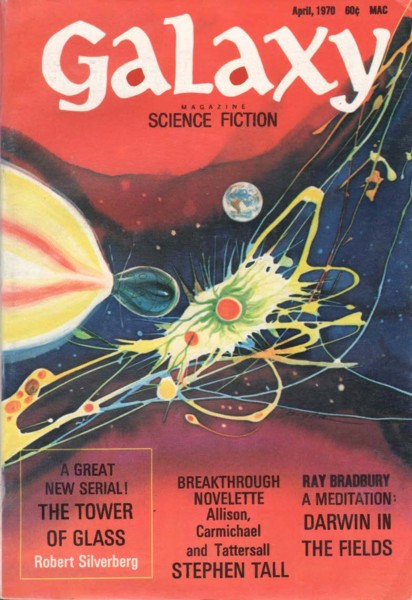


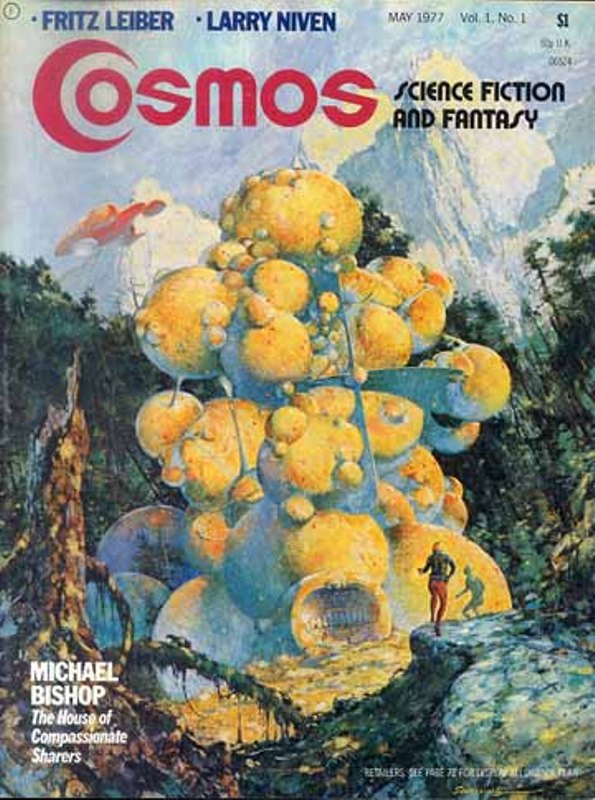
 Science Fiction & Fantasy Remembrance