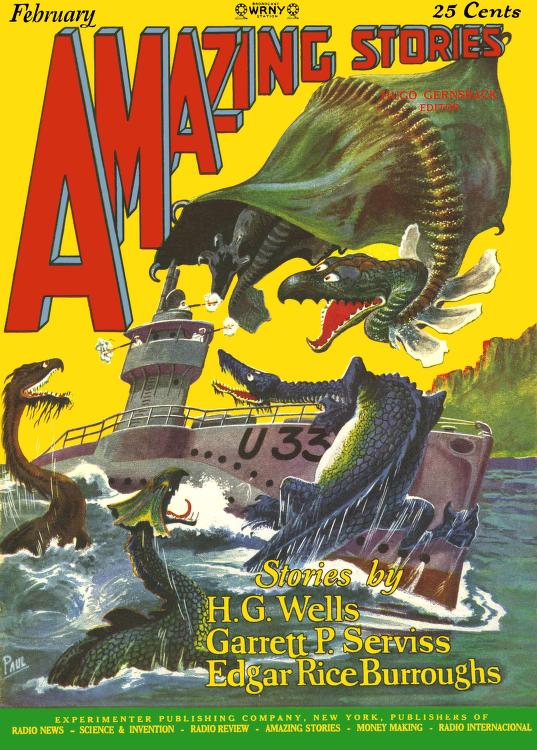
(Cover by Frank R. Paul. Amazing Stories, February 1927.)
Since it’s now the new year for everyone, it’s only natural that we have some new things to look forward to or new things to do. I have a few New Year’s resolutions myself: some movies on my watchlist, quite a few video games I hope to get around to playing. I have hundreds of games in my backlog and even more books to be read in my personal library. I have multiple hobbies, which is something I would recommend to everyone. Unfortunately another thing on my to-do list for 2026 is to either get a second job or to try my hand at writing professionally, which would take time away from this hobbies, including this here blog.
Truth be told, I’ve been winding down productivity here for a minute, so this shouldn’t come as a surprise. I’m seemingly incapable of uploading posts “on time” (but of course who’s keeping time except for myself), and I’ve been missing one or even two reviews every month for the past several months. I wouldn’t be too worried, for the few of you who read this, since I’m not gonna be shutting down this site—just lowering my productivity. Granted, for the first couple years I ran this site I was writing at a feverish pace; in hindsight I’ve not really sure how I did that while also having a day job. In 2023 and 2024 I wrote over 200,000 words a year, according to the stats, which is a lot for one person. There was less wordage for 2025, and now for 2026 you can expect fewer posts as well. But this is like being on a flight and going from 20,000 feet to 10,000 feet.
Now, as you may know, Amazing Stories turns 100 this year. It was revived (again) not too long ago as basically a fanzine, but I would like to celebrate Amazing Stories as a professional magazine, which still means going through material that spans seven decades or so. It’s a lot, not helped by the fact that it has a pretty messy history as far as changes in editorship and publisher go. Except for maybe the beginning of its life it always played second fiddle to competing magazines, but it survived (sometimes even thrived) for an impressive stretch of time, given the circumstances. So, every month (except for March, July, and October, where you can expect short-story marathons) I’ll be covering a serial, novella, or short story from the pages of Amazing Stories. This should be interesting.
With the exception of the aforementioned months we’ll be doing only one serial, one novella, and one short story every month from now on, plus at least one editorial. Anyway, we have one story from the 1900s, one from the 1930s, and one from the 1950s.
For the serial:
The First Men in the Moon by H. G. Wells. Serialized in Amazing Stories, December 1926 to February 1927. First published in 1901. Feel like it would be criminal to pay tribute to Amazing Stories without bringing up Wells at least once, possibly even twice, since he was heavily associated with the magazine in its first few years. Wells himself is arguably the most important SF writer to have ever lived, with his influence being felt to this day practically everywhere you look. Any given SFnal premise likely has its roots in something Wells did over a century ago. This is even more impressive when you consider that Wells at the height of his powers lasted only half a dozen years or so. The First Men in the Moon is one of the last of his classic novels.
For the novella:
“The Gulf Between” by Tom Godwin. From the October 1953 issue of Astounding Science Fiction. Godwin became somewhat famous in SF circles for exactly one story, “The Cold Equations,” which he wrote pretty much in collaboration in John W. Campbell. It might surprise some people that Godwin had in fact written other stuff, and I admit I’m part of the problem because I don’t think I’ve read any Godwin aside from “The Cold Equations.” But I’m gonna fix that. “The Gulf Between” was Godwin’s first story, and it’s notable, if for no other reason than that the cover it inspired would later be reworked as the iconic cover for a certain Queen album.
For the short story:
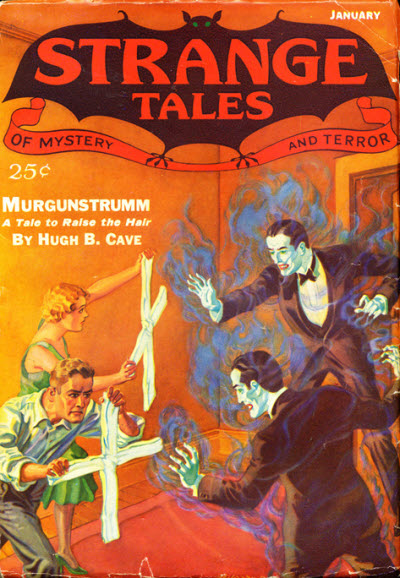
“The Cairn on the Headland” by Robert E. Howard. From the January 1933 issue of Strange Tales. Over the course of about a dozen years, Howard wrote nonstop for every outlet that would accept his work, and he was not just a fantasy writer, also writing horror, Westerns, sports stories, and non-supernatural adventure pulp. He wrote everything except for SF, which he didn’t seem to have an interest in. Conan the Cimmerian occupied much of Howard’s later years, to the point where he began to resent his creation, but this didn’t stop him from doing standalone yarns like this one.
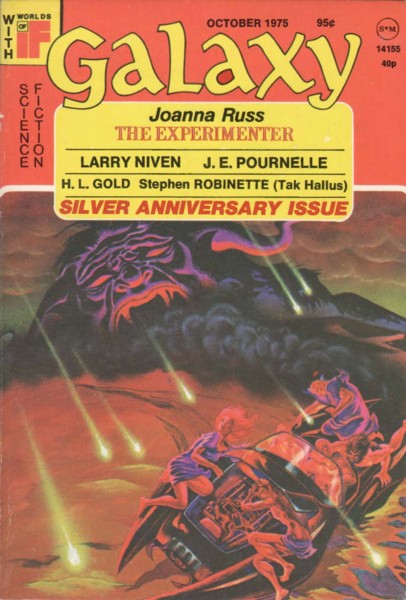
(Cover by Richard and Wendy Peni. Galaxy, October 1975.)
The Story So Far
Allen Carpentier has died, which turns out to be only the beginning of his suffering. He’s in Hell now, or Infernoland as he calls it, at first stuck in a little bottle like he were a genie before being released by a fat balding guy named Benito. Benito what? You’ll see. Now, Benito has been in Hell for a long time, and seems to know a way to get out. To where? Who’s to say. He’s to act as the Virgil to Allen’s Dante, and after all, Infernoland does seem to be modeled after Dante Alighieri’s vision of Hell. Funnily enough, the only way to get out of Hell and possibly into Heaven (or at least purgatory) is to go down, through each circle, each being stranger and more torturous than the last. For a while Allen has a hard time believe he’s in the real Hell and not some simulacrum; after all, he’s an SF writer and a rational man, not one given to superstition. But if Infernoland is a prank, or some sado-masochistic theme park, it’s extremely elaborate. “The Builders” have put a lot of work into it. Of course, it’d probably be easier just to take the whole setting as supernatural than to try some mental gymnastics, but that’s where some of the humor comes in—this being kind of a dark comedy. People have gone to Hell for all kind of reasons, not all of them seemingly reasonable. Niven and Pournelle get a lot of mileage out of depicting kinds of people they don’t like (mostly, but not always, people with left-wing bents) suffering in Hell, although the suffering itself is not always so bad either. There are a few times where they get more specific about whom they’ve thrown into Hell, although not too specific if the person was still alive in 1975. There’s a pretty memorable scene where Kurt Vonnegut (not named, but it’s very clearly meant to be him) is locked up in a big tomb, much to Allen’s annoyance.
Of course, it isn’t just Allen and Benito stuck together on this voyage, since their party does grow some, if also only temporarily. In an episode where the gang builds a glider, they get the help of Corbett, who was a pilot in life, and later they also recruit Billy the Kid—or at least a guy who claims to be Billy the Kid. Eventually they lose Corbett when he loses his nerve and decides to trudge his way back up to one of the higher circles. The thing is that nobody can die in Hell, on account of already being dead, and even though you may suffer incredibly gruesome torment that would have killed a normal person, you’ll not only live but heal in record time. So, this must be the real deal, then. Not helping is that aside from people populating Hell there are also black-skinned demons, a beast with an impossibly long tail named Midos, and a fishman named Geryon. Allen can barely bring himself to trust Benito as well, since the man knows a bit too much and acts more than a little off, like Allen is supposed to know who he is—or, more specificially, like Benito is some infamous figure from history.
Enhancing Image
We’re in the last stretch of Inferno, and it’s actually the shortest, which makes me think there’s more in the book version than what made it into the serial. I’m starting to think that yeah, there had to be some stuff cut out, because this feels stripped down within an inch of its life. Overall it feels more like the skeleton of a novel than the full picture, but I do have to say I like the bones on this thing enough. Then again, I’m not sure how much you can add to it and I’m even less sure why Niven and Pournelle felt compelled to return to it a few decades later. Something genre writers, both old and young, should learn is that more often than not, you should leave a good story well enough alone. Quit while you’re ahead.
It doesn’t take much time at all for Billy the Kid to quite literally get carried out of the novel, which in a world where nobody can die if I guess one way to do it. Just yoink a character out and put them in a location that’s virtually unreachable, it’s kinda like killing them off but not exactly. The party disintegrates rather quickly thereafter, since some World War II guys are all too happy (by that I mean outraged) to tell Allen he’s been traveling with Benito Mussolini this whole time. Yes, that Benito Mussolini. It really isn’t a shocker at all if you’ve been reading along and have not been living under a rock since the time of the pharaohs. I do genuinely have to wonder if the authors intended this to be a big reveal or if it’s meant to be like a joke, because I found it straining on my suspension of disbelief that Allen never figured it out for himself when it should’ve taken him maybe a few minutes. Also it sure is convenient that every historical figure we’d met up to this point where not know who Mussolini is, although that doesn’t go to explain why nobody who lived in a post-WWII world pointed out (or at least more strongly than merely hinted) that Benito looks and sounds familiar. It’s a contrived twist while also being laid on pretty thick, although maybe it was not so thick for readers in 1975. The reveal now feels demeaningly obvious, but given what Americans were allowed to learn in high schools in the days before the internet it’s possible that Mussolini was a semi-obscure figure for those not much interested in politics.
Well, anyway, Allen does what any reasonable person who’s confronted with the so-called father fascism: he chucks him into a goddamn fiery pit. Benito doesn’t even resist Allen turning on him, as if he expected and maybe even wanted this to happen. Of course, nobody can die here, which includes Benito, and you bet we’ll be seeing him again before the end. I do think the decision to make Benito Mussolini a pretty flawed but ultimately heroic character is certainly a choice. The former dictator, who was an avowed atheist in life, seems to have caught a second wind of Catholicism in Hell, and it seems to be an earnest religious awakening. The idea is that if Hell is meant to be punishment, then someone can choose to either better themself admist the horror or wallow in their sins until the end of time, and Benito has chosen the former. Niven and Pournelle are clearly trying to make an example of Benito, as to the potential of Hell’s cleansing flames, although they don’t go so far as to, say, rehabilitate Hitler or Stalin, who are mentioned but (for better or worse) never seen in-story. If Inferno were published as a new novel today it would probably cause a minor stir on social media and in SF fandom, what with how it handles real-life people; but in 1975, if it stirred any controversy then I’ve yet to find evidence of such a thing happening. I have to admit I like the audaciousness of such a move, even if it’s wrongheaded (and it probably is).
Eventually Allen and Benito do reunite, and despite having a good reason to wanna have a go at Allen’s neck, Benito’s pretty understanding about the whole thing. If for much of the novel we were stuck with Benito in the throws of religious mania, then this last stretch sees him having sunk into a depression. Speaking of religious mania, I mentioned that Kurt Vonnegut is one of the few then-living people featured in Hell. For those who think what the authors did with Vonnegut was really petty, just be aware that L. Ron Hubbard gets treated so much worse that it’s almost incomparable. As we reach the final circle of Hell and are about to meet Lucifer himself, Hubbard (again, not named, but context clues make it obvious) makes a cameo as a strange and disfigured monster which shambles around. For some reason Niven and Pournelle have a real bone to pick with people who create “false” religions, or who found religions chiefly for the purpose of making money off of gullible would-be followers.
The ending of Inferno is a bit of an anticlimax, although this seems to be by design, after the increasingly horrific bodily harm Allen has gone through. The iced-over lake, the final area, is relatively easy to traverse, and Lucifer, in the brief time he appears, seems like a chill guy. He only has a couple lines, but he does hit Allen with an epiphany about the purpose of Hell. There’s been a running debate among Christians for centuries as to the purpose of Hell, whether punishment in Hell is eternal or temporary, and so on. The authors here reach a compromise of sorts: Hell is eternal if you choose to stay there. Most of the people stuck in Hell are there either because they refuse to admit to their sins or because they see their punishment as appropriate. There have been at least a handful of people who’ve been escorted out of Hell thanks to Benito, so God knows how many others must have voyaged out over the eons. Benito has chosen to stay in Hell up to now because, well, he’s Benito Mussolini. (I think it needs be mentioned that Niven and Pournelle, while arguing that of course fascism is bad, also downplay just how instrumental a role Mussolini played in the world political climate unto the present day.) Allen convinces Benito that his time in Hell is finally up and that he can go on without him, for ironically, given that his goal this whole time has been to escape Hell, Allen chooses ultimately to stay. The ending is really abrupt, to the point where I’m convinced there’s more to it in the book version, but there’s a passing of the torch between Allen and Benito, the former taking the latter’s place.
A Step Farther Out
I remember years ago trying to read The Mote in God’s Eye, which is supposed to be the best of the Niven-Pournelle collaborations, and even after a couple false starts I couldn’t through it much. Mind you this was years ago, I’ve changed quite a bit as a reader, but I remember it being a rather stuffy and conservative (in a bad way) novel. I did not have such an issue with Inferno, although even in its book form it’s still less than half the length of The Mote in God’s Eye. Cut out the language and the most violent of the gore and you have something that could’ve appeared in Unknown a few decades earlier, since Inferno is essentially a fantasy novel, but with an evident SFnal bent to it that gives one the impression that its authors (or at least one of them, since Niven has occasionally written fantasy) are more accustomed to writing science fiction. It’s a detour for both its authors that more or less works, assuming you’re not too bothered by the humor and the fact that Inferno almost reads like fanfiction.
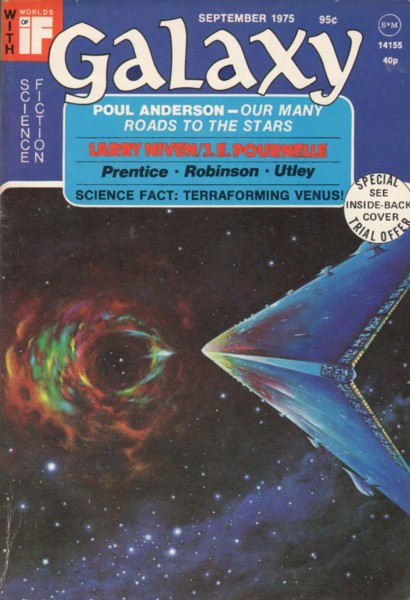
(Cover by Stephen Fabian. Galaxy, September 1975.)
The Story So Far
Allen Carpentier was once a bestselling if not very respected science fiction writer, but in the world of the living he recently became a mesh of blood and bones on pavement. At a sci-fi convention he decided to impress some fans by doing a drinking challenging on a window sill, only for Isaac Asimov to come in at the last second and steal his thunder. Even if Asimov had not done what he did best, Allen still would’ve fallen to his death, in what is perhaps one of the more embarrassing ways a person can go. Almost without skipping a beat, Allen regains consciousness, soon finding himself in the Vestibule of what he comes to call Infernoland. The good news (or maybe not so good) is that he has company in this strange room, in the form of Benito, a fat balding man with a weird accent and an even weirder sense of zealotry that the agnostic Allen finds suspicious. Still, Benito has been here for a hot minute, and he’s come up with a plan for how the two of them might get out of Hell—for of course it is Hell as Benito understands it. This place is modeled after Dante Alighieri’s The Divine Comedy, and with Benito as the Virgil to Allen’s Dante, the two of them set out to escape Hell by going straight through it, ever downward, circle after circle. One of the problems here is that Allen, being a committed rationalist, isn’t even convinced that he is in Hell, but rather thinks this is all an extremely elaborate (and far-fetched) science-fictional scenario.
Benito theorizes that Hell is one giant funnel, with the end of it being at the bottom. This sound simple, except that Allen and Benito have go through the circles of Hell, each one more painful (and weirder) than the last. So we have a start point and an end point, with a simple goal, the result being that this is a quest narrative. Allen, who doesn’t done anything particularly bad in his life, must find a way out of Hell while also figuring out why Hell (or Infernoland) is the way that it is. He meets one or two friends along the way, as in people who had died and been sent to Hell for seemingly minor infractions. We also meet a variety of cartoon characters, from food diet freaks to anti-nuclear activisits—so, in other words, the kinds of people a couple of right-wing authors wouldn’t like. It’s more complicated than that, not least because while these people the authors don’t like are being tortured, the torturing itself seems wildly disproportionate with what wrongs these people committed, and Allen himself points this out. As he says, in what has to be the most memorable line in the whole novel (if only because it gets repeated more than once, like a mantra): “We’re in the hands of infinite power and infinite sadism.” Not that there aren’t sympathetic characters in Hell, and Allen is not left alone with Benito all the time, namely that the two acquire the help of Corbett in building a glider. Unfortunately the glider doesn’t work out, so walking it is, then.
Enhancing Image
We’ve come to the scene in Inferno that’s probably the most (in)famous, in that it comes up as a first example of Niven and Pournelle’s biases, but it’s also an encapsulation of the novel’s leaning on bitchy SF fandom hijinks. At some point Kurt Vonnegut died in-story and got sent to Hell, although unlike every other character we’ve met so far he specifically gets special treatment, being locked up in a big monument, like he was one of the pharaohs. A sentence, one of Vonnegut’s most famous lines, is quoted ad nauseum, “SO IT GOES.” It nearly drives Allen crazy, both from the realization that he himself really is dead and in Hell, and also that Vonnegut, a fellow SF writer whom he didn’t like, has this big tomb dedicated to him in Hell. Vonnegut is not named, but it’s very clearly meant to be him. Real-life figures who appear in Inferno are generally people who’d been dead in Niven and Pournelle’s world for a good minute, whereas Vonnegut was very much alive still; but at some point after Allen went over to the other side, so did he. On the one hand, they clearly have a bone to pick with the man (as Allen says, ““If you must know, I was writing better than Vonnegut ever did before I left high school!”), but as Benito and Corbett point out, there’s also some palpable jealousy, which may or may not be reflective of the authors. Vonnegut had become a highly respected literary figure by the ’70s, and while Niven and Pournelle would write a few bestselling novels, they never even came close to that level of acclaim and acceptance.
Now, one can go on a whole tangent about Kurt Vonnegut, his troubled relationship with SF, and also his outspoken atheism and leftist viewpoint, with how Niven and Pournelle would find all of those objectionable. But I’m not going to. Okay, maybe a little bit. I kinda have to, since I did read a lot of Vonnegut in high school and college, and he’s one of those authors who played a big role in my formative years as an avid reader, even if I don’t read him much nowadays. Keep in mind that a few of Vonnegut’s early stories appeared in the very magazine Inferno was serialized in, and also that while he tried distancing himself from SF as a literary ghetto, this didn’t stop him from appearing in Again, Dangerous Visions. To a seasoned reader who hopefully has read their fair share of “classic” literature, not just classic SF but the likes of Faulkner and George Eliot, Vonnegut can now come off as maybe too simplistic and cloying, both in his style and how he tries to boil complex morality down to simple statements. Along with John Steinbeck he’s probably the first openly leftist fiction author a young American reader would encounter. Of course, in Inferno it’s less about Vonnegut’s politics and more his mocking of religion.
Anyway, we do meet a couple other historical figures in this installment, including a guy who claims to be Billy the Kid. The big revelation Allen has, aside from already being dead, is that nobody in Hell can die again. For better or worse. You can be put through all kinds of hideous and bloody torture, even having your skin and meat literally melted off your bones, and you will still come out of it alive; not only that, but you’ll heal so rapidly that you won’t even get to taste the sweet release of death temporarily. Allen’s party does grow over the course of this installment, although Corbett leaves and starts crawling his way back to a higher circle in Hell. You can’t really blame him, since going through this shit means, among other things, wading through a swamp of burning hot blood and being stalked by Geryon, a mythological fishman with webbed hands and feet. There are some humanoid creatures in Hell that are decidedly not human, including literal demons (black-skinned as opposed to red-skinned, though), which are scary, sure, but which also poke holes in Allen’s theorizing about “the Builders” and Hell being one giant theme park. I wanna mention that while being rather tame at first, Inferno by this point has gotten more graphic and unforgiving in its depiction of Hell. There’s gore that’s described in stomach-churning detail, and there’s even (unusually for magazine SF at the time) some pretty salty language, including a “fuck” or two. I thought at first that maybe the magazine version of Inferno is censored compared to the book version, but this doesn’t seem to be the case.
A Step Farther Out
You could definitely pick apart this novel, especially from a modern left-leaning perspective, but I think it’s fun! I’m willing to forgive right-wing tendencies in art if a) it achieves its goals as art, and b) there was clear thought put into it. It would be hypocritical for me to say I still love reading Yukio Mishima and Rudyard Kipling while also trashing Niven and Pournelle’s grudge against people who are really into health foods. If the novel were not entertaining and occasionally thought-provoking, things would be different. There is good right-wing art and there is bad right-wing art, although we’ve gotten so much of the latter, corresponding with the former shrinking, in recent years, that it’s easy to say all right-wing art is bad. This is understandable, especially since it seems like with a few hand-picked exceptions we simply don’t have any good right-wing artists anymore. Inferno really does feel like a novel from a different era, in that it is dated, but also it’s unserious in a way that most science-fantasy novels dare not be nowadays, or so it seems to me. I could be biased.
Niven and Pournelle had similar temperaments and politics, but their career trajectories were a fair bit different. Larry Niven emerged as arguably the best new hard SF writer of the ’60s, after being discovered by Frederik Pohl, winning a Hugo for his story “Neutron Star” and appearing in Dangerous Visions. Despite being just the kind of writer John W. Campbell would want, at least on paper, Niven stuck to Pohl’s magazines, and even appeared several times in F&SF. Niven’s biggest contribution to SF is undoubtedly his Known Space universe, in which mankind inhabits the galaxy alongside several intelligent alien races, most famously the Kzinti, a warmongering catlike race that are technically also canonical to the Star Trek universe. Niven’s most famous novel, Ringworld, also won a Hugo (and a Nebula), and served as an influence on the Halo franchise. (The titular halos are basically like Niven’s ringworld, but smaller and serving a different function.) Jerry Pournelle took a bit longer to go pro than Niven, despite being a few years older. He had been active as a fan since at least the early ’60s, but didn’t appear professionally in the field until 1971, just in time to have his first stuff bought by Campbell’s before the latter’s passing. Pournelle has his own ambitious universe, called the CoDominium universe, involving a future history that very much takes after those by Robert Heinlein and Poul Anderson. Eventually Pournelle stuck more to writing nonfiction rather than fiction, although he still collaborated with Niven sometimes, with their novels often being bestsellers.
At the time that Inferno was published, it came between two of Niven and Pournelle’s biggest successes, those being The Mote in God’s Eye (set in the CoDominium universe) and the massive standalone Lucifer’s Hammer. Despite being much shorter than these novels, Inferno is considerably more obscure, maybe because it’s harder to get a read on in terms of its genre. It’s been labeled at different times as SF and/or fantasy, being serialized in Galaxy (granted that Galaxy occasionally published fantasy) and with Jim Baen himself calling it SF, but with other sources calling it a fantasy novel. So, let’s call it science-fantasy. Obviously this is a riff on Dante’s The Divine Comedy (says someone who has not read The Divine Comedy yet), but also with a heavy metatextual element. Contemporary reviewers in the genre magazines also ignored Inferno, inexplicably, which didn’t stop it from getting Hugo and Nebula nominations.
Placing Coordinates
Inferno was serialized in Galaxy, August to October 1975. It was published in book form the following year, supposedly expanded although I can’t imagine by much. It seems to still be in print.
Enhancing Image
Allen Carpentier is dead, to begin with. Allen (I’m gonna be calling him by his first rather than last name) has died, in what has to be one of the more embarrassing ways someone can die. In life he was a bestselling (although not that respected) science fiction author, and the first scene he recounts is that at some unspecified science fiction convention. By the way, his real last name is Carpenter, but he added the i so as to appear more distinctive on book covers, although even in his internal monologue he refers to himself as Carpentier. Well, he was an author, and historically there’ve been a lot of hijinks at conventions like these, some more innocuous than others. Allen takes part in a bet, or you could say it’s a drinking game. He’s to finish a fifth of rum while sitting on an opened window sill, some eight stories above ground level. Not only does he fail the bet, falling to his death, but nobody even sees him do so, since the crowd got distracted by Isaac Asimov (I’m not kidding) entering the scene and naturally hogging all the attention. That Asimov is depicted as an egomaniac is accurate enough, although his penchant for sexual harassment (something which at this point was kind of an open secret) goes unmentioned.
For a while Allen finds himself miraculously conscious but without any of his senses. He is somehow nowhere at no particular point in time, but soon he really wakes up to find himself in the Vestibule, in Hell. Well, it’s supposed to be like Hell, although Allen is not convinced that it’s the real deal. He would be totally lost if not for the help of a fat, balding, middle-aged, and “Mediterranean” man who simply calls himself Benito. Both Allen and Benito are very much aware of Dante’s epic poem, although Allen is irreligious while Benito seems to be some flavor of zealous Christian, and as such they have very different interpretations of the situation. Benito thinks that they’re really in Hell, of course, as modeled after Dante’s version of it, whereas Allen thinks they’re in a man-made reproduction of said version, which he decides to call Infernoland. Allen takes on the position of Dante (the self-insert character, not the author) while Benito takes on the role of Virgil. This implies a couple things: that Allen is himself a self-insert for the authors, and that Benito, like Virgil, is a real historical figure. I’m gonna hold off on saying it outright, but who Benito is supposed to be has to be this novel’s most poorly kept secret. It’s apparently supposed to be a twist, but I’ve seen at least one reviewer casually give that away. It’s not hard to figure out, though, and knowing the answer makes Benito’s interactions with other characters, along with the authors’ implicit view of him, a lot more… let’s say awkward. I have some thoughts.
Similarly to Allen thinking of Infernoland as like a theme park, the novel itself feels like a darkly funny theme park ride, rather than a serious novel. Actually, from what I can tell, it seems like people who’ve read Inferno have a bad habit of taking it a little too seriously. More understandably your enjoyment of this novel will depend on a) your sense of humor, and b) how much you can tolerate Niven and Pournelle’s “I just wanna grill, for God’s sake!” conservatism. Just like how the real Dante used his epic poem to rag on people and historical figures he didn’t like, Niven and Pournelle use the setting of their novel as a pretext for taking potshots at certain types of people, and even occasionally named individuals. Granted that I’m only a third in so far, I was expecting worse. Some of the authors’ targets are what you’d expect from a couple of right-wingers (there’s a scene where they poke fun at treehuggers), but their targets aren’t always people on the so-called left (scene with said treehugger also depicts a real estate yuppie type just as unflatteringly). The people that Allen and Benito find in Infernoland are not necessarily “bad” people either, but often people who simply indulged in one of the deadly sins too much. While in the circle for gluttons they meet Jan Petri, whom Allen was friends with in life, Petri having died suddenly some years before. Petri is a decent guy, except he’s also one of those people who’s neurotic about dieting, which, as Benito (if I remember right) points out, is its own kind of gluttony. There’s also the first circle of Infernoland the two men go through, which the inhabitants see as purgatory, and indeed it’s not half bad an existence. The first circle includes people who died without having heard of The Word™, as well as unbaptized children. Allen is understandably disturbed by all this, but he’s also of the mind that really these people are robotic doubles of real people.
At this point, Inferno could be considered fantasy but as envisioned by writers who normally write science fiction. Allen writes (or wrote) SF, and being a rationalist he tries to find a non-supernatural explanation for Infernoland—even if the explanations he comes up with may as well be magical. He thinks of Infernoland as an incredibly ambitious theme park, one not made for entertainment but for the sadistic pleasure of “the Builders.” Allen doesn’t seem to believe in the God of Abraham, but rather he finds it easier to believe that Infernoland was made by a kind of demiurge, or a team of human-hating demigods. The absurdity of Allen trying to find a “natural” explanation for Infernoland when a supernatural explanation would do just as well says something about the religious stances of the authors, although it’s a bit complicated. Pournelle was a practicing Catholic while Niven is an atheist, but both men took a materialist stance on things, with Pournelle (as far as I can tell) keeping his religious beliefs walled off from his nonfiction writing. It’s worth mentioning that Pournelle, along with being friends with Niven, was also good friends with H. Beam Piper, who was also an outspoken atheist. Of course, science fiction has a long history of authors who are, if not agnostic or atheistic outright, prone to keeping their religious leanings on the sidelines when it comes to their work. Obviously there are some notable exceptions, but the idea that one need not be a Catholic or even a Christian to “get” Inferno.
There Be Spoilers Here
The back end of this installment is basically a quest, in which Allen and Benito try to build a glider from scraps that they might fly a high rim wall, by which they might be able to escape Hell. Assuming there’s anything “outside” the wall. How this will turn out, we don’t know—or at least Allen doesn’t know. We can safely guess the glider will not work, because we still have two installments to go. This is like when a movie tries tricking you into thinking it’s about to end, but you’re watching it on streaming or home video so you can look at the time stamp and know it’s LYING. At least the making of the glider, including Benito conning a not very smart desk worker (there is, of course, bureaucracy in Hell), is fun.
A Step Farther Out
I’ve seen some pretty mixed opinions on Inferno, but I’m enjoying it so far. Not sure why Niven and Pournelle felt it necessary to write a sequel thirty-odd years later, given that this feels like very much a standalone. While the setting is big, there’s also only so much you can do with it, at least with these two particular characters. You can only do the “sci-fi author doesn’t believe he’s in a fantasy world” routine for so long. For a comedy, which Inferno more or less is, you don’t wanna overdo a joke. I can see why the book version’s only about 240 pages, compared to the behemoths that came before and after it, since it’s meant to be more lightweight.
(Dark Forces. Cover by One Plus One Studio. The Viking Press, 1980.)
Something I don’t typically get to write about here is the topic of original anthologies, which is to say anthologies of short fiction comprised of material never before published. Of course, said fiction could later be reprinted in magazines, as has happened many times, but the implied purpose of an original anthology is fundamentally different from that of its sibling, the reprint anthology. Both involve similar work, with an editor trying to procure stories from authors or authors’ estates, as well as reading dozens upon dozens of stories, most of which end up not being worth printing. There’s the question of how many words/pages can be crammed between two covers. There’s the question of pricing, because an anthology will pretty much always be more expensive than a single magazine issue. Nowadays anthologies and magazines fill respective niches and try not to step on each other’s toes, since it’s no longer a problem of what can be printed in magazines, whereas in the days before Fortnite and even the internet there was the (true, at least up to a point) conventional narrative that editors and publishers of original anthologies were allowed to be more risqué than their magazine counterparts.
When Dangerous Visions hit shelves in 1967, its key appeal (at least for American readers) was that it was jam-packed with stories that could not be published in magazines of the era, on account of being too edgy, experimental, etc. You had a thick book (over 500 pages) from a mainstream publisher (Doubleday) with an all-star cast of authors, all of whom at least claimed to be putting forth their most mind-bending and transgressive material yet. You had such top talents as Philip K. Dick, John Brunner, Samuel R. Delany, Roger Zelazny, and so on, and commissioning this stuff could not have been cheap. The gambit paid off in spades, though. Dangerous Visions sold very well, remains in print to this day (a rarity for an anthology, especially an original one), and it even won a special Hugo. That Harlan Ellison, the editor, never quite recaptured that lightning, is beside the point. Not every story was a winner, but Dangerous Visions was the right book that entered the market at just the right time, serving as a harbinger of the New Wave. Just as importantly, publishers realized that there was some money to be made with original anthologies—maybe not on the same scale as Dangerous Visions, but rather cheap paperbacks of maybe half the size and half the number of stories; and maybe these books wouldn’t try to reinvent the wheel like their inspiration did, but instead took on more humble mission statements. You can have editors who are maybe not as discerning as Ellison was, who would also get the work done in a timelier fashion. It was a matter of quantity over quality.
There a meteor shower, or maybe a oversaturation, of original paperback anthologies from the late ’60s through much of the ’70s, until that particular bubble burst. These were books that often focused on science fiction, rather than fantasy or horror, although there was a trickle-down effect with those other genres. Still, standards had dripped, in large part (although he was not the sole offender) due to Roger Elwood’s extremely prolific tenure as editor for a few different publishers; the number of anthologies he edited between 1972 and 1976 alone is staggering. While he was able to procure work from big names, this work ran a good chance of being mid- to low-tier stuff that would’ve likely stayed on the shelf. A major exception was Epoch, which Elwood co-edited with Robert Silverberg, a lavish and well-received book, placing first in the Locus poll that year; but this is indeed an exception that proves the rule. By the end of the ’70s the market for original anthologies had inevitably gone into decline.
Meanwhile, in the waning days of the original anthology, Kirby McCauley made his living as a New York-based literary agent with some big talent on his hands. By 1980 he had already edited one well-received original horror anthology, with 1976’s Frights, which won the World Fantasy Award for Best Anthology/Collection. Frights was a hardcover original from St. Martin’s Press with a nice wraparound cover, but while McCauley procured stories by some of the top talent in horror at the time, including Ramsey Campbell and Robert Aickman, he found that he wanted to go one step further. The introduction for Dark Forces makes McCauley’s intentions with this bulky new anthology clear. McCauley’s inspiration was twofold, between August Derleth’s work as head of Arkham House and wanting to make a horror-themed counterpart to Dangerous Visions. Arkham House in its prime printed hardcover volumes with exquisite covers, all these being focused on horror, SF, and dark fantasy, from reprints of H. P. Lovecraft’s work to collections of never-before-published fiction by fresh young writers. McCauley grew up on books of horror that Derleth had edited, so in that way he overtly pays tribute to a fallen (Derleth had died in 1971) master of the field. The relationship that Dark Forces has with Dangerous Visions is more complicated, however, as there are a few major differences in how these books’ respective editors went about their businesses.
Consider that when Harlan Ellison edited Dangerous Visions, a process that took about two years, he was coming at it from the perspective of a reasonably successful author, which is to say he was a writer, first and foremost, as opposed to an editor or agent. This lack of experience with editing eventually came back to bite Ellison in the ass, with the shitshow that was the making of Again, Dangerous Visions, and far more infamously with The Last Dangerous Visions; but in the ’60s, it was novel for a writer with practically no editing experience to work with his fellow writers in such a way. Conversely, McCauley had already proven his ability with an original anthology, plus a couple reprint anthologies, and he was enough of a professional that he understood how to work with writers as people, and not just as practitioners of a certain craft. In the introduction he recounts his encouraging relationship with Stephen King while the latter wrote (first as a novelette, then ballooning into a long novella) The Mist. He also recounts having a get-together with Isaac Bashevis Singer in the latter’s apartment (they were both New Yorkers, and thus there had to be some inherent sense of kinship there), just months before Singer won the Nobel Prize for Literature. King and Singer are radically different in just about every way, in work ethic, style, and worldview, the former a flaming-liberal New Englander and the latter a conservative Polish-Jewish immigrant; yet McCauley makes it appear easy to work with both.
You may have noticed also that Singer is not a name that comes up much, if at all, in horror circles, because while a good portion of his fiction involves the supernatural, he’s not a “horror writer.” Thus we have another big difference between Dangerous Visions and Dark Forces, because while Ellison reached out to everyone in the SF field he could get his hands on, McCauley reached outside the field of horror and dark fantasy, the result being that there are authors in Dark Forces who are not primarily horror writers, and there are even a few who are known to be “literary” types. It’s not so unusual today, but back in 1980 it was a novelty for acclaimed novelist (and prolific tweeter) Joyce Carol Oates to appear in a horror anthology. You have some of the usual suspects of horror from that period (King, Campbell, even Robert Bloch late in his career, etc.), but you also have a really left-field choice like Davis Grubb, who was known at the time as author of The Night of the Hunter. You have writers like Edward Bryant and Joe Haldeman who, while they have sometimes written horror, are much more known for writing science fiction. You have a surprise appearance from Ray Bradbury, who by 1980 had long since entered the literary mainstream, and who also didn’t write much of anything at this point in his career. One can have gripes with who made it in and especially who didn’t (there are only two female authors here, Oates and Lisa Tuttle), but I can readily believe McCauley when he says he tried getting stories from everyone.
It’s also worth mentioning that McCauley didn’t construct Dark Forces with the intention of it being a boundary-pusher for the field of horror (he even explicitly says he didn’t want it to be “as revolutionary” as Dangerous Visions), and this ends up being to its benefit. True, there are a few stories here that may have been transgressive for 1980 (I’m thinking of Theodore Sturgeon’s tale of venereal agony, “Vengeance Is.,” and if I had a nickel for every “pregnant man” story in this book, I would have two nickels), but being extra-gross or what have you was not the name of the game. What might be Dark Forces‘s secret weapon and the biggest reason for its having aged pretty well is how its contents cover pretty close to the whole span of short horror literature up to circa 1980. While we don’t have much dark fantasy a la Robert E. Howard’s weird Conan stories, or the “extreme” horror that would start making the rounds in the proceeding years, there’s a great deal of variety in these 500 pages. We have traditional ghost stories such as Singer’s “The Enemy,” a rendering of the Sweeny Todd narrative with Robert Aickman’s “Mark Ingestre: The Customer’s Tale,” a cautionary tale of one unlucky busybody and a nest of vampiric creatures with Campbell’s “The Brood,” some rural “redneck” horror with Grubb and Manly Wade Wellman’s stories, and so on. There are also a couple non-supernatural tales of terror, as with Oates’s “The Bingo Master” (a personal fave of mine) and Bloch’s “The Night Before Christmas.” There are even a couple stories that fall into a certain genre that’s become rare in recent decades, that being the Christian allegory, with Gene Wolfe’s “The Detective of Dreams” and Russell Kirk’s “The Peculiar Demesne.”
And then there’s The Mist.
A story that “gets away” from the author, as it were, can sometimes be a bloated abomination, but in the case of The Mist we have one of King’s best and most tightly wound stories. Indeed King’s bad habits are pretty much absent here, and the fact that he’s able to reconcile ’50s B-movie monster action with genuine eeriness shows the level of craftmanship he’s capable of when he stops fucking around and focuses on what really matters. While the movie adaptation has a radically different ending (one that many, including King himself, prefer), I do have a soft spot for the novella’s ambiguity and cautious optimism. It was a simple choice for McCauley to put the longest story last, making The Mist the grand finale of Dark Forces, but it’s an example of how sometimes the simplest choice is also the best. Unlike the King collection Skeleton Crew, which sees The Mist as the protracted opening salvo, its position as the closing story of Dark Forces gives one the impression that the whole book had been building up to this moment. It was risky to include such a long story here (it takes up about 1/4 of the book), since if it failed then it would majorly tarnish what is otherwise a good read and leave a sour taste in the reader’s mouth; thankfully The Mist was a success, and has become one of King’s most beloved stories.
Dangerous Visions has, as far as I can tell, never gone out of print, although sadly the same can’t be said for Dark Forces. Anthologies, and especially original anthologies, have a bad tendency to have one or maybe two print runs, then go out of stock until the end of time. The only time Dark Forces has been reprinted this century was a super-expensive limited edition from Lonely Road Books in 2007. Bantam apparently did a paperback printing of Dark Forces in the early ’80s, but otherwise it’s only ever been published in hardcover in the US. It could be that Dangerous Visions was such a monolith at the time of its release, and has gone down as such an important entry in SF history, that its status (despite understandable attempts to knock it down a peg, especially as it continues to show its age more and more) has been more or less secured for the foreseeable future. Dark Forces is arguably a better book and set a better precedent (it served as an inspiration for Clive Barker to get into writing horror, and as we all know, the rest of that is history), but it also now reads, with hindsight, as one of the last big gasps for short fiction as a significant player in the realm of horror. Starting in the ’70s, both novels and movies started taking larger slices out of the pie in terms of what “mattered” for innovation and trends in horror, a field that historically largely hinged on the short story and novella. There would be major practicioners of the short horror story (see Barker, also Thomas Ligotti) to come after 1980, but Dark Forces celebrated (again, with hindsight) the short story as a form with authors who are, by and large, happiest and at their best when writing short stories and novellas.
There’s something about October that brings a change in me. It could be that autumn has now unambiguously started, as opposed to just going by the autumnal equinox. The weather is now colder and dryer. My hands and nose are getting dry, the latter occasionally resulting in a nosebleed. I now feel like I can put on a hoodie and jog around the city. The trees will start being stripped of their leaves. Overall it’s a time of changes, mostly for the better. October is also the month of Halloween, which is far and away my favorite holiday, to the point where it might the only one I really get festive about. Now is the time for watching horror movies, from the classices to some grade-A schlock. Time to catch up on some horror reads I’ve accumulated on my shelf. Time for pumpkin spice lattes, if you’re into that. In other words, this is for me what Christmastime is for some people—mind you that I tend to get depressed around Christmas.
For this month we’re back to reviews at regular intervals, all short stories, all featuring thrills, chills, and assorted horrors. For the first time in a while I’m actually excited with what I’m gonna be writing about. Hopefully you’ll be joining me in reading at least a few of these.
We have one story from the 1940s, three from the ’50s, three from the ’80s, one from the ’90s, and one from the 2020s.
For the short stories:
“The Hungry House” by Robert Bloch. From the April 1951 issue of Imagination. Bloch was correspondents with H. P. Lovecraft when the former was still in high school, and this friendship had an apparent influence on Bloch’s early fiction. While he’s most famous for writing Psycho, which is non-supernatural horror, most of Bloch’s work involves ghouls, cosmic horrors, and whatnot.
“Rabbit Test” by Samantha Mills. From the November-December 2022 issue of Uncanny Magazine. Winner of the Hugo, Nebula, and Theodore Sturgeon Memorial Award, being only the third story ever to win all three. Mills debuted in 2016, with her debut novel published in 2024. “Rabbit Test” was the last of a streak of short stories, as Mills stopped writing short fiction for three years.
“Punishment Without Crime” by Ray Bradbury. From the March 1950 issue of Other Worlds Science Fiction. Being one of the most famous American authors ever, it can be easy to forget that Bradbury started writing for the genre magazines, not all of them being of the first rate. He also wrote so much horror early in his career that only a fraction of it appeared in The October Country.
“Lost Memory” by Peter Phillips. From the May 1952 issue of Galaxy Science Fiction. I had ever heard of Peter Phillips before, which might be because he was only active for a short time, from about 1948 to 1958. He stopped writing SF for reasons I’m not sure of. He was also British, at a time when there weren’t too many active in the field, even appearing in the inaugural issue of New Worlds.
“Yellowjacket Summer” by Robert McCammon. From the October 1986 issue of Twilight Zone Magazine. McCammon made his debut in 1978, but it took him a bit to come to the forefront of contemporary horror fiction. His massive post-apocalyptic novel Swan Song tied for the inaugural Stoker for Best Novel. Disillusionment with the industry made him step away from writing for a decade.
“Bloodchild” by Octavia E. Butler. From the June 1984 issue of Asimov’s Science Fiction. Winner of the Hugo and Nebula for Best Novelette. This is a reread for me, but I’ve been meaning to return to it for a close read for a minute. Butler wrote only maybe a dozen short stories, but they’ve received a disproportinate amount of praise, with her winning Hugos for short fiction twice consecutively.
“Reckoning” by Kathe Koja. From the July 1990 issue of The Magazine of Fantasy and Science Fiction. Koja debuted in the late ’80s with a pretty strong string of short stories before her debut novel, The Cipher, hit stores in 1991. She was a formiddable horror talent in the ’90s, but in the 2000s onward took to writing novels aimed at young readers, and she hasn’t written much generally lately.
“Day of Judgment” by Edmond Hamilton. From the September 1946 issue of Weird Tales. While he’s most known as a pioneer of space opera, as well as his Captain Future series, Hamilton appeared frequently in Weird Tales from the beginning of his career, sometimes with SF but also sometimes with fantasy and horror. He was an old-school pulp writer in that he wrote for basically any market.
“The Pear-Shaped Man” by George R. R. Martin. From the October 1987 issue of Omni. Winner of the Stoker for Best Long Fiction. Martin is a case where a series (A Song of Ice and Fire) of his is so famous that it overshadows the rest of his work, which mind you is considerable. Martin’s gone on record as thinking of himself as instincively a horror writer, a fact which is on display here.
We have pretty much an all-star cast of authors here, so I hope this will help my recent writing slump. Of course, the most important thing is that we have fun with this. Happy Halloween.
(Cover by C. Barker Petrie, Jr. Weird Tales, August 1926.)
Who Goes There?
A couple years ago I was supposed to review A. Merritt’s novel The Dwellers in the Mirage, although I couldn’t get far into it before admitting defeat. It could be because I was reading it as it appeared in Fantastic Novels, a magazine with a type size intended for ants and other insects, but I was struggling with it. At the time I knew I would have to give Merritt another shot at some point, not least because of his reputation in the field—or, more accurately, his lack of a reputation nowadays. Abraham Merritt only wrote eight novels and small number of short stories, which for someone who wrote pulp fiction is borderline miniscule, but in fact he had such a well-paying day job that he felt not the need to write much fiction. He worked as assistant editor and later editor of The American Weekly, a Sunday newspaper whose top positions paid a pretty good deal. (Making it as a journalist a century ago meant a lot more than it does now, in the sense that you could afford a house without taking on a second job.) Merritt basically quit writing fiction after 1934 to focus on his lucrative career, resulting in a writing career that lasted not quite twenty years. As with close contemporary Edgar Rice Burroughs, Merritt didn’t start writing fiction until he was in his thirties; but once he picked it up, he found a good deal of success with it as well. Merritt cultivated such a devoted following that he’s one of a very small group of people to have a genre magazine named after him, the short-lived A. Merritt’s Fantasy Magazine.
Yet Merritt’s reputation dwindled in the years following his death in 1943, with naysayers popping up rather early on. In one of his books of criticism, I forget which piece exactly, James Blish calls Merritt a lousy writer. While such an assessment is more often true than not when it comes to once-beloved genre writers from so long ago (E. E. Smith was indeed a pretty bad writer, and his immense influence on the field is thus hard to account for), this judgment of Merritt seems harsh to me. It’s telling that Merritt was one of the first people to be inducted posthumously into the Science Fiction and Fantasy Hall of Fame, then was “awarded” the Cordwainer Smith Rediscovery Award in 2009. His stuff only seems to be kept in print by small independent presses, and I’m actually unsure if even all his novels are in print. He also wrote few short stories, with “The Woman of the Wood” being his only original appearance in Weird Tales. Merritt’s work was frequently reprinted in the genre magazines of the time, but he was originally published in the general pulps, namely Argosy.
Placing Coordinates
First published in the August 1926 issue of Weird Tales, and later reprinted in the January 1934 issue. It’s also been reprinted in the first issue of Avon Fantasy Reader, A Treasury of Modern Fantasy (ed. Terry Carr and Martin H. Greenberg), The Fantasy Hall of Fame (ed. Robert Silverberg and Martin H. Greenberg), and the Merritt collection The Fox Woman and Other Stories. It’s in the public domain now, which means you can read it however, although it’s not been transcribed for Project Gutenberg in the US as of yet. Very little of Merritt’s public-domain work is there.
Enhancing Image
McKay, an American World War I veteran, has come to the mountains of France in need of some fresh air. A pilot in the war, McKay had apparently joined the French forces and later the Americans, once they entered the war; but while he served honorably, the experience left him shell-shocked. “The war had sapped him, nerve and brain and soul. Through all the years that had passed since then the wound had kept open.” This is, of course, Merritt telling us upfront that we ought to take McKay’s testimony of the strange events to follow with a grain of salt. Indeed, McKay not entirely having his mental screws in place is key to the story working, or else it would sound even more ridiculous than it already does. McKay is quite different from his creator, being a war veteran while Merritt was not, but both men are what we might call eccentrics, and both also have green thumbs. McKay would be perfectly happy as a gardener, such that he seems to get along better with plants than people, and like Bob Ross he has a tendency to bestow human personality on the birch and pine trees of the Vosages. He’s staying at a lodge, owned by an unnamed inn-keeper and his wife, on the edge of a lake, with only one other human habitation at that forested lake—that being the house of Polleau and his two sons.
Polleau and his sons are the descendants of serfs who lived off the land generations ago, but they’ve been feuding with their surroundings such that several members of their family have befallen to bizarre tree-related accidents. Now they are the last of their kind. Given that McKay repeatedly equate the trees with royalty and medieval figures, it’s easy to picture the last of the serfs going up against a legion of nobility (or so Merritt/McKay thinks) from centuries past, in a France which has not had a monarch for many years at this point. When one of the sons tries cutting down a birch (the birch trees are given feminine qualities), McKay witnesses something very strange indeed: the trees seem to fight back. The birch, wounded, lies on a neighboring fir “as though it were a wounded maid stretched on breast, in arms, of knightly lover.” Something I’ll say in Merritt’s favor is that while he’s fond of using certain words over and over, he has a knack for evocative imagery that’s a step above most other people submitting to Weird Tales at the time. The cast is small, and it become apparent pretty soon where Merritt is gonna take the plot, but the setting is well-realized, and there’s an intense earthiness to it that reads like a pulpier and perhaps less scary Algernon Blackwood. I have no doubt that Merritt would’ve read his fair share of Blackwood, considering he was big into reading on the occult and both authors have a shared fondness for rural spaces. “The Woman of the Wood” was by no means the first “Nature fights back” story, probably not even the first to be published in Weird Tales that year, but it’s redeemed by Merritt’s knack for setting and tone.
One of the sons lose an eye in the ordeal, which was a bit more violent than I was expecting, but also it’s unsurprising that a) this conflict between man and tree is a bit more literal than would be deemed realistic, and b) McKay sympathizes a lot more with the trees. Later he is tormented, or maybe just haunted, by a small army of birches come to life as ghostly women, which is how I imagine we got the cover for this magazine issue. The trees tempt McKay to “slay” (they keep using that word specifically for a while, which makes the proceedings just a bit hard to take seriously) the Polleau family for them. Since the closest we have to a human woman in the story is the inn-keeper’s wife, who doesn’t say much, the estrogen quota will have to be met in the form of sly and vaguely slutty tree spirits. The spirits of the forest are not exactly evil, nor are they really good, but simply wanting to retaliate against a small but passionate force of deforestation. It does not seem to occur to anyone, even Polleau himelf, that the old man and his sons should probably make plans to move out of the mountains; but then, considering what we see of them, it wouldn’t be surprising that their pride would make moving out of the question. As is typical of weird fiction, and also pulp writing generally at the time, there’s an appeal more to emotions than the brain. That Merritt can delay the reader in thinking about the logical issues of the setting is to the story’s benefit, not really a negative. That McKay himself is shown to be in a fragile mental state to begin with also makes his extreme actions in the climax easier to understand.
There Be Spoilers Here
The really crazy part, which might be the one thing I wasn’t expecting in terms of the story itself (putting style and pacing aside), is that McKay gets away with murder. Yeah, he shivs one of the sons in the goddamn neck, in a kind of tree-induced rage, actually rips out the guy’s throat with the knife (it should be sliced instead of ripped if it’s with a blade, but putting that aside…), and it’s pretty graphic. It’s about as graphic as you could get away with in a dark fantasy magazine with a lot of naked women on its covers in the 1920s. And what’s more, the trees kill Polleau and the other son off-screen, giving McKay enough leeway to get off scott free. The trees don’t even take vengeance on him when he turns down their offer to join them (I assume by giving up his human body to become a tree spirit, I’m not sure), they just seem a little crestfallen about it. But yeah, aside from being shaken from killing a guy and making contact with a bunch of ghosts, McKay gets out of this in one piece. Didn’t expect that.
A Step Farther Out
Merritt’s known more for his novels (not that he’s known much at all these days), but I’m more of a short story fan myself. Why he didn’t contribute more to Weird Tales, I’m not sure. Maybe the pay rate wasn’t enough. At least with Amazing Stories in the late ’20s, Merritt’s lack of original appearances (although he did give the green light on a few reprints) can be explained by Hugo Gernsback being reluctant to pay anybody much of anything. By the time more rivals to Weird Tales, and indeed more genre alternatives to the general pulps, came about, Merritt stopped writing, and then he died about a decade later. It’s a bit of a shame, because it turns out he wasn’t half bad at writing short fiction. “The Woman of the Wood” is a decent bit of rural weird horror that’s aged better than most from the same period, namely due to Merritt’s style plus the lack of racism.
Joan D. Vinge was one of the more acclaimed SF writers in the latter half of the ’70s through the ’80s, which makes her retreat from public notice all the more conspicuous. She debuted in 1974 and was one of the post-New Wave crowd, alongside the likes of George R. R. Martin and John Varley. As you can guess, she was also married to Vernor Vinge for much of the ’70s, although they split in 1979, which didn’t stop Joan from ditching Vinge’s last name for her byline going forward. She won a Hugo for the borderline metafictional story “Eyes of Amber,” and she won another Hugo for her second novel, The Snow Queen. After the ’80s her output went down massively, to the point where she disappeared for nearly all of the 2000s. One reason for this is that she suffered a car accident in 2002 that left her unable to write for some years, although that doesn’t explain her relative inactivity in the ’90s as well. She has also, weirdly enough, written about as many novelizations as original novels at this point, including novelizations of (I’m not kidding) Return of the Jedi, Willow, Return to Oz, Cowboys & Aliens, and the ’90s Lost in Space movie. She had written virtually no short fiction since 1990, which makes “The Storm King” one of her later stories, published the same year as The Snow Queen. Unlike most of Vinge’s work, “The Storm King” is fantasy, although it retains Vinge’s propensity for incorporating fairy tale elements.
Placing Coordinates
First published in the April 1980 issue of Asimov’s Science Fiction. It’s been reprinted in Isaac Asimov’s Wonders of the World (ed. Shawna McCarthy and Kathleen Moloney), A Dragon-Lover’s Treasury of the Fantastic (ed. Margaret Weis), and the Vinge collection Phoenix in the Ashes.
Enhancing Image
This will be a short and sweet review, because despite being nearly thirty magazine pages I don’t have much to say about “The Storm King.” I think it’s interesting to point out first that this really is a high fantasy story published in Asimov’s, early in the magazine’s history when such a thing was rare. Granted, Roger Zelazny’s “Unicorn Variation” was published there a year later and was just as much a fantasy story, and even won a Hugo for it. The market for short fantasy fiction, barring a brief period in the 1930s and more so the last decade or so, has never been that good. 1980 saw the death of Fantastic, so that F&SF was the only magazine in town that published a good deal of short fantasy. But Asimov’s, even in its first years, occasionally printed fantasy, and the results tended to be rewarding. I liked “The Storm King” enough, although I didn’t love it.
Lassan-din has a problem—actually he has two problems, but we’ll get to the second one in a minute. He is the heir apparent to the throne in Kwansai, but he’s a prince in exile and he’s willing to do anything to take back what is “rightfully” his, even to go against his homeland’s predominent religion by consulting an old witch. The witch in question and her servant girl, the latter calling herself Nothing, are pagans who work with the elements of Nature. There’s also a dragon who lords over this area called the Storm King, who like your typical Tolkien-esque dragon is an intelligent being who communicates with humans telepathically. Lassan-din wants to tame the Storm King and use its power to retake the throne, but as the witch says, “You don’t fight fire with fire. You fight fire with water.” The witch gives the prince a hint as to how to deal with the dragon and sends Nothing with him, but as she also says, as a kind of warning, “power always has a price.” Nothing will repeat this phrase verbatim much later, which of course means that we’re meant to take it as the story’s thesis. And indeed it is. It becomes clear quite early on that Vinge’s story is a fable about how power corrupts, to the point where it feels a little condescending and wearying; that the plot trajectory goes pretty much exactly the way I expected, going off of the thesis Vinge gives us, also means there’s not much surprising in store for us. Since “The Storm King” doesn’t have any real twists or turns, that forces us to turn to other things in looking for the story’s merits.
In all fairness. while this kind of high fantasy is commonplace now, such that I have precious little interest in modern fantasy writing, it would’ve been more novel in 1980, right after the sword-and-sorcery revival and right before we started getting the super-chunky multi-book sagas that have since dominated the genre. “The Storm King,” for better or worse, would’ve fit right in with short fantasy being published nowadays. There is, of course, also a sexual element, with Nothing being implied to be a prostitute as well as a witch’s apprentice; and while her relationship with Lassan-din never turns romantic exactly, it does get rather steamy. The problem on Lassan-din’s end is that he had suffered some unspecified abuse from his uncle, which has left him impotent, although Vinge is unclear as to what exactly is wrong with him. I thought at first that Lassan-din genitals must’ve gotten damaged, but this turns out not to be the case. There’s an obvious symbolic connection between Lassan-din’s impotence and his having fallen from the throne. Well, the damage can’t be that bad, for Lassan-din and Nothing have sex, and there’s a little something extra thrown into the deal that the former is not made aware of. (You can guess what it is.) The two proceed on their quest, which sees Our Anti-Hero™ finally meet the Storm King himself, and another deal is made. Lassan-din inherits the Storm King’s scales and his control of lightning, but obviously there wouldn’t be much of a story if things ended here.
There Be Spoilers Here
Lassan-din retakes the throne, but he doesn’t become respected so much as feared among his people, not to mention the dragon is still free to terrorize the populace. Lassan-din’s reign becomes so maligned that he too becomes known as the Storm King, by which point he realizes he might’ve made a mistake. He’s unable to reverse the deal he had made with the dragon, being unable to rid himself of those scales; even if the dragon wanted to, he could not undo what has been done. He comes to the conclusion that if he can’t save himself then he can at least save everybody else, so he decides to banish the Storm King from the land. We get what is more or less a happy ending. Hell, there’s even a baby in the mix, with Nothing (now named Fallatha) having a daughter by him. This all reeks a bit of wish fulfillment, at least from a modern perspective. This is a story about how power corrupts, and yet the one whose character is poisoned by power still has enough of a conscience to do the right thing at the end of the day, never mind retaining some of his humanity. Lassan-din is an anti-hero who would be a villain in some other stories, depending on the perspective one writes from, and while this is a nice arc for a character to have, it doesn’t feel real at all. Unfortunately, in real life, someone in Lassan-din’s position is unlikely to have any redeeming qualities of note, nor are they likely to suffer at all from the pain and oppression they bring on other people. “The Storm King” is fantasy due to its setting, but it’s also fantasy because it depicts someone with immense power actually facing consequences for their actions.
A Step Farther Out
Sorry for the delay. Depression and a bit of writer’s block. I was honestly stumped for a bit as to what my thoughts on this story even were, maybe because I tried thinking back on something I had perhaps missed, only to think I really had gotten everything on my initial reading and that I didn’t need to put much thought into it. Maybe not the first Joan D. Vinge story I should’ve written about her first, since in a way it’s an outlier among her short fiction, but it’s also one of her short stories that I’d not read yet that I really wanted to check out. I was mildly disappointed, if only because I expected there to be more to it, but Vinge is not a bad writer. Hell, at this point she was a better writer than her ex-husband. It’s just that “The Storm King” doesn’t show Vinge at her best.
(Cover artist not credited. Subterranean, Summer 2010.)
Who Goes There?
Rachel Swirsky has been around for nearly the past twenty years, as a writer but also as an important figure in modern SF fandom. She was the founding editor of PodCastle back in 2008. She has also been open about issues of disability, cultural Judaism, and feminism, which are some of many topics permeating 21st century SFF that were not as prominent (except for feminism) half a century ago. The irony is that her social media presence seems to be oddly miniscule for a modern SFF writer. She won two Nebulas early in her career, for the 2013 prose poem “If You Were a Dinosaur, My Love,” and earlier for the 2010 fantasy novella “The Lady Who Plucked Red Flowers Beneath the Queen’s Window.” Maybe not the win, but for my money the nomination was certainly warranted. When it comes to choosing what fiction to review I sometimes fear that I might not have enough to say about the work to warrant its own post (a fear that has come to fruition a few times before), but thankfully this is a meaty novella that almost begs to be given the analysis treatment.
Placing Coordinates
First published in the Summer 2010 issue of Subterranean Online, which nowadays you can only access via the Wayback Machine. It’s been reprinted in The Best Science Fiction and Fantasy of the Year Volume Five (ed. Jonathan Stran), The Year’s Best Science Fiction & Fantasy: 2011 Edition (ed. Rich Horton), Heiresses of Russ 2011: The Year’s Best Lesbian Speculative Fiction (ed. Steve Berman and JoSelle Vanderhooft), and the Swirsky collection How the World Became Quiet: Myths of the Past, Present, and Future.
Enhancing Image
In the Land of Flowered Hills, Naeva is a sorceress and also Queen Rayneh’s favorite—as both a sorceress and a lover. This is not cause for scandal at all; on the contrary, lesbianism is treated as compulsory in this land. The Land of Flowered Hills, from Naeva’s view, is virtually paradise, being a matriarchal society where women rule and men are treated as an underclass, even being called “worms” regularly. Childbirth is so frowned upon that women who get stuck with the thankless job of having kids are also treated rather with disdain, being called “broods.” There’s a stringent hierarchy based on gender, and to a lesser extent on class, this being a kind of Social Darwinist nightmare in which the strong abuse the weak without hesitation or regret. This all sounds dystopian, and also ridiculous, like how a misogynist would imagine a matriarchal society in a work of satire, so as to take the piss out of feminism’s more unsavory notions, namely political lesbianism. For women, heterosexuality is universally frowned on, to the point where women who have children willingly with men are labeled perverts. I’m not sure how such a society is supposed to survive in the long run; but then again, given what happens in this story, it doesn’t.
Naeve, for all her loyalty to the crown, gets caught in the crossfire between Rayneh and her daughter Tryce, the latter wanting to take the throne as she believes her mother is unfit to defend the land against an oncoming army of barbarians. The barbarians are, of course, male, which is perhaps the biggest slight for these women, on top of the fact that they breed naturally and have been building their numbers with frightening speed. To make a long story short, Naeve is convinced to turn her back on Rayneh, but this costs her dearly, in that she is hit with a magic arrow and is thus put in a state where she is both alive and dead. She is rendered effectively immortal, but this is on the condition that someone is able to summon her from her coma, and also to provide a vessel for her soul to inhabit, on account of her original body being very much dead. People’s souls in the world of the story can be swapped to other bodies, with the caveat that the owner of that body will die when the new soul departs. That’s the original method transferring souls, anyway. So while the feud with Rayneh and Tryce takes up the first section of the novella, Naeve’s life-death state lasts from years to decades to centuries, so that before long she starts jumping (or rather she is summoned by different people periodically) ahead long after Tryce has died and the Land of Flowered Hills has fallen. Naeve becomes one of a small group of people, called “Insomniacs,” who are stuck in a perpetual state of magic-induced hibernation and revival.
The basic challenge of this novella (whose full title I don’t feel like repeating) is that Naeve herself is rather a horrible person, and the story is told exclusively through her perspective. I’m always kind of intrigued by the thought experiment of knowingly telling a story through the eyes and voice of someone who is thoroughly unlikable; it’s really a tightrope act, which for the most part I think Swirsky pulls off here. This is a story about bigotry and future shock, and I think Swirsky does something ambitious here in that she tries to put us in the mindset of someone who is an active bigot. Naeve’s fierce misandry ends up causing problems for herself and virtually everyone she meets, yet throughout the story she doesn’t change so much as come to the conclusion that she hasn’t changed. Normally in a narrative that’s at least novella-length, such as this, we expect the protagonist to go through some kind of change, to have a revelation or some epiphany, so that something about their character has altered by the end. They had learned a valuable lesson, or have suffered a certain trauma that makes them reevaluate how they understand the world. Yet despite being highly knowledgeable about magic and being considered one of the wisest members of her society, Naeve refuses to change her opinion on the status of men throughout the story, even when she befriends a man named Pasha briefly (and I do mean briefly, he’s barely in it before being killed off), a friendship that she writes off as being an exception that proves the rule. By the time Naeve gets resurrected for the last time, at the hands of a nerdy but cute scholar named Misa, she has not really aged or even changed as a person at all while literal centuries have passed by her.
Swirsky plays with fantasy conventions quite a bit here, mostly to good effect, although I have to admit I don’t really care for the whimsical-poetic prose style she goes for. After having read and reviewed a decent amount of fantasy over the years I can say that when it comes to English-language literature there are basically only two schools of fantasy writing: British and American. These are not mutually exclusive, and indeed someone who is British or American will not necessarily write in their respective nation’s school of writing; this is especially true with American writers, who to this day have a bad habit of copping notes from the British. In the British school the key forerunners are J. R. R. Tolkien, C. S. Lewis, William Morris, and Lord Dunsany. In the US you have Robert E. Howard, H. P. Lovecraft, Edgar Rice Burroughs, and Fritz Leiber. One of these clearly has more of a stranglehold on modern fantasy writing, even among Americans, than the other. The Land of Flowered Hills itself even has a vaguely Lord Dunsany-esque ring to its name. With all due respect to Swirsky, because her issue is by no means unique to her (if anything it’s far too common), trying to capture Dunsany’s exquisiteness of style is a bit of a fool’s errand; too often it comes off as cutesy and cloying.
There Be Spoilers Here
Naeve is summoned in the body of a straw dummy, which makes things awkward when she and Misa inevitably have a sexual/romantic relationship. Misa lives in and for academia, and being a scholar she is naturally taken by Naeve’s antiquity and knowledge regarding magic, although she’s disgusted by Naeve’s misandry. There’s that joke where you have a seemingly liberal white woman and her disgustingly racist boyfriend whose bigotry she just kind of, ignores? Enables? I think we’re supposed to sympathize with Misa here, but it’s hard to sympathize with someone who, perhaps against their better judgment, falls for someone as unlikable and toxic as Naeve. Generally, and this could be because we’re stuck in Naeve’s shoes the whole time, Swirsky seems to think that we out to at least take pity on Our Anti-Heroine™ for her inability to become a decent person adapt with the changing times. One might take pity on Naeve the same way one might take pity on an older family member whose brain has clearly been fried from watching Fox News nonstop and utterly failing to question the basic evils of our society, but personally I don’t feel sorry for these people. I simply can’t. Why? Because bigotry kills. Bigotry is as much a tool used in the violence and tyranny that terrorizes marginalized groups, except because it’s invisible and immaterial it’s something that people are willing to give a pass. But this mindset is put to the test when the academy and its environs are threatened by a plague, which is apparently magic-induced, and (surprise, surprise) Naeve just so happens to be the only one who knows a way to cure it. But, aha, she refuses to give this cure to the male members, condemning about half the populace to a painful death.
This is abhorrent. I mean there’s really no excuse made for why Naeve should have the right to condemn hundreds and even thousands because of her stupid and childish prejudices, but Misa and her colleagues fail to question Naeve’s stupidity seriously before basically mind-raping her for the cure. The results are disastrous. Everyone around Naeve is horrifically injured and even having gotten the cure, they come to the conclusion that she’s too dangerous to keep awake. The whole back half of the story is quite interesting, as much for what isn’t said (or maybe what Swirky did not intend) as what is. The idea is that you have a conservative who is quite literally ancient, thrust into a small society of liberals, the result being that neither side is willing to budge, nor is anybody willing to articulate their own position without coming off as an asshole. I see this as a critique of the kind of liberalism that takes hold in academia, in that these scholars take pride in the idea of multiculturalism, but are unwilling to challenge positions that are tangibly harmful for society, especially for those who are in some kind of second-class position. For reasons that are never given, Misa and her colleagues are totally incapable of explaining to Naeve just why it is that egalitarianism is important for a society to survive, which might be the point. Unfortunately the climax gets the wind knocked out of its sails by virtue of the ending, or rather the lack of an ending. Naeve is put into hibernation, before being awakened by some god-like entity. We’re told that we have reached the end of this universe, and that Naeve and her fellow Insomniacs will be carried over to the new universe—only as what is not made clear.
What the fuck is this? Nothing is resolved, Naeve’s character hasn’t changed much at all, and now I’m wondering, since she will apparently lose her consciousness in this new universe, how she is even telling this story to us. It’s a fallacy of first-person narration that even seasoned professionals are prone to making, but still it’s annoying. Why and especially how is Naeve telling us this story? Who is she talking to? We never get an answer to these questions, and they’re questions that didn’t need to be asked in the first place, only I couldn’t help but wonder about them.
A Step Farther Out
Its pacing is a bit lopsided, its ending comes off like a wet fart, and I did not fall in love with the style like I’ve seen some other reviewers do; but with that said, this is a fascinating and even harrowing read. It has a few obvious flaws, which seem to come from someone still being early in her writing career (Swirsky would’ve only been 26 or 27 when she wrote it), but it’s impressive enough on its face that I understand the awards attention. Hell, I appreciate that people actually paid attention to a novella that was published in a magazine and not as a chapbook, in the year 2010. This was before Tor Books (by that I really mean Macmillan) started monopolizing on chapbooks, so that virtually every SFF novella that hopes to find a decent readership nowadays will have to come to us in the form of a flimsy and overpriced chapbook. For $15 you can buy a slim hardcover that you can read through in a couple hours, compared to $10 for a magazine issue that has at least twice as much fiction between its covers! Sorry, I’m a little bitter. Point is I do recommend Swirky’s story.
(Cover by H. R. Van Dongen. Astounding, November 1955.)
So I had read Anne McCaffrey’s “The Weather on Welladays,” and I didn’t like it. I’ve read Dragonflight and The Ship Who Sang, plus one other novel and a few short stories now, and I’m still not really sure what McCaffrey’s appeal is (I say this as someone who jumps to defend A. E. van Vogt’s early work). “The Weather on Welladay” isn’t bad, but it’s seriously hampered by being a novelette where the perspective shifts several times so that we have a few protagonists, when ideally we should have only one. I also just don’t think McCaffrey is that good a writer when compared with some of her peers, who were (and still are) not as popular. It’s nice that McCaffrey was the first woman to win both a Hugo and Nebula for fiction, but I wish those honors had gone to better writers. That’s the gist of how I felt about it, in case you’re wondering where my review post for it is.
The funny thing is that I had too good a time during the couple of days I normally would’ve spent on reading and writing for this site, which is ironic. I struggle to write here either when my personal life is at a peak or when it’s deep in a valley. I have to admit to you, the five of you who actually read these posts, that I sometimes resent writing—well, really anything, but especially for SFF Remembrance. Sometimes I just don’t feel like writing anything, but the problem is that if you stop writing then it can be a real challenge to start again. Writing (if you’re “a writer”) is like brushing your teeth, in that ideally it should be a daily activity. But I also don’t like writing that much; yet at the same time I can barely do anything else that would be considered “productive.” I work a service job. I pay my bills and my rent and my taxes like a “good American,” but I feel like I don’t create anything. I have this urge, or maybe this sense of obligation, to create something that is of any value, but I can’t do it. I hate myself and this country I am forced to live in. The environment is hostile, for creativity but also just for human decency. It’s like that Godspeed You! Black Emperor song: “We are trapped in the belly of this horrible machine, and the machine is bleeding to death.” I hate being here, and yet I’m not sure where I could be that’s better. I hate that this is a culture that worships money and productivity. We must have infinite growth, even if the destination is oblivion.
Putting aside that I’m forced to live in this body, and in this third-rate backwater country called America, things are going well for me! Maybe that’s the problem: on a personal I’m doing well, for the most part, but I get the sense that this contentedness will not last, because the world around me is dying. My surroundings are transient. There will surely come a point where the workers of the world will have their revenge and the last politician is strangled with the entrails of the last capitalist; but I’m convinced that I will not live to see any of this happen. Not even the beginning of it. I will have made my way for the exit before this play called The Downfall of Capitalism will have even gotten to its prelude. The curtains will not have risen and we will not see the stage, let alone the actors. There is a future on the way, but something tells me I won’t take part in it.
…
This is getting to be a bit much.
What’s the holdup? After all, it’s a packed month, as far as my review schedule goes, and I’ve really been meaning to get to some of these works for a hot minute. I’m also taking advantage of the loophole I had made for myself and so I have a serial from Galaxy, on top of a novella. We’ve got one story from the 1920s, one from the 1940s, one from the 1950s, one from the 1960s, one from the 1970s, one from the 1980s, and one from the 2010s. This might be my most diverse roster yet, in terms of when the works were published. Well, let’s get to it.
For the serials:
A Time of Changes by Robert Silverberg. Serialized in Galaxy Science Fiction, March to May-June 1971. Nebula winner for Best Novel. When Galaxy changed editors in 1969, readers at the time as well as historians are prone to say the change was a downgrade. One major plus, however, of Ejler Jakobsson taking over was that we got several Silverberg novels in the magazine as serials in rather quick succession. Despite the acclaim he was earning, A Time of Changes was the only Silverberg novel from this period to win a major award.
Under Pressure by Frank Herbert. Serialized in Astounding Science Fiction, November 1955 to January 1956. Also titled The Dragon in the Sea, this was Herbert’s first novel, after he had been in the field for a few years already with now-forgotten short fiction. Herbert’s legacy pretty much solely rests on his Dune series, to the point where it might surprise the reader to find any Herbert that isn’t Dune-related in the wild. I’ve heard from a friend or two that this is actually supposed to be one of Herbert’s best, but we’ll see about that.
For the novellas:
“The Lady Who Plucked Red Flowers Beneath the Queen’s Window” by Rachel Swirsky. From the Summer 2010 issue of Subterranean Online. Nebula winner for Best Novella. More controversially Swirsky also won a Nebula for her story “If You Were a Dinosaur, My Love.” She was also the founding editor of PodCastle, which is crazy to me because she was like, 26? She’s written a good deal of short fiction and poetry over the years, plus one novel so far.
“A Tragedy of Errors” by Poul Anderson. From the February 1968 issue of Galaxy Science Fiction. It’s been a minute since we last covered Anderson, made more conspicuous because he wrote a truly staggering amount of fiction. Of Anderson’s several series the most ambitious might be his Technic History, a centuries-spanning saga tracing the rise and fall of a galactic empire. “A Tragedy of Errors” takes place toward the end of this future history’s timeline.
For the short stories:
“The Storm King” by Joan D. Vinge. From the April 1980 issue of Asimov’s Science Fiction. Not quite as well-known as her late ex-husband, Vernor, partly on account of the fact that she hasn’t written much over the past four decades, but Joan D. Vinge was one of the most promising new writers of the post-New Wave era. She’s more known for her SF, but “The Storm King” is fantasy.
“The Woman of the Wood” by A. Merritt. From the August 1926 issue of Weird Tales. In the ’20s and ’30s Merritt was one of the most popular pulp writers, even getting a magazine named after him. I was set to review one of Merritt’s novels a couple years ago, but I could not get far into it. Well, now it’s time to correct things a bit. Curiously Merritt didn’t write much short fiction.
For the complete novel:
The Sorcerer’s Ship by Hannes Bok. From the December 1942 issue of Unknown. Bok was known far more for his artwork than his fiction, which is understandable given that he was one of the most gifted and recognizable SFF artists of the ’40s and ’50s. You kinda know a certain magazine or book cover is a Bok work just from looking at it. That Bok died relatively young and in poverty, after having all but retired from illustrating, is tragic. Of course, we might not even know about Bok in the first place if not for Ray Bradbury acting as cheerleader for his early material. Bok was really one of the few mavericks of SFF from that era, being a semi-closeted gay man with some niche hobbies, who was also a perfectionist when it came to his art. The Sorcerer’s Ship was Bok’s debut novel and was published complete in Unknown, but would not see book publication until after his death.