(Cover by Frank Kelly Freas. Amazing Stories, May 1983.)
Who Goes There?
William F. Wu is almost certainly one of the first Asian-American authors to contribute to genre SFF with any regularity, although despite this he’s now a pretty obscure figure; it probably doesn’t help that he’s written little fiction since the turn of the millennium. Wu got started in the late ’70s and would come out a decade later with some big awards nominations, including a Hugo, Nebula, and World Fantasy nomination for “Wong’s Lost and Found Emporium.” He got another Hugo nomination for his 1985 vignette “Hong’s Bluff,” which I reviewed for Young People Read Old SFF. Thus this is not my first run-in with Wu, and my little exposure to him tells me we share a fondness for Westerns and the romanticized image of the American frontier. I may have to find Hong on the Range.
This is now the second story I’ve covered to get turned into a Twilight Zone episode—this time for the ’80s series.
Placing Coordinates
First published in the May 1983 issue of Amazing Stories, which is on the Archive. It was first reprinted in The Year’s Best Fantasy Stories: 10 (ed. Arthur W. Saha), and collected in the Wu volume Wong’s Lost and Found Emporium and Other Oddities. Since it got adapted for The Twilight Zone it’s only natural that it would appear in New Tales from the Twilight Zone (ed. Martin H. Greenberg). These, sadly, are all out of print, and despite its awards attention this story has not been collected in anything since the ’90s; and mind you, it’s Wu’s most popular story.
Enhancing Image
Wong is a dock worker for a New York Chinatown who also happens to be—let’s call him the substitute overseer of a very strange shop. Of course, Wong didn’t ask for this job and he’s not getting paid for it; the real owners of the shop have gone missing and Wong, for reasons unclear to himself, decided to take their place until they return. If they return. It’s a big place that expands to accommodate its stock seemingly endlessly. “The shop was very big, though crammed with all kinds of objects to the point where every shelf was crowded and overflowing.” There are crates everywhere, even ones hanging from the ceiling, filled with all kinds of junk.
True to what the title would make you think, it’s indeed a lost and found center where people can find lost items—and even belongings of theirs that are far more abstract. The story starts out with Wong helping out a much older woman (she has a name, but it doesn’t matter) look for a lost chance at becoming an artist in her youth—a lost opportunity that has taken the form of a bottle’s contents. The way it works is that if it’s a physical item that has been lost then it can found as a solid or liquid object in one of the many boxes; but if it’s an idea, like a decision not made or a part of one’s personality, then it would take the form of a gas that must be inhaled to take effect. The latter is harder to get a hold of, as once the bottle is opened and the vapors come out, the person has only one chance to capture it. Sadly for the old lady she fumbles her bottle and fails to take in the vapor. This all sounds pretty high-concept, although I have to admit Wu doesn’t do a lot with it in the story itself.
There’s not a lot of plot to go over, as this is little more than a vignette, but let’s talk about the mechanics of the shop since I suspect that’s the reason readers took such a liking to it. Wong has been working and basically living in this shop off and on for the past couple months, living off of food scraps, which would be impossible considering his responsibilities to his real job if not for the fact that time moves differently in the shop. “The dual passages of time in here and outside meant that I had spent over two months here, and I had only spent one week of sick days and vacation days back in New York, on the other side of one of the doors.” Even with that time dissonance, though, he’s just about at the end of his rope, losing his patience with people he helps but also knowing he only has so much time he can spend here. The real problem—the internal conflict, since there’s not much of an external one—is that Wong is a bit of an asshole, despite his “job.”
This comes to a head when Wong gets another “customer” in the form of a nameless young woman (Asian-American, like Wong) who has apparently been hiding out in the shop for some time now, watching Wong and judging (correctly, in all fairness) him unworthy of his position. It’s here that we’re given a reason for why Wong is so callous: growing up a victim of racism made him stone-hearted. On the one hand it now reads as cliched that a person of color gives childhood racism as the reason for their trauma, but it would’ve been novel at the time in magazine SFF to have that background be written by someone who almost certainly experienced the same thing in their own life. This story is a whole forty years old now and having two of the three main characters be non-white was certainly uncommon then, although in that sense it now reads as unexceptional.
One more thing about the shop. You may be asking, “How do you find anything here?” The idea is that there’s a customer and an overseer, and the customer would not be able to find what they’re looking for on their own; but the overseer is guided by a ghostly light which shines on the object of the customer’s desire. In other words, if you wanna find anything, you need a partner. The young woman is looking for something herself—a part of her personality that somehow she had lost, and while she disagrees with Wong’s attitude, she does need his help. The lost part of her personality, as it turns out, is her sense of humor, which makes her a good deal more bubbly—not that that helps Wong much. The back end of the story thus sees a sort of comedic-straight dynamic between Wong and the young woman, or one could think of it as a master-apprentice thing.
There Be Spoilers Here
The roles reverse as, having been helped, the young woman decides to help Wong in return—if only to make him more caring. Wong claims to have lost his sense of compassion, and while he ends up fumbling the bottle for that (mirroring the old lady earlier), he does find two bottles containing other things lost—only he’s not quite sure what’s inside. Had this been a horror narrative it’s at this point that we might be greeted with a horrific part of Wong’s background or personality that had been forgotten, like suddenly remembering a crime he had committed long ago. But this is not horror and what Wong finds is fairly pleasant: the first is a nice memory that he had forgotten, and the other is his integrity. While he didn’t get his compassion back exactly, he did get some of it along with his integrity “in a package deal.” It’s sweet. Wong didn’t think he owned the shop before, but now he feels genuinely responsible for it, even suggesting the young woman should become his assistant. How they intend to make a living off this is anyone’s guess.
Maybe I’m also an asshole, but I couldn’t help but think about how one is supposed to make money with this place. I mean, it’s a lost and found center, but I feel like services this esoteric shouldn’t come free.
A Step Farther Out
Upon reading “Wong’s Lost and Found Emporium” I wasn’t really sure how to feel about it. It’s cute, but despite the neat premise Wu gives us the ends were more banal than I would’ve hoped. We get the slightest hint of something cosmic lurking around the corner, since while the workings of the shop are explained somewhat there is much that is left a mystery, but this is very much not a horror narrative. Admittedly if it did turn out to be horror then I probably would’ve complained that such a premise leading to horror is trite, so I suppose I’m being unfair with it. The problem may be that while I can’t say it has aged poorly, it would probably not catch people’s attention if published as a new story today without a word changed. Urban fantasy, even from POC perspectives, has really taken off since 1983, so that while it was prescient, it has since been surpassed.
(Cover by Frank Kelly Freas. Astounding, March 1954.)
Who Goes There?
Clifford Simak is one of my favorite discoveries of the past few years, in that he’s exactly the kind of author I like to show off to people who think so-called Golden Age SF is just this or that. Simak debuted in 1931, which would make him a bit of an oldster by the time John W. Campbell took over Astounding in late 1937; but whereas some authors merely adapted to the new standard and were lucky to do that, Simak actually got better as time went on. He wrote most of the stories that would comprise City in the ’40s, with 1944 alone seeing four of them in print. These were some of the best and most emotionally fulfilling short stories of the era, even surpassing most literary fiction of the time in my opinion. The ’50s then saw a period of immense productivity for Simak, mostly in the pages of Galaxy, where he played well with authors two decades his junior.
“Immigrant” was one of the few major Simak stories in the ’50s to be published in Astounding, and without giving the game away at the start, I can see why it was published there and not in Galaxy. This is a bit of an unusual Simak story in that it takes place entirely away from Earth, as instead we find ourselves on an alien planet with a race of powerful and condescending aliens. It’s also rather foreboding—for the most part.
Placing Coordinates
First published in the March 1954 issue of Astounding Science Fiction, which is on the Archive. It was most recently reprinted in The Shipshape Miracle and Other Stories, which seems to only have an ebook edition. Sigh. You gotta go back to the ’90s for a paperback reprint. The most relevant for me has to be Galactic Empires Volume One (ed. Brian Aldiss), which is not an anthology you’d expect to see a Simak story in.
Enhancing Image
Going into this I thought it would be a coming-of-age narrative featuring a juvenile protagonist; well, it is a coming-of-age narrative in a sense, but there are a few twists. Our Hero™ is Selden Bishop, a 29-year-old genius who, through rigorous testing and passing a certain exam, gained the privilege of traveling to Kimon, apparently the most prosperous and alluring planet in the known galaxy. In this distant future, humanity knows it’s far from the only sentient race in the galaxy, and yet Kimon stands out among its neighbors as being where you wanna go if you wanna make it big; only thing is that a tiny fraction of humans (such that they can only be an extreme minority on Kimon) are allowed to enter.
Kimon was a galactic El Dorado, a never-never land, the country at the rainbow’s foot. There were few who did not dream of going there, and there were many who aspired, but those who were chosen were a very small percentage of those who tried to make the grade and failed.
The other thing is that those who are lucky enough to land on Kimon have been awfully cryptic in their letters to Earth for decades. It’s a shame Simak did not anticipate social media, as it would then be much harder to keep the exact relationship between humans and Kimonians a secret. Anyway, Bishop is here because he earned it, but also to do a sort of job for Morley, his Earth contact, which is to figure out what is actually happening on Kimon and what the humans are supposed to be doing there. No, despite the Kimonians being humanoid and very handsome (akin to tall bronze statues), there’s no implication of cross-breeding between humans and Kimonians; this is still a John W. Campbell magazine, after all. What Bishop discovered will be much more aligned with Campbell’s interests, but that’s for later. Much of the first half of “Immigrant” involves Bishop figuring out the basics and how to get a job, since he still needs one of those.
Like other immigrants from Earth, Bishop is sent to stay at a hotel that’s almost quite literally in the middle of nowhere, with “nothing, absolutely nothing, but rolling countryside” outside the hotel. There are no roads on Kimone, nor do there seem to be cities. While Simak does pander to Campbell somewhat in this story, the pastoralism of Kimon is surely Simak’s treat to himself. Actually the decadent ruralism of the Kimonians reminds me of what became of future humanity in Campbell’s own “Forgetfulness,” wherein mankind, in developing psi powers, forgets how to use technology as said technology becomes no longer needed. The Kimonians themselves are natural psi users, being able to communicate with each other across distances without tech via telepathy and teleportation; naturally, and more creepily, they can also read human minds.
As for the Kimonians themselves, they’re kinda… well, they’re like Vulcans: they’re a bunch of assholes. Not in an actively malicious way, but more in that they clearly think of humans as “cute.” Bishop can’t have a real conversation with them. The good news is that while the number of humans on Kimon is incredibly small, the humans have been clustered together such that it doesn’t take long for Bishop to make at least one new friend, namely Maxine, who to her credit does not exist to be Bishop’s love interest. Maxine has been here for a while now and not only understands the Kimonians to a better degree, but is capable of doing a couple things that normal humans ought not to be able to do. Unfortunately Maxine is also a pessimist who assumes the Kimonians just wanna play an epic prank of their human visitors—not that the Kimonians try hard to disprove this.
To make it in this new world, as surely the Irish and Italians had to in 19th century America, Bishop will have to know a whole new rulebook. “You have to adapt,” he thinks at one point. “You’d have to adapt and play the Kimon game, for they were the ones who would set the rules.” Whatever that game is. Eventually he sucks up his pride and goes to ask for a job, which true enough will have a very healthy paycheck by human standards, though it’s far from glamorous. Occupation? Babysitter.
What I like about “Immigrant” is that it’s too packed to work as a short story but too slight to be stretched to a 50,000-word novel; it’s a fine example of what can be done with the novella mode—specifically the short novella where we’re looking at 17,500 to 25,000 words. I suspect Simak wrote this for Astounding because of the paycheck, but also because Astounding usually ran a novella in each issue, with the only rival to both have such a policy and offer such a healthy paycheck being Galaxy. Still, this is not what I would call “major” Simak. It took me four days to read “Immigrant,” partly due to work but also I was not exactly glued to my screen. It’s hard to call boring, but it also meanders enough that I was not sure, while reading, about the point Simak was trying to make until the end. For those of you who are wary of Simak because of his sentimentality, though, you may be pleasantly surprised at how not sentimental “Immigrant” is.
There Be Spoilers Here
The “babysitting” job turns out to be a lot more taxing than Bishop assumed. For one, the Kimonian children he looks after seem totally capable of taking care of themselves, but worse is that they don’t seem to even acknowledge him as an adult figure; indeed, to the Kimonian children, Bishop is, at best, like a fellow child. When being introduced to the children they give him human names—for the sake of his convenience. “They are approximations,” says one. “They are as close […] as he can pronounce them,” says another. These are Kimonian names which Bishop is not equipped to understand; like with most everything else on the planet it’s a door he’s not allowed to open—at least not yet. Sure, the pay is extravagant, but Bishop finds “babysitting” these kids to be profoundly demeaning.
At first Bishop gets the idea that humans are allowed on Kimon to serve as pets, or at best as playmates for their children, since clearly a Kimonian child is treated as a more advanced being than an adult human with a college education. Most authors writing for most other outlets probably would’ve gone with the “humans are pets” option, predictable as that may sound now, but Simak is not like most authors; he believes, usually, that it’s possible for humans and other sentient races to treat each other with respect. I’m convinced at some point that Simak may have envisioned a downer ending wherein Bishop realizes that he and his fellow humans are mere playthings for the Kimonians—except for the fact that the Kimonians are natural psi users. Now, why would a story published in Astounding depict a “superior” alien race with psi powers while humans come off as a bunch of weaklings? Surely there’s a catch to this—and there is!
While overall I enjoy the previous Simak story I’ve covered, “The Big Front Yard,” (review here) more, I do think the solution to “Immigrant” is more justified, even if it still plays to Campbell’s interest. Simak may well have thought of the ending well in advance of writing the rest of the story; it doesn’t read like a last-minute addition. While I did not know how this story would end, I really should’ve made an educated guess from before the story even officially starts, as there’s a major clue. The opening blurb (probably written by Campbell) is clever in that while with hindsight it’s easy to see as spoiling the whole trajectory of the plot, there’s not enough context given to make a certain guess at the start.
After many years of work, the child graduates from grammar school—and is a freshman, in high school. After more years of work—he gets to be a freshman again. And if he is very, very wise, he might even get to be a kindergarten student again…
Bishop thinks back on a few things, such as Maxine’s ability to teleport (a rudimentary ability by her estimate) and other strange things that have happened, and realizes something: these psi powers can be learned. Over time, and with the right mindset, humans can evolve to read minds, move objects, and yes, teleport to other places, just as the Kimonians do. “But before you could even start to absorb the culture, before you could start to learn, before you ever went to school, you’d have to admit that you didn’t know.” In order to learn these abilities (in which it would take years to do so), Bishop has to, in a way, become a child again. This 29-year-old man with a high IQ has to start his life over, with a new mindset, with the expectation that he’ll have to think as the Kimonians think if he wants to get to their level. But it can be done. The very last line of the story confirms Bishop’s theory: that the humans bright enough to go to Kimon are going back to school—this time to learn psi powers.
A Step Farther Out
I’m not quite sure how to feel about “Immigrant.” This is a story that ultimately plays to Campbell’s obsessions, namely his thing for psi powers and humanity evolving to a higher state of consciousness. I don’t think Simak’s view of humanity is so optimistic as depicted here and in “The Big Front Yard,” although he certainly wasn’t a misanthrope. On the other hand, much as I wanna think Simak may have had a different ending in mind in the event he could’ve sold it to Galaxy, I do think the ending was as intended from the start. It’s a bit of an eerie story, not horror but a little uneasy with how Kimon is depicted, until its swings upward at the end, like someone waving a flag in triumph. I may question the sincerity of it, but as is typical with Simak I respect the swerving-away from what might’ve been a horrific conclusion and instead choosing an ending that bodes well for everyone involved. Simak probably doesn’t believe humans can evolve into telepathic superbeings in a matter of months, but he may well believe that with some hard work and humility, mankind can redeem itself.
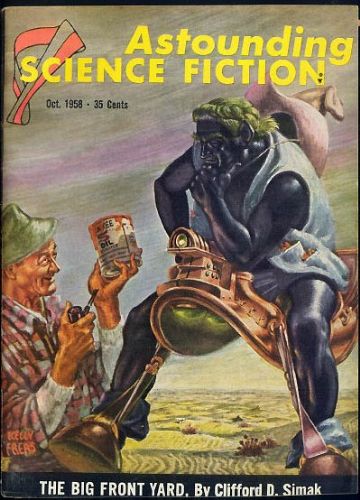
(Cover by Frank Kelly Freas. Astounding, October 1958.)
Who Goes There?
Clifford D. Simak is one of the most respected writers to come out of the so-called Golden Age of science fiction—this despite the fact that he was actually a pre-Golden Age practitioner of SF, having made his debut in 1931 with “The World of the Red Sun.” Simak became one of John W. Campbell’s regular authors in the ’40s, and then, without skipping a beat, he started submitting frequently to Galaxy Science Fiction in the ’50s onward. Unlike a lot of noted Golden Age writers, Simak was thoroughly a pastoralist, and also a humanist; his fiction often involves fundamentally decent rural types in plots which are rarely life-or-death scenarios. His obvious contempt for urbanity is counterbalanced by a gentleness uncharacteristic of most SF authors of his era, and at his best he can be deeply emotionally effective.
When Simak wrote “The Big Front Yard” in 1958, he had already been in the game for 27 years, and he would remain quietly yet consistently active for 27 more. According to David W. Wixon’s introduction to the story in the collection The Big Front Yard and Other Stories, Simak had originally submitted this piece to H. L. Gold over at Galaxy, but Gold rejected it; he then took it to Campbell, and Campbell bought it without hesitation. “The Big Front Yard” would go on to win the 1959 Hugo for Best Novelette (the Best Novella category had not yet been invented), and it would go down as one of Simak’s most famous stories.
Placing Coordinates
“The Big Front Yard” has been reprinted a fair number of times, so you’ll have no problem finding it. Assuming you don’t mind reading online or with a PDF, the October 1958 issue of Astounding in which it originally appeared is on the Archive. As far as book reprints go we have some easy-to-find options, including the aforementioned The Big Front Yard and Other Stories in ebook and paperback—though I must warn you that Open Road Media is, at best, a second-rate publisher, and I seriously lament the fact that so many books by authors I love have fallen into their hands. Typos and weird formatting decisions abound, such as the fact that FOR NO REASON the scene breaks were removed in their series of Simak’s collected short fiction. Chapter breaks are still intact, but scene breaks, which are arguably more important? Gone. How shitty.
If you want (in my opinion) more reputable reprints, I would recommend the anthology The Hugo Winners, Volumes One and Two; it’s super-duper out of print, but since this tome seemed to get around a lot back in the ’70s, used copies are pretty easy to find without breaking the bank. You also get the rest of the short fiction Hugo winners between 1955 and 1970, so that’s a big plus. Another great option is The Science Fiction Hall of Fame Volume Two B, the second half of (you guessed it) The Science Fiction Hall of Fame Volume Two. Unlike the former anthology, this one is very much in print, and seems to have remained so since its initial publication.
Enhancing Image
This is a first contact story, and maybe one of the most upbeat of its kind, though Simak misdirects us at first into thinking it won’t be.
We follow Hiram Taine, a handyman and trader of “antiques” (in reality just old junky furniture he cleans up and sells at a hefty price), just your average rural Wisconsin dude. He has a dog named Towser and he likes to chat with another local man named Beasly, who’s apparently not very bright but who likes to hang out with Taine and help him with his work. Random, but I couldn’t help but notice the dog has the same name as the protagonist’s dog in Simak’s earlier story, “Desertion.” Is this supposed to mean anything? How many Simak stories have dogs named Towser?
Anyway, Taine is hired to fix a TV set owned by the Hortons, Henry and Abbie, with Henry being boss man at a local plant (a computer plant, apparently). The TV is old and, according to Taine anyway, replacing it would probably be cheaper than repairing it, but it comes with a radio and a record player, and Abbie won’t replace it. Taine and Beasly move the bulky TV into the basement when this happens:
“Well, Hiram,” she said, excited, “you put a ceiling in the basement. It looks a whole lot better.”
“Huh?” asked Taine.
“The ceiling. I said you put in a ceiling.”
Taine jerked his head up and what she said was true. There was a ceiling there, but he’d never put it in.
Taine has one of those unfinished basements—only now it’s a little less unfinished. Not only does his basement have a ceiling that he didn’t have installed, but it seems to be of a metallic substance, except it’s not any kind of metal Taine recognizes. Later that day, he tests the ceiling and finds that a drill won’t penetrate it, or even leave so much as a scratch. Well that’s weird. At this early point in the story, Taine notices some things are different about his house, and normally this would be played for suspense, which is kind of is—but, as I said, this is misdirection.
Indeed the first stretch of “The Big Front Yard” feels almost like a subversion of what would, even in 1958, sound like the set-up for a spooky alien invasion story. You know how superstitious people will sometimes say dogs can see ghosts or some goofy shit like that? Towser spends much of the story trying to find a woodchuck that doesn’t exist, but we’ll get back to that in the spoilers section. Clearly something has started living in or around the property, and it doesn’t stop with Taine’s basement getting refurbished. Several of the junky odds and ends have been mysteriously repaired, even improved in some cases; the big TV set Taine got for repairs is now not only fixed without his help, but it now also plays in color (remember, 1958). You and I know, even going into this, that aliens are involved, yet the surprising part is that rather than hint ominously at a future attack on humanity, these aliens seem, if anything, to be pretty benign, if not outright friendly.
What I like about a lot of Simak’s work, and what he does to an almost perfect degree here, is he refuses to bend to the Golden Age cliché of aliens being depicted as evil outsiders, along with the xenophobic implications; aliens rarely play the villains in Simak’s fiction, but then Simak’s fiction tends to be light on conventional villains. Taine is also not your typical Golden Age protagonist: he’s not a scientist or a politician, he’s not what you’d call a genius, and he’s by no means the physical encapsulation of what Campbell would’ve considered the “ideal” man. Like a lot of Simak protagonists, Taine is a hard-working (if not entirely honest) Midwesterner who’s just looking to make a buck. Honestly I scratch my head as to why Gold rejected “The Big Front Yard” and Campbell bought it; it feels like the roles should’ve been reversed.
Before long, Towser, in his efforts to find the woodchuck, finds something else right by the house, and digs furiously for it. Already aware that something definitely strange has been going on, Taine and Beasly dig up whatever Towser sniffed out, and what they find is indeed strange: a large oval-shaped contraption buried in the ground, made of a glassy metal that Taine knows he’s never seen before. Fear runs through his veins, but he also experiences what we might call a conceptual breakthrough—a discovery of something beyond known human limits that counteracts the fear with a sense of wonder. “A sense of wonder” is a really old and cliched phrase in SF, especially Golden Age SF, but I think there are a few moments in “The Big Front Yard” alone which do it justice.
And the conviction grew: Whatever it was that had come to live with him undoubtedly had arrived in this same contraptions. From space or time, he thought, and was astonished that he thought it, for he’d never thought such a thing before.
Life on other planets? You bet. What else could it be? Like any first contact story there is at least some uncertainty involved, but as is typical of Simak, there’s also a gentle whimsy and that aforementioned sense of wonder which gives us the impression that Taine, Beasly, and the others aren’t in any real danger, despite the mysteriousness of the situation. If our boys thought the repaired junk and the large glassy contraption were weird, though, they’re about to have the sight of their lives, after they’ve finished with the digging and come back around to the front of the house.
He and Beasly went up the gravel driveway in the dark to put the tools away in the garage and there was something funny going on, for there was no garage.
There was no garage and there was no front on the house and the driveway was cut off abruptly and there was nothing but the curving wall of what apparently had been the end of the garage.
The front of the house is folded in on itself. The back is still good, though! But yeah, uhh, how did this happen? Why? Taine’s scared, but now he’s also utterly baffled. Our boys enter through the back door, and… the front of the house is still there. From the inside. Except whereas it had been nighttime outside the house, now there’s daylight breaking through the front windows which are no longer there from the outside.
“The Big Front Yard” can be more or less split into two halves, those being before and after the front of the house gets miraculously folded. If the first half of the novella has almost a magic realism feel about it, it becomes something more akin to a planetary romance in the latter half. I won’t say too much in the spoiler section, since the plot becomes more straightforward at this point, but it also becomes even more charming and readable. The whole thing can be described as “cute,” which is not a word I would use with the vast majority of Golden Age SF (FYI, I do consider the “Golden Age” to be the ’50s, not the ’40s), but “The Big Front Yard” is just a happy-go-lucky tale which refuses to take itself overly seriously.
There Be Spoilers Here
The front of the house, from the inside, opens to a different planet—a vast desert landscape with a sun different from ours. The front of Taine’s house, including his car and driveway, has been transported to this new world, in a way, and conversely the back of the house is now folded on itself. This is where we meet the aliens who have apparently taken up residence on Taine’s property: little ratlike creatures with humanoid-ish faces. These aliens pay Taine no mind and simply keep walking in a single file line through the desert. There’s also… du-dum… another house which serves the same function as Taine’s, except this one appears deserted, serving as a gateway between the desert world and a third world, this one being more jungle-like. Taine’s house seems to have become part of a network of houses which serve as portals for other worlds.
This was another world—there could be no doubt of that—another planet circling another star, and where it was in actual space no one on Earth could have the least idea. And yet, through some machination of those sixteen things walking straight in line, it also was lying just outside the front door of his house.
Soon we run into a different alien race, one which is decidedly more humanoid in appearance; these guys ride on what appear to be horseless saddles, though our boys gather that the humanoid aliens use some kind of anti-gravity device. Far more unfortunately, we also have to deal with the US government putting their filthy hands in things. It was a cliché, even at the time, for the government to get involved with ayy lmao affairs, though Simak’s irreverence for the soldiers and bureaucrats here is somewhat refreshing; they’re the closest thing the story has to villains, and while they are somewhat of the mustache-twirling variety, they’re not too harmful. Really the most tense thing to happen in the whole story is when Taine loses Towser in the desert world for a bit, but it’s okay, he finds him. Towser is such a good boy; there should be a Hugo for Best Dog.
What do these aliens want, though? And what will it take for the government to not take possession of Taine’s house? The solution ends up being a mighty convenient one: Beasly, while not being the sharpest tool in the shed, is able to communicate with the aliens, and as it turns out, the aliens are looking to start a trading relationship with mankind, as part of a network of interplanetary traders. Rather than wanting to trade top-secret info on weapons, the aliens want more practical things, like the very concept of paint, which is somehow foreign to them. The big twist of “The Big Front Yard” is that Beasly is telepathic; that’s right, he can communicate with others using his mind—even Towser, who’s a dog, and even the aliens, who are… aliens.
Suddenly I can see why Campbell would’ve liked this.
I do find this twist to be the least convincing part of the story. You could say it’s far-fetched that Taine is able to walk and breathe fine on an alien planet without any technological assistance, but I would also say you’re a killjoy who probably had a really boring childhood. I guess my problem is that the telepathy thing, even if it’s used to hand-wave communications between humans and the saddle-riding aliens (which it is), doesn’t cover for the fact that our languages would be completely different. That and while I feel like Towser sensing the aliens, including a giant woodchuck-looking alien, was foreshadowed well enough, I find Beasly’s secret power to be less convincing. People were just really into ESP at this time, huh?
Even so, all is well. The aliens want to become trading partners with mankind, with Taine as mankind’s ambassador and Beasly as his interpreter. The government will keep off their backs, at least for the time being, and anyhow, in the meantime they can learn some pretty valuable things from the aliens. It all looks like the beginning of a beautiful business relationship.
A Step Farther Out
Clifford D. Simak would win two more Hugos, and was the third person to be given the Grand Master Award by the Science Fiction and Fantasy Writers of America (after Robert Heinlein and Jack Williamson). Despite this immense honor, Simak now stands as a somewhat obscure figure (not unlike Williamson, actually), and I see that as a big shame, because his work has certainly aged better than a lot of Heinlein’s. Heinlein is one of my all-time favorite authors, maybe top five material, but he can be pretty embarrassing when he doesn’t have his eye on the prize. Simak, meanwhile, continued to produce respectable work well into the ’70s, after many of his contemporaries had either died, retired, or pulled a Heinlein.
Simak would win his third Hugo in 1981, and he would remain active until just a couple years before his death in 1988. The world of SF, and even genre fiction at large, would surely be worse off without him.
“The Big Front Yard” may not be Simak’s best story, but it might be the best example of what made Simak different from so many other SF authors in the ’40s and ’50s. While there is a bit of light misogyny with Abbie Horton’s characterization (she’s described as “bossy” at one point), it’s otherwise remarkably devoid of racism and jingoism. I also get the impression, just from reading this, that Simak was probably horrified and disgusted by the dropping of the atomic bombs on Hiroshima and Nagasaki; indeed his fix-up “novel” City partly feels like a cry against atrocities (be they Allied or Axis) committed during World War II. It would’ve been easy to initiate the partnership between mankind and the saddle-riding aliens for the purposes of exchanging weapons of mass destruction, but Simak did not seem keen on putting such an option on the table.
There’s a tenderness running through much of Simak’s fiction; you could say it’s an aversion to violence, and if Simak has any big weakness it’s that maybe he can be too much of a softy—a criticism one could aim at few, if any other Golden Age authors, I can assure you. “The Big Front Yard” has been held as a classic for decades, and while some classics of the field keep that title more for historical importance than enjoyability, this is a classic whose value very much persists. It’s a damn fine story, regardless of age.