(Cover by H. W. Wesso. Strange Tales, January 1932.)
Let me tell you about monsters.
I love monsters of all sizes, although I have to admit I tend to prefer the giants that stalk whole landscapes. The bigger the better, but then “bigger” doesn’t always mean physical size. I love Frankenstein’s monster, especially Boris Karloff’s mildly talkative and rather emo depiction in Bride of Frankenstein, with his hungering for both love and death. I love Max Schreck’s Count Orlock in Nosferatu, who despite being modeled on Dracula seems to be almost more rat than man. I love the blob, especially in the 1988 version of The Blob—a mindless eating machine that digests people while they’re still alive. I love Godzilla, Mothra, Rodan, King Ghidorah, and even Hedorah, the walking turd that might be the strangest of Godzilla’s foes. I love the zombies of George Romero’s Dawn of the Dead and Day of the Dead, the shambling corpses who walk the earth in search of something they can’t put a rotted finger on. I think the creature from the black lagoon deserves a break (which he finally gets in The Shape of Water, a Best Picture winner!) and I think werewolves are SEXY.
Fantastical horror always involves monsters, even if they’re the theoretical ghosts of Henry James’s The Turn of the Screw. As such the stories I pick for review every October (and it will be every October for the foreseeable future) always seem to be monster tales at their core. It’ll be Halloween soon and we’re putting up the decorations. We’ll be seeing vampires, ghosts, zombies, werewolves, witches, black cats, and things from beyond that cannot be easily classified. Because I believe horror, more than any other genre, benefits from brevity, we’ll be doing all shorts again. These are rapid-fire terrors that hopefully will ignite the imagination.
We have the usual suspects: Weird Tales, Twilight Zone Magazine, The Magazine of Fantasy and Science Fiction. Certain outlets have served as safe havens for short horror fiction through the decades, and admittedly I would feel weird if I were to not include a selection from something as foundational as Weird Tales. Some traditions ought to be respected.
Here are the stories:
“Not Our Brother” by Robert Silverberg. From the July 1982 issue of Twilight Zone Magazine. We’re starting with someone who probably doesn’t come to mind when one thinks of horror, although Silverberg’s work can sometimes evoke existential dread. Having made his debut in the early ’50s and still active in fandom, Silverberg has had one of the longest careers of any writer—inside or outside the field. This is a rare example of him doing straight terror.
“Nightmare Island” by Theodore Sturgeon. From the June 1941 issue of Unknown. I consider Sturgeon one of the finest short story writers of the 20th century, and a major inspiration. Without Sturgeon and those like him this site probably wouldn’t exist. While most associated with SF, Sturgeon wrote a good deal of horror, including the stories “Bianca’s Hands,” “Bright Segment,” and the novel Some of Your Blood. This one is from very early in Sturgeon’s career.
“The Naturalist” by Maureen F. McHugh. From the Spring 2010 issue of Subterranean Online. McHugh won a Hugo for her alternate history story “The Lincoln Train,” and her debut novel China Mountain Zhang is one of the cult classics of ’90s SF; but her range goes well beyond alternate history as she has proven herself to be quite versatile over the last 35 years. “The Naturalist” looks to be a rare horror turn from McHugh, having to do with zombies.
“The Ancient Mind at Work” by Suzee McKee Charnas. From the February 1979 issue of Omni. I had a bad first experience with Charnas a couple years ago, but have been meaning to give her another shot since her reputation is solid and her devotion to the weird is unquestioned. “The Ancient Mind at Work” was Charnas’s first short story, although she already had two novels in print. It would then be absorbed into the fix-up novel The Vampire Tapestry.
“Pipeline to Pluto” by Murray Leinster. From the August 1945 issue of Astounding Science Fiction. Here we have another surprising inclusion, given Leinster isn’t normally associated with horror. He first started writing genre fiction in 1919, predating even Weird Tales. What’s surprising is that not only did he stay relevant several decades into his career, but he peaked in the ’40s and ’50s, holding his ground against writers a generation younger than him.
“Brenda” by Margaret St. Clair. From the March 1954 issue of Weird Tales. I covere St. Clair only a few monthss ago, but she’s back already. She wrote a lot in a relatively short span of time (mostly from the late ’40s to the late ’50s), and during that time she was arguably one of the best short story wrriters in the field. Not one to be tied down to any single genre, or even any mode of writing, St. Clair swerved effortlessly between pulpy and more refined prose.
“Jedella Ghost” by Tanith Lee. From the September 1998 issue of Interzone. One of two returning authors from last October, because honestly I wanna taste more of what Lee has to offer before forming a real opinion; that and she’s such a prolific and consistently spooky writer that her well never runs dry. I’ve read one or two of her stories since our last encounter (which admittedly did not enthuse me) and I think I’m starting to get what her deal is.
“The Door to Saturn” by Clark Ashton Smith. From the January 1932 issue of Strange Tales. The other returning author from last year’s Spooktacular, and this time it’s because I do love me some Clark Ashton Smith. While he can sometimes phone it in, Smith’s writing is often vibrant, poetic, and deeply enchanting—like a wizard casting a spell. Here we have a story set in his Hyperboria universe, a land where sorcerers and dark gods are in charge.
“The Last Feast of Harlequin” by Thomas Ligotti. From the April 1990 issue of The Magazine of Fantasy and Science Fiction. We’re ending with what has to be the longest story of the bunch, but it’s by one of those rare modern masters of horror. Ligotti is not the most popular writer in his field, but those who read him hold him in the highest regard. A devout student of Lovecraft, Ligotti’s fiction can be disturbing by way of implication, as opposed to violence.
(Cover by Virgil Finlay. Weird Tales, March 1953.)
Who Goes There?
When it comes to authors I’ve never read before I always feel a bit nervous when writing this section, because I have to give some context for an artist whose work I have next to no context for. This was not even gonna be my first Mary Elizabeth Counselman story, as I had planned at some point to cover her back in March as part of my Weird Tales tribute, but plans change and now I can’t even remember who I replaced her with. It’s a shame, because while she doesn’t get brought up as nearly as often as H. P. Lovecraft or even C. L. Moore, Counselman was clearly loyal to Weird Tales in its first incarnation, continuing to get published in it up to the bitter end. Doubly a shame because the first Counselman story I ended up reading, todays’ pick, is rather dull, and I don’t have much to say about it—although there are a few points of interest I’ll be sure to write about here. What the hell, I’m not getting paid to do any of this, and this work will not redeem me, nor will it probably turn me into a more understanding person.
Placing Coordinates
First published in the March 1953 issue of Weird Tales, which is on the Archive. I was surprised to find “Night Court” has been reprinted several times, most notably in Witches’ Brew: Horror and Supernatural Stories by Women (ed. Marcia Muller and Bill Pronzini) and Great American Ghost Stories (ed. Martin H. Greenberg, Frank D. McSherry, and Charles G. Waugh). It’s definitely a ghost story, but I wouldn’t call it great.
Enhancing Image
We follow Bob: Korean War veteran, 22-year-old husband-to-be, mostly upstanding citizen, and a bit of an asshole. Bob has the very bad habit of reckless driving—not road rage exactly, but an immense carelessness that, we’re told, has gotten him into big trouble a couple times already. If not for a certain family connection in the local legal system Bob would probably be seeing jail time, but thanks to a powerful uncle he just once again got no more than a slap on the wrist for running over an elderly black man (these are not the words used in-story, mind you). Unluckily for Bob, but perhaps for future potentials victims of his behavior on the road, Bob is about to take a detour against his will… into the Twilight Zone.
Jokes aside, this does read like it could be adapted (and perhaps elevated) into a classic Twilight Zone episode, although more because of its structure and moralism than the quality of the thing. Bob is a one-note character, a good-for-nothing who exists in the context of the story to be taught a lesson, but even so there are a couple things about him that struck me. For one, I’ve read a good deal of ’50s SFF at this point, and shockingly little of what I’ve read directly mentions the Korean War; indeed the only SFF author I can think of off the top of my head who’s a Korean War veteran would be Jerry Pournelle. Mind you that the cease fire would not be declared until several months after “Night Court” was published, so this was very much an ongoing conflict when Counselman wrote it. Also, making the villain protagonist of your story a military veteran pre-Vietnam is certainly a choice. Bob talks about how he’s supposedly a hero for “killing fourteen North Koreans” but is labeled a hazard for accidentally killing a couple people on the road. He may have PTSD, but this is sadly not elaborated upon.
After seemingly having run over a little girl whilst rushing to meet up with his fiancée, Bob gets pulled over by a highway patrolman—only this is not a normal man, going by appearances, his thick goggles obscuring his eyes but also giving him an almost skeletal look. “Bob squirmed under the scrutiny of eyes hidden behind the green glass; saw the lips move… and noticed, for the first time, how queerly the traffic officer held his head.” The officer’s neck is craned as if it had been broken or mangled, yet surely the officer still lives. Things only get weirder (although not that weird) when the officer, ignoring the girl under Bob’s car, takes Bob in to be judged at the night court—which is like normal court but sPoOoOoKy. We have, by this point, pretty thoroughly left the confines of everyday reality, hence the Twilight Zone comparison, although once I realized what kind of story this was I have to admit my mind sort of went on autopilot from hereon out.
I knew nothing about “Night Court” going into it other than that it would be a tale of the supernatural, entailing some kind of judgment, and these were not incorrect assumptions! Unfortunately what I got was also a PSA on how you should watch where you’re going on the road, and it’s like… I get it, this was back before we even had seat belt laws; cars were little more than metal death traps. At the same time, I’m legally blind, so I don’t have a driver’s license, let alone a car myself. You may recall in high school how you were taught about the perils of drunk driving and texting on your phone while driving, that sort of thing. As someone who is faaaaaaaar more likely to be the victim of a hit-and-run than a perpetrator, I feel qualified to say that while this is an important lesson to learn when you’re young in the real world, it does not make for compelling storytelling. We learn that the people overseeing Bob’s trial in the night court are all victims of auto accidents, including the old man he had recently killed, and I get that this makes sense—I just don’t find it that interesting or worthy of study.
In 1953 this was probably seen as more necessary to get across in writing, but after decades of TV PSAs I think we’ve moved well past the point where a story like “Night Court” feels worthy of note.
There Be Spoilers Here
I will say, though, that the twist was not one I was expecting. You would expect the girl Bob had run over to appear at the night court as his most recent victim, but actually the girl does not exist—yet. The judge says that the girl will be born years from now, and if Bob doesn’t change his ways then he will kill this girl somewhere down the line. This gets a single golf clap from me. Less interesting is that said girl is implied to be Bob’s future daughter at the very end, which I don’t think is a necessary touch. I was expecting the story to end in a more predictable but tragically ironic way, like Bob promising to better himself only to get killed in an accident by another reckless driver, but the ending we got was anti-climatic by comparison; not as predictable, true, but it also left me feeling a little empty. Maybe Counselman had become weary of conventional twist endings? I would’ve gone for something more gruesome is what I’m saying.
A Step Farther Out
Not that all ghost stories have to be scary, but when I’m reading one I expect to feel something in connection with the supernatural; not always fear, but often an uncertainty, a sense of mystery at the unexplainable. The Turn of the Screw is not what I would call scary, but it is effective and memorable as a psychological study and as an extended metaphor—a metaphor for what we’re not so sure about. For “Night Court” I felt either detached or a little annoyed at the preachiness of it, which strikes me as old-timey even for 1953. It’s not scary or eerie, certainly, but it also reads like Counselman is wagging her finger at the reader and expecting us to take an important life lesson away from it. I usually don’t like moralism in my fiction (which is funny, given I’m a big Twilight Zone fan), but I’m willing to forgive that if the message is given a humane (not to say delicate) touch—only “Night Court” is not in touch with what I would call the pains of the human condition.
(Cover by Margaret Brundage. Weird Tales, December 1934.)
Who Goes There?
Given that her career as an a genre writer was cut short, on account of the premature death of her first husband Heny Kuttner, C. L. Moore’s time in the field was wide-spanning and much lauded. Nowadays (unless you’re a Weird Tales fan) she’s most recognized for her collaborations with Kuttner and the occasional solo story written during their marriage, but Moore gained cred as one of Weird Tales‘s most gifted writers within a year of her professional debut. Her planetary vampire story “Shambleau” was an instant hit and editor Farnsworth Wright cheerleaded her as a force to be reckoned with; within a year she established the two series that would define the first stage of her career, contributing to the planetary romance with Northwest Smith and the fast-growing sword-and-sorcery tradition with Jirel of Joiry. I recommend reading my review of the first Jirel story, “The Black God’s Kiss,” before continuing with this review, since today’s story very much assumes you’ve read what came before it.
Placing Coordinates
First published in the December 1934 issue of Weird Tales, which is on the Archive. Because this is a direct sequel to “The Black God’s Kiss” and thus does not stand on its own, it’s be reprinted considerably fewer times than its predecessor. The good news is that you can still find it readily in Jirel of Joiry and Black God’s Kiss, collections which as far as I can tell are mostly identical and which collect the whole (rather short) series. If you’re British and/or you suck eggs then there’s the SF Gateway omnibus collecting Jirel of Joiry, Northwest Smith, and the short novel Judgment Night.
Enhancing Image
It hasn’t been long since the end of “The Black God’s Kiss,” and yet despite having had her vengeance on the rogue invader Guillaume, Jirel has been tormented by guilt. She had ventured into the dark underworld beneath the castle of Joiry and received the most cursed of weapons: a kiss from a black Buddha-like statue in a temple. Not only did the kiss kill Guillaume but it seemed to send his soul to the underworld, which is the part that’s been troubling Jirel so much. You may recall the ending of “The Black God’s Kiss” was a bit odd, maybe problematic, due to Jirel realizing—too late—that her immense hatred for Guillaume was actually lust (or “love,” but let’s be real with ourselves, what Jirel feels is not love) in disguise.
The first story was almost a subversion on the sword-and-sorcery formula with how it de-emphasized action in favor of describing, in a great detail, an environment totally alien to human experience; call it a Lovecraftian heroic fantasy. Jirel herself is heroic in that she’s quite brave, true, but she’s really an anti-heroine, having no problem with chopping dudes’ heads off if they come into her castle without her consent (this both does and does not feel like a euphemism), and it’s not like she has any virtuous plans for the world in mind. She’s also not a virginal waif who has never seen a man’s drill before, as it’s made clear to us that she’s taken on several lovers before. I’m just gonna say it: she’s a top. The sexual undertones of “The Black God’s Kiss” are more or less absent in “Black God’s Shadow,” though, as Jirel is less concerned now with satisfaction than she is with finding inner peace.
The opening scene focuses on Jirel trying and failing to sleep at night, her castle restored but her faith in herself wrecked. She considers the possibility of Guillaume, in some spirit form, wandering the underworld beneath the castle, calling her out for her act of strange cruelty.
By the power of that infernal kiss which she had braved the strange dark place underground to get as a weapon against him—by the utter strangeness of it, and the unhuman death he died, it must be that now his naked soul wandered, lost and lonely, through that nameless hell lit by strange stars, where ghosts moved in curious forms through the dark. And he asked her mercy—Guillaume, who in life had asked mercy of no living creature.
Jirel knows what she must do: return to the underworld and find some way to put Guillaume’s soul to rest. Pretty simple goal, right? And it is! This is even more straightforward on a plot level than the first story, to the point where it actually becomes a bit hard to talk about. It’s a bit shorter than “The Black God’s Kiss” but feels about the same length because of the density of Moore’s descriptions, compounded by the fact that there’s virtually no dialogue this time around. We have three characters, but without being too specific for fear of spoiling only one of them is both human and alive; therefore don’t expect to read conversations here.
Another thing to take into account is that there’s even less action here than in “The Black God’s Kiss,” with Jirel fighting off strange creatures so much here as battling the strangeness of the underworld and her own psyche, which has taken a hit since the end of the first story. The most we get prior to the (rather prolonged) climax is an encounter with an unseen venomous creature that goes after Jirel’s legs during the underworld’s starlit nighttime—a bit of horrific ambiguity that shows once again that Moore could’ve become a horror maestro on par with Lovecraft and Howard had she kept going down this path. Indeed it’s here in her early fiction that Moore is the most poetic, being preoccupied with capturing places and emotions to an extent that may read to some people as trying too hard but which nevertheless gives the Jirel of Joiry stories a unique weird-adventure atmosphere.
With that said, some of the things I found memorable from “The Black God’s Kiss,” such as Jirel’s encounter with her evil mirror image and the herd of blind white horses, are gone here, replaced with things which do not strike me as eerie or memorable. The temple where the black god dwelled in the first story is no longer on an issland connected to the rest of the underworld by an invisible bridge but is instead at the head of a river. Stuff has changed around without explanation, which I suppose makes sense given the unhuman and eldritch nature of the underworld, but there are still certain rules it abides; for example, Jirel still has to ditch her crucifix in order to see the vast underground realm for what it is.
As far as Jirel’s wandering the landscape goes there’s a bit of “second verse, same as the first” at work, but what makes this one distinct is how it refuses to turn into an action fantasy. Actually I’d go so far as to say “Black God’s Shadow” is considerably more obscure than its predecessor because it almost doesn’t work as a short story—nay, it reads almost more like a prose poem, written by someone who may or may not have survivor’s guilt. I don’t know enough about Moore’s life to speculate, but I do have to wonder what could’ve prompted her to zero in on trauma and overcoming said trauma like she does in the first two Jirel of Joiry stories. There’s a darkness lurking at the core of these stories that makes them hard to grapple with, even from a modern reader’s perspective—a meditation on guilt and the dark side of lust that rings somehow as more personal than is to be expected from a 1930s fantasy series starring a bad bitch with red hair.
I don’t like “Black God’s Shadow” as much as what came before it, but when taking the two stories as two halves of one whole I do think they work better together than each on its own. “Black God’s Shadow” is gloomier and more contemplative than its predecessor, but as I’ll explain it’s also the more uplifting of the two at the end of it.
There Be Spoilers Here
The climax is basically a standoff between Jirel and the black god, the living and demonic statue she made a deal with before, now her adversary. Guillaume’s soul is kept prisoner by the black god and Jirel has to free it while also not being taken prisoner herself. A lot happens… and yet not a whole lot if you think about it. This is a spiritual battle, but it’s more so a psychological one. Jirel has to forgive both Guillaume and herself; in other words, she has two souls to save. While Jirel is unable to resurrect the man she had killed (thankfully Moore does not pull such a deus ex machina), she is ultimately able to free his soul from the black god’s clutches. While Jirel is unsure as to where Guillaume’s soul went, his voice no longer haunts her in her mind and dreams, which means we’ve gotten about as happy an ending as we can expect. Jirel’s victory is hard-won, but she has learned to love herself again, and thus this chapter in her life has now ended.
(I have to wonder how the next story, “Jirel Meets Magic,” follows up on the sheer darkness here, but my assumption is that it won’t, which is fair. A direct acknowledgment of Jirel’s suffering henceforth is unneeded.)
A Step Farther Out
I pulled up the letters column in the February 1935 issue of Weird Tales, which has responses to the December 1934 issue, and was dismayed by how unconstructive responses to “Black God’s Shadow” were. There’s the usual “I really like this and all hail C. L. Moore” stuff, but nothing I could find about how radically different “Black God’s Shadow” is from its predecessor, despite the two very much forming a duology—even more so when we consider that Moore very likely wrote the two back-to-back and had already sold “Black God’s Shadow” to Wright before “The Black God’s Kiss” saw print. The two were printed as separate stories and not part of a serial because, I reckon, there’s a clear divide between them such that they sort of mirror each other, and would not cohere as part of a single narrative. Still, with Jirel having resolved the internal conflict that plagued her since the end of “The Black God’s Kiss,” she was free to go on other adventures, and Moore was free to not return to Jirel of Joiry for several months.
(Cover by Margaret Brundage. Weird Tales, March 1937.)
Who Goes There?
Dorothy Quick is a name I recognize but prior to today’s story have not read anything by; specifically I know her as a contributor to Unknown, wherein her most prominent work would be a series of short stories called the Patchwork Quilt series, which sadly only has three entries and which Quick apparently abandoned by the time Unknown died. We don’t know a lot about Quick: we know she started writing SFF in the early days of genre pulp and that she basically stopped once the first incarnation of Weird Tales went under. She seems to be one of those authors whose genre output positively correlates with the state of magazine fantasy, in that once Unknown closed that was a market gone for her, and Weird Tales later closing must’ve been the last straw. She did, however, continue to write fiction in mainstream outlets. Anyway, I feel bad because I don’t have much to say about today’s story and I can’t say reading it filled me with confidence about covering Quick in the future, though I do wanna get to those Patchwork Quilt stories.
Placing Coordinates
First published in the March 1937 issue of Weird Tales, which is on the Archive. Judging Margaret Brundage covers, on a scale from 1 to 10 with 1 being chaste and 10 being “Is this pornographic?,” I would give this one a 2 or a 3; it’s pretty tame. I didn’t even notice the naked girl with the orchid on her body at first. Anyway, sad reality with most pulp-era lady authors is that their stuff doesn’t get reprinted often, and “Strange Orchids” is no exception. As far as I can tell there’s only one reprint, that being Sisters of Tomorrow: The First Women of Science Fiction (ed. Patrick B. Sharp and Lisa Yaszek), which thankfully looks to be in print in hardcover and paperback. But yep, looks like those are all your options.
Enhancing Image
We start with Louise, the narrator/protagonist, telling us that everything basically turned out fine in the end: oh sure, her hair is white now from getting spooked so hard, but she came out of whatever ordeal it was fine and she even ended up with this guy she really likes. This might be the fastest way possible to defuse tension, and I don’t know why Quick informs us of the bittersweet ending so far in advance. Within just a few sentences we get one of my biggest issues with this story, which is that Louise is not in any real danger; at most she has a tough time for a bit, we already know she gets better, and thus this is a hard story to spoil.
Whilst at a friend’s party, Louise meets the other two corners of what amounts to a love triangle: Rex, who is obviously a Good Guy™ and the aforementioned handsome fella Louise gets together with; and Angus, who is so obviously the villain that it’s actually not funny. (Never trust a guy named Angus.) Just how obvious is Angus’s villainy? Well, there have been several girls who’ve gone missing as of late, under similar circumstances, and Angus over here is acting incredibly suspicious—to the point where, if not for the plot that unfolds, Angus would probably be the first white man in history to get arrested simply for acting like someone who ought to be arrested. That Angus acts creepy towards Louise, simultaneously insulting her and trying to seduce her, should already make him a suspect.
Hmmmmmm.
To make things slightly more complicated, Rex is a G-man who’s part of a task force looking for these missing girls; already this story strains my suspension of disbelief by depicting a federal agent as a good guy who will not do anything morally dubious. I’m getting ahead of myself, as you may guess, but there’s really not much of intrigue here. I will, however, list off a couple things—really little more than references themselves—that I found at least memorable, if not very substantive.
The first is that there are several references to homosexuality sprinkled in the text that ultimately don’t amount to anything, but which are still work mentioning considering this is the ’30s and it was uncouth to mention homosexuality in pulp fiction. Right away, during the party in the opening stretch, we have a reference to “female impersonators,” whom we’re to take as transvestites (probably the word that would’ve been used at the time, or something even less flattering). Any queer man who’s lived in the past century will be at least a little familiar with the term “female impersonator,” which seems to cover anyone from drag queens or just gay men who dress in feminine-leaning attire. Again, not flattering, but Quick even mentioning this at all is above what we’d normally expect from ’30s pulp fiction.
The other thing is the coded homosexuality of Angus, who despite seeking to own Louise (as a wife but also maybe as something else), comes off as a bitchy and effeminate gay man, even being called “Oscar Wildish” at one point. He dresses well and Louise can’t help but notice the soft whiteness of his hands, “the hands of an artist or a dreamer,” which indicate that a) he’s not used to doing menial labor, and b) he pays more attention to grooming himself more than the average man. He’s also obsessed with flowers, especially orchids (I wonder why), with flowers typically being taken as symbolically feminine. There’s another reason why Angus’s heterosexuality is rather hard to take at face value, but I’ll get to that (briefly) in the spoilers section; it’s not like I can talk about much else.
Finally, we get a reference to contemporary cinema here, which does not happen often in genre fiction from any era, let alone one where sound film was still a recent phenomenon. There’s a movie starring Lionel Barrymore (yes, related to Drew Barrymore) wherein a mad scientist “reduced people to dolls” and made them do his bidding. I’m pretty sure this is supposed to be The Devil-Doll, but it goes unnamed in the story—point being it’s almost certainly a real movie. Now isn’t that fun?
Easy to forget I’m a movie buff, but whatever.
There Be Spoilers Here
Zzzzzzzzzzzzzzzzzz…
Okay, I do wanna talk about the ending a bit, if only because it kinda pisses me off; not because the ending on its own is bad, but because it wastes the last chance this story had to become really interesting.
Louise and Rex hatch a plan to nab Angus, since Rex already suspects Angus (as would anyone with more than two brain cells) but lacks hard evidence with which to book him. The plan goes amiss since for some reason Angus is telepathic and can read Louise’s intentions, thus kidnapping her and having a rather protracted James Bond villain moment wherein he explains (at length) what he plans to do: namely he wants to turn Louise into another slave, hypnotized via a special kind of orchid Angus has been breeding, to go along with the other girls he has kidnapped.
But all is well! Well Rex and the other feds are unable to save the other girls, who by this point have become humanoid abominations with orchids sprouting out of their chests, they’re able to save Louise in the nick of time. They uhh, gas Angus’s mansion? I wonder how that would read to a post-World War II audience. Anyway, my main problem here is that Louise is never in real danger, in that she does basically nothing in order to save the day since Rex is at her beck and call and the feds managed to break in without her input. Despite being the narrator, and you’d think the protagonist, Louise is ultimately little more than a damsel in need of rescuing, and I have to say I expected better.
How disappointing.
A Step Farther Out
In covering exclusively Weird Tales stories this month I’ve run the spectrum of genres that saw print in that magazine, but also a spectrum of how I feel about these stories, from the sublime (“The Black God’s Kiss”) to the putrid (“The Dreams in the Witch-House”) and everything in between, and “Strange Orchids” is certainly in that nebulous “in between” spot. This is about as middle of the road as you can get for me, in that I don’t dislike it exactly but I also don’t have anything strongly positive to say about it. If this story has committed a crime it’s the crime of being totally predictable, to the point where I was anticipating some kind of twist or catch to what seemed to me like a strictly formula affair, only to find out that no, this is not really a creative story but something that would’ve struck readers even at the time as nothing to write home about. I almost prefer something memorably bad like “The Dreams in the Witch-House” over a story so forgettable.
(Cover by Margaret Brundage. Weird Tales, July 1933.)
Who Goes There?
I’m about to talk some shit. I can’t say I’m a fan of H. P. Lovecraft, even though I’ve read a good portion of his work at this point and have liked some of it. Lovecraft, when he’s really up my alley, is pretty good: “The Rats in the Walls,” “Cool Air,” and “The Shadow Out of Time” are all bangers for me, with that last one especially standing out for its marrying of cosmic wonder with an equally strong dose of cosmic anxiety. But Lovecraft, IN MY OPINION, can also be pretty boring and full of himself, never mind his other limitations. You may notice for instance, especially in his later stories, that Lovecraft hates writing dialogue and will do anything to get around having to write basic human conversation. The irony is that, at least regarding his letter-writing, Lovecraft was very talkative; indeed the only reason we laymen even know about Lovecraft is because he formed several connections that proved valuable for preserving his work after his death. Based on his fiction alone, Lovecraft should have by all rights stayed as obscure as his close contemporary Clark Ashton Smith, whose stories are often more entertaining and who was overall the more elegant writer.
This, of course, is all just opinion, because the objective reality is that Lovecraft is the most influential horror writer of the 20th century and it’s not even close. Oh sure, Stephen King is the most popular, but popularity does not equate to influence and if we’re talking about authors whose tangibly left an impact on other authors, Lovecraft’s only serious rival would be Edgar Allan Poe. Everyone who even dabbles in cosmic horror must contend with Lovecraft’s legacy and it’s no coincidence that “Lovecraftian” horror is used interchangeably with cosmic horror; he didn’t invent the subgenre (Lovecraft made it clear that he was not the first), but he was, more than anyone, the guy who connected the dots and brought clarity to what must have seemed to a lot of people like just a bunch of stories written at different times by different people. His long essay “Supernatural Horror in Literature” is arguably the single most important document on the history of horror fiction, and it also gives us precious insight into how Lovecraft himself—that is to say, as a keeper of the flame that is horror fiction.
A little bit of bashing, a good deal more of praise. I’m putting all this upfront because there’s gonna be more bashing to come: today’s story is… not fun. “The Dreams in the Witch-House” (the hyphen removed for reprints) is a later Lovecraft story, set in what we now call the Cthulhu Mythos, and it’s what we might also call a noble failure. See, people called this story a turkey before it was even published: August Derleth admitted to not liking it, which didn’t stop him from submitting it to Farnsworth Wright, who promptly bought it. “The Dreams in the Witch-House” was written a year after At the Mountains of Madness, but was published three years before that short novel on account of the latter being rejected by Wright and collecting dust. I find this all ironic since while I think At the Mountains of Madness is unspeakably boring, the poor editing of “The Dreams in the Witch-House” strikes me as less excusable.
Placing Coordinates
First published in the July 1933 issue of Weird Tales, which is on the Archive. You may notice that the aura of these Weird Tales covers has changed radically since last time we saw them, the greys being replaced with an erotic blueness. Margaret Brundage did basically all of the covers for the magazine at the very height of its popularity, so from about to 1933 to 1937, and she sure did love her female nudes. Anyway, because this is a Lovecraft story, it’s very easy to find. You can read an easily legible online version via the H. P. Lovecraft Archive, found here. “The Dreams in the Witch-House” has been collected and anthologized many times over the years, despite opinion on its quality being widely varied; if you look up a given Lovecraft collection it’s probably in there.
Enhancing Image
Before I dig into this piece of shit, there are a few nuggets in the opening stretch that may trick you into thinking you’re about to read a good Lovecraft story, like “The Dunwich Horror” or “The Colour Out of Space.” For one, this is one of the few Cthulhu Mythos stories where Arkham is the main setting, whereas more often it’s simply alluded to. If you’re a Mythos fan there are chestnuts of the series you’ll notice quickly, such as the Necronomicon and that classic college for goths and edgy white dudes everywhere, Miskatonic University. Lovecraft even tips his hat to Robert E. Howard by including Von Junzt’s book (see my review of Howard’s “The Black Stone”), albeit under a different title. These Mythos stories all radiate Lovecraft’s undying love for New Endland, and “The Dreams in the Witch-House” might be the most New England-y of them all, not only taking place in Arkham but referencing Salem, that real-life eldritch location, heavily.
Speaking of Salem, the keyword for today is “witchcraft.” The villain of the story, Keziah Mason, is a 17th century witch whose exploits very much interest our hapless protagonist, Walter Gilman, a Miskatonic student who has rented a room in the house where Keziah had lived. The house, lorded over by unhinged Christian Joe Mazurewicz, is unique both for its history (having harbored a known witch and all) and its architecture, which Gilman finds to be… a little odd. The walls and ceiling of Gilman’s room are at odd angles, and I have to wonder if Lovecraft was inspired by the angular set design of The Cabinet of Dr. Caligari or if he had even seen that movie. (As weird as it sounds, Lovecraft really enjoyed movies, and on at least a couple occasions, including his late masterpiece “The Shadow Out of Time,” he was apparently inspired by movies he saw.) Any reasonable person would have rented some other goddamn house, but as the omniscient narrator makes clear, Gilman is not a reasonable man, with his closest ally, housemate Frank Elwood, also being a bit of an eccentric.
Back to witchcraft, Keziah was tried in Salem, in the court of one Judge Hathorne, a name that will ring a weird bell for some people. Hathorne was a real person in 17th century Salem, and was indeed the direct ancestor of Nathaniel Hawthorne, who changed his last name slightly to distant himself as a descendant of someone who persecuted innocent people under the guise of Puritan justice. Lovecraft was a devotee of horror literature and he sure knew his Hawthorne; indeed his enthusiasm as a student of weird and macabre fiction is what I like most about him. Keziah was set to be executed, but by means incomprehensible to normal humans was able to escape her jail cell, never to be seen again, as explained here:
She had told Judge Hathome of lines and curves that could be made to point out directions leading through the walls of space to other spaces beyond, and had implied that such lines and curves were frequently used at certain midnight meetings in the dark valley of the white stone beyond Meadow Hill and on the unpeopled island in the river. She had spoken also of the Black Man, of her oath, and of her new secret name of Nahab. Then she had drawn those devices on the walls of her cell and vanished.
A few things to unpack here…
The gimmick of “The Dreams in the Witch-House,” aside from the feverish dreams that Gilman has, is the way in which Keziah conducts her witchcraft, because it’s not the usual toil-and-trouble routine. Lovecraft’s writing increasingly delved into the cosmic as his career progressed, and in that sense I can believe “The Dreams in the Witch-House” was written after At the Mountains of Madness; there’s a preoccupation with geometry and special awareness here that is simply not present in Lovecraft’s fiction from a decade earlier. I dare say it makes sense that an eccentric college boy would rent a space with weird dimensions so that he could study this nifty bit of local history. Besides, the witch is surely dead by now, no harm can come from it, just don’t think too much about the sleepwalking.
The other thing is that Keziah is in cahoots with what Lovecraft calls “the Black Man,” although after a certain point he stops capitalizing for no reason and calls him “the black man.” Okay. So the Black Man is a Mythos character, he’s mentioned in the Necronomicon, and contrary to what his title would imply, he’s not black: he has charcoal skin but is supposed to have “white” features, “a tall, lean man of dead black coloration but without the slightest sign of negroid features.” First off, oof. Second, I know what we’re all thinking: Lovecraft is being his usual racist self again. To an extent that’s true, because it seems he goes out of his way to word things a certain way, and also the people who are clearly of Eastern European background in the story are described in unflattering terms, but it would be a mistake to call the story racist, for reasons I don’t feel like getting too much into.
The thing about Lovecraft is that if we’re talking about his fiction, and for this site that’s mostly what we’re talking about, his racism is not exceptional, even for ’30s pulp fiction—especially for ’30s pulp fiction, considering the myriad Yellow Peril narratives from the era that were deemed perfectly acceptable. Hell, Howard’s “The Black Stone” has some rather conspicuous racist underones, as indeed does a good deal of Howard’s other fiction. The difference between Lovecraft and Howard, though, is that the latter was actually willing to depict POC… at all? And not just that but as flesh-and-blood people when he wasn’t using racist tropes. Howard being a proud Irishman, at a time when the Irish being treated by WASPs as “unclean” whites was still recent history, definitely also informs his views on race and particularly his imperfect but sympathetic views of non-white peoples; meanwhile Lovecraft grew up in a WASP bubble and he never entirely broke out of said bubble, though he did eventually try.
I’m getting sidetracked, but then this story’s not terribly interesting.
Something I should’ve mentioned earlier is Keziah’s familiar, Brown Jenkin, a half-man half-rat thing with a human face and hands/feet but the body of a rat, which admittedly is an uncanny creature design. The problem is that none of this is scary; if anything it’s a bit silly. I don’t understand why Lovecraft, a known heathen, would indulge in tropes about witches that would’ve been old hat even when he wrote this story. Of course Keziah is an ugly old hag, because she must either be that or Marilyn goddamn Monroe, and of course the ugly old hag is up to no good. I’m sorry, is the implication here that the Salem witch trials were justified? It’s such an odd marriage, between old-timey witchcraft and a subgenre of horror that was comparatively young and less superstitious. The weirdest thing of all is that the aforementioned Eastern Europeans, who are rabidly Christian and thus would discomfort Lovecraft for both their religion and their ethnicity, are obviously in the right when they shun the witch-house.
Before I head into spoilers (not that there’s much that can actually be spoiled) I wanna let you know that this story took me THREE DAYS to get through. Technically two, but I took a day off from reading before finishing it, which for a short story is damning; of course I say that, but this is a long novelette, close to 15,000 words, and it really needn’t be that long. I criticized Hao Jinfang’s “Folding Beijing” (review here) for feeling bloated to mine eyes, but let it be known that while Jingfang’s story is about a thousand words longer than Lovecraft’s, the latter still felt longer. Gilman has several acid trip dream sessions with Keziah and Brown Jenkin and soon these scenes become reptitive, with little progress outside the dreams being made, not to mention the reliance on dreams gives the whole ordeal chopped-up pacing that makes it feel longer than it is. And then there’s what I said at the beginning, with Lovecraft summarizing (not concisely, mind you) conversations rather than actually writing them. I’m amazed Wright readily accepted this, because it so obviously could’ve used an editor’s blue pen.
There Be Spoilers Here
A lot happens, but deceptively little of it is proves to be concequential. Gilman keeps having these dreams with increasing vividness, to the point where a couple of drunkards claim to have witnessed one of his sleepwalking sessions—only this time he’s accompanied by Keziah and the Black Man. It’s pretty clear to us but not to Gilman what is happening, until it’s almost too late. In his dreams, in that other dimension, Gilman finally takes the initiative and tries to stop the blood sacrifice of a child, using the crucifix Mazurewicz gave him to stun Keziah momentarily before strangling her.
I have a couple questions…
Gilman pulling out the crucifix and it actually spooking Keziah is one of the most baffling things to happen in a Lovecraft story, and as far as I can tell there’s no defense for this. Lovecraft, an avowed atheist, uses a crucifix as a deus ex machina against a witch who by all logic should not be spooked by Christian iconography, on account of her being able to, ya know, travel between dimensions and cheat death literally for centuries. I’m also baffled by the fact that there’s not a single actual subversion of what Puritans thought witchcraft to be like, even down to witches sacrificing childen to what may as well be the devil. Oh sure, the Black Man is not Satan, but the result is exactly the same.
It seems that Lovecraft wanted to elevate what would otherwise be a standard evil witch narrative with a dash of cosmic horror, but if I’m being honest this is the least convincing use of the Necronomicon, the Old Ones, and so on that I’ve seen in a Lovecraft story. Arkham may as well be Salem, and while it seems at first like Lovecraft might be setting up what would’ve been standard witch hijinks only to subvert our expectations, he ultimately chooses to play everything straight—albeit more gruesomely than one would expect. Gilman kills the witch, but Brown Jenkin kills the child and completes the sacrifice, not to mention gets out alive. The climax is a bittersweet one, with Gilman daring to be heroic and partly succeeding but still failing to save the day to an extent.
Elwood finds Gilman in his bed, dazed. “On his throat were the marks of murderous hands, and on his left ankle was a distressing rat-bite. His clothing was badly rumpled, and Joe’s crucifix was missing.” Gilman, soon rendered deaf by an unearthly sound, never regains full lucidity—and in typical fashion for a Lovecraft protagonist, he will not live much longer. One day Elwood finds him very much dead, his chest having been eaten through by what is clearly meant to be Brown Jenkin; again this is gorier than is typical for Lovecraft, but the effect is hollow. Quite reasonably, this experience drives Elwood to madness temporarily (he gets better), and Mazurewicz soon abandons the house. The old damned place is evacuated, and as far we’re concerned this is where the story ends.
BUT WAIT, WE’RE NOT DONE YET!
The house is condemned, then partly demolished. The attic, which had been kept a mystery up to this point, collapses and covers the upper level of the house, no doubt killing anyone who would have been where Gilman was. I get that this collapse could have only happened after Gilman killed the witch, but I like to think of an alternate ending where Brown Jenkin doesn’t kill Gilman and instead Our Hero™ dies in some freak accident. Would that ending make the story better? Hmmm. Nobody wants to scavenge the remains, except someone has to; and the results will be shocking to the remaining townspeople, if not to us.
Among the rubbish which had crashed through the ancient slanting ceiling were several things which made the workmen pause and call in the police. Later the police in turn called in the coroner and several professors from the university. There were bones—badly crushed and splintered, but clearly recognizable as human—whose manifestly modern date conflicted puzzlingly with the remote period at which their only possible lurking place, the low, slant-floored loft overhead, had supposedly been sealed from all human access. The coroner’s physician decided that some belonged to a small child, while certain others—found mixed with shreds of rotten brownish cloth—belonged to a rather undersized, bent female of advanced years. Careful sifting of debris also disclosed many tiny bones of rats caught in the collapse, as well as older rat-bones gnawed by small fangs in a fashion now and then highly productive of controversy and reflection.
They then find what we know to be the skeleton of Brown Jenkin, since all the features match: unusually large rodent body, but with what appear to be humanoid hands and feet. The implication is that Keziah and Brown Jenkin have been dead in this dimension for centuries, but have stayed alive in that other dimension thanks to evil maths. We also get hard evidence that what Gilman had been experiencing was real and not a dream, even though we already would’ve figured a normal rat could not have eaten through his chest like it did. It’s only here, after this lengthy epilogue, that the story actually ends and by extension ends my suffering.
Something to keep in mind is that this final scene changes NOTHING. What useful information do we get here that we did not know about before? More importantly, all the characters have by this point left the scene, so we’re not attached to the people who find the hard evidence of supernatural shenanigans. If this was supposed to be confirmation of things that were “ambiguous” before, it fails because the aforementioned happenings were not ambiguous. If Lovecraft meant it to be a twist, it fell flat.
A Step Farther Out
There you have it, the second story I’ve reviewed for this site that I just don’t like; and unlike Tanith Lee’s “Bite-Me-Not or, Fleur de Feu” (review here), where it was my first story of hers and so I gave her the benefit of the doubt, I know I caught Lovecraft on a bad day with this one. “The Dreams in the Witch-House” is tedious, overly long, and more than a bit hackneyed, not so much Lovecraft repeating himself (which he does sometimes) as taking cues from older, more superstitious horror fiction. Despite enhancing the affair with some neat cosmic imagery, and treating witchcraft as like a sort of perverted mathematics, Lovecraft still plays the evil witch narrative straight from start to finish. What interests me is that Lovecraft’s Cthulhu Mythos stories, despite sharing continuity, run the gamut from occult horror to outright science fiction, with “The Dreams in the Witch-House” falling into the former end with a few hints of the latter, and if you know me then you know which end of the spectrum I prefer. Point being, this was a chore to get through; the chances of me ever rereading it are low.
(My copy of the April 1969 issue of F&SF, cover by Bert Tanner. Mind the tape and torn corner!)
Today we’ll be talking about one of my favorite topics that is not myself: preservation. The question of preservation is one that has haunted the SFF landscape since at least the ’40s, when we started seeing select stories from the magazines get immortalized via hardcover anthology reprints. Adventures in Time and Space (ed. Raymond J. Healy and J. Francis McComas) and The Best of Science Fiction (ed. Groff Conklin), published the same year, were big deals at the time because they were chunky hardcover volumes funded by mainstream publishers (Random House and Crown Publishers respectively) which rescued stories deemed worthy of rescue from the brittle pages of pulp magazines. And these were quite literally pulp magazines, both in the quality of the paper and the dimensions of the volumes, although by 1946 Astounding Science Fiction had transitioned to the relatively sturdier digest format; but even this would not be enough.
The truth is, magazines are not built to last; they have been, for as long as we’ve had them, meant as disposabls, with exceptions. Presumably the format of a magazine determines both its monetary value and how likely it is to withstand the merciless forces of time: for example, the aforementioned pulp magazines were cheap and nowadays, if you could find them at all, would be all torn and battered and tanned almost being recognitions. Conversely you have something like Omni, or even that phase in Analog‘s life where it tried out the bedsheet format, whose volumes are extraordinarily tall and wide, and made of fine smooth paper that would not tan or tear so easily, the result being that these are fine collector’s items. Seeing, however, that the digest format has been the standard since the death of the pulps, by far the most likely format you’ll find for a vintage SFF magazine is the digest format. Consider that in 1965 all of the surviving SFF magazines on the US market had virtually identical dimensions, with the difference in hardiness between say, Analog and F&SF, being now more subtle.
I’ve learned from first-hand experience that collecting F&SF from the ’60s and ’70s is a bit of a dangerous game, because for some reason copies of this magazines and era are especially brittle. Pictues above is my copy of the April 1969 issue, which didn’t start out with the tape forcibly marrying the front cover to the body of the magazine: the front cover just sort of tore itself off completely while I was going through its pages one day. At first the idea of taping a magazine together struck me as a little dirty, but then I realized that it’s better to have that than a volume with a missing front cover. I have another F&SF issue from 1969 whose spine snapped clean in half, the volume now being held together by the thin paper on the spine and Allah’s infinite mercy. I have several volumes which feels as though they might break apart in my hands if I handle them no less gently than my girlfriend during a much needed cuddling session.
Indeed some magazines are hardier. I have a good portion of Bova-era Analog on my shelf and these bastards have barely seen damage in the half-century that they’ve been in someone’s possession. But there are a couple exceptions where the spine (it’s usually the spine) has now encountered a crisis of faith and is no longer as sure if it wants to stay in one piece. And the less said about my copies of Galaxy Science Fiction (the ’60s ones, the ’70s ones are basically fine) the better. My point being that the magazines I physically have are old and must be handled with care—a good deal more care than needs be shown towards a hardcover or even paperback volume of the same vintage. These things were not meant to last.
The vast majority of the magazines I use for my review site are not physical copies but digital scans, either from the Internet Archive or Luminist. I’m pretty shameless about this because I think it’s necessary, for both my wallet and for the sake of preserving magazines, to rely on scans, which of course means we need people with physical copies and the tech with which to scan them and upload them to the internet. Scanners are some of the most important people in keeping track of our field’s history, despite them often being anonymous and looked down upon by anti-piracy purists. Scanners are what make my review site possible; without them I probably would’ve never become an SFF blogger, and I also probably would not have fallen head over heels for the rich and eccentric history of SFF magazines. I started getting into this business a couple years back, entirely thanks to scanners making issues of Galaxy—a magazine that went under more than forty years ago—avaulable online. Thing is, you’re only getting a small fraction of the picture, especially for short fiction, if you ignore this history.
The legality of uploading free copies of magazines, which after contain stories which have probably not fallen out of copyright, to the internet is murky, but what’s not murky is the necessity of doing this if one hopes to make these magazines available to the public. The spreading of online scans in recent years has made it so that these volumes, which contain material that has never been reprinted anywhere (usually editorials, science articles, and book columns, but also sometimes fiction), are no longer restricted to the hands of collectors. While there’s definitely still value in owning second-hand physical copies of magazines (I do it myself, as you know), even if you don’t intend to scan the materials for posterity, someone like me who digs through back issues like a raccoon digs through garbage will find it infinitely more useful to go to online archives for his reading materials. My wallet and my shelf space remain intact!
Scanner do this for the same reason I do it, and more or less with the same exceptions: they don’t do it for profit, as they don’t expect to get even a dime out of it; they do it, and I do it, for the love of the field. There are several sites which upload scans of vintage magazines, but to this day there are specific issues which either have yet to be preserved online or which remain, as far as we know, basically lost forever. The phrase “lost media” is a perennial favorite for people who are into real-life stories of the spooky, macabre, and the unexplained, but usually there’s nothing spooky or morbid about lost media; a lot of the time media becomes lost for the simplest and most mundane of reasons. Episodes of an old-timey game show or adventure serial become lost media because the studio wiped the tapes; issues of vintage magazines become lost media because these magazines were made to be disgarded and forgotten, and so nobody kept them.
Of course, this is all true for print magazines. Online magazines face a different issue, which will require its own editorial in the future, because scanners, helpful as they are, cannot scan magazines which have never seen paper. Consider the sad fate of Sci Fiction, the award-winning fiction department of the Sci-Fi Channel’s website, a revolutionary online magazine that produced several much-anthologized works—and yet you can only now access Sci Fiction via the Wayback Machine. Sci Fiction also got shut down, despite the quality of its fiction, because it failed to be profitable for the Sci-Fi Channel, and that’s an issue still very much haunting modern online magazines like Clarkesworld and Uncanny Magazine. Amazon (who after all can never be trusted) recently announcing that they will discontinue the Kindle Newsstand, a point of revenue for several online magazines, will force supporters to find alternative routes like direct donations and Patreon if they haven’t already.
The lifeblood of the SFF magazine is always being threatened in some way, it seems. There was the bubble followed by the implosion of pulp magazines in the ’50s, then the threat original anthologies posed to magazines in the ’60s onward, and of course the paperback has been a consistent threat to magazines, all but driving serials to extinction (worth its own future editorial), for the past several decades. Despite being a cornerstone of the field’s history, magazines must be kept alive via guerilla tactics and current subscribers finding backup means for supporting them. Scanners, ultimately, are a byproduct of a medium which must be stored in the heavens of the internet or else become handfuls of dust.
(Cover by C. C. Senf. Weird Tales, November 1931.)
Who Goes There?
I’ve covered Robert E. Howard on this site before not long ago; actually it was just last month with one of the longer Conan serials. Howard is one of the most important voices in the history of fantasy literature and he reached truly astonishing heights and put out an intimidatingly large body of work despite having committed suicide when he was only thirty. He began writing professionally as a teenager and never stopped until his death, and even then there was a healthy amount of work released posthumously. Given how well an “immature” Howard reads, it’s nothing short of tragic that we only barely got to see his writing reach a mature state by the end, but what we have is still one of the most impressive and versatile oeuvres to come out of pulp fiction. That for some reason Howard basically never got around to writing SF is in itself a bit tragic, and one has to wonder what would’ve happened had he lived to be direct contemporaries with his descendants.
While Howard is most known for Conan the Cimmerian, Kull the Conqueror, and other adventure characters, he also wrote a ton of horror, sometimes involving series regulars like Solomon Kane but more often venturing into different territory altogether. He even got a Retro Hugo nomination for his voodoo zombie story “Pigeons from Hell,” and indeed while his horror lacks the deliberate pacing of H. P. Lovecraft or Clark Ashton Smith, he compensates with that usual Howard brand of energized plotting. Today’s story, “The Black Stone,” is very much Howard trying to write a Lovecraftian (as in it’s clearly a Lovecraft homage) tale, but for better or worse it’s better this is still Howard’s show.
Placing Coordinates
First published in the November 1931 issue of Weird Tales, later reprinted as a “classic” in the November 1953 issue. The convenient thing about Howard is that he’s famous and has also been dead for a very long time. “The Black Stone” is easy to find online for free, even being included in the Library of America’s Story of the Week program, which you can find here. If you want printed copies then you can find it in LOA’s American Fantastic Tales: Terror and the Uncanny from Poe to the Pulps, although it looks like it might be out of print. More readily available is The Horror Stories of Robert E. Howard, a delightfully thick and heavy volume which still contains only a small fraction of Howard’s output. Because “The Black Stone” is set in the Cthulhu Mythos (although it wasn’t called that when Lovecraft and Howard were alive), it’s been anthologized alongside other Lovecraftian tales, the most available of these probably being Tales of the Cthulhu Mythos.
Enhancing Image
The unnamed narrator of “The Black Stone” is a bit unusual for a Howard protagonist in that he’s not a warrior or a tough guy at all, but a bookish dweeb who travels to Hungary basically for the lulz. Okay, there’s a bit more to it than that: the narrator is a linguist and archaeologist (or something like that), and like any good protagonist in a Lovecraftian narrative he also has a soft spot for the macabre. Here we start with Von Junzt’s Nameless Cults, also known as the Black Book, with Von Junzt being a 19th century studier of the uncanny and unexplainable. “Reading what Von Junzt dared put in print arouses uneasy speculations as to what it was that he dared not tell.” During his reading of Von Junzt’s book, the narrator catches mention of a mysterious object which Von Junzt doesn’t spill much ink over but which the narrator finds himself immensely curious about: the Black Stone.
The narrator cross-references Von Junzt’s writing (however scant) about the Black Stone with a few other documents, incidentally all early-to-mid 19th century, and struggles to distinguish fact from legend—though the legend, if true, would make quite the story. The Black Stone is supposedly a black monolith standing alone in the mountains of Hungary, near a village called Stregoicavar, roughly translating to “Witch-Town.” Nobody knows who built the Black Stone, but it possesses such power that even to gaze upon it apparently causes it to haunt one’s dreams, and to watch it on Midsummer Night (early on we’re given the pagan connection) for reasons unknown have driven people to insanity, then death. The narrator, being a perfectly reasonable man (I’m kidding), decides to travel to Hungary and see for himself what the fuss is about.
Mind you that we’re only just getting started.
Howard has a talent for compressing a novel’s worth of information into a much smaller space, and “The Black Stone” might be the most stark example of this I’ve seen yet; there’s enough backstory here for a narrative ten times the length. We haven’t even gotten to the thing with the Ottoman Turks yet. Okay, so we’re in Hungary, in an especially mountainous part of the country no less, and the narrator has come to Stregoicavar to inquire about the Black Stone; first he talks with the local tavern-keeper, then a schoolmaster about the village’s history. It’s—well, it’s a long story. You see, the Hungarians in the village are fairely recent settlers; they were not the first inhabitants of the village. Centuries prior there were people in the lowlands and people in the mountains, round Stegoicavar, and these latter peoples were of a different ethnic sort. The mountain people were half-castes: “the sturdy, original Magyar-Slavic stock had mixed and intermarried with a degraded aboriginal race until the breeds had blended, producing an unsavory amalgamation.” If this sounds problematic, boy do I have a tree to sell you.
Anyway, the original half-caste people of Stregoicavar, who were apparently pagans who kidnapped women and children from the lowland people, are not around anymore; they had been exterminated by the Turks, who had swept through Stregoicavar and had not left one person standing. Which even for warfare sounds a bit extreme; one would at least expect the Turks to have taken some as slaves, but for reasons unknown they gave no quarter, ridding the village and environs of the half-caste peoples and inadvertently making way for the lowland “pure” whites to settle.
Right, so there was an invasion…
The Hungarians, in 1526, entered Stregoicavar to push back the Turks, and by this point the mountain people had already been exterminated. Count Boris Vladinoff, in a nearby castle, had acquired a chest from a slain Turkish scribe, but nobody ever opened the chest or even discovered it, as the Count died suddenly in an artillery strike and, for some reason, the ruins of his castle have never been excavated. Keep this in mind for later. So the Turks had come into Stregoicavar and then were forced to retreat, and all seemed well for the lowland peoples, who then came in to occupy the village that had been made vacant before and which was now free once again. Only… they never could figure out what the deal with the black monolith in the woods was… only they figured out, the hard way, that this is not something to be touched or even seen for long.
We had a rough idea of what the Black Stone looked like before, but it’s only upon the narrator inspecting it first-hand that we get a detailed description. Mind you this is only part of a very long paragraph:
It was octagonal in shape, some sixteen feet in height and about a foot and a half thick. It had once evidently been highly polished, but now the surface was thickly dinted as if savage efforts had been made to demolish it; but the hammers had done little more than to flake off small bits of stone and mutilate the characters which once had evidently marched in a spiraling line round and round the shaft to the top. Up to ten feet from the base these characters were almost completely blotted out, so that it was very difficult to trace their direction. Higher up they were plainer, and I managed to squirm part of the way up the shaft and scan them at close range. All were more or less defaced, but I was positive that they symbolized no language now remembered on the face of the earth.
The engravings on the monolith would have only made sense to the original worshippers, who, all being dead now, no longer have opportunity to explain it to our unusually curious narrator. Personally I would’ve just fucked right off if I found this thing in the woods, but then I also wouldn’t be caught dead going to some backwater corner of Hungary. And yet the mysteriousness of the Black Stone has its allure, no doubt, and because Our Hero™ is a dumbass he thinks it would be just swell if he were to camp out in the vicinity and catch the monolith do its supposed freaky thing on Midsummer Night. Now, if you know even a little bit about paganism (or Hollywood depictions of paganism—I’m glancing warily at Midsommar) then you can predict the pagan connection and what will come next. What intrigues me, and what held my attention so sternly when reading this story, was how Howard couched what should be a derivative (and somewhat offensive) devil-worshipper narrative in so much history and lore.
I won’t spend much time talking about the back end of the story, partly because it’s at this point that we’re funneled from a busy backstory to a relatively straightforward plot in the present, and partly because I’ll be brutally honest with you, my beloved reader, for a second here: I’m pressed for time and while I’d love to write more about what’s probably my favorite horror story of Howard’s so far (I’ve read several), I must surely be on my way and meet the deadline I’ve set for myself.
There Be Spoilers Here
On Midsummer Night the narrator sets up camp near (but not too close) the monolith, presumably with some popcorm that he had microwaved in advance. I don’t know what this dude is expecting. Regardless, something very strange happens: Our Hero™ gets a free show that he didn’t expect, and ultimately he very much will not want. People start gathering round the Black Stone and, in one of those things silly old-timey people think pagans do, they dance around it and make some real noise. There’s a masked man with a thing round his neck that looks like it’s meant to carry a jewel, or perhaps a small idol, which the narrator deduces is a priest or elder of the cult. We’re then presented with a young naked woman and infant—possibly hers, possibly not; I don’t know which possibility is worse.
In what genuinely reminds me of a scene out of Blood Meridian, the priest takes the infant and, swinging it around, slams it down AND BASHES ITS FUCKING SKULL IN. WHAT THE FUCK? I mean, the Conan stories I’ve read have been violent as shit, but this is the single most gut-churning bit of violence I’ve read from him yet. The woman herself is beaten pretty severely, to the point where when she crawls toward the monolith she leaves a trail of blood in the grass, which can’t be good.
But that’s not the worst part of; well actually it is the worst part, but it’s not the only thing that would make you run in the opposite direction really fast. In the climax of the blood sacrifice, the mad priest has seemingly conjured a thing which the bloodied woman is meant to satisfy. “I opened my mouth to scream my horror and loathing, but only a dry rattle sounded; a huge monstrous toad-like thing squatted on the top of the monolith!” The toad-like creature, certainly not human but perhaps eerily close enough to humanoid, accepts the woman, although we never find out exactly happens to her—though probably her fate is similar to the baby’s. To make things even stranger, when the narrator wakes up (after having passed out), there is not even one sign of what had happened the previous night—no blood, no footprints in the grass, nothing.
And yet it was certainly not something he had imagined!
The narrator, working tirelessly, finds the castle of the late Count (who, mind you, would’ve been dead about 400 years) and uncovers what the Count had taken from the Turkish scribe, who had been so spooked by what he’d found that he never told anyone about it. In the Count’s chest of things is a parchment with Turkish writing, which the narrator can only make out pieces of—but enough to get the picture. More importantly he finds an idol of the toad-like creature—an idol which the priest would have been wearing during the sacrifice. The bad news is that what narrator saw last night was not a dream or him tripping balls; the good news is that he was not seeing a blood sacrifice in real time, but the projection of one. The people who worshipped this abomination have been dead for centuries, and even the creature itself had been slain “with flame and ancient steel blessed in old times by Muhammad, and with incantations that were old when Arabia was young.” So yeah, the Turks were basically in the right to massacre the village, as they murdered the cultists and their god.
At the end the narrator gets rids of the parchment and idol, drowning them in a river where hopefully no one will find them. Unusually for a Lovecraftian protagonist there’s no implication that the narrator will go insane or kill himself at the end; he is able, somehow, to retain his sanity, if only by the skin of his teeth. (Howard’s characters generally have stronger willpowers than Lovecraft’s.) And yet the knowledge that there may be other such beasts which walk the earth and acquire human worshippers may prove too much in the long run, and because this story got incorporated into the Cthulhu Mythos we know this much to be true.
A Step Farther Out
Apparently Howard got hooked on “The Rats in the Walls,” which distinctly is not cosmic horror (even the supernatural aspect is debatable) but which carries the theme of ancestral memories. Not unlike “The Rats in the Walls,” “The Black Stone” is intriguing partly because of its problematic elements; there’s some language Howard uses that’s rather unfortunate, and the topic of genocide is handled crassly. There’s racism crammed in which sadly is inextricably linked with the horror element; the fear of race-mixing, of “pure” white blood being tainted with something else, seems a chestnut of classic cosmic horror. At the same time, Howard does things here that Lovecraft probably wouldn’t, including a gruesome climax that juxtaposes pagan sexuality with death. The setting is also pretty unique, taking us away from even the outskirts of urbanity and placing us somewhere very distant from America or even modern civilization. A lot of the story’s eeriness is accomplished simply through Howard’s use of the location, and in things that took place long before the narrator was even born. The backstory has more meat than the story proper, which in this case is not really a negative; the backstory is the pearl inside the mollusk.
Is it assbackwards that I’ve reviewed a Cthulhu Mythos tale written by someone who is not Lovecraft before I got to Lovecraft himself? Well yes—but don’t worry, we’ll be getting to Lovecraft, and one of his more famous short stories, soon… very soon…
(Cover by Hugh Rankin. Weird Tales, December 1927.)
Who Goes There?
We don’t know much about Everil Worrell, which sadly is the case for most pulp-era female authors, whose legacies have only been partly rescued by modern faminists and allies. Clearly there is much work left to be done. We do know that Worrell contributed to Weird Tales fairly regularly—and virtually nowhere else; she more or less retired from writing fiction after the first incarnation of Weird Tales went under. She never wrote any novels. Hell, you can collect all of her short fiction in a slim-enough volume. While her work as a whole remains obscure, she does have at least one canonical piece of vampire fiction under her belt: “The Canal,” which H. P. Lovecraft liked enough to mention said fondness in multiple letters. I can sort of understand why Lovecraft liked this one, but while it shares a few traits with Lovecraft’s own fiction it is certainly not cosmic.
“The Canal” is Worrell’s most famous story and it’s one of those that was deemed popular enough back in the day to be reprinted in Weird Tales as a classic; its publication history is also a bit tangled. There are apparently two versions of “The Canal,” one that was printed in Weird Tales twice and one that was “revised,” either by Worrell or by August Derleth for an anthology he edited, to have a very different ending. Not that I’m big on the original version’s ending, but from what I’ve heard the revised ending is worse. To my surprise there are multiple reviews of this story online, but even so, if you would allow me to have my own take on things…
Placing Coordinates
First published in the December 1927 issue of Weird Tales, which is on the Archive; was later reprinted in the April 1935 issue, which can be found here. Be warned that ISFDB doesn’t do a good job at differentiating the original version from the revised version, though it at least tells us The Vampire Archives (ed. Otto Penzler) uses the latter, and of course that version made its first appearance in The Sleeping and the Dead, edited by Derleth. You may also be curious to look out for H. P. Lovecraft’s Favorite Weird Tales (ed. Douglas A. Anderson), which is what it says on the tin. Surprisingly “The Canal” is not on Project Gutenberg, which means either a) it’s just a bit too obscure to have been picked up yet, or more likely b) some evil scumfuck has not let the copyright expire for it. You have options, but if you wanna be on the safe side and be sure you’re reading the version that Worrell first wrote then the Weird Tales publications are your best bet.
Enhancing Image
The narrator is a recent college grad who also happens to be one of those people who, had he been born in 1990 and not 1900, would surely be jamming out to My Chemical Romance in the 2000s. He would either be a scene kid or really into goth rock. Outside of his office job (which he doesn’t like, naturally), he doesn’t really socialize with people, and much prefers to go on nightly walks by yourself. Going out for strolls is one of those things you did to pass the time in the era before TV, which, in fairness, at least there’s potential for exercise here.
The narrator being a moody loner who thinks of a walk by the local cemetery as fun is very Lovecraft-esque, I’ll say that—or at least it appeals to Lovecraft’s sensibilities. We even get a reference to Poe early in the story. Oh baby, this is the kind of shit that appeals to me. I’m a student of the macabre and Worrell knows how to tick my boxes.
Anyway, going back to the office job, the narrator’s co-workers have set up camp in the woods, right by the river, as what I have to imagine as like a team-building thing, although why these are called “pleasure” camps eludes me. Not that the narrator is enthused about this either. “At night these camps were a string of sparkling lights and tiny, leaping campfires, and the tinkle of music carried faintly far across the calmly flowing water. That far bank of the river was no place for an eccentric, solitary man to love.” Wandering off on his own, the narrator comes to the canal by the river, filled with mostly stagnant water, and oddly smelling of decay—and it’s here that the plot really kicks into motion.
There’s a boat in the canal, stationary, not going anywhere in the stagnant water, and on that boat is a woman, more beautiful than any the narrator has seen before. We don’t get the woman’s name, but we know that her power to seduce is strong and that something is not right about her; given that I’ve said before that this is a vampire tale, you can guess what that something is. What’s important, though, is that for our solitary young man this is practically love at first sight, even though the woman is acting strange: for one, she won’t let him get on the boat. She’s also nocturnal, only coming out of the boat at night; meanwhile her father guards the boat by day while she sleeps. Nothing to see here!
The following exchange, in which the woman explains her arrangement with her father (whom we don’t see), is pretty odd:
“In the night time, my father sleeps. In the daytime, I sleep. How could I talk to you, or introduce you to my father then? If you came on board this boat in the daytime, you would find my father—and you would be sorry. As for me, I would be sleeping. I could never introduce you to my father, do you see?”
“You sleep soundly, you and your father.” Again there was pique in my voice.
“Yes, we sleep soundly.”
“And always at different times?”
“Always at different times. We are on guard—one of us is always on guard. We have been hardly used, down there in your city. And we have taken refuge here. And we are always—always—on guard.”
I dunno, man.
The woman and her father used to live in the city, but no longer—for reasons the woman is conspicuously vague about. The point is that both the woman and the narrator find the city oppressive (for different reasons, as it turns out), and at first this sounds like a match made in heaven. Both are solitary, fed up with the fuss and conformity of urban life, and very goth. Without knowing what he’s getting into, the narrator swears allegiance to the woman and promises to meet her only at the time and place she wants, which, ya know, is not something a rational person ought to do.
There’s a good deal of gripe about with regards to the narrator’s stupidity, but I have to give props to Worrell for not shying away from the erotic aspect of vampires, which is virtually always there anyway. The vampire as seducer goes back to at least Carmilla (who gets bonus points for lesbianism), and it’s a tradition that would be well held up in Weird Tales but not so much in Unknown, partly for reasons of subverting tradition but also because the latter magazine is considerably more puritanical. At least here the narrator, despite his “eccentric” demeanor, is very much in love and, more implicitly, is very much horny. The narrator’s struggle (by his own admission) to think straight is what allows there to be conflict with stakes at all.
The setup is simple. There are only two characters worth anything, maybe a third if you count the narrator’s pesky co-worker. Worrell turns what almost feels like a one-act play into a short story with a real atmosphere of its own, even if it could also work on the stage. There is one thing, however, that would be hard to do justice on the stage, and that’s the ending—the thing that August Derleth meddled with for the story’s first book appearance, possibly with or without Worrell’s input (we’re not sure on that). As such, since it’s easily the most unexpected element, I’ll discuss the ending and not much else in the spoilers section.
There Be Spoilers Here
The woman being a vampire is not a twist; for one “The Canal” is consistently labeled as a vampire story, but even if you didn’t know that the woman being a vampire is extremely telegraphed. The narrator hears about a vampire victim (bite on the neck and everything) from his co-worker and to his horror it lines up with the woman’s own story of fleeing the city. Upon remembering his vampire lore like a good goth boy (especially the part about vampires not being able to cross running water), the narrator concludes that he’s fallen head over heels for a dark creature of the night. The father being dead (as in dead dead, not undead) is a good twist, though. For some reason the woman did not turn her father into a vampire; he helped her out of the city, “but died without becoming like her.” The backstory for the woman is never entirely given away, which I like, since there remains at least a bit of mystery and frankly you can’t have a good horror yarn without some questions left unanswered.
I think the ending itself is too short. After the vampires break out and infiltrate the camp site, we’re given very little time when the narrator attests to planting dynamite along the canal and killing himself once he’s done his job. This is a lot to lay on a reader in the space of a single page. While the narrator committing suicide and doing a little bit of terrorism is alluded to at the beginning of the story, there’s basically no transition between the attack on the camp site in the climax and the narrator’s resolve to get rid of the vampires at the very end. Still, this is at least more unconventional than the ending Derleth gave us for the “revised” edition, in which apparently the narrator kills the woman with a stake mid-embrace, which is more romantic but also more cliched for vampire fiction.
A Step Farther Out
I liked it. It didn’t reinvent the wheel or anything. This is the first original Weird Tales story we’re covering and it definitely feels like one, being overtly Gothic, even namedropping Edgar Allan Poe, and balancing a mix of horror with barely suppressed sexual angst. It’s lurid: the whole plot kicks off because the narrator gets a boner over meeting a chick in the woods this one time. I’m also mixed on the ending, but at the very least I can’t say it was expected; the woman being a vampire is obvious from the get-go, but the ending is… not. With all that said, if I have to read another vampire story in the next month, after having reviewed like three of the damn things last October, I’m gonna [YASS] myself.
(Cover by Margaret Brundage. Weird Tales, July 1933.)
Weird Tales, across incarnations, has been arguably the most important outlet for dark fantasy and horror in the American market for the past century now. Yes, it’s been that long. The first issue of Weird Tales is marked March 1923 and would have appeared on newsstands in February (I’m not splitting hairs), and while it wasn’t immediately impressive it would become the quintessential pulp horror magazine within a decade. Given the nature of my site and how important Weird Tales is, I thought it appropriate (not to mention a break away from tackling serials) to do a month-long tribute by reviewing entirely short stories from this magazine’s pages—but make no mistake, this is not an attempt to cover its incredibly wide-spanning history. What I’m doing rather is to cover the most famous period of Weird Tales: from the mid-1920s to the end of the 1930s.
In a way this is not so much a tribute to Weird Tales as to the man who, more than anyone, made it the legend it now is: Farnsworth Wright. Wright hopped on as editor with the November 1924 issue and stayed until failing health forced him to step down after the March 1940 issue; he died only a few months later. But in the decade and a half that Wright was editor there was a profound change in the magazine’s contents, as it went from focusing on unassuming ghost stories to encompassing a wider range of “weird” fiction, including but not limited to sword and sorcery, operatic science fiction, and of course, cosmic horror. Ghost stories remained a firm part of the magazine’s identity, but under Wright we saw several big forerunners to modern horror and fantasy, including H. P. Lovecraft and Robert E. Howard, and indeed Weird Tales was the birthplace of both Conan the Barbarian and the Cthulhu Mythos.
Weird Tales was not that friendly to novellas unless they were serialized, and anyway I figured it’d be more accurate a representation to review all short stories this month, which also allows for a more diverse set of authors. We’ve got some famous ones here, but also some deep cuts that I’m very much interested in exploring.
Anyway, here are the short stories:
“The Stolen Body” by H. G. Wells. From the November 1925 issue. This is the first true reprint I’ll be reviewing for Remembrance. “The Stolen Body” was first published in the November 1898 issue of The Strand Magazine, but we’re reading it as it appeared in Weird Tales, and apparently Wright (or somebody) deemed it major enough to make it the cover story despite its reprint status. Wells is someone who needs no introduction, and this is a story from his peak era.
“The Canal” by Everil Worrell. From the December 1927 issue. Not much is known about this author, but her vampire story “The Canal” has been reprinted several times over the years, including as a “classic” reprint in Weird Tales itself. Lovecraft was apparently a big admirer of this one, and he also didn’t seem immediately aware that Worrell was a woman. There’s a later revised version with a different ending, but we’re reading its first magazine appearance.
“The Star-Stealers” by Edmond Hamilton. From the February 1929 issue. Hamilton had made his debut in Weird Tales, and he soon proved to be the most prolific contributor of “weird-scientific stories,” or ya know, just science fiction. “The Star-Stealers” is the second entry in the episodic Interstellar Patrol series, which while not often read now was an early exmaple of space opera, which Hamilton helped codify alongside E. E. Smith and Jack Williamson.
“The Black Stone” by Robert E. Howard. From the November 1931 issue. This has to be the fastest I’ve returned to an author for my site, since only last month I finished covering Howard’s Conan serial The People of the Black Circle. “The Black Stone,” however, is not sword and sorcery but cosmic horror, and it’s supposed to be one of the best old-school Lovecraftian narratives, on top of being one of the first examples of someone taking cues from Lovecraft’s work.
“The Dreams in the Witch-House” by H. P. Lovecraft. From the July 1933 issue. Speaking of which, it’d be impossible to do a Weird Tales tribute without covering its most famous contributor, although Lovecraft was certainly not that at the time. Wright and Lovecraft did not get along, with Wright rejecting At the Mountains of Madness and “The Shadow Out of Time.” Still, this is one of his more famous short stories, and it even got adapted for TV recently.
“The Black God’s Kiss” by C. L. Moore. From the October 1934 issue. The only reread of the bunch, and that’s because I honestly did not give this one the attention I should have when I encountered it a couple years ago. Moore is now more known for collaborating with her husband Henry Kuttner, but she started as one of the more popular authors in Weird Tales. “The Black God’s Kiss” is the first in the Jirel of Jory series, featuring the titular sword-and-sorcery heroine.
“Vulthoom” by Clark Ashton Smith. From the September 1935 issue. The literary sorcerer returns! Smith was, for a brief time, one of the most prolific contributors to Weird Tales, although he mostly retired from writing fiction by the time Wright left. “Vulthoom” is a “late” Smith story, and you can tell because it was one of only a few he put out in 1935. It’s also a comparitibely rare example of Smith doing SF, with the setting being not Earth but a haunted Mars.
“Strange Orchids” by Dorothy Quick. From the March 1937 issue. As with Worrell we don’t know much about Quick, and unlike “The Canal” this has not been reprinted so often. I do remember first seeing Quick’s name in Unknown, the magazine that for a brief time usurped Weird Tales, but she appeared more in the latter; she basically stopped writing fiction once the first incarnation of Weird Tales shut down. Probably the most obscure pick of the bunch.
“Roads” by Seabury Quinn. From the January 1938 issue. Quinn was the most popular author to appear in Weird Tales during the Wright era, and yet his reputation dwindled enough since his death that he later “won” the Cordwainer Smith Rediscovery Award. The posthumous obscurity could be because a lot of what Quinn wrote was hackwork, but “Roads” is distinct for apparently being one of those pieces that Quinn wrote out of passion, being an earnestly told Christmas story.
I know Halloween was only like five months ago, but truth be told it’s always Halloween in my heart. If I could get away with just reading and reviewing spooky fiction I probably would; nothing warms my bones like a good horror yarn. The greatest hits from Weird Tales are still cited after nearly a century, but I suspect there are also deeper cuts (especially by female authors, as there would’ve been several) that are worth our attention. We have a healthy variety of authors and a good deal of diversity as to this magazine’s contents, ranging from the supernatural to the weird-scientific.
But enough buildup…
It’s time to venture into the eerie, the uncanny, and the WEIRD!
Do I really need to introduce you to Stephen King? Nah, I don’t. So this is not so much a cursory look at King’s life and works as my own personal experience with him, because I have to admit, I was slow to read King at all. A lot of people have probably read him in high school, but I didn’t read a single word of his until I was in college; that’s not a gloat or anything, that’s just the reality of the situation. Had I read King earlier I probably would’ve been more entranced. My first exposure to King was “The Gunslinger,” the short story that later became part of the novel of the same name, the first in his Dark Tower series. I remember basically nothing about it. But later I read Different Seasons, his novella collection (although I will die on the hill of arguing Apt Pupil and The Body are full novels), which was sort of a mixed experience but mostly positive, although honestly The Shawshank Redemption improves on its source material in several ways.
Then last year I read ‘Salem’s Lot, his second novel, and I was sort of impressed; I love the first half and while the second half is oddly not nearly as scary (it loses its foreboding tone once the vampire-hunting gets underway), I liked that too. Good novel, even if it proved to be ground zero for so many of King’s… well, let’s call them quirks. King has written a lot. Like a fuckton. Like it’s intimidating to see just how many novels he’s written, although his list of short works is more manageable. Point being, King inevitably repeats himself; he has a list of go-to tropes and plot devices, and probably even turns of phrase that he can resort to over and over. I don’t really blame him: Philip K. Dick had a set of formulae too. But it’s also easy to poke fun at King’s tendency to, for example, set a given story in his home state of Maine—although today’s tale is an exception.
Despite being labeled a horror author, King has at least dabbled in pretty much every genre you can think of, including some good ol’ science fiction. “The Jaunt” is one of his more famous short stories (admittedly his short stories are not nearly as famous as his novels and novellas), and it’s the most pronounced example of him combining SF with horror in that both genres about equally play off each other here.
Placing Coordinates
First published in the June 1981 issue of Twilight Zone Magazine. Because this is a King story from his prime era it’s very easy to find in print. The obvious choice is Skeleton Crew, which contains, among other things, The Mist. (I don’t know why I got The Mist as a standalone paperback, that was a waste of money. Actually several of King’s novellas have been resold as standalone paperbacks despite being only marginally cheaper than the collections they appear in.) The weird thing about “The Jaunt” is that it hasn’t been anthologized much; in four decades it’s been anthologized in English only a couple times.
Enhancing Image
Mark is taking his family for a business trip; in the old days they would’ve taken a ship to Mars, but with the Jaunt they can fall asleep and wake up at their destination in what feels like seconds. The Jaunt (with a capital J) is a revolutionary method of transportation that has made moving things and people between planets as easy as possible. Mark has Jaunted before but his wife Marilys and son Ricky and daughter Patty have not before. As they’re waiting to get a hit of sleeping gas (you have to be rendered unconscious before Jaunting), Mark passes the time and indulges his kids’ curiosity by telling them the story of how teleportation was invented; the kids would know little bits and pieces already, but Mark decides to tell them enough of the story, if not all the grisly details.
A few things to note before we get into that origin story…
King would’ve written “The Jaunt” circa 1980, or maybe earlier, and indeed this could not have been written any later than the early ’80s with how much it explicitly references OPEC and the oil crisis in the ’70s—a rather specific period in American history that the characters in this far-future setting treat like it was a recent and life-changing happening. I find this funny, because while the oil crisis no doubt impacted millions of Americans who were there to live through it, even people born, say, 1990 and later would have basically no context or sense of attachment with that period. The story shows its age by using what was then a recent time in history and overestimating how people in the future would relate to said time. Jaunting would be considered a monumental breakthrough in transportation regardless of when it was invented, but while King’s decision to date the story may seem superfluous, it does what most if not all science fiction sets out to do: not to predict the future but to comment on the present.
Also, if you’re a seasoned SF reader then you probably thought of jaunting (lower case l) as depicted in Alfred Bester’s The Stars My Destination, which was by no means the first use of teleportation in SF but definitely had one of the most creative and influential uses. I figured, even before starting to read this one, that “The Jaunt” was harking to Bester’s novel, and that it would subvert our expectations about the mechanics of teleportation in some way since it’s clearly a horror story. Rather than let the reference go unspoken, though, King goes out of his way to let you know that he too manages to fit reading science fiction into his no doubt busy schedule. It’s one of those hat tips to fandom that makes me roll my eyes, but it also makes me wonder if “The Jaunt” would’ve gotten a Hugo nomination had it been published in an SF (and not horror) magazine.
Get this:
“Sometimes in college chemistry and physics they call it the Carew Process, but it’s really teleportation, and it was Carew himself—if you can believe the stories—who named it ‘the Jaunt.’ He was a science fiction reader, and there’s a story by a man named Alfred Bester, The Stars My Destination it’s called, and this fellow Bester made up the word ‘jaunte’ for teleportation in it. Except in his book, you could Jaunt just by thinking about it, and we can’t really do that.”
Anyway, about Victor Carew. The Carew story is when “The Jaunt” starts to grab my attention and as far as I’m concerned it’s the good SF-horror story that, like one of those Russian toys, is nestled inside a less scary and more cliched story. Carew was a scientist who struggled to retain autonomy while under government surveillance, using a barn as a makeshift laboratory and, like Jeff Goldblum’s character in The Fly, using this space to work on teleportation. The good news is that he finds that inanimate objects can be teleported from Portal A to Portal B with no issues; this alone would’ve revolutionized transportation, being able to move cargo between whole planets without a human driver. But of course this is sort of a cautionary tale and Carew does something that sounds reasonable but which will prove to have very mixed results: teleporting living things.
Having experimented on himself partly (he “loses” two fingers), Carew wonders if something can go through Portal A wholesale and come out of Portal B unscathed. Now, rather than experiment on people, Carew does the sane thing and tests Jaunting on animals—more specifically white mice. The mice (King erroneously calls them rats at one point) unfortunattely don’t fare well with teleportation: they come out the other end seemingly unharmed, but every one them dies soon after Jaunting. What’s more interesting is that if a mouse is put through Portal A tail-first and only partly subjected to the Jaunt, such that their head is still on the side of Portal A, they’re fine; if they’re put in head-first, however, with their head at Portal B and their tail at Portal A, they die even if they’re not completely teleported. Clearly then the mice dying has something to do with vision—what they’re seeing at that point between Portal A and B.
“What the hell is in there?” Carew wonders. Indeed.
I was wondering if King would go in a body horror or cosmic horror direction with this, and turns out it’s a bit of both. The body horror stems from how teleportation, if done gradually, reveals the insides of anything being teleported, such that we’re able to see the organs of the mice as they’re put slowly through the portal. The effect is uncanny and King, admirably, doesn’t dwell on it for too long, since he has another trick up his sleeve—that being the cosmic aspect. You see, teleportation takes a tiney fraction of a second, but during that incredibly brief time the subjective time it takes to Jaunt is enormous, although Carew does not realize this immediately. After all, the mice, aside from acting dazed when they come out the other end, don’t show any physical signs of being on the brink of death. What, then, could be killing them? Doesn’t matter, at least to the government, because Jaunting works and it’s about to change everything.
The results of the announcement of the Jaunt—of working teleportation—on October 19th, 1988, was a hammerstroke of worldwide excitement and economic upheaval. On the world money markets, the battered old American dollar suddenly skyrocketed through the roof. People who had bought gold at eight hundred and six dollars an ounce suddenly found that a pound of gold would bring something less than twelve hundred dollars. In the year between the announcement of the Jaunt and the first working Jaunt-Stations in New York and L.A., the stock market climbed a little over two hundred points. The price of oil dropped only seventy cents a barrel, but by 1994, with Jaunt-Stations crisscrossing the U.S. at the pressure-points of seventy major cities, OPEC solidarity had been cracked, and the price of oil began to tumble. By 1998, with Stations in most free world cities and goods routinely Jaunted between Toyko [sic] and Paris, Paris and London, London and New York, New York and Berlin, oil had dropped to fourteen dollars a barrel. By 2006, when people at last began to use the Jaunt on a regular basis, the stock market had leveled off seven hundred points above its 1987 levels and oil was selling for six dollars a barrel.
By 2006, oil had become what it had been in 1906: a toy.
Again I’m amused that King made the invention of teleportation so close to what would’ve then been the present day. What is he trying to say here? Genuine question, although I have to think it has to do with what was then (and still is, really) a mad search not only for alternative energy sources but to make those sources commercially viable. Sadly he doesn’t go deeper into the socio-economic implications of Jaunting (I imagine truckers would be mad about being out of a job), but he does enough that we’re given a juicy slice of how society in the future could be changed radically. And hell, even if you consider the negatives, the environmental consequences (there don’t seem to be any drawbacks in this regard) alone would make Jaunting a godsend not just for most people but for life on Earth generally.
A shame about those who Jaunt while still awake…
There Be Spoilers Here
Turns out Jaunting does have a physical effect on people, and there’s a reason why Carew is not able to see that by testing on the white mice. Apparently Jaunting while awake (although not when asleep, weird) turns your hair white (assuming it’s not already) while also aging you massively—physically, with the hair, but especially mentally. I’m embarrassed actually that it took until mere minutes prior to my writing this that the reason why Carew doesn’t see a physical change in the mice is that their coats are already white. In fairness the mice having their coats unchanged is a detail that’s unusually subtle by King’s standards, and it makes me think about how much better “The Jaunt” could’ve been had he put more of that storytelling discipline into action. I know I may sound unfairly harsh to the most popular horror author of all time, but King really does have moments where he’s able to push himself to the realm of true artistry, something higher than workmanlike technique; sometimes he really doesn’t, though.
(My favorite King short story is still “The Reach,” which is an unusually low-key outing for him, though that paid off with a World Fantasy Award win. It’s refined and effective as both a ghost story and simply as a work of fiction, and if you want prime King then I’d say that’s an example.)
So now we’re at the end. The time has come for Mark and his family to Jaunt to Mars; they get the gas and at first everything seems fine when they arrive at the other end. The only thing is that Ricky, being a dumbass, intentionally held his breath during the gassing and stayed conscious during the Jaunt, with predictably horrific results. Like with other people who supposedly stayed conscious during the Jaunt he comes out the other end with his hair snow-white, only this time, rather than being dazed like the mice, Ricky is laughing mad to the point of clawing his own eyes out while he cackles. Presumably Ricky will not live long, and to say this trip for the family proves traumatic would be an understatement.
A few questions:
Since the Jaunt has been proved to be potentially deadly, and in a dramatic fashion at that, you’d think there’d be more safety measures. I get that if “The Cold Equations” can work in spite of how implausible its situation is then so can “The Jaunt,” but with the former I get the feeling (well actually we know this from correspondence between John W. Campbell and author Tom Godwin) that the decision to forego measures that would’ve saved the girl in that story was deliberate, whereas in “The Jaunt” it feels like a way for King to sneak in a scary ending.
If all it takes for someone to stay awake during the Jaunt is so just hold their breath when being gassed, shouldn’t there be more cases like this? We’re given the impression that surely no one would be stupid enough to do that, given that Ricky is shown to be only a mildly stupid child, shouldn’t there be more cases of children dying from the Jaunt? I know that sounds morbid, but surely it’s no more morbid than quite a bit of what King’s written over the years.
Come to think of it, how come the attendants didn’t notice that Ricky wasn’t inhailing the gas? Couldn’t they tell? Shouldn’t there be some kind of backup measure to make sure that someone is unconscious before Jaunting? You have a two-step authentication process to check your damn bank statements on your phone, there should probably be something extra here. Not that the story as a whole doesn’t work, but the ending specifically would not be allowed to happen if even rudimentary safety measures were in place.
Children should probably not be allowed to Jaunt, right? It sounds like too much of a safety hazard. I know the obvious counter-argument would be that children are allowed in cars all the time and cars kill far more people in a year than sharks and airplane accidents combined (by like a lot), but there are also measures in place to try to minimize car fatalities. Granted, when “The Jaunt” was being written cars were far less safe than now and some people even today are reckless enough to cheat around using seatbelts. Still, the red tape for a Jaunting accident involving a child would be tremendous.
Anyway, even if I ignored the leap in logic, it’s too over the top for me to find scary. Ricky, a character whom we’ve gotten to know very little up to this point, does something monumentally stupid so that we can get a shocker ending. You could argue that it justifies the frame narrative, since otherwise the story just ends once Mark is done telling the story within the story, but I’d retort by saying that at least if the frame narrative is gonna be here at all then an ambiguous and moody ending would do better. We already had some body horror earlier that was creative and restrained enough that King left a good deal to the imagination. Personally I think we could’ve done without the frame narrative entirely; it’s not like Mark and his family are more compelling voices than Carew, and I was far more gripped by the substance of the story that’s being framed than how it was being framed.
A Step Farther Out
Kinda mixed on this one. There’s a pretty interesting SF-horror narrative nestled within a rather pointless frame narrative that not only verges on cornball but has a twist so obvious that it can be seen from orbit. It wouldn’t take too much to reframe the narrative in a documentary-like fashion, like Lovecraft’s “The Call of Cthulhu” and “The Dunwich Horror,” wherein we’re like witnesses to a series of realistic but supernatural events. Unfortunately that requires a degree of restraint that King fails to practice here, and the result is ultimately too overblown for me to be genuinely spooked by. On the bright side, it’s memorable! King is aware that readers, even in 1981, are well aware of teleportation as a genre chestnut and tries admirably to subvert our expectations regarding this technology. That he’s able to conjure something menacing out of tech that, realistically, would change society for the better, is a sign of talent. It’s just a shame that the execution renders the story not all that scary, and also maybe too self-conscious.
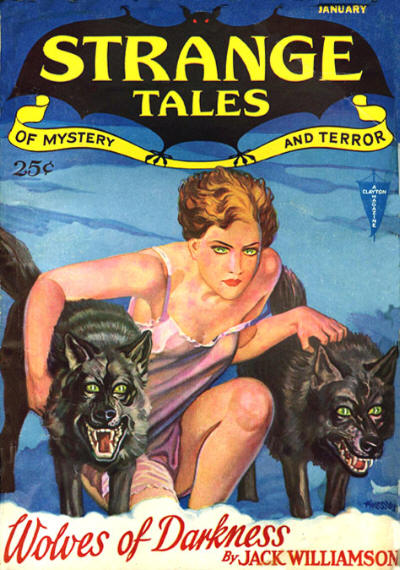


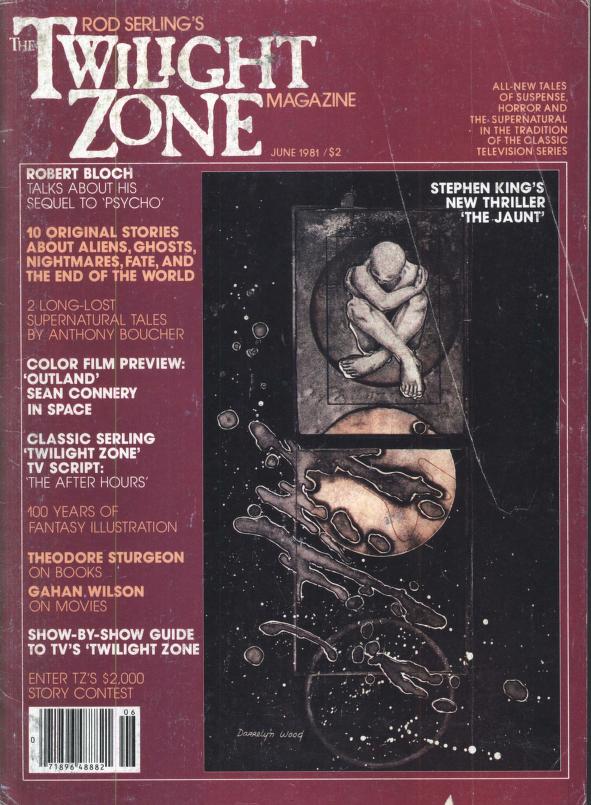
 Science Fiction & Fantasy Remembrance