This month’s editorial will be rambling and not straightforward. For one, now is the time to reveal my thought process with regards to how I pick review materials and why I do that; so in a way this will be a bit of a meta post. You’ll get to see how the sausage is made. You see, I’m not a book reviewer who gets paid to receive review copies of upcoming releases and give them my honest (but not too honest) opinions, wrapped in professional plastic and safe for toddlers and small dogs to chew on. There may come a point when I take on a review column for some publication, but that’s not now, nor is it in the immediate future. After all, SFF Remembrance is already time-consuming and it serves a different purpose. This is my blog that I run for the fun of it and I get to review what I want, without some editor breathing down my neck.
This still raises the question: Why do I do it? Why, so far, have I tackled only a handful of stories from the 2010s and nothing from the 2020s (yet) in favor of dusty, pulpy, uncouth genre fiction from the time before my parents were even in diapers? This is a question that actually involves several questions within it, like one of those Russian nesting dolls, especially for someone of my age who does not have the ability to remember any of these stories from when they had that fresh car smell.
We have to ask the following:
- What counts as “old” science fiction?
- What differentiates “old” science fiction from “classic” science fiction?
- Why read the damn things in the first place?
- If we should read them, why should we write about them?
- If we’re to write about them, should it be as a reader or as a pseudo-academic?
- When all is said and done, who would want to read these reviews?
That first question sounds like it has an obvious answer, but it doesn’t; nor does “old” necessarily mean “classic” science fiction, hence the second question. Most old SF is not considered classic by today’s readers. Here’s another way to look at it: Dune is a classic novel, without question. It has been continuously in print since 1965, won awards, and has now received multiple film and TV adaptations. It is a classic by reputation, which really is what makes something a classic; that is to say there’s a collective agreement among a set of people that this work is still worth celebrating. Contrast this with a novel that came out only one year prior, Robert Heinlein’s Farnham’s Freehold, which despite having Heinlein’s name attached to it is often reviled, with even contemporary reviews being unkind towards it; it’s old, but not really a classic. Then again, 1965 is over half a century ago, so surely anything from then would be deemed old by anyone now living—certainly by anyone in my age bracket. There’s a certain point where people can agree that something has gathered enough wrinkles to be considered old—only we don’t always agree on when.
Much like how beauty is in the eye of the beholder, so one could also argue the age of a work of art is relative to the person perceiving it. I mentioned 1965, but let’s turn the dial to the year of my birth: 1995. For some people 1995 was not that long ago—maybe even too recent to be considered old, let alone grounds for now-classic works. I used to think the same way myself, that SF from 1995 is still fairly contemporary; only problem is it’s not. While many of the authors who were active then are still active and producing good work now (Nancy Kress, James Patrick Kelly, Michael Swanwick, to name a few), and while writing techniques have not evolved greatly in the past 28 years (certainly not as jarring a shift as, say, between 1932 and 1960), the recurring concerns and, more importantly, the perspectives of SF writing have changed greatly. Now we see not so much white American writers spouting about other cultures as people of those other cultures having their seat at the table. This is a good change, mind you. While there is still much exciting and fresh fiction from 28 years ago, there’s some dust gathering on the surface, visible to the naked eye.
(To put this in context, and with all due respect, it’s hard to imagine Mike Resnick’s Kirinyaga stories, which won him awards in the ’80s and ’90s, would get such a glowing reception if published today.)
If such fiction now strikes us as a little (or very) dusty, why should we still read it then? I am not referring to the work that still reads as fresh but that which does not read as fresh. These are stories whose style and morals have since been superseded by works that are at least superficially better. Why go back and read Jack Williamson’s The Legion of Time when there have been many time war narratives since then that are more sophisticated and less problematic? Indeed, why do we still read Dune whilst acknowledging that Frank Herbert’s prose now reads as confusing and overcrowded? Surely there are novels that are reminiscent of Dune that are also more delicate with the English language? Why are Heinlein’s books all still in print despite his being a lecherous right-wing militant with a penchant for monologuing? These are not easy questions, nor do they seem to have an “objective” answer that can be gathered via the scientific method.
I’m also asking these questions specifically with regards to old science fiction, and not old fantasy or horror. Nobody asks why we still read Tolkien (although I do) despite his being a lackluster stylist and a puritan. Nobody doubts the immense power and importance of Edgar Allan Poe’s writing despite its vintage and Poe’s own stylistic flaws. Even that most controversial of old-timey horror writers, Lovecraft, is still held as the sun around which cosmic horror orbits, despite efforts (lousy efforts, mind you) over the decades to discredit him. The viability of these fine and flawed gentlemen and their flawed works need not be thrown out the window casually. To be fair, there is a straightforward reason for this attitude that does not carry over to science fiction: fantasy and horror are genres that have not been subjected to change nearly as viciously as SF. Time, who is always a harsh mistress, has devoured entire worlds with SF for the simple reason that SF, far more than its sister genres, hinges on discoveries of the moment. Our understanding of the natural world has changed over time, and so by extension what was considered cutting-edge in the past is now quaint—or even worse, incompatible with current understanding.
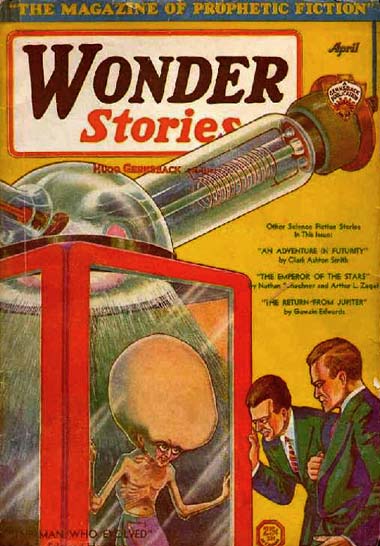
Consider that Frankenstein, that most foundational of SF novels, is still widely read and beloved—but not as science fiction. It’s still effective as horror, and as a cautionary tale, but as a narrative supposedly rooted in science it now reads as nigh incomprehensible. Even when I read it for the first time as a semi-literate high schooler I knew that Dr. Frankenstein’s method for resurrecting a corpse, and especially his subsequent fear that the monster would breed deformed hellspawn, made no sense. Mary Shelley wrote in a world that would not know Darwinian evolution for a few more decades, and it shows. Here’s another example: In the 1920s and ’30s there were a lot of stories about “cosmic rays” playing a part in evolution, perhaps best encapsulated in Edmond Hamilton’s “The Man Who Evolved.” This is total nonsense that cannot be taken seriously with a modern lens. Why, then, do people still read Frankenstein but “The Man Who Evolved” will forever be deemed a relic of the super-science era? Probably because, aside from being such a monumental work, Frankenstein can be understood as something other than science fiction, whereas Hamilton’s story can only be understood as a story founded on bad science.
And yet…
We still see reprints, from time to time, of very old and very dusty SF, and there are several blogs running right now that specialize in engaging with vintage SF. I myself started as part of the online book club Young People Read Old SFF before creating my own blog. Unfortunately said book club has dwindled in number over the past couple years, and outside of it I’ve seen scarcely any interest from people my age in the old stuff. I suspect this is for a few reasons. If you’re a part of fandom and you don’t have the memory capacity of a goldfish then you may recall several incidents in the past decade (most infamously the Sad Puppies fiasco) wherein old folks and reactionaries would rant about how kids these days don’t respect “the classics” and how SF is absolutely 100% for sure on its way out. It’s true that we may be heading into another dark age for SFF magazine publishing, but never before has the field been more inclusive, more niche-filling, and more accepting of ideas that go against heteronormativity, capitalism, etc. And yet there is the grain of truth that young readers (I’m thinking people aged thirty and under) fail to engage with where the field has been.
It’s true also that SF with a fine layer of dust on it does present a problem for young readers—one which reviewers like myself should but are unlikely to solve. You see, you can’t force somebody to enjoy a work of art. You could contextualize art and give it the proper platform for which to be understood, but enjoying something, much like romance or the urge to produce children, is totally beyond rational understanding. Ultimately I have to say I read this or that because I enjoy it, and then try to apply a veil of reason to my desire. Even when I come out of a story not liking it I usually feel joy from thinking and writing about it—because I like to think and write about science fiction as something that has changed over time, as indeed it does. If I wanted to read something and enjoy it in a vacuum I could do that, which is basically how most readers go about it, and true enough when I sit down and dig into a novella or serial installment I’d been anticipating I do it for the same reason as the rest of us: for the pleasure of it. My reviews and other posts are not as professional-sounding as those of my peers, in part because I wanna make it clear that I come from the place of someone who reads because he finds the act of reading pleasurable and thus unbusinesslike; it could also be that I’m from New Jersey, so pardon me on that.
A little bit of a story here.
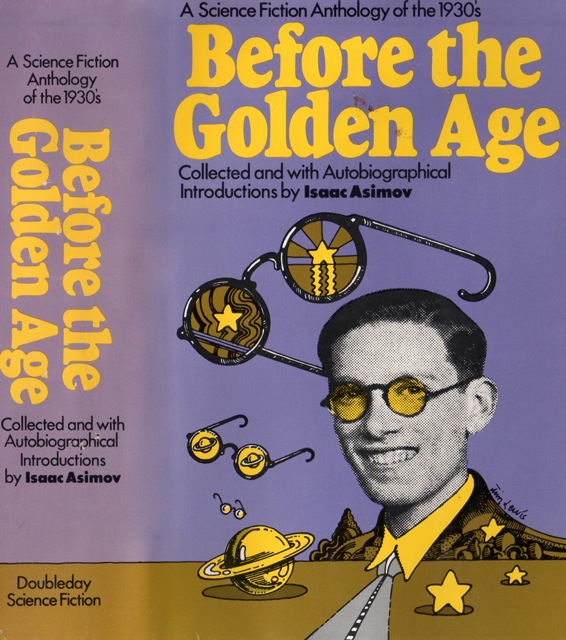
I have a lot of SF anthologies on my shelves, and almost entirely ones published prior to 2010, which means that inherently these volumes cover pre-2010 material; most of those are from the 20th century, which they cover (necessarily) even older material. There are two books I have that are of particularly relevant note to this month’s editorial, which have a strange amount in common, including their mission statements and the era in which they were published. These are Isaac Asimov’s Before the Golden Age and Damon Knight’s Science Fiction of the Thirties, from 1974 and 1976 respectively. Asimov and Knight are pretty close in age, the former born in 1920 (the official story, that is, although Asimov was probably born in late 1919) and the latter in 1922, and so these two men grew up reading mostly the same fiction. Even so, their temperaments are radically different. Asimov has a nostalgic view of the super-science stuff of the ’30s and his writing technique is a dot that connects perfectly with that era, his prose thoroughly beige (which is not to say dull); then in Knight’s case we have someone who started out as a critic before moving into writing and editing fiction, and thus someone who is more willing to experiment.
Asimov, for his anthology, picked 25 of what he considered the best SF stories he had read during his formative years—stories which he still enjoyed upon rereading as an adult. Knight, for his part, scouts the same time period (1931 to 1938 or thereabouts) but with a more “objective” stance, picking stories he had found whilst digging through old magazine issues that he thinks are worth rediscovering. Asimov’s book is autobiographical while Knight’s serves more as a brief history of short SF in the ’30s, and while I think the latter has stronger fiction on average (there are some truly awful picks in the Asimov), it seems people gravitate much more towards the Asimov because of that copious and shameless subjectivity. Before the Golden Age is a 900-page monster and about a hundred of those pages are Asimov reflecting on both his life and the stories he chose. We’re given, on top of a handful of still pretty good stories and a lot of clunkers, a look into Asimov’s mindset as reader, writer, and, for a brief time, reviewer. It’s an essential anthology, not so much for the stories but in how it argues for the need to return to old science fiction.
Something to think about is that when Asimov and Knight put together their anthologies, these being books deliberately collecting very old and outmoded fiction, the oldest story from was a mere 43 years old when Before the Golden Age was published; and yet the science fiction of 1931 and the ’70s were worlds apart. Time is relative, and merciless.




 Science Fiction & Fantasy Remembrance