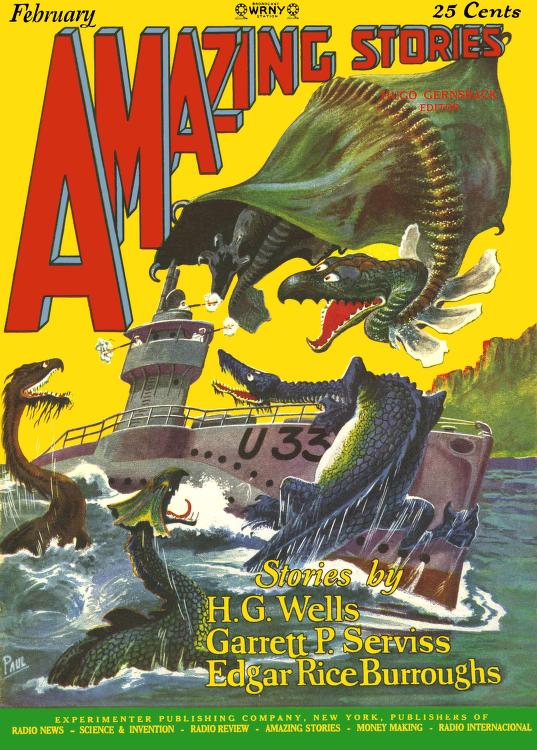
(Cover by Frank R. Paul. Amazing Stories, February 1927.)
Since it’s now the new year for everyone, it’s only natural that we have some new things to look forward to or new things to do. I have a few New Year’s resolutions myself: some movies on my watchlist, quite a few video games I hope to get around to playing. I have hundreds of games in my backlog and even more books to be read in my personal library. I have multiple hobbies, which is something I would recommend to everyone. Unfortunately another thing on my to-do list for 2026 is to either get a second job or to try my hand at writing professionally, which would take time away from this hobbies, including this here blog.
Truth be told, I’ve been winding down productivity here for a minute, so this shouldn’t come as a surprise. I’m seemingly incapable of uploading posts “on time” (but of course who’s keeping time except for myself), and I’ve been missing one or even two reviews every month for the past several months. I wouldn’t be too worried, for the few of you who read this, since I’m not gonna be shutting down this site—just lowering my productivity. Granted, for the first couple years I ran this site I was writing at a feverish pace; in hindsight I’ve not really sure how I did that while also having a day job. In 2023 and 2024 I wrote over 200,000 words a year, according to the stats, which is a lot for one person. There was less wordage for 2025, and now for 2026 you can expect fewer posts as well. But this is like being on a flight and going from 20,000 feet to 10,000 feet.
Now, as you may know, Amazing Stories turns 100 this year. It was revived (again) not too long ago as basically a fanzine, but I would like to celebrate Amazing Stories as a professional magazine, which still means going through material that spans seven decades or so. It’s a lot, not helped by the fact that it has a pretty messy history as far as changes in editorship and publisher go. Except for maybe the beginning of its life it always played second fiddle to competing magazines, but it survived (sometimes even thrived) for an impressive stretch of time, given the circumstances. So, every month (except for March, July, and October, where you can expect short-story marathons) I’ll be covering a serial, novella, or short story from the pages of Amazing Stories. This should be interesting.
With the exception of the aforementioned months we’ll be doing only one serial, one novella, and one short story every month from now on, plus at least one editorial. Anyway, we have one story from the 1900s, one from the 1930s, and one from the 1950s.
For the serial:
The First Men in the Moon by H. G. Wells. Serialized in Amazing Stories, December 1926 to February 1927. First published in 1901. Feel like it would be criminal to pay tribute to Amazing Stories without bringing up Wells at least once, possibly even twice, since he was heavily associated with the magazine in its first few years. Wells himself is arguably the most important SF writer to have ever lived, with his influence being felt to this day practically everywhere you look. Any given SFnal premise likely has its roots in something Wells did over a century ago. This is even more impressive when you consider that Wells at the height of his powers lasted only half a dozen years or so. The First Men in the Moon is one of the last of his classic novels.
For the novella:
“The Gulf Between” by Tom Godwin. From the October 1953 issue of Astounding Science Fiction. Godwin became somewhat famous in SF circles for exactly one story, “The Cold Equations,” which he wrote pretty much in collaboration in John W. Campbell. It might surprise some people that Godwin had in fact written other stuff, and I admit I’m part of the problem because I don’t think I’ve read any Godwin aside from “The Cold Equations.” But I’m gonna fix that. “The Gulf Between” was Godwin’s first story, and it’s notable, if for no other reason than that the cover it inspired would later be reworked as the iconic cover for a certain Queen album.
For the short story:
“The Cairn on the Headland” by Robert E. Howard. From the January 1933 issue of Strange Tales. Over the course of about a dozen years, Howard wrote nonstop for every outlet that would accept his work, and he was not just a fantasy writer, also writing horror, Westerns, sports stories, and non-supernatural adventure pulp. He wrote everything except for SF, which he didn’t seem to have an interest in. Conan the Cimmerian occupied much of Howard’s later years, to the point where he began to resent his creation, but this didn’t stop him from doing standalone yarns like this one.
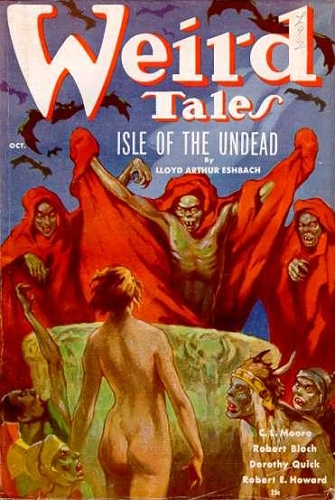
(Cover by J. Allen St. John. Weird Tales, October 1936.)
The Story So Far
Valeria of the Red Brotherhood is a warrior-pirate who was aboard ship not too long ago, but jumped in order to escape an unwanted marriage proposal. She then joined an army of mercenaries, but left that as well, after killing one of the officers. She’s now a fugitive, but she’s not alone, for Conan was in the same army and also deserted, with the intent of following Valeria’s trail. Conan doesn’t wanna kill Valeria, indeed having killed the brother of the officer she had killed off-screen, but rather is curious about her—in more ways than one. Aside from being warriors, one thing Conan and Valeria have in common is that they’re very bad at taking orders. They’re having a “fun” time bickering when a dragon in the forest they’re hiding out in kills their horses, and looks to have them for lunch next. Using a spear and some poison fruit, Conan’s able to incapacitate (although probably not kill) the dragon, and the two make a run for it on foot. On the plains by the forest there’s a domed city, called Xuchotl, which once had an indigenous population but which is not thinly populated by two clans, who years ago had moved in and slaughtered the original residents. Yes, that is technically genocide. We’re told that the indigenous people of the city were no better than those who killed them, and in some ways might’ve been worse. Now it’s a war between the last members of the Tecuhltli and Xotalancas, clans named after their founders. No children have been born in these clans in quite a few years, and it seems each is a mini-civilization on its last legs.
With the help of a Tecuhltli named Techotl, Our Heroes™ get introduced to the Tecuhltli higher-ups, namely their “king” Olmec and his partner Tascela (in the previous installment I said they were married, but their relationship is actually more ambiguous than that), the latter appearing youthful and yet, it turns out, being centuries old. Olmec sort of hires Conan and Valeria in the hopes that they’ll help vanquish the remaining Xotalancas. (The red nails of the title refer to red nails that are stuck into a column in Olmec’s chamber, each representing a vanquished enemy.) This arrangement goes sideways, though, when later that day one of Tascela’s servants tries to put Valeria into a deep sleep with the help of a black lotus. Valeria doesn’t appreciate this very much, so she tortures the servant until she confesses what Tascela’s plan is, although she escapes into the catacombs, never to be seen again but likely to be killed off-screen by something. It’s at this point that Valeria hears swords clashing at the gates, which probably means the Xotalancas have chosen now to make their final assault.
Enhancing Image
A battle goes down, with the Tecuhltli being victorious, of course. They’ve killed the last of the Xotalancas, which ordinarily would mean everyone gets to live happily ever after, but as you know, Tascela has other plans. Olmec also has plans of his own, and ultimately the two rulers fight for a bit over who gets a piece of Valeria’s ass. Olmec wants to rape Valeria while Tascela somehow has even worse plans in mind. Of course, while Olmec is a burley bearded guy who can break someone’s spine in half, Tascela is a sorceress who many years ago had put a spell on Olmec so that he would be unable to lay much more than a finger on her. Is this the only Howard-written Conan story with both a heroine and a villainess? Unfortunately, by this point Valeria has become little more than the obligatory damsel who needs rescuing, although while she’s physically helpless she does have quite the mouth on her. We hear about some “profanities” coming from her and it’s easy to imagine her dropping several F bombs if not for censorship. I sort of get the criticism of Valeria not being enough of a badass heroine, but at the same time I do think she works as a kind of foil to Conan. I think it’s also worth mentioning that it’s easy to believe Howard had based Valeria on Novalyne Price, his girlfriend at the time, namely through her assertive attitude and penchant for cursing, as was apparently Novalyne’s habit when she wasn’t on the job. Clearly by the last couple years of his life Howard was moving in a direction that, while not exactly feminist, was more sympathetic to women as people. Remember that this is a guy who really could not imagine living in a world without his mother in it.
As if to compensate for the slow middle section of the novella, the back end of Red Nails is nonstop violence and conspicuously erotic imagery (I don’t mean that last part in a bad way). Howard said in at least one letter that he thought of Red Nails as his sexiest Conan story, and between the two BDSM-coded torture scenes it’s easy to believe him. Yes, a second BDSM-coded torture scene has hit the towers! This time it’s Valeria who’s on the slab, with the dark-skinned Tascela towering over her, in an image that provided the cover for the first installment. (I should probably have mentioned by now that Tascela is coded as being equivalent to ancient Egyptian royalty, going by how Howard describes her clothing and especially with how she’s illustrated in the version of Red Nails printed in The Best of Robert E. Howard Volume II.) Conan kills Olmec and comes in for the rescue, but it looks like Our Heroes™ are outnumbered when the thing from the catacombs emerges as a deus ex machina, in the form of Tolkemec, who had been banished there many years prior. Conan kills Tolkemec while Valeria takes the chance to stab Tascela in the back, who despite being able to replenish her youth and make people follow her every order is apparently made of tissue paper if someone manages to catch her off-guard. “I had to do that much, for my own self-respect!” says Valeria, as almost a meta statement on how given her damsel status for much of the story she had to take down someone. Why not her evil counterpart, then? It makes enough sense. It also acts as a bit of a twist on its own, if also as an anticlimax, since Tascela shows herself to not be much of a fight after all, at least physically.
As I was reading Mark Finn’s Blood & Thunder: The Life and Art of Robert E. Howard (a good one-volume biography, if also unfortunately sloppy in the proofreading department), and Finn makes a point that I’m sure is not new but which I thought useful for my own read of Red Nails: he considers Red Nails to be a thematic counterpart to Howard’s earlier Beyond the Black River, which might still be my favorite Conan story. Granted that Beyond the Black River benefits from a tighter narrative focus and the damsel being a man instead of a beautiful woman for Conan to make out with, the two novellas do each show one side of the same coin, with Beyond the Black River showing barbarism creeping up on civilization while Red Nails shows what Howard saw as the inherent evil of civilization. A more conventionally racist (mind you that Howard did have racist tendencies) narrative would’ve painted the original inhabitants of Xuchotl as backward “savages,” but from what we’re told about them they were actually quite an advanced and “civilized” people—at least on paper. But they were also decadent, and their collective villainy made way for the settlers that came in and slaughtered them. Now that the clans have been wiped out as well, Conan sees the city being truly bereft of human life now as no great loss. “It’s well the breed exterminated itself,” he says, which could be referring to the original inhabitants, the clans (who after had spawned from one people), or both. For both Conan and Howard, civilization is only temporary, and at some point will meet its end. This is the view of a philosophical pessimist, which one could argue is the most essential foundation for dark fantasy.
A Step Farther Out
I have to admit that when I finished Red Nails I felt a bittersweetness, because it was the last Conan story Howard wrote; even had he lived longer it’s unlikely he would’ve written more Conan, as he made it clear in letters at the time that he was getting tired of the character, and moreover he was getting tired of writing fantasy in general. That one can think this while only pushing thirty is something many of us would now think of as absurd, but Howard really meant it. About a year after he finished Red Nails he got in his car, took out a revolver, put it to the side of his head, and pulled the trigger. It’s ironic that he had basically intended this as the final Conan story, since it ends on a relatively upbeat note (I mean hey, all the bad people are dead) and implies more adventures between Conan and Valeria—only we never got to see those. Eventually I’ll cover more Howard, specifically work of his that isn’t Conan, assuming I don’t follow my leader.
(Cover by Margaret Brundage. Weird Tales, Aug-Sept 1936.)
The Story So Far
Valeria of the Red Brotherhood is a pirate-turned-mercenary who abandoned her ship to avoid an unwanted marriage proposal, only then to also desert the band of mercenaries she had joined, after killing one of the officers. She’s currently a fugitive, but she’s not alone, for it turns out Conan, who was in the same army as Valeria, also deserted and followed her trail—partly out of curiosity but also because he makes no secret of having the hots for the female warrior. (You gotta give Conan credit: the man is upfront about what he wants.) Valeria is not so smitten with the legendary Cimmerian. At the same time the two are probably better off together than each going their separate ways, for the moment. Their bickering is interrupted when a dragon of the forest they’ve taken refuge in devours their horses off-screen, with Our Heroes™ looking to be another meal. The dragon is not the fire-breathing dragon of medieval folklore, nor the slim serpent with wings of ancient China, but a dinosaur-like beast whose belly drags on the ground and who’s got more teeth than a dentist could possibly hope to count. With the help of a makeshift spear and the juice of a poison fruit, Conan incapacitates the dragon and Our Heroes™ flee the forest, into a wide plain and then into a massive interior city. Xuchotl is an ancient city that’s partly underground and totally encased by a dome, and at first it looks to be abandoned. When Conan splits from Valeria to do some investigating, the latter stumbles onto a couple of the city’s inhabitants and gets herself into a battle she really did not anticipate. The first installment ends with Valeria and Techotl, a member of the Tecuhltli, fending off some ravenous dogs. This first installment actually ends in the middle of the second chapter; I’m not sure if this is a criticism, I just wanted to point that out. The question then is: Where could Conan be?
Enhancing Image
Of course this had to be unintended, but I find it interesting that the first installment started and ended without Conan, only for the second installment (which is actually just the second chapter continued) to reintroduce him as fast as possible. Also, aside from the action scene at the beginning, this middle chunk of Red Nails will be much more focused on building character and the world of Xuchotl. There’s a lot less fighting and a lot more dialogue. This is not really a bad thing, since Xuchotl is one of the more imaginatively realized settings for a Conan story. Right after Howard wrote Red Nails, about a year before its publication, he admitted in letters that it would not only be his last Conan story but also probably the last fantasy story he ever wrote—mind you he was only 29 when he said this. The notion that someone so young could feel that they’ve said all they could say about a character, never mind a whole genre, might strike us as crazy, but I do believe that even had Howard lived to a nice old age it’s unlikely he at the very least would’ve written more Conan stories. Red Nails was the grand finale of the series, even if it doesn’t exactly feel like one; but also Howard really pulled out all the stops with the action, worldbuilding, and character moments. It’s also, it must be said, possibly the sexiest of the Conan stories, but that’s for me to give the details of in just a moment. For now we must be content with being introduced to the rest of the Tecuhltli, who stand opposed to the clan on the other end of the city, the Xotalancas. Turns out the city had already been built and had its own indigenous population when the founders of these clans had arrived. Given that said indigenous population is not longer here, you can guess what happened, although curiously the original people of Xuchotl are also said to have been brutal and decadent in their own right.
Thus Conan and Valeria find themselves caught in the middle of a war between dying clans (there are no children among the Tecuhltli and presumably the same goes for the enemy) that has been going on for fifty years, so that basically nobody alive now was around to witness how it had all started. When we meet the rulers of the Tecuhltli, Olmec and his wife Tascela, we get the feeling that something is very off, not least because Tascela looks to be young and beautiful but is, in fact, at least in her seventies, given that she was an adult when the war started and indeed the big reason for why it had started in the first place. How she has retained her youth is a mystery—for now. During Olmec’s big exposition dump about the history of the clans, Tascela also seems weirdly focused on Valeria, as if transfixed by her beauty. (It’s worth mentioning that while homosexuality was sometimes mentioned in mainstream fiction of the time, it was sort of taboo in the genre magazines, so that even the implication of it here is Howard teasing the reader.) Now, my dumb ass thought going in that the story’s title referred to red fingernails, but actually it’s referring to red nails impaled in the Tecuhltlis’ headquarters, each representing a slain enemy. Granted, the red nails could also refer, if only metaphorically, to Valeria, who after all is of the Red Brotherhood. For better or worse Conan is rendered the secondary protagonist while Valeria is the real hero(ine) of Red Nails; and in case there was any doubt of this she once again takes hold of the narrative in the fourth chapter, which is where the second installment ends and which is short but pretty memorable. Red Nails could be considered a logical successor as well as a companion piece to Beyond the Black River, which in some ways it’s very different from but also in other ways similar. We go from the frontier to what is basically a buried city, and the POV character who follows Conan is female instead of male, but their premises are similar enough.
Now, let’s talk about the torture scene, although it’s actually not the torture scene that provided the cover for the previous issue of Weird Tales. After their meeting with Olmec and Tascela, Conan and Valeria once again part ways for the moment, with the latter going to take a nice post-battle nap. She wakes suddenly, however, to find that Yasala, Tascela’s servant girl, had tried to pull a Bill Cosby on her with the help of a black lotus, a blossom “whose scent brings deep sleep.” Valeria is very cross about this, especially because Yasala refuses to explain herself. Valeria then does what any normal person would do and decides to strip Yasala naked and tie her down, for the purposes of strangely erotic torture with a lash. Now, as somebody who is not particularly into BDSM (although I’m not opposed to it), I have to admit that what follows is pretty hot, to the point where I would be surprised how it made its way into Weird Tales in the ’30s if not for the fact that paying kink lip service was actually far from uncommon for the magazine at this time. (There are, in fact, multiple Robert E. Howard stories that made the cover for this very reason, courtesy of Margaret Brundage.) Indeed, I can imagine that reading Weird Tales in the early-to-mid-’30s (the magazine cleaned up its act towards the end of the decade, at least when it came to the covers) and being introduced to BDSM this way. Shit must’ve blown some minds. Anyway, Valeria gives Yasala a good thrashing until the latter finally gives in, saying the Bill Cosby routine was part of Tascela’s scheme. Once Valeria unstraps her she throws some wine in Valeria’s face for her troubles and runs off the catacombs, where it’s implied she meets her death off-screen. Meanwhile Valeria hears the clashing of swords in another direction, implying that the Xotalancas are at the gates.
A Step Farther Out
Sorry for the delay, but I hope the wait was worth it. Red Nails is shaping up to be yet another top-tier Conan story, but we still have a good chunk of it to go. I’ve read enough Conan at this point, a lot of it outside the confines of this site, to separate the mediocre (because there are a few Conan stories where Howard was clearly phoning it in) from the good stuff. It helps a lot that Valeria herself is a very fun character, who in some alternate timeline probably could’ve gotten her own spinoff series. I’ve read into the possible inspirations behind Valeria, with the most likely contenders being C. L. Moore’s Jirel of Joiry, whose first couple stories Howard had very likely read by the time he wrote Red Nails; and then there’s Novalyne Price, Howard’s girlfriend at the time. The details of Howard and Price’s relationship are unspeakably depressing, so I won’t go into it, but it seems he had based Valeria’s tenacity on Price. (I’ve been reading Mark Finn’s Blood & Thunder: The Life and Art of Robert E. Howard, and there’s a good chance I’ll be done with it by the time I finish reviewing Red Nails.) My point is that I was looking for a palate cleanser after the dismaying experience that was reading the first installment of E. E. Smith’s Triplanetary, and I’m happy to say Red Nails is meeting my expectations.
(Cover by Margaret Brundage. Weird Tales, July 1936.)
Who Goes There?
E. E. Smith has I guess the distinction of having the first serial I started to review but simply could not finish. I’m already a couple days behind in my schedule as it is. It would’ve been one thing if I did not enjoy reading Triplanetary (which is certainly the case, mind you), but Smith was also maybe a victim of bad timing. We are cursed to live in interesting times. Both in my personal life and in the outside world there have been some, let’s say disturbances. My question then is, if I’m not gonna continue my review of Triplanetary, what could I use as a substitute for the rest of the month? There were many options; as you probably know, a lot of novels and novellas were serialized in three installments. But for me the answer was obvious: I’d be returning to Robert E. Howard.
Despite the fact that he committed suicide when he was only thirty, Robert E. Howard can lay claim to being the most influential American fantasy writer of all time, not to mention being arguably the greatest of the pulp writers who never broke into mainstream or “slick” fiction. He began writing with the hopes of being published when he was 15, although he wouldn’t actually make his first fiction sale until he was 17 or 18; little did he know, when he started writing at 15, that his life was already halfway over. But once Howard started getting published, he never stopped—not even when he died. Almost too many short stories and poems to count were published, either complete or as fragments, in the decades following Howard’s death in 1936. He wrote nonstop for about a dozen years, and for practically every pulp and genre market, except, weirdly enough, science fiction, which he didn’t seem to have much if any interest in. He wrote fantasy, horror, Westerns, historical adventures, and even sports stories (Howard was especially fond of boxing). He also ran several different series focusing on a colorful roster of courageous and quite masculine heroes, from Solomon Kane and the sailor Steve Costigan to, of course, Conan the Barbarian. Conan is one of the most iconic characters in fiction, and he was also Howard’s final fantasy hero, being a culmination of themes and tropes Howard had developed. Red Nails was the last Conan story Howard had completed; the first installment would’ve been on newsstands around the time of Howard’s death. I had been meaning to get to this one for a while.
Placing Coordinates
Serialized in Weird Tales, July to October (the August and September issues were combined) 1936. Since this is Conan it’s been reprinted quite a few times, including 13 Short Fantasy Novels (ed. Isaac Asimov, Martin H. Greenberg, and Charles G. Waugh) and too many Howard collections to count. It’s also on Project Gutenberg.
Enhancing Image
Valeria of the Red Brotherhood is a pirate-turned-mercenary who’s currently a fugitive, having killed an officer in Zarallo’s Free Companions, an army of mercenaries and, ironically from what we hear about it, not free at all. Another member of that army was Conan, and like Valeria he too deserted, albeit for different reasons. Since this is the third Conan story I’ve reviewed, I think acknowledging formula is in order. Howard wrote a lot, and like anyone who writes enough for long enough he fell back on formula and certain turns of phrase, and even how he would structure his plots. With the Conan series the idea is that the “real” protagonist is not Conan, but some third party who has their own adventure, including their own personal stakes, and who sees Conan’s exploits from the outside. There are some exceptions, but most of the Conan stories do not start with Conan as the focus characters. Valeria herself is by no means the only female main character in a Conan story, but she’s certainly a contender for the feistiest, alongside Bêlit from “Queen of the Black Coast.” But whereas readers might recall Conan’s relationship with Bêlit being genuinely romantic (if also ill-fated), his interest in Valeria is more purely carnal. Indeed Conan and Valeria’s relationship is about as explicitly sexual as one could’ve gotten in ’30s pulp magazines without the characters having actual sex (at least not yet). Valeria compares Conan to a stallion and at one point Conan threatens to spank Valeria in a way that is clearly more meant to be taken as kinky teasing rather than punishment.
Of course, Valeria is a tsundere who is not so taken with Conan’s teasing and raw machismo, although there’s the sense that she can’t help but admire him as a fellow warrior. I’ve read up a bit on Red Nails and one criticism I’ve seen repeated is that for someone who is described as a bad bitch, and who takes a lot of pride in her supposed abilities as a fighter, Valeria is not as strong as she appears. This may prove more valid than it seems to me initially, but I like the idea of a pirate lady who is perhaps a little out of her depth when fighting on land—you could say like a fish out of water. She also clearly resents being on the receiving end of misogyny and mockery from her male colleagues, saying, “Why won’t men let me live a man’s life?” at one point. (Obviously such a sentiment reads different nowadays, what with our understanding of genderqueerness, although Valeria is at the very least gender-nonconforming.) Due to the episodic nature of the Conan series it can be hard to lay out some internal chronology, but I’m pretty sure Red Nails takes place after “Queen of the Black Coast” since Conan has already lived as a pirate by the time of the former, although he makes no mention of Bêlit. I like how these two are former pirates who’ve come to land under different circumstances, with Conan’s last ship getting sunk in battle and Valeria quite literally jumping ship to avoid an unwanted marriage proposal. Also it’s worth mentioning that despite being written after some of the darkest entries in the series (“Queen of the Black Coast” and Beyond the Black River especially), Red Nails starts off considerably lighter in tone, insofar as it reads like a more typical pulp adventure.
But of course, there’s trouble afoot. As Conan and Valeria leave their horses and really get down to bickering with each other, they realize too late that they really should’ve kept a better eye on those horses. A dragon ate them both, somehow, making such short work of the animals that their bones made a distinctive crunching sound. Our Heroes™ have come face-to-face with a dragon, a beast about as large as an elephant with “huge eyes, like those of a python a thousand times magnified,” a head larger than a crocodile’s, a belly that drags on the ground, “absurdly short legs,” and a long and flexible tail. It’s basically a walking tank with a trash compactor for a mouth. Much of the first installment of Red Nails has to do with getting around this dragon, which was not quite what I was expecting, since what I had heard most about this novella was the main setting—but we’ll get to that in a moment. It looks like Our Heroes™ are cooked, but Conan comes up with an ingenious tactic that might (just maybe) kill the dragon. He makes a spear and covers the tip with the juice of a poisonous fruit, then aiming for a spot on the dragon that isn’t totally covered with scaly armor. It works, or at least it works well enough, with Conan and Valeria running off, leaving the poisoned dragon to die a slow death—maybe. I have a feeling this will not be the last we see of it. Finally we come upon a city on the plain, although it’s no ordinary city but one that seems at least partly underground, being totally kept indoors as if under a dome. Being on the run, and with no other signs of civilization in sight, Conan and Valeria enter the interior and probably abandoned city. It took long enough, but in the back end of this installment we do finally enter Xuchotl.
There Be Spoilers Here
This first installment starts and ends with Valeria by herself, since she and Conan are separated for a time once they’ve entered the city. Conan goes off to investigate by himself and leaves Valeria by herself, which turns out to have been a bad move. Valeria finds herself caught in the midst of a battle between two clans that lurk in the city, those of Tecuhltli and those of Xotalanc, having been rescued by a scarred man named Techotl, who comes from the former clan. The builders of the city seem to have died or fled, but they’ve left a great deal in their wake. People reading Red Nails expecting Conan to have more time on the page than he does will be surprised and probably disappointed. The idea, I suppose, is that Conan is simply too powerful a character to be consistently in the midst of the action, so Howard came up with reasons for his to be somewhere else. (Tolkien had a habit of doing this with Gandalf, as another example.) Conversely, if Valeria was out of her depth before then she’s almost useless by the end of this installment. So there’s that.
A Step Farther Out
Ah, it feels good to be back. It’s been over a year since I last got to write about Conan, and Howard’s fiction generally. I’m sure someone out there will blame more for pussying out with Triplanetary, but life is short and I will not, at least for the moment, waste it on trudging through terrible writing. It’s not even like I get paid for any of this. It could also be that I returned to Howard because I’m turning thirty in eight months and I can’t say I’m happy about that. It got me thinking about Howard again, for his life story is surely one of the most tragic in the history of genre writing; but, on the plus side, while he never married or had children, anyone who loves fantasy of the blood-and-thunder variety has a least a bit of Robert E. Howard in their heritage. It’s like how some white Europeans have, to this day, a sliver of neanderthal in their DNA. A relic from an ancient time. Modern fantasy writing, it seems to me, plays things too safe and sanitary, so that we could really use a darker, bloodier, sexier fantasy—albeit not that much of it. You don’t wanna have too much of a good thing, after all.
(James Tiptree, Jr., real name Alice Bradley Sheldon [right] with her second husband, Huntington Sheldon [left]. Dated 1946.)
(Note: I shouldn’t have to say this, given the title of today’s post, but I’ll be discussing depression, mental illness generally, and suicide, including some real-life cases that have haunted our field.)
I was set to review Clare Winger Harris’s story “A Runaway World” today, but as you can see, this is not a review. I was also set to write my Observatory post for the 15th, but that didn’t happen either. Well, I’m doing it now. The truth is that when I read “A Runaway World” a couple days ago, two things occurred to me: that it wasn’t a very good story (in my opinion), and that I wasn’t sure what I would even write about it. This was a problem, because normally, even with stories that are sort of dull or not good, I’m able to articulate something such that I’m about to get at least a thousand-word review in; but this time I found myself pretty much totally divorced from the material I was supposed to be thinking and writing about. It then occurred to me that I was mentally unable to engage with the material. This is not to say that Harris was actually too “smart” a writer for me or that I had somehow missed the point of the thing, but that I was too much plagued with what a few centuries ago was called “the humors” to focus on what I was reading. I was too depressed. For the past four or five days, or almost a week at this point, I’ve slipped into a manic or depressive episode at least once during the day which left me basically unable to do anything except wish to crawl into a dark hole and cry in solitude, or to take my own life. I’m a manic-depressive. My therapist, whom I’ve been seeing for just under a year now, suspects I have bipolar disorder, specifically type II, which basically means that my mood shifts, for better or worse, tend to last a short time, a few hours instead of a few days like bipolar type I.
I was a fan of science fiction long before I was aware that there might be something “wrong” with me. One of the first books I ever read outside of the classroom was Kurt Vonnegut’s Slaughterhouse-Five, which in hindsight should have been a red flag. I read quite a bit of Vonnegut in high school: Slaughterhouse-Five, The Sirens of Titan, Mother Night, Cat’s Cradle, and even Breakfast of Champions, that really weird one that barely counts as a novel (not to be confused with Timequake, which isn’t really a novel at all). Breakfast of Champions especially stuck out to me when I read it at the time, for its weirdness but also Vonnegut’s candidness about his own long-term battle with depression, his family’s history of depression (the fact that his mother had killed herself), his PTSD, his disgust with the glorification of war in American culture, and so on. Vonnegut would live to a ripe old age, despite his “best” efforts (he somewhat jokingly claimed to smoke unfiltered cigarettes over many years as a way of killing himself), although it wasn’t cancer or a heart attack that got him but a trip down the stairs. It’s almost comedic, in a way I’m sure he would’ve approved of. Vonnegut ultimately won against his war with depression, in the sense that he allowed circumstance to take him rather than his own hand—for the difference between victory and defeat for every depressive is the question of whether to kill yourself or to leave your fragile little existence in the hands of the gods. Indeed, according to Albert Camus, the question of whether to kill yourself may be the only important question. Camus himself was not suicidal, on the contrary having a real lust for life; and yet as William Styron points out in his short but telling memoir, Darkness Visible, Camus became a passenger with someone he knew to be a reckless driver, in the car accident that would kill him, “so there was an element of recklessness in the accident that bore overtones of the near-suicidal, at least of a death flirtation.” Styron wrote Darkness Visible as a way to cope with his clinical depression, but like Vonnegut he chose to reject suicide.
Some other writers, including several prominent ones in the history of science fiction and fantasy, did not reject suicide. Robert E. Howard, James Tiptree, Jr., Walter M. Miller, Jr., Thomas M. Disch, H. Beam Piper, and some others I could mention, gave into some kind of psychological malady that had been pushing them to the brink. Howard is probably the most famous example out of all of them, and he was only thirty when he died. Supposedly Howard hated the idea of aging such that he wished not to live to an old age, which for someone so young is not in itself an unusual line of thinking. One has to admit that there’s also also an increasing sense of melancholy and foreboding in terms of tone, with Howard’s writing as he got closer to the day he chose to put a gun to his head; but this, by itself, is also not enough of a sign to have caused worry in those who knew Howard at the time. Sure, “Beyond the Black River” is a much more melancholy entry in the Conan series than “The People of the Black Circle,” which was published a year prior, but conveying melancholy through fiction is by no means a sign that the author is suicidal. As you may know, especially if you’re a fan of pre-Tolkien fantasy, Howard had a history of being sort of a moody fellow, but what pushed him into a more extreme mindset was his mother’s long-term illness and her impending death. There have been attempts to analyze Howard’s relationship with his mother, some of them in poor taste, but I’ll just say that what we know for certain is that Howard struggled to imagine a life for himself without his mother in it. As his mother’s illness reached its bitter end, Howard, like a lot of suicides who go through with the act, gave little clues to those closest to him as to what he was planning. But nobody took the hint until it was too late.
Howard’s suicide would haunt the pages of Weird Tales, his most frequent outlet, for years, not least because reprints and unpublished work from Howard would appear in that magazine after his death; and indeed hitherto unpublished work by Howard would appear sporadically over the next few decades, as if unearthed or discovered in some dusty tomb, giving one the sense that despite having been dead for almost ninety years now, we still feel the ripples of this man’s decision to cut his life and career short. Of course, while Howard suffered from insecurities, having to do with masculinity and other things, he was not (at least as far as I can tell) a long-term depressive; rather his suicide came about from a mix of material circumstances and something gone amiss in his own mind. Mind you that when I discuss depression here I am not exactly referring to depression in a clinical sense, like how a therapist or psychiatrist would use the term; rather I am using the word as laymen would have understood it for centuries for now, or for as long as the idea of depression has been understood in recorded history. By this I mean that depression at its core is the sense that the outside world, the material world, seems to shrink and become insignificant as one’s own sense of self-worth declines—a kind of self-loathing narcissism, or a snake eating its own tail. People who are unsympathetic to depressives (i.e., people who to some degree lack empathy for others) will say something along the lines of: “People with depression are so self-centered.” In a way this statement is true, although probably not in the way the empathy-deficient person imagines. The problem with depression is that due to the nature of the illness, there is be a barrier between the depressive and the people around them, who presumably are not also depressives. The result is that the depressive feels that they have no choice but to gaze inward, and to see an abyss; it’s self-obsession, but also self-hatred.
(Robert E. Howard in 1934, two years before his death.)
The other problem with depression, particularly those like myself who are depressives and also fans of SF, is that depictions of depression in SF seem to be nonexistent prior to maybe the 1950s. You can find a few examples, very scant and spread apart, but the exceptions if anything prove the rule. This is especially true of genre SF, in the American tradition, which does bring me back to the story I was supposed to review today. To make a long story short, “A Runaway World” is about Earth and Mars mysteriously being jettisoned from the solar system, in a scheme that has to do with radio waves and making alien contact. Or something like that. It’s an early example of a natural (or in this case, rather unnatural) catastrophe narrative that also runs adjacent to the Big Dumb Object™ narrative. It’s confusingly written and Harris’s prose is pulpy, to say the least, such that other than the fact that it’s apparently the first story by a female writer published under her own name in a genre magazine, there’s really nothing special about it. “A Runaway World” does serve, however, as a perfectly fine example of the kind of SF that normally saw print in the ’20s and ’30s, when genre SF saw print in Weird Tales and Amazing Stories; and, if we’re being perfectly honest, this technology-driven (i.e., material-driven) breed of SF would continue during the “golden age” of Astounding Science Fiction under John W. Campbell’s editorship. These stories are not really concerned with spirituality or even psychology, but are instead about people doing things, so in this way they are strictly materialist. There’s a material problem that requires a material solution. Now is not the time to ponder one’s own neurosis, or even the feelings of others. Something is to be done, physically. Characters in these old pulp stories can now strike us as weirdly inhuman, and while flat characterization is the surface criticism one should make, the lack of psychological depth is intrinsically tied with that characterization. These characters feel like cardboard because there’s nothing inside. As Gertrude Stein said, “There is no there there.”
Surely at least some of the authors who contributed to the early years of genre SF felt depression, anxiety, PTSD, and so on; but if they did in their personal lives then they dared not express such troubles in their fiction. Characters in the early stories of E. E. Smith, Murray Leinster, Raymond Z. Gallun, Isaac Asimov, and Robert Heinlein are (at least as far as the authors seem to think) perfectly reasonable and mentally fine-tuned fellows. Hal Clement, who made his debut during the height of Campbell’s powers, might be most “guilty” of this, as his characters, while being ostensibly human, do not have any human (in the psychological, Shakespearean sense) concerns to speak of. Mental illness and even just moments of mental disorder (say a nervous breakdown or an anxiety attack) were simply not things one was to write about if one wrote for the magazines in those days. Between the years of 1926 (when Amazing Stories launched and, incidentally, when “A Runaway World” was published) and circa 1945, one simply did not write or talk about mental illness anywhere near science fiction; and if you felt tempted then it was something between you and your therapist. Or God. Whichever you preferred. Yet in 1926 there were people, in the “literary” world, who wrote about their own mental illness, if only when projected onto their characters. The first examples to come to my mind are Virginia Woolf (suicide by drowning) and Ernest Hemingway (suicide by gunshot), who were both haunted by an inner sickness, among other things. But there was no one even close to a Woolf or Hemingway in the early days of genre SF—not just in writing skill but also giving a language to the array of mental pains that afflict far too many of us in the real world. I did, however, mention before that this streak of psychological emptiness in SF lasted from about 1926 to 1945, and there’s a reason for that.
World War II happened, and with it came a number of profound changes in the field. The once-hypothetical scenario of nuclear weapons became very much a reality overnight. Entire cities on fire. The enemy of the week went from being fascism to Soviet communism. There was the vast moral quandry of the Holocaust. There were also quite a few men who served in the war who came home, and decided to start writing science fiction. Kurt Vonnegut was one such veteran, whose experiences as a POW and subsequent PTSD inspired Slaughterhouse-Five. There was Walter M. Miller, who served as a bombardier, and who also suffered from PTSD and depression. There was C. M. Kornbluth, who saw action near the end of the war and whose already-weak heart was further weakened by the strain. Those who saw the horrors of World War II firsthand, and indeed those who grew up in the war’s aftermath (Philip K. Dick, Robert Sheckley, Robert Silverberg, etc.), seemed to take a much dimmer view of the human condition than the first generation of genre SF writers. Hal Clement served in the way and didn’t seem particularly bothered by his wartime experiences, but I see that as the exception that proves the rule. I have a bit of a hypothesis, although obviously you’re free to disagree with it: that one of the ways World War II impacted SF is how it made those us in the field aware that some of us, individually, are damaged inside. Before and during World War II the sentiment of the average SF story was, “There’s something wrong with the world,” but after the war it got amended to say, “There’s something wrong with the world, and me as well.” It’s hard to imagine a novel like A Canticle for Leibowitz, or Do Androids Dream of Electric Sheep?, or the stories of James Tiptree (possibly the most disturbed of all SF writers), could have been published in a landscape where depression were treated as if it did not exist.
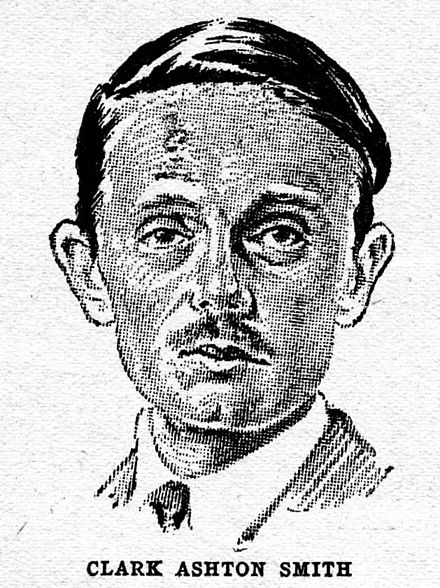
(Clark Ashton Smith, as sketched in the October 1930 issue of Wonder Stories. Artist uncredited.)
It’s the first editorial of the year, and yeah, I know it’s a bit late to be seeing this. Clark Ashton Smith’s birthday is January 13, so a couple days ago. He was born in 1893 in California, and he would more or less live there for the rest of his life. He never ventured too far, and in the ’20s and ’30s he would care for his ailing parents, hence his turning to writing fiction. So the story goes. Smith never gave interviews, and we still don’t have a biography of him, but we do have copious letters he wrote to H. P. Lovecraft, Robert E. Howard, August Derleth, and others. With only one serious rival (whom I’ll get to), Smith was, for my money, the best line-for-line writer to appear in Weird Tales during its 1930s heyday; and he appeared in that magazine A LOT. Despite being formidable in both quality and quantity, though, Smith is somewhat forgotten today unless you’re a weird fiction enthusiast; certainly he lacks the mainstream recognition of Lovecraft and Howard. You’d be hard-pressed to find Clark Ashton Smith studies in academia and you’d be as hard-pressed to find Clark Ashton Smith fanclubs.
How Smith’s reputation failed to pick up a posthumous second wind like what happened with Lovecraft and Howard is a mystery that has a few clues, but after all it might not even be a mystery. Certainly Smith becoming semi-obscure by the time of his death is the same fate that befalls most authors—those, anyway, who garnered any reputation in the first place. It’s the singing quality of his prose and the striking power of his writing that makes this fate seem unjust, though. This dissonance between his deserving recognition and not getting said recognition was solidified by Smith “winning” the Cordwainer Smith Rediscovery Award in 2015, an award reserved for authors whom the folks at Readercon believe to be worthy of recovering from the dust piles of history. Even Lovecraft agrees with me and the Readercon people: he singles out Smith as one living master of weird fiction in his seminal essay “Supernatural Horror in Literature.” It’s funny, because in some ways Lovecraft and Smith were very different, the former zeroing in on a rather niche subgenre of horror while the latter was content to hop across genres if it meant an extra paycheck.
Going back to the beginning, Smith tarted out as a poet; as a teenager he caught the attention of some notable personalities in the local California literary scene, even running into Ambrose Bierce. Smith was an autodidact who accrued an enormous amount of knowledge and even learned a couple extra languages from being a voracious reader. He would read encyclopedias and dictionaries front to back. He read seemingly everything he could get his hands on. Even without a proper education, Smith would come to have a much larger vocabulary than the vast majority of people who read his stories in the pulps, hence his (in)famous prose style. Smith dabbled in short fiction during his early days as a poet, but it was not until the late ’20s that he went full steam ahead on writing short fiction. Smith wrote something like a hundred short stories between 1929 and 1934—enough for a lifetime, compressed into five years. All told, Smith put out more fiction than Lovecraft (who, incidentally, did not write a whole lot during that same period), and he probably matched Howard in productivity for a short time there. He appeared in ten out of twelve issues of Weird Tales in 1934 alone, making him an almost omnipresent force.
Unlike Lovecraft, who turned up his nose at anything he deemed less dignified than Weird Tales (he was apparently cross when August Derleth sold At the Mountains of Madness to Astounding Science Fiction), Smith was not so picky; he would sell to Weird Tales the most, but he also appeared in Wonder Stories, the short-lived Strange Tales, and even Astounding. Of course, given how much he was writing, Smith could not afford to sell to only one outlet. And unlike Lovecraft, who didn’t seem to think of some of his work as science fiction, and Howard, who straight up never wrote science fiction, Smith was fine with playing into the recently founded pulp SF market, hence his appearing in Wonder Stories almost as often as Weird Tales. Smith had created several series, although it would be more accurate to call them settings: Zothique (a far-future wasteland which anticipates Jack Vance’s The Dying Earth), Hyperborea (a prehistoric Earth not dissimilar from Howard’s fantasies), and Averoigne (an alternate medieval France that has been infested with vampires, ghouls, and the like) are the big ones. When not setting his fiction on some fantastically altered Earth, Smith sometimes resorts to picking Mars or some other planet as the venue.
It’s worth mentioning, of course, that while Smith did play to the expectations of pulp readers for the sake of a paycheck, he did not do much to dumb down his language even with his most uncharacteristic work, which must’ve come as a shock to many at the time. The reality is that even many of the “classic” SF stories of the ’30s are semi-literate; they had other redeeming qualities, but you did not go to such fiction expecting to enjoy the prose for its own sake. Those who complain about the lack of literary flashiness in pre-New Wave SF writing would scarely survive a bout with SF as published in the pulps circa 1934. Read a randomly picked Smith story, on the other hand, and you’ll notice two things: you’ll find at least one word you do not recognize, and you’ll probably get swept up in the rhythm of Smith’s style. I’m a highly colloquial writer as opposed to a poetic one, so rather than try to lecture on what makes Smith’s prose different, I’ll simply provide a couple examples. The first is from the most recent story of his I’ve reviewed, “The Door to Saturn.” The wizard Eibon has used a magical door, courtesy of the god Zhothaqquah, to escape a pack of zealots, and upon entering Saturn (Cykranosh) encounters a strange creature:
He turned to see what manner of creature had flung the shadow. This being, he perceived, was not easy to classify, with its ludicrously short legs, its exceedingly elongated arms, and its round, sleepy-looking head that was pendulous from a spherical body, as if it were turning a somnambulistic somersault. But after he had studied it a while and had noted its furriness and somnolent expression, he began to see a vague though inverted likeness to the god Zhothaqquah. And remembering how Zhothaqquah had said that the form assumed by himself on Earth was not altogether that which he had worn in Cykranosh, Eibon now wondered if this entity was not one of Zhothaqquah’s relatives.
The second example is not from a story I’ve reviewed, but one I had read over a year ago which helped make me a Smith fan. This is from “The Dark Eidolon,” one of Smith’s best and most bombastic stories—a real scorcher of a tale, a dark fantasy epic in miniature. The wizard Namirrha, having accrued an unspeakable amount of power in his decades-long quest for revenge, has summoned the literal horses of the apocalypse to decimate the city of Ummaos, reveling in the destruction even as it will likely cost him his own life in the process:
Like a many-turreted storm they came, and it seemed that the world sank gulfward, tilting beneath the weight. Still as a man enchanted into marble, Zotulla stood and beheld the ruining that was wrought on his empire. And closer drew the gigantic stallions, racing with inconceivable speed, and louder was the thundering of their footfalls, that now began to blot the green fields and fruited orchards lying for many miles to the west of Ummaos. And the shadow of the stallions climbed like an evil gloom of eclipse, till it covered Ummaos; and looking up, the emperor saw their eyes halfway between earth and zenith, like baleful suns that glare down from soaring cumuli.
This shit is EPIC.
I wish I had something more sophisticated to say, but Smith’s work at its best conveys a sense of scale and a dark majesty in the span of twenty to forty pages that most novels fail to match up with, let alone other short fantasy stories of the time. Robert E. Howard was unlikely to use “somnolent” and almost certainly never used “somnambulistic,” let alone in combination with “somersault,” achieving the effect Smith pulled here. Lovecraft was also one to pull obscure words out of his ass, but he also never wrote a story featuring (among other things) a revenging sorcerer, an army of giant skeletons, and horses the size of skyscrapers which trample a whole city underfoot; and this is all in the same story! I’m just saying, read “The Dark Eidolon,” it kicks ass. You could say Smith dared to kick ass in a way Lovecraft had no interest in, and which Howard could only match via a different school of writing, that being the propulsion of action writing. Howard thrilled us with tales of musclebound men fighting demons and giant snakes, rescuing damsels and the like, but Smith thrilled us with his use of language. Reading a lumbering Smith paragraph, with its parenthetical asides and protracted sentences chain-linked with semi-colons, peppered with words you might not have ever seen before but whose meaning you can gather from context, can be like reading an incantation in a forbidden spell book. If Howard was a literary swordsman, then Smith was a literary sorcerer.
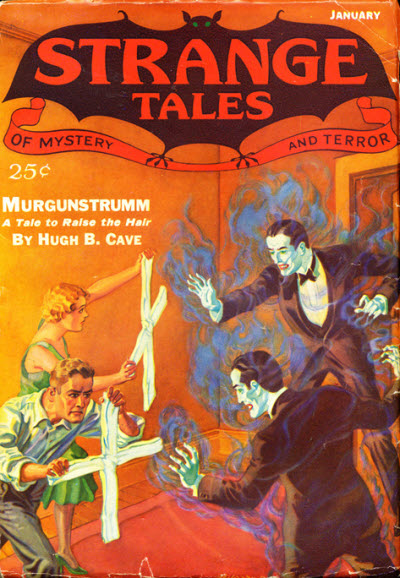
(Cover by H. W. Wesso. Strange Tales, October 1932.)
There is, of course, at least one writer in Weird Tales in the ’30s who I think matched Smith on almost the same wavelength: C. L. Moore. Being nearly twenty years Smith’s junior, Moore was very young when she hit the scene in 1933, but her first professional story, “Shambleau,” was an immediate success, and in just a couple years Moore garnered a reputation as a sort of prose poet, never mind a writer of immense depth. Moore’s Jirel of Joiry is one of the most memorable old-school sword-and-sorcery characters (she should by all rights be as influential as Conan, but sadly she is not), probably a bigger achievement than any of Smith’s characters individually (although Eibon and Maal Dweb are very fun and dastardly sorcerers), and despite her youth she could at times go toe-to-toe with Smith’s poetic strength. Imagine being a Weird Tales reader circa 1934 and seeing both Moore and Smith’s names in an issue’s table of contents. Both of these writers, for the rather brief time they were direct contemporaries, must surely have expanded the language of many readers, and by extension their minds. Moore is another writer who deserves to be popular with modern readers and for some reason is not; but that is a story for a later date.
Aside from being pessimists with a penchant for penning brooding passages, Smith and Moore were also both more open go writing about sex their most of their contemporaries—I don’t mean sex as a source of titillation, but as it pertains to human psychology. Lovecraft was probably asexual, and so avoided the topic when he could, and Howard, while he did sometimes write about erotic love (never mind his attempts at titillating the reader), was not given to jealousy, forbidden lust, and other psychosexual matters. Moore’s Jirel of Joiry experiences a crisis of conscience when she realizes (after she has killed him out of vengeance) that she is profoundly attracted to the man who had sexually assaulted her. Smith’s characters likewise are at times met with these conflicts between mind and flesh. Jealousy and temptation are especially common. I’ve noticed, after reading enough of his fiction, that Smith was fond of using flowers as symbols for two things at the same time: an ideal and tempting beauty, and a horrific malice which lurks under said beauty. For example, in his story “Vulthoom” (review here), the protagonists are met with an eldritch being in the Martian underground who, seemingly in an effort to tempt Our Heroes™ over to its side, takes on the appearance of an androgynous beauty within a massive flower. Much like Smith himself, who was a notorious womanizer (he only married after his sixtieth birthday), characters in Smith’s writing think about sexual attraction, and this thinking-about-sex plays into their psychologies.
Why did Smith never pierce the mainstream consciousness? There are a few reasons for this. For one, the fact that he never wrote a novel in adulthood (he did write one as a teenager, but it was only published decades after his death and I don’t know anyone who cares to read it), does hurt him, as it would anybody. Unfortunately novels have always sold far more than short stories; you’ll find many stories of SFF writers in the ’50s who take up novel-writing in an effort to make that extra cash. Even Howard, who died so young, wrote a novel with The Hour of the Dragon. Another is that while Lovecraft and Howard were very good at writing a certain type of story, Smith is harder to pin down—that is to say it’s harder to come up with a single “encapsulating” Smith story to hand off to some newcomer. Someone curious about Lovecraft would do well to start with “Dagon” or “The Rats in the Walls,” but an unaccustomed reader might find the sheer awesomness of “The Dark Eidolon” or “The Maze of the Enchanter” off-putting. Even when compared to Lovecraft, who by no means was a slacker in the language complexity department, Smith’s prose is positively purple. The truth is that Smith is at his best when his language is at its most pyrotechnic; an “easy-to-read” Smith story is a relatively boring one. Lastly, Smith was not exactly an innovator, nor did he write extensively on the history of weird fiction; as such he was neither a pioneer nor chronicler of the form.
As you know, Smith’s output slowed to a trickle after 1934; once his parents died he no longer had the financial strain that had pushed him to try writing for a living. He could be coaxed to write a short story now and again thereafter, and strictly from a modern perspective it might seem like he actually wrote a decent amount after 1934. He always remained a poet. Being restless as an artist, he would also take to sculpting and illustrating, although his reputation stands on his prose and poetry. Smith died in 1961, having outlived some of his contemporaries by a good margin, but in the context of weird fiction and American fantasy it’s easy to think he had “died” around the same time as Lovecraft and Howard. Much like how Moore’s story as a writer basically came to an end with the death of her first husband, Henry Kuttner, Smith’s winding-down as a writer of some of the darkest and gnarliest (and at times funniest) fantasy can be said to coincide with Weird Tales‘s subtle decline towards the end of the 1930s. Many writers have tried (and a few have even succeeded) to sound like the next H. P. Lovecraft, but I don’t know anyone who has tried to sound like the next Clark Ashton Smith. Maybe he was a sorcerer without an apprentice.
(Cover by Margaret Brundage. Weird Tales, June 1935.)
The Story So Far
There’s a frontier war going on the between the Aquilonians and the Picts, the former trying to expand westward and the latter trying to keep their territory by any means necessary. The Aquilonians have better weapons and fortification, but the Picts in the area have a secret weapon in the sorcerer Zogar Sag, who incidentally is out for revenge against Fort Tuscelan. We follow Balthus, a young Aquilonian warrior set to be at Fort Tuscelan, and Conan, a Cimmerian who is currently working as a mercenary for the Aquilonian government. The first believes that expansion is both possible and good for humanity; the latter does not. As far as Conan’s concerned he’s doing it for the paycheck, but that doesn’t stop him from wanting Zogar Sag’s head on a platter—for the sorcerer’s treacherousness if not to defend the fort. Indeed this Pictish sorcerer has been collecting human heads for the purposes of blood sacrifices.
Regrouping at the fort, Conan assembles a crack team of warriors to cross Black River and take out Zogar Sag on the down-low, so as to hopefully prevent an all-out skermish between the Picts and the fort. It goes about as well as you’d expect: all the men get killed off, either right away or in the sorcerer’s hideout, and Balthus only lives because Conan rescues him. They discover, perhaps too late, that the sorcerer is not fucking around, as he’s able to conjure (among other things) a giant snake and a shadowy beast that stalks the woods. Killing Zogar Sag becomes secondary to making it out of Pict territory alive, but also warning the fort.
Enhancing Image
What began now as an assassination attempt has now turned into a losing battle. Conan expressed doubts that the Aquilonians could hold the frontier earlier, and these doubts are proved valid when Zogar Sag’s forces cross Black River in search of the fort, where they will be sure to give no quarter. It’s here that Conan and Balthus split up, and it’s also here that we’re introduced to our last major character: Slasher, a mangy dog who was orphaned when his settler owners got killed. Depending on your politics Howard might be doing too much to humanize the settlers, despite also thinking that their cause is a fatally misguided one, not helped by the Picts being written as mindless brutes. Still, this is more nuance than one would expect from a pulpy sword-and-sorcery tale with lots of delicious gore that was written in the ’30s. One has to wonder what Howard would’ve done had he lived to contribute to the more “socially aware” Unknown a few years hence.
Howard is not known for his delicateness with language (despite writing a fair amount of poetry), and true enough his writing is often at its best with either dialogue or visceral action. He does, however, sometimes plop a bomb in the reader’s lap in the form of a really juicy passage. He crystalizes what makes Conan special, both in the context of his world (as a future barbarian king), and as a seminal figure in heroic fantasy. There was, to my knowledge, not a single character in the annals of heroic fantasy prior to Conan who stood so boldly against everything “polite society” in Howard’s day stood for, nor illustrated so clearly. Observe:
He felt lonely, in spite of his companion. Conan was as much a part of this wilderness as Balthus was alien to it. The Cimmerian might have spent years among the great cities of the world; he might have walked with the rulers of civilization; he might even achieve his wild whim some day and rule as king of a civilized nation; stranger things had happened. But he was no less a barbarian. He was concerned only with the naked fundamentals of life. The warm intimacies of small, kindly things, the sentiments and delicious trivialities that make up so much of civilized men’s lives were meaningless to him. A wolf was no less a wolf because a whim of chance caused him to run with the watchdogs. Bloodshed and violence and savagery were the natural elements of the life Conan knew; he could not, and would never, understand the little things that are so dear to civilized men and women.
One gripe I have with this story is that Zogar Sag is not a character; he doesn’t really have a personality, nor do anything that immediately distinguishes him from other Conan villains. He’s almost unnecessary for the story to even work, but admittedly how Conan disposes of him does offer the one little ray of light in what is otherwise a gloomy ending. Sure, Conan kills the demon Zogar Sag is linked with (the latter dying at the fort from seemingly nothing), and the sorcerer’s death demoralizes the Picts enough to make them retreat, but it’s a pyrrhic victory. All the men who stood to defend the fort have been killed with a single exception. The loss of the fort is so big that the border will be pushed back. Balthus and Slasher die in battle, fighting off Picts just so the women and children have enough time to evacuate, otherwise there would’ve been no survivors. Conan is literally one of only two survivors by story’s end.
A certain colleague of mine said that when she had first read this story many moons ago that Slasher’s death made her cry. It didn’t get that reaction out of me on either reading, but a) it speaks to Howard’s skills as a storyteller that we can feel for an animal that only shows up in the last quarter of the story, and b) on this second read I did feel sort of overwhelmed by the sheer gloominess of this story’s climax. Not that the Conan series is known for being uplifting (Conan himself is a pessimist and characters, be they heroic or villainous, are likely to meet bad ends), but even by those standards Beyond the Black River stands out as probably the gloomiest in the whole series. We’re told at the end that civilization “is a whim of circumstance,” and curiously this final line is not spoken by Conan but by an unnamed woodsman, who nonetheless shares Conan’s worldview. Appeal-to-nature fallacy aside, Howard seems to be saying that civilization, no matter how great, is only temporary; once it inevitably gives way, barbarism will take its seat on the throne, just as it had done previously.
A Step Farther Out
Beyond the Black River is arguably the best Conan story done by Howard’s pen, but I wouldn’t recommend it as one’s first Conan story. Aside from the genre mixing, this is an especially dark tale that lacks some of what had become hallmarks in the series, like Conan saving a scantily clad damsel in distress, and indeed there’s no romance plot nor any named female characters to speak of. This is not necessarily a bad thing. This was not the last Conan story written or even published in Howard’s lifetime, but it feels like a culimination of what Howard was trying to say with the character. This is the most vivid thesis statement on what Conan represents and what Howard was trying to do with the series. As such I would recommend reading it only after getting at least a few prior Conan stories under your belt; it becomes more rewarding the more you put into it.
And that’s it—my last serial review until 2025. 2024 will be focused on short stories, novellas, and the occasional novel. Reviewing serials takes a certain amount of energy out of me, and as I’m looking for a new job (yes, I’m back on the job hunt), I don’t wanna become fatigued on this blog. I love writing about mostly old-timey SFF and it would be a shame if personal issues got in the way of this specific hobby of mine. This is not my last review for 2023 (there’s one more in the oven), but still it marks the beginning of a hiatus I’m taking from reviewing a mode of fiction.
(Cover by Margaret Brundage. Weird Tales, May 1935.)
Who Goes There?
It’s telling of Robert E. Howard’s skill as well as his productivity that despite committing suicide at the age of thirty (most authors barely get their careers started by thirty these days), he stands out as one of the most influential American fantasists. He got his start when he was a teenager and from then on he never stopped writing, with a truly staggering amount of short fiction and poetry under his belt. (He only wrote two novels, however, one of which doesn’t seem to have been finished at the time of his death.) Howard started several series over his career, the most famous of these being Conan the Cimmerian, or Conan the Barbarian as he’s more popularly known. This one character (who admittedly is rarely ever depicted accurately in media by other hands) would lay the groundwork for sword-and-sorcery fantasy as we tend to recognize it, despite Conan not being Howard’s first attempt at such a character but rather a culmination. God only knows what the field would look like had Howard not died so young.
This will be my last serial review until 2025, and we’re capping things off with a reread. “Beyond the Black River” was one of the first Conan stories I had ever read, and it definitely helped ignite my interest in classic heroic fantasy, not to mention Howard’s writing. Conan himself is a bit of a handyman, taking on different odd jobs between stories, and this is reflected in the stories themselves taking on different subgenres, from straight action fantasy to weird horror. In the case of “Beyond the Black River” we see weird horror being wedded to—of all things—the frontier Western (think less A Fistful of Dollars and more The Last of the Mohicans). Howard really loved Westerns and he actually wrote a fair amount of straight examples of that genre, without fantastical elements.
Placing Coordinates
Serialized in the May and June 1935 issues of Weird Tales, which are on the Archive. It’s in more Conan collections than I can count, honestly, but good news is you don’t have to worry about tracking down a hard copy unlesss you really want to, because it’s on Project Gutenberg.
Enhancing Image
We start, not with Conan but a young Aquilonian settler named Balthus, who is on his way to his fort near Black River. He witnesses a fight between a Pict (a barbarian native to the land on which Balthus’s fort borders) and Conan, who really needs no introduction. Well, maybe a little. Conan is one of the most frequently (and inaccurately) depicted fantasy characters in visual media, and this is no doubt helped by Howard giving us some very juicy descriptions of his physique and demeanor in every story. He’s tanned, has raven-black hair, is built like a brick shithouse, moves “with the dangerous ease of a panther,” and is “too fiercely supple to be a product of civilization.” Conan is a Cimmerian, from a long line of Celtic barbarians, and in this sense he’s not dissimilar from the Pict whom he makes short work of. Balthus and Conan are working for the same side, although unlike the former, who believes in westward expansion, Conan is merely doing it for money, acting as muscle for the Aquilonians.
There’s a frontier war going on between the Picts and the Aquilonians, or more accurately a series of skirmishes. The only thing separating Pict land and Fort Tuscelan is Black River (not the black river as the title would suggest), not to mention woodland. The Aquilonians are a “civilized” people who, in the name of settler colonalism, may have bitten off more than they could chew. Balthus and Conan quickly find that there are far more dangerous things in the forest than Picts, for some animal had nearly ripped off the head of some dead merchant named Tiberias. We’re told of a Pictish sorcerer, Zogar Sag, who had been imprisoned in Fort Tuscelan for theft, but escaped and has since sought his revenge. The men who had originally detained the sorcerer were all killed, with their heads torn off. Zogar Sag lurks in Gwawela, a Pictish village on the other side of Black River. Clearly one side or the other must yield, but so far it’s been a stalemate between the Picts and Aquilonians, which is where Conan comes into play.
Beyond the Black River is a very different kind of story from the last Conan outing I reviewed, The People of the Black Circle, and indeed is quite different from other Conan stories I’ve read. Typically, though the narration is third-person, the perspective tends to be from Conan’s, at least when he’s onscreen. It’s pretty clear from the outset here, though, that Balthus is basically the protagonist of this story, not Conan. Of course, Conan is guaranteed to survive any story he’s in, but the same can’t be said of literally anyone else—including the person the story is really about. Another weird thing is that, to my knowledge, this is the only time Howard injects Western elements into the Conan series, although it’s certainly not the only time he mixed weird fiction with the Western. More specifically Beyond the Black River harks to a subgenre of Western that’s even older than the John Wayne variety—in this case James Fenimore Cooper’s Leatherstocking tales. Even the title would not be out of place in a Western pulp magazine.
Morality in the Conan series tends to lean towards a dark shade of grey, and Conan himself often only does heroic things by virtue of helping people who are not as bad as the opposition. In this case Our Anti-Hero™ gets caught between the settlers, who are rather misguided to put it one way, and Zogar Sag, who is actively malicious. There’s some debate, from a modern left-leaning perspective, if the settlers are sympathetic at all, given that they also indulge in racism against the Picts, and it’s not entirely clear how Howard himself sees them. Something very curious Howard does is he makes both sides of the conflict white, although the Picts (like Conan) are described as “swarthy” and dark-skinned, “but the border men never spoke of them as such.” It’s easy to make parallels, such as between WASPs and white Jews and in the US, or—more likely what Howard intended—between WASPs and the Irish. It’s unclear at what point the Irish started to not count as “off-white” in the US, but clearly anti-Irish discrimination was something experienced within living memory in Howard’s time.
(Conan himself continues to be one of the most entertaining characters in fantasy, in no small part because he’s a bit of a scoundrel. While he is a great warrior and there’s definitely a noble quality about him, he has no qualms with playing sides against each other, or even working for a faction he used to be enemies with if the pay is right. He admits pretty casually to Balthus that he had fought against the Aquilonians some years prior, despite now being on that government’s payroll as a mercenery.)
Beyond the Black River might be the most overt example of Howard’s thesis on the relationship between man and civilization, and it’s a shame he died when he did because had he lived he probably would’ve been able to refine it. Howard was pretty open-minded for a man of his time and place, but he still had his own prejudices, and there’s definitely something questionable going on in the dynamic between the settlers and Picts. I mentioned Cooper’s frontier Westerns before, and now I’m gonna specify the comparison a bit more, perhaps to an uncomfortable degree. Making the Picts white was a clever move, because it softens the blow—that being that this is clearly running parallel to American westward expansion in the 18th and 19th centuries. It’s true that the settlers are not shown in the fondest light (indeed Conan thinks their enterprise foolish), but the Picts—the stand-ins for Native Americans nations—are mindless fiends who probably don’t deserve to keep their land. That Zogar Sag is a ruthless killer who collects human heads and does blood sacrifices arguably plays into certain real-world stereotypes, and not incidentally the settlers call the Picts “savages.”
There Be Spoilers Here
Conan thinks correctly that it’d be better to assassinate Zogar Sag with a small group of warriors than a whole battalion, but it still goes about as well as you’d expect. Also, is it just me or did Howard really have a thing against snakes? Giant snakes show up pretty regularly in his fiction and the halfway point of Beyond the Black River is no exception.
A Step Farther Out
This is not what I would recommend as one’s first Conan story, but for my money it might be the most intriguing of the ones I’ve read; it’s certainly the one that tries hardest to worm its way out of what must’ve already become predictable sword-and-sorcery cliches. In some ways it feels complementary to another Conan story Howard wrote around the same time, “Queen of the Black Coast,” in which Conan takes up piracy and even falls for a pirate queen who’s no less a fearless adventurer than him. There aren’t any notable female characters in Beyond the Black River to my recollection, and actually this is a rare case of Conan not saving a scantily clad damsel—although Balthus fulfills the “damsel” part at the end of this installment. This is more downbeat and not as overtly pulpy as other Conan stories, and its lateness plus its mixing of genres imply that maybe Howard considered branching out with his writing; he was maturing, but unfortunately he would not give himself much more time to do that.
(Cover by Michael Carroll. Asimov’s, December 2007.)
Christmas is coming up, and my birthday before that. Not incidentally we have a birthday among the authors covered, namely Connie Willis, whose birthday is the 31st. Willis is also very fond of Christmas stories so there’s that. Last December we did a month-long tribute to Fritz Leiber, who sadly will not be featured this time. (Don’t feel too bad, he’s already one of our most frequent “visitors.”) Since we’re closing out the first full year of this site, I figure it’s time to introduce one more major change (not permanent, don’t worry), not for this month but for January. December will be the last month probably until 2025 that I’ll be doing serial reviews; for 2024 I’ll be taking a break from serials and focusing on short stories and novellas, although I’ll still squeeze a few complete novels into the schedule.
The way it’ll work is, the days I would be reviewing sserial installments will instead be relegated to short stories, but otherwise the alternating slot method will not change, only starting in January you can expect to see two short stories for every novella. The space given to complete novels will remain the same: if a novella slot were to fall on the 31st of the month then I’ll at least try to tackle a complete novel. Why no serials for a year? For a few reasons. For one, I’m tired, and also I’ve come to find that my serial reviews are the least popular of my reviews, or rather they get the least feedback. Also, I’m a devotee of the short story at heart, and the reality is that there are way more short stories in the magazine market than serials, by at least a factor of ten; so for one year I think short stories deserve more of the glory. We do, of course, get two short serials to tackle before the hiatus, both of which are actually rereads for me.
There is one other thing I have in mind, a rather special thing, but you’ll have to wait until January to hear about it. It’s a secret. :3
For the serial:
Three Hearts and Three Lions by Poul Anderson. Serialized in The Magazine of Fantasy and Science Fiction, September to October 1953. Retro Hugo nominee for Best Novella. This is the first serial I’ll be covering where I’ve not only read the book version but also the serial version, so this is sort of my third go-around with it. It’s worth it, though; this is one of the more influential works in the history of American fantasy, having partly inspired Dungeons & Dragons. It also makes me wish Anderson wrote more fantasy.
Beyond the Black River by Robert E. Howard. Serialized in Weird Tales, May to June 1935. Despite committing suicide at the age of thirty, Howard wrote a truly staggering amount of fiction and created several series in the process, with his most famous creation being Conan the Cimmerian. Howard did not invent sword-and-sorcery fantasy but he had unquestionably the most influence on proceeding American fantasists. This right here was one of the first Conan stories I had read, and it still reads as one of the more unusual.
For the novellas:
“Pursuit” by Lester del Rey. From the May 1952 issue of Space Science Fiction. Del Rey started out as a sentimentalist at a time when genre SF was markedly unsentimental, filling a niche that had gone untapped such that early stories like “Helen O’Loy” and “The Day Is Done” were very popular. He would move away from that style, and in the ’50s he even edited several (very short-lived) SFF magazines, Space Science Fiction being one. Thus the first story in the first issue of this magazine is by del Rey’s favorite writer: himself.
“All Seated on the Ground” by Connie Willis. From the December 2007 issue of Asimov’s Science Fiction. Hugo winner for Best Novella. In the ’90s and 2000s Connie Willis could lay claim to being the most popular writer to appear regularly in Asimov’s, and that’s on top of her novels, a few of which are certified classics. Her novel Doomsday Book especially is excellent, although it does not indicate her penchant for humor. She holds the record for most Hugo wins for Best Novella, with “All Seated on the Ground” being her fourth.
For the short stories:
“The Keys to December” by Roger Zelazny. From the August 1966 issue of New Worlds. Zelazny looks like he might see a much deserved renaissance soon, with a TV adaptation of his Amber serie being in the works. This is good news, because for a couple decades Zelazny has been threatened with the dark cloud of obscurity, despite being one of the most acclaimed SFF writers to come out of the ’60s. I picked “The Keys to December” because, well, look at the title.
“Genesis” by H. Beam Piper. From the September 1951 issue of Future Science Fiction. Piper is surely one of the most tragic figures in old-timey SF, having started his writing career very late (he was in his forties) and committing suicide at the age of sixty, believing himself to be a failure, such that despite not dying young his career was short-lived. It’s a shame, because Piper was in some ways an unusual writer for the time; he was a bit of a character, one could say.
For the complete novel:
Lest Darkness Fall by L. Sprague de Camp. From the December 1939 issue of Unknown. From 1937 to 1942 (he took a break to support the war effort), de Camp was one of the designated court jesters in John W. Campbell’s Astounding, and perhaps more importantly in Unknown. It was here that de Camp got to show off his range as a fantasist (most famously in his collaborations with Fletcher Pratt), although ironically his two longest solo efforts in Unknown in its first year, Divide and Rule and Lest Darkness Fall, are science fiction, not fantasy. Lest Darkness Fall was de Camp’s solo debut novel, an early example of a modern person being sent back to an ancient time period, and according to a lot of people it’s also his best. It was expanded (although I can’t imagine by much, since the magazine version looks to be a solid 50,000 words) for book publication in 1941.
You may think it a weak move for me to have my last two serial reviews before the hiatus be of ones I’ve already read, but as I’ve said before and always hope to make clear, rereading is arguably more important than reading in the first place. So it goes.
(Cover by Hugh Rankin. Weird Tales, December 1929.)
The Story So Far
Stephen Costigan is a drug addict and traumatized World War I veteran spending his days in the Limehouse district of London, wasting away in an opium den, until he is called upon by Kathulos, a strange man who claims to be of Egypt but whose ethnicity is ambiguous. Kathulos frees Stephen of his hashish addiction but instead gets him hooked on a much more powerful drug, an elixir whose ingredients only Kathulos knows. Stephen is hired to carry out a rather strange assassination plot, but he goes to John Gordon of the London secret police and conspires with him to double-cross Kathulos and his gang. Part 2 is concerned with Stephen and Gordon playing detective and discovering both the whereabouts and origin of Kathulos, who had escaped with Zuleika, Stephen’s love interest. Turns out Kathulos is an Atlantean—found in a coffin in the ocean and either awakened or resurrected. The sorcerer’s plan is to overthrow “the white races” and take over the world, with Africans and Asians as his underlings.
Funny thing about the recap section for this installment is that because so little progress was made in Part 2 the synopsis is expanded from the front so that we start with backstory before ending on basically where Part 1 ended. I said this before, but Part 2 really ground the plot to a halt and generally this novella could’ve used an editor’s judgment.
Enhancing Image
This will be mostly a series of notes, since right now I don’t have the motivation to do otherwise. Skull-Face isn’t very good, but it is certainly strange—and baffling, especially for the modern reader.
Let’s consider the following:
If you thought we were done with Gordon’s monologuing from Part 2, think again. Given he is supposed to be of the secret police, Gordon has no qualms pouring out every little bit of information he knows to Stephen, who after all is a civilian and not even a British subject at that. His eagerness to trust Stephen turns out to not be ill-founded, of course, but it does ring as implausible.
Speaking of implausibility, Kathulos being from Atlantis and Atlantis being a real place are taken basically at face value, with Our Heroes™ not having a hard time accepting these as fast. I genuinely wonder how many people back in the ’20s believed in the Atlantis myth, but upon reflection it would not surprise me if a good portion of the Weird Tales readership bought into it.
So let’s talk about how this is sort of a white supremacist narrative. To put it simply, the villain of the story is a non-white person who has kicked off several revolts in Africa and Asia against white colonists, and we’re supposed to believe these oppressed peoples taking back their land is a bad thing. The phrase “white supremacy” is actually used at one point, quite literally, coming out of Gordon’s mouth if I recall correctly. Of course, being a British cop, Gordon has the perfect motivation to back white supremacist interests.
This is, however, complicated by Kathulos being open about using said revolts and building an empire of non-white people for his own gain. He’s essentially a grifter who has radicalized people into anti-colonialist action so that he can reap the benefits. I’m not sure if Howard did this because he realized that the villain of his story might come off too sympathetically or if he wanted to placate his readership, a fraction of whom would’ve been bona fide white supremacists.
Further complicated by the Atlanteans apparently viewing whites as little more than barbarians in suits, being still inferior to the Atlanteans who see themselves as the truly supreme race. Genocide against whites would be the cherry on top to Kathulos’s empire, although as he points out, he does not view blacks as any better, with Atlanteans (at least in the old days) thriving on racialized slavery not unlike much of the US leading up to the Civil War. I’m not sure if Howard, who came from a former slave state and who became increasingly aware of his country’s blood guilt as he got older, is making a comment here.
The story climaxes with Stephen rescuing Gordon from bloody sacrifice and Gordon shooting Kathulos in the chest point-blank, which may or may not have killed him. While I do find it funny that a sorcerer with plans to rule a billion people gets taken down by A GUN, I was also intrigued by the fact that we don’t know if Kathulos died or if he somehow survived both the gunshot and his underground tunnel network getting blown to bits. His body is never found. The ending hints at a possible sequel, but we never got one.
The romance with Zuleika is about as rushed and unconvincing as you would expect, although for what it’s worth we do get a romance between a white man and a non-white woman that ends happily. As far as I can tell interracial marriage was totes legal in the UK at the time, although the social acceptability of such a union is a different question, especially since Stephen is himself an immigrant.
Reading Skull-Face after having read some later Howard works, it seems like Howard was on the verge of becoming more socially aware of the world outside of lily-whiteness, which is to take most of the world. His sympathies for black Americans would become more pronounced as he aged, to the point where he would get into arguments with Lovecraft and others with regards to white supremacy, but I’m not quite sure when he reached that point. Keep in mind that Howard grew up in a time and place where he would’ve been force-fed pro-Confederacy falsehoods almost from birth. He took more pains than most of his peers to understand people who come from outside the white Southern bubble. Gone with the Wind came out the year of Howard’s death, and for being a thousand pages of Confederacy apologia it won the Pulitzer Prize and became an enormous bestseller.
I realize I sound like I’m excusing the obvious racism of Skull-Face, but to make it clear, I don’t blame anyone for disliking this story on the basis of its problematic elements, which are indeed appalling.
A Step Farther Out
Skull-Face is not something I would recommend unless you’re already a Howard fan and/or a completionist, since it’s not very good, for one, but it’s also likely to alienate readers who are not already familiar with the trajectory of Howard’s writing. Being the oldest Howard story I’ve reviewed, it’s easily the weakest and shows the most signs of having been penned by someone who was still honing his craft; and then there’s the racism. The absurd race war plot is probably what people will take away from it, which does not bode well for how much one can enjoy it. Howard would go on to write a few equally long works and structure them far more ambitiously than here while also justifying that length. He gets better.