It’s now September, or as I like to think of it, the month before October. Yeah, I don’t have anything special in mind for this. Summer is about to end, the kids have gone back to school, and I’m about to head back to work as I’m finishing up this post. As has become typical I’ve toyed around with what I’m gonna review repeatedly, right up to the last minute, because I cannot make up my damn mind sometimes. There’s so much fiction, especially short stories, to cover that I’m constantly going, “Hmm, I wanna check this out. But ohhh, what about THIS?” Much as I want to at times I can’t do everything I want in a day. I’m a slow reader and I don’t give myself the heavy loads of someone who gets paid for review columns.
Speaking of making a good use of your time, I recommend subscribing to a few SFF ‘zines; doesn’t matter too much which ones, although I’m biased and I think Uncanny Magazine and Lightspeed are very much worth supporting. Even buying the latest issues of The Big Three™ (Analog, Asimov’s, and F&SF) would be a much better use of your time and money than a no-good piece-of-shit (HBO) Max subscription.
Apparently Analog and Asimov’s now have their own digital subscription services, to compensate for the Amazon bullshit, so that’s great honestly. Not sure what F&SF is gonna do since, with all due respect, of The Big Three™ they’re the ones most “behind” with regards to adjusting to changing market forces. We’ll see what happens there.
So what reading materials do we have?
For the serials:
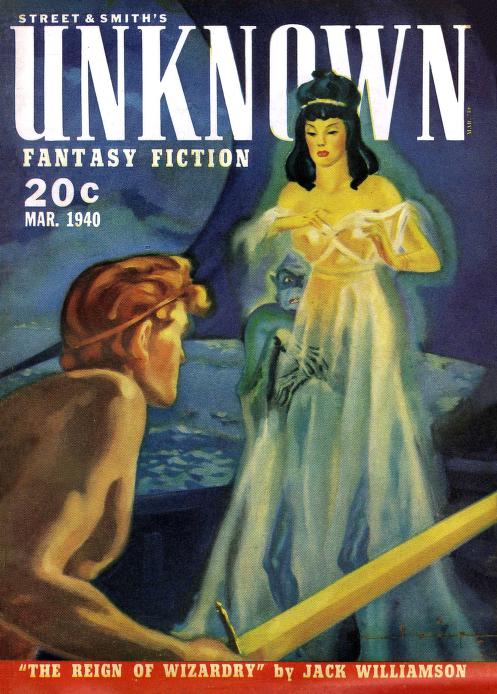
The Reign of Wizardry by Jack Williamson. Serialized in Unknown, March to May 1940. From a historical perspective, Williamson has to be one of the most intriguing figures in American SFF, debuting in 1928 and more or less remaining active until his death in 2006. At his best he also proves to be one of the most gripping and thoughtful “Golden Age” authors. The Reign of Wizardry was Williamson’s first attempt at writing fantasy that was not in the Weird Tales mode.
The Chronicler by A. E. van Vogt. Serialized in Astounding Science Fiction, October to November 1946. In the ’40s and early ’50s van Vogt was a star among genre readers, about on par with Robert Heinlein and Isaac Asimov—only since then his popularity has waned massively, for several reasons. A direct precursor to Philip K. Dick (by Dick’s own admission), van Vogt’s influence on the field is still discernable but now understated. He remains a divisive figure.
For the novellas:
“The Earth Quarter” by Damon Knight. From the January 1955 issue of If. As author, editor, and critic, Knight did much to bridge the gap between ’50s SF and the New Wave, with his Orbit series proving the viability of original anthologies. But in the ’50s he was one of the finer short story writers, with such classics as “Four in One” and “To Serve Man.” “The Earth Quarter” was later revised for book publication, but we’ll be reading the magazine version.
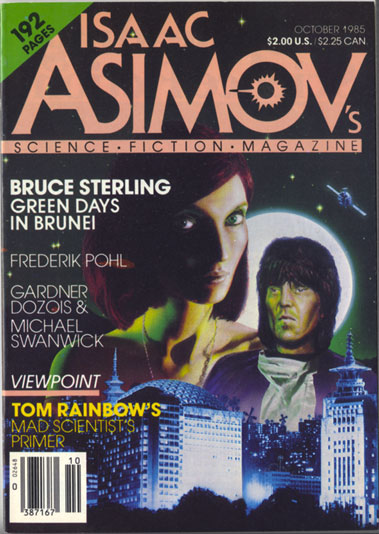
“Green Days in Brunei” by Bruce Sterling. From the October 1985 issue of Asimov’s Science Fiction. Probably the most important writer of cyberpunk whose name is not William Gibson, much of Sterling’s work is actually not cyberpunk—at least in content. If Gibson codified the tropes that would define the movement, Sterling codified the attitude of cyberpunk, emphasizing the “punk” half of that word. Will be one of two Sterling stories I review this month.
For the short stories:
“Forever to a Hudson Bay Blanket” by James Tiptree, Jr. From the August 1972 issue of Fantastic. Real name Alice Sheldon, Tiptree was one of the thorniest authors to come out of the New Wave, being much discussed for the outward feminism (and pessimism) of her work, the mystery of her true identity, and the tragic circumstances of her death. Tiptree made waves in the early ’70s, but I’m going for a relatively obscure story from that period.
“Wong’s Lost and Found Emporium” by William F. Wu. From the May 1983 issue of Amazing Stories. Surprisingly, given how obscure a name he is, this is not my first time reading or even reviewing Wu. He must’ve been one of the first Asian-American authors to partake in magazine SFF, and yet he remains to be rediscovered. This story, for one, was up for the Hugo, Nebula, and World Fantasy Award, and it even got turned into a Twilight Zone episode.
Next month is when we’ll be doing all short stories and all spooky shit, so be on the lookout for that. In the meantime my review schedule is pretty normal and I assume nothing will be replaced last-minute.
Well, we’ve been bamboozled again. I was gonna write a review of A. Merritt’s 1932 novel The Dwellers in the Mirage, but I basically fizzled out halfway through reading that novel; not that it was a bad read, it was more that somehow the timing did not seem right. I was struggling with Jack Williamson’s The Reign of Wizardry at the same time, a novel whose opening stretch is rather tough going, and reading both at the same time with a deadline in mind wearied me. Whereas the Williamson serial did pick up steam in its second half, giving me the energy to persist, I kept putting Merritt’s novel off and on, until I realized I probably wouldn’t have it finished in time. I’ll cover Merritt someday (considering his influence on other writers and how nearly everything he wrote appeared in the magazines), but I found out first-hand that sadly today will not be that day. Thus a shorter alternative was needed.
One thing I said in my review forecast was that only the novellas covered this month would be science fiction, and that remains true because we’re talking about a novella today that is very much science fiction. “Beyond Bedlam” had been in the back of my mind for a minute, because it apparently encapsulates what made the early years of Galaxy so unique and so ahead of the competition. Truth be told I thought “Wyman Guin” was a pseudonym at first, because it sounds like one. Guin did debut in the field under a pseudonym, but then started using his real name; maybe he was hesitant to do that as he already had a respectable day job. Anyway, he didn’t write much, but it was enough to earn him the Cordwainer Smith Rediscovery Award. “Beyond Bedlam” marked Guin’s first story under his own name and it remains his most well known.
Placing Coordinates
First published in the August 1951 issue of Galaxy Science Fiction. It’s been anthologized a few times, as well as collected in Beyond Bedlam, which has all of Guin’s short fiction; sadly these are all out of print, although the latter has an e-book edition. Good news is that you don’t even have to pay to read it in an unambiguously legitimate fashion, as it fell out of copyright and is available on Project Gutenberg.
Enhancing Image
(Before we get into the thick of it, be aware that “Beyond Bedlam” discusses mental illness at length in terms that are outdated; not that the language Guin uses is insensitive, but rather that our understanding of mental illness has, like everything else about ourselves, advanced massively since 1950. For the sake of staying consistent with the story, and for my own sanity, I’ll be referring to the condition described in-story as schizophrenia, even though it’s actually recognized as a different condition today.)
Sharpen your pencils, because class is in session.
It’s the 29th century, and things are… a little different. Sure, we have some future tech that one would expect in old-timey science fiction about “the future,” but the technology is not the focus of the story. No, the people have changed far more radically than the tech. We start out in a classroom, with Mary Walden, who is not the protagonist but who will eventually figure profoundly into the central conflict. Thing is, Mary is only half a person—or rather she’s a whole person, but only gets to use the body she’s in half the time. She shares her body with a filthy brat named Susan Shorrs, whom Mary knows nothing about other than she leaves the body shared with Mary in rough shape whenever the “shift” happens. The problem is that Mary is a schizophrenic, which is actually not a problem because so is everybody else. Schizophrenia, a mental illness that was very much frowned upon by “the ancient Moderns” (i.e., us), became more acceptable in the 20th century once psychiatric drugs started developing and became more accessible, not only treating schizophrenics but ushering them into normal society. “The drugs worked so well that the ancients had to let millions of schizophrenic people out from behind the bars of ‘crazy’ houses. That was the Great Emancipation of the 1990s.” After several generations schizophrenics were so entrenched in normal society that they actually started to outbreed non-schizophrenics, and because the Medicorps (mind the “the”) developed a monopoly on psychiatric drugs, and because said drugs became so accessible, schizophrenics soon had to take their drugs as mandated by law. Cut to 900 years later and you have a society (at least in the US, as we learn shockingly little about life outside of it) where everybody (with exceptions, who are themselves now pariahs) is a functioning schizophrenic. The “normal” person is now a body housing two totally separated and autonomous personalities, each in effect a whole person.
I mentioned earlier that Guin had a respectable day job that did not incentivize him to write fiction prolifically; more specifically he was a pharmacologist and advertising executive, so you bet he knew a thing or two about the latest in psychiatric medicine. The strange result is that the premise of “Beyond Bedlam” is patently ridiculous and whose foundations are a little shaky if you go asking too many questions, but for what the story asks of itself it is remarkably internally consistent. Basically, it works off assumptions made in 1950 (so when Guin wrote the story) about how people suffering from mental illnesses like schizophrenia seem to be growing in relation to the general populace. We know of course that as psychiatry has advanced by leaps and bounds that people with mental illness do not necessarily take up a greater percentage of the population, but that doctors have been able to diagnose people with greater understanding, never mind empathy. It’s a fallacy, but it’s necessary in presenting a distant future society wherein the “lunatics” have literally taken over the asylum.
(I could go on for a long fucking while about how this story’s setup clearly anticipates some of Philip K. Dick’s works regarding mental illness [Clans of the Alphane Moon, Martian Time-Slip, and A Scanner Darkly especially], but I won’t, becaue believe it or not I do value your time. I would just be shocked if Dick didn’t read “Beyond Bedlam” when it was first published as it very much reads as proto-Dickian, and also it’s great.)
So how does this work? You have, say, 10,000 bodies in a town but effectively 20,000 people running it. We’re told that historically there have been bodies with three or even four personalities, but while the word “eugenics” isn’t used, it’s made clear that these abnormal schizophrenics have been weeded out, or at best incentivized to not reproduce. A society wherein you have two personalities for every body would present enough of a problem, so it only stands to reason that more would be worse. People are forced into five-day shifts wherein each personality takes over for that duration, followed by a day of rest, between a “hyperalter” and “hypoalter.” The hyperalter is the so-called dominant personality that can, if they really want, interfere with the hypoalter’s consciousness, even invading their dreams. As such, on top of the drugs taken for compartmentalizing personalities, people are also required to take a “sleeping compound” that’ll prevent hypoalters from dreaming and thus risk invasion from their hyperalters.
The system in place to keep people’s lives in order is regimented and also imperfect, which is where the plot comes in; but we’re not quite there yet. “Aren’t you gonna get the plot already?” Soon. The thing about “Beyond Bedlam” is that the plot itself is straightforward, at least when put up against worldbuilding this dense. It’s like when people talk about Stand on Zanzibar but rarely discuss its main storyline; it’s because we all know the real meat of both of these works is in the background, and I do think “Beyond Bedlam” approaches that level of density. H. L. Gold’s editorial for this issue of Galaxy focuses pretty much entirely on “Beyond Bedlam” and how Guin went about writing it, and with good reason. Not only is this a first-rate story, but it probably could not have materialized in the way it did without the intense back-and-forth between Gold and Guin in refining it. Gold is unclear if Guin always intended this to be a novella, but he says that, with his help, Guin revised and rewrote “Beyond Bedlam” a couple times each, going through 80,000 words of drafts. The effort was worth it; this is a three-dimensional depiction of possible life in the future.
Now for the plot…
Mary is the “assigned” child (as people are not raised by their birth parents) of Bill and Helen Walden, who seem to lead a decent middle-class life, except for a couple things. For one, Bill and Helen’s alters, Conrad and Clara Manz, are also married to each other, which it turns out is very much out of the norm. “Such rare marriages in which the same bodies lived together on both halves of a shift were something to snicker about.” Conrad, being the hypoalter, knows that Bill has been “cheating” by messing with Conrad’s shifts for a few hours, but what Conrad does not know is that Bill has been having an affair with Clara, whom as you know is Helen’s hypoalter. Now, monogamy is not taken too seriously in this future society; people have affairs pretty casually, and the Waldens and Manzs are chill about messing around behind each other’s backs. The problem is that Bill is not only messing with a hypoalter (hypers and hypos are kept strictly apart, and never the twain shall meet) but his own alter’s spouse.
What starts as Bill and Clara worming their way around regulations to have their meet-and-fuck sessions soon snowballs into Bill jeopardizing both his own “life” and Conrad’s, both physically and by tempting the wrath of the Medicorps. This is all made worse by Mary becoming depressed and fed up with being neglected by her parents, causing her to break a different taboo by tracking down Conrad and Clara. Having the story start with Mary is sort of misleading since she only appears sporadically, but the classroom setting at the beginning gives us a healthy dose of exposition while also establishing how people in this future might want to break out of their regimented relationships with their alters. Since this is a strictly drug-induced culture, it’s also emotionally stifled, with the positives being that war is apparently a thing of the past (again, at least for the US) and crime seems to have gone down massively. The result is a more peaceful but also less free society where even one’s emotional spectrum is narrowed.
There Be Spoilers Here
The outcome is not surprising. Bill gets caught and put on trial by the Medicorps for a gross breach of conduct, with a guilty verdict resulting in either hospitalization for life or “mnemonic erasure,” i.e., death of the personality. If you’ve read a few dystopian narratives in your time then you’ve been here before, and you also know that Bill has to lose—to play the role of Winston Smith and John Savage. Yet even during what would normally be a been-here-done-that sequence in a dystopian narrative (the third-act breakdown of the rebellious hero), Guin once again shows off the wonderful density of the world he’s made. Mnemonic erasure will affect Conrad’s life almost as profoundly as Bill’s, as, being a single persona in a body, Conrad can’t just go around like one of the ancient Moderns. He still has his five-day shift, but during what would be Bill’s shift he gets put in deep freeze, so as to not interfere with the world of his late hyperalter. (Again, never the twain shall meet.) While Conrad is sort of pleased to see his alter put to death, since Bill’s been a huge recurring pain to him, there’s a cost to all this. With Bill gone, Conrad will now be sort of an outcast, and he will not be any freer than he was before.
So it goes.
A Step Farther Out
I have a two-part argument about SF and novellas. The first part is that SF is imaginative literature, in that it’s a literature chiefly concerned with ideas; the second is that the novella is the ideal mode for a literature of ideas, and by extension ideal for SF. “Beyond Bedlam” has enough meat on its bones to justify a novel, but it gets its point across in 21,000 words. It’s a densely packed depiction of a future society that, while absurd if considered too closely, does what it ought to do, in that it makes the reader think about how this society may be a distant descendent of ours. Guin does what most SF writers don’t in that he envisions a future that is mostly unrecognizable and yet just recognizable enough that we have context. The result is a nuanced dystopian narrative that does not provide easy answers, nor even an easily discernable perspective. If Orwell clearly sides with the individual in 1984, Guin seems unsure about the seesaw balance between individual freedom and public safety. It’s a haunting and mind-bending story, being one of the finest miniature gems of ’50s science fiction.
He made his debut in the ’80s, but Greg Egan is one of the quintessential voices of ’90s SF—a bridge connecting cyberpunk and transhumanist SF, sometimes wandering well outside the boundaries of either. Egan’s fiction is notorious for its incorporating of biology, computer science, quantum physics, and what have you. Egan started out as a programmer and his work often reads like the product of someone from that profession who also happens to read a lot of detective fiction. The typical Egan narrator, including the one for today’s story, is a rather melancholy white man who struggles with emotional honesty, and as such, depending on your frame of reference, it’s easier to understand Egan’s stories as detective narratives with cybernetics involved, rather than hard science fiction.
Placing Coordinates
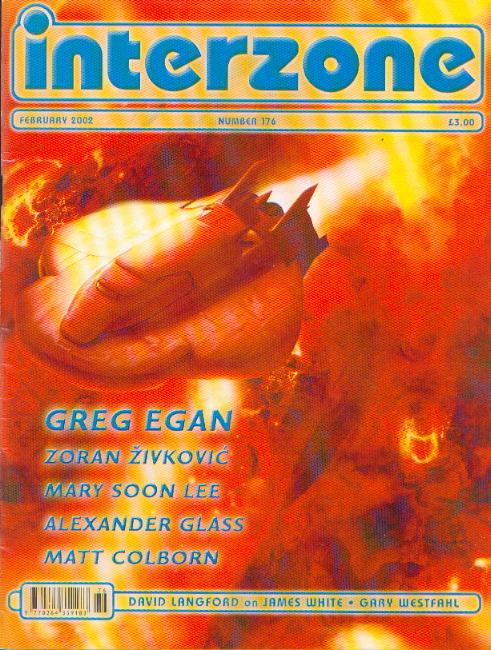
First published in the February 2002 issue of Interzone, which is on the Archive. If you have qualms with reading a scan of a 21-year-old back issue of a magazine that you would have to buy used anyway, rest assured you can read this story perfectly legit on Greg Egan’s site, found here. You can also find “Singleton” in The Best of Greg Egan.
Enhancing Image
We start in the now-ancient year of 2003, with Ben, the narrator, a snot-nosed college geek, being witness to what is likely a gang-related beatdown in an alley, with a ton of other people watching. A kitchen hand is getting his ass beat by two guys who don’t seem to be carrying guns but do seem to mean to kill this man with their bare hands. Nobody intends to interrupt the killing. “Keeping your distance from something like that was just common sense.” Something, however, snaps in Ben—maybe a jolt of guilt. He steps in and gets beat for his troubles, but the kitchen hand comes out the situation alive and Ben gets to feel like not just another bystander. Now, for most people an act of heroism like this would be a shining moment in their lives, maybe a fond memory, but the prossibility of not helping the kitchen hand will haunt Ben for the rest of his years.
The details of this first section are the foggiest in the story. We never learn exactly why those goons wanted to beat this man to a pulp, nor do we even learn the man’s name. We’ll never get the full context for some things—even the most important days of our lives. This haziness makes sense when you consider Ben is narrating this many years down the road, reflecting on when he was a teenager and the world seemed a fundamentally different place. Not unlike Marcel Proust in his search for lost time, there details of the past that time has simply devoured.
Ben, while still an undergrad, kicks it off with Francine, who will turn out to be his college sweetheart and life partner. The incident with the kitchen hand had, in the short term, given Ben a confidence that normally would be absent in young scientists, and he’s well aware that it was that incident which probably motivated him to pursue Francine. “There was no denying that if I’d walked away from the alley, and the kitchen hand had died, I would have felt like shit for a long time afterwards. I would not have felt entitled to much out of my own life.” But why shouldn’t they get together? They’re both scientists, albeit in different fields of study. Much of their relationshio will be long-distance due to work, but that will not be unusual in the coming years (as indeed it’s not out of the ordinary now); it may even strengthen their bond, that distance. “Singleton” is, among other things, a love story, and the romance is believable because there’s so little of it.
(A note here: There are several time-skips throughout the novella. We start in 2003 but creep across decades, well into even our own future. “Singleton” was published in early 2002 but it would’ve been written probably a whole year prior, which means Egan did not, for instance, take 9/11 and the War on Terror into account. This is like publishing an SF story in 1946 that was written, evidently, pre-Hiroshima.)
Some years go by and unfortunately the two hit a major speed bump in their relationship when Francine suffers a miscarriage that’s painful both physically and psychologically, possibly caused by Ben handling radioactive dust in a previous job but never confirmed. Regardless the two are not confident about the prospect of producing a child, and while adoption is on the table, their relationship is in enough of a rough patch that they don’t agree right away on the proper course of action. Not to say the romance aspect of “Singleton” is great, because that’s not its main purpose, but I do like how Egan shows the often banal (from the outside, anyway) downside of relationships. Ben and Francine love each other, but there are real-life issues standing in the way of an Eden-like existence, which of course also applies to a lot of real-life couples. Never mind that the idea of becoming a parent, as to be expected, fills Ben with an anxiety that’s both terrible and exhilarating. “I wasn’t ready,” he admits at one point, but for better or worse he would have to wait some more to become a parent after all.
Before we get into the actual science-fictional aspect of “Singleton,” I wanna take a moment to talk about how short fiction may be structured so as to resemble a novel; this is not exclusive to novellas as I’ve also seen it done with shorter works. The time skips and the conservation of detail (achieved via first-person narration, which you may notice is easier to do in that mode than in the third person) give the impression of a story being longer than it is, since it covers enough time and events to fit into a novel. We cover a lot of ground here in the development of Ben and Francine’s relationship, but there’s still plenty of room for Egan to explain, in language that is mostly beyond my dumb-dumb brain, quantum mechanics, the Many Worlds Interpretation, and how they relate to the major action of the narrative—which, to boil it down, is the raising of an AI.
Putting it as basically as I can, Ben builds a device, the Qusp, “the quantum singleton processor,” which basically acts as a funnel for a quantum computer. What separates a quantum computer from a normal or “classical” computer, you may ask? As a layman my explanation would be that while a classical computer can make decisions with incredible speed, it can only make one decision at a time, in other words being a linear thought processor. A classical computer, no matter how intelligent, even if it were sentient as with a true AI, would only be able to comprehend one decision at a time. A quantum computer, meanwhile, is able to see, with the naked eye so to speak, dozens or even hundreds of possible decisions simultaneously. Imagine you’re in a maze and you’re wondering which way to go; if you were a classical computer you would consider each direction one at a time, but as a quantum computer you would have all these decisions superimposed on top of each other, like cutting into a cake and seeing all the layers on the inside. I’ll let Egan explain more in his own words:
The Qusp would employ all the techniques designed to shield the latest generation of quantum computers from entanglement with their environment, but it would use them to a very different end. A quantum computer was shielded so it could perform a multitude of parallel calculations, without each one spawning a separate history of its own, in which only one answer was accessible. The Qusp would perform just a single calculation at a time, but on its way to the unique result it would be able to pass safely through superpositions that included any number of alternatives, without those alternatives being made real. Cut off from the outside world during each computational step, it would keep its temporary quantum ambivalence as private and inconsequential as a daydream, never being forced to act out every possibility it dared to entertain.
As such, a quantum computer that passes the Turing test could, with the Qusp installed, consider decisions simultaneously whilst being able to come to a single result and without being overwhelmed with information. Or so that’s the idea. The Many Worlds Interpretation is of course tied to quantum mechanics, wherein basically (I’m saying that word a lot, I know, but bear with me) every decision has its own branch, resulting in what would probably be billions (or functionally an infinite amount) of alternate universes—many of them very similar, but some very different. Ben and Francine eventually agree to try again at having a child—only this time they won’t make or adopt, but build a child. The result will be a quantum computer with the Qusp as its anchor, wrapped in a plastic human body. A ghost in a shell. Such a child would be tapped into many worlds, being able to consider decisions at a speed and complexity incomprehensible to humans.
What could possibly go wrong?
There Be Spoilers Here
In some robot/AI narratives the intelligence in question would turn out to be malicious, or perhaps too smart to relate to its human creators. Thanks to the Qusp, however, the resulting child, Helen, is not much more intelligent than a smartypants like Ben or Francine. There are certain things that are uncanny about her, such as the variety of plastic shells she can inhabit, but she is by no means an evil AI run amok. It does turn out, though, that of course there would be several issues that are not Helen’s fault. Our Heroes™ have functionally created a synthetic person or android, although it’s made clear that Helen only has her human body for the sake of her “parents.” The introduction of true AI in human form naturally causes a major stir throughout the world, with cultists both pro- and anti-AI popping out of the woodwork to make our characters’ lives worse.
(Another note: I appreciate that the future world Egan conjures is still very much recognizable as our own, albeit with a couple changes. We don’t get rayguns and flying cars, but we do get to see how an invention—in this case adais, or “Autonomously Developing Artificial Intelligences”—would interact with the known world. Aside from the whole pre-9/11 thing this is a plausible depiction of the near future.)
The back end of “Singleton” is concerned with raising Helen and how such a “unique” child poses a problem for Our Heroes™, who after all are doing this more so out of personal trauma than a need to do good. Ben eventually admits that he took on this extended project because he had become consumed by the implications of the Many Worlds Interpretation, with it all going back to that fateful day in the alley when he was but a teenager. The results are somewhat tragic, with Ben’s relationships with Helen and Francine eroding over time, but there is a ray-of-hope ending that hints at something which may bring an understanding between human and AI. If you’ve read enough Egan then you know that he’s in sympathy with transhumanism—more specifically the notion that consciousness can be totally divorced from organic biology. While there are several questions raied about Helen’s inner workings and how she may survive in the human world, what’s not questioned is that she is a thinking creature who deserves to be treated as such, and indeed the story ends with Helen caught in an act of contemplation. For better or worse, the machine is alive.
A Step Farther Out
“Singleton” is a curious novella (or, as I said before, a compressed novel) that would probably hit stronger on a reread—preferably after I’ve done more research on computing. I’ve read several Egan short stories throughout this year in preparation for reviewing a longer work of his, and yet—maybe it’s because I had read short stories from early in his career—”Singleton” is still a more demanding read than I had expected. I recommend it, because I’ve sat on it for a couple days now and it’s left an impression on me that’s hard to articulate (usually a good sign for a work of art), but it’s not what I would recommend for someone just starting to get into Egan; either shorter works or his most famous novels (so I’m told) would do the trick.
My Egan journey has been progressing at a pace where I’ll be getting to his novels, particularly Permutation City and Diaspora, soon enough. I hear the former is the best thing since sliced bread.
(Before the Golden Age. Cover by Tim Lewis. Doubleday, 1974.)
This month’s editorial will be rambling and not straightforward. For one, now is the time to reveal my thought process with regards to how I pick review materials and why I do that; so in a way this will be a bit of a meta post. You’ll get to see how the sausage is made. You see, I’m not a book reviewer who gets paid to receive review copies of upcoming releases and give them my honest (but not too honest) opinions, wrapped in professional plastic and safe for toddlers and small dogs to chew on. There may come a point when I take on a review column for some publication, but that’s not now, nor is it in the immediate future. After all, SFF Remembrance is already time-consuming and it serves a different purpose. This is my blog that I run for the fun of it and I get to review what I want, without some editor breathing down my neck.
This still raises the question: Why do I do it? Why, so far, have I tackled only a handful of stories from the 2010s and nothing from the 2020s (yet) in favor of dusty, pulpy, uncouth genre fiction from the time before my parents were even in diapers? This is a question that actually involves several questions within it, like one of those Russian nesting dolls, especially for someone of my age who does not have the ability to remember any of these stories from when they had that fresh car smell.
We have to ask the following:
What counts as “old” science fiction?
What differentiates “old” science fiction from “classic” science fiction?
Why read the damn things in the first place?
If we should read them, why should we write about them?
If we’re to write about them, should it be as a reader or as a pseudo-academic?
When all is said and done, who would want to read these reviews?
That first question sounds like it has an obvious answer, but it doesn’t; nor does “old” necessarily mean “classic” science fiction, hence the second question. Most old SF is not considered classic by today’s readers. Here’s another way to look at it: Dune is a classic novel, without question. It has been continuously in print since 1965, won awards, and has now received multiple film and TV adaptations. It is a classic by reputation, which really is what makes something a classic; that is to say there’s a collective agreement among a set of people that this work is still worth celebrating. Contrast this with a novel that came out only one year prior, Robert Heinlein’s Farnham’s Freehold, which despite having Heinlein’s name attached to it is often reviled, with even contemporary reviews being unkind towards it; it’s old, but not really a classic. Then again, 1965 is over half a century ago, so surely anything from then would be deemed old by anyone now living—certainly by anyone in my age bracket. There’s a certain point where people can agree that something has gathered enough wrinkles to be considered old—only we don’t always agree on when.
Much like how beauty is in the eye of the beholder, so one could also argue the age of a work of art is relative to the person perceiving it. I mentioned 1965, but let’s turn the dial to the year of my birth: 1995. For some people 1995 was not that long ago—maybe even too recent to be considered old, let alone grounds for now-classic works. I used to think the same way myself, that SF from 1995 is still fairly contemporary; only problem is it’s not. While many of the authors who were active then are still active and producing good work now (Nancy Kress, James Patrick Kelly, Michael Swanwick, to name a few), and while writing techniques have not evolved greatly in the past 28 years (certainly not as jarring a shift as, say, between 1932 and 1960), the recurring concerns and, more importantly, the perspectives of SF writing have changed greatly. Now we see not so much white American writers spouting about other cultures as people of those other cultures having their seat at the table. This is a good change, mind you. While there is still much exciting and fresh fiction from 28 years ago, there’s some dust gathering on the surface, visible to the naked eye.
(To put this in context, and with all due respect, it’s hard to imagine Mike Resnick’s Kirinyaga stories, which won him awards in the ’80s and ’90s, would get such a glowing reception if published today.)
If such fiction now strikes us as a little (or very) dusty, why should we still read it then? I am not referring to the work that still reads as fresh but that which does not read as fresh. These are stories whose style and morals have since been superseded by works that are at least superficially better. Why go back and read Jack Williamson’s The Legion of Time when there have been many time war narratives since then that are more sophisticated and less problematic? Indeed, why do we still read Dune whilst acknowledging that Frank Herbert’s prose now reads as confusing and overcrowded? Surely there are novels that are reminiscent of Dune that are also more delicate with the English language? Why are Heinlein’s books all still in print despite his being a lecherous right-wing militant with a penchant for monologuing? These are not easy questions, nor do they seem to have an “objective” answer that can be gathered via the scientific method.
I’m also asking these questions specifically with regards to old science fiction, and not old fantasy or horror. Nobody asks why we still read Tolkien (although I do) despite his being a lackluster stylist and a puritan. Nobody doubts the immense power and importance of Edgar Allan Poe’s writing despite its vintage and Poe’s own stylistic flaws. Even that most controversial of old-timey horror writers, Lovecraft, is still held as the sun around which cosmic horror orbits, despite efforts (lousy efforts, mind you) over the decades to discredit him. The viability of these fine and flawed gentlemen and their flawed works need not be thrown out the window casually. To be fair, there is a straightforward reason for this attitude that does not carry over to science fiction: fantasy and horror are genres that have not been subjected to change nearly as viciously as SF. Time, who is always a harsh mistress, has devoured entire worlds with SF for the simple reason that SF, far more than its sister genres, hinges on discoveries of the moment. Our understanding of the natural world has changed over time, and so by extension what was considered cutting-edge in the past is now quaint—or even worse, incompatible with current understanding.
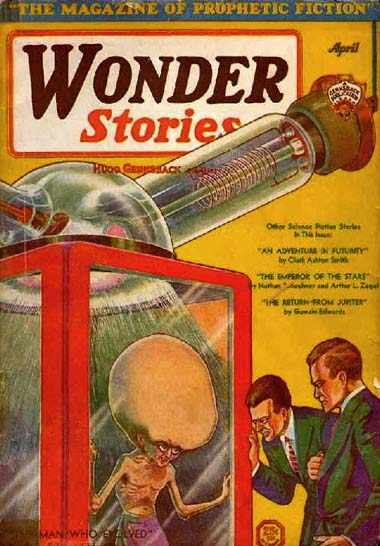
Consider that Frankenstein, that most foundational of SF novels, is still widely read and beloved—but not as science fiction. It’s still effective as horror, and as a cautionary tale, but as a narrative supposedly rooted in science it now reads as nigh incomprehensible. Even when I read it for the first time as a semi-literate high schooler I knew that Dr. Frankenstein’s method for resurrecting a corpse, and especially his subsequent fear that the monster would breed deformed hellspawn, made no sense. Mary Shelley wrote in a world that would not know Darwinian evolution for a few more decades, and it shows. Here’s another example: In the 1920s and ’30s there were a lot of stories about “cosmic rays” playing a part in evolution, perhaps best encapsulated in Edmond Hamilton’s “The Man Who Evolved.” This is total nonsense that cannot be taken seriously with a modern lens. Why, then, do people still read Frankenstein but “The Man Who Evolved” will forever be deemed a relic of the super-science era? Probably because, aside from being such a monumental work, Frankenstein can be understood as something other than science fiction, whereas Hamilton’s story can only be understood as a story founded on bad science.
And yet…
(Cover by Frank R. Paul. Wonder Stories, April 1931.)
We still see reprints, from time to time, of very old and very dusty SF, and there are several blogs running right now that specialize in engaging with vintage SF. I myself started as part of the online book club Young People Read Old SFF before creating my own blog. Unfortunately said book club has dwindled in number over the past couple years, and outside of it I’ve seen scarcely any interest from people my age in the old stuff. I suspect this is for a few reasons. If you’re a part of fandom and you don’t have the memory capacity of a goldfish then you may recall several incidents in the past decade (most infamously the Sad Puppies fiasco) wherein old folks and reactionaries would rant about how kids these days don’t respect “the classics” and how SF is absolutely 100% for sure on its way out. It’s true that we may be heading into another dark age for SFF magazine publishing, but never before has the field been more inclusive, more niche-filling, and more accepting of ideas that go against heteronormativity, capitalism, etc. And yet there is the grain of truth that young readers (I’m thinking people aged thirty and under) fail to engage with where the field has been.
It’s true also that SF with a fine layer of dust on it does present a problem for young readers—one which reviewers like myself should but are unlikely to solve. You see, you can’t force somebody to enjoy a work of art. You could contextualize art and give it the proper platform for which to be understood, but enjoying something, much like romance or the urge to produce children, is totally beyond rational understanding. Ultimately I have to say I read this or that because I enjoy it, and then try to apply a veil of reason to my desire. Even when I come out of a story not liking it I usually feel joy from thinking and writing about it—because I like to think and write about science fiction as something that has changed over time, as indeed it does. If I wanted to read something and enjoy it in a vacuum I could do that, which is basically how most readers go about it, and true enough when I sit down and dig into a novella or serial installment I’d been anticipating I do it for the same reason as the rest of us: for the pleasure of it. My reviews and other posts are not as professional-sounding as those of my peers, in part because I wanna make it clear that I come from the place of someone who reads because he finds the act of reading pleasurable and thus unbusinesslike; it could also be that I’m from New Jersey, so pardon me on that.
A little bit of a story here.
I have a lot of SF anthologies on my shelves, and almost entirely ones published prior to 2010, which means that inherently these volumes cover pre-2010 material; most of those are from the 20th century, which they cover (necessarily) even older material. There are two books I have that are of particularly relevant note to this month’s editorial, which have a strange amount in common, including their mission statements and the era in which they were published. These are Isaac Asimov’s Before the Golden Age and Damon Knight’s Science Fiction of the Thirties, from 1974 and 1976 respectively. Asimov and Knight are pretty close in age, the former born in 1920 (the official story, that is, although Asimov was probably born in late 1919) and the latter in 1922, and so these two men grew up reading mostly the same fiction. Even so, their temperaments are radically different. Asimov has a nostalgic view of the super-science stuff of the ’30s and his writing technique is a dot that connects perfectly with that era, his prose thoroughly beige (which is not to say dull); then in Knight’s case we have someone who started out as a critic before moving into writing and editing fiction, and thus someone who is more willing to experiment.
Asimov, for his anthology, picked 25 of what he considered the best SF stories he had read during his formative years—stories which he still enjoyed upon rereading as an adult. Knight, for his part, scouts the same time period (1931 to 1938 or thereabouts) but with a more “objective” stance, picking stories he had found whilst digging through old magazine issues that he thinks are worth rediscovering. Asimov’s book is autobiographical while Knight’s serves more as a brief history of short SF in the ’30s, and while I think the latter has stronger fiction on average (there are some truly awful picks in the Asimov), it seems people gravitate much more towards the Asimov because of that copious and shameless subjectivity. Before the Golden Age is a 900-page monster and about a hundred of those pages are Asimov reflecting on both his life and the stories he chose. We’re given, on top of a handful of still pretty good stories and a lot of clunkers, a look into Asimov’s mindset as reader, writer, and, for a brief time, reviewer. It’s an essential anthology, not so much for the stories but in how it argues for the need to return to old science fiction.
Something to think about is that when Asimov and Knight put together their anthologies, these being books deliberately collecting very old and outmoded fiction, the oldest story from was a mere 43 years old when Before the Golden Age was published; and yet the science fiction of 1931 and the ’70s were worlds apart. Time is relative, and merciless.
(Cover by Frank Kelly Freas. Astounding, March 1954.)
Who Goes There?
Clifford Simak is one of my favorite discoveries of the past few years, in that he’s exactly the kind of author I like to show off to people who think so-called Golden Age SF is just this or that. Simak debuted in 1931, which would make him a bit of an oldster by the time John W. Campbell took over Astounding in late 1937; but whereas some authors merely adapted to the new standard and were lucky to do that, Simak actually got better as time went on. He wrote most of the stories that would comprise City in the ’40s, with 1944 alone seeing four of them in print. These were some of the best and most emotionally fulfilling short stories of the era, even surpassing most literary fiction of the time in my opinion. The ’50s then saw a period of immense productivity for Simak, mostly in the pages of Galaxy, where he played well with authors two decades his junior.
“Immigrant” was one of the few major Simak stories in the ’50s to be published in Astounding, and without giving the game away at the start, I can see why it was published there and not in Galaxy. This is a bit of an unusual Simak story in that it takes place entirely away from Earth, as instead we find ourselves on an alien planet with a race of powerful and condescending aliens. It’s also rather foreboding—for the most part.
Placing Coordinates
First published in the March 1954 issue of Astounding Science Fiction, which is on the Archive. It was most recently reprinted in The Shipshape Miracle and Other Stories, which seems to only have an ebook edition. Sigh. You gotta go back to the ’90s for a paperback reprint. The most relevant for me has to be Galactic Empires Volume One (ed. Brian Aldiss), which is not an anthology you’d expect to see a Simak story in.
Enhancing Image
Going into this I thought it would be a coming-of-age narrative featuring a juvenile protagonist; well, it is a coming-of-age narrative in a sense, but there are a few twists. Our Hero™ is Selden Bishop, a 29-year-old genius who, through rigorous testing and passing a certain exam, gained the privilege of traveling to Kimon, apparently the most prosperous and alluring planet in the known galaxy. In this distant future, humanity knows it’s far from the only sentient race in the galaxy, and yet Kimon stands out among its neighbors as being where you wanna go if you wanna make it big; only thing is that a tiny fraction of humans (such that they can only be an extreme minority on Kimon) are allowed to enter.
Kimon was a galactic El Dorado, a never-never land, the country at the rainbow’s foot. There were few who did not dream of going there, and there were many who aspired, but those who were chosen were a very small percentage of those who tried to make the grade and failed.
The other thing is that those who are lucky enough to land on Kimon have been awfully cryptic in their letters to Earth for decades. It’s a shame Simak did not anticipate social media, as it would then be much harder to keep the exact relationship between humans and Kimonians a secret. Anyway, Bishop is here because he earned it, but also to do a sort of job for Morley, his Earth contact, which is to figure out what is actually happening on Kimon and what the humans are supposed to be doing there. No, despite the Kimonians being humanoid and very handsome (akin to tall bronze statues), there’s no implication of cross-breeding between humans and Kimonians; this is still a John W. Campbell magazine, after all. What Bishop discovered will be much more aligned with Campbell’s interests, but that’s for later. Much of the first half of “Immigrant” involves Bishop figuring out the basics and how to get a job, since he still needs one of those.
Like other immigrants from Earth, Bishop is sent to stay at a hotel that’s almost quite literally in the middle of nowhere, with “nothing, absolutely nothing, but rolling countryside” outside the hotel. There are no roads on Kimone, nor do there seem to be cities. While Simak does pander to Campbell somewhat in this story, the pastoralism of Kimon is surely Simak’s treat to himself. Actually the decadent ruralism of the Kimonians reminds me of what became of future humanity in Campbell’s own “Forgetfulness,” wherein mankind, in developing psi powers, forgets how to use technology as said technology becomes no longer needed. The Kimonians themselves are natural psi users, being able to communicate with each other across distances without tech via telepathy and teleportation; naturally, and more creepily, they can also read human minds.
As for the Kimonians themselves, they’re kinda… well, they’re like Vulcans: they’re a bunch of assholes. Not in an actively malicious way, but more in that they clearly think of humans as “cute.” Bishop can’t have a real conversation with them. The good news is that while the number of humans on Kimon is incredibly small, the humans have been clustered together such that it doesn’t take long for Bishop to make at least one new friend, namely Maxine, who to her credit does not exist to be Bishop’s love interest. Maxine has been here for a while now and not only understands the Kimonians to a better degree, but is capable of doing a couple things that normal humans ought not to be able to do. Unfortunately Maxine is also a pessimist who assumes the Kimonians just wanna play an epic prank of their human visitors—not that the Kimonians try hard to disprove this.
To make it in this new world, as surely the Irish and Italians had to in 19th century America, Bishop will have to know a whole new rulebook. “You have to adapt,” he thinks at one point. “You’d have to adapt and play the Kimon game, for they were the ones who would set the rules.” Whatever that game is. Eventually he sucks up his pride and goes to ask for a job, which true enough will have a very healthy paycheck by human standards, though it’s far from glamorous. Occupation? Babysitter.
What I like about “Immigrant” is that it’s too packed to work as a short story but too slight to be stretched to a 50,000-word novel; it’s a fine example of what can be done with the novella mode—specifically the short novella where we’re looking at 17,500 to 25,000 words. I suspect Simak wrote this for Astounding because of the paycheck, but also because Astounding usually ran a novella in each issue, with the only rival to both have such a policy and offer such a healthy paycheck being Galaxy. Still, this is not what I would call “major” Simak. It took me four days to read “Immigrant,” partly due to work but also I was not exactly glued to my screen. It’s hard to call boring, but it also meanders enough that I was not sure, while reading, about the point Simak was trying to make until the end. For those of you who are wary of Simak because of his sentimentality, though, you may be pleasantly surprised at how not sentimental “Immigrant” is.
There Be Spoilers Here
The “babysitting” job turns out to be a lot more taxing than Bishop assumed. For one, the Kimonian children he looks after seem totally capable of taking care of themselves, but worse is that they don’t seem to even acknowledge him as an adult figure; indeed, to the Kimonian children, Bishop is, at best, like a fellow child. When being introduced to the children they give him human names—for the sake of his convenience. “They are approximations,” says one. “They are as close […] as he can pronounce them,” says another. These are Kimonian names which Bishop is not equipped to understand; like with most everything else on the planet it’s a door he’s not allowed to open—at least not yet. Sure, the pay is extravagant, but Bishop finds “babysitting” these kids to be profoundly demeaning.
At first Bishop gets the idea that humans are allowed on Kimon to serve as pets, or at best as playmates for their children, since clearly a Kimonian child is treated as a more advanced being than an adult human with a college education. Most authors writing for most other outlets probably would’ve gone with the “humans are pets” option, predictable as that may sound now, but Simak is not like most authors; he believes, usually, that it’s possible for humans and other sentient races to treat each other with respect. I’m convinced at some point that Simak may have envisioned a downer ending wherein Bishop realizes that he and his fellow humans are mere playthings for the Kimonians—except for the fact that the Kimonians are natural psi users. Now, why would a story published in Astounding depict a “superior” alien race with psi powers while humans come off as a bunch of weaklings? Surely there’s a catch to this—and there is!
While overall I enjoy the previous Simak story I’ve covered, “The Big Front Yard,” (review here) more, I do think the solution to “Immigrant” is more justified, even if it still plays to Campbell’s interest. Simak may well have thought of the ending well in advance of writing the rest of the story; it doesn’t read like a last-minute addition. While I did not know how this story would end, I really should’ve made an educated guess from before the story even officially starts, as there’s a major clue. The opening blurb (probably written by Campbell) is clever in that while with hindsight it’s easy to see as spoiling the whole trajectory of the plot, there’s not enough context given to make a certain guess at the start.
After many years of work, the child graduates from grammar school—and is a freshman, in high school. After more years of work—he gets to be a freshman again. And if he is very, very wise, he might even get to be a kindergarten student again…
Bishop thinks back on a few things, such as Maxine’s ability to teleport (a rudimentary ability by her estimate) and other strange things that have happened, and realizes something: these psi powers can be learned. Over time, and with the right mindset, humans can evolve to read minds, move objects, and yes, teleport to other places, just as the Kimonians do. “But before you could even start to absorb the culture, before you could start to learn, before you ever went to school, you’d have to admit that you didn’t know.” In order to learn these abilities (in which it would take years to do so), Bishop has to, in a way, become a child again. This 29-year-old man with a high IQ has to start his life over, with a new mindset, with the expectation that he’ll have to think as the Kimonians think if he wants to get to their level. But it can be done. The very last line of the story confirms Bishop’s theory: that the humans bright enough to go to Kimon are going back to school—this time to learn psi powers.
A Step Farther Out
I’m not quite sure how to feel about “Immigrant.” This is a story that ultimately plays to Campbell’s obsessions, namely his thing for psi powers and humanity evolving to a higher state of consciousness. I don’t think Simak’s view of humanity is so optimistic as depicted here and in “The Big Front Yard,” although he certainly wasn’t a misanthrope. On the other hand, much as I wanna think Simak may have had a different ending in mind in the event he could’ve sold it to Galaxy, I do think the ending was as intended from the start. It’s a bit of an eerie story, not horror but a little uneasy with how Kimon is depicted, until its swings upward at the end, like someone waving a flag in triumph. I may question the sincerity of it, but as is typical with Simak I respect the swerving-away from what might’ve been a horrific conclusion and instead choosing an ending that bodes well for everyone involved. Simak probably doesn’t believe humans can evolve into telepathic superbeings in a matter of months, but he may well believe that with some hard work and humility, mankind can redeem itself.
What the hell, a whole month went by and nothing crazy happened that wasn’t work-related. Well, the SFF magazines are being choked out by big daddy Bezos and Twitter is now no longer Twitter, but aside from that, everything has been pretty normal!
I’m being sarcastic.
To keep your mind off the fact that the short story within the context of genre publishing is an endangered species and that readers can hardly be bothered to support the lifeblood of the field, let’s read some stories! We have a curious set this month, focusing more on fantasy, which is not normally my thing; indeed the only science fiction stories covered this month are the novellas. Much like pushing myself just a little bit when trying a new food, fantasy is a genre I treat, paradoxically, with both caution and enthusiasm. Enough wasting time, though…
For the serials:
Skull-Face by Robert E. Howard. Serialized in Weird Tales, October to December 1929. Howard wrote for only twelve years, debuting in 1924 and stopping with his suicide in 1936—at age thirty. Most writers barely get their feet off the ground by the time they’re thirty, but not only was Howard a natural-born storyteller, he wrote at a blistering pace such that he still accumulated a vast body of work. Skull-Face is a standalone fantasy, predating Conan by a few years.
The Reign of Wizardry by Jack Williamson. Serialized in Unknown, March to May 1940. Retro Hugo nominee for Best Novel. This was not published in book form until 1964, a 24-year gap that normally would imply the author had died in the interim—only Williamson was not only alive but had another 42 years left in him. Was not Williamson’s first go at fantasy, but it marked his first appearance in Unknown, a new fantasy magazine with more exacting standards.
For the novellas:
“Immigrant” by Clifford D. Simak. From the March 1954 issue of Astounding Science Fiction. The review for this will be posted on Simak’s 119th birthday, which is the least we can do for the man. With the wave of “empathetic” and pastoral SF in recent years, especially the works of Becky Chambers, some have looked back to Simak (rightfully) as a direct ancestor. “Immigrant” hopefully will see Golden Age SF’s most compassionate writer in good form.
“Singleton” by Greg Egan. From the February 2002 issue of Interzone. I was gonna tackle “Oceanic” originally, but that seemed too obvious and maybe not characteristic of Egan’s work. I’ve been quasi-binging Egan’s short fiction as of late, because he interests me. Egan’s one of the major voices in transhumanist science fiction, as well as one of the first Aussie writers to leave a mark on the field. He’s also notoriously aloof; there are no pictures of him on the internet.
For the short stories:
“The Dreaming City” by Michael Moorcock. From the June 1961 issue of Science Fantasy. I’ve read a couple Moorcock stories before, but truth be told he’s one of those authors I’ve been slow to get around to because of a bad first impression. Let’s just say I’m not a fan of his essay “Starship Stormtroopers.” But still Moorcock has been an earnest chronicler of fantasy for the past six decades, and to celebrate we’re going back 62 years to the start of his Elric saga.
“Travels with My Cats” by Mike Resnick. From the February 2004 issue of Asimov’s Science Fiction. Hugo winner for Best Short Story. Resnick was one of the most popular and frequent contributors to Asimov’s in the ’90s and 2000s, winning three of his five Hugos there, with his Kirinyaga series being one of the most decorated in genre fiction. I intentionally picked a standalone story because the Kirinyaga stories kinda bug me, and also I like cats. 🙂
For the complete novel:
The Dwellers in the Mirage by A. Merritt. From the April 1941 issue of Fantastic Novels. During his life and in the years immediately following his death, Merritt was one of the most beloved American fantasists, at least among pulp readers; he even got a magazine named after him with A. Merritt’s Fantasy Magazine. Nowadays Merritt is obscure enough to have “won” the Cordwainer Smith Rediscovery Award. The Dwellers in the Mirage was first published in 1932, but its printing in Fantastic Novels was the first time Merritt’s preferred ending was incorporated, making it the preferred version.
One last thing I wanna mention is that I’ll be revamping my method for reviewing serials. I’ll be writing about the first installment in the same way as usual, but I’ve come to realize that for subsequent installments there are a couple sections of my review formula that are really unnecessary; for example we don’t need an introductory section where I give context to the author if we’re already in the middle of a work by said author. As such you can expect a more streamlined reading experience when we get to the second installment of Howard’s Skull-Face. Things will look a bit different, but this is less a radical change and more like tweaking. Other than that, my review schedule should be back to normal.
(Cover by Art Sussman. Amazing Stories, Oct-Nov 1953.)
Who Goes There?
This is another case where I have to try to not fanboy out, becaue I respect Richard Matheson a lot and I’ll give anything he writes at least one try. Matheson entered the field in 1950 with a remarkable short-short story titled “Born of Man and Woman,” which instantly made him popular with readers and which remains (impressively for a debut) one of the more reprinted stories in all of genre fiction. Matheson’s subsequent efforts, including “Third from the Sun,” “Dress of White Silk,” “Witch War,” “Through Channels,” and others, were not quite to the level of that first story, but they showed a naturally gifted storyteller who casually wandered across different genres, from science fiction to straight horror. When Matheson turned to novels he proved good at that too, with I Am Legend and The Shrinking Man being two of the most disturbing and thought-provoking SF novels of the ’50s. He would win a Hugo for adapting The Shrinking Man into the 1957 film The Incredible Shrinking Man (the added word is justified, the film is indeed incredible), and Matheson’s new career as a screenwriter was just getting started.
There’s a high chance that if you tracked SFF film and TV in the ’60s that you encountered Matheson in screenwriting mode, including but not limited to the Star Trek episode “The Enemy Within” (really one of the better season 1 episodes) and some Roger Corman productions, including House of Usher and The Masque of the Red Death. The thing Mathesone would associate with the most, though, was The Twilight Zone—the ’60s and ’80s runs but especially the former. Along with Charles Beamont, Matheson contributed quite a few scripts to the original series, second in quantity (although not necessarily in quality) only to Rod Serling himself. Today’s story, “Little Girl Lost,” was itself adapted by Matheson for a Twilight Zone episode, though I have to admit my memory of this one is foggy.
Placing Coordinates
First published in the October-November 1953 issue of Amazing Stories, which is on the Archive. It was then reprinted as a “classic” in the April 1967 issue, which can be found here. It’s been reprinted several times, although not as many as I would’ve thought. The most relevant of the bunch, at least to my interests, would have to be The Twilight Zone: The Original Stories (ed. Martin H. Greenberg, Richard Matheson, and Charles G. Waugh), which, as you can guess, collects the short stories that served as the basis for Twilight Zone episodes. The most recent reprint is Duel: Terror Stories by Richard Matheson, which might still be in print although it’s hard to tell, especially since the quintessential Matheson collection is now Penguin’s The Best of Richard Matheson (which does not include “Little Girl Lost”).
Enhancing Image
Chris and Ruth are a young couple living in a California apartment who one night hear their daughter Tina crying, and like any reasonable man Chris gets up to see what the trouble is. He has to make his way into the living room. “Tina sleeps there because we could only get a one bedroom apartment.” It’s dark, but he can at least hear her. One problem: she’s not on top of the sleeper sofa. Tries reaching under the sofa: she’s not there either. And yet Chris can hear her crying… from somewhere. Tina has to be somewhere in the apartment and yet Chris can’t figure out where she could be. The dog, who’s out on the patio at night, has also started barking like crazy, which doesn’t help. This is a story structured such that it starts off at its most tense and gradually becomes less so, as you’ll see.
Context is important, and we know enough about Matheson to get it. He probably wrote “Little Girl Lost” in early 1953, at which point he was not only a newly married man but father of one (with more to come), and he apparently based the story on struggling to find his daughter one night when she was crying. This is a story about people around my age: a few years out of college, maybe married with their first kid or with one on the way, although Chris and Ruth were not able to buy a house at this point in their lives. I relate to these two, because I also can’t afford a house. Anyway, it doesn’t take long for the young couple to break into hysterics over figuring out where their daughter could’ve gone. She can’t have been abducted, becaue they can hear her, but she’s not in the living room or kitchen, or anywhere else in the apartment they can think of. I heard a criticism somewhere that Ruth is written in the typical “hysterial woman” fashion of the ’50s, but to be fair to her, it would take an iron will to not freak out about this situation, especially if it’s in the middle of the night.
(If you wanna lose some sleep then look up stories about people accidentally locking themselves inside convenience store freezers and being found as corpses in the morning. Have fun with that.)
Chris, instead of calling the police, hits up his friend Bill. “I’d called him because he’s an engineering man, CalTech, top man with Lockheed over in the valley.” Not ideal, but Chris can’t think of a better option in the heat of the moment. Maybe what’s happened to Tina can’t be explained by normal procedure and someone in the sciences ought to be brought in. Because this is a science fiction story and because some of us have seen the Twilight Zone episode beforehand, it’s rather hard to spoil this one. As such, I’ll make a couple more observations before we get into the back end, where there’s not a lot to talk about. This story, after all, is not quite ten pages long and those pages go by at a mile a minute. Matheson’s style is not pulpy but it’s certainly not concerned with fancy language; it goes down smooth, like the average experience of reading a screenplay. I interned as a script reader years ago and the best scripts (or rather the least bad) describe action as economically as possible, with no room given to purple prose antics.
Another thing to consider is that short stories are great for adapting into short films and TV episodes. You may notice that a lot of the shorts comprising Love, Death + Robots are based on short stories, and in those cases the filmmakers can choose to be as faithful to the source material as they want, making the shorts at just the “right” length to cover everything without need for padding. Now, when adapting a ten-page story into a 25-page teleplay, some padding is required. You could easily do the plot of “Little Girl Lost” justice in a short that’s about as long, one page per minute of screentime, but Matheson, when adapting his story for TV, undoubtedly had to make concessions. I don’t remember the Twilight Zone episode too well, but I do remember that structurally it stayed close to the source material; most importantly it retains the climax and tries its best considering it has to work with budget and effects of that era.
There Be Spoilers Here
Eventually the couple let their dog into the apartment, whereupon the dog apparently sniffs out where Tina is and finds what can only be described as a crack in the spacetime fabric that soon sees dog and then Chris fall through it. Chris slips into this other world that’s at once darker than the depths of the ocean and yet filled with blinding lights. “It was black, yes—to me. And yet there seemed to be a million lights. But as soon as I looked at one it disappeared and was gone. I saw them out of the sides of my eyes.” This is undoubtedly the money shot for both short story and TV episode, as we see the mundane apartment replaced with something very different that would strike anyone as alien. The justification for the dimension gap is about as silly as you’d expect, but it at least justifies the story’s escalation into borderline cosmic horror before we earn our happy ending.
The sofa and TV set have now been swapped in the living room so that nobody will be tempted to fall through that crack between dimensions. Call me a zoomer, but I have to look up who Arthur Godfrey is. Actually I’m not ssure if people twenty years older than me know who that is.
A Step Farther Out
It’s short, it’s slight, it’s not exactly deep, but it is evocative and it has imagery in the back end that would translate well to a visual medium. Matheson was a wizard when it came to moving a plot along and while “Little Girl Lost” is simple, it goes down in an even shorter time than its page count would suggest. I was gripped by this extended metaphor for what it’s like to be a young parent and to experience something horrible you’ve probably never thought about before—not until you became responsible for someone’s life. Just remind me to never have kids; a dog sounds better.
Walter M. Miller, Jr. is what a lot of people would call a one-book wonder. A Canticle for Leibowitz capped off what had been an impressive streak in the ’50s, earning Miller a Hugo and to this day remaining a much admired and discussed novel; that secular readers take no issue with the novel’s overtly religious themes speaks of its power. Miller served as a bomber crewman during World War II and his wartime experiences compelled him to turn to Catholicism—a turning point in his life that very much explains today’s story. Make no mistake in thinking Miller was some happy-go-lucky convert, though, as he would suffer from depression for much of his life—an outlook that only grew darker as he aged, eventually resulting in his casting aside the Church and committing suicide, leaving his final novel, Saint Leibowitz and the Wild Horse Woman, to be finished by Terry Bisson. We’ll never know what more Miller could’ve contributed to the field had he published even a single new word of fiction between 1960 and his death in 1996, but he seemed to have said all he needed to say.
Placing Coordinates
First published in the September-October 1953 issue of Fantastic, which is on the Archive. It was also reprinted as a “classic” in the May 1966 issue of Fantastic, which can be found here. “Wolf Pack” was reprinted in book form only once, in the anthology Beyond the Barriers of Space and Time (ed. Judith Merril), which has been out of print since the ’50s. This story has not seen print anywhere since 1966, which is criminal to me. Miller’s body of short fiction is small enough that you could gather all of it (minus the Leibowitz stories, of course) together in one (admittedly chunky) volume. Why has nobody done this yet?
Enhancing Image
The sun hasn’t quite come up on the horizon yet, but it’s already time for the bombers to get ready for their shift, dressing in coveralls and bomber jackets, “stuffed candy bars and bail-out kits in their knee-pockets, buckled low-slung forty-fives about their waists,” some of whom will not be returning. Mark Kessel is a capable crewman, having flown 46 missions in a B-25 and so close to earning his leave. We’re not flying over Germany or Japan, but Italy, over the the city of Perugia. “Perugia was a bulge in an artery that fed the Wehrmacht fist.” Pretty standard, heading out to bomb supply routes so as to starve the Nazis. Just another flight for Mark.
But there’s a problem. Actually two problems. The first is that Mark has become detached from his girlfriend back home, whom he hasn’t thought about much while in Europe, and the other is that he’s in love with some Italian woman named La. Thing is, La isn’t real—or is she? Mark has never met La (short for La Femme, and doesn’t sound like ammo for allegory) in person, yet he’s seen her and heard her voice with such clarity—more vividly than one would expect in dreams. Strangely, when Mark thinks of La, the latter does not speak English like you’d expect in a fantasy, but in her native tongue. Mark thinks this is just a symptom of being away from home so long. “He had not seen an English-speaking woman in so long that even the image of La spoke Italian.” Even so, he’s unsure if what he’s dealing with is a product of his own imagination or something else.
Regardless, there’s a job to be done.
Taking a step aside here, as the plot is very simple, let’s talk about Miller’s background and how it justifies the existence of “Wolf Pack.” Like Mark, Miller was a bomber crewman during World War II; he flew over fifty missions and took part in the destruction of an Italian religious landmark: a Benedictine Abbey. Mark is also, like his creator, a Catholic, although it’s unclear if Mark is a convert like Miller or was raised in the faith but that part doesn’t really matter. For both character and author, the cost of war doesn’t seem to be just physical but metaphysical—the loss of mankind’s capacity to be in touch with something greater and more virtuous than itself. Even before we take off, in a “scarred and decrepit” ship called the Prince Albert, there’s a strong hint that Mark is on the verge of suffering a mental health crisis, a crisis of faith, or both. There’s a passage early on that gives us a vivid impression of Mark’s eroding mental state.
I am a machine, he thought. Or a part of a machine. A machine with five human parts geared in with the aluminum, glass, and steel. They screw us into our places and we function like pistons, or cogs, or vacuum tubes. We, who were five, become one, and that beats hell out of the Trinity.
Reading this I was genuinely unsure of when the fantastical element was gonna come into play, since this is after all a genre story. Mark has visions of an Italian woman whom he has probably never met, but this can be easily explained as fantasies—a coping mechanism to help Mark live with the fact that he could get shot down on his next flight, a whole ocean dividing him from his homeland. Indeed you can show “Wolf Pack” to someone without the pretense of reading genre fiction and they would be very unlikely to question it. Part of it has to do with the ambiguity of what’s happening to Mark, but we must also give Miller credit for being one of the finest wordsmiths in ’50s SFF. I assume not every short story he wrote was this poetic, but despite being obscure in an already overlooked oeuvre, “Wolf Pack” reads as deeply personal for Miller—something he wanted to get out there, and without half-assing it.
The plot is simple, sure, but the feelings involved are not. Mark seems to be on the verge of a violent religious awakening, yet like Miller he’s also deeply troubled; these are not men who think of belief in Jesus as saving their souls so much as preventing them from walking off a cliff. A Canticle for Leibowitz is beloved by many readers, most of whom are not Catholic, and I think the reason why the religiosity of that and Miller’s other works (for make no mistake, “Wolf Pack” is a profoundly Christian story) doesn’t alienate people is because it doesn’t pretend that such belief will instantly fix everything. This is not some evangelical preachfest that’s trying to convince people (or, more likely, to reinforce certain beliefs), but a work of art wherein the artist tries to make sense of something terrible that happened to him. It’s autobiographical to an extent, which, as I’ll discuss below, does not frame Miller’s mental health as being the healthiest.
There Be Spoilers Here
The V-shaped squad of bombers, the titular wolf pack, turns inland to do its run, narrowly avoiding “death-blossoms” of anti-air gunfire, and unbeknownst to Mark it’s already too late to turn back—not just from the mission but from something else the planes are about to do. There’s that feeling, that specific feeling you can only parse in French, that makes Mark’s nerves uneasy—because he’s been here before. This place is oddly familiar; not just the feeling of being in a cramped airplane with the same guys after a few dozen missions, but being here, over this land and this water specifically. He hears La again, only this time Mark knows this is not a dream—and that she hates him, for what he’s about to do, as part of his job. The implication here is that La is real, that she’s on the ground, and that she knows who Mark is. “He had flown this mission before. He knew about the lake, and it was the same lake. He knew about her language and her mannerisms. He knew down deep—who she was, and where she was, and what she was.” Mark breaks down and tries turning the plane around, only for his fellow crewmen to stop him—which makes sense from their perspective, since as far as they’re concerned Mark is having a mental breakdown.
And maybe he is.
La gets killed in the bombing run, assuming she really existed. We never get any concrete explanation or evidence as to how these two people could’ve come into contact, which might label “Wolf Pack” as an ambiguous fantasy; it’s certainly hard to argue for as science fiction. Still, Mark never hears La’s voice in his head again, and the ending sees him recovering as someone who suffered a case of “combat fatigue,” or what we now call Post Traumatic Stress Disorder. We could choose to take Mark’s telepathic communication with La at face value, but it’s also easy to read the story as an extended metaphor for PTSD. If what happens in the story and what we know about Miller are to be taken into consideration, it’s easy to read the whole thing as anti-war, stating that war is not only destructive, but ungodly; it drives men to act against God’s will. For Miller, war, no matter how virtuous in its aims, is something that turns men into machines—into mechanized creatures that are no longer capable of spirituality. In a way it reminds me of Terrence Malick’s The Thin Red Line, which frames war as being inherently against Nature (which may as well be God for Malick) and thus horrific.
A Step Farther Out
Why “Wolf Pack” has not been picked up in the past half-century I don’t know; maybe because it’s such a downbeat story, even by Miller’s standards, or that it’s honestly hard to classify as fantastical literature. I’m not sure whether to count it as SF or fantasy myself. It could also be that there isn’t much SFF about World War II written after the fact and by actual World War II veterans, such that it stands out. This is a difficult story, far more of a downer and more depressing than what would’ve been the norm in early ’50s SFF—and yet it’s hard to imagine such a story being published at any other point in time. It has to be one of Miller’s most personal narratives, and yet it has been cited basically nowhere when people discuss Miller. I know few people read my blog, but I do know at least a couple editors in the business who read it, and this last message is for them: Find a way to bring “Wolf Pack” back into print, maybe via a themed anthology. It’s not the best story I’ve read all month (although it’s up there), but it’s the story that I feel most deserves to be rediscovered by modern readers.
One of the things that made The Magazine of Fantasy and Science Fiction unique in its early years was its mysterious ability to attract authors who normally wouldn’t be caught dead in one of the genre magazines. In the ’50s, if you were a “serious” short story writer (and wanted the big bucks), you would aim for The Saturday Evening Post, The New Yorker, and even Playboy. Still, you had famous mainstream authors like Ray Bradbury and Shirley Jackson appearing in F&SF without issue. Ann Warren Griffith is another one of these mainstream authors, although she is leagues more obscure (at least now) than Bradbury and Jackson. According to Anthony Boucher and J. Francis McComas’s intro for “Captive Audience,” Griffith was “an actress, a librarian, a shipfitter, a pilot in the WASPS, a Red Cross ‘overseas-type girl,’ an ‘editorial assistant-type girl’ on trade magazines and, of course, a writer.” Griffith was apparently busy in several outlets, but she only wrote two SFF stories, both of them for F&SF.
Placing Coordinates
First published in the August 1953 issue of F&SF, which is on the Archive. To my surprise “Captive Audience” has been reprinted a few times over the decades, including The Best from Fantasy and Science Fiction, Third Series (ed. Anthony Boucher and J. Francis McComas), reprinting what the editors felt were the best F&SF stories from 1953. There’s also Tomorrow, Inc.: Science Fiction About Big Business (ed. Martin H. Greenberg and Joseph D. Olander), which sounds like catnip for those who want SF that satirizes American capitalism. For something that’s more recent and in print we look toward Rediscovery: Science Fiction by Women (1953-1957), edited by… somebody. I wish I knew who this person was.
Enhancing Image
This is gonna be half a review and half an essay on the nature of dystopian science fiction, because frankly I don’t have a lot to say about “Captive Audience” but I do have a fair bit more to say about how it figures into the hitory of dystopian SF. The subgenre goes back a long way—back to Yevgeny Zamyatin’s We, and even further back to E. M. Forster’s “The Machine Stops” and Jack London’s The Iron Heel, although the first of these is often cited as the prototypical dystopian SF work. Regardless, these are stories about Bad Futures™, wherein the author makes an “If this goes on—” kind of statement, in some way criticizing some aspect of what was then their current society. Dystopia is typically defined by taking a current issue and taking it to a logical extreme. For example, Ray Bradbury reacted to what he saw as TV enabling anti-intellectualism with book burnings in Fahrenheit 451, and Aldous Huxley reacted to the rampant hedonism of the 1920s by turning it into a cult of pleasure in Brave New World.
In the case of “Captive Audience” the explosive rise in consumer culture in the years following World War II is taken to an admittedly cartoonish extreme by having advertisements that talk to you constantly. It’s the near-future—so near that it more reads like a slightly altered version of the ’50s—and we’re met with Fred and Mavis, a happy well-to-do couple who in most ways embody the “ideal” affluent American family. Fred is the Assistant Vice President of Sales at MV, short for Master Ventriloquism; like most vapid shitheads he’s into marketing. Fred and Mavis make for almost a perfect couple, except Fred has to deal with a certain in-law. “Fred honestly didn’t know if he would have gone ahead and married Mavis if he’d known about her grandmother.” Grandmother has been in jail for the crime of wearing earplugs, after the Supreme Court ruled them unconstitutional since they obstruct advertising—the freedom of marketing being held higher than freedom of the individual.
I wanna say the Supreme Court would never make so assbackwards a decision, but the past few years have shown us that this is actually the most believable part of the story.
In the America of “Captive Audience,” advertising is not only virtually omnipresent, but quite vocal; even cereal boxes will sing jingles at you, which makes me wonder how these things are profitable, given the tech involved. Going back to Brave New World, advertising has so thoroughly infiltrated the human psyche that people will regurgitate jingles at each other—that they will even think about jingles and slogans as if they’re Bible passages. Both Huxley and Griffith satirize the mindless pleasure-seeking that would’ve been spreading during what were, incidentally, years of huge economic growth in the US especially. Fred and Mavis are total converts of this new pleasure-at-all-costs mindset and are thus totally devoid of humanity; these are not sympathetic characters, although it’d be hard to call them monstrous. The funniest scene hass to be where Mavis has a splitting headache and decides she needs an aspirin, only she can’t pick between the three bottles she has based on their advertising—so she takes one of each. Robert Sheckley would’ve been proud to write this bit.
As for Grandmother, she fits into this weird archetype of the one character in a dystopian narrative who remembers the beforetimes. She is apparently the only person Fred knows who rejects the ad overload of the modern age, and when she gets out of prison her rebellious attitude is liable to ruin Fred’s reputation as an upstanding citizen. Aside from the inherent joke of an old lady being a remorseless “criminal,” I do have to wonder how much time has passed since American society metamorphized into this soulless hellscape that knows not love nor individuality; given the ’50s-isms it’s probable that Griffith didn’t mean the action to take place more than a couple decades into what was then the future. Endless jingles and Muzak pollute the ears of the populace, although strangely I don’t remember television getting more than maybe a few words of attention.
As with a lot of dystopian narratives, the characters are really not the highlight of the story. Grandmother is endearing, but she’s not the protagonist, being little more than a side character who appears so as to act as a reader surrogate; otherwise we would not be able to latch onto goddamn anybody. The closest we have to a real protagonist, the character who’s faced with a problem upon which the story hinges and whose actions matter the most, is Fred, whom as I’ve said is a shell of a man. Remember how John Savage, the “hero” of Brave New World, doesn’t even appear until halfway through the novel? Anyway, while there are a few good jokes here, and while Griffith’s observations are sadly on-point, I didn’t find myself thinking about this one much as I was reading it. “Captive Audience” is socially relevant now, especially since people have become more overtly anti-advertisement and anti-capitalist (again) in recent years. It’s pessimistic in that it assumes the average American is, or will become, incredibly stupid and short-sighted, but it’s sure not boring!
There Be Spoilers Here
Rather than try to change the world or even change her relatives’ minds, Grandmother finds she’s quickly gotten sick of the outside world and opts to return to prison. Again, it’s a little funny, this old lady who’s probably buddies with actual criminals. But the implication is that prison is partly where non-conformists go, those who commit the crime of standing “in the way of progress,” as Fred puts it, although what he means by progress is unclear. The story would be perfectly satisfactory if it were to stop there, but then Fred gets the “bright” idea that Grandmother is a non-conformist because being in prison has not allowed her to adapt to the brave new world. Prisoners aren’t consumers because they’re basically slaves so there’s the question of what to do about this “problem.” Indeed, what to do…
There are several flavors of dystopian ending: there’s the protagonist-gets-their-shit-kicked-in ending, the ray-of-hope ending, the Bolivian army ending, and so on. While Grandmother does not meet a destructive end like John Savage or Winston Smith, it’s implied that she and her kind will at some point be forced to join the crowd—that the skyscraper-high iron of capitalism, a la FLCL, will smooth out the wrinkles, as it were. I say this is a comedy, but it’s a bit of a dark one.
A Step Farther Out
I chuckled a couple times. “Captive Audience” has a grim ending but it’s more or less a comedy, and unfortunately an all-too-believable one. Still I find the problem here to be the same I have when reading Robert Sheckley stories, in that there’s a point being made and I can’t tell if there’s anything beneath that one meaning we’re supposed to take from it. It’s a ten-page story that was clearly meant to be taken a certain way so I can’t fault it much, but it’s just that I tend to like stories that make me think and feel more. The characters being totally superficial was no doubt intentional, but part of me wonders if this would’ve caught my eye more as a satire if it had more of a touch of humanity to it. But hey, it’s funny!
Philip K. Dick started out as a talented and prolific short story writer, honestly one of the field’s best given how old he was and the competition. Dick sold his first story in 1951 but would not get published until the following year (and with a different story), being broke, in his early twenties, having gotten kicked out of UC Berkley, and now getting the bright idea to try writing full-time. By the time of his death in 1982 he had written something like forty novels and 120 short stories, with about a quarter of those being published in 1953 alone. Dick wrote at a mile a minute, which means some of what he wrote was competent but only done to pay the bills. “Paycheck,” today’s story and one that quite shamefully I had never read until yesterday, is a case of Dick boiling the pot, as it were. Despite its banal title, this really is one of Dick’s best short stories. Not waiting to give my opinion on this; it’s just a lot of fun.
Placing Coordinates
First published in the June 1953 issue of Imagination, which is on the Archive. What’s shocking to me is that “Paycheck” has never been anthologized in English, and also that despite being printed in a long-defunked second-rate magazine it’s not in the public domain; if you wanna read it you’ll have to read a magazine scan or find a Dick collection that has it. The good news is that there are many Dick collections and “Paycheck” is likely to be in any one of them, most notably Ballantine’s The Best of Philip K. Dick and The Philip K. Dick Reader.
Enhancing Image
Jennings is your typical working man, now finishing his two-year contract as a mechanic at Rethrick Construction—only he can’t remember what had happened during those two years. Not a minute of it. Nothing about his job, not even what he did outside of his job in all that time. Turns out Jennings got his memory wiped by the company, standard procedure, nothing to see here. This is troubling in itself, but things only get weirder once Jennings receives his pay, which is supposed to be an envelope with 50,000 credits. (I assume this is supposed to equate to a lot for two years’ labor in 1953 money.) Another weird thing, and just as concerning: the money isn’t there. Apparently Jennings, after starting his contract, chose an alternative over the conventional payment, and rather conveniently Jennings doesn’t remember doing that either. Hmmm.
Inside the envelope are seven items which normally would have little to no value: “A code key. A ticket stub. A parcel receipt. A length of fine wire. Half a poker chip, broken across. A green strip of cloth. A bus token.” Why would Jennings, in the past, have picked these specific things over 50,000 credits that he really could’ve needed? This baffles Jennings post-memory wipe, but there’s nothing he can do about it. He gets caught up on how things have changed in the two years since the start of his contract. The US has become a bit more authoritarian, with the Security Police patrolling city streets and keeping a close eye on the populace. This is also a future where I guess commercial flight never took off and instead we have “inter-city rockets,” which is one of those funny things that shows Dick had several talents but predicting future tech is not one of them.
At least Kelly, the company secretary, is nice.
Jennings leaves his job with his trinkets and hardly a minute passes before he gets picked up by SP goons, who are very curious about what he did for Rethrick Construction. Not being much of a fighter, Jennings would tell the cops what he knows—if only he knew anything. The memory wipe seems to have been a security measure for Rethrick, with even its employees being shut off from secret doings. It’s unclear what the SP are gonna do with Jennings, since they can’t get much info out of him, but the outcome will probably be grim; therefore escape sounds like a good idea. Jennings reaches into his pocket and pulls out the wire—of just the right length and material to pick locks and hightail it out of the SP building. But to go where? The SP probably know where he lives. If he’s to survive he’ll have to become a fugitive, or return to Rethrick.
Ah, but that bus ticket…
Bus to where? Does it matter? Possibly. Two of the items have been used and so far they’ve been shockingly useful. Jennings in the past must’ve requested these items for a specific reason, except that Jennings in the present can only guess as to their purpose. Surely it can’t be a coincidence. Something I wanna point out is that “Paycheck” reads like a compressed novel; it’s 13,000 words, a hearty novelette, but there’s enough suspense here to fuel a whole novel, only Dick comes from a generation of SFF writers that doesn’t believe in wasting the reader’s time. The only reason it took me two days to get through it is because I’ve been working since Thursday, so my time has been limited. If I had a whole day to myself I would’ve blazed through “Paycheck” in one sitting. In less than ten pages we’re introduced to a flamboyant future America, a likeable protagonist who’s not movie star material but still talented, and a plot that, once it kicks into motion, never ceases to intrigue me. And we’re just getting started.
Jennings realizes that the only real choice he has is to return to Rethrick Construction—only he doesn’t even remember where his own workplace was; he had been taken to a separate building, far away from the actual plant, to receive his payment. At the very least if he can find where the plant is he might be able to get hired again and hide from the SP, as while the SP can do many things they cannot interfere with business unless there’s an exception. This is an action narrative, but there are still a few nuggets of commentary from Dick, including a rather incisive moment where Jennings ponders that in the modern world it’s no longer the separation between church and state that divides man, but the separation between state and business. “It was the Government against the corporation, rather than the State against the Church. The new Notre Dame of the world. Where the law could not follow.” This rings true especially in the present day, but keep in mind that in the years following World War II Dick and his contemporaries would’ve seen an intense expansion of commercialism in American life. Capitalism had started to hit the fast-forward button.
Of course, as far as both Jennings and Dick are concerned the government is a bigger threat to human freedom than some company, even if said company memory-wipes its employees so that they don’t snitch to the competition or some third party. The memory-wiping thing would probably be used for more foreboding ends if used in a modern narrative, but here it’s little more than a pretext for Jennings to have a conversation with his past self. I won’t say there’s time travel here, but without getting too much into spoilers just yet there is a reason why Jennings is able to use the items he gave himself just when and where he needs them. Clearly these items were obtained in the past, but there’s no way Jennings could have discerned their usefulness without clairvoyance—or a time machine. This raises another question: What the hell could Rethrick be building, especially since they’re so keen on secrecy? The plot only thickens more when Jennings catches up with Kelly, who may or may not be just a secretary.
One more thing before we barrel into the back end of the story. “Paycheck” was published in the June 1953 issue of Imagination, but it was probably written a full year earlier, during the height of McCarthyism. Some editors in the field were squeamish about publishing material that criticized McCarthy and other anti-communism fanatics, but some stories slipped through the cracks. Jennings and Kelly have a bit of an argument where Kelly says that anyone who’s against the SP must be on the side of good, to which Jennings says, “Really? I’ve heard that kind of logic before. Any one fighting communism was automatically good, a few decades ago.” Dick was not a leftist, but he did have several leftist friends; in some ways he was a fellow traveler, although he did have hangups like his misogyny and anti-abortion stance. “Paycheck” does not indulge in misogyny like some other Dick narratives: Jennings is a bachelor, so minus the shrewish wife (or ex-wife) often found in Dick’s works, and Kelly, while not a three-dimensional character, is by no means a pushover.
There Be Spoilers Here
Using the parcel receipt to find the town where the plant is probably near and the green strip of cloth to disguise himself as a plant worker (well, he was a plant worker, after all, if only in the past tense), Jennings is able to retrace his steps and infiltrate the Rethrick plant, which of course is set in the middle of fucking nowhere—like a nuclear testing site. The narrative, which had hints of espionage up to this point, becomes practically a spy thriller once Jennings gets inside the plant with hopes of acquiring photos of schematics and blueprints. He has a theory about what’s being built here, but he needs to know—which might well spell his doom. Admittedly, and I have say unexpectedly, this section of the story is the least engrossing if I had to pick a weak spot, if only because this section reads like something out of a rather non-SF spy thriller and we already have a lot of those. Dick probably could’ve made more money writing spy thrillers, but he was too creative and thoughtful to be tied down like that.
This may be obvious to some, but Rethrick has in fact been working on a “time scoop,” or a time viewer as I’m gonna call it—a machine that can see into the future. “Like Berkowsky’s theoretical model—only this was real.” There are some questions that might arise when reading “Paycheck” if you stop and think, but the big one, how Jennings was able to predict his own future predicament, gets thoroughly answered. You may also be thinking, “If Rethrick has a time viewer then how come they haven’t been able to track Jennings’s movements?” Also answered: the time viewer had been sabotaged—by Jennings. The mad bastard snuck peeks at the machine and then fiddled with it such that even the company’s other top mechanics have so far been unable to get it working right again. His past self apparently had everything thought out; even the poker chip, broken in half, saves Jennings’s skin as he pretends to be a gambler who’s simply lost his way after curfew. Even the big twist, that Kelly is actually the daughter of Rethrick himself and that she planned to betray Jennings this whole time, gets accounted for. Is there anything this man cannot do…?
Turns out Rethrick is a family-owned business, with the ending implying that Jennings and Kelly will marry and that by extension Jennings will eventually take over the company. Kelly, despite being more loyal to her father than to Jennings, is implied to have had a fondness for Jennings when he worked at the plant; and even if that were not the case, I would be so impressed by Jennings’s gambit that I might just marry him anyway. Dick stories often have endings that are bleak, darkly comical, confusing, or all three at once, but “Paycheck” might have the most triumphant ending of any Dick story. I would gripe about the happy ending, as I did when I read Eye in the Sky and found that novel’s ending unconvincing, but here the victory had been alluded to almost from the beginning; indeed Jennings coming out on top is the point of the story. Dick wanted to write a story about how a man can save his own life, and even change it for the better, using everyday items that would seemingly be of no consequence; that he also wrote a great action narrative is the big cherry on top.
A Step Farther Out
Not sure if this is a hot take, but I think “Paycheck” deserved a Retro Hugo nomination more than “Second Variety.” In terms of Dick-penned action, “Paycheck” is a blockbuster only seriously topped by the second half of Ubik. Even when he’s unsure as to where a plot is going, Dick is supernaturally adept at pushing the reader from one set-piece to another with such swiftness that we can often forgive the inconsistencies—only “Paycheck” has to be one of the most tightly knit of Dick’s short stories. In a way it’s a power fantasy par excellence, pitting an unassuming but quick-witted man against a system that struggles to keep up with his maneuvers; in another way it has commentary that foreshadows Dick’s novels while also just so happening to feature a level of badassery that’ll have you cheering. Can’t wait to see how the Ben Affleck movie fucks it all up.