You’re very likely reading this after December 31, 2025, in which case “Happy New Year” is not so relevant.
But still, Happy New Year!
Nancy Kress has had a pretty long career, even just a bit longer than people would think. It’s easy to think of her as one of many authors who came about in the ’80s, and indeed her first novel was published in 1981; but like with William Gibson and Bruce Sterling, she made her debut in the ’70s. “The Earth Dwellers” was her first story, published when she was 28, and it would take some years for her to come into her own as a writer. This is not unusual; if anything it was much weirder at this time to see someone like the late John Varley, who pretty much hit the ground running. Of course, decades later and with multiple Hugos and Nebulas under her belt, it’s easy to see that Kress was wise to hone her craft. Her debut story over here ain’t half bad either, being a short mood piece that feels just a little off-brand for Galaxy under Jim Baen’s editorship. It’s competently constructed, but unfortunately there’s not a whole lot too it either. This is similarly a short and not very demanding review for New Year’s Eve.
Placing Coordinates
First published in the December 1976 issue of Galaxy Science Fiction. It has never been reprinted.
Enhancing Image
Rachel has just said farewell to her daughter Susan, along with Susan’s husband and small child. Susan, at this point in her twenties, went to college to study astrophysics, and now she and her family are on the spaceship Oregon as colonists, heading for Sirius V. It’s a one-way trip, and the trip alone will take 16 years in objective time, while the passengers aboard will be in cold sleep. Rachel and her husband Duncan knew this day was coming, but still these just-past-middle-aged parents are each handling the situation quite differently. The launch of the Oregon itself is anticlimactic, going off without a hitch and without much ceremony, with the “ugly utilitarian structures” of the spacefield around them. They go home together as if they had just sent their girl off to college, and not to a planet where they will never hear from her (or their grandson, it must be said) again. The treatment of space travel in this story is generally ambivalent, although Rachel is biased considering she herself has no interest in it. The topic would’ve appealed to Jim Baen and a certain type of space-colonization-now freak, but Kress’s treatment of it is more as a “necessary” evil than anything. I personally don’t see space travel as necessary, or even desirable, but if I went on a rant about that on a day like this then I’d feel like an asshole.
As for Rachel, she’s an environmentalist of sorts, being concerned with the ailanthus (misspelled in-story as “alianthus”), which unlike in real life has become endangered. Dodderson’s blight, seemingly of Kress’s invention, is threatening the species. “[Rachel] wasn’t usually a Joiner of Causes, but this one was different.” What little we’re told about the world of this future implies that environmental collapse on Earth is perhaps imminent, which really is not much different from how things are going in our world. Something I now appreciate about “The Earth Dwellers” that I did not in the heat of the moment is that this feels like a believable future setting. While published in 1976, it doesn’t have that burnt-out post-hippie stink a lot of ’70s SF has; there are no clear indicators that this was written from the perspective of just four out from the last moon landing. If there’s any indication of when it was written, it’s the sense that the Space Race was winding down and that NASA was at risk of losing funding. This is something quite a few SF people, including Baen and Jerry Pournelle, were concerned about. Whether Kress herself thought much of it at the time is hard to say. At the end of the day this is only nominally an SF story, since this is a character study where technology only plays a peripheral part. Rachel lives in a world that doesn’t seem all that futuristic, and Rachel herself turns inward and retrospective.
Something that’s struck me after having read “The Earth Dwellers” is what could’ve compelled Kress to center a story on a woman who is at least deep in her fifties, given Kress’s age at the time. Kress was about the same age as Susan, and she was also married (her first marriage) at the time, and may or may not have had her first kid by this point. Yet she seems to identify more with Rachel than Susan, the latter coming off as selfish and reckless. Having read my fair share of Kress’s more recent SF, from the ’80s onward, I assumed her sympathizing with middle-aged characters was an indicator of her own age, but it turns out this was a hallmark of hers from the very beginning. Also evident here is a style that borders on purple, but at the very least it’s more pleasant to read than much SF then being written. Kress’s style would fit well in the pages of Asimov’s and F&SF, but we see a rougher and less ambitious version of here in Galaxy.
There Be Spoilers Here
Really not much I can say here, given that there’s hardly even the skeleton of a plot to begin with and “The Earth Dwellers” more stops rather than ends. Like I said, it’s a mood piece.
A Step Farther Out
I have a couple announcements to make regarding this site tomorrow, which sounds vaguely ominous, but it’s really not all that. It’s also the end of the year and naturally I’ve been in a sort of retrospective mood. I like Kress, and I was curious about her no-doubt modest beginnings as a writer. “The Earth Dwellers” is not something I would seek out unless you’re a Kress fan or completionist, but it’s perfectly decent.
(Cover by Williams Timmins. Astounding, July 1947.)
The Story So Far
Sam Reed is ugly both physically and as a person. He’s a remorseless thug and grifter who makes money in the underworld of Delaware Keep, but he’s also rough-skinned and bald as an egg. It wasn’t always supposed to be like this, though. When he was born, Sam Reed was actually Sam Harker, of the Immortal (long-lived) Harker family, perhaps the single most powerful family in the Keeps. Unfortunately his mother died in childbirth and the father, his mental state in a downward spiral, decided to take revenge on Sam by giving him up as well as having him modified to make him appear like a “short-termer.” Sam grew up unaware of his lineage, and also the fact that he would live for centuries—assuming someone doesn’t kill him first. The possibility of getting murdered is quite real, considering Sam already had enemies to begin with, but also he gets into dealing with the Harkers and more specifically Zachariah, the patriarch of the family and Sam’s grandfather, unbeknownst to either of them at first. A love triangle of sorts develops between Sam and Kedre Walton, Zachariah’s mistress, which naturally irks the old man. Still, Zachariah finds Sam useful and hires him to assasinate Robin Hale, a fellow Immortal and a former Free Companion who’s looking to revive efforts to colonize the hostile islands of Venus. Sam goes along with this at first, but quickly realizes he’s as likely to get killed himself after killing Hale. Thus the two men, when they meet, decide to come up with a scheme behind the Harkers’ backs, and within this scheme Sam forms a plan to fuck over Hale for the sake of a ton of money.
Just when it seems like Sam has pulled off a successful grift, he gets blasted with dream-dust by Rosale, a popular dancer who’s been looking to double cross Sam this whole time. Our Anti-Hero™ finds himself coming out of this drug-induced stupor—a whole forty goddamn years later. All this without having aged at all, which means he must be an Immortal. That’s like the only explanation, right? Really he should’ve died, but Kedre, apparently out of genuine fondness for him, had him drugged, walking the streets as an addict for decades, until one day he snapped out of it. Despite having no prospects and no money, and even his own name being cursed after the grift he pulled on the colony, Sam manages to get back on his feet and even strike a new deal with Hale—as Joel Reed, Sam’s long-lost son. The landside colony did happen, but it’s been lacking in manpower and resources for years, as the Immortals have made sure it won’t prosper. Sam sees a new grift on the horizon, but also a chance to get revenge on Zachariah and the others. In a big fat lie that he’s sure will be found out, in time, Sam claims to have found a way to immortality landside.
Enhancing Image
A character I did not mention before and probably should have, although she only appears in a couple scenes throughout the novel and not at all in the final installment, is Sari Walton. Sari is Kedre’s granddaughter, and bears enough of a resemblance to her that when they first meet early in the novel Sam actually confuses her for Kedre. She’s also, by extension of being both Walton and Harker, Sam’s cousin(?), although neither picks up on this family connection. She’s less a character and more an example of the Immortals’ sleazy decadence, being a hedonist and a barely functioning drug addict. Similarly Sam can’t even take revenge on his father, Blaze, who has long since lost his mind and been confined to a padded cell, a development that would’ve happened even if Sam had never started on his warpath against Zachariah. Of course, Blaze being institutionalized is bad PR for the Immortals, who while being a bunch of idlers and schemers take pride in their ability to govern over the proletariat. On the one hand I take issue with how with maybe the exception of Kedre, every female character in this novel serves a plot function as a warning sign with legs for Sam, but characters of either gender come off pretty badly. This is a Kuttner-driven story, and Kuttner had a rather dim view of humanity. Sadly even Kedre takes a backseat in the final installment, really just being there as someone for Zachariah to explain his plans to.
Much of the final installment takes place landside, in which, over the span of quite a few years, the new wave of colonists set up on several islands. We get very little description as to what life is like landside, but the idea is that it’s rough, made more so because now there is a ticking-clock element. Sam and Hale both know that the lie about immortality is just that, and that at some point the young settlers will notice that they’re not quite as young as they were, say, five years ago. At some point they will come for Sam’s head. Sam, on his part, had given the settlers some bogus explanation, something about radiation that only works on the very young, which now sounds even more ridiculous than was intended in 1947. Somehow the ploy works, despite an underground group of dissenters threatening to overthrow Sam. The Logician, who you may have forgotten about, has even decided to join in on the fun, although eavesdropping on the dissenters gets him into quite a bit of trouble, and only his connection with Hale saves him. The Logician (he has a name, but that’s not very important) is the unlikeliest character in the whole novel, both for the power he possesses and how he has a tendency to show up in just the right place at just the right time. Indeed without the Logician the ending would not have happened, but I’m getting ahead of myself slightly. This is a curious subplot, if only it didn’t suffer from the same problem as the rest of the novel, which is that it feels underdeveloped to the point of malnourishment. I’m not sure how much time Kuttner and Moore spent on writing Fury, but even by the standards of ’40s SF it strikes me as rushed and stripped-back to a fault.
Speaking of which, there is one new character of note introduced, although I’m barely exaggerating when I say she exists as plot device. See, we’re told over and over that the Immortals are fond of playing the long game, partly because of their extremely long lifespans but also implicitly because they’re lazy. Zachariah comes up with an assassination plan for Sam that would take a couple decades at least to come to fruition, but… I was going to say it’s all but foolproof, but it’s so strange. The Harkers, through the power of eugenics, are able to breed selecively a girl whom Sam would unconsciously trust, which is important for a man who is (rightfully) paranoid about everyone around him. The girl in question, Signa, eventually gets hired as Sam’s secretary when she comes of age, but little does Sam know that this is like The Manchurian Candidate and that Signa has been brainwashed to kill him upon a specific unconscious trigger. This is pseudo-science of the highest order, and it’s one of those things that makes me wonder if Fury had been written specifically with John W. Campbell’s tastes in mind. Certainly it feels more made-to-order than “Clash by Night,” which at least has a touch of the personal. Fury leans much harder on what you might generously call oudated psychology, to its detriment, and while the scene where Signa nearly kills Sam is a tense one, this is all such a last-minute development that the impact is minimal. Sam spends several years with Signa as a secretary, but we get very little impression of what they’re working relationship is like, only that they’re not romantically or sexually involved. I guess that’s all well and good, considering Sam is over a century old by this point and old enough to be Signa’s great-great-grandfather.
On the one hand Fury is about man quite literally crawling out of the swampy waters of Venus onto dry land, as a sort of retelling of man’s evolution, both as a descendant of amphibians and as homo sapiens evolved from hunter-gatherers to “civilized” people. Taken less as allegory and more as political commentary, it becomes more ominous. After the failed attempt on Sam’s life he’s essentially put into cold sleep by the Logician, after it’s become apparent that the colony might succeed without him, and just as apparent that if Sam continues in his position he’ll emerge as a Mussolini-esque figure. Democracy was already a fugazi landside, and it’s implied that the Immortals, who by this point had been forced out of the Keeps, will govern alonside Hale. This probably won’t be much of an improvement, if we’re being honest. If we’re to take the Logician at his word then we’re supposed to believe that there are times and places where strongmen like Sam are necessary for the betterment of humanity. The novel doesn’t challenge this notion at all. Sam may have been raised to be a criminal, but his Harker genes made sure he be destined for greatness—even if it comes at a rather high price. Intentionally or not, Fury is one of the more overtly fascistic works I’ve read from Astounding‘s so-called golden age, which sounds disconcerting (because it is).
A Step Farther Out
This is the longest Kuttner-Moore story I’ve read, as while the two wrote a mindboggling amount of fiction they wrote relatively few novels, and I have to admit it’s not one of my favorites. The virtues that mark the best of Kuttner and Moore’s (alone or together) short fiction is here, sort of, but these good qualities are held back by strange pacing and characters who are not totally worth caring about. This is not to say I wish the characters were lovable little woobies, as Sam being an asshole is indeed critical to the plot happening in the first place, but it can be hard to stay invested when, for instance, conversations between Sam and Zachariah are basically like Zoom calls between you and that coworker you hate. It’s also a disappointing follow-up to “Clash by Night,” which with a much smaller cast and in less than half the word count managed to evoke a vaster and more lively world. The problem ultimately is that while Moore did write parts of Fury, her contributions as a stylist and a sort of humanist (although like Kuttner she was a pessimist) are sorely missed.
Jack Vance had one of the longest careers of any SFF writer, from his debut in 1945 to just before his death in 2013. For better or worse, Vance’s interests, along with his technique, didn’t evolve that much over the decades; the man’s work in, say, the ’80s, is recognizably akin to what he wrote in the ’50s. His importance to the field is certainly more dependant on his work as a whole than on any single book or story, even if The Dying Earth is one of the most innovative fantasy “novels” (it’s really a story cycle) of its era. He also wrote a lot, and consistently, to the point where he’s one of those authors I sometimes fall back on for material. But while he was prolific and respected in his time, he doesn’t seem much read today, which is maybe fine by him, since Vance always preferred to keep a low profile. Early in his career there was speculation among fans that he was actually a pseudonym for some other writer, namely Henry Kuttner, and it got to where at least one magazine editor had to dispel these rumors. Vance was indeed a real person, although even in his Hugo-winning memoir, This Is Me, Jack Vance! (or, More Properly, This Is “I”), he doesn’t talk much about his methods as a writer, or indeed much about his personal view of the world. Perhaps the idea is that his stories speak for themselves.
Reading enough of Vance’s work, one can ascertain certain parts of what makes the man tick, and somehow, despite not really being a “fan” of him (I like but have yet to really love any of his work), I’ve read my fair share of Vance. “The Dragon Masters” is a longish novella, just under 30,000 words maybe, which very much falls in line with some other Vance I’ve read, although taken on its own it’s a pretty compelling tale of far-future intrigue and swashbuckling action. Despite what the title would have you think, this is a work of pure science fiction, albeit one taking place on a distant planet wherein humanity has devolved into quasi-barbarism. By the way, if you read this I seriously recommend tracking down the copy of Galaxy it first appeared in, which comes with quite a few illustrations by Jack Gaughan. The interiors for “The Dragon Masters” show some of Gaughan’s best artwork from this period, and maybe singlehandedly earned him a Hugo nomination. I do feel like you lose a little something if you read Vance’s story on its own, which sadly goes for every reprint.
Placing Coordinates
First published in the August 1962 issue of Galaxy Science Fiction. This is one of Vance’s more famous stories, as well as acclaimed (it won a Hugo), so it’s no surprise to see it reprinted many times over the years. “The Dragon Masters” first appeared in book form as one half of an Ace Double, the other half being Vance’s earlier short novel The Five Gold Bands. The most convenient reprint nowadays would be The Dragon Masters and Other Stories, which comes with two of Vance’s strongest novellas, “The Last Castle” and “The Miracle Workers.”
Enhancing Image
Aerlith had, at some point, been colonized by humans, although while the colonization was basically a success, the human settlers are besieged, over and over again, by an advanced alien race called the grephs (now called Basics), who keep human slaves and kill the rest by bombarding their settlements from the air. The grephs are a strange mix of reptilian and insectoid, being vertebrates with scaley armor like reptiles but having more than four limbs and with the mobility of bugs. Of course, like most reptiles, they also lay eggs and spawn many at a time. They’re also big enough that a human can ride on one, which will come in handy for one daring human commander named Kergan Banbeck. Kergan and his troops manage to capture more than a dozen grephs, called “the Revered” by their brainwashed human soldiers. These slaves destroy the ship the grephs had come in on, leaving the settlers once again stranded; but the good news is that they’re able to take advantage of the imprisoned grephs, who serve as ground zero for generations of mutated grephs, hence why they’re called Basics in the present day. With the power of eugenics the humans are able to breed selectively quite a variety of beasts who come to be called dragons. Vance’s descriptions of the different subspecies of dragon are rather sparce, made more vivid by Gaughan’s interiors, so that’s another good reason to read the magazine version. Aerlith is a harsh environment, with long days and a rocky landscape, so naturally its inhabitants are also harsh.
There’s another party here, the sacerdotes, who don’t seem to be indigenous to the planet and who are, while humanoid, only somewhat related to homo sapiens. They’re a nomadic people who quite literally wander the earth, naked except for a torc each wears around their neck, and they’re also fiercely religious. The sacerdotes consider themselves to be both the first and last humanoids in the universe, the “Over-men” who maintain neutrality partly out of a sense of superiority over their human cousins. This becomes a problem in the present day, since Joaz Bandeck, Kergan’s descendant, hears of a sacerdote wandering into his laboratory when it was supposed to be guarded (the guard was taking a nap). Joaz has been studying the movements of the planets in Aerlith’s solar system and has come to the conclusion that, if prior visits from the Basics are any indication, another visit is due soon. Joaz is the head of Bandeck Vale, and despite being a military leader he’s also rather an intellectual, which is the opposite of his rival, Ervis Carcolo of Happy Valley. Ervis is ruthless, but also suffers from a case of Chronic Backstabbing Disorder, almost to the point of stupidity. So you have four parties in this mess, actually: Joaz, Ervis, the Basics, and the sacerdotes. Much of “The Dragon Masters” has to do with the years-long rivalry between Joaz and Ervis, and while neither of these men is all that heroic, Joaz is clearly the protagonist. In typical Vance fashion he’s sort of an anti-hero, but the parties he’s up against are much worse.
I had read this story a few years ago, but could barely remember anything about it. So, a reread was in order. I’m glad I did, although I have to put myself in the mindset of a Galaxy reader in 1962 and not someone who’s read a decent amount of what Vance wrote after this point. Reading too much Vance can give one a sense of déjà vu, since he does like to explore the same themes and character archetypes over and over. His virtues but also his limitations are on full display, albeit in a nicely self-contained novella here. For one, there is a single woman in-story, named Phade (no last name given), a “minstrel-maiden” who basically exists to act anxious about the stuff going on, and also to be a friendly face for Joaz. I mean, it could be a lot worse. There’s also intrigue as to what female sacerdotes might be like, since the only ones the humans have seen in the wild have been male, but nothing much comes of this. Vance also seems to be fixated on the idea that humanity, if gone astray from “civilized” life on Earth, will inevitably revert to a kind of medieval feudalism. The humans on Aerlith have lost touch with Earth to the point where that’s not even what they call it, but rather it’s often referred to as Eden—the sacred place from which humanity sprung. It’s worth mentioning that Vance was politically right-wing, although having read his memoir he doesn’t seem all that religious. This is not a Christian story so much as it’s an example (one of many) of Vance’s thesis that such a society might be the “natural state” of mankind. This is a bit of an odd thesis to have in a story that’s also ultimately about the so-called indominable spirit of man, with Joaz embodying that spirit.
(Interiors by Jack Gaughan.)
Joaz is at a crossroads, because he can’t trust Ervis, the latter being convinced that the warning about the Basics is just a ploy, and at the same time he can’t get the sacerdotes to do anything to help the humans. He even suspects that the sacerdotes, who act unconcerned about the impending Basic threat, are secretly in possession of a super-weapon. He knocks out a sacerdote and dons a disguise as one of them (which yes, means walking about in the buff), but this doesn’t work out. The sacerdotes are not given to violence, but they have a knack for trolling, or playing word games with those trying to interrogate them. Joaz finds this out the hard way. One of my favorite scenes is a lengthy exchange between Joaz and the sacerdote we saw at the beginning of the story, in which getting straight answers out of the latter is like a puzzle for the former. For while the sacerdotes are not given to lying, they’re like an old-school text-based adventure game in that they require weirdly specific lines from the questioner in order to be useful. Vance has a habit (in his more fantasy-tinged works, not the really early stuff) of writing dialogue for his characters such that they sound stately and more than a little theatrical, which at times can be distracting, but that’s not so much a problem here. Anyway, turns out that the sacerdotes have a complex network of tunnels that would give them shelter in the event of attack, but also ways to sneak around the enemy, including a passage that leads to Joaz’s lab. It’s a good thing these nudists aren’t hostile.
While Ervis is functionally the villain of the story (at least for most of it), and is by all accounts a bastard, he’s not totally without redeeming qualities. Joaz has a friend in Phade, so similarly Ervis has a shoulder to lean on in the form of Bast Givven, his right-hand man and one of the titular dragon-masters (it has a hyphen in-story but not in the title, how strange). Bast is the Horatio to Ervis’s Hamlet, in that he doesn’t seem to exist outside of Ervis’s role in the story, but he also functions as the straight man to Ervis’s theatrical antics. Happy Valley would pose more of a threat to Bandeck Vale, except it’s not as well-armed and, frankly, it suffers from subpar leadership. It also doesn’t help that by the time Ervis realizes the Basics really are invading, it’s too late to make amends with Joaz. Fighting the Basics would’ve been easier, and presumably the story would’ve been a bit shorter, if the human forces were able to unite for longer than literally a day. It’s a good that these characters are a step above cardboard, because we do need something to anchor us while so much shit happens in the span of almost ninety magazine pages. (That number is rather deceptive, though, since I would say at least a dozen pages are dedicated to Gaughan’s interiors.) Vance could’ve reasonable expanded this into a full novel, given how many variations of dragon and human slave there are (so many that Vance barely has time to describe them all), but the plot itself is worth novella-length. By modern standards especially this would come as compressed almost to the point of fitting on the head of a pin, but then it doesn’t overstay its welcome.
There Be Spoilers Here
The back end of “The Dragon Masters” is a clusterfuck, truth be told, in that I felt like I was almost being read a transcript for a session of Dungeons & Dragons or Warhammer 40,000. (Of course, you have to remember Vance was a big influence on the former.) The idea is that victory against the Basics is hardfought, and rather bittersweet. Joaz takes Ervis prisoner and decides to have him executed immediately, although it’s not a decision he makes happily or in haste. So yes, Ervis gets killed off-screen at the very end, which I can’t help but feel is anti-climactic. As tleast Joaz spares Bast, and even appoints him as the new leader of Happy Valley. Even so, the battle and the aftermath have taken at least somewhat of a toll on Joaz, who now has to help rebuild with the others. We’re left wondering if what the sacerdotes are right and that the humans on Aerlith are some of the last of their kind in the whole universe, or if there really is an Eden they can return to someday. Vance ran several series, but “The Dragon Masters” is a one-off, which means we never really get an answer—not that we need one. Some other writers would’ve taken the wealth of material here and at least turned it into a full novel, but Vance was content with what he wrote.
A Step Farther Out
Merry Christmas, by the way.
It’s been a while, or at least it feels like it’s been a while by my standards. I’m way behind on reviews, and for no particular reason except that I’ve felt lethargic as of late with both reading and writing. I keep getting into these slumps and I’m not really sure how to get out. On the bright side, taking longer than usual does make sense with reviewing “The Dragon Masters,” given its length, quality, and reputation. When it comes to Vance I generally like him best when he writes novellas, although the best of his short stories are about on par with those. Not big on his novels unless you count The Dying Earth, which I don’t. But “The Dragon Masters” is long, dense, baroque but not too baroque, and filled with action and intrigue. I gotta say, though, I do prefer “The Miracle Workers.”
(Cover by Charles Schneeman. Astounding, June 1947.)
The Story So Far
600 years ago, mankind on Earth blew itself to smithereens via a nuclear chain reaction, with the saving grace being the human colony on Venus. Venus, as depicted in-story, is not only habitable but absolutely teeming with indigenous life—the problem being that said life is also totally hostile to human habitation. Unable to make “landside,” the settlers built undersea domed dwellings known as the Keeps, each Keep named after an American state, so New York Keep, Delaware Keep, etc. Long ago, before the Keeps unified, these city-states employed Free Companies, that is to say teams of mercenaries, to fight proxy battles for them, and for a good price. By the start of Fury, the Free Companies have long since disbanded, the Keeps now living more or less in harmony, or at least in complacency. There’s been peace among the Keeps for so long, actually, that things have gotten too peaceful, which is where Sam Reed and Robin Hale come in. Sam thinks of himself as just an ambitious hustler in Delaware Keep’s underworld but is, in fact, a member of the “Immortal” Harker family, having been denied knowledge of his lineage by his vengeful father. Hale is also an Immortal, that is to say an extremely long-lived person and a member of the Keeps’ upper crust, but he’s a former Free Companion who remembers the glory days when there were naval battles on the swampy surface of Venus. Hale wants to unite the common people of the Keeps and start a colonization effort for landside, something many thought to be impossible. Meanwhile Sam sees a business opportunity in such a venture.
The problem for Sam is that his goals are mixing business with the need for personal vengeance. He’s resentful towards the Immortals generally, believing himself to be just another common man, but he ends up having a complicated relationship with the Harkers especially. Sam has romantic (or at least sexual) tension with Kedre Walton, an Immortal who’s the mistress of Zachariah Harker, Zachariah being Sam’s grandfather. Sam doesn’t know about this blood relation, although it’s unclear at this point if Zachariah is also unaware. The older man hires Sam for a job: to kill Robin Hale. Hale’s landside idea troubles the Harkers and the other Immortal families, whose idleness depends on the proletariat themselves being complacent. A colonization effort, even if it fails, would inconvenience the families. Figuring himself expendable in all this, Sam decides to team up with Hale rather than kill him, although he also plans to take advantage of Hale’s campaign. At the same time Sam has his eyes on Rosale, a popular dancer who is secretly (to Sam, but not the reader) in cahoots with the Harkers. Sam pulls a grift once Hale’s campaign takes off, on the assumption that the colonization effort will fail, but this doesn’t do him any good since Rosale doops him by blowing some dream-dust in his face, just as Sam thinks he’s won. He wakes up, or rather regains consciousness, after forty years of total blackout. Sam, now eighty years old, finds that he’s barely aged in the intervening time, which means he’s an Immortal himself!
Enhancing Image
Censorship in Astounding was a funny matter, because on the one hand, sex was pretty much off the table and manuscripts were scrubbed for salty language, but violence and drugs (at least SFnal drugs) were just fine. Rosale basically roofied Sam with dream-dust, a drug so addictive that people hooked on it walk around for years like zombies before, eventually, dropping dead from malnutrition. Drugs are very bad, kids. Sam is relatively lucky, because not only is he still alive and in relative good health, it doesn’t take him long to acquire a bit of cash. Through illicit means, of course. The bigger problem is that he quite literally can’t afford to get back on his feet as Sam Reed. Sam Reed is not only disgraced for having screwed over Hale’s campaign, but also broke. The government had confiscated not only the money he got from selling his stock, but the caches of hard money he had left hidden in case of an emergency. Forty years is a long time—for “short-timers.” A lot has happened since he got knocked out. Now, one of the first questions the reader should be asking is why the Harkers decided to spare Sam when they could’ve just as easily killed him. We do actually get an answer to this, which is that while Zacharia wanted Sam killed, Kedre managed to argue for his being drugged instead, apparently out of genuine fondness for him. This is a bit strange, because Sam is about as cuddly as a cactus, but I guess it’s a matter of different strokes for different folks. Anyway, compared to his grandpa Sam still comes off as somewhat affable. That’s really the key to Fury working at all: the fact that while Sam is objectively a shithead, the people he’s up against are even worse.
It is awfully convenient how Sam, despite being homeless for decades, is not horribly starved or marred by disease, and also that he’s able to get a foothold again relatively easily. He does have to retrace his steps, but thankfully he still has some connections in Delaware Keep, including the Slider, his old (and now even older) mentor, and the Logician, an oracle who was selectively bred to calculate future events with almost perfect precision. (That’s right, this novel follows the RPG logic of having stats for intelligence and luck.) Sam also gets some help in donning a disguise, since he can’t go around looking like Sam Reed. Ah, but everyone thinks that Sam Reed would be, if not dead then visibly quite old, by now. Another question is how Robin Hale is still alive at this point, since the Harkers wanted him dead, but the logic seems to be that once the colonization campaign got underway the cat was out of the bag. There was no stopping it, at least without the people turning on the Immortals, but the Immortals could work to make sure the landside colony did not prosper. The colony is not totally a failure, but it’s also not really a success either. Despite the setbacks, both from the Harkers and Sam himself, Hale is surprisingly still determined to see his dream through; but then, being an Immortal, he has all the time in the world. We’re told multiple times that Immortals do not think in the same way as short-termers, which is an interesting observation if we’re to take this dynamic as analogous to real-world class division. The rich are, in some way, fundamentally different from the rest of humanity. This was quite deliberate on the authors’ part, which makes the dissonance between Fury‘s class politics and the hawkishness of the rest of it rather jarring.
The second installment is pretty long, I would say close to twenty pages longer than the first installment, so it feels both long and compressed. A lot happens, between Sam recovering from getting roofied, reuniting with Hale under the guise of being Sam’s long-lost son (nobody asks who the mother would’ve been), and his rivalry with Zachariah, but we’re not given much time with any one of these for the most part. It doesn’t help that this novel doesn’t have chapter breaks, and the scene breaks (as seems to be typical of stuff printed in magazines for the time) are also inexplicable at times. The pacing is very strange. The most exciting part of this installment happens at the very end when Sam, going toe to toe with Zachariah, makes a gambit which may or may not blow up in his face. See, Sam knows by this point that he’s an Immortal and a Harker, and Zachariah knows he’s actually Sam Reed, but the people listening are still sort of in the dark. Sam throws a Hail Mary and announces to the world (well, the Keeps) that yes, he’s an Immortal, and that something he had found landside (mind you he’s not been to the colony) somehow made him an Immortal. There’s something immensely precious in that colony, if only the common people of the Keeps would get behind it again! I do have to admit, I’m intrigued to see how this turns out, although I’m sure Sam will win at the end.
A Step Farther Out
It can be easy to complain about how long SFF (especially fantasy, it must be said) novels can run nowadays, so I wanna take a moment to say that back in the old days these novels instead sometimes erred on the side of being too short. With Fury there’s the bluntness of the style itself, which reads as more Kuttner than Moore, but also I feel as if I’m reading the abridged version of a longer novel. I don’t mean this to say the serial version is abridged compared to the book version, because they seem to be about the same length, but that in writing Fury so that it might fit neatly as a three-installment serial, Kuttner and Moore decided to tell a lot more than show. Indeed it has the opposite problem of its prequel, “Clash by Night,” which leans more on Moore’s strengths and limitations. I’m enjoying Fury enough, in that I’m curious how it ends, but I’m not loving it.
(A Canticle for Leibowitz. J. B. Lippincott. Cover by Milton Glaser.)
About a year ago I had read a couple books, which in hindsight I maybe should not have. But then maybe I should’ve. They were Mark Fisher’s Ghosts of My Life and Thomas Ligotti’s The Conspiracy Against the Human Race. You may know Fisher for his landmark book Capitalist Realism, and of course Ligotti is one of the most esteemed horror writers in living memory. Ghosts of My Life is the follow-up book to Capitalist Realism, being a collection of essays that have to do with (you guessed it) the bleakness of late capitalism, but with Fisher’s analyses of popular media in this context. It also has to do with Fisher’s long-standing battle with depression, which he ultimately lost. Ghosts of My Life was published in 2014, and Fisher committed suicide in 2017, around the same time as the publication of his third book, The Weird and the Eerie. Ligotti, thankfully, is still very much with us, although you might not’ve assumed that since he hasn’t written much in the past decade or so. The Conspiracy Against the Human Race, published in 2010, was arguably Ligotti’s last big effort, and interestingly it’s both a nonfiction book and Ligotti’s single longest work. These are both books having to do, directly in the former case and more indirectly in the latter, with depression and pessimism, the former being more autobiographical and the latter being rather philosophical. I recommend them, but only if you’re the sort of person whose mindset is not easily influenced by media you interact with, otherwise they might be too much. I have to admit I’ve not been quite the same since then, but that has less to do with the books and more with the world around me as I was reading them.
These books don’t have much to do directly with science fiction, except for some media covered in Ghosts of My Life, but indirectly they relate to SF in that they speculate on the future—or rather the lack of it. There will, of course, strictly in how time moves, be “a future,” but Fisher and Ligotti posit that “the future,” subjectively, is shrinking, and that being alive in this present moment, we feel this strange paralysis, as if trapped in a quagmire or quicksand of in-the-moment horror. There’s future shock, and then there’s lack-of-future shock. There are psychological, political, and even ecological elements to this. Depending on where you live in the world, which can range in specificity from what continent to even what region of a certain country, you may be feeling any one or all three of these elements to varying degrees of severity. If you’re a farmer in India then you would be feeling, maybe to your despair, future-shrinking of the ecological kind. If you work customer service in the US then you’d be feeling future-shrinking of the psychological kind. Both of these are, of course, influenced by politics. There is always a political (capitalist) reason, although depending on your income and level of education you might not be aware of it, or you might be willfully ignorant of it. Someone living in an urban area in the so-called global north might be blissfully unaware that there is, in fact, a water crisis that’s been ravaging the global south, and which will at some point come for the rest of us. The air becomes just slightly more unclean with each passing year. We see record-breaking heat waves, whose record highs are then soon beaten. There is (although I don’t think anyone wants to admit it) no liberal capitalist means of averting climate catastrophe.
I don’t think it’s a coincidence that Fisher and Ligotti, in being keenly aware of the sticky situation humanity has made for itself, are both some flavor of socialist. Fisher posits that there was a point somewhere in the not-so-distant past where we could’ve prevented this while Ligotti thinks that, quite the contrary, the cards were always stacked against humanity, by virtue of the inherent curse (so Ligotti argues) of us having been born in the first place. Science fiction doesn’t deal so much with philosophical pessimism, nor is it really much equipped to deal with that kind of philosophy, but it is equipped to deal with bad and lost futures. If anything science fiction is the genre which we can use to speculate on futures which can be prevented, or if not prevented then maybe coped with. The post-apocalypse, in which society as we know it has totally collapsed, leaving an orphaned and maybe savage humanity in its wake, is indeed a hallmark of the genre; and as Fisher famously said (in echoing Fredric Jameson), “It’s easier to imagine the end of the world than the end of capitalism.” There’s been no short of post-apocalyptic SF over the decades, although relatively little of it deals with a global machine which is slowly grinding down, rather than stopping suddenly. We do not live in a world that’s likely to experience “the deluge” of A Canticle for Leibowitz, or a civilization-ending virus (although the COVID-19 pandemic gave us a sort of test run for such a scenario) like in I Am Legend. SF during the Cold War reckoned with the possibility of the machine stopping because of nuclear devastation; and while this was plausible in the 1950s, it’s not so plausible now.
So the rules of the game have changed somewhat. Following the “end of history” in the years immediately after the Cold War ended, it was argued (most famously by Francis Fukuyama) that the world of politics had profoundly and irreversibly changed, that the dynamic between capitalism and Soviet-style socialism had come to an end. Since capitalism had come out the “winner,” it was clear (so these people argued) that such a system of money and government will be the status quo for the foreseeable future. In a sense this remains to be the case, even in [current year], given that socialism in China (having effectively replaced the Soviet Union on the world stage) does not provide an adequate alternative to capitalism—indeed it’s barely an alternative at all. During the Cold War there was no shortage of media (think Dr. Strangelove and the Modern English song “I Melt with You”) that posited the world might end because of The Bomb™, but now it’s far more likely the world might end because of the dollar. We live in a world where at the UN, time and again, the US and Israel have voted that food and shelter are not basic human rights. Even water has a price. Modern post-apocalyptic SF, if it’s to speak to readers now and in the future, should ideally reflect this change. There is a bit of a problem, naturally, in that such a kind of SF would presumably be made by those who are disillusioned with a system in which profit takes precedent over human lives. Anyone of pretty much any political leaning would say that of course nuclear war would be a bad thing, but far fewer would both express dissatisfaction with our system and also express a desire for an alternative.
Admittedly I haven’t read as much recent SF as I should, and even with this blog I’ve only been able to get a drop of water out of what has turned out to be a rather sizable pond. Very recently I reviewed Rebecca Campbell’s award-winning “An Important Failure,” which is about pursuing one’s lifelong passion in the midst of slow-burning environmental collapse. Most memorably I got to read Naomi Kritzer’s stunning (and surprisingly optimistic) “The Year Without Sunshine,” which tackles a plausible scenario in which a long-term and widespread power outage results in the formation of a makeshift socialist community. God knows how many novels and short stories are worth reading which cover similar ground, and that’s not even getting into the speculative articles. Not too many, I imagine, because, as I said, there would be fewer authors willing to tackle this subject in such a way; but at the same time there still probably isn’t enough, especially in perspectives from the global south. If we can’t even create the future then we can at least learn to live with the horrible, at times unbearable present. When we say the future is getting dimmer, we mean it’s getting bleaker, but also harder to perceive. Science fiction is not meant to be predictive, but it should tell us something about where we might be heading. I don’t know where we’re heading myself. For all I know we might be heading nowhere, and fast. To paraphrase the opening line of Bernard Malamud’s The Assistant, it’s dark, even though night has ended.
(Cover by Joseph Diaz. Clarkesworld, August 2020.)
Who Goes There?
Rebecca Campbell was born and raised in Canada, although last I checked she’s been living in the UK for a minute. Unusually she made her debut with a novel, The Paradise Engine, in 2013, which has not been reprinted as of yet. So far it’s her only full novel, with the rest of her work being short stories and novellas, and she’s been pretty successful in that area. Today’s story was itself expanded into a novella, Arboreality, a couple years later. Campbell is part of a generation of writers who breathed new life into SFF short fiction in the 2010s, when there was an online magazine boom and a healthy market for bringing these stories into physical print. In hindsight this was a bit of a golden age for the field. Even 2020, just five years ago, now strikes me as a healthier publishing environment than what we’re now facing. Well, “An Important Failure” caught my attention because it won the Sturgeon, although curiously it did not get a Hugo or Nebula nomination. My feelings on this story are a bit mixed, which I’ll try to articulate, but I did have to sit on this one for a couple days.
Placing Coordinates
First published in the August 2020 issue of Clarkesworld. It’s been reprinted in The Year’s Best Science Fiction: Volume 2 (ed. Jonathan Strahan), The Best Science Fiction of the Year: Volume 6 (ed. Neil Clarke), and The Year’s Best Science Fiction & Fantasy, 2021 Edition (ed. Rich Horton).
Enhancing Image
“An Important Failure” starts oddly. The opening scene is not really a scene at all, but a little exposition dump about “the Little Ice Age,” so called because in the 17th century there was, in North America, a slight but important overall drop in temperature; this coincided, and indeed may have been caused by, the (mostly unintended) mass deaths of indigenous peoples who came into contact with European settlers. Many of the natives, who were completely defenseless against the diseases the settlers carried with them, died, and when they did they left empty land behind them. The changing of the land itself, the revival of woodlands, will be instrumental to the rest of the story, but this is not apparent at first. Even more seemingly tangential is the mentioning of the famous luthier Antonio Stradivari, who lived in the 17th and early 18th centuries, who crafted instruments (mostly violins) by hand. These instruments were so finely made and so durable that many of them still exist today, naturally in the hands of wealthy collectors. Hand-crafted wood instruments logically require some very fine and aged wood to be chopped and carved, so that the felling of trees is necessary to the production of these instruments. Campbell introduces a key theme, although not the plot, in this opening scene.
I said at the beginning that 2020 already feels like a long time ago, and Campbell agrees. Life in 2020 was itself changing radically, even in ways we may not have considered at the time, and this story is about one of those ways, namely the altering of the landscape. Of course when I say “landscape” I mean the environment of the Vancouver woodlands and little islands, the closest American equivalent I can think of being Oregon and Washington, which hell, are driving distance from Vancouver anyway. The point is that this is a very Canadian story.
I started writing [“An Important Failure’] while watching the bushfires in Australia back in January, and finished it in June, while in lockdown. The world seemed to transform several times in those months, and the story reflects my disorientation. It’s a story about processing change—how we do it, how we fail to do it. It’s also about the giant trees of [British Columbia]—the “Champion Trees” of UBC’s big tree registry. The miraculous old growth they show you on fifth grade field trips to Cathedral Grove, or just off the road between Lake Cowichan and Port Renfrew. They’re vulnerable, of course: logging, poaching, climate change, wildfires. They’re so old, they belong, quite literally, to a different world.
While I’m mixed on the plot (I’ll get to that in a second) and the tone Campbell goes for, I do like how she writes about the setting around her characters, even if I’m not too keen on the characters themselves. I’ve never been to Canada, let alone the region of it Campbell writes about, but (and maybe this is partly because I’ve been reading Robert Frost again recently) I feel as if I could travel to these locations and smell the air, the greenery, the wildlife. (I actually don’t even live close at all to Vancouver, I’m on the wrong coast. I live much closer to Toronto. Oh well.) This is a lovely piece of environmentalist SF, although when I say “SF” I do think speculative fiction is a totally valid label here, rather than science fiction. I say this as someone who’s not fond of “speculative fiction” as a term. We don’t get aliens or time travel here, but rather speculation on how the world might change for a luthier over the span of a couple decades, starting in the 2030s. It’s a near-future story, and wisely Campbell doesn’t pull anything that outlandish, even though we seem now to be living in an outlandish and DeLillo-esque world. The plot itself is also, at its core, pretty straightforward, although the implications and the juicy little details are what really make it worth reading. It doesn’t reinvent the wheel, indeed it reminds me too much of certain other stories I’ve read, but I liked it.
Mason-Chris (the third-person narrator mostly calls him just Mason while some characters call him just Chris) is a luthier-in-training, fittingly somewhere in his twenties at the start of the story, who we’re introduced to as participating in some illicit lumber work. Mason going outside the boundaries of the law, and even once or twice betraying his own sense of morality, for the sake of his art is a personality quirk that will drive the rest of the plot. We then go back a bit to the birth of a girl who would become a very talented violinist, “magnificently named Masami Lucretia Delgado,” who Mason and his boss Eddie meet when she’s a precocious 13-year-old player and something of a charity case. They make her a violin that the government loans to her for three years—only three years. The transient nature of this bothers Mason such that he vows to make a violin for Delgado and give it to her as a present, which she will be able to play for the rest of her life and which in fact will last decades (perhaps centuries) after her death. Crafting such a violin is, of course, easier said than done, especially since Mason is working in the midst of climate catastrophe, deforestation, and certain species of tree being on the verge of extinction. Campbell speculates (I think correctly) that the physical world will continue to change in the decades to come, and not for the better.
I’m conflicted, because I do have a soft spot for stories about artists who dedicate an unreasonable amount of time and effort to their craft, especially if we get to see the downside to that level of dedication, but Mason himself is… not that interesting? It could be that the nigh-omniscience of the narrator means we’re given a bird’s-eye view of the action but not much insight into what these characters are thinking, but despite following this man from his twenties into middle age I never felt like I got to know him much. His obsession with Delgado is also rather inexplicable, and it doesn’t help that we get to know very little about Delgado as well. From the time she was a small child she’s been obsessed with being a violinist, and her physical ailments (she’s described as frail, overall, but with strong hands and shoulders, just right for playing a certain instrument), but she doesn’t seem to have much else going on in her life. She’s shown to have what you might call a one-track mind, and Mason is similarly preoccupied with crafting the “perfect” violin for her, pretty much to the exclusion of everything else. It’s a level of obsession that doesn’t strike me as believable, although it’s possible that the novella expansion fleshes these characters out. Basically, you have probably seen this kind of story before, albeit on a different subject. There’s a rough-hewn melancholy quality that I’ve seen elsewhere, to the point where I can easily imagine “An Important Failure” as appearing in Asimov’s a couple decades earlier.
There Be Spoilers Here
A couple characters I’ve not mentioned until now are Jake, Mason’s brother, and Sophie, Jake’s wife. Sophie makes money from growing weed and other plants, illicitly. There’s a special crop she grows, which she calls Nepenthe, and which I’m trying to remember is a strand of weed or some opioid. It has painkilling properties, which ends up being useful when Mason hurts his shoulder really bad in a lumbering accident. The shoulder never totally heals, but at least the Nepenthe is good. That name, which the reader is likely to forget about, comes back when Mason finally finishes his violin many years down the road. Delgado loves the violin, naturally, but she thinks it should have a name, as if it were a person or an animal. Mason pulls Nepenthe out of his memory, like some near-lost and hazy childhood thing, and hell, that does the job just fine. If Campbell asks the question of whether all this was worth the effort, if partaking in the demolishing of forest and precious trees is worth the creation of a single instrument, she doesn’t do so explicitly, which I have to respect. Mason realizes by the end of it that he is no longer a young man, that Delgado went off, got married, and even had a kid, in all the time that has passed. The world continues to slide downward into a pit of chaos and blackness.
A Step Farther Out
This is a depressing story, if I’m being honest, and I don’t mean that as necessarily a positive or negative criticism, more so that it’s not the kind of story I was in the right mindset for. I’ve been having depressive episodes more frequently than usual as of late, and I admit I had to drag myself (not literally) to the keyboard and write a review here. Depression, as a vibe if not as a mental aberration depicted in-story, is maybe too common in modern SF as it is. Of course, there’s a lot to be gloomy about. I do sort of recommend “An Important Failure,” but be aware going in that it has that special Canadian flavor of doom-and-gloom.
There have been power couples throughout the history of science fiction: Ed and Carol Emshwiller, Edmond Hamilton and Leigh Brackett, Damon Knight and Kate Wilhelm, and so on. These are creatives, be they writers, artists, editors, or what have you, who supported each other and fed into each other’s work. But the biggest power couple of the pre-New Wave years, even if it was laced with tragedy, had to be the marriage of Henry Kuttner and C. L. Moore. Kuttner and Moore both started in the ’30s, incidentally making their debuts in the same magazine (Weird Tales), and Kuttner even made contact with Moore as a fan of her work. They started as correspondents, but since they lived close together it didn’t take long for them to meet in person, and by 1940 they were married. They tried, and sadly failed, to have kids, but their bountiful output as writers would serve as their offspring. Each was prolific on their own (especially Kuttner, who was maybe one of the last of the old-school pulp writers), but together they formed a gestalt which called for a few pseudonyms. The ’40s saw the two contributing massively to Astounding, especially during the war years since several of John W. Campbell stable writers took a break from writing to join the war effort, with the ’50s seeing a downturn in productivity. It’s possible that Kuttner and Moore would’ve returned to writing full-time by the end of the ’50s, had Kuttner not died suddenly in 1958, just short of his 43rd birthday. Moore remarried, but she gave up the pen soon after.
A couple years ago I reviewed “Clash by Night,” written under Kuttner-Moore’s Lawrence O’Donnell pseudonym, which is an effective mood piece as well as one of the earliest examples of military SF I’ve encountered. SF historians tend to say that the O’Donnell name signaled a story in which Moore had primary creative input, which sounds accurate enough given that “Clash by Night” speaks to Moore’s style and emphasis on atmosphere over plotting. They eventually returned to the setting of that novella, it being a swampy and very much inhabited Venus. In stark contrast to Venus as we know it, the Venus of “Clash by Night” and Fury teems with alien life—much of it very hostile to humans. The human settlers, unable to take to land, built underwater cities known as the Keeps. But whereas “Clash by Night” is assumed to be Moore-driven, Fury was long thought to have been written by Kuttner alone, although Moore late in her life claimed to have been a minor collaborator on it. I’ve yet to find an edition of Fury that credits Moore as co-author, but I feel comfortable with crediting her here. Also, despite being marketed as the “sequel” to “Clash by Night,” Fury doesn’t share anything with that story aside from setting.
Placing Coordinates
Serialized in Astounding Science Fiction, May to July 1947. It was published in hardcover in 1950 as by Kuttner alone, which has been the case with every subsequent reprinting (at least in English). It’s in print at least in the UK now, although it’s not hard to find used.
Enhancing Image
Similarly to “Clash by Night,” Fury begins with a fictionalized introduction which establishes the ensuing story as already having happened in some distant future. You could say it’s an attempt at a future history. Once we get past that section, though, Fury reveals itself to be quite a different beast from the earlier story, in subject matter and even in how it’s written. While “Clash by Night” has a more elegiac tone, Fury reads more like a pulpy detective novel. The protagonist, fittingly, is rather hardboiled. Of course, Sam Reed (born Sam Harker) has a good reason to be the way he is. But first, a bit of backstory, since Fury treats the reader as if they might not have read the earlier story, which is understandable considering it had been four years. About 600 years ago, humanity destroyed life on Earth in some nuclear castrophe, which meant that the only way humanity hadn’t gone extinct right then was a colony on Venus. The problem was that the flora and fauna on land would’ve had mankind for breakfast, so the settlers had constructed undersea domes called the Keeps. (How these cities would’ve been built in the first place, I’m not sure. Stories about man-made underwater cities tend to be vague about that part.) Life in the Keeps is hard knocks really no matter what your status is, but there has indeed come about an upper crust in this society, defined not so much by money as by genetics. “The Immortals” are not literally immortal, but they are extremely long-lived thanks to selective breeding. This was not a new idea, even in 1947 (see Robert Heinlein’s Methuselah’s Children from 1941), that eugenics may result in a group of people who can live, virtually without aging, for centuries. Eugenics comes up several times in Kuttner-Moore stories (more often, it must be said, when Kuttner is the one primarily in control), and its legitimacy is never really questioned, which is disquieting.
The Immortals are long-lived, and also conventionally attractive, in a world where the average person tends to be short and ugly, in keeping with the cramped environments of the Keeps. Sam would have enjoyed being handsome and long-lived himself, as a member of the Harker family, but his mother dying in childbirth compels his father to take revenge on baby Sam, which even Sam’s grandfather and great-grandfather (mind you that these people live for centuries at a time) think is a bad idea. The father not only gives up Sam but has him tinkered with before doing so, so that Sam grows up bald as an egg and decidedly unhandsome. Most importantly, Sam grows up without the knowledge of being a Harker, and without knowing he is himself an Immortal. As is typical among the Immortals, Sam’s parents were “hedonists,” which is to say they were basically drug addicts (sex being a big no-no in Astounding) who sat around doing nothing. The Immortals are generally given to being idle, as befits their status as the ruling class, although while they certainly are not in desperate need of money, what they really have over the rest of the Keeps is time. As for Sam, he grows up in the city’s underbelly, having been orphaned and denied his birthright. He thus comes to think of himself as Sam Reed. You may notice, if you’re reading Fury, that Sam’s a bit more unlikable (by design) than the standard SF protagonist of the day, which is saying something considering “heroes” in SF magazines at the time tended to be actually anti-heroes. Sam is an unrepentant criminal who has a strong resentment towards the Immortals (understandably), and he’s not above doing anything heinous in the name of getting his way. He’s also, ya know, rather ugly.
During Carnival, Sam, now forty years old and notorious in the underworld, meets Kedre Walton, a lovely woman and an Immortal, being some 220 years old, although she looks maybe middle-aged. There’s some romantic tension between the two, although it’s complicated by a) Sam (so they both think) not being an immortal, and b) Kedre being Zachariah’s mistress. Zachariah is Sam’s grandfather, although Sam doesn’t know this. So there’s a bit of an age gap between Sam and Kedre, but that turns out to be the least of their problems. (It’s also worth mentioning, at this point, that the Immortals seem to play fast and loose with regards to monogamy. This is similar to the Free Companions, defunct by the time of Fury, who in their day had so-called “free-marriages” which were basically open. This is a progressive view of relationships, all things considered.) The Immortals know Sam is hot shit in the underworld, and they want him to do some dirty work for them: to kill Robin Hale. Hale is a former Free Companion, which is to say he used to be a mercenary, waging naval warfare on Venus for hard cash, but the Free Companies have long been disbanded and Hale has become disillusioned with the Keeps’ complacency. Surely humanity has to conquer “landside” somehow or slowly perish underwater, if only from decadence. Kedre and the others think Hale’s plan to unify the Keeps for a colonization effort will fail, for one, but also it will jeopardize Immortal supremacy. If there’s anything the Immortals hate, it’s change. Sam agrees to the job, but realizes pretty quickly that he’s totally expendable in this affair, since as far as anyone knows he’s just one of the proletariat. There’s also the issue of Jim Sheffield, a rival of Sam’s in the underworld, although Sam forgets about this for a while once he takes on the Hale job.
Quite a few characters are introduced in this first installment, and unfortunately while Kuttner was good at many things, writing three-dimensional characters wasn’t really one of them. The women here, namely Kedre and the popular dancer Rosathe, are made to be temptresses who are as likely to lead Sam to his doom as anything. The men are better, but not by that much. Maybe the most curious character here, if only because his function and powers strains one’s suspension of disbelief, is the Logician, an oracle who disguises himself as a super-computer, for the sake of the people who converse with him. I mentioned that faith in eugenics is very much played straight here, and that includes the Logician having been selectively breed to (get this) predict future events with supernatural accuracy. I mean fuck, it may as well be magic. The Logician himself is aware that his ability is a tough pill to swallow, hence his wizard-of-Oz routine. Sam himself is more interesting as a symbol than as a character with a Shakespearean personality. It’s made clear from his genetics that Sam is meant to be highly intelligent and even charming, and that had he been raised among the Harkers he might’ve used these traits for good—or maybe not. It’s actually not clear at all that Sam’s positive qualities would’ve been better put to use as a patrician than as a member of the criminal class. As it is he’s totally amoral, a man who loathes the Immortal less out of moral conviction and more out of jealousy, and even his opting to help Hale instead of killing him is done more as a pragmatic maneuver than anything. Would Sam have become a better person had his dipshit father accepted him?
There Be Spoilers Here
At lot happens in the back half of this installment, so only twenty or so pages. This is a fast-moving novel, considerably more so than its prequel, and in book form it totals only about 180 pages. Now, Sam and Hale conspire to garner public approval for colonization of landside in record time, and they need to do it fast because “the Families” expect Hale to be dead within 48 hours, and then if he isn’t by then it’ll be both of their heads. Just when the Immortals will take their vengeance on Sam, he’s not sure of, because the Immortals understand time itself differently from everyone else. (As an aside, I still find it amusing that they use physical film reels. Technology in the Keeps is very analog, despite this being like the 27th century. Writers at the time could envision undersea cities on Venus, but they couldn’t envision the microprocessor.) The plans, miraculously, at least in the short term, and Sam is even able to make a ton of money off the situation. Unfortunately he forgot about Sheffield, and he’s also unaware that Rosathe has been scheming behind his back this whole time. They don’t kill him, however, instead drugging him and making him unconscious for forty years. Or at least he blacked out, as he doesn’t remember the past forty years at all. So he’s eighty now, and yet when he looks at himself he finds that he hasn’t aged, which should be impossible. Unless—?
A Step Farther Out
There’s a literary quality to “Clash by Night” which Fury noticeably lacks, although given the change in subject matter it’s easy to understand why the style here is pulpier. Kuttner was not as precise a writer as Moore, but here the ruggedness of Kuttner’s style fits with the grimy underbelly of the Keeps. We’re talking about a story that, even in its opening stretch, involves murder, backstabbing, and forced drugging. This is less proto-military SF and more consciously (it seems to me) taking after Heinlein’s ’40s work. It also, by sheer coincidence, has a twist at the end of the first installment which anticipates Heinlein’s The Door into Summer by a decade. If “Clash by Night” is somber then Fury is a lot more vicious.
Kage Baker would no doubt still be writing and garnering acclaim today, had she not died of cancer back in 2010. She was born in 1952 and grew up in Hollywood, so it makes sense that the world of acting, both on stage and in the movies, would interest her. She spent the last year of her life trying (and sadly failing) to finish a novel while also watching and writing reviews for a lot of films from the silent era. We even got a book of these reviews published after Baker’s death, Ancient Rockets: Treasures and Trainwrecks of the Silent Screen. As for writing genre fiction, Baker came to it rather late in life, when she was in her forties (this is a lesson that it’s not too late to try your hand at pursuing such a career), but she hit the ground running with a ton of short stories, novellas, and novels. For the dozen or so years that she spent as a writer, she worked on a few series, most prolifically (it was probably her favorite) the episodic series about The Company, a far-future league of time-traveling cyborgs. In this series there is history as we know it, and then there’s a second history, a secret history, in which these time-traveling agents meddle, and this is where the fun happens. “Welcome to Olympus, Mr. Hearst” is an entertaining, if also slight, tale of mystery and old Hollywood intrigue, involving one of the more infamous American figures from the early 20th century: William Randolph Hearst.
Placing Coordinates
First published in the October-November 2003 issue of Asimov’s Science Fiction. It’s since been reprinted in The Year’s Best Science Fiction: Twenty-First Annual Collection (ed. Gardner Dozois) and the Baker collections Gods and Pawns and The Best of Kage Baker.
Enhancing Image
We start in the year 1926, on the set of a real movie called The Son of the Sheik (it’s the sequel to The Sheik, go figure), with Rudolph Valentino. We’re told this scene from the viewpoint of Lewis, who is Valentino’s stunt double for the film, although he’s actually an 800-year-old cyborg working for The Company. Lewis asks Valentino for his autograph and somehow pulls out a copy of the shooting script for the film, which Valentino signs. Baker doesn’t tell us the significance of this interaction right away, but the autographed script copy will become a McGuffin for later in the novella. Valentino will, of course, die tragically in a number of weeks, The Son of the Sheik being his final role, while Lewis will live—well, who knows how many more years or decades? Lewis is an “immortal,” which does not literally mean he will live forever (he will surely die at some point), but that he lives an astoundingly long amount of time, being immune to the usual natural causes. Old age, hunger, and disease are not concerns of his. The same goes for Joseph, fellow “immortal” and narrator of this story. Joseph only makes us aware of his presence at the very end of the prologue, but he’s gonna be the protagonist from here on out. The main action sees us jumping from 1926 to 1933, which sees a radical change having come over Hollywood and America at large. The Great Depression has hit the country, talkies have completely supplanted the silent pictures, Prohibition has ended, and Rudolph Valentino has been dead for some years now.
Ah, but William Randolph Hearst is still alive! Born in 1863, Hearst grew up to become the head of a media empire which continues to this day, in large part helped by his father George being a politician and gold-miner. (It’s said that money doesn’t grow on trees, and similarly that wealth typically must come from somewhere.) Hearst is partly responsible (for better or worse) for journalism as we now understand it. For Hearst there is objectively true news, and then there’s news which strikes the reader or viewer as true, even if it’s not based in reality. Indeed we can thank William Randolph Hearst for the concept of “fake news,” even if the phrase had not been coined yet in his lifetime. In the world of Baker’s story, Hearst had just turned seventy, and for being an old man (especially for the time) he was still spritely—with a sort of fiendish cunning. This is a fact that really should’ve been on Joseph’s mind as he and Lewis stay at Hearst’s famous mansion, under the pretense of having been recommended to Hearst by George Bernard Shaw. Joseph and Lewis are very old (Joseph being over 2,000 years old, in fact), but appear and even seem to think like young men. These are not people whose minds have been profoundly wearied by the passing of centuries, having experienced first-hand the ups and downs of multiple civilizations, which implies that there might be a ceiling for mental maturity. Of course, you and I know that old people, in the real world, have a funny tendency to act and think in childish ways, as if their minds had, at some point, boomeranged back into the stubbornness and shortsightedness associated with adolescence. Hearst himself is not quite an exception to this.
So, what’s the plan? The idea if twofold, firstly that Joseph is to make a deal with Hearst about his estate being used as a safe haven for certain precious artifacts, which are to be “discovered” a few centuries hence. In particular there’s the question of a copy of the script for The Son of the Sheik, signed by Valentino himself, which the Hearst estate is supposed to guard for safe keeping, so that it may be eventually sold at auction for an insane amount of money. Time, according to the immortals, is something which cannot be defied; once something has happened, it can’t be undone. The signed script must be found in the Hearst estate at such a time, and Hearst himself must die in 1951, at the impressive old age of 88. The problem, naturally, is that for someone like Hearst “just” living to an old age is not enough: he wants what the immortals have. It’s a damned-if-you-do-damned-if-you-don’t situation, because in order to convince Hearst of the immortals’ plan, they have to let him in on at least some of the truth (but not all of it) as to why they’re at his mansion. Mind you that this is like if time-traveling agents went to that bald fuck Jeff Bezos to do some business for them. If there’s a theme in “Welcome to Olympus, Mr. Hearst” it’s the malleability and to some extent the unknowability of “the truth.” What is the difference between what really happened and what appears to have happened? This is an appropriate theme to explore using one of the most infamous figures in the history of journalism, although I don’t think Baker explores it as well as she could’ve. It could’ve worked well as a short story or a novelette, but this is a novella, which means there’s some fat.
There are a few supporting characters, at least some of whom are real people from history, such as Marion Davies, Hearst’s mistress. There’s also Greta Garbo, although if I recall correctly (and in keeping with her reputation) we never get even a line of dialogue from here. We even get a cameo from Clark Gable, one year away from starring in It Happened One Night. There’s Constance Talmadge, who had played “the Mountain Girl in Intolerance.” But the most important player here is Cartimandua Bryce, who seems to be a character Baker invented—her and her two fucking dogs, named Conqueror Worm (yeah) and Tcho-Tcho. Mrs. Bryce is a very superstitious and gossipy woman, and also a fascist sympathizer, complimenting Hitler and Mussolini while calling FDR “a young soul, blundering perhaps as it finds its way.” She is not a good person. She also throws a wrench into Joseph and Lewis’s plan and pads out the story’s length a fair deal. Said plan goes amiss when the Valentino-signed script goes missing, despite presumably nobody else at the party knowing about it. There’s also the issue of Joseph having to lie to Hearst about the possibility of becoming an immortal in order to placate him, although he does tell a lot more of the truth about the Company than people of the past are meant to know. It’s true, for one, that while the Company does have many agents, it’s still not omniscient with regards to history: there are little pockets (you might call them dead zones) in history as we know it where there’s flexibility as to what can happen. History as a whole is predestined, but there are exceptions. William Randolph Hearst, in this particular way, may be an exception.
There Be Spoilers Here
The mystery regarding the Valentino script basically resolves itself, which is anti-climactic, as if the story turns into a mystery (we even get shoutouts to Agatha Christie and Dashiell Hammett) and then quickly gets bored with it because it’s pretty obvious right away who the culprit is. Mrs. Bryce is, like I said, a huge gossip and much interested in scandalous material. While she doesn’t receive so much as a slap on the wrist for her misdeed, she does lose one of the dogs, which gets a fatal taste of Joseph’s boot (in fairness, Joseph was acting in self-defense). Our Heroes™ conspire to make the dog’s death look like it had died of natural causes, with Mrs. Bryce ultimately buys. Things are tied up neatly on that front—maybe too neatly. The thread regarding Hearst himself is more intriguing and does take advantage of the SFnal premise, but it’s also a lot messier. Unbeknownst to everyone except for Joseph when he makes the discovery, a secret that know even Hearst is aware of, the old man is a genetic anomaly. Joseph had been bullshitting Hearst about becoming an immortal, with a mixture of half-truths and outright lies, but in a kind of self-fulfilling prophecy this deal becomes true, quite unwittingly on Joseph’s part. The ramifications of Hearst not only being exposed to how news is conveyed to the masses in the far future but actually living to witness that point in time are… a bit ominous. The mission is a success, but maybe it should’ve failed.
A Step Farther Out
This story appeals to me to an extent, since like Baker I’m a film buff, although I don’t know that much about the pre-Hays Code years. I’ve never seen a Rudolph Valentino movie, although I do know enough about his story (Valentino was one of Hollywood’s first major tragedies) to get the importannce of what Baker does here. My major issue, aside from the length and uneven pacing, is that Baker can’t quite decide how seriously she wants to treat this material. There’s some comic relief, but the point that Baker wants to make about people like Hearst is very serious. I wouldn’t call it satirical, because it doesn’t go that far, but it does rag on a fact about journalism which, sadly, remains true. On a final note, I do appreciate that Baker sets the action at a point in time where she doesn’t feel tempted to reference the Citizen Kane controversy. If you’re a film buff (and certainly Baker knew about it) then you probably know about Hearst’s relationship with that movie.
(Cover by Frank Kelly Freas. Satellite, December 1956.)
Merry Christmas, happy birthday to me, and all that.
People who keep up with my posts may have noticed that I missed a couple things last month, including what was to be the start of the second serialized novel, Kuttner and Moore’s Fury. Let’s say I’ve been slow about it. Generally I’ve been slower about keeping up with this blog than I was a year ago, and there could be a few reasons for this, but the point is that I’ve come to understand I’m not as on top of my own blog as I once was. I’ve slowed down with the “required” reading, and I’ve been slower about writing, although (not to toot my own horn) I still write here more than some other fan writers I know. Maybe nowadays the load I give myself is just a bit too much, especially since I’ve also been wanting to get into writing professionally, for that bit of extra money, only I’ve not been able to find the time and/or motivation for it. So, I’ll lighten the load a bit. From now on I’ll only be covering one serial a month, regardless of length. Of course, if the serial is four parts or longer this won’t make a difference, but a lot of serials are three-parters, which should give me an extra day to myself. Other than that, it’s gonna be business as usual.
What do we have on our table? All science fiction, which isn’t very diverse, but when these stories were published is certainly more diverse. One story from the 1940s, one from the ’50s, one from the ’60s, one from the ’70s, one from the 2000s, and one from the 2020s.
For the serial:
Fury by Henry Kuttner and C. L. Moore. Serialized in Astounding Science Fiction, May to July 1947. Kuttner and Moore wrote so much, both together and each solo, that they resorted to a few pseudonyms, one of them being Lawrence O’Donnell. Fury takes place in the same universe as the earlier Kuttner-Moore story “Clash by Night.” Despite Fury historically being credited to Kuttner alone, Moore claimed years later to having been a minor collaborator.
For the novellas:
“Welcome to Olympus, Mr. Hearst” by Kage Baker. From the October-November 2003 issue of Asimov’s Science Fiction. Baker had spent much of her adult life working in insurance and with theatre as her primary hobby, before pivoting to writing SF in her forties. No doubt she would still be writing SF today, had she not died all too soon in 2010. Still, for about a dozen years she wrote furiously, with her big series following a team of time-traveling secret agents.
“The Dragon Masters” by Jack Vance. From the August 1962 issue of Galaxy Science Fiction. Winner of the Hugo for Best Short Fiction. This is a reread, although I only have a vague memory of having read it in the first place, and that was without Jack Gaughan’s accompanying artwork. Despite what the title might make you think, “The Dragon Masters” is pure planetary SF, albeit with fantasy-esque coloring that Vance had become known for at this point.
For the short stories:
“An Important Failure” by Rebecca Campbell. From the August 2020 issue of Clarkesworld. Winner of the Theodore Sturgeon Memorial Award. Born and raised in Canada but now living in the UK, Campbell has written only one novel so far, which in fact was her first SF writing of any sort. Good news is she’s been somewhat prolific in writing short stories and novellas over the past decade.
“The Earth Dwellers” by Nancy Kress. From the December 1976 issue of Galaxy Science Fiction. This is the third time now that I’ve come to Kress, and why not? Her career now spands nearly half a century, and her stories, if not always entertaining, often provide some food for thought. I know nothing about “The Earth Dwellers,” except it marked Kress’s very first appearance in the field.
For the complete novel:
A Glass of Darkness by Philip K. Dick. From the December 1956 issue of Satellite Science Fiction. This book sounds unfamiliar, even for seasoned Dick fans, although it may ring a bell under its book title: The Cosmic Puppets. Dick had burst onto the scene in the early ’50s as one of the most promising short-story writers at the time, in a generation that included such bright newcomers as Robert Sheckley, Algis Budrys, and Katherine MacLean. It only stood to reason, then, that while writing short stories nonstop was all well and good, writing a novel was the logical next step. A Glass of Darkness wasn’t the first novel Dick wrote, but it was the first to be published.
(Cover by Richard and Wendy Peni. Galaxy, October 1975.)
The Story So Far
Allen Carpentier has died, which turns out to be only the beginning of his suffering. He’s in Hell now, or Infernoland as he calls it, at first stuck in a little bottle like he were a genie before being released by a fat balding guy named Benito. Benito what? You’ll see. Now, Benito has been in Hell for a long time, and seems to know a way to get out. To where? Who’s to say. He’s to act as the Virgil to Allen’s Dante, and after all, Infernoland does seem to be modeled after Dante Alighieri’s vision of Hell. Funnily enough, the only way to get out of Hell and possibly into Heaven (or at least purgatory) is to go down, through each circle, each being stranger and more torturous than the last. For a while Allen has a hard time believe he’s in the real Hell and not some simulacrum; after all, he’s an SF writer and a rational man, not one given to superstition. But if Infernoland is a prank, or some sado-masochistic theme park, it’s extremely elaborate. “The Builders” have put a lot of work into it. Of course, it’d probably be easier just to take the whole setting as supernatural than to try some mental gymnastics, but that’s where some of the humor comes in—this being kind of a dark comedy. People have gone to Hell for all kind of reasons, not all of them seemingly reasonable. Niven and Pournelle get a lot of mileage out of depicting kinds of people they don’t like (mostly, but not always, people with left-wing bents) suffering in Hell, although the suffering itself is not always so bad either. There are a few times where they get more specific about whom they’ve thrown into Hell, although not too specific if the person was still alive in 1975. There’s a pretty memorable scene where Kurt Vonnegut (not named, but it’s very clearly meant to be him) is locked up in a big tomb, much to Allen’s annoyance.
Of course, it isn’t just Allen and Benito stuck together on this voyage, since their party does grow some, if also only temporarily. In an episode where the gang builds a glider, they get the help of Corbett, who was a pilot in life, and later they also recruit Billy the Kid—or at least a guy who claims to be Billy the Kid. Eventually they lose Corbett when he loses his nerve and decides to trudge his way back up to one of the higher circles. The thing is that nobody can die in Hell, on account of already being dead, and even though you may suffer incredibly gruesome torment that would have killed a normal person, you’ll not only live but heal in record time. So, this must be the real deal, then. Not helping is that aside from people populating Hell there are also black-skinned demons, a beast with an impossibly long tail named Midos, and a fishman named Geryon. Allen can barely bring himself to trust Benito as well, since the man knows a bit too much and acts more than a little off, like Allen is supposed to know who he is—or, more specificially, like Benito is some infamous figure from history.
Enhancing Image
We’re in the last stretch of Inferno, and it’s actually the shortest, which makes me think there’s more in the book version than what made it into the serial. I’m starting to think that yeah, there had to be some stuff cut out, because this feels stripped down within an inch of its life. Overall it feels more like the skeleton of a novel than the full picture, but I do have to say I like the bones on this thing enough. Then again, I’m not sure how much you can add to it and I’m even less sure why Niven and Pournelle felt compelled to return to it a few decades later. Something genre writers, both old and young, should learn is that more often than not, you should leave a good story well enough alone. Quit while you’re ahead.
It doesn’t take much time at all for Billy the Kid to quite literally get carried out of the novel, which in a world where nobody can die if I guess one way to do it. Just yoink a character out and put them in a location that’s virtually unreachable, it’s kinda like killing them off but not exactly. The party disintegrates rather quickly thereafter, since some World War II guys are all too happy (by that I mean outraged) to tell Allen he’s been traveling with Benito Mussolini this whole time. Yes, that Benito Mussolini. It really isn’t a shocker at all if you’ve been reading along and have not been living under a rock since the time of the pharaohs. I do genuinely have to wonder if the authors intended this to be a big reveal or if it’s meant to be like a joke, because I found it straining on my suspension of disbelief that Allen never figured it out for himself when it should’ve taken him maybe a few minutes. Also it sure is convenient that every historical figure we’d met up to this point where not know who Mussolini is, although that doesn’t go to explain why nobody who lived in a post-WWII world pointed out (or at least more strongly than merely hinted) that Benito looks and sounds familiar. It’s a contrived twist while also being laid on pretty thick, although maybe it was not so thick for readers in 1975. The reveal now feels demeaningly obvious, but given what Americans were allowed to learn in high schools in the days before the internet it’s possible that Mussolini was a semi-obscure figure for those not much interested in politics.
Well, anyway, Allen does what any reasonable person who’s confronted with the so-called father fascism: he chucks him into a goddamn fiery pit. Benito doesn’t even resist Allen turning on him, as if he expected and maybe even wanted this to happen. Of course, nobody can die here, which includes Benito, and you bet we’ll be seeing him again before the end. I do think the decision to make Benito Mussolini a pretty flawed but ultimately heroic character is certainly a choice. The former dictator, who was an avowed atheist in life, seems to have caught a second wind of Catholicism in Hell, and it seems to be an earnest religious awakening. The idea is that if Hell is meant to be punishment, then someone can choose to either better themself admist the horror or wallow in their sins until the end of time, and Benito has chosen the former. Niven and Pournelle are clearly trying to make an example of Benito, as to the potential of Hell’s cleansing flames, although they don’t go so far as to, say, rehabilitate Hitler or Stalin, who are mentioned but (for better or worse) never seen in-story. If Inferno were published as a new novel today it would probably cause a minor stir on social media and in SF fandom, what with how it handles real-life people; but in 1975, if it stirred any controversy then I’ve yet to find evidence of such a thing happening. I have to admit I like the audaciousness of such a move, even if it’s wrongheaded (and it probably is).
Eventually Allen and Benito do reunite, and despite having a good reason to wanna have a go at Allen’s neck, Benito’s pretty understanding about the whole thing. If for much of the novel we were stuck with Benito in the throws of religious mania, then this last stretch sees him having sunk into a depression. Speaking of religious mania, I mentioned that Kurt Vonnegut is one of the few then-living people featured in Hell. For those who think what the authors did with Vonnegut was really petty, just be aware that L. Ron Hubbard gets treated so much worse that it’s almost incomparable. As we reach the final circle of Hell and are about to meet Lucifer himself, Hubbard (again, not named, but context clues make it obvious) makes a cameo as a strange and disfigured monster which shambles around. For some reason Niven and Pournelle have a real bone to pick with people who create “false” religions, or who found religions chiefly for the purpose of making money off of gullible would-be followers.
The ending of Inferno is a bit of an anticlimax, although this seems to be by design, after the increasingly horrific bodily harm Allen has gone through. The iced-over lake, the final area, is relatively easy to traverse, and Lucifer, in the brief time he appears, seems like a chill guy. He only has a couple lines, but he does hit Allen with an epiphany about the purpose of Hell. There’s been a running debate among Christians for centuries as to the purpose of Hell, whether punishment in Hell is eternal or temporary, and so on. The authors here reach a compromise of sorts: Hell is eternal if you choose to stay there. Most of the people stuck in Hell are there either because they refuse to admit to their sins or because they see their punishment as appropriate. There have been at least a handful of people who’ve been escorted out of Hell thanks to Benito, so God knows how many others must have voyaged out over the eons. Benito has chosen to stay in Hell up to now because, well, he’s Benito Mussolini. (I think it needs be mentioned that Niven and Pournelle, while arguing that of course fascism is bad, also downplay just how instrumental a role Mussolini played in the world political climate unto the present day.) Allen convinces Benito that his time in Hell is finally up and that he can go on without him, for ironically, given that his goal this whole time has been to escape Hell, Allen chooses ultimately to stay. The ending is really abrupt, to the point where I’m convinced there’s more to it in the book version, but there’s a passing of the torch between Allen and Benito, the former taking the latter’s place.
A Step Farther Out
I remember years ago trying to read The Mote in God’s Eye, which is supposed to be the best of the Niven-Pournelle collaborations, and even after a couple false starts I couldn’t through it much. Mind you this was years ago, I’ve changed quite a bit as a reader, but I remember it being a rather stuffy and conservative (in a bad way) novel. I did not have such an issue with Inferno, although even in its book form it’s still less than half the length of The Mote in God’s Eye. Cut out the language and the most violent of the gore and you have something that could’ve appeared in Unknown a few decades earlier, since Inferno is essentially a fantasy novel, but with an evident SFnal bent to it that gives one the impression that its authors (or at least one of them, since Niven has occasionally written fantasy) are more accustomed to writing science fiction. It’s a detour for both its authors that more or less works, assuming you’re not too bothered by the humor and the fact that Inferno almost reads like fanfiction.
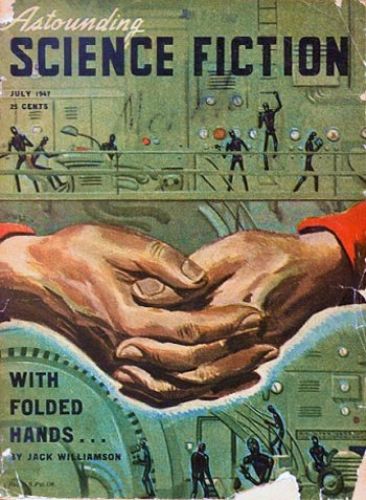
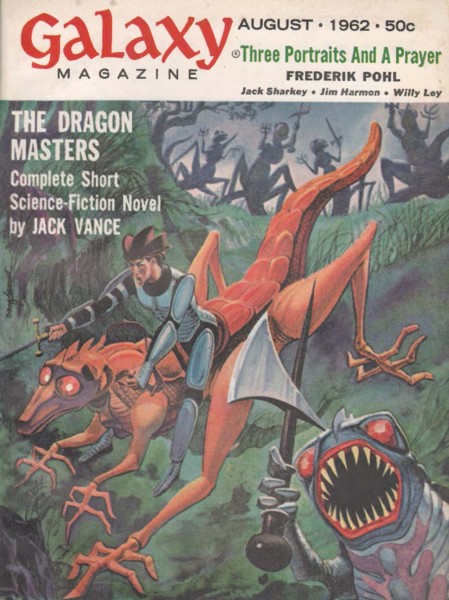
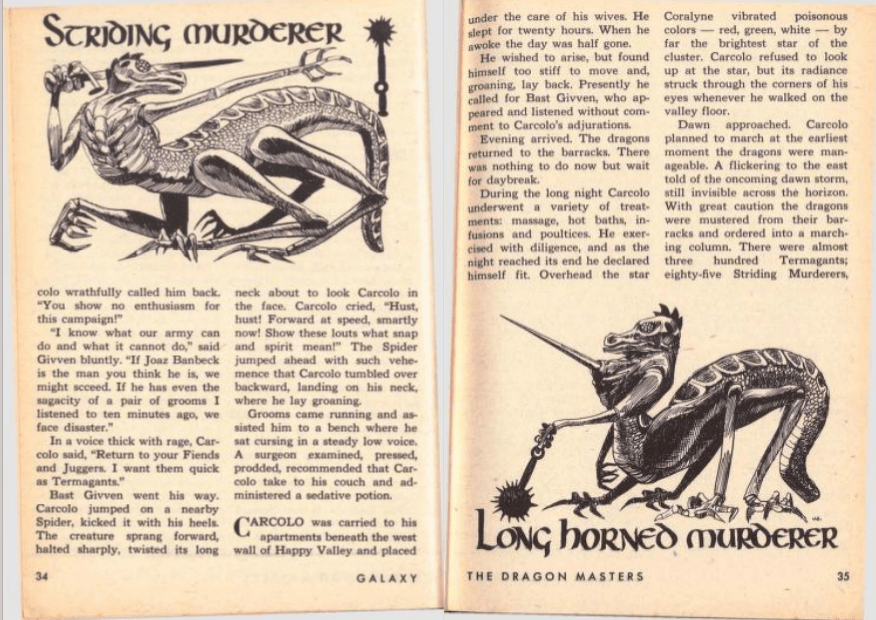

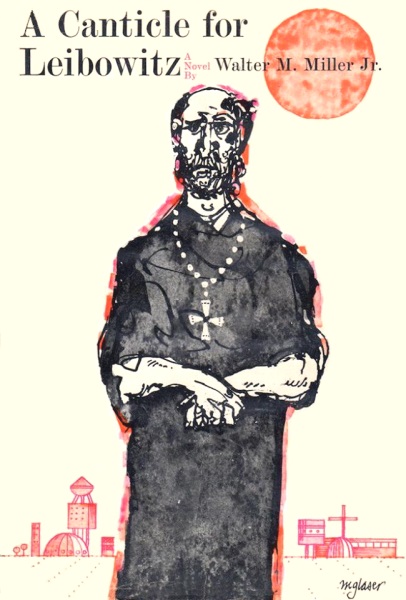

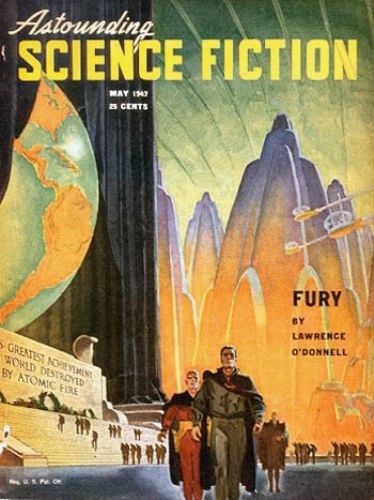


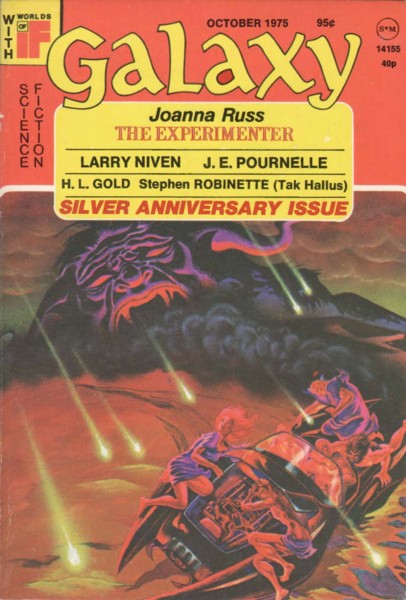
 Science Fiction & Fantasy Remembrance