
Who Goes There?
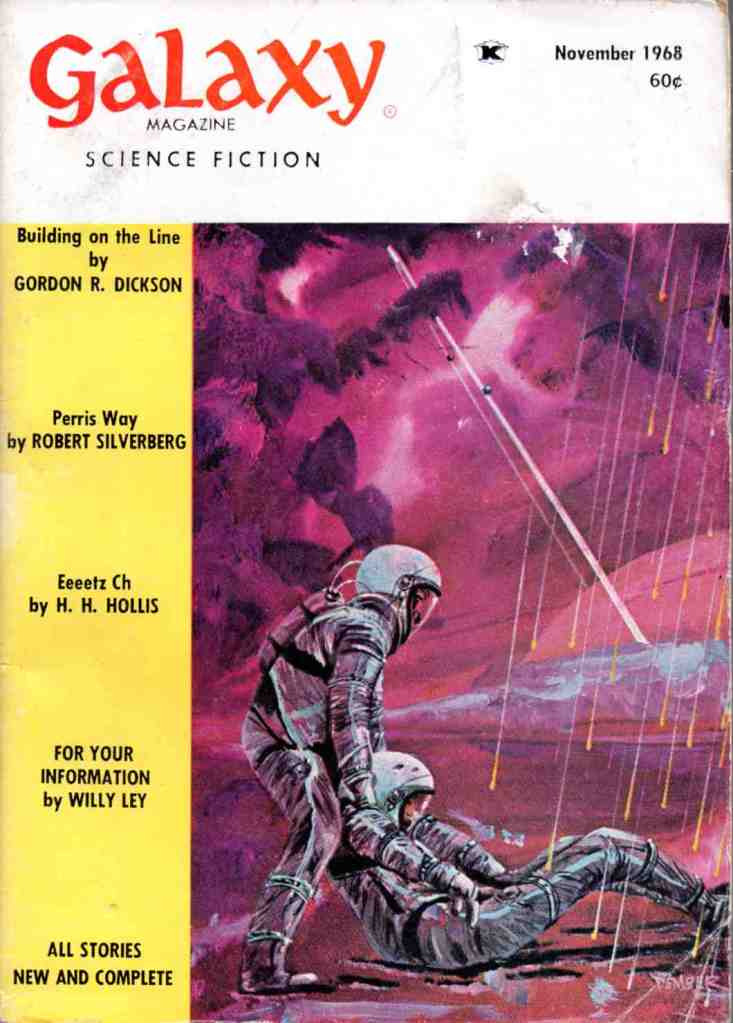
Robert Silverberg celebrated his 90th birthday this past January, making him one of the last living authors to have been active at least adjacent with the New Wave in the late ’60s. Not only that, but Silverberg had made his writing debut a whole decade earlier, and if you look through certain magazine issues in the early ’50s you might find a teenaged Silverberg in the letters section. He has his faults, but there are few people who’ve been more dedicated to the field for as long a span of time. Even as he announced his retirement from writing fiction about a decade ago, Silverberg still gets involved with fandom events and even writes editorials for Asimov’s Science Fiction to this day. The late ’60s and early ’70s are when SF historians consider Silverberg to have reached his artistic stride, which if I’m being honest is a claim I’ve found to be a little overexaggerated. Certainly the quantity of Silverberg’s output at this point can’t be denied, but the quality of his work from this period is a good deal more hit-or-miss than I’ve been led to believe. A Time of Changes was the only Silverberg novel from this period to win a major SF award; it won the Nebula, beating out Ursula K. Le Guin’s The Lathe of Heaven. Is that victory deserved? Hmmm.
Placing Coordinates
Serialized in Galaxy Science Fiction, March to May-June 1971. It was released in June of that year by Doubleday. I’m not sure if it’s in print in the US at this moment, but there’s an ebook edition from Open Road Media and a paperback from Gollancz.
Enhancing Image
Generations ago the planet Borthan was discovered by spacefaring humanity and thus colonized, although it’s a hostile environment with harsh weather and, like Earth, a great deal of water on its surface. The settlers, who were basically like Vikings, eventually forgot their history, the result being that human culture on Borthan has devolved into a kind of medieval futurism. You’ve got lords and barons and the like, complete with a peasant class, but more importantly this is a society that is so rooted in selflessness that it’s taboo even to use first-person singular pronouns in conversation. Everyone is supposed to look out for everyone else, to the detriment of the individual. This is important context to get out of the way first, because otherwise you might think the setting is more or less your typical Tolkien-esque fantasy realm. There are bits of modern tech, such as automobiles, but technology plays little role in the story. A Time of Changes is ostensibly SF, but it’s actually closer to being science-fantasy along the lines of The Book of the New Sun, to the point where I wonder if Gene Wolfe had taken some inspiration from Silverberg’s novel. To put it another way, it’s the kind of setting Jack Vance was fond of inventing, in which you have what is basically a medieval fantasy world but with an SFnal twist.
Of course, another thing A Time of Changes has with Wolfe’s series is the characterization of its narrator, the anti-hero Kinnall Darival, as what we’re reading turns out to be Kinnall’s memoir—or maybe it’d be more accurate to call it a bit of confessional writing. In a few reviews I’ve written before I’ve taken issue with what are depressingly common fallacies when it comes to writing first-person narration, which is why I’ve not been a fan of it myself on the occasion I’ve been able to write fiction. There are too many questions that can be potentially raised when dealing with a first-person narrator, of the sort that would distract from the reading experience; but thankfully Silverberg gives us a pretty clear reason up front as to why he wrote the novel in this way. Not only is Kinnall writing a tell-all account of his apparent rise to becoming a rebellious figure, but he writes in first-person specifically as a middle finger to his society’s aversion to the concept of selfhood. Kinnall is kind of a selfish asshole with some psychosexual hang-ups, but at least he doesn’t try to make excuses for some questionable past behavior. I mean a big part of Kinnall’s personal trauma is the fact that he clearly wanted to have a romantic/sexual relationship with Halum, his bondsister, only that Halum died years ago, tragically young.
Right, so the people of this world do not have familial relations in the traditional sense. You don’t have a pair of loving parents to whom you’re related to blood, and you also potentially two sets of siblings: blood-related siblings and bondsiblings. Everyone has bondbrothers and bondsisters, who are basically step-siblings. So Kinnall has some pseudo-incestuous feelings for Halum, and even if she were still alive this is something he’s unlikely to confess to her. There’s also Noim, Kinnall’s bondbrother, who proves useful in getting him out of the country when the political climate becomes risky. To make a long story short, Kinnall is son to the prime septarch of Salla, one of Borthan’s provinces. (I just realized it’s called a “septarch” because there are other monarchic figures who share rule of the province.) The problem is that Kinnall has a blood brother, Stirron, who becomes septarch instead of Kinnall. Mind you that the brothers are very young when this all happens, as the septarch dies unexpectedly during a hunting expedition. Now, if you know anything about the history of monarchy as form of government then you know it can be perilous to be king/queen/whatever and have siblings waiting in the wings; or, just as perilously, you might be the sibling in question. It becomes clear that Stirron is overburdened with being prime septarch (which is to say the one the other septarchs have to get approval from) of Salla, and yet Kinnall resents the structure of this society too much to become a leader of it.
The result is a picaresque, of sorts. Kinnall gets the hell out of Dodge and becomes a day laborer in another land, for a time, before becoming a sailor by the end of this installment. Something odd about A Time of Changes is that while its plot trajectory is broadly in chronological order, Kinnall can’t help but allude to future events and characters that haven’t come along yet, such as Schweiz, an Earthman whom Kinnall befriends, and whom we hear about way before we actually meet him. We hear about Kinnall being introduced to a mind-altering “potion” that Schweiz gives him way before this event happens in-story. Characters are mentioned as having died while they’re still alive in Kinnall’s recollection of them. As such, I can already tell that this is a hard novel to spoil. The unusual structure and diction can be explained by the fact that Kinnall’s never written a book before, let alone a first-person narrative, and so he’s still new to this whole confession-writing ordeal. Still, it’s awkward, not helped by Kinnall himself being a thorny character in the way that Silverberg’s protagonists tend to be. I’m gonna be brutally honest and say that maybe with a few exceptions Silverberg’s protagonists all more or less act and think the same way, which is to say they’re dreary and neurotic heterosexuals with both high sex drives and psychosexual angst. They’re also very male. Granted that the objectifying of women here is not as bad as in some of Silverberg’s other novels, one still finds a few cases of “she breasted boobily.”
There Be Spoilers Here
I dunno.
A Step Farther Out
As has happened to me almost every time when reading a Silverberg novel from this era, my feelings are mixed. It took me two days to read this installment when really it should’ve only taken one, and part of my slowness is that there are sequences I find way more engaging than others; or, to put it another way, there are sequences where Silverberg strains my patience. At least far it’s doing better than, say, Up the Line, or Across a Billion Years, which are novels that make bad impressions early on and do little to nothing to fix things. Some of Silverberg’s bad habits (namely his tendency to sexualize every female character he introduces) are on display, but as of yet there’s nothing too egregious. I think the more pressing issue is that despite being one-third into the novel now, I feel as if the plot has only barely just started kicking into gear. The pacing is “deliberate,” which is to say it’s slow, and given this is a short novel it’s a slowness that Silverberg really can’t afford. But he’s gonna make us wait.
See you next time.





 Science Fiction & Fantasy Remembrance