The Story So Far
Roan’s time aboard the Warlock ends in disaster, although in fairness it wasn’t his fault. With Henry Dread, on the surface a pirate captain and in actuality an officer in the fledgling Imperial Terran Navy, now dead (by Roan’s hands) and the Warlock having gotten its ass blasted by a Niss ship’s automatic defense system, the survivors are left with Roan as their new leader. He’s not much of a “leading” type. The good news is that while the Niss ships are still about, lingering in the blackness of space, the Niss themselves seem to have gone out to lunch—via the grim reaper. The ship that destroyed the Warlock turned out to be a ghost ship: everybody, both the Niss crew and Terran captives, has long since died. Roan and his crew decide to take a diversion to Tambool, the planet where Roan was born and raised, to gather some info about Our Anti-Hero’s past. Some gaps remain in his backstory, though, and the quest to ITN HQ continues, with Roan impersonating a lieutenant who had died on the Niss ship. This move sounds smart in the short term, but will prove a problem for later.
With some deception and threats, Roan and three of his best men are taken to ITN HQ, a palace that had originally be constructed for some member of the ruling class, now the home of Terran military ghouls and their cronies. And also their slaves. Slavery is not unusual in parts of the galaxy, with some alien cultures treating it less as a means of cheap labor and more a give-and-take practice. Roan himself grew up with an alien slave who lost to Roan’s parents in battle, and thus became a sort of member of their family as dictated by his race’s customs. Commodore Quex and his buddies of the ITN are a lot less caring with their slaves, however, murdering them on sight if they become even so much as a slight inconvenience. Terrans, even though none of them be “purely” human, clearly look down on Gooks and especially Geeks as akin to dogs and horses. Maybe even less. So it’s hard to feel bad when, in the midst of a tense and violent dinner part, Roan kills Quex, even if he does give him an “honorable” death. With this violence, it looks like Roan’s time in the ITN will be short.
Enhancing Image
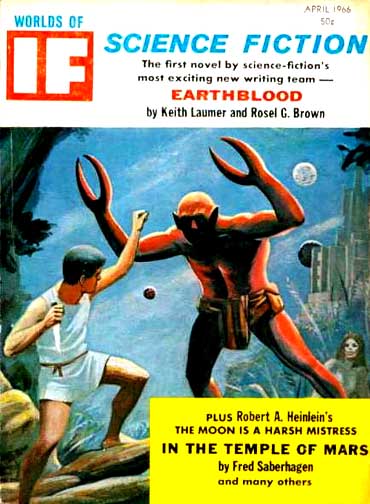
We finally get answers to the two biggest questions that have been haunting this novel, namely what the Niss have been doing this whole time and what has become of Earth, Roan’s ancestral homeworld. The answers are both interconnected and anticlimactic, maybe by design. It’s true that the Niss formed a blockade around Earth and supplanted the Terrans as the top dog in known space, but that was literally thousands of years ago. We have never seen a Niss prior to this final installment, and when we do finally meet one he is weak and at death’s door, with everyone else already dead. Having replaced humanity as rulers of the galaxy, the Niss apparently diluded themselves over time, to the point of a slow extinction; nowadays they’re treated as a myth, something to be talked about rather than seen. With the highest goals of galactic conquest achieved eons ago, the Niss, having found no greater cause in life, opted for a slow death. Humanity still exists on Earth, it turns out, maybe being better off than their former conquerors; but this too, came with its own price. As with the ITN ghouls, the people on Earth have at least partly fallen to decadence, with there being an “Upper” and “Lower” society. They also have their own form of slavery, keeping mutated “dogs” (which really are more like large and intelligent monkeys, or very hairy humans) as their servants. Like real-world dogs, these “dogs” are loyal to their masters; they enjoy being slaves. This is a fact that disturbs Roan, since, to paraphrase him, at least slaves in alien cultures knew enough to loathe their positions in life. This all feels very wrong.
The final quarter of Earthblood, in which Roan and two of his men (Poion having died in the interim) are on Earth, could’ve justified being a novel on its own, and maybe it should’ve been a novel. Something I’ve mentioned before in passing but which needs reiterating here is that Earthblood is fast as fuck; it’s one of the most lightning-quick SF novels I’ve read in a while, which is sometimes to its detriment. The pacing becomes almost manic at times, with how much Laumer and Brown try to fit in here. The Terran culture Roan comes quickly to hate is layered, in some ways disturbing, and yet we’re not given that much time with it. There are a few new characters introduced in this last stretch of the book, maybe the most memorable of them being Daryl, who serves as Roan’s (and by extension the reader’s) guide to how things work. Daryl is old enough to have birthed a daughter who herself at least appears to be an adult, and yet he’s youthful and rather feminine in appearance. He’s also, not very subtly, a queer man almost of the drag show variety. I’m not sure if Daryl’s effeminate nature and attempts to flirt with Roan are indicative of the authors’ homophobia, because truth be told he’s no worse than some of the human characters we’d met before, but it’s certainly hard to ignore. Speaking of ambiguous queerness, we also have Sostelle, the “dog” who accompanies Roan for much of his stay, who despite having a feminine-sounding name is supposedly male, and who also comes to have a submissive relationship with him. These are things the novel never elaborates on, because it’s already so fast and so much is happening that for better or worse we can’t dwell on them.
The good news is that the Niss blockade is no longer an issue for Earth interacting with the rest of known space, but the people on Earth aren’t even aware the blockade had ended a long time ago, due to humanity having become degraded and small-minded. Typically in an old-timey SF novel with this kind of plot, Roan would support the rebuilding of the Terran empire, but not only has he since given up on that, having hared his short time spent with the ITN, but he loves the rather large number of intelligent alien races in the galaxy too much to let mankind put the lot into servitude. He’s still a tough and murderous son of a bitch, but he does in fact have some morals, which Daryl and those like him run afoul of. There’s an unnerving scene in which a dancer named Desiranne, who reminds Roan of Stellaraire, tries to commit ritual suicide as the grand finale of her performance for him—an act she had been trained and even raised to carry out. She almost succeeds. Roan’s one-man rebellion against decadent Earth society is totally justified, if we’re being honest, and it feels earned because the whole novel had been building to this moment. The Terra Roan hoped to find wasn’t there after all; instead, it’s something he and the others will have to build themselves. You could say a kind of cultural revolution is needed, to break down the old way of living and create something new.
A Step Farther Out
I decided to read a couple contemporary reviews of Earthblood, including Algis Budrys’s review in Galaxy, who makes the connection that Laumer and Brown had probably taken inspiration from Robert Heinlein and L. Ron Hubbard. More specifically the brutality and paranoia of Earthblood remind me of Hubbard’s short novel To the Stars, one of the most brutal (and xenophobic—it is Hubbard, after all) SF stories I’ve ever read. I do mean that as a compliment, by the way. What Earthblood lacks in elegance, having a rather shoddy structure that makes it seem like Laumer and Brown wrote it with serialization in mind, it makes up for in a kind of “wow” factor. Like damn, I did not think an SF novel from the ’60s could be this grimy. At the same time it has more of a humanist angle than Heinlein or Hubbard, or at least it’s not as racist or sexist as it could’ve been. I recommend it as a rough but entertaining one-off, the kind of adventure novel that was soon to become outdated thanks to the New Wave. It is, as Baird Searles says in his review of the novel for Asimov’s, a relic from “the tail end of this jolly era” that included such pulpy SF.
See you next time.

 Science Fiction & Fantasy Remembrance