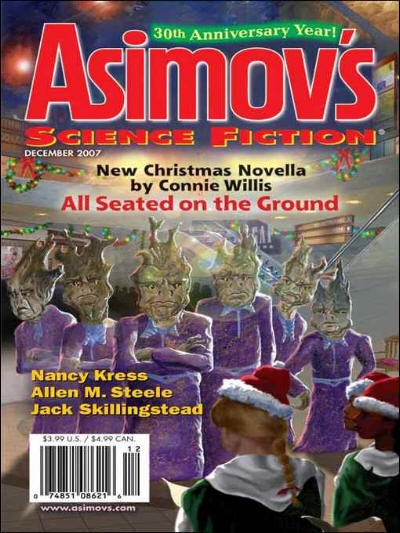
(Cover by Michael Carroll. Asimov’s, December 2007.)
Christmas is coming up, and my birthday before that. Not incidentally we have a birthday among the authors covered, namely Connie Willis, whose birthday is the 31st. Willis is also very fond of Christmas stories so there’s that. Last December we did a month-long tribute to Fritz Leiber, who sadly will not be featured this time. (Don’t feel too bad, he’s already one of our most frequent “visitors.”) Since we’re closing out the first full year of this site, I figure it’s time to introduce one more major change (not permanent, don’t worry), not for this month but for January. December will be the last month probably until 2025 that I’ll be doing serial reviews; for 2024 I’ll be taking a break from serials and focusing on short stories and novellas, although I’ll still squeeze a few complete novels into the schedule.
The way it’ll work is, the days I would be reviewing sserial installments will instead be relegated to short stories, but otherwise the alternating slot method will not change, only starting in January you can expect to see two short stories for every novella. The space given to complete novels will remain the same: if a novella slot were to fall on the 31st of the month then I’ll at least try to tackle a complete novel. Why no serials for a year? For a few reasons. For one, I’m tired, and also I’ve come to find that my serial reviews are the least popular of my reviews, or rather they get the least feedback. Also, I’m a devotee of the short story at heart, and the reality is that there are way more short stories in the magazine market than serials, by at least a factor of ten; so for one year I think short stories deserve more of the glory. We do, of course, get two short serials to tackle before the hiatus, both of which are actually rereads for me.
There is one other thing I have in mind, a rather special thing, but you’ll have to wait until January to hear about it. It’s a secret. :3
For the serial:
Three Hearts and Three Lions by Poul Anderson. Serialized in The Magazine of Fantasy and Science Fiction, September to October 1953. Retro Hugo nominee for Best Novella. This is the first serial I’ll be covering where I’ve not only read the book version but also the serial version, so this is sort of my third go-around with it. It’s worth it, though; this is one of the more influential works in the history of American fantasy, having partly inspired Dungeons & Dragons. It also makes me wish Anderson wrote more fantasy.
Beyond the Black River by Robert E. Howard. Serialized in Weird Tales, May to June 1935. Despite committing suicide at the age of thirty, Howard wrote a truly staggering amount of fiction and created several series in the process, with his most famous creation being Conan the Cimmerian. Howard did not invent sword-and-sorcery fantasy but he had unquestionably the most influence on proceeding American fantasists. This right here was one of the first Conan stories I had read, and it still reads as one of the more unusual.
For the novellas:
“Pursuit” by Lester del Rey. From the May 1952 issue of Space Science Fiction. Del Rey started out as a sentimentalist at a time when genre SF was markedly unsentimental, filling a niche that had gone untapped such that early stories like “Helen O’Loy” and “The Day Is Done” were very popular. He would move away from that style, and in the ’50s he even edited several (very short-lived) SFF magazines, Space Science Fiction being one. Thus the first story in the first issue of this magazine is by del Rey’s favorite writer: himself.
“All Seated on the Ground” by Connie Willis. From the December 2007 issue of Asimov’s Science Fiction. Hugo winner for Best Novella. In the ’90s and 2000s Connie Willis could lay claim to being the most popular writer to appear regularly in Asimov’s, and that’s on top of her novels, a few of which are certified classics. Her novel Doomsday Book especially is excellent, although it does not indicate her penchant for humor. She holds the record for most Hugo wins for Best Novella, with “All Seated on the Ground” being her fourth.
For the short stories:
“The Keys to December” by Roger Zelazny. From the August 1966 issue of New Worlds. Zelazny looks like he might see a much deserved renaissance soon, with a TV adaptation of his Amber serie being in the works. This is good news, because for a couple decades Zelazny has been threatened with the dark cloud of obscurity, despite being one of the most acclaimed SFF writers to come out of the ’60s. I picked “The Keys to December” because, well, look at the title.
“Genesis” by H. Beam Piper. From the September 1951 issue of Future Science Fiction. Piper is surely one of the most tragic figures in old-timey SF, having started his writing career very late (he was in his forties) and committing suicide at the age of sixty, believing himself to be a failure, such that despite not dying young his career was short-lived. It’s a shame, because Piper was in some ways an unusual writer for the time; he was a bit of a character, one could say.
For the complete novel:
Lest Darkness Fall by L. Sprague de Camp. From the December 1939 issue of Unknown. From 1937 to 1942 (he took a break to support the war effort), de Camp was one of the designated court jesters in John W. Campbell’s Astounding, and perhaps more importantly in Unknown. It was here that de Camp got to show off his range as a fantasist (most famously in his collaborations with Fletcher Pratt), although ironically his two longest solo efforts in Unknown in its first year, Divide and Rule and Lest Darkness Fall, are science fiction, not fantasy. Lest Darkness Fall was de Camp’s solo debut novel, an early example of a modern person being sent back to an ancient time period, and according to a lot of people it’s also his best. It was expanded (although I can’t imagine by much, since the magazine version looks to be a solid 50,000 words) for book publication in 1941.
You may think it a weak move for me to have my last two serial reviews before the hiatus be of ones I’ve already read, but as I’ve said before and always hope to make clear, rereading is arguably more important than reading in the first place. So it goes.
(Cover by Vincent Di Fate. Analog, February 1988.)
The Story So Far
The Cay Habitat was constructed a few decades ago to house a race of special humans—ones that were made to work in zero gravity indefinitely, since such conditions are awkward for normal humans. With a second set of arms for legs, the quaddies are considered the property of GalacTech, who’re also the employers of Leo Graf, Our Hero™. Leo has a problem: How do you teach a group of people about exploitation when said people exist as slave labor? It’s a question that for better or worse will have to go unanswered, because word gets through that an anti-gravity device has not only been invented but deemed ready for market sale, thus rendering the quaddies obsolete. Of course this raises another problem: What do you do with outdated tech when the tech is people? At best GalacTech will have the quaddies sterilized and shipped off to a barracks—at worst have them terminated with extreme prejudice. If the quaddies can’t be allowed to live out their lives peacefully under GalacTech jurisdiction then the only solution is to get out of said jurisdiction—and then comes an idea.
The Habitat is small, when taken in its essentials; it was made to house a thousand quaddies and little more than that. If broken down, the Habitat could be made to piggyback on an interstellar ship as flies through the wormhole near Rodeo. What at first sounds like a moral problem then becomes an engineering problem. The quaddies are very young (the oldest are barely out of their teens), but the best of them, along with some help from sympathetic humans, could make the scheme a success. Sure, the other end of the wormhole falls under a different planet’s jurisdication, but they’ll cross that bridge when they get there.
Enhancing Image
Sorry this is a day late. Forces beyond my control kept me in a bind yesterday such that I couldn’t write this post in time. Oh well.
I’m not sure if I would get this same feeling if I read it all at once, but I’ve become less interested in Falling Free with each successive installment, and the big reason for this is that Bujold gives us a memorable premise and a memorable setting to go with it, but there also has to be a plot here. For the record, there’s a difference between conflict and plot; you could have a character-driven narrative that’s rife with conflict, but very little actually happens. We start with both external and internal conflict here. We have the conflict between Leo and Van Atta, Leo and Dr. Yei, Dr. Yei and the quaddies, Leo and the quaddies, and of course Leo conflicting with his own interests. A great deal is implied about what had led to the quaddies being created. We only learn about Dr. Cay through second-hand sources, since Cay died a year before the story’s beginning, but what we do learn about him is not flattering. Yei, Cay’s successor, is implied to be in conflict with herself, since she was hired basically to make the quaddies docile whilst being well aware of their slave status, but for most of the novel she has a “just doing my job” mentality that eventually gives way to guilt.
Bujold introduces us to some engrossing character conflicts, but they start taking a backseat as the plot starts being funneled into what amounts to a race against the clock. Van Atta was never a layered character (he is, I have to say, disappointingly one-dimensional), but his role gets eroded to the point where he becomes a walking plot device—a threat that Our Heroes™ have to evade, since he can’t be reasoned with. Since we’re never allowed into Dr. Yei’s head our ability to perceive her inner conflict is limited, and her redemption at the end in incapacitating Van Atta long enough to let the Habitat enter the wormhole is boiled down to a single action. The recurring problem with this novel as it progresses is that it starts out as rather chatty, with a lot of room for character depth, but rather than elaborate on that we’re instead forced down a corridor wherein characters, who once were well-defined and intelligent, are boiled down to their actions. Tony, who is the first quaddie we see, all but stops being a character after the first installment; now admittedly part of this is because he gets put on a bus, figuratively speaking, but when we do meet up with him again he is reduced to something Our Heroes™ have to rescue.
What’s frustrating is that, at least going by Theodore Sturgeon’s definition of what makes a good science fiction story, Falling Free is good SF. Paraphrasing Sturgeon here, a good SF story is a human story with a human problem that must be solved in a human way, but which hinges on a scientific aspect. In Falling Free we’re given a premise which (at least with existing technology) can only be made possible in a science-fictional universe; but at the same time sounds logical enough that it could happen. We’re given a problem centered around human rights and this problem is resolved in a human way, albeit with a dose of that old-school hard SF hardheadedness. There comes a point, however, when Bujold’s economy of style turns against her and the novel, which starts out as seemingly open-ended, turns into a series of Things Happening™. I can see what people mean when they say this is minor Bujold, despite the Nebula win. I would be less disappointed if the novel’s opening stretch wasn’t so promising.
Oh, and the romance between Leo and Silver is both unnecessary and unconvincing, never mind that Silver is half Leo’s age.
A Step Farther Out
I’m unsure how to feel about this novel, although having finished it I can say its winning the Nebula is totally baffling. Was there really no better choice that year? C. J. Cherryh’s Cyteen won the Hugo that year, and while I haven’t read it I have this hunch it would’ve at least been the more fitting winner; but to make things more baffling Cyteen wasn’t even nominated for the Nebula! What were people on back in the day? It’s shit like this that my borderline zoomer brain struggles to comprehend. I’m also not sure if Bujold wrote Falling Free with serialization in mind or if maybe her agent recommended it, but I don’t think the serial model works great for her. Admittedly there’s a reason serialization has basically become extinct, because a) not many people read magazine anymore, and b) it incentivizes a certain type of writing that puts higher priority on plot than character. Looking at this novel as a whole, I’m mixed. Getting kinda tired of serials.
(Cover by Robert Daniels. Analog, Mid-December 1987.)
The Story So Far
Leo Graf took on an instructing job at the Cay Habitat, an artificial satellite orbiting the planet Rodeo, where the work is hard but the rewards are rich. Leo was to train a group of “quaddies,” test-tube humans born with four arms and no legs, made specially to work in zero gravity. GalacTech, the company behind the quaddies and the ones responsible for Leo’s paychecks, had produced a race of humans to use as slave labor—a reality which does not sit well with Leo at all. Dr. Cay, who came up with the Habitat (itself having been made in secret two decades prior) in the first place, died a year ago, and in his place are Bruce Van Atta, Leo’s supervisor, and Dr. Sondra Yei, who works to socialize the quaddies. Unfortunately tensions are already rising as it becomes clear that the quaddies, despite efforts to isolate them from the human race at large, have already picked up some “bad habits,” like monogamy and a wish to leave the Habitat.
The end of Part 1 saw Tony, his girlfriend Claire, and their infant son Andy sneak off the Habitat and take refuge in a warehouse, still in deep space but at least avoiding a trip to Rodeo which would’ve literally crushed them. Van Atta interrogates Silver but with little result (Van Atta himself had already “corrupted” the quaddies by way of seriously unprofessional behavior, such as having sex with Silver), and to make matters worse Apmad, GalacTech’s VP, has come to the Habitat for an inspection ahead of schedule. So you have a drugged and traumatized quaddie, plus three more who are MIA. Part 1 does what a serial installment should do in that it raises intrigue, builds tension, and then ends on a huge question mark. How will Our Heroes™ get out of this one? You have to stay tuned and find out.
Enhancing Image
The good news is that despite being stowaways, Tony and his family come out of the experience alive—but not unharmed. A frenzied security officer wounds Tony when he was supposed to stun him (having replaced his stun gun with an unregistered pistol), and thu Tony spends pretty much all of Part 2 out of the picture. Indeed Claire spends most of the time off-screen, with the only quaddie then being given a fair amount of screentime here being Silver. That there have been issues taming the quaddies turns out to be a problem without a solution, or rather a problem where the solution would not be worth it, because Leo hears a rumor from one of the shuttle pilots that a new anti-gravity device has not only been invented, but has reached the stage where companies are willing to buy it. The quaddies were made because zero gravity presents a problem for normal humans, but with anti-gravity it would be much easier for normal humans to work in deep space. You thus have a race of people, treated by GalacTech as organic technology, “post-fetal experimental tissue cultures,” about to be outmoded by actual technology. The question then is: What will become of them?
Part 2 is shorter than Part 1 and there seem to be fewer scenes; instead we get several lengthy borderline Socratic dialogues in which Leo and the people running the Cay Project have to confront both the ethical and logistical dilemma of the quaddies. This is the stuff that was hinted at in Part 1, but now that the cat’s out of the bag we’re knee-deep in it, and frankly this installment gripped my interest even more tightly than the first. Like this is the kind of shit that I’m here for. Moral conundrums usually get me going and Falling Free provides a meaty one in the form of, “We typically throw away technology once something better comes along, but what if that technology is people?” Leo’s problem with the quaddies escalates from “How do you protect workers from exploitation when said workers are already slaves?” to “How do you prevent the eradication of a people if legally they don’t even count as a people?” Because, technically speaking, the options GalacTech are providing for the quaddies in light of the anti-gravity device boil down to genocide—either via sterilization or extermination outright. This is a lot for a 300-page hard SF novel.
When confronting Van Atta about the anti-gravity device we get a pretty good line from Van Atta, who is an irrideemable monster but who says something that, unfortunately for Leo, rings true: “There’s only so much one human being can do, Leo.” The bastard is right—actually more right than he’s capable of knowing. There’s only so much one person can do in this situation. The mid-section of Part 2 sees Leo at his lowest point, unable to convince anyone on the Cay Project that these people are worth saving, and to make matters even worse, Leo has developed a crush on Silver despite her only being about half his age. (I don’t recall us being told how old Leo is, but given his 18 years of experience he’s probably somewhere in his forties.) The bright side of all this is that since GalacTech has not offered a third option, and since Leo knows what the quaddies are up against, it’s up to him now to find a solution—with a little help from his friends. The “character’s lowest point” part of the narrative has seemingly passed and now we’re looking at an ascent to victory, my one reservation being that unless Bujold has another trick up her sleeve, this might be too early in the novel to be doing such a plot turn, now that we’re about halfway through.
A few things to note here since I don’t really have anywhere else to put them. I said earlier that this novel is about 300 pages in its book version; as far I can tell the serial and book versions are more or less the same. To my novella-pilled brain 300 pages sounds like a good amount, but even by the ’80s we were seeing SF novels become longer on average. Call it an educated guess, but I think this happened because genre publishing was moving away from serializations, such that by the late ’80s the only magazine which regularly did serials was Analog. Serialization has some implicit demands, such that a novel must be structured in a certain way (there must be chapters which end on a high-tension note that sparks intrigue) and must be—or at least ought to be—of a certain length. The lack of such restrictions meant a novel could be of any length so long as it didn’t piss off the editor, but with those restrictions you would have a more concise work. Bujold wastes very little time on describing locations and people in Falling Free, to the point where Part 2 is mostly he-said-she-said dialogue. I’m not bothered by it, because I don’t like to have my time wasted, but modern readers might want something with more meat and flab on its bones.
Since this is a serial but also since Bujold is a very capable writer, every scene serves a purpose with regards to the plot, and the plot is pretty much always moving forward. Modern conventional wisdom says we should be have more “quiet” moments, where we’re treated to character psychology, but the characters here more exist to serve the plot while still being vividly drawn enough. Despite the deep-space setting, this is still a human narrative. I get the impression that Bujold is too much of a humanist to let her characters be mere cogs in a machine (like say, Hal Clement, although Clement’s talent very much lay elsewhere), although that doesn’t stop her from conceiving a borderline cartoonish villain like Van Atta. This is ultimately an “ideas” novel, but it’s by no means heartless or reactionary.
A Step Farther Out
In her rundown of Hugo nominees up to the year 2000 (very addicting series of articles, by the way), Jo Walton calls Falling Free “minor Bujold,” then adds “but minor Bujold would be a major book from most writers.” I do have to think, if this is minor Bujold then what does major Bujold look like? True, it’s rather small in scale, a little short by today’s standards (fantasy readers might even wrongly call it a novella), but it puts forth a novel concept and explores it in a way that is consistently intriguing. I do have to wonder how conflict will be sustained, because we’re about halfway through the novel now and there’s this creeping sense that the rest may turn into a white savior narrative (no doubt problematic), which would disappoint me a bit. The fact that I’m eagerly looking forward to whether I will be disappointed or not, though, speaks to Bujold’s skill and the novel’s readability.
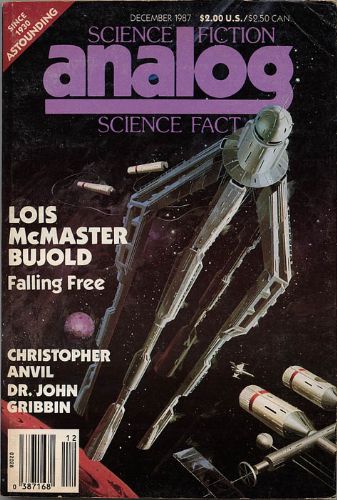
(Cover by Vincent Di Fate. Analog, December 1987.)
Who Goes There?
I only first read Lois McMaster Bujold about a year ago, with the novella “The Mountains of Mourning,” a work that impressed me but didn’t bring me to dive deep into Bujold’s oeuvre so quickly. A lot of this has to do with Bujold’s work largely being connected to some series, or in the case of today’s novel the vast and not-so-chronological Vorkosigan universe. It would take too long to explain the backstory for this series, and anyway I haven’t read enough of it yet to be intimately familiar. Generally speaking it’s a space opera series which in parts follows members of the notorious Vorkosigan family, namely Cordelia and her son Miles. This series has won Bujold five out of her six Hugos (she is tied with Robert Heinlein for most Hugo wins for Best Novel, although Heinlein leads if we count Retro Hugos), and Falling Free, while not as renowned as some other entries, still won the Nebula for Best Novel. I’m enjoying it so far but I have to say this kind of novel winning the Nebula is a bit of an odd choice.
The premise is eye-catching right away, though, and I can already see how it would’ve gotten inducted into the Prometheus Hall of Fame, it being chiefly concerned with the rights of a race of genetically engineered humans. The quaddies, so called, are normal humans in most ways except they’ve been engineered to have four arms and no legs (or rather arms for legs), so as to make them more nimble in zero gravity; in fact they’re so monkey-like in their “natural habitat” that they’re sometimes called “chimps.” Yes, a company breeding a race of people for the sake of specialized labor sounds like a moral black hole, but that’s only the start of it!
Placing Coordinates
The first installment is in the December 1987 issue of Analog Science Fiction, which is NOT on the Archive but which can be found on Luminist. It’s still in print from Baen, both on its own and as part of the omnibus Miles, Mutants, and Microbes, which includes the novella “Labyrinth” and the later novel Diplomatic Immunity. Falling Free takes place a good deal before Miles’s birth but does apparently set up the backstory for “Labyrinth,” in which Miles meets the quaddies.
Enhancing Image
Leo Graf is a veteran engineer and inspector who has come to the Cay Habitat (named after its founder), a facility near the planet Rodeo, “the armpit of the universe,” on what amounts to a teaching assignment. Up to now the details had been kept foggy; Leo knows about “the Cay Project” but not what it entails. Dr. Cay himself had died a year ago, and in his place stands Bruce Van Atta, one of Leo’s former students, although it takes time for Leo to remember where they could have met before. What he manages to remember of Van Atta does not fill him with enthusiasm. “Was this sleek go-getter the same idiot he had kicked impatiently upstairs to Administration just to get him out from underfoot on the Morita Station project—ten, twelve years ago now?” And now this yuppie of the future is Leo’s supervisor for the Cay Project. What could go wrong here?
The question, though, remains as to whom Leo will be teaching while on the Habitat—a question that gets answered more suddenly and frightfully than Our Hero™ could’ve anticipated. We soon meet one of the young engineers on the Habitat, Tony, who is smart, spritely, willing to learn, about what you would hope for out of someone both young (only twenty years old) and talented. There is one problem: Tony doesn’t have any legs. Rather, he has an extra pair of arms where his legs would be, which nearly sends Leo into abject panic. Apparently nobody had told him in advance about the quaddies, the unusual denizens of the Habitat, and the people he is supposed to teach about welding in zero gravity. Leo thinks this condition is some kind of deformity, but Van Atta informs him that no, the quaddies (so they’re called) are supposed to be like this; they were genetically engineered by GalacTech, Leo’s company as well as the ones behind the Cay Project, in secret. This new race of people, who were at first created in test tubes but who have now taken to breeding naturally, “self-replicating” as Van Atta puts it, are designed to live and work in deep space.
Indeed Tony, who mind you is barely out of his teens and still one of the oldest of the quaddies, is already a father, raising his infant son Andy with his girlfriend Claire. All three are company property. The quaddies, strictly speaking, are not people, but assets of GalacTech; theoretically the company could have them killed without legal qualms if not for the fact that doing so would be blowing a lot of money. Leo’s viscerally troubled by the physiology of the quaddies but soon he becomes far more troubled by the fact that his own company has invented a new form of slave labor. Actually it’s a wonder that he’s not more disgusted by what’s going on, but then his job also depends on him keeping a cool head—or trying to. Things get thornier when we meet Dr. Sondra Yei, who has been working closely with the quaddies and conditioning them to not indulge in certain lines of thinking. At face value Yei is here to help prepare the quaddies for a life permanently cut off from 99% of humanity, but, although her intent doesn’t seem to be malicious, she seems to be here to reinforce a slave mentality.
Bujold doesn’t strike me as an ironist, but there’s a vicious bit of irony about Leo teaching the quaddies about safety procedures about shady company practices when they are literally the products of exploitation. How do you inform an audience about exploitation when said audience is slave labor and not even considered human by their creators? This sounds like a huge red flag, or rather a sign that maybe Leo should high-tail it out of there, but the conflict here is that yes, the situation is abhorrent, but Leo is also a devoted engineer who has been granted the opportunity to instruct a generation of people who were literally born and raised to be engineers. “The degree of censorship imposed upon the quaddies implied by Yei’s brief description made his skin crawl—and yet, the idea of a text that devoted whole sections to great engineering works made him want to stand up and cheer.” I know a few engineers and they’re all goddamn freaks; they see instruction manuals as a form of entertainment. Incidentally, despite the extreme dubiousness of the Cay Project, a love engineering still shines through, both in Leo’s thoughts and Bujold’s third-person narration. I mean if you put aside the slavery thing it’s really a technical marvel.
Leo being the protagonist is a logical choice since he’s the outsider in the narrative, a newcomer to the Habitat who at first doesn’t exactly side with either the people running the show or the quaddies, although it doesn’t take him long to sympathize far more with the latter. It helps that the quaddies are so innocent, despite the oldest of them already starting families and knowing a thing or two about sex and all that. Silver, a mutual friend of Tony and Claire’s, might be the most interesting of the ones we meet in how there is much more than meets the eye with her, but we’ll get to her more in the spoilers section. The characters—at least the ones we’re introduced to in this first installment—are largely at least understandable (you can understand someone’s motivations while still disagreeing with them), with only Van Atta being basically irredeemable. Of course Van Atta is a stand-in for the moral vacuum that is GalacTech. Actually I’m surprised a novel this ambivalent about corporate leeway was printed in Analog, but then again Bujold is a Baen regular despite apparently being liberal.
Right, so I should probably bring up why this novel blipped on my radar in the first place. True, I’d been meaning to get into Bujold, and a Nebula win is nothing to sneeze at, but I find it amusing that the people over at the Libertarian Futurist Society said, “Yes, this novel about the exploitation of a race of genetically engineered humans is the kind of shit we’re looking for in our mostly right-libertarian fiction.” I mean they have sometimes picked works by liberals and left-libertarians, but Falling Free doesn’t immediately stick out like, say, The Dispossessed, which is overtly a left-libertarian narrative. It’s less that Bujold is clearly arguing for the rights of man, whether that man has two arms or four (which I suspect is why it got picked anyway), and more the dimness with which she frames the creation of the quaddies. Van Atta may well be a Heinlein-esque figure in a different context, but here we see him as power-hungry and uncaring. If the story’s intend is to make us uncomfortable and even complicit in the mistreatment of the quaddies, but so far I think it’s a job well done.
There Be Spoilers Here
One problem with keeping a group of people in perfect isolation is that it’s impossible to do such a thing if there are outside forces; the other problem is that human nature is always at play, even if the humans came from test tubes. Tony and Claire wanna stay together, naturally, both because they love each other and for the sake of their son. The higher-ups don’t see it that way. In one has to be the most upsetting scene in the first installment, Dr. Yei informs the couple that they will soon be separated—not because they’ve done anything wrong but as some kind of “reward.” Claire’s done such a good job as a mother that she’s been granted permission for a second pregnancy ahead of schedule—with someone other than Tony as the father. “There is a Project-wide push to increase productivity. In all areas,” so Dr. Yei says. As for Tony, he will be shipped off and paired with a different quaddie woman for breeding. Dr. Yei justifies this monstrous procedure with the “Well it wasn’t my idea” justification; after all it was Dr. Cay’s idea and Dr. Cay is now dead, so who’s to blame really?
Meanwhile Silver has been getting intimate with normal humans on the sly—implicitly with Van Atta (or, more accurately, it’s implied she tolerates Van Atta’s behavior) and explicitly with Ti Gulik, one of the shuttle pilots who flies between the Habitat and Rodeo. There’s a great scene where Ti gives Silver a few books and a blouse as gifts, but Silver can’t accept the blouse since it would undoubtedly set off alarms that someone from outside the Habitat has been courting her. Sex between normal humans and quaddies is forbidden, or at least that’s an unspoken rule. Something that only just now occurred to me is that Van Atta clearly sees the quaddies as subhuman, even calling them “chimps” as times, but that doesn’t stop him from having an illicit affair with one—like a slave driver back in the old South. This comes back to bite him in a curious way at the end of the first installment. You see, the boss is coming in for a dog-and-pony show and three of the company’s prized assets have gone missing.
Knowing they’re to be forcefully separated, Tony and Claire take Andy with them as they hop on one of the shuttles (Ti’s shuttle, as it turns out) heading out as stowaways, they think heading for an orbiting station but which, due to a mix-up, is heading “Downside”—to Rodeo. The gravity nearly kills them but they manage to survive the trip, except now their problems are only just beginning. We get the deeply uneasy feeling that someone will get killed from all this. Bujold knows how to end an installment, with tensions having reached a fever pitch in all the plot threads; more impressively, I’m genuinely unsure as to where the novel will go from here. Granted, it could also be because I’ve been high-strung as of late, but I’ve found this to be an unusually tense and bleak novel for what is ostensibly hard SF.
A Step Farther Out
Falling Free was Bujold’s fourth novel, written during what must’ve been a white heat as it was her fourth novel in three years. True enough, she’s not trying to reinvent the English language here; this is not a novel you would read as a bit of prose poetry. The Nebula is often stereotyped as the award given to more “artsy” works, being a writer’s award, but there are a lot of populist novels that prove the exception (if there ever was a rule) and Falling Free is one of those accessible Nebula winners. Doesn’t matter, because unless Bujold fumbles the ball later on, I’m sold. I’ve been thinking about this novel for the past couple days and I’ll still be thinking about it when I read the next installment in a couple more.
(Cover by William Timmins. Astounding, March 1943.)
How’ve you been? I’ve been not great. Long story short, October was a rough patch for me; there were a couple weeks in there where I didn’t even enjoy working on this blog. It sucks, because one of the reaons I started SFF Remembrance was I thought it would be therapeutic, and it usually is! But it’s not 100% guaranteed to work. Now, despite not having to write about any longer works, October was also a busy month for me, partly because of work but also it was my own fault. For the past several years I’ve done a month-long movie marathon in October and I’ve been continuing that tradition, even with the extra workload of this blog.
I ended up getting a sleep med prescription, since I had a really awful bout of insomnia combined with depression there. Anyway, good news is we’re back to our regularly scheduled programming. Last month was focused on horror and weird fiction, but for November we’re returning to pure uncut science fiction from start to finish. I like to write about short fantasy since it’s a field that my colleagues are not prone to covering, but science fiction is my home turf. We’ve got a mix of names I’ve covered before with a few newcomers, and in one case someone who has only been active for the past decade. I know my tastes skew towards the classics, but I do like to go out of my way to cover new voices in the field at timess.
Let’s see what’s on my plate.
For the serial:
Falling Free by Lois McMaster Bujold. Serialized in Analog Science Fiction, December 1987 to February 1988. Bujold is tied for the most Hugo wins for Best Novel (although Heinlein has the lead if we count Retro Hugos), and she also won a Nebula for Falling Free. Aside from the award-winning novella “The Mountains of Mourning” I’ve not read any Bujold, which shames me because I can tell she’s not your average writer of space opera and military SF. This novel, a fairly early effort from Bujold, is set in her incredibly vast Vorkosigan universe, which includes the aforementioned novella as well as the Hugo-winning novels The Vor Game, Barrayar, and Mirror Dance.
For the novellas:
“A Man of the People” by Ursula K. Le Guin. From the April 1995 issue of Asimov’s Science Fiction. Possibly the most universally respected of all modern SF writers, Le Guin emerged in the ’60s as a writer of immense depth and humanity. Her crowning achievement, at least when taken collectively, is the Hainish cycle, which includes The Left Hand of Darkness and The Dispossessed. Le Guin put the series on hold in the mid ’70s but made a grand return to it in the ’90s, with “A Man of the People” being set in that universe.
“Clash by Night” by Henry Kuttner and C. L. Moore. From the March 1943 issue of Astounding Science Fiction. Retro Hugo nominee for Best Novella. The power couple of old-timey SF, Kuttner and Moore started out alone (both, incidentally, debuting in Weird Tales) before meeting up, marrying, and writing prolifically together. They were so prolific in the ‘40s that they employed a few pseudonyms, with Lewis Padgett and Lawrence O’Donnell being the most popular. With some exceptions it’s up to guessing as to who wrote what.
For the short stories:
“Everquest” by Naomi Kanakia. From the October 2020 issue of Lightspeed. This has the honor of being the most recent story I will have covered for my blog so far. When it comes to literature I prefer to wait at least a couple years for something to ripen, don’t know why. Anyway, Kanakia is a trans Indian-American writer, one of many colorful new talents to have come about in the 2010s. And yes, the title is very much a shoutout to the MMORPG of the same name.
“Angel’s Egg” by Edgar Pangborn. From the June 1951 issue of Galaxy Science Fiction. I’ve read a couple of Pangborn’s novels, each showing a unique and warm-hearted writer who would’ve stuck out in the ‘50s. A Mirror for Observers won the International Fantasy Award while Davy was up for the Hugo (losing to Fritz Leiber’s The Wanderer, ugh). “Angel’s Egg” was Pangborn’s first short story, which is fitting because it’s also my first time reading him at short length.
I recommend checking out the short stories in advance since it’s pretty easy to do so; they’re both readily available online.
(Cover by William Timmins. Astounding, November 1946.)
The Story So Far
Michael Slade is a strapping young businessman who would’ve continued to enjoy a normal and luxurious life if not for a car accident that revealed a third eye lurking in his forehead. Using a dubious method of eye therapy, Slade is able to perceive a plane of existence totally separate from and yet existing in tandem with Earth as we recognize it. He meets a fellow three-eyed person, a mysterious woman named Leear who guides him (rather obtusely) toward a city of this new plane: Naze. A city perpetually under siege and whose denizens have a concerning appetite for human blood, Naze is controlled by a man named Geean, who, so Leear claims, must be killed if the city is to be saved at all. Outside the city lurks a group of people who dwell in caves and who seem to be connected with Leear, having come from a crashed ship and who show themselves to be more civilized than the city-dwellers. This is all well and good, but Slade isn’t sure what his role in all this is, and unfortunately for him he’s in an A. E. van Vogt story.
That’s the gist, but there are so many odd little things that happened in the first installment that the recap section reads like a somewhat inebriated person trying to summarize a Thomas Pynchon novel. Van Vogt crams a lot into those thirty pages, and if you think the next thirty-something pages are gonna be any clearer—I’m sorry.
Enhancing Image
I had to take a Tylenol for this.
Like last time I won’t be talking about the plot so much as things taken almost in isolation that stuck out to me, because while I don’t claim to be a master at reading comprehension, I can’t bring myself to understand all of what happens here; more damningly, I can’t bring myself to care enough. The Chronicler is a turkey in a way that bad van Vogt stories specifically tend to be turkeys, which is to say they’re bad in such a way as to be unique to van Vogt’s own failings as a writer. It’s like how latter day Heinlein can be bad in ways that only latter day Heinlein can be bad: the digressions, the lack of plotting, the very odd sexual remarks, and so on. In the case of van Vogt it’s an incoherence of plotting which other writers might only reach if trying to write a van Vogt pastiche. It’s funny because in the anthology Five Science Fiction Novels (ed. Martin Greenberg) I had read and reviewed another inclusion in that book: Fritz Leiber’s Destiny Times Three. I remarked in my review that Leiber almost certainly intended to write a van Vogt pastiche there, and the sad part is that when compared with The Chronicler Leiber beats van Vogt at his own game—not that Destiny Times Three is a masterpiece or anything, just the better narrative.
The first ten pages or so of The Chronicler‘s second installment made me think that maybe things won’t be so bad. Slade, after being saved from the depths of Naze, meets the cave people and this time tries to get to know them. It turns out that these people are not only civilized but have psychic powers beyond even what Slade can do—for now. He falls under the wing of Danbar and Malenkens, who know what Leear is up to but refuse to give Slade more than a little breadcrumb of information, since Leear has plans of her own. The idea is that the eye therapy (which doesn’t work IRL) which allowed Slade to perceive this other plane was only the beginning of what will turn out to be arduous psychic training. As an example, the cave people can turn themselves invisible—or rather mess with other people’s vision so as to make them think they’ve turned invisible. Technology doesn’t much play much of a part in this narrative, as the powers that the characters have are pretty much all psychic—powers that are already dormant, like the third eye, only needing to be awakened via training.
ESP is the flavor of the week, in the case of Astounding/Analog the flavor of, hmmm, some forty years and change. We’re introduced to the niths, one of which we had seen towards the end of the first installment but whose roles are now made more clear: bear-like creatures that are not only sentient but telepathic, opening two-way channels with those they communicate with. Telepathy is not predominant in The Chronicler as some other typical Astounding works, if only because van Vogt turns up the dial so high on ESP generally here that telepathy comes almost as an afterthought. The thing about the predominance of ESP is Astounding/Analog is that most authors used it either as a storytelling tool (nothing inherently wrong with that) or to spice up their piece for Campbell. James Blish tore apart his own serial Get Out of My Sky (under a pseudonym) for cynically incorporating ESP in the back end of that story, which I’m sure will be amusing when we eventually get to that. But van Vogt was one of the few writers in Campbell’s stable who was a true believer—with tragic consequences.
Okay, so. Van Vogt’s writing philosophy was that on average you should scenes of about 800 words and that with each scene there should be at least one plot development. Sounds simple. The result is often that van Vogt’s stories pack a lot of plot into relatively little space, such that even a short-short like “The Great Judge” is just a bit more action-packed and twisty than you would expect. Sometimes this works beautifully; sometimes you get a bunch of shit that fails to cohere. The Chronicler packs a short novel’s worth of plot into a 30,000-word novella and while it could’ve worked if van Vogt was a more elegant writer, elegance is not something he’s known for. People, when taking down van Vogt, say his prose is rather stilted, almost like it was written by someone whose first language is not English. This is true enough, although he can be surprisingly evocative at times, almost in spite of himself, and there are a few scenes in the back half of The Chronicler that work—that are memorable in a good way. There’s a late scene where Slade has a telepathic conversation with a friendly nith that is strongly dreamlike, evoking what Joseph Conrad calls “the dream-sensation,” that struck me as a rare moment here of van Vogt being on the ball.
But holy shit, I’m tired and I could no longer afford to care by the end. It doesn’t help that the climax of this story is extremely confusing, even by the “high” standard it set for itself. We’re given a series of revelatios about Leear and Geean and how they have a shared history, even being part of the same race of immortals (makes sense, given their names are similar). It all has something to do with life-prolonging technology being tossed aside in favor of true immortality achieved with—you guessed it—ESP. There are a couple major twists brought up in, I kid you not, the last couple pages that raise so many needless questions that my head hurt a bit. I wasn’t convinced van Vogt was being 2 smart 4 me so much van Vogt writing something that only made sense to himself. I can see why this hasn’t been printed in English since the ’70s: it’s not very good. It’s the kind of bad that doesn’t offend me but rather deeply weary me; it’s the kind of bad that makes me feel like I’m coming down with a cold, or the flu, and that I ought to take a nap. Sleep is always good, so I suppose you could do much worse.
A Step Farther Out
What’s funny is that I could’ve avoided this—or delayed the inevitable, since given the finite number of serials I would’ve had to cover The Chronicler at some point; but I had read a van Vogt piece a few days before my monthly forecast post with the intention of writing about it, and it was a much stronger piece than this. “Dormant” is a short story I would recommend to anyone curious about post-nuclear SF in the years immediately following World War II, as it’s entertaining, evocative, a little unhinged, and yet coherent for van Vogt. Problem was, too much time had passed between my reading the story and when I was set to write about it. I got cold feet. My metaphorical pen started to run out of ink. There’s much to say about “Dormant,” but I may save it for when I’ll have reread it in a few years, presumably when my thoughts will be more fully formed. Please read that one instead. To quote a letter in the March 1947 issue of Astounding, The Chronicler is “not up to van Vogt’s standards.”
(Cover by William Timmins. Astounding, October 1946.)
Who Goes There?
It’s not unusual for authors who’ve made it to see their popularity dwindle within their lifetimes, but A. E. van Vogt’s fall from grace is a little weirder and more complicated than average. In the ’40s he was one of the most popular writerss in magazine SFF, easily rivaling Robert Heinlein and Isaac Asimov—until, almost overnight, he wasn’t. Van Vogt debuted in 1939 and wrote a mile a minute until 1951, whereupon he gave up writing fiction from whole cloth in favor of taking the many stories he had already written and stitching them into fix-up novels. This change in work ethic happened, at least in part, because van Vogt got really busy shilling a new pseudoscience that you may have heard of: Dianetics. While he didn’t join the Church of Scientology, van Vogt shilled Dianetics for little over a decade, and by the time he gave up that business and got back to writing in earnest he had lost his prestige—although he still had his fans.
On top of the Dianetics business, van Vogt saw some pretty biting criticism during his heyday, most famously from a young Damon Knight who tore apart the serial version of The World of Null-A. When van Vogt returned in the ’60s his work was not up to the standard of prior material, such that it became easy to assume that van Vogt was never good. It’s a shame, because van Vogt’s best stories are pretty special, with nuggets like “Far Centaurus,” “Enchanted Village,” “The Weapon Shop,” “The Rull,” “The Great Judge,” and of course the stories making up The Voyage of the Space Beagle being well worth reading today. The Chronicler, also reprinted as Siege of the Unseen, does not look to be one of van Vogt’s finer moments, although it’s still far too strange an endeavor to be considered dull.
Placing Coordinates
Serialized in the October and November 1946 issues of Astounding Science Fiction, which can be found here and here. The Chronicler has only been reprinted a few times in English and you’re more likely to find it as Siege of the Unseen. It was first reprinted under its original title as part of Five Science Fiction Novels (ed. Martin Greenberg) and then as one half of an Ace Double in 1959—the other half being John Brunner’s The World Swappers. It has not seen print since the ’70s (in English, that is, since apparently the French love van Vogt) and there may be a reason for that.
Enhancing Image
Normally I would try to do a point-by-point synopsis, but the plot for The Chronicler is nigh undiscernible and so for the sake of my own sanity I’ll be instead focusing on scenes and ideas that caught my attention—for better or worse. A common criticism of van Vogt is that his stories make no sense, and while this is sometimes not the case (the aforementioned “Enchanted Village” and “The Great Judge” have straightforward narratives), it is very much true here. This thing makes no sense. There are some pretty memorable scenes and if van Vogt has a major talent it’s for crafting moments like these, but stringing them together is a different story.
So…
Michael Slade is co-head of a brokerage firm who survives a car accident with his wife at the beginning of the story. He gets cut pretty badly on his forehead, but the injury is nothing compared to what lies under the skin: a third eyeball, lidless but otherwise functional, which hitherto had been dormant since it couldn’t see anything. It’s suggested that the third eye has to do with the pineal gland, which if you’ve read some really old-timey SF (for example, Lovecraft’s “From Beyond”) then you might be familiar with it as a trope. We’re literally two pages in and we’re already being introduced to some Cronenberg-esque body horror and pseudoscience that would’ve been old hat even in 1946. Slade always knew his forehead was soft (something that really should’ve concerned him more than it does), but he didn’t know he had a dormant third eye hiding in there.
But wait, there’s more!
Slade, whose vision in his two normal eyes is poor and in his third eye very bad, goes to see an eye doctor who suggests an alternative method for restoring his eyesight. The doctor is a quack, although he’s framed as perfectly legit in-story, and I’m bringing this up being he employs an actual eye correction method that van Vogt may or may not have also bought into: the Bates method. Named after William Horatio Bates, this is a “theory” that proposes that poor eyesight comes not from something wrong with the eye itself, but with how the brain functions. The idea is that someone will basically go through therapy and relax their mental state such that they’re able to see more clearly, foregoing surgery and prescription glasses. I shouldn’t have to tell you this, but the Bates method has long since been discredited and it was likely already considered bunk by most eye doctors even when van Vogt was writing this story.
Using a method that doesn’t work, Slade is able to not only to improve his eyesight but see things with his third eye that he normally should not be able to, even being seemingly transported to a different location from where he was a second ago. It’s during one of these sessions that Slade finds himelf by a stream, in a place he’s never been before, and he sees a woman who looks like she’s about go skinny dipping, as “except for a rather ornamental silvery belt around her waist, she had no clothes on.” This is an unexpectedly titillating scene, given it was printed in Astounding, but more importantly, Slade and this woman (let’s call her Leear) have a short interaction. The thing that really catches Slade’s attention, aside from the view, is that Leear also has a third eye. What could this mean?
Before I get into what will be the main setting, let’s talk about pseudoscience, as it’s a word that’s come up a few times now. Pseudoscience, which is really an umbrella term that can cover anything from ESP to UFOs to alternatives to Darwinian evolution, has historically played a major part in the conceiving of science fiction—which creates a problem. For decades SF fans and writers have prided themselves on keeping up to date with the latest scientific findings, but if you check the facts you’ll find this rarely the case; and even then, science goes through far more changes than myth. Some writers intentionally fall back on speculations that held water decades ago but have since then been disproved, writing what we’d call recursive SF to achieve a retrograde effect. Nobody with sense would seriously object to someone writing a story set on a swampy Venus in 2023.
The problem is that outdated science is not quite the same thing as pseudoscience—i.e., as fake science, i.e., once more, as science that, when asked for evidence and consistency, fails the test. ESP is fake science. Dianetics is fake science. The Dean Drive is fake science. The Bates method is fake science. Despite John W. Campbell’s proclaiming that Astounding (and later Analog) would print fiction based in real science (or at least credible speculation), the magazine would oftentimes print fiction that takes advantages of fake science, and it would become such a habit that it would persist even after Campbell’s death. One of the differences between Heinlein and van Vogt is that while Heinlein was masterful at incorporating real (for the time) science, van Vogt was equally masterful at incorporating fake science. The result is that van Vogt’s premises are often patently absurd, as is the case with The Chronicler.
One more thing to bring up before we get to “the other plane,” which is that this story swaps back and forth between in-the-moment third-person narration and a series of recorded interviews with different characters that presumably happen after the story ends; saying “presumably” because Slade has apparently died. According to Slade’s wife (or ex-wife, as she leaves him during the eye therapy ordeal), the quack doctor, and a few other people, Slade ATE SHIT, and yet in the third-person half of the narrative he is very much alive. This is an unusual method of creating intrigue and I have to give van Vogt kudos for trying, but I have to think it would also be more effective if I could understand what was happening.
Upon returning to his old family estate outside the city where he normally lives, Slade follows through on a deal made with Leear—that he is to meet her on this farm at midnight on any given day. It works, and through means which not even the omniscient narrator is able to explain, Slade gets spirited away to “the other plane”—a place not so much on a different planet as in another dimension existing in tandem with Earth, thanks to his third eye. It’s here that we’re moved into the city of Naze, a massive shithole which is perpetually under siege and which is host to thousands of… and this is really the best way I can put it… non-supernatural vampires. People who have a bit of an addiction to human blood, much like how we might have an addiction to cocaine or jerking off. The city is home to savages while Leear and her people are civilized folks who live in caves because their spaceship has been put out of commission. Nice little reversal there, huh? The civilized live like barbarians while the barbarians live in the city.
Slade jumps back and forth a few times between Naze and Earth, but mostly he sticks to Naze, and perhaps too quickly he comes to the conclusion that he’s likely to stay here in spite of everything. Slade’s mindsert makes sense to a degree, since he is a three-eyed freak who’s now getting divorced and whose friends won’t return his calls. Something that keps popping into my head while reading this installment, aside from “WHAT THE FUCK’S GOING ON?,” is the possibility that van Vogt had been rereading the John Carter novels at the time. The Chronicler, in some ways, certainly echoes A Princess of Mars. While John Carter astral projects himself to Barsoom (itself a hard pill to swallow nowadays), Slade has more esoteric ways of shifting between the dimensions. Romance also comes up unusually quickly, although I’m not sure if it’s weirder to crush on a female alien who mostly look human but lays eggs or a three-eyed crackhead vampire.
There Be Spoilers Here
It’s hard to spoil something you barely comprehend.
Let me put it another way. This installment of The Chronicler is pretty short, being only thirty pages. Looking at both installments I would say it comes to maybe about 30,000 words—honestly short enough to have been published in one piece as a novella, except there was probably an issue with scheduling and Campbell needed a serial. Despite being objectively short, and despite not being boring (it has other issues, but not that one), reading it can feel like an endurance test. The worst part is that van Vogt crams so much plot development in here, and so little of it connects, that you’d be tempted to read the recap section of the second installment right away just to see what you might’ve missed. Like I said, while there are scenes that work (I’m thinking of a very odd bit wherein Slade considers hitting on Amor, a city dweller and ally to Leear, only for her to ask him if she could have a little taste of his blood), the dots do not connect.
I have many questions and I suspect only some of them will be answered in the next installment. Van Vogt has this thing for flashbanging the reader with an enigma or unexplained revelation at the last minute, which sometimes works, but not so much here.
Theseus, known as Captain Firebrand the infamous Greek pirate, has landed ashore on the island of Crete, at the time the most powerful empire in the world despite its small size. Separated from Cyron, his right-hand man, along with the rest of his crew, Theseus now stands alone except for a crafty but “minor” Babylonian wizard named Snish. Every nine years games are held in Knossos, the capital palace of Crete, to see if anyone is worthy to succeed Minos as the ruler of the island—and to take his beautiful daughter Ariadne as their bride. Things seem to be going well until Theseus’s disguise breaks at the worst possible moment and he gets taken into prison, to be thrown into the labyrinth and meet his death at the hands of the dreaded Minotaur, known to Cretans as the Dark One.
With Snish’s help once again, Theseus hatches a plan to break out of prison and into Ariadne’s bedchamber, where, for reasons unfathomable to both Our Hero™ and the reader, Ariadne admits her intense love for the Greek pirate and they almost agree to escape the island together—only Theseus still has a job to do. The plan is foiled and Theseus is caught once again, and this time is thrown straight into the labyrinth, naked and weaponless, although not bitchless, as Ariadne still helps him in the few ways she can. Reunited with his beloved sword, Theseus thinks he might stand a chance against the Minotaur, only to be blind-sided by what feels like a horn grazing his side. The Greek pirate seems to be in quite the pickle!
Enhancing Image
Good news: it’s a fake-out. The “horn” belongs to Cyron, who was also tossed into the labyrinth and left to be either killed or die from the elements. The two recognize each other and it’s a sweet reunion—only problem being that they’re still trapped in a maze with no obvious way out. It’s here, however, that we’re given what is perhaps the biggest twist in the narrative, which is that despite a statue of the Minotaur being constructed in the labyrinth, the Minotaur himself seems to be nonexistent—an elaborate ruse devised by Minos centuries ago to keep the Cretans in line. Those trapped in the labyrinth either kill each other, themselves, or die presumably from starvation, for hitherto nobody has escaped to tell of the big lie that has haunted the island for so many years.
This has to be coincidental, but I couldn’t help but think if maybe John W. Campbell had a certain theme in mind, as The Reign of Wizardry was serialized back-to-back against Robert Heinlein’s If This Goes On—, which also covers religious fear and tyrants using the people’s faith to rule over them with an iron fist. In the case of the Heinlein novella there’s a conspicuous aside where we’re told that Christianity is totally fine actually, and that the villains of the story are using a religion similar to Christianity but actually something different. The Abrahamic God also gets off pretty easy in Williamson’s story, but in fariness it takes place in pre-Christian times, so it’s only natural that the religion of evil has nothing to do with what some reader at the time would’ve believed.
The Minotaur turning out to be a fabrication is inherently disappointing, since it deprives the narrative of what could’ve been a gripping cosmic element, but in the context of a work written specifically for Unknown I begrudgingly admit it makes sense. Works published in Unknown generally try to urbanize the creatures of myth, such that they become either as ordinary in the context of the story’s world as a real-life animal, or they turn out to be something that can be easily rationalized. The result is that there’s very little cosmic horror to be found in Unknown, and I think this is compounded by Williamson being such a rational storyteller, although his fast-paced pulp action style of writing at this point in his career can make this rationalism not so obvious. That the Minotaur does not exist in this rendition of the Theseus-Minotaur myth is only fitting for something published in a “rational fantasy” magazine.
What’s not so easy to rationalize is Ariadne’s cooperating with Theseus in overthrowing her father, which only becomes harder to swallow as a couple more twists come our way. I’ve said this before, but I wanna stress that Ariadne is a far worse-written leading lady than either of the female leads in The Legion of Time, which who were not exactly deeply realized themselves but who served clear purposes in the narrative. Ariadne’s seems split between her loyalty for her father and her newfound passion for Theseus—the problem being we have no reason to believe Theseus and Ariadne would love each other. It’s one of those inexplicable romance plots that plagues old-school pulp writing, only here it’s more conspicuous because Williamson is going for something a little more high-concept. Sure, it’s a somewhat neat premise, but the characters are still lacking in psychology; we’re not allowed to understand the why of anything.
Anyway, Theseus and Cyron lead a rebellion against the higher-ups of Crete on the basis that the Minotaur, the thing that supposedly lurked in the island’s depths, is not real, and therefore the power of the wizards is based on a falsehood. It goes pretty well! People are surprisingly quick to believe the guy who has been on the island for maybe three days. But there’s still work to be done. Minos goes down without much of a fight, although Theseus realizes that the old wizard might not be dead after all, as the doppelganger, upon dying, turns into “an old, old woman” whose real identity is unknown—for the moment. The real Minos must be hiding somewhere, but Theseus struggles to articulate this, and for now it looks like the day might be saved. Ariadne, who as it turns out is not much of a fighter, encourages Theseus to escape with her using a flying machine (what?) Daedalus had built, but Our Hero™ refuses. Something is not right.
It’s here at the novel’s climax (which also happens to be its ending, since the story ends right when the action does) that we get back-to-back twists, which I have some very mixed feelings about. The first is that impossibly old lady who died disguised as Minos turns out to be… Ariadne’s mother, who, mind you, was a non-presence up to this point; I honestly thought she was dead already, but apparently she chose to take Minos’s place by the time Theseus appeared on the island. I don’t get any emotional weight from this since we have no clue who Ariadne’s mom is as a character, and we barely even get a glimpse of how Ariadne’s feels about her own now-dead parent. It feeds into the other twist I’m about to give and it does explain “Minos’s” odd behavior before, but I honestly would’ve preferred if they just got some random person to stand in for Minos.
The other twist is that Snish, the real Minos, and Talos are all the same person. Let’s sit around a bonfire and ponder this. Snish and Talos—you know, the giant bronze statue, are both disguises for Minos. Theseus recalls, during this revelation, that he never saw Snish and Talos in the same place, and that Snish and Minos being together can be explained by “Minos” being a fake here. I will say, this is not, strictly speaking, a self-contradicting twist, and it’s also a twist I did not see coming, which would give it a point each—bringing its score to a total of two points. Yeah, otherwise it reads as fucking stupid to me; there’s really no other way for me to describe it, other than it feels dumb somehow. I figured Williamson would dish out a few twists in the name of subverting the myth, but he may have gone too far. It doesn’t help that through all this Ariadne is still a blank slate.
But due to the power of “love,” Ariadne gives Theseus the deus ex machina necessary to defeat her father and end the reign of wizardry on Crete for good. Personally if I was pining for Ariadne I would be concerned by the fact that she played a part in the deaths of both her parents, but Theseus is not so bothered by that detail. It ultimately doesn’t matter, though, as it’s implied that Ariadne dies from… something, going limp in her man’s arms. Maybe she’s just tired. I could take a nap myself. Theseus kisses his dead (or maybe just sleepy) girlfriend and the novel ends. Even if Ariadne is not dead at the end, the chemistry between the two is so inert that Theseus may as well be making out with a corpse.
A Step Farther Out
In a deliberate attempt to extinguish wonder, Williamson replaced it with something of very little substance. I have to think The Reign of Wizardry got a Retro Hugo nod because there wasn’t much competition that year. Jason and the Argonauts it ain’t. I suspect the reason it gets so little wordage in Williamson’s autobiography is because there was little he could say about it, other than that it was his first attempt at writing more “mature” fantasy and that it getting published technically made it a success. While it now only exists as a footnote in a pretty good writer’s oeuvre, it did do good in that it probably encouraged Williamson to write a much better and more unique fantasy story—that being “Darker Than You Think.”
Theseus, in his quest to end the reign of wizardry in Crete, takes part in the games to see who might be worthy enough to succeed Minos as ruler of the island empire. Disguised as a viking with the help of the Babylonian sorcerer Snish, Theseus persists through the combat trials, going up against men and bulls as they symbolize the Minotaur, the half-man half-bull dark god who lurks in the labyrinth. Having survived the final test, that of “the gods,” Theseus is one step away from taking control of Crete and claiming Ariadne (Minos’s daughter) as his bride when his disguise evaporates at the worst possible moment. Revealed as Theseus, or Captain Firebrand, the Greek pirate with a bounty on his head in Crete, Theseus is thus thrown into jail, where he awaits his death at the hands of the Minotaur. How will he get out of trouble this time, eh?
Know that this review will be short and sweet, in accordance with the installment but also because certain real-life circumstances have made my laptop unavailable for the next couple days, or rather it has been available and I won’t get it back until tomorrow or Friday. Despite this inconvenience, you can’t keep a good dog down, and while I’ve had to write this post in less-than-ideal circumstances, the show must go on.
Enhancing Image
Theseus, if he were acting alone, would surely be toast by now; it’s a good thing he’s not, as Snish, for reasons unknown, continues to serve despite being mistreated. Despite claiming repeatedly to be only the most minor of wizards, Snish’s ability to cast disguises proves to be a life-saver once again, with Theseus this time luring Phaistro (the Creten admiral he had a run-in with earlier) into a trap and switching places with him. Phaistro buying into Theseus’s promise of hidden treasure was ill-advised and a more reasonable man would’ve smelled something fishy, but it turns out that Phaistro was desperate for that treasure. Disguising oneself as a prominent member of Crete’s navy sounds like a good idea until you realize said member also has a crippling gambling addiction.. with debts to pay.
There’s some irony at play here, and unlike the few attempts at humor in Part 1 it’s actually amusing, if in an exhale-through-the-nostrils sort of way. Theseus goes from having a target on his head to having a different kind of target, attributed to a different person (someone whom Theseus normally wouldn’t mind seeing punished) but now aimed at him. Out of the frying pan and all that. Phaistro owes a ton of money to a servant named Amur who apparently is at the end of his paience with the admiral, now offering one last chance for him to pay off his debt: by “making love” to Ariadne, sort of prostituting himself. I suspect that this is the archaic definition of the phrase, since “to make love” used to mean simply to court, which is probably (but I can’t guarantee it is) what Williamson intended, as opposed to the more modern definition. When exactly the definition changed in the English-speaking world I don’t know, but almost certainly the change happened by 1960. Anyway the idea is that Theseus-as-Phaistro will woo Ariadne, who, we need be reminded, is rather a cold bitch.
This seems like it’ll be the end for Theseus, since Snish’s disguise magic evaporates with a kiss, which was how Ariadne found him out in the first place. The good news is that Ariadne’s chamber will be darkly lit, so that with enough luck Theseus will be able to go in and pull a bit of a sleight of hand a la Anton Chekhov’s “The Kiss,” being a touch in the dark that’s nigh impossible to connect with a face. As should be expected, though, the ruse doesn’t fucking work, as at some point Ariadne figures out Phaistro is really Theseus in disguise… and then she goes along with it. It’s here that we get what has to be the most baffling plot development in the novel, which is that Ariadne actually oves Theseus, after seeing him in the games. Despite having known each other for all of two days and being enemies, Ariadne hopes that (so she says) Theseus will take her off the island where they can have a honeymoon in peace. Theseus, for his part, is skeptical about this, which is understandable given Ariadne’s sppsed affection for him makes no goddamn sense. Not that Williamson is a raging misogynist, but his struggle to write women convincingly is most apparent here.
Inevitably, because this is a novel and we still have at least another 45 magazine pages to go, Theseus gets caught yet again, this time courtesy of the real Phaistro; this time Snish is not here to save him. If you went into The Reign of Wizardry knowing it’s about Theseus and the Minotaur, you go in thinking we’ll get an epic fight sequence with them in the labyrinth; we’re not quite there yet, but the back end of Part 2 does see Theseus get thrown, naked and weaponless, into the labyrinth. Good thing modesty is no issue, or at least would be the least of Theseus’s problems. (Something I’ve noticed with the Campbell magazines is that sex rarely ever gets brought up, even implicitly, no doubt due to Campbell being a puritan and also his devoutly religious secretary scrubbing manuscripts of salty language in advance. However, male nudity, even described in some detail, seems to be fair, with there even being several male nudes as Astounding covers. What’s the meaning of this?) I’m getting distracted.
Being thrown into a deadly maze without a weapon or even clothes would drive most people to despair, but not Theseus, who like a true warrior makes the best of what he can… even using human bones as weapons. It’s here, as we approach our encounter with the Minotaur, that the horror of the so-called Dark God takes on an almost Lovecraftian aura, as Theseus sees a statue of the Minotaur and the creature’s voice without ever seeing the creature itself… and then, without seeing what hit him, there’s a horn digging into his side. Had Clark Ashton Smith written this we would’ve gotten more atmosphere and spookiness, especially with the towering idol of the Minotaur, but I’ll take what I can get. It’s fiiiiine.
A Step Farther Out
After the slog that was the first installment we’re on firmer ground, if only because Williamson has far less setup to worry about; could also be that at thirty pages (as opposed to the first installment’s fifty) there’s less room for suffering. Recently getting into Dark Souls again may have also gotten me into the right mindset for this and that I was being unfair to Part 1, but that’s probably not the case. As we approach the third act it’s become apparent to me that this is indeed a short novel, with hardly enough meat on its bones for what we would not consider a modern fantasy novel. I still wish Williamson would take more liberties with what is quite literally ancient source material, but we’ll see how he manages
It’s now September, or as I like to think of it, the month before October. Yeah, I don’t have anything special in mind for this. Summer is about to end, the kids have gone back to school, and I’m about to head back to work as I’m finishing up this post. As has become typical I’ve toyed around with what I’m gonna review repeatedly, right up to the last minute, because I cannot make up my damn mind sometimes. There’s so much fiction, especially short stories, to cover that I’m constantly going, “Hmm, I wanna check this out. But ohhh, what about THIS?” Much as I want to at times I can’t do everything I want in a day. I’m a slow reader and I don’t give myself the heavy loads of someone who gets paid for review columns.
Speaking of making a good use of your time, I recommend subscribing to a few SFF ‘zines; doesn’t matter too much which ones, although I’m biased and I think Uncanny Magazine and Lightspeed are very much worth supporting. Even buying the latest issues of The Big Three™ (Analog, Asimov’s, and F&SF) would be a much better use of your time and money than a no-good piece-of-shit (HBO) Max subscription.
Apparently Analog and Asimov’s now have their own digital subscription services, to compensate for the Amazon bullshit, so that’s great honestly. Not sure what F&SF is gonna do since, with all due respect, of The Big Three™ they’re the ones most “behind” with regards to adjusting to changing market forces. We’ll see what happens there.
So what reading materials do we have?
For the serials:
The Reign of Wizardry by Jack Williamson. Serialized in Unknown, March to May 1940. From a historical perspective, Williamson has to be one of the most intriguing figures in American SFF, debuting in 1928 and more or less remaining active until his death in 2006. At his best he also proves to be one of the most gripping and thoughtful “Golden Age” authors. The Reign of Wizardry was Williamson’s first attempt at writing fantasy that was not in the Weird Tales mode.
The Chronicler by A. E. van Vogt. Serialized in Astounding Science Fiction, October to November 1946. In the ’40s and early ’50s van Vogt was a star among genre readers, about on par with Robert Heinlein and Isaac Asimov—only since then his popularity has waned massively, for several reasons. A direct precursor to Philip K. Dick (by Dick’s own admission), van Vogt’s influence on the field is still discernable but now understated. He remains a divisive figure.
For the novellas:
“The Earth Quarter” by Damon Knight. From the January 1955 issue of If. As author, editor, and critic, Knight did much to bridge the gap between ’50s SF and the New Wave, with his Orbit series proving the viability of original anthologies. But in the ’50s he was one of the finer short story writers, with such classics as “Four in One” and “To Serve Man.” “The Earth Quarter” was later revised for book publication, but we’ll be reading the magazine version.
“Green Days in Brunei” by Bruce Sterling. From the October 1985 issue of Asimov’s Science Fiction. Probably the most important writer of cyberpunk whose name is not William Gibson, much of Sterling’s work is actually not cyberpunk—at least in content. If Gibson codified the tropes that would define the movement, Sterling codified the attitude of cyberpunk, emphasizing the “punk” half of that word. Will be one of two Sterling stories I review this month.
For the short stories:
“Forever to a Hudson Bay Blanket” by James Tiptree, Jr. From the August 1972 issue of Fantastic. Real name Alice Sheldon, Tiptree was one of the thorniest authors to come out of the New Wave, being much discussed for the outward feminism (and pessimism) of her work, the mystery of her true identity, and the tragic circumstances of her death. Tiptree made waves in the early ’70s, but I’m going for a relatively obscure story from that period.
“Wong’s Lost and Found Emporium” by William F. Wu. From the May 1983 issue of Amazing Stories. Surprisingly, given how obscure a name he is, this is not my first time reading or even reviewing Wu. He must’ve been one of the first Asian-American authors to partake in magazine SFF, and yet he remains to be rediscovered. This story, for one, was up for the Hugo, Nebula, and World Fantasy Award, and it even got turned into a Twilight Zone episode.
Next month is when we’ll be doing all short stories and all spooky shit, so be on the lookout for that. In the meantime my review schedule is pretty normal and I assume nothing will be replaced last-minute.