(Cover by Frank Kelly Freas. Satellite, December 1956.)
Merry Christmas, happy birthday to me, and all that.
People who keep up with my posts may have noticed that I missed a couple things last month, including what was to be the start of the second serialized novel, Kuttner and Moore’s Fury. Let’s say I’ve been slow about it. Generally I’ve been slower about keeping up with this blog than I was a year ago, and there could be a few reasons for this, but the point is that I’ve come to understand I’m not as on top of my own blog as I once was. I’ve slowed down with the “required” reading, and I’ve been slower about writing, although (not to toot my own horn) I still write here more than some other fan writers I know. Maybe nowadays the load I give myself is just a bit too much, especially since I’ve also been wanting to get into writing professionally, for that bit of extra money, only I’ve not been able to find the time and/or motivation for it. So, I’ll lighten the load a bit. From now on I’ll only be covering one serial a month, regardless of length. Of course, if the serial is four parts or longer this won’t make a difference, but a lot of serials are three-parters, which should give me an extra day to myself. Other than that, it’s gonna be business as usual.
What do we have on our table? All science fiction, which isn’t very diverse, but when these stories were published is certainly more diverse. One story from the 1940s, one from the ’50s, one from the ’60s, one from the ’70s, one from the 2000s, and one from the 2020s.
For the serial:
Fury by Henry Kuttner and C. L. Moore. Serialized in Astounding Science Fiction, May to July 1947. Kuttner and Moore wrote so much, both together and each solo, that they resorted to a few pseudonyms, one of them being Lawrence O’Donnell. Fury takes place in the same universe as the earlier Kuttner-Moore story “Clash by Night.” Despite Fury historically being credited to Kuttner alone, Moore claimed years later to having been a minor collaborator.
For the novellas:
“Welcome to Olympus, Mr. Hearst” by Kage Baker. From the October-November 2003 issue of Asimov’s Science Fiction. Baker had spent much of her adult life working in insurance and with theatre as her primary hobby, before pivoting to writing SF in her forties. No doubt she would still be writing SF today, had she not died all too soon in 2010. Still, for about a dozen years she wrote furiously, with her big series following a team of time-traveling secret agents.
“The Dragon Masters” by Jack Vance. From the August 1962 issue of Galaxy Science Fiction. Winner of the Hugo for Best Short Fiction. This is a reread, although I only have a vague memory of having read it in the first place, and that was without Jack Gaughan’s accompanying artwork. Despite what the title might make you think, “The Dragon Masters” is pure planetary SF, albeit with fantasy-esque coloring that Vance had become known for at this point.
For the short stories:
“An Important Failure” by Rebecca Campbell. From the August 2020 issue of Clarkesworld. Winner of the Theodore Sturgeon Memorial Award. Born and raised in Canada but now living in the UK, Campbell has written only one novel so far, which in fact was her first SF writing of any sort. Good news is she’s been somewhat prolific in writing short stories and novellas over the past decade.
“The Earth Dwellers” by Nancy Kress. From the December 1976 issue of Galaxy Science Fiction. This is the third time now that I’ve come to Kress, and why not? Her career now spands nearly half a century, and her stories, if not always entertaining, often provide some food for thought. I know nothing about “The Earth Dwellers,” except it marked Kress’s very first appearance in the field.
For the complete novel:
A Glass of Darkness by Philip K. Dick. From the December 1956 issue of Satellite Science Fiction. This book sounds unfamiliar, even for seasoned Dick fans, although it may ring a bell under its book title: The Cosmic Puppets. Dick had burst onto the scene in the early ’50s as one of the most promising short-story writers at the time, in a generation that included such bright newcomers as Robert Sheckley, Algis Budrys, and Katherine MacLean. It only stood to reason, then, that while writing short stories nonstop was all well and good, writing a novel was the logical next step. A Glass of Darkness wasn’t the first novel Dick wrote, but it was the first to be published.
A short and sweet review forecast for this month, partly because I’m running behind on my writing a bit and so am pressed for time, but also because I don’t have a particular theme in mind here. Of course, if you thought I was gonna take a break from reviewing spooky fiction altogether after last month, you’d be mistaken, as both of the short stories due for November are horror pieces. We’re still deep in autumn, after all, and honestly my thirst for spooky shit has not been quenched.
Another thing I just randomly decided to throw in there is that both of the serials are novels written in collaboration, by authors who gained a good deal of acclaim and presumably money from working together. In one case there’s decades-long besties Larry Niven and the late Jerry Pournelle, who shared similar politics and also writing philosophies. There’s also the husband-wife duo of Henry Kuttner and C. L. Moore, perennial favorites on this site, who wrote most of their novels together, although for decades Fury has been erroneously credited to just Kuttner.
We’ve got one story from the 1850s (the oldest I will have reviewed thus far), two from the 1940s, two from the 1970s, and one from the 2000s.
For the serials:
Inferno by Larry Niven and Jerry Pournelle. Serialized in Galaxy Science Fiction, August to October 1975. Niven had quickly established himself as one of the major hard SF writers by the end of the ’60s, but Pournelle had a longer road to success, first being active as a fan and then not writing his first stories and articles professionally till he was deep in his thirties. In the ’70s and ’80s Niven and Pournelle wrote several successful novels in collaboration.
Fury by Henry Kuttner and C. L. Moore. Serialized in Astounding Science Fiction, May to July 1947. Kuttner and Moore wrote so much, both together and each solo, that they resorted to a few pseudonyms, one of them being Lawrence O’Donnell. Fury takes place in the same universe as the earlier Kuttner-Moore story “Clash by Night.” Despite Fury historically being credited to Kuttner alone, Moore claimed years later to having been a minor collaborator.
For the novellas:
“Against the Fall of Night” by Arthur C. Clarke. From the November 1948 issue of Startling Stories. Clarke is one of the most famous SF writers ever, to the point that by the ’60s he had become, along with Isaac Asimov and Robert Heinlein, a media personality. He collaborated with Stanley Kubrick on the script for 2001: A Space Odyssey whilst writing the novel version parallel to it.
“The Region Between” by Harlan Ellison. From the March 1970 issue of Galaxy Science Fiction. Ellison is similarly a pretty famous (if more controversial) figure, being just as notorious for his real-life antics and combative nature as for his writing. This novella, one of Ellison’s longest stories, works as a standalone but was commissioned as part of a series which features the same main character.
For the short stories:
“The Old Nurse’s Story” by Elizabeth Gaskell. From the October 1927 issue of Weird Tales. First published in 1852. Now here’s a name you probably didn’t see coming. For someone who gained notoriety as one of the finest novelists of the mid-Victorian period, as well as being Charlotte Brontë’s first major biographer, Gaskell also wrote a fair amount of supernatural fiction.
“I Live with You” by Carol Emshwiller. From the March 2005 issue of The Magazine of Fantasy and Science Fiction. By this point Carol had outlived her late husband, Ed Emshwiller, by over a decade, but she had long since made a name for herself. The last Emshwiller story I wrote about was from the late ’50s, but nearly half a century later we still find her seemingly in her prime.
(Dark Forces. Cover by One Plus One Studio. The Viking Press, 1980.)
Something I don’t typically get to write about here is the topic of original anthologies, which is to say anthologies of short fiction comprised of material never before published. Of course, said fiction could later be reprinted in magazines, as has happened many times, but the implied purpose of an original anthology is fundamentally different from that of its sibling, the reprint anthology. Both involve similar work, with an editor trying to procure stories from authors or authors’ estates, as well as reading dozens upon dozens of stories, most of which end up not being worth printing. There’s the question of how many words/pages can be crammed between two covers. There’s the question of pricing, because an anthology will pretty much always be more expensive than a single magazine issue. Nowadays anthologies and magazines fill respective niches and try not to step on each other’s toes, since it’s no longer a problem of what can be printed in magazines, whereas in the days before Fortnite and even the internet there was the (true, at least up to a point) conventional narrative that editors and publishers of original anthologies were allowed to be more risqué than their magazine counterparts.
When Dangerous Visions hit shelves in 1967, its key appeal (at least for American readers) was that it was jam-packed with stories that could not be published in magazines of the era, on account of being too edgy, experimental, etc. You had a thick book (over 500 pages) from a mainstream publisher (Doubleday) with an all-star cast of authors, all of whom at least claimed to be putting forth their most mind-bending and transgressive material yet. You had such top talents as Philip K. Dick, John Brunner, Samuel R. Delany, Roger Zelazny, and so on, and commissioning this stuff could not have been cheap. The gambit paid off in spades, though. Dangerous Visions sold very well, remains in print to this day (a rarity for an anthology, especially an original one), and it even won a special Hugo. That Harlan Ellison, the editor, never quite recaptured that lightning, is beside the point. Not every story was a winner, but Dangerous Visions was the right book that entered the market at just the right time, serving as a harbinger of the New Wave. Just as importantly, publishers realized that there was some money to be made with original anthologies—maybe not on the same scale as Dangerous Visions, but rather cheap paperbacks of maybe half the size and half the number of stories; and maybe these books wouldn’t try to reinvent the wheel like their inspiration did, but instead took on more humble mission statements. You can have editors who are maybe not as discerning as Ellison was, who would also get the work done in a timelier fashion. It was a matter of quantity over quality.
There a meteor shower, or maybe a oversaturation, of original paperback anthologies from the late ’60s through much of the ’70s, until that particular bubble burst. These were books that often focused on science fiction, rather than fantasy or horror, although there was a trickle-down effect with those other genres. Still, standards had dripped, in large part (although he was not the sole offender) due to Roger Elwood’s extremely prolific tenure as editor for a few different publishers; the number of anthologies he edited between 1972 and 1976 alone is staggering. While he was able to procure work from big names, this work ran a good chance of being mid- to low-tier stuff that would’ve likely stayed on the shelf. A major exception was Epoch, which Elwood co-edited with Robert Silverberg, a lavish and well-received book, placing first in the Locus poll that year; but this is indeed an exception that proves the rule. By the end of the ’70s the market for original anthologies had inevitably gone into decline.
Meanwhile, in the waning days of the original anthology, Kirby McCauley made his living as a New York-based literary agent with some big talent on his hands. By 1980 he had already edited one well-received original horror anthology, with 1976’s Frights, which won the World Fantasy Award for Best Anthology/Collection. Frights was a hardcover original from St. Martin’s Press with a nice wraparound cover, but while McCauley procured stories by some of the top talent in horror at the time, including Ramsey Campbell and Robert Aickman, he found that he wanted to go one step further. The introduction for Dark Forces makes McCauley’s intentions with this bulky new anthology clear. McCauley’s inspiration was twofold, between August Derleth’s work as head of Arkham House and wanting to make a horror-themed counterpart to Dangerous Visions. Arkham House in its prime printed hardcover volumes with exquisite covers, all these being focused on horror, SF, and dark fantasy, from reprints of H. P. Lovecraft’s work to collections of never-before-published fiction by fresh young writers. McCauley grew up on books of horror that Derleth had edited, so in that way he overtly pays tribute to a fallen (Derleth had died in 1971) master of the field. The relationship that Dark Forces has with Dangerous Visions is more complicated, however, as there are a few major differences in how these books’ respective editors went about their businesses.
Consider that when Harlan Ellison edited Dangerous Visions, a process that took about two years, he was coming at it from the perspective of a reasonably successful author, which is to say he was a writer, first and foremost, as opposed to an editor or agent. This lack of experience with editing eventually came back to bite Ellison in the ass, with the shitshow that was the making of Again, Dangerous Visions, and far more infamously with The Last Dangerous Visions; but in the ’60s, it was novel for a writer with practically no editing experience to work with his fellow writers in such a way. Conversely, McCauley had already proven his ability with an original anthology, plus a couple reprint anthologies, and he was enough of a professional that he understood how to work with writers as people, and not just as practitioners of a certain craft. In the introduction he recounts his encouraging relationship with Stephen King while the latter wrote (first as a novelette, then ballooning into a long novella) The Mist. He also recounts having a get-together with Isaac Bashevis Singer in the latter’s apartment (they were both New Yorkers, and thus there had to be some inherent sense of kinship there), just months before Singer won the Nobel Prize for Literature. King and Singer are radically different in just about every way, in work ethic, style, and worldview, the former a flaming-liberal New Englander and the latter a conservative Polish-Jewish immigrant; yet McCauley makes it appear easy to work with both.
You may have noticed also that Singer is not a name that comes up much, if at all, in horror circles, because while a good portion of his fiction involves the supernatural, he’s not a “horror writer.” Thus we have another big difference between Dangerous Visions and Dark Forces, because while Ellison reached out to everyone in the SF field he could get his hands on, McCauley reached outside the field of horror and dark fantasy, the result being that there are authors in Dark Forces who are not primarily horror writers, and there are even a few who are known to be “literary” types. It’s not so unusual today, but back in 1980 it was a novelty for acclaimed novelist (and prolific tweeter) Joyce Carol Oates to appear in a horror anthology. You have some of the usual suspects of horror from that period (King, Campbell, even Robert Bloch late in his career, etc.), but you also have a really left-field choice like Davis Grubb, who was known at the time as author of The Night of the Hunter. You have writers like Edward Bryant and Joe Haldeman who, while they have sometimes written horror, are much more known for writing science fiction. You have a surprise appearance from Ray Bradbury, who by 1980 had long since entered the literary mainstream, and who also didn’t write much of anything at this point in his career. One can have gripes with who made it in and especially who didn’t (there are only two female authors here, Oates and Lisa Tuttle), but I can readily believe McCauley when he says he tried getting stories from everyone.
It’s also worth mentioning that McCauley didn’t construct Dark Forces with the intention of it being a boundary-pusher for the field of horror (he even explicitly says he didn’t want it to be “as revolutionary” as Dangerous Visions), and this ends up being to its benefit. True, there are a few stories here that may have been transgressive for 1980 (I’m thinking of Theodore Sturgeon’s tale of venereal agony, “Vengeance Is.,” and if I had a nickel for every “pregnant man” story in this book, I would have two nickels), but being extra-gross or what have you was not the name of the game. What might be Dark Forces‘s secret weapon and the biggest reason for its having aged pretty well is how its contents cover pretty close to the whole span of short horror literature up to circa 1980. While we don’t have much dark fantasy a la Robert E. Howard’s weird Conan stories, or the “extreme” horror that would start making the rounds in the proceeding years, there’s a great deal of variety in these 500 pages. We have traditional ghost stories such as Singer’s “The Enemy,” a rendering of the Sweeny Todd narrative with Robert Aickman’s “Mark Ingestre: The Customer’s Tale,” a cautionary tale of one unlucky busybody and a nest of vampiric creatures with Campbell’s “The Brood,” some rural “redneck” horror with Grubb and Manly Wade Wellman’s stories, and so on. There are also a couple non-supernatural tales of terror, as with Oates’s “The Bingo Master” (a personal fave of mine) and Bloch’s “The Night Before Christmas.” There are even a couple stories that fall into a certain genre that’s become rare in recent decades, that being the Christian allegory, with Gene Wolfe’s “The Detective of Dreams” and Russell Kirk’s “The Peculiar Demesne.”
And then there’s The Mist.
A story that “gets away” from the author, as it were, can sometimes be a bloated abomination, but in the case of The Mist we have one of King’s best and most tightly wound stories. Indeed King’s bad habits are pretty much absent here, and the fact that he’s able to reconcile ’50s B-movie monster action with genuine eeriness shows the level of craftmanship he’s capable of when he stops fucking around and focuses on what really matters. While the movie adaptation has a radically different ending (one that many, including King himself, prefer), I do have a soft spot for the novella’s ambiguity and cautious optimism. It was a simple choice for McCauley to put the longest story last, making The Mist the grand finale of Dark Forces, but it’s an example of how sometimes the simplest choice is also the best. Unlike the King collection Skeleton Crew, which sees The Mist as the protracted opening salvo, its position as the closing story of Dark Forces gives one the impression that the whole book had been building up to this moment. It was risky to include such a long story here (it takes up about 1/4 of the book), since if it failed then it would majorly tarnish what is otherwise a good read and leave a sour taste in the reader’s mouth; thankfully The Mist was a success, and has become one of King’s most beloved stories.
Dangerous Visions has, as far as I can tell, never gone out of print, although sadly the same can’t be said for Dark Forces. Anthologies, and especially original anthologies, have a bad tendency to have one or maybe two print runs, then go out of stock until the end of time. The only time Dark Forces has been reprinted this century was a super-expensive limited edition from Lonely Road Books in 2007. Bantam apparently did a paperback printing of Dark Forces in the early ’80s, but otherwise it’s only ever been published in hardcover in the US. It could be that Dangerous Visions was such a monolith at the time of its release, and has gone down as such an important entry in SF history, that its status (despite understandable attempts to knock it down a peg, especially as it continues to show its age more and more) has been more or less secured for the foreseeable future. Dark Forces is arguably a better book and set a better precedent (it served as an inspiration for Clive Barker to get into writing horror, and as we all know, the rest of that is history), but it also now reads, with hindsight, as one of the last big gasps for short fiction as a significant player in the realm of horror. Starting in the ’70s, both novels and movies started taking larger slices out of the pie in terms of what “mattered” for innovation and trends in horror, a field that historically largely hinged on the short story and novella. There would be major practicioners of the short horror story (see Barker, also Thomas Ligotti) to come after 1980, but Dark Forces celebrated (again, with hindsight) the short story as a form with authors who are, by and large, happiest and at their best when writing short stories and novellas.
(Cover by Malcolm Smith. Imagination, April 1951.)
Who Goes There?
Robert Bloch was something of a prodigy, with his first stories being published professionally when he was still in high school. He was also probably the youngest member of the Lovecraft circle, being correspondents with the man himself in the last few years of the latter’s life, and they were on such good terms that they even dedicated stories to each other. Bloch’s early work very much owed a debt to Lovecraft, but by the early ’40s he had matured into a different kind of horror writer, although mostly he still wrote in the supernatural mode for the rest of his career. This may come as a bit of a surprise to people who only know about Bloch through Psycho, which is horror but not supernatural, although the Bates house is certainly haunted in a metaphorical if not literal sense. Of course, we should not feel too bad for Bloch being known nowadays mostly for a single novel that’s also somewhat uncharacteristic of his oeuvre, since he made some big bucks out of it, and he also wrote for TV on top of his prose fiction, most famously a few spooky-themed Star Trek episodes.
Horror was Bloch’s genre of choice, without question, although he did write SF on occasion, and funnily enough the last Bloch story I reviewed here, “The Movie People,” is fantasy but decidedly not horror. If “The Movie People” was Bloch attempting a sentimental fantasy sort of in the style of Ray Bradbury, then “The Hungry House” sees Bloch on his home turf, and is all the better for it. This is a classic haunted-house story with a morbid ending, which also feels distinctly modern in the sense that it feels like it could’ve only been written no earlier than the 20th century. The haunted-house story has a long lineage, going way back to the days of the original Gothic novel in the late 18th century, and Bloch does just enough here to distinguish his story from its many predecessors.
Placing Coordinates
First published in the April 1951 issue of Imagination. It’s been reprinted a fair number of times, including Masterpieces of Terror and the Supernatural (ed. Marvin and Saralee Kaye), The Weird: A Compendium of Strange and Dark Stories (ed. Ann and Jeff VanderMeer), and the Bloch collections Pleasant Dreams—Nightmares, The Best of Robert Bloch, and The Early Fears (Bloch really loved his wordplay).
Enhancing Image
Bloch does something clever from the outset in that he lets us know, in not so plain words, that this is meant to be taken as an allegory, since the protagonists, a married couple, are not given names, simply being referred to as “he” and “she.” The couple had bought a five-year lease on this house, which I’m not sure if this is a thing or not nowadays, since I’m not a homeowner (at least at this time) myself. Normally such a story would start with the couple moving in and discovering, gradually, that something is a bit off about their new home, but we start with the duo already being aware that they have a problem before briefly flashing back to when the trouble started. This is a nice way of getting us quickly up to speed on what kind of story this is, as Bloch seems to know that the reader is probably already familiar with haunted-house narratives; even in 1951 they were kind of old-hat. We also waste no time in being told why the couple can’t just move out, which is always the question one asks with this kind of story. “Why don’t they just leave?” And sell the house to whom? And how do they explain the issue to anyone, even their agent, whom we find out has a secret or two of his own. There’s a degree of self-awareness here that’s both indicative of when “The Hungry House” was written and of how deeply Bloch is familiar with his game. He knows, just as we know, what we’re in for; the question the remains as to the exact execution of it.
He and she’s marriage is tested from the outside, by the fact that their house, or more specifically the mirrors in their house, is haunted. At different points they see a man, a young girl, and an old woman in the reflections of these windows (a window is a kind of mirror, after all) and mirrors. They know something is wrong and yet feel powerless before this ghostly power, doubly so because there’s gonna be a house-warming party that weekend and it’s not like they can make up a good-enough excuse for the guests. Their friends will be coming over, among them being Mr. Hacker, the agent who sold them the house in the first place. (I’m not sure if it’s supposed to be a joke that his name is Hacker, being that he sold the house on a lie by way of omission.) The ensuing party sequence, in which we’re introduced to a bunch of well-dressed urbanites, reads like it could belong in literary fiction of the time, or SF that was being printed in Galaxy. This is a story about people who think rather highly of themselves, and are prone to follies we tend to associate with the upper-middle class, namely vanity and a pervasive itch to escape boredom. Bloch explicitly mentions the myth of Narcissus more than once, although an unspoken influence is no doubt The Picture of Dorian Gray, especially once we hear about the house’s backstory. A basic flaw with “The Hungry House,” which sadly is a weak spot with Bloch’s writing generally, is that it leans into misogyny, to the point where the misogynistic element is part of the story’s DNA. We even get the “Woman, thy name is vanity!” line, so that while people of either gender are susceptible to it in-story, Bloch also makes it out to be a decidedly feminine flaw.
As is similarly the case with Psycho, all this trouble started because of a bitchy old woman. This house used to belong to the Bells, with Joe Bell building it back in “the sixties” (I have to think the 1860s), with his wife dying in childbirth and him being left to care for his daughter Laura. Laura grows up to be a wealthy spinster who stays young for decades, or at least appears to stay young, with the help of the mirrors in the house. She becomes so obsessed with her own beauty that she locks herself away from even her servants to focus on herself. However, when one of the servants breaks a mirror (dying in the process, although Laura doesn’t mind that part so much), the magic breaks as well, with Laura seeing herself as a horribly aged woman. (See what I mean by the Dorian Gray influence?) In despair she commits suicide, cutting her throat on the broken glass. The woman may have died in body, but apparently not in spirit, since she continues to be mistress of the manor years after her death. A few people, including a little girl who had gone missing, have met bad ends coming to this house. There’s some ambiguity as to how much the house has direct control over the people inside it and how much of it is merely illusion—you might say a trick of the light, thanks to the haunted reflections. The reflections are haunted, that much is certain, but Bloch (I think wisely) leaves it up to interpretation as to how much control Laura has over the house’s architecture. Granted that I don’t think it’s a very scary story, there’s enough cleverness and escalation of tension here to suffice.
There Be Spoilers Here
Hacker and the other party guests leave shaken but otherwise unscathed, but “he” and “she” are not so lucky. Part of me was hoping we would get a happy or even bittersweet ending, but I suppose it had to end this way. To give Our Heroes™ some credit, they make the bright decision that breaking all the mirrors in the house would at least nerf Laura’s power, although (of course) it turns out they had forgotten about one important thing: you can find your reflection in more than just mirrors and windows. Laura’s power lurks in any reflection, including water, and even a pool of fresh blood. It’s predictable, especially for Bloch, who has a soft spot for this kind of morbid conclusion, but I do like how the water pipe bursting could be taken as either a freak accident that just so happens to benefit Laura or something she willed to happen. There’s a raw paranoia here that heightens the story’s scare factor, even if structurally it’s easy enough to figure out in advance, because the villain can work through damn near anything and nothing that can reflect one’s face is to be trusted.
A Step Farther Out
I’ll be honest, when I heard of “The Hungry House” I thought it’d be about a house that literally eats people, but thankfully this turned out not to be the case. Oh sure, the house consumes people, in a kind of metaphorical sense, but it’s more of an old-school haunted-house narrative with that trademark touch of modern self-awareness that Bloch is known for. It may read as a bit creaky and predictable today, but this would not have been so much the case back in 1951. What I can’t help but think about is that Bloch, who remained a regular at Weird Tales until its demise (well, its first demise) in 1953, could not get “The Hungry House” published there, but instead went to the ostensibly SF-focused Imagination, which may or may not have paid as well. I wonder why that happened.
There’s something about October that brings a change in me. It could be that autumn has now unambiguously started, as opposed to just going by the autumnal equinox. The weather is now colder and dryer. My hands and nose are getting dry, the latter occasionally resulting in a nosebleed. I now feel like I can put on a hoodie and jog around the city. The trees will start being stripped of their leaves. Overall it’s a time of changes, mostly for the better. October is also the month of Halloween, which is far and away my favorite holiday, to the point where it might the only one I really get festive about. Now is the time for watching horror movies, from the classices to some grade-A schlock. Time to catch up on some horror reads I’ve accumulated on my shelf. Time for pumpkin spice lattes, if you’re into that. In other words, this is for me what Christmastime is for some people—mind you that I tend to get depressed around Christmas.
For this month we’re back to reviews at regular intervals, all short stories, all featuring thrills, chills, and assorted horrors. For the first time in a while I’m actually excited with what I’m gonna be writing about. Hopefully you’ll be joining me in reading at least a few of these.
We have one story from the 1940s, three from the ’50s, three from the ’80s, one from the ’90s, and one from the 2020s.
For the short stories:
“The Hungry House” by Robert Bloch. From the April 1951 issue of Imagination. Bloch was correspondents with H. P. Lovecraft when the former was still in high school, and this friendship had an apparent influence on Bloch’s early fiction. While he’s most famous for writing Psycho, which is non-supernatural horror, most of Bloch’s work involves ghouls, cosmic horrors, and whatnot.
“Rabbit Test” by Samantha Mills. From the November-December 2022 issue of Uncanny Magazine. Winner of the Hugo, Nebula, and Theodore Sturgeon Memorial Award, being only the third story ever to win all three. Mills debuted in 2016, with her debut novel published in 2024. “Rabbit Test” was the last of a streak of short stories, as Mills stopped writing short fiction for three years.
“Punishment Without Crime” by Ray Bradbury. From the March 1950 issue of Other Worlds Science Fiction. Being one of the most famous American authors ever, it can be easy to forget that Bradbury started writing for the genre magazines, not all of them being of the first rate. He also wrote so much horror early in his career that only a fraction of it appeared in The October Country.
“Lost Memory” by Peter Phillips. From the May 1952 issue of Galaxy Science Fiction. I had ever heard of Peter Phillips before, which might be because he was only active for a short time, from about 1948 to 1958. He stopped writing SF for reasons I’m not sure of. He was also British, at a time when there weren’t too many active in the field, even appearing in the inaugural issue of New Worlds.
“Yellowjacket Summer” by Robert McCammon. From the October 1986 issue of Twilight Zone Magazine. McCammon made his debut in 1978, but it took him a bit to come to the forefront of contemporary horror fiction. His massive post-apocalyptic novel Swan Song tied for the inaugural Stoker for Best Novel. Disillusionment with the industry made him step away from writing for a decade.
“Bloodchild” by Octavia E. Butler. From the June 1984 issue of Asimov’s Science Fiction. Winner of the Hugo and Nebula for Best Novelette. This is a reread for me, but I’ve been meaning to return to it for a close read for a minute. Butler wrote only maybe a dozen short stories, but they’ve received a disproportinate amount of praise, with her winning Hugos for short fiction twice consecutively.
“Reckoning” by Kathe Koja. From the July 1990 issue of The Magazine of Fantasy and Science Fiction. Koja debuted in the late ’80s with a pretty strong string of short stories before her debut novel, The Cipher, hit stores in 1991. She was a formiddable horror talent in the ’90s, but in the 2000s onward took to writing novels aimed at young readers, and she hasn’t written much generally lately.
“Day of Judgment” by Edmond Hamilton. From the September 1946 issue of Weird Tales. While he’s most known as a pioneer of space opera, as well as his Captain Future series, Hamilton appeared frequently in Weird Tales from the beginning of his career, sometimes with SF but also sometimes with fantasy and horror. He was an old-school pulp writer in that he wrote for basically any market.
“The Pear-Shaped Man” by George R. R. Martin. From the October 1987 issue of Omni. Winner of the Stoker for Best Long Fiction. Martin is a case where a series (A Song of Ice and Fire) of his is so famous that it overshadows the rest of his work, which mind you is considerable. Martin’s gone on record as thinking of himself as instincively a horror writer, a fact which is on display here.
We have pretty much an all-star cast of authors here, so I hope this will help my recent writing slump. Of course, the most important thing is that we have fun with this. Happy Halloween.
(Cover by H. R. Van Dongen. Astounding, November 1955.)
So I had read Anne McCaffrey’s “The Weather on Welladays,” and I didn’t like it. I’ve read Dragonflight and The Ship Who Sang, plus one other novel and a few short stories now, and I’m still not really sure what McCaffrey’s appeal is (I say this as someone who jumps to defend A. E. van Vogt’s early work). “The Weather on Welladay” isn’t bad, but it’s seriously hampered by being a novelette where the perspective shifts several times so that we have a few protagonists, when ideally we should have only one. I also just don’t think McCaffrey is that good a writer when compared with some of her peers, who were (and still are) not as popular. It’s nice that McCaffrey was the first woman to win both a Hugo and Nebula for fiction, but I wish those honors had gone to better writers. That’s the gist of how I felt about it, in case you’re wondering where my review post for it is.
The funny thing is that I had too good a time during the couple of days I normally would’ve spent on reading and writing for this site, which is ironic. I struggle to write here either when my personal life is at a peak or when it’s deep in a valley. I have to admit to you, the five of you who actually read these posts, that I sometimes resent writing—well, really anything, but especially for SFF Remembrance. Sometimes I just don’t feel like writing anything, but the problem is that if you stop writing then it can be a real challenge to start again. Writing (if you’re “a writer”) is like brushing your teeth, in that ideally it should be a daily activity. But I also don’t like writing that much; yet at the same time I can barely do anything else that would be considered “productive.” I work a service job. I pay my bills and my rent and my taxes like a “good American,” but I feel like I don’t create anything. I have this urge, or maybe this sense of obligation, to create something that is of any value, but I can’t do it. I hate myself and this country I am forced to live in. The environment is hostile, for creativity but also just for human decency. It’s like that Godspeed You! Black Emperor song: “We are trapped in the belly of this horrible machine, and the machine is bleeding to death.” I hate being here, and yet I’m not sure where I could be that’s better. I hate that this is a culture that worships money and productivity. We must have infinite growth, even if the destination is oblivion.
Putting aside that I’m forced to live in this body, and in this third-rate backwater country called America, things are going well for me! Maybe that’s the problem: on a personal I’m doing well, for the most part, but I get the sense that this contentedness will not last, because the world around me is dying. My surroundings are transient. There will surely come a point where the workers of the world will have their revenge and the last politician is strangled with the entrails of the last capitalist; but I’m convinced that I will not live to see any of this happen. Not even the beginning of it. I will have made my way for the exit before this play called The Downfall of Capitalism will have even gotten to its prelude. The curtains will not have risen and we will not see the stage, let alone the actors. There is a future on the way, but something tells me I won’t take part in it.
…
This is getting to be a bit much.
What’s the holdup? After all, it’s a packed month, as far as my review schedule goes, and I’ve really been meaning to get to some of these works for a hot minute. I’m also taking advantage of the loophole I had made for myself and so I have a serial from Galaxy, on top of a novella. We’ve got one story from the 1920s, one from the 1940s, one from the 1950s, one from the 1960s, one from the 1970s, one from the 1980s, and one from the 2010s. This might be my most diverse roster yet, in terms of when the works were published. Well, let’s get to it.
For the serials:
A Time of Changes by Robert Silverberg. Serialized in Galaxy Science Fiction, March to May-June 1971. Nebula winner for Best Novel. When Galaxy changed editors in 1969, readers at the time as well as historians are prone to say the change was a downgrade. One major plus, however, of Ejler Jakobsson taking over was that we got several Silverberg novels in the magazine as serials in rather quick succession. Despite the acclaim he was earning, A Time of Changes was the only Silverberg novel from this period to win a major award.
Under Pressure by Frank Herbert. Serialized in Astounding Science Fiction, November 1955 to January 1956. Also titled The Dragon in the Sea, this was Herbert’s first novel, after he had been in the field for a few years already with now-forgotten short fiction. Herbert’s legacy pretty much solely rests on his Dune series, to the point where it might surprise the reader to find any Herbert that isn’t Dune-related in the wild. I’ve heard from a friend or two that this is actually supposed to be one of Herbert’s best, but we’ll see about that.
For the novellas:
“The Lady Who Plucked Red Flowers Beneath the Queen’s Window” by Rachel Swirsky. From the Summer 2010 issue of Subterranean Online. Nebula winner for Best Novella. More controversially Swirsky also won a Nebula for her story “If You Were a Dinosaur, My Love.” She was also the founding editor of PodCastle, which is crazy to me because she was like, 26? She’s written a good deal of short fiction and poetry over the years, plus one novel so far.
“A Tragedy of Errors” by Poul Anderson. From the February 1968 issue of Galaxy Science Fiction. It’s been a minute since we last covered Anderson, made more conspicuous because he wrote a truly staggering amount of fiction. Of Anderson’s several series the most ambitious might be his Technic History, a centuries-spanning saga tracing the rise and fall of a galactic empire. “A Tragedy of Errors” takes place toward the end of this future history’s timeline.
For the short stories:
“The Storm King” by Joan D. Vinge. From the April 1980 issue of Asimov’s Science Fiction. Not quite as well-known as her late ex-husband, Vernor, partly on account of the fact that she hasn’t written much over the past four decades, but Joan D. Vinge was one of the most promising new writers of the post-New Wave era. She’s more known for her SF, but “The Storm King” is fantasy.
“The Woman of the Wood” by A. Merritt. From the August 1926 issue of Weird Tales. In the ’20s and ’30s Merritt was one of the most popular pulp writers, even getting a magazine named after him. I was set to review one of Merritt’s novels a couple years ago, but I could not get far into it. Well, now it’s time to correct things a bit. Curiously Merritt didn’t write much short fiction.
For the complete novel:
The Sorcerer’s Ship by Hannes Bok. From the December 1942 issue of Unknown. Bok was known far more for his artwork than his fiction, which is understandable given that he was one of the most gifted and recognizable SFF artists of the ’40s and ’50s. You kinda know a certain magazine or book cover is a Bok work just from looking at it. That Bok died relatively young and in poverty, after having all but retired from illustrating, is tragic. Of course, we might not even know about Bok in the first place if not for Ray Bradbury acting as cheerleader for his early material. Bok was really one of the few mavericks of SFF from that era, being a semi-closeted gay man with some niche hobbies, who was also a perfectionist when it came to his art. The Sorcerer’s Ship was Bok’s debut novel and was published complete in Unknown, but would not see book publication until after his death.
(Cover by John Pederson, Jr. Galaxy, October 1965.)
As far as I can tell there’s no book dedicated to the history of Galaxy Science Fiction, although we do have several books that delve into this magazine’s strange history to one degree or other. The best that I’ve read myself would probably be Frederik Pohl’s The Way the Future Was, in which Pohl’s gives us some insight into working as a writer, an agent, and eventually an editor. H. L. Gold edited Galaxy for about a decade, but a car accident that left him in a good deal of physical pain incentivized someone taking over Galaxy and If (Gold was also editor of the latter, briefly). Pohl was already acting as Gold’s assistant by the end of 1960, but by the end of 1961 Pohl had emerged as editor of Galaxy in both name and function. While they had originally started as competitors, Galaxy and If became sister magazines, housed under the same publisher, and Pohl had control of both for most of the ’60s. Despite publishing quite a few award-winning stories during this time, Galaxy never again won the Hugo for Best Professional Magazine, and when Pohl did win three back-to-back Hugos for that category it was for his work on If. Despite initially having the reputation of being Galaxy‘s lesser and trashier sister, If amassed a more devoted following during this decade, somewhat to Galaxy‘s detriment.
I’ll be honest and say that I toyed with what stories I would be covering this month up until the very last minute (that is to say today), not because Galaxy wasn’t publishing enough worthy material during the ’60s, but because it was indeed such a strange time for the magazine. Galaxy under Gold had, for better or worse, a rather strong identity, with a stable of authors associated with it; but Pohl’s Galaxy is harder to define, its material having less of an emphasis on sociological and psychological SF and more being geared towards adventure fiction. There’s something oddly retrograde about Galaxy (even more so with If) under Pohl, not helped by Pohl himself being a vocal critic of the New Wave. This is a bit ironic considering Pohl was politically progressive and rather keen-eyed when it came to making observations on the goods and bads of the industry.
At the end of the ’60s there was another changing of the guard, with Pohl stepping out of both Galaxy and If, indeed leaving magazine-editing altogether, to focus on writing fiction again. Ejler Jakobsson, a Finnish immigrant who was actually nearly a decade older than Pohl and who had been working in the field for about as long, took over both magazines. I’m not covering anything from Jakobbson’s tenure this month; for that we’ll have to wait until October, when I tackle the ’70s. As for what I’m tackling this month, I intentionally decided to go for a roster of authors that is a bit less star-studded than when I covered the ’50s. We’re reaching for deeper cuts, for the most part, although whether this pays off is something only future me will know about.
Now, as for the stories:
“Something Bright” by Zenna Henderson. From the February 1960 issue. I’ve covered Henderson before, and while I wasn’t impressed with “Subcommittee” I’m always willing to give any author another try. What’s curious is to see Henderson out of her natural habitat, since she contributed far more prolifically to F&SF, whose lightness of scientific rigor probably appealed to her more.
“Arcturus Times Three” by Jack Sharkey. From the October 1961 issue. Sharkey debuted in 1959 and wrote basically nonstop for every outlet that would have him until the second half of the ’60s, by which point he seemed to vanish from the face of the earth. The closest I can find to a reason as to why this happened is that Sharkey was more a playwright who treated writing SFF as a side gig.
“Sodom and Gomorrah, Texas” by R. A. Lafferty. From the December 1962 issue. People tend to overlook Lafferty’s pre-New Wave years, which is funny because what early Lafferty I’ve read is still in keeping with his more famous (or infamous) material. Despite being a devout Catholic and politically conservative, Lafferty fit right in with the likes of Harlan Ellison and Kate Wilhelm.
“Think Blue, Count Two” by Cordwainer Smith. From the February 1963 issue. Speaking of authors who very much influenced the New Wave despite differing politics, Cordwainer Smith is the pseudonym of Paul Linebarger, who had US government connections as well as an admiration for Chiang Kai-shek. This didn’t stop him from being one of the most unique SF writers of his day.
“The Rules of the Road” by Norman Spinrad. From the December 1964 issue. People most recognize Spinrad not for any one of his stories or novels, but for having written “The Doomsday Machine,” one of the more memorable Star Trek episodes. He debuted in 1963, just in time to hit his stride when the New Wave came around, even appearing in Dangerous Visions a few years later.
“Shall We Have a Little Talk?” by Robert Sheckley. From the October 1965 issue. Sheckley was most prolific during the ’50s, and while he didn’t make his debut in Galaxy he still became heavily associated with that magazine. It’s easy to pigeonhole Sheckley as someone who only seems to write ironic social satire, which is understandable given he wrote so much of it early in his career.
“The Body Builders” by Keith Laumer. From the August 1966 issue. Like Sharkey, Laumer debuted in 1959 and became a somewhat popular figure during the ’60s, although unlike Sharkey we know why Laumer’s career declined afterward. Laumer suffered a stroke in 1971, and while he recovered somewhat he apparently never wrote as well or as prolifically as during his golden years.
“Eeeetz Ch” by H. H. Hollis. From the November 1968 issue. Hollis was a pseudonym for Ben Neal Ramey, who presumably took on the name so as to separate his SF writing from his day job as a lawyer. I’ve never read any Hollis before, not that he wrote much. The study of cetaceans really took off in the ’60s, hence this story.
“The Weather on Welladay” by Anne McCaffrey. From the March 1969 issue. We have another story revolving around cetaceans, but unlike Hollis I am actually familiar with McCaffrey’s game. By the end of the ’60s McCaffrey had emerged as one of the most popular writers in the field, with her Pern and much smaller Ship series amassing followings, although I’m not really a fan of either.
At the beginning of the year I said that I would be covering one short story or novella from Galaxy each month—but I said nothing about serials. The truth is that Galaxy was, alongside Astounding/Analog, the most consistent market for serialized novels and novellas at the time, so it would feel wrong to never acknowledge that part of the magazine’s history. As such we’re getting a novella and a serial from Galaxy this month; that they’re both from authors I admire probably helps.
Last month I covered a horror story by the crime/mystery author Dorothy Salisbury Davis, which gave me the idea of finding more SFF by people who normally write crime/mystery, which while also a genre that has a history in pulp magazines, is “realistic” fiction rather than SFF. One curiosity that struck me ever since I saw it years ago was the fantasy story “The Bronze Door” by Raymond Chandler, which marked one of only two times he appeared in an SFF magazine. Someone who wrote a good deal more SFF than Chandler would be John D. MacDonald, who wrote prolifically for the genre magazines in the late ’40s and early ’50s before shifting to crime fiction and making a killing on that. So for this month’s complete novel we’ve got the early MacDonald novel Wine of the Dreamers. Rounding out the novel-length stuff is a relatively obscure standalone SF novel by Roger Zelazny, who nowadays is more known for his fantasy.
For the women we have two people who are a few generations apart and coming from different continents, but who still, each in her own way, have come to write science fiction. Kate Wilhelm is actually a bit hard to find in magazines after the late ’60s, once she found her voice as a writer, but the September 2001 issue of F&SF was a special issue dedicated to Wilhelm, complete with a new novella. As for the Greek writer Eugenia Triantafyllou, I picked just about the newest story I reasonably could’ve (an unofficial rule of mine is that a story must be at least a year old for me to consider it for review), with “Loneliness Universe” being a finalist in this year’s Hugos. I’m voting in the Hugos, by the way.
That makes one story from the 1930s, two from the 1950s, two from the 1970s, one from the 2000s, and one from the 2020s.
For the serial:
The Dream Millennium by James White. Serialized in Galaxy Science Fiction, October to December 1973. I’ve been meaning to read more James White, and thankfully several of his novels first appeared as serials. White first appeared in the UK, in New Worlds, before eventually finding some success in the US as well. Along with Bob Shaw he was one of the few Irish SF writers to appear regularly on both sides of the Atlantic back in those days.
Doorways in the Sand by Roger Zelazny. Serialized in Analog Science Fiction, June to August 1975. Zelazny is one of the most influential SFF writers of all time, his mark being apparent on the likes of George R. R. Martin and (God help us) Neil Gaiman; and yet despite a couple generations of writers (especially those of fantasy) owing a debt to Zelazny, much of his work remains obscure or simply out of print, including this standalone novel.
For the novellas:
“Yesterday’s Tomorrows” by Kate Wilhelm. From the September 2001 issue of The Magazine of Fantasy and Science Fiction. It’s easy to forget this, but Wilhelm started in the ’50s, only that she flew under the radar for about a decade. Like a caterpillar turning into a butterfly, though, Wilhelm seemed to metamorphize almost overnight into one of the most acclaimed SF authors from the late ’60s until her death in 2018. She was married to Damon Knight.
“The Other Man” by Theodore Sturgeon. From the September 1956 issue of Galaxy Science Fiction. Sturgeon is one of my favorite authors, especially of short fiction. Sturgeon had started to write professionally with “mainstream” fiction, although this went nowhere and he quickly pivoted to SFF, much to our benefit. His productivity was peaks and valleys so that he was writing either a lot or nothing at all. He was most consistently productive in the ’50s.
For the short stories:
“Loneliness Universe” by Eugenia Triantafyllou. From the May-June 2024 issue of Uncanny Magazine. Hugo and Nebula nominee for Best Novelette. Triantafyllou was born and raised in Greece, and continues to live abroad, but writes her fiction in English. She made her debut back in 2017, and has yet to write her first novel, although maybe she just much prefers writing short fiction.
“The Bronze Door” by Raymond Chandler. From the November 1939 issue of Unknown. Possibly the most acclaimed crime writer of the 20th century, seriously only rivaled by Agatha Christie, Chandler’s known for his series of novels starring Philip Marlowe. Chandler famously didn’t start writing crime fiction until he was in his forties, and didn’t write his first novel until he was pushing fifty.
For the complete novel:
Wine of the Dreamers by John D. MacDonald. From the May 1950 issue of Startling Stories. Fans of crime fiction would know MacDonald for his prolific (21 novels over a span of as many years) Travis McGee series, as well as the standalone novel Cape Fear (first titled The Executioners, but then retitled after the 1962 film adaptation), but he also wrote a good deal of science fiction in the late ’40s and early ’50s. It’s not unusual for authors to cut their teeth on working with one genre before moving to greener pastures, so that much like how Elmore Leonard started with Westerns before moving to crime fiction, the same happened with MacDonald. Wine of the Dreamers was either MacDonald’s first or second novel, it’s hard to say.
(Cover by H. W. Wesso. Strange Tales, January 1932.)
My schedule is not what it used to be, although I’m not sure if that’s my new living conditions, work slowly growing down on me, the real-world turmoil happening just outside of view, or some combination. I used to run this blog as a way of escaping temporarily from the drudgery of my everyday existence, between my job and living with my parents; but since I moved out four months ago, the scales have shifted in balance quite a bit. Writing for this blog no longer feels like an escape, but just more work that I have to do. I must write every couple days or else… what? What would happen if I took a break for, say, a month? Most likely my skill at writing would wither, if only a bit. Writing is like any other skill in that if you don’t do it for long enough then you sort of forget how to do it in the first place. It’s why I always find it amazing whenever an artist, be they a writer, filmmaker, musician, or whatever, takes a hiatus from the craft, then returns years later, seemingly out of hibernation, as if nothing had happened. Do you think Terrence Malick had to remember what it’s like to direct a movie when he was making The Thin Red Line, or if Robert Fripp, after not playing guitar for a couple years, had to refamiliarize himself with the damn thing when recording for David Bowie’s “Heroes”? Really this mindset can be applied to any skill, even one as worthless and solitary as writing.
I just remembered a depressing thought I had the other night, during one of my shifts, which is that I might be witnessing the death of human creativity in my lifetime. I’m not talking about creativity on an individual level, since I think it’s obvious that so long as humankind exists there will be artists, probably living on the margins, for the same reason there will always be Palestinians and Kurds and Chechens and what have you. I’m talking about a collective resentment towards creativity that has, at least in the US and UK, been building up since the Reagan and Thatcher years, if not earlier. Fascism, be it Christofascism or neo-liberalism of the Reagan-Clinton sort, is at its core a rejection of the human mind’s ability, indeed its incessant urging, to grow and progress. There is a Freudian return-to-the-womb desire inherent in fascism, except on a systemic level. The fascist wants to stop the future from happening—not a good or bad future, but the future as a concept. You can at least give the Chinese credit for envisioning a future, although if we’re being honest it’s a rather bleak one. In a more just world “AI” would be used only to make soul-crushing labor easier to stomach for human workers, but instead the right-wing technocrats who have increasingly gotten a stranglehold on government and commerce think such incredible technology should rather be used for kneecapping the human imagination. It’s possible that in just a decade or two the artist will be treated like how drug addicts and the homeless are treated today, which is to say the artist will be treated in the mainstream as at best a nuisance and more often as a threat to “the status quo.” We are undoubtedly on the path to that conclusion, and really it’s been a long time coming.
So what can I do? I talk a lot about art and artists, because I’m of the firm belief that without art human existence is really not worth it. Evelyn Waugh said that without God human existence is “unintelligible and unendurable.” I mostly agree with that sentiment. I write about art, even bad art, even the pulpy stuff, because I think there must be some value in it, and because God knows there isn’t much value elsewhere. Speaking of which, I decided it’s been too long since I last covered material from the pre-Campbell years that isn’t from the pages of Weird Tales. (I can’t help it that on average Weird Tales aged a lot better than its SF contemporaries.) So, I’m doing something a bit different this month. The serial, along with both novellas, will be from the pre-Campbell ’30s. I’m also finally checking the E. E. Smith box off my list, although not by reading a Skylark or Lensman novel but a standalone that caught my eye if only because of its convoluted publication history. The two short stories are from lady writers, one of whom you might’ve heard of if you’re really into crime fiction, while the other is totally obscure. See, the news is not all bad. Spring is finally here, and while my allergies may be kicking in I’m no longer freezing to death.
I’ve done enough yapping. What will I be reading? We have three stories from the 1930s and two from the 1950s.
For the serial:
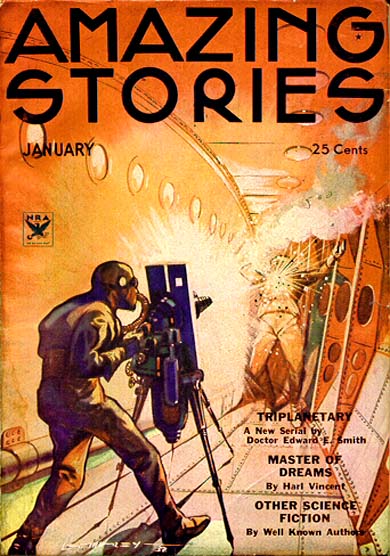
Triplanetary by E. E. Smith. Serialized in Amazing Stories, January to April 1934. Smith was immensely popular in SF fandom during his lifetime, and yet despite a few attempts to resurrect his reputation he has since then been relegated to something of a sideshow attraction. Along with Edmond Hamilton he was one of the pioneers of space opera, with his novel The Skylark of Space especially laying the groundwork for future entries in that subgenre. The magazine version of Triplanetary was a standalone novel that Smith later retooled so as to make it a prequel in the Lensman series.
For the novellas:
“Proxima Centauri” by Murray Leinster. From the March 1935 issue of Astounding Science Fiction. I actually don’t remember if I’ve read this one before, so I’m counting it as a new read. Anyway, Leinster is curious if only because he’s one of the few writers from the Gernsback era to survive the coming of Campbell; not only that, but he actually hit his creative peak in the ’40s and ’50s.
“Wolves of Darkness” by Jack Williamson. From the January 1932 issue of Strange Tales. Williamson had one of the longest careers of any writer, inside or outside of SF, debuting in 1928 and remaining active until his death in 2006. “Wolve of Darkness” stands out as, if I remember right, getting Williamson his single biggest paycheck for a story up to that point, as he says in his autobiography.
For the short stories:
“The Pilot and the Bushman” by Sylvia Jacobs. From the August 1951 issue of Galaxy Science Fiction. This is now the third time I’ve nabbed a story from this issue of Galaxy. I unfortunately have next to nothing to say about Jacobs since we know basically nothing about her, not even when and where she was born. She wrote a handful of SF stories in the ’50s and ’60s and then vanished.
“The Muted Horn” by Dorothy Salisbury Davis. From the May 1957 issue of Fantastic Universe. This is a case where looking at an author’s ISFDB page can be deceiving, since going by it one would think Davis wrote very little; but actually she was a prolific crime novelist, and was even President of the Mystery Writers of America when she wrote this story, which is apparently horror.
Let’s talk about where genre SF was at in 1950, because this year, perhaps more than any other year in the field’s history barring maybe 1926 (the launch of Amazing Stories) and 1953 (the year the magazine market reached critical mass). Changes in the field tend to come gradually; it’s not like, for example, one day you have a market that’s 95% WASPs and then the next it’s much more racially diverse. These things happen in movements, like the rest of history, or indeed like the waxing and waning of the tide. There really was a profound difference between how genre SF looked at the beginning of 1950 and how it looked by the end of the year. There were multiple changes happening at once, and not all of them were good. The less said about Dianetics the better. But you also had the publications of Isaac Asimov’s I, Robot and Ray Bradbury’s The Martian Chronicles, two “novels” (they’re really short story collections) that not only garnered acclaim from the usual suspects but even managed to break into the mainstream. This was practically unheard of at the time, to have science fiction that “normal” readers admitted to caring about. 1950 also saw the publication of other major SF books, like Robert Heinlein’s Farmer in the Sky, Theodore Sturgeon’s The Dreaming Jewels, A. E. van Vogt’s The Voyage of the Space Beagle, Asimov’s Pebble in the Sky, and the book version of Hal Clement’s Needle. Notice that with the exception of the van Vogt book, all the ones I just mentioned were aimed at younger readers—as in teenagers, those who might grow up to be SF enthusiasts.
A revolution, of a sort, was happening.
In the world of the genre magazines, things were shaking up at least much, even putting Dianetics aside. The Magazine of Fantasy and Science Fiction, which had launched in the fall of 1949, was finding its footing. There were signs of the coming deluge of new magazines, on top of the current rivals to Astounding, and the biggest of these new arrivals, by far, was Galaxy Science Fiction. Galaxy first hit newsstands with its October 1950 issue, which means it would’ve been available in September. Under the editorship of H. L. Gold, who had already proved himself a capable writer, this was a magazine that would do what Astounding could not, namely be socially conscious, with a focus on science fiction that was rather urbane and literate, while still being very much focused on science. But whereas Astounding was all about the hard sciences, Galaxy would focus just as much on the soft sciences, such as psychology and sociology. Being more socially conscious, there would also thus be much more of a focus on social satire, and one stereotype that would come to haunt Galaxy in the ’50s is that too many of its story would be misanthropic hehe-haha comedy pieces, aimed at the middle-class urbanites it was satirizing. As with The New Yorker around the same time (and indeed The New Yorker now), Galaxy ran the risk of coming off as incessantly liberal and middle-brow. This is a legitimate criticism, but it was also a risk one had to accept when changing the field this radically. To this day a lot of SF being published seemingly either takes after Galaxy under Gold’s editorship or Asimov’s Science Fiction under Gardner Dozois’s. There’s a third, more conservative (because Galaxy was kinda “woke” for its day) brand of SF writing that wants desperately to turn back the clock to a pre-Galaxy world, to a time before white people cared about things like social justice, but you can’t put the genie back in the bottle.
I had to think really hard about what stories and authors to cover this month, because the truth is that Galaxy at its peak had individual issues whose sheer quality and star power would put whole novels to shame. Nearly every story in a given issue would be a banger, or at least a fine read. There are people who wrote for Galaxy during its first decade that I had to leave behind, at least for the moment, including Theodore Sturgeon, Margaret St. Clair, Robert Sheckley, Philip K. Dick, Isaac Asimov, Clifford Simak, Cordwainer Smith, Poul Anderson, Ray Bradbury, and many others. But still we have a mix of usual suspects, as in those who regularly contributed to the magazine during this time, as well as a few lesser known authors. Of course I couldn’t have it all be now-famous selections.
Anyway, for the stories:
“Self Portrait” by Bernard Wolfe. From the November 1951 issue. If Wolfe is little known in the field, it could be because he wrote very little SF, putting out only one SF novel and a handful of short stories. Wolfe was a trained psychologist who also was a committed leftist, specifically a Trotskyist; he even knew the man himself personally, in the years right before Trotsky’s assassination.
“The Snowball Effect” by Katherine MacLean. From the September 1952 issue. I’ve covered MacLean before, actually not too long ago, but seeing as how her most prolific era was when she wrote for Galaxy in the ’50s, why not? She lived a very long time, although she didn’t write that much, making her debut in Astounding in 1949 before (for the most part) switching over to Galaxy.
“A Bad Day for Sales” by Fritz Leiber. From the July 1953 issue. Leiber is one of my favorite writers of old-timey SF, although he was also quite skilled (maybe even more so) in fantasy and horror. He debuted in 1939, and thus was one of the old guard, but he adapted to changes in the market with a chameleon’s touch. I picked this story specifically on a friend’s strong recommendation.
“The Big Trip Up Yonder” by Kurt Vonnegut. From the January 1954 issue. Vonnegut is one of those few authors who needs no introduction, but here it goes. He broke onto the scene in 1952 with his novel Player Piano, which was SF, as would be about half of his other novels. Despite not wanting to be pigeonholed as a “sci-fi” writer, he also occasionally appeared in the genre magazines.
“The Princess and the Physicist” by Evelyn E. Smith. From the June 1955 issue. We don’t know a lot about Smith, which unfortunately is not unusual for women in pre-New Wave SF, and incidentally she had mostly stepped away from the field by the time the New Wave and second-wave feminism kicked in. In the ’50s she wrote by far the most prolifically for Gold’s magazines.
“A Gun for Dinosaur” by L. Sprague de Camp. From the March 1956 issue. As with Leiber, de Camp was perhaps more adept at writing fantasy than SF, but then in the ’50s there wasn’t much of a demand for the former. He too was of the old guard, and was able to adapt to the changing times. He also lived an extremely long time, indeed having one of the longest careers in the field.
“Prime Difference” by Alan E. Nourse. From the June 1957 issue. Nourse is one of the lesser known of the original “hard” SF writers, and indeed the vast majority of his short fiction appeared in the ’50s when he was a very young man. He mostly stopped writing SF probably because he got a very well-paying job as a trained physician, but his work remains to be rediscovered.
“Nightmare with Zeppelins” by Frederik Pohl and C. M. Kornbluth. From the December 1958 issue. Pohl and Kornbluth were good friends for many years, but in the ’50s they collaborated on several novels and short stories, the most famous being The Space Merchants. Sadly Kornbluth died in early 1958, making “Nightmare with Zeppelins” one of the last stories he would’ve finished.
“The Man in the Mailbag” by Gordon R. Dickson. From the April 1959 issue. Dickson was born and raised in Canada (he’s from Alberta), but moved with his family to the US when he was a teenager. He’s most known for his regular collaborations with Poul Anderson, as well as his long-running and ambitious Childe cycle. He was one of the pioneers of what we now call military SF.