(Cover by Gerard Quinn. Science Fantasy, February 1963.)
Sometimes I get confused by my own schedule, which is to say the rotation method I used is one I’m not sure I always abide. Do I do eight reviews this month, or nine? How many days are in September? Thirty. But that doesn’t matter now. August was a pain and a half for me, for a few reasons. I went on vacation with family, which wasn’t all sunshine and rainbows (although I at least got PTO from that), not helped by there being I guess you could say a changing of the guard in my polycule. One of my partners dumped me. We’d been together about three months, and it was a pretty intense pairing. They (I say that because they’re non-binary) ultimately didn’t feel comfortable being with someone who is polyamorous. That’s the short of it. It sucks, and I’m still feeling sore from it, although I suppose this is the kind of loss you have to accept with a polycule. But it hasn’t been all bad! We did also welcome a new member recently, and she’s very cute. She’s not used to polyamory (the last polycule she was in didn’t work out), but she’s patient and so far things have been going pretty well for us.
On to shit that matters more, the Hugos happened this past month, and I actually got to vote in them—not that it mattered too much. I only felt qualified to vote in about half a dozen categories, although I did vote in Best Short Story (the #1 on my slate didn’t win :/), and I think this was also the first time I was poised to review a Hugo nominee which then went on to win by the time my review was published (Naomi Kritzer’s “The Year Without Sunshine,” a very fine pick). Next year’s Worldcon is to be held in Seattle, which hey, that’s only on the other side of the country for me. I should get to work on attending, since I can feasibly do that. Worldcon 2026 is also gonna be held in LA, so that’s… two American Worldcons in a row. That’s a bit weird. But I can’t complain too much.
As for this months reviews, we have a few birthdays! John Brunner would be celebrating his 90th birthday on the 24th (had he not died in 1995), which is crazy considering one would think he was maybe a decade older. Stephen King (who is very much alive) is celebrating his 77th birthday on the 21st. Something I’ve started to think about is the decades I’m pulling from with my story choices, because given how the magazine market has ebbed and flowed over the years there are a few boom periods that would get more attention than others. It shouldn’t come as a surprise that I’ve had to try to not pick material from the ’50s too often, and indeed there are no ’50s stories this month! We have three from the ’60s, two from the ’80s, two from the ’90s, and one from the 2020s. A couple these would be horror outings, as a prelude to next month’s shenanigans.
Now let’s see…
For the novellas:
“Green Mars” by Kim Stanley Robinson. From the September 1985 issue of Asimov’s Science Fiction. Robinson is one of the most respected living SF writers, for his hard-science credentials but also for being one of the few openly leftist writers in the field over the age of sixty. Worth mentioning that this novella has nothing to do with Robinson’s award-winning Mars trilogy, although it does apparently share continuity with a few other stories set on Mars—just not the Mars of that trilogy. And also I heard Robinson would take some ideas from this early Mars story and reuse them for the trilogy.
“Some Lapse of Time” by John Brunner. From the February 1963 issue of Science Fantasy. Low-key one of the more tragic figures in classic SF, Brunner was something of a prodigy, making his debut while still a teenager. He also wrote full-time in the ’50s and ’60s, at a time when that wasn’t considered all too viable for genre writers, and money was an issue. Brunner wrote so much that a lot of his short fiction hasn’t been collected more than once, or at least not in my lifetime. “Some Lapse of Time” has not seen print since Lyndon B. Johnson was in office, so let’s see if it’s a hidden gem or not.
For the short stories:
“The Transcendent Tigers” by R. A. Lafferty. From the February 1964 issue of Worlds of Tomorrow. Lafferty has a reputation as something of a writer’s writer, and there’s a reason for this: nobody writes quite like Lafferty. I’m not a fan of him, because I often find him overly quirky, but I’m all for giving authors another chance. I went out of my way to pick a relatively obscure Lafferty story.
“Angels in Love” by Kathe Koja. From the July 1991 issue of The Magazine of Fantasy and Science Fiction. I’ve only read short stories by her so far (I do have The Cipher, her first novel, on my shelf), but I can already say Koja is becoming one of my favorite horror writers. She’s turned more to YA in recent years, but her early stuff is vicious, snarky, and at times genuinely disturbing.
“Craphound” by Cory Doctorow. From the March 1998 issue of Science Fiction Age. Acclaimed as both a writer and commentator on the state of tech and surveillance, Doctorow has probably kept a thumb on the pulse of the post-internet zeitgeist more than any other living SF writer. “Craphound” is a very early story, but Doctorow thinks fondly enough of it to have named his blog after it.
“Crazy Beautiful” by Cat Rambo. From the March-April 2021 issue of The Magazine of Fantasy and Science Fiction. Rambo is a no-nonsense Texan who’s been active in the field for the past twenty years, more or less. They’ve been most prolific as a short story writer and editor, but have also recently taken to writing novels. Their latest novel, Rumor Has It, is due out from Tor later this month.
“Beachworld” by Stephen King. From the Fall 1984 issue of Weird Tales. Really needs no introduction, but let’s do it. King started writing in the ’60s, a fact people tend to forget because Carrie, his first novel, didn’t come out until 1974. Then the rest was history. He’s known firstly as a horror writer, but he’s also ventured into basically every genre under the sun, “Beachworld” being SF-horror.
“David’s Daddy” by Rosel George Brown. From the June 1960 issue of Fantastic. Brown made her debut in 1958 and quickly established herself as a short fiction writer; a large portion of her fiction would be published between 1958 and 1963. In one of SF’s many lost futures, Brown could’ve gone on to fit in with the New Wave feminists, had she not died in 1967, at only 41 years old.
Not much to update on for this month, although I did decide to shake things up for slightly for what I’ll be covering. See, for a while I was gonna do a whole tribute month for Clifford Simak, like I did for Fritz Leiber almost two years ago; but truth be told I’m not sure if I’ll do a whole month of reviews for one author like that again. It can be fatiguing to read a ton from one author, even one as diverse in his output as Leiber; and I can tell you Simak is not as diverse. I do have a compromise, though, since it’s gonna be the man’s 120th birthday in two days and I wanted to do something special. So instead of one Simak story we’re getting two. Not only that, but I’m making an exception for my “one story per magazine a month” rule (excepting F&SF this year, as you know) so as to pick two Simak stories from the pages of Galaxy Science Fiction. Simak was such a prolific contributor to Galaxy that I feel it’s only right to double dip here.
Another quirky choice I decided to pull was this month’s complete novel, which is not only a certified classic of “literary” fiction but a fantasy novel that people tend to not think of as such. Whether The Man Who Was Thursday “really” counts as fantasy was a point of contention even when it was printed in Famous Fantastic Mysteries, with people in the letters column loving the novel but questioning its fantasy credentials. But fuck you, I’m counting it. Aside from Simak we have a fairly diverse roster of writers, none of whom I’ve previously covered on here. We also have a few stories I would consider appropriate for summer reading, in that they take place in warm climates and/or involve aquatic life.
Let’s see here…
For the novellas:
“No Life of Their Own” by Clifford D. Simak. From the August 1959 issue of Galaxy Science Fiction. For the story I picked to cover on Simak’s birthday I figured I may as well pick a story that also had an August release date. When Simak restarted his writing career in the late ’30s he would be a regular at Astounding Science Fiction for the next decade, but in the ’50s it quickly became apparent Galaxy would be his new go-to outlet. Incidentally the ’50s also saw Simak’s most prolific period as a short fiction writer.
“Surfacing” by Walter Jon Williams. From the April 1988 issue of Asimov’s Science Fiction. Williams had started out as a “mainstream” writer in the early ’80s, but by the latter half of that decade he had moved to writing SF. His rise to prominence happened to coincide with the cyberpunk movement. Bit of a funny story: this is a semi-reread for me, since I got about halfway through “Surfacing” a year or so ago, but due to circumstances outside of my control I wasn’t able to finish it at the time. I’m correcting that now.
For the short stories:
“Retrograde Summer” by John Varley. From the February 1975 issue of The Magazine of Fantasy and Science Fiction. Varley debuted in 1974 and within just a couple years rose as arguably the most imaginative and exhilarating new writer in the field. His Eight Worlds stories especially (of which “Retrograde Summer” is one) pointed towards a writer who was a breath of fresh air at the time.
“The Voices of Time” by J. G. Ballard. From the October 1960 issue of New Worlds. Ballard would later see mainstream recognition, of a sort, with his highly controversial novel Crash and the semi-autobiographical Empire of the Sun. In the ’60s, however, Ballard was known as one of the quintessential figures in the New Wave. This story is an example of early Ballard, from before the New Wave.
“The Evening and the Morning and the Night” by Octavia E. Butler. From the May 1987 issue of Omni. Butler was a respected author in her lifetime, winning multiple awards, but her reputation seems to have gotten a second wind in the years following her death. She was a somewhat prolific novelist, but she wrote very few short stories—which didn’t mean there was a dip in quality.
“Dusty Zebra” by Clifford D. Simak. From the September 1954 issue of Galaxy Science Fiction. Simak had been with Galaxy from literally that magazine’s first issue, with the serialization of his novel Time Quarry (or Time and Again), and from there he was a constant presence. Given the subject matter, “Dusty Zebra” may or may not be a precursor to Simak’s more famous “The Big Front Yard.”
“The Year Without Sunshine” by Naomi Kritzer. From the November-December 2023 issue of Uncanny Magazine. Kritzer has been around for a while—actually way longer than you’d think, considering she only started getting real awards attention in the 2010s. This story here just won the Nebula, and is currently a finalist for the Hugo, making it the most recent story I’ll have covered.
“There Used to Be Olive Trees” by Rich Larson. From the January-February 2017 issue of The Magazine of Fantasy and Science Fiction. I remember reading a few Larson stories in the past and assuming he was older than he really was, which says something about his skill. Larson made his debut in the early 2010s while still a teenager, and has been writing at a mile a minute ever since.
For the complete novel:
The Man Who Was Thursday by G. K. Chesterton. From the March 1944 issue of Famous Fantastic Mysteries. First published in 1908. This is kind of a treat for myself, since not only is this a reread but The Man Who Was Thursday is also one of my favorite novels. Chesterton is known for his Father Brown detective series, and for being a celebrated Catholic apologist; but before his conversion he wrote one of the pioneering (and still one of the weirdest) espionage novels with this month’s pick. Interestingly this seems to be one of the rare cases of a “complete” novel in FFM actually being unabridged, the only omission being a poem at the beginning dedicated to a friend of Chesterson’s which is not part of the novel itself.
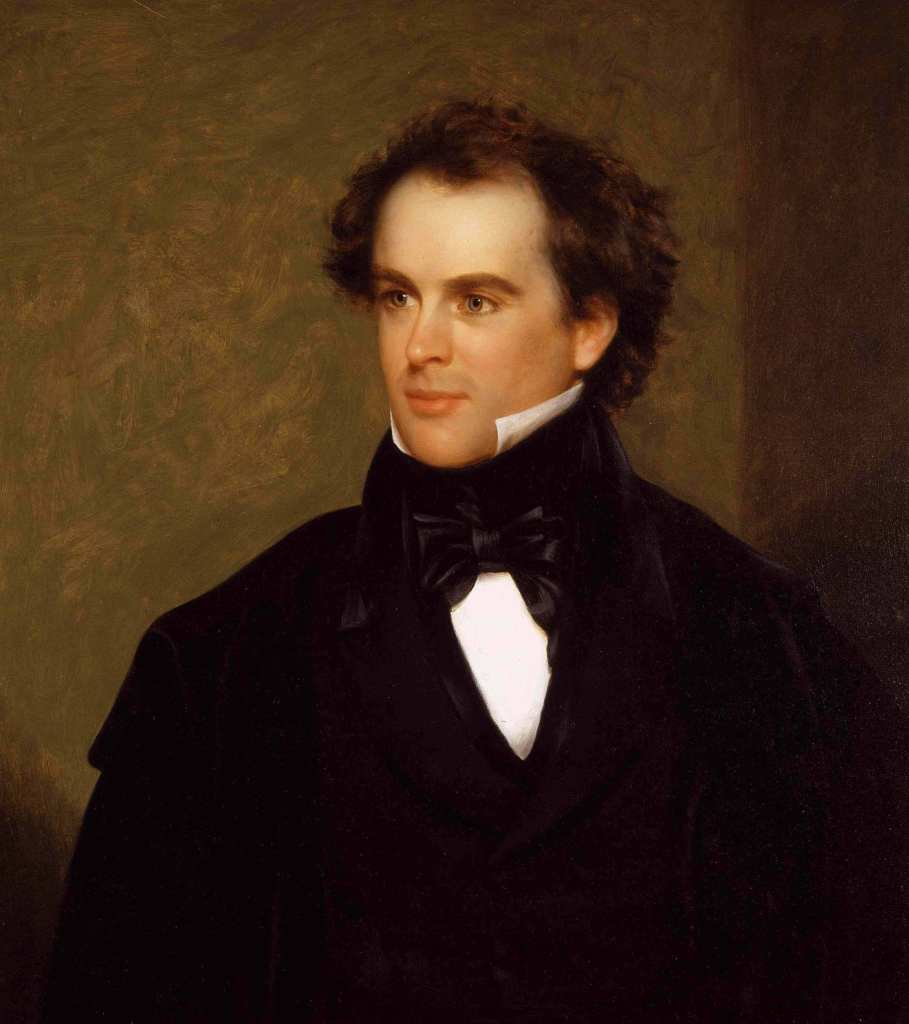
(Portrait of Nathaniel Hawthorne, by Charles Osgood. Circa 1841.)
(Contains spoilers for “The Birthmark,” “Rappaccini’s Daughter,” and “The Artist of the Beautiful.”)
We’re here to talk about some “classic literature,” which I understand tends to fall outside genre confines for a lot of people. After all, genre SF, or indeed science fiction as a codified genre, did not exist in Nathaniel Hawthorne’s lifetime; and yet he, along with a few contemporaries, contributed massively to what we now call science fiction. Hawthorne is one of the undisputed canonical American authors, and he was also one of the first, having been born on July 4th, 1804, at a time when the US had not even started really to foster its first generation of “canonical” literature. When Hawthorne started writing his first major work in the 1830s the literary landscape in the US was basically at the stature of a toddler; and despite having already written a novel (one that nobody talks about and which Hawthorne went out of his way to disown), he would dedicate two decades of his life to mastering just the short story. The Scarlet Letter is one of the most famous (if divisive) American novels of all time, but when it was published in 1850 Hawthorne had already garnered a reputation as a master of short fiction; and like his direct contemporary Edgar Allan Poe he often wrote stories that would now be considered horror, fantasy, and/or SF. There’s a reason Lovecraft, in his “Supernatural Horror in Literature,” singled out Hawthorne as a major pioneer in weird fiction, even calling his borderline supernatural novel The House of the Seven Gables a masterpiece.
If I were to talk about Hawthorne’s horror fiction then I would really have my work cut out for me, given how much of his material is horror; but today we’re here to talk about three of his short stories, all of which could be considered SF, and all of which involve some kind of mad-scientist figure. The truth is that had Mary Shelley not beaten him to the punch by a few decades then the popular conception of the mad scientist would probably be much more based on Hawthorne’s conceptions—and to a degree those conceptions have still left a footprint on the popular consciousness. Had things gone a bit differently we might call a scientist who plays God a Rappaccini instead of a Frankenstein. The three stories—”The Birthmark,” “Rappaccini’s Daughter,” and “The Artist of the Beautiful”—were all published over a span of two years (1843 and 1844), and the SF Encyclopedia singles them out as masterpieces of early SF. There’s a good reason for this. While not officially connected with each other in any way, the three stories are thematically conjoined at the hip, on top of featuring variations of the same character type: the scientist in search of perfection. These are also stories that happen to show Hawthorne at the top of his game, being some of his most tightly composed and insightful work, and showing a seriousness that would be missing in the early days of genre SF a century later. Mind you that this is not a review: I very much recommend all three stories. We’re gonna be doing some analysis, specifically in how Hawthorne conceptualizes scientist characters at a time when “the sciences” as different fields of discipline were only then starting to splinter, and indeed some hadn’t even been founded yet. This was a time before Darwin’s theory of evolution and our modern understanding of genetics, for example, such that “science” in 1843 might now sound almost like mysticism.
I read each of these stories in order of how they appeared in the Hawthorne collection Mosses from an Old Manse, so let’s talk about “The Birthmark” (or “The Birth-Mark” as it’s also titled) first. This is one of Hawthorne’s most reprinted stories, and given its simplicity and economy of style it’s easy to see why it’d be one of the more popular choices. There are only two main characters (plus a singular supporting character I’ll get to in a minute), trapped together in basically one room. Aylmer is a research scientist, living at some point in the late 18th century, with his wife Georgiana, a perfectly submissive woman who nonetheless is insecure about a hand-shaped birthmark on her cheek which renders her, at least to her husband, just imperfect enough as to be tragic. We’re told Georgiana is as conventionally attractive a woman as one can think, almost perfect in her beauty—almost. This single imperfection (clearly supposed to be the hand of Nature on her cheek) is enough to make Aylmer neurotic, and to propose a series of experiments in order to remove the birthmark, which Georgiana agrees to. Aylmer’s assistant, Aminadab, suggests that the experiment would be a bad idea, but remains loyal to his master. Aminadab is a curious figure, since he has to be one of the first examples of the mad scientist’s impish assistant in SF, serving as a predecessor to the likes of Fritz in the 1931 Frankenstein movie and Igor elsewhere. (Remember, Dr. Frankenstein did not have such an assistant in the novel.) Of course, Aminadab is not very impish; if anything he serves as a symbol of “earthy” wisdom to contrast with Aylmer’s blinding bookishness. Aylmer is not evil by any means, but he turns out to be tragically misguided, perhaps driven by the fact that he loves his work more than his wife, or as the narrator posits, he is unable to untangle his love for his wife from his love for science.
“The Birthmark” is a parable that has quite a bit going on within its almost brutally simple confines. It’s a story about man’s vain pursuit to overthrow Nature (and for Hawthorne it’s always Nature with a capital N), which will become a bit of a running theme here. It’s also about the futile pursuit of obtaining perfection, which of course Aylmer and Georgiana can’t have. Aylmer’s borderline abuse of his wife and the narrative’s sympathy for Georgiana’s insecurity arguably reads as proto-feminist, especially now that we’ve become much more aware of women having unrealistic beauty expectations thrust upon them; indeed the seeming “need” for perfect beauty is so prevalent that despite the quasi-Shakespearean dialogue and dense expository paragraphs, very little has aged about any of these stories in terms of their concerns. Of course Aylmer is able to remove the birthmark, but Georgiana quickly becomes ill and dies on the operating table; obviously if we’re being pedantic the removal of the birthmark shouldn’t have been able to kill her, but it’s meant to be symbolic. Prior to the climax, Georgiana alluded to being connected with the birthmark in some spiritual fashion, such that if the birthmark were extinguished then her a soul might go with it—a possibility Aylmer doesn’t quite heed. For a brief moment he renders Georgiana “perfect,” but as will become apparent if one reads his other fiction, Hawthorne thinks of perfection as something that can only last for a single moment—if it’s possible at all. Aylmer is a tragic hero in that he has good intentions, or at least thinks he has good intentions, but is unable to do away with Nature’s imperfection.
Now we have possibly Hawthorne’s most famous short story with “Rappaccini’s Daughter,” which despite being a fair bit longer than either of the other stories is still very much a parable. I should probably mention that I suspect the biggest reason why more people don’t enjoy Hawthorne nowadays is that he was not a realist; he often wrote in the allegorical mode, itself having apparently gone out of fashion in recent decades. Nobody likes being moralized at, and Hawthorne did quite a bit of moralizing; but he was also very good at it, such that his skill goes undervalued now. It’s quite possible that had Frankenstein not been published a quarter-century earlier that our conception of what a “mad scientist” even looks like might’ve been more informed by Hawthorne’s Rappaccini—an ironic fact, considering Rappaccini himself barely appears in his own story and we don’t even get any dialogue from him until the climax. We do, however, see a great deal of Rappaccini’s work, including his experimental botanical garden, an “Eden of poisonous flowers,” and his daughter Beatrice, who manages said Eden. We move off to Italy, where a young man named Giovanni gets caught in a rivalry between two physicians, Baglioni and Rappaccini, and Giovanni himself becomes deeply fascinated with Beatrice. I could be wrong, but this might be the earliest example of the “mad scientist’s beautiful daughter” trope in fiction; I certainly struggle to think of anything that could’ve predated it. There is a problem with Beatrice, aside from the fact that she’s socially inept: she’s poisonous, such that even her breath can kill. After years of exposure to the garden Beatrice has become immune to the poisonous plants around her—the tradeoff being that she has become poisonous to everything else. Well, nobody’s perfect.
Of Hawthorne’s mad scientists, Rappaccini is by far the most villainous and the least human, so it’s fitting he’s the only one who serves as a proper antagonist. Rappaccini’s sinister nature is amplified by the fact that we get to know very little about how this whole situation came to be. We never find out what became of Mrs. Rappaccini and we never get a clear answer as to why Rappaccini would use his own daughter as a kind of living experiment, or why he built his garden so that it would resemble a kind of inverted Eden—a place where nothing is allowed to live except that which kills. Maybe the point of making Beatrice immune to the poisonous plants of the garden was to make her, quite literally, immune to what Rappaccini considers the evils of the world—the killing things which Nature produces. Beatrice has become so perfectly immune, and herself so perfectly poisonous, that the result is idealistic—if only in a way that would strike the average person as perverse. Not that Hawthorne’s writing tends to be subtle, but “Rappaccini’s Daughter” might be one of his most overtly religious works in how intensely (and masterfully) it harks to Biblical mythology, to such a degree that even the verbose style of the prose seems to be the spawn of Milton and the King James Bible. (Naturally there are also references to The Divine Comedy.) Rappaccini is a man who clearly thinks of himself as akin to God—a demiurge who has created an inverted and treacherous Eden of his own. If Rappaccini is the demiurge, a counterfeit God, then Baglioni is like the snake in Eden, but made ultimately good, such that his foiling of his rival involves making Giovanni immune to Beatrice’s own poison—an antidote that, tragically, results in her death. The villainous striving for perfection, the “paradise” of the garden, has been lost.
(Cover by E. M. Stevenson. Weird Tales, July 1926.)
The last of these stories is not as famous as the others, nor was it reprinted in genre magazines as a classic—all a shame, since it’s arguably the strongest of the bunch. I was stunned a bit when I had first read “The Artist of the Beautiful” a year or so ago, which as its title suggests is an incredibly tender parable. It must be said, though, that the protagonist of this one is not, strictly speaking, a scientist. Owen Warland is young watchmaker who has just finished his apprenticeship under Peter Hovenden, a capable but conventional-thinking watchmaker who doesn’t see the value in Owen’s idealism. Working on little machines is all well and good, but Owen wants to make something beautiful, something with real aesthetic value that will stick in the mind long after its practical function has expired. In other words, he wants to be an artist. In “The Birthmark” we saw the scientist-as-destroyer; in “Rappaccini’s Daughter” we saw a villainous take on the scientist-as-creator; but in “The Artist of the Beautiful” we see the scientist-as-artist. Indeed it’s here, in this tightly constructed little story, that Hawthorne most neatly marries art with the sciences. Owen’s growing obsession with making something small and yet perfect could serve as analogous with Hawthorne’s own obsession with perfecting the short story. After all, “the beautiful idea has no relation to size.” This proves to be a very hard task for Owen, though, and he gives up a lot to achieve his vision, having lost his chance with Peter Hovenden’s daughter Annie and having become an outcast. There are false starts, and he even gives up watchmaking to focus on his secret project, mooching off an inheritance in the meantime. For all intents and purposes, Owen shuts out the human world; but the same can’t be said of Nature, which he becomes more fascinated with…
The scientists of the previous two stories thought that in some way they could conquer Nature—Aylmer to remove Nature’s imperfections and Rappaccini to bend Nature to serve his own ends. If Owen is redeemed by anything it’s his willingness to acknowledge Nature’s—maybe “superiority” is not the right word, but Nature’s status as the immovable object, not to be destroyed or pushed aside by human hands. So rather than try to conquer Nature, Owen instead takes inspiration from it, perhaps with the expectation that he won’t be able to reach perfection—but he can get very close, if only for a prolonged moment. Even if only a few people get to see his creation before it falls apart in their hands. The mechanical butterfly, an early example of a robot in fiction, is tiny, yet perfectly designed. It has no practical utility, but it exists seemingly for the sake of being a wonderful little work of art, not to mention what would’ve been a technological marvel. Post-industrial technology rarely comes up in Hawthorne’s fiction, partly because he actually lived through the industrial revolution and partly because his fiction tends to take place in what would’ve been the distant past, even from the perspective of 1840s New England. Owen’s mechanical butterfly thus stands out as a rare example for Hawthorne of what we even today would call modern technology, but it’s also an example of science and art coming together to imitate Nature—not to replace it but to take inspiration from it. The ending is bittersweet, as Owen’s creation which he had toiled over for months crumbles, but it strikes me as a kind of spiritual victory for the “scientist” here. If Aylmer was misguided and Rappaccini villainous, then Owen, the scientist-as-artist, comes out the victor.
Hawthorne wrote more SF than just these three stories, of course, although SF would still only take up a small fraction of his output, for I think at heart he was really a horror writer. There is some overlap between the genres he played with, though, and it shouldn’t be too surprising that “The Birthmark” and “Rappaccini’s Daughter” were reprinted in Weird Tales. Poe certainly wrote more SF, but far more than Poe I think Hawthorne set a standard for how we (people who, for the most part anyway, are not scientists at all) think about scientist characters in SF. Poe’s protagonists are often misfits, adventurers, schemers, and other archetypes Poe may or may not have admired; but Hawthorne’s protagonists tend to be more bookish, dour, isolated from human contact, like the man himself. No doubt Hawthorne saw some of himself in Owen Warland, and he may have even seen a bit of himself in Aylmer. More than with scientists as people, though, Hawthorne was arguably the first (after Mary Shelley, obviously) to write science fiction in which the sciences matter even close to as much as the action and themes of the story. In “Rappaccini’s Daughter” alone we have a physician who is also a botanist, and while he stays offscreen for most of the story we do see clearly the fruits of his labor. In the days before we even knew of Darwinian evolution, Hawthorne had given us some ideas as to what a world ruled by scientists, by the seeking-after-knowledge above all else, might look like—and it didn’t look very promising.
As I’ve said elsewhere, we’re gonna be covering the ’60s in this year-long tribute to The Magazine of Fantasy and Science Fiction this month. Picking stories to review for July proved a challenge, but in a good way. Over its 75-year history F&SF has gone through several editors, which is normal, but the ’60s were almost certainly the most tumultuous time in the magazine’s history, for a few reasons. At the beginning of the decade Robert P. Mills was editor, and for the few years he edited F&SF Mills was very capable, arguably even on par with Anthony Boucher; but Mills was an agent and publisher first, and editing wasn’t something he wanted to do as a career. So the torch was passed to Avram Davidson, which sounds like an odd choice with hindsight, but it probably made perfect sense at the time. Davidson was a well-respected writer out of the “new” generation; he was more literary than most of his contemporaries, but he was also… quirkier. For practical reasons more than anything Davidson’s editorship could not last, and so the torch was passed once again, this time to Joseph W. Ferman, with his son Edward assisting him. Joseph lasted about a year before passing the torch to Ed; and this time, by the beginning of 1966, the torch would stay in place, as Ed Ferman would remain editor for the next 25 years. By the last ’60s F&SF had found a new and comfortable niche.
The rapid changing of editors also coincided with a rapid changing of material and reader expectations at this time. The ’60s were the decade of a lot of things: the Vietnam War escalating, racial and socio-economic strife reaching a breaking point, the assassinating of left-leaning public figures, the coming of the hippies. More innocuously it saw the birth of the New Wave, which was spearheaded in the UK by Michael Moorcock and a small army of forward-thinking British writers (although, if it makes you feel better, quite a few important contributors to the New Wave were American), reinventing New Worlds to make it a boundary-pushing powerhouse of a magazine. The US scene was a bit slow to catch up. John W. Campbell and Frederik Pohl lamented the New Wave, but the rascally movement would eventually find a sympathizing magazine in the US with F&SF. Understandably the fiction published in F&SF during this time was a good deal more eclectic than what happened in the ’50s, so it also makes sense the lineup of authors for this month would be a bit eccentric. We have a few of the usual suspects, but we also have… Lin Carter? And Russell Kirk…? We have a New Waver with Brian Aldiss, although the story chosen is decidedly anticipatory of the New Wave rather than part of it. For the most part we have science fiction here, with some horror thrown in; this was not a great time for fantasy in F&SF. Still, I think it’s at least an interesting roster.
Let’s see what’s on our plate.
For the short stories:
“The Oldest Soldier” by Fritz Leiber. From the May 1960 issue. He’s baaaaack. Honestly it’s been too long—in fact it’s been exactly a year since we last covered Leiber. Of course in the interim I’ve not refrained from writing about him on a different outlet or two, and can you blame me? This time we have an entry in his Change War series, being one of the first examples of a time war in SF.
“Hothouse” by Brian W. Aldiss. From the February 1961 issue. Aldiss has a career that goes shockingly far back for someone who died fairly recently, having debuted in the ’50s and almost overnight becoming a force to be reckoned with. Hothouse is usually considered a novel, but as a series of linked stories it won Aldiss a Hugo. This first entry in the “series” is a much-needed reread for me.
“Subcommittee” by Zenna Henderson. From the July 1962 issue. There were quite a few female authors active in the early days of F&SF (more so than other SFF magazines), and one of the most prolific contributors was Henderson. Her fiction often involves families and the experiences of children, and she’s most known for her stories of “The People.” This story, however, is totally standalone.
“The Voyage of the ‘Deborah Pratt’” by Miriam Allen deFord. From the April 1963 issue. DeFord has one of the most curious careers of any old-timey SF writer, and in 1963 she was almost certainly the oldest living contributor to F&SF, being in her seventies. Prior to taking up genre writing she wrote for socialist and feminist publications, as well as conducting research for Charles Fort.
“Cynosure” by Kit Reed. From the June 1964 issue. Starting in the ’50s and remaining active until her death in 2017 (she lived to be 85), Reed’s work is often quirky, humorous, satirical, but also at times brutal. Her science was never hard, and her disposition makes one think of Shirley Jackson. Both are vicious when it comes to domestic portraits. In other words, Reed was perfect for F&SF.
“Uncollected Works” by Lin Carter. From the March 1965 issue. Acclaimed, if also controversial, as an editor, and pretty notorious as a writer, Carter is probably most responsible for reviving interest in pre-Tolkien fantasy in the ’60s and ’70s. He’d been active as a fan since the ’40s, but “Uncollected Works” was his first solo professional story, and it garnered him a Nebula nomination.
“Balgrummo’s Hell” by Russell Kirk. From the July 1967 issue. Kirk, at least when he was alive, was known more as a conservative political philosopher, and indeed Christianity is integral to both his fiction and non-fiction. But he was also a surprisingly accomplished writer of supernatural horror, and despite being very much an outsider he did sometimes appear in the pages of F&SF.
“They Are Not Robbed” by Richard McKenna. From the January 1968 issue. McKenna gained mainstream recognition with his one novel, The Sand Pebbles, but it seems he used science fiction as a training ground, such that he appeared semi-regularly in the magazines—both before and after his death. McKenna died in 1964, but he apparently had a small trove of stories waiting to be published.
“The Movie People” by Robert Bloch. From the October 1969 issue. Bloch is most known for writing Psycho, but his career started much earlier and much more embedded in the Lovecraftian tradition—indeed he and Lovecraft were correspondents when Bloch was a teenager. On top of writing bestsellers Bloch wrote for film and TV, even penning a few (horror-themed) Star Trek episodes.
Nothing unusual for this month, although we do have a couple authors who are not normally associated with SFF, let alone magazine SFF. One of the reasons I decided to make this year more focused on The Magazine of Fantasy and Science Fiction for its 75th anniversary is that, easily more than any of its contemporaries (and F&SF has outlived most of its competitors), is that it has managed to snag authors who otherwise would probably never appear in SFF magazines. It’s quite possible Jonathan Lethem would’ve tried his hand in the magazines regardless of whether F&SF ever existed, but the same can’t be said for Joyce Carol Oates.
I’ve recently been going through another mental health struggle (my bipolar episodes thankfully last hours at a time instead of days or weeks), but that’s not something to be elaborated on—at least not for this post. I may have something in mind having to do with mental illness in certain SF writers that you may or may not see later in the month.
Let’s see what we do have.
For the novellas:
“Oceanic” by Greg Egan. From the August 1998 issue of Asimov’s Science Fiction. Hugo winner for Best Novella. Egan is one of the leading voices of post-cyberpunk, and while mixing SF with detective fiction was a thing pretty much since cyberpunk became a codified subgenre, Egan has gone farther than most in mixing hard science with film noir tropes. Last time we met Egan it was with his mind-bending novella about quantum physics, “Singleton,” but “Oceanic” seems to catch Egan in a very different mode.
“Autubon in Atlantis” by Harry Turtledove. From the December 2005 issue of Analog Science Fiction. Prolific tweeter Harry Turtledove is known as a possibly even more prolific novelist, and while by no means did he invent the alternate history novel he has undoubtedly worked to define that subgenre more than anyone in recent years, especially regarding the American Civil War. “Autubon” is not a misspelling of “autobahn” but refers to the real-life naturalist John James Autubon, who stars in this alternate history story.
For the short stories:
“Friend” by James Patrick Kelly and John Kessel. From the January 1984 issue of The Magazine of Fantasy and Science Fiction. Long-time friends and collaborators, brilliant both solo and together, Kelly and Kessel got their starts around the same time and happened to get involved in the cyberpunk movement, although it would be inaccurate to call either of them cyberpunk writers.
“Drunkboat” by Cordwainer Smith. From the October 1963 issue of Amazing Stories. One of the most unique voices of his day, Smith, as you probably know, is the pseudonym of Paul Linebarger, a respected writer on psychological warfare and consultant on Asian geopolitics. He spent some of his childhood in China. Most of his stories, including this one here, are set in the same future history.
“Mood Bender” by Jonathan Lethem. From the Spring 1994 issue of Crank!. A “literary” author who has never forgotten his roots, Lethem started out in the late ’80s as a genre writer, and indeed his first four novels were all SF before he gained mainstream attention with Motherless Brooklyn in 1999. As with Greg Egan, Lethem has a knack for combining SF with film noir elements.
“Pictures Don’t Lie” by Katherine MacLean. From the August 1951 issue of Galaxy Science Fiction. MacLean debuted just in time for the magazine boom of the ’50s and the first great era for female SF writers. She lived an extraordinarily long time and her career is a distinguished one. “Pictures Don’t Lie” is one of MacLean’s most reprinted stories, and has even been adapted multiple times.
“In Shock” by Joyce Carol Oates. From the June 2000 issue of The Magazine of Fantasy and Science Fiction. Noted tweetsmith Joyce Carol Oates also happens to be one of the most acclaimed living American authors, having won the National Book Award, the Bram Stoker Award, among others. Most of her work is “literary,” but she’s also a somewhat prolific (and quite skilled) writer of horror.
“The Secret Life of Bots” by Suzanne Palmer. From the September 2017 issue of Clarkesworld. Hugo winner for Best Novelette. Palmer was born in 1968 but didn’t make her genre debut until 2012; despite this she has quickly built a reputation as one of the leading authors in the field. She’s been a prolific contributor to Asimov’s especially, but this story marked her first appearance in Clarkesworld.
As you can see this nearly all SF, except for the Oates which is horror, but it’ll also be the last “normal” forecast until September. In July we’re doing all F&SF stories, this time from the ’60s (I covered the ’50s in March), and for August I have a special author tribute in mind.
Not much to say with regards to updates here, other than I’m looking into a tutoring gig and I seem to be starting a polycule, the latter of which I’ve heard is kinda like starting a rock band. If anyone wants to join, please let me know. There are no gimmicks for this month’s review forecast, except that we have a complete novel on our hands for the first time in what feels like forever, and we’ve got a few familiar faces returning to the site. I may have also intentionally picked Lucius Shepard and Aliette de Bodard stories with similar titles. One thing I’ve been thinking about that I’ve decided to act on is reviewing more reprints of classic stories; one every couple months seems like a good deal. The reason for this is at least twofold: I have a soft spot for the classics, but I also wanna cover authors from the pre-pulp years who contributed to genre fiction. This month I’ll be reviewing an SF story by Jack London, who is not known primarily for his SF but who indeed wrote a lot of it. Once again Jack Vance will be providing the novel, which is unsurprising since quite a few of his novels first appeared in magazines, either as serials or all in one piece like this month’s novel.
Don’t wanna keep you long; just letting you know we have another month packed with fiction that looks to be at least interesting, although it’s mostly SF with a couple fantasy stories thrown in.
For the novellas:
“Birthright” by April Smith. From the August 1955 issue of If. Smith sadly is one of many women who wrote SF in the pre-New Wave days whom we know basically nothing about. We don’t know when she was born or when she died. She’s a ghost. She has one solo story, “Birthright,” to her credit, plus one collaboration. ISFDB classifies this story as a novelette, but running the Project Gutenberg text through a word processor shows it’s just over 17,500 words.
“Polyphemus” by Michael Shea. From the August 1981 issue of The Magazine of Fantasy and Science Fiction. Shea had a varied career, lasting from the ’70s until his death in 2014. His work ran the gamut from SF to high fantasy to the Cthulhu Mythos. He won the World Fantasy Award multiple times for his fantasy and horror. His most famous story, “The Autopsy,” is an SF-horror hybrid, and “Polyphemus” looks to be a similar blend of the two genres.
For the short stories:
“The Shadow and the Flash” by Jack London. From the June 1948 issue of Famous Fantastic Mysteries. First published in 1903. London was one of the most popular and prolific authors of the early 20th century, despite dying young. He’s best known for his adventure stories set in the Klondike, such as The Call of the Wild and White Fang, but he also wrote a surprising amount of science fiction.
“The Witch of Orion Waste and the Boy Knight” by E. Lily Yu. From the September-October 2016 issue of Uncanny Magazine. Yu burst onto the scene with her story “The Cartographer Wasps and the Anarchist Bees,” which nabbed her several award nominations. She won the Astounding Award for Best New Writer the same year she graduated from Princeton, which is no small feat.
“The Jaguar Hunter” by Lucius Shepard. From the May 1985 issue of The Magazine of Fantasy and Science Fiction. Speaking of late bloomers, Shepard didn’t start writing fiction as an adult until he was deep in his thirties, but he quickly emerged as one of the defining SFF writers of the ’80s. If you’ve read enough Shepard then you know he has a “type,” and this story looks to be typical Shepard.
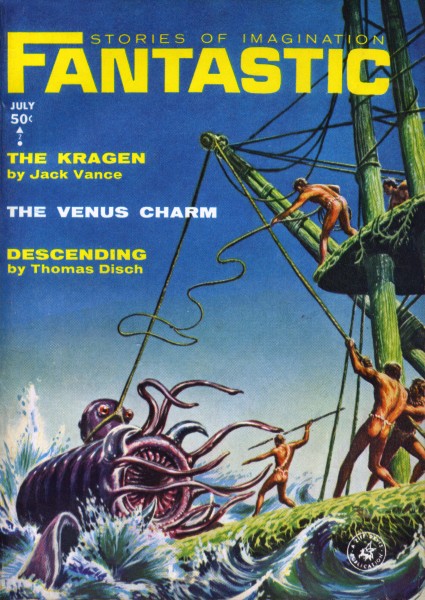
“Descending” by Thomas M. Disch. From the July 1964 issue of Fantastic. Feels like it’s been a long time since I covered Disch, with his novel Camp Concentration. Disch was one of the daring young writers to kick off the New Wave in the ’60s, although despite being a regular at Michael Moorcock’s New Worlds he actually first appeared in Fantastic, under Cele Goldsmith-Lalli’s editorship.
“The Defenders” by Philip K. Dick. From the January 1953 issue of Galaxy Science Fiction. It’s been ten months since I last talked about Dick on here, which in my book is too long a wait. The thing about Dick is that he’s become frankly over-discussed in “serious” SF discussions, or at least his most famous novels. Thankfully this is not the case with many of his short stories, such as this one.
“The Jaguar House, in Shadow” by Aliette de Bodard. From the July 2010 issue of Asimov’s Science Fiction. Of Vietnamese heritage, living in France, and writing predominantly in English, de Bodard has a curious cultural background, so it makes sense she would concoct one of the most curious future histories in modern SF. Spacefaring humanity here is decidedly non-white and non-American.
For the complete novel:
Planet of the Damned by Jack Vance. From the December 1952 issue of Space Stories. The early ’50s were a formative period for Vance, who was showing himself to be one of the most imaginative talents at the time—albeit one whose efforts were mostly relegated to second-rate magazines. I’ve previously coveredBig Planet, which was a breakthrough title for Vance, and now we’re on Vance’s follow-up novel, published just a few months later. Planet of the Damned has a rather convoluted publication history: as with Big Planet, the magazine version and not the first book version served as the basis for future “definitive” reprints. It’s also been printed as Slaves of the Klau and Gold and Iron.
(Contains spoilers for “The Ash-Tree,” “A Warning to the Curious,” and “‘Oh, Whistle, and I’ll Come to You, My Lad.’”)
Montague Rhodes James was born in 1862 and died in 1936, incidentally the same year as Rudyard Kipling; and with that, English literature lost two of its finest writers of the supernatural. It wasn’t the only thing they had in common: they were both conservatives of a breed that seemed to die out following the erosion of the British empire, both given to a distrust of women (Kipling more explicitly), both seeming to be relics of a prior age—a status which makes them a bit of a challenge for modern readers. More endearingly, both were consummate and compulsive storytellers. Kipling read stories to his children while James often wrote his stories with the intention of reading them aloud to his friends, which he would then do at Christmastime gatherings. They can’t help it; it’s like a second language for them. But whereas Kipling wrote almost every kind of story then conceivable (adventure, fantasy, science fiction, horror, you name it), James wrote only one kind of story: the ghost story. As he admits in “Stories I Have Tried to Write,” a brief but telling essay, “I never cared to try any other kind.” It’s a good thing he was perfect for such a niche job.
I’ve been reading some M. R. James as of late, or in a few cases rereading. I’ve said before that I’m a bit of a slow reader, and even then I struggle to retain information; but there’s also a pleasure in rereading something juicy, and James’s writing often demands closer examination. It’s occurred to me that James really was one of the best horror writers of his time, and he did this despite (by his own admission) being adept at only one specific kind of story. If you read five M. R. James stories in one day (which I wouldn’t recommend, because each requires at least some time to digest) then you will at some point feel like you’re reading five variations on the same story—the primordial M. R. James story which may not exist. “‘Oh, Whistle, and I’ll Come to You, My Lad’” and “A Warning to the Curious” were written more than a decade apart, but read like the offspring of the same mother—or, to evoke the things lurking in the ash tree at the climax of that story, siblings in the same brood, belonging to the same monstrous spider-queen. To make a more film-nerd comparison, James’s fiction is sort of like the movies of Yasujirō Ozu, in that both artists seemed preoccupied with toying with the same set of ideas, creating works that are similar enough to each other, with subtle and at times profound differences.
In James’s case there is a tangible obsession with the distant past—in many cases the positively ancient past. This wasn’t just a hobby for the man, mind you. James was one of those writers who wrote relatively little fiction (his complete set of ghost stories has been printed in volumes under 500 pages) because he had a day job that both covered his ass financially and was respectable. He spent pretty much his whole adult life in academia, at a few different colleges, from undergrad all the way to senior positions. He was a professional medievalist, and he did not fuck around when it came to uncovering artifacts and works of architecture. If he were alive today he might be one of those “lost media” YouTubers, but ya know, more cultured. Something to keep in mind about James is that, being a Briton and living in the UK most of his life (he did like to travel), he had a first-hand conception of the ancient that filthy Americans like myself simply don’t have. For Americans the “ancient” past goes back to about the 1600s, but for someone who’s traveled through the UK and continental Europe this conception of the past goes back several more centuries. In this sense his story “The Ash-Tree” might be one of his most well-known, at least for American readers, because of its dealings with Puritans and the persecution of alleged witches—things Americans are likely to know about. Fans of Nathaniel Hawthorne will be sure to seek out this one especially.
But more often than not the terrors that haunt James’s protagonists are unspeakably old and ethereal, perhaps more monster than man. Not only are the living characters unable to communicate with these apparitions, but they’re barely even able to understand their existence in the physical world. You may be thinking there are only so many ways one can write about ghosts, or even imagine ghosts; but even comparing James to Kipling, or Montague Rhodes to Henry (that other great ghost story writer), shows that there’s more than one way to skin a cat. Indeed, unlike the popular conception of ghosts up to the Edwardian period, James’s (I’m talking about M. R. now) ghosts are decidedly meaner, crueler, more unreasonable, and more impenetrable. Or, to quote H. P. Lovecraft in “Supernatural Horror in Literature,” in which he articulates James’s virtues better than I could:
In inventing a new type of ghost, [James] has departed considerably from the conventional Gothic tradition; for where the older stock ghosts were pale and stately, and apprehended chiefly through the sense of sight, the average James ghost is lean, dwarfish, and hairy—a sluggish, hellish night-abomination midway betwixt beast and man—and usually touched before it is seen. Sometimes the spectre is of still more eccentric composition; a roll of flannel with spidery eyes, or an invisible entity which moulds itself in bedding and shews a face of crumpled linen.
That latter description, by the way, applies to the ghost at the center of what is arguably James’s masterpiece, “‘Oh, Whistle, and I’ll Come to You, My Lad.’” This story, one of the finest ghost stories of all time, also happens to be a perfect encapsulation of James’s wants, fears, virtues, and limitations; it is a microcosm of everything relevant to and about M. R. James. We follow an academic, Professor Parkins, journeys to the coastal town of Burnstow (based on the real town of Felixstowe) for vacation, where he ends up golfing with a fellow at the same inn who mostly goes simply by “the Colonel.” Parkins gets word that there’s an attraction within walking distance of the inn that may be of interest to him: the site of a Templar preceptory, now mostly buried. The site would be at least 600 years old, and yet, England itself being such an old country, there might be something worth digging for. One day Parkins goes to the site as part of his beach walk, and digs out a whistle that, despite being caked in and clogged with dirt, remains miraculously intact. There’s writing on the whistle, in Latin, which Parkins can only partly make out, but which he translates as, “Who is this who is coming?” Having cleaned the whistle, and out of curiosity, he decides to use it. This is a mistake. The whistle’s owner has been dead for centuries, and yet upon Parkins’s discovering the whistle has been brought back into this world—first as a vague human-shaped specter that stalks Parkins on the beach and later taking possession of the aforementioned “crumpled linen.” This might be the only time in history the stereotypical bedsheet ghost is made threatening.
Everything is neatly laid out for us. We have an intellectual but sort of hapless protagonist, a pastoral locale that seems inviting but which houses an ancient evil (locations in James stories always seem either to be wide open spaces or storied buildings like cathedrals and old colleges, no in-between), a spirit of the distant past which is catapulted into the present by some cursed object, and ultimately an anti-intellectual message. For James, the past seems to always be just one bad move away from resurfacing, on a collision course with the present unbeknownst to the latter. The central character of “A Warning to the Curious” takes what is supposedly the last buried crown on England’s coasts, made to stave off foreign enemies, and draws the unwanted attention of something—and, even after returning the ancient crown to its rightful place, he pays for his transgression. Similarly the latest in a line of Puritan landowners falls prey to a witch’s curse that his ancestor had brought upon the family in “The Ash-Tree,” with the witch continuing to wreak vengeance long after her execution. According to James, the past is never dead—merely dormant. In cosmic horror a rule of thumb is to never alert the eldritch horror to your presence, but while James’s ghost stories are not cosmic, they do have a similar rule: do not wake that which is sleeping. All things considered, Parkins gets off lightly.
It’s funny to think that James would revolutionize the ghost story, since he was about as far removed from the revolutionary as is possible. He was a reactionary, a staunch anti-Modernist, a misogynist, and if contemporary accounts are to be believed, a bit of a man-child. He had no sense of worker solidarity, wasn’t remotely interested in making the world a better place, and seemed to be a walking goldmine of useless trivia (again, think “lost media” YouTuber); and yet it could be argued that this sheltered lifestyle, this state of being perpetually knee-deep in the past, had nurtured James’s writing rather than hindered it. Sure, you (possibly left-leaning reader—or maybe not) and I find the politics of, say, H. G. Wells, a lot more agreeable, but I don’t think Wells (at least young Wells) could’ve written such a menacing work of horror as “‘Oh, Whistle’” or “Count Magnus” or “Casting the Runes.” I’ve been having this thought, or rather question, tumbling around in my head lately: Is horror a conservative genre? Very loaded question, probably worthy of its own editorial at a later date. Historically some of the great horror writers were conservative, and certainly the best writers of ghost stories in particular have tended to be right-wing. It could be because conservatives go through life already being stalked by phantoms—by the specters of queerness, feminism, socialism, and what have you. M. R. James is a rare case where his artistry was often fabulous because of his backwards politics, and more specifically because of his crippling fear of the present.
(Cover by Frank Kelly Freas. Analog, December 1972.)
As has unfortunately become commonplace, there have been a few deaths in the family. Christopher Priest and Brian Stableford died in February and Vernor Vinge little over a week ago. This last one hit me by far the hardest. Obviously there are some people I’m not mentioning, but unfortunately unless I really wanted to I can’t cover everyone. There’s too much. The past month or so has been rough for me. I had a nasty fall a few weeks ago and I seem to have acquired mild PTSD from it. Half of my face got messed up and I ended up spending some time in the ER. Obviously I’m doing better now. Yet somehow I don’t feel totally “right.”
Hopefully some good (or at least interesting) fiction will help me! We have a nice mix: two SF novellas, plus two SF short stories, two fantasy, and two horror. Or at least these stories seem to fit predominantly into those genres; obviously they’re not mutually exclusive.
For the novellas:
“A Woman’s Liberation” by Ursula K. Le Guin. From the July 1995 issue of Asimov’s Science Fiction. One of the most universally beloved of all SFF writers, Le Guin started relatively late but would enjoy a very long and acclaimed career. She’s one of the few authors to enjoy about equal reverence for both her SF and fantasy. Her Hainish Cycle, especially The Left Hand of Darkness and The Dispossessed, might constitute her best and most important work overall. “A Woman’s Liberation” is set in the same universe as those novels, and is a loose sequel to “Forgiveness Day” and “A Man of the People.”
“Palely Loitering” by Christopher Priest. From the January 1979 issue of The Magazine of Fantasy and Science Fiction. British Science Fiction Award winner for Best Short Fiction. Priest died in February, after a career spanning more than half a century. His 1974 novel Inverted World is something of a cult classic. His 1995 novel The Prestige was turned into a movie by Christopher Nolan. ISFDB classifies “Palely Loitering” as a novelette, but at about forty pages in F&SF I suspect it counts as a novella. It got a Hugo nomination for Best Novelette but placed third in the Locus poll for Best Novella.
For the short stories:
“The Hounds of Tindalos” by Frank Belknap Long. From the March 1929 issue of Weird Tales. Long had a ridiculously long (ha) career, spanning from the 1920s to his death in 1994. He was a close friend of H. P. Lovecraft and the two seemed to take inspiration from each other, with “The Hounds of Tindalos” being one of the first Cthulhu Mythos stories not written by Lovecraft.
“Traps” by F. Paul Wilson. From the Summer 1987 issue of Night Cry. A doctor by day and a bestselling author by night, Wilson is the only person to have earned both the Bram Stoker and Prometheus Award for Lifetime Achievement. He likes to hop between science fiction and horror, with the two not being mutually exclusive. “Traps” itself was a Stoker nominee for Best Short Story.
“The Swordsman Whose Name Was Not Death” by Ellen Kushner. From the September 1991 issue of The Magazine of Fantasy and Science Fiction. Kushner got started in the ’80s writing Choose Your Own Adventure books before turning to proper fantasy literature and even radio. This story is set in the same universe as her novel Swordspoint but, as far as I can tell, is not a sequel.
“Two Suns Setting” by Karl Edward Wagner. From the May 1976 issue of Fantastic. British Fantasy Award winner for Best Short Story. Wagner was a devotee of both horror and sword-and-sorcery fantasy. His Kane series very much follows in Robert E. Howard’s footsteps, but Wagner at his best was a genuine poet as well. “Two Suns Setting” was his first (and I think only) appearance in Fantastic.
“Original Sin” by Vernor Vinge. From the December 1972 issue of Analog Science Fiction. Despite debuting in 1965 and remaining active until about half a decade ago, Vinge’s output is fairly small; but, given the five Hugo wins, he certainly did something right. “Original Sin” is one of Vinge’s more obscure stories, but I went with it on the recommendation of a certain colleague.
“The Growth of the House of Usher” by Brian Stableford. From the Summer 1988 issue of Interzone. Stableford passed away in February after a very long and winding career. (Incidentally Priest, Vinge, and Stableford all debuted within a few years of each other.) He was a prolific translator of French SF and contributed to the SF Encyclopedia, on top of a massive amount of fiction.
Howard Waldrop debuted in 1972, apparently one of the last authors to be discovered by John W. Campbell, but he would quickly head off in a very different direction from the house of Analog. Waldrop’s fiction can be russtic and nostalgic, sometimes positing what-if scenarios, most famously in his World Fantasy-winning story “The Ugly Chickens,” an alternate history in which the dodo had not gone extinct in the 17th century. His short fiction is what has secured his legacy, since Waldrop had only put out one solo novel, Them Bones in 1984. In the introductory blurb for today’s story, Gardner Dozois says Waldrop was working on a novel titled I, John Mandeville, but this book never materialized. In an age where authors hopped on novel-writing for that bigger paycheck, or even started out as novelists before moving “down” to short fiction for funzies, Waldrop is one of the few notable SFF authors of his generation who was almost a pure short fiction writer. He death last month has left a hole in the field.
Both readers and writers must’ve really liked “Do Ya, Do Ya, Wanna Dance?” since it was nominated for the Hugo, Nebula, and Theodore Sturgeon Memorial Award, and placed third in that year’s Locus poll for Best Novelette. I also really liked it! I’m surprised I haven’t read more Waldrop since the few stories of his I’ve read have been certified bangers; but then he also wasn’t that prolific a writer, so I ought to savor it. There’s definitely a hint of autobiography with this one, as the narrator is a about a few years younger than Waldrop and is an Austin denizen.
Placing Coordinates
First published in the August 1988 issue of Asimov’s Science Fiction, which is on the Archive. Its quality was immediately noted, as Gardner Dozois would reprint it in The Year’s Best Science Fiction: Sixth Annual Collection. It then appeared in the Waldrop collections Night of the Cooters and Things Will Never Be the Same: A Howard Waldrop Reader.
Enhancing Image
The plot is simple. “The Class of ’69 was having its twentieth high school reunion.” The story takes place in what would’ve been a very near but decidedly alternate future—a 1989 that’s different from what the year ended up being but otherwise is close enough to reality to be plausible. It’s this near-future element that qualifies the story as SF—that and the ending, although I’ll try not get ahead of myself here. The narrator, Frank Bledsoe, is pushing forty and makes his living as a handyman. “I help people move a lot. In Austin, if you have a pickup, you have friends for life.” Austin. Feels like a Richard Linklater movie. This story is much more about characters and speculation than plot, so pardon me if my reviews sounds a little disjointed. This is a very hard story to spoil. It’s totally possible Frank is a stand-in for Waldrop, but I don’t know enough about Waldrop to make that assessment. There’s less a plot and more a series of reminiscences connecting to a single event—in this case the reunion.
Frank is a passive protagonist: he doesn’t really do anything, which would be a problem if this was an action narrative. Instead it almost reads like autobiography, with a strong dose of self-reflection. I mean why not, it’s been twenty years since he graduated high school. It’s been ten years since I graduated high school, and I’ll be honest, I barely remember anything from that time in my life. I was on the wrestling team, until a leg injury junior year convinced me to quit. I didn’t have my first serious relationsip until about a month before graduating, and that whole thing (three years!) was a mistake (I was immature and I wish I had treated her a lot better than I did). I don’t talk to any of the friends I had in high school. People, Frank included, are able to recall their teen years with crystal clarity, but I just can’t. I was an outcast who was very likely autistic and, as it turns out, someone with bipolar disorder who would go undiagnosed for ten years. Things were very different in 2014. We had a Democrat president who had backed a mass murder campaign in the Middle East, and Taylor Swift was seemingly everywhere in the press and on the radio. Okay, maybe it wasn’t that different. People much older than me have a better sense of time passing.
Part of me wonders if Waldrop had not envisioned “Do Ya, Do Ya, Wanna Dance?” as a non-SF story, maybe something he would’ve sold to The New Yorker or somewhere else that probably pays better than Asimov’s. Most of the story barely even registers as speculative, which I can see as a problem for some people. Of course, the reality is that the market for non-genre short fiction is rather small, or at least pales in comparison to the wealth of potential buyers in genre fiction. It’s also totally possible Waldrop started writing with the ending in mind, in which case it’s intentionally designed as a non-SF story that suddenly explodes into something else in the climax. Waldrop has an uncanny ability to evoke the ordinary, slightly altered by an ingredient of his own making. “The Ugly Chickens” could be a literary short story that teachers would make students read in high school, except for the whole dodo thing. “Flying Saucer Rock and Roll” could be a literary coming-of-age narrative, like Stephen King’s The Body, if not for the whole aliens-causing-a-blackout bit. This story could be just a middle-aged dude reflecting on years past, but have you heard of this band called Distressed Flag Sale and a gnarly show they wanna put on…?
But then the story is less about Frank and more about the time of his youth, the state the US was in, the future that failed to happen. By his own admission he’s not a very interesting person. “I care a lot. I’m fairly intelligent, and I have a sense of humor. You know, the doormat personality,” he tells us. Thing is, Frank is not unique. Indeed much of the story is him finding that his former comrades have largely moved away from their radical youths and slipped into unassuming lives. This is a story about people who would’ve graduated high school in the late ’60s, about those who would’ve been old enough get drafted into the Vietnam War; in other words, this is a story about boomers. Waldrop seems to be in search of an anwer to a question that pertains to people of his generation: Why are boomers like that? Why does the average boomer seem so tired and reactionary? In a less charitable way of putting it, why is the average boomer a coward? Didn’t these people attend Woodstock? Didn’t they make a ruckus at the 1968 Democratic National Convention? What happened to these people? Why had their fighting spirit gone the way of the dodo? Can’t just be old age. Waldrop implicitly gives us a few answers to this question, by way of illustrating how times changes for the boomers between 1969 and 1989.
For one, not everyone boomer was a hippie—pretty far from it. Pop culture tends to do some funny shit, not the least of it being a tendency to co-opt radical movements of the past. Remember when ultra-capitalist Beyoncé appropriated Black Panther attire? Remember when milquetoast liberal Aaron Sorkin turned the leftist Chicago Seven into a pack of like-minded liberals? People, in “remembering” the hippies of the late ’60s and early ’70s, tend to paint these people as a) not as politically subversive as reality dictates, and b) more popular at the time than was the case. Truth is there were a lot of bootlickers among the youth at that time. One of the more memorable characters in Waldrop’s story is Hoyt Lawton, a classmate who was about as straight-laced as they came and who would go on to be a yuppie. “He won a bunch of money from something like the DAR for a speech he made at a Young Republicans convention on how all hippies needed was a good stiff tour of duty in Vietnam that would show them what America was all about.” There were a lot of Hoyts in the US (there still are, actually), and these people went on to vote for Reagan and “master” the stock market. Donald Trump is one such boomer we all know.
The Democratic National Convention. The moon landing. The Manson murders. Altamont. Kent State. This all happened in a period of two years and basically destroyed hippies’ reputation as a genuinely subversive group working towards the betterment of mankind. The so-called New Left came into conflict with itself. Leftist groups like the Black Panthers were being systematically targeted by the government. War protesters were being arrested. It was a bad time to be an American who was not a bootlicker. Maybe the real eccentrics—those, say, in Austin, who really believed in the cause—were being worn out. The guys in Distressed Flag Sale (now renamed Lizard Level) got arrested on bogus drug charges in 1970 and that forced the band to split up. 1969, the year of the Stonewall riots. The burgeoning queer community was then torn to shreds by AIDS, by the government deliberate ignoring of the virus. AIDS does get brought up in the story, sort of in passing; a shame none of the characters are explicitly queer, feel like that was a missed opportunity. We would not have Pride parades without riots. Queer liberation is inherently distrutful of government. God, imagine the work we could’ve accomplished with the hippies. This is a future that failed to happen, or rather wasn’t allowed to happen.
There Be Spoilers Here
So, that reunion. Distressed Flag Signal play some ’60s classics, but then their frontman drunkenly comes out, saying they’re gonna play a song that nobody would’ve heard—a song that existed only by way of reputation, like a myth. It’s called “Life Is Like That” and was due to be on their upcoming album (which never materialized due to the breakup), called either New Music for the AfterPeople or A Song to Change the World. “It was a great song, man, a great song. […] It was going to change the world we thought. […] We were gonna play it that night, and the world was gonna change, but instead they got us, they got us, man, and we were the ones that got changed, not them.” And then something very strange happens. The song has a hypnotic effect on the crowd, and I don’t mean just in the way good music will make people bump in the club, but it seems to draw the whole building into a frenzy. First a few hundred people, but then it builds—goes beyond the building. A few hundred people dancing turns into a few thousand, people dancing in the streets, people forming conga lines, people feeling a kind of insane euphoria that comes through either great sex, drugs, or a bipolar manic episode. The song does what the band hoped it would: it changes people. A literal infection of music that spreads throiughout the land.
One must imagine them happy, even as they dance until their legs give out. It’s sort of ambiguous as to whether the ending is supposed to be fully good or bittersweet, but still, these people are happy; for some of them it might be sheer happiness for the first time in two decades. It’s an ending that leaps straight into the fantastic, and its inexplicableness and potential meaning boost this story for me.
A Step Farther Out
How much you enjoy this story might depend on how much you’re willing to connect with people of a certain generation—people who, at this point, are starting to die from old age. One reason this could’ve been reprinted only once in the past thirty years is that it’s a story written in the ’80s about the ’80s, and more specifically about people who were old enough in the ’80s to be raising families of their own. And, let’s face it, boomers don’t exactly have a good reputation among millennials and younger people like myself. My simple counterargument is twofold, a) that Waldrop is pretty good at what he does, and b) if we make no attempt to understand previous generations then what hope do we have of not repeating their mistakes? I take an amateur’s interest in the historical context of really any fiction, although it helps if said fiction is good—which this is.
(Cover by Edward Valigursky. Amazing Stories, May 1959.)
Who Goes There?
From the ’50s until Arkady’s death in 1991, the Strugatsky brothers were almost certainly—along with Stanislaw Lem—the most internationally acclaimed SF writers to come out of the Soviet Union. There are a few reasons for this. No doubt during the Cold War there was a push to translate Soviet fiction that badmouthed practices in that coalition, and usually could get away with it since the censors apparently didn’t pay as much attention to genre fiction as “serious” literature. Even so, the Strugatsky brothers sometimes ran afoul of censors, with their novel The Doomed City being written in 1972 but not published until 1989 as censorship was loosening. Their 1972 novel Roadside Picnic is one of the most famous non-English SF novels of all time, helped by an extremely loose but equally fascinating film adaptation in Andrei Tarkovsky’s Stalker.
In the introductory blurb, Norman Lobsenz (I think it’s Lobsenz) says “Initiative” is the first Soviet SF story ever to see publication in the SF magazines. This might be true, although I’m not ready to tumble down that particular rabbit hole. I’m not sure whose decision it was, Lobsenz’s, Goldsmith’s, or Rutley’s, but despite giving us a direct translation of the title (“Spontaneous Reflex”) in said blurb, the story itself is named “Initiative.” In fairness “Initiative” does sound better in English than “Spontaneous Reflex,” and basically conveys the same meaning in fewer syllables. “Initiative” was first published in the Russian in 1958, and was one of the Strugatsky brothers’ first published stories.
Placing Coordinates
From the May 1959 issue of Amazing Stories, which is on the Archive. Finding reprints for stories in translation can be a bit tricky. For example, “Initiative” was never reprinted in book form—at least under that title. As “Spontaneous Reflex” it was reprinted in what seems to be the same anthology under two different titles, A Visitor from Outer Space and Soviet Science Fiction (editor not credited). As “The Spontaneous Reflex” it appeared in Red Star Tales: A Century of Russian and Soviet Science Fiction (ed. Yvonne Howell). See what I mean?
Enhancing Image
Urm (“Universally Reacting Mechanism”) is a robot—a metal giant that does not wanna harm anyone, the only problem being that it’s bored. “The Master” has gone away and apparently nobody has been left on-site to watch over Urm and make sure he doesn’t get into any funny business. Suppose you’re a machine with arms and legs, and some capacity to make decisions on your own? You might wanna get a hobby or two. You might even become curious. Urm takes it upon himself to explore what seems to be a nuclear power plant (we’re not given many details), scaring an assistant or two and accidentally getting himself irradiated—which is fine, because Urm is virtually indestructible. He leaves the site “a contaminated and a wiser robot,” news of which the underlings at the plant are quick to bring to Urm’s makers, namely Nikolai Petrovich and Piskunov. (I don’t think we ever get Piskunov’s first name, although the authors felt it necessary to give us Petrovich’s first and last name almost every time.) To make matters worse, this is in Siberia, and there’s a snowstorm going on.
I would be intereted to discuss this story with someone who actually has a background in robotics, since it posits a few questions about artificial intelligence, albeit not very seriously. The Strugatsky brothers are known for having a cynical sense of humor, and at least in this early story their humor reads like a similar-looking branch to Robert Sheckley’s—but not belonging to the same tree. Two comedic voices in genre SF that formed around the same time but totally parallel to each other. But whereas early Sheckley can often be summed up as the man’s folly when inventing or confronted with a scientific revelation (the situation will always get worse, and often it ends very grimly), the Strugatsky brothers are a bit more forgiving. “Initiative” is a comedy of errors, but it’d be more accurate to say it’s a comedy of one error, even if it’s a big one. Piskunov and his team had designed Urm for a specific purpose (we’ll get to that in spoilers), but failed to consider the cognitive limitations of a being that a) practically a newborn, and b) only semi-sentient. It’s less that Urm doesn’t act according to his programming and more that his programming is flawed in ways not predicted.
The human characters don’t really matter here other than as physical stand-ins for man’s hubris; they’re little more than cardboard, and that’s fine because the story compensates in other ways. Urm is pretty interesting as a plausible depiction of a self-aware robot, since unlike Asimov’s robots he’s never overcome with delusions of religious zeal or godhood, nor does he particularly dislike humans. He also, we’re told, doesn’t have a sense of self-preservation, such that a man on the street firing a gun at him in terror doesn’t phase him at all—never mind that it would probably take a literal tank to destroy him. Of course what makes him so special, and why Piskunov is determined to capture him rather than destroy, is his brain, “an extremely complicated and delicate network of germanium and platinum membranes and ferrite.” There’s some debate as to how much Urm’s actions are of his own initiative (ha) and how much it’s him simply reacting to stimulation; after all, “reacting” is part of his name. Like a toddler his absorbs information without actually trying to understand it.
Here we see a somewhat juvenile prototype of what would become a recurring theme for the brothers, that being human cognition and its relationship with ethics. Because Urm had been programmed to take interest in tangible things but not ethics and morals, and because it has no real sense of self past a need for stimulation, it’s not fully sentient. It’s not immoral (it doesn’t even cause that much trouble, ultimately) so much as amoral. The Strugatsky brothers seem to be arguing that it’s not possible to be truly self-aware while also being totally divorced from morality. This is a basic premise, and anyone who ascribes to religious faith, or indeed anyone who leans somewhere on the left politically already knows this; whether they choose to do anything good or constructive with the fact that their capacity to think is linked inextricably with the capacity for moral understanding is a different question. Like any self-proclaimed leftist who indulges in racism, classism, misogyny, or transphobia, Urm runs into a problem because there’s a connection not being made in his thinking—although in fairness to Urm this is because the connection can’t be made.
There Be Spoilers Here
With the help of some construction equipment the crew are able to trap Urm and have him turned off, and nobody even had to die to make this happen! It’s also here that we’re finally told why such a robot would be invented in the first place. “Initiative” takes place not far in the future (everything is recognizably “modern”), but enough in the future that it’s clear the Space Race is in full swing. Makes sense: this story was published in Russia about a year after Sputnik. Unlike way too many American SF stories of the time (and until about the ’70s, it turns out), the scientists here got the bright idea to send robots to probe planets in the solar system instead of humans. Urm was made of very tough stuff because he’s supposed to set foot on Venus at some point; this was before it became known to everyone that Venus is too inhospitable a place, even for specially armored robots like Urm. You could date this story, from it being obviously written in the early days of the Space Race, but ultimately the Strugatsky brothers are more interested in thought experiments immerging from the tech than the tech itself—as tends to be the case with good science fiction.
A Step Farther Out
I liked it, and unlike early Sheckley there’s a good deal to chew on here despite the comedic tone. (I like Sheckley, but if we’re being totally honest, once you’ve read a few early Sheckley storie you can predict where they’re going.) This is still much smaller in scale than the intellectual big game the brothers would be hunting a decade or so down the road, but it marks the beginning of what would be a very fruitful creative friendship. That the brothers almost always worked together, what with Boris only writing two novels after Arkady died despite outliving him by two decades, shows a fluidity of style and work ethic. If you were an American genre reader and had picked up the May 1959 issue of Amazing Stories, the prospect of reading a Soviet SF story in translation would’ve been novel, but it also would’ve presented a story that was a bit more cerebral than what American genre readers at the time would’ve expected.