(Cover by Vidmer. Beyond Fantasy Fiction, July 1954.)
Who Goes There?
We don’t know a lot about Evelyn E. Smith (not to be confused with Edward E. Smith), which unfortunately is not unusual for women in pre-New Wave SF, and incidentally she had mostly stepped away from the field by the time the New Wave and second-wave feminism kicked in. Her story is very much like what you’ve come to expect with female SFF authors in the ’50s: she would mostly give up short fiction to focus on novels. Hey, that’s where the money is! It’s a shame, because this is my first story of hers and I’m already looking forward to more stuff of hers. “The Agony of the Leaves” is very much emblematic of the kind of fantasy H. L. Gold wanted printed in the short-lived Beyond Fantasy Fiction, and I mean that in a good way. This is a fun yarn that doesn’t take itself very seriously.
Placing Coordinates
First published in the July 1954 issue of Beyond Fantasy Fiction. It’s been reprinted a total of one time, in Rediscovery: Science Fiction by Women (1953-1957). The editor isn’t credited, but seeing as I am friends with a few of the people involved, I can make an educated guess on who the culprit is. Also strange to see “The Agony of the Leaves” included here since it’s urban fantasy and not SF.
Enhancing Image
Ernest is a freelance tea master (I guess they had fictional jobs that don’t exist in the ’50s) who has to live with two women fighting over him—both of whom are witches. Mrs. Greenhut (whatever happened to Mr. Greenhut is never disclosed, although Ernest has his theories) and Ms. Levesque are not the most charming or kind-hearted women, but what they lack of decency they make up for in assertiveness. Ms. Levesque has been giving Ernest love potions while Mrs. Greenhut has been giving him love cookies. “[Ms. Levesque]—both of them—were so careless with other people’s property, as well as with other people themselves.” The two women were once friends but now fight as rivals over Ernest. That Ernest is being fought over by two powerful women and is also able to afford rent with his non-job immediately tells us this is a fantasy, never mind the witch part. Then there’s Nadia, an Eastern European woman whom Ernest has the hots for, and this conflict makes him worry and wonder as to what’s to be done about the witches. So we have what you might call a love square at the heart of it, with Ernest trying to get it with Nadia while also trying to make her understand that two witches are tormenting him.
Getting the obvious out of the way, I’m not sure if Smith would’ve read Fritz Leiber’s Conjure Wife when she wrote this story. Sure, the magazine version of Conjure Wife would’ve been a decade old at this point, but I have no clue if Smith would’ve read the issue of Unknown it appeared it, and then there’s the fact that Leiber’s novel didn’t see book publication until right before Smith would’ve presumably written her story. A recurring criticism of Leiber’s novel is that it operates on the (admittedly absurd) notion that women are witches; not that witches are women (as they tend to be depicted), but that every other woman in the world is secretly a witch. Achievements that men take for their own are actually the workings of their witch wives, which means (of course Leiber didn’t intend this implication) that women are reponsible for holding up patriarchy. It’s a hurdle to get over, if you’re the kind of person who doesn’t like to have fun at all. Smith’s story seems to be in conversation with Leiber’s; after all, all the women with speaking roles in the story are either witches or suspected to be witches. Unlike the protagonist of Conjure Wife, who makes the uncomfortable discovery that his wife is a witch, Ernest starts out as knowledgable about witchcraft and wants desperately to return to normalcy—whatever that is.
(By the way, the title is a reference to tea-making, “the unfolding of the leaves when boiling water’s poured on them.” Ernest is apparently eager to tell everyone about his tea-making knowledge, and there are even hints that he’s the 1950s equivalent of a weeaboo. Of course it’s also a pun, given how much Ernest suffers here.)
So there are two driving questions: How do we get rid of these witches? And is Nadia a witch herself? When Ernesst and takes Nadia out to dinner, the witches try to ruin the date, and they try pretty hard; but for some reason their magic tricks have no effect on Nadia, who either doessn’t notice or mistakes Ernest’s blubberings for some psychological thing. Nadia herself is a funny character: she talks in butchered English and is weirdly preoccupied with psychoanalysis. Everything that happens to Ernest (according to Nadia) can be explained by either mania or hallucinations. Nadia isn’t even sure these women exist, despite them living in the same apartment building as Ernest. Is Nadia gaslighting Ernest or is she genuinely clueless? It gets to the point where even Mrs. Greenhut and Ms. Levesque are unsure if Nadia is a witch even more powerful than either of them, which leads them ultimately to joining forces—if for no other reason than to get Ernest out of the clutches of this foreign lady. “The Agony of the Leaves” is a novelette that moves at a breakneck pace, such that you probably don’t realize we’re already approaching the climax when Ernest takes Nadia out on that date. Smith has a way with snappy dialogue that makes everything at the very least entertaining.
There Be Spoilers Here
The ending is pretty good. It’s not confirmed if Nadia is a witch or not but it’s implied she’s a normal-ish person, who just so happens to be way more charming than the witches. Ernest ultimately decides that it doesn’t really matter if Nadia is a witch or not, because he’s under a different kind of spell, if we’re to take Nadia as emblematic of the then-modern woman. It’s subversive because we were led to believe that, given her heritage and her unusual behavior, Nadia is a witch of an even older breed than Greenhut and Levesque. There’s an unspoken rule that Eastern European characters are written as prone to a certain pre-Christian mysticism. The two witches admit, however, that they’ve lost this battle. Smith might be saying something about the superficial nature of a lot of relationships, or she could be having fun with it. This is a pretty cynical ending that could take a legitimately dark turn if it wasn’t the ending to a comedy.
A Step farther Out
On the one hand there’s not too much to say about the story itself, but does there need to be? It’s a frivolous satire, of the kind Gold liked, but it does that job with a fun-loving nature that doesn’t read as phoned-in; rather it seems like Smith genuinely liked to play into Gold’s brand of comedy. I never laughed out loud, but I did chuckle a few times and I was smirking for much of it. You could very easily turn this premise into something unfunny and offensive, and in the hands of a male writer from that period (including, sad to say, Leiber) it could’ve been that. A shame this one had to languish in limbo for over half a century; it’s a fun read.
I’ve covered David Drake before, with his dinosaur time travel novella “Time Safari,” and while I wasn’t a fan of that story it did succeed in making me curious about Drake’s work. Sadly Drake passed away in the interim, and what struck me about people’s reactions to this was that Drake was a pretty uncontroversial figure despite being a pioneering writer of military SF, never mind a heavy contributor to the Baen stable. He was maybe (I’m not sure, truth be told) on the conservative side, but he wasn’t a raging bigot and he didn’t seem to have crackpot theories about the environment or the government or what have you. Reading his introductions to some of his stories, he seemed to like someone who understood the human cost of war from first-hand experience. He took a break from writing at the start of his career to see action in Vietnam and he was candid about how this experience had given him PTSD and how he’d cope with it for decades. We lost a good man with David Drake, that much is certain.
Of course, Drake didn’t just write military SF—far from it. He at least dabbled in nearly everything, and if anything he seemed to think of himself as a horror writer first and foremost, despite that not being what he’s most known for. “The Automatic Rifleman” is a creepy yarn, although less haunted-house horror and more a look into man’s capacity for evil. Because it’s never been anthologized I had basically no clue what it even was going in, but in hindsight I should’ve taken the title (it’s a reference) as a clue. It’s also SF, although how it’s SF is not revealed to us until the very end. I won’t bury the lead here, so I’ll say now I liked this one quite a bit more than “Time Safari,” although as we’ll see, and as Drake will admit freely, he did take some notes from one of the masters of the field.
Placing Coordinates
First published in the Fall 1980 issue of Destinies, which is on the Archive. It’s never been anthologized, but has been reprinted in a few Drake collections, incidentally all being his horror-themed collections. There’s From the Heart of Darkness, Balefires, and then Night & Demons, which from what I can tell is just Balefires but bigger. The latter two (not sure about the first) come with lengthy introductions by Drake for each story. A few stories from these collections are available to read on Baen’s site free of charge, although “The Automatic Rifleman” is not one of them.
Enhancing Image
A trio, Kerr, Davidson, and Penske, arrive at a secluded apartment for a certain man they’re supposed to need for a certain job. Kerr is an idealist, Davidson is a bitch, and Penske is a pessimist. The other party, Coster, is a strange man with an even stranger-looking rifle that’s supposed to be his weapon of choice; their mutual contact didn’t say much about him, but he’s apparently a gifted marksman. The job is simple: assassination. The target is the prime minister of Japan, who is touring the US for the sake of business. (Incidentally this story anticipates the racist tendency in some ’80s SF to depict Japan as a threat to American economic and technological supremacy.) Kerr, the brains behind the operation, has rather vague politics but seems to fall somewhere on the left; certainly his disdain for environmental destriction in the name of business has an anti-capitalist bent. (I think Drake makes a bit too much of a point that Kerr is an “affluent” black American, with a suit and everything.) Whether or not Coster agrees with Kerr’s views doesn’t matter: he’s getting paid to do a job.
On November 22, 1963, Lee Harvey Oswald took position in the Texas School Book Depository in Dallas, as John F. Kennedy was passing through as part of a motorcade. Oswald fired three shots with a bolt-action rifle, wounding the governor of Texas and killing Kennedy, scoring a shot through the throat plus a headshot. He was a former Marine.
Something sneaky “The Automatic Rifleman” does is that it makes you unsure if anything even fantastical is gonna happen, because for a long while it holds its cards close to its chest and plays out like a realistic crime thriller. There is, however, a creeping sense that something beyond normal human experience might be at work. Penske is the weapons expert of the trio, set to be the second gunman in the assassination in case Coster fumbles, and he can’t figure out what kind of gun Coster’s is supposed to be; it looks like a modified M14 carbine but Penske can’t be sure and Coster’s not telling. At one point he asks Coster how he got the rifle and Coster replies with, “You’d better hope you never learn.” We never do learn exactly how Coster got his rifle, but we can infer he didn’t buy it at a gun store. Certainly Coster doesn’t treat his rifle like how a normal person (with training) would handle a firearm; he basically always has it with him, even when he goes to bed. It could just be that Coster has a screw loose: he does, after all, claim to have killed both John F. Kennedy and Martin Luther King, with this rifle, and he’s implied to be some kind of racist. He makes the trio uneasy, but he’s also an unnaturally good sharpshooter.
On August 1, 1966, Charles Whitman killed his wife and mother before taking a sniper rifer to the clock tower of the University of Texas at Austin, killing three people in the campus’s main building before killing another eleven from the clock tower. He kept shooting for an hour and a half before authorities killed him. He was a former Marine.
Penske is the one in the trio who doubts Coster’s skills, so they travel to a farm owned by a contact of theirs that would serve as a firing range. Coster proves to be as good a shot as he claims to be, but he also acts rather strangely around firearms—like he’s not used to being around them, despite never being without his rifle. Afterwards Penske even claims he saw Coster close his eyes shut while firing his rifle, as if jarred by the very use of his weapon. He can’t put his finger on how this is possible, but Penske supposes Coster is not a veteran, or has military training at all, yet is able to hit bottles with pin-point accuracy, even with his eyes closed. It’s like handling the rifle gives him the ability to shoot like a pro, like how the whimpiest person on the planet can be made threatening with a good guard dog. “Or a witch cat,” Penske says rather pointedly. He’s scarily close to being right. Coster is sort of like a foil to Penske, in that they’re both pessimists who think themselves good at what they do, namely killing; yet while Penske is an imperfect but skilled shooter, there is something seriously wrong with Coster. He has a strange philosophy about the nature of man, that man of some kind of werebeast, “part flesh, part metal,” conjoined with his technology.
On April 4, 1968, James Earl Ray shot Martin Luther King in the face with a hunting rifle while the latter stood on the balcony of his motel room. King died about an hour later. Ray was a convicted criminal and was already on the run from authorities when he crossed paths with King in Memphis. He had military training but was apparently a poor soldier, and several sources, including King’s family, doubt he was the shooter.
Have I mentioned this story is dark? Its eeriness has only increased with time, which is partly why I think it’s due to be included in some themed anthology in the future. It’s a story whose potency only heightens as American life becomes more submerged in everyday violence. Assassinations, lynchings, police brutality, white supremacists ramming their cars into crowds of protesters, people bringing guns into schools. We know that, regardless of individual or systemic problems, these are the result of human malice, and Drake knows this too. In his introduction he says “The Automatic Rifleman” is horror, but also escapist, because it posits that man’s evils are not the result of man’s own doing. “The story posits the notion that things are in their present state because some external force is working to make them bad; in other words, the world’s problems are not the result of mankind’s own actions.” It actually reminds me of the movie Sorcerer, and how director William Friedkin said he picked that title because he wanted to evoke the sense that the horrors of human existence are the machinations of some unseen force. The sorcerer is purely metaphorical, and in the case of Friedkin’s movie the sorcerer is capitalism; but the external evil lurking in Drake’s story turns out to be a lot more tangible.
There Be Spoilers Here
It’s the day of the assassination, and Penske and Coster have set up camp while the prime minister is making his way through a parade. The “good” news is Coster’s aim is true, and within seconds the prime minister lies dead or dying, “his spine shattered by two bullets,” while security people surround him in vain. (Reminder that this was published about six months before the assassination attempt on Ronald Reagan.) The bad news, for our Anti-Heroess™ at least, is that in trying to escape the scene (they were on a high-level floor), Coster takes a serious fall and is unable to get up; and Penske knows carrying Coster would likely result in both of them getting caught. Coster, in self-defence, takes aim at Penske when it becomes clear what’s about to be done, but his rifle refuses to fire—the safety refuses to turn off. We don’t see it, but it’s implied Penske knifes Coster to death, and we can infer this because afterwards he now has the rifle. Have I mentioned this story takes a bleak view of humanity? I hope you didn’t go into this expecting to sympathize with any of the characters. I know Drake said it’s meant to be escapist, but I keep thinking of real-world horrors while reading it. Can’t tell if this counts as good or bad writing.
On July 8, 2022, Tetsuya Yamagami shot former Japanese Prime Minister Shinzo Abe in the chest with a double-barreled shotgun the former had constructed in the comfort of his own home. Abe died five hours later. Yamagami had military training, and a series of family tragedies plus Abe’s cult connections drove him to plot Abe’s murder.
You may be wondering just what is SFnal about this story, and if you’ve been paying attention you probably guessed: the rifle is alive. Specifically the rifle is an alien, descended from “metal creatures who glittered and shifted their forms and raised triumphant cities to the skies.” The rifle is basically a parasite that communicates telepathically with its host, like Sauron’s ring, and Penske has taken Coster’s place as the new Gollum. We learn all this in the last few paragraphs of the story, and for my money I think Drake could’ve done a slightly more convincing job had he opted for fantasy and made the rifle a supernatural thing; but then there weren’t many outlets for short fantasy in 1980. Science fiction it is, then! Drake freely admits to have taken inspiration from Fritz Leiber’s “The Automatic Pistol,” which honestly is a connection I should’ve made from the start given I had read that story. I think I prefer Drake’s rendition, granted that “The Automatic Pistol” was a very early Leiber story and that later Leiber would write more gracefully than Drake. You could call it a sort of remake, but I like to think of it more as a variation on a theme. Leiber wrote his story seemingly in reaction to Chicago gang violence in the ’20s and ’30s while Drake was reacting to shootings and assassinations in the ’60s.
A Step Farther Out
A good story can be similar to an older story, by design, and get away with it if it adds something new to the equation, which I think this does. There’s the Leiber influence, with perhaps some Sturgeon (specifically “Killdozer!”) in there as well, but it’s still very much David Drake’s story. The SFnal element is a little arbitrary, in that it could have just easily been explained in supernatural terms, but as a machine fable in the mode of Kipling it’s still effective. This all raises a question, though: If “The Automatic Rifleman” was a then-modernized riff on “The Automatic Pistol,” then what story would take the same basic premise and apply it to the current era? And has such a story already been written?
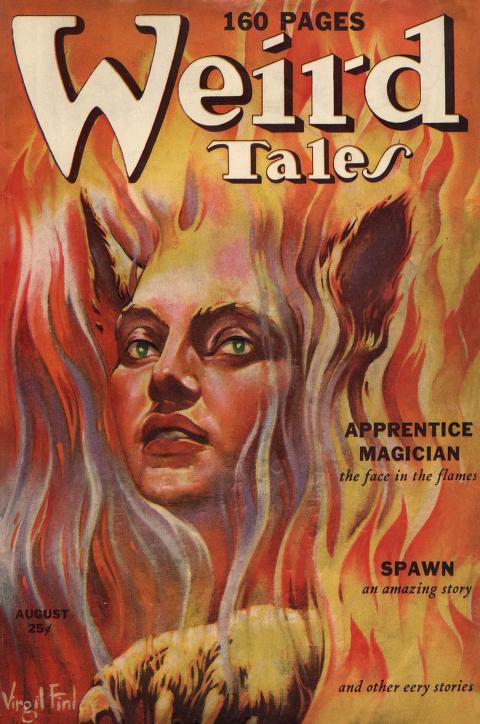
(Cover by Virgil Finlay. Weird Tales, August 1939.)
Who Goes There?
Manly Wade Wellman debuted in 1927, in Weird Tales, and remained a resident there for quite some time, which partly explains how he, who wrote both SF and fantasy, managed to stay relevant after John W. Campbell started reshaping the former genre in his own image. Indeed his reputation as a fantasist only grew over time, and when he eventually settled in North Carolina he would become one of the foremost authors associated with that state. His career is a long-spanning one, and I’m sure we’ll be seeing him again before too long. He won the World Fantasy Award for Lifetime Achievement in 1980. I may have picked “The Valley Was Still” as my first Wellman to review because it was adapted into a classic Twilight Zone episode, retitled “Still Valley.”
Placing Coordinates
First published in the August 1939 issue of Weird Tales, which is on the Archive. Was anthologized in Weird Tales (ed. Peter Haining), The Twilight Zone: The Original Stories (ed. Martin H. Greenberg, Richard Matheson, and Charles G. Waugh), and The American Fantasy Tradition (ed. Brian M. Thomsen). It’s also in the Wellman collection Worse Things Waiting. That last one seems to be in print.
Enhancing Image
I wanna start this review by saying I’ll be discussing the ramifications of the American Civil War a fair bit—maybe even a bit more than the story itself. “The Valley Was Still” is a very fine story, but it’s also a work of neo-Confederate propaganda, albeit one that’s more morally nuanced than the usual. Wellman believed pretty heavily that the Confederacy fought for a just cause, more specifically that the Confederacy fought for “states’ rights.” What rights exactly states should have is something neo-Confederates are always silent about giving. The topic of slavery never comes up in this story, which for anything regarding the Civil War basically renders the given viewpoints incomplete at best. The problem with not mentioning slavery when talking about the Civil War is that the absence of slavery renders the Civil War a conflict seemingly without a root cause. The Civil War, Confederacy sympathizers argue implicitly, is a war that started basically from nothing. Mental gymnastics are obviously at work here.
You may be wondering how I, as a proud Union man, can like this story if I think the implied worldview it’s presenting is wrong on a basic level. The answer is simple: I have the media literacy of at least a 5th grader, as opposed to the 3rd grade where too many people are stuck at. You can like a work of art whilst disagreeing with its worldview. This is really easy to understand, but many people somehow miss the point. Like I said, “The Valley Was Still” is a very fine story, with maybe more texture in its ideas than Wellman had intended; but then art, even art written to fill pages in a pulp magazine, requires at least a fraction of the artist’s subconscious for its making. I have to say Wellman also does something that at least from a modern perspective is hard to pull off, in that he gives us a protagonist who is a Confederate soldier, a “chivalric idealist” as Wellman tells us, and despite his patriotism for a doomed and deeply immoral system he remains worthy of our sympathy. This is a sign of good writing, by the way. Wellman tells us very early on that Joseph Paradine is this idealistic patriot, because it’s important to establish such a thing before Paradine gets confronted with what would be for him (if not for us dirty Yankees) a tough choice.
Paradine and his scout buddy Dauger are looking out over the town of Channow, a Southern town deep in a valley that Union troops are supposed to be encamped in. There’s one problem: from where Paradine is sitting he can’t find any Yankees. Indeed the town is… a little too quiet. Paradine volunteers to go on ahead by himself, in what would under normal circumstances by almost a suicide mission. He would be guaranteed a POW if the Union boys caught him if not for the fact that he could, at least at a glance, pass for a Union soldier, having stolen several items of apparel as “trophies of war.” On the other hand, if the Union troops are not encamped here, then something more sinister may be going on. Paradine ventures into town and it doesn’t take him long to scout out the place: it’s basically deserted. All the townsfolk had gone. More importantly, he finds dozens of Union troops, all of whom have seem to have dropped dead. “But who could have killed them? Not his comrades, who had not known where the enemy was. Plague, then? But the most withering plague takes hours, at least, and these had plainly fallen all in the same instant.” Only it turns out, after some testing, that they’re not dead, but have somehow been made to take to a deathlike sleep. But what could’ve done this?
I wouldn’t call “The Valley Was Still” a horror story, but it does have a quiet eeriness at its center, and this is helped by Wellman’s style, which I would call a few steps above the standard weird pulp prose of the time. Rod Serling, when he adapted it into a teleplay for The Twilight Zone, must’ve been similarly taken by Wellman’s writing, It’s simple, but controlled and quite affecting. By the way, Serling must’ve read it in what had to be a battled old copy of the 1939 issue of Weird Tales, since “The Valley Was Still” had not yet been reprinted anywhere at that time. Indeed it’s very short (only maybe a dozen book pages) and it presents its message with a neat little bow, which is just the kind of thing Serling liked. However, the message, for how concisely it’s presented, may not be so simple. Things get weirder when Paradine finds there is one other waking person in the town—a very old man named Teague, who had apparently put a spell on the Union boys. Teague is a “witch-man,” from a family line of witches, so he says. The townsfolk of Channow treated him as an outcast, only coming to him for favors, and when the Union boys came in they high-tailed it, leaving Teague seemingly alone to fend for himself—only he’s a one-man army.
Like Paradine, Teague is a patriot. He almost confused Paradine for a Union man and nearly put the sleeping spell on him, but is delighted to find a bright-eyed Confederate willing to do anything for the cause. Well, we’ll see how far that “anything” goes. Before I get to spoilers, I wanna say again that we’re clearly supposed to believe Paradine is fighting on the “right” side of the conflict, even if it’s doomed by history. The plot almost could not exist if not for its pro-Confederacy angle—I say “almost” because Serling, a New Yorker and a flaming liberal, saw that there was something rather touching at the core of what could easily be woe-is-me Gone with the Wind-esque soap-boxing. (Gone with the Wind is a very bad, overlong, melodramatic, and deeply racist novel, none of whose qualities overlap with “The Valley Was Still,” other than a general wistfulness about a certain war neither of the authors were even old enough to have witnessed.) We’re told repeatedly that Paradine believes in honor, that he looks up to Robert E. Lee, that he believes in chivalry. Lee fought to preserve slavery, but he was courageous, and he did believe in such a thing as honor on the battlefield.
The question Wellman then poses is: How low are you willing to sink to fight for what you believe is a just cause? Do the ends justify the means? Should the Confederacy win, even through dishonorable means? Is “honorable” defeat something Paradine will have to accept? These are some juicy questions Wellman asks of us in the span of only a few pages, and it’s here that the story reveals itself as a parable. On the surface it’s a parable about an honorable man who’s fighting for a dishonorable cause, and must chose between cheating for the sake of victory and defeat on his own terms. Consciously Wellman thinks Paradine and Lee are perfectly honorable men, but subconsciously he might’ve been more conflicted; he might’ve been unsure, deep down, if the Confederacy really was a cause worth dying for. This uncertainty stops “The Valley Was Still” from becoming jingoistic garbage, but it also elevates this story about witchcraft from pulp to a perfectly respectable fantasy fable.
There Be Spoilers Here
Teague has a spell book. The whole thing, he claims, is filled with the word of God, but when Paradine sees the book for himself he finds God’s name has been crossed out and replaced with what is highly implied to be the devil’s. We’re told that with the power in this book the Confederacy can win the war, with Paradine as the second greatest man in the South—only behind Teague, of course. Paradine assumes when Teague refers to the greatest he means Robert E. Lee, but Teague clearly thinks highly enough of himself that he believes he can rule the South almost single-handedly. Almost. He needs the help of some fresh meat, some young patriot to help carry out his plan—someone like Paradine. All Paradine needs to do is sign his name in the book, with his own blood, to make an allegiance with the devil, and the South can win this war; if he doesn’t sign, then we’re told the devil doesn’t like being scorned. Now, Paradine is well-read enough to figure out quickly what kind of situation he’s in; he may be an idealist but he’s not an idiot. He knows the price one might have to pay for this deal.
Victory through evil—what would it become in the end? Faust’s story told, and so did the legend of Gilles de Retz, and the play about Macbeth. But there was also the tale of the sorcerer’s apprentice, and of what befell him when he tried to reject the force he had thoughtlessly evoked.
Thus “The Valley Was Still” is a Faustian parable, or a deal-with-the-devil type story. The difference between this and some others of its ilk is that rather than make a deal with the devil, Paradine ponders whether he should do such a thing in the first place. Ultimately he decides that whatever wrath the devil might inflict on him and the South, he figures it’s better to lose (if the South is to lose) honorably than to win dishonorably. Not only does he reject Teague’s deal but he cuts the old man’s head off with his saber before he can finish signing his name. He then takes the book and undoes the sleeping spell, replacing the devil’s name in his recitation with God’s, opting to do the right thing even if it means likely getting taken prisoner. Wellman seems to be telling us that even the most patriotic of Confederates would rather risk losing the war than to commit blasphemy in the name of winning it. I think Wellman is being a little charitable here, but you have to admit his take on the war is about as morally upright as one can be while still being pro-Confederate; indeed the story borders on anti-jingoistic. In the context of the story, the South loses because one man chose to do the right thing, even if it meant the devil conspiring against him.
A Step Farther Out
I shouldn’t have to say this, but you don’t need to be a neo-Confederate or even a Southerner to enjoy this one. Wellman, as expected in the pulp tradition, can phone it in at times, but this is definitely not one of those times. This is a story he clearly wanted to tell; it might’ve been rolling around in his head for years prior to the writing for all we know. It has the controlled style and tight structure, combined with a thematic density, that implies it was a passion project, and I’d be surprised if it was just another bit of hackwork. You could teach this in a course on the art of the short story and people would probably not make a big fuss over it. Certainly it’s a good place to start with if you’re getting into Wellman.
Michael F. Flynn was arguably one of the last major discoveries to first appear in Analog Science Fiction, debuting relatively late (he was already in his thirties) in 1984 and quickly becoming a resident of that magazine. He was a generation younger than the likes of Larry Niven and Jerry Pournelle, but his politics and hard-nosed approach to SF aligned with theirs enough that they would collaborate on occasion, and indeed my first run-in with Flynn was the novel Fallen Angels, co-written with Niven and Pournelle. (This novel is rather infamous among older SF readers, and yeah, it’s not good, but I found it too silly to be offended by it. It’s at least marginally more enjoyable than Fritz Leiber’s The Wanderer, but then so are most novels.) I didn’t read my first solo Flynn until last year, incidentally not long before his death, but I figured quickly he was someone to keep an eye on.
Unfortunately Flynn died in September 2023. I actually work in the same town he lived in, but we never crossed paths—probably not even close. He was, from what I’ve heard, a very affable man despite his conservatism, and surely the field will not look quite the same henceforward. I wanted to review something of his, sort of in memoriam, and ultimately I went with what seems like an uncharacteristic story of his. “House of Dreams” is a rare case of Flynn appearing outside of Analog, and it even won a major award, the Theodore Sturgeon Memorial Award. This is one of the few Sturgeon winners to not get a Hugo or Nebula nomination (only a Locus poll spot), and—well, there might be a reason for that.
Placing Coordinates
First published in the October-November 1997 issue of Asimov’s Science Fiction, which is on the Archive. Unfortunately this is the only way you can read “House of Dreams”; it has never been reprinted in English. If you wanna read it then you’ll just have to read that PDF of the issue, or find yourself a used copy if you’re the collecting type.
Enhancing Image
We know this is a story about parallel worlds because the narrator tells us right away, about “worldlines abutting” and “the walls of the universes.” The action is framed as a sort of cautionary tale, told by an elder to some villagers around a bonfire—or so that’s how I see it. We’re immediately met with the most contentious part of “House of Dreams” (or rather one of two very contentious points), which is the manner in which Flynn decided to tell his story. This is not just a first-person narrator; it’s a first-person narrator with an attitude. The narrator both is and is not a character, being outside the action of the story but still conveying his own personality to the reader. Like I said, it’s framed as if we the reader are a listener at a bonfire, and the narrator is a flesh-and-blood storyteller. I’m not very fond of this, although it could be more the particular voice Flynn decided to use: a kind of jokey but not necessarily funny tone that can strike one as condescending. It does, I suppose fittingly, sound like emulation of one of Sturgeon’s own attempts at narrative voice, but unfortunately it’s an emulation of one of Sturgeon’s unsuccessful attempts.
The actual protagonist is Ted, an academic type with a wife and son who’s in the process of buying a house. The purchase has not been finalized and so the family hasn’t moved in yet, but that doesn’t stop Ted from loafing about in the place for days on end, by himself, with tragic consequences. The house has not been cleared out yet, which allows Ted to go poking around, and at one point he discovers a bulky and weird-looking flashlight—a device that doesn’t illuminate areas in the conventional sense but, as it turns out, does shed light on parts of the house otherwise unseen. This all sounds somewhat detached, for one because of the narrator’s voice and also the fact that there’s basically no dialogue. It’s almost a one-man show. Ted doesn’t interact with other characters in conventional sense, although we do get a line into his thoughts and there is one other character of note. As for the flashlight, we never learn where it came from or who built it, but we do find out quickly that it can show a different plane of existence in the house that works in parallel with what the naked eye can see.
Ted, using the flashlight, discovers a stranger in the house—a woman who can’t see him, although he can see her. The meeting is ass-first. “He didn’t see her face, not then. The view was strictly from the rear.” The narrator is quick to remind us that Ted is a faithfully married man, but that doesn’t stop him from experiencing love at first sight, or at least lust at first sight. I’m not exaggerating when I say Ted’s boner for the ghost woman (the narrator settles on calling her “Betsy,” so let’s go with that) will determine the course of the rest of the story. The male gaze is so strong here and so deliberately put in that it arguably becomes the point of the story, rather than something that distracts from it. There are obvious criticisms one can make. Being unable to talk to Betsy or even get her to acknowledge his existence, Ted has to settle for watching, although sometimes he does a little more than that. One night, in his bedroom, Ted turns on the flashlight and sees Betsy naked next to him, crying—maybe from sadness or an intense happiness. The narrator tells us, in so many words, that Ted jerks off to this image of Betsy, and you have to admit this is not something you read about every day. It’s discomforting, probably more than Flynn intended, and I’m not sure how much of it is supposed to serve a function other than pornographic. Robert Silverberg in the ’70s would’ve done something like this.
We learn a few things along the way, although naturally we don’t learn every detail since the world on the other side of the flashlight is blocked off to Ted other than what it allows him to see. We know Betsy lives in an alternate world where humanity has apparently been brought to the brink of annihilation, being at war with a race of vicious ape-like creatures called “leapers,” which we’ll come back to later. We know Betsy herself is a warrior, armed with a bolt-action rifle and some knives for close encounters, probably living every day as if it might be her last. We can infer Ted is drawn to Betsy by her immense physical prowess, her courage, and her rough beauty, but we can also infer Ted becomes obsessed because there’s something missing in his everyday life. We get to know very little about his marriage (his wife does not appear at all until the end), but despite the narrator’s insistence that Ted leads a faithful life he would not be so fiercely attracted to someone else unless he was discontented. The narrator tells us Ted probably decided to give the woman a name, if not Betsy, and why else would he do this other than as a projection of distorted love? “Names make us human.” Of course it’s a doomed attraction, because while he can see that other world with the flashlight, he can’t interact with it.
“House of Dreams” is about the inherent tragedy of wanting something you can’t have. I wish it went about that theme in a different way. While we can read some of Ted’s thoughts, he remains a distant character because this is all filtered through the jokey, cloying narrator who proves to be an obstacle one has to get over to enjoy the actual story at hand. I could buy into Ted’s sort of perverted attraction to Betsy if we were firmly planted in his shoes. Many would be put off by the perversion regardless, but I would argue it’d at least be easier to understand if Flynn had decided to tell this story in a more personal way. Flynn is trying to examine a basic human truth here, but decides to keep us one degree separated from the heart of the matter for some reason I can’t ascertain, and ultimately such a choice undermines what should be more emotionally resonant.
There Be Spoilers Here
The leapers, somehow, are able to sense Ted’s magic flashlight, which proves to be a problem; it’s never explained how they, but not the humans in the parallel world, are able to sense Ted’s presence, but I’ll deal with it. More unfortunately for Ted in the short term, he is forced (or rather forces himself) to witnesses Betsy’s last stand against the leapers. She gives them a pretty good fight, which gives this final scene between the two a bittersweetness, even if they’re never able to exchange even a word. Betsy seems like an interesting character; would be cool if we got a parallel story from her perspective. After Betsy’s death, Ted gives up the flashlight for good, which ultimately doesn’t do him any good, as it’s heavily implied the leapers have found a way to tear into “our” world, not only killing Ted but eating him partly. The house becomes abandoned. The narrator implies the leapers will do to our world what they did to Betsy’s. This is a thorough downer of an ending, which makes me wish I cared more.
A Step Farther Out
Was not a fan. Granted, I had no clue what I was expecting. I’m not sure what the people who voted for that year’s Sturgeon Award were thinking either, other than that it reads like Flynn trying to sound like Sturgeon. The problem is these are two writers with very different worldviews with different writing philosophies. Sturgeon, aside from being a more graceful prose stylist (even when he was trying too hard), was as open-hearted a romantic as one could get, and I’m not sure the same can be said for Flynn. “House of Dreams” has little in the way of hard science and instead focuses on a parasocial relationship, which is probably why it didn’t appear in Analog. Maybe this was not the best way to pay tribute to an author who died somewhat recently and who had done better work.
(Cover artist not credited. New Worlds, June 1965.)
Who Goes There?
I’ve occasionally covered authors who had meteoric rises such that they garnered reputations only a couple years after entering the field, but Vernor Vinge falls on the opposite end of the spectrum. Vinge debuted in 1965 with the story I’m talking about today, but he would not start to make an impression on the field until his cyberpunk novella “True Names” in 1981, and would not surpass that until A Fire Upon the Deep in 1992. This is all a little pointless to say now, since Vinge (sadly now retired from writing fiction) has long since made his case for being one of the important SF writers in living memory. His Zones of Thought series has one of the most unique and captivating space opera premises. “True Names” was an eerily prescient glimpse at what virtual reality and cybersecurity might entail. He has won five Hugos and is one of the few people to earn the Special Prometheus Award for Lifetime Achievement. I like him.
“Apartness” was Vinge’s first published story; he would’ve been all of 19 when he wrote it. Now, tempting as it is to pick on a literal teenager, I wanna be clear that for all its flaws, this is a pretty ambitious story. Here we have a post-apocalypse story that tackles, rather directly, the ramifications of real-world colonialism. It’s a rare genre SF story from the era that tackles race relations without resorting to metaphor. This is a lot to chew on for a 19-year-old, and it hints at an ambition Vinge would take advantage of much later. I recommend it, despite its roughness.
Placing Coordinates
First published in the June 1965 issue of New Worlds, which is on the Archive. It was then reprinted in World’s Best Science Fiction: 1966 (ed. Terry Carr and Donald Wollheim) and Under African Skies (ed. Gardner Dozois and Mike Resnick). Then of course there’s The Collected Stories of Vernor Vinge, which is supposed to be a complete volume of Vinge’s short fiction but which does not include a few stories that were published afterward. Somebody should update that maybe.
Enhancing Image
Context matters, so I’m frontloading the review with some of that if you don’t mind. Some three centuries into the future, half the world has gone to shit. The “North World War” was a series of calamities that left the entire northern hemisphere devoid of human life, with only South America, South Africa, and Australia and I guess New Zealand too escaping the carnage; and even then, the survivors were by no means unscathed. South America has since been “unified” by a family line of dictators, resulting in one massive police state. We follow Diego Ribera y Rodrigues, an anthropologist on a seafaring expedition near Antarctica, who has to deal with a cynical captain and a group of government-appointed astrologers, who basically take the place of scientists. What these astrologers could be doing or accomplishing is unclear, but it is clear that Ribera’s only allowed to be here because he has good connections, otherwise “el Presidente Imperial” would be happy with just superstitious busybodies.
Vinge gives us a whole lot of backstory upfront for a short novelette, and right away you might guess how this future world might be unusual for genre SF in 1965. The main characters are, at the very least, not white Americans or Europeans; actually you’d be hard-pressed to find another SF story from the era that has a cast of Hispanics. There’s an African character and another part of the backstory Vinge does not reveal until much later, but we’ll get to that. This is also a rare case in SF of a first contact narrative between two groups of humans; because, you see, the people on the ship find that there are also people in Antarctica. Which is weird. Nobody was supposed to be living here. Now if you know your history then you know first contact between an indigenous people and a more “advanced” group of settlers has always ended badly, and the following encounter runs a similar course. Naturally the people living in the Antarctic are not natice to that land, but it becomes clear they have become accustomed to the harshness of the land and have not been in contact with other human civilizations for a very long time. Delgado, the ship captain, is unimpressed.
Vinge, even as a teenager, understood that for our talk of wanting to see exotic alien worlds, there are places on Earth that are already strange enough, just from their geography and weather. Ribera and his fellow South Americans, accustomed to warmer climate, are taken aback by the stark coldness of the Antarctic landscape—the sheer desolation of it. “The only things that seemed even faintly normal were the brilliant blue sky, and the sun which cast long shadows into the drowned valley; a sun that seemed always at the point of setting even though it had barely risen.” There’s not so much a subgenre as a subspecies of SFF, the lost world tory, that was pretty popular in the late 19th and early 20th century, and which was about civilized (read: white) man venturing into some unmapped corner of the globe and finding lost civilizations, ancient creatures, and so on. Of course, as the surface of the globe became more or less entirely charted, the lost world story faded into antiquity—except for when there’s a twist. “Apartness” is a lost world story with a couple twists: firstly, the explorers are not white, and secondly, the “lost world” is a place that had once been known but, as a result of a quasi-apocalypse, had been forgotten.
As for the people in the Antarctic, they’re not dissimilar from what you’d find in an old lost world story, with a race of ape-people who are semi-civilized but who might also want the explorers for lunch. There’s a big language barrier issue; whatever language the ice people speak it has been isolated from the rest of humanity for a couple centuries. Ribera discovers that the ice people are the survivors of what must’ve been a shipwreck, although what exactly happened will not be revealed until after we have left the Antarctic. There’s certain information Vinge, rather coyly, refrains from giving us, which made me scratch my head whilst reading the story a bit. The structure of the thing is a bit odd. There’s some useful context that’s denied us until after the central action of the narrative. If it seems like I’m trying a little too hard to not jump ahead it’s because the conflict, or rather the question, of the story is a bit foggy without that last piece of the puzzle. And it is a mystery, with who these people are and what civilization they could’ve descended from. “Ribera’s mind returned to the puzzle: where were these people from? How had they gotten here?” You could flesh out this scenario into at least a novella, which Vinge probably should’ve.
There Be Spoilers Here
Things go badly between the groups and Ribera takes a harpoon to the abdomen, which honestly he should not have survived (especially because, by his own admission, there wasn’t much medical help on hand), but a little too miraculously he survives. I know why Vinge did this: because Ribera is our POV character and if he dies then the final scene becomes a dialogue between two characters we knew nothing about previously. I guess that would be worse since it would slightly undermine what ends up being a pretty powerful closer; indeed it’s only here at the end that it becomes clear what point Vinge is trying to make. Hitherto there have been little inklings of what “Apartness” is about, but only with the introduction of Lunama and his subsequent infodump do all the pieces fit. Lunama is a government guy, part of the propaganda wing—and a black African, a proud “Zulunder.” It turns out that, among the other atrocities committed during the North World War, an actual race war erupted in South Africa, with black Africans taking to exterminating the white settlers in the region. On the one hand, that’s a spicy meatball; on the other hand, Vinge at least tries to not play into the (presumably) white reader’s fear of a “white genocide.” If anything there’s the implication that whitey might’ve had it coming, as brutal as that sounds. You don’t read about anti-colonial extremism often in old-timey SF often, especially from a non-reactionary viewpoint.
Ya know, it’s an awkward word, like you would never hear someone use it in a conversation, but “apartness” sure does sound similar to “apartheid.” Vinge is playing an association game with us.
But, as Ribera points out, you can’t entirely wipe out a people with as much power and influence as the white South Africans had. Colonialism always leaves its mark. “The Afrikaners had left a lasting mark, obvious to any unbiased observer; the very name Zulunder, which the present Africans cherished fanatically, was in part a corruption of English.” We also learn that the people in Antarctica are the decendants of white South Africans who, desperate to escape the carnage, escaped on two luxury cruisers, housing a total of some 5,000 people. Ribera, now understanding the why of the situation but also understanding this is a couple hundred years post-race war and genocide, speaks up to convince Lunama that the Antarctic barbarians need not be exterminated, but Lunama makes it clear they’re perfectly happy to leave those people basically alone—cut off from the rest of humanity. The “civilized” man, left without a colonized land and people to exploit, has descended into barbarism. (Incidentally, or maybe not, Ribera calls these runaway white South Africans “aborigines” at one point, which is funnily ironic.) Certainly from a modern perspective this is a spicy meatball, and I’ll be honest, I did not expect someone like Vernor Vinge to make such a point: that the “Afrikaners,” in thinking themselves innately superior to the people they’re exploiting, have deservedly been left to rot in their own “apartness”—their separation from mankind. It doesn’t help, of course, that the richest person in the world (depending on the time of day) is a fascistic and socially inept white South African.
A Step Farther Out
Obviously I wouldn’t recommend “Apartness” as one’s first Vinge, although if you know your SF then you’ve probably read at least some Vinge already. It’s an outlier in his oeuvre, but while it would not cover the same territory as more mature Vinge and indeed has a touch of the amateur, it’s a good time provided you’re a fan who’s curious about a great writer’s early days and/or your interest is piqued by the somewhat unique and thorny material Vinge is playing with. Most authors’ first stories are creaky and unassuming, and while “Apartness” certainly is creaky it is not unassuming; rather it’s an ambitious start for someone—I need remind you—who was a literal teenager at the time. I’m able to give works of literature the proper context when understanding them, so I enjoyed it.
A famous and well-worn “takedown” of criticism, usually said by artists who are deeply insecure about their craft, is that critics aren’t artists, or if they’re artists then they don’t have the talent to match the art they’re criticizing. “If you can’t do something yourself then why criticize it?” sounds reasonable until you realize nobody would be able to criticize a bad piece of woodwork unless they’ve worked in carpentry, or nobody would be able to criticize the comfortability of a pair of shoes unless they’re a shoemaker. I’m getting a bit sidetracked. Thing is, Algis Budrys is a notable response to this non-criticism because he is one of the few people in the history of genre SF to ssucceed as a writer, critic, and editor. He started off as a very promising short story writer (debuting the same year as Philip K. Dick and Robert Sheckley, the early ’50s were insane), before showing as much success with novels, and then mostly moving away from fiction in the ’60s in favor of criticism. Budry’s writing didn’t always live up to his own standards, but one can’t doubt he helped raise literary standards in genre SF.
Placing Coordinates
First published in the December 1961 issue of Galaxy Science Fiction, which is on the Archive. It’s been reprinted a decent number of times. Where to start? The Tenth Galaxy Reader (ed. Frederik Pohl), Alpha Two (ed. Robert Silverberg), Galaxy: Thirty Years of Innovative Science Fiction (ed. Martin H. Greenberg, Joseph D. Olander, and Frederik Pohl), and The Arbor House Treasury of Modern Science Fiction (ed. Martin H. Greenberg and Robert Silverberg). There’s also the Budrys collection Blood and Burning. This is all well and good, but “Wall of Crystal, Eye of Night” has apparently fallen out of copyright; you can read it on Project Gutenberg.
Enhancing Image
Rufus Sollenar is the current head of the Sollenar Corporation and the new owner of EmpaVid, a machine that’s set to push TV to the next level. However, as Ermine, an advisor from the International Association of Broadcasters, informs Our Anti-Hero™, there’s trouble on the horizon. Sollenar’s long-time competitor, Cortwright Burr, has been in talks with the Martians about a machine that might outcompete EmpaVid if put on the market but whose properties Ermine is super-vague about; in fairness to the man he doesn’t really know what Burr is up to. The point is that if Burr’s machine is what Ermine thinks it is then the IAB (who are basically a board of investors) will ditch Sollenar in favor of Burr. Sollenar, being a totally reasonable businessman, decides to take matters into his own hands, i.e., to kill Burr and steal the mystery machine for himself; this will turn out to have tragic and very strange consequences.
If it seems like I’m frontloading this review with more synopsis straight from the tap than usual, it’s because Budrys frontloads his story with exposition—only it’s not as straightforward as that. There’s some context that would be helpful that Budrys, for some reason, refrains from telling us. In the first few pages we’re told that this is set at some point in the future, sometime after 1998, and that the Martians, “a dying race” (when are they not), are trading with human civilization like it’s no big thing. This raises some questions that go unanswered, and while this may be so because these questions are not strictly plot-relevant, the answers would add some background flavor the story is otherwise lacking. We know basically nothing about Sollenar aside from his having inherited a powerful company and that he seems used to always getting his way; again, this is all the plot needs to work, but it is unfortunately lacking in character. We arguably learn more about Ermine, who is deliberately made out to be sort of an enigma, than Our Anti-Hero™, and I don’t think Budrys intended this.
I don’t usually say this with regards to length, but “Wall of Crystal, Eye of Night” could stand to be a couple thousand words longer. ISFDB says it’s a novelette, and while I haven’t run the Gutenberg text through a word processor I’d wager it just barely reaches the 7,500-word mark. Even taking the exposition into account the pacing on this thing is lightning-quick, and not strictly to its benefit. I’m pretty sure Budrys would get on my case for saying this, but this story reads like a pastiche of Dick’s early work: the pacing, the sense of irony, and most importantly the playing with the line between reality and illusion. Once Sollenar fails to kill Burr (so he thinks) the story descends into borderline horror of the surreal kind, which would almost feel more at home in the pages of Weird Tales than Galaxy—if only Weird Tales were still around in 1960. The science-fictional element could easily be replaced with fantasy anyway, and might even work better in that context. Sure, Budrys wrote a story about the future of TV, but that’s an obstacle that can be easily overcome; and anyway who says a fantasy setting can’t have a bit of electricity. The machine the Martians gave Burr, which is now in Sollenar’s possession, may as well be magic. Unfortunately the only American fantasy outlet when Budrys had at that time was Fantastic, which did not pay so well.
This is not to say it’s a bad story. It reads very well, Budrys has a fluency with English that would not give the impression it’s his second language, the pacing (like I said) is fast as a whip, and there is a weird strangeness that one doesn’t normally see in SF of this vintage. Burr is not really a character so much as a ghost that haunts Sollenar, mute, silently judging, looking “like a corpse. Or worse.” Worse yet, after trying to kill Burr, Sollenar is now on the IAB’s shit list; not only might he lose his business but he might also lose his skin. Ermine plays the role of the strictly rational bystander here—so blocked off from emotion that he had all his nerve endings severed so that he literally can’t feel anything. We thus are dealing with a literal zombie and a man who, while not dead, has all the feeling of a corpse. The enjoyment in reading this story comes from watching a not very good person enter a downward spiral as a result of his actions. We’re told, even from the introductory blurb, that Sollenar is likely to meet a bad end; how he meets that end is the real question. It’s a twisty and rather morbid tale that would arguably have benefited from Budrys giving it more time in the oven.
There Be Spoilers Here
Turns out Burr really did die, but—probably because he knew Sollenar had it out for his—decided to give his competitor one last fuck-you in the form of the machine the Martians had given him. The machine, we learn much later, creates what amounts to a waking dream for the auditor, which can be used on the person with the machine or on someone else. The results of such a machine would be unspeakably disastrous, considering the user can basically induce hallucinations in other people, and I’m not sure why the Martians built such a machine in the first place, let alone are willing to sell it to humans. Burr has in fact been dead for most of the story, but he induced a continuing hallucination in Sollenar such that he torments him from beyond the grave. This indirectly leads to Sollenar’s death at the hands of Ermine, but in what I suppose is a moment of grace he uses the machine to give Ermine the illusion of his senses having returned. Sollenar knows the IAB will have him assassinated no matter what at this point, so why not give his assassin a farewell gift.
That has to count for something.
A Step Farther Out
It could be that for personal reasons I’ve been experiencing some gnarly sleep depravation (we’re talking two or three hours of sleep a day) for the past few days, but I was struggling to come up with things to say about this one. My brain was and still is a-fog. In a way this is appropriate since “Wall of Crystal, Eye of Night” is a surreal narrative, but unfortunately it does not lead to clear-minded literary analysis. There is, of course, the chance that there isn’t much to say about this story because there simply—well—isn’t much to say about it. This is strange, because it’s not hackwork and Budrys’s good stuff lends itself to discussion, if only to criticize it; but then Budrys’s work tends to be more lucid than this story. It could be in attempting to write a nightmare masquerading as an SF narrative, taking after Philip K. Dick whether he intentionally did so or not, Budrys wrote something that can be experienced fine but not so easily rationalized. I’ve mentioned this before, but had Weird Tales still been around in the early ’60s Budrys could’ve reworked the story into a fantasy; it would not have taken much effort and might’ve actually improved the thing.
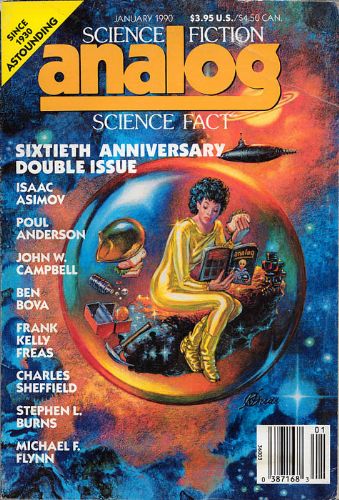
(Cover by Frank Kelly Freas. Analog, January 1990.)
Who Goes There?
Nancy Kress debuted in the ’70s, and became a big deal in the ’80s mostly on the back of some very good short fiction. Her 1991 novella “Beggars in Spain” (then expanded into a novel) is one of the most decorated of its kind in SF history. Her 1985 aliens-on-Earth vignette “Out of All Them Bright Stars” won a Nebula. She, along with Connie Willis, has been one of the most frequent and popular contributors to Asimov’s Science Fiction, and incidentally both women are very fond of writing at novella length. So today we’re looking at a Kress story that’s neither a novella nor published in Asimov’s. “Inertia” might be the best Kress story I’ve read so far; it’s certainly the complete package, containing thought-out speculation and human drama that struck a chord with me. That this story only got away with a Locus poll spot feels more than a little criminal.
Placing Coordinates
First published in the January 1990 issue of Analog Science Fiction, which you cannot find anywhere at the moment. I’m sure it’ll be added to Luminist at some point, but thankfully I had bought a used copy of this issue some months ago. Gardner Dozois tended to overlook Analog stories, but he recognized this one’s quality enough to include in The Year’s Best Science Fiction: Eighth Annual Collection. “Inertia” was also reprinted in A Woman’s Liberation: A Choice of Futures by and About Women (ed. Sheila Williams and Connie Willis) and Wastelands: Stories of the Apocalypse (ed. John Joseph Adams). This last one, I’d argue, is a little misleading.
Enhancing Image
A note to put upfront is that “Inertia” discusses the lives of people with disabilities, with mental illness, and more subliminally works as a reaction to what was then the worst years of the AIDS epidemic. This is not light reading; indeed its dark hues stand out in a magazine that’s more known for rigorous but not emotionally intense fiction.
It’s the future (not too distant a future), and the US has mostly gone to shit. Riots have become a frequent occurrence and the country has basically devolved into a police state; but that’s only the case for “Outside.” There are sealed-off internment camps across the country containing those infected with a disease that at first glance sounds like Leprosy; it’s a skin disease in which the infected is scarred with ropy patches of skin, but without getting ahead of myself there’s more to it than that. The disease is communicable and so the infected are walled off in “blocks,” basically left to die since the government is no longer looking for a cure. It’s here that we’re introduced to the elderly narrator, her daughter Mamie, her teen granddaughter Rachel, and her in-law Jennie. “Jennie, the daughter of Mamie’s dead husband’s brother, is Rachel’s cousin, and technically Mamie is her guardian.” We start with two announcements in this little family unit: that Mamie is getting engaged to some guy named Peter, and that Jennie is bringing in someone from Outside—a doctor named Tom McHabe. The latter will turn out to have a profound effect on these characters.
“Inertia” both is and is not a dense read. The plot, if one were to recite to someone, is not complicated. It starts out as a slice-of-life narrative in what is admittedly a dreary setting before someone from Outside comes in and changes everything, and the story picks up inertia. There is, however, a lot of scarily plausible speculation, and these characters are never anything less than human. AIDS had been public knowledge for no quite five years when Kress wrote this story: the Reagan administration had deliberately ignored HIV/AIDS until it became literally impossible to do so, the result being that people were dying of a virus nobody knew anything about, and once it was made public there was a tidal wave of misinformation that would have long-term ramifications. Nowadays conservatives wanna downplay this, but the reality is that the Reagan administration had condemned a swath of the American population to death for the non-crime of homosexuality, and there were many politicians and pundits who came up with some truly monstrous ideas as to what ought to be done with AIDS victims. Putting thousands of people in internment camps is not even the worst thing that could’ve happened. In case you doubt me about the connection, we get a reference to AIDS in-story, although not by name, it being called “that other earlier one” that was sexually transmitted. Of course we know you could contract AIDS via blood transfusion, but in the ’80s it was typically known as something that happened between queer men.
Life in the camps is far from ideal, but it’s surprisingly functional. There are no riots. There’s no huge wealth disparity. There’s no war, naturally. People are able to provide for each other, even if they have to work every day for it. This is not an anarcho-communist paradise, mind you, because these people live in poverty and with an infection that might prove fatal, but as McHabe soon makes it clear, life Outside is often worse. You may recall that “Inertia” was reprinted in an anthology focused on stories about the apocalypse, and honestly I don’t think it qualifies. At the most you could say society in the story is on the brink of total collapse, but that the apocalypse has not happened—at least not yet. Journalists and pundits speculated that the camps would soon descend into total mayhem, but to their disappointment this has not happened. Obviously something is different about the people living in the camps, something that compels them to cooperate rather than start fighting in the streets (Kress does not seem to think people are inherently good), which is why McHabe is here. The government stopped finding a cure years ago, after several people in the camps were tested on and killed as a result (Mamie’s husband had died “of an experimental cure being tested by government doctors”), but that doesn’t stop people from coming in to conduct their own research illegally.
About the characters. I don’t think we ever get the narrator’s first name, but she’s as vividly drawn a protagonist as any you’ll find in the best short fiction, with bonus points for being an SF protagonist who’s both a woman and probably in her sixties. Rachel and Jennie, despite their age, are not the rebellious sort, and this pleasing demeanor will have plot importance. The big outlier among the women in the story is Mamie, who unlike her mother and daughter is far from content. For one, she finds out almost as soon as they’re engaged that Peter is cheating on her, although this doesn’t stop her from soon making up with him—probably more from her fear of being abandoned than anything Peter did to make it up to her. Given her outbursts and her fear of abandonment it’s quite possible Mamie has what we’d now call Borderline Personality Disorder. It’s unclear if she was always like this, whether it was being forced Inside, the death of her husband, or something that has always afflicted her; but then if a revelation later in the story is anything to go by it’s implied that Mamie always lived with mental illness, only that something exasperated her condition. Then there’s McHabe, who in a typical Analog story would be the protagonist, but here he’s a supporting character whose aims are noble but tragic.
Something odd I noticed is that Kress wrote this story in first-person present tense, which is uncommon and honestly hard to justify; you need a rather specific reason to write with this combination, otherwise it reads awkwardly and raises unnecessary questions. I suspect it’s because, given the context, it raises the emotional intensity of the narrative, but it also reinforces the notion that what Kress is talking about is happening in the now—that her future story is firmly rooted in what were then current events. The inhumane treatment of AIDS victims was a part of the background the story was written against, and this would be the case for many more years. It still holds true because homosexuality is still demonized in many pockets of the country, and those who suffer chronic illness are often denied proper accommodations. It’s funny because there is no homosexual activity in the story itself (the characters are drearily straight), but it’s something those who didn’t live under a rock would’ve picked up. Don’t get the wrong idea, though, “Inertia” has aged depressingly little; it actually holds up better than some of the award-winners from this period.
There Be Spoilers Here
The reason McHabe went Inside is to tudy the neurology of those with the infection, because it turns out this infects the brain as well as the skin. The people in the camps have not descended into anarchy because (assuming McHabe is correct) they’re constantly depressed—not clinically depressed, as he puts it, but mildly enough that they’re not quick to take action on anything. The infected are able to maintain a society with minimal resources because the infection messed with their brain chemicals such that by and large they’ve become docile. Curiously, this applies to neurotypical people, and the longer someone has had the infection the more chill they are; but again, this is assuming they would’ve been “balanced” before. Mamie probably had mental illness prior to getting infected, which seems to have thrown her more off-balance, and the consequences of this will prove to be disastrous for our characters. McHabe’s idea is to cure people of the skin disease part of the infection, but to leave the brain alteration as is, such that these people can hopefully rejoin “normal” society and “infect” as many people as possible. He thinks the infection, if rid of its harmful aspect, can be useful. The narrator is doubtful about this.
Mamie, in one of her manic episodes, betrays McHabe to the authorities, resulting in his execution. It speaks to the savagery of government authority at this point that McHabe is killed pretty much on the spot. It’s traumatic, but it’s also the push that compels Rachel and the narrator to escape to Outside, or die trying. There’s a passage at the end that really struck me, as someone who very likely has BPD myself, and it might speak truer than even Kress had intended—to those with mental illness, but also those who feel trapped by their conscience, by the tug-of-war between their thoughts and what they feel they ought to do. “[Rachel] is sixteen years old, and she believes—even growing up Inside, she believes this—that she must do something. Even if it is the wrong thing. To do the wrong thing, she has decided, is better than to do nothing.” It’s a spin on Le Guin’s “The Ones Who Walk Away from Omelas,” and in my opinion it’s at least as emotionally compelling, at least as thought-provoking, in no small part because unlike Le Guin’s story Kress’s has plot and characters. There’s a concreteness that pushes it out of the realm of pure allegory, and emerges arguably stronger for it. This is a deeply bittersweet ending.
A Step Farther Out
Theodore Sturgeon argued that a great SF story should ideally have both compelling human drama and a thoughtful speculative element. The reality is that a lot of good and even great SF stories only have one or the other, and Sturgeon’s own “A Saucer of Loneliness” is an iconic story despite its SFnal element being tangential. “Inertia” meets this ideal, though; it’s a deeply felt and rather angry story that was written in response to one of the American government’s biggest failures in living memory. While you can make an educated guess as to when this story was written, though, it remains relevant and gut-punching because the American government does not value the lives of its own people, especially people who live marginalized lifestyles and those who live with disabilities. This will continue to be true so long as the government only puts stock in people of a certain income, skin complexion, and balance of brain chemicals. Kress repeatedly shows herself to be a friend of the downtrodden, and “Inertia” is one of her most effective and overt studies of the people we leave behind.
H. Beam Piper is one of the most intriguing and certainly one of the most tragic figures in old-timey SF. He made his debut with “Time and Time Again,” a pretty solid first story, in 1947, and kept writing off and on for the next decade. In the last five years of his life Piper went through a kind of metamorphosis, such that while he did write a couple novels before 1960, the years 1961 to 1965 saw at least one novel per year, with Little Fuzzy nabbing him a Hugo nomination. Unfortunately Piper did not have much time to enjoy this artistic success, as he committed suicide in 1964, and because he got his start very late in life his career was short-lived despite not exactly dying young. The SF Encyclopedia is mostly written in a matter-of-fact way, as befits an encyclopedia, but John Clute’s final words on Piper’s entry are bone-chilling: “He died in his prime.”
Piper’s work has this tendency to stand out in ways other SF of the period did not, even when he was playing with premises that were by no means novel. I’ve read quite a bit of ’50s SF at this point and Piper is the only writer I’ve met from that period who consistently posited that not only would a hypothetical space-faring humanity be multiracial, but that mixed-race people would be rather common in such a future; as a ressult of this his characters are often at least implied to be non-white. Women also do pretty well in Piper’s stories, despite his habit of calling them “girls,” as they’re shown to be as intelligent and capable as their male counterparts. “Genesis” is a take on something that even in 1951 must’ve been familiar to readers: the Adam-and-Eve plot. It’s the little things peppered throughout this story, though, that make it worth reading.
Placing Coordinates
First published in the September 1951 issue of Future Science Fiction, which is on the Archive. The only time “Genesis” was reprinted in Piper’s lifetime was in the anthology Shadow of Tomorrow (ed. Frederik Pohl). It was later collected in The Worlds of H. Beam Piper, which was part of a concerted effort from Ace in the early ’80s to put Piper’s work back into print. I recommend not looking up all the places this has been reprinted, since a couple of them have titles that give away plot twists. The good news, if you’re looking to read this for free and without guilt, is that most of Piper’s work has fallen into public domain, including this story. You can read it on Project Gutenberg, naturally.
Enhancing Image
A generation ship has headed out from the dying planet Doorsha, for a habitable planet called Tareesh for some 1,500 people may live. It’s the only ship of its kind, “fifty years’ effort” and without the resources neeed to make a second such ship. It would be a terrible shame, then, if a security failure were to result in the ship’s destruction. As if on cue, a meteor hits the ship and things fall apart fast enough that (as far as we know) only one escape pod makesss it out, with a one-way ticket to Tareesh. The pod contains two men and six women; Kalvar Dard and Seldar Glav, the men, are trained professionals, and unusually for a ’50s SF story so are the women for the most part. Olva is an “electromagnetician,” Varnis is a “machinist’s helper,” Kyna is a “surgeon’s-aide,” Dorita is an accountant, and Eldra is an “armament technician.” We’re not told what Analea’s—the last woman’s—job is, but I’m just listing these off to give you the idea that despite these grown women being called girls, they are still quite capable.
The first stretch of “Genesis,” which thankfully is not long, is also easily the weakest part. With pretty much any SF story there’s the question of plausibility, and I don’t think the way by which Piper puts his characters on Tareesh is all that plausible. For one I struggle to believe there would be only one generation ship without any backup, given a) the race’s survival depends on it not getting blown to bits, and b) the likelihood of an accident such as the one aforementioned occurring in space. I also would’ve thought there would be more survivors from the accident, maybe a few more lifeboats that made it to Tareesh; but I don’t think I’m spoiling things by saying that, at least far as our characters know, they’re the only survivors. Also, with what we have learned about space travel since 1951, it goes without saying that not only would a perfectly habitable planet like Tareesh be exceedingly unlikely, especially since it’s said to not be too far away from Doorsha, but that Our Heroes™ would at the very least be hindered by the change in gravity and air content; but then this is the sort of thing you have to accept with all but the hardest SF from that era.
I’m getting this negative criticism out of the way first, for one because this story’s problems are frontloaded, but also because otherwise I found the story to be a pretty good time once we land on Tareesh. The idea is simple enough: we have eight people, presumably the last of their rest (the rest stranded on a dying planet), who must not only survive in this harsh new environment but work to rebuild civilization. They have a few guns with ammo and some explosives, but these are very finite resources and at some point they will have to forge their own primitive weapons. The good news is that Tareesh is teeming with life that can be hunted for food and clothing; the bad news is that Our Heroes™ have some competition. A race of humanoids who may or may not be native to this planet, called the Hairy People, are aggressive and tribal, yet are intelligent enough to use tools and have their own language, “too bestial to bury as befitted human dead, but too manlike to skin and eat as game.” What ensues is a series of skirmishes over the years between Our Heroes™ and the Hairy People, and what makes this conflict unusual is that while Piper frames the latter as villainous, he also gives them enough humanity that their existence falls into the uncanny valley, never mind that the violence is tragic.
Life on Tareesh soon proves to be cutthroat, and while normally in old-timey SF women are spared from such ruthlessness, Kyna dies in childbirth while Eldra gets killed rather brutally by the Hairy People. Five years in and the original party has whittled down from eight to five; but all is not lost, as a few children have entered the fray. Something clever Piper does is he doesn’t always tell us who fathered what child, and ultimately raising the children is a group effort; it’s also not always clear who is paired with whom, romantically or sexually. It is clear from the very outset that the survivors all like each other, and that jealousy doesn’t seem to be an issue. This is like the polar opposite of Joanna Russ’s We Who Are About To…, which you may recall is a nasty subversion of the science-fictional Adam-and-Eve plot; in that novel nobody likes each other, and the unnamed heroine would rather spend the rest of her days playing card games than be forced to act as an Eve on a desolate planet. I would argue Piper’s version is just as much a subversion, coming from the other direction, in that it posits that the nuclear family model is unnecessary for human survival, and indeed might not be preferable for the persons involved. The word would not be coined for several more decades, but what we have here is arguably a polycule. Piper ditches romance drama in favor of cooperation.
Piper was not a poet, nor was he the hardest of science-fictionists (he had a few funny ideas, which we’ll get to), but he did have a knack for adventure writing. His prose is often lean and muscular; every gunshot and knife blow has weight to it, both from the punchiness of the style and the human cost involved. We don’t get to know Eldra much as a person, but we know just enough, and are given enough detail as to how she died, that her death still strikes a chord. These characters are broadly drawn in that we don’t get to know much about them as individuals, but we do understand what they mean to each other and what their survival means for their species; as such each death means something. Tareesh is vividly depicted as habitable but not hospitable; anyone can die here, man, woman, or child. A common criticism with old SF stories (and some recent ones actually) is that alien planets tend to just be Earth 2.0, but there is a reason for why Tareesh’s landscape and lifeforms will strike the reader as familiar; but for now I’ll hold off on giving that twist away. Said twist also seems to have caused some confusion as to whether “Genesis” is a one-off story or part of one of Piper’s series, but I’ll give my own theory on that in a minute.
There Be Spoilers Here
Twenty years after the crash landing and now only three of the original eight remain: Analea broke her back in an accident and opted to kill herself; Glav broke through the ice on a frozen river and survived, only to die later of hypothermia; and Olva got killed by the Hairy People. Varnis has gone insane from years of trauma, but the group still takes care of her. In a society where every human life matters, even those with mental illness are looked after. By the end of the story only two of the original eight are left, and one of them is delusional. Dard sacrifices himself with one of the last explosives on hand, to protect his tribe from the Hairy People. He won’t live to witness it, but Dard’s people will wage war against the Hairy People and drive them into extinction, for the Hairy People are Neanderthals—our close relatives in the last ice age. Doorsha is Mars, and Tareesh is Earth. You probably anticipated this twist, but as a dumb sack of shit I did not call it right away.
There’s a good deal to unpack here. Piper does not shy away from the fact that genocide would’ve played a part in Neanderthals going extinct, although we now know another reason was crossbreeding between the races (a good fraction of people alive today have a sliver of Neanderthal DNA in them), effectively homo sapiens absorbing the less adaptable Neanderthals. Homo sapiens being Martians also sort of falls in line with the first modern humans being non-white; this is another case of Piper sneaking non-white characters into his narratives. There’s some discomfort in the non-judgmental way in which said genocide is depicted, but I don’t think Piper is condoning it either; rather he’s chronicling something that (as far as we knew at the time) really happened, and if anything there’s a melancholy tone that intensifies as the story reaches its conclusion. The ensuing warfare between the humanoids is framed less as heroism and more as a consequence of the Martians’ need for survival. “You do what you must” seems to be the sentiment.
Since we’ve reached the story’s end I think it’s fair to bring up something that struck me as peculiar when I was looking into it pre-read. On ISFDB “Genesis” is labeled as a Paratime story, which confused me because a) it does not involve time travel, and b) Piper himself did not count it as part of that series. The people at ISFDB do invaluable work, but they also sometimes fuck up. The mix-up has at least two causes, as far as I can tell: the first is that it was reprinted in the series collection Paratime! from Wildside Press—although, tellingly, not in Ace’s The Complete Paratime. The other thing is that the lore of “Genesis” and the Paratime stories do not seem to contradict each other. In the Paratime series it’s all but said that homo sapiens descended from Martians, and indeed “Genesis” could serve as the germ for our Earth’s timeline in the Paratime continuity. But the two are not explicitly connected, and rather from what I can tell Piper might’ve genuinely believed that not only was there life on Mars but that these Martians are our ancestors. It’s unscientific, but you have to admit it’s fun to think about.
A Step Farther Out
Piper was not the most refined writer, and I have to admit “Genesis” could’ve been bumped up from a pretty good story to a very good one with one more rewrite, especially focused on the beginning. It’s quite possible, of course, that Piper wrote this story in a single blistering session, checked it once over for obvious mistakes, before sending it to his agent; this would’ve been far from unusual for SF writers at the time. It also might’ve been published in the low-budget Future because it got rejected (actually it almost certainly was a reject from the higher-paying magazines) elsewhere, but while it’s easy to think the cracks in the story’s armor did not endear it to more discerning editors, it might’ve also gotten rejected for being subtly subversive. Piper’s work is never perfect, but it’s often interesting in ways other SF of the time was usually not, and “Genesis” is no exception.
(Cover by Keith Roberts. New Worlds, August 1966.)
Who Goes There?
It’s possible that a TV adaptation of his Amber series will bring about a renaissance, but for many years now Roger Zelazny has been a somewhat known but sadly not famous science-fantasy writer. He had one of the fastest rises to prominence of any genre SF writer, making his professional debut in 1962 and just a few years later he would win big at the inaugural Nebulas. (He probably would’ve also won two Hugos that same year had the Best Novelette category been in effect then, as “The Doors of His Face, the Lamps of His Mouth” would’ve surely won that, on top of the Nebula.) In the ’60s Zelazny was a critical darling, and the ’70s saw commercial success with his Amber novels. Despite some more award wins, though, critical opinion grew shaky on him after his ’60s explosion, not helped by the fact that his output slowed down in the last years of his life.
Zelazny died relatively young, in 1995 from cancer. That he didn’t live to see what is probably the biggest indicator of his legacy, George R. R. Martin’s A Song of Ice and Fire (Martin very consciously takes after Zelazny, more on that later), no doubt played a part in dooming him to semi-obscurity. Despite being repped by some big names currently in the field like Martin and Neil Gaiman, recovering Zelazny is still a work in progress, completion date unknown. “The Keys to December” is one of those short stories Zelazny wrote in a white heat that made his reputation, and with good reason, as the SFWA, in agreeing with my assessment, nominated it for a Nebula. Just one of many for Zelazny during that time!
Placing Coordinates
First published in the August 1966 issue of New Worlds, which for some reason is not on the Archive but which thankfully is on Luminist. Its quality was immediately noted because the very next year it appeared in Best S.F. Stories from New Worlds (ed. Michael Moorcock) and World’s Best Science Fiction: 1967 (ed. Terry Carr and Donald Wollheim). It then appeared in The Doors of His Face, the Lamps of His Mouth and in the more comprehensive The Collected Stories of Roger Zelazny Volume 2.
Enhancing Image
Jarry Dark is your typical hard-working blue-collar man, except for the fact that a) he has a keen business sense, and b) he’s not, strictly speaking, human. Jarry was born to normal human parents, but his parents had signed away his future job prospects and even his genes to General Mining. The idea is that Jarry is to be genetically modified in utero as a Catform, or a humanoid with catlike qualities like those ears and a coat of thick hair—plus what will turn out to be a tendency to purr. The bad news of course is that Jarry and his kind will not be able to interact so much with normal human society, being different but also built for much colder climates than normal humans could withstand; but the good news is that by signing this contract his parents have guaranteed him a job with General Mining. Jarry will be trained to work on Alyonal, a recently purchased would-be mining colony.
The problem then becomes this: What if suddenly there is no more Alyonal? That planet’s sun has gone nova and now Jarry and his fellows (those of “the December Club”) are left without a workplace. There’s an initial hurdle to jump over with regards to this story, which is the absurd notion that a company with surely massive resources can genetically modify a race of furries into existence but can’t anticipate a sun going nova. A common flaw in Zelazny’s writing is that he’s not keen on scientific plausibility, and actually there’s a good chance he’ll deliberately go for an outdated depiction of a planet or ecosystem. The Mars of “A Rose for Ecclesiastes” was not a realistic depiction of that planet, even in 1963. The Venus of “The Doors of His Face, the Lamps of His Mouth” has more in common with how Leigh Brackett wrote it in the ’40s than with any speculations on that planet in 1965. “The Keys to December” has the advantage of depicting fictional planets, including what will be the setting for the action, dubbed Alyonal II, but we’ll come back to implausibility in a second.
So the Catforms are out of a job. Except not really. For one, true to the contract, the Catforms are guaranteed employment “until [they] achieved [their] majority” from General Mining, and Jarry himself soon enough becomes independently wealthy through the stock market. Now, finding a planet that can support life, Catform life specifically, and which is in rich in minerals, is a tall order. And then there’s the cost of terraforming, which will be necessary. “Worldchange” units cost a lot of money and a lot of manpower will be needed. Ultimately you have the December Club, some 28,000 Catforms, moving to Alyonal II with twenty Worldchange units, in a terraforming effort that Jarry calculates will take 3,000 years. This, of course, is 3,000 years in objective time; the workers will take shifts between working and cold sleep, and it’s said in passing at one point that due to advancements in medicine (read: space wizard handwaving), people can live unnaturally long lives in this future. Jarry and his “betrothed” Sanza will age only several years themselves while they pass over centuries.
Another problem: Alyonal II can not only support life but is in fact already teeming with it. Life itself is not unusual on this planet: you have the usual plant life, plus birds and assorted mammals. Not that Zelazny is normally creative with inventing alien life, but here he may be trying to make a point about Alyonal II being a counterpart to Earth. This idea gets reinforced when the settlers meet a vaguely humanoid race they take to calling Redforms, who at the outset are a little less evolved than our distant ancestors. “It was covered with a reddish down, had dark eyes and a long, wide nose, lacked a true forehead. It had four brief digits, clawed, upon each hand and foot.” An apt comparison might be that the Catforms are like homo sapiens while the Redforms are like Neanderthals, except it’s a sort of ironic reversal since the Catforms are the ones built for cold weather while Neanderthals died out (partly) because they could not adapt to warmer climate. You probably already guessed what the central conflict will be: the fact that as the Catforms terraform the planet, whole species will inevitably die out, including the Redforms who are at least borderline sentient.
“The Keys to December” explores the inherent tragedy of colonialism, but also overspecialization. We would blame the Catforms more for their lack of consideration for the native life, but the Catforms can’t live anywhere else except maybe in the vacuum of space; these are beings who were created for a rather niche existence. It’s a question of adaptation. Most of the life on the planet simply will not be able to adapt to the changing climate in 3,000 years—probably not even 10,000 years. This is the cold reality of man-made climate change. Homo sapiens can adapt to basically anything, as history has shown time and again, but the same can’t be said for most anything else. I’m not sure if Zelazny was making a comment on man-made climate change, since when he wrote this story (circa 1965), this was a topic that would not make its way into popular discussion for several more years. Then again, while they do tend to be comically wrong about predicting the future, SF writers are, or at least should be, less vulnerable to future shock. Regardless, intended or not, it still rings true.
Speaking of intentions, it’s hard to say who or what inspired Zelazny. All artists are inspired by something; I’ve yet to see any exceptions to this. The thing is that aside from maybe Ray Bradbury I can’t think of a clear predecessor to Zelazny in American genre SF. With “The Keys to December,” though, I was less reminded of Bradbury and more of Poul Anderson and Cordwainer Smith, who are not authors I would immediately associate with Zelazny. Admittedly with Smith the comparison is more surface level—ya know, genetically modified furries to be used for blue-collar work. But this story almost reads like an homage to Anderson’s more humane works and I have to wonder if this is a coincidence. For one there’s the preoccupation with planet-building, which I have to admit is a premise that never fails to draw my interest. (Why else would I read Kim Stanley Robinson’s Red Mars, and then stall on that series when Green Mars turned to be such a slog?) But there’s also a thematic similarity, in that Anderson often posits that interfering with other people’s cultures is a bad idea; this is a notion Zelazny, at least in this story, agrees with.
Of course, Zelazny is a more graceful writer than any of the aforementioned people, yes even including Bradbury. Enough happens in “The Keys to December” that it could serve as the germ for a whole novel, but Zelazny not only keeps it as novelette length but uses its relative brevity to achieve a poetic effect. The alternating sleep-wake cycle attains its own rhythm and we start to see the planet change in fits and starts alongside the characters, like camera footage being played at double speed in random intervals. Zelazny oscillates between long borderline Faulknerian passages and these short, punchy, at times vulgar bits that imply someone who probably smoked weed in college but also first tried his hand at writing poetry before he realized he was more suited to prose. Sometimes this is done for comedic effect; in the case of “The Keys to December” it’s done to convey a crushing sense of loss. Even as the Catforms slowly mold the planet to be more to their liking, a price must be paid. Take this, for example:
It was twelve and a half hundred years.
Now they could breathe without respirators, for a short time.
Now they could bear the temperature, for a short time.
Now all the green birds were dead.
While it’s hard to figure out who came before Zelazny (he really was one of those bright new talents in the ’60s, alongside Samuel R. Delany, and even Delany had obvious ties to the Modernists), it’s much easier to see who took after him. I’ve read a fair bit of early George R. R. Martin, his ’70s material, when he was trying to make his name more as a science fiction writer, and early Martin often reads much like early Zelazny, although Martin never had the knack for poetry that Zelazny did. Much as I love Martin’s “With Morning Comes Mistfall” (review here), it has some of the hallmarks of early Zelazny: a mood piece with a poetic rhythm set on an alien planet of dubious scientific plausibility. This is not really a slight against Martin; there are far worse writers to copy than Zelazny, especially early Zelazny when he seemed to be at his most passionate. True enough there’s a bit of romance here, although Sanza is not exactly a three-dimensional character; not that she needs to be, since ultimately the tragedy of the situation is far grander in scope than something between two people.
There Be Spoilers Here
Centuries have passed, and things have been going smoothly for Jarry and Sanza at their installation—until tragedy strikes. They encounter a bear-like creature while going out for a ride on their “sled,” and in the ensuing fight Sanza and the “bear” kill each other, and in front of a group of Redforms no less. Sanza is the first Catform to die during the terraforming. Centuries pass again. Something very strange starts happening with the Redforms: for one they’ve begun to evolve physically, even growing a pair of thumbs (I doubt this can be achived in a thousand years or so), but they’ve also taken to seeing the Catforms as demigods. Jarry is understandably disquieted by how the Redforms have taken on a more human appearance and demeanor. “They now had foreheads.” They’ve been adapting to the changing environment, but it might not be enough; they will almost certainly die out once the planet becomes cold enough for the Catforms’ liking.
Is this genocide? Is it genocide to kill off a race of sentient beings by way of inaction? Is it fair that one race must die so another can live? The best Jarry can hope for is that he can convince the rest of the December Club to slow down the terraforming enough that the Redforms might stand a fighting chance. Maybe it’s from a combination of grief and guilt, the former from losing Sanza and the latter from seeing life vanish on the planrt, that pushes Jarry to drastic measures—to terrorism. He sabostages multiple installations before they catch him. It’s amazing they don’t opt to shoot him on sight, but remember that Jarry partly bankrolled the project in the first place and is a highly respected member of the Club, plus the fact that grief does strange things to a person’s brain. And his conscience. A lethal cocktail of grief and guilt can send someone into a downward spiral mentally. Zelazny’s early stuff can be emotionally intense at times, but “The Keys to December” might be the most emotionally effective short story of his I’ve read, partly because it has a rock-solid foundation (iffy science aside) and partly because this is Zelazny at his most sincere.
Jarry forces a vote from the Club, even those who were supposed to be in cold sleep, as to what to do with the Redforms, and it’s unclear if the Club votes to slow down terraforming or not. Even so, the ending is deeply bittersweet. Jarry opts to forego cold sleep and spends the rest of his days with the Redforms, the race he had helped doom to extinction. But he did what he could, and that has to be worth something. The hero suffering a case of conscience like this is a bit unusual for Zelazny, whose characters tend to be more unrepentantly hard-boiled, and even Anderson (again the closest point of comparison for this story specifically) usually doesn’t bless (or curse) his characters with conscience like this. “The Keys to December” is in some ways atypical Zelazny; if not for its stylistic tics I would almost not think he had written it. This is not a bad thing. Zelazny wrote a lot in the ’60s and he did sometimes repeat himself, but not here.
A Step Farther Out
When recommending old-timey genre SF writers to people there’s sometimes the temptation to add the asterisk of a given writer’s prose style being function-only. This is not a problem with Zelazny, because line for line he was such a wordsmith, something I remembered when reading this story. Zelazny has other problems, such as an indifference to scientific plausibility, which does rear its head a bit here, but it’s easy to forgive. Some of Zelazny’s stuff can read as workmanlike (by his standards) and a little too abstract (the number of mood pieces he wrote, lacking both plot and character), but “The Keys to December” is a great SF story in the classic sense, in that it’s a human story whose conflict and resolution would not be possible without its science-fictional aspect. It’s a mix of scientific intrigue and human tragedy that Poul Anderson could muster on a very good day but which Zelazny, at least in the ’60s, evoked like it was second nature.
(Cover by Michael Carroll. Asimov’s, December 2007.)
Christmas is coming up, and my birthday before that. Not incidentally we have a birthday among the authors covered, namely Connie Willis, whose birthday is the 31st. Willis is also very fond of Christmas stories so there’s that. Last December we did a month-long tribute to Fritz Leiber, who sadly will not be featured this time. (Don’t feel too bad, he’s already one of our most frequent “visitors.”) Since we’re closing out the first full year of this site, I figure it’s time to introduce one more major change (not permanent, don’t worry), not for this month but for January. December will be the last month probably until 2025 that I’ll be doing serial reviews; for 2024 I’ll be taking a break from serials and focusing on short stories and novellas, although I’ll still squeeze a few complete novels into the schedule.
The way it’ll work is, the days I would be reviewing sserial installments will instead be relegated to short stories, but otherwise the alternating slot method will not change, only starting in January you can expect to see two short stories for every novella. The space given to complete novels will remain the same: if a novella slot were to fall on the 31st of the month then I’ll at least try to tackle a complete novel. Why no serials for a year? For a few reasons. For one, I’m tired, and also I’ve come to find that my serial reviews are the least popular of my reviews, or rather they get the least feedback. Also, I’m a devotee of the short story at heart, and the reality is that there are way more short stories in the magazine market than serials, by at least a factor of ten; so for one year I think short stories deserve more of the glory. We do, of course, get two short serials to tackle before the hiatus, both of which are actually rereads for me.
There is one other thing I have in mind, a rather special thing, but you’ll have to wait until January to hear about it. It’s a secret. :3
For the serial:
Three Hearts and Three Lions by Poul Anderson. Serialized in The Magazine of Fantasy and Science Fiction, September to October 1953. Retro Hugo nominee for Best Novella. This is the first serial I’ll be covering where I’ve not only read the book version but also the serial version, so this is sort of my third go-around with it. It’s worth it, though; this is one of the more influential works in the history of American fantasy, having partly inspired Dungeons & Dragons. It also makes me wish Anderson wrote more fantasy.
Beyond the Black River by Robert E. Howard. Serialized in Weird Tales, May to June 1935. Despite committing suicide at the age of thirty, Howard wrote a truly staggering amount of fiction and created several series in the process, with his most famous creation being Conan the Cimmerian. Howard did not invent sword-and-sorcery fantasy but he had unquestionably the most influence on proceeding American fantasists. This right here was one of the first Conan stories I had read, and it still reads as one of the more unusual.
For the novellas:
“Pursuit” by Lester del Rey. From the May 1952 issue of Space Science Fiction. Del Rey started out as a sentimentalist at a time when genre SF was markedly unsentimental, filling a niche that had gone untapped such that early stories like “Helen O’Loy” and “The Day Is Done” were very popular. He would move away from that style, and in the ’50s he even edited several (very short-lived) SFF magazines, Space Science Fiction being one. Thus the first story in the first issue of this magazine is by del Rey’s favorite writer: himself.
“All Seated on the Ground” by Connie Willis. From the December 2007 issue of Asimov’s Science Fiction. Hugo winner for Best Novella. In the ’90s and 2000s Connie Willis could lay claim to being the most popular writer to appear regularly in Asimov’s, and that’s on top of her novels, a few of which are certified classics. Her novel Doomsday Book especially is excellent, although it does not indicate her penchant for humor. She holds the record for most Hugo wins for Best Novella, with “All Seated on the Ground” being her fourth.
For the short stories:
“The Keys to December” by Roger Zelazny. From the August 1966 issue of New Worlds. Zelazny looks like he might see a much deserved renaissance soon, with a TV adaptation of his Amber serie being in the works. This is good news, because for a couple decades Zelazny has been threatened with the dark cloud of obscurity, despite being one of the most acclaimed SFF writers to come out of the ’60s. I picked “The Keys to December” because, well, look at the title.
“Genesis” by H. Beam Piper. From the September 1951 issue of Future Science Fiction. Piper is surely one of the most tragic figures in old-timey SF, having started his writing career very late (he was in his forties) and committing suicide at the age of sixty, believing himself to be a failure, such that despite not dying young his career was short-lived. It’s a shame, because Piper was in some ways an unusual writer for the time; he was a bit of a character, one could say.
For the complete novel:
Lest Darkness Fall by L. Sprague de Camp. From the December 1939 issue of Unknown. From 1937 to 1942 (he took a break to support the war effort), de Camp was one of the designated court jesters in John W. Campbell’s Astounding, and perhaps more importantly in Unknown. It was here that de Camp got to show off his range as a fantasist (most famously in his collaborations with Fletcher Pratt), although ironically his two longest solo efforts in Unknown in its first year, Divide and Rule and Lest Darkness Fall, are science fiction, not fantasy. Lest Darkness Fall was de Camp’s solo debut novel, an early example of a modern person being sent back to an ancient time period, and according to a lot of people it’s also his best. It was expanded (although I can’t imagine by much, since the magazine version looks to be a solid 50,000 words) for book publication in 1941.
You may think it a weak move for me to have my last two serial reviews before the hiatus be of ones I’ve already read, but as I’ve said before and always hope to make clear, rereading is arguably more important than reading in the first place. So it goes.