(My copy of the April 1969 issue of F&SF, cover by Bert Tanner. Mind the tape and torn corner!)
Today we’ll be talking about one of my favorite topics that is not myself: preservation. The question of preservation is one that has haunted the SFF landscape since at least the ’40s, when we started seeing select stories from the magazines get immortalized via hardcover anthology reprints. Adventures in Time and Space (ed. Raymond J. Healy and J. Francis McComas) and The Best of Science Fiction (ed. Groff Conklin), published the same year, were big deals at the time because they were chunky hardcover volumes funded by mainstream publishers (Random House and Crown Publishers respectively) which rescued stories deemed worthy of rescue from the brittle pages of pulp magazines. And these were quite literally pulp magazines, both in the quality of the paper and the dimensions of the volumes, although by 1946 Astounding Science Fiction had transitioned to the relatively sturdier digest format; but even this would not be enough.
The truth is, magazines are not built to last; they have been, for as long as we’ve had them, meant as disposabls, with exceptions. Presumably the format of a magazine determines both its monetary value and how likely it is to withstand the merciless forces of time: for example, the aforementioned pulp magazines were cheap and nowadays, if you could find them at all, would be all torn and battered and tanned almost being recognitions. Conversely you have something like Omni, or even that phase in Analog‘s life where it tried out the bedsheet format, whose volumes are extraordinarily tall and wide, and made of fine smooth paper that would not tan or tear so easily, the result being that these are fine collector’s items. Seeing, however, that the digest format has been the standard since the death of the pulps, by far the most likely format you’ll find for a vintage SFF magazine is the digest format. Consider that in 1965 all of the surviving SFF magazines on the US market had virtually identical dimensions, with the difference in hardiness between say, Analog and F&SF, being now more subtle.
I’ve learned from first-hand experience that collecting F&SF from the ’60s and ’70s is a bit of a dangerous game, because for some reason copies of this magazines and era are especially brittle. Pictues above is my copy of the April 1969 issue, which didn’t start out with the tape forcibly marrying the front cover to the body of the magazine: the front cover just sort of tore itself off completely while I was going through its pages one day. At first the idea of taping a magazine together struck me as a little dirty, but then I realized that it’s better to have that than a volume with a missing front cover. I have another F&SF issue from 1969 whose spine snapped clean in half, the volume now being held together by the thin paper on the spine and Allah’s infinite mercy. I have several volumes which feels as though they might break apart in my hands if I handle them no less gently than my girlfriend during a much needed cuddling session.
Indeed some magazines are hardier. I have a good portion of Bova-era Analog on my shelf and these bastards have barely seen damage in the half-century that they’ve been in someone’s possession. But there are a couple exceptions where the spine (it’s usually the spine) has now encountered a crisis of faith and is no longer as sure if it wants to stay in one piece. And the less said about my copies of Galaxy Science Fiction (the ’60s ones, the ’70s ones are basically fine) the better. My point being that the magazines I physically have are old and must be handled with care—a good deal more care than needs be shown towards a hardcover or even paperback volume of the same vintage. These things were not meant to last.
The vast majority of the magazines I use for my review site are not physical copies but digital scans, either from the Internet Archive or Luminist. I’m pretty shameless about this because I think it’s necessary, for both my wallet and for the sake of preserving magazines, to rely on scans, which of course means we need people with physical copies and the tech with which to scan them and upload them to the internet. Scanners are some of the most important people in keeping track of our field’s history, despite them often being anonymous and looked down upon by anti-piracy purists. Scanners are what make my review site possible; without them I probably would’ve never become an SFF blogger, and I also probably would not have fallen head over heels for the rich and eccentric history of SFF magazines. I started getting into this business a couple years back, entirely thanks to scanners making issues of Galaxy—a magazine that went under more than forty years ago—avaulable online. Thing is, you’re only getting a small fraction of the picture, especially for short fiction, if you ignore this history.
The legality of uploading free copies of magazines, which after contain stories which have probably not fallen out of copyright, to the internet is murky, but what’s not murky is the necessity of doing this if one hopes to make these magazines available to the public. The spreading of online scans in recent years has made it so that these volumes, which contain material that has never been reprinted anywhere (usually editorials, science articles, and book columns, but also sometimes fiction), are no longer restricted to the hands of collectors. While there’s definitely still value in owning second-hand physical copies of magazines (I do it myself, as you know), even if you don’t intend to scan the materials for posterity, someone like me who digs through back issues like a raccoon digs through garbage will find it infinitely more useful to go to online archives for his reading materials. My wallet and my shelf space remain intact!
Scanner do this for the same reason I do it, and more or less with the same exceptions: they don’t do it for profit, as they don’t expect to get even a dime out of it; they do it, and I do it, for the love of the field. There are several sites which upload scans of vintage magazines, but to this day there are specific issues which either have yet to be preserved online or which remain, as far as we know, basically lost forever. The phrase “lost media” is a perennial favorite for people who are into real-life stories of the spooky, macabre, and the unexplained, but usually there’s nothing spooky or morbid about lost media; a lot of the time media becomes lost for the simplest and most mundane of reasons. Episodes of an old-timey game show or adventure serial become lost media because the studio wiped the tapes; issues of vintage magazines become lost media because these magazines were made to be disgarded and forgotten, and so nobody kept them.
Of course, this is all true for print magazines. Online magazines face a different issue, which will require its own editorial in the future, because scanners, helpful as they are, cannot scan magazines which have never seen paper. Consider the sad fate of Sci Fiction, the award-winning fiction department of the Sci-Fi Channel’s website, a revolutionary online magazine that produced several much-anthologized works—and yet you can only now access Sci Fiction via the Wayback Machine. Sci Fiction also got shut down, despite the quality of its fiction, because it failed to be profitable for the Sci-Fi Channel, and that’s an issue still very much haunting modern online magazines like Clarkesworld and Uncanny Magazine. Amazon (who after all can never be trusted) recently announcing that they will discontinue the Kindle Newsstand, a point of revenue for several online magazines, will force supporters to find alternative routes like direct donations and Patreon if they haven’t already.
The lifeblood of the SFF magazine is always being threatened in some way, it seems. There was the bubble followed by the implosion of pulp magazines in the ’50s, then the threat original anthologies posed to magazines in the ’60s onward, and of course the paperback has been a consistent threat to magazines, all but driving serials to extinction (worth its own future editorial), for the past several decades. Despite being a cornerstone of the field’s history, magazines must be kept alive via guerilla tactics and current subscribers finding backup means for supporting them. Scanners, ultimately, are a byproduct of a medium which must be stored in the heavens of the internet or else become handfuls of dust.
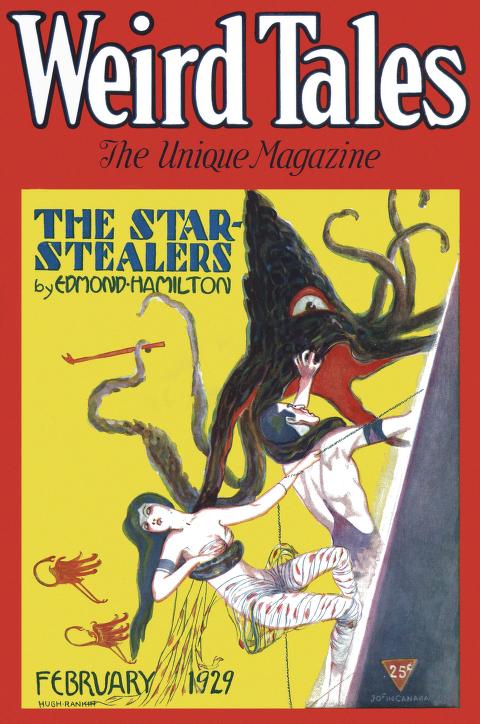
(Cover by Hugh Rankin. Weird Tales, February 1929.)
Who Goes There?
For a certain generation of SF readers (many of whom are now dead), Edmond Hamilton was one of the quintessential pulp writers—for both good and ill. Hamilton debuted in 1926, in Weird Tales, and he remained a loyal contributor to that magazine for the next two decades, churning out what were then called “weird-scientific” tales; that’s right, a cross between weird fiction and SF. Aside from maybe E. E. Smith and Jack Williamson, nobody embodied the virtues and constraints of ’30s pulp SF writing like Hamilton did. Too unrefined to appear in Astounding Science Fiction once John W. Campbell took over, Hamilton remained a regular presence in the second-rate magazines. Hamilton in the late ’40s and through the ’50s proved a different and relatively more refined beast, though, compared to his pre-World War II output, and it’s possible that his marriage to fellow author Leigh Brackett inspired him to better his craft, even if he did not put out as much work as a result.
Now listen…
Anyone who writes a story of such high caliber as “What’s It Like Out There?” is at least worth keeping track of; you write a story that good and you get a golden ticket basically for life. While Hamilton no doubt wrote a lot of forgettable stuff for money’s sake (the Captain Future series being the most infamous example), he was also quite capable of artistry. With all that said, “The Star-Stealers,” today’s story, is very much Hamilton in pulp adventure mode, being an entry in his Interstellar Patrol series—worthy of remembrance for, if nothing else, being some of the very first space opera ever written, almost parallel to E. E. Smith’s Skylark series. You could even say that space opera has two dads, such that modern/famous space opera like Star Wars have at least a little Hamilton in their DNA.
Placing Coordinates
“The Star-Stealers” (it’s reprinted sometimes with the hyphen, sometimes not) was first published in the February 1929 issue of Weird Tales, which is on the Archive, and with a pretty eye-catching Hugh Rankin cover! It was collected in the Interstellar Patrol volume (containing most but for some reason not all the entries) Crashing Suns. The two big anthologies to find this story in nowadays are the out-of-print but easy to find The Space Opera Renaissance (ed. David G. Hartwell and Kathryn Cramer), which contains “The Star-Stealers” and a few other pulp examples and juxtaposes them with works from the ’90s onward. But the big anthology, indeed the biggest, is The Big Book of Science Fiction (ed. Ann and Jeff VanderMeer), which I cited in another review not long ago and whose contents I’ll no doubt mine again. It shouldn’t come as a surprise that the VanderMeers, being devotees of weird fiction, picked this one.
Enhancing Image
Our Heroes™ are traversing the stars when they’re called back to home base rather abruptly, and so start at eighty times the speed of light back to our soler system, which naturally is the birthplace of the Federation of this series. Because there’s always a human federation with these things. Also try not to think too hard about how spaceships in this series are able to just casually break physics in half or else we’ll be here all day; Edmond Hamilton was a science-fictionist and he really put emphasis on the latter word. Anyway, the captain/protagonist/narrator of the battle cruiser at the story’s center is called home because there’s a pretty serious issue that only he and maybe a few other qualified captains can handle, and the issue has to be one of the first Big Dumb Objects in SF.
The BDO in question is a dark star that has apparently been dislodged from its solar system—a renogade planet that’s heading for our solar system at an impossible (for us, not for the characters) speed. Now, SF has a long proud (sometimes not so proud) tradition of BDOs, perhaps the most famous of them all being Larry Niven’s Ringworld or Arthur C. Clarke’s Rendezvous with Rama, but “The Star-Stealers” is innovative for combining space opera with the BDO narrative. “Innovative” is the keyword here. I’m about to sound rather harsh and dismissive about Hamilton’s story, but we needs be reminded that pioneers must always contend with later, more refined variations on what they took the pains to introduce.
With that said, this is all rather a bit silly, and only about to get sillier.
In order to get into the correct headspace for “The Star-Stealers” you have to put aside the Wile E. Coyote physics and take everything at face value—that the internal logic of the story is perfectly reasonable and understood by its characters and just roll with it. Unfortunately I found I was… not quite able to do this. It could be that I’ve read another later Hamilton to have set up unfair expectations for his very early work, but I do prefer the pulpy but more serious Hamilton of “What’s It Like Out There?” and City at World’s End. Or even the slightly more sophisticated stories of his ’30s output. “The Star-Stealers” is an important milestone, but it’s also primitive, and I suspect its lack of presence (or indeed the lack of the Interstellar Patrol series generally) in The Best of Edmond Hamilton implies that Brackett did not think too highly of her husband’s early space opera.
Anyway, the idea is for the captain to take a fleet of ships and do something about the runaway dark star before it enters our solar system and seriously messes with the planets’ stability. Something not to worry about with Hamilton is modesty: there will always be more of a given thing than what is needed. For instance, we probably don’t need fifty damn ships for this expedition, but given how many ships the Federation has… but I’m getting ahead of myself. The fleet must meet up with and divert the dark star before it gets in range of our solar system and quite possibly dislodges our sun. Up to this point in this story we’re led to believe that the dark star being rogue was the result of some freak accident that would only make sense on old-timey super-science logic, but assuming you didn’t forget (like I did, how embarrassing) about “The Star-Stealers” being the cover story for this issue and what that cover illustrates, you know there’s more going on here. This would not be as much of adventure if we were just dealing with a BDO.
Upon investigating the dark star closely, the crew find that a) it has an atmosphere, which we shouldn’t think too hard about, and b) the assumed “dead” star is actually not that dead; in fact it’s teeming with alien life. We find a whole civilization here, with buildings shaped like pyramids containing similarly shaped alien beings. Now, to Hamilton’s credit, the aliens here are pretty freaky-looking: they’re a few things but they’re certainly not humanoid. Actually this has to be one of the first instances in SF (at least pulp SF) where we see so-called starfish aliens. And of course, because this is an interplanetary adventure yarn, the aliens have no interest in befriending or even conversing with the crew—indeed destroying basically the entire fleet before Our Heroes™ have even hit the ground.
Here we get a good description of the aliens:
Imagine an upright cone of black flesh, several feet in diameter and three or more in height, supported by a dozen or more smooth long tentacles which branched from its lower end—supple, boneless octopus-arms which held the cone-body upright and which served both as arms and legs. And near the top of that cone trunk were the only features, the twin tiny orifices which were the ears and a single round and red-rimmed white eye, set between them. Thus were these beings in appearance, black tentacle-creatures, moving in unending swirling throngs through streets and squares and buildings of their glowing city.
Our Heroes™, the one ship out of a fleet of fifty that didn’t get blown up, are taken prisoner and at least one (a bit of a redshirt) gets vivisected like he was some animal. So we have a bit of a weird situation on our hands, with starfish aliens that perform horrible tests on beings they evidently deem lesser. The question then becomes of how the surviving crew is gonna break out of prison, get back to the ship (since the aliens have not taken it apart, at least not yet), and call for reinforcements before the dark star enters our solar system. Even with the presence of aliens sentient enough to have built their own civilization, the dark star heading towards our sun could still be an accident, but we find out that’s not the case…
There Be Spoilers Here
The starfish aliens intend to steal (get it?) our sun via a gravitational device, strengthening the dark star’s already immense pull and basically swiping our sun out of the solar system as it passes through, the results of which would obviously be disastrous. If this barely makes sense to you, don’t worry, even Bugs Bunny would call the aliens’ plan a bit zany. Again I struggle to take what’s happening seriously because of the goddamn Looney Tunes logic of it, although Hamilton’s melodramatic style employed here both helps and hurts it. On the one hand it’s easy to see how a reader in 1929 would find the action exhilarating, especially because space opera was such a young subgenre and SF had rarely if ever ventured beyond our solar system up to this point; on the other, it is so silly. The image of Our Heroes™ breaking out of prison, one of the pyramid buildings, and fighting off one of the aliens (the inspiration for the cover) is fun but also frivolous—both the story’s salvation and its damnation.
I may be slightly too old and “cultured” to be reading this.
Going on a mini-rant here, but my criticisms of “The Star-Stealers” are not so unique to it as more a general (you could say unfair) criticism of space opera as a concept. Oh sure, space opera in SF literature has come a long way since the days of Hamilton and Williamson, what with a far more “sophisticated” writer like Peter F. superseding Edmond for modern readers, but space opera remains very much a gosh-wow subspecies of SF, this especially still being the case for film and TV. There’s a valid criticism to be made, for instance, of the so-called Kelvin Star Trek series of movies (I like Beyond a lot myself, for the record), that those movies put a much higher priority on space action than the TV show they’re based on, but that’s only true insofar as comparing one Star Trek product with another Star Trek product.
In actuality, the pew pew action of the Kelvin movies has a precedent much older than the original Star Trek series, rather calling back to what made space opera during the super-science era of SF so appealing—but also so laughably primitive now. I’m not even getting into Star Wars again; I think my point’s been made. What made Star Trek, the original series, so unique was that while it was technically a space opera (it ticks enough boxes), it subverts tropes in the subgenre (while admittedly making new ones) that are still worth subverting. Smashing spaceships together like they’re toys was and still is a thing in space opera, but in Star Trek the best solution to a problem was often a non-violent one; conversely the epic space battles of the new movies are not the product of newfangled Hollywood meddling but rather descended from a very old storytelling philosophy.
Speaking of which, the solution to the problem in “The Star-Stealers” is to smash spaceships together like they’re toys. Somehow one ship out of the fleet that had gotten its shit kicked in earlier managed to evade the aliens and bring word back to the Federation, so that once Our Heroes™ have gotten back to their own ship they’re met with another fleet—only this time it’s hundreds rather than dozens of ships. The gravitational device the aliens use is disabled and the dark star is finally sent on its merry way, only now far away from our solar system. The day is saved! To Hamilton’s credit, the climactic space battle is pretty epic, being almost a novel’s worth of action condensed into the back end of a novelette, even if we knew from the beginning that everything would turn out fine.
A Step Farther Out
We all have our thresholds. A lot of people now find the Foundation trilogy a hard pill to swallow, due to Isaac Asimov’s minimalist and dialogue-heavy style, while others fault his lack of eagerness to write female characters. Time comes for us all, and what was considered the shit half a century ago will probably not pass muster now. Go back and read some “classic” New Wave stories and see how many of them make you cringe. This is a nice way of saying that while it no doubt has its place, I found it impossible to take “The Star-Stealers” seriously—which strikes me as a shame, because it obviously has its appeal. What Hamilton lacks in finesse he compensates with scope; it’s a shame, then, that his “science” fiction now almost reads as fantasy, and not the kind of fantasy with elves and ogres. I didn’t dislike it, but I feel I may have hit my threshold with SF of such a vintage as “The Star-Stealers.” I take comfort, however, in knowing Hamilton was capable of better, and that indeed he would improve tremendously.
(Cover by Hugh Rankin. Weird Tales, December 1927.)
Who Goes There?
We don’t know much about Everil Worrell, which sadly is the case for most pulp-era female authors, whose legacies have only been partly rescued by modern faminists and allies. Clearly there is much work left to be done. We do know that Worrell contributed to Weird Tales fairly regularly—and virtually nowhere else; she more or less retired from writing fiction after the first incarnation of Weird Tales went under. She never wrote any novels. Hell, you can collect all of her short fiction in a slim-enough volume. While her work as a whole remains obscure, she does have at least one canonical piece of vampire fiction under her belt: “The Canal,” which H. P. Lovecraft liked enough to mention said fondness in multiple letters. I can sort of understand why Lovecraft liked this one, but while it shares a few traits with Lovecraft’s own fiction it is certainly not cosmic.
“The Canal” is Worrell’s most famous story and it’s one of those that was deemed popular enough back in the day to be reprinted in Weird Tales as a classic; its publication history is also a bit tangled. There are apparently two versions of “The Canal,” one that was printed in Weird Tales twice and one that was “revised,” either by Worrell or by August Derleth for an anthology he edited, to have a very different ending. Not that I’m big on the original version’s ending, but from what I’ve heard the revised ending is worse. To my surprise there are multiple reviews of this story online, but even so, if you would allow me to have my own take on things…
Placing Coordinates
First published in the December 1927 issue of Weird Tales, which is on the Archive; was later reprinted in the April 1935 issue, which can be found here. Be warned that ISFDB doesn’t do a good job at differentiating the original version from the revised version, though it at least tells us The Vampire Archives (ed. Otto Penzler) uses the latter, and of course that version made its first appearance in The Sleeping and the Dead, edited by Derleth. You may also be curious to look out for H. P. Lovecraft’s Favorite Weird Tales (ed. Douglas A. Anderson), which is what it says on the tin. Surprisingly “The Canal” is not on Project Gutenberg, which means either a) it’s just a bit too obscure to have been picked up yet, or more likely b) some evil scumfuck has not let the copyright expire for it. You have options, but if you wanna be on the safe side and be sure you’re reading the version that Worrell first wrote then the Weird Tales publications are your best bet.
Enhancing Image
The narrator is a recent college grad who also happens to be one of those people who, had he been born in 1990 and not 1900, would surely be jamming out to My Chemical Romance in the 2000s. He would either be a scene kid or really into goth rock. Outside of his office job (which he doesn’t like, naturally), he doesn’t really socialize with people, and much prefers to go on nightly walks by yourself. Going out for strolls is one of those things you did to pass the time in the era before TV, which, in fairness, at least there’s potential for exercise here.
The narrator being a moody loner who thinks of a walk by the local cemetery as fun is very Lovecraft-esque, I’ll say that—or at least it appeals to Lovecraft’s sensibilities. We even get a reference to Poe early in the story. Oh baby, this is the kind of shit that appeals to me. I’m a student of the macabre and Worrell knows how to tick my boxes.
Anyway, going back to the office job, the narrator’s co-workers have set up camp in the woods, right by the river, as what I have to imagine as like a team-building thing, although why these are called “pleasure” camps eludes me. Not that the narrator is enthused about this either. “At night these camps were a string of sparkling lights and tiny, leaping campfires, and the tinkle of music carried faintly far across the calmly flowing water. That far bank of the river was no place for an eccentric, solitary man to love.” Wandering off on his own, the narrator comes to the canal by the river, filled with mostly stagnant water, and oddly smelling of decay—and it’s here that the plot really kicks into motion.
There’s a boat in the canal, stationary, not going anywhere in the stagnant water, and on that boat is a woman, more beautiful than any the narrator has seen before. We don’t get the woman’s name, but we know that her power to seduce is strong and that something is not right about her; given that I’ve said before that this is a vampire tale, you can guess what that something is. What’s important, though, is that for our solitary young man this is practically love at first sight, even though the woman is acting strange: for one, she won’t let him get on the boat. She’s also nocturnal, only coming out of the boat at night; meanwhile her father guards the boat by day while she sleeps. Nothing to see here!
The following exchange, in which the woman explains her arrangement with her father (whom we don’t see), is pretty odd:
“In the night time, my father sleeps. In the daytime, I sleep. How could I talk to you, or introduce you to my father then? If you came on board this boat in the daytime, you would find my father—and you would be sorry. As for me, I would be sleeping. I could never introduce you to my father, do you see?”
“You sleep soundly, you and your father.” Again there was pique in my voice.
“Yes, we sleep soundly.”
“And always at different times?”
“Always at different times. We are on guard—one of us is always on guard. We have been hardly used, down there in your city. And we have taken refuge here. And we are always—always—on guard.”
I dunno, man.
The woman and her father used to live in the city, but no longer—for reasons the woman is conspicuously vague about. The point is that both the woman and the narrator find the city oppressive (for different reasons, as it turns out), and at first this sounds like a match made in heaven. Both are solitary, fed up with the fuss and conformity of urban life, and very goth. Without knowing what he’s getting into, the narrator swears allegiance to the woman and promises to meet her only at the time and place she wants, which, ya know, is not something a rational person ought to do.
There’s a good deal of gripe about with regards to the narrator’s stupidity, but I have to give props to Worrell for not shying away from the erotic aspect of vampires, which is virtually always there anyway. The vampire as seducer goes back to at least Carmilla (who gets bonus points for lesbianism), and it’s a tradition that would be well held up in Weird Tales but not so much in Unknown, partly for reasons of subverting tradition but also because the latter magazine is considerably more puritanical. At least here the narrator, despite his “eccentric” demeanor, is very much in love and, more implicitly, is very much horny. The narrator’s struggle (by his own admission) to think straight is what allows there to be conflict with stakes at all.
The setup is simple. There are only two characters worth anything, maybe a third if you count the narrator’s pesky co-worker. Worrell turns what almost feels like a one-act play into a short story with a real atmosphere of its own, even if it could also work on the stage. There is one thing, however, that would be hard to do justice on the stage, and that’s the ending—the thing that August Derleth meddled with for the story’s first book appearance, possibly with or without Worrell’s input (we’re not sure on that). As such, since it’s easily the most unexpected element, I’ll discuss the ending and not much else in the spoilers section.
There Be Spoilers Here
The woman being a vampire is not a twist; for one “The Canal” is consistently labeled as a vampire story, but even if you didn’t know that the woman being a vampire is extremely telegraphed. The narrator hears about a vampire victim (bite on the neck and everything) from his co-worker and to his horror it lines up with the woman’s own story of fleeing the city. Upon remembering his vampire lore like a good goth boy (especially the part about vampires not being able to cross running water), the narrator concludes that he’s fallen head over heels for a dark creature of the night. The father being dead (as in dead dead, not undead) is a good twist, though. For some reason the woman did not turn her father into a vampire; he helped her out of the city, “but died without becoming like her.” The backstory for the woman is never entirely given away, which I like, since there remains at least a bit of mystery and frankly you can’t have a good horror yarn without some questions left unanswered.
I think the ending itself is too short. After the vampires break out and infiltrate the camp site, we’re given very little time when the narrator attests to planting dynamite along the canal and killing himself once he’s done his job. This is a lot to lay on a reader in the space of a single page. While the narrator committing suicide and doing a little bit of terrorism is alluded to at the beginning of the story, there’s basically no transition between the attack on the camp site in the climax and the narrator’s resolve to get rid of the vampires at the very end. Still, this is at least more unconventional than the ending Derleth gave us for the “revised” edition, in which apparently the narrator kills the woman with a stake mid-embrace, which is more romantic but also more cliched for vampire fiction.
A Step Farther Out
I liked it. It didn’t reinvent the wheel or anything. This is the first original Weird Tales story we’re covering and it definitely feels like one, being overtly Gothic, even namedropping Edgar Allan Poe, and balancing a mix of horror with barely suppressed sexual angst. It’s lurid: the whole plot kicks off because the narrator gets a boner over meeting a chick in the woods this one time. I’m also mixed on the ending, but at the very least I can’t say it was expected; the woman being a vampire is obvious from the get-go, but the ending is… not. With all that said, if I have to read another vampire story in the next month, after having reviewed like three of the damn things last October, I’m gonna [YASS] myself.
(Cover by Andrew Brosnatch. Weird Tales, November 1925.)
Who Goes There?
H. G. Wells is one of those authors who really needs no introduction. Of the forerunners to the great experiment we call science fiction, Wells was arguably the most influential and most talented; he was at least certainly the most direct ancestor to the likes of Heinlein and Asimov; he was also one of the first SF authors I remember reading with any enthusiasm. I picked up copies of The Time Machine and The Island of Dr. Moreau as a middle schooler and I was thus introduced to classic literature and classic science fiction in one swoop. Mind you that I—well, I didn’t like reading much up to that point in my life; I was a late bloomer when it came to the whole reading for fun thing. The Time Machine especially might’ve rewired my brain a bit, and I’ve gone back to it several times since then—which is easy, considering it’s really a novella. Point being, even though I don’t tend to think of him as one of my favorite authors, I owe quite a lot to Wells, as so do the rest of us who think of science fiction as our home turf.
Wells wrote a lot and lived a long time, but his legacy gets boiled down to a handful of novels that were written close together and a smattering of short stories and novellas that were written during that same period. This is fine, because with such pioneering works as The Time Machine and The War of the Worlds, Wells’s legacy was secured. It may seem odd to see him in the pages of Weird Tales, but consider both the story to follow and also how “weird” much of Wells’s fiction is. The Invisible Man would surely have been serialized in Weird Tales had it been published three decades later, and the beast men of The Island of Dr. Moreau are such grotesque creations as to make the average horror writer nod in gratitude. “The Remarkable Case of Davidson’s Eyes” is a mind-bending tale about seeing several places simultaneously, and actually “The Stolen Body” feels like a bit of a companion to that earlier short story.
Placing Coordinates
First published in the November 1898 issue of The Strand Magazine, but we’re reading “The Stolen Body” as it appeared in the November 1925 issue of Weird Tales, which is on the Archive. Curiously, despite being a reprint, it was made the cover story. In what has to be one of the faster magazine reprints it also appeared just over two years later in the January 1928 issue of Amazing Stories, which you can find here. Because this is Wells it’s not hard to find. It was included in the collection Twelve Stories and a Dream, which is on Project Gutenberg. If you want a paper copy then your best bet is probably Selected Stories of H. G. Wells from Modern Library, which seems to still be in print. You have options is all I’m saying.
Enhancing Image
We start with two friends, Mr. Bessel and Mr. Vincey, who have the crippling combination of being bored and also into paranormal shit. This is Victorian England; people did some wild shit just to pass the time. Bessel thinks he can separate his spirit from his body by sheer force of will—as in he can hypnotize himself and astral project into Vincey’s apartment. Hypnotism is a running thing in SF of this vintage, and would sometimes even show up in Campbellian SF a few decades later. The most famous example in old-timey fiction might be Poe’s “The Facts in the Case of M. Valdemar,” a horror yarn that, curiously, could also be considered science fiction; it certainly convinced Gernsback enough to print it in Amazing Stories, as would “The Stolen Body” be a few years later.
Bessel simply trying hard enough in order to achieve this supernatural end also reminds me of another Wells story, “The Man Who Could Work Miracles,” but whereas that story makes no attempt to explain itself in rational terms, we’ll find “The Stolen Body” to be couched in science fictional rationalism. Anyway, the idea is that the spirit of Bessel will appear to Vincey, then Vincey will take a picture of this spirit before Bessel returns to his body. Well, the first part of the experiment works. Bessel’s spirit does indeed appear to Vincey, but for one, Vincey is too slow to take a picture with what admittedly has to be a slow and clunky camera, and second, when Vincey heads over to Bessel’s place, he’s nowhere to be found. For reasons unknown, Bessel has all but vanished into thin air. To make things even weirder, Bessel seems to have trashed his own apartment before vanishing—but then maybe there was foul play involved?
The answer is “yes” and also “no.”
What follows is very strange. Vincey has a series of vivid dreams in which he’s confronted with Bessel’s spirit, but he also sees Bessel—the man, or at least the body of the man—go on a rampage through the streets at night, assaulting people with a cane and blabbering the word “Life!” over and over. When Vincey wakes up, he finds that the dream was not really a dream; Bessel really did go on a rampage during the night, and at the same time that Vincey was sleeping. Vincey and Mr. Hart, a mutual friend, take this information to the police, and are told that not only was Vincey’s vision a projection of what really happened, but that despite quite a few eye witnesses, Bessel has not been found since the rampage.
They confirmed Mr. Vincey’s overnight experiences and added fresh circumstances, some of an even graver character than those he knew—a list of smashed glass along the upper half of Tottenham Court Road, an attack upon a policeman in Hampstead Road, and an atrocious assault upon a woman. All these outrages were committed between half-past 12 and a quarter to 2 in the morning, and between those hours—and, indeed, from the very moment of Mr. Bessel’s first rush from his rooms at half-past 9 in the evening—they could trace the deepening violence of his fantastic career. For the last hour, at least from before 1, that is, until a quarter to 2, he had run amuck through London, eluding with amazing agility every effort to stop or capture him.
But after a quarter of 2 he had vanished. Up to that hour witnesses were multitudinous. Dozens of people had seen him, fled from him or pursued him, and then things suddenly came to an end. At a quarter to 2 he had been seen running down the Euston Road towards Baker Street, flourishing a can of burning colza oil and jerking splashes of flame therefrom at the windows of the houses he passed. But none of the policemen on Euston Road beyond the Waxwork Exhibition, nor any of those in the side streets down which he must have passed had he left the Euston Road, had seen anything of him. Abruptly he disappeared. Nothing of his subsequent doings came to light in spite of the keenest inquiry.
How Vincey was able to have a vision of something that happened simultaneously with his sleeping will be explained later, but it’s certainly hard to rationalize—thus an irrational explanation, never mind a solution, will have to do. Vincey gets in contact with a local medium, which strikes me as unusually dishonest for Wells since he depicts mediums as well-meaning people and not the con artists they actually are. Anyway, putting aside my intense ambivalence towards mediums and ghost hunters and whatnot, the visit pays off immensely, even if the message we get from what seems to be Bessel’s spirit is cryptic. The medium, as if hypnotized herself, writes down a message in what Vincey recognizes as Bessel’s handwriting, and with nothing else to go on the police use this clue to find Bessel, who following his deliriam from the previous night had apparently fallen down a shaft at a construction site and was unable to get out on his own.
A few broken bones aside, Bessel is in fine shape, and more importantly he acts like himself again. That’s basically the end of the story, if we were to map this whole thing out linearly, but there are still questions begging to be answered, such as “Why did Bessel go on that mad rampage?” and “How come Vincey was able to see said rampage in his dream as it was happening in the real world?” But those are spoilers…
Wells’s characters are not knowing for being all that colorful, with a few notable exceptions (Dr. Moreau and his henchman/boytoy Montgomery are far more memorable than the narrator), with “The Stolen Body” being an especially pronounced example. Bessel, Vincey, and the few other characters worth mentioning at all are very vanilla, and it struck me at some point while reading that there’s very little dialogue. We don’t even get Bessel and Vincey’s first names if I remember right. They serve their purpose, though; clearly Wells is far more interested in mapping out this strange sequence of events than having the characters act as the story’s anchor. We’re supposed to find these supernatural shenanigans as adequate compensation for the lack of actual character drama, and I think it worked out.
Anyway, we don’t go to Wells for the characters. It’d be like if you went to Hal Clement for characters, or Vernor Vinge; these writers are much more about the visionary potential of fiction than the potential of human drama. “The Stolen Body” isn’t scary, really, but it’s certainly perplexing, making us wonder what the hell is going on and where Bessel could have gone to during his astral projection. What makes “The Stolen Body” very much worth a recommendation is that it’s not simply a ghost story—it’s a ghost story as written by a real man of science, a man who refuses to let any substantial question go unanswered. It’s like when James Blish tried to rationalize werewolves in “There Shall Be No Darkness” (review here), except Wells’s rationalizing is a bit less labored, if also less eccentric.
There Be Spoilers Here
You may be thinking, “Brian, you handsome devil, why did you give away the end of the story in the non-spoiler section? What could you even have left to consider a spoiler?” Well that’s where you’d be mistaken, because we haven’t gotten Bessel’s side of the story up till now. While we know he more or less ended up fine, how we got to finding him in a shaft where he could’ve only been found with some supernatural assistance was not explained. Wells does something very peculiar here in that he rewinds the clock and retells most of the story, but from Bessel’s perspective.
So what happened when Bessel hypnotized himself and left his own body? Wasn’t he able to get back into it? How else could he have gone on that rampage, albeit seemingly in a state of shock? Well…
He enters a world that could be considered the shadow realm—a level of existence beyond the natural world. A world without sound, separated from the natural world by what seems like a glass pane. It’s uncanny and certainly intriguing, but Bessel finds that he can’t return to his body with ease; in fact, he soon finds that he’s not the only one looking for a body around here. While Bessel is currently apart from his body, he’s not technically dead, which I guess leaves it open to possession. (Is that how it works? I don’t think too hard about it.) There are spirits in this realm—people in limbo, between the living and the departed, neither alive nor totally dead. One of these spirits invades Bessel’s body and, after presumably being stuck in spirit form for a long time, immediately goes nuts with it.
A few problems Bessel must solve: the obvious is that he has to get back into his body, but he can’t do that if someone else has it; the second, arguably bigger problem is making contact with Vincey or someone who might help him get back itno his body; the third is hoping to God or whoever it is that the spirit that hijacked his body doesn’t kill it somehow. Indeed that second problem takes up most of the back end of the story, and goes a long way in explaining some earlier events that might seem inexplicable to us.
For instance, Vincey has the dream about Bessel going on his rampage because the real Bessel messes with his… pineal gland. Lovecraft fans may note that this peculiar little gland in the brain gets used as a plot device in that dude’s early story “From Beyond,” with similarly supernatural but far more negative results. Apparently writers in the 19th and early 20th century were fucking stoked about all the weird little things in the human body, like the appendix and all that. The pineal gland in old-timey (we’re talking pre-Campbellian SF, it’s that old) SF serves as basically one’s third eye, which Bessel opens for Vincey; he witnesses the rampage as it’s occurring, though he doesn’t realize that until later.
Confused slightly? Don’t worry, Wells catches us up:
And now the attentive reader begins to understand Mr. Bessel’s interpretation of the first part of this strange story. The being whose frantic rush through London had inflicted so much injury and disaster had indeed Mr. Bessel’s body, but it was not Mr. Bessel. It was an evil spirit out of that strange world beyond existence, into which Mr. Bessel had so rashly ventured. For twenty hours it held possession of him, and for all those twenty hours the dispossessed spirit-body of Mr. Bessel was going to and fro in that unheard-of middle world of shadows seeking help in vain. He spent many hours beating at the minds of Mr. Vincey and of his friend Mr. Hart. Each, as we know, he roused by his efforts. But the language that might convey his situation to these helpers across the gulf he did not know; his feeble fingers groped vainly and powerlessly in their brains. Once, indeed, as we have already told, he was able to turn Mr. Vincey aside from his path so that he encountered the stolen body in its career, but he could not make him understand the thing that had happened; he was unable to draw any help from that encounter…
Also, while Bessel isn’t allowed to talk to normal people, he can make indirect messages through people’s pineal glands if they’re juiced up enough, I guess, hence, the medium writing down Bessel’s cryptic message and even mimicking Bessel’s handwriting. Bessel has to fight other spirits for control of the medium’s body, but he gets in there just long enough to let Vincey know what happened to his body and where it is.
Meanwhile the spirit, having had an accident and fallen down the shaft, breaking a few bones in the process, is not happy to be in Bessel’s body anymore and eventually leaves it, allowing Bessel to return. He’s hurt badly and the whole experience has been pretty traumatic, never mind, outlandish, but he’s more or less fine at the end. What lingers far more than the physical pain is the knowledge that, for a relatively brief time, he experienced the afterlife—and it SUCKS.
A Step Farther Out
Is it science fiction? Is it supernatural horror? It’s kinda both. It’s interesting to look back at pre-Gernsbackian SF and see how these writers were playing with genre boundaries when they didn’t even know what that genre was yet. Wells was on to something, though, and it’s no wonder that “The Stolen Body” was reprinted in two genre magazines a few decades after initial publication—because no doubt Hugo Gernsback would have bought it even if it had never been published before. As it turns out, scientific (or often pseudo-scientific) concerns did not change much among those who were “in the know” between the tail end of the 19th century and around the time of the stock market crash. What makes an artifact like “The Stolen Body” especially interesting is that because our understanding of the human body has advanced so much since Wells’s time, Victorian superstition about ghosts and whatnot now sounds more fantastical than it would’ve at the time. Wells was a materialist, but even so he appealed to Victorian fears about damnation and voices from beyond the grave.
Wells would become a more frequent contributor to Amazing Stories, but “The Stolen Body” was not his last appearance in Weird Tales and if you know enough about his work it’s not hard to see why. It’s strange, considering how much he is known as an optimist and utopian socialist, that so much of Wells’s fiction could be classified as horror; indeed he is much more famous for crafting bad futures than good ones. Whereas The Time Machine shows a bad distant future, hundreds of thousands of years from now, “The Stolen Body” shows a much more immediate but still horrific (at least on a personal level) future: the life that comes after death.
(Cover by Margaret Brundage. Weird Tales, July 1933.)
Weird Tales, across incarnations, has been arguably the most important outlet for dark fantasy and horror in the American market for the past century now. Yes, it’s been that long. The first issue of Weird Tales is marked March 1923 and would have appeared on newsstands in February (I’m not splitting hairs), and while it wasn’t immediately impressive it would become the quintessential pulp horror magazine within a decade. Given the nature of my site and how important Weird Tales is, I thought it appropriate (not to mention a break away from tackling serials) to do a month-long tribute by reviewing entirely short stories from this magazine’s pages—but make no mistake, this is not an attempt to cover its incredibly wide-spanning history. What I’m doing rather is to cover the most famous period of Weird Tales: from the mid-1920s to the end of the 1930s.
In a way this is not so much a tribute to Weird Tales as to the man who, more than anyone, made it the legend it now is: Farnsworth Wright. Wright hopped on as editor with the November 1924 issue and stayed until failing health forced him to step down after the March 1940 issue; he died only a few months later. But in the decade and a half that Wright was editor there was a profound change in the magazine’s contents, as it went from focusing on unassuming ghost stories to encompassing a wider range of “weird” fiction, including but not limited to sword and sorcery, operatic science fiction, and of course, cosmic horror. Ghost stories remained a firm part of the magazine’s identity, but under Wright we saw several big forerunners to modern horror and fantasy, including H. P. Lovecraft and Robert E. Howard, and indeed Weird Tales was the birthplace of both Conan the Barbarian and the Cthulhu Mythos.
Weird Tales was not that friendly to novellas unless they were serialized, and anyway I figured it’d be more accurate a representation to review all short stories this month, which also allows for a more diverse set of authors. We’ve got some famous ones here, but also some deep cuts that I’m very much interested in exploring.
Anyway, here are the short stories:
“The Stolen Body” by H. G. Wells. From the November 1925 issue. This is the first true reprint I’ll be reviewing for Remembrance. “The Stolen Body” was first published in the November 1898 issue of The Strand Magazine, but we’re reading it as it appeared in Weird Tales, and apparently Wright (or somebody) deemed it major enough to make it the cover story despite its reprint status. Wells is someone who needs no introduction, and this is a story from his peak era.
“The Canal” by Everil Worrell. From the December 1927 issue. Not much is known about this author, but her vampire story “The Canal” has been reprinted several times over the years, including as a “classic” reprint in Weird Tales itself. Lovecraft was apparently a big admirer of this one, and he also didn’t seem immediately aware that Worrell was a woman. There’s a later revised version with a different ending, but we’re reading its first magazine appearance.
“The Star-Stealers” by Edmond Hamilton. From the February 1929 issue. Hamilton had made his debut in Weird Tales, and he soon proved to be the most prolific contributor of “weird-scientific stories,” or ya know, just science fiction. “The Star-Stealers” is the second entry in the episodic Interstellar Patrol series, which while not often read now was an early exmaple of space opera, which Hamilton helped codify alongside E. E. Smith and Jack Williamson.
“The Black Stone” by Robert E. Howard. From the November 1931 issue. This has to be the fastest I’ve returned to an author for my site, since only last month I finished covering Howard’s Conan serial The People of the Black Circle. “The Black Stone,” however, is not sword and sorcery but cosmic horror, and it’s supposed to be one of the best old-school Lovecraftian narratives, on top of being one of the first examples of someone taking cues from Lovecraft’s work.
“The Dreams in the Witch-House” by H. P. Lovecraft. From the July 1933 issue. Speaking of which, it’d be impossible to do a Weird Tales tribute without covering its most famous contributor, although Lovecraft was certainly not that at the time. Wright and Lovecraft did not get along, with Wright rejecting At the Mountains of Madness and “The Shadow Out of Time.” Still, this is one of his more famous short stories, and it even got adapted for TV recently.
“The Black God’s Kiss” by C. L. Moore. From the October 1934 issue. The only reread of the bunch, and that’s because I honestly did not give this one the attention I should have when I encountered it a couple years ago. Moore is now more known for collaborating with her husband Henry Kuttner, but she started as one of the more popular authors in Weird Tales. “The Black God’s Kiss” is the first in the Jirel of Jory series, featuring the titular sword-and-sorcery heroine.
“Vulthoom” by Clark Ashton Smith. From the September 1935 issue. The literary sorcerer returns! Smith was, for a brief time, one of the most prolific contributors to Weird Tales, although he mostly retired from writing fiction by the time Wright left. “Vulthoom” is a “late” Smith story, and you can tell because it was one of only a few he put out in 1935. It’s also a comparitibely rare example of Smith doing SF, with the setting being not Earth but a haunted Mars.
“Strange Orchids” by Dorothy Quick. From the March 1937 issue. As with Worrell we don’t know much about Quick, and unlike “The Canal” this has not been reprinted so often. I do remember first seeing Quick’s name in Unknown, the magazine that for a brief time usurped Weird Tales, but she appeared more in the latter; she basically stopped writing fiction once the first incarnation of Weird Tales shut down. Probably the most obscure pick of the bunch.
“Roads” by Seabury Quinn. From the January 1938 issue. Quinn was the most popular author to appear in Weird Tales during the Wright era, and yet his reputation dwindled enough since his death that he later “won” the Cordwainer Smith Rediscovery Award. The posthumous obscurity could be because a lot of what Quinn wrote was hackwork, but “Roads” is distinct for apparently being one of those pieces that Quinn wrote out of passion, being an earnestly told Christmas story.
I know Halloween was only like five months ago, but truth be told it’s always Halloween in my heart. If I could get away with just reading and reviewing spooky fiction I probably would; nothing warms my bones like a good horror yarn. The greatest hits from Weird Tales are still cited after nearly a century, but I suspect there are also deeper cuts (especially by female authors, as there would’ve been several) that are worth our attention. We have a healthy variety of authors and a good deal of diversity as to this magazine’s contents, ranging from the supernatural to the weird-scientific.
But enough buildup…
It’s time to venture into the eerie, the uncanny, and the WEIRD!
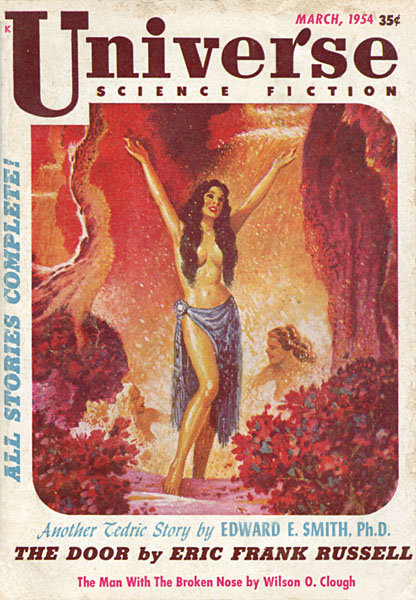
(Cover by Robert Gibson Jones. Universe, March 1954.)
Who Goes There?
Chad Oliver was one of many authors who came about just in time for the bubbling of the SFF magazine market in the first half of the ’50s; he debuted in 1950, and more than half his short fiction was published by 1960. Despite being a mainstay of the ’50s, there were certain oddities about Oliver’s background and character that separated him from his fellows, namely that he was an academic—more specifically he was an anthropologist, first as a student and later as a staff member at the University of Texas. His 1952 thesis “They Builded a Tower” had to be one of the first academic papers about “modern” SF, and his preoccupation with wedding academia with SF in the ’50s coincided with the likes of Jack Williamson and others bringing the genre to the world of higher education. He was also, a little unusually (and admirably) for the time, vocal about his sympathies for indigenous peoples, with his westerns and some of his SF apparently depicting Native Americans as flesh-and-blood people.
Before Ursula K. Le Guin became SF’s leading anthropologist (among other things), there was Chad Oliver. Given his background, it should be less surprising that Oliver’s fiction is less concerned with individuals and more so with cultures. In the case of his SF we’re talking alien cultures, and with today’s story, “Let Me Live in a House,” we’re given quite the taste of what Oliver’s game is. What a great title, by the way. It’s vaguely ominous, is open to several meanings, and while the alternate title “A Friend to Man” is perfectly fine (the irony is what sells it), this is much better.
Placing Coordinates
First published in the March 1954 issue of Universe Science Fiction, which is on the Archive. It’s one of those stories that showed up more than once in the magazines; its first British publication was in the June 1956 issue of Authentic Science Fiction, which you can find here. For old-timey book appearances we have the Groff Conklin anthology Science Fiction Terror Tales and the Oliver collection The Edge of Forever: Classic Anthropological Science Fiction. If you want in-print options then you do have a couple, and one of them is huge—quite literally. First we have the hardcover Oliver collection from NESFA Press, Far from This Earth and Other Stories. Then we have what drew my attention to this story in the first place, The Big Book of Science Fiction (at over 1,100 two-columned pages it lives up to its title), edited by Ann and Jeff VanderMeer. I can see why the VancerMeers, as champions of weird fiction, picked this one out…
Enhancing Image
We start with what seems like suburbia, only it’s smaller and more isolated than the norm. We have two cottages next to each other, each adequately but quaintly fitted. Framed in one of these cottages is part of a poem; Oliver doesn’t cite it, but it’s “The House by the Side of the Road” by Sam Walter Foss, and we only get one line from it: “Let me live in a house by the side of the road and be a friend to man.” On its face it’s meant to be optimistic, but the events that follow will put a much darker spin on it.
The two cottages are enclosed in a dome, or as it’s called a bubble. We’re not on Earth, but on Ganymede, Jupiter’s largest moon. Two couples live here: Gordon and his wife Helen, and their neighbors Barton and Mary. Gordon is our protagonist, and for some reason he’s the only one of the four who doesn’t act like everything is normal; in a way his lack of contentment with his environment makes him look normal, and the others strange. Unfortunately for Gordon, who already is not that happy a camper, he and the others live on the side of Ganymede that overlaps with the Twilight Zone. No, but in all seriousness I’m surprised this wasn’t adapted for a Twilight Zone episode, or The Outer Limits. Life under the dome starts out uncanny and things only get worse from there. The grass and foliage are artificial. The “weather” is programmed. There are no animals.
If the outsider is uncanny then life inside one of these cottages is little better. There’s no communication with the outside world (well, with Earth), there’s no way to leave the dome, and for entertainment your options are limited and quickly exhausted. There’s a TV—a “tri-di,” which I take to be a 3D set (because 3D was also a fad in the ’50s, history repeating itself)—but it’s all pre-programmed and much like with an iPod Touch circa 2012 you run out of variety quickly. Oh, and there’s board games. Cool.
Even the act of talking becomes minotonous.
They exchanged such small talk as there was. Since they had all been doing precisely the same things for seven months, there wasn’t much in the way of startling information to be passed back and forth. The bulk of the conversation was taken up with Mary’s opinion of the latest tri-di shows, and it developed that she liked them all.
The sheer monotomy of living under a small dome for months seems close to breaking Gordon already when something unforeseen happens. One “night” the four hear a sound—a whistling noise over their heads—that they know for a fact can’t be coming from inside the dome. Hell, it can’t be coming from outside the dome either; that’s not how sound in space works. Gordon and Barton enter a hidden equipment room and check what has to be the ’50s equivalent of convenience store CCTV footage. An arc of light, perhaps a meteor, passed over the dome at “night”—or, perhaps, it could be something else. Gordon tells himself it has to be a meteor, but even at this early point he’s not doing a great job at convincing himself. I’m amazed Gordon made it this far, considering he seems on the verge of cracking at any moment. Then again, his relatively loose grip on reality will prove something of an asset.
I know I’m bringing up the time period in which this story was written a lot, but you have to keep in mind that “Let Me Live in a House” could not have been written any later than 1963 (when John F. Kennedy caught a bullet with his brain), and I don’t mean that in a bad way. Oliver’s decision to model life under the dome after a rather stripped-down parody of middle-class suburbia was very much deliverate. There’s a whole subgenre of ’50s SF stories that take pot shots at the growing middle-class suburban population and this is one of them. This story could not have been written twenty years before or after; in 1934 people were fighting just to get jobs, and in 1974 there was the oil crisis. There’s this satire of complacency as the result of economic prosperity; not to say it’s a comedy, because it really isn’t, but satire can be serious, in its message if not on its face.
Here they were, he thought—four human beings on a moon as big as a planet, three hundred and ninety million miles from the Earth that had sent them there. Four human beings, encased in two little white cottages under an air bubble on the rock and ice that was Ganymede. Here they were—waiting.
Waiting for the ship from home that was not due for five months. Waiting all alone in an abandoned solar system, with only sound effects and visual gimmicks for company. Waiting in an empty universe, sustained by a faith in something that had almost been lost.
Hey, remember this bit? “The last man on Earth sat alone in a room. There was a knock on the door…” I’m not sure where this originated. It was used in the Fredric Brown short story “Knock” (which I haven’t read yet), but I don’t think that’s where it comes from. Regardless it’s a great little two-sentence horror yarn. Well, anyway, the only four people on Ganymede are hanging out in a cottage, when there’s a knock on the door…
Someone’s knocking on the door, and right after an unscheduled storm in a dome on Ganymede. Not long after what looked like a meteor passed this-a-way. Hmmm. After much hesitation Gordon lets the stranger in, and—he’s just an old guy, although miraculously he looks just like a portrait hanging in the cottage, of some guy named Grandfather Walters. (I don’t know if he’s related to anyone.) Somehow he got in here. Is he an alien? That’s the first and most likely answer. But if so, what kind of alien? Is he benevolent? How come he looks perfectly human? A lot of aliens in SF (especially TV) look humanoid or just straight-up like people because of either budget constraints or because the writers weren’t being very creative. We do, however, get a pretty good reason for why the alien, who calls himself “John,” looks like a normal person, but I won’t say what it is for now.
See, all this is rather stagey. We have one location, a grand total of five characters (not even supporting characters, this is all we get), and it’s pretty chatty. There’s very little action, and that’s for later. John doesn’t come in looking to subdue the men with giant tentacles and capture the women for his own perverted ends, but rather comes here to talk; he’s a guest at the cottage and he’s staying for the night whether the other people like it or not. In a way he’s more threatening than the average alien because we honestly don’t know what his deal is, and yet his appearance is hard to explain regardless of the rationale. There’s the burning question of how the hell he got into the dome, and maybe just as importantly, where the hell he came from. It’s implied, of course, that he came by via the meteor, but that doesn’t explain much. Again, how did he get inside the dome?
He’s not here to conquer Earth, and he’s not here to cause too much trouble. He’s also upfront about not being human; the appearance is merely a stand-in for—something else. By all rights and indications he’s an alien, which is a problem for Gordon, because if John is an alien, then…
Another thing about John you may notice is that he speaks English perfectly fine. He also, oddly and humorously (in that satirical way, like I said), has a tendency to spew of-the-time jargon and slogans like a computer trying to imitate human speech. Like I said about aliens appearing humanoid, aliens understanding English like it’s a first language is often the result of writers not being very creative, but again (again, again…), there’s a reason why John is able to do this—although the explanation Oliver gives us would not be deemed so plausible nowadays. You see, there used to be a huge thing about ESP back in ’40s and ’50s SF, not least because of John W. Campbell’s obsession with ESP (many casualties because of authors shoehorning in ESP to appeal to Campbell), but also because it just seemed like a popular topic for writers. So John apparently (we’re “told” through a demonstration, in which Gordon suffers a bad trip) has psi powers.
Hey, remember “Who Goes There?,” the novella that inspired The Thing? (Speaking of Campbell.) Do you remember, in the original story, how the alien copied its victims and was even able to mimic their personalities? You probably forgot because the scene where we get that explanation is one where nothing exciting happens. Anyway, the alien is a telepath and it able to look into people’s minds—more specifically it was able to delve into their dreams. Very odd explanation, very on-brand for a Campbell explanation, and Oliver also makes John an alien that can read people’s minds. He’s able to copy people’s behavior and persumably was able to mimic the look of Grandfather Walters because he’s a telepath. Among other things. How much he’s capable of is never fully revealed.
Helen and their neighbors, who reacted like everything was normal when John came along, are sort of overwhelmed by the alien’s presence and the abnormality of the situation makes them catatonic; their conditioning, which evidently worked more on them than on Gordon, works too well. Gordon, being the only abnormal one of the bunch, is not driven over the edge by the rush of visions John gives him, but now he’s left as the only person who can talk with the alien. The second half of the story is largely concerned with the dialogue these two have, and it would all read as too stagey and chatty if not for Oliver’s way of writing conservation. That and, through mostly just dialogue, he’s able to turn the screw, as the saying goes, with a mounting sense of dread that reaches Lovecraftian levels.
There Be Spoilers Here
John comes from a race of aliens that mimics others, and fittingly does not have a home planet; just as fittingly, considering Oliver’s profession, they mimic other people’s cultures. You have an alien which is telepathic and which can absorb the language and even the lingo of other species, and can even take on their appearance. Unlike Campbell’s alien however, which has the straightforward mission of getting the hell off Earth (in Campbell’s story it builds an anti-gravity pack, in The Thing it’s building a spaceship), John’s goal is harder to discern. To Gordon it doesn’t matter too much, though, since if John is an alien (and he is), then, according to Gordon, man’s goal of colonizing the solar system has come to an abrupt end. For Gordon, and apparently for his superiors, the one thing worse than man being alone in the universe is man not being alone in the universe.
Because if mankind is not the only spacefaring race in the universe, then mankind is not at the top of the food chain. Worse yet, mankind is a minor race that, so far, has not been able to transfer any of its native cultures abroad. The dome on Ganymede is an experiment destined to fail because it’s a prototype for a colony that does not meet the minimum requirements for a culture to thrive. Oliver supposes that mankind, if it is to live in space, must either carry on a previous culture (difficult) or form a new culture practically from whole cloth (at least as difficult). The lack of a culture will (so he implies) drive men insane. The TV, the board games, the neighborly small talk the people in the dome engage with are cultural artifacts, but they’re not enough. The dome has more than one person in it, but it’s little more than a hint at a society. This is not enough.
In John’s words:
“In the long run, you see,” John continued, “it is the totality of little things that goes to make up a culture. A man such as yourself does not simply sit in a room; he sits in a room of a familiar type, with pictures on the walls and dust in the corners and lamps on the tables. A man does not just eat; he eats special kinds of food that he has been conditioned to want, served as he has been trained to want them to be served, in containers he is accustomed to, in a social setting that he is familiar with, that he fits into, that he belongs in. All intelligent life is like that, you see.”
Meanwhile John comes from a race whose special quality is the ability to assimilate other people’s cultures; fittingly they also don’t have a home planet of their own, but are perpetually spacefaring. They seem to go after any intelligent race they can find and take on their appearance and culture, for their own selfish ends. No doubt if ants were as intelligent as humans then members of John’s race would take on the likeness of ants. John is a bad actor, but his maliciousness comes down to the fact that he sees these people as little more than game—like hunting a not very impressive buck. Regardless, someone will probably be dead by the end of the night. The only hope Gordon has of retaining his dream of space travel for mankind is to get rid of John, and make sure nobody on Earth founds out. Yet how did David feel when he took on Goliath? How can Gordon deal with this thing he doesn’t (and can’t) entirely understand?
Thus Gordon is confronted with a member of a race that sees mankind as barely sentient—hardly worth thinking about. Mankind is to John’s race what pigs are to men. “Does the hungry man worry about whether or not pigs have dreams?” Yet there must be a way to defeat him, and indeed there is. While John is able to take on the likeness of a given thing, the likeness is merely a mirage; he looks like a man but he does not feel like one. Gordon gets an idea, and a very simple one at that: fight through John’s psi fuckery and touch him. Whatever it may be past that likeness. And much to Oliver’s credit he refrains from going into what John actually looks like. Whereas Lovecraft describes his horror in exhaustive detail, in an effort to give the reader some impression of the unnamable horror of the week, Oliver goes for a lack of detail. Gordon manages to grab hold of John, and well… the results aren’t pretty. For John, but also for Gordon.
The experience is incredibly traumatizing.
Gordon defeats the alien, but at the cost of his sanity. The experiment is a failure. Mankind’s future of colonizing the planets has died, or at the very least has been postponed. The others are given therapy while Gordon is put in what might be a mental hospital. The cruel irony is that when the Earth ship comes to pick them up months later they do not believe the story with the alien at all; they mistake Gordon’s fears for being spooked by the “meteor” passing over the dome. The log in the equipment room gives far from the full picture. “Odd that a meteor could unnerve a man so!” So the ending is mostly a downer, but then again, much better this than a disingenuous happy ending that doesn’t fit the story’s themes. I guarantee you Oliver would not have been able to stick with this ending had he submitted it to Campbell’s Astounding.
A Step Farther Out
This reminds me of another SF story that’s deeply ambivalent about space travel, and it’s one of the all-time greats at that: Edmond Hamilton’s “What’s It Like Out There?” Oliver’s story is about one step below Hamilton’s, which means it’s damn good instead of a masterpiece, but it’s an eerie and multifaceted tale that works remarkably well as both science fiction and Lovecraftian horror. While he would’ve only been about 25 when he wrote it, Oliver demonstrates a keen sense of cultural shifts, cultural priorities, and mankind’s relationship with a universe which is, in fact, much bigger than himself, never mind that he understands Lovecraftian horror more than most. Given our current values with regards to what constitutes “good” and “important” science fiction, it’s hard to understand why Oliver continues to be an obscure figure. Certainly his best work has aged better than that of certain SF authors from the period who are now more famous.
I’m thinking about the one scholarly article I could find on Oliver, and I don’t think I can link it since you have to log into JSTOR (don’t worry, it’s free) to read it, but you’ll find it right away if you Google Chad Oliver, and you’ll see this title, which justifiably praises Oliver from the outset: “Scientifically Valid and Artistically True.”
(Cover by Julie Dillon. Uncanny, January-February 2015.)
Who Goes There?
We don’t know a whole lot about Hao Jingfang, although she’s prominent enough to be one of those native Chinese authors to get circulation in the Anglosphere, and even a Hugo! She’s appeared in both Invisible Planets (which is where I had first read “Folding Beijing,” although I remembered basically nothing about it prior to this reread) and Broken Stars, both edited by Ken Liu, both containing stories from native Chinese authors in translation. Her background in economics certainly gives context to today’s story, which unusually for an SF story (even a “modern” one) gives a good deal of thought to not only the practical conditions of a future civilization but also the economic reality of it. The only other Jingfang story I’ve read is “Invisible Planets,” from the aforementioned anthology of the same name. (No, I don’t remember reading that one either.)
“Folding Beijing” is a sort of reprint but not really. It was first published in the February 2014 issue of the Chinese magazine ZUI Found, but did not appear in English (translated by Ken Liu) until the January-February 2015 issue of Uncanny Magazine, and it’s this English version that won Jingfang the Hugo for Best Novelette. At 16,254 words it’s almost long enough to count as a novella, although I can believe its novelette status; despite its wordage it has plot beats that could be adequately covered in a 10,000-word story. I’m not sure if Jingfang’s style is just verbose or if it looks that way as filtered through Liu’s own poetic-leaning style.
Placing Coordinates
You can read “Folding Beijing” free online here. I really should not have to elaborate on that, but then we do have several print options. It appeared in a couple annual best-of anthologies, including Rich Horton’s The Year’s Best Science Fiction & Fantasy 2016 and Neil Clarke’s The Best Science Fiction of the Year Volume 1. Something I’ve noticed, looking through the last few entries in his own best-of series, is that Gardner Dozois was oddly deaf to stuff coming out of Uncanny Magazine, despite that publication quickly gaining traction for its quality. Speaking of which, if you’re in a collecting mood then there’s The Best of Uncanny: you could get a hardcover for a pretty penny or as an ebook if you wanna save money, but my opinion on this deeply political matter is, what’s the point of getting an ebook copy of something that’s clearly meant to be a collector’s item? Finally, as said before, you can find it in Invisible Planets.
Not hard to find at all. What’s your excuse?
Enhancing Image
The stereotype of Asian parents being obsessed with schooling immediately rears its head, and not only that but it drives the plot. Some things just can’t be escaped. Lao Dao is a waste disposal worker in a future Beijing that looks a little… different from how it is nowadays. Just how different we’ll see later. The crux of the issue is that Lao Dao, a single parent with a shitty job, wants to send his adopted daughter Tangtang to kindergarten, which sounds easy enough to basically all of us, except that apparently in the Beijing of the story kindergarten may as well be college. Right off the bat I find this hard to believe, at least as a pale white kid from New Jersey who spent his time at kindergarten literally taking naps. There is sort of a justification for why schooling works the way it does in-story, but we’re not given that until much later and even then it’s a bit of a tough pill. The words “kindergarten” and “tuition” really should not be next to each other.
Lao Dao makes just enough to pay rent, so how he’s going to get his daughter (who, mind you, is an off-screen plot device and not a real character) may require some extra income if you know what I mean. I’m of two minds about the exposition here, because clearly Jingfang thought out the implications of her partly invented society and did what most any good science-fictionist ought to do: take things to their logical conclusion, even if it sounds extreme. The problem is that, like I said earlier, this story could’ve feasibly been a few thousand words shorter, mainly through streamlining the walls of text Jingfang throws at us. Take, for instance, this early bit where we find out just how dire the kindergarten situation is:
Lao Dao’s research on kindergarten tuition had shocked him. For schools with decent reputations, the parents had to show up with their bedrolls and line up a couple of days before registration. The two parents had to take turns so that while one held their place in the line, the other could go to the bathroom or grab a bite to eat. Even after lining up for forty–plus hours, a place wasn’t guaranteed. Those with enough money had already bought up most of the openings for their offspring, so the poorer parents had to endure the line, hoping to grab one of the few remaining spots. Mind you, this was just for decent schools. The really good schools? Forget about lining up—every opportunity was sold off to those with money. Lao Dao didn’t harbor unrealistic hopes, but Tangtang had loved music since she was an eighteen–month–old. Every time she heard music in the streets, her face lit up and she twisted her little body and waved her arms about in a dance. She looked especially cute during those moments. Lao Dao was dazzled as though surrounded by stage lights. No matter how much it cost, he vowed to send Tangtang to a kindergarten that offered music and dance lessons.
The good exposition is giving us an impression as to the class divide in this city, which as we’ll find out is even more of a gulf than we’re initially led to believe; the bad exposition is at the end, those last few sentences about the daughter which we really don’t need to know about. All that matters is that Lao Dao has someone in his life whom he loves and who he has to care for. That Lao Dao might do something illegal so as to provide for someone he cares about is understandable on its own; we don’t need bits of flavor for a character we won’t be getting attached to anyway.
Moving on, Lao Dao meets up with a knowledgable older neighbor who, reluctantly, gives him advice on how to traverse the city for a risky but lucrative gig. See, Lao Dao is in Third Space, the lowest echelon of Beijing and the rank that has quite literally the least time and space to work with. You see, Beijing is not a place that you can just make a round trip for; it’s always locked away in parts depending on which echelon of the city is allowed to use what. I’ll explain how this works in a second, but for now it’s important to know that Lao Dao has a difficult task as messenger, taking a message he had originally gotten from Second Space and taking it to First Space. Getting caught meant imprisonment, but success meant putting his daughter in school. “And the cash, the cash was very real.” Lao Dao had snuck into Second Space just to get the message, so First Space, while it would be more difficult, would be surely possible.
Now is the time for me to explain how this works. Correct if I’m wrong, because the phrasing for this little bit of exposition is confusing (I blame Ken, sorry), but Beijing operates on a 48-hour cycle. First Space gets 24 hours to do whatever it wants, then gets put into drug-induced sleep for the next 24. Second Space gets to be awake from 6am on that second day, when First Space is asleep, to 10pm. Then Third Space comes up at 10pm that second day and goes to sleep at 6am the following day, and then the cycle begins anew. 24 hours, then 16, then a measely eight for Third Space. “Five million enjoyed the use of twenty-four hours, and seventy-five million enjoyed the next twenty-four hours.” Sounds simple enough to get around; Lao Dao just has to break curfew. Well, there is one more complication, and it’s what gives the story its title.
What happens to Beijing every Change (mind the capital C) is hard to describe with words, which doesn’t stop Jingfang/Liu from trying. Imagine if a city was a piece of origami. The city is always compartmentalized; it’s impossible to see or even comprehend the city with all its parts unfolded. It’s an impressive if also nightmare work of architecture wherein the three echelons are segrigated by time and space, with First Space being allowed the most access. Not only does Lao Dao have to sneak past surveillance (which, come to think of it, would be nigh superhuman on its own) but he also has to navigate a city that has literally changed its shape around him. The scene where Beijing changes for the first time is a money shot and the most evocative part of the story; it kinda just peaks right there, which is weird because we’re only about a third into it.
Getting to Second Space would be easy enough, as was getting the message. Quin Tian is willing to pay a huge sum for a message to be sent to Yi Yan, a woman in First Space he is deeply fond of, and twice as much money if Lao Dao can get a message from Yi Yan back to him. Basically, Lao Dao has to go from Third Space, wait a whole 24 hours for First Space to go through its cycle, then meet at Second Space, then wait through Third Space’s cycle before getting to First Space. (Who’s on First Space? Sorry.) If this sounds a little convoluted, don’t worry, it’s not as complicated as it sounds.
There’s a weirdly specific genre of storytelling that may as well have (although it probably didn’t) originated in Italian Neo-Realist films. To indulge my film buff side and drop some of my baggage on you, “Folding Beijing” reminds me more than a little of Bicycle Thieves, which has a very similar premise and sequence of events: a put-upon father has to help his child but is forced to venture outside the law when his livelihood is threatened, with tragic results. See also the much more recent Wendy and Lucy, in which a woman (implied to be homeless) has to choose between taking care of her beloved dog on a shoestring budget and putting her in more capable (i.e., slightly less impoverish) hands. In all three stories money is the driving force of the conflict; without it there would be no plot. “The soul of man under capitalism” is fitting for all three.
Needless to say that the Beijing of the story is not the socialist paradise that certain people desperately want China in the real world to be, and which China in the real world is seemingly averse to bringing about.
There Be Spoilers Here
I’m not terribly interested in recounting events in the latter of the story, so I’ll use much of this space to go on a related tangent. “Folding Beijing” is no doubt a dystopian narrative, which makes it just one more entry in a very long (and honestly tired) line of dystopian science fiction. Dystopian SF is, to my mind, the most overexposed and overrated subgenre of SF; it really can be quite tiresome with how much it’s read in schools and how much water it holds in the popular consciousness. 1984 is a more respected (and itself overrated) work of literature than the genre it belongs to. If SF wants to be taken seriously by naysayers and academics it’s all but required to come packaged in a box which reads “DYSTOPIA” instead of “AMAZON.” The Last of Us (both the video game and the TV show) is taken seriously seemingly on the basis that it’s dystopian SF, therefore it’s serious SF. The world presented is dogshit (i.e., worse than ours), therefore we respect it.
Anyway…
Something I’ve realized is that it’s impossible to write dystopian fiction without also writing self-criticism. There’s no such thing as writing a dystopian SF where the society presented has absolutely nothing to do with the society the authors lives in, where the society presented can’t possibly be an “if this goes on” scenario. George Orwell wrote 1984 in reaction to Stalinisn, yes, but he also wrote it because he feared the UK devolving into (more) authoritarian capitalism and becoming akin to that other country he loathed very much. Ray Bradbury wrote Fahrenheit 451 in reaction to the creeping ubiquity of technology in people’s lives which (he thought) would choke off intellectualism and freedom of expression. (The prominence of television, then-newfangled tech, in the novel and how it relates to characters losing their capacity to think actively, should tell you where Bradbury is coming from.) Similarly to Fahrenheit 451, “Folding Beijing” is basically an anti-technology narrative.
Now, when we call someone a luddite, we use as shorthand for the “old man shakes fist at cloud” meme, but when I call Jingfang a luddite, I’m using it in the proper sense. There are two sides to the robot debate with regards to human employment: the first side says that automation will free people to do as they please and indulge in creative endeavors they otherwise might not have been able to; the second side raises the question of, “What would happen if you had millions of people only really fit for unskilled labor who one day found that unskilled labor taken over by automation?” Jingfang very much falls on the latter side. Beijing is a city of about 80 million people where a sizable portion of those people don’t have work to do and there’s very little room for upward mobility. A good fraction of the population works in waste disposal because that’s basically the only job they can do; meanwhile a small fraction reaps the benefits.
And even the human-driven waste disposal is in jeopardy of being replaced.
Rather than free people to live the lives they want, automation has helped create an incredibly rigid class system in which the rich use the city as a playground and dump their waste on those who (quite literally) live on the other side. And yet, while Lao Dao’s experience in First Space is traumatizing, there is a ray-of-hope ending, with him not getting thrown in jail and even bringing home some money for his daughter—albeit not the amount he had originally sought. Personally I found the ending unsatisfying, if only because by the time we get to it Jingfang has thrown so much exposition at us that the plot starts feeling like a sideshow. She does a lot telling rather than showing, whether it be someone projectile vomiting exposition at Lao Dao or the reader being subjected to chunky paragraphs of characters telling their life stories—characters who, mind you, appear once and never again. This is a short story and not a novella, sure, but it’s bloated.
A Step Farther Out
“Folding Beijing” winning the Hugo when it did must not have seemed like coincidence, given that Liu Cixin’s The Three-Body Problem in its English translation also won the Hugo the previous year. If SF in the 2010s was defined by anything (aside from, ya know, the Sad Puppies and that whole debacle) it’s the rise of Chinese SF in the Anglosphere. I reckon “Folding Beijing” appealed to voters because it has a robust human interest plot that’s buoyed by an admittedly pretty neat idea, but the important thing is that said pretty neat idea is not just there to look cool in the reader’s mind: it illustrates the story’s central conceit effectively. That it’s also outwardly ambivalent about China’s future (i.e., that China will only become more of a hyper-capitalist shithole under the current regime) probably didn’t hurt. As for myself, I’ve seen this sort of thing done many times before, and more concisely, even if I agree with Jingfang’s conceit.
(Cover by Andreas Rocha. Clarkesworld, September 2009.)
Who Goes There?
Assuming you’re “in the know,” you already know about N. K. Jemisin, by reputation if not by having read several of her many novels. With that said, a bit of an introduction is in order, for me if no one else. Jemisin is so far the only author to have won the Hugo for Best Novel three years in a row, along with the only author to win the Hugo for Best Novel for all three entries in a trilogy. (Vernor Vinge won with three consecutive novels, but said novels were all published several years apart.) The Broken Earth trilogy, a fantasy series with a dying Earth setting, did all this, along with the third entry, The Stone Sky, winning a Nebula. While her career is still very much in progress, Jemisin stands as one of the most acclaimed SFF authors of the past decade, and has achieved that certain status that the vast majority of authors crave: to be a critical darling and a regular bestseller. “Non-Zero Probabilities,” an early short story from Jemisin, was also a Hugo and Nebula finalist.
I’m ashamed to say that prior to doing this review I’ve not read a single word of Jemisin’s fiction. Sure, I’ve checked out her blog, and I follow her on a certain social media platform that has a bird for a logo, but the thing with Jemisin (this is not a criticism, please don’t kill me) is that she sure loves her series. On top of the aforementioned Broken Earth trilogy we also have the Inheritance trilogy, which I actually saw an omnibus edition of at a Barnes & Noble the other day; the thing was fucking HUGE. Most recently we have The World We Make, which came out last year from Orbit, as the sequel to The City We Became. Jemisin has yet to write a novel that’s not part of a series or franchise, so either I wait for her to write a standalone novel or I get over my fear of commitment and give one of these a shot.
Placing Coordinates
“Non-Zero Probabilities” was first published in the September 2009 issue of Clarkesworld, and you can read it for free online here. Check out also the magazine’s podcast reading of the story here. Despite the Hugo and Nebula nominations (along with being a damn fine story), “Non-Zero Probabilities” has not been reprinted much, although you can easily find a print version of it in the Jemisin collection How Long ’til Black Future Month? Jemisin has not written a great deal of short fiction over the years, with How Long ’til Black Future Month? collecting the vast majority of it, and she has not published a short story since 2019. The good news is that several of those stories have appeared in various online magazines, which means we’ll be seeing her on this site again… eventually…
Enhancing Image
Adele (no, not that one) is your standard quirky biracial (half black, half Irish) woman, although her situation as of late has not been standard. New York has been caught in a sort of bubble where statistically unlikely things have been happening with frightening regularity—for both good and ill. One of the first things we see is a shuttle train being derailed and killing bare minimum a couple dozen people—a horrifying accident that normally would be unthinkable but which recently has been inexplicably allowed into existence. “The probability of a train derailment was infinitesimal. That meant it was only a matter of time.” Incredibly unlikely yes, but not impossible. This is by no means an isolated incident; miraculous things have been happening constantly, but only in this finite space.
“It’s only New York, that’s the really crazy thing. Yonkers? Fine. Jersey? Ditto. Long Island? Well, that’s still Long Island. But past East New York everything is fine.”
At least my home state has not been affected!
New York has been transformed, sort of cut off from the rest of the world, in a way that’s not seen so much as experienced. I’m reminded very much of Bellona, that isolated wasteland (or wonderland, depending on how you look at it) of Samuel R. Delany’s mammoth novel Dhalgren. If you’re even remotely familiar with that novel and are worried that “Non-Zero Probabilities” might approach that level of opaqueness, fear not, this is basically a comedy. A rather dark comedy, but a comedy nonetheless. The fact that it’s set in New York, one of the world’s biggest punching bags, and not say, fucking Cleveland, makes the hijinks hit much harder. Granted, there’s a bit of an out-of-pocket comment made about Bangkok being “pedophile heaven,” which is a little… culturally insensitive perhaps; there’s also a joke about Chinese knockoffs, which might’ve been a fresh joke then but just feels tired now. But the insensitivity is all in good fun, and boy does this story have fun with the sheer lunacy of its premise.
I’m not sure if I’m supposed to call “Non-Zero Probabilities” fantasy or SF, given that the scientific “explanation” is only mentioned in passing and is not even confirmed to be the cause of the bubble. People who normally would not be superstitious have started taking good luck charms seriously, and conversely doing away with things meant to represent bad luck. It’s a bad time and place to be a black cat. Hundreds of thousands of people are set to gather together in Yankee Stadium and I guess push the bad vibes out of the city—although that would necessitate pushing out the good vibes as well. Sure, you could get absolutely fucked over in a convoluted series of accidents, but you could also win the lottery twice in a week. By the way, if you’re wondering if the mass prayer at Yankee Stadium will serve as the climax, just don’t think about that.
At 3,350 words this is probably the shortest story I’ve covered for the site, and it’s also a contender for the most plotless. Adele goes about her day, she meets up with a couple people she knows and they talk about the bubble that’s overtaken New York, and Adele herself does not get into any life-threatening situations. The stakes, at least from a certain angle, are low. We don’t get a plot so much as a series of happenings, which are both entertaining and logical extensions of a setting wherein the unlikely has become likely and there is no such thing as impossibility.
Question: Who would want to live in New York?
I’m not talking about the New York of the story, I’m just asking generally.
Anyway, this thing is highly readable and very short; it’s just long enough that you get a taste of what Jemisin’s doing but short enough that it doesn’t tire itself out as a comedy. It’s an episodic narrative where we get these short scenes that illustrate Adele’s character, the ways in which the city has changed, or both, often to comedic effect. The conflict does not involve Adele directly so much as a general question of science vs. superstition; on a micro level it has to do with Adele’s nominal Catholicism (ya know, the Irish in her) being challenged on two fronts, by a scientific anomaly on one and a supernatural force which may not be the Abrahamic God on the other; on a macro level it’s a question of whether “objective” reality is merely determined by numbers or if there’s an invisible hand orchestrating events.
It’s a bit of a thinker, but first and foremost it’s a slice-of-life comedy that’s constructed efficiently and written with remarkable confidence.
There Be Spoilers Here
This is a hard one to spoil, first because, like I said, it’s basically a slice-of-life narrative, but also because it doesn’t really have an “ending.” Now, not every story has to go out with a bang; it’s possible, occasionally even preferable, to leave things open, and “Non-Zero Probabilities” is one of those stories where I actually don’t mind the lack of closure. The question of whether the statistical anomalies are driven by science or superstition goes unanswered, but to answer that question, or rather to give us the answer, would probably be unsatisfying. Jemisin makes the wise choice of plopping us straight into this augmented New York for a few thousand words and then taking us out of it just as quickly, with a helpful dose of humor but also an air of mystery about what the city might become. Much like Dhalgren, like the Bellona of that novel, the mystery behind the anomaly is much more interesting than the possibility of finding a solution.
A Step Farther Out
A pretty good introduction to Jemisin’s fiction, although something tells me this is lightweight by Jemisin standards, but that’s not necessarily a bad thing. Sometimes you want your short story of the day to be like comfort food. I also have to admit that as a fan of comedic fantasies in the Unknown tradition I’m predisposed to find the hijinks of “Non-Zero Probabilities” at least a little involving. Not all of the jokes work, but most of them do in my opinion, which is more than can be said of most comedic SFF. A lot of the humor of course has to do with Jemisin’s snappy narrator’s voice and the fact that she doesn’t waste time on flowery descriptions when she knows that’s not the kind of writing we’re here for. I can see why it’d be deemed a bit too minor to be included in best-of-the-year anthologies, but given its modest goals which it achieves with easy success, I liked it quite a bit.
(Childhood’s End. Cover by Richard Powers. Ballantine Books, 1953.)
Are we halfway through the first month of the year already? Aw geez, that means I gotta write something. I always have a few editorial ideas swimming around, but the question is always: When should I write these? A topic can be timeless, or it could benefit from being discussed at just the right moment. The right person in the right place can make all the difference, and the same goes for articles, even ones I’m not getting paid for. It’s January 15, 2023, which means two things: it’s a Sunday, and it’s also Robert Silverberg’s 88th birthday. Hopefully we can get a dozen more out of him.
I don’t consider myself a big Silverberg fan, at least not yet, but I do see his place as a constant in SF history as indispensable. I can’t think of anyone alive now aside from maybe Samuel R. Delany whom I would like to sit down with and interview for an hour more than Silverberg, for the simple reason that Silverberg has a nigh-endless supply of stories to tell—not stories as in fiction, mind you, but life stories, stories within SF fandom, stories about all the times he got rejected by editors and, naturally, the subsequent acceptances. This is a man who traded words with John W. Campbell, Anthony Boucher, H. L. Gold, Frederik Pohl, Ben Bova, etc., and lived to tell the tale. This man has attended every Hugo ceremony since its inception in 1953, since he was just old enough to be able to attend the Hugos, and that alone would make his memory a precious thing to back up on some hypothetical external hard drive for people’s memories, which are essentially their beings anyway.
And speaking of 1953…
I have a lot of anthologies on my shelves. I’m young and amateur, but still I think I have a good number. One of those is Silverberg’s Science Fiction: 101, which is a curious mixture of fiction anthology, writing advice, and memoir. I don’t think it’s in print anymore, sadly, but I do recommend finding a copy, as, regardless of how one may feel about Silverberg as a person, the fiction selected is of quite a high standard—some certified classics with a few deeper cuts thrown into the equation. Something I couldn’t help but notice, though, even if Silverberg didn’t bring it up himself, is that focus on ’50s SF in the anthology, and more specifically on a certain year. Of the thirteen stories included, five are from 1953, which one might think to be a little much, especially given that there are only two stories from the ’40s (C. L. Moore’s “No Woman Born” and Cordwainer Smith’s “Scanners Live in Vain”). Yet 1953 is undoubtedly framed as a Big Year™ for Silverberg, which makes sense; he was just then starting to write SF in earnest, having lurked around long enough as a fan and now readying to make his mark on the field.
Science Fiction: 101 shows off short SF that meant a lot to Silverberg personally, mostly stuff published during a period in his life when he was making the jump from fan to professional. The slant towards 1953, however, only hints at just how prolific and remarkably high in quality that year was for a lot of people active in the field then. On multiple fronts, the field was rolling ahead at full speed, with the growing accessibility of paperbacks meeting halfway with a magazine market which was at the very height of a bubble—a bubble that, mind you, was about to burst, but in the moment it was at a point of critical mass, which meant a diverse market for writers who otherwise might struggle to get published in Astounding or Galaxy. In the US along there were well over a dozen SF magazines active in ’53, including Amazing Stories, Fantastic, Future Science Fiction, Science Fiction Quarterly, Worlds of If, Universe Science Fiction, Startling Stories, Thrilling Wonder Stories, Planet Stories, Space Science Fiction, and frankly almost too many more to count. We would not see this saturated an SF magazine market again until, well, now, but I’ll come back to that at the end.
There was something for everyone. If you wanted “literary” thinking man’s SF then Galaxy and F&SF scratched that itch tremendously; if you’re stubborn and like to read macho SF about psi powers then Astounding has your back; if you’re into planetary romance and generally adventure SF then there are a few options; if you like certain authors but wish you could buy even more of what they’re selling, then good news, those authors have probably sold to more magazines than you existed. And of course, if you’re one of those few sad fantasy readers in that weird point in time that’s post-Chronicles of Narnia but pre-Lord of the Rings then you’ll be pleased to know there’s a new fantasy magazine on the market: Beyond Fantasy Fiction, helmed by Galaxy‘s own H. L. Gold. And if that’s not enough, especially if you’re an avid book reader, the paperback market for SF is opening up big time, and that door will only open wider.
1953 was a great year to be Philip K. Dick, Robert Sheckley, Poul Anderson, Theodore Sturgeon, Arthur C. Clarke, and quite a few others. Dick and Sheckley had debuted the previous year, but 1953 saw these one-man writing factories pull out all the stops; you could probably make a top 10 list of your favorite Robert Sheckley stories from 1953 alone. It was also the year that Arthur C. Clarke, who had appeared from time to time in the American market previously, made his first big splash with American readers here, not just with the publication of Childhood’s End but also a slew of short stories that are still highly regarded, the most famous being “The Nine Billion Names of God.” Poul Anderson, who had been active for some years but had not made much impact, invoked F&SF‘s first serial with Three Hearts and Three Lions, forcing editors Anthony Boucher and J. Francis McComas to backpedal on their “no serials” policy.
When it came time for Hugo voters back in 2004 to partake in the Retro Hugos, all the aforementioned authors got at least one nomination, not to mention others getting in as well. I understand that the Retro Hugos are a controversial topic (Worldcon doesn’t even do them anymore, at least for now), but I find the idea admirable, and at the very least we get some deep cuts that deserve to be rediscovered on top of the usual suspects. The “1954” Retro Hugos, covering the best stuff to come out of 1953, might have, across all its fiction categories, the strongest of any Retro Hugo lineup. You’re probably thinking, “Voters are biased, they always pick either already-famous works or minor works by famous authors,” and that is basically true. For one I’m pretty sure the people who gave Damon Knight’s “To Serve Man” the Retro Hugo for Best Short Story were thinking about the justly famous Twilight Zone adaptation and had not actually read Knight’s story; if they did they would deem it as minor. I’m also pretty sure Ray Bradbury was not the best fan writer of 1938, just call it a hunch.
(Cover by Ed Emshwiller. F&SF, October 1953.)
What makes the 1954 Retro Hugos different, however, is that the shortlists (never mind the winners) for fiction, regardless of category, are all but unimpeachable. Let’s take Best Novel as an example, because this really is a golden set of nominees. We have Clarke’s Childhood’s End, Isaac Asimov’s The Caves of Steel, Theodore Sturgeon’s More Than Human, Hal Clement’s Mission of Gravity, and the winner with Ray Bradbury’s Fahrenheit 451. While not my personal favorite, Fahrenheit 451 is one of the most famous novels in all of SF; people continue to read it, it’s still being discussed quite actively, and it’s even taught in schools; it’s a stone-cold classic of the field and its win is deserved. With that said, you could literally pick any of these other novels and you wouldn’t really be wrong to do so. The Caves of Steel is arguably Asimov’s single best novel; Childhood’s End is a career highlight for Clarke, not to mention one of his most influential; More Than Human sees Sturgeon in rare good form as a novelist; and even the most obscure of the bunch, Mission of Gravity (Clement is one of those authors begging to be rediscovered), is a foundational example of hard SF.
All killer, no filler. You can’t say that with the Best Novel shortlist for any other Retro Hugo year, either because of nominees that are justly forgotten or because of nominees that don’t hold up to modern scrutiny. Yet the near-uniform excellence of the nominees here, as the best of 1953, tells me that it was a very good year indeed. A lot of people were active in the field at the time, but just as importantly, a lot of those people were producing damn good work that still holds up. There was filler, and there was retrograde SF that would’ve been considered old-timey in fashion even in 1953, but there was also so much treasure from so many different voices that the sheer level of quantity and quality is hard to ignore. It was even a good time to be a lady author, what with women like C. L. Moore, Leigh Brackett, Margaret St. Clair, Andre Norton, Judith Merril, and others who have been sadly forgotten producing good work; we would not see this many women contributing to SF again until at least the ’70s.
Now, I admit, I have a ’50s bias. When I started reading short SF in earnest some years ago I mostly stuck to the ’40s, ’50s, and ’60s, with that middle decade especially getting attention. I have a real soft spot for SF from the ’50s, but not because it’s idyllic or puritanical or old-fashioned—it’s because the SF of that period is often not any of those things. The first serial I reviewed for my site was Alfred Bester’s The Demolished Man, a sleazy novel about cold-blooded murder, prostitution, incest, and generally the dark side of a world where telepaths are the top 1%. A little more intense than what you’d expect for a novel published in 1952, and yet when the inaugural Hugos were held the following year Bester’s novel was honored with the first Hugo for Best Novel. Clearly writers and readers alike (at least enough of them) were daring enough in 1953 to think that a novel about the aforementioned cold-blooded murder, prostitution, incest, etc., was not only welcomed in SF spaces but could be considered a great work of literature. People seventy years ago were not as naïve as we like to pretend.
But that was, after all, seventy years ago, and of course 1953 is not the best year in SF history; there really cannot be a “best year” for a genre lauded for its capacity to change and adapt over time. The best year for SF hopefully has not happened yet. Yet certainly 1953 is emblematic of a specific point in time for the genre’s history, a time when the magazine market was booming, book publishing was on the rise, and we even get a few major “sci-fi” films that would help determine the genre’s cinematic power for the coming decade; more specifically I’m thinking of The Beast from 20,000 Fathoms and The War of the Worlds, by no means perfect movies but ones which set a standard for the genre on the silver screen. The variety of voices writing SF in 1953 would also not be outdone for many years, and if we’re talking about short SF alone, we would not see such diversity again until the current era, what with several online magazines publishing works by people who would not have been heard even in that wonderland of ’53, whether because of their race, sexual orientation, or political leanings.
The future should always look better, and if it doesn’t then we should try to make sure that it does. There’ve been think pieces and discussions recently about the need for utopian SF, and why not? SF writers aren’t supposed to predict the future, but it’s possible to offer a blueprint for how people might be able to make a world wherein future generations will want to live. First, however, you need SF that’s thriving with quality works by quality people, and you can’t have that if the market has narrowed, where only so many outlets can only take so many voices. I shudder to think of a time when short SF has been basically locked out of discussion by virtue of so few short stories being published, which is why it’s such a good thing that the market is doing very well right now, and why such a level of diversity that we now see is to be treasured. If 1953 for SF represents anything it’s the same thing that 2023 for SF ought to represent: the promise of a good future.
Nowadays we’re used to genre authors hopping across the border, so to speak, or even just mixing several genres together in a stew; you have “SF” authors writing fantasy with ease and vice versa. But 70 years ago there was not much cross-pollination, mostly due to there not being much of a market for fantasy then. Fritz Leiber started as one of the best fantasists of his generation, contributing regularly to Weird Tales and Unknown in the late ’30s and ’40s, but the SF magazine market started bubbling and by 1950 it became prudent to turn to writing SF. Some authors did not make the transition, but Leiber was one of those who became a good science-fictionist due to market forces; he had written some SF prior to 1950, but his material from this second phase of his career was decidedly stronger than what came before. It seemed only natural that he would be made Guest of Honor at the 1951 Worldcon, given his almost rebirth as one of the best SF short story writers of the period, and this rebirth was in no small part due to the premiere of what was, at least for a time, the best SF magazine on the market.
Galaxy Science Fiction, for at least most of the ’50s, was the gold standard for magazine SF—not just short SF, but even novels which ran as serials. While not always appealing to the hard SF crowd which continued to devour Astounding and while not as strictly “literary” as F&SF, Galaxy presented a new breed of SF which was socially conscious, which commented on what were then current conditions for real people, and which was more willing to discuss topics like gender roles, the growing suburban populace, and a wave of new technology which overwhelmed people’s minds in the years following World War II. Leiber, who was always a little more cosmopolitan than his fellows, spent 1950 to 1953 delivering a string of classic short stories in the pages of Galaxy, of which “The Moon Is Green” is one.
Placing Coordinates
First published in the April 1952 issue of Galaxy, which is on the Archive. Oddly it has not been reprinted that often, but there are options. There’s The Best Science Fiction Stories: 1953, edited by Everett F. Bleller and T. E. Dikty, which has a couple alternate titles, such as The Best Science Fiction Stories: Fourth Series. We also have The Great SF Stories #14, covering fiction published in 1952, edited by Isaac Asimov and Martin H. Greenberg. If you’re looking for more of a collector’s item then there’s The Leiber chronicles: Fifty Years of Fritz Leiber from Dark Harvest, although I’m not sure how pricey it would be to get online.
Most curiously this is the first story I’ve covered for my blog which got adapted for the legendary radio program X Minus One, which in the ’50s was probably the best introduction to short SF of the period. That episode is available on both the Archive and YouTube, although I recommend only listening to it after reading the story, since… well, it doesn’t entirely do justice to Leiber’s writing. It’s a bit less poetic and a bit more overblown is what I’m saying, along with the performances being uneven.
Enhancing Image
Effie and her husband Hank live in an apartment, which is normal; what’s not so normal is that this apartment is one of the few constructed on the surface. Most of what is left of humanity lives underground, but Effie and Hank live a privileged existence by virtue of Hank’s connections with the Central Committee—what is left of the government—while Effie is supposed to be fertile, although she and Hank have been unable to have a child all these years. The obvious implication is that Hank is impotent, but it must also be said that the world had gone to SHIT a good deal prior to the story’s beginning. The years following the bombings of Hiroshima and Nagasaki saw a nigh-endless wave of SF about the dangers of nuclear weapons, and “The Moon Is Green” is not even Leiber’s first go at the subject.
What makes “The Moon Is Green” different from a lot of other nuclear catastrophe stories of the period, especially ones prior to the coming of Galaxy, is that it’s more a domestic drama than an outright nuclear catastrophe story. Another thing that was unusual (for the time, anyway) is that we get a heroine in Effie, and unlike most female characters from this period in SF she’s not fickle or overly reliant on the men in her life, but someone with thoughts and dreams of her own. I know, totally radical. Mind you that by 1952 we had started to see an influx of women in the field, and for the first time it could be said that SF had a place for women among its many voices—though the ratio of men to women was still very much lopsided. Still, authors like Leiber dabbling earnestly in writing female protagonists was a sign of some profound changes.
Anyway, despite the fact that objectively life is pretty good for her (or at least it could be a whole lot worse), Effie is not satisfied with her life as essentially a first-generation Morlock. “A mole’s existence, without beauty or tenderness, but with fear and guilt as constant companions. Never to see the Sun, to walk among the trees—or even know if there were still trees.” She pines for pastoralism, for the simple pleasures of taking a stroll through the forest and gazing up at a full brightly lit moon during a clear night. Both Effie and the narration specifically describe her hunger as a hunger for beauty, which takes on almost a religious zeal; that she hopes to transcend her semi-buried existence will lead to tragedy. The problem is that she can’t go outside because the outside world is shrouded in radioactive dust, which will kill most things and what it doesn’t kill it would presumably make stranger.
So what to do? She’s unhappy but she can’t go anywhere, and at this point she doesn’t even like staying with her husband, whom she clearly sees as having become overly controlling and bureaucratic. Hank is not exactly a villain, but he’s pretty far from what we would call a model husband; he almost cares more about his relationship with the Central Committee than with his wife, and while his fears about death by radiation are not unjustified (what stops him from being a villain), he has become one of those no-fun-allowed people who has to do everything by the book. What separates the two, and what allows the real drama of the story to happen, is that Hank demands that Effie go with him to a Committe meeting, where he hopes to get his foot in the door as a small-time bureaucrat, but Effie refuses on the grounds that she has Covid she’s too sick to go. Relauctantly Hank leaves her behind, on the condition that she not do any funny business like touching the lead shutters of their apartment, which can carry radiation.
I wonder how long she’ll behave herself?
A more important question that will become more pronounced when we get to spoilers is: What is more important to life, its longevity or its quality? Because the two are not always the same. The main conceit of Joanna Russ’s We Who Are About To…, maybe the thorniest of all ’70s SF novels, is that life can only mean so much when there’s minimal pleasure to be taken from it. What’s the point of continuing to live after the bombs have gone off if you’re to become a burrower for the rest of your years? If the best you can hope for is that your children’s children will be able to enjoy what you could not (assuming there’s anything left) once there’s been enough radiation decay. You might have a long-term plan, but what do you do in the short term? Even the act of love-making might lose its luster.
In post-nuclear stories there’s a variety of possible obstacles for the characters, and you’d know this regardless of whether you’re a connoisseur of the subgenre or if you just play a lot of Fallout. In A Canticle for Leibowitz the biggest threat is the death of human knowledge; in The Road the biggest threat is the total loss of human empathy, never mind that the race is ultimately fucked in that novel and there’s no going back; in “The Moon Is Green” the biggest threat is the fact that regardless of who’s left, life underground or just barely above ground is quite shitty. There’s government, there’s a semblance of order, and some human culture remains, but at least in Effie’s mind there is no beauty left—only the machinery of human endeavor. Which is what makes what happens next tragic and yet vaguely hopeful.
There Be Spoilers Here
While Hank is out, Effie gets a visitor—from outside. How? Surely everyone who didn’t go underground died or turned rabid; but Patrick is not like most people. (He also sounds like a damn leprechaun in the X Minus One adaptation for some reason.) Somehow he and his cat have been able to survive in the outdoors this whole time, with Patrick himself seemingly bereft of mutations. Tempted by the prospect of life outside of her burrow, and the fact that Patrick is a charming enough fellow, Effie not only touches the shutters but opens her apartment window to meet Patrick face to face, exposing herself to the radioactive dust of the outside world. Why would she do this? Consider that it seems to be standard practice for the underground people to have Geiger Counters on them, to test for radiation easily, so paranoid are they about what’s left of civilization succumbing to its own failings. Yet Patrick claims that actually the radiation has decayed much faster than expected, and that actually it’s all fucking sunshine and rainbows outside civilization’s metal coffin.
Now, a few question. Why do these buildings on the surface have windows? Why are they comprised of materials which could transmit radiation? How come Effie and Hank didn’t divorce after failing to produce a child after several years? The last question is sort of answered by Hank eventually coming back and accusing of Effie having an affair with a colleague of his (Effie claims at one point to be pregnant, but from how I read it I took her as lying about it). I’m also not sure what Patrick would’ve lived off of all this time, given how much animal and even plant life would’ve died off in the interim, although given what he reveals later some radioactive sunflower seeds would probably not hurt him. Doesn’t quite explain the cat, but in typical ’50s post-nuclear fashion we just take mutated animals for granted. You’d think with how well-documented the bombings of Hiroshima and Nagasaki were that there would be more stories from this period about the actual effects of radiation on organic matter.
When Hank returned unexpectedly, however, the truth about Patrick comes out via a waving of the Geiger Counter. Contrary to what Patrick had said, the outside world was still smothered in radioactive dust that would be fatal to most living things, and in fact Patrick HIMSELF makes the Geiger Counter go off the damn charts. Appartently Patrick puts on an act in order to get some action with women who have locked themselves off from the outside, which is… actually even more horrifying than it sounds at first. Like how many times has he done this? How many people have died because of his need for companionship? Not that he makes a secret of being a harbinger of death once he’s outed, being “Rappacini’s [sic] child, brought up to date,” in reference to the famous Nathaniel Hawthorne short story. Hawthorne’s “Rappaccini’s Daughter” is one of the great 19th century SF stories (worthy of a future blog entry, I’d say), about a mad scientist’s daughter who, in being experimented on and living alongside poisonous plants, has become immune to the poison at the cost of now being poisonous herself.
The twist here is that while Patrick thinks himself a modern incarnation of that tragic woman, it is really Effie who takes after Rappaccini’s daughter, being the victim of her own circumstances, torn and ultinately brought down by the two most important men in her life. Leiber takes what was already potentially a feminist narrative (Hawthorne’s sympathies for the women of his time being prescient, all things considered) and alters the perspective to make that feminist angle more explicit. Leiber would explore the “woman’s angle” in later works such as The Big Time, albeit much quirkier in that case, but “The Moon Is Green” is a quite serious and quite effective early attempt at writing a woman’s perspective in a science-fictional context.
Having lost hope in the man who’s been with her and having been betrayed by the man who had teased her with a new way of living, Effie runs off on her own into the wasteland, for good or ill. In a lot of love triangles you would get rid of the hypotenuse by way of, say, death, or having the third wheel find someone else, but what makes “The Moon Is Green” subversive for its time is that Effie turns her back on both of the men in her life. Patrick leaves, knowing he won’t be able to bring Effie back, while Hank locks himself up again and tests himself with his Geiger Counter, his own immediate future hanging in the balance. Whether Effie dies or adapts to the wasteland is unknown, but even if she doesn’t adapt to the radiation she might think it best to die on her feet and with her lungs taking in the unclean air. All for just a slice of beauty, and a taste of freedom.
A Step Farther Out
Leiber’s short fiction from this period tends to be pretty damn solid, and “The Moon Is Green” is no exception. It could be that I’ve been reading a good number of his works in quick succession, but I’ve been noticing how many of Leiber’s stories read like plays. “The Moon Is Green” could very easily work as a one-act play: you’ve got one location, a total of three on-screen characters (four if you count the cat), and it’s not like you need fancy effects work to realize the setting or what happens in the climax. It’s very simple like that, but it also works. When I picked this one for review I knew basically nothing about it, not even it being a post-nuclear fable not entirely dissimilar to “Coming Attraction”; but whereas you could argue that that more famous story is tinged with misogyny, “The Moon Is Green” is one of Leiber’s more actively feminist efforts.
Effie is an active chaeacter with a sense of interiority, and she doesn’t want anything stereotypical like wanting to have a ton of kids or to be a good wife, but to escape from the cage of her daily life for something more freer and more beautiful. Her fate is left open, but Leiber supposes that, regardless of whether she lives or dies in the wasteland, it might be best for Effie to leave the men in her life and chase after her dream. Best of luck to her.