(Cover by Margaret Brundage. Weird Tales, September 1941.)
I was supposed to write my review of “Beyond the Threshold” by August Derleth for today, but I could not find it in myself to do so. For one I have to admit I’ve been feeling horribly drained from the business of moving into my apartment, which I still haven’t totally finished with yet. I’ve barely slept for the past few weeks, hence the lack of a mid-month editorial post in October. Anyway, this isn’t a review. If you want my opinion on the story, it’s middling. Derleth was a pretty good editor but a second-rate writer, from the weird fiction of his that I’ve read, and “Beyond the Threshold” explicitly tips its hat to Lovecraft and the Cthulhu Mythos (a name Lovecraft himself did not use) without doing anything meaningfully extra. It has a bit of that rural Wisconsin atmosphere, but mostly does away with it in favor of a typical old-dark-house-has-dark-secrets narrative. If you want a take that’s a bit more in-depth you’ll have to wait a couple weeks, as I am really doing a proper (albeit short) review of this story for Galactic Journey, as part of the chunky anthology Tales of the Cthulhu Mythos. I’ll be reviewing more than half the stories in that book, so keep an eye out for that. Hopefully I will have also regained my writing energy by then.
Unfortunately I’m not here to talk about fiction, really. In the morning, today, November 6th, Americans woke up to find that the improbable (not the impossible, because I think we all understood the chance of this happening was very real) had happened. Now, I don’t make my politics a secret on here; after all it’s my blog and nobody else’s. Over the past couple years my views have shifted farther left: back in August 2022, when I posted my first review here, I think I considered myself a fellow traveler, but now I would say I’m a libertarian socialist. I used to be a libertarian of the American sort (we all make mistakes, huh), but now I’m a libertarian in the tradition of Ursula K. Le Guin, William Morris, and Oscar Wilde. I’m ambivalent about the state’s capacity to help marginalized groups and I’m even more ambivalent about marginalized people’s rights being secured through electoral means. Yesterday we had the chance to prove that we are above electing the king of the yuppies (that he’s also very likely a rapist is pretty significant, but which mainstream news media has treated as almost incidental) back into office, but we failed. The Democratic establishment failed its voter base and its voter base in turn failed the most vulnerable people in this country. Indeed it’s a collective failure of liberalism in the US that we have not seen since—well, the 2016 election. We’ve been told (accurately) that Trumpism is an American blue-collar sort of fascism, yet if this is true then liberalism has failed to stop fascism—again.
To be clear, and I shouldn’t have to say this given what I had just said but I’ll do it anyway, I don’t like Kamala Harris, as both a politician and person. I think she’s a weasel, a centrist with a few progressive sympathies but ultimately someone who tried really hard to cater to “moderate” conservatives, a plan which literally did not work. It was a huge gamble, because calling Dick Cheney brat (how do I even explain to people of the future what “being brat” means) alienated a lot of left-liberal people, understandably. Who the actual fuck voted for Trump in 2016 and 2020 but then Harris in 2024? Who of that demographic was persuaded? Cuddling up with neo-conservatives while also ignoring (at best it was ignoring) the concerns of Palestinian-Americans and Arab-Americans at large was not a good move! I know, this may seem like a controversial opinion, but as someone who basically was radicalized by Israel’s siege of Gaza, I think the Biden (later Harris) campaign leaving Arab-Americans in the dust was very bad. Islamophobia has been a major problem in this country since at least 9/11, and it has not really gotten better. Sure, we have a few Muslim members of congress, but look at how the Biden administration has defended them against harassment, or rather how the Biden administration has not: it’s disgraceful. I say this as someone who, back when I was a right-libertarian and edgy atheist (I’m much softer on religion nowadays), also had Islamophobic tendencies; so I know very well what it looks like. Large swaths of the population see Muslims as subhuman, and unfortunately those people will be totally without shame about it.
We have failed queer people (so that includes me), we have failed people with disabilities (also includes me), we have failed the working class, we have failed black Americans, we have failed Muslim Americans, we have failed the women of this country, and of course we have failed ourselves. What do we do with this information? How does it relate to this blog, which is after all a genre fiction review fan site? Because I’m not here to write political tracts, I’m generally someone who reads for the pleasure of it. As a leftist I still enjoy right-leaning writers like Robert Heinlein, Poul Anderson, Larry Niven, and so on. I don’t believe in abstaining from reading fiction by authors with very different political views, or at least I try to hold myself to that belief; obviously there’s a limit for everything. But, I’m queer, and my partners are all queer, and so are quite a few of my friends. I had to talk one of my partners through a panic attack over the phone last night. We live in a country that basically wants us dead, because most of the American population is homophobic and/or transphobic. This has been the case since forever, but it’s impossible to ignore now, with social media and the little slivers of mainstream visibility queer people get. It’s not even about resisting the incoming Trump administration, it’s simply about coping, and finding ways to support marginalized people, even if these are small things like donating to someone’s GoFundMe. God knows I’ve been supporting some of the fellow queer people in my life for a minute now. I’ve said before that I use this blog as a coping mechanism, because I have a history of depression and anxiety, and that hasn’t changed.
Here’s the thing, and this happened after Trump won in 2016 as well: the people who voted him in, who are really fucking stoked about him winning, are not gonna be any happier in the long run. If anything, with the exception of the rich (because the rich will evade basically any kind of retribution, even climate disaster [for now]), these Trumpists are gonna be made more miserable, if for no other reason than that Trump is such a toxic personality that mere exposure to him and his fucking yapping for long enough will do something horrid to one’s psyche, even if that person is pro-Trump. I’ve seen it happen first-hand, it’s a very creepy phenomenon, but Trumpists also don’t wanna admit that their own guy, whom they treat like a demi-god, makes them feel miserable. And we’re not even getting into his “economic plan” to combat inflation, because assuming that actually happens we’re all gonna be feeling that a year from now. In a way I’m morbidly curious about the future, with how bleak and yet how cloudy it is. I talk about the past all the time here because the past is never dead, and like a shambling corpse that has risen from the grave it terrorizes us despite not having a pulse. If the past is a zombie then the future is a horror that has not yet been birthed, and I’m not sure which is worse. The only thing I can say is that I hope to stay alive, despite my own thoughts of suicide.
Stephen King had already been writing professionally for a handful of years when his debut novel Carrie became a bestseller in 1974, despite it being horror and also nominally science fiction. He was 26 at the time. Carrie was by no means the first horror novel to sell by the truckload, even in the ’70s, but it did mark a genuine paradigm shift in the field of horror, one which arguably has not had a successor. Rather than fade off the map, King quickly emerged as a one-man publishing business; not only did he write a lot but he consistently wrote bestsellers and got more movie/TV deals than the vast majority of writers can even hope for. By 1980 he had written Carrie, ‘Salem’s Lot, The Shining, The Stand, The Dead Zone, The Long Walk (as Richard Bachman), and Firestarter. The holy trinity of horror can be said to comprise Edgar Allan Poe, H. P. Lovecraft, and Stephen King; but while Poe and Lovecraft did not earn their reputations until after their deaths, King had unquestionably become the new king of horror while still in his thirties. It could even be said, in what I have to admit is kind of a foreboding tone, that King is so big that he is larger than horror. I know people who are casual readers who have read very little horror outside of King, who don’t care much for horror as a genre outside of what King does with it, which on the one hand is sad, but it also speaks to the grip King has had on horror writing for the past fifty years.
So I have mixed feelings on King. I’m of the opinion that horror is at its best at short lengths, and King’s immense popularity as a novelist has made it so that horror short stories and novellas has been rendered mostly irrelevant since the ’80s, except in a historical context. Indeed, from about the time of Poe to the 1970s horror thrived on and was mostly defined by its short fiction, and this is simply not the case anymore. If you wanna get noticed as a horror writer you must write a novel—preferably several. But to give King credit, unlike some of his contemporaries like Anne Rice and Peter Straub who had little to no interest in contributing to the field at short lengths, he very much respects the short story and its shared history with horror. It also helps that King has written a lot of short fiction over the years, “Beachworld” being just one of many. I covered “The Jaunt” a hot minute ago, which you may recall was an SF-horror hybrid, as is “Beachworld.” Do I like this one more than the other? Hmmm…
Placing Coordinates
First published in the Fall 1984 issue of Weird Tales, which from what I can tell was a one-off. (The publication history of Weird Tales is convoluted.) It’s been reprinted in English only twice, but the King collection Skeleton Crew is super-duper in print. I should’ve said “three times” maybe, but the strange thing is that despite being reprinted in the October 2010 issue of Lightspeed and being available on that magazine’s website for over a decade, “Beachworld” seems to have been taken down last year. Why? On whose orders? You can still access it online via the Wayback Machine, I’m just confused as to why it’s not longer on the site. It was also reprinted in Lightspeed: Year One (ed. John Joseph Adams), a beefy anthology collecting all the short fiction of Lightspeed‘s first twelve months, including reprints. They never did a Year Two, sadly.
Enhancing Image
ASN/29 had crash landed (“There had been a fire. The starboard fuel-pods had all exploded.”) on an unnamed desert planet, a three-manned ship with two survivors. There’s Shapiro and Rand, with the third, Grimes, having been turned into a bowl of spaghetti from the impact. Not a pretty sight! Shapiro and Rand are alive, but they probably won’t be for much longer, what with the few resources at their disposal and the fact that they landed on the worst possible type of planet that’s still theoretically habitable. Arrakis has more biodiversity than this world, which is not only endless desert, indeed a vast ocean of desert, but which doesn’t seem have to have any grub to feed on. No vegetation. Chances of being rescued are supremely remote. This is what we call a major bummer. For about half the story or so we’re left with two guys, neither of whom one can really call “likable,” although Shapiro is the POV character and is at least marginally more relatable than his companion, on account of having a much stronger will to live. Rand, the melancholy half of the pair, quickly becomes convinced that the whole thing is doomed, and it actually takes him a shockingly small amount of time to crack under the pressure. In situations like this, where chances of survival are low, it’s almost better to be alone than to be stuck with an unhinged companion. And in the words of Anakin Skywalker, “I hate sand.”
First, what “Beachworld” does well, which is a fair bit. King did not become the most famous horror writer in living memory from sheer luck; when he’s on the ball he knows how to bring the spooky vibes. Like two ends of a circle meeting, the world of “Beachworld” is so vast that it becomes claustrophobic, with deert as far as the eye can see, and with the sand being so pervasive that it manages to creep into the crashed ship’s air-tight hull. “Beach sand,” as Rand notes, “is very ubiquitous.” A robust short story hould have at least one of the three fundamental types of conflict, those being man vs. man, man vs. self, and man vs. nature. That third one tends to involve one of the other two, or possibly both, as is the case with this story. The desert world is like a sweltering purgatory, and in Shapiro’s shoes the central problem of living long enough that rescue may come along takes on a psychological aspect, thus man vs. self; and then there’s Shapiro’s deteriorating partnership with Rand, plus a spoiler, which gives you man vs. man. This is all captured in a story which thankfully does not overstay its welcome, and it helps that on top of an impending sense of doom King manages to sneak in some sardonic humor. My favorite not-totally-serious passage has to be when the pair go through Grimes’s quarters and find his pet goldfish—or what’s left of them. “The tank was built of impact-resistant clear-polymer plastic, and had survived the crash easily. The goldfish—like their owner—had not been impact-resistant.” It’s morbidly funny. Had this been “pure” horror, with some snark to lighten the mood a bit, I would find it easier to recommend this story; but unfortunately it’s not.
When writing a genre hybrid, ideally the two (or three, the more the merrier) genres should work in tandem to produce something that could not exist without all its components. Some of the most beloved horror movies of all time (Alien, The Thing, David Cronenberg’s version of The Fly, etc.) are known primarily as horror, but they retain their potency even if undertood purely as science fiction. Alien is not a personal favorite of mine, but it might be the perfect synthesis, being balls-to-the-wall science fiction rivaled in sseriousness only by the likes of 2001: A Space Odyssey, and at the same time it’s such an eerie and mysterious movie. (That Ridley Scott would later toss much of that mysteriousness out the window with Prometheus is beside the point.) The problem is that “Beachworld” is not very good science fiction, at least if we’re going by Theodore Sturgeon’s criterion for what constitutes good science fiction. Namely there’s the problem that you could have perhaps more easily turned this story into a Robinson Crusoe-esque fantastical narrative, turning it into an outright ghost story, and it would be easier to believe and digest. One of the commenters on Lightspeed said they couldn’t tell this was a Stephen King story just by reading it, and oh, I have to disagree. The prose style at times slips into King’s trademark colloquialism, but also it takes place in the distant future only because King tells us so. Despite it being set 8,000 years in the future, Shapiro and Rand happen to know the pop culture boomers like King are familiar with, namely the Beach Boys. Because of course. King has this borderline fixation on the pop culture of his adolescent, so we’re talking 1950s and ’60s; and while these references usually work fine in his fiction, as it tends to be contemporary or set in the ’50s/’60s, here they’re a lot more conspicuous, to the point of implausibility. And that’s not getting into spoilers.
There Be Spoilers Here
Early on there grows the suspicion that somehow the endless sand of the world is alive, which is certainly alarming. At first there remains the possibility that this is all a trick of the mind, and this possibility stays until pretty close to the end. The good news is that the distress beacon Shapiro set up worked, although it turns out the people who’ve come to “rescue” them are not an ideal choice. I’m not totally sure who these new people are, but they seem to be space pirates, as while they try to find salvage in the ship, they also posit that Shapiro and Rand would go for such-and-such an amount on the market. I guess getting sold into slavery is arguably a better fate than slowly dying on a world totally bereft of water. Their option are limited. Among the pirate crew are a couple androids, very expensive machinery there, and the captain himself is a cyborg, his lower half being like a metal horse, giving the appearance of a centaur. That’s neat, although I’m not sure what the symbolic potential behind it could be, and more importantly I’m not sure this is a more practical arrangement than just having two human legs. It doesn’t matter, though, because by the time the captain and his crew get here Shapiro has (rightly) gone paranoid and Rand’s mind has all but turned to jelly. Maybe there’s something in the sand, or maybe it’s the sand itself that’s alive, but the planet doesn’t want these people to leave. They narrowly escape, too, losing an android in the process and leaving Rand on the planet, who at the very end is putting handfuls of sand in his mouth, eating it and eating it. I have to admit it’s a disgusting ending, that last bit, so kudos there, although otherwise I found the ending predictable. “The Jaunt” has a pretty memorable ending, for all my gripes with that story, while “Beachworld” has more of a mixed bag of an ending.
A Step Farther Out
It’s fine. Those looking for big surprises will not find any, and while it does have a fittingly ominous tone (those, like myself, who dislike the beach will be sure to have their nerves hit), the SFnal half of the equation does very little to heighten the horror half; if anything this story is dragged down a bit for being SFnal only one a surface level. This is good horror but lackluster science fiction is my point. Still, it does show King’s capacity as a chameleon, able to change his colors—to an extent.
(Portrait of Nathaniel Hawthorne, by Charles Osgood. Circa 1841.)
(Contains spoilers for “The Birthmark,” “Rappaccini’s Daughter,” and “The Artist of the Beautiful.”)
Sorry I missed last month’s editorial. I don’t really have an excuse as to why I couldn’t write anything; sometimes things just turn up empty. I did already have a topic in mind for July, though, so I wasn’t worried about that. We’re here to talk about some “classic literature,” which I understand tends to fall outside genre confines for a lot of people. After all, genre SF, or indeed science fiction as a codified genre, did not exist in Nathaniel Hawthorne’s lifetime; and yet he, along with a few contemporaries, contributed massively to what we now call science fiction. Hawthorne is one of the undisputed canonical American authors, and he was also one of the first, having been born on July 4th, 1804, at a time when the US had not even started really to foster its first generation of “canonical” literature. When Hawthorne started writing his first major work in the 1830s the literary landscape in the US was basically at the stature of a toddler; and despite having already written a novel (one that nobody talks about and which Hawthorne went out of his way to disown), he would dedicate two decades of his life to mastering just the short story. The Scarlet Letter is one of the most famous (if divisive) American novels of all time, but when it was published in 1850 Hawthorne had already garnered a reputation as a master of short fiction; and like his direct contemporary Edgar Allan Poe he often wrote stories that would now be considered horror, fantasy, and/or SF. There’s a reason Lovecraft, in his “Supernatural Horror in Literature,” singled out Hawthorne as a major pioneer in weird fiction, even calling his borderline supernatural The House of the Seven Gables a masterpiece.
If I was here to talk about Hawthorne’s horror fiction then I would really have my work cut out for me, given how much of his material is horror; but today we’re here to talk about three of his short stories, all of which could be considered SF, and all of which involve some kind of mad scientist figure. The truth is that had Mary Shelley not beaten him to the punch by a few decades then the popular conception of the mad scientist would probably be much more based on Hawthorne’s conceptions—and to a degree those conceptions have still left a footprint on the popular consciousness. Had things gone a bit differently we might call a scientist who plays God a Rappaccini instead of a Frankenstein. The three stories—”The Birthmark,” “Rappaccini’s Daughter,” and “The Artist of the Beautiful”—were all published over a span of two years (1843 and 1844), and the SF Encyclopedia singles them out as masterpieces of early SF. There’s a good reason for this. While not officially connected with each other in any way, the three stories are thematically conjoined at the hip, on top of featuring variations of the same character type: the scientist in search of perfection. These are also stories that happen to show Hawthorne at the top of his game, being some of his most tightly composed and insightful work, and showing a seriousness that would be missing in the early days of genre SF a century later. Mind you that this is not a review: I very much recommend all three stories. We’re gonna be doing some analysis, specifically in how Hawthorne conceptualizes scientist characters at a time when “the sciences” as different fields of discipline were only then starting to splinter, and indeed some hadn’t been founded yet. This was a time before Darwin’s theory of evolution and our modern understanding of genetics, for example, such that “science” in 1843 might now sound like mysticism.
I read each of these stories in order of how they appeared in the Hawthorne collection Mosses from an Old Manse, so let’s talk about “The Birthmark” (or “The Birth-Mark” as it’s also written) first. This is one of Hawthorne’s most reprinted stories, and given its simplicity and economy of style it’s easy to see why it’d be one of the more popular choices. There are only two main characters (plus a singular supporting character I’ll get to in a minute), trapped together in basically one room. Aylmer is a research scientist, living at some point in the late 18th century, with his wife Georgiana, a perfectly submissive woman who nonetheless is insecure about a hand-shaped birthmark on her cheek which renders her, at least to her husband, just imperfect enough as to be tragic. We’re told Georgiana is as conventionally attractive a woman as one can think, almost perfect in her beauty—almost. This single imperfection (clearly supposed to be the hand of Nature on her cheek) is enough to make Aylmer neurotic, and to propose a series of experiments in order to remove the birthmark, which Georgiana agrees to. Aylmer’s assistant, Aminadab, suggests that the experiment would be a bad idea, but remains loyal to his master. Aminadab is a curious figure, since he has to be one of the first examples of the mad scientist’s impish assistant in SF, serving almost as a predecessor to the likes of Fritz in the 1931 Frankenstein movie and Igor elsewhere. (Remember, Dr. Frankenstein did not have such an assistant in the novel!) Of course, Aminadab is not very impish; if anything he serves as “earthy” wisdom to contrast with Aylmer’s blinding bookishness. Aylmer is not evil by any means, but he turns out to be tragically misguided, perhaps driven by the fact that he loves his work more than his wife, or as the narrator posits, he is unable to untangle his love for his wife from his love for science.
“The Birthmark” is a parable that has quite a bit going on within its almost brutally simple confines. It’s a story about man’s vain pursuit to overthrow Nature (and for Hawthorne it’s always Nature with a capital N), which will become a big of a running theme here. It’s also about the vain pursuit of obtaining perfection, which of course Aylmer and Georgiana can’t have. Aylmer’s borderline abuse of his wife and the narrative’s sympathy for Georgiana’s insecure arguably reads as proto-feminist, especially now that we’ve become much more aware of women having unrealistic beauty expectations thrust upon them; indeed the seeming “need” for perfect beauty is so prevalent that despite the quasi-Shakespearean dialogue and dense expository paragraphs, very little has aged about any of these stories in terms of their concerns. Of course Aylmer is able to remove the birthmark, but Georgiana quickly becomes ill and dies on the operating table; obviously if we’re being pedantic the removal of the birthmark shouldn’t have been able to kill her, but it’s meant to be symbolic. Prior to the climax Georgiana alluded to being connected with the birthmark in some spiritual fashion, such that if the birthmark were extinguished then her a soul might go with it—a possibility Aylmer doesn’t quite heed. For a brief moment he renders Georgiana “perfect,” but as will become apparent if one reads his other fiction, Hawthorne thinks of perfection as something that can only last for a single moment—if it’s possible at all. Aylmer is a tragic hero in that he has good intentions, or at least thinks he has good intentions, but is unable to do away with Nature’s imperfections.
Now we have possibly Hawthorne’s most famous short story with “Rappaccini’s Daughter,” which despite being a fair bit longer than either of the other stories is still very much a parable. I should probably mention that I suspect the biggest reason why more people don’t enjoy Hawthorne nowadays is that he was not a realist; he often wrote in the allegorical mode, itself having apparently gone out of fashion in recent decades. Nobody likes being moralized at, and Hawthorne did quite a bit of moralizing; but he was also very good at it, such that his skill goes undervalued now. It’s quite possible that had Frankenstein not been published a quarter-century earlier that our conception of what a “mad scientist” even looks like might’ve been more informed by Hawthorne’s Rappaccini—an ironic fact considering Rappaccini himself barely appears in his own story and we don’t even get any dialogue from him until the climax. We do, however, see a great deal of Rappaccini’s work, including his experimental botanical garden, an “Eden of poisonous flowers,” and his daughter Beatrice, who manages said Eden. We move off to Italy, where a young man named Giovanni gets caught in a rivalry between two physicians, Baglioni and Rappaccini, and Giovanni himself becomes deeply fascinated with Beatrice. I could be wrong, but this might be the earliest example of the “mad scientist’s beautiful daughter” trope in fiction; I certainly struggle to think of anything that could’ve predated it. There is a problem with Beatrice, aside from the fact that she’s socially inept: she’s poisonous, such that even her breath can kill. After years of exposure to the garden Beatrice has become immune to the poisonous plants around her—the tradeoff now being that she has become poisonous to everything else. Well, nobody’s perfect.
Of Hawthorne’s mad scientists Rappaccini is by far the most villainous and the least human, so it’s fitting he’s the only one who serves as a proper antagonist. Rappaccini’s sinister nature is amplified by the fact that we get to know very little about how this whole situation came to be. We never find out what became of Mrs. Rappaccini and we never get a clear answer as to why Rappaccini would use his own daughter as a kind of living experiment, or why he built his garden so that it would resemble a kind of inverted Eden—a place where nothing is allowed to live except that which kills. Maybe the point of making Beatrice immune to the poisonous plants of the garden was to make her, quite literally, immune to what Rappaccini considers the evils of the world—the killing things which Nature produces. Beatrice has become so perfectly immune, and herself so perfectly poisonous, that the result is idealistic—if only in a way that would strike the average person as perverse. Not that Hawthorne’s writing tends to be subtle, but “Rappaccini’s Daughter” might be one of his most overtly religious works in how intensely (and masterfully) it harks to Biblical mythology, to such a degree that even the verbose style of the prose seems to be the spawn of Milton and the King James Bible. (Of course there are also references to The Divine Comedy.) Rappaccini is a man who clearly thinks of himself as akin to God—a demiurge who has created an inverted and treacherous Eden of his own. If Rappaccini is the demiurge, a counterfeit God, then Baglioni is like the snake in Eden, but made ultimately good, such that his foiling of his rival involves making Giovanni immune to Beatrice’s own poison—an antidote that, tragically, results in her death. The villainous striving for perfection, the “paradise” of the garden, has been lost.
(Cover by E. M. Stevenson. Weird Tales, July 1926.)
The last of these stories is not as famous as the others, nor was it reprinted in genre magazines as a classic—all a shame, since it’s arguably the strongest of the bunch. I was stunned a bit when I had first read “The Artist of the Beautiful” a year or so ago, which as its title suggests is an incredibly tender parable. It must be said, though, that the protagonist of this one is not, strictly speaking, a scientist. Owen Warland is young watchmaker who has just finished his apprenticeship under Peter Hovenden, a capable but conventional-thinking watchmaker who doesn’t see the value in Owen’s idealism. Working on little machines is all well and good, but Owen wants to make something beautiful, something with real aesthetic value that will stick in the mind long after its practical function has expired. In other words, he wants to be an artist. In “Birthmark” we saw the scientist-as-destroyer, in “Rappaccini’s Daughter” we saw a villainous take on the scientist-as-creator, but in “The Artist of the Beautiful” we see the scientist-as-artist. Indeed it’s here, in this tightly constructed little story, that Hawthorne most neatly marries art with the sciences. Owen’s growing obsession with making something small and yet perfect could serve as analogous with Hawthorne’s own obsession with perfecting the short story. After all, “the beautiful idea has no relation to size.” This proves to be a very hard task for Owen, though, and he gives up a lot to achieve his vision, having lost his chance with Peter Hovenden’s daughter Annie and having become an outcast. There are false starts, and he even gives up watchmaking to focus on his secret project, mooching off an inheritance in the meantime. For all intents and purposes Owen shuts out the human world, but the same can’t be said of Nature, which he becomes more fascinated with…
The scientists of the previous two stories thought that in some way they could conquer Nature—Aylmer to remove Nature’s imperfections and Rappaccini to bend Nature to serve his own ends. If Owen is redeemed by anything it’s his willingness to acknowledge Nature’s—maybe “superiority” is not the right word, but Nature’s status as the immovable object, not to be destroyed or pushed aside by human hands. So rather than try to conquer Nature Owen instead takes inspiration from it, perhaps with the expectation that he won’t be able to reach perfection—but he can get very close, if only for a prolonged moment. Even if only a few people get to see his creation before it falls apart in their hands. The mechanical butterfly, an early example of a robot in fiction, is tiny, yet perfectly designed. It has no practical utility, but it exists seemingly for the sake of being a wonderful little work of art, not to mention what would’ve been a technological marvel. Post-industrial technology rarely comes up in Hawthorne’s fiction, partly because he actually lived through the industrial revolution and partly because his fiction tends to take place what would’ve been the distant past, even from the perspective of 1840s New England. Owen’s mechanical butterfly thus stands out as a rare example for Hawthorne of what we even today would call modern technology, but it’s also an example of science and art coming together to imitate Nature—not to replace it but to take inspiration from it. The ending is bittersweet, as Owen’s creation which he had toiled over for months crumbles, but it strikes me as a kind of spiritual victory for the “scientist” here. If Aylmer was misguided and Rappaccini villainous then Owen, the scientist-as-artist, comes out the victor.
Hawthorne wrote more SF than just these three stories, of course, although SF would still only take up a small fraction of his output, for I think at heart he was really a horror writer. There is some overlap between the genres he played with, though, and it shouldn’t be too surprising that “The Birthmark” and “Rappaccini’s Daughter” were reprinted in Weird Tales. Poe certainly wrote more SF, but far more than Poe I think Hawthorne set a standard for how we (people who, for the most part anyway, are not scientists at all) think about scientist characters in SF. Poe’s protagonists are often misfits, adventurers, schemers, and other archetypes Poe may or may not have admired; but Hawthorne’s protagonists tend to be more bookish, dour, isolated from human contact, like the man himself. No doubt Hawthorne saw some of himself in Owen Warland, and he may have even seen a bit of himself in Aylmer. More than with scientists as people, though, Hawthorne was arguably the first (after Mary Shelley, obviously) to write science fiction in which the sciences matter even close to as much as the action and themes of the story. In “Rappaccini’s Daughter” alone we have a physician who is also a botanist, and while he stays offscreen for most of the story we do see clearly the fruits of his labor. In the days before we even knew of Darwinian evolution Hawthorne had given us some ideas as to what a world ruled by scientists, by the seeking-after-knowledge above all else, might look like—and it didn’t look promising.
Frank Belknap Long had an exceedingly long life and career, born in 1901 and writing from about 1920 to well into the ’80s. He was close friends with H. P. Lovecraft, and was the first author to contribute to the Cthulhu Mythos, although it wasn’t called that in Lovecraft’s lifetime. “The Hounds of Tindalos” was Long’s third Mythos story, despite Wikipedia calling it the first to not be written by Lovecraft. This one story would have a rather large influence on Mythos fiction to come, with the hounds themselves even appearing later in Lovecraft’s “The Whisperer in Darkness,” in one of several instances of Lovecraft inspiring and in turn being inspired by others in the so-called Circle. There’s even an anthology of Mythos stories by different writers featuring the hounds. By the ’40s Long would move away from cosmic horror and focus more on science fiction, and indeed “The Hounds of Tindalos” is an early example of Long marrying the weird with the scientific, creating a structurally flawed but pretty memorable SF-horror narrative with an iconic monster at the center. It’s one of the more influential cosmic horror stories, and that’s because Long effectively utilizes one of the scariest things known to man: basic geometry.
Placing Coordinates
First published in the March 1929 issue of Weird Tales. It was then reprinted as a “classic” in the July 1937 issue. It first appeared in book form in the Long collection of the same title, with a pretty gnarly Hannes Bok cover for the first edition. We also have Avon Fantasy Reader #16. For anthology appearances there’s Tales of the Cthulhu Mythos: Volume 1 (ed. August Derleth), The Spawn of Cthulhu (ed. Lin Carter), and The Science Fiction Century (ed. David G. Hartwell).
Enhancing Image
Frank is an average guy who happens to be buddies with a real eccentric in the form of Chalmers, a sort of scientist-mystic who has contrarian views regarding objective reality. His library is filled with books on alchemy and theology, and “pamphlets about medieval sorcery and witchcraft and black magic, and all of the valiant glamorous things that the modern world has repudiated.” Or as Charles Fort would’ve put it, the excluded. Chalmers rejects what would’ve been conventional scientific narratives in 1928, although to Frank’s mild relief he does see Einstein as a kindred spirit, “a profound mystic and explorer of the great suspected.” Chalmers has a hypothesis that time, the fourth dimension, is actually an illusion, there merely because without it the human mind would wither at being able to see everything happening simultaneously. To test this he has concocted a drug which, if successful, should have the effect of breaking down that barrier. He wants Frank to be there as witness, and to act if something goes wrong. This is like your friend trying LSD for the first time and having you stay in the room with them for hours on end as a sober spectator, although LSD had not yet been invented when Long wrote this story.
Drugs play a surprisingly large role in the history of cosmic horror writing, although in the ’20s and ’30s these things were treated with utmost skepticism, if not contempt. In the context of a cosmic horror narrative the ambivalence makes sense. Sure, Aldous Huxley would later argue for the positive potential of hallucinogens, but for fiction with an overall thesis of “There are things man is better off not knowing,” it makes sense to go on an anti-drug screed. I’m not sure what experience Long would be basing his writing of this fictional drug on, although it seems he had been reading the Tao Te Ching and found it inspirational—but not for religious reasons. Chalmers takes the drug, which takes effect “with extraordinary rapidity,” and to say he has a trip would be understating it. What Chalmers expected happens, in that he not so much hops across bodies through time but experiences all these different perspectives at the same time; it’s that he can only convey this information to Frank in a linear fashion. But there’s something much more concerning that rears its head in the midst of this trip, which only Chalmers can see (not so much see as comprehend) and which forces Frank to break him out of the trance.
Let’s talk about the hounds, since they’re the star of the show, which is saying a lot since they never technically appear. We never see the hounds because they don’t exist in three-dimensional space. As Chalmers says, “There are […] things that I can not distinguish. They move slowly through angles. They have no bodies, and they move slowly through outrageous angles.” They’re only called hounds because Chalmers really isn’t sure what else he can call them; they’re certainly not like any dog in the real world, and they might only be distantly related to something mythical like Cerberus. In line with Lovecraft’s own conception of morality, the hounds are evil, but only as understood by humans. They act simply according to their nature, which apparently is an unspeakably horrific one. Or, as Chalmers says:
“They are beyond good and evil as we know it. They are that which in the beginning fell away from cleanliness. Through the deed they became bodies of death, receptacles of all foulness. But they are not evil in our sense because in the spheres through which they move there is no thought, no morals, no right or wrong as we understand it.”
Because Chalmers broke through the barrier of time he also stepped into the hounds’ domain, which if you know your cosmic horror is always a fatal mistake. The worst thing you can do in this kind of story is to alert the eldritch horror to your presence. So, there are basically two kind of geometry: curves and angles—cleanliness and foulness. Which sounds a bit silly as I’m saying it, but I respect Long for trying to apply a scientific rigor to something which refuses to be understood in human terms, even if math is supposedly the language of the natural world. This melding of the weird and scientific might’ve helped inspire Lovecraft in his own later, more SFnal Mythos stories, such as At the Mountains of Madness and “The Shadow Out of Time.” I can’t say for sure because I’m a layman and not a scholar. If you’re a Lovecraft scholar then feel free to call me a dumbass. Anyway, what makes the hounds memorable, despite never being seen in-story (though this hasn’t stopped people from trying, such as the aforementioned Bok illustration), is that they’re threatening while also not being god-like figures like Cthulhu or Shub-Niggurath; these are animals basically, as their name indicates, but they’re not puppers you’d wanna pet.
Unlike some other contemporary attempts at writing cosmic horror, Long’s language is fairly unadorned; even Chalmers, who is given to monologuing, is not as verbose as the average Lovecraft narrator. Frank (who might be a stand-in for Long) is less a typical cosmic horror narrator and more riding shotgun to the poor sap who normally would be narrating. Long might’ve done this one-degree-of-separation tactic because Chalmers is such an eccentric and so detached from normal human behavior that the reader (the God-fearing Christian reader who might dabble in the occult as a tourist) might not have anything to latch on to. This decision seems like a good idea, but as we’re about to see, it does have a serious drawback, which in my opinion stops “The Hounds of Tindalos” from entering masterpiece territory and instead relegates it to the realm of “pretty good.” I mean, there are far worse things you can be than pretty good.
There Be Spoilers Here
The story is split into five chapters, of which the first is by far the longest; this first chapter puts us in Frank’s shoes and the result is one long scene that happens in one location. So far so good. The second chapter, much shorter, sees Frank and Chalmers plastering up the angels in the latter’s room, since the hounds have been alerted and, as said before, enter through angles. But then Long makes the odd decision to jettison us from Frank’s flesh prison (Frank himself basically disappears from the narrative), and to switch perspectives to what seems to be a third-person view—and then to switch perspectives yet again. All in the span of just a few pages. Perspective, especially in a short story, is an important thing to keep consistent, and it’s a rule Long violates without (I would think) just cause. Of course things don’t turn out well for Chalmers; when do they ever. I think the last cosmic horror story I read where the protagonist/narrator comes out of the ordeal more or less intact was Robert E. Howard’s “The Black Stone” (review here); and yes I do consider Chalmers the real protagonist of Long’s story. On the plus side, Chalmers’s death manages to be both gory and genuinely creepy: authorities find his body with his head removed and placed on his chest, and yet there’s not a drop of blood at the scene. And to make things weirder there’s protoplasm on the body. Certainly no human could’ve done such a clean job, one that seems physically impossible—unless your existence is deemed physically impossible by known science.
A Step Farther Out
As I’ve been getting more into horror fiction I think I’ve come to appreciate the efforts of the “old masters” more. The irony with Long is that he would outlive Lovecraft and Howard by decades, but he never garnered even close to the amount of respect and impact as them—in death or in life. When he died he was so poor that he was initially buried in a potter’s grave, and it was only because of several big names in the weird fiction scene banding together that allowed him a proper burial about a year later. Clearly there’s some respect there, but if Long gets mentioned nowadays it’s very likely because he was buddies with Lovecraft. I know I haven’t helped with that problem. “The Hounds of Tindalos” points toward a talent who does indeed take after Lovecraft but whose priorities might lie elsewhere. If anything the quality of this story has made me curious in Long’s later, more mature work, albeit I know he drifts away from the cosmic.
(Cover by Virgil Finlay. Weird Tales, August 1939.)
Who Goes There?
Manly Wade Wellman debuted in 1927, in Weird Tales, and remained a resident there for quite some time, which partly explains how he, who wrote both SF and fantasy, managed to stay relevant after John W. Campbell started reshaping the former genre in his own image. Indeed his reputation as a fantasist only grew over time, and when he eventually settled in North Carolina he would become one of the foremost authors associated with that state. His career is a long-spanning one, and I’m sure we’ll be seeing him again before too long. He won the World Fantasy Award for Lifetime Achievement in 1980. I may have picked “The Valley Was Still” as my first Wellman to review because it was adapted into a classic Twilight Zone episode, retitled “Still Valley.”
Placing Coordinates
First published in the August 1939 issue of Weird Tales, which is on the Archive. Was anthologized in Weird Tales (ed. Peter Haining), The Twilight Zone: The Original Stories (ed. Martin H. Greenberg, Richard Matheson, and Charles G. Waugh), and The American Fantasy Tradition (ed. Brian M. Thomsen). It’s also in the Wellman collection Worse Things Waiting. That last one seems to be in print.
Enhancing Image
I wanna start this review by saying I’ll be discussing the ramifications of the American Civil War a fair bit—maybe even a bit more than the story itself. “The Valley Was Still” is a very fine story, but it’s also a work of neo-Confederate propaganda, albeit one that’s more morally nuanced than the usual. Wellman believed pretty heavily that the Confederacy fought for a just cause, more specifically that the Confederacy fought for “states’ rights.” What rights exactly states should have is something neo-Confederates are always silent about giving. The topic of slavery never comes up in this story, which for anything regarding the Civil War basically renders the given viewpoints incomplete at best. The problem with not mentioning slavery when talking about the Civil War is that the absence of slavery renders the Civil War a conflict seemingly without a root cause. The Civil War, Confederacy sympathizers argue implicitly, is a war that started basically from nothing. Mental gymnastics are obviously at work here.
You may be wondering how I, as a proud Union man, can like this story if I think the implied worldview it’s presenting is wrong on a basic level. The answer is simple: I have the media literacy of at least a 5th grader, as opposed to the 3rd grade where too many people are stuck at. You can like a work of art whilst disagreeing with its worldview. This is really easy to understand, but many people somehow miss the point. Like I said, “The Valley Was Still” is a very fine story, with maybe more texture in its ideas than Wellman had intended; but then art, even art written to fill pages in a pulp magazine, requires at least a fraction of the artist’s subconscious for its making. I have to say Wellman also does something that at least from a modern perspective is hard to pull off, in that he gives us a protagonist who is a Confederate soldier, a “chivalric idealist” as Wellman tells us, and despite his patriotism for a doomed and deeply immoral system he remains worthy of our sympathy. This is a sign of good writing, by the way. Wellman tells us very early on that Joseph Paradine is this idealistic patriot, because it’s important to establish such a thing before Paradine gets confronted with what would be for him (if not for us dirty Yankees) a tough choice.
Paradine and his scout buddy Dauger are looking out over the town of Channow, a Southern town deep in a valley that Union troops are supposed to be encamped in. There’s one problem: from where Paradine is sitting he can’t find any Yankees. Indeed the town is… a little too quiet. Paradine volunteers to go on ahead by himself, in what would under normal circumstances by almost a suicide mission. He would be guaranteed a POW if the Union boys caught him if not for the fact that he could, at least at a glance, pass for a Union soldier, having stolen several items of apparel as “trophies of war.” On the other hand, if the Union troops are not encamped here, then something more sinister may be going on. Paradine ventures into town and it doesn’t take him long to scout out the place: it’s basically deserted. All the townsfolk had gone. More importantly, he finds dozens of Union troops, all of whom have seem to have dropped dead. “But who could have killed them? Not his comrades, who had not known where the enemy was. Plague, then? But the most withering plague takes hours, at least, and these had plainly fallen all in the same instant.” Only it turns out, after some testing, that they’re not dead, but have somehow been made to take to a deathlike sleep. But what could’ve done this?
I wouldn’t call “The Valley Was Still” a horror story, but it does have a quiet eeriness at its center, and this is helped by Wellman’s style, which I would call a few steps above the standard weird pulp prose of the time. Rod Serling, when he adapted it into a teleplay for The Twilight Zone, must’ve been similarly taken by Wellman’s writing, It’s simple, but controlled and quite affecting. By the way, Serling must’ve read it in what had to be a battled old copy of the 1939 issue of Weird Tales, since “The Valley Was Still” had not yet been reprinted anywhere at that time. Indeed it’s very short (only maybe a dozen book pages) and it presents its message with a neat little bow, which is just the kind of thing Serling liked. However, the message, for how concisely it’s presented, may not be so simple. Things get weirder when Paradine finds there is one other waking person in the town—a very old man named Teague, who had apparently put a spell on the Union boys. Teague is a “witch-man,” from a family line of witches, so he says. The townsfolk of Channow treated him as an outcast, only coming to him for favors, and when the Union boys came in they high-tailed it, leaving Teague seemingly alone to fend for himself—only he’s a one-man army.
Like Paradine, Teague is a patriot. He almost confused Paradine for a Union man and nearly put the sleeping spell on him, but is delighted to find a bright-eyed Confederate willing to do anything for the cause. Well, we’ll see how far that “anything” goes. Before I get to spoilers, I wanna say again that we’re clearly supposed to believe Paradine is fighting on the “right” side of the conflict, even if it’s doomed by history. The plot almost could not exist if not for its pro-Confederacy angle—I say “almost” because Serling, a New Yorker and a flaming liberal, saw that there was something rather touching at the core of what could easily be woe-is-me Gone with the Wind-esque soap-boxing. (Gone with the Wind is a very bad, overlong, melodramatic, and deeply racist novel, none of whose qualities overlap with “The Valley Was Still,” other than a general wistfulness about a certain war neither of the authors were even old enough to have witnessed.) We’re told repeatedly that Paradine believes in honor, that he looks up to Robert E. Lee, that he believes in chivalry. Lee fought to preserve slavery, but he was courageous, and he did believe in such a thing as honor on the battlefield.
The question Wellman then poses is: How low are you willing to sink to fight for what you believe is a just cause? Do the ends justify the means? Should the Confederacy win, even through dishonorable means? Is “honorable” defeat something Paradine will have to accept? These are some juicy questions Wellman asks of us in the span of only a few pages, and it’s here that the story reveals itself as a parable. On the surface it’s a parable about an honorable man who’s fighting for a dishonorable cause, and must chose between cheating for the sake of victory and defeat on his own terms. Consciously Wellman thinks Paradine and Lee are perfectly honorable men, but subconsciously he might’ve been more conflicted; he might’ve been unsure, deep down, if the Confederacy really was a cause worth dying for. This uncertainty stops “The Valley Was Still” from becoming jingoistic garbage, but it also elevates this story about witchcraft from pulp to a perfectly respectable fantasy fable.
There Be Spoilers Here
Teague has a spell book. The whole thing, he claims, is filled with the word of God, but when Paradine sees the book for himself he finds God’s name has been crossed out and replaced with what is highly implied to be the devil’s. We’re told that with the power in this book the Confederacy can win the war, with Paradine as the second greatest man in the South—only behind Teague, of course. Paradine assumes when Teague refers to the greatest he means Robert E. Lee, but Teague clearly thinks highly enough of himself that he believes he can rule the South almost single-handedly. Almost. He needs the help of some fresh meat, some young patriot to help carry out his plan—someone like Paradine. All Paradine needs to do is sign his name in the book, with his own blood, to make an allegiance with the devil, and the South can win this war; if he doesn’t sign, then we’re told the devil doesn’t like being scorned. Now, Paradine is well-read enough to figure out quickly what kind of situation he’s in; he may be an idealist but he’s not an idiot. He knows the price one might have to pay for this deal.
Victory through evil—what would it become in the end? Faust’s story told, and so did the legend of Gilles de Retz, and the play about Macbeth. But there was also the tale of the sorcerer’s apprentice, and of what befell him when he tried to reject the force he had thoughtlessly evoked.
Thus “The Valley Was Still” is a Faustian parable, or a deal-with-the-devil type story. The difference between this and some others of its ilk is that rather than make a deal with the devil, Paradine ponders whether he should do such a thing in the first place. Ultimately he decides that whatever wrath the devil might inflict on him and the South, he figures it’s better to lose (if the South is to lose) honorably than to win dishonorably. Not only does he reject Teague’s deal but he cuts the old man’s head off with his saber before he can finish signing his name. He then takes the book and undoes the sleeping spell, replacing the devil’s name in his recitation with God’s, opting to do the right thing even if it means likely getting taken prisoner. Wellman seems to be telling us that even the most patriotic of Confederates would rather risk losing the war than to commit blasphemy in the name of winning it. I think Wellman is being a little charitable here, but you have to admit his take on the war is about as morally upright as one can be while still being pro-Confederate; indeed the story borders on anti-jingoistic. In the context of the story, the South loses because one man chose to do the right thing, even if it meant the devil conspiring against him.
A Step Farther Out
I shouldn’t have to say this, but you don’t need to be a neo-Confederate or even a Southerner to enjoy this one. Wellman, as expected in the pulp tradition, can phone it in at times, but this is definitely not one of those times. This is a story he clearly wanted to tell; it might’ve been rolling around in his head for years prior to the writing for all we know. It has the controlled style and tight structure, combined with a thematic density, that implies it was a passion project, and I’d be surprised if it was just another bit of hackwork. You could teach this in a course on the art of the short story and people would probably not make a big fuss over it. Certainly it’s a good place to start with if you’re getting into Wellman.
(Cover by Margaret Brundage. Weird Tales, June 1935.)
The Story So Far
There’s a frontier war going on the between the Aquilonians and the Picts, the former trying to expand westward and the latter trying to keep their territory by any means necessary. The Aquilonians have better weapons and fortification, but the Picts in the area have a secret weapon in the sorcerer Zogar Sag, who incidentally is out for revenge against Fort Tuscelan. We follow Balthus, a young Aquilonian warrior set to be at Fort Tuscelan, and Conan, a Cimmerian who is currently working as a mercenary for the Aquilonian government. The first believes that expansion is both possible and good for humanity; the latter does not. As far as Conan’s concerned he’s doing it for the paycheck, but that doesn’t stop him from wanting Zogar Sag’s head on a platter—for the sorcerer’s treacherousness if not to defend the fort. Indeed this Pictish sorcerer has been collecting human heads for the purposes of blood sacrifices.
Regrouping at the fort, Conan assembles a crack team of warriors to cross Black River and take out Zogar Sag on the down-low, so as to hopefully prevent an all-out skermish between the Picts and the fort. It goes about as well as you’d expect: all the men get killed off, either right away or in the sorcerer’s hideout, and Balthus only lives because Conan rescues him. They discover, perhaps too late, that the sorcerer is not fucking around, as he’s able to conjure (among other things) a giant snake and a shadowy beast that stalks the woods. Killing Zogar Sag becomes secondary to making it out of Pict territory alive, but also warning the fort.
Enhancing Image
What began now as an assassination attempt has now turned into a losing battle. Conan expressed doubts that the Aquilonians could hold the frontier earlier, and these doubts are proved valid when Zogar Sag’s forces cross Black River in search of the fort, where they will be sure to give no quarter. It’s here that Conan and Balthus split up, and it’s also here that we’re introduced to our last major character: Slasher, a mangy dog who was orphaned when his settler owners got killed. Depending on your politics Howard might be doing too much to humanize the settlers, despite also thinking that their cause is a fatally misguided one, not helped by the Picts being written as mindless brutes. Still, this is more nuance than one would expect from a pulpy sword-and-sorcery tale with lots of delicious gore that was written in the ’30s. One has to wonder what Howard would’ve done had he lived to contribute to the more “socially aware” Unknown a few years hence.
Howard is not known for his delicateness with language (despite writing a fair amount of poetry), and true enough his writing is often at its best with either dialogue or visceral action. He does, however, sometimes plop a bomb in the reader’s lap in the form of a really juicy passage. He crystalizes what makes Conan special, both in the context of his world (as a future barbarian king), and as a seminal figure in heroic fantasy. There was, to my knowledge, not a single character in the annals of heroic fantasy prior to Conan who stood so boldly against everything “polite society” in Howard’s day stood for, nor illustrated so clearly. Observe:
He felt lonely, in spite of his companion. Conan was as much a part of this wilderness as Balthus was alien to it. The Cimmerian might have spent years among the great cities of the world; he might have walked with the rulers of civilization; he might even achieve his wild whim some day and rule as king of a civilized nation; stranger things had happened. But he was no less a barbarian. He was concerned only with the naked fundamentals of life. The warm intimacies of small, kindly things, the sentiments and delicious trivialities that make up so much of civilized men’s lives were meaningless to him. A wolf was no less a wolf because a whim of chance caused him to run with the watchdogs. Bloodshed and violence and savagery were the natural elements of the life Conan knew; he could not, and would never, understand the little things that are so dear to civilized men and women.
One gripe I have with this story is that Zogar Sag is not a character; he doesn’t really have a personality, nor do anything that immediately distinguishes him from other Conan villains. He’s almost unnecessary for the story to even work, but admittedly how Conan disposes of him does offer the one little ray of light in what is otherwise a gloomy ending. Sure, Conan kills the demon Zogar Sag is linked with (the latter dying at the fort from seemingly nothing), and the sorcerer’s death demoralizes the Picts enough to make them retreat, but it’s a pyrrhic victory. All the men who stood to defend the fort have been killed with a single exception. The loss of the fort is so big that the border will be pushed back. Balthus and Slasher die in battle, fighting off Picts just so the women and children have enough time to evacuate, otherwise there would’ve been no survivors. Conan is literally one of only two survivors by story’s end.
A certain colleague of mine said that when she had first read this story many moons ago that Slasher’s death made her cry. It didn’t get that reaction out of me on either reading, but a) it speaks to Howard’s skills as a storyteller that we can feel for an animal that only shows up in the last quarter of the story, and b) on this second read I did feel sort of overwhelmed by the sheer gloominess of this story’s climax. Not that the Conan series is known for being uplifting (Conan himself is a pessimist and characters, be they heroic or villainous, are likely to meet bad ends), but even by those standards Beyond the Black River stands out as probably the gloomiest in the whole series. We’re told at the end that civilization “is a whim of circumstance,” and curiously this final line is not spoken by Conan but by an unnamed woodsman, who nonetheless shares Conan’s worldview. Appeal-to-nature fallacy aside, Howard seems to be saying that civilization, no matter how great, is only temporary; once it inevitably gives way, barbarism will take its seat on the throne, just as it had done previously.
A Step Farther Out
Beyond the Black River is arguably the best Conan story done by Howard’s pen, but I wouldn’t recommend it as one’s first Conan story. Aside from the genre mixing, this is an especially dark tale that lacks some of what had become hallmarks in the series, like Conan saving a scantily clad damsel in distress, and indeed there’s no romance plot nor any named female characters to speak of. This is not necessarily a bad thing. This was not the last Conan story written or even published in Howard’s lifetime, but it feels like a culimination of what Howard was trying to say with the character. This is the most vivid thesis statement on what Conan represents and what Howard was trying to do with the series. As such I would recommend reading it only after getting at least a few prior Conan stories under your belt; it becomes more rewarding the more you put into it.
And that’s it—my last serial review until 2025. 2024 will be focused on short stories, novellas, and the occasional novel. Reviewing serials takes a certain amount of energy out of me, and as I’m looking for a new job (yes, I’m back on the job hunt), I don’t wanna become fatigued on this blog. I love writing about mostly old-timey SFF and it would be a shame if personal issues got in the way of this specific hobby of mine. This is not my last review for 2023 (there’s one more in the oven), but still it marks the beginning of a hiatus I’m taking from reviewing a mode of fiction.
(Cover by Margaret Brundage. Weird Tales, May 1935.)
Who Goes There?
It’s telling of Robert E. Howard’s skill as well as his productivity that despite committing suicide at the age of thirty (most authors barely get their careers started by thirty these days), he stands out as one of the most influential American fantasists. He got his start when he was a teenager and from then on he never stopped writing, with a truly staggering amount of short fiction and poetry under his belt. (He only wrote two novels, however, one of which doesn’t seem to have been finished at the time of his death.) Howard started several series over his career, the most famous of these being Conan the Cimmerian, or Conan the Barbarian as he’s more popularly known. This one character (who admittedly is rarely ever depicted accurately in media by other hands) would lay the groundwork for sword-and-sorcery fantasy as we tend to recognize it, despite Conan not being Howard’s first attempt at such a character but rather a culmination. God only knows what the field would look like had Howard not died so young.
This will be my last serial review until 2025, and we’re capping things off with a reread. “Beyond the Black River” was one of the first Conan stories I had ever read, and it definitely helped ignite my interest in classic heroic fantasy, not to mention Howard’s writing. Conan himself is a bit of a handyman, taking on different odd jobs between stories, and this is reflected in the stories themselves taking on different subgenres, from straight action fantasy to weird horror. In the case of “Beyond the Black River” we see weird horror being wedded to—of all things—the frontier Western (think less A Fistful of Dollars and more The Last of the Mohicans). Howard really loved Westerns and he actually wrote a fair amount of straight examples of that genre, without fantastical elements.
Placing Coordinates
Serialized in the May and June 1935 issues of Weird Tales, which are on the Archive. It’s in more Conan collections than I can count, honestly, but good news is you don’t have to worry about tracking down a hard copy unlesss you really want to, because it’s on Project Gutenberg.
Enhancing Image
We start, not with Conan but a young Aquilonian settler named Balthus, who is on his way to his fort near Black River. He witnesses a fight between a Pict (a barbarian native to the land on which Balthus’s fort borders) and Conan, who really needs no introduction. Well, maybe a little. Conan is one of the most frequently (and inaccurately) depicted fantasy characters in visual media, and this is no doubt helped by Howard giving us some very juicy descriptions of his physique and demeanor in every story. He’s tanned, has raven-black hair, is built like a brick shithouse, moves “with the dangerous ease of a panther,” and is “too fiercely supple to be a product of civilization.” Conan is a Cimmerian, from a long line of Celtic barbarians, and in this sense he’s not dissimilar from the Pict whom he makes short work of. Balthus and Conan are working for the same side, although unlike the former, who believes in westward expansion, Conan is merely doing it for money, acting as muscle for the Aquilonians.
There’s a frontier war going on between the Picts and the Aquilonians, or more accurately a series of skirmishes. The only thing separating Pict land and Fort Tuscelan is Black River (not the black river as the title would suggest), not to mention woodland. The Aquilonians are a “civilized” people who, in the name of settler colonalism, may have bitten off more than they could chew. Balthus and Conan quickly find that there are far more dangerous things in the forest than Picts, for some animal had nearly ripped off the head of some dead merchant named Tiberias. We’re told of a Pictish sorcerer, Zogar Sag, who had been imprisoned in Fort Tuscelan for theft, but escaped and has since sought his revenge. The men who had originally detained the sorcerer were all killed, with their heads torn off. Zogar Sag lurks in Gwawela, a Pictish village on the other side of Black River. Clearly one side or the other must yield, but so far it’s been a stalemate between the Picts and Aquilonians, which is where Conan comes into play.
Beyond the Black River is a very different kind of story from the last Conan outing I reviewed, The People of the Black Circle, and indeed is quite different from other Conan stories I’ve read. Typically, though the narration is third-person, the perspective tends to be from Conan’s, at least when he’s onscreen. It’s pretty clear from the outset here, though, that Balthus is basically the protagonist of this story, not Conan. Of course, Conan is guaranteed to survive any story he’s in, but the same can’t be said of literally anyone else—including the person the story is really about. Another weird thing is that, to my knowledge, this is the only time Howard injects Western elements into the Conan series, although it’s certainly not the only time he mixed weird fiction with the Western. More specifically Beyond the Black River harks to a subgenre of Western that’s even older than the John Wayne variety—in this case James Fenimore Cooper’s Leatherstocking tales. Even the title would not be out of place in a Western pulp magazine.
Morality in the Conan series tends to lean towards a dark shade of grey, and Conan himself often only does heroic things by virtue of helping people who are not as bad as the opposition. In this case Our Anti-Hero™ gets caught between the settlers, who are rather misguided to put it one way, and Zogar Sag, who is actively malicious. There’s some debate, from a modern left-leaning perspective, if the settlers are sympathetic at all, given that they also indulge in racism against the Picts, and it’s not entirely clear how Howard himself sees them. Something very curious Howard does is he makes both sides of the conflict white, although the Picts (like Conan) are described as “swarthy” and dark-skinned, “but the border men never spoke of them as such.” It’s easy to make parallels, such as between WASPs and white Jews and in the US, or—more likely what Howard intended—between WASPs and the Irish. It’s unclear at what point the Irish started to not count as “off-white” in the US, but clearly anti-Irish discrimination was something experienced within living memory in Howard’s time.
(Conan himself continues to be one of the most entertaining characters in fantasy, in no small part because he’s a bit of a scoundrel. While he is a great warrior and there’s definitely a noble quality about him, he has no qualms with playing sides against each other, or even working for a faction he used to be enemies with if the pay is right. He admits pretty casually to Balthus that he had fought against the Aquilonians some years prior, despite now being on that government’s payroll as a mercenery.)
Beyond the Black River might be the most overt example of Howard’s thesis on the relationship between man and civilization, and it’s a shame he died when he did because had he lived he probably would’ve been able to refine it. Howard was pretty open-minded for a man of his time and place, but he still had his own prejudices, and there’s definitely something questionable going on in the dynamic between the settlers and Picts. I mentioned Cooper’s frontier Westerns before, and now I’m gonna specify the comparison a bit more, perhaps to an uncomfortable degree. Making the Picts white was a clever move, because it softens the blow—that being that this is clearly running parallel to American westward expansion in the 18th and 19th centuries. It’s true that the settlers are not shown in the fondest light (indeed Conan thinks their enterprise foolish), but the Picts—the stand-ins for Native Americans nations—are mindless fiends who probably don’t deserve to keep their land. That Zogar Sag is a ruthless killer who collects human heads and does blood sacrifices arguably plays into certain real-world stereotypes, and not incidentally the settlers call the Picts “savages.”
There Be Spoilers Here
Conan thinks correctly that it’d be better to assassinate Zogar Sag with a small group of warriors than a whole battalion, but it still goes about as well as you’d expect. Also, is it just me or did Howard really have a thing against snakes? Giant snakes show up pretty regularly in his fiction and the halfway point of Beyond the Black River is no exception.
A Step Farther Out
This is not what I would recommend as one’s first Conan story, but for my money it might be the most intriguing of the ones I’ve read; it’s certainly the one that tries hardest to worm its way out of what must’ve already become predictable sword-and-sorcery cliches. In some ways it feels complementary to another Conan story Howard wrote around the same time, “Queen of the Black Coast,” in which Conan takes up piracy and even falls for a pirate queen who’s no less a fearless adventurer than him. There aren’t any notable female characters in Beyond the Black River to my recollection, and actually this is a rare case of Conan not saving a scantily clad damsel—although Balthus fulfills the “damsel” part at the end of this installment. This is more downbeat and not as overtly pulpy as other Conan stories, and its lateness plus its mixing of genres imply that maybe Howard considered branching out with his writing; he was maturing, but unfortunately he would not give himself much more time to do that.
(Cover art by Evan Singer. Weird Tales, March 1954.)
Who Goes There?
One of the unsung heroes of ’50s SFF, Margaret St. Clair got her start in the latter half of the ’40s and spent the next fifteen years writing short fiction at a mile a minute. Unfortunately by the ’60s she turned mostly to writing novels, and not very prolifically at that. Still, St. Clair’s best short fiction still reads as fresh, ferocious, subversive, witty, and rather concise today. I tackled her urban fantasy story “The Goddess on the Street Corner” a few months ago, so it hasn’t been very long since our last encounter. St. Clair is no stranger to weird fiction and today’s story, “Brenda,” is definitely a weird story. I was surprised to learn that while it didn’t get turned into a Twilight Zone episode, it did become a segment of Night Gallery. Is it horror, as one would expect of source material for a show that’s mainly horror-themed? Hmmmm. I’ll try to explain in the body of this review, because I’m not totally sure what to make of the story.
Placing Coordinates
First published in the March 1954 issue of Weird Tales, which is on the Archive. It was then reprinted in the anthology Twisted (ed. Groff Conklin) and later Rod Serling’s Night Gallery Reader (ed. Martin H. Greenberg, Carol Serling, Charles G. Waugh). Then there are the St. Clair collections The Best of Margaret St. Clair and The Hole in the Moon and Other Tales; thankfully the latter is recent and still in print.
Enhancing Image
Brenda is a preteen living on an island… somewhere. It’s implied to be a tourist attraction, what with the mentioning of summer people, but it’s unclear if this is off the coast of, say, New England, or the British Isles. It’s a small island with an even smaller population, with only six families currently staying. Everybody knows each other, but that doesn’t take away from the fact that Brenda feels alienated from other kids. We’re not told exactly what’s wrong with her; she seems, on the face of it, like a normal girl (although in the Night Gallery adaptation she’s coded as having some kind of mental didability), but we’ll soon learn that Brenda does not take to strange or dangerous situations like other girls.
While playing by herself in the forest one day she comes across a strange man—one who is probably not entirely human. The man doesn’t have any lines, but just going by how he’s described it’s easy to get that he’s the “weird” element of the story.
He was not a tramp, he was not one of the summer people. Brenda knew at once that he was not like any other man she had ever seen. His skin was not black, or brown, but of an inky grayness; his body was blobbish and irregular, as if it had been shaped out of the clots of soap and grease that stop up kitchen sinks. He held a dead bird in one crude hand. The rotten smell was welling out from him.
A sludgy humanoid creature with a strong rotten smell. Where he came from is never given. If not for a later event it’s easy to think the man is merely a figment of Brenda’s imagination, and for the story’s purposes he might well be. What’s unusual, though, is that Brenda isn’t threatened by this creature—not really. She runs away, sure, but more like she’s playing a game than if she was in mortal peril. She then tricks the creature into falling into a deep quarry, whose purpose itself is a mystery and whose deliberate lack of explanation might be the only “scary” moment in the story; otherwise this is a rather whimsical narrative.
St. Clair can say a lot with few words, but I have to admit this is the most abstract story of hers I’ve read thus far. We don’t know where we are, we don’t get much about Brenda’s backstory and nothing that would explain her behavior, and not helping things is that the third-person narrative is totally divorced from Brenda’s state of mind. The result is that we’re only able to understand what’s going on through action and dialogue, with Brenda’s train of thought being locked off for the reader. This makes it hard to rationalize the strange relationship she takes on with the sludgy creature, whom she seems to think of as both like a sideshow attraction and a kindred spirit—something to mock but also relate with.
There Be Spoilers Here
The creature eventually gets out of the quarry and the men of the island (all five of them) band together to get it back in the pit; what’s curious is that they don’t kill it, but instead entrap it and build up a mound of stones around it. “The men of Moss Island must have worked hard all day to pile up so much rock.” Even curiouser: the creature doesn’t die—not even after being stuck under that mound for a year. We discover this following a one-year time skip, wherein Brenda matures into a teen girl and becomes a lot more charismatic, although still a troublemaker and what we would call an odd duck.
The blurb at the start of the story says something about “waiting to be born,” and it’s a phrase Brenda uses at the end when reuniting with the creature, a mound of rock between them but the creature’s presence still being discernible. I don’t know what the fuck this phrase means. It has to do something with coming of age, but I’m not sure what the connection between Brenda and the creature is supposed to be. The fantastical element at the heart of this story blurs rather than illumines what should be a straightforward tale about a girl coming to maturity. Please let me know in the comments if I’m a dumb piece of shit who couldn’t understand this story’s subtext.
A Step Farther Out
Between the time I started this review and finishing it I decided to check out the Night Gallery segment that adapted this story, out of curiosity. Was not good, would not recommend. It’s a reasonably faithful adaptation but the acting is atrocious, and even at 25 minutes it’s a bit overlong. More importantly, I thought the story being translated to visuals would make the central theme more clear, but that was not the case. “Brenda” is a coming-of-age narrative, that much is obvious, but the symbolism of the sludgy creature and the phrase “waiting to be born” is surprisingly obtuse. It’s also a weird tale that I would not describe as horror. St. Clair can be a chameleon when it comes to genre but I have to admit this one went over my head; if only I could figure out what she was up to.
(Cover by Hugh Rankin. Weird Tales, December 1929.)
The Story So Far
Stephen Costigan is a drug addict and traumatized World War I veteran spending his days in the Limehouse district of London, wasting away in an opium den, until he is called upon by Kathulos, a strange man who claims to be of Egypt but whose ethnicity is ambiguous. Kathulos frees Stephen of his hashish addiction but instead gets him hooked on a much more powerful drug, an elixir whose ingredients only Kathulos knows. Stephen is hired to carry out a rather strange assassination plot, but he goes to John Gordon of the London secret police and conspires with him to double-cross Kathulos and his gang. Part 2 is concerned with Stephen and Gordon playing detective and discovering both the whereabouts and origin of Kathulos, who had escaped with Zuleika, Stephen’s love interest. Turns out Kathulos is an Atlantean—found in a coffin in the ocean and either awakened or resurrected. The sorcerer’s plan is to overthrow “the white races” and take over the world, with Africans and Asians as his underlings.
Funny thing about the recap section for this installment is that because so little progress was made in Part 2 the synopsis is expanded from the front so that we start with backstory before ending on basically where Part 1 ended. I said this before, but Part 2 really ground the plot to a halt and generally this novella could’ve used an editor’s judgment.
Enhancing Image
This will be mostly a series of notes, since right now I don’t have the motivation to do otherwise. Skull-Face isn’t very good, but it is certainly strange—and baffling, especially for the modern reader.
Let’s consider the following:
If you thought we were done with Gordon’s monologuing from Part 2, think again. Given he is supposed to be of the secret police, Gordon has no qualms pouring out every little bit of information he knows to Stephen, who after all is a civilian and not even a British subject at that. His eagerness to trust Stephen turns out to not be ill-founded, of course, but it does ring as implausible.
Speaking of implausibility, Kathulos being from Atlantis and Atlantis being a real place are taken basically at face value, with Our Heroes™ not having a hard time accepting these as fast. I genuinely wonder how many people back in the ’20s believed in the Atlantis myth, but upon reflection it would not surprise me if a good portion of the Weird Tales readership bought into it.
So let’s talk about how this is sort of a white supremacist narrative. To put it simply, the villain of the story is a non-white person who has kicked off several revolts in Africa and Asia against white colonists, and we’re supposed to believe these oppressed peoples taking back their land is a bad thing. The phrase “white supremacy” is actually used at one point, quite literally, coming out of Gordon’s mouth if I recall correctly. Of course, being a British cop, Gordon has the perfect motivation to back white supremacist interests.
This is, however, complicated by Kathulos being open about using said revolts and building an empire of non-white people for his own gain. He’s essentially a grifter who has radicalized people into anti-colonialist action so that he can reap the benefits. I’m not sure if Howard did this because he realized that the villain of his story might come off too sympathetically or if he wanted to placate his readership, a fraction of whom would’ve been bona fide white supremacists.
Further complicated by the Atlanteans apparently viewing whites as little more than barbarians in suits, being still inferior to the Atlanteans who see themselves as the truly supreme race. Genocide against whites would be the cherry on top to Kathulos’s empire, although as he points out, he does not view blacks as any better, with Atlanteans (at least in the old days) thriving on racialized slavery not unlike much of the US leading up to the Civil War. I’m not sure if Howard, who came from a former slave state and who became increasingly aware of his country’s blood guilt as he got older, is making a comment here.
The story climaxes with Stephen rescuing Gordon from bloody sacrifice and Gordon shooting Kathulos in the chest point-blank, which may or may not have killed him. While I do find it funny that a sorcerer with plans to rule a billion people gets taken down by A GUN, I was also intrigued by the fact that we don’t know if Kathulos died or if he somehow survived both the gunshot and his underground tunnel network getting blown to bits. His body is never found. The ending hints at a possible sequel, but we never got one.
The romance with Zuleika is about as rushed and unconvincing as you would expect, although for what it’s worth we do get a romance between a white man and a non-white woman that ends happily. As far as I can tell interracial marriage was totes legal in the UK at the time, although the social acceptability of such a union is a different question, especially since Stephen is himself an immigrant.
Reading Skull-Face after having read some later Howard works, it seems like Howard was on the verge of becoming more socially aware of the world outside of lily-whiteness, which is to take most of the world. His sympathies for black Americans would become more pronounced as he aged, to the point where he would get into arguments with Lovecraft and others with regards to white supremacy, but I’m not quite sure when he reached that point. Keep in mind that Howard grew up in a time and place where he would’ve been force-fed pro-Confederacy falsehoods almost from birth. He took more pains than most of his peers to understand people who come from outside the white Southern bubble. Gone with the Wind came out the year of Howard’s death, and for being a thousand pages of Confederacy apologia it won the Pulitzer Prize and became an enormous bestseller.
I realize I sound like I’m excusing the obvious racism of Skull-Face, but to make it clear, I don’t blame anyone for disliking this story on the basis of its problematic elements, which are indeed appalling.
A Step Farther Out
Skull-Face is not something I would recommend unless you’re already a Howard fan and/or a completionist, since it’s not very good, for one, but it’s also likely to alienate readers who are not already familiar with the trajectory of Howard’s writing. Being the oldest Howard story I’ve reviewed, it’s easily the weakest and shows the most signs of having been penned by someone who was still honing his craft; and then there’s the racism. The absurd race war plot is probably what people will take away from it, which does not bode well for how much one can enjoy it. Howard would go on to write a few equally long works and structure them far more ambitiously than here while also justifying that length. He gets better.
(Cover by C. C. Senf. Weird Tales, November 1929.)
The Story So Far
Stephen Costigan is a traumatized World War I veteran and drug addict who’s taken up residence in London’s Limehouse district, at first a slave to hashish and then a slave to the enigmatic sorcerer Kathulos, a strange man of ambiguous ethnicity who draws Stephen into the underworld, promising him new vitality with an elixir that’ll grant him near-superhuman powers—but whose addictive power is lethal. As he gets further ensnared in the underworld Stephen comes across a beautiful woman named Zuleika who, aside from obviously being the love interest, lets Stephen in on how evil Kathulos’s machinations are. Our Hero™ soon gets wrapped up in an assassination plot that (I kid you not) involved a gorilla costume and Stephen allying with John Gordon of the British secret police.
Stephen and Gordon team up to take Kathulos and his goons into custody, but naturally things don’t go well and the skull-faced sorcerer escapes via a secret tunnel, taking Zuleika with him. Both sides have taken a few casualties in the fight, but now Our Heroes™ are left with the question of where Kathulos could’ve gone, what he might be planning, and perhaps most importantly, where the hell he came from.
Enhancing Image
Part 2 is hard to summarize as it’s not only the shortest installment, but very little actually happens in it; indeed, the plot moves hardly an inch forward between the start and end of this installment. Stephen and Gordon, now like buddies in a detective narrative, retrace their steps in an effort to find out Kathulos’s origins, in doing so hoping they can figure out what his endgame is. By the way, if you’re reading Skull-Face I recommend reading the text on Project Gutenberg as it’s not only easier to read but does away with the recap sections. In the case of Part 2 the recap givess away the big revelation in the installment to follow, which frustrated me because a) it made me worry I had missed a big plot point in Part 1 (I did not), and b) it sort of just hits you over the head with something major before you’ve had a chance to read it for yourself and digest it properly.
Gordon, who apparently knew more than he let on, givess us a truly massive infodump about a series of revolts in Africa as of late had had a common element about them, with Kathulos being involved and encouraging unrest among African and Asian peoples. There’s been a prophecy spreading that a man “from the sea” will unite the marginalized ethnicities of the world and overthrow the “white races.” There are apparently multiple white races; be sure to put a pin in that one. So… to make a long story short, Kathulos is not of Egypt like he claims, nor is he from any known country on the planet, but from Atlantis. Kathulos is an Atlantean who mummified himself and lay at the bottom of the ocean, only to be discovered and subsequently either resurrected or brought out of cold sleep. Kathulos doesn’t seem to have a personal desire to topple white supremacy but, it’s implied, is taking advantage of racial strife by crowning himself as emperor of a new society where non-white people are on top.
I have a few questions.
I had heard about the race war plot of this novella in advance, and yet even reading it now I feel like I wasn’t prepared for it. Howard has a rather messy relationship with racism, being a Texan in the early 20th century, but he was also a proud Irishman surrounded by WASPs, at a time when people still made distinctions between “types” of whiteness. Nowadays Jews are often considered white (I say often, but admittedly not always), but this was obviously much more of a point of contention a hundred years ago. At what point were Jews considered white? Evidently not at the time of Howard’s writing Skull-Face. Rather than the huge gelatinous blob with arbitrary boundaries that we now understand whiteness to be, it was like a school with different cliques in Howard’s time, thus in Skull-Face we have “the white races” pitted against several non-white races. This all sounds a bit cracked, but I’m trying to make sense of an understanding of racism that’s totally alien to modern conceptions, except maybe the most backwards parts of the US (i.e., the parts that think the Confederacy meant well).
You may be thinking, “Brian, you handsome devil, how come there’s no content warning for racism that came with this review?” The answer is simply that if you’re reading a Weird Tales pulp adventure from the ’20s, you ought to go in expecting at least some racism. I know this is gonna sound like a bit of a “these darn kids” rant, but I’m peeved whenever people fail to engage with old genre fiction because of the simple fact that values change over time and even left-liberal writers from more than half a century ago generally did not believe in intersectionality. Was Howard a racist? I’m gonna say no. In fact it seems Howard was vocally againsst notions of racial supramcy, at least in his later years. Did he have preconceived notions about race, and did he use white people’s ignorance of other cultures to give his fiction an “Orientalist” appeal? Absolutely to both those parts. I would be lying if I said a good portion of this installment of Skull-Face wasn’t baffling or painful to read, not to mention the plot grinds to a hault. By the end of Part 2 nothing except lore-dumping has been accomplished.
A Step Farther Out
This is a major step down from the first installment. Howard has a knack for writing action and there basically isn’t any here; worse than that, it’s almost entirely dialogue-driven, which I have to admit has never been Howard’s strong suit. It’s short, but even so I started to wonder when John Gordon’s borderline monologuing would come to an end so we can get back to the actual plot. Kathulos and his goons are pushed totally off-stage, and by extension we get zero development with Zuleika, instead being stuck with Stephen, who’s a hot mess of a person, and Gordon, who for this particular part of the novella acts as Mr. Exposition. Hopefully the final installment can bring back the momentum I so dearly missed in Part 2… and, ya know, maybe not make the race war plot as painful to read.

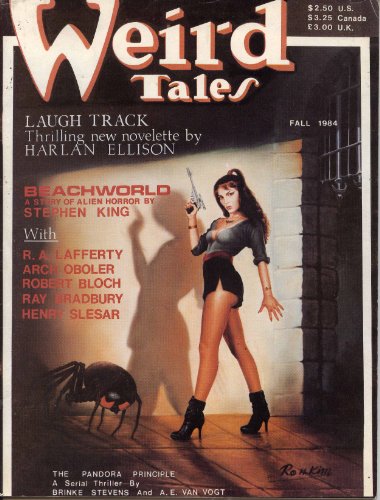
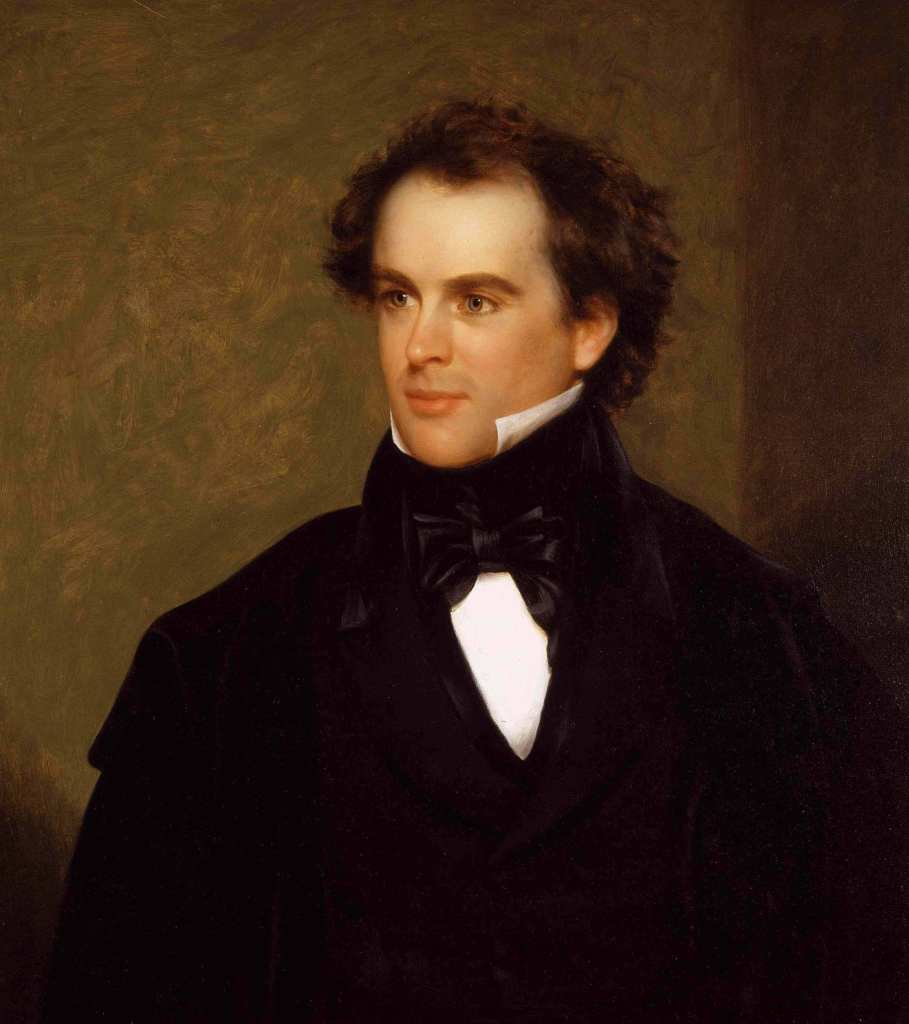


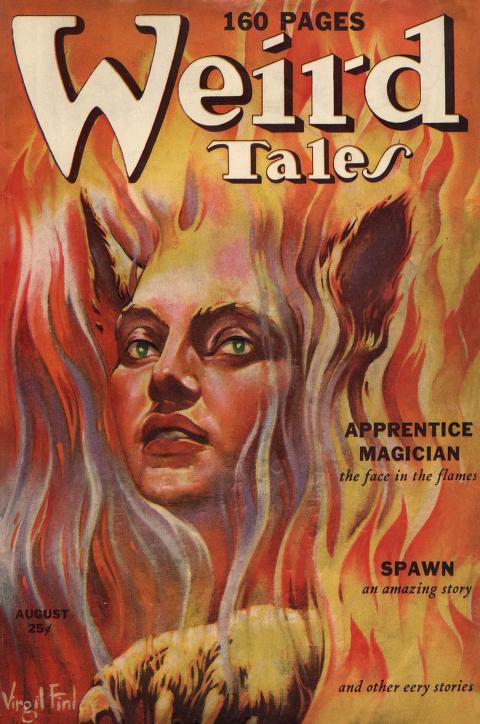



 Science Fiction & Fantasy Remembrance