It’s now September, or as I like to think of it, the month before October. Yeah, I don’t have anything special in mind for this. Summer is about to end, the kids have gone back to school, and I’m about to head back to work as I’m finishing up this post. As has become typical I’ve toyed around with what I’m gonna review repeatedly, right up to the last minute, because I cannot make up my damn mind sometimes. There’s so much fiction, especially short stories, to cover that I’m constantly going, “Hmm, I wanna check this out. But ohhh, what about THIS?” Much as I want to at times I can’t do everything I want in a day. I’m a slow reader and I don’t give myself the heavy loads of someone who gets paid for review columns.
Speaking of making a good use of your time, I recommend subscribing to a few SFF ‘zines; doesn’t matter too much which ones, although I’m biased and I think Uncanny Magazine and Lightspeed are very much worth supporting. Even buying the latest issues of The Big Three™ (Analog, Asimov’s, and F&SF) would be a much better use of your time and money than a no-good piece-of-shit (HBO) Max subscription.
Apparently Analog and Asimov’s now have their own digital subscription services, to compensate for the Amazon bullshit, so that’s great honestly. Not sure what F&SF is gonna do since, with all due respect, of The Big Three™ they’re the ones most “behind” with regards to adjusting to changing market forces. We’ll see what happens there.
So what reading materials do we have?
For the serials:
- The Reign of Wizardry by Jack Williamson. Serialized in Unknown, March to May 1940. From a historical perspective, Williamson has to be one of the most intriguing figures in American SFF, debuting in 1928 and more or less remaining active until his death in 2006. At his best he also proves to be one of the most gripping and thoughtful “Golden Age” authors. The Reign of Wizardry was Williamson’s first attempt at writing fantasy that was not in the Weird Tales mode.
- The Chronicler by A. E. van Vogt. Serialized in Astounding Science Fiction, October to November 1946. In the ’40s and early ’50s van Vogt was a star among genre readers, about on par with Robert Heinlein and Isaac Asimov—only since then his popularity has waned massively, for several reasons. A direct precursor to Philip K. Dick (by Dick’s own admission), van Vogt’s influence on the field is still discernable but now understated. He remains a divisive figure.
For the novellas:
- “The Earth Quarter” by Damon Knight. From the January 1955 issue of If. As author, editor, and critic, Knight did much to bridge the gap between ’50s SF and the New Wave, with his Orbit series proving the viability of original anthologies. But in the ’50s he was one of the finer short story writers, with such classics as “Four in One” and “To Serve Man.” “The Earth Quarter” was later revised for book publication, but we’ll be reading the magazine version.
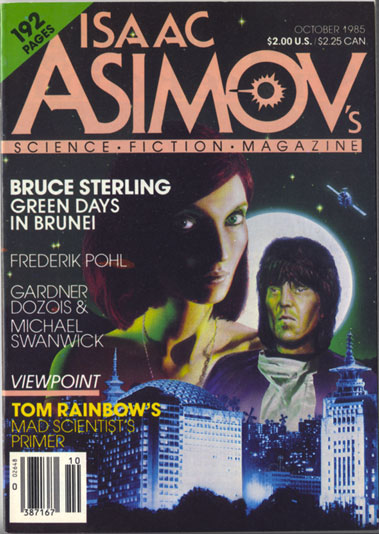
- “Green Days in Brunei” by Bruce Sterling. From the October 1985 issue of Asimov’s Science Fiction. Probably the most important writer of cyberpunk whose name is not William Gibson, much of Sterling’s work is actually not cyberpunk—at least in content. If Gibson codified the tropes that would define the movement, Sterling codified the attitude of cyberpunk, emphasizing the “punk” half of that word. Will be one of two Sterling stories I review this month.
For the short stories:
- “Forever to a Hudson Bay Blanket” by James Tiptree, Jr. From the August 1972 issue of Fantastic. Real name Alice Sheldon, Tiptree was one of the thorniest authors to come out of the New Wave, being much discussed for the outward feminism (and pessimism) of her work, the mystery of her true identity, and the tragic circumstances of her death. Tiptree made waves in the early ’70s, but I’m going for a relatively obscure story from that period.
- “Wong’s Lost and Found Emporium” by William F. Wu. From the May 1983 issue of Amazing Stories. Surprisingly, given how obscure a name he is, this is not my first time reading or even reviewing Wu. He must’ve been one of the first Asian-American authors to partake in magazine SFF, and yet he remains to be rediscovered. This story, for one, was up for the Hugo, Nebula, and World Fantasy Award, and it even got turned into a Twilight Zone episode.
Next month is when we’ll be doing all short stories and all spooky shit, so be on the lookout for that. In the meantime my review schedule is pretty normal and I assume nothing will be replaced last-minute.
Won’t you read with me?
 Science Fiction & Fantasy Remembrance