Let me tell you about monsters.
I love monsters of all sizes, although I have to admit I tend to prefer the giants that stalk whole landscapes. The bigger the better, but then “bigger” doesn’t always mean physical size. I love Frankenstein’s monster, especially Boris Karloff’s mildly talkative and rather emo depiction in Bride of Frankenstein, with his hungering for both love and death. I love Max Schreck’s Count Orlock in Nosferatu, who despite being modeled on Dracula seems to be almost more rat than man. I love the blob, especially in the 1988 version of The Blob—a mindless eating machine that digests people while they’re still alive. I love Godzilla, Mothra, Rodan, King Ghidorah, and even Hedorah, the walking turd that might be the strangest of Godzilla’s foes. I love the zombies of George Romero’s Dawn of the Dead and Day of the Dead, the shambling corpses who walk the earth in search of something they can’t put a rotted finger on. I think the creature from the black lagoon deserves a break (which he finally gets in The Shape of Water, a Best Picture winner!) and I think werewolves are SEXY.
Fantastical horror always involves monsters, even if they’re the theoretical ghosts of Henry James’s The Turn of the Screw. As such the stories I pick for review every October (and it will be every October for the foreseeable future) always seem to be monster tales at their core. It’ll be Halloween soon and we’re putting up the decorations. We’ll be seeing vampires, ghosts, zombies, werewolves, witches, black cats, and things from beyond that cannot be easily classified. Because I believe horror, more than any other genre, benefits from brevity, we’ll be doing all shorts again. These are rapid-fire terrors that hopefully will ignite the imagination.
We have the usual suspects: Weird Tales, Twilight Zone Magazine, The Magazine of Fantasy and Science Fiction. Certain outlets have served as safe havens for short horror fiction through the decades, and admittedly I would feel weird if I were to not include a selection from something as foundational as Weird Tales. Some traditions ought to be respected.
Here are the stories:
- “Not Our Brother” by Robert Silverberg. From the July 1982 issue of Twilight Zone Magazine. We’re starting with someone who probably doesn’t come to mind when one thinks of horror, although Silverberg’s work can sometimes evoke existential dread. Having made his debut in the early ’50s and still active in fandom, Silverberg has had one of the longest careers of any writer—inside or outside the field. This is a rare example of him doing straight terror.
- “Nightmare Island” by Theodore Sturgeon. From the June 1941 issue of Unknown. I consider Sturgeon one of the finest short story writers of the 20th century, and a major inspiration. Without Sturgeon and those like him this site probably wouldn’t exist. While most associated with SF, Sturgeon wrote a good deal of horror, including the stories “Bianca’s Hands,” “Bright Segment,” and the novel Some of Your Blood. This one is from very early in Sturgeon’s career.
- “The Naturalist” by Maureen F. McHugh. From the Spring 2010 issue of Subterranean Online. McHugh won a Hugo for her alternate history story “The Lincoln Train,” and her debut novel China Mountain Zhang is one of the cult classics of ’90s SF; but her range goes well beyond alternate history as she has proven herself to be quite versatile over the last 35 years. “The Naturalist” looks to be a rare horror turn from McHugh, having to do with zombies.
- “The Ancient Mind at Work” by Suzee McKee Charnas. From the February 1979 issue of Omni. I had a bad first experience with Charnas a couple years ago, but have been meaning to give her another shot since her reputation is solid and her devotion to the weird is unquestioned. “The Ancient Mind at Work” was Charnas’s first short story, although she already had two novels in print. It would then be absorbed into the fix-up novel The Vampire Tapestry.
- “Pipeline to Pluto” by Murray Leinster. From the August 1945 issue of Astounding Science Fiction. Here we have another surprising inclusion, given Leinster isn’t normally associated with horror. He first started writing genre fiction in 1919, predating even Weird Tales. What’s surprising is that not only did he stay relevant several decades into his career, but he peaked in the ’40s and ’50s, holding his ground against writers a generation younger than him.
- “Brenda” by Margaret St. Clair. From the March 1954 issue of Weird Tales. I covere St. Clair only a few monthss ago, but she’s back already. She wrote a lot in a relatively short span of time (mostly from the late ’40s to the late ’50s), and during that time she was arguably one of the best short story wrriters in the field. Not one to be tied down to any single genre, or even any mode of writing, St. Clair swerved effortlessly between pulpy and more refined prose.
- “Jedella Ghost” by Tanith Lee. From the September 1998 issue of Interzone. One of two returning authors from last October, because honestly I wanna taste more of what Lee has to offer before forming a real opinion; that and she’s such a prolific and consistently spooky writer that her well never runs dry. I’ve read one or two of her stories since our last encounter (which admittedly did not enthuse me) and I think I’m starting to get what her deal is.
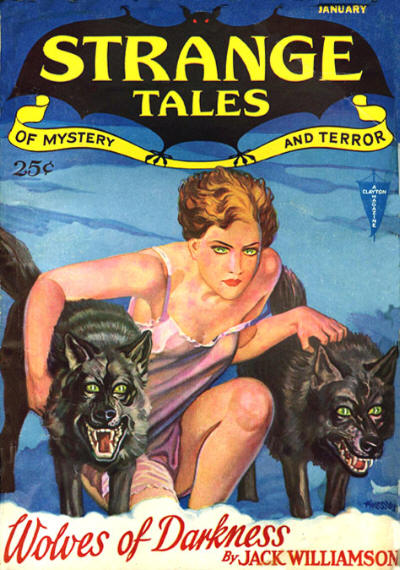
- “The Door to Saturn” by Clark Ashton Smith. From the January 1932 issue of Strange Tales. The other returning author from last year’s Spooktacular, and this time it’s because I do love me some Clark Ashton Smith. While he can sometimes phone it in, Smith’s writing is often vibrant, poetic, and deeply enchanting—like a wizard casting a spell. Here we have a story set in his Hyperboria universe, a land where sorcerers and dark gods are in charge.
- “The Last Feast of Harlequin” by Thomas Ligotti. From the April 1990 issue of The Magazine of Fantasy and Science Fiction. We’re ending with what has to be the longest story of the bunch, but it’s by one of those rare modern masters of horror. Ligotti is not the most popular writer in his field, but those who read him hold him in the highest regard. A devout student of Lovecraft, Ligotti’s fiction can be disturbing by way of implication, as opposed to violence.
Won’t you read with me?
 Science Fiction & Fantasy Remembrance
One response to “Things Beyond: October 2023”
Nice post
LikeLike