Who Goes There?
A name I would not have expected to see during spooky season, and I’m the one who came up with this whole thing. Murray Leinster got his start way back—like back even before Amazing Stories and Weird Tales. He debuted in the 1910s and only stopped about five years before his death in 1975; a scareer spanning over half a century is impressive on its own, but also consider the radical changes happening in genre SF during that time. Most of the writers who were popular in the ’20s and early ’30s failed to make the transition with John W. Campbell’s takeover of Astounding, but Leinster, if anything, got better during that transition phase. Leinster was pushing fifty in 1945, and whereas most writers by that age would rest on their laurels, his career was about to have its Indian summer.
1945 was kind of a turning point for Leinster, whose fiction not only rose in quality but also, shockingly, there would be more of it. It’s here that we get two of Leinster’s most famous short stories, “First Contact” and “The Ethical Equations,” both being about dilemmas and space travel. “Pipeline to Pluto” is also about voyaging across the stars (well, across our solar system), but it does not have the humanistic touch of “First Contact.” No, this is a savage story for Leinster—uncharacteristically so. Not burying the lead this time, so I’ll say now that this is a short and brutal yarn, and genuinely creepy despite the fact that I’m not sure if I would call it “horror.”
Placing Coordinates
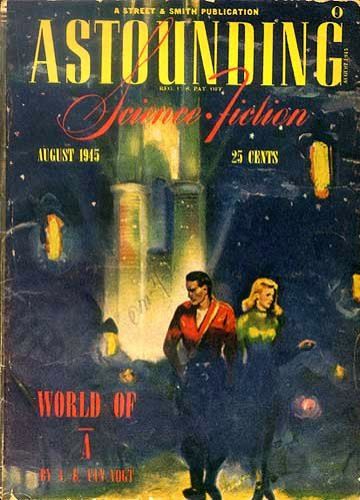
First published in the August 1945 issue of Astounding Science Fiction, which is on the Archive. It was then reprinted in Science Fiction Terror Tales (ed. Groff Conklin) and the Leinster collections The Best of Murray Leinster and First Contacts: The Essential Murray Leinster. Honestly, if not for that one anthology appearance, this would not have blipped on my radar as something appropriate for October.
Enhancing Image
The good news (I suppose) is that there’s a mining colony on Pluto, but the bad news is that the distance between Earth and Pluto is unfathomably long, such that space shuttles are expensive—too expensive just to ship cargo to and from the planets. Thus we’re introduced to the carriers: unmanned ships that cruise at low inertia, one lane heading to Pluto, the other heading back to Earth. It saves money on shipping cargo, but the carriers are also slow as shit, with a trip one way taking about three years. The thing is that there’s one carrier landing on Pluto and one landing on Earth every day, or so that’s the estimation. Mining on Pluto is tough work but its pays well, and some people will try to forego a costly shuttle trip and get to Pluto through “the Pipeline,” on one of those carriers as a stowaway.
Remember that this was written a mere fifteen years after Pluto was discovered and 24 years before the moon landing—before people had any idea how expensive space travel would actually be. (Read: It would be a lot more expensive than as depicted in the story.)
Enter Hill, a scruffy blue-collar guy who talks like a 1930s gangster and who doesn’t wanna give up the money for a proper shuttle. He meets up with Crowder, who works at the carrier shipyard. Hill knows people can bribe their way into getting on a carrier and Crowder knows he himself is the sort of person who can be bribed. There is one thing Hill knows that Crowder doesn’t, but we’ll get to that in a minute. Apparently Hill managed to buy another guy’s “ticket” for the carrier and he’s desperate to get on, seemingly at any cost. Of course it costs money to get food and enough shelter for the trip, but Crowder says he can arrange that.
At first I thought maybe characters were just gonna talk a certain way in this story (the ’30s gangster thing), but Crowder and his crony Moore talk more or less like normal people. Leinster lays Hill’s accent on rather thick, but it’s to show that this man has done his time—probably hard time. We get the gist with Hill pretty quickly, and while he’s definitely framed as an anti-hero, there is a nasty little trick Leinster has hidden up his sleeve about him. The characters in “Pipeline to Pluto” are not dull, but they’re also function-only in the sense that they exist to serve the plot. With the exception of what the third-person narrator grants us (some pretty important information, mind you), this could work as a one-act play.
About that narration, though. It’s during Hill’s talk with Crowder that we break away to get a rather long exposition dump about the very short history of stowaways on the Pipeline and the effects of traveling in what amounts to a huge tin can in space. The results are very bad. This sounds obvious to us now, but people can be surprisingly ignorant about the fact that space is a vacuum; then again, one would think the characters here would be aware of those effects. I can’t go further without getting into spoilers, but I’ll say that Leinster does something rather unusual here in he gives us, the reader, info via narration that (so we’re led to believe) the characters might not be aware of. The characters all know more than they let on, but that’s where the story gets really spicy—and a little scary.
There Be Spoilers Here
So Hill is unaware that he’s being set up for a death trap, right? WRONG. He had gone to this same shipyard a year prior, trying to pay his way into one of the carriers, and luckily for him his carrier had gotten picked up by the so-called Space Patrol not long after takeoff. Hill did hard time for that, sure, because what he did was illegal, but he survived on account of not being subjected to the harshness of space for long. He discovered the effects of space travel without proper protection first hand, and so he knew that other stowaways were being sent unknowingly to their deaths. Of course, whether those stowaways lived or died was of no concern to the guys who made money off of it. Crowder, Moore, and Slim the security guard (who’s implied to be in on the racket) would not remember Hill, considering he’s just one of dozens of people they sent off in metal coffins, but Hill sure does remember them. And he has a plan in mind.
What exactly happens when you’re in one of those carriers?
The hundred-foot cylinders drifting out and out and out toward Pluto contained many stowaways. The newest of them still looked quite human. They looked quite tranquil. After all, when a carrier is hauled aloft at four gravities acceleration the air flows out of the bilge-valves very quickly, but the cold comes in more quickly still. None of the stowaways had actually suffocated. They’d frozen so suddenly they probably did not realize what was happening. At sixty thousand feet the temperature is around seventy degrees below zero. At a hundred and twenty thousand feet it’s so cold that figures simply haven’t any meaning. And at four gravities acceleration you reach a hundred and twenty thousand feet before you’ve really grasped the fact that you paid all your money to be flung unprotected into space. So you never quite realize that you’re going on out into a vacuum which will gradually draw every atom of moisture from every tissue of your body.
The ending, thus, is pretty satisfying, if also grim. Hill gets the upper hand on the three racketeers and ties and gags them inside the carrier they were supposed to put him in. Hill is taking vengeance for himself, but also the dozens of people who took a one-way ticket to Pluto, unaware of the effects of exposure to cold vacuum. Leinster pulls a neat trick on us by revealing the story to be a revenge narrative when we were led to believe it would be something more coldly scientific—maybe about the wonders of the Pipeline. Or hell, have the twist be that Hill has fallen for a racket and gets sent to his doom, but maybe that was too obvious for Leinster. It helps that the story does not overstay its welcome.
A Step Farther Out
Is the science outdated? Absolutely. Doesn’t really bother me if the story is good. I’m not someone with a scientific background, nor am I really a science enthusiast; if bad science doesn’t get in the way of a good story then I’m fine with it. It’s about ten pages but it establishes a future method of space travel, its logical implications, some characters, and with a savage twist to boot. Short and bitter, you might say. I will say, however, that “Pipeline to Pluto” is not a good place to start with Leinster, because it’s very much an outlier as far as his science fiction goes. This is something to check out if you’re curious about a side of Leinster we don’t normally see.
See you next time.
 Science Fiction & Fantasy Remembrance