Christmas is coming up, and my birthday before that. Not incidentally we have a birthday among the authors covered, namely Connie Willis, whose birthday is the 31st. Willis is also very fond of Christmas stories so there’s that. Last December we did a month-long tribute to Fritz Leiber, who sadly will not be featured this time. (Don’t feel too bad, he’s already one of our most frequent “visitors.”) Since we’re closing out the first full year of this site, I figure it’s time to introduce one more major change (not permanent, don’t worry), not for this month but for January. December will be the last month probably until 2025 that I’ll be doing serial reviews; for 2024 I’ll be taking a break from serials and focusing on short stories and novellas, although I’ll still squeeze a few complete novels into the schedule.
The way it’ll work is, the days I would be reviewing sserial installments will instead be relegated to short stories, but otherwise the alternating slot method will not change, only starting in January you can expect to see two short stories for every novella. The space given to complete novels will remain the same: if a novella slot were to fall on the 31st of the month then I’ll at least try to tackle a complete novel. Why no serials for a year? For a few reasons. For one, I’m tired, and also I’ve come to find that my serial reviews are the least popular of my reviews, or rather they get the least feedback. Also, I’m a devotee of the short story at heart, and the reality is that there are way more short stories in the magazine market than serials, by at least a factor of ten; so for one year I think short stories deserve more of the glory. We do, of course, get two short serials to tackle before the hiatus, both of which are actually rereads for me.
There is one other thing I have in mind, a rather special thing, but you’ll have to wait until January to hear about it. It’s a secret. :3
For the serial:
- Three Hearts and Three Lions by Poul Anderson. Serialized in The Magazine of Fantasy and Science Fiction, September to October 1953. Retro Hugo nominee for Best Novella. This is the first serial I’ll be covering where I’ve not only read the book version but also the serial version, so this is sort of my third go-around with it. It’s worth it, though; this is one of the more influential works in the history of American fantasy, having partly inspired Dungeons & Dragons. It also makes me wish Anderson wrote more fantasy.
- Beyond the Black River by Robert E. Howard. Serialized in Weird Tales, May to June 1935. Despite committing suicide at the age of thirty, Howard wrote a truly staggering amount of fiction and created several series in the process, with his most famous creation being Conan the Cimmerian. Howard did not invent sword-and-sorcery fantasy but he had unquestionably the most influence on proceeding American fantasists. This right here was one of the first Conan stories I had read, and it still reads as one of the more unusual.
For the novellas:
- “Pursuit” by Lester del Rey. From the May 1952 issue of Space Science Fiction. Del Rey started out as a sentimentalist at a time when genre SF was markedly unsentimental, filling a niche that had gone untapped such that early stories like “Helen O’Loy” and “The Day Is Done” were very popular. He would move away from that style, and in the ’50s he even edited several (very short-lived) SFF magazines, Space Science Fiction being one. Thus the first story in the first issue of this magazine is by del Rey’s favorite writer: himself.
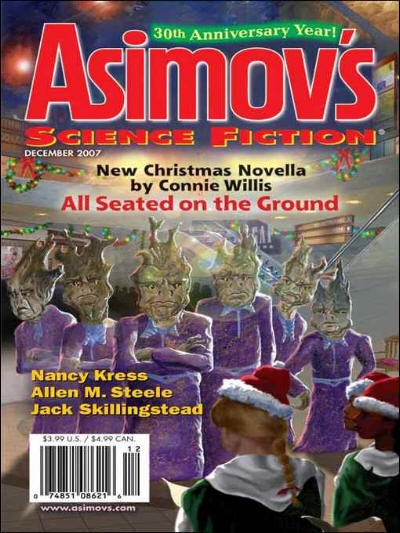
- “All Seated on the Ground” by Connie Willis. From the December 2007 issue of Asimov’s Science Fiction. Hugo winner for Best Novella. In the ’90s and 2000s Connie Willis could lay claim to being the most popular writer to appear regularly in Asimov’s, and that’s on top of her novels, a few of which are certified classics. Her novel Doomsday Book especially is excellent, although it does not indicate her penchant for humor. She holds the record for most Hugo wins for Best Novella, with “All Seated on the Ground” being her fourth.
For the short stories:
- “The Keys to December” by Roger Zelazny. From the August 1966 issue of New Worlds. Zelazny looks like he might see a much deserved renaissance soon, with a TV adaptation of his Amber serie being in the works. This is good news, because for a couple decades Zelazny has been threatened with the dark cloud of obscurity, despite being one of the most acclaimed SFF writers to come out of the ’60s. I picked “The Keys to December” because, well, look at the title.
- “Genesis” by H. Beam Piper. From the September 1951 issue of Future Science Fiction. Piper is surely one of the most tragic figures in old-timey SF, having started his writing career very late (he was in his forties) and committing suicide at the age of sixty, believing himself to be a failure, such that despite not dying young his career was short-lived. It’s a shame, because Piper was in some ways an unusual writer for the time; he was a bit of a character, one could say.
For the complete novel:
- Lest Darkness Fall by L. Sprague de Camp. From the December 1939 issue of Unknown. From 1937 to 1942 (he took a break to support the war effort), de Camp was one of the designated court jesters in John W. Campbell’s Astounding, and perhaps more importantly in Unknown. It was here that de Camp got to show off his range as a fantasist (most famously in his collaborations with Fletcher Pratt), although ironically his two longest solo efforts in Unknown in its first year, Divide and Rule and Lest Darkness Fall, are science fiction, not fantasy. Lest Darkness Fall was de Camp’s solo debut novel, an early example of a modern person being sent back to an ancient time period, and according to a lot of people it’s also his best. It was expanded (although I can’t imagine by much, since the magazine version looks to be a solid 50,000 words) for book publication in 1941.
You may think it a weak move for me to have my last two serial reviews before the hiatus be of ones I’ve already read, but as I’ve said before and always hope to make clear, rereading is arguably more important than reading in the first place. So it goes.
Won’t you read with me?
 Science Fiction & Fantasy Remembrance