Who Goes There?
A doctor by day and a bestselling author by night, F. Paul Wilson has had a long and pretty acclaimed career since he debuted in the early ’70s, being one of John W. Campbell’s last discoveries. His fiction can be basically divided into SF and horror, although the two are not mutually exclusive. He has the unique honor of earning both the Bram Stoker and Prometheus Award for Lifetime Achievement, for his horror and libertarian-themed SF respectively. His 1981 novel The Keep was adapted into an ill-fated Michael Mann film. “Traps” itself was apparently adapted into a short film, but I can’t find anything on it. This story is Wilson in pure horror mode, almost written in the allegorical mode but seemingly lacking a moral at its center. It’s an effective little short, and unsurprisingly it got a Stoker nomination. It could’ve worked as an episode of Tales from the Darkside, which is probably not a reference you were expecting.
Placing Coordinates
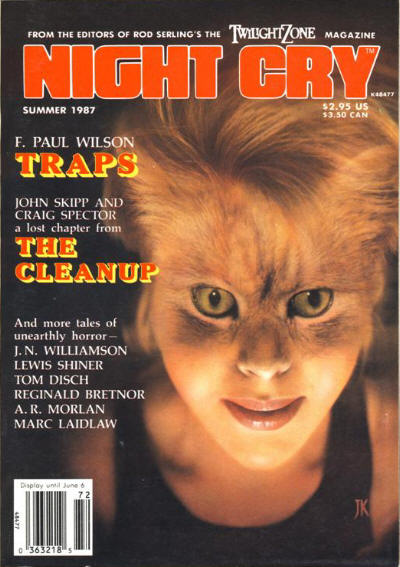
First published in the Summer 1987 issue of Night Cry, which was a reprint-oriented sister mag to Twilight Zone Magazine. It’s not on Internet Archive, but it is on Luminist. It then appeared in the Wilson collections Soft and Others and Ad Statum Perspicuum. For anthology appearances we have 100 Fiendish Little Frightmares (ed. Stefan Dziemianowicz, Martin H. Greenberg, and Robert Weinberg) and Piercing the Darkness: A Charity Anthology for the Children’s Literacy Initiative (ed. Craig Cook).
Enhancing Image
This story is not quite ten pages, so let’s get right into it. Hank is a do-gooding husband with twin daughters, and the family has recently moved into a rural-ish Jersey suburb where their house is one of maybe two on the street. (Incidentally the first house I lived in was similarly one of the first in a new development, and also in Jersey.) The scenery is nice, but the problem is with all the critters, which Hank is loathe to deal with. “He didn’t like killing anything. Even ants. Live and let live was fine with him, but he drew the line at the threshold of his house.” There’s especially been a mice problem, in the attic, with one of those hatches that unfurls a set of steps. Let’s face it, no one likes to go into the attic for whatever reason, although I would say the older the house the creepier the attic becomes. More history that way. In Hank’s case he’s had to take pains to set up mousetraps in the attic, and he has to do all this in secret so as to not traumatize his young daughters, who are big Mickey Mouse fans and who are set to go to Disney World very soon. “Kids had Disney World on the East Coast and Disneyland on the West. Katie and Kim would start out on their first pilgrimage Thanksgiving morning.” And yet there was still the mice problem.
The business is already morbid enough, but things get weird when Hank finds the traps are working—and also only the heads of the mice remain. The bodies are missing, or more accurately something must’ve taken the bodies. “Something had eaten the dead mice. Something bigger than a mouse.” And there’s an awful smell slowly growing from the attic that can’t just be rodent corpses. What’s neat about “Traps” is how economical it is: there’s barely any dialogue; there are only four characters to speak of, only one of whom really matters; we’re given a gruesome if technically mundane situation, only for there to be a twist in the routine; and we’re given a reason for why Hank would be going about this by himself. This all happens in the span of a few pages. Let’s talk about what David G. Hartwell, in his seminal anthology The Dark Descent, considered the three basic classes of horror: allegorical, psychological, and supernatural. Obviously, as Hartwell admits, the three are not mutually exclusive, and indeed with a lot of stories you’ll find some balance of two of these classes. “Traps” reads almost like an allegory, with some kind of moral message the reader is supposed to take away from it—only there doesn’t seem to be one. It does, however, work similarly to a fable you might read aloud to your children. Not that I’d recommend showing “Traps” to kids unless you wanna make sure they get no sleep for a few days; but then it could feasibly be understood by a younger readership, since Wilson’s style is straightforward, concise yet gripping, and while there’s violence it’s not too graphic.
Then there’s the psychological aspect. We can infer that whatever lurks in the attic is probably not a racoon or badger, but another part of the sense of looming doom is Hank listening for the mousetraps as they go off with a snap, often in the dead of night, and having to check the results the next morning. to make things worse, something has been sneaking into the attic through a vent, which Hank has to nail shut in the hopes this does the trick. At this point I would’ve forked over the money to hire an exterminator, but a) this is on short notice, since the family’s leaving for Disney World in a few days, and b) with hindsight it’s safe to say an exterminator wouldn’t have been able to help much with the thing in the attic. Our normal everyman Hank is thus faced with a dilemma: he could call someone take care of the issue, to the inconvenience and possible trauma of his family, or he could try taking care of the problem himself. Ultimately he goes with the latter, which turns out to be a very bad idea—which if you’re familiar with horror tropes you would’ve guessed already. “Traps” is the kind of setup-payoff horror story that’s determined to end on a bad note for the protagonist, but it’s the execution that matters most here.
There Be Spoilers Here
I said earlier that “Traps” fits primarily into the allegorical and psychological classes of horror, but this isn’t quite true as we do get a quick dose of that third class at the very end. Hank, seeing that something had come through the vent, is understandably worried about this. Unfortunately for Hank and even more unfortunately for his family, as he had left the hatch to the attic open, a monster, “big as a rottweiler, brown scruffy fur, a face that was all mouth with huge countless teeth, four clawed arms extended toward him as it held onto the beams above with still two more limbs,” killing him all but instantly. In the last seconds of his life realizes two things: that he’s being killed by some unspeakable horror he could not have possibly anticipated, and that he has unwittingly and probably doomed his family to being eaten by the same creature. This all happens in literally the last paragraph of the story, and I have to admit in the couple days since I read “Traps” this ending has stuck with me, for its suddenness and inexplicableness. There’s no reason (at least none I could pick up) for why there should be a six-limbed carnivore the size of a large dog and with about as many teeth as a shark should exist and be living in this family’s house specifically. It’s a complete break from reality that the story alludes to heavily and yet does not try to rationalize. The result is an ending that I find disturbing, for its implications but also for the sheer nightmarish quality of it.
A Step Farther Out
Wilson has been prolific for the past half-century and change, although sadly he has written relatively little short fiction. It’s a shame because the standalone horror stories I’ve read of Wilson’s have all been pretty strong. “Traps” is short, almost a vignette, but it has a finely laid out setup-and-payoff structure that makes the ending so disturbing, even if it’s also predictable. You can write horror that the reader can anticipate and get away with it so long as you effectively discomfort the reader as they await the inevitable. It’s stuck with me the more I’ve thought about it.
See you next time.
 Science Fiction & Fantasy Remembrance