(Contains spoilers for “The Birthmark,” “Rappaccini’s Daughter,” and “The Artist of the Beautiful.”)
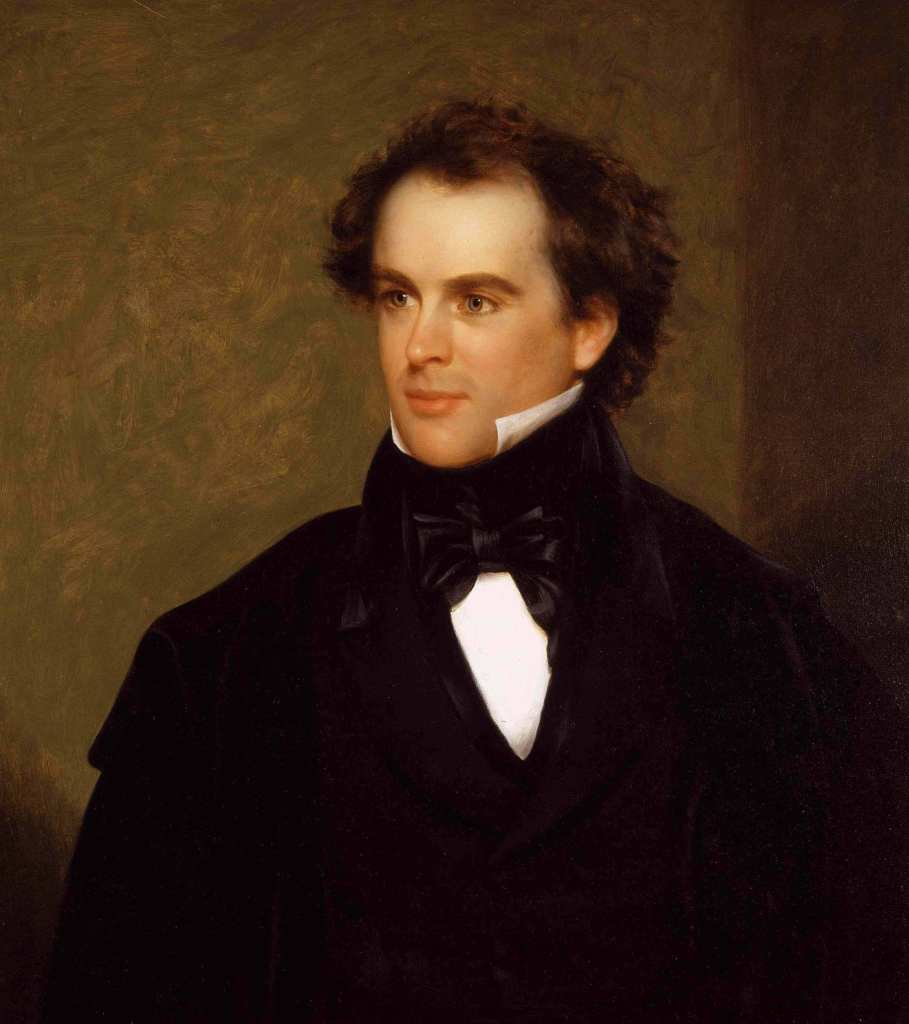
We’re here to talk about some “classic literature,” which I understand tends to fall outside genre confines for a lot of people. After all, genre SF, or indeed science fiction as a codified genre, did not exist in Nathaniel Hawthorne’s lifetime; and yet he, along with a few contemporaries, contributed massively to what we now call science fiction. Hawthorne is one of the undisputed canonical American authors, and he was also one of the first, having been born on July 4th, 1804, at a time when the US had not even started really to foster its first generation of “canonical” literature. When Hawthorne started writing his first major work in the 1830s the literary landscape in the US was basically at the stature of a toddler; and despite having already written a novel (one that nobody talks about and which Hawthorne went out of his way to disown), he would dedicate two decades of his life to mastering just the short story. The Scarlet Letter is one of the most famous (if divisive) American novels of all time, but when it was published in 1850 Hawthorne had already garnered a reputation as a master of short fiction; and like his direct contemporary Edgar Allan Poe he often wrote stories that would now be considered horror, fantasy, and/or SF. There’s a reason Lovecraft, in his “Supernatural Horror in Literature,” singled out Hawthorne as a major pioneer in weird fiction, even calling his borderline supernatural novel The House of the Seven Gables a masterpiece.
If I were to talk about Hawthorne’s horror fiction then I would really have my work cut out for me, given how much of his material is horror; but today we’re here to talk about three of his short stories, all of which could be considered SF, and all of which involve some kind of mad-scientist figure. The truth is that had Mary Shelley not beaten him to the punch by a few decades then the popular conception of the mad scientist would probably be much more based on Hawthorne’s conceptions—and to a degree those conceptions have still left a footprint on the popular consciousness. Had things gone a bit differently we might call a scientist who plays God a Rappaccini instead of a Frankenstein. The three stories—”The Birthmark,” “Rappaccini’s Daughter,” and “The Artist of the Beautiful”—were all published over a span of two years (1843 and 1844), and the SF Encyclopedia singles them out as masterpieces of early SF. There’s a good reason for this. While not officially connected with each other in any way, the three stories are thematically conjoined at the hip, on top of featuring variations of the same character type: the scientist in search of perfection. These are also stories that happen to show Hawthorne at the top of his game, being some of his most tightly composed and insightful work, and showing a seriousness that would be missing in the early days of genre SF a century later. Mind you that this is not a review: I very much recommend all three stories. We’re gonna be doing some analysis, specifically in how Hawthorne conceptualizes scientist characters at a time when “the sciences” as different fields of discipline were only then starting to splinter, and indeed some hadn’t even been founded yet. This was a time before Darwin’s theory of evolution and our modern understanding of genetics, for example, such that “science” in 1843 might now sound almost like mysticism.
I read each of these stories in order of how they appeared in the Hawthorne collection Mosses from an Old Manse, so let’s talk about “The Birthmark” (or “The Birth-Mark” as it’s also titled) first. This is one of Hawthorne’s most reprinted stories, and given its simplicity and economy of style it’s easy to see why it’d be one of the more popular choices. There are only two main characters (plus a singular supporting character I’ll get to in a minute), trapped together in basically one room. Aylmer is a research scientist, living at some point in the late 18th century, with his wife Georgiana, a perfectly submissive woman who nonetheless is insecure about a hand-shaped birthmark on her cheek which renders her, at least to her husband, just imperfect enough as to be tragic. We’re told Georgiana is as conventionally attractive a woman as one can think, almost perfect in her beauty—almost. This single imperfection (clearly supposed to be the hand of Nature on her cheek) is enough to make Aylmer neurotic, and to propose a series of experiments in order to remove the birthmark, which Georgiana agrees to. Aylmer’s assistant, Aminadab, suggests that the experiment would be a bad idea, but remains loyal to his master. Aminadab is a curious figure, since he has to be one of the first examples of the mad scientist’s impish assistant in SF, serving as a predecessor to the likes of Fritz in the 1931 Frankenstein movie and Igor elsewhere. (Remember, Dr. Frankenstein did not have such an assistant in the novel.) Of course, Aminadab is not very impish; if anything he serves as a symbol of “earthy” wisdom to contrast with Aylmer’s blinding bookishness. Aylmer is not evil by any means, but he turns out to be tragically misguided, perhaps driven by the fact that he loves his work more than his wife, or as the narrator posits, he is unable to untangle his love for his wife from his love for science.
“The Birthmark” is a parable that has quite a bit going on within its almost brutally simple confines. It’s a story about man’s vain pursuit to overthrow Nature (and for Hawthorne it’s always Nature with a capital N), which will become a bit of a running theme here. It’s also about the futile pursuit of obtaining perfection, which of course Aylmer and Georgiana can’t have. Aylmer’s borderline abuse of his wife and the narrative’s sympathy for Georgiana’s insecurity arguably reads as proto-feminist, especially now that we’ve become much more aware of women having unrealistic beauty expectations thrust upon them; indeed the seeming “need” for perfect beauty is so prevalent that despite the quasi-Shakespearean dialogue and dense expository paragraphs, very little has aged about any of these stories in terms of their concerns. Of course Aylmer is able to remove the birthmark, but Georgiana quickly becomes ill and dies on the operating table; obviously if we’re being pedantic the removal of the birthmark shouldn’t have been able to kill her, but it’s meant to be symbolic. Prior to the climax, Georgiana alluded to being connected with the birthmark in some spiritual fashion, such that if the birthmark were extinguished then her a soul might go with it—a possibility Aylmer doesn’t quite heed. For a brief moment he renders Georgiana “perfect,” but as will become apparent if one reads his other fiction, Hawthorne thinks of perfection as something that can only last for a single moment—if it’s possible at all. Aylmer is a tragic hero in that he has good intentions, or at least thinks he has good intentions, but is unable to do away with Nature’s imperfection.
Now we have possibly Hawthorne’s most famous short story with “Rappaccini’s Daughter,” which despite being a fair bit longer than either of the other stories is still very much a parable. I should probably mention that I suspect the biggest reason why more people don’t enjoy Hawthorne nowadays is that he was not a realist; he often wrote in the allegorical mode, itself having apparently gone out of fashion in recent decades. Nobody likes being moralized at, and Hawthorne did quite a bit of moralizing; but he was also very good at it, such that his skill goes undervalued now. It’s quite possible that had Frankenstein not been published a quarter-century earlier that our conception of what a “mad scientist” even looks like might’ve been more informed by Hawthorne’s Rappaccini—an ironic fact, considering Rappaccini himself barely appears in his own story and we don’t even get any dialogue from him until the climax. We do, however, see a great deal of Rappaccini’s work, including his experimental botanical garden, an “Eden of poisonous flowers,” and his daughter Beatrice, who manages said Eden. We move off to Italy, where a young man named Giovanni gets caught in a rivalry between two physicians, Baglioni and Rappaccini, and Giovanni himself becomes deeply fascinated with Beatrice. I could be wrong, but this might be the earliest example of the “mad scientist’s beautiful daughter” trope in fiction; I certainly struggle to think of anything that could’ve predated it. There is a problem with Beatrice, aside from the fact that she’s socially inept: she’s poisonous, such that even her breath can kill. After years of exposure to the garden Beatrice has become immune to the poisonous plants around her—the tradeoff being that she has become poisonous to everything else. Well, nobody’s perfect.
Of Hawthorne’s mad scientists, Rappaccini is by far the most villainous and the least human, so it’s fitting he’s the only one who serves as a proper antagonist. Rappaccini’s sinister nature is amplified by the fact that we get to know very little about how this whole situation came to be. We never find out what became of Mrs. Rappaccini and we never get a clear answer as to why Rappaccini would use his own daughter as a kind of living experiment, or why he built his garden so that it would resemble a kind of inverted Eden—a place where nothing is allowed to live except that which kills. Maybe the point of making Beatrice immune to the poisonous plants of the garden was to make her, quite literally, immune to what Rappaccini considers the evils of the world—the killing things which Nature produces. Beatrice has become so perfectly immune, and herself so perfectly poisonous, that the result is idealistic—if only in a way that would strike the average person as perverse. Not that Hawthorne’s writing tends to be subtle, but “Rappaccini’s Daughter” might be one of his most overtly religious works in how intensely (and masterfully) it harks to Biblical mythology, to such a degree that even the verbose style of the prose seems to be the spawn of Milton and the King James Bible. (Naturally there are also references to The Divine Comedy.) Rappaccini is a man who clearly thinks of himself as akin to God—a demiurge who has created an inverted and treacherous Eden of his own. If Rappaccini is the demiurge, a counterfeit God, then Baglioni is like the snake in Eden, but made ultimately good, such that his foiling of his rival involves making Giovanni immune to Beatrice’s own poison—an antidote that, tragically, results in her death. The villainous striving for perfection, the “paradise” of the garden, has been lost.

The last of these stories is not as famous as the others, nor was it reprinted in genre magazines as a classic—all a shame, since it’s arguably the strongest of the bunch. I was stunned a bit when I had first read “The Artist of the Beautiful” a year or so ago, which as its title suggests is an incredibly tender parable. It must be said, though, that the protagonist of this one is not, strictly speaking, a scientist. Owen Warland is young watchmaker who has just finished his apprenticeship under Peter Hovenden, a capable but conventional-thinking watchmaker who doesn’t see the value in Owen’s idealism. Working on little machines is all well and good, but Owen wants to make something beautiful, something with real aesthetic value that will stick in the mind long after its practical function has expired. In other words, he wants to be an artist. In “The Birthmark” we saw the scientist-as-destroyer; in “Rappaccini’s Daughter” we saw a villainous take on the scientist-as-creator; but in “The Artist of the Beautiful” we see the scientist-as-artist. Indeed it’s here, in this tightly constructed little story, that Hawthorne most neatly marries art with the sciences. Owen’s growing obsession with making something small and yet perfect could serve as analogous with Hawthorne’s own obsession with perfecting the short story. After all, “the beautiful idea has no relation to size.” This proves to be a very hard task for Owen, though, and he gives up a lot to achieve his vision, having lost his chance with Peter Hovenden’s daughter Annie and having become an outcast. There are false starts, and he even gives up watchmaking to focus on his secret project, mooching off an inheritance in the meantime. For all intents and purposes, Owen shuts out the human world; but the same can’t be said of Nature, which he becomes more fascinated with…
The scientists of the previous two stories thought that in some way they could conquer Nature—Aylmer to remove Nature’s imperfections and Rappaccini to bend Nature to serve his own ends. If Owen is redeemed by anything it’s his willingness to acknowledge Nature’s—maybe “superiority” is not the right word, but Nature’s status as the immovable object, not to be destroyed or pushed aside by human hands. So rather than try to conquer Nature, Owen instead takes inspiration from it, perhaps with the expectation that he won’t be able to reach perfection—but he can get very close, if only for a prolonged moment. Even if only a few people get to see his creation before it falls apart in their hands. The mechanical butterfly, an early example of a robot in fiction, is tiny, yet perfectly designed. It has no practical utility, but it exists seemingly for the sake of being a wonderful little work of art, not to mention what would’ve been a technological marvel. Post-industrial technology rarely comes up in Hawthorne’s fiction, partly because he actually lived through the industrial revolution and partly because his fiction tends to take place in what would’ve been the distant past, even from the perspective of 1840s New England. Owen’s mechanical butterfly thus stands out as a rare example for Hawthorne of what we even today would call modern technology, but it’s also an example of science and art coming together to imitate Nature—not to replace it but to take inspiration from it. The ending is bittersweet, as Owen’s creation which he had toiled over for months crumbles, but it strikes me as a kind of spiritual victory for the “scientist” here. If Aylmer was misguided and Rappaccini villainous, then Owen, the scientist-as-artist, comes out the victor.
Hawthorne wrote more SF than just these three stories, of course, although SF would still only take up a small fraction of his output, for I think at heart he was really a horror writer. There is some overlap between the genres he played with, though, and it shouldn’t be too surprising that “The Birthmark” and “Rappaccini’s Daughter” were reprinted in Weird Tales. Poe certainly wrote more SF, but far more than Poe I think Hawthorne set a standard for how we (people who, for the most part anyway, are not scientists at all) think about scientist characters in SF. Poe’s protagonists are often misfits, adventurers, schemers, and other archetypes Poe may or may not have admired; but Hawthorne’s protagonists tend to be more bookish, dour, isolated from human contact, like the man himself. No doubt Hawthorne saw some of himself in Owen Warland, and he may have even seen a bit of himself in Aylmer. More than with scientists as people, though, Hawthorne was arguably the first (after Mary Shelley, obviously) to write science fiction in which the sciences matter even close to as much as the action and themes of the story. In “Rappaccini’s Daughter” alone we have a physician who is also a botanist, and while he stays offscreen for most of the story we do see clearly the fruits of his labor. In the days before we even knew of Darwinian evolution, Hawthorne had given us some ideas as to what a world ruled by scientists, by the seeking-after-knowledge above all else, might look like—and it didn’t look very promising.
 Science Fiction & Fantasy Remembrance
3 responses to “The Observatory: Nathaniel Hawthorne’s Mad Scientists”
[…] Science Fiction (SFF Rembrance): Genre SF, or indeed science fiction as a codified genre, did not exist in Nathaniel Hawthorne’s […]
LikeLike
[…] Science Fiction (SFF Rembrance): Genre SF, or indeed science fiction as a codified genre, did not exist in Nathaniel Hawthorne’s […]
LikeLike
[…] (SFF Remembrance): After all, genre SF, or indeed science fiction as a codified genre, did not exist in Nathaniel […]
LikeLike