Who Goes There?
We’ve reached the end of the month, as well as the end of my marathon covering F&SF as it was in the ’60s, which as it turns out was a pretty weird time for the magazine! In that ten-year period F&SF went through four editors, and you can tell different hands were at the wheel at different points, because for better or worse this was a transitory period. Robert Bloch himself comes off as a rather transitory writer, in that he always seemed to be going for some new angle, never staying in the same place for long. Bloch has one of the more unusual career trajectories of any genre writer, and you can also partly blame him for our modern obsession with true crime. In the ’30s Bloch became (if I remember right) the youngest member of the Lovecraft circle, even corresponding with Lovecraft himself, despite Bloch being a snotty teenager at the time. While he would drift away from Lovecraftian horror, Bloch remained mostly a horror writer, although interestingly today’s story is not horror at all. Of course you know him for Psycho, and he was also a prolific screenwriter for film and TV, namely a few classic Star Trek episodes. I’ve read enough of Bloch at this point to know he loved the movies, to the point where he might’ve been as inspired by horror in cinema as horror in literature; but again, “The Movie People” is quite different. Bloch was born in Chicago but would eventually settle in Los Angeles, and today’s story is a bittersweet ode to his adopted city.
Placing Coordinates
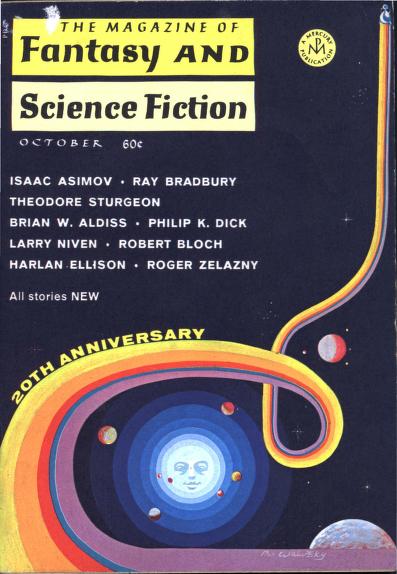
First published in the October 1969 issue of The Magazine of Fantasy and Science Fiction, which is on the Archive. It was then reprinted in New Worlds of Fantasy #2 (ed. Terry Carr), Hollywood Unreel: Fantasies About Hollywood and the Movies (ed. Martin H. Greenberg and Charles G. Waugh), Silver Scream (ed. David J. Schow), plus the Bloch collections The Best of Robert Bloch and The Complete Stories of Robert Bloch, Volume 3.
Enhancing Image
This story could be considered, to some extent, autobiographical. It’s circa 1970 and the narrator may as well be a stand-in for Bloch, living in LA and friends with a guy, Jimmy Rogers, who’s about a generation older than him. Jimmy is an old man now, but back in the 1920s he had started making cash as a regular extra in silent movie productions, along with his girlfriend at the time, June Logan. The narrator, in no small part to console his friend in his old age, goes with Jimmy to The Silent Movie, “the only place in town where you can still go and see The Mark of Zorro. There’s always a Chaplin comedy, and usually Laurel and Hardy, along with a serial starring Pearl White, Elmo Lincoln, or Houdini.” It’s what it says on the tin, playing silent movies at a time when silent movies would’ve been relegated to TV airings, on the occasion they were played at all. While he would’ve still been a kid when silent movies got usurped by sound productions, Bloch apparently held them in high regard, with the 1925 version of The Phantom of the Opera specifically being a gateway drug for his getting into horror. We’re clearly supposed to sympathize with Jimmy, since his original job had been taken over and his industry changed forever—never mind the fact that June has been dead for four decades now.
One of the first things I thought while reading “The Movie People” was that in 1969 this nostalgic treatment of Hollywood in the years before the invention of synchronized sound would not have been as old hat then as now, although there was still precedent for it at the time. (I’m ashamed to say I still have not seen Singin’ in the Rain.) Your knowledge of film history may or may not improve the experience, since Bloch assumes you have at least a cursory knowledge of Hollywood during the silent era, but then if you’re familiar with the historical material you can already predict the arc of the narrative and the sentimentality behind it. We learn about Jimmy and June’s relationship, which was kind of a Star Is Born scenario in which Jimmy couldn’t rise above being an extra and June was clearly on her way up the ladder—and no doubt would’ve continued her way up, had she not died in a freak accident. It was 1930 and June was on the set for an early sound production. The crew was experimenting with a traveling boom mic, what has long since become the standard for film productions, only it was newfangled then. “Somehow, during a take, it broke loose and the boom crashed, crushing June Logan’s skull.” It’s a pretty on-the-nose metaphor for the changing of the guard sound film brought about, ruining careers and hitting immigrants in the industry the hardest. Read some film history and filmmakers and historians will always treat The Jazz Singer as if it were one of the horsemen of the apocalypse (it’s also kind of a shitty movie). The late ’20s in Hollywood (other film industries lagged behind in adopting sound) marked the end of an era.
Bloch is a lot of things, but he’s not subtle. The man himself seemed aware of this, as he all but says in his lecture “Imagination and Modern Science Fiction,” for my money one of Bloch’s very best pieces of writing. It’s savage, insightful, and very funny, although while he did write some SF, Bloch was never much of an SF writer. “The Movie People” is not really horror either, being that rare example of a ghost story which does not try to evoke dread or terror, but instead melancholy. The thing is that The Silent Movie seems to be haunted—maybe. It’s unclear where the supernatural is coming from, but the short of it is that Jimmy has started to notice June has been appearing on the margins of old silent movies, including ones she would not have taken part in; for example he sees her in The Birth of a Nation, which came out nearly a decade before June’s first film role. (I could go on a whole tirade about how The Birth of a Nation went from being a deeply controversial but massively successful movie at the time of its release, to sort of just being accepted as part of the American film canon, to now being treated like that one aunt or uncle who thinks Trump actually won the 2020 election. But I won’t.) Despite not having seen her alive in forty years Jimmy can still pick her out from a crowd, and is convinced there must be some ghostly hijinks going on with these films such that he can see dead people in the roles of extras. Of course the narrator doesn’t believe this, but he wants to be there for his friend—perhaps even more so now, since he’s convinced Jimmy is seeing things in his old age.
There Be Spoilers Here
On the set of his latest “role,” Jimmy gets a mysterious letter which then falls into the narrator’s hands, and it’s a surprisingly long letter especially when you consider it was somehow written by a dead person. *It could be a hoax of course, but this is a ghost story and we have to take everything at face value, never mind that Jimmy’s suspicions about the ghosts in the silent movies are proven true at the very end.) It’s a letter from June, telling her long-lost boyfriend that he can join her and others as an extra from beyond the grave. There are rules to be followed and some advice given (humorously she tells him to stay away from “the slapstick comedies”), but Jimmy is given the chance to be with June again. Naturally he takes it. The ending is bittersweet, because on the one hand Jimmy dies on-set, but it’s not tragic or brutal death at all; indeed he looks “very much as though he were smiling in his sleep” when they find him. One thing that confuses me, and this is something I’ve started to notice more when giving fiction the deep-read treatment, is that the narrator acts like Jimmy was being delusional as he is recounting his story, despite already knowing that Jimmy’s speculation about The Silent Movie being haunted has merit. Why would a narrator act like they don’t know certain information when they already know that info? It’s a common fallacy with writing first-person narrators. Anyway, that final scene where the narrator goes to The Silent Movie and sees Jimmy and June waving at him in one of Intolerance‘s famous crowd scenes is sweet. (I’ve yet to see Intolerance either, it’s a glaring blind spot for me.)
A Step Farther Out
I’m quite biased about the history behind this story, being an actual film major who’s seen a decent amount of 1920s cinema at this point, but I came away from “The Movie People” with mixed feelings. The thing is that Bloch is an ironist at heart; he’s kind of a bastard. His fiction usually falls on a spectrum between horror and comedy, with his most effective work being either darkly humorous or horrific with a touch of playful irony. “The Movie People” basically falls outside of this spectrum altogether as it’s a story more or less without irony; it’s totally sincere. I’m not sure if this is Bloch’s wheelhouse. It’s a cute diversion that tries to tug at the reader’s heartstrings a bit, but I would’ve preferred this material be put in the hands of a writer more delicate than Bloch. But that’s just me.
See you next time.
 Science Fiction & Fantasy Remembrance