My schedule is not what it used to be, although I’m not sure if that’s my new living conditions, work slowly growing down on me, the real-world turmoil happening just outside of view, or some combination. I used to run this blog as a way of escaping temporarily from the drudgery of my everyday existence, between my job and living with my parents; but since I moved out four months ago, the scales have shifted in balance quite a bit. Writing for this blog no longer feels like an escape, but just more work that I have to do. I must write every couple days or else… what? What would happen if I took a break for, say, a month? Most likely my skill at writing would wither, if only a bit. Writing is like any other skill in that if you don’t do it for long enough then you sort of forget how to do it in the first place. It’s why I always find it amazing whenever an artist, be they a writer, filmmaker, musician, or whatever, takes a hiatus from the craft, then returns years later, seemingly out of hibernation, as if nothing had happened. Do you think Terrence Malick had to remember what it’s like to direct a movie when he was making The Thin Red Line, or if Robert Fripp, after not playing guitar for a couple years, had to refamiliarize himself with the damn thing when recording for David Bowie’s “Heroes”? Really this mindset can be applied to any skill, even one as worthless and solitary as writing.
I just remembered a depressing thought I had the other night, during one of my shifts, which is that I might be witnessing the death of human creativity in my lifetime. I’m not talking about creativity on an individual level, since I think it’s obvious that so long as humankind exists there will be artists, probably living on the margins, for the same reason there will always be Palestinians and Kurds and Chechens and what have you. I’m talking about a collective resentment towards creativity that has, at least in the US and UK, been building up since the Reagan and Thatcher years, if not earlier. Fascism, be it Christofascism or neo-liberalism of the Reagan-Clinton sort, is at its core a rejection of the human mind’s ability, indeed its incessant urging, to grow and progress. There is a Freudian return-to-the-womb desire inherent in fascism, except on a systemic level. The fascist wants to stop the future from happening—not a good or bad future, but the future as a concept. You can at least give the Chinese credit for envisioning a future, although if we’re being honest it’s a rather bleak one. In a more just world “AI” would be used only to make soul-crushing labor easier to stomach for human workers, but instead the right-wing technocrats who have increasingly gotten a stranglehold on government and commerce think such incredible technology should rather be used for kneecapping the human imagination. It’s possible that in just a decade or two the artist will be treated like how drug addicts and the homeless are treated today, which is to say the artist will be treated in the mainstream as at best a nuisance and more often as a threat to “the status quo.” We are undoubtedly on the path to that conclusion, and really it’s been a long time coming.
So what can I do? I talk a lot about art and artists, because I’m of the firm belief that without art human existence is really not worth it. Evelyn Waugh said that without God human existence is “unintelligible and unendurable.” I mostly agree with that sentiment. I write about art, even bad art, even the pulpy stuff, because I think there must be some value in it, and because God knows there isn’t much value elsewhere. Speaking of which, I decided it’s been too long since I last covered material from the pre-Campbell years that isn’t from the pages of Weird Tales. (I can’t help it that on average Weird Tales aged a lot better than its SF contemporaries.) So, I’m doing something a bit different this month. The serial, along with both novellas, will be from the pre-Campbell ’30s. I’m also finally checking the E. E. Smith box off my list, although not by reading a Skylark or Lensman novel but a standalone that caught my eye if only because of its convoluted publication history. The two short stories are from lady writers, one of whom you might’ve heard of if you’re really into crime fiction, while the other is totally obscure. See, the news is not all bad. Spring is finally here, and while my allergies may be kicking in I’m no longer freezing to death.
I’ve done enough yapping. What will I be reading? We have three stories from the 1930s and two from the 1950s.
For the serial:
- Triplanetary by E. E. Smith. Serialized in Amazing Stories, January to April 1934. Smith was immensely popular in SF fandom during his lifetime, and yet despite a few attempts to resurrect his reputation he has since then been relegated to something of a sideshow attraction. Along with Edmond Hamilton he was one of the pioneers of space opera, with his novel The Skylark of Space especially laying the groundwork for future entries in that subgenre. The magazine version of Triplanetary was a standalone novel that Smith later retooled so as to make it a prequel in the Lensman series.
For the novellas:
- “Proxima Centauri” by Murray Leinster. From the March 1935 issue of Astounding Science Fiction. I actually don’t remember if I’ve read this one before, so I’m counting it as a new read. Anyway, Leinster is curious if only because he’s one of the few writers from the Gernsback era to survive the coming of Campbell; not only that, but he actually hit his creative peak in the ’40s and ’50s.
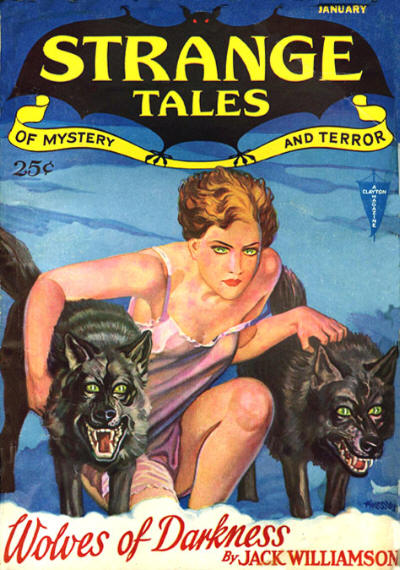
- “Wolves of Darkness” by Jack Williamson. From the January 1932 issue of Strange Tales. Williamson had one of the longest careers of any writer, inside or outside of SF, debuting in 1928 and remaining active until his death in 2006. “Wolve of Darkness” stands out as, if I remember right, getting Williamson his single biggest paycheck for a story up to that point, as he says in his autobiography.
For the short stories:
- “The Pilot and the Bushman” by Sylvia Jacobs. From the August 1951 issue of Galaxy Science Fiction. This is now the third time I’ve nabbed a story from this issue of Galaxy. I unfortunately have next to nothing to say about Jacobs since we know basically nothing about her, not even when and where she was born. She wrote a handful of SF stories in the ’50s and ’60s and then vanished.
- “The Muted Horn” by Dorothy Salisbury Davis. From the May 1957 issue of Fantastic Universe. This is a case where looking at an author’s ISFDB page can be deceiving, since going by it one would think Davis wrote very little; but actually she was a prolific crime novelist, and was even President of the Mystery Writers of America when she wrote this story, which is apparently horror.
Won’t you read with me?
 Science Fiction & Fantasy Remembrance
4 responses to “Things Beyond: April 2025”
I tried to read the novel version of Triplanetary at one point. Did not get far… at all… I look forward to the Jacobs. Does she come up in Eric Leif Davin’s Partners in Wonder?
LikeLike
According to Yaskzek’s Galactic Suburbia she mostly wrote popular science non-fiction:” While a few SF science popularizers such Lurie and Sylvia Jacobs also wrote science fiction, most devoted themselves to nonfiction prose. Much like their fiction-writing counterparts, the women who wrote science nonfiction for the mid-century SF community comprised a discrete group of authors who employed specific narrative strategies to authoritatively comment on a diverse range of scientific and social topics.’”
And…
“As contributors to major SF magazines such as Amazing Stories and Fantastic Adventures, authors including June Lurie, Sylvia Jacobs, and Kathleen Downe wrote hundreds of articles on topics ranging from the historic foundations of mythology and superstition to new developments in deep sea diving and atomic energy. Following the conventions established by women science writers of the eighteenth, nineteenth, and early twentieth centuries, these columnists represented themselves as trained educators or scientific wives whose education, close observation skills, and first-hand experience of science and technology empowered them to critically assess the discoveries made by male scientists and engineers. And so these authors claimed places for themselves as essential members of the scientific community.”
LikeLike
Rich Horton reviewed all her works here and compiled as much info as he could: https://rrhorton.blogspot.com/2022/08/the-complete-sf-of-sylvia-jacobs.html
LikeLike
[…] Collins at Science Fiction & Fantasy Remembrance seemed depressed in his current post. His solution is to read old science fiction and fantasy. That’s been my solution too when I […]
LikeLike