Who Goes There?
This might not be surprising, but H. H. Hollis is a pseudonym for one Ben Neal Ramey, who like a lot of people in the field used a pseudonym to separate his SF work from his well-paying day job. Hollis never wrote a novel, and there has never been a volume collecting what little short fiction he wrote, although it would not be hard to print a one-volume edition containing all of Hollis’s SF. He got two Nebula nominations, actually in the same year, but nothing else as far as awards attention goes. He’s honestly an ideal candidate for the Cordwainer Smith Rediscovery Award in the future, since he’s very much a forgotten writer when he probably should not be that obscure. I’ve read a couple Hollis stories and they certainly have their points of interest. “Eeeetz Ch” (what a title, huh) is one of quite a few SF stories about cetaceans that rather conspicuously started popping up in the ’60s. There was Arthur C. Clarke’s Dolphin Island. There was Margaret St. Clair’s The Dolphins of Altair. There was Gordon R. Dickson’s “Dolphin’s Way.” There’s even the story I’ll be reviewing in a couple day which also involves cetaceans. Not to say there was zero interest beforehand, but there was clearly a sea change in popular interest in cetaceans that happened in the early ’60s, culminating in what now feel like totally inexplicable crazes like the album Songs of the Humpback Whale.
Placing Coordinates
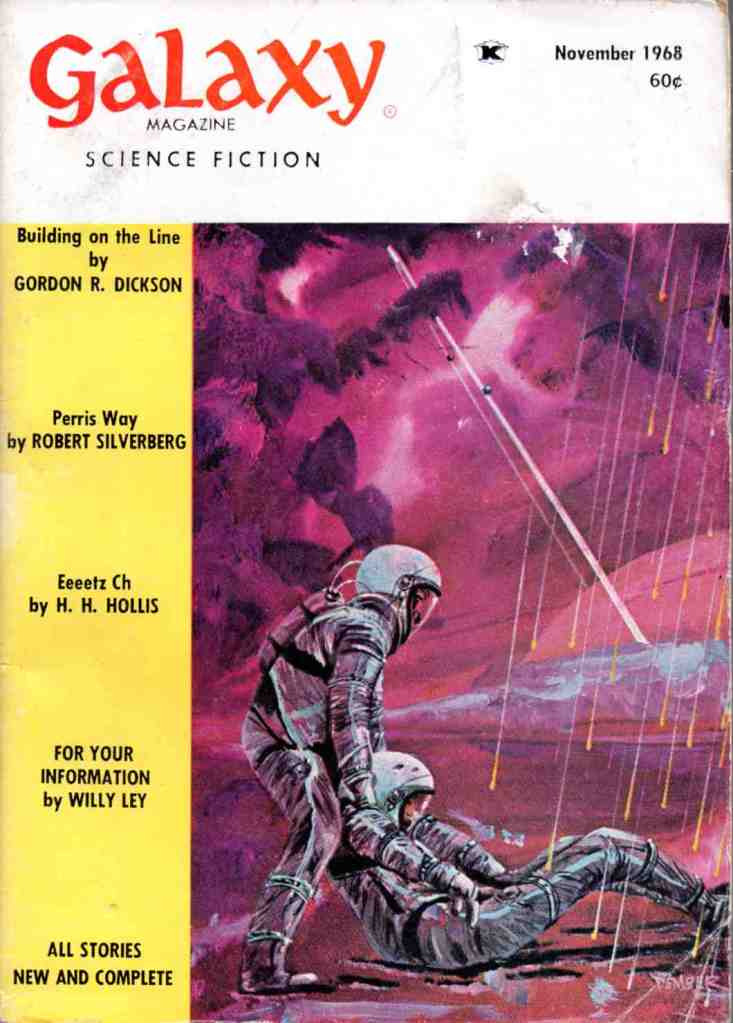
First published in the November 1968 issue of Galaxy Science Fiction. It has never been reprinted in English, which I have to say reeks of bullshit considering there are way worse stories than “Eeeetz Ch” that have gotten reprinted multiple times.
Enhancing Image
Ramon Coatle is a senator from Hawaii who has been given I suppose the unenviable task of surveying the Caribbean Research Station, an off-shore American research facility specializing in—you can guess by this point—the intelligence of dolphins. Specifically they’re studying dolphins as a kind of substitute for computers, since dolphins, as it turns out, are highly intelligent, albeit of the calculating variety. A dolphin, even if given the tools, is unlikely to understand the philosophical complexities of, say, Hamlet. As one of the scientists puts it:
“[F]rom a man-centered view of reality all that happens is that, like a computer, they have much faster access to stored information than we do, and much faster manipulation of it. But creative, intuitive use of it? Not in human terms. If that is the measure of true intelligence, then these big, seagoing cats are not very intelligent. They’re just better equipped to handle information.”
The scientists compares the dolphins to cats, but really they’re more like rats, both in their intelligence but also in the tests they’re subjected to at the facility. There are several human characters in “Eeeetz Ch,” but of course the most memorable character is Eeetz ch himself, who is the main dolphin being tested, by virtue of being the first. Eeeetz ch has the intelligence of a well-adjusted human adult, although (as will become a cliche with writing uplifted dolphins in SF) he is rather mischievous. Coatle and the others communicate with the dolphins through a computer translator, since the dolphins are physiologically incapable of human speech; meanwhile Eeeetz ch is hoping his human companions will try to learn his language, his own name as given being an approximation of what it would be in dolphin tongue. There’s a bit of a language barrier, and also the fact that these are two intelligent races who previously had not been able to have a conversation. Dolphins and their close relatives are indeed the closest we have to alien life on Earth, is what Hollis seems to be implying.
In the ’60s, and even for a while after, there seemed to be a reluctance in SF to introduce advanced robotics and unmanned drones, despite the obvious advantages in terms of saving human life and such—or maybe it’s because of these advantages that writers were slow to hop on robot-controlled spaceships and exploration units, until it became too glaring a thing to deny. It would be like denying Darwinian evolution in [the current year], in that normal people would immediately raise their eyebrows with suspicion. As such, in the world of “Eeeetz Ch,” the folks at NASA and elsewhere seem to think investing in uplifted dolphins that can control spaceships remotely would be more feasible than to have artificially intelligent robots do the same damn thing. As mentioned before, the people at the research facility already think of the dolphins there as like lively and quirky computers with fins. This all sounds a bit far-fetched, made more glaring since “Eeeetz Ch” would be published less than a year prior to the moon landing. In-story the prospect of landing on the moon is still treated as theoretically, which is something that would date the story in almost record-time. Another thing that dates the story is the treatment of its sole female character of note, Marguerite, who is one of Eeeetz ch’s human companions, and who honestly comes off as a bit of a shrew; her tendency to be on the emotionally volatile side is certainly conspicuous compared to her male colleagues’ reasonableness, although she does seem to mean well.

The stranger aspects of the research regarding Eeeetz ch, such as prosthetic hands being developed for his fins (this being illustrated uncannily, courtesy of Dan Adkins), now strike me as almost proto-cyberpunk. This is not just because of the topic of cybernetics with how the uplifted dolphins (and conversely the human who swim with their test subjects) are being at least slightly mechanized to better fit their environment, but also (and this is almot certainly a coincidence) the fact that there’s a similarly uplifted dolphin in a certain seminal work of cyberpunk. I’m talking about William Gibson’s “Johnny Mnemonic,” which features a drug-addled hyper-intelligent hacker dolphin that floats in a tank. (It is a weird story, for sure.) Eeeetz ch and his ilk are given prospethic hands that take advantage of the fact that cetaceans’ finsss are basically mammal finger joints that have been webbed together; meanwhile Marguerite and her partner have metal plates in their chests, machines meant to give them a kind of gills surrogate. Coatl is understandably disturbed by this at first, but after several days he gets used to the humans and dolphins meeting each other halfway like this. Actually he might be getting to like the strange dynamics of the facility a little too much, as the ending shows.
There Be Spoilers Here
This is a hard story to spoil, on account of nothing much dramatic happening. I was a bit taken aback by this myself initially, since I was expecting some kind of dramatic climax, only to realize the story just—ends. Not to say it’s that abrupt an ending, or that it just stops in its tracks, since there is at least some change implied at the end. Coatle leaves the facility for home, wondering if he can even express to his colleagues in Washington what he had seen, never mind how he might convince them of the facility’s non-military utility. Not much may have actually changed throughout the story, in that the stakes were never those of life and death, but something has changed (or maybe been revealed or uncovered) in Coatl’s spirit. “His chest itched, and he scratched it gently. Senator Ramon Coatl knew what his chest itched for: he wanted one of those brass adaptor plates set in it, so he could wear gills.” It’s a bittersweet sentiment that doesn’t become overblown or overstay its welcome, which is nice.
A Step Farther Out
Well, this was an oddly cozy read. “Eeeetz Ch” is curious, not least because it feels both of its time and also ahead of its time. The proto-cyberpunk elements and speculation on dolphin intelligence butt heads with what was clearly an America still licking its wounds from the Apollo 1 tragedy. As far as I can tell there isn’t any anthology collecting SF stories revolving around cetaceans, which on the one hand is a bit odd, but also the fascination with cetaceans in pop culture was such a hippie New Age thing (later examples Ecco the Dolphin and David Brin’s Uplift series notwithstanding) that if such an anthology were to be put together then it would’ve happened at least half a century ago. The moment has passed.
Unless, of course, I became an editor myself.
See you next time.
 Science Fiction & Fantasy Remembrance
One response to “Short Story Review: “Eeeetz Ch” by H. H. Hollis”
There’s of course McIntyre’s horrifying “The End’s Beginning” (1976), which would find a nice (brutal) place in that imaginary anthology!
LikeLike