
(This post will be discussing spoilers for Carnival of Souls, including the twist ending, so if you haven’t seen the movie already I suggest you do just that before reading any further.)
I was supposed to write a review two goddamn days ago, except I realized that I had made a mistake and somehow gotten my own schedule wrong. I had read the first installment of Larry Niven and Jerry Pournelle’s Inferno, except I was actually supposed to read Arthur C. Clarke’s “Against the Fall of Night.” So, no review happened for the 3rd or the 4th. With any luck I’ll get around to Clarke’s novella sometime this month, and of course you can expect my review of Inferno (the first stretch) very soon, as in tomorrow or the day after. For now, let’s content ourselves with an editorial I had in mind for last month but couldn’t find the time or proper motivation for at the time, a not-review of a certain cult classic. Carnival of Souls is one of the best horror movies of the ’60s, almost in spite of itself, being made on a very low budget by a crew comprised of people who had not worked on a feature film before, and whose cast was similarly comprised of non-actors and people (including its lead actress) who would not have a future in movies. There’s a lot to say about it, but one can only say so much without giving away the whole plot, so it’s best to start at the ending and then slingshot back to the beginning. It’s that kind of movie.
Mary Henry is dead, to begin with. We start with a logo for Harcourt Productions, which I have to think was made specifically for this movie, since this is the only movie ever to be produced by this company. Before said logo can even fade to black we’re met with a jarring (maybe deliberate, maybe not) shift in the form of the opening scene: an impromptu drag race between two cars, one filled with dudes, the other filled with Mary and her gal pals. A few things are going on in this first scene, which seems to me an effort in disorienting the viewer. At the very beginning here, Mary doesn’t say anything, and she has kind of this quizzical expression on her face, as if she’s unsure about the race but is too shy to discourage her friends from taking part. Her skepticism is more than justified, since it takes all of about one minute for the race to go wrong, as the cars go across a rickety bridge and the girls’ car tips over into the river below. You would think the girls, if not killed from the impact, would at least drown, and you’d be right. A rescue team comes in, more to salvage the car than anything, and if you pay attention to the dialogue you can hear that they’ve been looking for three hours. Obviously nobody can be alive still.
Except for Mary—or so it seems.

Wet from the river and caked with mud, Mary walks dizzily out of the water, as if some kind of ghoul emerging from a swamp, quite miraculously to everyone around her. It’s telling that when asked about what happened Mary can only say, “I don’t remember.” It’s her first line of dialogue, and in a striking formal decision it’s spoken offscreen. From this scene to the next there’s an unexplainable gap in time, and it’s only then that we see Mary talk for the first time. Having apparently recovered from the accident, Mary takes up a job as an organist for a church in Utah, despite being irreligious herself. The man at the organ factory doesn’t mind Mary’s disposition much, but the minister at the church where she’ll be working is more concerned. (We know that this must take place in fantasy land because somehow Mary is able to afford rent with a non-job like “church organist.”) Interestingly, the only woman of note that Mary interacts with throughout the rest of the movie is Mrs. Thomas, her landlady; otherwise she’s beholden to a handful of male figures. These men fall on a spectrum that ranges from uselessly benevolent to openly hostile, but the point is that they either try and fail to help her or are looking to make her day worse. The worst of these might be John, the neighbor in the apartment building, who unsubtly creeps on Mary and tries to get her in his bed at all costs. If this movie took place in modern times, John would be an incel and/or one of those guys who follows macho influencers for “dating advice.”
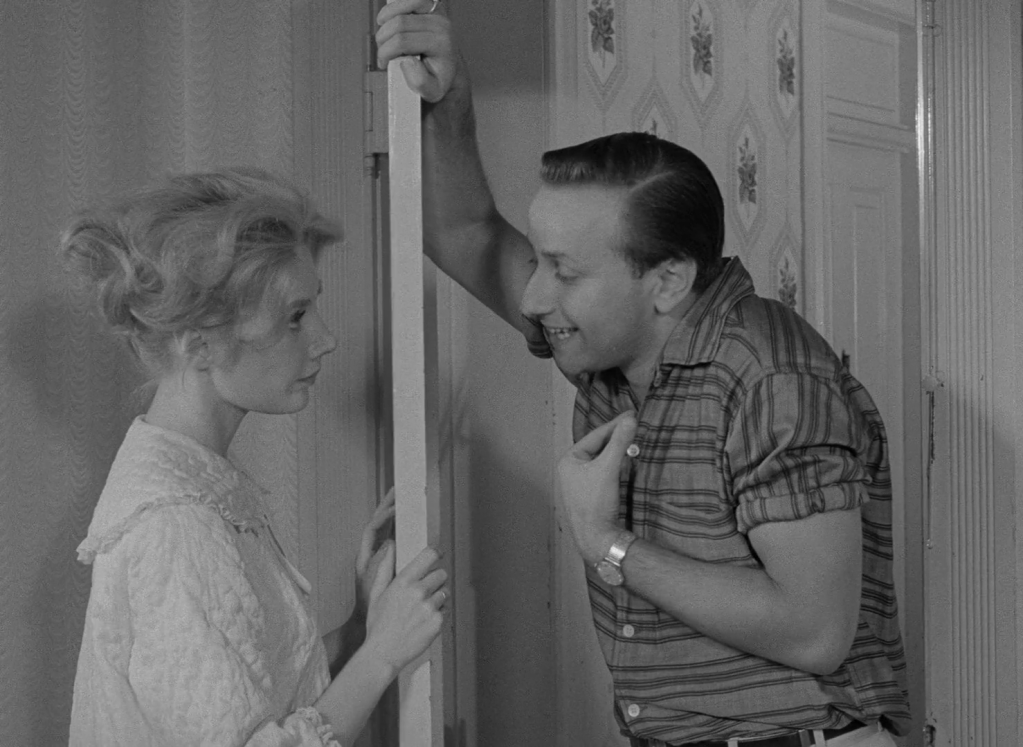
Let’s take a step back to talk about the acting and directing, since this is a movie that does a lot with only a few resources, and also where a lot happens despite clocking in at just under 80 minutes. The director, Herk Harvey, had experience as a filmmaker from making PSA-type shorts about urban and industrial areas, with Carnival of Souls being his first and only narrative feature. He directed, produced, worked on the script with John Clifford, and even plays a major role as an actor here, as a pale-skinned ghostly man who stalks Mary throughout the film. Like I said earlier, the people acting in Carnival of Souls have never been in a movie before, with maybe an exception or two in there. This is quite a surprise with Candace Hilligoss as Mary, since she gives unquestionably one of the defining lead performances of ’60s horror, and her presence gives one the impression that she could’ve been in a hundred movies. The way she often stares off into the distance, dissociating, or sometimes how she cranes her neck like a flightless bird, gives one the impression of Mary being like a confused animal. The closest reference point I can think of with Hilligoss’s performance is Elsa Lanchester’s performance as the bride in Bride of Frankenstein, where similarly Lanchester plays a worried and at times frightened animal in human skin. Lanchester as the bride only shows up for a few minutes in her movie, nevertheless leaving a mark on people’s imaginations; but luckily for us we have a whole movie to spend with Hilligoss as Mary.
Harvey and his crew shot on location in Utah, on a budget of just over $30,000 in 1962 money, and since they obviously couldn’t afford sets they shot the scenes of the titular carnival at the Saltair Pavilion (specifically Saltair II), a resort that hit hard times during the Great Depression and which wss finally abandoned a few years before Carnival of Souls was shot. Securing a permit for shooting at Saltair II was cheap and easy. There are a few scenes set in urban locations, namely Salt Lake City, but the most memorable stuff in this movie has to do with the shabby apartment building Mary lives in and the industrial shithole just out her window, namely the abandoned carnival that haunts her dreams. The lack of sets, combined with harsh lighting and industrial locales, gives one the feeling that maybe David Lynch had taken notes from this movie during the long process of making Eraserhead. Mary, being a ghost unbeknownst to herself, lives in a world that itself comes off as ghostly. Of course, it is not the abandoned carnival which turns out to be haunted, but rather Mary. I have a soft spot for ghost stories in which a person instead of a place is haunted, either because the person is a member of the undead or attracts the undead like a magnet. Harvey and Clifford took inspiration from the Ambrose Bierce story “An Occurrence at Owl Creek Bridge,” which (spoilers for a short story that’s over a century old) is similarly about someone who seemingly survives being killed, only to find out afterward that they are a ghost. So we have a ghost who unwittingly haunts people, and who herself is haunted by a dead (abandoned) place. I know it can be a little hard to believe, given its cheap and grimy aesthetics, but this is an intelligently crafted film.
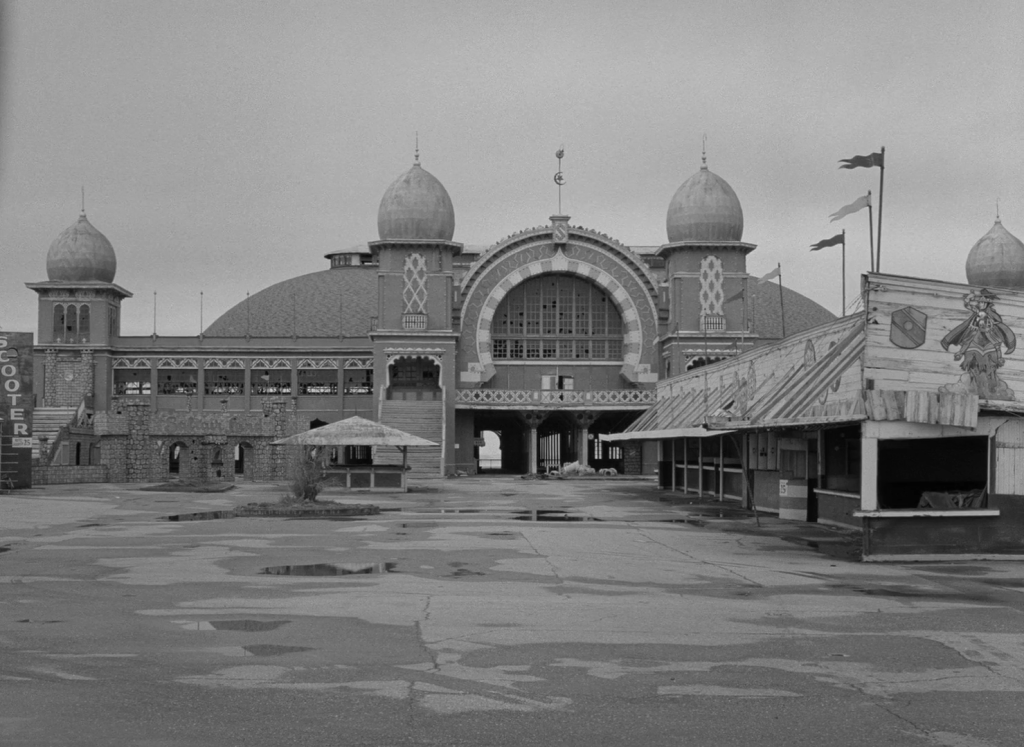
If taken literally, Carnival of Souls is a spooky story about a woman who thinks she has cheated death, but if you try even slightly you’ll find that this is a resonant and prescient study of a woman suffering from some undiagnosed mental illness, trying to live in a world dominated by “normal” people. It is at the very least explicitly about a woman who, following her accident, lives in a permanent state of disconnect from the rest of humanity, a kind of switch being flipped in her brain which she may or may not be able to flip back the other way. It’s ambiguous if Mary’s unusual mental state is something she had before the accident or if it’s brought on from trauma, but regardless she acts as if being around people for longer than short controlled bursts is a burden on her—to other people’s dismay. As the minister says during their first meeting, “But my dear, you cannot live in isolation from the human race, you know.” At first Mary is content to live on her own, with her crummy job and not having any friends, but eventually the loneliness does get to her; but at the same time she has some unwanted company, with John from the side of the living and the pale man from that of the dead. She quite literally phases in and out of reality at a few points in the movie, where people can’t see or hear her and she fully becomes a ghost. She’s stuck in a liminal position, between wanting but being unable to socialize with the living while also being scared of the ghosts she sees dancing at the carnival at night. During the daytime the carnival just a normal industrial area, totally empty of human life; but while there’s no ghost who can torment her here during the day, it’s eerily missing that human touch. It shouldn’t come as a surprise that the sequence at the halfway point of the movie, where Mary explores Saltair II, might be my favorite.
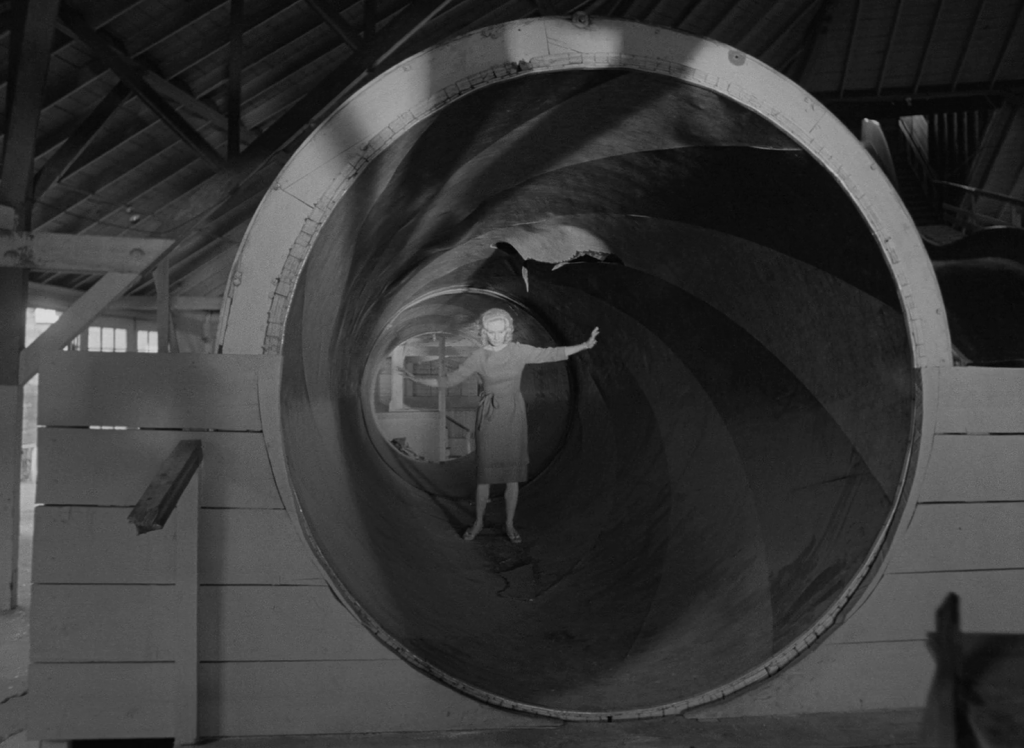
The most helpful character is Dr. Samuels, a psychologist who just so happens to run into Mary during one of her daytime scares. (How is she paying for this? Is she paying for it? Does Samuels put their first session on the house? We don’t ask these questions when watching a movie.) The best thing he does is allow Mary to articulate her state of mind, especially her strange (to other characters) indifference to intimacy with those of the opposite sex. The language wasn’t around at the time, but the idea is that Mary is queer, by virtue of being asexual and possibly also aromantic. This quirk with her sexuality is treated as unusual, but not harmful, which for a movie of this vintage is pretty forward-thinking. Indeed what modern viewers might appreciate most about Carnival of Souls, more than what it’s able to accomplish on a tight budget and its capacity for genuine chills, is its sympathetic depiction of someone who is both mentally ill and outside the realm of cisgender-heterosexual normality. We have a complex figure with Mary, helped by Hilligoss’s nuanced performance, a woman who is tormented by men who either shun her or try to coerce her into unwanted sex—and that’s not even going into the literal ghouls following her. The ending of the movie is obviously meant to be taken as eerie, but Mary’s ultimate fate, as a ghost who gets dragged screaming into the afterlife, also has a tragic aspect. The “dead all along” twist has arguably been done with more elegance in one or two other movies, but the inevitability of it in Carnival of Souls is crushing.
Carnival of Souls is not a perfect movie by any means; on the contrary it’s pretty rough around the edges. Actually the whole movie is rough. The lighting is amateurish at times, the acting is a mixed bag (understandably), there are a few shots I can think of that could’ve used another take, and of course someone watching this today would find the twist to be pretty obvious—although this was not so much the case back then. As typically goes with B-movies, it languished in obscurity for a couple decades, until it was revived thanks to late-night TV airings and being discovered by the international arthouse crowd. Roger Ebert wrote a positive review of it in 1989. It’s now in the Criterion Collection. I’ve seen three or four times myself over the years, and each time I’ve found more small and subtle things about it to like. This is a pulpy exploration of mental illness via supernatural horror, which nowadays feels almost overdone as one of the genre’s many modes. But trust me, it’s a good one.
 Science Fiction & Fantasy Remembrance
2 responses to “The Observatory: Carnival of Souls, Purgatory, and Mental Illness”
I recently watched Carnival again after recording it on TCM. I think I like the vibe of the movie more than the story itself, which screamed Ambrose Bierce from its opening moments. Of course, that twist practically became a horror movie trope. Still, I dig the Twilight Zone vibe. While we watched it, I kept saying, “They’re coming to get you, Barbara,” and my wife couldn’t understand why. Maybe you do.
LikeLike
Its aesthetic definitely elevates it. It’s cheap, but not incompetent. It falls somewhere between early David Lynch and one of Ingmar Bergman’s spookier movies (The Seventh Seal, Hour of the Wolf) on a tighter budget. Film inherently has a dreamlike quality, but that’s especially true here.
LikeLiked by 1 person