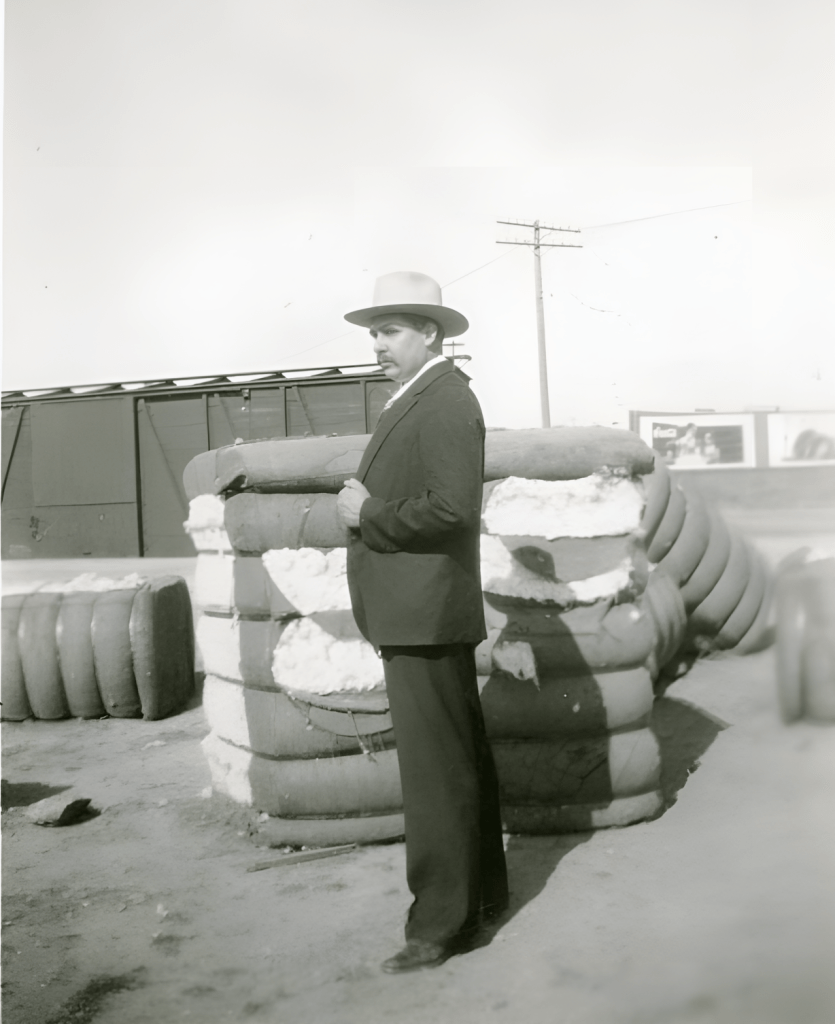
(As you can guess, this post has to do with mental illness and suicide. My main source for this is Mark Finn’s Blood & Thunder: The Life & Art of Robert E. Howard, which even with its faults in mind [namely some sloppy editing] is a reliable summary of Howard”s life.)
I consider myself something of a Robert E. Howard fan, and yet I’ve not even come close to reading all of his work. Given that he committed suicide at just thirty years old, Howard had written an intimidatingly large amount over a career that only spanned about a dozen years, between a few novels, dozens of short stories and novellas, and quite a bit of poetry. He was born on January 22, 1906, 120 years ago, and died on June 11, 1936. He was a Texan born and raised; yet despite adhering to the rough-and-tumble ways of his state to an extent, he knew from an early age that he wanted to be a writer. While he had an intellectual curiosity, Howard also knew from an early age that he wanted to write pulp fiction, rather than “real” literature. This was during the age of the original pulp magazines, called so because they were printed on cheap paper, sometimes with untrimmed edges. The world of pulp fiction in the 1920s and ’30s was pretty broad, believe it or not, ranging from general adventure fiction to Westerns, detective fiction, science fiction, sports stories, and fantasy. When he was in his teens, Howard tried desperately to write pulp of professional quality, aiming to be published in Adventure, one of the biggest pulp magazines of the time. But he never appeared in Adventure. Instead his first professional sale went to the newfangled Weird Tales in 1924, where Howard would stay as a regular (on top of selling to other magazines) until his death. Just twelve years as a professional, but it was enough.
Howard’s early death and the circumstances of his suicide have haunted the world of fantasy for nearly a century—a haunting made more eerie because for decades we didn’t have much more than hearsay as to what the man himself was like. Howard never lived to give any interviews, and while we now have a number of letters, his character and reputation rested on the words of those who knew him, and in some cases, those who didn’t. Dark Valley Destiny: The Life of Robert E. Howard, by L. Sprague de Camp, Catherine de Camp, and Jane Whittington Griffin, was the first book-length biography of Howard, and it was only published in 1983. L. Sprague de Camp had already written on Howard and was, along with Lin Carter, responsible for public perception of Howard’s work (for both good and ill) starting in the ’50s. De Camp didn’t know Howard personally; they would’ve been contemporaries, had Howard not died when he did. There wouldn’t be another book-length biography of Howard until the 2000s, hence Mark Finn’s book. There is, of course, a saying attributed to Oscar Wilde that there is no such thing as history, only biography. Another way of looking at it is that there’s no such thing as history, only the interpretation of history. There are some basic facts, but what to do with these facts, not to mention the messy details (or, as happens more often than not, the lack of details), is really up to the biographer. Howard’s fate, on top of being tragic no matter how you look at it, has presented a problem for those wanting to know about him for decades, and (to paraphrase William S. Burroughs) there’s no secret Howard himself can tell us.
What’s the story everyone knows? Hester, Howard’s mother, was ill for many years, and in June 1936 she slipped into a coma from which she would never awaken. Howard and his father Isaac knew that this was it. Howard didn’t exactly have an easy relationship with Isaac, what with their arguments and Isaac holding Howard’s choice of profession against him, but his relationship with Hester has long been the subject of controversy. It doesn’t help that like Socrates and Jesus of Narzareth, we don’t really have anything from Hester’s own perspective on the matter—only how others viewed her. While Finn tries to be even-handed in his assessment of Howard as a person (Finn clearly being a fan of Howard’s work), his assessment of Hester is decidedly unflattering. Finn frames Hester as being chronically manipulative, lying to her son on a regular basis throughout his life, as well as trying to push him away from Novalyne Price, the only woman Howard ever loved romantically. (Howard’s relationship with Novalyne is its own can of worms, so we’ll get to that later.)
There are several famous authors who were momma’s boys to varying degrees of unhealthiness, from Marcel Proust to D. H. Lawrence, with Howard being among them. This much is not up for debate. It’s also quite unambiguous, because he admitted as such to more than one person, that Howard planned to not outlive Hester. For her part, Hester’s days were always numbered, a fact she seemingly used as a manipulation tactic. That Howard actually went through with his plan came as a shock to his friends and Novalyne, since even the few who did know about such a plan didn’t believe it was something Howard was that serious about.
Still.
On June 11, the day after he drank coffee for the first (and last) time in his life, Howard went out to his car, pulled out a .380 revolver he had borrowed, and shot himself through the temple. Isaac and others heard the shot and brought Howard into the house, and rather miraculously he lived for another eight hours before dying.
Hester died the next day. Within a span of 24 hours, Isaac witnessed the deaths of both his wife and his son.
Robert E. Howard never married, and he didn’t leave behind any heirs. He did write up a will weeks before his death, which I don’t think is something the average 30-year-old does. The thing about Howard is that, as often (but not always) happens with suicides, he deliberated on ending his life for quite some time before the end. There are about as many reasons for why someone might commit suicide as there are stars in the sky, which I’ve noticed is something people who’ve never grappled with depression or suicidal ideation struggle to understand.
Finn interprets Howard’s suicide as perhaps an inevitability, a foregone conclusion neither Howard nor anyone close to him was equipped to prevent. This might well be true. It’s tempting, especially given how young the man was, to imagine an alternate timeline wherein Howard was able to live even ten or twenty more years—the problem being that there’s no clear path for this alternate ending. There is no simple or singular “if only” scenario in which Howard could’ve spared himself. Some suicides are preventable, but others, even with the gift of hindsight, are not so straightforward. As I said before, a lot of suicides (especially, it must be said, the famous cases) plan their own deaths well in advance, either with utmost secrecy or hidden in plain sight. When Kurt Cobain killed himself, it was in fact not the first time he had attempted suicide, and those close to him knew just how volatile his mental state had been. Ian Curtis of the band Joy Division wrote tracks for the band’s final album which amounted to death poems, with said album releasing after Curtis’s suicide. Ernest Hemingway admitted to his wife, many years before his death, that he would probably commit suicide like his father did.
So it was.
Let’s rewind the film a bit, and by “a bit” I mean a few years. Howard and Novalyne had met in 1933, through a mutual friend, with Novalyne knowing Howard by reputation prior to having met him. She knew Howard as a writer and an eccentric, who while having various pen pals was more standoffish with local people. The good news was that Novalyne was bookish herself, and she had enough willpower to not only hit up Howard, but to get past his conniving mother. The two started dating in 1934, and their relationship lasted about a year, with its ups and downs. The tragedy of their romance was twofold, in that Howard’s neurosis worked to sabotage it, but also that even if they had stayed together, it’s unlikely that Novalyne could’ve prevented Howard’s suicide.
This is not to say nothing good came of their relationship; on the contrary, Novayline inspired some of Howard’s strongest material when it came to writing women. As Finn puts it:
It’s easy to see how Robert could have been attracted to Novalyne. Certainly, she was prettyand intelligent, but her spirit was vital and alive, and not unlike some of Robert’s stronger female characters. Just prior to their first meeting in 1933, Robert sold ‘The Shadow of the Vulture’ in late March, a story that was written in late 1932. It’s tempting to insinuate that Red Sonya was inspired by Novalyne, but it’s more probable that if any character was a response to Robert’s new, outspoken girlfriend, that character was Agnes de Chastillon, the Sword Woman.
Another clear example of Novalyne’s influence was Valeria of the Red Brotherhood, Conan’s strong-willed companion in the novella Red Nails. There’s also the pirate queen Bêlit, in “Queen of the Black Coast,” one of the most beloved Conan stories, who takes on the burly Cimmerian as her lover. It is indeed the one time Conan falls genuinely in love throughout the series, at least as written by Howard.
Conan the Cimmerian is one of the most famous characters in fantasy, and one of the few characters in literature to emerge from the 20th century and garner a permanent legacy. Everybody “knows” who Conan is, even if it’s more often through movies and artwork than through Howard’s writing. You could Conan as a pop culture figure is a mixed child birthed from Robert E. Howard, Frank Frazetta, and Arnold Schwarzenegger. In just four years Howard wrote more than a dozen Conan stories, including a full novel, and that’s not even taking into account the stories published after Howard’s death. Howard had started several series character, including the undead-fighting Puritan Solomon Kane and the proto-Conan figure Bran Mak Morn; but Conan was Howard’s ultimate hero, and soon came to be easily his most popular character ever.
The success of Conan also came to be a thorn in Howard’s side, though, in that he at times grew tired of the character, a fatigue he admitted in letters to friends. Even if we didn’t have those letters, however, it’d be easy enough to infer that sometimes Howard went to Conan simply for the paycheck, since some Conan stories are easily worse than others. I don’t see anyone claim “The Pool of the Black One” or “The Devil in Iron” as their favorite Conan story. The lesser Conan stories are formulaic and not very exciting, frankly. Howard’s growing weariness with his star hero also correlated with the series becoming progressively grimmer, bordering on outright nihilistic. While awesome violence was always a part of the series, and indeed Howard’s fiction more often than not, the tone of latter-day Conan stories was more pessimistic than earlier entries. By the time we get to Beyond the Black River, serialized in 1935, we have one of the most downbeat endings to any pulp story published at the time.
It maybe shouldn’t be surprising, then, that Howard decided to lay Conan to rest as early as 1935. Red Nails was the final Conan story Howard wrote, and its serialization in Weird Tales happened around the same time as Howard’s death. It’s possible that had Howard lived long enough he might’ve eventually returned to Conan, like Arthur Conan Doyle did with Sherlock Holmes, but the truth is that Howard had become disillusioned with the character who had brought him the most attention. He had become interested in writing Westerns, and he might’ve been the first author to have consciously mixed the Western with weird fiction, most notably with the 1932 story “The Horror from the Mound.” This, along with the rare non-supernatural fiction he wrote, spoke more directly of the landscape he knew: that of Texas in the early 20th century.
It’s hard to say what Howard would’ve written had he lived longer, but he seemed convinced, by the end of it, that he could not write anymore. In the last months of his life, after he and Novalyne had broken up, he had made up his mind to kill himself. Novelyne, who had not heard from Howard for some time, had gotten word of his death on June 15, four days after the fact. She had witnessed his declining mental health, including the uncharacteristic growing of a mustache which didn’t suit him, but didn’t act. She recalled things Howard said to no one in particular, repeatedly, like lines in a poem. As Finn writes: “Robert frequently talked of being in his ‘sere and yellow leaf,’ and the phrase always stuck in Novalyne’s craw, for she could never remember where she’d heard it before.” She did some digging and found the line to be from the final act of Macbeth.
The full line is as follows:
I have liv’d long enough: my way of life
Is fall’n into the sere, the yellow leaf;
And that which should accompany old age,
As honour, love, obedience, troops of friends,
I must not look to have; but, in their stead,
Curses, not loud but deep, mouth-honour, breath,
Which the poor heart would fain deny, and dare not.
When it comes to bystanders in the wake of a suicide, there tends to be the creeping feeling that a) something could’ve been done, and b) there were warning signs. Howard didn’t exactly try to keep his plan to commit suicide a seqret, and yet nobody close to him was prepared to take extreme measures. I’m not sure if I agree with Finn’s opinion that nothing could’ve been done to avert Howard’s suicide, that his death was inevitable and unpreventable, if still tragic. It’s certainly tragic in that we see someone who was quite talented, and who in his own way had a strong personality; yet this very personality, with such a dim outlook on life, seemed to have doomed him. At the end of his relationsip with Novalyne, Howard lamented that he sometimes wanted to and yet could not be a “normal” man. He couldn’t smoke cigarettes with the lads by the railroad tracks or go to church on Sundays, or work a normal job. If he did those things he would perhaps no longer be Robert E. Howard, the creator of Conan and Solomon Kane. He hated the idea of working a normal job, he was ambivalent about Christianity, and he was maybe too devoted to his mother.
For better or worse, only someone like Howard, that man who spent his final days profoundly unhappy, probably believing himself to be a failure, could’ve forever changed fantasy writing the way he did. Which might be the ultimate tragedy of the whole thing.
 Science Fiction & Fantasy Remembrance
One response to “The Observatory: The Last Days of Robert E. Howard”
[…] of posts have marked the occasion. Such as Science Fiction & Fantasy Remembrance remembering “The Last Days of Robert E. Howard”, and DMR offering “Robert E. Howard: In Praise of His […]
LikeLike