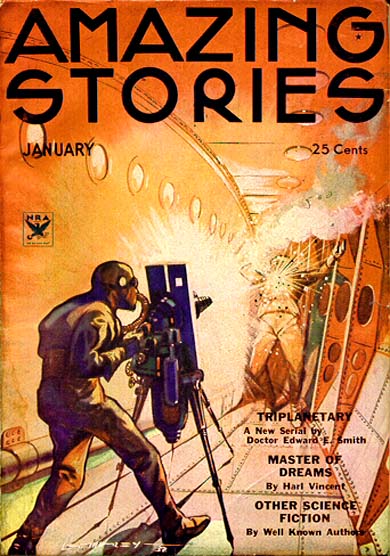
In March 1926, there was a new fiction magazine on newsstands. This in itself was an unexceptional event; after all, there were already quite a few fiction magazines on the market, “the usual fiction magazine, the love story and the sex-appeal type of magazine, the adventure type, and so on.” But this was Amazing Stories, a magazine whose mission statement was to publish a genre of fiction which prior to this didn’t even have a name: science fiction. Sorry, “scientifiction.” The publisher was Experimental Publishing Company, which had already run SF-adjacent magazines, namely Science and Invention and Radio News, and the editor was Hugo Gernsback. Gernsback was born and raised in Luxemburg, but moved to the US as a young man, where he made a name for himself as an inventor, as well as taking major part in the aforementioned magazines. He was also a lousy fiction writer, and even worse when it came to having business sense. What he lacked in those areas, though, he certainly at least tried to compensate with a restless imagination. He was a pioneer in the truest sense, with both the good and bad that come with being on the razor’s edge of innovation. Gernsback ran SF before, but he wanted a whole magazine dedicated to “scientific fiction,” and as he explains in the inaugural editorial: “By ‘scientifiction’ I mean the Jules Verne, H. G. Wells, and Edgar Allan Poe type of story—a charming romance intermingled with scientific fact and prophetic vision.” The standard for science fiction had been set.
There was science fiction prior to Amazing Stories, of course, and a lot of it. Gernsback himself considered the first real master of SF to be Edgar Allan Poe, who despite being known for his horror also wrote quite a few SF stories—the two not being mutually exclusive. (Nowadays people, including those like Brian Aldiss who very much know their stuff, tend to say SF really started with Mary Shelley’s Frankenstein.) Other practitioners of proto-SF include Jack London, William Hope Hodgson, Nathaniel Hawthorne, Ambrose Bierce, and others. Indeed, it’s this wealth of SF published prior to 1926 that would make up the bulk of the material in Amazing Stories for the first few years of its existence. Gernsback especially resorted to reprints of stories and novels by H. G. Wells, who was still alive and well at this point. The business relationship between Gernsback and Wells eventually soured, and unfortunately this was a common occurrence with authors hoping to be published in Amazing Stories. The big problem was that Gernsback seemed to have the money-handling abilities of a gerbil or guinea pig, neglecting to pay his writers for absurdly long periods, even having to be threatened legally to pay up. The money problem got so bad that it’s suspected by some historians that Gernsback declared bankruptcy because he found it preferrable to paying up on his debts. There was an infamous case where H. P. Lovecraft only appeared in Amazing Stories once, with “The Colour Out of Space” (one of his best), on account of Gernsback’s reluctance to pay him, with Lovecraft calling him “Hugo the rat.”
Despite the financial strain, and with Gernsback losing his own magazine only three years after launching it, Amazing Stories somehow persevered. Things looked even rougher when T. O’Conor Sloane, who was managing editor under Gernsback, got kicked upstairs to become editor. Sloane was already in his seventies when he took over, so he was goddamn unspeakably old from the outset. He eventually died in 1940, at the impressive age of 88. If Amazing Stories was shaky in quality under Gernsback, with the original fiction often failing to stand toe-to-toe with the reprints, then the Sloane era made it thoroughly play second-fiddle to newfangled SF magazines, including Astounding Stories and Gernsback’s own Wonder Stories. Within just five years or so the first SF magazine got relegated to publishing second-rate fiction with second-rate paychecks for its writers. E. E. Smith, who had first made his mark in Amazing Stories, eventually jumped ship in favor of Astounding. You also like authors like Jack Williamson, who stayed loyal to Gernsback despite everything. That Amazing Stories made it to the end of the ’30s, and survived well beyond that, is really incredible. It subsisted largely on an audience comprised of young readers and scientist/inventor types. These are very different demographics in some ways, mind you. It continued, under Sloane, as the magazine where science and adventure would (ideally, if not so much in practice) be perfectly balanced.
It wasn’t all bad. In scouting for this month’s selection of short stories to review, I thought the pickings would be slim, but there was still a decent amount of fiction printed in the first ten years or so of this magazine’s life that at least looked intriguing. For instance, how many women would you say wrote for Amazing Stories in those early years? More than you’d think. Gernsback had his shortcomings, but he didn’t seem to have a misogynistic streak worth mentioning, and on occasion he published stories that would be considered positively feminist for the time. So, we have nine stories, the biggest batch of fiction I’ve had to tackle in a bit, all from the 1920s and ’30s. I’m sure some of it will not be very good, and it’s worth mentioning that when reading SF of such vintage it’s important to put yourself in a certain mindset. Still, I think I chose well.
For the short stories:
- “The Thing from—’Outside’” by George Allan England. From the April 1926 issue. First published in 1923. Makes sense that we’re starting with a reprint, given the heavy usage of them in early issues. Also, it originally appeared in the Gernsback-edited magazine Science and Invention. England was a prolific pulp adventure writer, real-life adventurer, and failed socialist politician.
- “The Fate of the Poseidonia” by Clare Winger Harris. From the June 1927 issue. Harris was, as far as we can tell, the first woman to write for the genre magazines under her own name. She made her debut in Weird Tales in 1926, but more than half of her work went to Amazing Stories. I had meant to review her debut story some months ago, but I struggled to write anything constructive about it.
- “The Metal Man” by Jack Williamson. From the December 1928 issue. Williamson might have the single longest career in genre fiction, although Michael Moorcock is getting close. He made his debut in 1928, with this very story, and only stopped with his death in 2006. He always remained pulpy in style to an extent, but he managed to stay relevant for an impressive span of time.
- “The Undersea Tube” by L. Taylor Hansen. From the November 1929 issue. Lucile Taylor Hansen was a trained anthropologist whose writing was mostly nonfiction books and articles. She concealed her first name and gender when writing SF early on, likely to separate this side gig (she didn’t write much SF) from her life in academia. She contributed some science articles to Amazing much later.
- “The Gostak and the Doshes” by Miles J. Breuer. From the March 1930 issue. Breuer was the son of Czech immigrants, and even wrote for Czech-American publications in Czech rather than English. He was a trained medical doctor, and he spent most of his adult life in Nebraska, working alongside his dad at first. As you can guess, he didn’t write that much SF, on account of his day job.
- “Omega” by Amelia Reynolds Long. From the July 1932 issue. Long seemed to have lived her whole life in Pennsylvania, although she would’ve lived on the other end of the state from me. She cut her teeth on writing SF, seemingly using the field as a training ground, but she later moved to detective fiction and poetry. She worked at the William Penn Memorial Museum for 15 years.
- “The Lost Language” by David H. Keller. From the January 1934 issue. Of the pre-Campbell SF writers, Keller might be one of the most respected. Like Breuer, he was a trained physician, complete with an MD, and like Breuer he served in the Medical Corps in World War I. He was one of the first American doctors to deal with PTSD in soldiers, which apparently influenced his fiction.
- “The Human Pets of Mars” by Leslie F. Stone. From the October 1936 issue. Stone was another pioneer in the field, in that like Harris she published under her real name, although many assumed it was a pseudonym. Her work is shockingly feminist and anti-capitalist for the time. She stopped writing by 1940, having become disillusioned with both the field and the world at large.
- “Shifting Seas” by Stanley G. Weinbaum. From the April 1937 issue. For about a year and a half, Weinbaum was arguably the hottest new writer in SF. His untimely death from cancer in December 1935, about 18 months after his debut, means we’ll never know how he might’ve matured as a writer. Ironically he never appeared in Amazing during his life, opting instead for its competitors.
Hopefully you’ll read along with me.
 Science Fiction & Fantasy Remembrance