Who Goes There?
David H. Keller was one of the oldest authors to have started writing in the field at the time Hugo Gernsback launched Amazing Stories. He was born in 1880, in Philadelphia, and long before he started writing genre fiction he was already a trained physician with an MD, having studied at U Penn. The most formative of Keller’s experiences as a doctor seemed to have been serving in the Army Medical Corps in World War I (like his contemporary and fellow doctor-writer Miles J. Breuer), where he treated that generation of American soldiers suffering from what was called shell shock. He later rejoined the Army Medical Corps for WWII. First-hand experience with the horrible aftermath of a new kind of warfare had a profound effect on Keller’s view of the world, which by several accounts became very pessimistic and reactionary. When he got to writing fiction, as a thing to do on the side, he contributed prolifically to both Amazing Stories and Weird Tales, his SF often having a dark side to it, or in many cases he simply wrote horror. While Keller remained somewhat active when John W. Campbell took over Astounding and reshaped the field in his image to an extent, he remains an artifact of the pre-Campbell years.
Strangely enough, “The Lost Language” does not have the roughness or scare factor of a typical Keller story; on the contrary, it’s quite humane by his standards. Keller’s work as a doctor (especially as a psychiatrist) informs the premise of a boy who grows up forming his own unique language. The story’s sympathetic depiction of a neurodivergent child, while rooted in an SFnal premise, will resonate with modern readers a lot more than so many other SF stories about similar cases, even some written decades after Keller’s. It’s sort of a hidden gem, and has aged pretty well.
Placing Coordinates
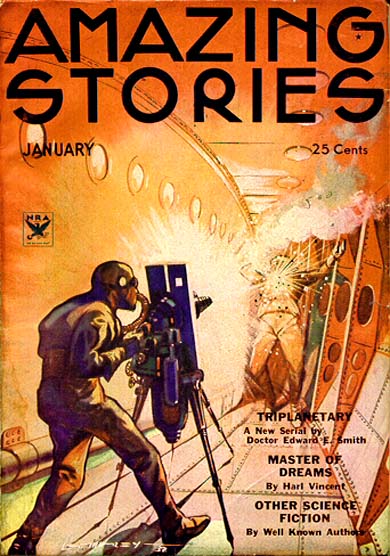
First published in the January 1934 issue of Amazing Stories. It wasn’t reprinted at all until the July 1971 issue of Amazing Stories, 37 years later. It also appeared in Science Fiction of the Thirties (ed. Damon Knight) and Young Mutants (ed. Isaac Asimov, Martin H. Greenberg, and Charles G. Waugh). Not that Keller’s stories have been reprinted all that often generally, but “The Lost Language” might’ve been especially neglected on account of lacking Keller’s trademark tinge of horror.
Enhancing Image
David Phillips III is the first boy of David Phillips, Jr. and his wife, after having had three daughters. This was a joyoud occasion, but gradually things soured for the family, since by four years old little David would say a single word. Not even a grunt or whine of displeasure. “Even when he was four they would not admit that he could not,—because all of his relatives, even some of the physicians they consulted, were sure that he could talk if he wanted to.” He was not “mentally deficient,” in fact he otherwise grows up as a bright and healthy boy, able even to take care of himself and be more self-sufficient than a lot of kids his age—except he will not talk. By age five it’s clear to the adults that this is a problem, and a rather unique one. Now, for those of us who are autistic or more generally neurodivergent, it’s not so strange to have grown up not learning or for some reason not choosing to talk until you were of kindergarten age. Maybe your parents took you to a speech therapist, like mine did. Think of all the ways autistic people continue to be discriminated against, in everyday conversation and even on a systemic level, and think about how Keller wrote his story nearly a century ago. Consider how much worse the mental health profession and how less empathetic it would’ve been in those days. The good news is that David’s parents are both patient and wealthy; had David grown up in a working-class family there’s a good chance he would’ve been locked in a cage.
“The Lost Language” is as much about the life of an autistic child as it is about language—how language forms and how the first speakers of a language might feel alienated from their fellows. The only way Daniel communicates with others is through a language of his own invention, this being an entirely written language with no oral component. Soon because something of an international attraction and language specialists from around the world drive or fly thousands of miles to see the boy at work, in a vain effort to understand him. As one specialist says, Daniel’s way of forming language is backwards from how it has historically been done, in that he has developed a language without any sound involved.
To quote said specialist:
“For centuries the human race has communicated with each other, first by sounds, and later by writing. Writing is simply a mode of sound. I admit that people learn to read silently, but even then they transpose the typed symbols into sounds subconsciously and thus obtain the meaning of the printed line and page. The dot and dash of the Morse code simply replaces letters which, in proper combination, have definite sounds, and those sounds for centuries have had definite meaning. This boy forms his own symbols. There is no doubt they mean definite things to him. You have shown me that, and my experiments with him have convinced me that you are right. But his refusal to adopt the symbols of the herd, to learn the alphabet, to follow the lines of communication used by his ancestors and his associates, stamps him at once as abnormal.”
David’s mother rushes to explain that the boy is strange, but he’s certainly not “feebleminded.” This is true enough, but for “the herd” that is society “abnormal” and “feebleminded” amount to the same thing. When David grows up he will be a curiosity for others at best. Because he doesn’t share a common language with the rest of mankind, and refuses to learn, he’ll always be an outcast. And yet, the language he does have turns out to be internally consistent. He has words (or rather symbols) for specific things. He can write “I want an egg,” which granted is a simple sentence, in his language. With time and effort, someone can learn to understand this language. But still, it has no oral equivalent. David and his father end up traveling to London to meet with an inventor, who had already created the “vibrowriter,” a speech-to-text machine. (This is, of course, something your smartphone can do with ease.) The idea is that if human speech can be translated to text, then maybe the reverse is also possible. If David were to have a special typewriter built for his set of symbols, then…
This is all conveyed in a style that strikes me as a mix of documentary-like and akin to a fable. Most of the characters are given names, but their names are mostly incidental; what really matters is the roles they play, in relation to David as either professionals or family members. The style writers often used in pulp SF at the time was of the sensationalist kind, with exclamation points and lots of active voice. The emphasis tends to be on action. Yet there is no action or adventure in “The Lost Language.” There’s not even much of a sense of wonder for Keller to invoke. It reads, in a way, like a much more modern SF story, being focused on an innocuous scientific anomaly—one which at least sounds plausible. There are no world-ending stakes, or even stakes other than on the emotional level for a single family. The years pass, and one of David’s sisters even trains to become a psychologist, “because she loved her little brother.” Ultimately it’s a story about the adults in David’s life wanting to understand him, despite the instinctive urge to cast him out as an “abnormal.” This is incredibly refreshing coming from a story that’s now over ninety years old, more so because Keller doesn’t seem like the kind of person to write something so empathetic.
There Be Spoilers Here
One of the scientists studying David’s language claims it might have something in common with an old and niche Welsh dialect, that Granny Lanarch, an old lady in Wales, would know. Unfortunately when David and his father arrive in Wales, they learn Granny Lanarch is dead—has been dead for a couple years, in fact. The one key to finding an shared lineage for David’s language is gone. There is no surprise victory. “The good guys” do not win in this instance, although Keller assures us this is not much of a loss ultimately, since the aforementioned sister wants to dedicate her work to understanding her brother’s language. For no other reason than that she loves him and doesn’t want to see him totally on his own in the world. The ending is anti-climactic, seemingly by design, but I don’t mind it at all. For once there is no miraculous solution to the characters’ problems, with science treating but not curing the malady.
A Step Farther Out
Truth be told, I may have read this one before, in Damon Knight’s book Science Fiction of the Thirties. I do have that on my shelf, and I certainly remember seeing “The Lost Language” in its pages, complete with Leo Morey’s interior that came with its original appearance. I don’t remember if I had read start-to-finish before, but I’ll certainly remember this reading of it. “The Lost Language” is an example of how pre-Campbell magazine SF wasn’t all spaceships and rayguns, even if a lot of it was that. There’s some 1930s super-science stuff here, but it’s grounded in a world that’s otherwise pretty similar to ours. This was one of Keller’s last notable stories before he stepped away from writing SF for the most part, which is a shame. I’ll be reviewing more of his work at some point.
See you next time.
 Science Fiction & Fantasy Remembrance