Skip to content

Science Fiction & Fantasy Remembrance

Celebrating the genre magazines, one story at a time…

  • About
  • Serial Reviews
  • Novella Reviews
  • Short Story Reviews
  • Complete Novel Reviews
  • Things Beyond
  • The Observatory
  • The Author Index
  • Novella Review: “Yesterday’s Tomorrows” by Kate Wilhelm

    May 5th, 2025
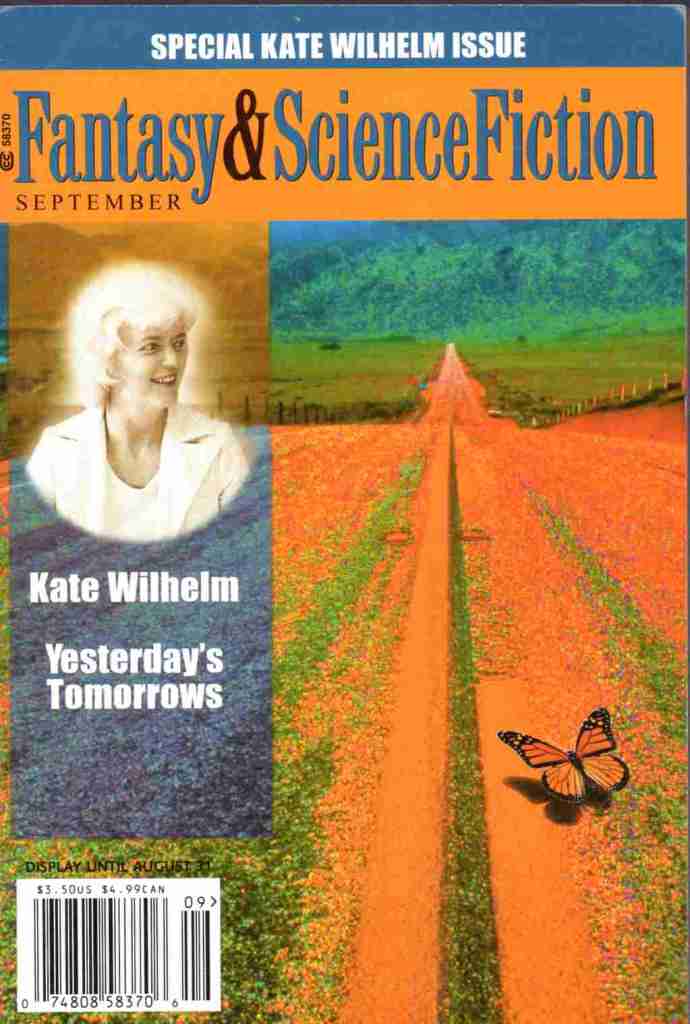
    (Cover by Richard Wilhelm. F&SF, September 2001.)

    Who Goes There?

    Like most of the New Wave authors who caused a stir in the latter half of the ’60s, Kate Wilhelm had actually made her debut a decade earlier, in 1956. It wasn’t until the New Wave, though, with the appearances of Dangerous Visions and Damon Knight’s Orbit series, that Wilhelm emerged as a major writer of short fiction especially. She won a Nebula for her story “The Planners,” although I never really understood the praise for this one. She appeared most often in original anthologies and especially in the Orbit series, which shouldn’t be surprising considering she was married to Damon Knight. Together they (along with Robin Scott Wilson) founded the Clarion Writers’ Workshop. In the late ’60s through the ’70s Wilhelm rarely appeared in magazines, but starting in the ’80s she made more magazines appearances; it could be because by the early ’80s the original anthology market had all but imploded, including the death of Orbit, and then there’s the high-paying science magazine Omni, which Wilhelm was a somewhat regular name in. By the time she got a special issue dedicated to her for F&SF she was a living legend in fandom, as both a writer and a teacher. Her son Richard did the cover for this issue, which I feel bad pointing out because said cover is… not very good, to put it one way. “Yesterday’s Tomorrows” is a “realistic” story with a tangentially SFnal element, showcasing a mature talent who’d been around for decades at this point.

    Placing Coordinates

    First published in the September 2001 issue of The Magazine of Fantasy and Science Fiction. It’s been reprinted only once, in the Wilhelm collection Masters of Science Fiction: Kate Wilhelm, Volume 1.

    Enhancing Image

    In a way this is a love story, as well as a road trip story. By sheer happenstance Hal Whitcomb, a divorced middle-aged guy, picks up Tilly Dunning off the side of the road. (Do people still hitchhike? I have to wonder.) Hal is 47 while Tilly is about to turn 31, although the latter looks younger than that, to where she can pass off as a college undergrad. Sparks fly between them pretty quickly, although Tilly has what you might call a troubled backstory, which forces the two to get more involved in each other’s lives than was thought possible. As Tilly says, “Last week I lost my job, lost my boyfriend, had my car stolen, and my grandmother died.” All of these things, except maybe the stolen car, tie into one men, or rather two men who knew each other once. Tilly is the granddaughter of the famous physicist Dr. Cherny, who would still be spoken of with reverence today if not for the circumstances of his death: he had apparently died while at a sex worker’s place, in the midst of an affair. He was found dead and naked, from heart failure, inside the woman’s apartment, although she claimed to have never met him before. Tilly’s grandmother suspected foul play, but there was no evidence found of such. Dr. Cherny had died shortly after speaking with one of his students, one Dr. Mandrill, who coincidentally Tilly also worked for, until she got fired. Tilly boyfriend, Peter, also works for Dr. Mandrill, but Mandrill fired Tilly and Peter dumped her. So there’s that. Mandrill fired Tilly for what amounted to insubordination, but Tilly’s suspecting there was more to it than that.

    “Yesterday’s Tomorrows” doesn’t have that complicated a plot once you sort out the different perspectives Wilhelm hop between, but it’s given a smokescreen of complication by Wilhelm showing us what end up being two sides of the same corn, between Hal and Tilly. Despite being the first POV character, Hal is actually not that important, nor does he really do much. Tilly is really the focus here, between her backstory but also her conflicts, which are external as well as internal. She’s grieving for her grandmother, whom she was close with, but she’s also at odds over whether her grandmother (who had a paranoid streak, it must be said) was right about Cherny. Is Tilly really the granddaughter of a disgraced scientist, or is there more going on here than meets the eye? Like yeah, obviously there is, but this story has meat on its bones more from being a character study than the mytery behind the Mandrill Institute. Mandrill had studied in physics but switched gears to biology, on Cherny’s recommendation; but the circumstances of this recommendation, for why Cherny saw Mandrill as unfit for pursuing physics, are not made clear until much later. The thing is, this story has little to do with either biology or physics, although it does pay lip service to Quantum Physics 101. The butterfly effect. Schrödinger’s cat. You know how it is. There’s the matter of predestination and alternate futures. The SFnal connection is very faint, to the point where I wonder if at some point during writing Wilhelm panicked and realized she should probably insert a bit more stuff about quantum physics in there if she wanted to sell it to a genre publication. As with other Wilhelm stories I’ve read, “Yesterday’s Tomorrows” is more concerned with character development than it is with being science fiction.

    Really this is a story about coincidences, or more specifically serendipity. Tilly just so happens to be the granddaughter of a famous (or infamous at this point) scientist, formerly employed to another famous scientist, and Hal just so happens to be working for some documentary filmmaker named Val (Hal and Val, now won’t that confuse you) who ends up being instrumental in Tilly digging into Mandrill’s past, as well as her own. Mandrill and Tilly’s famous scientist grandfather just so happened to know each other many years ago, when the former was a student, and Tilly’s grandmother’s suspicion that somebody had plotted to ruin Cherny’s reputation just so happens to have been correct. Seeing a pattern here? Wilhelm willingly violates a basic rule of good storytelling, in that “Yesterday’s Tomorrows” is like a ten-car pileup of coincidences; but then this focus on serendipity is also the point. Tilly believess herself to be weirdly unlucky, which given recent events is easy to understand, but she’s also being railroaded toward a certain revelation and a certain conclusion. Speaking of quantum physics, I’m now reminded of the first Half-Life game, which also explores predestination and railroaded sequences of events, albeit in a very different fashion. This is all better to think about after the fact than it is to read in the moment. The one review I could find of this novella that has any depth (it’s the Locus review of this very F&SF issue) described it as having elements of a thriller, but I would say it’s more like a scientific mystery. Wilhelm wants you to take part in putting pieces of the narrative together so that by the end you (hopefully) feel a sensse of accomplishment.

    There Be Spoilers Here

    When Tilly finally confronts Mandrill about his charlatanism and his past relationship with Dr. Cherny, Mandrill reveals that if anything he had killed the old professor by way of inaction. What happened was that Cherny had called Mandrill a fraud, and the young man didn’t like this very much. On the fateful night of Cherny’s death the man suffered a heart attack while with Mandrill, and Mandrill probably could’ve saved him, or called an ambulance, but instead he conspired to ruin the dying man’s reputation, in a way that admittedly ssounds more far-fetched than the official cause. Mandrill tries drugging Tilly and getting her to kill Peter, so as to kill two birds with one stone: get Peter out of the way so that Mandrill can take all the credit, and also to have Tilly locked away. The plan goes “wrong,” though, as Tilly reveals she had never taken the roofied drink Mandrill had given her. Peter is shot, but lives, and is able to discredit Mandrill’s attempt to frame Tilly. Everyone except for the obvious villain gets a happy ending. This all sounds like a lot for maybe the last ten pages of a sixty-page novella that’s mostly just been talking and ruminating up to this point. In one stroke Tilly gets to clear her grandfather’s name and also take her sweet revenge on Mandrill; she even gets with Hal at the end. Tilly theorizes that her grandmother, despite the shameful circumstances of her husband’s death, had a kind of That’s So Raven moment when Tilly was born, as she foresaw her granddaughter making things right again. Maybe.

    A Step Farther Out

    This one took longer to gestate than I had hoped. I spent two days getting through the novella itself (I don’t really have an excuse there), and then another two days spent trying to come up with thoughts about it. It’s not that “Yesterday’s Tomorrows” is bad by any means, although I have to admit that after several Wilhelm stories I’ve had to be wowed by any of them, although I’ve enjoyed a few. It could be because Wilhelm, as part of the New Wave, was one of the first in American genre SF to focus more on characters than science or even plot with her fiction, which has since become pretty much the standard for SF writing at short lengths. What was once special might now be commonplace, although there’s still a reason Wilhelm managed to stay in the game as long as she did.

    See you next time.

  • Things Beyond: May 2025

    May 1st, 2025
    (Cover by John Schoenherr. Analog, June 1975.)

    At the beginning of the year I said that I would be covering one short story or novella from Galaxy each month—but I said nothing about serials. The truth is that Galaxy was, alongside Astounding/Analog, the most consistent market for serialized novels and novellas at the time, so it would feel wrong to never acknowledge that part of the magazine’s history. As such we’re getting a novella and a serial from Galaxy this month; that they’re both from authors I admire probably helps.

    Last month I covered a horror story by the crime/mystery author Dorothy Salisbury Davis, which gave me the idea of finding more SFF by people who normally write crime/mystery, which while also a genre that has a history in pulp magazines, is “realistic” fiction rather than SFF. One curiosity that struck me ever since I saw it years ago was the fantasy story “The Bronze Door” by Raymond Chandler, which marked one of only two times he appeared in an SFF magazine. Someone who wrote a good deal more SFF than Chandler would be John D. MacDonald, who wrote prolifically for the genre magazines in the late ’40s and early ’50s before shifting to crime fiction and making a killing on that. So for this month’s complete novel we’ve got the early MacDonald novel Wine of the Dreamers. Rounding out the novel-length stuff is a relatively obscure standalone SF novel by Roger Zelazny, who nowadays is more known for his fantasy.

    For the women we have two people who are a few generations apart and coming from different continents, but who still, each in her own way, have come to write science fiction. Kate Wilhelm is actually a bit hard to find in magazines after the late ’60s, once she found her voice as a writer, but the September 2001 issue of F&SF was a special issue dedicated to Wilhelm, complete with a new novella. As for the Greek writer Eugenia Triantafyllou, I picked just about the newest story I reasonably could’ve (an unofficial rule of mine is that a story must be at least a year old for me to consider it for review), with “Loneliness Universe” being a finalist in this year’s Hugos. I’m voting in the Hugos, by the way.

    That makes one story from the 1930s, two from the 1950s, two from the 1970s, one from the 2000s, and one from the 2020s.

    For the serial:

    1. The Dream Millennium by James White. Serialized in Galaxy Science Fiction, October to December 1973. I’ve been meaning to read more James White, and thankfully several of his novels first appeared as serials. White first appeared in the UK, in New Worlds, before eventually finding some success in the US as well. Along with Bob Shaw he was one of the few Irish SF writers to appear regularly on both sides of the Atlantic back in those days.
    2. Doorways in the Sand by Roger Zelazny. Serialized in Analog Science Fiction, June to August 1975. Zelazny is one of the most influential SFF writers of all time, his mark being apparent on the likes of George R. R. Martin and (God help us) Neil Gaiman; and yet despite a couple generations of writers (especially those of fantasy) owing a debt to Zelazny, much of his work remains obscure or simply out of print, including this standalone novel.

    For the novellas:

    1. “Yesterday’s Tomorrows” by Kate Wilhelm. From the September 2001 issue of The Magazine of Fantasy and Science Fiction. It’s easy to forget this, but Wilhelm started in the ’50s, only that she flew under the radar for about a decade. Like a caterpillar turning into a butterfly, though, Wilhelm seemed to metamorphize almost overnight into one of the most acclaimed SF authors from the late ’60s until her death in 2018. She was married to Damon Knight.
    2. “The Other Man” by Theodore Sturgeon. From the September 1956 issue of Galaxy Science Fiction. Sturgeon is one of my favorite authors, especially of short fiction. Sturgeon had started to write professionally with “mainstream” fiction, although this went nowhere and he quickly pivoted to SFF, much to our benefit. His productivity was peaks and valleys so that he was writing either a lot or nothing at all. He was most consistently productive in the ’50s.

    For the short stories:

    1. “Loneliness Universe” by Eugenia Triantafyllou. From the May-June 2024 issue of Uncanny Magazine. Hugo and Nebula nominee for Best Novelette. Triantafyllou was born and raised in Greece, and continues to live abroad, but writes her fiction in English. She made her debut back in 2017, and has yet to write her first novel, although maybe she just much prefers writing short fiction.
    2. “The Bronze Door” by Raymond Chandler. From the November 1939 issue of Unknown. Possibly the most acclaimed crime writer of the 20th century, seriously only rivaled by Agatha Christie, Chandler’s known for his series of novels starring Philip Marlowe. Chandler famously didn’t start writing crime fiction until he was in his forties, and didn’t write his first novel until he was pushing fifty.

    For the complete novel:

    1. Wine of the Dreamers by John D. MacDonald. From the May 1950 issue of Startling Stories. Fans of crime fiction would know MacDonald for his prolific (21 novels over a span of as many years) Travis McGee series, as well as the standalone novel Cape Fear (first titled The Executioners, but then retitled after the 1962 film adaptation), but he also wrote a good deal of science fiction in the late ’40s and early ’50s. It’s not unusual for authors to cut their teeth on working with one genre before moving to greener pastures, so that much like how Elmore Leonard started with Westerns before moving to crime fiction, the same happened with MacDonald. Wine of the Dreamers was either MacDonald’s first or second novel, it’s hard to say.

    Won’t you read with me?

  • Serial Review: Red Nails by Robert E. Howard (Part 3/3)

    April 28th, 2025
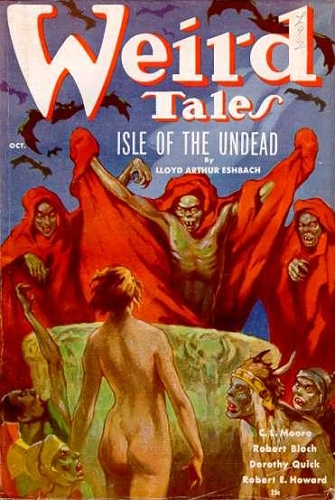
    (Cover by J. Allen St. John. Weird Tales, October 1936.)

    The Story So Far

    Valeria of the Red Brotherhood is a warrior-pirate who was aboard ship not too long ago, but jumped in order to escape an unwanted marriage proposal. She then joined an army of mercenaries, but left that as well, after killing one of the officers. She’s now a fugitive, but she’s not alone, for Conan was in the same army and also deserted, with the intent of following Valeria’s trail. Conan doesn’t wanna kill Valeria, indeed having killed the brother of the officer she had killed off-screen, but rather is curious about her—in more ways than one. Aside from being warriors, one thing Conan and Valeria have in common is that they’re very bad at taking orders. They’re having a “fun” time bickering when a dragon in the forest they’re hiding out in kills their horses, and looks to have them for lunch next. Using a spear and some poison fruit, Conan’s able to incapacitate (although probably not kill) the dragon, and the two make a run for it on foot. On the plains by the forest there’s a domed city, called Xuchotl, which once had an indigenous population but which is not thinly populated by two clans, who years ago had moved in and slaughtered the original residents. Yes, that is technically genocide. We’re told that the indigenous people of the city were no better than those who killed them, and in some ways might’ve been worse. Now it’s a war between the last members of the Tecuhltli and Xotalancas, clans named after their founders. No children have been born in these clans in quite a few years, and it seems each is a mini-civilization on its last legs.

    With the help of a Tecuhltli named Techotl, Our Heroes™ get introduced to the Tecuhltli higher-ups, namely their “king” Olmec and his partner Tascela (in the previous installment I said they were married, but their relationship is actually more ambiguous than that), the latter appearing youthful and yet, it turns out, being centuries old. Olmec sort of hires Conan and Valeria in the hopes that they’ll help vanquish the remaining Xotalancas. (The red nails of the title refer to red nails that are stuck into a column in Olmec’s chamber, each representing a vanquished enemy.) This arrangement goes sideways, though, when later that day one of Tascela’s servants tries to put Valeria into a deep sleep with the help of a black lotus. Valeria doesn’t appreciate this very much, so she tortures the servant until she confesses what Tascela’s plan is, although she escapes into the catacombs, never to be seen again but likely to be killed off-screen by something. It’s at this point that Valeria hears swords clashing at the gates, which probably means the Xotalancas have chosen now to make their final assault.

    Enhancing Image

    A battle goes down, with the Tecuhltli being victorious, of course. They’ve killed the last of the Xotalancas, which ordinarily would mean everyone gets to live happily ever after, but as you know, Tascela has other plans. Olmec also has plans of his own, and ultimately the two rulers fight for a bit over who gets a piece of Valeria’s ass. Olmec wants to rape Valeria while Tascela somehow has even worse plans in mind. Of course, while Olmec is a burley bearded guy who can break someone’s spine in half, Tascela is a sorceress who many years ago had put a spell on Olmec so that he would be unable to lay much more than a finger on her. Is this the only Howard-written Conan story with both a heroine and a villainess? Unfortunately, by this point Valeria has become little more than the obligatory damsel who needs rescuing, although while she’s physically helpless she does have quite the mouth on her. We hear about some “profanities” coming from her and it’s easy to imagine her dropping several F bombs if not for censorship. I sort of get the criticism of Valeria not being enough of a badass heroine, but at the same time I do think she works as a kind of foil to Conan. I think it’s also worth mentioning that it’s easy to believe Howard had based Valeria on Novalyne Price, his girlfriend at the time, namely through her assertive attitude and penchant for cursing, as was apparently Novalyne’s habit when she wasn’t on the job. Clearly by the last couple years of his life Howard was moving in a direction that, while not exactly feminist, was more sympathetic to women as people. Remember that this is a guy who really could not imagine living in a world without his mother in it.

    As if to compensate for the slow middle section of the novella, the back end of Red Nails is nonstop violence and conspicuously erotic imagery (I don’t mean that last part in a bad way). Howard said in at least one letter that he thought of Red Nails as his sexiest Conan story, and between the two BDSM-coded torture scenes it’s easy to believe him. Yes, a second BDSM-coded torture scene has hit the towers! This time it’s Valeria who’s on the slab, with the dark-skinned Tascela towering over her, in an image that provided the cover for the first installment. (I should probably have mentioned by now that Tascela is coded as being equivalent to ancient Egyptian royalty, going by how Howard describes her clothing and especially with how she’s illustrated in the version of Red Nails printed in The Best of Robert E. Howard Volume II.) Conan kills Olmec and comes in for the rescue, but it looks like Our Heroes™ are outnumbered when the thing from the catacombs emerges as a deus ex machina, in the form of Tolkemec, who had been banished there many years prior. Conan kills Tolkemec while Valeria takes the chance to stab Tascela in the back, who despite being able to replenish her youth and make people follow her every order is apparently made of tissue paper if someone manages to catch her off-guard. “I had to do that much, for my own self-respect!” says Valeria, as almost a meta statement on how given her damsel status for much of the story she had to take down someone. Why not her evil counterpart, then? It makes enough sense. It also acts as a bit of a twist on its own, if also as an anticlimax, since Tascela shows herself to not be much of a fight after all, at least physically.

    As I was reading Mark Finn’s Blood & Thunder: The Life and Art of Robert E. Howard (a good one-volume biography, if also unfortunately sloppy in the proofreading department), and Finn makes a point that I’m sure is not new but which I thought useful for my own read of Red Nails: he considers Red Nails to be a thematic counterpart to Howard’s earlier Beyond the Black River, which might still be my favorite Conan story. Granted that Beyond the Black River benefits from a tighter narrative focus and the damsel being a man instead of a beautiful woman for Conan to make out with, the two novellas do each show one side of the same coin, with Beyond the Black River showing barbarism creeping up on civilization while Red Nails shows what Howard saw as the inherent evil of civilization. A more conventionally racist (mind you that Howard did have racist tendencies) narrative would’ve painted the original inhabitants of Xuchotl as backward “savages,” but from what we’re told about them they were actually quite an advanced and “civilized” people—at least on paper. But they were also decadent, and their collective villainy made way for the settlers that came in and slaughtered them. Now that the clans have been wiped out as well, Conan sees the city being truly bereft of human life now as no great loss. “It’s well the breed exterminated itself,” he says, which could be referring to the original inhabitants, the clans (who after had spawned from one people), or both. For both Conan and Howard, civilization is only temporary, and at some point will meet its end. This is the view of a philosophical pessimist, which one could argue is the most essential foundation for dark fantasy.

    A Step Farther Out

    I have to admit that when I finished Red Nails I felt a bittersweetness, because it was the last Conan story Howard wrote; even had he lived longer it’s unlikely he would’ve written more Conan, as he made it clear in letters at the time that he was getting tired of the character, and moreover he was getting tired of writing fantasy in general. That one can think this while only pushing thirty is something many of us would now think of as absurd, but Howard really meant it. About a year after he finished Red Nails he got in his car, took out a revolver, put it to the side of his head, and pulled the trigger. It’s ironic that he had basically intended this as the final Conan story, since it ends on a relatively upbeat note (I mean hey, all the bad people are dead) and implies more adventures between Conan and Valeria—only we never got to see those. Eventually I’ll cover more Howard, specifically work of his that isn’t Conan, assuming I don’t follow my leader.

    See you next time.

  • Short Story Review: “The Muted Horn” by Dorothy Salisbury Davis

    April 25th, 2025
    (Cover by Virgil Finlay. Fantastic Universe, May 1957.)

    Who Goes There?

    Occasionally looking up an author through ISFDB can be misleading, if what that author wrote was mostly not SFF; such is the case with Dorothy Salisbury Davis, who over her extremely long life (she was born in 1916 and died in 1914) wrote almost too many mystery and crime novels to count. I don’t think I’ve ever seen one of these novels in the wild, but in the ’50s Davis was apparently big enough of a deal to be President of the Mystery Writers of America at the time when today’s story was published. Going off of her ISFDB profile, though, you’d think she wrote practically nothing, which is why you should always consult a second source for these things. “The Muted Horn” is very much an outlier in Davis’s body of work, in that while there’s a sense of mystery it’s ultimately a tale of supernatural horror. How it found its way into the predominantly SFnal Fantastic Universe is itself a mystery, but I assume this has to do with the lack of markets for short horror in the latter half of the ’50s.

    Placing Coordinates

    First published in the May 1957 issue of Fantastic Universe. It’s actually been reprinted more times than I would’ve thought, appearing in The Fantastic Universe Omnibus (ed. Hans Stefan Santesson), The Dark of the Soul (ed. Don Ward), and Ladies of Fantasy: Two Centuries of Sinister Stories by the Gentle Sex (ed. Gogo Lewis and Seon Manley).

    Enhancing Image

    Jeb Sayer is a young man tending the same farm that his family has kept for generations, somewhere in New England in what was probably then the present day, in a cozy little town called Tinton. Nathan Wilkinson, “town moderator, deacon of the church, and publisher of the oldest weekly in the state,” has stopped by the Sayer home in the hopes of making Jeb an elder in Tinton Church, but Jeb declines the offer. (It’s unclear what sect of Christianity this is.) The reason for Jeb declining is that he’s unsatisfied with being just another upstanding New England redneck in a dead-end town, and he has other plans, namely that he wants to marry Ellen, who he’s been dating for some time and who works in a record store. (Jeb understands that any woman who works in a record store is probably wife material.) He’s even thought about leaving Tinton before, and it doesn’t help that the town has, allegedly, supposedly, a dark history going back to the Puritan days, when it was a den full of scum and villainy, “so wicked that once the church elders had gone among the citizens in chains lest one of them fall into temptation.” Said chains have survived into the modern day, first in the church belfry and then moved to the cemetery by a younger Jeb, the chains being wrapped around the tombstones of dead vicars. Those chains will eventually come back, so put a pin in that.

    This does raise a question, though: What does this have to do with a horn? Not much, actually. One problem I realized I had with this story, looking back on it, is that Salisbury introduces two supernatural horror elements which, at least on a surface level, don’t have anything to do with each other. We get the impression that there’s something off about Tinton, but then we’re introduced to this other, tangential thing in the form of an ancient horn that’s supposed to be golden but which has been covered so thickly with dust and gunk that it’s been “tarnished black.” It and a few other old instruments have been moved to the record store, and Ellen asks Jeb to clean to the horn. Fine. This ends up being a mistake, though. Of course a curiosity shop is involved, which even in the 1950s would’ve been a tired old horror trope. So how does Salisbury differentiate “The Muted Horn” from other similar stories that came before it?

    Well…

    The other problem, and this could be because while Salisbury was a professional when it came to crime fiction but inexperienced with writing supernatural horror, is that “The Muted Horn” doesn’t really stand out other than the conspicuousness of its being published where and when it was. Had Salisbury written “The Muted Horn” just five years earlier it would’ve appeared in Weird Tales without issue; unfortunately for Salisbury, and really for everyone writing horror at the time, Weird Tales was dead at this point. The market for short genre fiction in the late ’50s was not great generally (the shutdown of American News Company in 1957 was one reason for the magazine market all but imploding), but it was especially bad for short horror fiction. There was basically nothing specializing in horror or dark fantasy in the US at this time. Fantastic Universe occasionally published fantasy and horror but was primarily an SF magazine, and not a first-rate one at that. “The Muted Horn” stuck out to me when I was scrounging for ’50s stories written by lady authors, because it’s a rarity for the magazine it appeared in, but if it had appeared in Weird Tales in the early ’50s it probably would not have been on my radar. And really, if for some reason you do read this one, it’s for the novelty of the thing.

    There Be Spoilers Here

    Once Jeb cleans off the horn he started playing it, and well, some weird stuff happens. A hurricane blows through Tinton, except not really. Nobody has died, or at least not yet. The animals are acting weird, though. And lo, the chains in the cemetery are gone! SpOoOoOoKy. What could this mean? Does the horn have the power to quite literally raise the dead? Has Jeb inadvertently brought about the apocalypse? We don’t get a straight answer, the story just kinda ends there. Yeah, if you wanted to see the consequences of Jeb’s actions, you’ll be disappointed.

    A Step Farther Out

    It took me longer to write a review than I would’ve liked, not because I struggled to get through “The Muted Horn” but because when I finished it I realized I didn’t have much to say about it. It’s fine. It’s a perfectly average rural horror yarn that really anybody could’ve written, except it happened to be written by someone who was a pretty respected crime writer at the time. This did give me an idea, though, since Salisbury was by no means the only crime writer who occasionally dipped their toes in SFF. I don’t cover crime fiction here unless it’s also SFF in some way, but I can cover SFF works by crime fiction writers.

    See you next time.

  • Serial Review: Red Nails by Robert E. Howard (Part 2/3)

    April 22nd, 2025
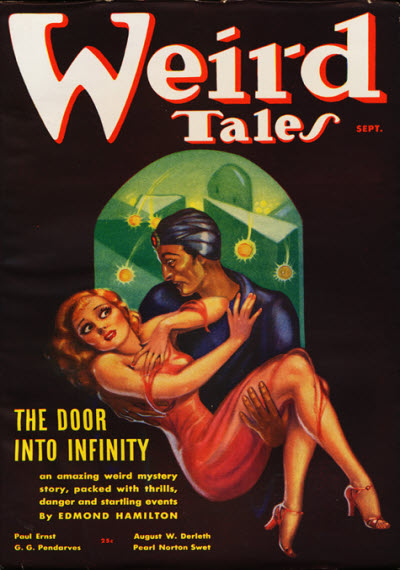
    (Cover by Margaret Brundage. Weird Tales, Aug-Sept 1936.)

    The Story So Far

    Valeria of the Red Brotherhood is a pirate-turned-mercenary who abandoned her ship to avoid an unwanted marriage proposal, only then to also desert the band of mercenaries she had joined, after killing one of the officers. She’s currently a fugitive, but she’s not alone, for it turns out Conan, who was in the same army as Valeria, also deserted and followed her trail—partly out of curiosity but also because he makes no secret of having the hots for the female warrior. (You gotta give Conan credit: the man is upfront about what he wants.) Valeria is not so smitten with the legendary Cimmerian. At the same time the two are probably better off together than each going their separate ways, for the moment. Their bickering is interrupted when a dragon of the forest they’ve taken refuge in devours their horses off-screen, with Our Heroes™ looking to be another meal. The dragon is not the fire-breathing dragon of medieval folklore, nor the slim serpent with wings of ancient China, but a dinosaur-like beast whose belly drags on the ground and who’s got more teeth than a dentist could possibly hope to count. With the help of a makeshift spear and the juice of a poison fruit, Conan incapacitates the dragon and Our Heroes™ flee the forest, into a wide plain and then into a massive interior city. Xuchotl is an ancient city that’s partly underground and totally encased by a dome, and at first it looks to be abandoned. When Conan splits from Valeria to do some investigating, the latter stumbles onto a couple of the city’s inhabitants and gets herself into a battle she really did not anticipate. The first installment ends with Valeria and Techotl, a member of the Tecuhltli, fending off some ravenous dogs. This first installment actually ends in the middle of the second chapter; I’m not sure if this is a criticism, I just wanted to point that out. The question then is: Where could Conan be?

    Enhancing Image

    Of course this had to be unintended, but I find it interesting that the first installment started and ended without Conan, only for the second installment (which is actually just the second chapter continued) to reintroduce him as fast as possible. Also, aside from the action scene at the beginning, this middle chunk of Red Nails will be much more focused on building character and the world of Xuchotl. There’s a lot less fighting and a lot more dialogue. This is not really a bad thing, since Xuchotl is one of the more imaginatively realized settings for a Conan story. Right after Howard wrote Red Nails, about a year before its publication, he admitted in letters that it would not only be his last Conan story but also probably the last fantasy story he ever wrote—mind you he was only 29 when he said this. The notion that someone so young could feel that they’ve said all they could say about a character, never mind a whole genre, might strike us as crazy, but I do believe that even had Howard lived to a nice old age it’s unlikely he at the very least would’ve written more Conan stories. Red Nails was the grand finale of the series, even if it doesn’t exactly feel like one; but also Howard really pulled out all the stops with the action, worldbuilding, and character moments. It’s also, it must be said, possibly the sexiest of the Conan stories, but that’s for me to give the details of in just a moment. For now we must be content with being introduced to the rest of the Tecuhltli, who stand opposed to the clan on the other end of the city, the Xotalancas. Turns out the city had already been built and had its own indigenous population when the founders of these clans had arrived. Given that said indigenous population is not longer here, you can guess what happened, although curiously the original people of Xuchotl are also said to have been brutal and decadent in their own right.

    Thus Conan and Valeria find themselves caught in the middle of a war between dying clans (there are no children among the Tecuhltli and presumably the same goes for the enemy) that has been going on for fifty years, so that basically nobody alive now was around to witness how it had all started. When we meet the rulers of the Tecuhltli, Olmec and his wife Tascela, we get the feeling that something is very off, not least because Tascela looks to be young and beautiful but is, in fact, at least in her seventies, given that she was an adult when the war started and indeed the big reason for why it had started in the first place. How she has retained her youth is a mystery—for now. During Olmec’s big exposition dump about the history of the clans, Tascela also seems weirdly focused on Valeria, as if transfixed by her beauty. (It’s worth mentioning that while homosexuality was sometimes mentioned in mainstream fiction of the time, it was sort of taboo in the genre magazines, so that even the implication of it here is Howard teasing the reader.) Now, my dumb ass thought going in that the story’s title referred to red fingernails, but actually it’s referring to red nails impaled in the Tecuhltlis’ headquarters, each representing a slain enemy. Granted, the red nails could also refer, if only metaphorically, to Valeria, who after all is of the Red Brotherhood. For better or worse Conan is rendered the secondary protagonist while Valeria is the real hero(ine) of Red Nails; and in case there was any doubt of this she once again takes hold of the narrative in the fourth chapter, which is where the second installment ends and which is short but pretty memorable. Red Nails could be considered a logical successor as well as a companion piece to Beyond the Black River, which in some ways it’s very different from but also in other ways similar. We go from the frontier to what is basically a buried city, and the POV character who follows Conan is female instead of male, but their premises are similar enough.

    Now, let’s talk about the torture scene, although it’s actually not the torture scene that provided the cover for the previous issue of Weird Tales. After their meeting with Olmec and Tascela, Conan and Valeria once again part ways for the moment, with the latter going to take a nice post-battle nap. She wakes suddenly, however, to find that Yasala, Tascela’s servant girl, had tried to pull a Bill Cosby on her with the help of a black lotus, a blossom “whose scent brings deep sleep.” Valeria is very cross about this, especially because Yasala refuses to explain herself. Valeria then does what any normal person would do and decides to strip Yasala naked and tie her down, for the purposes of strangely erotic torture with a lash. Now, as somebody who is not particularly into BDSM (although I’m not opposed to it), I have to admit that what follows is pretty hot, to the point where I would be surprised how it made its way into Weird Tales in the ’30s if not for the fact that paying kink lip service was actually far from uncommon for the magazine at this time. (There are, in fact, multiple Robert E. Howard stories that made the cover for this very reason, courtesy of Margaret Brundage.) Indeed, I can imagine that reading Weird Tales in the early-to-mid-’30s (the magazine cleaned up its act towards the end of the decade, at least when it came to the covers) and being introduced to BDSM this way. Shit must’ve blown some minds. Anyway, Valeria gives Yasala a good thrashing until the latter finally gives in, saying the Bill Cosby routine was part of Tascela’s scheme. Once Valeria unstraps her she throws some wine in Valeria’s face for her troubles and runs off the catacombs, where it’s implied she meets her death off-screen. Meanwhile Valeria hears the clashing of swords in another direction, implying that the Xotalancas are at the gates.

    A Step Farther Out

    Sorry for the delay, but I hope the wait was worth it. Red Nails is shaping up to be yet another top-tier Conan story, but we still have a good chunk of it to go. I’ve read enough Conan at this point, a lot of it outside the confines of this site, to separate the mediocre (because there are a few Conan stories where Howard was clearly phoning it in) from the good stuff. It helps a lot that Valeria herself is a very fun character, who in some alternate timeline probably could’ve gotten her own spinoff series. I’ve read into the possible inspirations behind Valeria, with the most likely contenders being C. L. Moore’s Jirel of Joiry, whose first couple stories Howard had very likely read by the time he wrote Red Nails; and then there’s Novalyne Price, Howard’s girlfriend at the time. The details of Howard and Price’s relationship are unspeakably depressing, so I won’t go into it, but it seems he had based Valeria’s tenacity on Price. (I’ve been reading Mark Finn’s Blood & Thunder: The Life and Art of Robert E. Howard, and there’s a good chance I’ll be done with it by the time I finish reviewing Red Nails.) My point is that I was looking for a palate cleanser after the dismaying experience that was reading the first installment of E. E. Smith’s Triplanetary, and I’m happy to say Red Nails is meeting my expectations.

    See you next time.

  • Novella Review: “Wolves of Darkness” by Jack Williamson

    April 19th, 2025
    (Cover by H. W. Wesso. Strange Tales, January 1932.)

    Who Goes There?

    Despite the sheer length of his career and how much of SF history he was involved with, there’s been relatively little retrospective material on Jack Williamson. He made his debut in 1928 and kept writing, albeit with quiet periods in his career, until his death in 2006. By the time First Fandom arose in the late ’30s, Williamson was already considered something of a titan in fandom circles, yet he also outlived most of the young folks in First Fandom who looked up to him. Williamson’s obscurity could be tossed up to him being a B-tier writer who occasionally wrote A-tier material, and also because despite being pretty popular within SF fandom, especially in the ’30s and ’40s, his influence is nowhere near as pronounced as, say, Robert Heinlein’s or even A. E. van Vogt’s. As he more or less admits in his memoir, Wonder’s Child, Williamson didn’t think of himself as a capital-A Artist™, but rather he wrote genre fiction because he enjoyed it. In a way he was the longest-lived and most persistent of the pulpsters, having more in common with the likes of Robert E. Howard and Edgar Rice Burroughs than Heinlein. “Wolves of Darkness” itself is a curious if imperfect SF-horror blend that marked one of several turning points for Williamson as a writer. It was, up to that point, his biggest paycheck for a single story, it was made the cover story for the January 1932 issue of the short-lived Strange Tales, and it was also his first attempt at applying an SFnal rationalism to what was then considered purely the ground of fantasy: lycanthropy.

    Placing Coordinates

    First published in the January 1932 issue of Strange Tales. It was stranded there for 35 years, until it was reprinted in the November 1967 issue of Magazine of Horror. It’s also been reprinted in The Mammoth Book of Classic Science Fiction: Short Novels of the 1930s (ed. Isaac Asimov, Martin H. Greenberg, and Charles G. Waugh), Rivals of Weird Tales (ed. Stefan R. Dziemianowicz, Martin H. Greenberg, and Robert Weinberg), Echoes of Valor III (ed. Karl Edward Wagner), and the Williamson collection The Collected Stories of Jack Williamson: Volume Two.

    Enhancing Image

    Clovis McLaurin is a med student, so somewhere in his twenties, who makes his way to the rural Texas landscape on account of his weird scientist dad needing his assistance for some vague purpose. Dr. McLaurin had inherited a ranch plus some funds from his brother, and has apparently been using the combo of free home and secluded location to conduct experiments. Clovis convinces one the locals, Judsgon, in the town of Hebron, near enough to the ranch, to help him on his way, although traveling by night ends up being a huge mistake for both of them. We’re already told early on that the landscape in these here parts of the state seem to be tormented at night by a pack of wolves, or maybe a werewolf. The introductory blurb for “Wolves of Darkness” tells us that this story will have to do with lycanthropy, which is true enough, although Williamson’s treatment of it pretty unconventional by the standards of pulp fiction. It’s also worth mentioning that one major plus in this story’s favor is its sense of place, which is no doubt inspired by Williamson spending much of his life in rural areas. He was, in fact, born in what is now Arizona, before it had become a state (that’s how old he is), before his family moved to Texas and then New Mexico, literally in a covered wagon in the 1910s. Despite being ostensibly set in what was then modern times, “Wolves of Darkness” is a depiction of the southwest at a time when it was still in the early stages of modernization. It’s set in the 1920s or early ’30s, but could almost just as well takes place circa 1900, as if the past and present were converging. Incidentally Jack Williamson and Robert E. Howard were close contemporaries who were both from the southwest, and thus reading their work from the ’30s you can get an idea of what early modernization for that region was like, albeit from quite different perspectives: Howard had a very love-hate relationship with Texas while Williamson was more forgiving.

    Anyway, Clovis it’s such a weird name I’m sorry and Judson are attacked by wolves and a rather skimpily dressed lady with glowing green eyes—in fact the wolves have the same sort of uncannily green eyes, as depicted in the cover. Judson gets killed off-screen, but the woman and her wolf pack take Clovis back to the ranch as a captive. Clovis swears he recognizes the girl from somewhere, and realizes it’s at least the body of Stella Jetton, the daughter of Dr. Jetton, who is (or was) Dr. McLaurin’s colleague. The problem is that Stella doesn’t recognize Clovis, and going by her actions it’s more likely that some outside force has taken control of her body. This turns out to be the case, not just with Stella and the wolves but Dr. McLaurin himself, who is, let’s say not quite himself once Clovis meets him. Both the people and wolves Clovis meets all have green eyes, and all seem to be possessed of some fierce intelligence that while in the bodies of “lower” animals appears to give them extra intelligence, while in the bodies of people they become more animalistic. The big weakness of this outside force becomes apparent early on when Dr. McLaurin (or the thing inhabiting his body) tells Clovis that they really dislike light of any kind, so as to why the interior of the ranch is only shown in a dim red light. The beings who have taken over these bodies are nocturnal, or rather they come from a world that is deprived of light—a notion that seems outlandish, although there are many organisms in the depths of our own planet’s oceans that have never known sunlight. “Wolves of Darkness,” like much if not necessarily all of weird fiction, is basically about someone trespassing beyond the boundaries of the natural order and in so doing fucking around and finding out, as we say. In the case of this story it’s Dr. McLaurin who, prior to the beginning, had tampered with studies in possible alternate dimensions. This is what I mean by the story being SF rather than fantasy, since we’re given an SFnal explanation for why these things are happening.

    Even in 1932 the premise of humanity coming into contact with malicious alien life was by no means new, although what’s more novel here is that “Wolves of Darkness” is an early example of aliens of the body-snatching variety. We never see what they look like, although from what I can tell they’re more like energy beings of the sort of that appear regularly in Star Trek; rather we only see them as filtered through the organic Earth bodies they take over. The conflict thus boils down to Clovis being held hostage, to help the aliens make a machine that would basically facilitate an invasion of Earth, or die a horrific death. Of course, he figures he’s gonna die either way, but he’d much rather defeat the aliens and save Stella in the process (he’s not as concerned about saving his dad). I’ve read enough early Williamson that I can tell Clovis very much fits in the mold of what Williamson was doing at the time, which is to say Clovis is a typical early Williamson protagonist: he’s sort of shy and intellectual, but also antsy, and he has a hunger for adventure that puts him in dangerous situations despite his social insecurities. In a way this is wish-fulfillment, a fact which Williamson was not exactly secretive about when it came to his ’30s output. (Some writers intentionally keep the methods behind their madness hidden while others, especially in the age of social media, are a little too eager about sharing with us all the boring fucking processes of their work. Williamson, in Wonder’s Child, takes a pleasant middle ground and only gives us insight into what really mattered to him as both a writer and person. If I ever become a professional writer of fiction, please put a gun to my head if I start oversharing about the miserable and solitary process of writing and getting my stories accepted wherever.) The “romance” between Clovis and Stella (the two barely interact if we discount scenes where the latter is still possessed) is also indicative of pulp fiction, in that it’s totally unconvincing.

    What’s more convincing is the thinly veiled sexual angst, which Williamson also points out in his memoir as being rooted in his own failed attempts at romance and sexual intimacy at that time. There’s a memorable scene in which Stella bites Clovis’s leg in retaliation and licks the blood, in a way which is animalistic but also evocative of a merciless dominatrix. Clovis carries that leg wound for the rest of the story, and it gets brought up a few times so as to remind us that Clovis is not in the best physical shape to run from these horrors, but it’s also a connection he has with this woman he is irrationally driven to save. The idea is that he really want to fuck Stella, although this sentiment is never made explicit, or rather it’s shrouded under the guise of “true love.” Their relationship is unconvincing when taken on its face, but is more convincing when read as repressed lust, helped by the fact that Stella is barely clothed for pretty much the whole thing. Another neat thing is that the energy beings are apparently able to inhabit any organic life, even those who are dead, resulting in a small army of green-eyed zombies, including the resurrected Judson. There’s a memorable little passage in which Williamson describes one of the zombies, apparently missing its head, with a pair of gaseous green eyes protruding from its neck stump. This is the kind of gory and unabashedly horrific stuff that would’ve been fine in Weird Tales but would probably not have been fine for Unknown a decade later. “Wolves of Darkness,” aside from just being too long (it’s a novella but has the plot and character depth of a novelette), is a slight challenge to recommend because it has elements of both pulpy weird fiction and more sophisticated SF and fantasy that would appear later.

    There Be Spoilers Here

    After a lengthy infodump, in which Clovis manages to put Stella under hypnosis and make the energy being recede from controlling her temporarily, and also a failed escape attempt, Our Hero™ knows what he must do. The aliens really hate light, to the point that enough exposure might be able to kill them, or at least make them retreat from the bodies they control. With the help of a few locals, some dynamite, and some matches, he kills the fuck out of some of the zombies and ultimately is able to turn the tables on the aliens. Of course everyone who fell under the possession of the aliens is dead now, including Clovis’s dad, a fact which he doesn’t seem to mind much, leaving Stella as the sole survivor. All’s well that ends well, I guess? It’s a weirdly upbeat ending, considering the death toll and also the strain it put on Clovis’s mental health; meanwhile Stella conveniently doesn’t remember being a meat puppet. Not one of the more convincing endings among Williamson’s fiction.

    A Step Farther Out

    A few years ago, when I really started to get into magazine fiction, I remember being instantly captivated by H. W. Wesso’s splendid cover for this issue of Strange Tales. I didn’t even know what Strange Tales was at the time; it was actually the horror/fantasy sister magazine to Astounding Stories, back when both were published by Clayton. Astounding almost didn’t make it, but Street & Smith came to the rescue, although Strange Tales was left to rot. Since it was the cover story for this issue, I’d been wanting to read “Wolves of Darkness” for a minute, and I’m glad I finally did. I will say that it does pale a bit in comparison with Williamson’s later attempt at putting an SFnal twist on lycanthropy, “Darker Than You Think,” which I had read a couple years ago, although I may revisit that for the sake of writing about it. “Wolves of Darkness” is a liminal piece in Williamson’s career that I’d recommend for anyone interested enough in the trajectory of the man’s career and/or the history of old-school weird fiction.

    See you next time.

  • Serial Review: Red Nails by Robert E. Howard (Part 1/3)

    April 15th, 2025
    (Cover by Margaret Brundage. Weird Tales, July 1936.)

    Who Goes There?

    E. E. Smith has I guess the distinction of having the first serial I started to review but simply could not finish. I’m already a couple days behind in my schedule as it is. It would’ve been one thing if I did not enjoy reading Triplanetary (which is certainly the case, mind you), but Smith was also maybe a victim of bad timing. We are cursed to live in interesting times. Both in my personal life and in the outside world there have been some, let’s say disturbances. My question then is, if I’m not gonna continue my review of Triplanetary, what could I use as a substitute for the rest of the month? There were many options; as you probably know, a lot of novels and novellas were serialized in three installments. But for me the answer was obvious: I’d be returning to Robert E. Howard.

    Despite the fact that he committed suicide when he was only thirty, Robert E. Howard can lay claim to being the most influential American fantasy writer of all time, not to mention being arguably the greatest of the pulp writers who never broke into mainstream or “slick” fiction. He began writing with the hopes of being published when he was 15, although he wouldn’t actually make his first fiction sale until he was 17 or 18; little did he know, when he started writing at 15, that his life was already halfway over. But once Howard started getting published, he never stopped—not even when he died. Almost too many short stories and poems to count were published, either complete or as fragments, in the decades following Howard’s death in 1936. He wrote nonstop for about a dozen years, and for practically every pulp and genre market, except, weirdly enough, science fiction, which he didn’t seem to have much if any interest in. He wrote fantasy, horror, Westerns, historical adventures, and even sports stories (Howard was especially fond of boxing). He also ran several different series focusing on a colorful roster of courageous and quite masculine heroes, from Solomon Kane and the sailor Steve Costigan to, of course, Conan the Barbarian. Conan is one of the most iconic characters in fiction, and he was also Howard’s final fantasy hero, being a culmination of themes and tropes Howard had developed. Red Nails was the last Conan story Howard had completed; the first installment would’ve been on newsstands around the time of Howard’s death. I had been meaning to get to this one for a while.

    Placing Coordinates

    Serialized in Weird Tales, July to October (the August and September issues were combined) 1936. Since this is Conan it’s been reprinted quite a few times, including 13 Short Fantasy Novels (ed. Isaac Asimov, Martin H. Greenberg, and Charles G. Waugh) and too many Howard collections to count. It’s also on Project Gutenberg.

    Enhancing Image

    Valeria of the Red Brotherhood is a pirate-turned-mercenary who’s currently a fugitive, having killed an officer in Zarallo’s Free Companions, an army of mercenaries and, ironically from what we hear about it, not free at all. Another member of that army was Conan, and like Valeria he too deserted, albeit for different reasons. Since this is the third Conan story I’ve reviewed, I think acknowledging formula is in order. Howard wrote a lot, and like anyone who writes enough for long enough he fell back on formula and certain turns of phrase, and even how he would structure his plots. With the Conan series the idea is that the “real” protagonist is not Conan, but some third party who has their own adventure, including their own personal stakes, and who sees Conan’s exploits from the outside. There are some exceptions, but most of the Conan stories do not start with Conan as the focus characters. Valeria herself is by no means the only female main character in a Conan story, but she’s certainly a contender for the feistiest, alongside Bêlit from “Queen of the Black Coast.” But whereas readers might recall Conan’s relationship with Bêlit being genuinely romantic (if also ill-fated), his interest in Valeria is more purely carnal. Indeed Conan and Valeria’s relationship is about as explicitly sexual as one could’ve gotten in ’30s pulp magazines without the characters having actual sex (at least not yet). Valeria compares Conan to a stallion and at one point Conan threatens to spank Valeria in a way that is clearly more meant to be taken as kinky teasing rather than punishment.

    Of course, Valeria is a tsundere who is not so taken with Conan’s teasing and raw machismo, although there’s the sense that she can’t help but admire him as a fellow warrior. I’ve read up a bit on Red Nails and one criticism I’ve seen repeated is that for someone who is described as a bad bitch, and who takes a lot of pride in her supposed abilities as a fighter, Valeria is not as strong as she appears. This may prove more valid than it seems to me initially, but I like the idea of a pirate lady who is perhaps a little out of her depth when fighting on land—you could say like a fish out of water. She also clearly resents being on the receiving end of misogyny and mockery from her male colleagues, saying, “Why won’t men let me live a man’s life?” at one point. (Obviously such a sentiment reads different nowadays, what with our understanding of genderqueerness, although Valeria is at the very least gender-nonconforming.) Due to the episodic nature of the Conan series it can be hard to lay out some internal chronology, but I’m pretty sure Red Nails takes place after “Queen of the Black Coast” since Conan has already lived as a pirate by the time of the former, although he makes no mention of Bêlit. I like how these two are former pirates who’ve come to land under different circumstances, with Conan’s last ship getting sunk in battle and Valeria quite literally jumping ship to avoid an unwanted marriage proposal. Also it’s worth mentioning that despite being written after some of the darkest entries in the series (“Queen of the Black Coast” and Beyond the Black River especially), Red Nails starts off considerably lighter in tone, insofar as it reads like a more typical pulp adventure.

    But of course, there’s trouble afoot. As Conan and Valeria leave their horses and really get down to bickering with each other, they realize too late that they really should’ve kept a better eye on those horses. A dragon ate them both, somehow, making such short work of the animals that their bones made a distinctive crunching sound. Our Heroes™ have come face-to-face with a dragon, a beast about as large as an elephant with “huge eyes, like those of a python a thousand times magnified,” a head larger than a crocodile’s, a belly that drags on the ground, “absurdly short legs,” and a long and flexible tail. It’s basically a walking tank with a trash compactor for a mouth. Much of the first installment of Red Nails has to do with getting around this dragon, which was not quite what I was expecting, since what I had heard most about this novella was the main setting—but we’ll get to that in a moment. It looks like Our Heroes™ are cooked, but Conan comes up with an ingenious tactic that might (just maybe) kill the dragon. He makes a spear and covers the tip with the juice of a poisonous fruit, then aiming for a spot on the dragon that isn’t totally covered with scaly armor. It works, or at least it works well enough, with Conan and Valeria running off, leaving the poisoned dragon to die a slow death—maybe. I have a feeling this will not be the last we see of it. Finally we come upon a city on the plain, although it’s no ordinary city but one that seems at least partly underground, being totally kept indoors as if under a dome. Being on the run, and with no other signs of civilization in sight, Conan and Valeria enter the interior and probably abandoned city. It took long enough, but in the back end of this installment we do finally enter Xuchotl.

    There Be Spoilers Here

    This first installment starts and ends with Valeria by herself, since she and Conan are separated for a time once they’ve entered the city. Conan goes off to investigate by himself and leaves Valeria by herself, which turns out to have been a bad move. Valeria finds herself caught in the midst of a battle between two clans that lurk in the city, those of Tecuhltli and those of Xotalanc, having been rescued by a scarred man named Techotl, who comes from the former clan. The builders of the city seem to have died or fled, but they’ve left a great deal in their wake. People reading Red Nails expecting Conan to have more time on the page than he does will be surprised and probably disappointed. The idea, I suppose, is that Conan is simply too powerful a character to be consistently in the midst of the action, so Howard came up with reasons for his to be somewhere else. (Tolkien had a habit of doing this with Gandalf, as another example.) Conversely, if Valeria was out of her depth before then she’s almost useless by the end of this installment. So there’s that.

    A Step Farther Out

    Ah, it feels good to be back. It’s been over a year since I last got to write about Conan, and Howard’s fiction generally. I’m sure someone out there will blame more for pussying out with Triplanetary, but life is short and I will not, at least for the moment, waste it on trudging through terrible writing. It’s not even like I get paid for any of this. It could also be that I returned to Howard because I’m turning thirty in eight months and I can’t say I’m happy about that. It got me thinking about Howard again, for his life story is surely one of the most tragic in the history of genre writing; but, on the plus side, while he never married or had children, anyone who loves fantasy of the blood-and-thunder variety has a least a bit of Robert E. Howard in their heritage. It’s like how some white Europeans have, to this day, a sliver of neanderthal in their DNA. A relic from an ancient time. Modern fantasy writing, it seems to me, plays things too safe and sanitary, so that we could really use a darker, bloodier, sexier fantasy—albeit not that much of it. You don’t wanna have too much of a good thing, after all.

    See you next time.

  • Short Story Review: “The Pilot and the Bushman” by Sylvia Jacobs

    April 10th, 2025
    (Cover by Ed Emshwiller. Galaxy, August 1951.)

    Who Goes There?

    Overall we know about as much about Sylvia Jacobs as we know about Jesus of Nazareth. I can’t find any pictures of her, or find out when she was born or when she died; but then we at least have writings from her, so there’s that. I was pointed towards a useful piece by Rich Horton which covers what little we know about Jacobs’s life and what little fiction and non-fiction she had published in the genre magazines. She had studied oceanography, and was married to a professional deep-sea diver. She apparently had done some research for Robert Heinlein (regarding the ocean, of course) for a juvenile novel he had planned but sadly never got to write. She was a California denizen for at least some of her adult life. She wrote about half a dozen SF stories, mostly in the early ’50s, which is unsurprising given that was when the magazine market saw an immense bubble; and, just as unsurprisingly, she mostly went dormant after 1960. This is the basic narrative of a lot of lady SF writers from that period, although by no means all of them. Horton describes “The Pilot and the Bushman” as like a prototype for the light satire Christopher Anvil later wrote nonstop, although I don’t think he gives Jacobs’s story quite enough credit—not to say it’s a hidden gem, really, but there’s a fair bit going on here.

    Placing Coordinates

    First published in the August 1951 issue of Galaxy Science Fiction. This is my third time plundering this issue for gold, and it’s quite possible I will have covered all of this issue’s fiction contents eventually. The copyright must’ve run out at some point, because “The Pilot and the Bushman,” along with a couple other Jacobs stories, is on Project Gutenberg. It’s also been reprinted in Women Wrote the Future: Vol. 1: Tales from Galaxy (ed. J. LaRue). Other than that it’s not seen print at all.

    Enhancing Image

    The first and easily longest scene is a Socratic dialogue between two men, although despite both appearing to be human one of them is, in fact, an alien. The Ambassador from Outer Space (we never get his actual name) is having a behind-closed-doors meeting with Jerry Jergins, a marketing man and predictably a bit of a scoundrel. The two are in the situation because the Ambassador had made what was called a “boner” in the old days, by that I mean he had made a slip at the UN Assembly by saying the aliens have what they call a Matter Repositor. The problem is that the Matter Repositor can replicate anything, and I do mean anything, which is no real issue for a society that does not run on industrial capitalism. (The Ambassador is quick to point out that the aliens’ economic model is NOT some brand of socialism, IT’S NOT SOCIALISM, GUYS.) The Matter Repositor may as well be magic, but the point is that mankind is too “primitive” to have it. The problem is that once you inform someone of something’s existence and then tell them they can’t have that thing, then that someone is no less incentivized to take the whatever-it-is. God told Adam and Eve to not eat fruit from the tree of knowledge, but that did nothing to stop Eve from having a bite. If you tell your kid they can’t have more cookies from the cookie jar than they ought to, what do you think they’re gonna do at some point? The aliens, as you can tell by the comparisons I’ve made, see themselves as being in a parental or patronizing position with regards to the humans. Jerry isn’t happy about the Ambassador’s smarmy attitude, but if he has a plan (and he does), he’s not upfront about what he has in mind.

    This is a story about two races from radically different cultures, with one actually immersing itself in the other’s culture for the first time. “The Pilot and the Bushman” is, on its surface, about the immediate aftermath of mankind making first contact with a fellow intelligent race, but it takes no more than a single brain cell to figure out Jacobs is comparing her SFnal situation with the real-life occurrences of one human culture making first contact with another human culture, with one side being far more advanced on a technological level than the other. I have to italicize that one part because, of course, the Spaniards and later the English who set foot in North America were no more inherently intelligent or morally upright than the indigenous peoples of the land. There were things the indigenous peoples were not and could not be prepared for, namely diseases they had no prior contact with or knowledge of, and thus you had whole populations introduced to diseases they had no immunity against. Similarly the Ambassador fears that introducing mankind to the Matter Repositor would have apocalyptic consequences, since virtually every country on Earth has (whether lefties wanna admit it or not) a capitalist economy based on scarcity. The people of the Ambassador’s home world have been born and raised into a post-scarcity environment, which understandably has created a radically different mindset from what humans are acquainted with. The aliens are not necessarily superior but are certainly very different—the huge gap in cultures being the races being the problem.

    As the Ambassador says:

    To a Micronesian bushman, the pilot who can be trusted with the power and speed of a B-29 seems a veritable god. But the pilot is only an ordinary Joe, very likely no more intelligent than the bushman—he just had a different background. Fighting each other for necessities and luxuries, the process that you people call business competition, has so long been needless to our people that they would no more think of competitive gain than you would do an Indian harvest dance before you signed a contract. They aren’t necessarily more intelligent or more virtuous than your people—they just have a different background.

    Of course, the aliens are the pilot and the humans are the bushman. It’s not exactly a hard comparison to make. What’s strange, reading it now, is that Jacobs goes about it with the mindset that the aliens really do mean well despite their smug attitude around humans, or at the very least that they aren’t looking to divide and conquer Earth as hot new real estate, like with their real-life counterparts. It’s a commentary on colonialism and the relationships invasive cultures have historically had with indigenous peoples, but it lacks serious bite because it does not interrogate the myriad ways in which a colonizing force can subjugate a colonized people’s development. The biggest complaint I have with this story, other than it being overly chatty (there is nonstop talking for over half of it, which can dull one’s attention span), is that Jacobs does not treat her own subject matter with enough seriousness. Horton compares it to Christopher Anvil, but I also thought of a less funny and less vicious Robert Sheckley—granted that Jacobs’s story was published about a year before Sheckley made his debut. My point is that it’s easy to overlook the territory “The Pilot and the Bushman” covers because the story itself doesn’t pay said territory that much mind. It’s a social satire, of the sort that appeared quite often in Galaxy, especially in its early years, and for that it’s an adequate example.

    But it could’ve been better.

    There Be Spoilers Here

    Conditions improve, thankfully, when we finally see an end to the dialogue and some action can kick in, although it’s not much. The back end of this story has enough of a sense of humor and also a viciousness that the first half or so was rather lacking; like I would’ve appreciated it if Jacobs had not spent so much time setting things up. The gist is that Jerry agrees to coordinate a huge propaganda campaign to disincentivize people from looking into the Matter Repositor, while at the same time playing up humanity’s quickly growing reputation as “savage” compared to the aliens. The plan works—in fact it works better than the Ambassador would’ve wanted, although Jerry is perfectly happy with the results. Earth becomes a tourist destination for the aliens, who are so unaccustomed to things to like drinking, whoring, theft, and other vices that they see it all as an alluring novelty. They think stealing some doodad from a convenience store and spending a night in jail is fun. They’re totally unprepared for the eccentricates of human culture and are thus unequipped to resist it. This is clearly a satire of how people in the Anglosphere see certain “backwards” countries as lovely tourist spots. Even circa 1950 this would’ve been very the case with how Americans treated Hawaii, which was a US territory but a state yet. The othering of indigenous people and East-Asians in Hawaii has been a thing for decades now, but ya know, nobody likes a tourist.

    A Step Farther Out

    I have to assume, given how little she wrote, that Jacobs saw writing SF as like a hobby more than anything. In the early ’50s it was possibly to write SF for a living, so long as you wrote at a mile a minute and knew how to sell a story to the right editor. Maybe Jacobs was into it but not that into it; she did, after all, have a respectable day job. “The Pilot and the Bushman” was her second published story, and I’d be interested in reading the rest of her SF, although I don’t expect to find a hidden master of the form. Jacobs’s career as an SF writer is like a ship that passed in the night.

    See you next time.

  • Serial Review: Triplanetary by E. E. Smith (Part 1/4)

    April 8th, 2025
    (Cover by Leo Morey. Amazing Stories, January 1934.)

    Who Goes There?

    There were once people who loved reading E. E. Smith, but they’re all dead now. Even at the time of his own death in 1965, Edward E. Smith was something of a dinosaur, albeit one treated with reverence within SF fandom, even if he remained totally unknown outside of it. Smith, as you might know, was perhaps the chief innovator of space opera; when his debut novel, The Skylark of Space, was serialized in 1928, there was nothing else quite like it on the market. The closest for comparison would have been Edmond Hamilton’s Interstellar Patrol series, but there was nothing on the scale of what Smith was doing. Unfortunately, to cop a line from Alexei and Cory Panshin’s review of The Best of Stanley G. Weinbaum, time has long since swallowed up what were once Smith’s virtues—an assessment that I think befits Smith a lot more than Weinbaum, for the record. You can still read and enjoy Weinbaum just fine, assuming you’re not of the sort that requires your SF to be dead serious; but with Smith, even if one were to keep an open mind, it can be a real challenge. Smith just wasn’t a good writer, sad to say, really in any sense of the word, except he did have a sixth sense for scale and action, mostly in the depths of space. Even Hamilton, Smith’s closest contemporary, holds up better to modern scrutiny, especially since he did end up evolving with the times, whereas Smith did not. Thus we have someone whose work strikes even the most retro-friendly of modern SF readers as a museum piece.

    Why did I pick Triplanetary as my first Smith to cover here, then? The novelty of it was tempting. You see, along with the Skylark series there was the even grander Lensman series, which occupied Smith for much of the ’30s and ’40s. Smith didn’t see any of his novels get published in book form, however, until after the end of World War II, by which point some of these novels had not seen the light of day since they ran as serials more than a decade earlier. When Smith took hold of Triplanetary for book publication he revised and expanded it so as to make it almost unrecognizable from its serial version, to the point that whereas the serial version of Triplanetary is a standalone novel, the book version was retrofitted to be a prequel entry in the Lensman series. The book version is also about 1.5x the length of the serial version. The two are so different that they have separate ISFDB pages. Like I said, it’s the novelty of the thing.

    Placing Coordinates

    Triplanetary was serialized in Amazing Stories, January to April 1934. Smith had apparently hoped to sell it to Astounding, but that magazine went through a change in both editor and publisher, not to mention it’d gone on hiatus for about six months. The serial version of Triplanetary would remain stranded there for more than seventy years, until it was transcribed for Project Gutenberg in 2007. A few small publishers have since made this version of the novel available in book form, making sure to differentiate it from its book counterpart.

    Enhancing Image

    The space liner Hyperion is going on its merry way—or maybe not so merry, as the crew is aware that two ships from the Triplanetary League have gone missing in this part of space recently. Not destroyed, but simply vanished without a trace. (The Triplanetary League is a coalition of Earth, Mars, and Venus, from that distant time when Venus was thought to be hostile to human life, sure, but theoretically livable.) Conway Costigan is First Officer of the Hyperion, but also a member of the Triplanetary Secret Service, so he’s like if Spock and Jason Bourne were the same guy. Unfortunately, a pirate must’ve snuck aboard ship and taken on a disguise, as there’s an outbreak of Vee-Two gas, which incapacitates the crew. Costigan only has enough time to save himself and a single passenger, Clio Marsden, getting them into a lifeboat and reviving her. Costigan explains to Clio that Vee-Two is strictly forbidden, something she apparently already knows. (There’s quite a bit of dialogue wherein characters explain things to each other that they already know.) “The penalty for using it or having it is death on sight. Gangsters and pirates use it, since they have nothing to lose, being on the death list already,” says Costigan. Looking into Smith’s works, the death penalty was something he was just really keen on, to the point where he seemed to support its use even for drug dealers—a view that I wanna say has not aged well, but it looks like modern American conservatives are about as enthusiastic about capital punishment. History doesn’t repeat, but it does rhyme. Costigan heads back into the bowels of the Hyperion to track down the pirate, with a gas mask, space armor, and a nifty weapon on a tripod that’s so powerful that it not only jibs the pirate but turns him into a cloud of mist. This scene, the strongest in the installment, understandably provides the image for Leo Morey’s cover for the issue.

    You can accuse Triplanetary of a lot of things, but it is certainly not slow in its pacing, unless you’re talking about the book version. I’ve gathered that the biggest change Smith made was that he wrote six chapters of backstory to pad out the beginning of the book version, working mainly to wedge Triplanetary into the Lensman continuity. I don’t know how anyone is supposed to survive a single chapter of lore written by E. E. Smith, let alone six. The serial version, for all the bad writing on display, wastes the reader’s time as little as possible. In the course of three chapters we’re introduced to the hero, the (probable) love interest, the villain, and what’s at stake. Speaking of which, when it looks like the Hyperion’s troubles are over, the crew is taken hostage by a ship that appears to be invisible, with Costigan, Clio, and Captain Bradley meeting face to face with the owner of an artificial “planetoid” (listen, it’s not the Death Star, got it?), named Roger. Yes, Roger. That’s his name! We know this is about as old-school a space opera as you can get because tractor beams are mentioned. Roger is a mad scientist, although he considers himself not to be mad but perfectly calm and collected; indeed he doesn’t do a Bond villain laugh or anything like that, but rather is calculated in his malice. Even his threat to rape Clio (I suspect it’s implied rather than explicit because of censorship) is stated in so many words, rather than bluntly put. Much of Roger’s workforce is also robotic, rather than flesh-and-blood people, despite what the pirate in the first chapter would make us believe. Thankfully Costigan, being a badass secret agent, has a plan for getting at least himself and the others out of prison. They escape, thanks to some tech that somehow Roger’s goons were unable to detect, but their victory is short-lived as there turns out to be yet another villain, apparently alien, even bigger of a threat than the mad scientist.

    Oh, it’s bad.

    Putting his ridiculously bland name aside, Roger’s actually not a bad villain. Smith doesn’t bother much with describing his characters physically, but he does give Roger special treatment:

    Not only was [Roger] dressed entirely in gray, but his heavy hair was gray, his eyes were gray, and even his tanned skin seemed to give the impression of grayness in disguise. His overwhelming personality radiated an aura of grayness—not the gentle gray of the dove, but the resistless, driving gray of the super-dreadnaught; the hard, inflexible, brittle gray of the fracture of high-carbon steel.

    Mind you that this all happens, with Costigan and company getting attacked by pirates and then introduced to Roger, in the first chapter. If the book version of Triplanetary suffers from being too slow, as in frontloaded with exposition, then the serial version might have the opposite problem. And yet, despite having breakneck pacing, Smith still finds room to insert dialogue that is, let’s say redundant. For example Roger spends rather too much time saying, indirectly, that he plans to make a sex toy out of Clio, if only because she’s apparently too slow on the uptake to get his point. A common criticism I’ve seen when reading about Smith is that his characters don’t talk like real people, or even people you’d read about in SF published a decade later, but almost like old-school comic book characters. It’s writing in the old pulp tradition, although even within that context I’d still say Smith is more stilted than, say, Edgar Rice Burroughs, who for all his faults went out of his way to not irritate the reader unless one thought about his racism or dodgy science too deeply. Three chapters in and we have one character who feels like he has real presence, except Roger turns out to not even be the greater-scope villain, if the third chapter’s anything to go by.

    There Be Spoilers Here

    My eyes started glazing over towards the end, although I’m not sure how much of that was the quality of the novel and how much was the awful mood I’ve been in lately. I’ll let you know.

    A Step Farther Out

    On the one hand I believe that once I start writing about a serial then I really ought to finish it, as I probably will in this case. I’ll be honest with you, though, it’s been rough going already and we’re only a quarter into it. Maybe I just like Smith as a writer; something about him, aside from his obvious faults, bugs me. I tend to be generous with old-timey SF, even of the pre-Campbell sort, but this might be the threshold for me. But, it’s also possible that this is as bad as it gets.

    See you next time.

  • Novella Review: “Proxima Centauri” by Murray Leinster

    April 4th, 2025
    (Cover by Howard V. Brown. Astounding, March 1935.)

    Who Goes There?

    When John W. Campbell became editor of Astounding with the October 1937 issue, there was a sort of mass extinction event for genre SF—although not quite. For one, the changing of the guard from F. Orlin Tremaine to Campbell was gradual, with many of the writers who submitted to Tremaine still being around in the early ’40s, but also a few of the pre-Campbell writers did survive well past what should’ve been their expiration date. The most remarkable example of one of these authors succeeding against the odds might be Murray Leinster, which was the pseudonym for real-life inventor Will F. Jenkins. Of course, Leinster also occasionally used his real name as a byline, most memorably with one of his forward-thinking stories, “A Logic Named Joe.” Leinster had his first SF story published in 1919, making him so old that he came about before the launch of Amazing Stories. In the ’30s he wrote his first major work, including today’s short novella, but the consensus among genre historians is that the years 1945 to about 1960 are where Leinster really hit his stride. This is impressive for someone who turned sixty in 1956. “Proxima Centauri” is decidedly pre-Campbell in that it’s an example of the pulpy space opera that dominated SF magazines (it even appeared sometimes in Weird Tales) in the late ’20s through much of the ’30s. It’s more Star Trek than something more intellectual like, say, Robert Heinlein’s “Universe,” which is often regarded as having extrapolated on Leinster’s premise; but really, the two stories have little in common past their settings (big spaceship) being similar.

    Placing Coordintes

    First published in the March 1935 issue of Astounding Stories. It’s been reprinted in Before the Golden Age (ed. Isaac Asimov), From Wells to Heinlein (ed. James E. Gunn), and too many Leinster collections to count, including Sidewise in Time, The Best of Murray Leinster, and First Contacts: The Essential Murray Leinster.

    Enhancing Image

    The Adastra is big. Like monstrously big. Indeed “monstrous” is a word Leinster uses to describe it maybe one too many times; the vocabulary for pulp writing was not that varied. The Adastra is a spaceship that has been journeying out to Proxima Centauri for the past seven years, with its crew of a few hundred, plus a fair number of children. When someone brings up “Proxima Centauri” it’s as a precursor to the generation ship subgenre of SF, if you can even call it a subgenre. The idea behind the generation ship is that people live, from cradle to grave, on a spaceship, generation after generation. Going by this criteria, however, this is not an example of a generation ship story, since the people aboard the Adastra are supposed to reach Proxima Centauri and then return for Earth. The trip even one-way takes several years, though. At some point, enough people aboard got tired of the day-to-day monotony that a mutiny happened, although it did not succeed. At the beginning of the story there are basically two factions, those who side with the officers and the captain of the ship, and those who side with the “Muts,” short for mutineers. Jack Gary is one of these Muts; he came aboard as a teenager, when he wasn’t even old enough to serve as crewman, but his father died during the trip and Jack took his place. Jack’s in love with Helen Bradley, who (of course) is the captain’s daughter. Doing some basic math tells us that Jack is 23 while Helen is 21. Unfortunately for the both of them, Captain Bradley does not approve of them marrying, on account of Jack being a Mut; meanwhile Alstair, the first mate, approves of them being a couple even less, given he also has eyes on Helen. Helen, for her part (being “the girl” [Leinster’s words, not mine] of the story), doesn’t seem interested in Alstair at all, which is understandable given that he’s an asshole who wants Jack’s head on a pike.

    The love triangle between Jack, Helen, and Alstair forms the human drama of the narrative, which… is fine, I guess. You could do worse. Aside from the aforementioned characters there’s nobody else really worth considering; maybe if Leinster had expanded it to a longer novella we would’ve gotten more from the rest of the crew, but alas. The point of the story is really not the borderline generation-ship conditions of life aboard the Adastra, but instead what the crew meet by total accident as they get close to the star. See, this is actually first contact narrative, and the aliens we meet end up being really something. The crew hide in the ship’s depths when the aliens (let’s call them Centaurians) come aboard, although one unlucky redshirt gets killed instantly for his troubles, the Centaurian’s weapon not only killing him but rapidly mummifying his body. One might think this was just a case of misunderstanding, or that maybe the boarding party of Centaurians were too quick with the trigger and realized their mistake; but no, these aliens are very happy to take home some human corpses. After a skirmish in which armed crewmen are able to fight off the boarding party and taken one of the aliens captive, we find out a few things: that the Centaurians are not animals but rather sentient plants; that the Centaurians see animal life as both a food source and the corpses of animals as collectors’ items; and also that the Adastra is woefully ill-equipped to deal with the Centaurian ship. While some people aboard have weapons with which to defend themselves, the Adastra itself does not, and at the same time the ship is too bulky to maneuver out of the way of attack. To make matters worse, Captain Bradley has died offscreen, from… something. Now Alstair is in command, and Alstair is not the right man for the job.

    I’d been meaning to review more Leinster since I tackled his SF-horror yarn “Pipeline to Pluto” about 18 months ago, because I wanted to read a Leinster story that’s maybe less bleak, and also because when I reviewed “Pipeline to Pluto” I was in a terrible headspace myself. Turns out that “Proxima Centauri” is only marginally less dark than that other story, although its body count is higher by several orders of magnitude. Death hangs like a shroud over pretty much every page, and the situation Our Heroes™ find themselves in is really hopeless; there is no magical solution in which both sides get to sort out their differences. Leinster’s Centaurians are unambiguously evil, but his human characters are only better by virtue of sometimes being able to make rational decisions. Much of the conflict comes from Jack and Alstair hating each other’s guts and Helen being able to do very little about that. Even when they devise a way to communicate with the captured Centaurian, there’s no way to see eye-to-eye with the alien; the two races are fundamentally opposed to each other’s existences. This is all a curious foil to Leinster’s later and more beloved story, “First Contact,” in which (spoilers) the human and alien space crews are able to resolve their conflict peacefully. In “Proxima Centauri” there is no such option. The crew of the Adastra were already on the brink of killing each other, but for a lot of them being confronted with the pure evil that is the Centaurians proves to be the tipping point. As you can see with the cover for this issue of Astounding, which depicts “Proxima Centauri,” the Centaurians are vaguely humanoid but do not have heads or necks; instead their eyes are rendered as slits in the upper abdomen, and their limbs are rather spongy, which makes sense given that they are walking plants. The Centaurian ship used radio waves to kill non-animal life before boarding the ship, but then of course the Centaurians themselves are non-animal life so that’s what they would think to use.

    Assuming you can put aside the insane logistics of the Adastra, a ship whose dimensions and internal workings either cannot or should not exist, it’s internally consistent enough of a story. Most SF writers at this point were not scientists or inventors, despite people like Hugo Gernsback really wanting to push the “credibility” of scientists as writers, but Leinster could actually claim to have in-depth knowledge of some technology. There’s a seriousness with how Leinster imagines the Adastra and its alien foes, even if the tone of the thing is very pulpy.

    There Be Spoilers Here

    By the time we get to the final chapter the vast majority of the Adastra‘s crew is dead, either killed by the Centaurians or via suicide. There’s a disturbing little passage wherein one of the officers, about to be taken prisoner by the aliens, kills his family and then himself; unfortunately Leinster does not give this sort of grimness the proper sense of weight, either through pacing or his choice of words. The pulp method of writing is ill-equipped for dealing with a story where by the end a few hundred people have died, along with an entire race of intelligent lifeforms. Since that cat is out of the bag, we may as well talk about the ending, which in looking up opinions on “Proxima Centauri” I’ve found surprisingly little material for. It could be that in the context of when it was written the kill-them-all ending is probably far from unique, but I still think it’s worth noting the sense of inevitability in how Alstair, being the last people aboard the Adastra, rigs its engines so that the ship, in exploding, destroys the Centaurians’ home world. Alstair’s decision to sacrifice himself and let Jack and Helen run off together is treated as heroic, but in sacrificing himself he also commits an act of genocide. The extermination of a whole species. It was them or us. A human ship, following the Adastra by a few years, has apparently been on its way to Proxima Centauri, with no way for the Adastra‘s crew to warn them that the Centaurians would be waiting for them. Worse yet, once the Centaurians heard about Earth, they saw a goldmine in the form of a planet, full of animal life that was for the taking.

    What’s curious about Leinster’s resigned position that the Centaurians must be exterminates is that it’s not because they’re a warmongering people, but because they’re such resource hogs that they’ve eliminated all animal life from their home planet, as well as others containing life in their solar system. They see non-plant life like how humans see precious metals, and Leinster makes this comparison explicit because he’s not really talking about some hypothetical race of plant people—he’s talking about us. Human greed may become so all-consuming that it threatens life on an existential level. Spoilers for The Day the Earth Stood Still, but after Klaatu, an alien visiting Earth with his cool robot, is resurrected and able to call upon the leaders of as many human governments as could be managed, he warns us that the galactic council he’s a part of might have to take drastic action if the governments of Earth persist in researching nuclear weapons. Powers from another galaxy apparently see the hydrogen bomb, or at least what it can lead to, as enough of a threat to other planets hosting intelligent life that the message is basically: “Sort your shit out, or we will sort your shit out for you.” Surely if the race of people Klaatu belonged to was real, we would all be dead by now. Likewise the Centaurians are so devastating to whatever environment they come upon that something must be done about them. It’s an extremely bloody ending for how hopeful it is.

    A Step Farther Out

    “Proxima Centauri” is one of the most important pre-Campbell SF stories of the ’30s, although it’s not necessarily one of the best. It’s a story that gives hints of a deceptively bright talent, but is also beholden to pulp-era tropes that not mix well with modern sensibilities. I also recommend not going into it as a precursor to generation-ship narratives since that’s really not the point of the thing, although it might strike some (like it did Asimov, when he first read it as a teenager) as a pleasant surprise. Leinster would adapt with the time, up to a point, so that a decade after “Proxima Centauri” he would emerge as one of the more mature writers in the field. It helps that the story itself is not a slog to get through; it doesn’t overstay its welcome and it mostly go down smooth. Still, this is the kind of thing you read in 2025 for the sake of studying it than enjoying it.

    See you next time.

←Previous Page
1 … 8 9 10 11 12 … 43
Next Page→

Create a free website or blog at WordPress.com.


Loading Comments...
 

    • Subscribe Subscribed
      • Science Fiction & Fantasy Remembrance
      • Join 139 other subscribers
      • Already have a WordPress.com account? Log in now.
      • Science Fiction & Fantasy Remembrance
      • Subscribe Subscribed
      • Sign up
      • Log in
      • Report this content
      • View site in Reader
      • Manage subscriptions
      • Collapse this bar