Not much to say with regards to updates here, other than I’m looking into a tutoring gig and I seem to be starting a polycule, the latter of which I’ve heard is kinda like starting a rock band. If anyone wants to join, please let me know. There are no gimmicks for this month’s review forecast, except that we have a complete novel on our hands for the first time in what feels like forever, and we’ve got a few familiar faces returning to the site. I may have also intentionally picked Lucius Shepard and Aliette de Bodard stories with similar titles. One thing I’ve been thinking about that I’ve decided to act on is reviewing more reprints of classic stories; one every couple months seems like a good deal. The reason for this is at least twofold: I have a soft spot for the classics, but I also wanna cover authors from the pre-pulp years who contributed to genre fiction. This month I’ll be reviewing an SF story by Jack London, who is not known primarily for his SF but who indeed wrote a lot of it. Once again Jack Vance will be providing the novel, which is unsurprising since quite a few of his novels first appeared in magazines, either as serials or all in one piece like this month’s novel.
Don’t wanna keep you long; just letting you know we have another month packed with fiction that looks to be at least interesting, although it’s mostly SF with a couple fantasy stories thrown in.
For the novellas:
“Birthright” by April Smith. From the August 1955 issue of If. Smith sadly is one of many women who wrote SF in the pre-New Wave days whom we know basically nothing about. We don’t know when she was born or when she died. She’s a ghost. She has one solo story, “Birthright,” to her credit, plus one collaboration. ISFDB classifies this story as a novelette, but running the Project Gutenberg text through a word processor shows it’s just over 17,500 words.
“Polyphemus” by Michael Shea. From the August 1981 issue of The Magazine of Fantasy and Science Fiction. Shea had a varied career, lasting from the ’70s until his death in 2014. His work ran the gamut from SF to high fantasy to the Cthulhu Mythos. He won the World Fantasy Award multiple times for his fantasy and horror. His most famous story, “The Autopsy,” is an SF-horror hybrid, and “Polyphemus” looks to be a similar blend of the two genres.
For the short stories:
“The Shadow and the Flash” by Jack London. From the June 1948 issue of Famous Fantastic Mysteries. First published in 1903. London was one of the most popular and prolific authors of the early 20th century, despite dying young. He’s best known for his adventure stories set in the Klondike, such as The Call of the Wild and White Fang, but he also wrote a surprising amount of science fiction.
“The Witch of Orion Waste and the Boy Knight” by E. Lily Yu. From the September-October 2016 issue of Uncanny Magazine. Yu burst onto the scene with her story “The Cartographer Wasps and the Anarchist Bees,” which nabbed her several award nominations. She won the Astounding Award for Best New Writer the same year she graduated from Princeton, which is no small feat.
“The Jaguar Hunter” by Lucius Shepard. From the May 1985 issue of The Magazine of Fantasy and Science Fiction. Speaking of late bloomers, Shepard didn’t start writing fiction as an adult until he was deep in his thirties, but he quickly emerged as one of the defining SFF writers of the ’80s. If you’ve read enough Shepard then you know he has a “type,” and this story looks to be typical Shepard.
“Descending” by Thomas M. Disch. From the July 1964 issue of Fantastic. Feels like it’s been a long time since I covered Disch, with his novel Camp Concentration. Disch was one of the daring young writers to kick off the New Wave in the ’60s, although despite being a regular at Michael Moorcock’s New Worlds he actually first appeared in Fantastic, under Cele Goldsmith-Lalli’s editorship.
“The Defenders” by Philip K. Dick. From the January 1953 issue of Galaxy Science Fiction. It’s been ten months since I last talked about Dick on here, which in my book is too long a wait. The thing about Dick is that he’s become frankly over-discussed in “serious” SF discussions, or at least his most famous novels. Thankfully this is not the case with many of his short stories, such as this one.
“The Jaguar House, in Shadow” by Aliette de Bodard. From the July 2010 issue of Asimov’s Science Fiction. Of Vietnamese heritage, living in France, and writing predominantly in English, de Bodard has a curious cultural background, so it makes sense she would concoct one of the most curious future histories in modern SF. Spacefaring humanity here is decidedly non-white and non-American.
For the complete novel:
Planet of the Damned by Jack Vance. From the December 1952 issue of Space Stories. The early ’50s were a formative period for Vance, who was showing himself to be one of the most imaginative talents at the time—albeit one whose efforts were mostly relegated to second-rate magazines. I’ve previously coveredBig Planet, which was a breakthrough title for Vance, and now we’re on Vance’s follow-up novel, published just a few months later. Planet of the Damned has a rather convoluted publication history: as with Big Planet, the magazine version and not the first book version served as the basis for future “definitive” reprints. It’s also been printed as Slaves of the Klau and Gold and Iron.
Carol Emshwiller came a bit late to the whole writing-fiction thing, not even writing her first novels until she was in her sixties, but she would have one of the longest and most acclaimed careers of any modern SF writer. She started in the mid-’50s and remained more or less active until her death in 2019; the crazy part is that she would remain a high-quality writer over that sixty-year span. She steppd away from writing for much of the ’60s but returns just in time to contribute to Dangerous Visions, with one of its better stories, “Sex and/or Mr. Morrison.” Despite having started in the ’50s, Emshwiller changed her colors like a chameleon and fit right in with the New Wave crowd—and then changed again for the post-New Wave years. This is a degree of versatility most writers couldn’t manage.
I should probably mention at this point that Carol was the wife of legendary illustrator (later experimental filmmaker) Ed Emshwiller. Yeah. In one of the cuter instances of both halves of a couple being successful creative types, Ed sometimes illustrated Carol’s stories, including the cover depicting “Day at the Beach” that you see above. (It would have to be the cover because F&SF made it a policy to not have interior illustrations for stories.) “Day at the Beach,” while short and simple in a way, has enough evocative imagery that such a cover might’ve been earned; you could do a lot worse than this one. It’s a post-nuclear fable that reminds me of Cormac McCarthy’s The Road, in its grimness but also its central message.
Placing Coordinates
First published in the August 1959 issue of The Magazine of Fantasy and Science Fiction, which is on the Archive. It was reprinted in The Year’s Best S-F: 5th Annual Edition (ed. Judith Merril), An ABC of Science Fiction (ed. Tom Boardman, Jr.), Future Love: A Science Fiction Anthology (ed. Victoria Williams), Beyond Armageddon: Twenty-One Sermons to the Dead (ed. Martin H. Greenberg and Walter M. Miller, Jr. [?!]), and the Emshwiller collection The Collected Stories of Carol Emshwiller Vol. 1. Unfortunately, if what I’ve heard is true, the proofreading for that last one is really bad.
Enhancing Image
We meet Myra, a housewife who has “neither eyebrows nor lashes nor even a faint, transparent down along her cheeks.” She is in fact totally hairless, and so is her husband Ben. Their son, named Littleboy, is however a different story, being “the opposite of his big, pink and hairless parents, with thick and fine black hair growing low over his forehead and extending down the back of his neck.” Littleboy is three-and-a-half years old and we’re told that things were normal not long before then, when nuclear war broke out; it’s implied Littleboy was in utero when Myra and Ben got a generous dose of radiation. Emshwiller is light on the details: we’re never told who fired the first shot, which countries went to war (although we can guess(), or how much of civilization is left after the fallout. Presumably not much. I say “post-nuclear” but it’s fair to call “Day at the Beach” a post-apocalyptic tale. And then Myra gets the idea to take her family to the beach. It’s a nice sunny Saturday—or at least she thinks it’s a Saturday; she’s unsure.
We aren’t told a lot about what life in such a future is like. We know oil is apparently a precious and fought-over commodity, like in Mad Max, and that the family is used to having to defend itself through violent means, as we’ll see later. What do they do for food? It’s not dwelled on. “Day at the Beach” is about ten pages long, and if anything it could be longer, which is the best kind of negative criticism. It’s a slice-of-life narrative in the allegorical mode, which as I said before reminds me of The Road, albeit with a lot less cannibalism. (There isn’t any on-screen cannibalism, don’t worry.) It’s a story about making way for the next generation, of “carrying the fire” as McCarthy liked to put it, in spite of horrendous circumstances. Myra and Ben are disfigured from the radiation and Littleboy is undoubtedly a mutant, but they don’t love him any less for it. Even Littleboy’s unconventional name alludes to the story’s allegorical nature, with the child being a stand-in for the next generation. As Anthony Boucher says in the introduction, it’s about “the endurance and adaptability of the human spirit.”
The family has a simple goal in mind, which is to hang out at the beach—alone. They don’t seem to have any mutuals, no oomfies or pookies to call on for such an occasion; but then maybe solitude in the midst of nature is what Myra and Ben want. It’s a tranquel scene, although I have to say I’m not sure if letting Littleboy go swimming in the buff was the norm for really young children in the ’50s or if it’s a casualness brought on by the end of civilization and public decency laws. Probably the latter. It does feed into the sense of tranquility, and of a kind of purity. They may not be a sight for sore eyes (although I must admit that going by her depiction in Ed’s cover, Myra rocks the bald look), but that doesn’t make them any less kind to each other. In the years during and following World War II there was much speculation on what life might be like in the wake of nuclear fallout, from Judith Merril’s “That Only a Mother” to Walter M. Miller’s A Canticle for Leibowitz. The idea of humanity becoming mutated, with negative or possibly even positive effects, from the bombs was a popular one. Actually the “human mutants” stock is still high, if the continuing popularity of the Fallout series (now with its own TV show) is anything to go by.
Emshwiller seems to suggest that while life is rough, and some harsh decisions must be made, and although our descendants may look different from us, they (probably) won’t be any less human. Governments may fall and capitalism might (hopefully) end at some point (as Lovecraft says, “even death may die”), but the average person, with even a little bit of luck, will persist. Like the Okies in The Grapes of Wrath (indeed the migrant workers who now suffer on the receiving end of border violence), the survivors of nuclear catastrophe will not go quietly into the night. In a way it can be thought of as a response (although Emshwiller probably didn’t intend this, and anyway I have no way of proving it) to Merril’s most famous story—a ray of hope to the stark terror of “That Only a Mother.”
There Be Spoilers Here
I’m tired.
A Step Farther Out
So that’s it. End of the month. I didn’t end on the strongest note, but the Emshwiller is a good example of F&SF‘s range of fiction and willingness to take on more poetic material. In 1959 (incidentally this was the only story Emshwiller saw published in 1959) there were really only a couple options for “Day at the Beach.” Maybe Galaxy would’ve taken it. The genre SF market had shrunk massively; certainly it was no longer the market of near-endless possibilities that it would’ve been at the start of the decade. F&SF was arguably the only American SFF magazine that was doing really well at this point. The late ’50s and early ’60s were a low period for short fiction writers, and this was especially true the women. A lot of female writers would leave the field around 1960 in search of greener pastures, no doubt in part due to the market shrinking massively, and Emshwiller would be one of those women who stepped away from the scene.
Holger Carlsen is a Danish immigrant of unknown parentage studying engineering in America when World War II breaks out. Returning to his homeland, Holger joins the resistance movement and one night is trapped on a beach facing certain death from the Nazis when an explosion from somewhere sends him into a totally different land. He quickly comes across a horse saddled with equipment fit for a knight, including a shield with three hearts and three lions emblazoned on it. After an encounter with a conniving witch we are introduced to our other members of the party: Hugi, a jolly if brutish dwarf; and Alianora, a maiden who can turn into a swan at will. Holger has two main goals: to find a way to return home and to figure out who he is supposed to be, since clearly he is inhabiting someone else’s body. While his mindset is initially self-centered, Holger soon realizes he has been catapulted into a conflict much larger than himself, between the forces of Law and Chaos, between order and entropy.
Being an agnostic both in faith and in his allegiances at the outset, Holger is tempted by the forces of Chaos who see him as potentially useful—first by the whores of Duke Alfric and then by the sorceress Morgan le Fay, who claims she has the key to Holger’s past. To make matters more complicated, the line between Holger’s own memories and those of his alter ego start to blur. He remembers little bits and pieces of this other self, including a fluency in Latin and something about a sword named Cortana. He suspects that he has entered a parallel world where the mythical exploits of Charlemagne were real, yet there is another piece to the puzzle he has to acquire. If he can uncover his past then maybe he can help defeat the forces of Chaos—but doing so will take the help of a wizard.
Enhancing Image
Some notes:
While the romance between Holger and Alianora is still rather limp (Anderson was never the best at writing women), it does work on a thematic level since Alianora is supposed to be Morgan le Fay’s mirror image, or rather the other way around. You could choose between the chaste and dull but well-meaning girl or you could go with the bad bitch who will probably kill you if you turn her down. Personally I would have to sit down and think about it.
Speaking of which, I was reminded of Jack Williamson’s The Legion of Time, which is in part about resisting fascism even as it takes on the form of a beautiful and feisty woman. The reality that a lot of liberals don’t wanna acknowledge is that fascism can sound tempting. How else can you explain millions of people falling for such a patently destructive ideology? Holger could rule the world with Morgan at his side or he could fight and possibly die on the side of good. Not quite as clean-cut as one would hope, but then this is a story about ultimately rejecting the dark side of human nature.
Harping on the women just a bit more, much is made of the fact that Holger, who while not ugly or a wimp was not a lady’s man back home, now has to dodge female affection like it’s bullets in The Matrix. Multiple women either fall for him or just wanna jump his bones over the course of the story. Obviously this is part of the power fantasy, but Anderson tries rationalizing it by saying that while Holger doessn’t know the man whose body he’s currently in, other people sure as hell recognize him, and this knight of the three hearts and three lions is undoubtedly a big deal in this world.
Aside from the contrivance of Holger suddenly becoming a chick magnet, much of the plot is driven by educated guesses that turn out to be correct. Holger theorizes that the world he’s been thrown into is an alternate Earth where magic is real and the legends of Charlemagne were true, and this theory turns out to be correct. The wizard Martinus later theorizes that Morgan had spirited Holger away to our Earth as an infant, and this also proves correct. What are the odds? Granted, these contrivances are not unusual for old-school high fantasy writing. At least Anderson tries to justify what he’s doing.
This is an early example of an RPG-style party in fantasy writing—not the first, because even The Hobbit precedes it by nearly two decades, but for American fantasy it was certainly prescient. Fantasy heroes before then were typically lone wolves, or in the case of Fafhrd and the Gray Mouser a dynamic duo, but by the time we reach the back end of this story we have Holger, Hugi, Alianora, and the Muslim knight Carahue. Each member fills a certain niche in what should be a well-rounded party. Alianora would no doubt be a white mage.
Carahue himself is a pretty good depiction of a Muslim character, given the circumstances. Holger is suspicious of him at first, not because of his race or religion but because other characters had warned him that such a knight had been looking for the man whom Holger is posing as—for good or ill, nobody could say. Turns out Carahue is buddies with the guy Holger is acting as. We’re told, once Holger regains his memories as Holger Danske, a paladin who fought for Charlemagne, that Holger and Carahue had met in battle and gained each other’s respect. There’s a religious tolerance here that historically has been sorely lacking in the US, and even today there are far too many Christian/Jewish Americans who treat Muslims—at best—like children.
Those reading this story expecting some grand faceoff with Morgan and her army will be disappointed. The climactic battle is with a bunch of “cannibals” and “savages,” as part of the Wild Hunt. Hugi gets mortally wounded in the battle, sadly. What’s strange is that in most narratives this would serve as the end-of-second-act lowest point for our heroes before they get put to the test one last time; but no, this is the final action scene, at least in the serial version. Once Holger finds Cortana all his memories of his former life come back to him and next thing we know we’re in the epilogue. There is an epic final battle between Law and Chaos, but we don’t get to see it.
I remembered Holger converting to Catholicism once he gets returned home in the epilogue, but I did not remember a rather strange remark the narrator makes. The idea is that Holger is a Danish paladin who fought to bring balance to the world, and the narrator says something vague about real-world conflict. “It may be that we shall need Holger Danske again.” This is the late ’40s, mind you; the Cold War was just getting started. I have to assume Anderson is referring to the Cold War here, but I’m more wondering what role Holger could play in this conflict. Anderson was a liberal when he wrote the serial version, but by the time he expanded it into a novel he had turned conservative. That the last sentence is the same in both makes me wonder what Anderson could’ve meant at either time.
A Step Farther Out
Three Hearts and Three Lions was an outlier when it was first serialized in F&SF, and even for Anderson’s body of work it stands out from other fantasy stories of his I’ve read. I had read the novel version first, then went back to the serial, and while both have issues with pacing, I do think the serial version is more tightly woven. Anderson didn’t change shit around for the novel so much as he added stuff on, much of it not strictly necessary. There’s more of a sense of scale with the novel (we get something like an epic final battle, whereas the Wild Hunt is the serial’s climax), but there’s almost a more personal touch to the serial. Here it’s not so much about war between good and evil as it is about one man’s spiritual conflict, between redicovering his true self as a Christian warrior and giving into the temptations of Chaos. I would say it’s a Christian allegory, but the conflict is more text than subtext; it must’ve been strange but also captivating for a largely irreligious audience, though it no doubt appealed to the Catholic (if liberal-minded) Anthony Boucher. Religion being wedded to fantasy was not strictly new even in 1953, as C. S. Lewis had already started his Chronicles of Narnia, but Lewis also hated rationalism, whereas Anderson did not.
Edgar Pangborn is an author I discovered only this year who is quickly looking to become a favorite of mine. Sure, part of that is because Pangborn seems, in some ways, to be a successor to Clifford Simak in his pastoralism and gentle sentimentalism, but there are also some striking differences; I’m pretty sure Simak would not have written Davy, for one. But still, they’re kindred spirits in that they were, uncharacteristically for genre SF of the time, driven by empathy and a need for peace among men. The atrocities of World War II inspired Simak’s anti-war stance, and the same can probably be said for Pangborn, although with the latter there’s also this palpable fear of nuclear annihiliation—not from the Soviets, but that someone on either side could send humanity into oblivion. Davy, and the other stories set in that universe (a loose series that consumed most of Pangborn’s fiction output after 1960), explores the line humanity must tow, between despair and hope. His 1954 novel A Mirror for Observers similarly asks, in rather Christian allegorical terms, if humanity can be saved.
“Angel’s Egg” was not Pangborn’s first published work of fiction, but it was his SFF debut. For a while I thought this was my first Pangborn short story, but actually I had previously read “The Golden Horn,” which then became part of Davy. Close enough. By the time Pangborn started writing SFF he was already in his forties, and reading “Angel’s Egg” you might get the impression it was written by someone twenty years older and in the twilight of his career; I don’t mean this in a bad way. Pangborn is one of those writers who seemed to be fully formed in his craft right out the gate, and he’s also of a perpetually melancholy sort. He was never that popular, but was and is respected enough by those who’ve read him to have been deserving recipient of the Cordwainer Smith Rediscovery Award.
Placing Coordinates
First published in the June 1951 issue of Galaxy Science Fiction, which is on the Archive. It was then reprinted in Invaders of Earth (ed. Groff Conklin), A Century of Science Fiction (ed. Damon Knight), The Arbor House Treasury of Modern Science Fiction (ed. Robert Silverberg and Martin H. Greenberg), The Great SF Stories Volume 13, 1951 (ed. Isaac Asimov and Martin H. Greenberg), and the collection Good Neighbors and Other Strangers. If you wanna read “Angel’s Egg” for free and without having to deal with legal grey areas, you can! It’s on Project Gutenberg.
Enhancing Image
Starting off with not a criticism of the story per se, but the introductory blurb for this is not one of H. L. Gold’s better pieces of writing. It gives the false impression that we’re in for something comedic, perhaps with a dose of social commentary, which I would say is Robert Sheckley-esque except Sheckley would not debut for another year. There’s a bit of social commentary in “Angel’s Egg,” but it is most certainly not a comedy. I sometimes wonder if authors have any say in the blurbs editors write for their stories in magazines, and I have to assume no because I struggle to believe Pangborn had approved of Gold’s crassness with what is a very tender story.
Anyway, we start with a framing narrative in which we’re informed that David Bannerman, the protagonist, has died. Like with Charles Foster Kane we’re introduced to our main character as he has already exited the world of the living, with the ensuing narrative looking backwards and trying to make sense of the last days of the man’s life. Bannerman is (or was) a middle-aged academic who lives a lonely and uncomplicated existence. He has no close family. He never married. “For the last twelve summers he occupied a small cottage on a back road about twenty-five miles from [the] city, and had few visitors.” The closest he has to human company is Steele, a nearby farmer. An injury obtained during World War I, which as happens sometimes only got worse over the years, prohibits Bannerman from physically strenuous activities. It’s easy to forget this once we get caught up in the narrative, but two things are made apparent at the beginning: a) that Bannerman is a war veteran, and b) that despite having served his country he was apparently accused of being a commie sympathizer during what was, in 1951, the ongoing Red Scare, hence the framing device.
Now, it’s at this point that I feel compelled to bring up the ways in which Pangborn might’ve projected himself onto Bannerman, or rather how there’s a hint of autobiography in the latter. For one, the two were both lifelong bachelors, but their dipositions are also pretty similar. It was brought to my attention through Rich Horton’s review of A Mirror for Observers that Pangborn might’ve been gay, although we don’t have any hard evidence to prove this. At the risk of playing armchair psychologist, I do think it’s very likely that Pangborn was gay, and also that he probably never got to be in a fulfilling romantic relationship. There’s an entrenched loneliness in “Angel’s Egg” and A Mirror for Observers (not to mention the frankly odd way in which relations between men and women are written in Davy) that suggests the queer, although obviously I’m biased on that front. I know I’m getting a little ahead of myself here, but bear with me.
One day Camilla, a grumpy old hen on Bannerman’s land, lays a batch of unfertilized eggs—only one of these eggs could not have not have come naturally from the hen, because it does not resemble any egg of any animal Bannerman can think of. “It was a deep blue, transparent, with flecks of inner light that made me think of the first stars in a clear evening.” And there’s something inside. A few days later the egg hatches, and it’s here that we’re introduced to the “angel” of the title, which is of course an alien. The angel resembles a small girl, and is humanoid enough in appearance, except this alien also resembles a bird in that she’s mostly covered in feathers. It’s at this point that the average human would be awe-struck, or even driven to a mental institution, but Bannerman is pretty chill with what turn out to be alien visitors. Why not? It’s not like he has to explain this to anyone. He is one lonely man who lives with his dog Judy, some chickens, and the open air. Never mind Bannerman also considers himself a “naturalist,” and is thus taken to questions of how the angels work.
Worth mentioning is that we never learn what the aliens call themselves; they’re called angels in-story because that’s what Bannerman calls them. No doubt there’s something of the Christian allegory at play here, which must’ve been unusual for what was, even in the early ’50s, a mostly agnostic genre SF readership. Was Pangborn himself a Christian? Maybe. At least by the time he wrote Davy he seemed to take an ambivalent stance on organized religion, and after all one doessn’t have to be Christian to find worth or usefulness in the Christian allegorical mode. I mean Shakespeare wrote Measure for Measure but I seriously doubt the guy who wrote Macbeth was a regular churchgoer. This religious undercurrent might’ve also made Gold uncomfortable with the story, despite him obviously being fond of it, and indeed it reads like something that doesn’t wholly fit in with any publication of the time—not even Galaxy, which cast a pretty wide net in the early ’50s. The angels being telepathic (hence they’re being able to communicate with Bannerman and even the animals) made me sigh and also wonder if maybe Pangborn had submitted it to Astounding, but maybe John W. Campbell also didn’t know what to make of it.
Camilla dies. She was already up there in years, but the angel had decided to carry out what one might call assisted suicide. Normally in this situation the alien killing some farm animal would be a harbinger for greater horrors to come, but Bannerman and Pangborn make it very clear that this was not a killing done out of malice or ignorance, but mercy. “She was old. She wanted a flock of chicks, and I couldn’t stay with her. So I—so I saved her life,” says the angel, or rather projects it into Bannerman’s mind. Immediately it sounds strange, to “save” Camilla’s life, because on the surface that’s not what happened. What does the angel mean by “saved,” anyway? Being that the alien is called an angel, we’re obviously supposed to take it as saving someone in the Christian sense—made stranger because this is a chicken we’re talking about, and presumably chickens don’t have souls. There is, however, a second meaning to the word that we’ll discover soon enough. The mystery raised turns out to be not threatening but rather philosophical. The angel and her kin taking up residence on Bannerman’s land could lead to horror or hijinks, but Pangborn doesn’t go with either of those options.
A few things to note before I get into the real conflict of the story, which I’d rather discuss in the spoilers section than here: The angel rapidly maturing, physically, leads to a remark or two from Bannerman that might discomfort the modern reader. Also, the angel is basically a nude human woman but mostly covered in feathers (although her chest is not), which is depicted in a David Stone interior, and this must’ve been pretty racy for readers of the time. Because this is an epistolary narrative we’re stuck in Bannerman’s head except for the framing device, and while I’m not exactly a fan of the epistolary mode (because I’m not terribly interested in reading people’s letters), it makes sense here. Pangborn must’ve considered writing a simple first-person narration, but realized that could not work given the ending, not to mention that the pacing is such that we’re drip-fed information through journal entries. It’s a bit of a long novelette, but except for the very end (which I’ll get to) I think it’s well-paced.
There Be Spoilers Here
Much of the story is concerned with facing death, and in the case of Bannerman it’s being given the choice of either dying naturally or giving up his life for something much greater than himself. Earlier the angel had “saved” Camilla, and later does the same for Judy. Being saved, for the angels, means giving up one’s physical body to have one’s memories pooled into a collective consciousness—like if you were to upload your memories to a computer hard drive. Indeed when reading it I thought that had Pangborn lived and written “Angel’s Egg” some three decades later it could very feasibly be appropriated for a cyberpunk context. The thing is, the angel wasn’t born in the egg; rather the egg is an artificial construct, made to store the angel for a time while it was having its mind pumped with generations—literally millions of years—of information, from not just angels but other walks of life. The angels are benign race, but they were not born that way, nor did they become virtuous overnight. Mistakes were made, and the angels are keenly aware that humans now have the means to destroy themselves—to undo civilization in virtually an instant.
Pangborn asks two questions here that have concerned believers for centuries and theologians especially. Can we, as a species, be saved? And also, What is to become of us after we die? Once the body expires, does the human personality persist? Does our spiritual existence continue after death? To be clear, the “total recall” the angel proposes, of Bannerman allowing his memories to be absorbed into the greater consciousness, is not a way of cheating death. Once Bannerman dies he himself will no longer be conscious, and he will not be aware of how his memories may be used thereafter. Of course the angels will not force Bannerman into this. “Recall cannot begin unless the subject is willing or unresisting; to them, that has to mean willing, for any being with intellect enough to make a considered choice.” Total recall is a process that takes several days, in which the person recalling will lose, gradually, their memories, starting at their earliest and moving up to the present, as which point they’ll die, peacefully. This is not suicide. I’m not sure how each Christian sect treats suicide, but my understanding is that the Roman Catholic Church considers suicide a mortal sin. You could be a serial rapist or ax murderer and still be saved if you jump through the necessary hoops, but if you give in to despair and take your own life then your soul is forfeit. There is, however, a difference between taking one’s own life and giving it up. Bannerman is an educated man and a decent man, and the angels consider it a service to both them and humanity if he were to accept the call and give up his life for them.
Back to the Christian allegory. Bannerman has to make the choice between living out the rest of his life as a normal man and sacrificing himself for the good of mankind, and he chooses the latter. Surely it must’ve occurred to Jesus, maybe during those days when he took off for the desert by himself, that it wasn’t too late to turn back—that he could reject his call to save mankind and live like a normal man. But then what would be the cost? “Angel’s Egg” is a powerful narrative, only slightly dampened by the unnecessary coda at the end so as to close out the framing device, because it’s concerned with questions that don’t necessarily apply to believers. I’m not a believer myself, but I’m still at times preoccupied with man’s spiritual destiny—whether the human race deserves to persist. Bannerman trusting the angels and giving up his life is an act of sheer faith. The moral seriousness of it would’ve been most unusual for the time, and that it’s more than a little sentimental does nothing to detract from the bittersweetness nor the power of Bannerman’s final journal entries.
A Step Farther Out
“Angel’s Egg” reads like the work of a veteran at the height of his powers, and while Pangborn had written fiction before, his sudden appearance in the SFF field with this story must’ve come as a shock for some. Here we have a writer who seemingly came out of the womb fully formed, with a vision that can’t quite be easily categorized, nor can it fall comfortably into any one niche. While the framing device and the angels’ psi powers betray the story’s age, it otherwise holds up strongly as a thoughtful allegory and a tale of first contact. Pangborn’s preoccupation with humanity’s capacity for destruction will rear its head in longer works, but it’s memorably put forth here, for the first time, in a story that’s emblematic of the revolution (a seismic change in literary standards for the field that arguably rivals the New Wave) that was happening in genre SF in the early ’50s. It’s a treasure.
Sometimes the topics for these editorials can venture into “serious” territory, but this one is rather frivolous, being about a little footnote in genre history that nobody living today thinks about—probably not even the likes of John Clute. At the same time it’s such an odd footnote that I had to turn it into a thousand-word essay, so sit back and enjoy your coffee while I talk about one of the most important figures in old-timey American SF and how he, if not mostly for circumstance, could’ve been a very fine magazine editor on the level of Ed Ferman or even Anthony Boucher. There were brief spots in the ’50s, in fact, when Knight got the chance to flex his editing muscles—only he got the plug pulled far too early.
Knight, as you know, started out in the ’40s as a critic—arguably the first serious critic in American magazine SFF. He was a bratty 20-something who made no bones about his opinions, and it was also clear that he was a little more “literary” than the average bear, which would put him in the same boat as Brian Aldiss and fellow Futurian James Blish. Reviewers in the field at the time were sometimes accomplished writers who turned to reviewing, such as Boucher and P. Schuyler Miller, but Knight was a reviewer who then turned to writing fiction—almost as a way of proving that he could do himself what he wanted other writers to do. While his criticism is not what Knight is now most known for, he did win a special Hugo in 1956 for his book reviews, and no doubt his astute breaking-down of other people’s work led him to be just as demanding with his own fiction.
Knight’s success in fiction was not immediate, but 1950 would see two of his most famous short stories in print: “Not with a Bang” in the Winter-Spring 1950 issue of F&SF, and “To Serve Man” in the November 1950 issue of Galaxy. These are not works of great depth, but they are memorable and quite functional, being written very much in the O. Henry mode wherein we’re given a setup and a twist payoff in the span of ten pages or less. Knight would write more ambitious stories in subssequent years, but it can’t be denied that 1950 was a watershed year for him—and not just for his most remembered stories. Working as an assistant under Ejler Jakobsson, Knight got a first taste of what editing a magazine was like with the revived Super Science Stories, and this experience seemed to encourage him to strike out on his own and make a magazine in his own image.
Still only 27 when he would’ve begun work on Worlds Beyond, Knight got to start his new magazine with Hillman Periodicals, who, at a time when the SFF magazine market was about to explode, wanted a hit as soon as possible and had no patience when they didn’t get it. Worlds Beyond hit newsstands in November with the December 1950 issue, and for a first issue its contents certainly catch one’s attention. On top of original works by Fredric Brown, Mack Reynolds, C. M. Kornbluth, and future detective fiction heavyweight John D. MacDonald, we have reprints by a couple unusual names such as Franz Kafka and Graham Greene. Knight’s policy with reprints at first looks like he’s taking a cue from F&SF (which had quite a few reprints at the outset), and he probably was—but the choice in authors is telling. Whereas Boucher and McComas picked pre-pulp authors who generally were known for supernatural fiction, Knight picked authors who are not usually associated with genre fiction.
There was another reprint in the first issue of Worlds Beyond that should catch one’s eyes: Jack Vance’s “The Loom of Darkness,” published earlier that year in The Dying Earth as “Liane the Wayfarer.” Vance was still pretty early in his career, and The Dying Earth initially saw very little attention, being a small collection of connected fantasy stories that really did not read like anything else at the time; but clearly Knight was enamored with it. That issue of Worlds Beyond no doubt introduced some readers to the Dying Earth series. Vance would appear again in the February 1951 issue with “Brain of the Galaxy,” reprinted thereafter as “The New Prime.” Another author who clearly appealed to Knight was fellow Futurian C. M. Kornbluth, who also appeared in two of the three issues—although that latter appearance was reprints rather than original fiction.
Worlds Beyond obviously took after F&SF to a degree, but whereas F&SF started out as a “classy” genre outlet with more emphasis put on supernatural fantasy (it was indeed The Magazine of Fantasy initially), Knight was not afraid to print fairly pulpy science fiction if the actual writing—the substance of the work—met his standards. There was about a 50/50 split between original fiction and reprints, and for something that lasted only three issues there’s a disproportionate amount of notable work here, such as Vance’s “The New Prime,” Kornbluth’s “The Mindworm,” Judith Merril’s “Survival Ship,” William Tenn’s “Null-P,” and Harry Harrison’s debut story (he was already active as an illustrator) “Rock Diver.” Knight also ran the book review column for each issue, which makes sense considering he was already perfectly qualified for that job—and anyway Knight’s reviews are often informative, if caustic. This all seems like a recipe for success.
Worlds Beyond might’ve prospered, or at least survived until the market crunch of 1955, if not for Hillman Periodicals seeing the lackluster numbers for the first issue and immediately pulling the plug. The second and third issues were already being printed when the magazine got the ax, so we’re lucky enough to have three issues instead of just one. Still, it must’ve been a blow for Knight, as he would not return to magazine editing for nearly a decade—but thankfully he would return, if only for a short while again. It’s a bit of an odd coincidence that Knight edited two magazines in the ’50s and they both lasted only three issues under his watch; no more, no less. Of course, If was a reasonably ssuccessful magazine before Knight came along and it would persist long after he left, being something of a chameleon, changing colors depending on who’s running the show—for better or worse. Genre historians often make note of how If reinvented itself under Frederik Pohl’s editorship, but its transformation under Knight was almost as radical, as we’re about to see.
(Cover by Ed Emswhiller. If, December 1958.)
For most of the ’50s If was a second-tier magazine that sometimes published very good fiction but otherwise had little to distinguish itself. It began as a pet project for James L. Quinn, published by Quinn’s own company and with him as the editor for most of the decade. If‘s quality under Quinn fluctuated depending on who was working as Quinn’s assistant (i.e., doing much of the heavy lifting) at the time, but in 1958 Quinn let go of the reins (mostly) and gave them to Knight, so that while Quinn still kept an eye on things as the publisher, Knight suddenly had more control of the magazine than if he was “just” an assistant. As with Worlds Beyond, Knight also ran the book review column, which shouldn’t surprive anyone.
The October 1958 issue was the first to have Knight’s name on it, and if we’re being honest it’s a pretty weird issue on its face, just going by the theme. Yes, the October 1958 has a shared theme between the stories, although this was appearently done after the fact (the authors had no intention of their stories connecting somehow) and it was Quinn’s idea, not Knight’s. The idea was that we would get a chronology—let’s call it a future history—of mankind and space flight. It’s an obnoxious gimmick that didn’t actually amount to anything of substance, but there are still a few notable pieces here, including works by A. Bertram Chandler, one of the first stories by Richard McKenna (sadly gone too soon), and one of Cordwainer Smith’s more famous stories, “The Burning of the Brain.” Smith’s piece was part of a future history, but not the cobbled-together one that the issue proposes; instead it’s part of his Instrumentality series.
Something to keep in mind about Smith is that up to this point he had only appeared a few times in the magazines, with his work being a little too eccentric and ambitious for most editors at the time. Indeed his debut story as an adult, “Scanners Live in Vain,” took about five years to see publication, and only then in an obscure little semi-pro called Fantasy Book. Fred Pohl would later take an immense liking to Smith, even calling first dibs on all his work and printing most of it in the ’60s—but before Pohl there was Knight, who must’ve gobbled up whatever Smith had on hand, since every issue of Knight’s If had a Smith story. McKenna also appeared in all three issues, first under “R. M. McKenna” and then under his full name. Other big names include Fritz Leiber, Algis Budrys, Margaret St. Clair, Philip K. Dick, and even an early appearance from David R. Bunch, who would later become much associated with the New Wave.
A rule of thumb with magazines changing editors is that it takes several issues for the new boss to carry about their policy, since they would have a backlog of purchased stories to deal with and, after all, Rome was not built in a day. What’s impressive about Knight’s If is that in only three issues, the magazine was reshaped to fit Knight’s rather quirky parameters, becoming wholly his own by the second issue. The standard of the fiction had gone up, certainly, but combining that with Knight’s review column and his obvious bias with certain authors, I have no doubt that had If kept going like this for even another year or two it could’ve easily surpassed Galaxy, which at this particular point in time was not putting out its best work. H. L. Gold, at one point the finest editor in the field by a considerable margin, had become noticeably fatigued by the end of the ’50s, letting Pohl do a considerable amount of the heavy lifting for him before giving him the reins in light of a car accident that left Gold physically disabled.
Knight would have continued raising the bar for If, but Quinn saw a lack of profits for the magazine and decided to sell it to another publisher, and Knight did not come with the package. It was a loss even more arbitrary than the axing of Worlds Beyond—nothing more than cutthroat publishing industry nonsense. Knight went back to writing fiction, even trying his hand more earnestly at writing novels (not his strong suit), while If skipped what would’ve been the April 1959 issue before returning with the July issue, this time under a worn-out Gold as editor. For those keeping track it must’ve looked like If was on the verge of shutting down unceremoniously before returning in a somewhat regressed state; it would not come even close to the forefront again for several more years. But for a brief moment—all too brief—we got a glimpse of a magazine that started as one step above pulp that could’ve been a real contender.
The experience, of course, was not a total loss: Knight would return to editing again—only this time it was for books, not magazines. The first volume of Orbit appeared in 1966, with Knight expressing a noble mission statement of publishing science fiction that likely would not see print in any of the magazines—fiction that was too experimental, too mature, too literary for magazine editors (in the US, anyway) to touch. The plan worked. The Orbit series saw some very fine work by voices who probably would not have prospered in the magazine market at the time, including Kate Wilhelm, R. A. Lafferty, and most importantly of all, Gene Wolfe, who wrote such memorable stories as “The Fifth Head of Cerberus” and “Seven American Nights” with Knight as both editor and coach. The Orbit series proved the validity of both the New Wave and original anthologiess as an alternative market, and while it did occasionally print nigh unreadable garbage, Knight’s achievement here is hard to overstate.
With that said, I do occasionally think about what we lost…
Well, we’ve been bamboozled again. I was gonna write a review of A. Merritt’s 1932 novel The Dwellers in the Mirage, but I basically fizzled out halfway through reading that novel; not that it was a bad read, it was more that somehow the timing did not seem right. I was struggling with Jack Williamson’s The Reign of Wizardry at the same time, a novel whose opening stretch is rather tough going, and reading both at the same time with a deadline in mind wearied me. Whereas the Williamson serial did pick up steam in its second half, giving me the energy to persist, I kept putting Merritt’s novel off and on, until I realized I probably wouldn’t have it finished in time. I’ll cover Merritt someday (considering his influence on other writers and how nearly everything he wrote appeared in the magazines), but I found out first-hand that sadly today will not be that day. Thus a shorter alternative was needed.
One thing I said in my review forecast was that only the novellas covered this month would be science fiction, and that remains true because we’re talking about a novella today that is very much science fiction. “Beyond Bedlam” had been in the back of my mind for a minute, because it apparently encapsulates what made the early years of Galaxy so unique and so ahead of the competition. Truth be told I thought “Wyman Guin” was a pseudonym at first, because it sounds like one. Guin did debut in the field under a pseudonym, but then started using his real name; maybe he was hesitant to do that as he already had a respectable day job. Anyway, he didn’t write much, but it was enough to earn him the Cordwainer Smith Rediscovery Award. “Beyond Bedlam” marked Guin’s first story under his own name and it remains his most well known.
Placing Coordinates
First published in the August 1951 issue of Galaxy Science Fiction. It’s been anthologized a few times, as well as collected in Beyond Bedlam, which has all of Guin’s short fiction; sadly these are all out of print, although the latter has an e-book edition. Good news is that you don’t even have to pay to read it in an unambiguously legitimate fashion, as it fell out of copyright and is available on Project Gutenberg.
Enhancing Image
(Before we get into the thick of it, be aware that “Beyond Bedlam” discusses mental illness at length in terms that are outdated; not that the language Guin uses is insensitive, but rather that our understanding of mental illness has, like everything else about ourselves, advanced massively since 1950. For the sake of staying consistent with the story, and for my own sanity, I’ll be referring to the condition described in-story as schizophrenia, even though it’s actually recognized as a different condition today.)
Sharpen your pencils, because class is in session.
It’s the 29th century, and things are… a little different. Sure, we have some future tech that one would expect in old-timey science fiction about “the future,” but the technology is not the focus of the story. No, the people have changed far more radically than the tech. We start out in a classroom, with Mary Walden, who is not the protagonist but who will eventually figure profoundly into the central conflict. Thing is, Mary is only half a person—or rather she’s a whole person, but only gets to use the body she’s in half the time. She shares her body with a filthy brat named Susan Shorrs, whom Mary knows nothing about other than she leaves the body shared with Mary in rough shape whenever the “shift” happens. The problem is that Mary is a schizophrenic, which is actually not a problem because so is everybody else. Schizophrenia, a mental illness that was very much frowned upon by “the ancient Moderns” (i.e., us), became more acceptable in the 20th century once psychiatric drugs started developing and became more accessible, not only treating schizophrenics but ushering them into normal society. “The drugs worked so well that the ancients had to let millions of schizophrenic people out from behind the bars of ‘crazy’ houses. That was the Great Emancipation of the 1990s.” After several generations schizophrenics were so entrenched in normal society that they actually started to outbreed non-schizophrenics, and because the Medicorps (mind the “the”) developed a monopoly on psychiatric drugs, and because said drugs became so accessible, schizophrenics soon had to take their drugs as mandated by law. Cut to 900 years later and you have a society (at least in the US, as we learn shockingly little about life outside of it) where everybody (with exceptions, who are themselves now pariahs) is a functioning schizophrenic. The “normal” person is now a body housing two totally separated and autonomous personalities, each in effect a whole person.
I mentioned earlier that Guin had a respectable day job that did not incentivize him to write fiction prolifically; more specifically he was a pharmacologist and advertising executive, so you bet he knew a thing or two about the latest in psychiatric medicine. The strange result is that the premise of “Beyond Bedlam” is patently ridiculous and whose foundations are a little shaky if you go asking too many questions, but for what the story asks of itself it is remarkably internally consistent. Basically, it works off assumptions made in 1950 (so when Guin wrote the story) about how people suffering from mental illnesses like schizophrenia seem to be growing in relation to the general populace. We know of course that as psychiatry has advanced by leaps and bounds that people with mental illness do not necessarily take up a greater percentage of the population, but that doctors have been able to diagnose people with greater understanding, never mind empathy. It’s a fallacy, but it’s necessary in presenting a distant future society wherein the “lunatics” have literally taken over the asylum.
(I could go on for a long fucking while about how this story’s setup clearly anticipates some of Philip K. Dick’s works regarding mental illness [Clans of the Alphane Moon, Martian Time-Slip, and A Scanner Darkly especially], but I won’t, becaue believe it or not I do value your time. I would just be shocked if Dick didn’t read “Beyond Bedlam” when it was first published as it very much reads as proto-Dickian, and also it’s great.)
So how does this work? You have, say, 10,000 bodies in a town but effectively 20,000 people running it. We’re told that historically there have been bodies with three or even four personalities, but while the word “eugenics” isn’t used, it’s made clear that these abnormal schizophrenics have been weeded out, or at best incentivized to not reproduce. A society wherein you have two personalities for every body would present enough of a problem, so it only stands to reason that more would be worse. People are forced into five-day shifts wherein each personality takes over for that duration, followed by a day of rest, between a “hyperalter” and “hypoalter.” The hyperalter is the so-called dominant personality that can, if they really want, interfere with the hypoalter’s consciousness, even invading their dreams. As such, on top of the drugs taken for compartmentalizing personalities, people are also required to take a “sleeping compound” that’ll prevent hypoalters from dreaming and thus risk invasion from their hyperalters.
The system in place to keep people’s lives in order is regimented and also imperfect, which is where the plot comes in; but we’re not quite there yet. “Aren’t you gonna get the plot already?” Soon. The thing about “Beyond Bedlam” is that the plot itself is straightforward, at least when put up against worldbuilding this dense. It’s like when people talk about Stand on Zanzibar but rarely discuss its main storyline; it’s because we all know the real meat of both of these works is in the background, and I do think “Beyond Bedlam” approaches that level of density. H. L. Gold’s editorial for this issue of Galaxy focuses pretty much entirely on “Beyond Bedlam” and how Guin went about writing it, and with good reason. Not only is this a first-rate story, but it probably could not have materialized in the way it did without the intense back-and-forth between Gold and Guin in refining it. Gold is unclear if Guin always intended this to be a novella, but he says that, with his help, Guin revised and rewrote “Beyond Bedlam” a couple times each, going through 80,000 words of drafts. The effort was worth it; this is a three-dimensional depiction of possible life in the future.
Now for the plot…
Mary is the “assigned” child (as people are not raised by their birth parents) of Bill and Helen Walden, who seem to lead a decent middle-class life, except for a couple things. For one, Bill and Helen’s alters, Conrad and Clara Manz, are also married to each other, which it turns out is very much out of the norm. “Such rare marriages in which the same bodies lived together on both halves of a shift were something to snicker about.” Conrad, being the hypoalter, knows that Bill has been “cheating” by messing with Conrad’s shifts for a few hours, but what Conrad does not know is that Bill has been having an affair with Clara, whom as you know is Helen’s hypoalter. Now, monogamy is not taken too seriously in this future society; people have affairs pretty casually, and the Waldens and Manzs are chill about messing around behind each other’s backs. The problem is that Bill is not only messing with a hypoalter (hypers and hypos are kept strictly apart, and never the twain shall meet) but his own alter’s spouse.
What starts as Bill and Clara worming their way around regulations to have their meet-and-fuck sessions soon snowballs into Bill jeopardizing both his own “life” and Conrad’s, both physically and by tempting the wrath of the Medicorps. This is all made worse by Mary becoming depressed and fed up with being neglected by her parents, causing her to break a different taboo by tracking down Conrad and Clara. Having the story start with Mary is sort of misleading since she only appears sporadically, but the classroom setting at the beginning gives us a healthy dose of exposition while also establishing how people in this future might want to break out of their regimented relationships with their alters. Since this is a strictly drug-induced culture, it’s also emotionally stifled, with the positives being that war is apparently a thing of the past (again, at least for the US) and crime seems to have gone down massively. The result is a more peaceful but also less free society where even one’s emotional spectrum is narrowed.
There Be Spoilers Here
The outcome is not surprising. Bill gets caught and put on trial by the Medicorps for a gross breach of conduct, with a guilty verdict resulting in either hospitalization for life or “mnemonic erasure,” i.e., death of the personality. If you’ve read a few dystopian narratives in your time then you’ve been here before, and you also know that Bill has to lose—to play the role of Winston Smith and John Savage. Yet even during what would normally be a been-here-done-that sequence in a dystopian narrative (the third-act breakdown of the rebellious hero), Guin once again shows off the wonderful density of the world he’s made. Mnemonic erasure will affect Conrad’s life almost as profoundly as Bill’s, as, being a single persona in a body, Conrad can’t just go around like one of the ancient Moderns. He still has his five-day shift, but during what would be Bill’s shift he gets put in deep freeze, so as to not interfere with the world of his late hyperalter. (Again, never the twain shall meet.) While Conrad is sort of pleased to see his alter put to death, since Bill’s been a huge recurring pain to him, there’s a cost to all this. With Bill gone, Conrad will now be sort of an outcast, and he will not be any freer than he was before.
So it goes.
A Step Farther Out
I have a two-part argument about SF and novellas. The first part is that SF is imaginative literature, in that it’s a literature chiefly concerned with ideas; the second is that the novella is the ideal mode for a literature of ideas, and by extension ideal for SF. “Beyond Bedlam” has enough meat on its bones to justify a novel, but it gets its point across in 21,000 words. It’s a densely packed depiction of a future society that, while absurd if considered too closely, does what it ought to do, in that it makes the reader think about how this society may be a distant descendent of ours. Guin does what most SF writers don’t in that he envisions a future that is mostly unrecognizable and yet just recognizable enough that we have context. The result is a nuanced dystopian narrative that does not provide easy answers, nor even an easily discernable perspective. If Orwell clearly sides with the individual in 1984, Guin seems unsure about the seesaw balance between individual freedom and public safety. It’s a haunting and mind-bending story, being one of the finest miniature gems of ’50s science fiction.
Contains spoilers for “Flowers for Algernon,” a story that’s over half a century old and which a lot of people have read already.
Act III Scene 1 of Hamlet has what must be the most famous soliloquy in the English language, although it’s so lengthy that only teachers and trained actors can recite all of it; but that doesn’t matter because anyone who’s had at least a high school English education knows parts of it. You know the one. “To be or not to be…” We’re about knee-deep in the play at this point; there’s no going back. Hamlet has already gotten word from his ghost dad (whose presence we’re supposed to take at face value) that his uncle Claudius had indeed murdered Hamlet’s father and taken his place on the throne deliberately. This is not long before the play-within-a-play that serves as Hamlet‘s third-act climactic event. Really there should be no reason for this play to be longer than three acts, but Shakespeare is gonna keep us seated for much, much longer. As we all know, Hamlet may be the slowest avenger in the history of English fiction; he really TAKES HIS TIME.
And yet where would we be without that soliloquy? The strange part is that from a strictly plot-relevant standpoint there’s no reason for it to be in the play: Hamlet contemplates suicide and ultimately chooses to keep going. Why stop like this? Actually there are a lot of soliloquys and conversations in Hamlet that do nothing to push the plot forward, but “To be or not to be…” is the most famous example; more importantly, it offers a key to figuring out what the hell all this is about. Rereading it, I’m inclined to quote a specific passage here, which has to do with today’s topic. And why not? It’s such a wonderful bit of poetry. Get this:
Thus conscience does make cowards of us all, And thus the native hue of resolution Is sicklied o’er with the pale cast of thought, And enterprises of great pith and moment, With this regard their currents turn awry And lose the name of action. […]
Hamlet would avenge his father sooner if he wasn’t so burdened with conscience. The very ability to contemplate his actions, to such an extent that he struggles to act. Hamlet’s chief flaw, as we understand it, is that he dooms about half the cast by acting either too late or not at all; and when he does put his foot down it’s pretty much always for the worse. Action is the enemy. Or is it thought? You may not know this, but it’s pretty hard to convey a character’s thoughts, divorced from their actions, on the stage. Theatre is not a medium that naturally lends itself to introspection; if a character thinks about something they have to say so out loud—quite loud, for the sake of the people in the back row. Shakespeare also knew that people think basically nonstop, even if it’s about the most banal nonsense, hence why Hamlet, a famously introspective character whose every thought pours from his maw, has easily the most lines of any Shakespeare character.
Yet there’s nothing more human: the burden of conscience.
Shakespeare wrote Hamlet for the stage, but the chances of it being meant to be performed in its entirety are not high. Only the foolhardy try to perform Hamlet unabridged, with Kenneth Branagh’s film adaptation being more of a gimmick than an act of faithfulness to the text. Wow, all four exhausting hours! At the same time it’s much more digestible if read to oneself, with the ideal cast being a single performer: the reader. Even its length supports this notion that we’re supposed to wallow in Hamlet’s flawed humanity by ourselves, in our mind’s voice, which you have to admit is remarkable. Aside from being a natural-born poet, Shakespeare did something that was probably thought to be impossible for the stage, in how he explored the zones and textures of human thought. Many people wrotes plots like Shakespeare, and even better than Shakespeare (the man borrowed quite a few of his plots and even then he wasn’t an inventive plotter with his “original” stories), but the characters are something else.
Despite being first performed circa 1600, we would not see the heights of human consciousness in Hamlet even remotely reached in magazine SF in the genre’s early days. Even when John W. Campbell came along, with his preoccupation with the potential of the human mind (yadda yadda psi powers yadda yadda), there was still a conspicuous lack of writing about human thought as opposed to action. Consider this: the typical Campbellian SF story is a problem story. There’s a problem, due to technology or human error or something else, and the (it’s always human) protagonists must find a material, practical solution. A cult manifests among conveyer belt workers in Robert Heinlein’s “The Roads Must Roll” and this problem must be solved practically. Two spacefaring races meet unexpectedly in Murray Leinster’s “First Contact” and they must find a way to avoid blowing each other to smithereens. Isaac Asimov’s robot stories are largely concerned with testing the Three Laws of robotics. In Fredric Brown’s “Arena,” a human and an alien warrior must battle to death for the fate of humanity.
A common criticism of so-called Golden Age SF I’ve seen from people my age (i.e., in the 18-to-30 brackett) is that characters in these stories are almost always made of cardboard. The characters to serve a problem narrative, in which the author will demonstrate possible future tech or, more interestingly, moral dilemmas that may arise from future developments. These are stories that are fundamentally rooted in action, which is to say they exclude thought that does not contribute to propelling said action. The logical conclusion of this school of genre storytelling comes in the form of Hal Clement—who, make no mistake, is quite good at what he does. Clement characters are, at their core, totally sane, reasonable people who, if we’re given a window into their thought processes, will generally only consider problems and solutions. Probably why a lot of people bounce off Clement: his “human” characters are little more than abstractions. Not very Shakespearean!
Sure, the best of these stories are memorable and entertaining, but thre’s also not a warm human heart beating at their cores—with exceptions. Even then, with the rise of Galaxy and The Magazine of Fantasy and Science Fiction in the ’50s, presenting a more liberal and humane side to SF, stories published in the magazines were still, at least without the shackles of Campbell this time, problem narratives that fed on action. You won’t exactly see the SF equivalent of a John Cheever story in Galaxy. There are examples sprinkled here and there, but we would have to wait until 1959 to witness what would, up to that point, be the single finest example of thought-driven—character-driven—science fiction, and that’s the short story version of “Flowers for Algernon,” in the April 1959 issue of F&SF. Daniel Keyes had originally written “Flowers for Algernon” for H. L. Gold over at Galaxy, but after Keyes refused to give the story a happy ending, Gold turned it down—in what has to be one of the biggest editorial mistakes in magazine SF history. Robert P. Mills of F&SF then picked it up and it won a Hugo.
There are a few stories I’ve read several times before that I refuse to cover for this site in a review, and “Flowers for Algernon” is one of them. What more can I say about it? Only that it’s one of the most perfectly crafted and emotionally resonant works of modern fiction, inside or outside of the genre, and that its lasting popularity is a testament to its humanity. I could give a couple gripes that don’t really mean anything—namely that the science-fictional aspect is clearly implausible and that our understanding of people with mental disabilities has grown considerably since the time of Keyes writing the short story; but really, I’d be wasting my time. Both the short story and novel are award winners and undying classics in the field, with the novel alone selling over 5 million copies with no sign of its star power waning; it’s even been enshrined with a Library of America edition. Most “classics” in the field don’t get this treatment.
We all know the basic “plot,” with Charlie Gordon, a mentally disabled man who consents to partake in an experiment that may revolutionize the capacity for human thought—the other test subject being the white lab mouse Algernon, who himself has become abnormally intelligent due to the treatment. Charlie’s own arc is pretty much a full circle, with him starting as a man of below-average intelligence who gradually soars to intellectual heights previously only dreamt of—only to plummet to Earth in the end when the treatment reverses itself. One man gains and then loses his immense capacity to think, and this in itself is the tragedy. The world is not in danger. No significant portion of the human race is in danger. There is no grand “problem” to be solved. Charlie tries to make good with his time but at some point he realizes there really is nothing to be done about averting his fate. All he can do is think, and ya know, try not to ruin the relationships he’s formed with some people in the meantime.
“Flowers for Algernon” (I’m using quotation marks because I’m primarily referring to the short story version) does not give us a complicated narrative; there’s a reason it works as both a short story and a 300-page novel. Stuff happens, but there is surprisingly little action. Charlie does not do a whole lot, especially in the short story version. The story’s maleability with its plot beats is intentional—as is a journal being used to frame everything. There’s nothing more personal, more given to introspection, than someone’s journal/diary, on top of the inherent intimacy of a first-person narrative. “Flowers for Algernon” would not work so well, nor would we be able to relate to Charlie so much, if it was all told with bird’s-eye-view third-person narration; we can’t afford to be that detached from what we’re reading. Charlie Gordon would not be one of the most beloved protagonists in SF history if we weren’t able to read his every written hope and dream—and nightmare. This was it: character-driven SF.
Not that Keyes has Shakespeare’s knack for the language (I’m not sure who does), but he does tap into the same source that the bard’s most rounded characters came from. It wasn’t the very first example, but “Flowers for Algernon” became a phenomenon damn near overnight in no small part because it gave genre readers something in so perfectly crystalized a form that they previously may have only found in the most psychologically adept of “literary” fiction: a human character who feels human. We get a character who is not constantly on the move, but someone who often stops and thinks about where he is and why he’s here. When Algernon dies near the end, we feel sad because Algernon is a cute little mouse who never did anything wrong, but we also empathize with Charlie and his grief—which would not hit us with such force if Charlie was a Campbellian protagonist, someone who was not burdened with conscience.
In her review of the novel (June 1966, F&SF), Judith Merril says the following, as she sums up the story’s appeal so well:
The impact of the original story rested primarily in the author’s extraordinary—perhaps unique—success in conveying an identifiable-and-identifiable-with subjective portrait of a subnormal intelligence. Charlie Gordon was a moron, and he was also a man; the reader could accept him as a fellow-human, share his fears and hopes and desperate needs. ([Theodore] Sturgeon has occasionally come close to accomplishing the same thing for me, but never so completely; offhand, I cannot think of another writer who has even come near it.)
Indeed Sturgeon was arguably the closest precursor to what Keyes tried with “Flowers for Algernon,” but, much as I also love Sturgeon, none of his characters (at least in his short fiction) are as deeply drawn as Charlie Gordon; and of course the Sturgeon who wrote “Microcosmic God” kept more in line with Campbellian logic than the Sturgeon who wrote “The Other Celia” and “A Saucer of Loneliness.” Keyes, who apparently had said all he wanted to say within the confines of science fiction, wrote very little SF following his masterpiece—not a full stop like what happened with Walter M. Miller in the wake of A Canticle for Leibowitz, but the effect was more or less the same. Keyes’s importance to the field rests on one short story and its novel expansion, but these set a new standard for SF storytelling that we’ve been taking for granted ever since. We still have big-picture extravaganzas that bet their money on a Sense of Wonder™, but these have been exceptions rather than the rule in recent years.
Now it’s hard to accept science fiction that’s anything less than human.
(Childhood’s End. Cover by Richard Powers. Ballantine Books, 1953.)
Are we halfway through the first month of the year already? Aw geez, that means I gotta write something. I always have a few editorial ideas swimming around, but the question is always: When should I write these? A topic can be timeless, or it could benefit from being discussed at just the right moment. The right person in the right place can make all the difference, and the same goes for articles, even ones I’m not getting paid for. It’s January 15, 2023, which means two things: it’s a Sunday, and it’s also Robert Silverberg’s 88th birthday. Hopefully we can get a dozen more out of him.
I don’t consider myself a big Silverberg fan, at least not yet, but I do see his place as a constant in SF history as indispensable. I can’t think of anyone alive now aside from maybe Samuel R. Delany whom I would like to sit down with and interview for an hour more than Silverberg, for the simple reason that Silverberg has a nigh-endless supply of stories to tell—not stories as in fiction, mind you, but life stories, stories within SF fandom, stories about all the times he got rejected by editors and, naturally, the subsequent acceptances. This is a man who traded words with John W. Campbell, Anthony Boucher, H. L. Gold, Frederik Pohl, Ben Bova, etc., and lived to tell the tale. This man has attended every Hugo ceremony since its inception in 1953, since he was just old enough to be able to attend the Hugos, and that alone would make his memory a precious thing to back up on some hypothetical external hard drive for people’s memories, which are essentially their beings anyway.
And speaking of 1953…
I have a lot of anthologies on my shelves. I’m young and amateur, but still I think I have a good number. One of those is Silverberg’s Science Fiction: 101, which is a curious mixture of fiction anthology, writing advice, and memoir. I don’t think it’s in print anymore, sadly, but I do recommend finding a copy, as, regardless of how one may feel about Silverberg as a person, the fiction selected is of quite a high standard—some certified classics with a few deeper cuts thrown into the equation. Something I couldn’t help but notice, though, even if Silverberg didn’t bring it up himself, is that focus on ’50s SF in the anthology, and more specifically on a certain year. Of the thirteen stories included, five are from 1953, which one might think to be a little much, especially given that there are only two stories from the ’40s (C. L. Moore’s “No Woman Born” and Cordwainer Smith’s “Scanners Live in Vain”). Yet 1953 is undoubtedly framed as a Big Year™ for Silverberg, which makes sense; he was just then starting to write SF in earnest, having lurked around long enough as a fan and now readying to make his mark on the field.
Science Fiction: 101 shows off short SF that meant a lot to Silverberg personally, mostly stuff published during a period in his life when he was making the jump from fan to professional. The slant towards 1953, however, only hints at just how prolific and remarkably high in quality that year was for a lot of people active in the field then. On multiple fronts, the field was rolling ahead at full speed, with the growing accessibility of paperbacks meeting halfway with a magazine market which was at the very height of a bubble—a bubble that, mind you, was about to burst, but in the moment it was at a point of critical mass, which meant a diverse market for writers who otherwise might struggle to get published in Astounding or Galaxy. In the US along there were well over a dozen SF magazines active in ’53, including Amazing Stories, Fantastic, Future Science Fiction, Science Fiction Quarterly, Worlds of If, Universe Science Fiction, Startling Stories, Thrilling Wonder Stories, Planet Stories, Space Science Fiction, and frankly almost too many more to count. We would not see this saturated an SF magazine market again until, well, now, but I’ll come back to that at the end.
There was something for everyone. If you wanted “literary” thinking man’s SF then Galaxy and F&SF scratched that itch tremendously; if you’re stubborn and like to read macho SF about psi powers then Astounding has your back; if you’re into planetary romance and generally adventure SF then there are a few options; if you like certain authors but wish you could buy even more of what they’re selling, then good news, those authors have probably sold to more magazines than you existed. And of course, if you’re one of those few sad fantasy readers in that weird point in time that’s post-Chronicles of Narnia but pre-Lord of the Rings then you’ll be pleased to know there’s a new fantasy magazine on the market: Beyond Fantasy Fiction, helmed by Galaxy‘s own H. L. Gold. And if that’s not enough, especially if you’re an avid book reader, the paperback market for SF is opening up big time, and that door will only open wider.
1953 was a great year to be Philip K. Dick, Robert Sheckley, Poul Anderson, Theodore Sturgeon, Arthur C. Clarke, and quite a few others. Dick and Sheckley had debuted the previous year, but 1953 saw these one-man writing factories pull out all the stops; you could probably make a top 10 list of your favorite Robert Sheckley stories from 1953 alone. It was also the year that Arthur C. Clarke, who had appeared from time to time in the American market previously, made his first big splash with American readers here, not just with the publication of Childhood’s End but also a slew of short stories that are still highly regarded, the most famous being “The Nine Billion Names of God.” Poul Anderson, who had been active for some years but had not made much impact, invoked F&SF‘s first serial with Three Hearts and Three Lions, forcing editors Anthony Boucher and J. Francis McComas to backpedal on their “no serials” policy.
When it came time for Hugo voters back in 2004 to partake in the Retro Hugos, all the aforementioned authors got at least one nomination, not to mention others getting in as well. I understand that the Retro Hugos are a controversial topic (Worldcon doesn’t even do them anymore, at least for now), but I find the idea admirable, and at the very least we get some deep cuts that deserve to be rediscovered on top of the usual suspects. The “1954” Retro Hugos, covering the best stuff to come out of 1953, might have, across all its fiction categories, the strongest of any Retro Hugo lineup. You’re probably thinking, “Voters are biased, they always pick either already-famous works or minor works by famous authors,” and that is basically true. For one I’m pretty sure the people who gave Damon Knight’s “To Serve Man” the Retro Hugo for Best Short Story were thinking about the justly famous Twilight Zone adaptation and had not actually read Knight’s story; if they did they would deem it as minor. I’m also pretty sure Ray Bradbury was not the best fan writer of 1938, just call it a hunch.
(Cover by Ed Emshwiller. F&SF, October 1953.)
What makes the 1954 Retro Hugos different, however, is that the shortlists (never mind the winners) for fiction, regardless of category, are all but unimpeachable. Let’s take Best Novel as an example, because this really is a golden set of nominees. We have Clarke’s Childhood’s End, Isaac Asimov’s The Caves of Steel, Theodore Sturgeon’s More Than Human, Hal Clement’s Mission of Gravity, and the winner with Ray Bradbury’s Fahrenheit 451. While not my personal favorite, Fahrenheit 451 is one of the most famous novels in all of SF; people continue to read it, it’s still being discussed quite actively, and it’s even taught in schools; it’s a stone-cold classic of the field and its win is deserved. With that said, you could literally pick any of these other novels and you wouldn’t really be wrong to do so. The Caves of Steel is arguably Asimov’s single best novel; Childhood’s End is a career highlight for Clarke, not to mention one of his most influential; More Than Human sees Sturgeon in rare good form as a novelist; and even the most obscure of the bunch, Mission of Gravity (Clement is one of those authors begging to be rediscovered), is a foundational example of hard SF.
All killer, no filler. You can’t say that with the Best Novel shortlist for any other Retro Hugo year, either because of nominees that are justly forgotten or because of nominees that don’t hold up to modern scrutiny. Yet the near-uniform excellence of the nominees here, as the best of 1953, tells me that it was a very good year indeed. A lot of people were active in the field at the time, but just as importantly, a lot of those people were producing damn good work that still holds up. There was filler, and there was retrograde SF that would’ve been considered old-timey in fashion even in 1953, but there was also so much treasure from so many different voices that the sheer level of quantity and quality is hard to ignore. It was even a good time to be a lady author, what with women like C. L. Moore, Leigh Brackett, Margaret St. Clair, Andre Norton, Judith Merril, and others who have been sadly forgotten producing good work; we would not see this many women contributing to SF again until at least the ’70s.
Now, I admit, I have a ’50s bias. When I started reading short SF in earnest some years ago I mostly stuck to the ’40s, ’50s, and ’60s, with that middle decade especially getting attention. I have a real soft spot for SF from the ’50s, but not because it’s idyllic or puritanical or old-fashioned—it’s because the SF of that period is often not any of those things. The first serial I reviewed for my site was Alfred Bester’s The Demolished Man, a sleazy novel about cold-blooded murder, prostitution, incest, and generally the dark side of a world where telepaths are the top 1%. A little more intense than what you’d expect for a novel published in 1952, and yet when the inaugural Hugos were held the following year Bester’s novel was honored with the first Hugo for Best Novel. Clearly writers and readers alike (at least enough of them) were daring enough in 1953 to think that a novel about the aforementioned cold-blooded murder, prostitution, incest, etc., was not only welcomed in SF spaces but could be considered a great work of literature. People seventy years ago were not as naïve as we like to pretend.
But that was, after all, seventy years ago, and of course 1953 is not the best year in SF history; there really cannot be a “best year” for a genre lauded for its capacity to change and adapt over time. The best year for SF hopefully has not happened yet. Yet certainly 1953 is emblematic of a specific point in time for the genre’s history, a time when the magazine market was booming, book publishing was on the rise, and we even get a few major “sci-fi” films that would help determine the genre’s cinematic power for the coming decade; more specifically I’m thinking of The Beast from 20,000 Fathoms and The War of the Worlds, by no means perfect movies but ones which set a standard for the genre on the silver screen. The variety of voices writing SF in 1953 would also not be outdone for many years, and if we’re talking about short SF alone, we would not see such diversity again until the current era, what with several online magazines publishing works by people who would not have been heard even in that wonderland of ’53, whether because of their race, sexual orientation, or political leanings.
The future should always look better, and if it doesn’t then we should try to make sure that it does. There’ve been think pieces and discussions recently about the need for utopian SF, and why not? SF writers aren’t supposed to predict the future, but it’s possible to offer a blueprint for how people might be able to make a world wherein future generations will want to live. First, however, you need SF that’s thriving with quality works by quality people, and you can’t have that if the market has narrowed, where only so many outlets can only take so many voices. I shudder to think of a time when short SF has been basically locked out of discussion by virtue of so few short stories being published, which is why it’s such a good thing that the market is doing very well right now, and why such a level of diversity that we now see is to be treasured. If 1953 for SF represents anything it’s the same thing that 2023 for SF ought to represent: the promise of a good future.
By 1969, Fritz Leiber had been in the game for thirty years (a long time, mind you), and yet unlike most of his contemporaries he had not started to rest on his laurels, or, even worse, embarrass himself in front of his peers. Isaac Asimov became known as a pop scientist, releasing the occasional short story but mostly spending his time on articles and science books. Robert Heinlein went silent after The Moon Is a Harsh Mistress, and when he returned he seemed to have lost his magic touch (imagine waiting four years for a new Heinlein novel and you get I Will Fear No Evil). Theodore Sturgeon was mostly not writing at this point, although he was gaining himself some major Trek cred and he would soon return to the magazines with fresh material. Clifford Simak was pumping out about one novel a year, but the late ’60s were not exactly peak years for him. Yet Leiber not only remained productive but played nicely with the New Wave kids, fitting in with authors a generation younger than him; even at this relatively late stage of his career he remained restless.
“Ship of Shadows” was written specially for Leiber’s F&SF tribute issue, and as should probably be expected of a special author tribute story it goes just a bit farther than the average Leiber yarn. Whereas Leiber tends to jump between SF, fantasy, and horror with his fiction, “Ship of Shadows” dabbles in all three genres, though it can ultimately be considered science fiction for reasons I’ll get to much later. On the one hand this is a perfect recipe for disaster, or at least a muddled story, but the hodgepodge of genres paid off, as it won the Hugo for Best Novella. It’s also a reread for me, but it’s been a couple years, and as it turns out I remembered even less of “Ship of Shadows” than I thought I did—which is not necessarily a mark against it!
Placing Coordinates
First published in the July 1969 issue of The Magazine of Fantasy and Science Fiction, which is on the Archive. Incidentally this is one of those old F&SF issues I actually have a physical copy of, which is cool. Being a Hugo winner, “Ship of Shadows” has been reprinted quite a few times over the years, first in World’s Best Science Fiction: 1970 (confusingly covering fiction from 1969), edited by Terry Carr and Donald Wollheim. Naturally it would also appear in The Hugo Winners, Volume Three; it was supposed to appear in the previous volume, but Isaac Asimov, by his own admission, had somehow forgotten to include it. We also have the Leiber collection Ship of Shadows, very creatively named no doubt. If you’re an avid collector then there’s Masters of Science Fiction: Fritz Leiber from Centipede Press, although I do wanna warn you that a copy of this pristine hardcover will run you in the hundreds of dollars. Sadly it looks like there aren’t any reprints in paperback or hardcover that are currently available new, but on the bright side you have a lot of second-hand options.
Enhancing Image
Spar is an elderly (or at the very least decrepit) member of Windrush, some kind of ship that may or may not be the world entire. It’s amazing that Spar is able to accomplish anything given that a) he’s half-blind, and b) he’s a raging alcoholic. Indeed we start with Spar nursing himself through a hangover, which compounds his already poor eyesight, but quickly things “improve” when he comes across a talking cat—yeah, a talking cat, and it’s not a hallucination. The cat, to be named Kim, is clearly intelligent, and while there are “witches” on the ship who have cats as their familiars, Kim seems to be acting on his own. The two bond and start a sort of business relationship, with Spar providing Kim with a home and Kim providing him a service as rat catcher. Meanwhile Spar works at the Bat Rack (I sense a Halloween theme going on here) as a bartender’s assistant; said bartender is Keeper (get it? like barkeep? but also his brother’s keeper…?), who gives Spar something to do while also trying to not have him waste away on booze.
Know how you shouldn’t get high on your own supply? Same goes for drink, and it doesn’t take a rocket scientist to figure Spar is an addict.
A few things to note about the Bat Rack and the people who frequent it. Much of the novella’s action happens in or around this bar, which gives the story a vaguely theatrical tingue, what with there being only a few locations of note. The characters also have tangled personal and professional relationships, and it might be easiest to understand them as if in the context of a film noir, and why not, the setting and the character archetypes fit the bill well enough. Spar is our nominal hero who, much like the typical film noir protagonist, is knee-deep in his vices, with Keeper as the straight man. Suzy is a barfly who has a bit of a maybe-maybe-not going on with Spar, being much less the femme fatale than the film noir protagonist single obligatory lady friend, if he even has one. There’s Kim, the humorous and callous sidekick who arguably functions as the id to Spar’s ego. Then there’s the Big Bad™ of the story (not a spoiler, trust me), Crown, who is all but said to be the local pimp, as well as a big deal at the Bat Rack.
Oh, and then there’s Doc—the sage.
Regardless of where we actually are, we’re almost certainly not on Earth; for one thing, the method of timekeeping in Windrush is different. “Workday, Loafday, Playday, Sleepday. Ten days make a terranth, twelve terranths make a sunth, twelve sunths make a starth, and so on, to the end of time,” so says Spar. There’s a four-day cycle, ten days in the equivalent of a week, and so on, although this doesn’t help with understanding the setting so much as it helps give the impression that the setting itself is not totally understandable. Not much is explained in at least the first half of “Ship of Shadows,” partly because Spar, being our POV character, doesn’t know a whole lot himself, but also partly because his ability to comprehend his surroundings is hampered by his blindness. While everything being described as a “blur” got repretitive for me, I get that there are only so many words you can use to convey the fuzziness and lack of depth of poor eyesight.
Windrush is a curious setting for what swerves between fantasy, horror, and SF, as the descriptions of the ship’s interior very much imply that the story, on the whole, falls into that last genre. What complicates matters is that aside from the “normal” people aboard Windrush, there are also apparently witches, vampires, and even zombies, although tellingly these creatures of the night are not confronted directly (unless I’m missing something); for example we hear a good deal about witches, but we never see a witch or see witchcraft performed. The closest we get to witchcraft is actually medical science, plain and simple, and nobody aside from Doc understands how modern (or I guess it’d be considered futuristic) medicine works. Doc, whom Spar comes to with hopes of restoring his eyesight and even giving him a new pair of teeth, is the real hero of the story if anything, but since he’s a supporting character we’re not always sure what he’s up to.
Doc, who is maybe not the oldest (although he would be up there) but certainly the wisest of the cast, is also seemingly the only one aware that there was life prior to the current dynamic in Windrush. More than anything he represents the standards of our civilization, and I don’t think it’s a coincidence either that Doc, being the only truly civilized man on a ship full of barbarians, has a little black bag that amounts to the story’s MacGuffin. Little black bag? A doctor’s bag that can do anything? Does this sound a little but like the equally sought-after MacGuffin of C. M. Kornbluth’s “The Little Black Bag”? Similarly there’s a tinge of pessimism about humanity’s future, and how Doc’s equipment is the ony thing keeping what’s left of humanity from teetering off a cliff. Take Doc’s response to Spar’s request for new eyes and teeth, which is as bitter as it is solemn:
After what seemed a long while, Doc said in a dreamy, sorrowful voice, “In the Old Days, that would have been easy. They’d perfected eye transplants. They could regenerate cranial nerves, and sometimes restore scanning power to an injured cerebrum. While transplanting tooth buds from a stillborn was intern’s play. But now… Oh, I might be able to do what you ask in an uncomfortable, antique, inorganic fashion, but…” He broke off on a note that spoke of the misery of life and the uselessness of all effort.
Leiber was not only aware of Kornbluth but was close contemporaries with him, although the two have starkly different worldviews. Doc’s little black bag, and generally the narrative of how it will take a select few “smart” people to prevent humanity from blowing itself up, are definitely in keeping with Kornbluth’s writing, but let’s not kid ourselves; this is merely paying homage to a fellow great writer, rather than pastiche. For the most part “Ship of Shadows” reads like Leiber—not exactly classic Leiber, as it is grimier and bloodier than his early ’50s standouts, but it has the theatrics, the inventiveness, and the sense of wit one can expect from him. Had Kornbluth not already been dead for a whole decade he may have written a New Wave piece not too dissimilar from “Ship of Shadows.” Just beware that this is Leiber in an unusually dark vein (though not without a snarky sense of humor) by his standards.
F&SF used to (I guess they still do it, but we’ve only gotten one of these since 2002) dedicate special issues to authors deemed important in the field, especially authors who have contributed immensely to F&SF, with Leiber of course being one of the authors to receive this treatment. The tribute story, written specially for the issue, tends to be a novella, though not always, and typically you can expect the author indulge in as many of their fetishes (in the non-sexual meaning of the word) as possible while also, ideally, delivering a fine read. Eventually I’ll review Poul Anderson’s “The Queen of Air and Darkness,” which also won a Hugo, and that novella is, for good or ill depending on your biases, very Anderson-y; similarly “Ship of Shadows” is up there with the most Leiber-y of works, and as a result of that it’s a bit muddled but also highly entertaining. It also has the advantage of being, like much of Leiber’s best work, pretty compact all things considered; it’s a novella, sure, but only maybe 20,000 words in length, and Leiber gets a lot of mileage by the gallon with this one.
There Be Spoilers Here
The big twist of “Ship of Shadows” is that it’s a generation ship story. Now, that may sound rather niche, but the generation ship story was, at least for a time, a pretty crowded subgenre (if it can even be called a subgenre) of SF. If you’ve read, say, Heinlein’s “Universe” or Brian Aldiss’s Non-Stop then you know there are certain tropes to expect here. The thing about generation ships is that they sound cool on paper but realistically would run into a number of problems that are likely to jeopardize the whole operation, of which I would say the big three are: 1. the passengers or the crew commit mutiny and overthrow the ones in charge, 2. enough time passes that, depending on the sophistication of the ship’s design, the passengers might even forget that they’re on a spaceship, and 3. some illness or virus breaks out that, once it spreads, nobody on the ship is able to stop it, so we’d be looking at death or something not quite as bad. “Ship of Shadows” manages to tick all three boxes, because Leiber is going one step beyond with this one.
Whatever crew seems to be left on Windrush is clearly in charge of shit anymore, I suspect because they’ve tried to isolate themselves from the mostly ill passengers. Speaking of which, the passengers have almost entirely succumbed to the Lethean rickettsia, known colloquially as Styx ricks, with Doc the only person onboard who has the equipment and the know-how to treat symptoms; why then Doc and Keeper, who are demonstrably more rational, should give the reigns to Spar at the end is beyond me, but apparently it’s due to Spar’s position as the closest the drama has to an innocent soul. Awkward and unearned sex scene (well, implied sex scene) with Suzy aside, of course.
The novella’s climax is pretty over the top, almost reaching the levels of Titus Andronicus with how gruesome it is, although it must be said it lacks the camp factor of that infamous play. Not only are Crown and Ensign Drake disposed of in bloody fashion, but Suzy, who up to this point has been the only sympathetic female character of any substance, gets it maybe the bloodiest of all; there’s being fridged, and then there’s being fed unceremoniously into a meat grinder. Given Leiber’s history of quasi-pacifism, and how violence is often treated in his fiction (i.e., as something to be avoided), the brutality of “Ship of Shadows” further reinforces this notion that Leiber is pulling out all the stops—for both good and bad. Mostly good, but I was reminded rather uncomfortably that “Ship of Shadows” is one of those Leiber stories where he unintentionally comes off as much more of a woman hater than he really was.
Qualms aside, the ending is still one of those classic eureka moments, typical yes but often satisfying in a generation ship story where the characters realize that the universe is unfathomably bigger than their metal coffin. No wonder then that the twist is what I remembered more than anything (aside from Kim and the generally ghoulish atmosphere) from my first reading. Leiber loves his Halloween shit and he knows how to do the monster mash. That the ghoulish apperitions seemingly haunting Windrush are human drug addicts is maybe a little anticlimactic, but as another entry in Leiber’s continuing interest in the nature of addiction (especially alcoholism, which the man himself was prone to) it makes sense allegorically.
A Step Farther Out
I have to admit I’m a sucker for stories set on ships. Not a fan of actually being on ships, but stories about ships? Aw hell yeah. No wonder I like Melville and Conrad. A ship is the perfect setting to invoke paranoia, loneliness, nightmarish visions, a sense of isolation, all this negative shit that would be bad for the characters but good for us as readers. “Ship of Shadows” starts out as murky, intentionally so what with Spar’s eyesight, almost masquerading as fantasy before revealing itself to be SF in the second half, unfortunately sort of petering out at the very end. What makes “Ship of Shadows” so memorable is that while it would not be surprising if someone in their thirties wrote it, it’s a good deal more surprising that Leiber was pushing sixty at the time. There’s a bit of New Wave, a bit of satirical fantasy in the Unknown tradition, and a bit of that trademark Leiber quirkiness; the only thing it’s seriously missing is his thing for chess. It’s also a contender for Leiber’s most violent story, although your mileage may vary with regards to his treatment of his female characters (admittedly more brutal than the norm for him). In 1969, thirty years into his career (almost to the month), he was still searching for new avenues.
It’s that special time of year, and I’m not just saying that because it’s Christmastime. Truth be told, I’m not crazy about Christmas; I certainly don’t go nuts over it like I do with Halloween—which is why my review roster for this month is not Christmas-themed. My birthday is also this month (it’s the 9th, if you’d like to know), but that’s not why I’m here. Some months thing will be totally normal, but then there are times like this. Oh, we still have the usual rotation, albeit with a little twist (in fact it’s a new department), which I’ll get to in a minute. The real twist is that this will be a single-author lineup, and the guest of honor is Fritz Leiber.
Fritz Leiber was born on Christmas Eve, 1910, and when he made his professional genre debut in 1939, he was about to mark a new era in fantasy writing—although people were not aware of this at the time. His most lasting achievement is the grand episodic narrative of Fafhrd and the Gray Mouser, one of fantasy’s most daring duos and a landmark in what is now called Sword and Sorcery (the same subgenre which contains Robert E. Howard’s Conan, among other things). Leiber’s tales of Fafhrd and the Gray Mouser are by no means his only contribution to the genre, and indeed his turf goes far beyond just fantasy. You know, I really like Leiber, but even with most of my favorite authors I would not dedicate a whole month to reviewing works of theirs; what makes Leiber different from most is his ability to dabble in basically everything, from fantasy to horror to science fiction. Across the half-century of his career, Leiber shfited from genre to genre, mood to mood, not being as easy to pin down as most of his contemporaries.
Since this is a bit of an unusual month for reviews, I decided to go an extra step and introduce another new department—albeit an irregular one. There aren’t too many of them, but there are in fact “complete” novels in the magazines, especially in the ’40s and ’50s. Or rather were, because magazines running novels was basically an attempt to keep paperbacks (which were gaining traction) from biting their heels, an attempt which ultimately and inevitably proved a failure. A lot of “complete” novels being run in magazineare also just novellas, but there are exceptions! Leiber’s 1950 novel You’re All Alone is one such exception, and while it is technically an abridged version of The Sinful Ones (long story), at 40,000 words it’s a bit too long to be comfortably called a novella, at least for my blog. I’ll explain how this new thing will work at the end.
So, we get two serials, two novellas, two short stories, and a complete novel in honoring this bastard. Not the last time I’ll be doing this single-author month deal, but obviously it’s something I’ll only do maybe once a year. But enough! It’s time to reveal what we’ll be reading.
The serials:
Destiny Times Three, first published in the March to April 1945 issues of Astounding Science Fiction. Retro Hugo nominee for Best Novel. Not one of Leiber’s more famous works, if the number of times it’s been reprinted says anything, but then it is quite a short novel—probably too short to sell on its own but also too long to be anthologized easily. One of Leiber’s earliest attempts at depicting alternate timelines, a premise that he would return to fruitfully much later.
Rime Isle, first published in the May to July 1977 issues of Cosmos Science Fiction and Fantasy. Never heard of Cosmos? Don’t worry, it only lasted four issues. Rime Isle is part of the Fafhrd and Gray Mouser series, being a later entry, as well as one of Leiber’s final appearances in the magazines; thereafter he stuck to original anthologies. Whereas some other Fafhrd and Gray Mouser stories are often cited, this is not one of them. I know basically nothing about it.
The novellas:
“Scylla’s Daughter,” from the May 1961 issue of Fantastic. The late ’50s saw a major revival for the Fafhrd and Gray Mouser series, which was not coincidental considering Fantastic‘s new editor, Cele Goldsmith, clearly sympathized with Leiber and wanted to buy what he was selling, with Fafhrd and the Gray Mouser getting at least one story a year in that magazine until Goldsmith left. “Scylla’s Daughter” would later be expanded into The Swords of Lankhmar.
“Ship of Shadows,” from the July 1969 issue of The Magazine of Fantasy and Science Fiction. This is a special issue of F&SF, being one of its author tribute issues, with “Ship of Shadows” as the lead novella. Technically a reread, but it’s been long enough that I could use a refresher, and hell, I remember liking it quite a bit. Leiber stories tend to fall into SF, fantasy, or horror, but “Ship of Shadows” ticks all three boxes, and it won a Hugo while it was at it!
The short stories:
“The Hound,” from the November 1942 issue of Weird Tales. The first several years of Leiber’s career saw him dwell primarily in Weird Tales and Unknown, the top fantasy-horror magazines of the early ’40s. Not being the most comfortable with SF, Leiber distinguished himself at first as a young master of terror and the supernatural. “The Hound” is one such early horror effort from Leiber, and hey, it’s apparently a werewolf story, and I love me some werewolves.
“The Moon Is Green,” from the April 1952 issue of Galaxy Science Fiction. After being relatively inative in the late ’40s, Leiber came back strong early the next decade, and his return to the field coincided with those explosive first years of Galaxy, the new SF magazine on the market. Leiber became one of Galaxy‘s leading writers in the early ’50s, and “The Moon Is Green” is one of those Galaxy-Leiber tales to get adapted for the legendary X Minus One.
Now, finally, the complete novel:
You’re All Alone, from the July 1950 issue of Fantastic Adventures. Apparently the magazine version is an earlier draft that Leiber had tried but failed to get published, since the fantasy market in the latter half of the ’40s was in the dumps, but luckily Fantastic Adventures, previously a second-rate pulp outlet, was under new management. Leiber would then “expand” the novel for book publication under the title The Sinful Ones, but from what I’ve heard the magazine version is better.
About how these complete novel reviews will work. My review schedule is on a rotation basis, switching between short stories, novellas, and serials; depending on how many days there are in a month I would cram in a third novella or short story. The way I have it figured is, if a month has 31 days, and if I’m set to review a novella on the 31st day, I’ll switch that would-be novella out for a complete novel. After all, I wanna save the biggest single review project for last, and I wanna give myself enough time to really digest the extra long material. The resulting review will itself of course be longer than average. Now, how do I separate a complete novel from a novella? How does one tell the difference, especially since magazines, while usually two-columned, have different type sizes and therefore some can pack more wordage into each page? Sometimes magazines give rough word counts, but much of this, admittedly, will come down to my own discretion.
Not making promises, but complete novel reviews will probably be the last department I add to my blog. This is a one-man show, ya know, and I do have a day job to contend with. Still, I wouldn’t be doing this if it wasn’t out of passive, and you also know that I’m a compulsive reader. The more the merrier! Just hope I can do someone as great as Leiber justice with this.
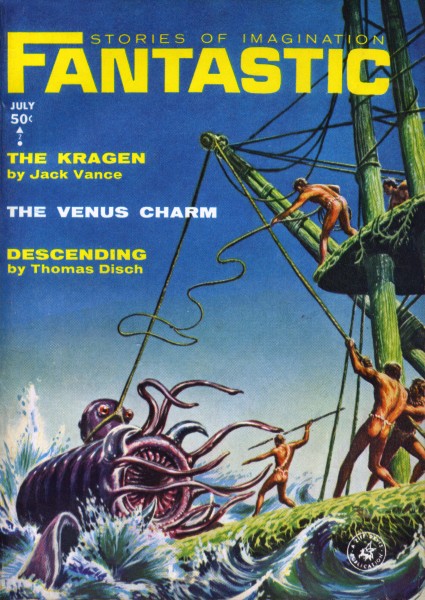
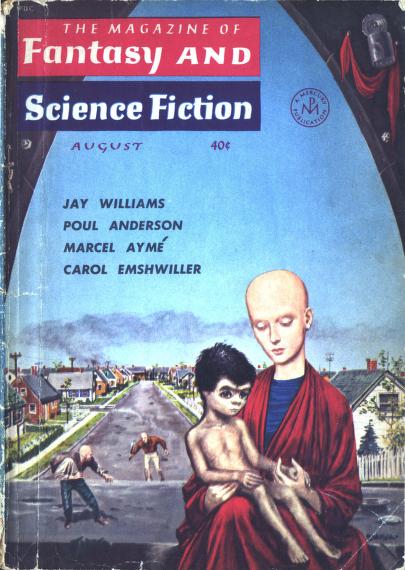




 Science Fiction & Fantasy Remembrance