(My copy of the April 1969 issue of F&SF, cover by Bert Tanner. Mind the tape and torn corner!)
Today we’ll be talking about one of my favorite topics that is not myself: preservation. The question of preservation is one that has haunted the SFF landscape since at least the ’40s, when we started seeing select stories from the magazines get immortalized via hardcover anthology reprints. Adventures in Time and Space (ed. Raymond J. Healy and J. Francis McComas) and The Best of Science Fiction (ed. Groff Conklin), published the same year, were big deals at the time because they were chunky hardcover volumes funded by mainstream publishers (Random House and Crown Publishers respectively) which rescued stories deemed worthy of rescue from the brittle pages of pulp magazines. And these were quite literally pulp magazines, both in the quality of the paper and the dimensions of the volumes, although by 1946 Astounding Science Fiction had transitioned to the relatively sturdier digest format; but even this would not be enough.
The truth is, magazines are not built to last; they have been, for as long as we’ve had them, meant as disposabls, with exceptions. Presumably the format of a magazine determines both its monetary value and how likely it is to withstand the merciless forces of time: for example, the aforementioned pulp magazines were cheap and nowadays, if you could find them at all, would be all torn and battered and tanned almost being recognitions. Conversely you have something like Omni, or even that phase in Analog‘s life where it tried out the bedsheet format, whose volumes are extraordinarily tall and wide, and made of fine smooth paper that would not tan or tear so easily, the result being that these are fine collector’s items. Seeing, however, that the digest format has been the standard since the death of the pulps, by far the most likely format you’ll find for a vintage SFF magazine is the digest format. Consider that in 1965 all of the surviving SFF magazines on the US market had virtually identical dimensions, with the difference in hardiness between say, Analog and F&SF, being now more subtle.
I’ve learned from first-hand experience that collecting F&SF from the ’60s and ’70s is a bit of a dangerous game, because for some reason copies of this magazines and era are especially brittle. Pictues above is my copy of the April 1969 issue, which didn’t start out with the tape forcibly marrying the front cover to the body of the magazine: the front cover just sort of tore itself off completely while I was going through its pages one day. At first the idea of taping a magazine together struck me as a little dirty, but then I realized that it’s better to have that than a volume with a missing front cover. I have another F&SF issue from 1969 whose spine snapped clean in half, the volume now being held together by the thin paper on the spine and Allah’s infinite mercy. I have several volumes which feels as though they might break apart in my hands if I handle them no less gently than my girlfriend during a much needed cuddling session.
Indeed some magazines are hardier. I have a good portion of Bova-era Analog on my shelf and these bastards have barely seen damage in the half-century that they’ve been in someone’s possession. But there are a couple exceptions where the spine (it’s usually the spine) has now encountered a crisis of faith and is no longer as sure if it wants to stay in one piece. And the less said about my copies of Galaxy Science Fiction (the ’60s ones, the ’70s ones are basically fine) the better. My point being that the magazines I physically have are old and must be handled with care—a good deal more care than needs be shown towards a hardcover or even paperback volume of the same vintage. These things were not meant to last.
The vast majority of the magazines I use for my review site are not physical copies but digital scans, either from the Internet Archive or Luminist. I’m pretty shameless about this because I think it’s necessary, for both my wallet and for the sake of preserving magazines, to rely on scans, which of course means we need people with physical copies and the tech with which to scan them and upload them to the internet. Scanners are some of the most important people in keeping track of our field’s history, despite them often being anonymous and looked down upon by anti-piracy purists. Scanners are what make my review site possible; without them I probably would’ve never become an SFF blogger, and I also probably would not have fallen head over heels for the rich and eccentric history of SFF magazines. I started getting into this business a couple years back, entirely thanks to scanners making issues of Galaxy—a magazine that went under more than forty years ago—avaulable online. Thing is, you’re only getting a small fraction of the picture, especially for short fiction, if you ignore this history.
The legality of uploading free copies of magazines, which after contain stories which have probably not fallen out of copyright, to the internet is murky, but what’s not murky is the necessity of doing this if one hopes to make these magazines available to the public. The spreading of online scans in recent years has made it so that these volumes, which contain material that has never been reprinted anywhere (usually editorials, science articles, and book columns, but also sometimes fiction), are no longer restricted to the hands of collectors. While there’s definitely still value in owning second-hand physical copies of magazines (I do it myself, as you know), even if you don’t intend to scan the materials for posterity, someone like me who digs through back issues like a raccoon digs through garbage will find it infinitely more useful to go to online archives for his reading materials. My wallet and my shelf space remain intact!
Scanner do this for the same reason I do it, and more or less with the same exceptions: they don’t do it for profit, as they don’t expect to get even a dime out of it; they do it, and I do it, for the love of the field. There are several sites which upload scans of vintage magazines, but to this day there are specific issues which either have yet to be preserved online or which remain, as far as we know, basically lost forever. The phrase “lost media” is a perennial favorite for people who are into real-life stories of the spooky, macabre, and the unexplained, but usually there’s nothing spooky or morbid about lost media; a lot of the time media becomes lost for the simplest and most mundane of reasons. Episodes of an old-timey game show or adventure serial become lost media because the studio wiped the tapes; issues of vintage magazines become lost media because these magazines were made to be disgarded and forgotten, and so nobody kept them.
Of course, this is all true for print magazines. Online magazines face a different issue, which will require its own editorial in the future, because scanners, helpful as they are, cannot scan magazines which have never seen paper. Consider the sad fate of Sci Fiction, the award-winning fiction department of the Sci-Fi Channel’s website, a revolutionary online magazine that produced several much-anthologized works—and yet you can only now access Sci Fiction via the Wayback Machine. Sci Fiction also got shut down, despite the quality of its fiction, because it failed to be profitable for the Sci-Fi Channel, and that’s an issue still very much haunting modern online magazines like Clarkesworld and Uncanny Magazine. Amazon (who after all can never be trusted) recently announcing that they will discontinue the Kindle Newsstand, a point of revenue for several online magazines, will force supporters to find alternative routes like direct donations and Patreon if they haven’t already.
The lifeblood of the SFF magazine is always being threatened in some way, it seems. There was the bubble followed by the implosion of pulp magazines in the ’50s, then the threat original anthologies posed to magazines in the ’60s onward, and of course the paperback has been a consistent threat to magazines, all but driving serials to extinction (worth its own future editorial), for the past several decades. Despite being a cornerstone of the field’s history, magazines must be kept alive via guerilla tactics and current subscribers finding backup means for supporting them. Scanners, ultimately, are a byproduct of a medium which must be stored in the heavens of the internet or else become handfuls of dust.
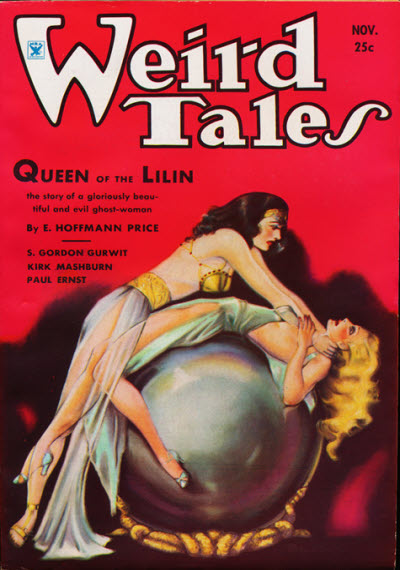
(Cover by Margaret Brundage. Weird Tales, July 1933.)
Weird Tales, across incarnations, has been arguably the most important outlet for dark fantasy and horror in the American market for the past century now. Yes, it’s been that long. The first issue of Weird Tales is marked March 1923 and would have appeared on newsstands in February (I’m not splitting hairs), and while it wasn’t immediately impressive it would become the quintessential pulp horror magazine within a decade. Given the nature of my site and how important Weird Tales is, I thought it appropriate (not to mention a break away from tackling serials) to do a month-long tribute by reviewing entirely short stories from this magazine’s pages—but make no mistake, this is not an attempt to cover its incredibly wide-spanning history. What I’m doing rather is to cover the most famous period of Weird Tales: from the mid-1920s to the end of the 1930s.
In a way this is not so much a tribute to Weird Tales as to the man who, more than anyone, made it the legend it now is: Farnsworth Wright. Wright hopped on as editor with the November 1924 issue and stayed until failing health forced him to step down after the March 1940 issue; he died only a few months later. But in the decade and a half that Wright was editor there was a profound change in the magazine’s contents, as it went from focusing on unassuming ghost stories to encompassing a wider range of “weird” fiction, including but not limited to sword and sorcery, operatic science fiction, and of course, cosmic horror. Ghost stories remained a firm part of the magazine’s identity, but under Wright we saw several big forerunners to modern horror and fantasy, including H. P. Lovecraft and Robert E. Howard, and indeed Weird Tales was the birthplace of both Conan the Barbarian and the Cthulhu Mythos.
Weird Tales was not that friendly to novellas unless they were serialized, and anyway I figured it’d be more accurate a representation to review all short stories this month, which also allows for a more diverse set of authors. We’ve got some famous ones here, but also some deep cuts that I’m very much interested in exploring.
Anyway, here are the short stories:
“The Stolen Body” by H. G. Wells. From the November 1925 issue. This is the first true reprint I’ll be reviewing for Remembrance. “The Stolen Body” was first published in the November 1898 issue of The Strand Magazine, but we’re reading it as it appeared in Weird Tales, and apparently Wright (or somebody) deemed it major enough to make it the cover story despite its reprint status. Wells is someone who needs no introduction, and this is a story from his peak era.
“The Canal” by Everil Worrell. From the December 1927 issue. Not much is known about this author, but her vampire story “The Canal” has been reprinted several times over the years, including as a “classic” reprint in Weird Tales itself. Lovecraft was apparently a big admirer of this one, and he also didn’t seem immediately aware that Worrell was a woman. There’s a later revised version with a different ending, but we’re reading its first magazine appearance.
“The Star-Stealers” by Edmond Hamilton. From the February 1929 issue. Hamilton had made his debut in Weird Tales, and he soon proved to be the most prolific contributor of “weird-scientific stories,” or ya know, just science fiction. “The Star-Stealers” is the second entry in the episodic Interstellar Patrol series, which while not often read now was an early exmaple of space opera, which Hamilton helped codify alongside E. E. Smith and Jack Williamson.
“The Black Stone” by Robert E. Howard. From the November 1931 issue. This has to be the fastest I’ve returned to an author for my site, since only last month I finished covering Howard’s Conan serial The People of the Black Circle. “The Black Stone,” however, is not sword and sorcery but cosmic horror, and it’s supposed to be one of the best old-school Lovecraftian narratives, on top of being one of the first examples of someone taking cues from Lovecraft’s work.
“The Dreams in the Witch-House” by H. P. Lovecraft. From the July 1933 issue. Speaking of which, it’d be impossible to do a Weird Tales tribute without covering its most famous contributor, although Lovecraft was certainly not that at the time. Wright and Lovecraft did not get along, with Wright rejecting At the Mountains of Madness and “The Shadow Out of Time.” Still, this is one of his more famous short stories, and it even got adapted for TV recently.
“The Black God’s Kiss” by C. L. Moore. From the October 1934 issue. The only reread of the bunch, and that’s because I honestly did not give this one the attention I should have when I encountered it a couple years ago. Moore is now more known for collaborating with her husband Henry Kuttner, but she started as one of the more popular authors in Weird Tales. “The Black God’s Kiss” is the first in the Jirel of Jory series, featuring the titular sword-and-sorcery heroine.
“Vulthoom” by Clark Ashton Smith. From the September 1935 issue. The literary sorcerer returns! Smith was, for a brief time, one of the most prolific contributors to Weird Tales, although he mostly retired from writing fiction by the time Wright left. “Vulthoom” is a “late” Smith story, and you can tell because it was one of only a few he put out in 1935. It’s also a comparitibely rare example of Smith doing SF, with the setting being not Earth but a haunted Mars.
“Strange Orchids” by Dorothy Quick. From the March 1937 issue. As with Worrell we don’t know much about Quick, and unlike “The Canal” this has not been reprinted so often. I do remember first seeing Quick’s name in Unknown, the magazine that for a brief time usurped Weird Tales, but she appeared more in the latter; she basically stopped writing fiction once the first incarnation of Weird Tales shut down. Probably the most obscure pick of the bunch.
“Roads” by Seabury Quinn. From the January 1938 issue. Quinn was the most popular author to appear in Weird Tales during the Wright era, and yet his reputation dwindled enough since his death that he later “won” the Cordwainer Smith Rediscovery Award. The posthumous obscurity could be because a lot of what Quinn wrote was hackwork, but “Roads” is distinct for apparently being one of those pieces that Quinn wrote out of passion, being an earnestly told Christmas story.
I know Halloween was only like five months ago, but truth be told it’s always Halloween in my heart. If I could get away with just reading and reviewing spooky fiction I probably would; nothing warms my bones like a good horror yarn. The greatest hits from Weird Tales are still cited after nearly a century, but I suspect there are also deeper cuts (especially by female authors, as there would’ve been several) that are worth our attention. We have a healthy variety of authors and a good deal of diversity as to this magazine’s contents, ranging from the supernatural to the weird-scientific.
But enough buildup…
It’s time to venture into the eerie, the uncanny, and the WEIRD!
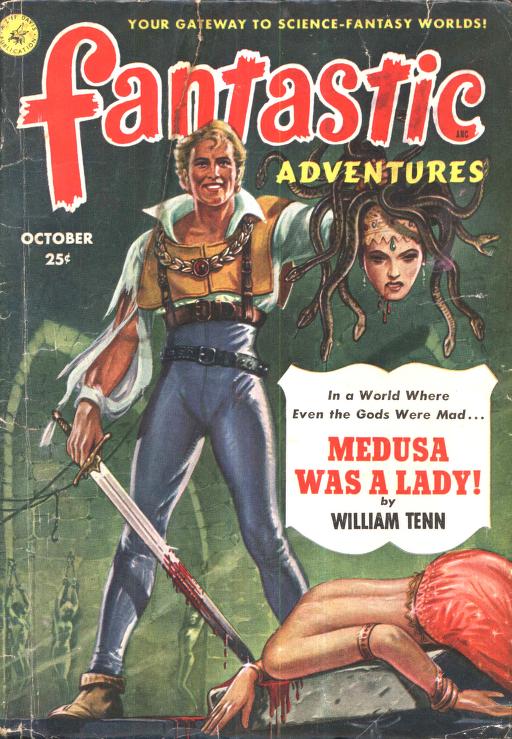
(Cover by Joe Tillotson. Fantastic Adventures, October 1951.)
Who Goes There?
William Tenn was, along with C. M. Kornbluth and Henry Kuttner, one of the great satirists of old-timey SF. He made his debut in 1946 with “Alexander the Bait,” a story which takes an unusually ambivalent (for the time) view of space flight, but more importantly he followed that up with “Child’s Play,” a brutal but genuinely funny comedy that rightly saw adaptation more than once. His 1953 story “The Liberation of Earth” might be his most famous, although while written for Galaxy Science Fiction it was deemed too ambivalent about both sides of the Cold War; it instead saw print in Future Science Fiction. “Ambivalent” is indeed a word that could describe the general mood of Tenn’s fiction—less hysterical than Kornbluth’s writing but also less prone to moments of humanity.
Tenn’s output declined after 1960, and by 1970 he had all but retired from the field. A hardcore short story writer, and despite living to be damn near 90 years old, Tenn left behind only one novel, Of Men and Monsters, whose title makes it sound more like a short story collection than a novel. Thus Tenn’s SF output is relatively small; his entire SF output, including Of Men and Monsters, has been collected in a measly two volumes (see below). Today’s story, “Medusa Was a Lady!,” seems at first to be Tenn venturing into fantasy writing—at first. More on that later.
Placing Coordinates
First published in the October 1951 issue of Fantastic Adventures, which is on the Archive. This is one of Tenn’s more obscure stories; it’s been reprinted only three times, and under a different title: the less pulpy but lamer sounding “A Lamp for Medusa.” It was reprinted as one half of a Belmont Double, paired with Dave Van Arnam’s “The Players of Hell,” which if you can believe it is even more obscure. Then there’s your best shot at a book reprint, which is Here Comes Civilization: The Complete Science Fiction of William Tenn, Volume II, from NESFA Press, the second of the two aforementioned volumes collecting all of Tenn’s SF.
Enhancing Image
Percy S. Yuss (we’re really doing this) is just your average Joe who may have made a bad investment and nabbed an apartment whose rent is a little too low. Immediately something both we and Percy learn is that if something sounds too good to be true, it most certainly is false. Mrs. Danner, the ratty landlady, demands an advance payment from Percy, who gives it despite having reservations about how much of a fixer-upper the apartment is; it doesn’t help that, for some reason, belongings from previous tenants have never been picked up or put away. But because he’s a modern man who disdains superstition Percy is convinced that nothing too weird could be going on, although while he is a bit of a chump he is no stone-cold idiot, and rightly suspects that something fishy might be going on.
Quickly realizing that the apartment is in such bad shape that it’s almost not even worth the tiny rent demanded for it, Percy tries to make the best of the situation when, being the protagonist of a William Tenn story, something weirder and more inexplicable happens to him. He finds a piece of parchment which, for one, seems to be made of animal skin, but even weirder is what’s written on it: a poem, or a fragment of a poem, that relates to Greek Mythology—more specifically the legend of Perseus and Medusa. The dramatic irony of this is that the fragment does not name Perseus or Medusa, so while we the readers are aware of the myth, Percy remains ignorant of the connection. I’ll quote the fragment here:
“…He slew the Gorgon and winged back, bringing to the islanders
The head with its writhing snake-locks, the terror that froze to stone.”
Reading the fragment has an effect that Percy could not have anticipated. When he takes a bath he gets isekai’d to the middle of an ocean, in the bathtub with nothing but a towel and soap in his mouth. He meets a sea serpent who uhh, talks? Which surprisingly does not frighten Percy or drive him into an existential crisis; actually he takes the encounter with the talking sea serpent (whose dialogue reminds me of Douglas Adams) pretty well. The sea serpent at first believes Percy to be part of the Perseus prophecy, but Percy’s hostility drives the sea serpent away. A running thing with this story is that, depending on whom Percy is interacting with, he’ll either be denying the prophecy or deliberately playing into it, since he gets constantly mistaken for the Greek hero. Or perhaps, by some chance, Percy is really Perseus but something happened to make him forget?
Readers of a certain pre-Tolkien era of American fantasy may feel that the situation Percy gets thrown into is oddly familiar. I’m of course thinking of the Harold Shea stories by L. Sprague de Camp and Fletcher Pratt, and even L. Ron Hubbard’s Typewriter in the Sky, and I have little doubt that Tenn had at least read up on the former. A normal man gets thrown into a fantasy world that operates on a different internal logic from the normal world, and said normal man has to figure his way out or perish, with often comedic results. Truth be told this was not unusual for fantasy published in Unknown, and we could go back even further with Edgar Rice Burroughs’s John Carter series to see basically the same formula. (The John Carter novels are very loosely considered SF, but they arguably read more as fantasy from a modern perspective.) “Medusa Was a Lady!” very much follows in the footsteps of the Harold Shea stories, but with a couple twists.
Percy uses his bathtub cum boat to land on the island on Seriphos, which is where, in the myth, Perseus as a child and his mother Danae land. Had he known about the myth in advance Percy could use this to his advantage, but because he doesn’t recognize the myth for what it is—that he basically matches the physical description of Perseus (albeit scrawnier)—he probably would’ve done fine right away, but unfortunately for Percy he doesn’t know shit about the myth. He doesn’t know who Perseus and Danae are, which causes issues because he’s accused of impersonating a mythical figure—a crime punishable by slow cooking over a fire.
Some hijinks ensue. We’re introduced to King Polydectes, who might be the funniest character in the story, being a stereotypical decadent monarch who looks for any excuse to “thin out” the overpopulated little island society he runs. He orders executions very casually and comes up with punishments for crimes seemingly on a whim, and because the island is so small people often serve multiple roles, such that literally anyone can be a juror in a “court” case. I would complain about how the ’50s slang coming out of the islanders’ mouths stretches plausibility, but this is not a story that claims to be plausible, and also the slang adds to the snappy tone of the comedy. Again I almost have to wonder if Tenn’s brand of humor influenced Douglas Adams’s, although I seriously doubt that.
Awaiting his execution, which is set for the following day, Percy gets thrown into the same cell as a fellow person from his own world: Ann Drummond (like Andromeda?), who was one of the former tenants in the apartment Percy had rented out, and who had apparently gotten thrown into this world through the same means. We’re also formally introduced to Hermes, who had appeared earlier but then vanished from the scene, a mythological figure who rather conspicuously had golden skin. Hermes offers help to Percy and Ann so that they can fulfill the prophecy, and evidently he knows a great deal more than they do—only a fraction of which he lets on. Something to keep in mind with Percy’s journey is that he never entirely understands anything; when he tries ringing an explanation out of someone he only gets one small part out of a much greater whole, assuming what the person is saying is true. Hermes doesn’t like to Percy and Ann per se, but we’ll come to find later that there may be an ulterior motive for getting Percy to fill his role as a makeshift Perseus.
Anyway, we stay like this for a while. The pacing of this novella is a bit odd; it spends a great deal of time on characters talking and rationalizing things while also making surprisingly little progress in terms of getting from one place to another. By the time we get to the next day and Percy and Ann are thrown into the arena as an alternative method of execution (Hermes had sabotaged the pot that was supposed to be used to cook them the previous night) we’re already about halfway into the story. While Tenn was some five years into his writing career, he evidently was less sure about writing longer stories (specifically of novella length), at least up to this point. There’s enough material in “Medusa Was a Lady!” to make a full novel out of, but then Tenn was not a novelist by instinct, so we have to live with what admittedly feels like a novel that got Swiss cheese’d into a novella.
Anyway, this fight in the arena with a bizarre multi-headed monster (sort of like a hydra but uncannily more humanoid) is the closest we get to a satisfying action sequence, because after this point the story reveals itself to be something quite different altogether.
There Be Spoilers Here
When I first heard about this story I thought it odd that it should be classified as science fiction, since its premise clearly struck me as fantasy; well, not unlike with Percy, what I’d seen was not the full picture. “Medusa Was a Lady!” is, in actuality, science fiction masquerading as fantasy. Well goddamnit, it looks like we been bamboozled! Hermes comes in with anti-gravity boots, which Percy will also use later, and we’re even introduced to a mad scientist in the form of Professor Gray, who (predictably) was also a tenant who got thrown into this world. It’s here that we find out that not only is the novella science fiction, but more specifically it’s a multiverse story. That’s right, there’s no escaping the goddamn multiverse thing.
More interestingly, you may be wondering about the fight with Medusa, which we know is gonna happen because it’s on the cover and because it’s “part of the prophecy.” The “fight” with Medusa lasts literally a paragraph and its sheer brevity took me by surprise, partly because of that and also because Medusa doesn’t seem to put up a fight. How strange, that the infamous Gorgon, the snake woman who turns men to stone, should lose her head so easily. As it turns out, in his willingness to fill a role, like an actor on a stage, Percy does something he probably should not have done, because it turns out that Medusa is not the villain of the story. Hermes and the other gold-skinned people, the Olympians who wanted Medusa dead so badly, only told Percy a fraction of the context for the conflict between the Olympians and the Gorgons; it could be considered one big lie by way of omission. The good news is that Medusa isn’t quite dead once her head is in the bag, which leads to what I can only call an infodump of staggering length.
If I tried to explain the whole backstory for Medusa and the Gorgons I would be here all day, which is a problem because a) I don’t have the time, and b) Tenn’s explanation via telepathy is incredibly convoluted, never mind a massive infodump to plop in the reader’s lap in the last, oh, ten pages of the novella. I’m not sure if Tenn did this as a serious attempt or if he was making fun of something, but the third act of the novella is bogged down with a mountain of exposition, followed by rushed action. The basic idea of the thing is a neat subversion, because we just went in assuming Medusa would be the Big Bad™ of the story, or in more typical Tenn fashion would be more of a shrew than a conventional evil-doer, but the twist is much harder to anticipate—admirably so. I just wish the pacing in particular wasn’t so uneven, with the climactic battle with the gold-skinned Olympians lacking room to breathe and thus is robbed of some catharsis.
The ending, at least, is clever, even if it plays into Tenn’s pessimism. There’s the suggestion that, even if Percy did get to be the man who now knows better, he will still get played for a chump at the end. The implied cruelty is logical, if also predictable, while also implying possible paradoxes and other issues with people meeting themselves via the multiverse. Honestly I think I’m done with the whole multiverse thing for a while.
A Step Farther Out
In a way I was disappointed, but in another my expectations were very much met. Joe Tillotson’s excellent cover and the premise give the impression of a fantasy adventure, which evidently Tenn was not very interested in writing; that or he tried but failed to write compelling action. Thankfully, most of the story is filled with dialogue, and this is where Tenn excels, in that he packs a lot of jokes and a lot of those jokes are quite funny. “Medusa Was a Lady!” is ultimately a comedy, and an effective one, being admirably less a direct parody of sword and sorcery, or even Greek mythology, so much as a humorous commentary on the intermingling of fact and mythology. Nothing Percy is told turns out to be entirely true, but conversely every bit of deception has at least a kernel of truth in it, which only befits Tenn’s pessimistic worldview. I recommend not going into this one with the expectation of reading a fantasy adventure, but if you want a genre-bending comedy that’s a fair bit cerebral, it’s a good one.
(Cover by Margaret Brundage. Weird Tales, November 1934.)
Who Goes There?
We’re at the point where I probably don’t have to introduce Robert E. Howard to you, but I’ll do it anyway; or rather I’ll elaborate on what makes Howard special. Fantasy is a very old genre, but it’s much less so as practiced by American authors, at least if we’re talking fantasy as separated from horror. It doesn’t help that historically the magazine market hasn’t been very kind towards fantasy, but for a stretch Weird Tales was the most famous and most prolific outlet for American fantasy, and it was where Howard published much of his most famous work. Of course Howard was looking for several outlets at the same time, since he was such a massively productive writer, whether it be his fantasy, his horror, or hell, his stories about boxing. Oddly enough, though, he was basically absent from the then-growing science fiction scene, and one has to wonder if he would have eventually moved into SF had he lived longer.
Howard’s life was tragically short, and yet he wrote more in the span of a decade than most authors (especially today) write in fifty years. His tales of Conan the Barbarian alone take up several volumes, despite the fact that he was only able to write one Conan novel with The Hour of the Dragon. Conan is, of course, the godfather of sword-and-sorcery heroes, despite not even being Howard’s first such character. Conan is really more of an icon than a character with traits people recognize, whether it’s his very loose film depiction via Arnold Schwarzenegger or the more faithful paintings done by Frank Frazetta. As depicted in the original Howard stories, Conan shows himself to be quite different from people’s assumptions.
Placing Coordinates
Part 3 was published in the November 1934 issue of Weird Tlaes, which is on the Archive. Because Howard has been dead for almost 90 years at this point, pretty much all of his work is in the public domain, including The People of the Black Circle, which you can read in its entirety on Project Gutenberg. If you want a book copy, you have plenty of options; the Conan stories have been perpetually in print (albeit subject to some editing fuckery early on) for the past several decades.
Enhancing Image
Sadly there’s not a whole lot for me to say about the conclusion to this gripping novella; not the story’s fault really, it’s more that I’m not a very good reader and even worse when it comes to action. Howard has a sixth sense for writing action and suspense, although given how much there is of it in the third installment you might start to get the impression that Howard is grasping at straws, or rather ways in which he can challenge his nigh-invincible anti-hero.
To recap, Conan has teamed up with fellow gun for hire Kerim Shah to rescue Yasmina from the Black Seers of Yimsha, with help from some redshirts under Kerim Shah’s leadership. Kerim Shah and the Black Seers were originally working for the same country but the latter went rogue and snatched up Yasmina for their own ends. A bit of a disappointment, albeit an inevitable one, with this installment is that Yasmina is absent for much of it; she’s too busy being a damsel. I bring this up because Yasmina is almost as good a Conan woman as Bêlit from “Queen of the Black Coast,” which if I remember right was my first Conan story. I may have set up an unfair precedent with that one. Howard wrote “Queen of the Black Coast” and The People of the Black Circle close to each other, and I get the impression that at this point in his career he got pretty good at writing women who have personalities and agency. Bêlit has the advantage of being a criminal, the titular queen of the black coast, while Yasmina is filthy royalty (no truce with queens), but nobody’s perfect.
Conan, now armed with the magic girdle Khemsa had given him in the last installment, proves to be very valuable; arguably it’s the only reason he’s able to get out of this conflict alive. Something I’ve noted before and which I still like is that the enemy Conan faces off with in this story is objectively way more powerful than him, and even Conan admits that defeating the Seers for good is basically impossible. The key objective then is not to beat the Seers so much as to rescue Yasmina and get the hell out of there as fast as possible—which, naturally, involves facing off with the Seers and their underlings to some capacity. I don’t feel like recounting every detail of that journey, since it’s one long action sequence and I’m tired, but I do feel like pointing out a few things, such as…
Howard seems to be of the belief that when in doubt, throw a big aggressive animal at the protagonist. Not even an animal that’s all that fantastical, just take a normal animal and make it the size of a car. One of the first enemies Conan fights in this installment is a really big dog. How exciting. We also get giant magical snakes later on, which are at least marginally more exciting because of how Conan has to defeat them; it involves balls. I’m also pretty sure these snakes inspired this memorable interior, courtesy of Hugh Rankin. I can easily imagine Conan stories, especially this one, being adapted into an adventure flick in the ’50s or ’60s with stop-motion effects by Ray Harryhausen, although I doubt the gore would be replicated.
Speaking of gore, I was wondering, at the end of the last installment, if Conan and Kerim Shah would fight the Seers together and then have an epic duel in the aftermath, or if there would be a betrayal beforehand; turns out I was wrong about both. The master of the Seers, who last we checked was subjecting Yasmina to some pretty far-out torture, doesn’t care too much about Conan and Kerim Shah invading his private space—not because he doesn’t mind them but because he sees them as little more than petulant flies. While Conan was able to deal with the underlings and the giant snakes at the cost of a few redshirts, this forthcoming battle won’t be as easy. Actually it’s a battle that Conan hopes not to win outright so much as to incapacitate the master long enough to rescue Yasmina.
A barbarian would have absolutely no chance against such a high-level wizard—not even a certified badass like Conan, were it not for that magic girdle. Indeed the gift from Khemsa had saved him before; the aforementioned big dog went after the redshirts but ignored Conan for reasons he did not understand at first. No doubt the girdle has symbolic value: Khemsa used it to good effect when protecting Gitara, his girlfriend, while Conan is using it to help him in rescuing Yasmina. Is it quaint that we’re supposed to believe Conan and Yasmina love each other despite having known each other for less than a week and being mostly on the run during that short time? Maybe, but what’s a good old-fashioned adventure yarn without some high-spirited romance? Even for a super-macho guy like Conan.
There Be Spoilers Here
I was gonna discuss Kerim Shah’s death in the previous section, but realized a) it really is a spoiler, and b) I should probably hold off on talking about it. I just say that because it’s pretty gnarly; it’s the most memorable part of the novella’s concluding installment. The Conan series is not averse to gore at all, but even by its standards this man goes out in a gruesome fashion. When Conan and Kerim Shah confront the master of the Seers the creepy guy YANKS KERIM SHAH’S HEART OUT OF HIS BODY. Like it’s the easiest thing in the world, too. Since Kerim Shah isn’t protected by any kind of magic, well, honestly he probably should’ve seen that coming. Even so, Howard’s talent for describing visceral action kicks into high gear and the result is almost mesmerizing with how grotesque it is.
Observe in all its glory:
He held out his hand as if to receive something, and the Turanian cried out sharply like a man in mortal agony. He reeled drunkenly, and then, with a splintering of bones, a rending of flesh and muscle and a snapping of mail-links, his breast burst outward with a shower of blood, and through the ghastly aperture something red and dripping shot through air into the Master’s outstretched hand, as a bit of steel leaps to the magnet. The Turanian slumped to the floor and lay motionless, and the Master laughed and hurled the object to fall before Conan’s feet—a still-quivering human heart.
Anyway, Conan manages to “defeat” the master, nab Yasmina, and get the hell out of Yimsha, although by Conan’s own admission his defeat of the master is by no means permanent; it’s mighty hard to kill such a powerful wizard. But wait, we’re not quite out of the woods yet! In the previous installment Conan’s henchmen, by way of misunderstanding, thought he had betrayed them, so now we have to tie up that loose end with one last battle where Conan makes it clear that he was loyal to his homies the whole time. We also get what is implied to be the final appearance of the master of the Seers, in the form of a big bird (not to be confused with Big Bird), because, like I said, when in doubt just take an animal and super-size it.
The ending sees Conan and Yasmina parting ways, as is to be expected. Yasmina is the love interest of the week, and as is custom she must either die or be unable to “tame” the Cimmerian. I’m not sure if this story takes place before or after “Queen of the Black Coast,” but probably after. Bêlit was, as far as I can tell, the closest Conan had to a true love, which due to tragic circumstances was not to be. Yasmina is in many ways a worthy partner, but as queen of Vendhya she has an obligation to her people—an obligation that Conan refuses to take part in; wisely he chooses his nomadic lifestyle over being forced into becoming something he’s not in the name of love. This all reminds me of the back end of Robert Heinlein’s Glory Road, albeit more concise and without those weird Heinlein-isms.
Now I’m just thinking about what the field would look like had Howard and Heinlein crossed paths, since they’re both such unique personalities and have such odd views of how man ought to interact with the society around him. Mind you that Heinlein started out as a quirky New Deal Democrat and only later became the quirky right-libertarian we recognize him as, and meanwhile Howard’s political outlook is… harder to parse. At least in the Conan stories, however, his sympathy for barbarism (or rather his definition of barbarism, which involves being quasi-civilized) is easy enough to understand. Conan’s capacity to stay a free individual and keep himself outside the confines of normal society is what makes him such a noble figure despite his penchant for criminal activities, at least for Howard. So ends yet another adventure for the Cimmerian.
A Step Farther Out
I’m conflicted about the length of this thing. It could’ve been streamlined and shortened, but also it could’ve been expanded to novel length so that we get more character development. The scale Howard invokes here is enough to fill a modern fantasy novel (so like 600 pages), but he’s content to give us a novella that would fill 90 to a hundred pages. I might still prefer “Queen of the Black Coast” if we’re talking Conan, but it’s hard to fault The People of the Black Circle for its heightened ambition. Also, while there is some old-timey misogyny at play, Howard proves once again that he was pretty ahead of his time with regards to writing female characters. The relationship between Conan and Yasmina is a bit rushed but both parties are assertive types with their own agendas, and while Conan clearly has an upper hand physically they’re mostly shown to be equal partners. This is also one of the longest of the original Conan stories (albeit still a novella), so now I’m curious as to what the sole Conan novel (that Howard wrote) looks like.
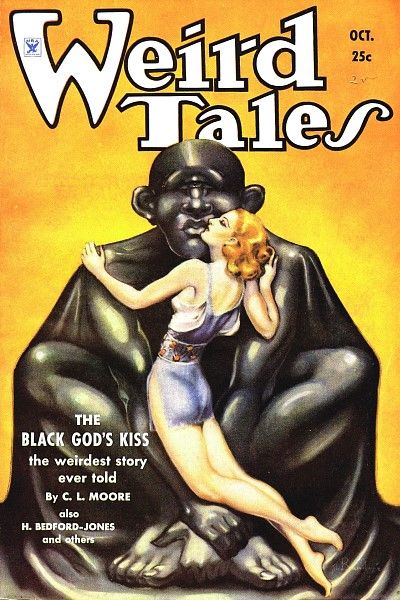
(Cover by Margaret Brundage. Weird Tales, October 1934.)
Who Goes There?
Looking back on it, many of the most important figures in fantasy are British. J. R. R. Tolkien, C. S. Lewis, Lord Dunsany, William Morris, and of course we have William Shakespeare, whose fantastical plays (namely The Tempest) are essential to our understanding of the genre, even down to the language we use. As far as American fantasists go, though, few are more important (or more American) than Robert E. Howard, whose life was tragically short but who managed to produce a truly alarming amount of work in that short time. Across a near-endless supply of short fiction and poetry he ventured between low fantasy, horror, and the western, sometimes mixing the three to produce stories that were more invigorating than those written by his fellows. He was arguably the first literary swordsman, although he would probably prefer the position of “barbarian poet.”
Howard ran several series during his brief career, and Conan the Cimmerian was easily the most popular of the bunch, at least with hindsight; it, more than anything else, gave Howard a life after death as scord and sorcery’s key founder. While not Howard’s first sword-and-sorcery hero (or rather anti-hero), Conan was the final synthesis of Howard’s developing philosophy regarding man’s relationship with civilization.
Placing Coordinates
Part 2 of The People of the Black Circle was published in the October 1934 issue of Weird Tales, which is on the Archive. You can also read the whole novella (the individual installments are pretty short, totaling about 30,000 words) on Project Gutenberg in a variety of formats. Because this is a Conan story, and one of the more famous ones, you won’t have a hard time finding it at all, be it online or in print.
Enhancing Image
Picking up where we left off, Conan and Yamina are on the run yet again after Conan is accused of murdering an ally of his—an act actually committed by Kemsha, the wizard who, along with his girlfriend Gitara (she has a name now), turned his back on the Black Seers of Yimsha and is now trying to take Yasmina as ransom of his own. Part 1 saw us starting out in the Hyborian equivalent of India, and now we’ve moved towards the equivalent of the Himalayan mountains. You start filling in the blanks once you realize these locales are based on real places.
The romantic/sexual tension between Conan and Yasmina continues to grow when the former proposes that the latter ought to take on the clothes of a local girl so as to disguise herself; after all, at least three parties are looking for her. Conan trades with a local girl and gives her a gold coin for her troubles, although perhaps wisely he sees her running off in the buff rather than giving her Yasmina’s clothes, since if the girl were found with those clothes she could be tortured and, worse yet, Our Heroes™ could be found out. It’s a bit of a comedic scene and it provides some relief after what amounted to a prolonged chase sequence in the first installment. It’s also here that Yasmina’s attraction to Conan is written more overtly, and it turns out such attraction may not be one-sided: when Conan gives her the new robes he beckons her to change out of his sight—an unusually chivalric and modest move for the barbarian.
A little gripe to shove in here before we get to the big action set piece of this installment. I’ve said before that Howard tends to use the same words to describe things when a perfectly fine alternative doesn’t present itself immediately, like Howard is in a mad dash to get the words out and has to go with what comes to mind first. For example, I feel like there has to be a better word to describe an attractive woman’s spine than “supple.” Actually Howard throws the word “supple” at several body parts, and it only works occasionally. This is a small price to pay for writing that is, far more often than not, narratively adept. Howard, on top of having a superhuman work ethic, also had a sixth sense for plotting, both in sustaining narrative momentum and also coming up with twists and turns that’ll hold the reader’s attention.
Speaking of which, here’s one now!
Kemsha and Gitara catch up with Conan and Yasmina, quite miraculously considering Kemsha got damn near run over by Conan’s horse at the end of the previous installment, but their reunion is short-lived when the big (i.e., the true) villains of the story make their first in-person appearance. Four of the Black Seers appear out of a dark cloud, above Our Heroes™ and well out of reach, and while we were led to believe the Black Seers meant business before, this is the first time we get to see them.
Howard doesn’t miss here:
The crimson cloud balanced like a spinning top for an instant, whirling in a dazzling sheen on its point. Then without warning it was gone, vanished as a bubble vanishes when burst. There on the ledge stood four men. It was miraculous, incredible, impossible, yet it was true. They were not ghosts or phantoms. They were four tall men, with shaven, vulture-like heads, and black robes that hid their feet. Their hands were concealed by their wide sleeves. They stood in silence, their naked heads nodding slightly in unison. They were facing Khemsa, but behind them Conan felt his own blood turning to ice in his veins. Rising, he backed stealthily away, until he felt the stallion’s shoulder trembling against his back, and the Devi crept into the shelter of his arm. There was no word spoken. Silence hung like a stifling pall.
The Seers are mainly here to get at the one who betrayed them. On the one hand, fair, but also despite being a villain we’ve come to sympathize with Kemsha. Howard has a gift for creating characters who are, if not totally rounded, at least recognizably human; while we haven’t spent that much time with Kemsha and his girl we understand their motives. Surprisingly, Gitara is not a Lady Macbeth figure who bullies Kemsha into taking power so that she can rule vicariously through him; she genuinely cares for him, and he cares for her, which is a connection that is ultimately held to be true, even if what comes next is tragic.
I hate to bring up another blocky quote like this, but I had to copy down some of the confrontation between Kemsha and the Seers as told from Yasmina’s perspective. The wizards have a bit of a Dragon Ball Z standoff, and despite facing off against four wizards more powerful than him, Kemsha is able to hold his ground. We knew he was more powerful than he appeared from he was able to do in Part 1, but this battle of wills is easily the greatest test of Kemsha’s strength, both as a wizard and as a human being. Yasmina, however, being far from a brainless damsel, figures out how Kemsha does not immediately succumb to the Seers, and how he probably is only able to do this with Gitara by his side.
The answer, simply is love.
The reason was the girl that he clutched with the strength of his despair. She was like an anchor to his staggering soul, battered by the waves of those psychic emanations. His weakness was now his strength. His love for the girl, violent and evil though it might be, was yet a tie that bound him to the rest of humanity, providing an earthly leverage for his will, a chain that his inhuman enemies could not break; at least not break through Khemsa.
Unfortunately something has to give. The Seers, similarly to Yasmina, pick up on Kemsha’s love for Gitara as his shield and proceed to use it against him. Redirecting their efforts at Gitara, she unfortunately is not able to withstand their efforts and is thus guided off the mountain’s edge, taking Kemsha with her to their apparent deaths. Again, despite being villains, their downfall is framed as tragic, and such framing works as we feel their loss. With their biggest opponent (who isn’t Conan) out of the way, the Seers snatch up Yasmina and take her to their lair, with Conan getting the fuck away just by the skin of his teeth. If you’ve read a few entries in this series before then you know Conan ain’t scared of shit, except… well, maybe these creepy bald guys. Admittedly a barbarian, while he can punch and slice his way out of most trouble, would probably get ass-blasted by some high-level wizards.
The People of the Black Circle is a later Conan story and it definitely feels like a later entry, on top of being the longest written up to that point. Conan has loved and lost before, and faced off with some pretty scummy bad guys, but the Black Seers actually make the guy retreat and think hard about how he can get his girl back. Of course it’s a hard conflict to spoil since we know in advance that Conan will come out on top somehow, but it’s more a question of how many people have to die for the bad guys to get taken down. Speaking of which, there’s a character who only appeared for a second in Part 1 who makes a big reappearance here, and his crossing paths with Conan may well lead to quite the final battle with the Seers…
There Be Spoilers Here
There is one player I’ve not mentioned till now, and that’s Kerim Shah. He was allies with Kemsha in Part 1 for like five seconds before the latter decided to go rogue, but now that Kemsha is dead (well, not quite yet) it’s up to Kerim Shah to rescuse Yasmina (and by “rescue” we mean capture her for his own ends) with or without Conan’s help. Since Our Hero™ is at his lowest point towards the end of this installment and since all his allies are now either dead or think him a traitor (his own Afghuli henchmen, having thought he killed the glorified redshit from Part 1, are now after him as well), he might do well to enter a temporary truce with Kerim Shah.
The two thus join forces.
What I find entertaining about this arrangement is that Kerim Shah makes no secret of wanting to take Yasmina as ransom; he states clearly that he and Conan have different goals in mind, and that even if they were to defeat the Seers they would still fight over Yasmina. They team up anyway. Kerim Shah might be a mercenary and a bit of a shithead, but he’s nothign compared to the creepy bald guys who spend the final scene of Part 2 subjecting Yasmina to some rather esoteric torture. Hero versus villain? Yawn. Hero teaming up with Villain B to take down Villain A? Now that’s more interesting. Of course what separates Conan from Kerim Shah is that he’s not a dog for bureaucracy and he actually seems to care for Yasmina. Again, Conan is really an anti-hero; he’s the guy we root for because the people he faces off with are always much worse than him.
Oh, and one last thing…
Gitara has fallen to her death, sadly, but for better or worse Kemsha’s death was not as swift. Conan finds Kemsha barely alive, apparently little more than a pile of broken bones, but luckily Kemsha lives long enough to give Conan his magical… girdle? Yeah, I guess you’d call it that. Conan is not a magician at all, but even a tool handed down from a skilled wizard will certainly help him in his inevitable confrontation with the Seers. Then Kemsha finally dies, sort of in a state of grace, broken but not destroyed, his humanity preserved. We actually get a spectrum of villainy with this story, from irredeemably bad (the Seers), to bad pragmatic and cool (Kerim Shah), to kinda bad but also kinda good (Kemsha). Howard has a way with bringing characters to life with relatively few words.
A Step Farther Out
Thing about Conan stories is that, like any other episodic series with a recurring protagonist, we know Conan will get out of this ordeal fine; the question is how and at what cost. Conan is wearing plot armor, but they must’ve run out of stock at the plot armor store because nobody else has it. People are dropping like FLIES! And yet the good news is that the plot is funneling into what looks to be an exciting climax. Will Yasmina make it out okay? Will Conan and Kerim Shah keep to their truce or will there be BETRAYAL? Most importantly, how the FUCK do people run around half-naked or just totally naked fine when we’re in the mountains? I’m pretty it’d be chilly at that elevation. Anyway, stay tuned.
(Cover by Joe Tillotson. Fantastic Adventures, October 1951.)
I have to admit I take really niche pleasure in writing these forecast editorials. I suspect reviewers have a to-read list and just tackle shit when they feel like it, but I myself prefer to plan things out. Funny thing is that aside from these forecasts I don’t have a to-read list, anywhere. All this stuff is either in my noggin or it’s not shown up on my radar yet. Hell, I only started keeping a list of things I did read this year. I’m mostly a spontaneous reader, so let me have this one little bit of scheduled activity.
No gimmicks this month. Well, there is one, but you wouldn’t know it at first glance and I’m not even sure it counts. You see, I have a major soft spot for SF-horror; I love SF, and believe it or not I love horror too with almost equal passion, so what happens when you combine the two? This month’s short stories are crossbreeds of horror and science fiction, one by the most famous horror author of all time, the other by someone whose name probably doesn’t ring a bell but who really deserves more recognition.
Anyway…
No more wasting time, let’s see what’ll be on my plate!
For the serials:
The People of the Black Circle by Robert E. Howard. Published in Weird Tales, September to November 1934. Started this last month and now we’re gonna finish it. It’s been a fun ride so far. Howard only wrote about Conan the Cimmerian in the last four years of his life, but like with everything else he wrote a lot of it, and this is one of the longer Conan tales. Due to the episodic nature of the series it’s not necessary to have read previous Conan stories to enjoy this one.
Needle by Hal Clement. Published in Astounding Science Fiction, May to June 1949. Clement had already been active for several years, but Needle was his debut novel, and it would be published in book form in 1950. Clement is one of the founding fathers of what we’d call hard SF, with Mission of Gravity especially geing a genre-defining novel, but Needle seems to not fall into that mold; rather it’s one of the earliest known attempts at mixing SF with the mystery genre.
For the novellas:
“Dancing on Air” by Nancy Kress. From in the July 1993 issue of Asimov’s Science Fiction. Hugo and Nebula nominee for Best Novella (well, Best Novelette for the Hugo, I guess voters were confused). Kress is one of those authors I’ve been meaning to read more of, and I’ve been making progress… slowly. Like all great authors Kress seems very fond of the novella mode, but rather than go for one of her award-winners I’m going for a slightly deeper cut. Just slightly.
“Medusa Was a Lady!” by William Tenn. From the October 1951 issue of Fantastic Adventures. Tenn is supposedly one of the great comedians in SF from the late ’40s to his semi-retirement from the field in the late ’60s. Unusually for Tenn, “Medusa Was a Lady!” (also reprinted as the lamer-sounding “A Lamp for Medusa”) ventures into fantasy adventure territory. And look, I’m weak for a good cover, and the Joe Tillotson cover shown above convinced me.
For the short stories:
“Let Me Live in a House” by Chad Oliver. From the March 1954 issue of Universe Science Fiction. Oliver is one of those forgotten authors who popped up on my radar recently, with this story especially catching my interest. Oliver started young and was one of many authors who rode the wave of ’50s magazine saturation before quieting down circa 1960. While Ursula K. Le Guin is rightly praised for her anthropological SF, Oliver was a major forerunner in that vein.
“The Jaunt” by Stephen King. From the June 1981 issue of Twilight Zone Magazine. Does King need an introduction? Not really. Anyway, an SF Discord (shoutout to Media Death Cult, by the way) I’m in has “The Jaunt” on a list of short stories the group’s covering this month, and it’s one of the few on the list I had not read before in all honesty. Rather than just read and make a few remarks on it, I do believe I’ll give it the fancy long review treatment…
So it’s a short month. Only two serials, two novellas, and two shorts. I have something special in mind for March, but for now I’ll enjoy this calm before the storm. Nothing too gimmicky this month! Just catching up with some authors I’ve been meaning to do that with, plus some horror thrown into the mix—which may or may not be foreshadowing.
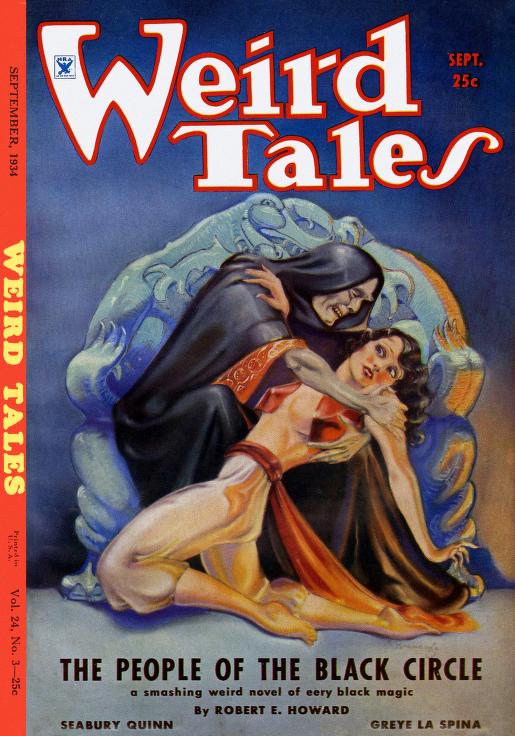
(Cover by Margaret Brundage. Weird Tales, September 1934.)
Who Goes There?
Robert E. Howard is one of the most important practitioners of fantasy in the genre’s history, and this is impressive when you consider not only how young he was when he died but how much he wrote in that short time. He debuted in 1924 and wrote at a truly terrifying rate until his death by gunshot wound in 1936, with a slew of completed works and outlines in his wake. Among the authors who frequented Weird Tales in the ’20s and ’30s, Howard had to be one of the five most popular contributors to that magazine, not to mention one of the most prolific. Whether it was fantasy, horror, or the Western (though, oddly, not science fiction), Howard did it all, and with a zeal that few could match. Whereas others authors had maybe major series under their belt, Howard had several, and one of these would come to define a subgenre: Conan the Cimmerian, more popularly known as Conan the Barbarian.
Conan is the single most famous sword-and-sorcery character of all time, and he wasn’t even Howard’s first attempt at creating such a figure (see Kull the Conqueror); rather he was the final synthesis of Howard’s developing philosophy on man’s relationship with civilization. Hailing from a distant alternate past where sorcery and devilish creatures reign, Conan is both a classic anti-hero and Howard’s ideal man: a nomad, a man who doesn’t take orders, a man who can fight his way out of anything, and yet a man who is articulate and thoughtful despite his brawn. “The People of the Black Circle” was the longest Conan adventure published up to that point; the series had been going on for two years and would only last two more under Howard’s watch, ending with his suicide, until the scavengers came…
Placing Coordinates
Part 1 was published in the September 1934 issue of Weird Tales, which is on the Archive. I do believe this is also the first story I’ve covered that’s on Project Gutenberg! That’s right, you have no excuse to not read this, unless you just don’t feel like it. And since it’s a Conan story, and one of the big ones at that, you won’t have a hard time finding it in print at all. With that said, the go-to choice would be The Bloody Crown of Conan from Random House Worlds. They put out a series of Howard collections and this is just one of several Conan collections, never mind Howard’s other work. I actually have the paperback for his horror fiction, and if that one is anything to go by these paperbacks are sturdy, thick, and heavy. Like physically heavy. Your wrists are gonna be sore after a while.
Enhancing Image
Of the Conan stories I’ve read (this is like the fourth or fifth one), this one has easily the best opening scene in my opinion. We start in the kingdom of Vendhya, the in-universe equivalent of India, where the king is on his deathbed and his sister the Devi Yasmina is by his side. However, the king is not dying via natural causes; rather he’s been cursed, by the Black Seers of Mount Yimsha, presumably the people of the black circle. The king, whose soul is bound to eternal damnation by the curse if something doesn’t kill him before it can take him, begs Yasmina to take his life and save his soul, as he’s too physically weak to do it himself. In tears, but know what she has to do, Yasmina kills her brother’s body but saves his soul.
It’s a tense and delightfully macabre opener, but more importantly it’s an effective establishing moment for Yasmina, the heroine of the story and arguably the true protagonist. This is not your typical “screaming wench” of old-timey fantasy—this is a woman who, though she may get emotional, will take action and will not take shit from anyone. Her establishing scene is so good that I can forgive the fact that Howard can’t help but mention her mammariesmommy milkerstitties breasts a couple times. The king’s death begins the plot, the ball only really gets rolling because Yasmina vows to avenge her brother and take on the Black Seers. This will, of course, be a massive and dangerous undertaking since the Black Seers are a league of incredibly powerful wizards, capable of cutting down a man from halfway around the globe. To take down these sorcerers will require cunning, might, and the will of an unstoppable man. Hmm…
Across the series we see Conan in a variety of occupations, from mercenary to pirate to bandit and generally anything that’s not all too reputable. Here we get word of him as the leader of a band of marauders, although he remains offscreen for a bit. Yasmina speaks with Chunder Shan, the governor of one of Vendhya’s provinces, about finding a man who may be able to enact her revenge. The good news is that Conan’s men have been captured recently and are waiting for execution, which makes them ample ransom material for Conan to join Yasmina; the bad news is that this news will undoubtedly piss off Conan, and Conan is not a man to piss off. I don’t see how this could possibly go wrong for Yasmina or the governor.
A couple scenes go by and you may notice that Conan has not shown up yet. This is not unusual for series. These stories are episodic in nature, with perspective characters usually not being Conan, but rather people with their own self-contained plotlines, never to appear again by virtue of dying or by simply never running into Conan a second time. The perspective shifts around here quite a bit, impressively so considering how short this installment is (about 10,000 words, if even that, the norm for Weird Tales serials), but ultimately Yasmina is the closest we have to a lead figure and it sure as hell is her story. None of this is a problem, since Howard has an almost supernatural ability to draw the reader’s attention, even when you’re unsure if he has everything worked out in advance.
I mean really, Afghulistan is Afghanistan? Iranistan is Iran? Who writes this shit? At least Vendhya for India is slightly more clever.
Anyway, a lot of misconceptions fly around because of how Conan’s been interpreted in other media, and admittedly I still get taken back a bit when reading one of the original Howard stories. I love Arnie and all, but his version of Conan barely fucking resembles the guy except maybe physically, and only if you’re staring through an empty beer bottle. Conan has become popularly thought of as a big dumb Germanic dude who barely talks, but in the Howard stories he’s a surprisingly articulate but still strong and nimble Celt; that last part is a bit of self insert hijinks considering Howard’s own Irish background. But no, Conan is not just dumb muscle, although to call him an anti-hero almost feels like a stretch; he comes off good because the people he faces off with are orders of magnitude worse.
We actually get a physical description of Conan when he decides to cut out the middle man and pay the governor an unscheduled and rather direct visit. You can see with your mind’s eye where Frank Frazetta’s legendary paintings of the man might have come from.
The invader was a tall man, at once strong and supple. He was dressed like a hillman, but his dark features and blazing blue eyes did not match his garb. Chunder Shan had never seen a man like him; he was not an Easterner, but some barbarian from the West. But his aspect was as untamed and formidable as any of the hairy tribesmen who haunt the hills of Ghulistan.
Things quickly get more complicated. Yasmina comes in and catches Conan and the governor in a behind-locked-doors conversation, and being a perfectly reasonable man Conan snatches up Yasmina and jumps the nearest goddamn window like it’s no big deal. Ah, the tables have turned! Yasmina, having offered Conan’s men as ransom, is now ranson herself, and in the arms of a man who will not be fucked with. He’s kinda cute, though. To make matters stickier Yasmina’s servant (who I don’t think is named in Part 1) runs off with plans of her own, conspiring with her boy toy Khemsa (who happens to be a wizard) to turn against the Black Seers and go after Yasmina themselves. Khemsa is an interesting character, and we’ll get back to him in a minute, but to complicate things even more we have Kerim Shah, a formiddable mercenary who was formerly in league with Khemsa but, upon overhearing the lovers’ plotting, seeks to strike out on his own.
At this point we have at least three factions with their eyes on the Devi, each for their own purposes, and honestly reminds me a bit of It’s a Mad Mad Mad Mad World, though obviously this is not a comedy. It is quite a fun time, though. In record time we’re introduced to an ensemble cast, on top of the sheer badassery of Conan himself, plus an exotic location, plus a MacGuffin of sorts, plus a sizable dose of intrigue. It’s a multi-threaded chase that’s maybe a bit overstuffed, but again, it’s consistently enthralling. Howard was not a refined writer, but somehow he found the energy himself to not only write with alarming speed but to convey that speed into the writing itself; the ffect is a wee bit intoxicating.
There Be Spoilers Here
Conan sometimes gets a love interest of the week; sometimes this translates to some woman who just needs rescuing and whom Conan will abandon as soon as she’s out of danger. To her credit, Yasmina is far from a nameless damsel, partly because, while normally a woman in her position would be captured by the villain of the week, Conan is the one doing the capturing here. Despite their circumstances, it doesn’t take a genius to figure out where their relationship is heading, especially once Yasmina starts putting on the tsundere “it’s not like I like you or anything” act deep into Part 1. What makes the budding relationship fun to read is that both of these characters are tops—that is to say, they’re both dominant types. Conan won’t take any of Yasmina’s shit and Yasmina conversely won’t take any of Conan’s; at most she’ll keep quiet as a pragmatic decision.
And of course Howard can’t help but describe in loving detail how physically well-toned both parties are. Look, I’m bisexual, I’ll take it.
Just as curious is the subplot with Khemsa, a wizard and underling of the Black Seers who goes rogue and who may be more powerful than he would seem. There’s a bit of Orientalism at play here, with Khemsa sometimes being referred to as “a man in a green turban”—ya know, to remind the reader that he’s From the East™. Some racism at play, no doubt, but it’s not that bad unless you’re at the age where you don’t know where babies come from yet. What makes Khemsa interesting is that he’s a villain for sure, but he’s also doing this for good pussy out of love, and he’s also clearly not the biggest threat, though we do get hints of how terrible his power can be. A glorified redshirt who knew Conan from a previous adventure feels the wrong end of a wizard-conjured spider. Still, he’s one player in a much grander scheme who hopes to become something much greater than just a mook; you could say he’s the rare mook who gains self-awareness and takes matters into his own hands, and damn his masters.
Unlike the other Conan stories I’ve read, this one has a distinctly “exotic” set of locales, encompassing central Asia and the Middle East. again there’s some racism at play, what with Howard repeatedly comparing Conan’s handsome (albeit deeply tanned) whiteness with the rest of the cast, which to Howard’s credit this is a mostly POC cast, including the love interest. Howard’s writing on race and gender can be messy, not helped by the tragic fact that he died so young, but unlike Lovecraft, whose depictions of non-white folks (or hell, non-WASPs) are almost always cringe-worthy and whose representation of women in his fiction is next to zero, at least Howard tries. This was 1934, and SFF writers (with a few exceptions) even two decades later struggled to write women and non-white characters as inclusively.
A Step Farther Out
There are maybe one too many plot threads going on, considering how short it is, but this is a train with no brakes on it and I just bought a ticket. Howard, even when he’s phoning it in, knows how to move a plot forward at breakneak speed and intensiity, and “The People of the Black Circle” is pretty far from him phoning it in. We get an expertly crafted opening scene and Conan’s not even in that, and while it does take a bit for him to show up, that’s by no means a bad thing as we’re given more time to know the supporting cast. The action starts right from the first page and it basically doesn’t stop, with gambit being piled on top of gambit and with characters plotting behind each other’s backs. Speaking of characters, some leading ladies in Conan stories are just there to be captured and then rescued, but Yasmina is much more thoroughly characterized than the norm, and one more example of how Howard is actually able to like, write women. Crazy to think about, I know. Howard’s ability to balance narrative momentum and characterization continues to astound me.
(Cover by Andreas Rocha. Clarkesworld, September 2009.)
Who Goes There?
Assuming you’re “in the know,” you already know about N. K. Jemisin, by reputation if not by having read several of her many novels. With that said, a bit of an introduction is in order, for me if no one else. Jemisin is so far the only author to have won the Hugo for Best Novel three years in a row, along with the only author to win the Hugo for Best Novel for all three entries in a trilogy. (Vernor Vinge won with three consecutive novels, but said novels were all published several years apart.) The Broken Earth trilogy, a fantasy series with a dying Earth setting, did all this, along with the third entry, The Stone Sky, winning a Nebula. While her career is still very much in progress, Jemisin stands as one of the most acclaimed SFF authors of the past decade, and has achieved that certain status that the vast majority of authors crave: to be a critical darling and a regular bestseller. “Non-Zero Probabilities,” an early short story from Jemisin, was also a Hugo and Nebula finalist.
I’m ashamed to say that prior to doing this review I’ve not read a single word of Jemisin’s fiction. Sure, I’ve checked out her blog, and I follow her on a certain social media platform that has a bird for a logo, but the thing with Jemisin (this is not a criticism, please don’t kill me) is that she sure loves her series. On top of the aforementioned Broken Earth trilogy we also have the Inheritance trilogy, which I actually saw an omnibus edition of at a Barnes & Noble the other day; the thing was fucking HUGE. Most recently we have The World We Make, which came out last year from Orbit, as the sequel to The City We Became. Jemisin has yet to write a novel that’s not part of a series or franchise, so either I wait for her to write a standalone novel or I get over my fear of commitment and give one of these a shot.
Placing Coordinates
“Non-Zero Probabilities” was first published in the September 2009 issue of Clarkesworld, and you can read it for free online here. Check out also the magazine’s podcast reading of the story here. Despite the Hugo and Nebula nominations (along with being a damn fine story), “Non-Zero Probabilities” has not been reprinted much, although you can easily find a print version of it in the Jemisin collection How Long ’til Black Future Month? Jemisin has not written a great deal of short fiction over the years, with How Long ’til Black Future Month? collecting the vast majority of it, and she has not published a short story since 2019. The good news is that several of those stories have appeared in various online magazines, which means we’ll be seeing her on this site again… eventually…
Enhancing Image
Adele (no, not that one) is your standard quirky biracial (half black, half Irish) woman, although her situation as of late has not been standard. New York has been caught in a sort of bubble where statistically unlikely things have been happening with frightening regularity—for both good and ill. One of the first things we see is a shuttle train being derailed and killing bare minimum a couple dozen people—a horrifying accident that normally would be unthinkable but which recently has been inexplicably allowed into existence. “The probability of a train derailment was infinitesimal. That meant it was only a matter of time.” Incredibly unlikely yes, but not impossible. This is by no means an isolated incident; miraculous things have been happening constantly, but only in this finite space.
“It’s only New York, that’s the really crazy thing. Yonkers? Fine. Jersey? Ditto. Long Island? Well, that’s still Long Island. But past East New York everything is fine.”
At least my home state has not been affected!
New York has been transformed, sort of cut off from the rest of the world, in a way that’s not seen so much as experienced. I’m reminded very much of Bellona, that isolated wasteland (or wonderland, depending on how you look at it) of Samuel R. Delany’s mammoth novel Dhalgren. If you’re even remotely familiar with that novel and are worried that “Non-Zero Probabilities” might approach that level of opaqueness, fear not, this is basically a comedy. A rather dark comedy, but a comedy nonetheless. The fact that it’s set in New York, one of the world’s biggest punching bags, and not say, fucking Cleveland, makes the hijinks hit much harder. Granted, there’s a bit of an out-of-pocket comment made about Bangkok being “pedophile heaven,” which is a little… culturally insensitive perhaps; there’s also a joke about Chinese knockoffs, which might’ve been a fresh joke then but just feels tired now. But the insensitivity is all in good fun, and boy does this story have fun with the sheer lunacy of its premise.
I’m not sure if I’m supposed to call “Non-Zero Probabilities” fantasy or SF, given that the scientific “explanation” is only mentioned in passing and is not even confirmed to be the cause of the bubble. People who normally would not be superstitious have started taking good luck charms seriously, and conversely doing away with things meant to represent bad luck. It’s a bad time and place to be a black cat. Hundreds of thousands of people are set to gather together in Yankee Stadium and I guess push the bad vibes out of the city—although that would necessitate pushing out the good vibes as well. Sure, you could get absolutely fucked over in a convoluted series of accidents, but you could also win the lottery twice in a week. By the way, if you’re wondering if the mass prayer at Yankee Stadium will serve as the climax, just don’t think about that.
At 3,350 words this is probably the shortest story I’ve covered for the site, and it’s also a contender for the most plotless. Adele goes about her day, she meets up with a couple people she knows and they talk about the bubble that’s overtaken New York, and Adele herself does not get into any life-threatening situations. The stakes, at least from a certain angle, are low. We don’t get a plot so much as a series of happenings, which are both entertaining and logical extensions of a setting wherein the unlikely has become likely and there is no such thing as impossibility.
Question: Who would want to live in New York?
I’m not talking about the New York of the story, I’m just asking generally.
Anyway, this thing is highly readable and very short; it’s just long enough that you get a taste of what Jemisin’s doing but short enough that it doesn’t tire itself out as a comedy. It’s an episodic narrative where we get these short scenes that illustrate Adele’s character, the ways in which the city has changed, or both, often to comedic effect. The conflict does not involve Adele directly so much as a general question of science vs. superstition; on a micro level it has to do with Adele’s nominal Catholicism (ya know, the Irish in her) being challenged on two fronts, by a scientific anomaly on one and a supernatural force which may not be the Abrahamic God on the other; on a macro level it’s a question of whether “objective” reality is merely determined by numbers or if there’s an invisible hand orchestrating events.
It’s a bit of a thinker, but first and foremost it’s a slice-of-life comedy that’s constructed efficiently and written with remarkable confidence.
There Be Spoilers Here
This is a hard one to spoil, first because, like I said, it’s basically a slice-of-life narrative, but also because it doesn’t really have an “ending.” Now, not every story has to go out with a bang; it’s possible, occasionally even preferable, to leave things open, and “Non-Zero Probabilities” is one of those stories where I actually don’t mind the lack of closure. The question of whether the statistical anomalies are driven by science or superstition goes unanswered, but to answer that question, or rather to give us the answer, would probably be unsatisfying. Jemisin makes the wise choice of plopping us straight into this augmented New York for a few thousand words and then taking us out of it just as quickly, with a helpful dose of humor but also an air of mystery about what the city might become. Much like Dhalgren, like the Bellona of that novel, the mystery behind the anomaly is much more interesting than the possibility of finding a solution.
A Step Farther Out
A pretty good introduction to Jemisin’s fiction, although something tells me this is lightweight by Jemisin standards, but that’s not necessarily a bad thing. Sometimes you want your short story of the day to be like comfort food. I also have to admit that as a fan of comedic fantasies in the Unknown tradition I’m predisposed to find the hijinks of “Non-Zero Probabilities” at least a little involving. Not all of the jokes work, but most of them do in my opinion, which is more than can be said of most comedic SFF. A lot of the humor of course has to do with Jemisin’s snappy narrator’s voice and the fact that she doesn’t waste time on flowery descriptions when she knows that’s not the kind of writing we’re here for. I can see why it’d be deemed a bit too minor to be included in best-of-the-year anthologies, but given its modest goals which it achieves with easy success, I liked it quite a bit.
Pop that champagne because IT’S THE NEW YEAR, BABY! WOOOO! 2023 LET’S FUCKING GO! Not that I expect this to be a better year than last (mind you that 2022 was mostly pretty good for me), but there’s always something a little exciting and yet anxiety-inducing about turning over to a new year. It implies change, which is often scary. Last month I spent the whole time reviewing fiction by Fritz Leiber, one of the best to ever do it, and while it was nice to pay such a tribute, it also became exhausting. I missed the sheer variety of discovering new voices and returning to some old favorites. We actually don’t have any such favorites this month, although we do have a couple authors I’ve grown fond of in the past year or two.
Most importantly, this is the time for me to correct some mistake. For example, I’ve never read even a single word of N. K. Jemisin’s fiction, despite her impressively high status. I know, I suck for that. The thing is that Jemisin is one of those authors who likes to focus on series, and I have commitment issues; she also hasn’t appeared in the magazines too often, but I did manage to snag an early story of hers that caught my attention. We also have a short story by Hao Jingfang that I technically must’ve read, due to its inclusion in a certain anthology, but which I literally have no recollection of. Speaking of rereads and stories I don’t remember reading even though I must have, we have what is perhaps Timothy Zahn’s most famous short work—not saying much considering how his contributions to Star Wars have utterly dwarfed the rest of his output.
And of course, any reason to read more Ken Liu is a good reason.
For the serials:
The Tower of Glass by Robert Silverberg. Published in Galaxy Science Fiction, April to June 1970. Hugo and Nebula nominee for Best Novel. I don’t know why they got rid of the definite article for the book version. With Silverberg you could basically throw a dart as his stuff published between 1967 and 1972 and land on a classic, and I’d be surprised if The Tower of Glass isn’t one of those. Incidentally Silverberg turns 88 this month, and unless he pulls a Betty White we’ll be celebrating his birthday, for a man who’s been in the game seven goddamn decades.
The People of the Black Circle by Robert E. Howard. Published in Weird Tales, September to November 1934. Howard, unlike Silverberg, sadly did not live so long; in fact he killed himself when he was only a few years older than me. But Howard wrote a truly frightening amount in his short time, and The People of the Black Circle is one of the longest “official” entries in the Conan series. That’s right, we’ll be reading some Conan the Cimmerian! Not the first hero of sword and sorcery, or even the first created by Howard, but Conan is the great codifier.
For the novellas:
“Hardfought” by Greg Bear. Published in the February 1983 issue of Asimov’s Science Fiction. Yeah, I know, the timing of it. Never mind that Bear sadly passed away back in November, I’d actually been meaning to read his Nebula-winning novella “Hardfought” for a minute. I’ll even be reviewing another Bear story next month, just not on my own; that’ll be his Hugo- and Nebula-winning short story “Blood Music” (from the same year!) as part of Young People Read Old SFF.
“Cascade Point” by Timothy Zahn. Published in the December 1983 issue of Analog Science Fiction. So this won the Hugo for Best Novella of 1983 while Bear’s “Hardfought” won the Nebula, and the two have even been bundled together as a Tor double. Why not? I’ve also been meaning to return to this one since I admit when I read “Cascade Point” I didn’t retain much from it, which could mean the story is mid or it could mean I didn’t give it the proper amount of attention. We’ll see…
For the short stories:
“The Perfect Match” by Ken Liu. Published in the December 2012 issue of Lightspeed. Liu’s fiction is so humane, his prose is so elegant, and while he doesn’t write short stories as often as he used to (he went from being insanely prolific to be “only” moderately prolific), he’s now a bestselling and beloved novelist. His short story “Good Hunting” got adapted for one of the best Love, Death & Robots episodes and his fiction has served as the basis for the series Pantheon.
“Non-Zero Probabilities” by N. K. Jemisin. Published in the September 2009 issue of Clarkesworld. Hugo and Nebula nominee for Best Short Story. Jemisin has the unique honor of being the only author thus far to win the Hugo for Best Novel three years in a row with her Broken Earth trilogy. Her standing has only escalated in the past decade and she rivals Ken Liu as a generation-defining author. I’ve never read any Jemisin past some of her blog. Heresy, I know, but we’re about to fix that!
“Folding Beijing” by Hao Jingfang. Published in the January-February 2015 issue of Uncanny Magazine. Hugo winner for Best Novelette. I know I must’ve read this before, as part of Invisible Planets (courtsey of Ken Liu), but I literally remember nothing about it. Let’s see if the forgetfulness was warranted. Also has the honor of being the first reprint to be covered on my blog, on account of it first being published in Chinese, but we’ll be looking at its first English publication.
I’m not in favor of quotas, generally speaking; they make me feel bad. I feel like I shouldn’t be obligated to cover this much material by these demographics in a year, but at the same time the name of the game is to discover potential gold, both old and new, from many different walks of life. So I’m not including Liu, Jemisin, and Jingfang for the sake of imaginary brownie points—I’m doing it because I feel I owe it to myself to broaden my horizons and not only explore works by someone I already like (Liu) but to discover a new potential favorite (Jemisin). SFF, being speculative by its nature, should be about venturing out to new territories and sailing through uncharted waters. You can’t hang on to the past forever.
We have a diverse set of authors here, though. We have some sword and sorcery with Howard, some New Wave SF with Silverberg, some classic hard SF with Bear and Zahn, and voices from the current generation with the short stories. I’m looking forward to it.
(Cover by Robert Gibson Jones. Fantastic Adventures, July 1950.)
Who Goes There?
This is it. The last Fritz Leiber review I’ll be writing for a long while. I’m about tuckered out at this point, but thankfully we’re ending this month on somewhat of a high note. I like Leiber quite a bit, and his range is impressive, but even with that said, this is not the sort of thing I’d normally do with an author. I’m not even sure I’ll do it again, ever, but it’s been a neat experiment! Most importantly, going through so many of his works in such a span of time has made me appreciate Leiber’s versatility more, the things that make him tick, as well as become more aware of his few limitations. That Leiber continued to produce great work for so long, despite some obstacles, is a testament to his skill and especially his creative restlessness. Despite debuting in 1939, alongside Isaac Asimov and Robert Heinlein, Leiber did three decades later what those peers of his could not: remain contemporary. His longevity and his versatility across several genres are remarkable, and much of his material still reads as perfectly modern.
You’re All Alone was part of a big revival for Leiber, having reinvigorated himself around 1950 after half a decade of low productivity and struggling to publish what little he wrote. Despite being published around the same time as SF classics like “Coming Attraction” and “A Pail of Air,” though, You’re All Alone‘s origins go back much farther, with themes and a tone that fall much more in line with Leiber’s horror fiction from the early ’40s. ISFDB provides an unusually lengthy note on the short novel’s gestation, but beware that this is a secondary source and the couple of typos left in tell me it’s not as thoroughly edited an entry as it should be. Basically, Leiber started working on You’re All Alone in 1943, right after finishing Conjure Wife and Gather, Darkness!, with the intention of submitting it to Unknown. Unfortunately, Unknown kicked the bucket midway through the year and Leiber was left without a suitable market for his fantasy-horror tale. It wasn’t until Fantastic Adventures, under the new editorship of Howard Brown (who also took over Amazing Stories), became a more prominent fantasy outlet in 1950 that Leiber’s novel would see publication.
Now, there are two versions of this novel: there’s the shorter magazine version under the title of You’re All Alone, and then there’s the longer book version titled The Sinful Ones (what a trashy, inferior title). The latter was initially published in 1953 with changes were made without Leiber’s consent, and it was “spiced up” considering books had looser censorship standards than the magazines. This strikes me as funny because the magazine version is already lurid enough, for reasons I’ll get into, and that while I haven’t read The Sinful Ones yet I feel like teetering more on the eroticism would simply be too much. Clocking in at 40,000 words (according to the contents page, and I can believe that estimate), You’re All Alone is too long to be considered a typical SFF novella (normally we’d be talking 20,000 to 30,000 words), and thus I’m reviewing it as a “complete novel,” even though it’s technically an abridged text.
Placing Coordinates
First published in the July 1950 issue of Fantastic Adventures, which is on the Archive. Pretty striking cover, huh? It does a good job of letting you in on this being a little horrifying, a little paranoid, but also, judging from the woman’s torn clothing, a little sexually charged as well. Oh, there’s a dog in the novel, and it’s big and ruthless enough to rip out a man’s throat, but it’s not nearly that big. Unusually for a complete novel, You’re All Alone saw magazine publication more than once, appearing again in the November 1966 issue of Fantastic, which you can also find here. It’s been reprinted in both its magazine form and as The Sinful Ones, which can get confusing; there’s a paperback of The Sinful Ones from Wildside Press, and there’s a combo paperback with You’re All Alone and C. G. Gilford’s The Liquid Man, also a Fantastic Adventures complete novel. Your best bet is to just bite the bullet and read it online, since neither version has been published often, and unfortunately even the shorter version is too long to be anthologized.
Enhancing Image
Carr Mackay is just your average thirty-something in a lot of ways. He’s got a nice job at a Chicago employment office, he’s attractive enough but not model material, he has a sexy if also demanding girlfriend, and he doesn’t have any major hangups to speak of. Unfortunately for Carr, whose life prior to the story’s beginning seemed to be simple, he’s about to get a real kick in the pants in the form of a girl (said to be college age, don’t think about it too hard) who will both make and break his world. What follows is a trip into a nightmare world, a novel-length chase sequence, and perhaps most perplexing of all, a bit of a love story.
We meet Jane, who comes in presumably for job opportunities but who, judging from her nervous demeanor, is here for something else. She notices something off about Carr, but she won’t say what it is, at least not in public. Carr himself notices that a tall blonde woman is spying on both of them, or at least that’s what it looks like. Jane tells Carr to act like everything’s normal, but she’s not doing a good job at such an act and all of this is confusing for Carr, who is now finding out that there’s somsrthing “different” with him, something which separates him from everyone else. When Jane leaves, the tall blonde, apropos of nothing, slaps her, but Jane does not react; she doesn’t so much as flinch, just ignoring the slap and walking out. Do the two know each other? How come nobody in the office reacted to this? The opening scene is uncanny, and it’s also from this early point that Leiber injects a bit of social commentary into the equation.
No one said anything, no one did anything, no one even looked up, at least not obviously, though everyone in the office must have heard the slap if they hadn’t seen it. But with the universal middle-class reluctance, Carr thought, to recognize that nasty things happened in the worlds they pretended not to notice.
You’re All Alone is a Chicago narrative through and through, and it’s pretty far from a flattering depiction of the city. Of course, this could be just about any city. For such an urbanite, Leiber consistently made out cityscapes to be nightmarish, oppressive, artless, unappealing, specifically in his horror fiction. While it was published years afterward, You’re All Alone has more in common with his early stories “Smoke Ghost” and “The Hound” (see my review of the latter here) than with other works of his published during that time. There is no science-fictional basis for what happens to Carr; he, the average guy, is plopped by the hand of God from “our” world into something else entirely, as if someone had flipped a switch in the universe. One second his girlfriend Marcia and his coworker Tom act like their usual selves and the next they start acting strange, like they too had been suddenly put into a different universe, only they act unaware of it.
One moment everything’s normal, the next it’s all backwards. That’s what falling in love is like, you know, only here it’s a bit more foreboding. Who can he trust? He supposes it would have to be Jane, but she hesitates to explain herself, only to say that she and Carr ought to trust each other, that the people Carr knows are not entirely who they seem to be, and that the tall blonde is someone to be avoided at all costs. This would be sort of a demented meet cute if not for the fact that Carr is already taken, though he won’t be like that for long. First Tom introduces him to someone who does not exist (possiblly Jane is supposed to be in that place, but Tom is talking to thin air), and later when Carr meets up with Marcia she talks to him, but not quite. Again Marcia is talking to thin air, but it’s like she’s talking to a Carr who is not where she thinks he is, like Carr has gone invisible and there’s another alternate version of him that’s supposed to be in his place.
What the hell’s going on here? Carr has his theories, as to why people he knows are suddenly ignoring him or acting like he’s somewhere he’s not, as to why Jane has singled him out. And surprisingly, in the midst of his theorizing, he more or less figures out what the deal is, although it’s hard to explain, all the more so because there’s no why given. Basically, Tom and Marcia and the others are not the people who are acting weird, but in fact it’s Carr and Jane (along with the tall blonde) who are acting out of order. The tall blonde is named Hackman, and she’s part of a trio of people who, like Carr and Jane, have stepped out of the “normal” world and entered a level of existence where normal people can’t touch them.
The “normal” world of You’re All Alone is predetermined, with everything on a set path, with an unwritten script that everyone is supposed to follow. The people of this world may look alive, but they’re basically robots (not literally but metaphorically) who exist to serve what is predetermined. There are, however, exceptions… people who have broken from the script, who have become truly alive in the sense that they’re able to think and make decisions that go against the greater reality. The weird part is that the robots don’t react to when the “free” people break from the script; they just keep going like nothing has changed, reacting to the ghosts of the people they assume to be following along. The result is that the “free” people are free to do whatever they want, albeit they have to contend with other people who have gone off-script, some of which I’ll get into in the spoilers section.
(Interior illustration by Henry Sharp.)
The question is, how do you inject physical conflict into a story where the leads are unable to be hurt by 99.9% of people in the world? Well, suppose you had a secret, and a possibly dangerous one at that; then suppose there was a small group of people that knew this secret of yours, and conversely you would know their secret. You would become secret sharers, which means you could form a bond over your shared knowledge, or…
Carr and Janes are faced with danger from more than one direction. On the one end you have the trio of Hackman, Wilson, and Dris, plus their dog (yes, the dog on the cover and in the interior art, although it’s nowhere near that size) and on the other they face an even more mysterious threat: a gang of four men in black hats, who seem to scare the aforementioned trio just as much as our leads. Then there’s a wild card in the form of Jane’s ally, or at least the closest she has to one, a fellow “free” person whose name we never learn, only described as a small man with glasses. How trustworthy is he? How do we deal with these villains? Stay tuned.
There Be Spoilers Here
This is a novel full of thrills, not just of the horror variety but also incorporating some thrills of the romantic/sexual kind. Not a surprising development, but as Carr and Jane try to evade the fiends which haunt the city streets, they also grow closer together, and the result is kind of a love story. Romance is not something often practice in old-timey SFF, and even more rarely does it work; while I wouldn’t put the romance between Carr and Jane on a Shakespearean pedestal, it’s a more earnest effort than what most authors of the time would’ve given us. The problem with writing romance in the world of old-timey SFF is that presumably there would have to be some chemistry between a male lead and a female lead, and the latter specifically is an issue because most authors were not keen on writing a female lead as more than just a satellite love interest.
Jane is not as thoroughly characterized as some later Leiber leading ladies (try saying that three times fast), but she’s certainly not a trophy with legs existing only as a reward for Carr. Unlike the average leading lady in SFF from this time, Jane also has some real baggage; her home life sucks (she has basically none to speak of, on account of going off-script), she constantly lives in fear, and she has some major trust issues—with Carr as well as the small man with the glasses. Unlike most other examples from this period, Jane is not a perfect do-gooder or a total shrew but a believably flawed person, and ultimately Carr accepts her anyway, which I think is pretty sweet. Really ahead of his time, that Leiber.
Speaking of being out of the norm, there’s this common assumption that American life in the ’50s (You’re All Alone was written in the ’40s, but you’ll get what I mean) was puritanical, basically devoid of depictions and discussions of sex outside of the bedroom. You didn’t read about it, and you didn’t watch it, and you certainly didn’t talk about it. I’m thinking of Pleasantville, which is a good movie, but it’s also often misunderstood to be a parody of ’50s American suburban life when it’s actually parodying ’50s American suburban life as depicted in ’50s American television. The truth is that people seventy years ago were about as horny then as they are now—which is to say they were pretty fucking horny, it’s just that they didn’t have as many outlets for expression. A good deal of pulp fiction illustrations from this period shows scantily clad or tastefully nude women, either in a state of distress or of joy.
Why do you think the book version of this novel is called The Sinful Ones? To make it sound more lurid for the book market, sure, but it’s also not entirely inaccurate. Carr, Jane, the small man with the glasses, and others of their kind are indeed the sinful ones, the ones who have broken from societal norms on account of breaking of the big machine, and well, if you had the ability to get away with, say, being a peeping tom without consequence, you may very well do that. A “free” person in the world of the novel wouldn’t use that ability to rob a bank or get away with murder (although the latter, as we see, is certainly an option), but rather for something even pettier: to get their rocks off. Sexuality defines so many of the motivations and actions among the characters that the novel would cease to function without it; even the “wholesome” romance between Carr and Jane is tinged strongly with sexual tension.
In one of the most memorable scenes in the novel, Carr and Jane are out on one of their “dates” and they stop at a club, except they don’t take part in Chicago’s night life so much as have their fun apart from it. At one point Jane does a strip tease for Carr where everyone can see them, except nobody notices past maybe a split-second of disruption, like a glitch in the Matrix. It’s provocative, but it also captures intimacy between lovers in a public space that I’ve rarely seen in fiction. It’s like you’re both caught in a bubble and suddenly you turn into a couple of exhibitionists. Why should you care if people watch? There really is nobody else.
Jane looked at Carr and let her slip drop. Tears stung Carr’s eyes. Her breasts seemed far more beautiful than flesh should be.
And then there was, not a reaction on the part of the crowd, but the ghost of one. A momentary silence fell on Goldie’s Casablanca. Even the fat man’s glib phrases slackened and faded, like a phonograph record running down. His pudgy hands hung between chords. While the frozen gestures and expressions of the people at the tables all hinted at words halted on the brink of utterance. And it seemed to Carr, as he stared at Jane, that heads and eyes turned toward the platform, but only sluggishly and with difficulty, as if, dead, they felt a faint, fleeting ripple of life.
And although his mind was hazy with liquor, Carr knew that Jane was showing herself to him alone, that the robot audience were like cattle who turn to look toward a sound, experience some brief sluggish glow of consciousness, and go back to their mindless cud-chewing.
The eventual two-way confrontation with Hackman, Wilson, and Dris (and let’s not forget the dog!) and the gang of four (who are implied, going by their names, to be mafia members) is also inevitable; thus I don’t feel the need to dig deep into that. I was expecting thrills and chills with You’re All Alone, a robust and fast-moving plot with Leiber’s reliable level of prose, but what I was not expecting was sheer grime and sleaziness of the setting to not only be as present as it was but also to inform the plot to such an extent. Sex and violence are like border towns in neighboring countries, techically separated but only a stone’s throw apart. Leiber knew all about sex, violence, and alienation, and he respected the audience enough to let them in on this dark knowledge. For “pulp trash” in 1950 to do this? It’s likelier than you think. In hindsight the version of You’re All Alone that we now have would probably not have gotten printed in Unknown, a magazine which for all its virtues was a “classier” and more chaste establishment.
The ending is hopeful, if also too abrupt for my tastes, yet there’s still this sense of danger lurking around every corner, as if the dog that had been stalking Carr and Jane for much the novel was only a taste of future terrors. The total lack of an epilogue (the novel ends at exactly the same time the action ends) hints at a lack of real closure. Our leads can escape normal everyday life, but they can’t escape the shadows of the city, nor can they even hope to return to normality. It’s the story of star-crossed lovers who find, for both better and worse, that they are not alone.
A Step Farther Out
Leiber wasn’t much of a novelist, despite the two Hugo wins (plus a Retro Hugo) in that category, but unlike Destiny Times Three, which was short and felt like it could’ve been longer, You’re All Alone is short and yet feels like it wouldn’t really benefit from expansion. The cast is small, the plot is simple when you get down to it, yet this baby is dripping with atmosphere; the Chicago skyline is oppressive, the alleys and clubs no refuge from the lurking terror of suffocation. I’m not surprised Leiber had started working on it in the early ’40s, since it has more in common with his horror fiction and even the moodier Fafhrd and Gray Mouser stories from that period. Leiber started out as a fantasist, but he was especially a practitioner of horror—a student of Lovecraft who quickly outpaced his teacher. You’re All Alone, published during Leiber’s return as a masterful science-fictionist, feels like the climax of his horror phase, being his last major venture in the genre for at least a decade. It might be the strongest argument for Leiber as the most important innovator in urban fantasy (and horror) in the days before Neil Gaiman, which may sound like a niche compliment, but it really isn’t.
Well, that’s it! I might do something like this again late next year, but this has been exhausting, if somewhat enlightening. Leiber is one of the few old-timey SFF authors who can be read voraciously in a variety of modes, and if there’s anything I’ve learned it’s that such a marathon is unwise for even an author as varied as him. I’ll be posting this on the last day of 2022, and if you’re reading this in the future (which yeah, 99% likelihood you will be) you’ll have at least something of an idea as to how 2023 is going. Is it better? did things somehow get worse? Regardless, I’m looking forward to getting back on a regular schedule with a roundtable of authors, jumping across decades and discovering (and rediscovering) several quite different voices. Much as I like to pay tribute to an author I respect very much, the thrill of discovery is so much greater…