Not much to update on for this month, although I did decide to shake things up for slightly for what I’ll be covering. See, for a while I was gonna do a whole tribute month for Clifford Simak, like I did for Fritz Leiber almost two years ago; but truth be told I’m not sure if I’ll do a whole month of reviews for one author like that again. It can be fatiguing to read a ton from one author, even one as diverse in his output as Leiber; and I can tell you Simak is not as diverse. I do have a compromise, though, since it’s gonna be the man’s 120th birthday in two days and I wanted to do something special. So instead of one Simak story we’re getting two. Not only that, but I’m making an exception for my “one story per magazine a month” rule (excepting F&SF this year, as you know) so as to pick two Simak stories from the pages of Galaxy Science Fiction. Simak was such a prolific contributor to Galaxy that I feel it’s only right to double dip here.
Another quirky choice I decided to pull was this month’s complete novel, which is not only a certified classic of “literary” fiction but a fantasy novel that people tend to not think of as such. Whether The Man Who Was Thursday “really” counts as fantasy was a point of contention even when it was printed in Famous Fantastic Mysteries, with people in the letters column loving the novel but questioning its fantasy credentials. But fuck you, I’m counting it. Aside from Simak we have a fairly diverse roster of writers, none of whom I’ve previously covered on here. We also have a few stories I would consider appropriate for summer reading, in that they take place in warm climates and/or involve aquatic life.
Let’s see here…
For the novellas:
“No Life of Their Own” by Clifford D. Simak. From the August 1959 issue of Galaxy Science Fiction. For the story I picked to cover on Simak’s birthday I figured I may as well pick a story that also had an August release date. When Simak restarted his writing career in the late ’30s he would be a regular at Astounding Science Fiction for the next decade, but in the ’50s it quickly became apparent Galaxy would be his new go-to outlet. Incidentally the ’50s also saw Simak’s most prolific period as a short fiction writer.
“Surfacing” by Walter Jon Williams. From the April 1988 issue of Asimov’s Science Fiction. Williams had started out as a “mainstream” writer in the early ’80s, but by the latter half of that decade he had moved to writing SF. His rise to prominence happened to coincide with the cyberpunk movement. Bit of a funny story: this is a semi-reread for me, since I got about halfway through “Surfacing” a year or so ago, but due to circumstances outside of my control I wasn’t able to finish it at the time. I’m correcting that now.
For the short stories:
“Retrograde Summer” by John Varley. From the February 1975 issue of The Magazine of Fantasy and Science Fiction. Varley debuted in 1974 and within just a couple years rose as arguably the most imaginative and exhilarating new writer in the field. His Eight Worlds stories especially (of which “Retrograde Summer” is one) pointed towards a writer who was a breath of fresh air at the time.
“The Voices of Time” by J. G. Ballard. From the October 1960 issue of New Worlds. Ballard would later see mainstream recognition, of a sort, with his highly controversial novel Crash and the semi-autobiographical Empire of the Sun. In the ’60s, however, Ballard was known as one of the quintessential figures in the New Wave. This story is an example of early Ballard, from before the New Wave.
“The Evening and the Morning and the Night” by Octavia E. Butler. From the May 1987 issue of Omni. Butler was a respected author in her lifetime, winning multiple awards, but her reputation seems to have gotten a second wind in the years following her death. She was a somewhat prolific novelist, but she wrote very few short stories—which didn’t mean there was a dip in quality.
“Dusty Zebra” by Clifford D. Simak. From the September 1954 issue of Galaxy Science Fiction. Simak had been with Galaxy from literally that magazine’s first issue, with the serialization of his novel Time Quarry (or Time and Again), and from there he was a constant presence. Given the subject matter, “Dusty Zebra” may or may not be a precursor to Simak’s more famous “The Big Front Yard.”
“The Year Without Sunshine” by Naomi Kritzer. From the November-December 2023 issue of Uncanny Magazine. Kritzer has been around for a while—actually way longer than you’d think, considering she only started getting real awards attention in the 2010s. This story here just won the Nebula, and is currently a finalist for the Hugo, making it the most recent story I’ll have covered.
“There Used to Be Olive Trees” by Rich Larson. From the January-February 2017 issue of The Magazine of Fantasy and Science Fiction. I remember reading a few Larson stories in the past and assuming he was older than he really was, which says something about his skill. Larson made his debut in the early 2010s while still a teenager, and has been writing at a mile a minute ever since.
For the complete novel:
The Man Who Was Thursday by G. K. Chesterton. From the March 1944 issue of Famous Fantastic Mysteries. First published in 1908. This is kind of a treat for myself, since not only is this a reread but The Man Who Was Thursday is also one of my favorite novels. Chesterton is known for his Father Brown detective series, and for being a celebrated Catholic apologist; but before his conversion he wrote one of the pioneering (and still one of the weirdest) espionage novels with this month’s pick. Interestingly this seems to be one of the rare cases of a “complete” novel in FFM actually being unabridged, the only omission being a poem at the beginning dedicated to a friend of Chesterson’s which is not part of the novel itself.
We’ve reached the end of the month, as well as the end of my marathon covering F&SF as it was in the ’60s, which as it turns out was a pretty weird time for the magazine! In that ten-year period F&SF went through four editors, and you can tell different hands were at the wheel at different points, because for better or worse this was a transitory period. Robert Bloch himself comes off as a rather transitory writer, in that he always seemed to be going for some new angle, never staying in the same place for long. Bloch has one of the more unusual career trajectories of any genre writer, and you can also partly blame him for our modern obsession with true crime. In the ’30s Bloch became (if I remember right) the youngest member of the Lovecraft circle, even corresponding with Lovecraft himself, despite Bloch being a snotty teenager at the time. While he would drift away from Lovecraftian horror, Bloch remained mostly a horror writer, although interestingly today’s story is not horror at all. Of course you know him for Psycho, and he was also a prolific screenwriter for film and TV, namely a few classic Star Trek episodes. I’ve read enough of Bloch at this point to know he loved the movies, to the point where he might’ve been as inspired by horror in cinema as horror in literature; but again, “The Movie People” is quite different. Bloch was born in Chicago but would eventually settle in Los Angeles, and today’s story is a bittersweet ode to his adopted city.
Placing Coordinates
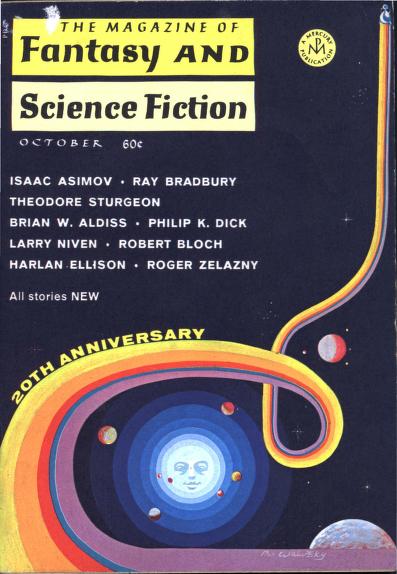
First published in the October 1969 issue of The Magazine of Fantasy and Science Fiction, which is on the Archive. It was then reprinted in New Worlds of Fantasy #2 (ed. Terry Carr), Hollywood Unreel: Fantasies About Hollywood and the Movies (ed. Martin H. Greenberg and Charles G. Waugh), Silver Scream (ed. David J. Schow), plus the Bloch collections The Best of Robert Bloch and The Complete Stories of Robert Bloch, Volume 3.
Enhancing Image
This story could be considered, to some extent, autobiographical. It’s circa 1970 and the narrator may as well be a stand-in for Bloch, living in LA and friends with a guy, Jimmy Rogers, who’s about a generation older than him. Jimmy is an old man now, but back in the 1920s he had started making cash as a regular extra in silent movie productions, along with his girlfriend at the time, June Logan. The narrator, in no small part to console his friend in his old age, goes with Jimmy to The Silent Movie, “the only place in town where you can still go and see The Mark of Zorro. There’s always a Chaplin comedy, and usually Laurel and Hardy, along with a serial starring Pearl White, Elmo Lincoln, or Houdini.” It’s what it says on the tin, playing silent movies at a time when silent movies would’ve been relegated to TV airings, on the occasion they were played at all. While he would’ve still been a kid when silent movies got usurped by sound productions, Bloch apparently held them in high regard, with the 1925 version of The Phantom of the Opera specifically being a gateway drug for his getting into horror. We’re clearly supposed to sympathize with Jimmy, since his original job had been taken over and his industry changed forever—never mind the fact that June has been dead for four decades now.
One of the first things I thought while reading “The Movie People” was that in 1969 this nostalgic treatment of Hollywood in the years before the invention of synchronized sound would not have been as old hat then as now, although there was still precedent for it at the time. (I’m ashamed to say I still have not seen Singin’ in the Rain.) Your knowledge of film history may or may not improve the experience, since Bloch assumes you have at least a cursory knowledge of Hollywood during the silent era, but then if you’re familiar with the historical material you can already predict the arc of the narrative and the sentimentality behind it. We learn about Jimmy and June’s relationship, which was kind of a Star Is Born scenario in which Jimmy couldn’t rise above being an extra and June was clearly on her way up the ladder—and no doubt would’ve continued her way up, had she not died in a freak accident. It was 1930 and June was on the set for an early sound production. The crew was experimenting with a traveling boom mic, what has long since become the standard for film productions, only it was newfangled then. “Somehow, during a take, it broke loose and the boom crashed, crushing June Logan’s skull.” It’s a pretty on-the-nose metaphor for the changing of the guard sound film brought about, ruining careers and hitting immigrants in the industry the hardest. Read some film history and filmmakers and historians will always treat The Jazz Singer as if it were one of the horsemen of the apocalypse (it’s also kind of a shitty movie). The late ’20s in Hollywood (other film industries lagged behind in adopting sound) marked the end of an era.
Bloch is a lot of things, but he’s not subtle. The man himself seemed aware of this, as he all but says in his lecture “Imagination and Modern Science Fiction,” for my money one of Bloch’s very best pieces of writing. It’s savage, insightful, and very funny, although while he did write some SF, Bloch was never much of an SF writer. “The Movie People” is not really horror either, being that rare example of a ghost story which does not try to evoke dread or terror, but instead melancholy. The thing is that The Silent Movie seems to be haunted—maybe. It’s unclear where the supernatural is coming from, but the short of it is that Jimmy has started to notice June has been appearing on the margins of old silent movies, including ones she would not have taken part in; for example he sees her in The Birth of a Nation, which came out nearly a decade before June’s first film role. (I could go on a whole tirade about how The Birth of a Nation went from being a deeply controversial but massively successful movie at the time of its release, to sort of just being accepted as part of the American film canon, to now being treated like that one aunt or uncle who thinks Trump actually won the 2020 election. But I won’t.) Despite not having seen her alive in forty years Jimmy can still pick her out from a crowd, and is convinced there must be some ghostly hijinks going on with these films such that he can see dead people in the roles of extras. Of course the narrator doesn’t believe this, but he wants to be there for his friend—perhaps even more so now, since he’s convinced Jimmy is seeing things in his old age.
There Be Spoilers Here
On the set of his latest “role,” Jimmy gets a mysterious letter which then falls into the narrator’s hands, and it’s a surprisingly long letter especially when you consider it was somehow written by a dead person. *It could be a hoax of course, but this is a ghost story and we have to take everything at face value, never mind that Jimmy’s suspicions about the ghosts in the silent movies are proven true at the very end.) It’s a letter from June, telling her long-lost boyfriend that he can join her and others as an extra from beyond the grave. There are rules to be followed and some advice given (humorously she tells him to stay away from “the slapstick comedies”), but Jimmy is given the chance to be with June again. Naturally he takes it. The ending is bittersweet, because on the one hand Jimmy dies on-set, but it’s not tragic or brutal death at all; indeed he looks “very much as though he were smiling in his sleep” when they find him. One thing that confuses me, and this is something I’ve started to notice more when giving fiction the deep-read treatment, is that the narrator acts like Jimmy was being delusional as he is recounting his story, despite already knowing that Jimmy’s speculation about The Silent Movie being haunted has merit. Why would a narrator act like they don’t know certain information when they already know that info? It’s a common fallacy with writing first-person narrators. Anyway, that final scene where the narrator goes to The Silent Movie and sees Jimmy and June waving at him in one of Intolerance‘s famous crowd scenes is sweet. (I’ve yet to see Intolerance either, it’s a glaring blind spot for me.)
A Step Farther Out
I’m quite biased about the history behind this story, being an actual film major who’s seen a decent amount of 1920s cinema at this point, but I came away from “The Movie People” with mixed feelings. The thing is that Bloch is an ironist at heart; he’s kind of a bastard. His fiction usually falls on a spectrum between horror and comedy, with his most effective work being either darkly humorous or horrific with a touch of playful irony. “The Movie People” basically falls outside of this spectrum altogether as it’s a story more or less without irony; it’s totally sincere. I’m not sure if this is Bloch’s wheelhouse. It’s a cute diversion that tries to tug at the reader’s heartstrings a bit, but I would’ve preferred this material be put in the hands of a writer more delicate than Bloch. But that’s just me.
Brian W. Aldiss debuted in the mid-’50s, and within just a few years he emerged as one of the most eye-catching talents in genre SF, on both sides of the Atlantic. Being a British writer he naturally started with the UK magazines, but once he found a home in F&SF stateside it was clear he was a talent not to be fucked with. He would have one of the longest and most acclaimed (at least among fellow writers) careers of any genre SF writer, having started in the ’50s but seamlessly becoming a crucial figure in the New Wave a decade later. He wrote one of the first notable histories of the field, Billion Year Spree, then later massively revised it and co-wrote with David Wingrove to make Trillion Year Spree, the latter winning him (and Wingrove) a Hugo. Of course Aldiss had already won a Hugo, this one for fiction, under circumstances so unusual as to not be repeated. See, people usually count Hothouse as a novel, although it’s really a fix-up of related stories; and the “novel,” as a series of linked stories, won Aldiss the 1962 Hugo for Short Fiction. It remains the only example of a short fiction Hugo going to a group of stories. Admittedly had Hothouse (initially titled The Long Afternoon of Earth in the US) been counted as a novel then Aldiss would’ve stood no chance against the titan that was Heinlein’s Stranger in a Strange Land. I’ve read “Hothouse” before, although I’m rereading it and reviewing it now because I remember basically nothing from that first encounter. I’ve not read the other stories yet, but rest assured I’ll be covering them on this site in due time.
Placing Coordinates
First published in the February 1961 issue of The Magazine and Science Fiction. Obviously you can find “Hothouse” in its novel form, but as a standalone story it’s also been reprinted in Mutants: Eleven Stories of Science Fiction (ed. Robert Silverberg), The Great Science Fiction Series (ed. Martin H. Greenberg, Joseph Olander, and Frederik Pohl), The Great SF Stories #23 (ed. Isaac Asimov and Martin H. Greenberg), and a Silverberg anthology that’s gone by two titles, Robert Silverberg’s Worlds of Wonder and Science Fiction: 101. That last one comes with commentary on each story which at the very least may prove interesting to you, if not helpful as a would-be short fiction writer.
Enhancing Image
The epigraph of this story is a couplet from the Andrew Marvell poem titled “To His Coy Mistress,” a borderline erotic love poem in which, seemingly, the narrator’s beloved is conflated with a tree—maybe not just a tree but the tree. All the trees of the world. It’s a proto-environmentalist poem that you’ve very likely seen quoted elsewhere if you’re a seasoned SF reader, since Ursula K. Le Guin quotes the same couplet for her short story “Vaster Than Empires and More Slow.” If I had a nickel for every time this poem has been quoted in 20th century science fiction I would have at least two nickels—which may not sound like a lot, but it’s weird that it happened at least twice! Of course in the case of the Aldiss story the tree of Marvell’s poem is indeed a single tree that has grown so as to become a vast forest by itself. “On this great continent where the humans lived, only one banyan tree grew now. It had become first King of the forest, then it had become the forest itself. It had conquered the deserts and the mountains and the swamps.” The single banyan tree has conquered the “day” half of the world, serving as the base for what has now become mostly varieties of plant life, from fungi to strange bulking plants called “traversers” that can easily be confused for enormous spiders. Earth and the moon have become locked in place in relation to each other, such that one half of the world is literally always day while the other is always without light, and the traversers have even somehow built a network of webs that acts as a path between Earth and the moon. The only non-plant life on land is a few species of insect, which nonetheless have grown truly massive, along with a small pocket of mankind.
You may notice that this premise sounds a bit outlandish even by Looney Tunes standards. The idea of Earth and its moon becoming locked in place, with there even being life on the latter, is patently scientifically implausible, which I suspect is why in Robert P. Mills’s introductory blurb for “Hothouse” he calls it “science fantasy.” It would be a fatal error to read Aldiss’s story as straight SF, as apparently James Blish did; but as I’ll get to in a moment, it’s not totally unfair to blame Blish for his dissatisfaction with “Hothouse”—not for the implausibility of the premise itself, but because Aldiss goes out of his way to try to make it sound plausible. The third-person narration often reads like a script for a nature documentary, albeit a bit more flowery (aha) than the usual. We meet a tribe of humans, comprised of adults and children (in the world of the story you basically stop being considered a child once you’re physically old enough to breed, (which has its own implications…), and it only takes a couple pages for one of the children to get swallowed up by a massive plant akin to a Venus fly trap. “It is the way,” as the elders say. Life both is and is not cheap here; given the smallness of the tribe every life counts, but also there are more children than adults because not all the children are expected to make it to adulthood. Not so much safety in numbers as an insurance policy. There are more children than adults, but there are also more women than men. The adult women make the important decisions while the men are basically walking sperm banks; this could be construed as feminist if not for the fact that the humans are both deeply tied to tradition and have basically no rights to speak of. After all, civilization as we know it does not exist. It’s a tyrannical little tribe, functioning as it does for the “good” of the race, which after all could easily go extinct.
Humans are so likely to be lost entirely to the vegetation or insects that rather than try to bury what can be retrieved the tribe does a burial rite for a fallen member’s “soul,” a doll “roughly carved of wood” that then stood in for the once-living person. After having done this for the child who’d been killed at the beginning of the story, the elders and the children of the tribe decide to part ways—the elders being old enough to “go up” and the children now being old enough to look after themselves. The life expectancy in this future world must be insanely short—like in the days of hunter-gatherer groups. It makes sense, now that the few humans left have become prey far more often than predator, and Aldiss is a mean-enough bastard that he’s not above killing off children or well-meaning characters. Even in this first story characters can die suddenly, so it’s best to not get too attached to anyone. Nevertheless, we do have characters with names, and possibly even personalities—although we don’t have much to go on there. We have a bit of an ensemble for this first story, but the closest we get to a protagonist would be Lily-yo, the matriarch of the tribe and the one who decides that maybe it would be for the best if she and a few fellow elders took a one-way ticket to the moon, along the traversers’ web, a journey which may or may not kill them. Only two males are left out of the children, Gren and Veggy, and as we can infer these humans really need their walking sperm banks. (I’ve read that Gren becomes an important character as the series goes on, but in this first story he’s little more than an accessory, and easy to forget about.) So of the adults going up we have Lily-yo, Haris, Flor, Jury, Daphe, and Hy. I may be forgetting someone, so sorry about that.
We have carnivorous plants, but we also have giant insects with the tigerflies, treebees, plantants, and termights. (Can you guess what the termights are supposed to be.) The insects feed off each other, the humans, and even the traversers. I know this is supposed to be unfathomably far in the future, but I have to wonder what could’ve happened to produce such a fucked up ecosystem as this; not only are basic physics out the window, but so is Darwinian evolution seemingly. And yet, a good chunk of the story’s word count is Aldiss explaining the dynamics of this ecosystem, as if it were not based on an already-implausible premise. Taken purely as science fiction it’s nonsensical, but it also fights against being taken as fantasy—at least fantasy as the genre was understood in 1961. The telling of the story is as if we’re being given a glimpse into the lives of future humans who actually bear little relation to us, and who have become almost like the animals you’d see in a nature documentary. When Lily-yo and company have gotten to the moon they find themselves mutates via solar radiation, and also find that Daphe and Hy did not survive the journey. It is the way. We’re given no insight into the thinking of these characters, such that they become purely kinetic beings, all living and dying on action, and so we’re not that emotionally invested when a few do inevitably kick the bucket. But there’s another side to this, in that Aldiss’s treatment of his characters is so heartless that it reinforces the cutthroat nature of this story’s world. It’s kill or be killed. When the surviving adults reach the moon they find they’ve become mutated, which would normally be a negative—only here it means they might’ve found an advantage over their nenemies. And maybe an ally.
There Be Spoilers Here
The traversers had constructed a passage to the moon, and brought life with them. “More thoroughly than another dominant species had once managed to do, the traversers colonised the moon.” I find it funny to think “Hothouse” takes place in the same universe as the real-world moon landing, although that wouldn’t happen for another eight years, not to mention the physics don’t line up at all. How would humanity have gotten to the moon with this story’s physics? With a really big slingshot? Anyway, the adults of the tribe find traversers, along with other plant life (yes, breathable air), on the moon, but they also find the flymen. It’s not obvious at first, but the flymen are in fact mutated humans, with angel-like wings that make them suited to the moon’s lighter gravity. Growing wings is one mutation made possible by solar radiation; there are mutations that are less useful. There are non-winged humans among the flymen called Captives who nonetheless serve an important function in this moon society, called “the True World.” But there’s still a problem: replenishing the human race. Age has something to do with it, but the likelier culprit for the lack of children on the moon is that the radiation tended to render the incoming humans impotent, “the rays that made their wings grow made their seed die,” so that the only practical solution is to retrieve more humans from Earth. The leader of the flymen, Band Appa Bondi, is one such human who had been spirited away to the moon as a child. Don’t get attached to him.
Also don’t get attached to Jury; she gets killed offscreen. It is the way. The climax of “Hothouse” sees Band Appa Bondi and the remainder of Lily-yo’s gang heading back to Earth to retrieve the children, only to be met with an army of tigerfly larvae—all of whom happen to be hungry, Band Appa Bondi gets killed unceremoniously in the battle and Our Heroes™ don’t even pay it a second thought. It’s hard to overstate how both outlandish and hardboiled this story is; it’s an odd but compelling combination. “Hothouse” very much ends on a sequel hook—not really a cliffhanger but as a sign of things to come. I remember Silverberg, in his Science Fiction: 101 anthology, had to evaluate “Hothouse” quite differently from the other stories included since it’s the only one that wasn’t written as a standalone; like sure, you could read it as a standalone, if you’re a little freak, but what’s the point in that. What’s the point of developing a fictional world as vividly (if outlandishly) as Aldiss does here and relegating that to a one-off story? What is this, Jack Vance? Aldiss is a good deal more cerebral than Vance. I like Aldiss, but I get the impression he knew he was the smartest person in the room nine times out of ten, and I’m subconsciously envious of this as a certified dumbass. I sometimes get the impression Aldiss may be too smart for me. As such “Hothouse” may be the quintessential Aldiss story in that it leaves me evenly split between ambivalent and intrigued—both because I’m keenly aware he’s doing something unique, and he knows it too.
It is the way.
A Step Farther Out
I appreciate “Hothouse” a lot more on a reread, although I’m not sure I can say it’s “my thing.” It’s already a longish novelette, but it’s dense. It’s easy to see how a hardcore SF reader would be frustrated by it, but it’s also easy to see how in 1961 readers would’ve been impressed with it; it’s not quite New Wave, not least because it lacks any kind of psychological insight into its human characters, but it’s very much a stepping stone to the New Wave era. I also feel that despite sometimes being printed on its own that this is palpably the first entry in a series, as the ending shows, such that I feel like I won’t be honest with myself if I don’t cover “Nomansland” in a few months. Indeed “Nomansland” was already in the can when “Hothouse” was published, since Mills mentions having bought it in the introduction. This is not my favorite Aldiss, but it’s very much worth following.
As I’ve said elsewhere, we’re gonna be covering the ’60s in this year-long tribute to The Magazine of Fantasy and Science Fiction this month. Picking stories to review for July proved a challenge, but in a good way. Over its 75-year history F&SF has gone through several editors, which is normal, but the ’60s were almost certainly the most tumultuous time in the magazine’s history, for a few reasons. At the beginning of the decade Robert P. Mills was editor, and for the few years he edited F&SF Mills was very capable, arguably even on par with Anthony Boucher; but Mills was an agent and publisher first, and editing wasn’t something he wanted to do as a career. So the torch was passed to Avram Davidson, which sounds like an odd choice with hindsight, but it probably made perfect sense at the time. Davidson was a well-respected writer out of the “new” generation; he was more literary than most of his contemporaries, but he was also… quirkier. For practical reasons more than anything Davidson’s editorship could not last, and so the torch was passed once again, this time to Joseph W. Ferman, with his son Edward assisting him. Joseph lasted about a year before passing the torch to Ed; and this time, by the beginning of 1966, the torch would stay in place, as Ed Ferman would remain editor for the next 25 years. By the last ’60s F&SF had found a new and comfortable niche.
The rapid changing of editors also coincided with a rapid changing of material and reader expectations at this time. The ’60s were the decade of a lot of things: the Vietnam War escalating, racial and socio-economic strife reaching a breaking point, the assassinating of left-leaning public figures, the coming of the hippies. More innocuously it saw the birth of the New Wave, which was spearheaded in the UK by Michael Moorcock and a small army of forward-thinking British writers (although, if it makes you feel better, quite a few important contributors to the New Wave were American), reinventing New Worlds to make it a boundary-pushing powerhouse of a magazine. The US scene was a bit slow to catch up. John W. Campbell and Frederik Pohl lamented the New Wave, but the rascally movement would eventually find a sympathizing magazine in the US with F&SF. Understandably the fiction published in F&SF during this time was a good deal more eclectic than what happened in the ’50s, so it also makes sense the lineup of authors for this month would be a bit eccentric. We have a few of the usual suspects, but we also have… Lin Carter? And Russell Kirk…? We have a New Waver with Brian Aldiss, although the story chosen is decidedly anticipatory of the New Wave rather than part of it. For the most part we have science fiction here, with some horror thrown in; this was not a great time for fantasy in F&SF. Still, I think it’s at least an interesting roster.
Let’s see what’s on our plate.
For the short stories:
“The Oldest Soldier” by Fritz Leiber. From the May 1960 issue. He’s baaaaack. Honestly it’s been too long—in fact it’s been exactly a year since we last covered Leiber. Of course in the interim I’ve not refrained from writing about him on a different outlet or two, and can you blame me? This time we have an entry in his Change War series, being one of the first examples of a time war in SF.
“Hothouse” by Brian W. Aldiss. From the February 1961 issue. Aldiss has a career that goes shockingly far back for someone who died fairly recently, having debuted in the ’50s and almost overnight becoming a force to be reckoned with. Hothouse is usually considered a novel, but as a series of linked stories it won Aldiss a Hugo. This first entry in the “series” is a much-needed reread for me.
“Subcommittee” by Zenna Henderson. From the July 1962 issue. There were quite a few female authors active in the early days of F&SF (more so than other SFF magazines), and one of the most prolific contributors was Henderson. Her fiction often involves families and the experiences of children, and she’s most known for her stories of “The People.” This story, however, is totally standalone.
“The Voyage of the ‘Deborah Pratt’” by Miriam Allen deFord. From the April 1963 issue. DeFord has one of the most curious careers of any old-timey SF writer, and in 1963 she was almost certainly the oldest living contributor to F&SF, being in her seventies. Prior to taking up genre writing she wrote for socialist and feminist publications, as well as conducting research for Charles Fort.
“Cynosure” by Kit Reed. From the June 1964 issue. Starting in the ’50s and remaining active until her death in 2017 (she lived to be 85), Reed’s work is often quirky, humorous, satirical, but also at times brutal. Her science was never hard, and her disposition makes one think of Shirley Jackson. Both are vicious when it comes to domestic portraits. In other words, Reed was perfect for F&SF.
“Uncollected Works” by Lin Carter. From the March 1965 issue. Acclaimed, if also controversial, as an editor, and pretty notorious as a writer, Carter is probably most responsible for reviving interest in pre-Tolkien fantasy in the ’60s and ’70s. He’d been active as a fan since the ’40s, but “Uncollected Works” was his first solo professional story, and it garnered him a Nebula nomination.
“Balgrummo’s Hell” by Russell Kirk. From the July 1967 issue. Kirk, at least when he was alive, was known more as a conservative political philosopher, and indeed Christianity is integral to both his fiction and non-fiction. But he was also a surprisingly accomplished writer of supernatural horror, and despite being very much an outsider he did sometimes appear in the pages of F&SF.
“They Are Not Robbed” by Richard McKenna. From the January 1968 issue. McKenna gained mainstream recognition with his one novel, The Sand Pebbles, but it seems he used science fiction as a training ground, such that he appeared semi-regularly in the magazines—both before and after his death. McKenna died in 1964, but he apparently had a small trove of stories waiting to be published.
“The Movie People” by Robert Bloch. From the October 1969 issue. Bloch is most known for writing Psycho, but his career started much earlier and much more embedded in the Lovecraftian tradition—indeed he and Lovecraft were correspondents when Bloch was a teenager. On top of writing bestsellers Bloch wrote for film and TV, even penning a few (horror-themed) Star Trek episodes.
Nothing unusual for this month, although we do have a couple authors who are not normally associated with SFF, let alone magazine SFF. One of the reasons I decided to make this year more focused on The Magazine of Fantasy and Science Fiction for its 75th anniversary is that, easily more than any of its contemporaries (and F&SF has outlived most of its competitors), is that it has managed to snag authors who otherwise would probably never appear in SFF magazines. It’s quite possible Jonathan Lethem would’ve tried his hand in the magazines regardless of whether F&SF ever existed, but the same can’t be said for Joyce Carol Oates.
I’ve recently been going through another mental health struggle (my bipolar episodes thankfully last hours at a time instead of days or weeks), but that’s not something to be elaborated on—at least not for this post. I may have something in mind having to do with mental illness in certain SF writers that you may or may not see later in the month.
Let’s see what we do have.
For the novellas:
“Oceanic” by Greg Egan. From the August 1998 issue of Asimov’s Science Fiction. Hugo winner for Best Novella. Egan is one of the leading voices of post-cyberpunk, and while mixing SF with detective fiction was a thing pretty much since cyberpunk became a codified subgenre, Egan has gone farther than most in mixing hard science with film noir tropes. Last time we met Egan it was with his mind-bending novella about quantum physics, “Singleton,” but “Oceanic” seems to catch Egan in a very different mode.
“Autubon in Atlantis” by Harry Turtledove. From the December 2005 issue of Analog Science Fiction. Prolific tweeter Harry Turtledove is known as a possibly even more prolific novelist, and while by no means did he invent the alternate history novel he has undoubtedly worked to define that subgenre more than anyone in recent years, especially regarding the American Civil War. “Autubon” is not a misspelling of “autobahn” but refers to the real-life naturalist John James Autubon, who stars in this alternate history story.
For the short stories:
“Friend” by James Patrick Kelly and John Kessel. From the January 1984 issue of The Magazine of Fantasy and Science Fiction. Long-time friends and collaborators, brilliant both solo and together, Kelly and Kessel got their starts around the same time and happened to get involved in the cyberpunk movement, although it would be inaccurate to call either of them cyberpunk writers.
“Drunkboat” by Cordwainer Smith. From the October 1963 issue of Amazing Stories. One of the most unique voices of his day, Smith, as you probably know, is the pseudonym of Paul Linebarger, a respected writer on psychological warfare and consultant on Asian geopolitics. He spent some of his childhood in China. Most of his stories, including this one here, are set in the same future history.
“Mood Bender” by Jonathan Lethem. From the Spring 1994 issue of Crank!. A “literary” author who has never forgotten his roots, Lethem started out in the late ’80s as a genre writer, and indeed his first four novels were all SF before he gained mainstream attention with Motherless Brooklyn in 1999. As with Greg Egan, Lethem has a knack for combining SF with film noir elements.
“Pictures Don’t Lie” by Katherine MacLean. From the August 1951 issue of Galaxy Science Fiction. MacLean debuted just in time for the magazine boom of the ’50s and the first great era for female SF writers. She lived an extraordinarily long time and her career is a distinguished one. “Pictures Don’t Lie” is one of MacLean’s most reprinted stories, and has even been adapted multiple times.
“In Shock” by Joyce Carol Oates. From the June 2000 issue of The Magazine of Fantasy and Science Fiction. Noted tweetsmith Joyce Carol Oates also happens to be one of the most acclaimed living American authors, having won the National Book Award, the Bram Stoker Award, among others. Most of her work is “literary,” but she’s also a somewhat prolific (and quite skilled) writer of horror.
“The Secret Life of Bots” by Suzanne Palmer. From the September 2017 issue of Clarkesworld. Hugo winner for Best Novelette. Palmer was born in 1968 but didn’t make her genre debut until 2012; despite this she has quickly built a reputation as one of the leading authors in the field. She’s been a prolific contributor to Asimov’s especially, but this story marked her first appearance in Clarkesworld.
As you can see this nearly all SF, except for the Oates which is horror, but it’ll also be the last “normal” forecast until September. In July we’re doing all F&SF stories, this time from the ’60s (I covered the ’50s in March), and for August I have a special author tribute in mind.
Lucius Shepard had one of the more unusual career trajectories for an SFF writer of his generation, and it shows in his work. He was born in 1943 and apparently wrote some juvenilia as a highly precocious preteen, but didn’t start writing fiction as an adult until he was deep in his thirties, having spent the intervening years on a series of very odd jobs. (He was part of several small-time rock bands in the ’70s and even claimed to have been a gun runner at one point—so he claimed.) His stories often take place on Earth but outside the US, starring an American expatriate or a local of the land, the latter being the case with today’s story. Shepard traveled often and his experiences abroad certainly inspired his fiction. The inspiration seemed to come fast too, since once he started writing in earnest he rarely stopped (he took a break for much of the ’90s, but was otherwise prolific), such that between 1983 and 1985 he produced a healthy platter of short fiction plus a novel. His early output was so strong and consistent that it won him the Astounding Award for Best New Writer in 1985.
I’ve read enough Shepard at this point that I can sort of predict his movements, which you could interpret as an insult or the sign of an artist with a unique vision. It’s like calling Wes Anderson’s movies predictable. The thing with Shepard is that he has a “type,” i.e., a set of tropes and ideas he likes to return to again and again—with the flaws that come with them. I highly recommend “The Jaguar Hunter” as one’s first Shepard story because it neatly encapsulates what makes his writing different from what other genre authors were doing in the ’80s, for both good and ill. It’s a bit orientalist and more than a little misogynistic, but it also has a moodiness and an erotic intensity that identify it as a fable for adults. I found it a captivating read almost in spite of its problematic elements.
Placing Coordinates
First published in the May 1985 issue of The Magazine of Fantasy and Science Fiction, which is on the Archive. It was then reprinted in The Year’s Best Science Fiction: Third Annual Collection (ed. Gardner Dozois), The 1986 Annual World’s Best SF (ed. Arthur W. Saha and Donald A. Wollheim), Killing Me Softly: Erotic Tales of Unearthly Love (ed. Gardner Dozois), The Fantasy Hall of Fame (ed. Robert Silverberg), Tails of Wonder and Imagination (ed. Ellen Datlow), and the Shepard collections The Jaguar Hunter and The Best of Lucius Shepard.
Enhancing Image
Esteban and his wife lncarnación are not doing so well in their marriage: they don’t fuck much anymore, Esteban suspects lncarnación envies his looks and talent, and perhaps most importantly, the wife has a nasty habit of buying things she can’t afford. As such, Esteban owes Onofrio and his son Raimondo money for a TV his wife had bought—but he can clear that debt, and even earn a hearty paycheck on top of that, if he does a difficult job for them. A black jaguar has been stalking Barrio Carolina, not killing anyone just for the fun of it but only hunters who have been paid to go after it. We can infer here that the jaguar is acting in self-defense, not like that matters much to Esteban. This particular jaguar is tough, with a body count, but Esteban is a veteran hunter (albeit one who would prefer to not go back to hunting to make a buck), and he has a special technique that’s earned him kills in the past which other hunters are unlikely to use. So to clear the debt and maybe please his wife along the way (after all, sometimes baby needs a new pair of shoes and sometimes baby needs a new house), he ventures out, solo, expecting to meet his toughest enemy yet.
In the first few pages we have a clean setup, and it’s a pretty good one. The setting is Honduras, which I don’t think is explicitly stated in the text except for the fact that the currency is lempiras (“ten thousand lempiras” being Esteban’s check), but it’s apparently a country Shepard had visited, and Esteban himself is inspired by an actual hunter Shepard knew. The setting is vividly realized, like something out William Friedkin’s Sorcerer or early Kipling, even if it runs the risk of orientalism. This is a risk to be expected of any white American writer depicting places and cultures he may or may not have had any personal interaction with, which is a risk Shepard does sometimes run afoul of, although here I think he’s pretty good about it. What’s more conspicuous is the misogyny, which will only become more apparent as the story goes on and which is arguably baked into the story’s DNA. We get to know very little about lncarnación, but what little we’re told points to her being a massive shrew whom Esteban is probably better off without—and then there’s the other female character, who we’ll get to in a second. I suspect Shepard wrote Esteban as having standoffish relationships with women for symbolic purposes, which I’ll elaborate on, but the point is that this is not by any means a feminist narrative.
(I’m gonna digress for a second here to clarify where I stand on misogyny in fiction, because when I see fellow reviewers harp on it there’s this sense at times of coming from a holier-than-thou position, as if the writer has or had never indulged in misogynistic behavior. I think this is dishonest in some way, or at least gives the wrong impression. When I critique woman-hating in my fiction it’s from the viewpoint of someone who, unfortunately, spent his college years as what you might call an alt-righter or proto-fascist. Such a phase would have a major ripple effect on my life and to this day it creeps up in my interactions with people, especially women and non-white folks, in ways that unnerve me, even if this discomfort is unbeknownst to the other party. As such when I see misogynistic or generally bigoted writing I critique less from a “how dare they” position and more from the fact that I see a little dark part of myself in this writing.)
I’m putting this all up front because the rest is positive; to say this is an evocative story wouldn’t quite be doing it justice. Shepard is often called an SF writer, but “The Jaguar Hunter” starts off as realistic fiction before slowly becoming something else—not science fiction, but a kind of supernatural fantasy that would probably have a hard time getting published anywhere in the ’80s except for F&SF. We expect, going into this as an SFF story, that the black jaguar will not be just a jaguar—only the question then becomes what it could possibly be. (Incidentally I had a bad dream the other night where I thought I had encountered a jaguar in the hills, but someone [who?] beside me told me that this supposed jaguar was in fact, somehow, a bobcat with a night-black coat. A big cat masquerading as an even bigger cat? But why?) This is where the last main character comes into play, in the form of Miranda, a woman who lives by herself on the coat, in what is supposed to be the jaguar’s territory. Now, I don’t think I’m spoiling anything by saying Miranda and the jaguar are connected, because the instant she appeared I felt something was up. It’s one of those “twists” that’s so easy to predict that Shepard doesn’t even treat it as a twist, but rather part of something greater. That the woman and the jaguar turn out to be the same is not the big reveal but only the first major step in the narrative’s arc.
“The Jaguar Hunter” is in essence a love story—not between Esteban and Miranda but between Esteban and death. Esteban is a hunter who has been on quite a few expeditions in his time, and despite being wary of taking on the role once again at the story’s beginning he does take a certain pride in his work. He explains to Miranda (who turns out to be the very jaguar he’s after) in detail how he plans on taking down this fierce animal—by drugging himself and playing dead, only to stab the jaguar between the ribs once the beast gets close enough. Miranda, like a siren, tries to mislead Our Hero™, but Esteban is not swayed until the two meet under different circumstances. Esteban is super-horny for Miranda when they first meet, but it’s only when she reveals herself to be the jaguar in human form (or maybe both the human and jaguar forms are disguises for something else) that he completely falls for her. This is a curious duality, the woman standing in for both eroticism and death. Esteban told Onofrio that if he didn’t return with the jaguar in a week that something must’ve happened to him—and he’s not strictly wrong there. He spends over a week with Miranda, apparently having given up on lncarnación, the two in a state of paradise.
There Be Spoilers Here
Unfortunately paradise, like a euphoric state for a manic-depressive, does not last. Onofrio and Raimondo drive to the territory in search of Esteban, or what they think will be his corpse; they are not pleased when they find their hunter alive and apparently slacking on the job. Esteban kills Raimondo with a machete and provokes the wrath of Onofrio’s goons, and there’s seemingly no way out of this problem. The good(?) news is that Miranda is not an ordinary woman, nor even a werejaguar, but a member of a magical race perhaps akin to the fair folk, who can open portals between the realm of humans and the realm of these magical beings. The story ends on an ambiguous note, with a wounded Esteban jumping into a seemingly bottomless river, chasing after the portal Miranda had opened, in the hopes it will not have closed before he reaches it. Tellingly, we’re not told if Esteban succeeds or not. He’s between a rock and a hard place: if the portal is still open then Our Hero™ will be entering a world totally unknown to him, and which he might not be able to adapt to; and if the portal is closed then he’s a dead man, plain and simple. Shepard’s writing at its best captures what Joseph Conrad in Heart of Darkness called “the dream-sensation” (Shepard undoubtedly took inspiration from Conrad, although Conrad was the better writer), that borderline between the realistic and the mystical. “The Jaguar Hunter” crosses this borderline with a lustiness that befits Esteban and Miranda’s steamy affair, connecting sex and death with an explicitness that Conrad could not (and would not, even had censorship been more lax in his day) have tried. The result is grim, but magical.
A Step Farther Out
To give Shepard credit, he sticks to what he does well. “The Jaguar Hunter” is the prototypical Shepard story, in that it tackles his pet ideas, plus a grizzled protagonist, plus an exotic locale, all in a neat package. It hasn’t aged so much as its problematic elements were so from day one, but as a result it’s also tempting to call it timeless. I think it also helps that Shepard had the habit of writing about Vietnam, explicitly or in an allegorical fashion, and “The Jaguar Hunter” has nothing to do with Vietnam except taking place in a country with a similar climate. This is a story that blurs the line somewhat between fantasy and SF, although I’m much more inclined to go with the former label. If you’re curious about Shepard, this is a good start.
We don’t know much about E. Lily Yu. We don’t even know what the “E.” in her name stands for, or at least I can’t find a source on it; her own site doesn’t mention it. We don’t know when she was born either, but given that she graduated from Princeton in 2012 we can make an educated guess. Incidentally she received the Astounding Award for Best New Writer that same year, off the strength of a couple very strong short stories. Since then she has written one novel, a short story collection, plus an essay collection. “The Witch of Orion Waste and the Boy Knight” is a fable, or rather a fairy tale sort of in the style of Hans Christian Andersen, but with a more explicitly feminist bent. This one is a little upsetting to read, truth be told, because of how vividly it depicts an abusive relationship and a woman’s disillusionment; but it’s also written in a style that is (for the most part) in keeping with the tradition.
Placing Coordinates
First published in the September-October 2016 issue of Uncanny Magazine, which you can read here. It was then reprinted in The Best Science Fiction and Fantasy of the Year: Volume Eleven (ed. Jonathan Strahan), The Best American Science Fiction and Fantasy 2017 (ed. Charles Yu), The Best of Uncanny (ed. Lynne M. Thomas and Michael Damian Thomas), and the Yu collection Jewel Box. Pretty good for a more recent story.
Enhancing Image
The story is about a witch, “neither very old nor very young,” and as the narrator tells us, “she had not been born a witch.” She went through a few jobs first and took on the role of witch, learning the arts, living a secluded life in a hut on Orion Waste, so named after a fallen star. The setting is for the most part your typical medieval fantasy setting, albeit with a tinge of the post-apocalyptic and couched in a style of narration that makes it clear from the outset we’re reading a story. The witch herself seems close to being aware she’s playing a part in a fable, and there are a couple side characters who are mentioned as taking part in other stories—which of course we hear nothing about, but this is a fantasy world that is decidedly and completely removed from the real world. The style Yu employs here makes sense for both the material and for someone would’ve been very young still when she was writing it, as the fable is a mode that’s easy to learn but hard to master; it’s not as demanding as trying to emulate the Bible, or even Hemingway, but it takes a talented writer to squeeze fresh juice out of this fruit. As such Yu assumes (correctly) that the reader has at least a cursory knowledge of how traditional fairy tales work and proceeds from there while also having some fun with it, such as a light meta touch.
The witch takes on the companionship of a knight, with the former seeing the latter as worthy of admiration and the latter seeing the former as useful. Right away we get the feeling something isn’t right with this relationship, but the witch is blinded both by her feelings for the knight and the fact that she hesitates to use a certain tool that would’ve prevented this whole oncoming trouble. You see, the witch had inherited a magic bell, “forged from cuckoo spit, star iron, and lightning glass, which if warmed in the mouth showed, by signs and symbols, true things.” The problem is that using the bell renders the witch ill to the point of being bedridden, so it’s only something to be used in dire situations. It’s a shame, because the knight is not without his merits; he is brave, and he does try to take on the dragons that his profession calls for, but he proves to be simply not strong enough to take on these beasts alone. The witch goes through great pains to save the knight, but is not rewarded for it; instead the knight berates her, being clearly envious of her talent, and even later in the story threatens to kill her if she “takes the credit” again. The knight does not see the witch as fully human but rather as a utility, to be discarded if deemed too inconvenient or if her usefulness runs out. And yet the witch stands by the knight; she can’t bring herself to hate him, or even to articulate the ways in which he mistreats her.
The witch is a woman, but the knight never treats her as such. Historically, in the real world, witchcraft has been associated with women’s evil ways, and while witchcraft is not an exclusively female practice and women aren’t the only people to suffer from witch hunts (Giles Corey sure died for it), a woman being accused of witchcraft is like a woman under patriarchy being accused of promiscuity. To help make this point, Yu introduces us to the lady (mind you that none of these characters have names), whom the knight rescues after the witch has defeated another dragon. The lady is everything the knight expects out of a “good” woman: conventionally attractive and pure as snow, not given to wickedness. Unfortunately the lady is also a real bitch, and it doesn’t take long for her to whisper sweet nothings in the knight’s ear and convince him to kill the witch while she isn’t looking—something the witch luckily overhears. I will say that things at this point get a bit confusing since there aren’t any breaks between scenes and the third-person narrator seems to jump between characters’ perspectives carelessly by the time the lady is introduced. It doesn’t make the story difficult so much as unnecessarily hard to untangle at times; it gives the impression of unprofessionalism, or at least that one more go through the manuscript would’ve been nice. Ultimately these are quibbles, given the story’s power otherwise; just wanted to point them out since they stuck out to me initially.
There Be Spoilers Here
When I started reading this story I assumed the “boy knight” of the title would be an actual boy and not a man (how stupid of me), and yet I ended up not being that far off. The witch’s bell reveals that a curse had been put on the knight, such that while physically a man he’s still a young boy on the inside, which goes to explain his erratic behavior and lack of capacity to empathize with anyone. The lady, for her part, is also cursed, such that once she has her hands on someone she can’t have them, though it’s unclear at first what this could mean in practical terms. The witch pities both of them, although what’s interesting is that for both Yu and the witch the curses put on these people do not absolve them of their wrongdoings. The twist of the knight’s condition also comments on the immaturity inherent in misogyny, about how a misogynistic tendency always reveals a lack of maturity and capacity to empathize with other people in the misogynist. (Needless to say this also applies to transmisogyny.) I say this with clarity as someone with a long history of misogynistic tendencies that I’ve been trying to atone for in the past couple years. I used to be almost as bad as the knight. It’s not an easy thing to say, but it’s true, and it’s probably a personal factor that has gone to heighten this story’s effectiveness for me.
In a way the story’s climax is a bitter one. The knight is not cured of his curse, nor is he redeemed, but rather becomes another toy for the lady, who herself is said to be deeply unhappy. Things turn out well for the witch, though, who has gotten out of her toxic relationship and can now act only for herself again. Aging and wounded from her travels, she take up working at a shop, not saying much but being content in her work—only she’s met with one last visitor, a peddler “with a profitable knack for roaming between stories” who offers her a pair of red shoes. The ending is a bit of a head-scratcher if taken on a literal level, but since this is a fairy tale it’s easy to grasp the allegorical significance of the witch putting on the shoes and taking flight, after having suffered and yet retained a sense of purity. Unlike the mermaid of Hans Christian Andersen’s story, who must work in the afterlife to redeem herself, Yu’s witch is more akin to Thomas Hardy’s Tess in that she is a fundamentally good woman who has been done dirty. The very end sees the witch ascend to the heavens, but also out of the story.
A Step Farther Out
There’s a roughness to it, mainly in the lack of scene breaks and shifting in perspectives, that tells me it could’ve been even better had there been another rewrite. At the same time it’s telling that when logging this story for my reads-of-the-year spreadsheet I bolded the title, telling future me this is very much a story work recommending and remembering. “The Witch of Orion Waste and the Boy Knight” is a modern fairy tale that captures, in balanced measures, both the whimsical high fantasy and dark moralism of quite a few classic fairy tales. Yu understood the form well enough to not only emulate it successfully but to give it a little something extra. rest assured we’ll be returning to her eventually.
Not much to say with regards to updates here, other than I’m looking into a tutoring gig and I seem to be starting a polycule, the latter of which I’ve heard is kinda like starting a rock band. If anyone wants to join, please let me know. There are no gimmicks for this month’s review forecast, except that we have a complete novel on our hands for the first time in what feels like forever, and we’ve got a few familiar faces returning to the site. I may have also intentionally picked Lucius Shepard and Aliette de Bodard stories with similar titles. One thing I’ve been thinking about that I’ve decided to act on is reviewing more reprints of classic stories; one every couple months seems like a good deal. The reason for this is at least twofold: I have a soft spot for the classics, but I also wanna cover authors from the pre-pulp years who contributed to genre fiction. This month I’ll be reviewing an SF story by Jack London, who is not known primarily for his SF but who indeed wrote a lot of it. Once again Jack Vance will be providing the novel, which is unsurprising since quite a few of his novels first appeared in magazines, either as serials or all in one piece like this month’s novel.
Don’t wanna keep you long; just letting you know we have another month packed with fiction that looks to be at least interesting, although it’s mostly SF with a couple fantasy stories thrown in.
For the novellas:
“Birthright” by April Smith. From the August 1955 issue of If. Smith sadly is one of many women who wrote SF in the pre-New Wave days whom we know basically nothing about. We don’t know when she was born or when she died. She’s a ghost. She has one solo story, “Birthright,” to her credit, plus one collaboration. ISFDB classifies this story as a novelette, but running the Project Gutenberg text through a word processor shows it’s just over 17,500 words.
“Polyphemus” by Michael Shea. From the August 1981 issue of The Magazine of Fantasy and Science Fiction. Shea had a varied career, lasting from the ’70s until his death in 2014. His work ran the gamut from SF to high fantasy to the Cthulhu Mythos. He won the World Fantasy Award multiple times for his fantasy and horror. His most famous story, “The Autopsy,” is an SF-horror hybrid, and “Polyphemus” looks to be a similar blend of the two genres.
For the short stories:
“The Shadow and the Flash” by Jack London. From the June 1948 issue of Famous Fantastic Mysteries. First published in 1903. London was one of the most popular and prolific authors of the early 20th century, despite dying young. He’s best known for his adventure stories set in the Klondike, such as The Call of the Wild and White Fang, but he also wrote a surprising amount of science fiction.
“The Witch of Orion Waste and the Boy Knight” by E. Lily Yu. From the September-October 2016 issue of Uncanny Magazine. Yu burst onto the scene with her story “The Cartographer Wasps and the Anarchist Bees,” which nabbed her several award nominations. She won the Astounding Award for Best New Writer the same year she graduated from Princeton, which is no small feat.
“The Jaguar Hunter” by Lucius Shepard. From the May 1985 issue of The Magazine of Fantasy and Science Fiction. Speaking of late bloomers, Shepard didn’t start writing fiction as an adult until he was deep in his thirties, but he quickly emerged as one of the defining SFF writers of the ’80s. If you’ve read enough Shepard then you know he has a “type,” and this story looks to be typical Shepard.
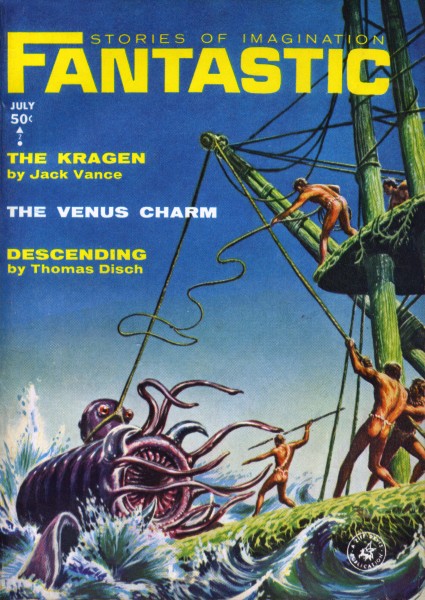
“Descending” by Thomas M. Disch. From the July 1964 issue of Fantastic. Feels like it’s been a long time since I covered Disch, with his novel Camp Concentration. Disch was one of the daring young writers to kick off the New Wave in the ’60s, although despite being a regular at Michael Moorcock’s New Worlds he actually first appeared in Fantastic, under Cele Goldsmith-Lalli’s editorship.
“The Defenders” by Philip K. Dick. From the January 1953 issue of Galaxy Science Fiction. It’s been ten months since I last talked about Dick on here, which in my book is too long a wait. The thing about Dick is that he’s become frankly over-discussed in “serious” SF discussions, or at least his most famous novels. Thankfully this is not the case with many of his short stories, such as this one.
“The Jaguar House, in Shadow” by Aliette de Bodard. From the July 2010 issue of Asimov’s Science Fiction. Of Vietnamese heritage, living in France, and writing predominantly in English, de Bodard has a curious cultural background, so it makes sense she would concoct one of the most curious future histories in modern SF. Spacefaring humanity here is decidedly non-white and non-American.
For the complete novel:
Planet of the Damned by Jack Vance. From the December 1952 issue of Space Stories. The early ’50s were a formative period for Vance, who was showing himself to be one of the most imaginative talents at the time—albeit one whose efforts were mostly relegated to second-rate magazines. I’ve previously coveredBig Planet, which was a breakthrough title for Vance, and now we’re on Vance’s follow-up novel, published just a few months later. Planet of the Damned has a rather convoluted publication history: as with Big Planet, the magazine version and not the first book version served as the basis for future “definitive” reprints. It’s also been printed as Slaves of the Klau and Gold and Iron.
Karl Edward Wagner is one of those recent discoveries for me who sadly I’ve not been able to read a lot more of as of yet, because his works are not exactly easy to find. Wagner is (I’ve been told) arguably the best of the generation of writers to hop on the sword-and-sorcery revival of the late ’60s and early ’70s. He debuted in 1970 with the novel Darkness Weaves with Many Shades…, which was also the first to star his nigh-immortal anti-hero Kane, seemingly based on the Cain of the Bible. In an interview for the fanzine Dagon, Wagner had this to say on his biggest contribution to heroic fantasy:
The idea of Kane came from all the villains that I saw as heroes, derived from reading books, comics and watching movies: the bad gunfighter who would get shot down, who was really faster than the good guy. Good always had to win so I thought I’d write about a villain who always wins. Villains always had to be either like Fu Manchu, or intensely intelligent super scientific geniuses, but they couldn’t really break somebody in half, or else they were big hulking creatures like Rondo Hatton. So I thought what happens if you got the super intelligent villain who could break somebody in half if he wanted to? That’s how Kane came about. He was a villain who was going to win at the end and be smart enough to control the situation when things got bad. If he had to mow down sixty other people he could handle that, that is if he didn’t summon up something supernatural in the process. I thought let’s do something totally all out, and that’s Kane.
“Two Suns Setting” is one of the more notable Kane stories, and even won Wagner his second British Fantasy Award for Best Short Story; the first was for his Lovecraftian horror story (and his most famous story overall) “Sticks.” This also marked Wagner’s first and only appearance in Fantastic, which is weird because you’d think Wagner and Fantastic in the ’70s, when it had become the most high-profile outlet for heroic fantasy, would make a perfect pair. Wagner mostly stuck to fanzines and semi-pros for his stories, which might explain why he’s not as widely read as he should be: few people would’ve been able to read his stuff at the time, but the few who did thought it A+ material. (The fact that he also died young, from severe alcoholism, no doubt helped doom him to obscurity.) He’s probably known more nowadays for his horror stories, which are also highly regarded and which have been reprinted more often than his Kane stories.
Placing Coordinates
First published in the May 1976 issue of Fantastic, which is on the Archive. It was then reprinted in The Year’s Best Fantasy Stories: 3 (ed. Lin Carter) and the Wagner collections Night Winds and Midnight Sun: The Complete Stories of Kane.
Enhancing Image
Normally I don’t talk about the quality of a story’s title, but I really like how this one both sets the tone and expectations for the reader. We can infer that the second sun in the title is a metaphorical one—perhaps a person’s life. We immediately get the sense that there will likely be a death in the narrative, but unlike most deaths in heroic fantasy tales which happen to side characters and mooks, this one will be more bitter, more funereal. Since Kane is a recurring protagonist who has something close to immortality we can guess ahead of time that Our Anti-Hero™ will make it out fine—whoever happens to be with him, not so sure. Anyway, about that special power. Obviously there’s a wish-fulfillment element with Kane aging extremely slowly, to the point of living for centuries whilst barely showing any change, but he can be killed. Kane committed some horrible crime in the past, possibly the killing of his brother although this is not told explicitly, that cursed him with a mark, so that passersby would know him by appearance. Even at this early stage in man’s history (the time of Genesis, when it seemed giants and other mythical beings roamed the earth), he has become infamous. At the beginning of the story he had just left Carsultyal, the first great human city, partly because of said infamy and partly out of boredom.
The spirit of discovery, of renaissance that had drawn him to Carsultyal in its earliest years was burned out now, so that boredom, his nemesis, had overtaken Kane once more. To be sure, he had been restless, his thoughts drawn more and more to the world beyond Carsultyal—lands yet to know the presence of man. But that he returned to his pathless wandering without much forethought could be judged in that Kane had left the city with little more than a few supplies, a double handful of gold coins, a fast horse, and a sword of tempered Carsultyal steel.
So Kane traverses the desert, without a clear destination in mind, aside from the immediate need to find food and water; his supplies are running low. Thankfully he comes across a fellow traveler who has set up camp—a giant named Dwasslir. Eighteen feet tall, the giant is cooking an entire mountain goat for himself. “Kane had seen, had spoken with giants in the course of his wanderings, although in recent decades they were seldom encountered.” Indeed, so Dwassllir admits, his race is surely but slowly dwindling—not for any particular reason it seems but, so Dwassllir suspects, the giants, being a race much older than man, have become collectively weary. Humans, still very young, have already built cities and encroached on nature’s domain, bringing civilization into the world. The giants don’t have cities, or much in the way of civilization, but as Dwassllir argues they are accustomed to living off the fat o’ the land; they don’t need civilization. Humans, being small and rather flimsy compared to their much bigger cousins, use civilization as a “crutch,” as the friendly giant says. Kane, who believes wholly in the glory of man despite being cursed, has found a philosophical opponent in the giant.
Even a giant who lives outside man’s domain and who presumably doesn’t have fast internet knows who Kane is simply by looking at him, which proves to be a bit of a problem for the latter. The two strike up something of a friendship, or at least friendly companionship as one would want while traveling, but Kane a) knows that if he pisses the giant off that the big guy could crush his skull with his bare hands like a musclebound bitch could crush a watermelon with her thighs, and b) is intrigued by a certain treasure Dwassllir mentions that he is in search of: the crown of King Brotemllain, an ancient giant ruler. “Although our wars and our kings are all past now, I believe that resurrection of this legendary symbol might unlock some of the old energy and vitality of my people,” says Dwassllir. He has long been in search of the king’s tomb, and thinks he is finally on the verge of holding this no-doubt valuable treasure in his hands—assuming Brotemllain’s tomb has not already been stripped clean by raiders. But then a royal giant’s burial place would have its own unique traps, different from what one would find in tomb built for humans.
The first half or so of the story has no action to speak of, and yet if I had to pick which is my favorite I would say it’s this one. I’m biased, and not given to action scenes much, but it helps also that Wagner is a deeply moody writer, showing a mastery of atmosphere that I had only been able to see in his horror writing prior to this, my first Kane story. I mean this as a compliment when I say “Two Suns Setting” could work as a stage production, since there are only two locations (the desert and later the tomb), two human actors (surely a very tall and muscly actor could convey Dwassllir’s enormity compared to Kane), and while there is some action that we’ll get to in a minute, this is primarily a character- and dialogue-driven narrative. It’s a kind of Socratic dialogue in which the philosophical problem of what constitutes achievement for a civilization is raised, with Kane believing the giants, having very little to show for their troubles in human terms, are a race that will be forgotten once they’ve died out, while Dwassllir thinks his people were once glorious and indeed still have the capacity for glory, despite the humans overtaking them. As if to prove this, Dwassllir will take Brotemllain’s crown, with Kane bearing witness to this moment of glory. It’s possible the giant will not even try selling the crown, but would rather keep it as a memento.
There Be Spoilers Here
Having found the tomb, the companions come pretty close to getting the crown, only for some of the architecture to give way (the tomb is old enough apparently that the stonework has become infirm), with the human and giant becoming separated. Interesting little moment leading up to this is that Kane contemplates murdering Dwassllir and taking the crown for himself, although this thought seems to vanish as suddenly as it had entered his mind. This is a startling passage, and it would be considered an out-of-character moment if not for the reader’s foreknowledge that Kane is capable of committing such a horrific deed and for such a petty reason as this. He’s a bit more of an anti-hero than Conan, who happily partakes in criminal activities but who usually tries to not take the life of innocents, whereas Kane, whether out of pragmatism or a bad mood, could stab an ally of his in the back. Right after this we’re confronted with the “monsters” of the story, as the rockslide has made a gaping hole or “aperture” to the world below. It seems the tomb was built on top of a vast underworld, where creatures live without any sunlight and having for some reason grown to enormous sizes—perhaps befitting a tomb of the giants. (By the way, people meme up Blighttown a lot, but Tomb of the Giants is a contender for the worst area in Dark Souls.) We have rats “the size of jackals,” along with something much more threatening in the form of a massive (and mostly blind) saber-toothed cat.
Kane, at first facing the big kitty alone, would surely have been toast if not for the cat having very poor eyesight, made worse by being unaccustomed to sunlight. Dwassllir comes in for the rescue, and it’s here that we get our obligatory climactic battle, man against beast, giant against giant. The fight itself is particularly badass, but more importantly for me, it clearly means something to one of the combatants. Dwassllir is literally fighting for his life, and so he can get his hands on the crown, but symbolically he’s also fighting this saber-tooth to prove a point to Kane—that the giants, in their prime, fought beasts like these and came out victorious. Even as he’s taking some pretty serious damage, by the end of it being mortally wounded, the giant still comes out seeming like a noble figure, as if he were the deserving successor to the throne on which Brotemllain’s skeleton sits. After crushing the cat’s ribcage and turning its head all the way around in what almost seems like a wrestling maneuver, Dwassllir goes to take what’s his. It’s unclear if this is due to the fact that Dwassllir is clearly dying or if he really was moved by the fight, but while Kane is perfectly capable of taking the crown for himself, he decides to hand it to the giant; he has earned it. It’s a bittersweet ending, made even more so by Kane wondering at the very end of Dwassllir, being already of a dwindling species, is maybe the last remnant of the “age of heroes.” Maybe this marks the end of an era.
A Step Farther Out
It’s almost deceptive in its simplicity. I think what I really liked about “Two Suns Setting,” aside from the beauty of Wagner’s language (especially in the first half of the story), is that it functions perfectly as a short story. It does what Edgar Allan Poe thought a good short story should do, which is provide the reader with a singular experience that’s transformative and yet which can be easily read in one sitting. Despite only taking about an hour or two to read, we come out of the experience feeling like something in the air or in ourselves has changed somehow. It’s essentially a two-act (the first in the desert, the second in the tomb) play starring two guys who not so much act as individuals as represent different states of existential dread. The action is engrossing (a rarity for me, mind you) because Wagner has set up the emotional and thematic stakes in advance, so that we understand the meaning behind the climactic fight beyond the mere physicality of it. And of course anything that gives me the itch to play Dark Souls again must be doing something right.
Author, anthologist, and (curiously) radio personality, Ellen Kushner has been active off and on since the early ’80s. As far as I can tell she’s one of those writers who basically works within the confines of a single genre—in this case fantasy. Her 1990 novel Thomas the Rhymer won the World Fantasy Award for Best Novel. Her Riverside universe is comprised of three novels plus a smattering of short fiction, of which today’s story is an example. “The Swordsman Whose Name Was Not Death” is a borderline sword-and-sorcery narrative and is, as Kristine Kathryn Rusch puts it in the introduction, “a coming of age story—with a twist.” Of course I won’t say what the twist is here, but this is one of those stories that’s arguably more pleasurable to think about with the gift of hindsight than it is to read in the moment. This is not necessarily a bad thing. It struck me enough that I’m now curious about picking up a couple of Kushner’s novels.
(Note: Truth be told, had I known about Kushner’s position on the ongoing genocide in Gaza, as well as her support of certain loathsome personalities, before I had written this review, I probably would not have chosen a story of hers, nor would I have gone through the trouble of buying a couple of her novels like I said I would. It’s relatively easy to put aside an author’s shitty politics when they’ve been dead for years, as is often the case with this site, but not so when one can support the author with shitty politics monetarily. It’s a mistake I hope not to repeat often.)
Placing Coordinates
First published in the September 1991 issue of The Magazine of Fantasy and Science Fiction, which is on the Archive. It was then reprinted digitally in Strange Horizons, although you’d have to use the Wayback Machine to find that now. More conveniently it was reprinted digitally in Fantasy Magazine, which you can find here. Sadly Fantasy Magazine closed its doors late last year, so there will probably come a point when the site will shut down and you’ll have to use the Wayback Machine as well. For print appearances we have The Year’s Best Fantasy and Horror: Fifth Annual Collection (ed. Ellen Datlow and Terry Windling), In Lands That Never Were: Tales of Swords and Sorcery from The Magazine of Fantasy & Science Fiction (ed. Gordon Van Gelder), and more recent editions of Swordspoint that include a few short stories set in the Riverside universe.
Enhancing Image
This story begins and ends with a wound. Richard St. Vier, master swordsman, has just taught some punk a lesson. This is a coming-of-age story, but not for Richard, who is already a fully-formed person and who for all I know could be the hero of another story set in the Riverside universe. Speaking of which, Riverside itself is sort of a red light district, “beyond reach of the law,” where Richard lives with his scholar friend Alec. The two make an odd couple, a brains-and-brawn pair that would probably strike people as funny in more civilized corners of the city, hence their residing in Riverside. “It would not have been a safe place for a man like Alec, who barely knew one end of a knife from another; but the swordsman St. Vier had made it clear what would happen to anyone who touched his friend.” It’s sort of unclear how platonic the two are, given some exchanges much later on, which would fit in with Kushner’s playing with sex and gender. Maybe they’re just roommates. Anyway, after the opening fight Richard is chilling when he’s confronted with a boy who’s probably barely in his teens, and whom he at first mistakes for a girl. The boy wants to work for the master swordsman as a servant, but Richard’s not interested. It’s clear the boy wants to become an apprentice, but Richard’s not biting.
In under 5,000 words we’re given a vivid picture of Riverside as a semi-historic low-fantasy setting, where magic doesn’t seem to play a part in the average person’s life, but at the same time this is certainly not the Renaissance of our world. It’s hostile and at the same time cozy, in a weird way. It could be because the stakes of this particular story are low. It’s essentially a slice-of-life narrative that will—without the reader realizing it—turn into something else, albeit without ever turning into an adventure. This is about relationships, about how characters perceive each other, and how the reader perceives these characters. There’s a bit of foreshadowing that I didn’t even catch the first time around with regards to the true identity of one of these characters. Despite being “friends” officially, jokey remarks between Richard and Alec imply maybe a friends-with-benefits relationships. (These two are so gay together it’s insane.) In short, it’s about deception, or at least lying by way of omission. Kushner is playing some tricks on the reader, but in a friendly, unpretentious way, which at first doesn’t seem serious but which provides some real food for thought. It helps that Kushner’s style is so breezy and so affable, such that it doesn’t surprise me this story would be reprinted online twice. When it appeared in the November 2011 issue of Fantasy Magazine it would’ve been two decades old, but it fits in neatly with short fantasy being published for the first time in the 2010s.
On returning home by himself, “in a cul-de-sac off the main street; part of an old townhouse, a discarded veteran of grander days,” Richard finds the lights are out on the first floor—but there’s someone inside. Not one to take chances, Richard takes out his sword and is about to enter slowly, only for a “small woman” to throw herself on him in desperation, pleading for protection. This is all pretty strange, Richard thinks, but out of sheer politeness he lets the girl into his apartment, albeit with caution. Eventually Alec comes home and assumes Richard really did get a servant, in a misunderstanding, but is pretty chill with the girl sharing the apartment for the night. (And oh my goodness, Richard and Alec are sleeping in the same bed, this is too much.) The next morning, however, and things are not what they had seemed before, for the girl turned out to be the teen boy mentioned earlier in disguise. I have to quote this exchange here since it a) it’s funny, and b) it neatly sums up the story’s gender-bending antics:
St. Vier eased himself onto his elbows. “Which are you, an heiress disguised as a snotty brat, or a brat disguised as an heiress?”
“Or,” Alec couldn’t resist adding, “a boy disguised as a girl disguised as a boy?”
It’s been a few days since I read “The Swordsman Whose Name Was Not Death,” partly because I had to let it simmer and also because I was feeling some mild burnout with writing, but since then I’ve come to appreciate how tightly knit this one is. For a story now over thirty years old it still feels “modern,” between the queerness, Kushner’s very readable style, and what turns out to be a striking thesis hidden in plain sight. (By the way, I suspect the queerness still holds up perfectly because Kushner herself is a queer writer, being bisexual.) Speaking of the thesis, you may be wondering, “If the damsel being a boy in disguise is the twist, then what would count as spoilers?” You see, that’s not the real twist…
There Be spoilers Here
Kushner bamboozled us, but goddamn it, she bamboozles us yet again! Alec’s joke earlier is almost correct, except it turns out the genders are reversed: it’s a girl disguised as a boy disguised as a girl. Now isn’t this confusing? The girl-as-boy, who trains with Richard and proves to not be a hopeless case but gets wounded in the process, has her true identity revealed. (You could theorize the girl is actually a trans boy, or at least an egg, but it’d only be a vague implication, and anyway there’s already enough going on that we probably don’t need further complications. At the same time this story was basically tailor-made for genderqueer readings.) Alec pulls a book with a blood stain on it out of the girl’s breast pocket, titled The Swordsman Whose Name Was Not Death (in a bit of a meta move), an erotic chivalric romance that, coincidentally, Alec’s sister also had. “It’s about some Noble girl who comes home from a ball and finds a swordsman waiting in her room for her. He doesn’t kill her; he fucks her instead. She loves it. The End.” In this case the swordsman doesn’t kill the girl, but he doesn’t fuck her either; yet there’s undoubtedly a symbolic deflowering as the girl gets her first taste of swordplay and bleeds for it. The metaphor is pretty blunt, but so effective that it made me reevaluate the story up to this point. Rusch wasn’t lying—it is indeed a coming-of-age narrative, a gender-bending symbolic taking of a girl’s virginity that’s at once traumatic and liberating. This is the kind of juicy material that made me buy two of Kushner’s books.
A Step Farther Out
At first I was wondering what Kushner was up to with this one, since at first it seemed like a pretty standard low-ish fantasy yarn with a stoic tough-guy swordsman at the center—only to find out the tough guy is not the point. Kushner plays with gender and symbolism in a way that is somehow both blunt (it’s pretty hard to miss) and yet timeless. It starts as one thing but then becomes a protracted metaphor for a young woman’s first sexual experience. An unexpected turn of events, but this is one of those surprises that caught me in its trap in the best of ways.