(Cover by Frank Kelly Freas. Analog, December 1972.)
As has unfortunately become commonplace, there have been a few deaths in the family. Christopher Priest and Brian Stableford died in February and Vernor Vinge little over a week ago. This last one hit me by far the hardest. Obviously there are some people I’m not mentioning, but unfortunately unless I really wanted to I can’t cover everyone. There’s too much. The past month or so has been rough for me. I had a nasty fall a few weeks ago and I seem to have acquired mild PTSD from it. Half of my face got messed up and I ended up spending some time in the ER. Obviously I’m doing better now. Yet somehow I don’t feel totally “right.”
Hopefully some good (or at least interesting) fiction will help me! We have a nice mix: two SF novellas, plus two SF short stories, two fantasy, and two horror. Or at least these stories seem to fit predominantly into those genres; obviously they’re not mutually exclusive.
For the novellas:
“A Woman’s Liberation” by Ursula K. Le Guin. From the July 1995 issue of Asimov’s Science Fiction. One of the most universally beloved of all SFF writers, Le Guin started relatively late but would enjoy a very long and acclaimed career. She’s one of the few authors to enjoy about equal reverence for both her SF and fantasy. Her Hainish Cycle, especially The Left Hand of Darkness and The Dispossessed, might constitute her best and most important work overall. “A Woman’s Liberation” is set in the same universe as those novels, and is a loose sequel to “Forgiveness Day” and “A Man of the People.”
“Palely Loitering” by Christopher Priest. From the January 1979 issue of The Magazine of Fantasy and Science Fiction. British Science Fiction Award winner for Best Short Fiction. Priest died in February, after a career spanning more than half a century. His 1974 novel Inverted World is something of a cult classic. His 1995 novel The Prestige was turned into a movie by Christopher Nolan. ISFDB classifies “Palely Loitering” as a novelette, but at about forty pages in F&SF I suspect it counts as a novella. It got a Hugo nomination for Best Novelette but placed third in the Locus poll for Best Novella.
For the short stories:
“The Hounds of Tindalos” by Frank Belknap Long. From the March 1929 issue of Weird Tales. Long had a ridiculously long (ha) career, spanning from the 1920s to his death in 1994. He was a close friend of H. P. Lovecraft and the two seemed to take inspiration from each other, with “The Hounds of Tindalos” being one of the first Cthulhu Mythos stories not written by Lovecraft.
“Traps” by F. Paul Wilson. From the Summer 1987 issue of Night Cry. A doctor by day and a bestselling author by night, Wilson is the only person to have earned both the Bram Stoker and Prometheus Award for Lifetime Achievement. He likes to hop between science fiction and horror, with the two not being mutually exclusive. “Traps” itself was a Stoker nominee for Best Short Story.
“The Swordsman Whose Name Was Not Death” by Ellen Kushner. From the September 1991 issue of The Magazine of Fantasy and Science Fiction. Kushner got started in the ’80s writing Choose Your Own Adventure books before turning to proper fantasy literature and even radio. This story is set in the same universe as her novel Swordspoint but, as far as I can tell, is not a sequel.
“Two Suns Setting” by Karl Edward Wagner. From the May 1976 issue of Fantastic. British Fantasy Award winner for Best Short Story. Wagner was a devotee of both horror and sword-and-sorcery fantasy. His Kane series very much follows in Robert E. Howard’s footsteps, but Wagner at his best was a genuine poet as well. “Two Suns Setting” was his first (and I think only) appearance in Fantastic.
“Original Sin” by Vernor Vinge. From the December 1972 issue of Analog Science Fiction. Despite debuting in 1965 and remaining active until about half a decade ago, Vinge’s output is fairly small; but, given the five Hugo wins, he certainly did something right. “Original Sin” is one of Vinge’s more obscure stories, but I went with it on the recommendation of a certain colleague.
“The Growth of the House of Usher” by Brian Stableford. From the Summer 1988 issue of Interzone. Stableford passed away in February after a very long and winding career. (Incidentally Priest, Vinge, and Stableford all debuted within a few years of each other.) He was a prolific translator of French SF and contributed to the SF Encyclopedia, on top of a massive amount of fiction.
One of the most famous authors in 20th century American literature, Shirley Jackson occupies the same space as Ray Bradbury in the sense that she broke into the mainstream by sticking to slick outlets. In 1948 her short story “The Lottery” was published in The New Yorker and sparked an enormous amount of press and controversy, and “The Lottery” has since been canonized as one of those classic short stories high school English students are subjected to. But Jackson wrote much more than “The Lottery,” even if we’re counting just her short fiction; but she also was the rare successful horror novelist prior to 1970, with classics like The Haunting of Hill House and We Have Always Lived in the Castle. Unfortunately she didn’t live to see the horror renaissance of the ’70s, as she died in 1965, at 48 years old, after years of what should’ve struck people at the time as concerning levels of drug and alcohol abuse. In a way she was a victim of her own success, since being a famous lady writer who made more money than her husband contributed to the strain in her marriage, which was a miserable ordeal.
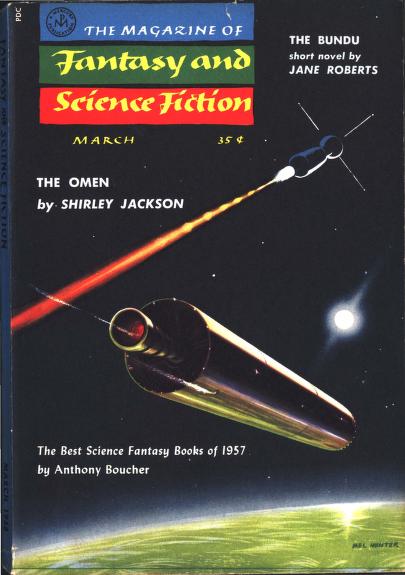
It would be fair, I think, to call Jackson a horror writer first and foremost; certainly her horror writing is what made her legacy. She did sometimes not write horror, as is the case with today’s story, “The Omen,” one of Jackson’s few appearances in F&SF—indeed one of maybe a handful of appearances she made in the genre outlets. No doubt F&SF‘s dignified appearance, fast-and-loose philosophy with genre boundaries, plus (I suspect) some charm on Anthony Boucher’s part, had some role in wrangling a thoroughly slick author like Jackson. “The Omen” is pretty obscure, especially for Jackson, and admittedly it’s not a hidden masterpiece by any stretch of the imagination; but it does show another side to Jackson, albeit with some of the venom we come to expect with her.
Placing Coordinates
First published in the March 1958 issue of The Magazine of Fantasy and Science Fiction, which is on the Archive. It was then reprinted in The Best from Fantasy and Science Fiction, Eighth Series (ed. Anthony Boucher) and the Jackson collection Just an Ordinary Day, a volume of stories which hitherto had either gone unpublished or uncollected in a previous Jackson collection. It’s possible there’s a reprint that ISFDB doesn’t register, since Jackson is sometimes considered a non-genre author, but I find it believable that “The Omen” has only been reprinted twice.
Enhancing Image
Granny is nice old woman in her eighties, who gets along with her daughter, son-in-law, and grandkids—and on the day of the story she also gets hit with an unexpected but very welcome bit of money. She gets an envelope, inside of which is a check for $13.74, “with a covering letter saying that the sender had owed it to Granny’s husband for nearly fifty years, and so was paying it now to his widow, with interest.” Now, in today’s economy $13.74 is piss, but circa 1957 it would’ve been a good deal of money, especially for an old lady. You could do quite a bit with $13.74. She makes a list of things to get her family members, including a perfume brand named Carnation and a stuffed blue cat—only problem being it takes her all of five minutes to lose the list. Anyway, Granny is not the main character, but a much younger woman named Edith, who is in a long-term relationship with some guy named Jerry but who is hesitant to marry him—not because of Jerry, but Edith’s abusive and domineering (redundant) mother.
The omen of the story’s title is Edith making a mistake and finding Granny’s shopping list instead of taking her own bag. Being destitute and a little supersticious, Edith takes the shopping list to be a sort of guide that’ll help her return home, and even maybe help her make up her mind on the Jerry situation. Let’s talk about genre, and about F&SF‘s policy in the ’50s, especially after J. Francis McComas stepped down. Usually fiction printed in F&SF would be SF, fantasy, or a hybrid, but on occasion Boucher would buy a story that can’t really be called SFF, yet is also maybe too strange to have seen print in the slick outlets. Jackson’s first original story in F&SF, “One Ordinary Day, with Peanuts,” doesn’t have any discernable fantastic elements, and indeed ISFDB classifies it as non-genre; yet it might’ve been too hard to classify (it isn’t horror, and yet there’s something vaguely sinister in its twist) for higher paying markets. “The Omen” arguably is not fantasy at all, depending on how you interpret the list. Is this a case of something like magical realism, or is it a bunch of coincidences? Are the omens good or bad, and does it matter on a cosmic scale?
I personally am counting “The Omen” as fantasy because I have to I think Jackson’s implying that some cosmic force is pointing Edith in the right direction, even though she can’t be sure of it. She can’t know the context for the “Carnation” on the list, instead taking it to mean finding a literal carnation flower, and so she happens to meet a man on the street with one carnation on his breast who’s on his way to getting married. The soon-to-be-married man is also taking part in a contest involving a certain woman and $100 in groceries, which Edith gets wrapped up in. A comedy of mistaken identity ensues. I think the man with the carnation is a seed planeted in Edith’s mind that will later influence her to be more assertice in her relationship with Jerry, but I might be overthinking it. Jackson could at times be a writer of shocking subtlety, although I don’t think “The Omen” is an example of such; it seems to be Jackson taking herself and her world (New York) less seriously. Edith’s journey is a sort of spoof odyssey wherein Our Heroine™ is someone of modest means and probably average intelligence who maybe tricks herself into thinking she’s stumbled into a fantastical situation. Your mileage may vary.
Reading this, I couldn’t help but think about Jackson’s life, the circumstances of her writing, and a kind of unexpected but perfectly logical contemporary comparison: Flannery O’Connor. The two were in some ways very different: O’Connor was a diehard Catholic while I struggle to believe the woman who wrote We Have Always Lived in the Castle believed in an all-loving deity. But they were also pessimists with a biting sense of humor and an equally biting sense of justice, and even though Jackson often wrote horror at a time when the genre was pulp-adjacent, I do think she was at least almost as morally serious as O’Connor. (Sadly they also both died young.) This is why I’m not sure what to make of “The Omen,” which depicts a downtrodden woman who is, quite possibly, on the cusp of liberating herself from one abuser to falling into the hands of another. The few times we hear from Jerry are not flattering. It could also be that I’m projecting Jackson’s own deeply unhappy marriage onto a character of hers, but I can’t help but get the impression that Edith, while on the surface being presented with a way out with Jerry, may be stuck between a rock and a hard place.
There Be Spoilers Here
Edith soon finds a cafe, Kitty’s Lunch, where the owner herself had, “with odd humor, chosen to adorn the window of Kitty’s Lunch with a large painted blue cat.” The cafe also happens to have a payphone Edith can use, and she just happens to have enough money for a cup of coffee and a phone call. And don’t feel too bad for Granny, who you may recall lost her list and subsequently forgot everything she was supposed to get. But everything works out. I could be wrong, though, but the ending feels phony to me, which I know is an odd way of putting it. I don’t think Jackson believes in her own happy ending. Granny, at the very end, even calls the outcome of events “sentimental,” which is a word that I can’t imagine Jackson would use without puking in her own mouth a tiny bit; Jackson doesn’t do sentimentality. Is this impression of fakeness intentional or just a failure at being sincere? It’s a question Jackson’s not keen on answering.
A Step Farther Out
“The Omen” is a lesser known Jackson story, because of its relatively lighthearted tone but also I don’t think it shows Jackson at her best. We know Shirley Jackson could be a really vicious and subversive writer for her time, but “The Omen” reads as the eternal pessimist indulging in sentimentality. You could even argue it’s non-genre and that not only should it have not been printed in F&SF but that I shouldn’t have covered it for this genre blog of mine, but I’ll be generous and work off the assumption that the hints of supernatural intervention should be taken at face value. It’s a curiosity that shows Jackson’s range, but it’s not something I’d recommend unless you’re a Jackson completionist.
Theodore Sturgeon was, for one or two spans of time, arguably the best American SFF writer in the business. It can be hard to judge Sturgeon’s career as a whole since he had periods of inactivity, and health problems seemed to prevent him from writing much in the last decade or so of his life; but when he was on the ball, he was on it. Unlike most authors in the pulp days, who tended to specialize in SF or fantasy, Sturgeon was great at both, and sometimes his fiction can be hard to categorize. Sadly he never broke into the mainstream like Ray Bradbury, despite some brushes with notoriety, such as his involvement with Star Trek. (His second episode for the original series, “Amok Time,” is one of my favorites.) He is the one who coined Sturgeon’s Law, although it was originally called Sturgeon’s Rule: 90% of science fiction is crud, but then 90% of everything is crud. This rule, however, does not apply to Sturgeon’s own work. He was, for my money, one of the best short story writers of the 20th century.
The ’50s can be thought of as Sturgeon’s heyday, and 1953 especially might’ve shown Sturgeon at the very peak of his powers. We saw his novel More Than Human, often considered his best (though I think the last third is comparatively weak) and which won the International Fantasy Award; and there were such iconic short stories such as “A Saucer of Loneliness” and “The World Well Lost.” “The Silken-Swift” is not as well-known as those stories, likely because it’s fantasy (which has always had an uphill battle when it comes to short fiction) and a more demanding read. It’s totally possible to read “The Silken-Swift” casually and not understand what’s happening at first. This is Sturgeon’s writing at its most controlled and layered, and unsurprisingly he would later regard it as one of his personal favorites. He wrote it as basically a fairy tale for adults, and it was such a success that it’s still one of the best of its kind. This is a Sturgeon who has reached full maturity as both a person and artist.
Placing Coordinates
First published in the November 1953 issue of The Magazine of Fantasy and Science Fiction, which is on the Archive. In A Saucer of Loneliness, Paul Williams says this story’s magazine publication happened simultaneously with its inclusion in the Sturgeon collection E Pluribus Unicorn, although ISFDB doesn’t give a publication month for the latter. However, the introduction in F&SF says it precedes the collection by a month, with “The Silken-Swift” being a teaser for E Pluribus Unicorn. Where else has it appeared? Unicorns! (ed. Jack Dann and Gardner Dozois), The Fantasy Hall of Fame (ed. Robert Silverberg), Masterpieces of Fantasy and Enchantment (ed. David G. Hartwell and Kathryn Cramer), and The Oxford Book of Fantasy Stories (ed. Tom Shippey), to name a few.
Enhancing Image
The story incorporates a poem not written by Sturgeon, titled “Unicorn.” It was written by Christine Hamilton and seemed to have been unpublished prior to “The Silken-Swift.” Now who is Christine Hamilton, you may ask? I assumed maybe she was one of Sturgeon’s wives or mistresses, but she was actually Sturgeon’s mother, and she was herself a writer, albeit mostly unpublished. It’s cute that Sturgeon would incorporate his mom’s poetry into a story that is ultimately about womanhood—not that Sturgeon considered himself a feminist, as far as I can tell, but he did sometimes write about women’s struggles under patriarchy. He didn’t write about systemic injustice so much as things like hypocrisy and arbitrary restrictions on how women “ought” to live their lives. He seemed to think highly of “The Silken-Swift” among his own works because its theme was (and sadly will probably always be) prescient. I don’t think it’s a coincidence that out of Sturgeon’s heyday, this story might’ve aged the most gracefully.
So, the plot. I won’t get too deep into it, since it’s a dense narrative and there seems to be some confusion (from reactions I’ve seen) as to what actually happens in “The Silken-Swift.” I also had a concussion a few days ago and am still recovering from that, so sadly I won’t be writing about this as much as I would’ve liked. We have three main characters: Rita, a squire’s daughter who lives in a manor; Barbara, a vegetable saleswoman who lives near said manor; and Del, a brash man “whose corded, cabled body was golden-skinned, and whose hair flung challenges back to the sun.” Rita and Barbara live in the Bogs, right outside town, with a “pool of purest water” by the manor; be sure to remember this last part. At the beginning, Del is sort of lured to the manor while the squire himself and the servants have gone out, leaving just Rita, who takes Del in—although not to do with him what he expects. The two have a good time at first, but before Del can get to second base, Rita plays a rather cruel trick on him (she apparently has been toying with witchcraft) by blinding him. Her reasoning is that no man shall have her—that she will remain a virgin so that one day she can catch a unicorn; this is taking teasing to extreme levels, you have to admit.
After Rita’s catch-and-release routine with Del, she kicks him, still blinded, out of the manor, and it’s here that we meet our other female protagonist. It’s also here that Sturgeon does something very strange for a work of prose fiction, although it does tie into the poem at the story’s center: he repeats himself, a whole paragraph, literally word-for-word. We’re introduced to Barbara twice. I had this feeling of recurrence when reading, so I had to copy-paste these two introductions just to see if my brain (which had just been rattled, mind you) was fucking with me.
The first time:
Deep in the Bogs, which were brackish, there was a pool of purest water, shaded by willows and wide-wondering aspen, cupped by banks of a moss most marvelously blue. Here grew mandrake, and there were strange pipings in midsummer. No one ever heard them but a quiet girl whose beauty was so very contained that none of it showed. Her name was Barbara.
Then the second time:
Deep in the Bogs, which were brackish, there was a pool of purest water, shaded by willows and wide-wondering aspens, cupped by banks of a moss most marvelously blue. Here grew mandrake, and there were strange pipings in midsummer. No one ever heard them but a quiet girl whose beauty was so very contained that none of it showed. Her name was Barbara.
This tactic might not work for some people, and it might seem like padding (this is not exactly a long story in the first place), but it fits with what Sturgeon is going for, which is a sort of narrative prose poem. Sturgeon can at times try too hard with his style, but this might be the single best use of poetry (actual poetry on top of poetic prose) in his writing. The setting is definitely medieval fantasy, but aside from the squire’s manor and the elusive unicorn at the heart of the story this feels detached from any one time frame; it doen’t feel like a stereotypical medieval fantasy setting because there’s basically none of the iconography we’ve come to associate with such a setting. The Bogs are a place that could exist, and the three central characters feel like they could be modeled on real people, despite very much fitting into archetypes appropriate for an allegory. “The Silken-Swift” is ultimately an allegory, if a rather indirect one, with a clear message that floats to the surface despite details of the plot being obscured. Simply put, it’s a story that has not aged, which can’t be said for the vast majority of literature, although fantasy does have a much easier time detaching from the circumstances of its making than science fiction.
As for Barbara’s side of the story, this is where people seem to get confused, and admittedly Sturgeon uses some obtuse language to skirt around a horrific event that, if written today, would probably be described in more visceral terms. Something I realized while reading is that Rita and Barbara are like mirror images of each other, to the point where they could be related. They’re similar enough, or at least sound similar enough, that a blinded Del confuses Barbara for Rita; this will turn out to have very bad consequences for Barbara, since Del, having just been kicked out of the manor and not knowing where he is, is out for revenge. Barbara does her best to care for an injured Del (who, as far as she knows, is just a dude who had something bad happen to him), but Del does something. Is it rape? Probably. It happens so quickly and is so indirectly described that you could miss it on a casual reading, which is one gripe I do have with this story (because nothing is perfect): either out of artfulness, getting around censorship, or likely both, Sturgeon’s language can be a little opaque.
Get this:
Once she cried out.
Once she sobbed.
“Now,” he said, “you’ll catch no unicorns. Get away from me.” He cuffed her.
“You’re mad. You’re sick.” she cried.
“Get away,” he said ominously.
Terrified, she rose. He took the cloak and hurled it after her. It almost toppled her as she ran away, crying silently.
You might not even know something had happened if you’re not reading carefully; but credit where credit’s due, Sturgeon implies a great deal in just a few lines. If Barbara was a virgin before then she apparently isn’t one now. Del does something pretty heinous, but it’s also hard to gauge how in control of his own actions he is, given he’s evidently still under the effects of Rita’s witchcraft and is so delirious that he thinks Barbara is Rita; but also the fact that he wanted to rape Rita in retaliation for the witchcraft is inexcusable. Barbara becomes a victim of Del’s abuse and, more indirectly, of Rita’s treachery; but despite all this she retains her sense of virtue, which is important to remember. Unicorns have often been treated in mythology as embodiments of purity, and indeed associated with purity; in the case of “The Silken-Swift” this purity is assumed to mean one’s virginity. Sturgeon, however, asks a simple question: What really counts as “pure?” Rita thinks herself pure, but she’s also a major bitch; meanwhile Barbara is the victim of sexual assault, yet is no less “pure” for it.
I wanna say the message of the story (because like all allegories it does have a clear message, for all its indirectness of style) is the one way you could date it, but unfortunately the message is evergreen. Women’s “purity” is still obsessed over in practically every major society you can think of, regardless of how authoritarian or libertarian the society’s governing system is, and regardless of the majority religion. Misogyny is always here, and might always be here on a systemic level. Among the many ways trans women are dehumanized is to frame them as sex-hungry monsters who prey on “innocent” cisgender women; and of course there’s no such thing as a “pure” trans person, because if you “violate” gender norms then you have already lost that claim to purity. (Never mind that a truly horrifying number of genderqueer people are victims of sexual assault.) Even some liberal-minded people feel threatened somehow if a women has had “too many” sexual partners in the past—if they aren’t reserved enough for their current partner. Sturgeon says this is all bullshit, and while yes the implication of sexual assault is not kid-friendly, this really is, in its subject matter and complexity, a fairy tale “for grown-ups,” as Sturgeon said of it many years later.
There Be Spoilers Here
I don’t even wanna get into spoilers, honestly.
Read it for yourself.
A Step Farther Out
Earlier in my review I said “The Silken-Swift” has not aged, which is not the same thing as saying a work of literature has aged gracefully. Most literature, indeed most great literature, is firmly rooted in the circumstances under which it was written, whether it be the author’s personal baggage or societal norms of the time and place. This in itself is no disgrace. Dhalgren could’ve only been written in the late ’60s through the post-burnout ’70s. The Crying of Lot 49 could’ve only been written during that short period in the ’60s following John F. Kennedy’s assassination and the Beatles landing in America, but before the Vietnam War escalated. Even fantasy, which tends to be more timeless than other genres, is not always excempt. The Once and Future King was clearly written in reaction to the horrors of the Great War and, later, World War II. But “The Silken-Swift,” in both its conception and its message, is timeless; you can’t put a date or place on it. Sturgeon, despite being most known for his SF, was really more comfortable as a fantasist, and I think this is a prime example of such talent.
(Cover by Chesley Bonestell. F&SF, December 1950.)
Who Goes There?
I like Margaret St. Clair. I think out of the many authors who were filling up the genre SF market in the ’50s she was in the top tier, or at least the next best. But you know how it goes, with women who were prolific short story writers in the ’50s: she got out of it. After 1960 she turned mostly to novel-writing, and not prolifically at that. Not that St. Clair owed readers anything, but it’s a shame that there was sort of a vacuum of good female writers in the field for much of the ’60s. St. Clair was so good that she was two of the best women writing at the time, as she published work under her own name as well as the pseudonym Idris Seabright. The conventional narrative is that St. Clair would submit her pulpier stories under her own name whilst reserving the slicker stuff for Seabright. “The Listening Child” is one such example of a genre story that can be hard to categorize, and was in fact the first published under the Seabright name.
Placing Coordinates
First published in the December 1950 issue of The Magazine of Fantasy and Science Fiction, which is on the Archive. It’s been reprinted three times: in The Best from Fantasy and Science Fiction (ed. Anthony Boucher and J. Francis McComas), in Young Mutants (ed. Isaac Asimov, Martin H. Greenberg, and Charles G. Waugh), and in the collection The Best of Margaret St. Clair. There’s also A Compendium of Margaret St. Clair, but that’s only an e-book so I hesitate to count it. (I don’t like e-books, sorry.)
Enhancing Image
Edwin Hoppler is 63 and wracked with a heart condition that leaves him bedridden for much of the day. He lives in a boardinghouse, with the only people he talks to regularly being the older but much more spritely Mrs. Dean and her grandson Timmy. A case of scarlet fever as an infant left Timmy a deaf mute; he presumably knows ASL but is still learning to read people’s lips. There is something else about Timmy: he seems to be able to sense things that haven’t happened yet That’s So Raven-style. One day a dog gets run over right outide the boardinghouse, but as Hoppler is observing Timmy he notices that the boy seemed to react to the dog getting hit before it happened. “Timmy hadn’t heard the dog’s yelps, the cries, when they occurred. Had he, somehow, heard them ahead of time? It was beyond belief. But it had looked like that.” In a sense the boy was “listening” to things that were about to happen—more specifically bad things, which Hoppler, being understandably worried about his own mortality, considers taking advantage of, hanging out with the boy and whatnot.
Newbery Medal material.
This was, I suppose, back when an old man who is not a relative could be left in the same room with a child for long periods of time and nobody would think it suspicious. Jokes aside, the budding friendship between Hoppler and Timmy is cute, not least because at first Hoppler is disturbed by what he thinks is the boy’s secret power. In a different story, even a St. Clair story in a darker hue, Timmy would be a weird little creep; but here, he is more or less innocent, free of even implied character flaws. Maybe it could be that we’ve seen this archetype way too many times since then, but I felt jaded with the whole “baby Jesus figure” routine. Timmy is not really a character so much as he’s an object of fascination for Hoppler (but not in a creepy way!) and an outlet for him to ponder his own lot in life. The only other “character” is Mrs. Dean, who exists as a foil to Hoppler, being older (or so he believes) but being much more grateful for the life she’s been given. There’s something wrong with Hoppler’s heart, both medically and metaphorically, and this short (I do mean like ten pages) story sees Hoppler’s heart thaw the more he interacts with Timmy. It’s a robust character arc.
Let’s talk disabilities.
There’s a very long history of able-bodied writers having characters with physical disabilities be constantly angsty over said disabilities. (I myself am angsty, but it’s not because of my partial blindness or scoliosis.) Robert Heinlein of all people was actually better about this than most, although he too occasionally indulged in it (I’m looking at you, Waldo). Thing is, both of the main characters in “The Listening Child” have disabilities: one is basically a walking symbol while the other wallows in worry and self-pity. It’s a story about people wounded by circumstance connecting with each other, but it’s also evidently written by someone who—while meaning well—has probably not interacted with disabled persons a great deal. Now, I’m not a sourpuss who can’t enjoy something if it doesn’t align with my own personal understanding of the world. (I mean come on, one of my favorite authors is Yukio Mishima, who has almost nothing in common with me in terms of worldview.) This is more me saying that, even without racism, sexism, or outdated tech, a story can still show its age.
There Be Spoilers Here
Hoppler recover enough from his condition, thanks to medication, that he decides to take Timmy to the beach. (Again this was apparently something you could do in the ’50s and nobody thought it was weird.) Unfortunately, Hoppler suffers an attack and, fumbling for his meds, realizes he had misplaced them. “With desperate incredulity Hoppler remembered that he had meant to move the bottle and hadn’t. It was in his other coat, at home, in the closet.” By all rights this should be the end for Hoppler, but then something pretty strange happens: having sensed before that Hoppler was about to die, Timmy decided to give up his own life, choosing to drown in the ocean if it meant saving the old man. Hoppler sees Timmy gets engulfed by the waves, and as this happens the horrible weight on his chest lightens; he seems to have been cured of his condition, but at the cost of the boy’s life. The ending is a bittersweet one, as the friendship ends tragically but Hoppler is given a new lease on life.
If there was an award for killing fictional children then St. Clair would certainly be in the running.
Now, there is a question that was tumbling through my head as I was reading this story: What genre is it? Because its inclusion in Young Mutants would make you think it’s SF, but while Timmy’s deafness is said to have been from scarlet fever, his precognitive ability lacks an explanation. You could argue losing his sense of hearing as a baby gave Timmy some ESP somehow, but this is grasping at straws; if there’s a connection made, St. Clair does not make it explicit. Timmy’s power to predict the future is treated as magical, and if anything the ending confirms for me that this is a work of fantasy, since Timmy’s ability to heal Hoppler at the cost of his own life implies a supernatural force at work. I would even say the ending makes no sense if taken as SF, but works fine enough as supernatural fantasy. The fact that I had to think what label to even put on this story, though, tells me St. Clair was not thinking actively of labels when she was writing it—that the story itself took much higher priority than what kind of story it would be. This fast-and-loose approach to genre suited F&SF well, especially as the magazine was still forging its own identity.
A Step Farther Out
It’s slick and certainly heartfelt, although I think St. Clair would become more ambitious under the Seabright name quite soon. It does, however, work very convincingly as an early example of what kind of magazine F&SF was trying to be and how it was differentiating itself from its peers. You could show “The Listening Child” to someone without any real genre experience or even interest and they wouldn’t think it unusual. This also shows St. Clair’s willingness to blur genre boundaries and focus on the human angle of a story. I think it’s good, but not great.
Anthony Boucher and J. Francis McComas wanted to start a fantasy magazine in the mid-’40s, but couldn’t get it greenlit until the decade was about to end. They both were perfectly qualified for such an endeavor, at a time when the SFF magazine boom was still a year or two off: Boucher was an accomplished author and book reviewer while McComas had just co-edited what was, at the time, the definitive SF anthology with Adventures in Time and Space. According to Lawrence E. Spivak’s (F&SF‘s initial publisher) introduction in the inaugural issue, The Magazine of Fantasy would try to encompass the whole breadth of fantasy, “from the thrilling to the chilling, from the comic to the cosmic,” providing a safe haven for what must’ve at the time seemed like the endangered species that was short fantasy fiction. Unlike Weird Tales, which leaned towards horror, and Unknown, which leaned towards the comedic, The Magazine of Fantasy would take a jack-of-all-trades approach with what material was accepted.
Of course, It would only stay “just” a fantasy magazine for the first issue. From the Winter-Spring 1950 issue onward it would be the magazine we now know and love, incorporating SF and fantasy of almost every flavor. But just because the editors caved and hopped on the SF bandwagon doesn’t mean F&SF was any less unique than before; on the contrary, it remained the only SFF magazine of its kind in the ’50s, and even today it stands out as arguably the most progressive outlet in the field thanks to the efforts of current editor Sheree Renée Thomas. Indeed for most of its life F&SF has had a left-leaning mindset, with Boucher and McComas making it clear from day one that they would go out of their way to encourage women who were trying to make it in what was up to that point a thoroughly male-dominated market. When it came time for picking what stories by which authors I should cover this month, it would’ve been easy to have an entirely all-women lineup, given contributors to F&SF in the Boucher/McComas years: Zenna Henderson, Rosel George Brown, Miriam Allen deFord, Mildred Clingerman, Judith Merril, and the list keeps going.
F&SF turns 75 this year; it is the second oldest SFF magazine still active, only behind Analog Science Fiction. Whereas Analog intentionally appeals to an older and more hard-nosed sect of genre readership, however, F&SF is remarkable for its ability to change its colors chameleon-like with the times, and even being ahead of its time on occasion. It would be a fool’s errand to cover fiction from the whole span of F&SF‘s existence, so I decided to devote March, July, and October to the ’50s, ’60s, and ’70s respectively. As such, for this month, we’re looking at a small sample of what was published during the Boucher/McComas years, then during Boucher’s solo tenure, and finally the beginning of a short but very fruitful period with Robert P. Mills’s editorship. Something that really made F&SF stand above its contemporaries was its sense of dignity, being a digest with artsy and at times abstract covers that managed to snag authors from outside the genre SFF market. You have Shirley Jackson, who was definitely a genre author but who very rarely went outside the “slick” markets; and you have Robert Graves, who was totally outside the field but who would appear (with reprints) a few times in F&SF. I think I’ve said enough now; let’s get to it.
For the short stories:
“The Listening Child” by Margaret St. Clair. From the December 1950 issue. I covered St. Clair not long ago, although if I’m being honest I was in the midst of a horrible time in my life (long story), and thus I think she deserves another go now that I’m (for the moment) in a healthier state of mind. “The Listening Child” was the first published under St. Clair’s “Idris Seabright” pseudonym.
“The Shout” by Robert Graves. From the April 1952 issue. First published in 1929. The early years of F&SF were defined in part by its reprints, so I felt obligated to pick one. It helps that I had read I, Claudius and Claudius the God recently and loved them. “The Shout” sees Graves going for supernatural horror, published the same year as his star-making memoir Good-Bye to All That.
“The Silken-Swift” by Theodore Sturgeon. From the November 1953 issue. Sturgeon is one of my favorite writers; in terms of the short story I think he rivals Hemingway and Cheever. Nobody in the field at the time had a bigger heart, and impressively he hopped between SF, fantasy, and horror. “The Silken-Swift” is from Sturgeon during his peak era, and is also said to be one of his own favorites.
“Mousetrap” by Andre Norton. From the June 1954 issue. Readers of a certain age will tell you they got into SF by reading Heinlein’s juveniles, Norton’s, or both. Norton is one of the most prolific writers in the field’s history, with her Witch World series alone taking up a whole shelf or two. Strange thing is she wrote relatively little short fiction, and even less of it appeared in the magazines.
“Free Dirt” by Charles Beaumont. From the May 1955 issue. Beaumont was one of the best horror and fantasy writers of the ’50s and early ’60s, and would’ve kept at it had he not died of a horrific brain disease at 38. He was the third most prolific writer on The Twilight Zone, behind Richard Matheson and, of course, Rod Serling. He also had a movie review column in F&SF around this time.
“Steel” by Richard Matheson. From the May 1956 issue. Speaking of which, Matheson is a personal favorite of mine, and unlike Beaumont he did live (indeed a very long time) to see some degree of mainstream recognition. He’ll always be most famous for I Am Legend, but I’ll always think of him first as a short story writer and screenwriter. “Steel” was itself turned into a Twilight Zone episode.
“MS. Found in a Chinese Fortune Cookie” by C. M. Kornbluth. From the July 1957 issue. Like Beaumont, Kornbluth died way too young, but he also got a lot of work done in the short time he had. He’s most known for The Space Merchants, written with Frederik Pohl, but for my money he was a better short story writer than novelist. This was one of the last stories of his published in his lifetime.
“The Omen” by Shirley Jackson. From the March 1958 issue. Jackson is one of those authors who needs no introduction. She’s one of the most famous American horror writers, and one of the few prior to the ’70s to find success with horror novels more specifically. Sadly she didn’t live to take advantage of the ’70s horror boom. “The Omen” is pretty obscure for Jackson, likely because it’s not horror.
“Day at the Beach” by Carol Emshwiller. From the August 1959 issue. Wife of artist and filmmaker Ed Emshwiller, Carol is just as talented as her husband, proving early on she had a knack for the short story. She started in the ’50s and kept writing until her death in 2019. In a case of creatives in a relationship supporting each other, Ed sometimes did art for Carol’s stories, as is the case here.
I think I struck enough of a balance between SF and fantasy with this roster. It’s very tempting to focus only on the SF part of F&SF, but fantasy of various flavors (except sword-and-sorcery, which Boucher and McComas were weirdly deaf to) has always played a part in the magazine, especially in those early years. Short stories, as opposed to novellas and serials, defined F&SF at the outset, so it also happens to make sense we’re reading nothing but short stories this month.
The fact that Dark Souls became a meme a hot minute ago has probably done much to undermine the fact that it’s one of the most important video games to come out of the 2010s. You wouldn’t know this just from looking at sales numbers, but there’s a reason why Elden Ring (the latest in the “franchise,” which is really more a coalition of games developed by FromSoftware with shared elements of a certain design philosophy) is one of the highet selling games of all time. There’s also a reason why the Soulsborne (a portmanteau of Dark Souls and Bloodborne) games have such a devoted (at times rabid and frankly annoying) fanbase. I’m gonna make some people feel very old when I say that when Dark Souls came out thirteen years ago it came to a lot of people as a revelation; it came as such a tidal wave that it forever changed how people understand action RPGs, or even what it means to make a genuinely challenging game in an age where big-budget gaming has become increasingly homogenized and “safe.” When it came time to write listicles and thinkpieces about the most important games of the 2010s, Dark Souls was obligated to be part of the conversation.
There’s just one problem: Demon’s Souls already did (albeit with rougher edges) most of what made Dark Souls special.
I remember when Demon’s Souls came out in the US (published here by Atlus, which is very weird to see in a Soulsborne game), and I remember this because I had just gotten my PS3 (I think for Christmas) and Demon’s Souls was one of those games that consistently made best-of-the-year lists, especially for PS3 exclusives. Demon’s Souls came out in Japan in February 2009 and in North America that October; so yeah, it’s fifteen years old now, and I’m sure some people are really feeling their age at this moment. Of course when I played Demon’s Souls for the first time many years ago I couldn’t get into it. I couldn’t even get past the first level, although of course now I can get through both the tutorial and that first level dying maybe once or not at all. One of the things that caught people’s attention with this game at the time was that it was much harder than the average RPG, although in hindsight it’s the shortest and arguably easiest of the Soulsborne games. (I wanna take a second to differentiate Soulsborne from Souls-like, the former being Souls-like games developed by FromSoftware and Souls-like at large being a subspecies of action RPG.) It’s a game that consistently punishes you for rushing head-first into danger.
The difficulty was such a talking point in contemporary reception that it threatened to overshadow all the other ways Demon’s Souls was unlike any other action RPG at the time, and if I went in-depth with every point on such a list we would be here all day. So I’ll stick to what makes Demon’s Souls such a unique game to me in particular, as someone who has played through it a few times with different builds at this point. First off, what is this game even about? One of many precedents Demon’s Souls set for future entries was a near total lack of plot. A scourge has come over the kingdom of Boletaria, brought on by some eldritch horror, and it’s your job as an adventurer to seal away said horror and save what remains of Boletaria. Interestingly your character gets slightly more backstory than in most future Soulsborne games. In Dark Souls and Bloodborne you’re some random shlub who gets picked to save the day, but in Demon’s Souls we’re told at the outset that you’re some brave warrior who has done your fair share of adventuring. This still falls more in line with traditional Western RPGs, wherein your character is a blank slate (bonus points if you have a case of magical amnesia), as opposed to JRPGs, wherein your character (or characters more often) has a personality, backstory, and even a canonical name.
Despite being Japanese-developed, Demon’s Souls is heavily Western-influenced, in both its aesthetics and game design, although there are some mechanics here that seemingly have no predecessor. Boletaria is very much a medieval setting, albeit one that has been made practically vacant due to the scourge. You have a hub level, the Nexus, in which you can level up, buy and store items, and so on; and in the Nexus you have five “archstones” which take you to different parts of Boletaria: Boletarian Palace, Stonefang Tunnel, the Tower of Latria, the Shrine of Storms, and the Valley of Defilement. Each of these archstones has a few levels plus a few bosses, with you only getting a “checkpoint” once you defeat a boss. Unlike most RPGs, including future Soulsborne games, Demon’s Souls doesn’t have an interconnected world or a continuous dungeon but rather is split into sections that the player can tackle mostly in any order. Once you get past the first level of Boletarian Palace (it’s really the second tutorial level after the first one), there’s nothing stopping you from heading to the Shrine of Storms or the Valley of Defilement next. Other than Boletarian Palace’s first level the other archstones’ first levels are similar in difficulty—which is to say difficult.
Most RPGs give you a party to work with, but Demon’s Souls and its kin have you playing a lone wolf—for the most part. The only other Japanese-developed RPGs I can think of that give you only one character are Vagrant Story (an editorial for another day, to be sure), and of course previous FromSoftware RPGs like King’s Field and Shadow Tower. For Western examples you have the Diablo series (if you’re not in multiplayer) and the Ultima series, especially Ultima Underworld. Incidentally Vagrant Story, Shadow Tower, Diablo, and Ultima Underworld are all dungeon-crawlers; and while Demon’s Souls is not a dungeon-crawler, it does take some notes from that kind of action RPG whilst adding a few twists. For one, combat is totally in real time, with the player working with melee weapons, ranged weapons (which I’ve never really used), and offensive magic spells. You also have miracles, which are like spells (if you have high magic then you go for magic, and if you have high faith then you get miracles), but they serve much more of a supporting role. New Soulsborne fans will be surprised by shields actually being quite useful in this game; you could dodge your way out of every attack, if your equip load is light enough, but using a shield to block attacks is perfectly valid here.
Let me tell you a little bit about my most recent playthrough, which sadly I started but could not finish by the time I had to write this editorial. If you wanna know a little bit about how I tend to play RPGs then this will be a useful guide. When playing an RPG, especially Western, I often go for a strength build on my first playthrough, trying to keep combat as close to pure melee as I can. You can tell how well-balanced a game is by how it treats strength builds. You have quite a few classes in Demon’s Souls and a few of them have pretty good strength stats; mind you that magic in this game is kinda broken, so if you wanna play on “easy mode” then I suggest Magician or Royalty. For this playthrough I went with Temple Knight, which has very good strength, endurance, dexterity, and faith, but has low intelligence and an even worse magic stat. Clearly we’re not gonna be casting spells, but we are gonna wanna level up that intelligence since spells and miracles both hinge on that stat. The temple knight is one of the slowest but sturdiest classes, and because you have high endurance you can attack multiple times consecutively. Barbarian has the highest starting strength stat, but Knight and Temple Knight are not far behind.
I named my temple knight Bubbus.
(From Demon’s Souls, 2009.)
Something ingenious Demon’s Souls does at the outset is it makes the tutorial optional, but it also rewards the player for going through it if they can defeat the boss at the end. Defeating Vanguard (the tutorial boss) is very much possible but a first-time player is highly unlikely to do it, in which case you die and get sent to the Nexus (you die regardless, either to Vanguard or Dragon God if you beat the former); but if you beat Vanguard then you get some very good loot that’ll help you in the early game. This is a reward for experienced players. Once you’ve done that, you go to the first level of Boletarian Palace, which is like a more in-depth and much more challenging tutorial. It’s also here that you can farm health items if you’re good enough, which is maybe not to the game’s advantage. Demon’s Souls is short, in that an experienced player can get through it in ten hours or so, but it’s also very exploitable. You have a health item, called grass, and you can stockpile this shit pretty quickly depending on how good you are. There’s also a stupidly broken accessory, the Thief’s Ring, that you can get in that first level pretty easily. And there’s the Cling Ring, which if you will never take off if you’re playing the PS3 version, because…
While Demon’s Souls is relatively easy in the ball-busting world of Souls-likes, it does do some dickish things to the player that even later installments would backpedal on. See, when you die at the end of the tutorial and go to the Nexus, you lose your human body. When you lose your human body you go into soul form, and in soul form you have half your health removed, getting back your human form when you beat bosses. So you wanna get back your human form as fast as possible, right? Not necessarily. Something super-dickish this game in particular has is World Tendency, which on the PS3 version (whose servers shut down years ago) makes the game almost unplayable. Each archstone is subject to this arcane thing called World Tendency, in which the difficulty of a given level can go up or down depending on the color of that archstone’s world tendency. Every time you die as a human, that archstone’s world tendency darkens, and as it darkens enemies will get tougher, and if it gets dark enough the level will spawn black phantoms on top of the normal enemies. You really don’t wanna deal with those black phantoms. In soul form your deaths do no affect World Tendency, so you’re incentivized to stay in soul form with your health cut in half. The Cling Ring brings up your health cap from half to about two thirds, so it’s a big help if you’re in soul form.
In the old days, when the servers were up, you would invade other people’s worlds in order to balance out your own World Tendency, on top of beating bosses; but since the servers are down, if you’re playing the original you’ll have to kill yourself in the Nexus to get into soul form as soon as possible. It’s weird. And about that multiplayer. You can only experience this by playing the remake now, but Demon’s Souls had a truly unique multiplayer that had never been done before and which would become a Soulsborne staple. You don’t play with other players directly, for the most part, but you do get to leave messages in the world and in turn can read messages other players have left behind. You can also read players’ bloodstains to see how they died, which can be useful in situations where there might be a trap or an ambush waiting for you. As for direct confrontations, you can invade other players’ worlds or summon them to your own. You can summon a player if you need help with a boss fight or you can invade to fight another player, primarily to balance World Tendency. Of course you yourself can be summoned or invaded. This was a big fucking deal in 2009, and it helped make a game as desolate as this one seem less lonely.
Said loneliness does have its own charm, though. What keeps bringing me back to Demon’s Souls, despite it not being my favorite Soulsborne game (that would be Bloodborne), is its atmosphere and immersion. “Atmosphere” and “immersion” are tired go-to words when people write about video games, but they’re useful words and sadly we have few options for substitutes. Let’s say, in more dude-ish language, that Demon’s Souls has some immaculate vibes. The archstones are different in their enemy variety and level design, but they also run the gamut from classic medieval fantasy to borderline Lovecraftian horror. My personal favorite, in terms of atmosphere, is the Tower of Latria, in which the game takes on a deeply creepy aura: the Tower is a prison, set many stories aboveground, and when you do get down to the surface it’s a swamp with some of the weirdest-looking enemies in the game. That the game has basically no music outside of the intro and boss fights means the sounds you hear are all diegetic. What seals the deal is that each archstone’s world feels like a real place: Boletarian Palace has you breaking into a castle from the front, and it’s designed such that it feels less game-y and more like a real medieval castle with pathways and defensive measures that make sense. While each archstone’s progression is linear, there’s not too much railroading, and the detours you can make are also practical.
Demon’s Souls, despite being horror-tinged at points, is as close to a straight heroic fantasy adventure as the Soulsbourne series gets; it helps that it has a relatively happy ending for the series. (There is a second, “bad” ending, but you probably wouldn’t even think it’s an option on a blind playthrough, as you have to go out of your way to get it.) You might be the Chosen Undead in Dark Souls or the Tarnished in Elden Ring (the latter, as far as I can tell, being the most heroic in the series since Demon’s Souls), but in Demon’s Souls you play a certified badass who ultimately wants to do good. There’s a bit of moral ambivalence in there (namely with Maiden Astraea, one of the bosses), but the player’s goal is unambiguously good—exemplified by the Maiden in Black, who levels you up, is a total sweetheart, and whom I totally do not have a crush on. You get to save the day, and because this game can be hard as balls for the uninitiated you will feel you’ve earned your keep. But it’s also lonely at the top. There’s a quiet desolation here that none of the other Soulsborne games quite capture, and even the 2020 remake fails to replicate the original’s vibes. If you have a PS3 (my readers are at least in their thirties so I don’t know if you fellas even game much), get a copy of the original Demon’s Souls and see what I’m talking about.
(Cover by Vidmer. Beyond Fantasy Fiction, July 1954.)
Who Goes There?
We don’t know a lot about Evelyn E. Smith (not to be confused with Edward E. Smith), which unfortunately is not unusual for women in pre-New Wave SF, and incidentally she had mostly stepped away from the field by the time the New Wave and second-wave feminism kicked in. Her story is very much like what you’ve come to expect with female SFF authors in the ’50s: she would mostly give up short fiction to focus on novels. Hey, that’s where the money is! It’s a shame, because this is my first story of hers and I’m already looking forward to more stuff of hers. “The Agony of the Leaves” is very much emblematic of the kind of fantasy H. L. Gold wanted printed in the short-lived Beyond Fantasy Fiction, and I mean that in a good way. This is a fun yarn that doesn’t take itself very seriously.
Placing Coordinates
First published in the July 1954 issue of Beyond Fantasy Fiction. It’s been reprinted a total of one time, in Rediscovery: Science Fiction by Women (1953-1957). The editor isn’t credited, but seeing as I am friends with a few of the people involved, I can make an educated guess on who the culprit is. Also strange to see “The Agony of the Leaves” included here since it’s urban fantasy and not SF.
Enhancing Image
Ernest is a freelance tea master (I guess they had fictional jobs that don’t exist in the ’50s) who has to live with two women fighting over him—both of whom are witches. Mrs. Greenhut (whatever happened to Mr. Greenhut is never disclosed, although Ernest has his theories) and Ms. Levesque are not the most charming or kind-hearted women, but what they lack of decency they make up for in assertiveness. Ms. Levesque has been giving Ernest love potions while Mrs. Greenhut has been giving him love cookies. “[Ms. Levesque]—both of them—were so careless with other people’s property, as well as with other people themselves.” The two women were once friends but now fight as rivals over Ernest. That Ernest is being fought over by two powerful women and is also able to afford rent with his non-job immediately tells us this is a fantasy, never mind the witch part. Then there’s Nadia, an Eastern European woman whom Ernest has the hots for, and this conflict makes him worry and wonder as to what’s to be done about the witches. So we have what you might call a love square at the heart of it, with Ernest trying to get it with Nadia while also trying to make her understand that two witches are tormenting him.
Getting the obvious out of the way, I’m not sure if Smith would’ve read Fritz Leiber’s Conjure Wife when she wrote this story. Sure, the magazine version of Conjure Wife would’ve been a decade old at this point, but I have no clue if Smith would’ve read the issue of Unknown it appeared it, and then there’s the fact that Leiber’s novel didn’t see book publication until right before Smith would’ve presumably written her story. A recurring criticism of Leiber’s novel is that it operates on the (admittedly absurd) notion that women are witches; not that witches are women (as they tend to be depicted), but that every other woman in the world is secretly a witch. Achievements that men take for their own are actually the workings of their witch wives, which means (of course Leiber didn’t intend this implication) that women are reponsible for holding up patriarchy. It’s a hurdle to get over, if you’re the kind of person who doesn’t like to have fun at all. Smith’s story seems to be in conversation with Leiber’s; after all, all the women with speaking roles in the story are either witches or suspected to be witches. Unlike the protagonist of Conjure Wife, who makes the uncomfortable discovery that his wife is a witch, Ernest starts out as knowledgable about witchcraft and wants desperately to return to normalcy—whatever that is.
(By the way, the title is a reference to tea-making, “the unfolding of the leaves when boiling water’s poured on them.” Ernest is apparently eager to tell everyone about his tea-making knowledge, and there are even hints that he’s the 1950s equivalent of a weeaboo. Of course it’s also a pun, given how much Ernest suffers here.)
So there are two driving questions: How do we get rid of these witches? And is Nadia a witch herself? When Ernesst and takes Nadia out to dinner, the witches try to ruin the date, and they try pretty hard; but for some reason their magic tricks have no effect on Nadia, who either doessn’t notice or mistakes Ernest’s blubberings for some psychological thing. Nadia herself is a funny character: she talks in butchered English and is weirdly preoccupied with psychoanalysis. Everything that happens to Ernest (according to Nadia) can be explained by either mania or hallucinations. Nadia isn’t even sure these women exist, despite them living in the same apartment building as Ernest. Is Nadia gaslighting Ernest or is she genuinely clueless? It gets to the point where even Mrs. Greenhut and Ms. Levesque are unsure if Nadia is a witch even more powerful than either of them, which leads them ultimately to joining forces—if for no other reason than to get Ernest out of the clutches of this foreign lady. “The Agony of the Leaves” is a novelette that moves at a breakneck pace, such that you probably don’t realize we’re already approaching the climax when Ernest takes Nadia out on that date. Smith has a way with snappy dialogue that makes everything at the very least entertaining.
There Be Spoilers Here
The ending is pretty good. It’s not confirmed if Nadia is a witch or not but it’s implied she’s a normal-ish person, who just so happens to be way more charming than the witches. Ernest ultimately decides that it doesn’t really matter if Nadia is a witch or not, because he’s under a different kind of spell, if we’re to take Nadia as emblematic of the then-modern woman. It’s subversive because we were led to believe that, given her heritage and her unusual behavior, Nadia is a witch of an even older breed than Greenhut and Levesque. There’s an unspoken rule that Eastern European characters are written as prone to a certain pre-Christian mysticism. The two witches admit, however, that they’ve lost this battle. Smith might be saying something about the superficial nature of a lot of relationships, or she could be having fun with it. This is a pretty cynical ending that could take a legitimately dark turn if it wasn’t the ending to a comedy.
A Step farther Out
On the one hand there’s not too much to say about the story itself, but does there need to be? It’s a frivolous satire, of the kind Gold liked, but it does that job with a fun-loving nature that doesn’t read as phoned-in; rather it seems like Smith genuinely liked to play into Gold’s brand of comedy. I never laughed out loud, but I did chuckle a few times and I was smirking for much of it. You could very easily turn this premise into something unfunny and offensive, and in the hands of a male writer from that period (including, sad to say, Leiber) it could’ve been that. A shame this one had to languish in limbo for over half a century; it’s a fun read.
(Cover by Virgil Finlay. Weird Tales, August 1939.)
Who Goes There?
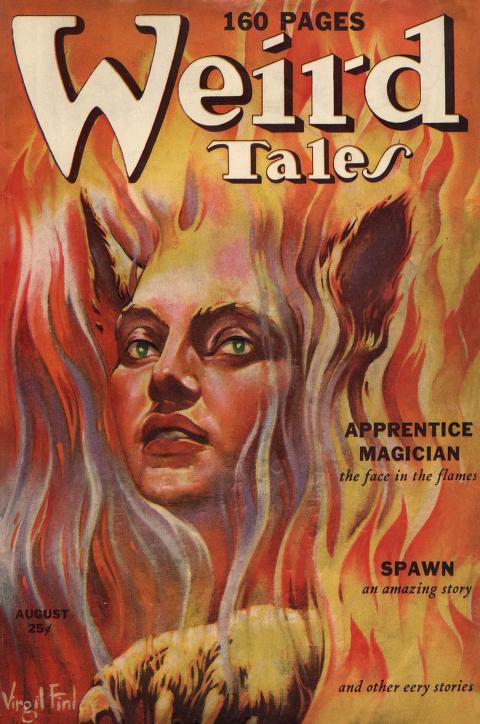
Manly Wade Wellman debuted in 1927, in Weird Tales, and remained a resident there for quite some time, which partly explains how he, who wrote both SF and fantasy, managed to stay relevant after John W. Campbell started reshaping the former genre in his own image. Indeed his reputation as a fantasist only grew over time, and when he eventually settled in North Carolina he would become one of the foremost authors associated with that state. His career is a long-spanning one, and I’m sure we’ll be seeing him again before too long. He won the World Fantasy Award for Lifetime Achievement in 1980. I may have picked “The Valley Was Still” as my first Wellman to review because it was adapted into a classic Twilight Zone episode, retitled “Still Valley.”
Placing Coordinates
First published in the August 1939 issue of Weird Tales, which is on the Archive. Was anthologized in Weird Tales (ed. Peter Haining), The Twilight Zone: The Original Stories (ed. Martin H. Greenberg, Richard Matheson, and Charles G. Waugh), and The American Fantasy Tradition (ed. Brian M. Thomsen). It’s also in the Wellman collection Worse Things Waiting. That last one seems to be in print.
Enhancing Image
I wanna start this review by saying I’ll be discussing the ramifications of the American Civil War a fair bit—maybe even a bit more than the story itself. “The Valley Was Still” is a very fine story, but it’s also a work of neo-Confederate propaganda, albeit one that’s more morally nuanced than the usual. Wellman believed pretty heavily that the Confederacy fought for a just cause, more specifically that the Confederacy fought for “states’ rights.” What rights exactly states should have is something neo-Confederates are always silent about giving. The topic of slavery never comes up in this story, which for anything regarding the Civil War basically renders the given viewpoints incomplete at best. The problem with not mentioning slavery when talking about the Civil War is that the absence of slavery renders the Civil War a conflict seemingly without a root cause. The Civil War, Confederacy sympathizers argue implicitly, is a war that started basically from nothing. Mental gymnastics are obviously at work here.
You may be wondering how I, as a proud Union man, can like this story if I think the implied worldview it’s presenting is wrong on a basic level. The answer is simple: I have the media literacy of at least a 5th grader, as opposed to the 3rd grade where too many people are stuck at. You can like a work of art whilst disagreeing with its worldview. This is really easy to understand, but many people somehow miss the point. Like I said, “The Valley Was Still” is a very fine story, with maybe more texture in its ideas than Wellman had intended; but then art, even art written to fill pages in a pulp magazine, requires at least a fraction of the artist’s subconscious for its making. I have to say Wellman also does something that at least from a modern perspective is hard to pull off, in that he gives us a protagonist who is a Confederate soldier, a “chivalric idealist” as Wellman tells us, and despite his patriotism for a doomed and deeply immoral system he remains worthy of our sympathy. This is a sign of good writing, by the way. Wellman tells us very early on that Joseph Paradine is this idealistic patriot, because it’s important to establish such a thing before Paradine gets confronted with what would be for him (if not for us dirty Yankees) a tough choice.
Paradine and his scout buddy Dauger are looking out over the town of Channow, a Southern town deep in a valley that Union troops are supposed to be encamped in. There’s one problem: from where Paradine is sitting he can’t find any Yankees. Indeed the town is… a little too quiet. Paradine volunteers to go on ahead by himself, in what would under normal circumstances by almost a suicide mission. He would be guaranteed a POW if the Union boys caught him if not for the fact that he could, at least at a glance, pass for a Union soldier, having stolen several items of apparel as “trophies of war.” On the other hand, if the Union troops are not encamped here, then something more sinister may be going on. Paradine ventures into town and it doesn’t take him long to scout out the place: it’s basically deserted. All the townsfolk had gone. More importantly, he finds dozens of Union troops, all of whom have seem to have dropped dead. “But who could have killed them? Not his comrades, who had not known where the enemy was. Plague, then? But the most withering plague takes hours, at least, and these had plainly fallen all in the same instant.” Only it turns out, after some testing, that they’re not dead, but have somehow been made to take to a deathlike sleep. But what could’ve done this?
I wouldn’t call “The Valley Was Still” a horror story, but it does have a quiet eeriness at its center, and this is helped by Wellman’s style, which I would call a few steps above the standard weird pulp prose of the time. Rod Serling, when he adapted it into a teleplay for The Twilight Zone, must’ve been similarly taken by Wellman’s writing, It’s simple, but controlled and quite affecting. By the way, Serling must’ve read it in what had to be a battled old copy of the 1939 issue of Weird Tales, since “The Valley Was Still” had not yet been reprinted anywhere at that time. Indeed it’s very short (only maybe a dozen book pages) and it presents its message with a neat little bow, which is just the kind of thing Serling liked. However, the message, for how concisely it’s presented, may not be so simple. Things get weirder when Paradine finds there is one other waking person in the town—a very old man named Teague, who had apparently put a spell on the Union boys. Teague is a “witch-man,” from a family line of witches, so he says. The townsfolk of Channow treated him as an outcast, only coming to him for favors, and when the Union boys came in they high-tailed it, leaving Teague seemingly alone to fend for himself—only he’s a one-man army.
Like Paradine, Teague is a patriot. He almost confused Paradine for a Union man and nearly put the sleeping spell on him, but is delighted to find a bright-eyed Confederate willing to do anything for the cause. Well, we’ll see how far that “anything” goes. Before I get to spoilers, I wanna say again that we’re clearly supposed to believe Paradine is fighting on the “right” side of the conflict, even if it’s doomed by history. The plot almost could not exist if not for its pro-Confederacy angle—I say “almost” because Serling, a New Yorker and a flaming liberal, saw that there was something rather touching at the core of what could easily be woe-is-me Gone with the Wind-esque soap-boxing. (Gone with the Wind is a very bad, overlong, melodramatic, and deeply racist novel, none of whose qualities overlap with “The Valley Was Still,” other than a general wistfulness about a certain war neither of the authors were even old enough to have witnessed.) We’re told repeatedly that Paradine believes in honor, that he looks up to Robert E. Lee, that he believes in chivalry. Lee fought to preserve slavery, but he was courageous, and he did believe in such a thing as honor on the battlefield.
The question Wellman then poses is: How low are you willing to sink to fight for what you believe is a just cause? Do the ends justify the means? Should the Confederacy win, even through dishonorable means? Is “honorable” defeat something Paradine will have to accept? These are some juicy questions Wellman asks of us in the span of only a few pages, and it’s here that the story reveals itself as a parable. On the surface it’s a parable about an honorable man who’s fighting for a dishonorable cause, and must chose between cheating for the sake of victory and defeat on his own terms. Consciously Wellman thinks Paradine and Lee are perfectly honorable men, but subconsciously he might’ve been more conflicted; he might’ve been unsure, deep down, if the Confederacy really was a cause worth dying for. This uncertainty stops “The Valley Was Still” from becoming jingoistic garbage, but it also elevates this story about witchcraft from pulp to a perfectly respectable fantasy fable.
There Be Spoilers Here
Teague has a spell book. The whole thing, he claims, is filled with the word of God, but when Paradine sees the book for himself he finds God’s name has been crossed out and replaced with what is highly implied to be the devil’s. We’re told that with the power in this book the Confederacy can win the war, with Paradine as the second greatest man in the South—only behind Teague, of course. Paradine assumes when Teague refers to the greatest he means Robert E. Lee, but Teague clearly thinks highly enough of himself that he believes he can rule the South almost single-handedly. Almost. He needs the help of some fresh meat, some young patriot to help carry out his plan—someone like Paradine. All Paradine needs to do is sign his name in the book, with his own blood, to make an allegiance with the devil, and the South can win this war; if he doesn’t sign, then we’re told the devil doesn’t like being scorned. Now, Paradine is well-read enough to figure out quickly what kind of situation he’s in; he may be an idealist but he’s not an idiot. He knows the price one might have to pay for this deal.
Victory through evil—what would it become in the end? Faust’s story told, and so did the legend of Gilles de Retz, and the play about Macbeth. But there was also the tale of the sorcerer’s apprentice, and of what befell him when he tried to reject the force he had thoughtlessly evoked.
Thus “The Valley Was Still” is a Faustian parable, or a deal-with-the-devil type story. The difference between this and some others of its ilk is that rather than make a deal with the devil, Paradine ponders whether he should do such a thing in the first place. Ultimately he decides that whatever wrath the devil might inflict on him and the South, he figures it’s better to lose (if the South is to lose) honorably than to win dishonorably. Not only does he reject Teague’s deal but he cuts the old man’s head off with his saber before he can finish signing his name. He then takes the book and undoes the sleeping spell, replacing the devil’s name in his recitation with God’s, opting to do the right thing even if it means likely getting taken prisoner. Wellman seems to be telling us that even the most patriotic of Confederates would rather risk losing the war than to commit blasphemy in the name of winning it. I think Wellman is being a little charitable here, but you have to admit his take on the war is about as morally upright as one can be while still being pro-Confederate; indeed the story borders on anti-jingoistic. In the context of the story, the South loses because one man chose to do the right thing, even if it meant the devil conspiring against him.
A Step Farther Out
I shouldn’t have to say this, but you don’t need to be a neo-Confederate or even a Southerner to enjoy this one. Wellman, as expected in the pulp tradition, can phone it in at times, but this is definitely not one of those times. This is a story he clearly wanted to tell; it might’ve been rolling around in his head for years prior to the writing for all we know. It has the controlled style and tight structure, combined with a thematic density, that implies it was a passion project, and I’d be surprised if it was just another bit of hackwork. You could teach this in a course on the art of the short story and people would probably not make a big fuss over it. Certainly it’s a good place to start with if you’re getting into Wellman.
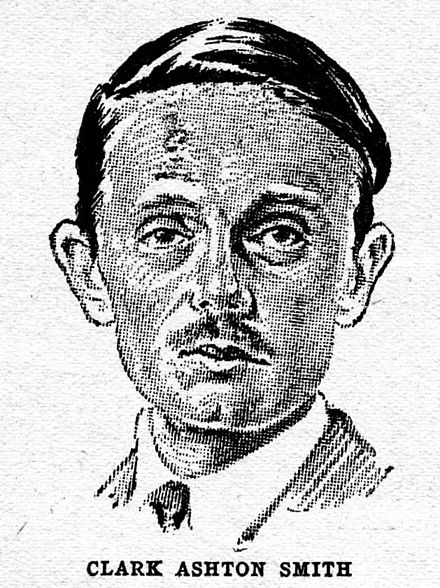
(Clark Ashton Smith, as sketched in the October 1930 issue of Wonder Stories. Artist uncredited.)
It’s the first editorial of the year, and yeah, I know it’s a bit late to be seeing this. Clark Ashton Smith’s birthday is January 13, so a couple days ago. He was born in 1893 in California, and he would more or less live there for the rest of his life. He never ventured too far, and in the ’20s and ’30s he would care for his ailing parents, hence his turning to writing fiction. So the story goes. Smith never gave interviews, and we still don’t have a biography of him, but we do have copious letters he wrote to H. P. Lovecraft, Robert E. Howard, August Derleth, and others. With only one serious rival (whom I’ll get to), Smith was, for my money, the best line-for-line writer to appear in Weird Tales during its 1930s heyday; and he appeared in that magazine A LOT. Despite being formidable in both quality and quantity, though, Smith is somewhat forgotten today unless you’re a weird fiction enthusiast; certainly he lacks the mainstream recognition of Lovecraft and Howard. You’d be hard-pressed to find Clark Ashton Smith studies in academia and you’d be as hard-pressed to find Clark Ashton Smith fanclubs.
How Smith’s reputation failed to pick up a posthumous second wind like what happened with Lovecraft and Howard is a mystery that has a few clues, but after all it might not even be a mystery. Certainly Smith becoming semi-obscure by the time of his death is the same fate that befalls most authors—those, anyway, who garnered any reputation in the first place. It’s the singing quality of his prose and the striking power of his writing that makes this fate seem unjust, though. This dissonance between his deserving recognition and not getting said recognition was solidified by Smith “winning” the Cordwainer Smith Rediscovery Award in 2015, an award reserved for authors whom the folks at Readercon believe to be worthy of recovering from the dust piles of history. Even Lovecraft agrees with me and the Readercon people: he singles out Smith as one living master of weird fiction in his seminal essay “Supernatural Horror in Literature.” It’s funny, because in some ways Lovecraft and Smith were very different, the former zeroing in on a rather niche subgenre of horror while the latter was content to hop across genres if it meant an extra paycheck.
Going back to the beginning, Smith tarted out as a poet; as a teenager he caught the attention of some notable personalities in the local California literary scene, even running into Ambrose Bierce. Smith was an autodidact who accrued an enormous amount of knowledge and even learned a couple extra languages from being a voracious reader. He would read encyclopedias and dictionaries front to back. He read seemingly everything he could get his hands on. Even without a proper education, Smith would come to have a much larger vocabulary than the vast majority of people who read his stories in the pulps, hence his (in)famous prose style. Smith dabbled in short fiction during his early days as a poet, but it was not until the late ’20s that he went full steam ahead on writing short fiction. Smith wrote something like a hundred short stories between 1929 and 1934—enough for a lifetime, compressed into five years. All told, Smith put out more fiction than Lovecraft (who, incidentally, did not write a whole lot during that same period), and he probably matched Howard in productivity for a short time there. He appeared in ten out of twelve issues of Weird Tales in 1934 alone, making him an almost omnipresent force.
Unlike Lovecraft, who turned up his nose at anything he deemed less dignified than Weird Tales (he was apparently cross when August Derleth sold At the Mountains of Madness to Astounding Science Fiction), Smith was not so picky; he would sell to Weird Tales the most, but he also appeared in Wonder Stories, the short-lived Strange Tales, and even Astounding. Of course, given how much he was writing, Smith could not afford to sell to only one outlet. And unlike Lovecraft, who didn’t seem to think of some of his work as science fiction, and Howard, who straight up never wrote science fiction, Smith was fine with playing into the recently founded pulp SF market, hence his appearing in Wonder Stories almost as often as Weird Tales. Smith had created several series, although it would be more accurate to call them settings: Zothique (a far-future wasteland which anticipates Jack Vance’s The Dying Earth), Hyperborea (a prehistoric Earth not dissimilar from Howard’s fantasies), and Averoigne (an alternate medieval France that has been infested with vampires, ghouls, and the like) are the big ones. When not setting his fiction on some fantastically altered Earth, Smith sometimes resorts to picking Mars or some other planet as the venue.
It’s worth mentioning, of course, that while Smith did play to the expectations of pulp readers for the sake of a paycheck, he did not do much to dumb down his language even with his most uncharacteristic work, which must’ve come as a shock to many at the time. The reality is that even many of the “classic” SF stories of the ’30s are semi-literate; they had other redeeming qualities, but you did not go to such fiction expecting to enjoy the prose for its own sake. Those who complain about the lack of literary flashiness in pre-New Wave SF writing would scarely survive a bout with SF as published in the pulps circa 1934. Read a randomly picked Smith story, on the other hand, and you’ll notice two things: you’ll find at least one word you do not recognize, and you’ll probably get swept up in the rhythm of Smith’s style. I’m a highly colloquial writer as opposed to a poetic one, so rather than try to lecture on what makes Smith’s prose different, I’ll simply provide a couple examples. The first is from the most recent story of his I’ve reviewed, “The Door to Saturn.” The wizard Eibon has used a magical door, courtesy of the god Zhothaqquah, to escape a pack of zealots, and upon entering Saturn (Cykranosh) encounters a strange creature:
He turned to see what manner of creature had flung the shadow. This being, he perceived, was not easy to classify, with its ludicrously short legs, its exceedingly elongated arms, and its round, sleepy-looking head that was pendulous from a spherical body, as if it were turning a somnambulistic somersault. But after he had studied it a while and had noted its furriness and somnolent expression, he began to see a vague though inverted likeness to the god Zhothaqquah. And remembering how Zhothaqquah had said that the form assumed by himself on Earth was not altogether that which he had worn in Cykranosh, Eibon now wondered if this entity was not one of Zhothaqquah’s relatives.
The second example is not from a story I’ve reviewed, but one I had read over a year ago which helped make me a Smith fan. This is from “The Dark Eidolon,” one of Smith’s best and most bombastic stories—a real scorcher of a tale, a dark fantasy epic in miniature. The wizard Namirrha, having accrued an unspeakable amount of power in his decades-long quest for revenge, has summoned the literal horses of the apocalypse to decimate the city of Ummaos, reveling in the destruction even as it will likely cost him his own life in the process:
Like a many-turreted storm they came, and it seemed that the world sank gulfward, tilting beneath the weight. Still as a man enchanted into marble, Zotulla stood and beheld the ruining that was wrought on his empire. And closer drew the gigantic stallions, racing with inconceivable speed, and louder was the thundering of their footfalls, that now began to blot the green fields and fruited orchards lying for many miles to the west of Ummaos. And the shadow of the stallions climbed like an evil gloom of eclipse, till it covered Ummaos; and looking up, the emperor saw their eyes halfway between earth and zenith, like baleful suns that glare down from soaring cumuli.
This shit is EPIC.
I wish I had something more sophisticated to say, but Smith’s work at its best conveys a sense of scale and a dark majesty in the span of twenty to forty pages that most novels fail to match up with, let alone other short fantasy stories of the time. Robert E. Howard was unlikely to use “somnolent” and almost certainly never used “somnambulistic,” let alone in combination with “somersault,” achieving the effect Smith pulled here. Lovecraft was also one to pull obscure words out of his ass, but he also never wrote a story featuring (among other things) a revenging sorcerer, an army of giant skeletons, and horses the size of skyscrapers which trample a whole city underfoot; and this is all in the same story! I’m just saying, read “The Dark Eidolon,” it kicks ass. You could say Smith dared to kick ass in a way Lovecraft had no interest in, and which Howard could only match via a different school of writing, that being the propulsion of action writing. Howard thrilled us with tales of musclebound men fighting demons and giant snakes, rescuing damsels and the like, but Smith thrilled us with his use of language. Reading a lumbering Smith paragraph, with its parenthetical asides and protracted sentences chain-linked with semi-colons, peppered with words you might not have ever seen before but whose meaning you can gather from context, can be like reading an incantation in a forbidden spell book. If Howard was a literary swordsman, then Smith was a literary sorcerer.
(Cover by H. W. Wesso. Strange Tales, October 1932.)
There is, of course, at least one writer in Weird Tales in the ’30s who I think matched Smith on almost the same wavelength: C. L. Moore. Being nearly twenty years Smith’s junior, Moore was very young when she hit the scene in 1933, but her first professional story, “Shambleau,” was an immediate success, and in just a couple years Moore garnered a reputation as a sort of prose poet, never mind a writer of immense depth. Moore’s Jirel of Joiry is one of the most memorable old-school sword-and-sorcery characters (she should by all rights be as influential as Conan, but sadly she is not), probably a bigger achievement than any of Smith’s characters individually (although Eibon and Maal Dweb are very fun and dastardly sorcerers), and despite her youth she could at times go toe-to-toe with Smith’s poetic strength. Imagine being a Weird Tales reader circa 1934 and seeing both Moore and Smith’s names in an issue’s table of contents. Both of these writers, for the rather brief time they were direct contemporaries, must surely have expanded the language of many readers, and by extension their minds. Moore is another writer who deserves to be popular with modern readers and for some reason is not; but that is a story for a later date.
Aside from being pessimists with a penchant for penning brooding passages, Smith and Moore were also both more open go writing about sex their most of their contemporaries—I don’t mean sex as a source of titillation, but as it pertains to human psychology. Lovecraft was probably asexual, and so avoided the topic when he could, and Howard, while he did sometimes write about erotic love (never mind his attempts at titillating the reader), was not given to jealousy, forbidden lust, and other psychosexual matters. Moore’s Jirel of Joiry experiences a crisis of conscience when she realizes (after she has killed him out of vengeance) that she is profoundly attracted to the man who had sexually assaulted her. Smith’s characters likewise are at times met with these conflicts between mind and flesh. Jealousy and temptation are especially common. I’ve noticed, after reading enough of his fiction, that Smith was fond of using flowers as symbols for two things at the same time: an ideal and tempting beauty, and a horrific malice which lurks under said beauty. For example, in his story “Vulthoom” (review here), the protagonists are met with an eldritch being in the Martian underground who, seemingly in an effort to tempt Our Heroes™ over to its side, takes on the appearance of an androgynous beauty within a massive flower. Much like Smith himself, who was a notorious womanizer (he only married after his sixtieth birthday), characters in Smith’s writing think about sexual attraction, and this thinking-about-sex plays into their psychologies.
Why did Smith never pierce the mainstream consciousness? There are a few reasons for this. For one, the fact that he never wrote a novel in adulthood (he did write one as a teenager, but it was only published decades after his death and I don’t know anyone who cares to read it), does hurt him, as it would anybody. Unfortunately novels have always sold far more than short stories; you’ll find many stories of SFF writers in the ’50s who take up novel-writing in an effort to make that extra cash. Even Howard, who died so young, wrote a novel with The Hour of the Dragon. Another is that while Lovecraft and Howard were very good at writing a certain type of story, Smith is harder to pin down—that is to say it’s harder to come up with a single “encapsulating” Smith story to hand off to some newcomer. Someone curious about Lovecraft would do well to start with “Dagon” or “The Rats in the Walls,” but an unaccustomed reader might find the sheer awesomness of “The Dark Eidolon” or “The Maze of the Enchanter” off-putting. Even when compared to Lovecraft, who by no means was a slacker in the language complexity department, Smith’s prose is positively purple. The truth is that Smith is at his best when his language is at its most pyrotechnic; an “easy-to-read” Smith story is a relatively boring one. Lastly, Smith was not exactly an innovator, nor did he write extensively on the history of weird fiction; as such he was neither a pioneer nor chronicler of the form.
As you know, Smith’s output slowed to a trickle after 1934; once his parents died he no longer had the financial strain that had pushed him to try writing for a living. He could be coaxed to write a short story now and again thereafter, and strictly from a modern perspective it might seem like he actually wrote a decent amount after 1934. He always remained a poet. Being restless as an artist, he would also take to sculpting and illustrating, although his reputation stands on his prose and poetry. Smith died in 1961, having outlived some of his contemporaries by a good margin, but in the context of weird fiction and American fantasy it’s easy to think he had “died” around the same time as Lovecraft and Howard. Much like how Moore’s story as a writer basically came to an end with the death of her first husband, Henry Kuttner, Smith’s winding-down as a writer of some of the darkest and gnarliest (and at times funniest) fantasy can be said to coincide with Weird Tales‘s subtle decline towards the end of the 1930s. Many writers have tried (and a few have even succeeded) to sound like the next H. P. Lovecraft, but I don’t know anyone who has tried to sound like the next Clark Ashton Smith. Maybe he was a sorcerer without an apprentice.
Happy New Year, ya screwheads. I said last month I would be taking a year off from covering serials, which means the field has very much opened up for tackling short fiction. The schedule I keep has changed in a sense, except not really; the only difference is that the spots that would normally be held for serial installments are now for short stories. So we’re looking at six or seven short stories a month, which if you ask me is for the best. There are so many short stories across the long history of the biz that I couldn’t stay content with only three or four a month. Think about how much ground there is to cover. Thus we have two novellas and seven short stories for this month, with as many authors being pulled.
There is one other thing I wanna mention, since it will be affecting what I cover for this year. As you know, The Magazine of Fantasy and Science Fiction is celebrating its 75th anniversary; it had premiered way back in 1949, and was initially called The Magazine of Fantasy. F&SF is such a prestigious outlet, with such a long history and with so much good material gathered in its pages over the decades, that a year-long tribute is in order. The question I then had tumbling around in my head was: How do I go about this? The solution I came to was twofold: first, as with last year, I’ll be covering all short stories in March, July, and October, only this time it will be all fiction from F&SF‘s pages; and the second is that outside of those months I’ll be covering two pieces (a short story and novella, or two of either) from F&SF each month. For example, you may notice we have two novellas from F&SF for January, which I think is a fine idea.
How March, July, and October will work is that I’ll be covering the first thirty years of F&SF across these months, so one decade for each. I’ll be grabbing stories from the ’50s, ’60s, and ’70s respectively, with the ’70s—falling on October—leaning more towards spooky stuff. F&SF‘s history is so rich that I won’t be able to give an adequate impression of its contents across 75 years, even with the methods I’ve created.
Lastly, in more solemn news, I’ll be reviewing works this month by some notable authors who sadly passed away recently. Michael F. Flynn died in September last year; Michael Bishop died in November; and David Drake died only last month. I’ve tackled Drake before, but while I wasn’t exactly a fan of “Time Safari” I did say I was curious to read more of his work. These are writers who are well-respected in the community and whom sadly I had read very little of when they were alive. If we’re to do right by the dead then we can’t afford to forget them.
For the novellas:
“Project Nursemaid” by Judith Merril. From the October 1955 issue of The Magazine of Fantasy and Science Fiction. She became known as an important critic and editor, but she started out as a member of the Futurians. Her story “That Only a Mother” is probably one of the most frequently reprinted classic SF stories, to the point that it’s now a little overexposed. I have to admit that aside from being force-fed “That Only a Mother” across multiple anthologies I’ve not read any of Merril’s other fiction, but I’m about to correct that!
“The Samurai and the Willows” by Michael Bishop. From the February 1976 issue of The Magazine of Fantasy and Science Fiction. Placed first in that year’s Locus poll for Best Novella. Speaking of writers I’ve been meaning to read more of, Bishop’s been on my radar for a minute now, but prior to his death I had only read a couple of his short stories. As with some other works of his, Bishop would revise “The Samurai and the Willows” extensively many years after the fact, but we’re reading it as it had originally appeared in F&SF.
For the short stories:
“Inertia” by Nancy Kress. From the January 1990 issue of Analog Science Fiction. I’ve covered Kress before, and while it’s always tempting to go for one of her novellas (given her fondness for that mode), I opted for something different—both in length and where the story was published. Kress has been a regular at Asimov’s for years, but “Inertia” is a rare appearance from her in Analog.
“Wall of Crystal, Eye of Night” by Algis Budrys. From the December 1961 issue of Galaxy Science Fiction. In some ways diametrically opposed to Judith Merril as a critic, and with as vicious an intellect, Budrys started as one of ’50s SF’s most promising writers. After a decade of heated activity he would turn away from fiction for the most part to focus on criticism and editing.
“Apartness” by Vernor Vinge. From the June 1965 issue of New Worlds. Vinge is one of the most important living SF writers, although sadly he retired from writing fiction about a decade ago. Despite being in some ways a prototypical Analog-type writer, Vinge made his debut in the Moorcock-run New Worlds with this story here. He would’ve been all of 19 years old when he wrote “Apartness.”
“House of Dreams” by Michael F. Flynn. From the October-November 1997 issue of Asimov’s Science Fiction. Theodore Sturgeon Memorial Award winner. I actually live one town over from Flynn, but sadly we never got to meet. “House of Dreams” is a rare case of Flynn appearing outside of Analog, and despite the Sturgeon win it has apparently never been reprinted in English, which is weird.
“The Valley Was Still” by Manly Wade Wellman. From the August 1939 issue of Weird Tales. Wellman started out during the Gernsback years, and was one of the few SFF authors of that era to maintain his street cred after Campbell took over Astounding—if only because he was more of a fantasy writer. I picked this one for the nerdy reason that it became the basis for a Twilight Zone episode.
“The Automatic Rifleman” by David Drake. From the Fall 1980 issue of Destinies. (Yes I’m still counting Destinies and its ilk as magazines.) David Drake was one of the codifying writers of military SF, but his range was a lot wider than that, having also written sword-and-sorcery fantasy and horror, on top of work that’s not so easy to classify. The following story seems to be an exercise in terror.
“The Agony of the Leaves” by Evelyn E. Smith. From the July 1954 issue of Beyond Fantasy Fiction. I only discovered this one as part of a very recent SF anthology edited by a certain colleague, and I’m pretty sure it’s not SF. As with too many female SFF writers in the ’50s, Smith moved away from the short fiction market once new avenues opened up; after 1960 she mostly stuck to novels.