
Happy New Year, ya screwheads. I said last month I would be taking a year off from covering serials, which means the field has very much opened up for tackling short fiction. The schedule I keep has changed in a sense, except not really; the only difference is that the spots that would normally be held for serial installments are now for short stories. So we’re looking at six or seven short stories a month, which if you ask me is for the best. There are so many short stories across the long history of the biz that I couldn’t stay content with only three or four a month. Think about how much ground there is to cover. Thus we have two novellas and seven short stories for this month, with as many authors being pulled.
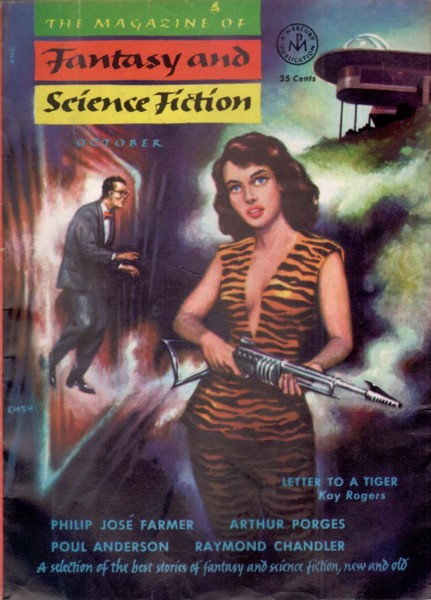
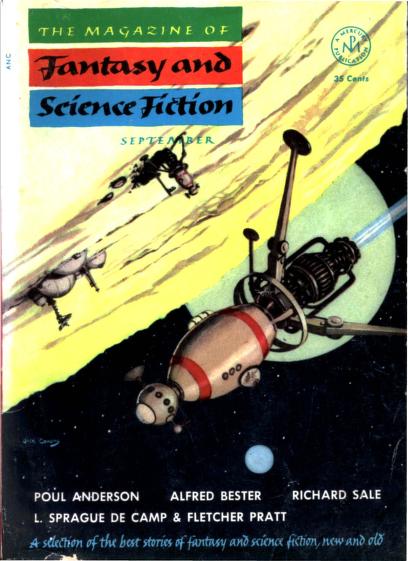
There is one other thing I wanna mention, since it will be affecting what I cover for this year. As you know, The Magazine of Fantasy and Science Fiction is celebrating its 75th anniversary; it had premiered way back in 1949, and was initially called The Magazine of Fantasy. F&SF is such a prestigious outlet, with such a long history and with so much good material gathered in its pages over the decades, that a year-long tribute is in order. The question I then had tumbling around in my head was: How do I go about this? The solution I came to was twofold: first, as with last year, I’ll be covering all short stories in March, July, and October, only this time it will be all fiction from F&SF‘s pages; and the second is that outside of those months I’ll be covering two pieces (a short story and novella, or two of either) from F&SF each month. For example, you may notice we have two novellas from F&SF for January, which I think is a fine idea.
How March, July, and October will work is that I’ll be covering the first thirty years of F&SF across these months, so one decade for each. I’ll be grabbing stories from the ’50s, ’60s, and ’70s respectively, with the ’70s—falling on October—leaning more towards spooky stuff. F&SF‘s history is so rich that I won’t be able to give an adequate impression of its contents across 75 years, even with the methods I’ve created.
Lastly, in more solemn news, I’ll be reviewing works this month by some notable authors who sadly passed away recently. Michael F. Flynn died in September last year; Michael Bishop died in November; and David Drake died only last month. I’ve tackled Drake before, but while I wasn’t exactly a fan of “Time Safari” I did say I was curious to read more of his work. These are writers who are well-respected in the community and whom sadly I had read very little of when they were alive. If we’re to do right by the dead then we can’t afford to forget them.
For the novellas:
- “Project Nursemaid” by Judith Merril. From the October 1955 issue of The Magazine of Fantasy and Science Fiction. She became known as an important critic and editor, but she started out as a member of the Futurians. Her story “That Only a Mother” is probably one of the most frequently reprinted classic SF stories, to the point that it’s now a little overexposed. I have to admit that aside from being force-fed “That Only a Mother” across multiple anthologies I’ve not read any of Merril’s other fiction, but I’m about to correct that!
- “The Samurai and the Willows” by Michael Bishop. From the February 1976 issue of The Magazine of Fantasy and Science Fiction. Placed first in that year’s Locus poll for Best Novella. Speaking of writers I’ve been meaning to read more of, Bishop’s been on my radar for a minute now, but prior to his death I had only read a couple of his short stories. As with some other works of his, Bishop would revise “The Samurai and the Willows” extensively many years after the fact, but we’re reading it as it had originally appeared in F&SF.
For the short stories:
- “Inertia” by Nancy Kress. From the January 1990 issue of Analog Science Fiction. I’ve covered Kress before, and while it’s always tempting to go for one of her novellas (given her fondness for that mode), I opted for something different—both in length and where the story was published. Kress has been a regular at Asimov’s for years, but “Inertia” is a rare appearance from her in Analog.
- “Wall of Crystal, Eye of Night” by Algis Budrys. From the December 1961 issue of Galaxy Science Fiction. In some ways diametrically opposed to Judith Merril as a critic, and with as vicious an intellect, Budrys started as one of ’50s SF’s most promising writers. After a decade of heated activity he would turn away from fiction for the most part to focus on criticism and editing.
- “Apartness” by Vernor Vinge. From the June 1965 issue of New Worlds. Vinge is one of the most important living SF writers, although sadly he retired from writing fiction about a decade ago. Despite being in some ways a prototypical Analog-type writer, Vinge made his debut in the Moorcock-run New Worlds with this story here. He would’ve been all of 19 years old when he wrote “Apartness.”
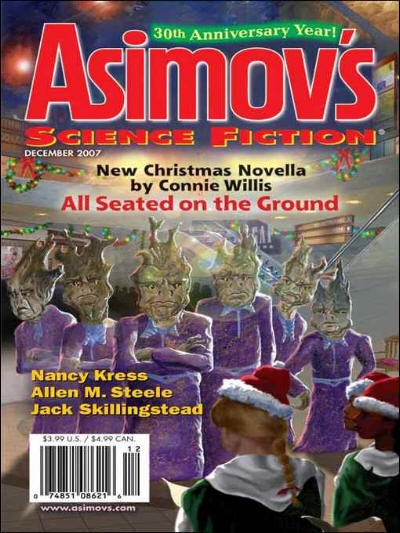
- “House of Dreams” by Michael F. Flynn. From the October-November 1997 issue of Asimov’s Science Fiction. Theodore Sturgeon Memorial Award winner. I actually live one town over from Flynn, but sadly we never got to meet. “House of Dreams” is a rare case of Flynn appearing outside of Analog, and despite the Sturgeon win it has apparently never been reprinted in English, which is weird.
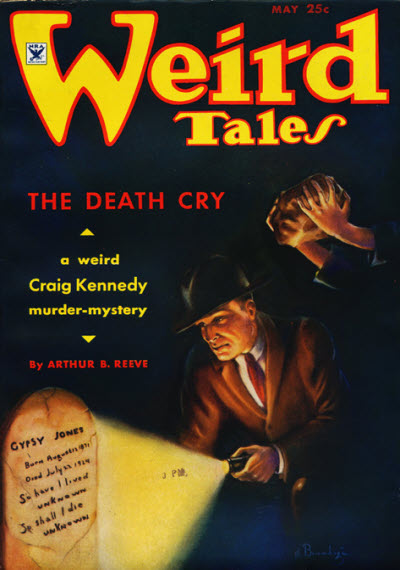
- “The Valley Was Still” by Manly Wade Wellman. From the August 1939 issue of Weird Tales. Wellman started out during the Gernsback years, and was one of the few SFF authors of that era to maintain his street cred after Campbell took over Astounding—if only because he was more of a fantasy writer. I picked this one for the nerdy reason that it became the basis for a Twilight Zone episode.
- “The Automatic Rifleman” by David Drake. From the Fall 1980 issue of Destinies. (Yes I’m still counting Destinies and its ilk as magazines.) David Drake was one of the codifying writers of military SF, but his range was a lot wider than that, having also written sword-and-sorcery fantasy and horror, on top of work that’s not so easy to classify. The following story seems to be an exercise in terror.
- “The Agony of the Leaves” by Evelyn E. Smith. From the July 1954 issue of Beyond Fantasy Fiction. I only discovered this one as part of a very recent SF anthology edited by a certain colleague, and I’m pretty sure it’s not SF. As with too many female SFF writers in the ’50s, Smith moved away from the short fiction market once new avenues opened up; after 1960 she mostly stuck to novels.
And that’s it.
Won’t you read with me?




 Science Fiction & Fantasy Remembrance