A short and sweet review forecast for this month, partly because I’m running behind on my writing a bit and so am pressed for time, but also because I don’t have a particular theme in mind here. Of course, if you thought I was gonna take a break from reviewing spooky fiction altogether after last month, you’d be mistaken, as both of the short stories due for November are horror pieces. We’re still deep in autumn, after all, and honestly my thirst for spooky shit has not been quenched.
Another thing I just randomly decided to throw in there is that both of the serials are novels written in collaboration, by authors who gained a good deal of acclaim and presumably money from working together. In one case there’s decades-long besties Larry Niven and the late Jerry Pournelle, who shared similar politics and also writing philosophies. There’s also the husband-wife duo of Henry Kuttner and C. L. Moore, perennial favorites on this site, who wrote most of their novels together, although for decades Fury has been erroneously credited to just Kuttner.
We’ve got one story from the 1850s (the oldest I will have reviewed thus far), two from the 1940s, two from the 1970s, and one from the 2000s.
For the serials:
Inferno by Larry Niven and Jerry Pournelle. Serialized in Galaxy Science Fiction, August to October 1975. Niven had quickly established himself as one of the major hard SF writers by the end of the ’60s, but Pournelle had a longer road to success, first being active as a fan and then not writing his first stories and articles professionally till he was deep in his thirties. In the ’70s and ’80s Niven and Pournelle wrote several successful novels in collaboration.
Fury by Henry Kuttner and C. L. Moore. Serialized in Astounding Science Fiction, May to July 1947. Kuttner and Moore wrote so much, both together and each solo, that they resorted to a few pseudonyms, one of them being Lawrence O’Donnell. Fury takes place in the same universe as the earlier Kuttner-Moore story “Clash by Night.” Despite Fury historically being credited to Kuttner alone, Moore claimed years later to having been a minor collaborator.
For the novellas:
“Against the Fall of Night” by Arthur C. Clarke. From the November 1948 issue of Startling Stories. Clarke is one of the most famous SF writers ever, to the point that by the ’60s he had become, along with Isaac Asimov and Robert Heinlein, a media personality. He collaborated with Stanley Kubrick on the script for 2001: A Space Odyssey whilst writing the novel version parallel to it.
“The Region Between” by Harlan Ellison. From the March 1970 issue of Galaxy Science Fiction. Ellison is similarly a pretty famous (if more controversial) figure, being just as notorious for his real-life antics and combative nature as for his writing. This novella, one of Ellison’s longest stories, works as a standalone but was commissioned as part of a series which features the same main character.
For the short stories:
“The Old Nurse’s Story” by Elizabeth Gaskell. From the October 1927 issue of Weird Tales. First published in 1852. Now here’s a name you probably didn’t see coming. For someone who gained notoriety as one of the finest novelists of the mid-Victorian period, as well as being Charlotte Brontë’s first major biographer, Gaskell also wrote a fair amount of supernatural fiction.
“I Live with You” by Carol Emshwiller. From the March 2005 issue of The Magazine of Fantasy and Science Fiction. By this point Carol had outlived her late husband, Ed Emshwiller, by over a decade, but she had long since made a name for herself. The last Emshwiller story I wrote about was from the late ’50s, but nearly half a century later we still find her seemingly in her prime.
(Cover by Pete Kuhlhoff. Weird Tales, September 1946.)
Who Goes There?
Born in 1904, Edmond Hamilton was, along with friend and close contemporary Jack Williamson, one of the last of the classic SF pulp writers, and one of the few of that type to survive the raising of standards for SF writing that came about during the World War II years. He tried but failed to strike a business relationship with John W. Campbell, but found Campbell’s criteria to be too exacting and finicky, so he was to appear regularly in just about every genre magazine of the era that Campbell wasn’t editing. In the pre-war years Hamilton was known for his quite literally world-shattering space opera, being one of the pioneers of that subgenre; but whereas E. E. Smith captured readers’ imaginations with his novels, Hamilton stuck to the short story and novella early in his career, and he also deliberately mixed horror elements in with his SF. It shouldn’t be surprising, then, that he had made his debut in Weird Tales, and was maybe the most consistent contributor of “weird-scientific” stories for that magazine. He remained loyal to Weird Tales until it shut down (not for the last time) in 1954. So we have a story today that’s not really horror at all, but rather is SF that could’ve just as well have been published in Startling Stories or Thrilling Wonder Stories at the time. This is also one of those cases where I checked out the story based on the nifty magazine cover it inspired.
Placing Coordinates
First published in the September 1946 issue of Weird Tales. It’s only been reprinted twice, in The Last Man on Earth (ed. Isaac Asimov, Martin H. Greenberg, and Charles G. Waugh) and the Hamilton collection The Best of Edmond Hamilton.
Enhancing Image
As you can guess from the cover, this story involves anthropomorphized animals, or more accurately animals that have been unintentionally uplifted via atom-bomb-induced mutation. Hahl and his comrade S’San, a dog-man and a cat-man respectively, are minding their own business when a star passes over them, passing so close in fact that it crashes in the Crying Stones, an island that is forbidden to the Clans. The Clans are of course communities of different humanoid animals, including dogs, cats, foxes, and even horses. These beast-people are akin to those poor mutilated creatures in The Island of Doctor Moreau; but whereas the beast-folk in that novel are in a state of constant agony, their equivalents in “Day of Judgment” don’t have too bad a life—even barring the nuclear devastation they’ve been born into. Hahl, being a dog, if one that walks on two legs, is curious about this fallen star, going against S’San’s warnings. Naturally the fallen star turns out to be a spaceship that’s landed on the island, home to two humans, a man and a woman. When I reviewed Peter Phillips’s very good (and chilling) “Lost Memory” not long ago I went into some detail about how humankind getting back into contact with one of our robot or animal companions might turn out badly, but this is not so much case with the humans in Hamilton’s story. For one, it’s been long enough since the nuclear holocaust wrecked the world (several dog generations we’re told) that the radiation has long since died down. Also, while the humans are outnumbered, they do have futuristic weapons, whereas the beast-folk have not yet gotten past the stone-and-spear phase. Still, their first meeting is a rough one.
Unfortunately “Day of Judgment” is not very interesting on its own, although it is interesting when taken in the context of a certain strand of SF that proliferated in the years immediately following WWII, that being the tale of nuclear anxiety/depression. I wrote an editorial on this topic some months back, because it’s a topic that informs a great deal of SF published from about 1946 to 1960. There were stories beforehand that speculated on the use of a theoretical nuclear weapon, but following the atomic bombs being dropped on Hiroshima and Nagasaki there came along a new subspecies of SF story, written from an American or at least Allied perspective, about a world in which humanity has disfigured or destroyed itself with atom bombs. There are too many examples to count, but some notable ones include Ray Bradbury’s “There Will Come Soft Rains,” Judith Merrill’s “That Only a Mother,” Theodore Sturgeon’s “Memorial,” A. E. van Vogt’s “Dormant,” and perhaps the ultimate post-nuclear story of the era, Walter M. Miller’s A Canticle for Leibowitz. These are at times melancholy and outright pitch-black stories in tone, and it’s strange to think these are coming from people who were on the winning side. Hamilton himself was a hawk who supported America’s involvement in WWII and later (more regrettably) Vietnam, although he was not the the screaming cold warrior that Robert Heinlein was. Even someone with Hamilton’s politics could see that the proliferation of nuclear weapons would likely be a losing game for everybody. The human couple in “Day of Judgment” have returned from a failed Venus colony, only to find Earth has been bereft of human life for a hot minute now, replaced by intelligent beast-people.
The immediate question is what ought to be done with these humans, as they could well present a threat to the Clans, but the thematic question is whether humanity, in the wake of the nuclear age, deserves a second chance. This is Hamilton, who for how dark he can be at times is not as much a pessimist as his wife (Leigh Brackett), so you can guess.
There Be Spoilers Here
A trial ensues among the clans, with the humans being in a position where they might be executed; of course they won’t be, which is a bit of a shame, since a bleaker ending would’ve elevated this story a bit. I’d like to take a moment to talk about a gripe I have with Trondor, the leader of the horse clan, and his ilk: these fuckers stand on their hind legs, which are hoofed. This simply doesn’t work. Humans are able to walk on two legs because of a lack of a real tail, and more importantly we have feet with flexible toes which are good for keeping ourselves balanced. If someone loses even one toe on one of their feet they find it more difficult to stay balanced when standing, so imagine not having any toes on your feet. I can take cat and dog furries, but I draw the line at horse-people with hooves instead of clawed or fingered toes. Anyway, that was my TED talk.
A Step Farther Out
I would say I’m sorry for the delay, but I didn’t have too much to say about this one and I’m not sure how many cared to hear what I had to say. This is the second time I’ve reviewed Edmond Hamilton and the second time I’ve come away feeling rather indifferent, which sucks because I’ve read enough of his work outside the confines of this site that I know he’s capable of a good deal better. Then again, he wrote a lot, and since he wrote as a way to make a living, he didn’t spend much time on revising his work. He’s a relic from a bygone era, but I don’t mean that in an insulting way.
(Dark Forces. Cover by One Plus One Studio. The Viking Press, 1980.)
Something I don’t typically get to write about here is the topic of original anthologies, which is to say anthologies of short fiction comprised of material never before published. Of course, said fiction could later be reprinted in magazines, as has happened many times, but the implied purpose of an original anthology is fundamentally different from that of its sibling, the reprint anthology. Both involve similar work, with an editor trying to procure stories from authors or authors’ estates, as well as reading dozens upon dozens of stories, most of which end up not being worth printing. There’s the question of how many words/pages can be crammed between two covers. There’s the question of pricing, because an anthology will pretty much always be more expensive than a single magazine issue. Nowadays anthologies and magazines fill respective niches and try not to step on each other’s toes, since it’s no longer a problem of what can be printed in magazines, whereas in the days before Fortnite and even the internet there was the (true, at least up to a point) conventional narrative that editors and publishers of original anthologies were allowed to be more risqué than their magazine counterparts.
When Dangerous Visions hit shelves in 1967, its key appeal (at least for American readers) was that it was jam-packed with stories that could not be published in magazines of the era, on account of being too edgy, experimental, etc. You had a thick book (over 500 pages) from a mainstream publisher (Doubleday) with an all-star cast of authors, all of whom at least claimed to be putting forth their most mind-bending and transgressive material yet. You had such top talents as Philip K. Dick, John Brunner, Samuel R. Delany, Roger Zelazny, and so on, and commissioning this stuff could not have been cheap. The gambit paid off in spades, though. Dangerous Visions sold very well, remains in print to this day (a rarity for an anthology, especially an original one), and it even won a special Hugo. That Harlan Ellison, the editor, never quite recaptured that lightning, is beside the point. Not every story was a winner, but Dangerous Visions was the right book that entered the market at just the right time, serving as a harbinger of the New Wave. Just as importantly, publishers realized that there was some money to be made with original anthologies—maybe not on the same scale as Dangerous Visions, but rather cheap paperbacks of maybe half the size and half the number of stories; and maybe these books wouldn’t try to reinvent the wheel like their inspiration did, but instead took on more humble mission statements. You can have editors who are maybe not as discerning as Ellison was, who would also get the work done in a timelier fashion. It was a matter of quantity over quality.
There a meteor shower, or maybe a oversaturation, of original paperback anthologies from the late ’60s through much of the ’70s, until that particular bubble burst. These were books that often focused on science fiction, rather than fantasy or horror, although there was a trickle-down effect with those other genres. Still, standards had dripped, in large part (although he was not the sole offender) due to Roger Elwood’s extremely prolific tenure as editor for a few different publishers; the number of anthologies he edited between 1972 and 1976 alone is staggering. While he was able to procure work from big names, this work ran a good chance of being mid- to low-tier stuff that would’ve likely stayed on the shelf. A major exception was Epoch, which Elwood co-edited with Robert Silverberg, a lavish and well-received book, placing first in the Locus poll that year; but this is indeed an exception that proves the rule. By the end of the ’70s the market for original anthologies had inevitably gone into decline.
Meanwhile, in the waning days of the original anthology, Kirby McCauley made his living as a New York-based literary agent with some big talent on his hands. By 1980 he had already edited one well-received original horror anthology, with 1976’s Frights, which won the World Fantasy Award for Best Anthology/Collection. Frights was a hardcover original from St. Martin’s Press with a nice wraparound cover, but while McCauley procured stories by some of the top talent in horror at the time, including Ramsey Campbell and Robert Aickman, he found that he wanted to go one step further. The introduction for Dark Forces makes McCauley’s intentions with this bulky new anthology clear. McCauley’s inspiration was twofold, between August Derleth’s work as head of Arkham House and wanting to make a horror-themed counterpart to Dangerous Visions. Arkham House in its prime printed hardcover volumes with exquisite covers, all these being focused on horror, SF, and dark fantasy, from reprints of H. P. Lovecraft’s work to collections of never-before-published fiction by fresh young writers. McCauley grew up on books of horror that Derleth had edited, so in that way he overtly pays tribute to a fallen (Derleth had died in 1971) master of the field. The relationship that Dark Forces has with Dangerous Visions is more complicated, however, as there are a few major differences in how these books’ respective editors went about their businesses.
Consider that when Harlan Ellison edited Dangerous Visions, a process that took about two years, he was coming at it from the perspective of a reasonably successful author, which is to say he was a writer, first and foremost, as opposed to an editor or agent. This lack of experience with editing eventually came back to bite Ellison in the ass, with the shitshow that was the making of Again, Dangerous Visions, and far more infamously with The Last Dangerous Visions; but in the ’60s, it was novel for a writer with practically no editing experience to work with his fellow writers in such a way. Conversely, McCauley had already proven his ability with an original anthology, plus a couple reprint anthologies, and he was enough of a professional that he understood how to work with writers as people, and not just as practitioners of a certain craft. In the introduction he recounts his encouraging relationship with Stephen King while the latter wrote (first as a novelette, then ballooning into a long novella) The Mist. He also recounts having a get-together with Isaac Bashevis Singer in the latter’s apartment (they were both New Yorkers, and thus there had to be some inherent sense of kinship there), just months before Singer won the Nobel Prize for Literature. King and Singer are radically different in just about every way, in work ethic, style, and worldview, the former a flaming-liberal New Englander and the latter a conservative Polish-Jewish immigrant; yet McCauley makes it appear easy to work with both.
You may have noticed also that Singer is not a name that comes up much, if at all, in horror circles, because while a good portion of his fiction involves the supernatural, he’s not a “horror writer.” Thus we have another big difference between Dangerous Visions and Dark Forces, because while Ellison reached out to everyone in the SF field he could get his hands on, McCauley reached outside the field of horror and dark fantasy, the result being that there are authors in Dark Forces who are not primarily horror writers, and there are even a few who are known to be “literary” types. It’s not so unusual today, but back in 1980 it was a novelty for acclaimed novelist (and prolific tweeter) Joyce Carol Oates to appear in a horror anthology. You have some of the usual suspects of horror from that period (King, Campbell, even Robert Bloch late in his career, etc.), but you also have a really left-field choice like Davis Grubb, who was known at the time as author of The Night of the Hunter. You have writers like Edward Bryant and Joe Haldeman who, while they have sometimes written horror, are much more known for writing science fiction. You have a surprise appearance from Ray Bradbury, who by 1980 had long since entered the literary mainstream, and who also didn’t write much of anything at this point in his career. One can have gripes with who made it in and especially who didn’t (there are only two female authors here, Oates and Lisa Tuttle), but I can readily believe McCauley when he says he tried getting stories from everyone.
It’s also worth mentioning that McCauley didn’t construct Dark Forces with the intention of it being a boundary-pusher for the field of horror (he even explicitly says he didn’t want it to be “as revolutionary” as Dangerous Visions), and this ends up being to its benefit. True, there are a few stories here that may have been transgressive for 1980 (I’m thinking of Theodore Sturgeon’s tale of venereal agony, “Vengeance Is.,” and if I had a nickel for every “pregnant man” story in this book, I would have two nickels), but being extra-gross or what have you was not the name of the game. What might be Dark Forces‘s secret weapon and the biggest reason for its having aged pretty well is how its contents cover pretty close to the whole span of short horror literature up to circa 1980. While we don’t have much dark fantasy a la Robert E. Howard’s weird Conan stories, or the “extreme” horror that would start making the rounds in the proceeding years, there’s a great deal of variety in these 500 pages. We have traditional ghost stories such as Singer’s “The Enemy,” a rendering of the Sweeny Todd narrative with Robert Aickman’s “Mark Ingestre: The Customer’s Tale,” a cautionary tale of one unlucky busybody and a nest of vampiric creatures with Campbell’s “The Brood,” some rural “redneck” horror with Grubb and Manly Wade Wellman’s stories, and so on. There are also a couple non-supernatural tales of terror, as with Oates’s “The Bingo Master” (a personal fave of mine) and Bloch’s “The Night Before Christmas.” There are even a couple stories that fall into a certain genre that’s become rare in recent decades, that being the Christian allegory, with Gene Wolfe’s “The Detective of Dreams” and Russell Kirk’s “The Peculiar Demesne.”
And then there’s The Mist.
A story that “gets away” from the author, as it were, can sometimes be a bloated abomination, but in the case of The Mist we have one of King’s best and most tightly wound stories. Indeed King’s bad habits are pretty much absent here, and the fact that he’s able to reconcile ’50s B-movie monster action with genuine eeriness shows the level of craftmanship he’s capable of when he stops fucking around and focuses on what really matters. While the movie adaptation has a radically different ending (one that many, including King himself, prefer), I do have a soft spot for the novella’s ambiguity and cautious optimism. It was a simple choice for McCauley to put the longest story last, making The Mist the grand finale of Dark Forces, but it’s an example of how sometimes the simplest choice is also the best. Unlike the King collection Skeleton Crew, which sees The Mist as the protracted opening salvo, its position as the closing story of Dark Forces gives one the impression that the whole book had been building up to this moment. It was risky to include such a long story here (it takes up about 1/4 of the book), since if it failed then it would majorly tarnish what is otherwise a good read and leave a sour taste in the reader’s mouth; thankfully The Mist was a success, and has become one of King’s most beloved stories.
Dangerous Visions has, as far as I can tell, never gone out of print, although sadly the same can’t be said for Dark Forces. Anthologies, and especially original anthologies, have a bad tendency to have one or maybe two print runs, then go out of stock until the end of time. The only time Dark Forces has been reprinted this century was a super-expensive limited edition from Lonely Road Books in 2007. Bantam apparently did a paperback printing of Dark Forces in the early ’80s, but otherwise it’s only ever been published in hardcover in the US. It could be that Dangerous Visions was such a monolith at the time of its release, and has gone down as such an important entry in SF history, that its status (despite understandable attempts to knock it down a peg, especially as it continues to show its age more and more) has been more or less secured for the foreseeable future. Dark Forces is arguably a better book and set a better precedent (it served as an inspiration for Clive Barker to get into writing horror, and as we all know, the rest of that is history), but it also now reads, with hindsight, as one of the last big gasps for short fiction as a significant player in the realm of horror. Starting in the ’70s, both novels and movies started taking larger slices out of the pie in terms of what “mattered” for innovation and trends in horror, a field that historically largely hinged on the short story and novella. There would be major practicioners of the short horror story (see Barker, also Thomas Ligotti) to come after 1980, but Dark Forces celebrated (again, with hindsight) the short story as a form with authors who are, by and large, happiest and at their best when writing short stories and novellas.
Some authors see their reputations wither after death, and indeed this is more often than not the case; but there are also authors who have the good fortune to receive a second wind posthumously. Octavia E. Butler was a pretty well-respected writer in her lifetime, but in the years since her untimely death in 2006 she has become one of the select few from the old school to be both widely read and respected among the modern SF readership. This is despite Butler not having written a great deal over the course of her life, going from fairly productive in the ’70s and ’80s to only writing two novels in the ’90s, and then finally just one in the 2000s. She also only wrote little more than half a dozen short stories, just enough to fill a single collection, Bloodchild and Other Stories, which is also padded out with an afterword for each story and a few essays. While Butler wrote very little short fiction, though, she won back-to-back Hugos for it, with “Bloodchild” itself winning her that second Hugo, plus a Nebula. “Bloodchild” is one of the most acclaimed and famous (or infamous) of all “modern” SF stories, being Cronenberg-esque body horror while also being surprisingly melancholy. It is Butler’s “pregnant man” story.
Placing Coordinates
First published in the June 1984 issue of Asimov’s Science Fiction. It’s been reprinted in The Year’s Best Science Fiction, Second Annual Collection (ed. Gardner Dozois), Best Science Fiction of the Year 14 (ed. Terry Carr), The New Hugo Winners (ed. Isaac Asimov and Martin H. Greenberg), Foundations of Fear (ed. David G. Hartwell), The Weird: A Compendium of Strange and Dark Stories (ed. Ann and Jeff VanderMeer), The Big Book of Science Fiction (ed. Ann and Jeff VanderMeer), and of course the Butler collection Bloodchild and Other Stories. Really it’s hard to not have at least one copy of this story on hand if you’re a serious SF reader.
Enhancing Image
I said before that “Bloodchild” is a “pregnant man” story (there were more of those being written back then than you would think), but it’s also a coming-of-age story, about Gan, our narrator, recalling a moment in his life that made him cross the shadow-line from adolescence to adulthood. This is a story about the loss of one’s innocence, which means it’s also about trauma. Gan and the rest of his family are Terran settlers who have come to a planet already host to at least one intelligent race, and now they’re stuck on “the Preserve,” with T’Gatoi, an elder of said intelligent race, being their local symapthizer. The Tlic, a somewhat mammalian but also insectoid (they have more than two arms and lay eggs) race, are the ones in control here. Historically, on Earth, there’s a nasty tendency for the colonizing force to overwhelm and then assimilate the indigenous populace, but this is not always so; in her afterword, Butler explains that she modeled the relations between the Terrans and Tlic off British colonialism in India. The humans here are thoroughly outnumbered and outmatched by their alien hosts, and unlike their real-world counterparts it seems like the Tlic can easily kill or drive out the settlers any day if they wanted to. The two parties thus have reached an agreement wherein the settlers are allowed a swath of land while also serving a specific use for the aliens.
The Tlic are some of the more interesting aliens in SF, in that they meet John W. Campbell’s criteria for an intelligent alien that could think as well as a human but not quite like a human. They’re big, at least as big as adult humans, and live considerably longer, with the nutrients from sterile eggs apparently contributing to slowed aging. They also have no issue with slavery, since they buy and sell Terrans, and back in the day they even split up Terran families for this purpose. (Does this remind you of anything?) They and the Terrans are biologically compatible enough that the latter can serve as hosts for Tlic eggs, which… more on that in a second. In her afterword Butler writes that she had taken inspiration for the Tlic when she was doing research for what eventually became her Xenogenesis trilogy. She looked into the workings of the botfly, which as you might know already is a bug found in the Amazon that lays its eggs in living hosts. The larvae, once ready, break out of the host’s skin, which for humans is a gross but by no means fatal business—unless there’s an infection. The Tlic similarly lay their eggs in living hosts, except it’s much worse here, since whatever has the misfortune of carrying Tlic eggs will die in gory fashion when those eggs hatch. The one gripe I have with how Butler conceived her aliens is that while they’re based on the botfly, it’s not a 1:1 comparison, and there are a few unanswered questions. The botfly is an insect, only yay big, and only lives for a few days, while the Tlic are the size of humans, and live for several decades at a time as opposed to days. How such a species would survive without completely ravaging the ecosystem, I’m not sure.
(Of course, given that humans have been ravaging Earth’s ecosystems for decades, it’s possible that our own species will not survive in the long run, or that much of life on Earth will die before us.)
In a sense the Tlic reflect a certain type of human endeavor, while the human settlers are put in the place of put-upon immigrants or enslaved peoples. Butler looks at the minority of whites living in British India, or indeed South Africa, and wonders what would happen if the tables were turned and the white minority were to be subject to the “colonized” populace’s whims. This is oversimplifying things a great deal, but it does make you wonder how it is that Dutch and British whites could make up not even 10% of South Africa’s population, yet to this day own the vast majority of the land there. Typically a minority demographic is beholden to the whims and prejudices of the majority, hence, despite some progress being made, nearly 30% of the population in the US being beholden to the 72% that’s white. So Gan, despite being part of a colonizing force, is not the one in control. In fact he is next in line in his family for carrying a nice batch of eggs, which makes today’s “delivery” quite the learning experience. Bram Lomas, an adult man, has been made pregnant with Tlic eggs, and the operation to get them out of him before they can kill him is most unpleasant. The delivery, which takes up the middle portion of “Bloodchild,” is undoubtedly the most memorable part, being pretty graphic but also serving a purpose in Gan’s character arc. I’m not gonna quote a whole passage from this section of the story, because I don’t hate you that much, but it’s a lot. It’s also worth mentioning that while a more conventional story might have the delivery as the big climax, Butler makes it so that it’s over and done with by the time we’re in the last third. After all, the delivery is not the point of the whole thing, but rather how the experience sparks an epiphany for Gan.
There Be Spoilers Here
The way this works is that delivering larvae for a human might be fatal if there’s a surrogate willing to take the fall. Doesn’t necessarily have to be a live body to receive the larvae. T’Gatoi gives Gan the thankless job of having to go out and kill one of the livestock, one that must be of suitable size, although he’s never done such a thing before and taking a knife to one of the “achti” (some native animal) would be risky. He opts to take a different kind of risk and gets out the gun that’s been hidden in the family home. Guns were outlawed among the settlers decades ago, but as with real-world countries with strict gun laws, one occasionally does find itself inside. After killing the achti and witnessing the finale of the delivery, Gan is understandably shaken by the whole thing, especially since he’s due to go through the same ordeal himself in the future. The final scene is a confrontation between Gan and T’Gatoi in which the former threatens to kill himself, in order to force his sister to be the one in the family to “give birth.” Ultimately he changes his mind and decides to take up the responsibility, but we’re not sure if his pregnancy has already happened by the time he’s relating this story to us or if it’s still off in the future. It’s a rather abrupt ending, which I’m not sure is exactly a negative criticism, but it kinda took me off-guard to have suddenly reached the end on this rereading. This is a setting you could certainly build a whole novel out of, but Butler is content to keep is contained within a single short story.
A Step Farther Out
Sometimes when I read something for this site, I groan with the realization that I won’t have much to write about, usually when it’s something that’s middle-of-the-road. (Unfortunately there is a lot of middle-of-the-road fiction in the SFF magazines, probably way more even than straight-up bad fiction.) On the one hand, “Bloodchild” is a reread for me, but my memory of it was pretty dim; at the same time I knew going in that there would be quite a bit to talk about, but then this is often the case with Butler. It’s not a personal favorite of mine, because it is, by design, a pretty unpleasant read, but it’s a very well-constructed story. I wish Butler wrote more short fiction, but I’m also not surprised that she didn’t.
I don’t have much to say on today’s author, partly because I’ve not read anything by him until now and partly because there’s not much I can dig up on him. Peter Phillips was an English SF writer, at a time when there weren’t too many of those, and for about a decade he took up writing SF as a side gig, from 1948 to 1958. If he wrote any other fiction, ISFDB makes no mention of it. He also apparently never wrote a novel, which goes some way to explaining his obscurity, since authors who only do short stories (unless you’re Ted Chiang) get kneecapped in the market. There also has never been a collection of Phillips’s short fiction, even though he wrote little enough of it that you could fit it all snuggly into one volume. He quietly stopped writing SF at the end of the ’50s, incidentally when the magazine market was shrinking almost to the point of imploding. He died in 2012. I don’t even know what he looks like. It’s a shame because “Lost Memory,” my first from him, is very good. It’s the kind of hard-knuckled SF with a disturbing tinge of horror that I really like.
Placing Coordinates
First published in the May 1952 issue of Galaxy Science Fiction. There’s no Phillips collection, but it’s been anthologized a fair number of times, including Gateway to Tomorrow (ed. John Carnell), Second Galaxy Reader of Science Fiction (ed. H. L. Gold), Science Fiction Terror Tales (ed. Groff Conklin), The Great SF Stories #14 (ed. Isaac Asimov and Martin H. Greenberg), In Space No One Can Hear You Scream (ed. Hank Davis), and We, Robots (ed. Simon Ings).
Enhancing Image
The action takes place on a planet which is hostile to organic life, it seems, although not to hostile to, say, mechanical beings. Indeed a race of mechanical life has grown here, or rather has produced and adapted itself for the situation. Palil is a robot, and a robot, so he’s like a robot reporter. There’s a storytelling method that often made the rounds in old-timey SF, and which Phillips uses effectively here, which is the reporter-protagonist-narrator. Such an archetype is common at this point, because it’s useful, although it doesn’t strictly follow the rules of “good” storytelling. Palil is the narrator, which means he’s our eyes and ears for how this society of robots operates, and his profession makes him doubly good (and convenient) for the task. The robots are presumably all male, since they don’t reproduce sexually (they probably also don’t have any idea of romance) and the characters in-story all refer to each other by male pronouns. Personally I wish Phillips had gone a step further and made the robots genderless, but this is a quibble at most, so I’m happy to live with it. The robots at the museum have encountered a problem in the form of a crashed ship, which to the reader should clearly be understood as an escape pod for some human or humans; but to the robots this is not clear at all. Palil and the others have no concept of human life, and they associate metal (as opposed to flesh) with life that they treat the ship itself as if it were a living thing.
Get this description of the ship:
He was thirty-five feet tall, a gracefully tapering cylinder. Standing at his head, I could find no sign of exterior vision cells, so I assumed he had some kind of vrulling sense. There seemed to be no exterior markings at all, except the long, shallow grooves dented in his skin by scraping to a stop along the hard surface of our planet.
To “vrull” is a sense the robots have which Phillips never explains, and for all we know it’s something unique to them.
The robots have nonsensical names like Chur-chur and Fiff-fiff, which come to think of it sound like sounds for machine parts grinding and whirring, as in the reptition of machinery. The human visitor, for his part, calls himself Entropy, although it’s unclear if that’s the name of the ship or somehow the man’s own name. This ties into the basis of the conflict: the fact that the robots don’t actually know what it is they’re trying to help. There’s a heavy dose of dramatic irony here, as we know perfectly well that Entropy is a human inside the ship, but Palil and the others don’t know what a “mann” is or what it looks like. They don’t even have the word for it in their lexicon. Aside from telling us what senses they have, we also don’t get really any descriptions of what the robots look like, so there’s a good choice they might not look humanoid at all. Howard Muller’s interior art for “Lost Memory” runs with this possibility and depicts what looks like a nightmarish scene, in which a bunch of weirdly designed robots are operating over a ship, as if the ship itself were the patient.
Observe:
(Interior art by Howard Muller.)
While they’re able to establish communications, and both parties just so happen to speak “Inglish,” but this does little to help Entropy, who’s trapped inside his ship and who can barely even comprehend what is on the outside. (By the way, it’s a nice touch on Phillips’s part that Palil spells certain words unconventionally, as if they were either not in the robots’ dictionary or the spelling has simply changed over time. It’s a bit of extra effort that Phillips didn’t need to put in, but he did.) There’s speculation that the robots are the descendants of machines constructed by a fallen human astronaut or crew who had come to this planet many decades ago, that while the human(s) died (perhaps by suicide), their intelligent robots have succeeded them. Society has taken root and ultimately flourished here—only it’s not a human society. Indeed humanity doesn’t seem to have any place here, not because the robots are hostile, but because they’ve completely forgotten what humanity even is, hence the title. This is like a response to many earlier SF stories about man’s relationship with robots, in which the latter have come to either idolize or vilify their creators, but regardless there’s a lasting connection between the two, like a parent with an unruly child; whereas in “Lost Memory,” the connection has long been severed. Robots, at least on this planet, have no need for those who made them.
There Be Spoilers Here
The Fermi paradox is a famous question that’s served as inspiration for many good SF stories, even though it’s relatively recent, not becoming “a thing” until the ’60s. The paradox is basically that there is a high likelihood that Earth is not the only planet even in the Milky Way to contain intelligent life, and yet after all these decades we’ve yet to make contact with said life. The universe seems to be overwhelmingly a cold dead place. The robots of “Lost Memory” are all but confirmed to have been created by man, but they’re still an intelligent race not native to Earth, and the story itself plays out like a first-contact narrative. But, while he has made contact with the descendants of a group of intelligent machines, Entropy doesn’t live long enough to appreciate this at all. The “doctor” who breaks open the ship inadvertently kills Entropy, and even if he hadn’t done so directly, there’s very little chance of the human surviving long afterward anyway. This is a case where the reader can easily anticipate the ending, and yet despite the ending being practically a foregone conclusion, the inevitability of it only raises one’s anxiety as we get closer to the end.
A Step Farther Out
I mentioned Ted Chiang earlier as kind of a joke, but “Lost Memory” does unintentionally read like both a distant precursor and counterpart to Chiang’s “Exhalation.” Both have to do with mechanical life overcoming (or failing to overcome) entropy, but either way a price must be paid. Humans are totally absent in “Exhalation,” but in “Lost Memory” the robots meet a member of the race that created them—much to the human’s detriment. The ending is perhaps predictable, to the point of being inevitable, but this is a rare case where the ending being easily foreseen does nothing to ease mind’s mind at the impending horror of it. Phillips is pretty obscure and didn’t write much, but I’ll be keeping an eye on him.
(Cover by Malcolm Smith. Other Worlds, March 1950.)
Who Goes There?
We’re keeping things short and sweet today, with a rather self-explanatory story by an author who has little need for an introduction. Ray Bradbury is one of those rare people who’s a canonical SF writer as well as having a place in the mainstream American literary canon; and yet this was by no means inevitable for Bradbury, who started out as a fan at the tail end of the ’30s, writing for niche publications. He spent the next few years honing his craft, until he began getting his first really good short fiction published in 1943, with the next decade being very productive. Bradbury advised young writers to try for one short story a week, a rule he himself seemed to abide for a while, since by by the time he was 27 he’d written more than enough short fiction for his first collection, Dark Carnival. Despite being known best for his science fiction, much of Bradbury’s early work has a horror bent to it, enough that he felt the need to update his first collection with a revised table of contents and a new title: The October Country. “Punishment Without Crime” was not printed in one of the famous collections, but it combines SF with horror and crime fiction in a way that encapsulates some of Bradbury’s interests—if also his shortcomings. It’s also the last in a trilogy of stories about Marionettes, Inc., a company that produces lifelike telepathic androids. Weirdly enough these were all published in different magazines, but each one seems to work as a standalone.
Placing Coordinates
First published in the March 1950 issue of Other Worlds Science Fiction. It’s been reprinted in Science Fiction Terror Tales (ed. Groff Conklin) and the Bradbury collections Long After Midnight, The Stories of Ray Bradbury, and Killer, Come Back to Me: The Crime Stories of Ray Bradbury.
Enhancing Image
It’s America in the 2000s, and middle-aged middle-class husbands still have not considered that it might be better to divorce one’s wife on grounds of adultery than to kill her. George Hill, our protagonist, at least apparently doesn’t consider divorce to be an option, since lately he’s been thinking about murdering Katherine, his wife. Katherine (or Katie) is about twenty years George’s junior, while George is about fifty, which might explain why Katie’s been having an affair with Leonard Phelps, who is, if nothing else, closer to her age. “Better men than he had taken young wives only to have them dissolve away in their hands like sugar crystals under water.” But still, George is too mannerly, and maybe too decent, to kill his wife; so instead he’s come to the next best thing, which is Marionettes, Inc. Sure, to have a doll, a simulacrum of Katie, and to “kill” this doll, is in itself illegal, but it beats doing the real thing, at least morally. That much should go without saying. What George doesn’t realize, though, is that confronting a simulacrum of his wife may prove just as deadly to him as if he had tried murdering the real Katie. “The violent unviolence. The death without death. The murder without murdering.” And so there might also be, ironically for George, punishment without crime.
Sorry, I was trying out my Rod Serling voice.
This is very much a Twilight Zone episode in spirit, never mind it was published almost a whole decade before TZ‘s premiere. Bradbury consciously fell in with the O. Henry school of short-story writing, which is to say his stories are often structures as akin to jokes, with a setup and a punchline. The punchline is often a cruel one. A contemporary of Bradbury’s, John Collier, wrote along the same lines, to the point where “Punishment Without Crime” could be taken as Bradbury paying homage to Collier, what with the strange preoccupation with husbands conspiring to murder their wives. Bradbury had very likely read some Collier stories by 1949, so it’s possible. (There’s a misoginistic streak running through some of Bradbury’s work that I don’t see people bring up, really.) Anyway, George gets what he asks for, but he also gets something a bit extra in the bargain, what with the doll, being telepathic and sentient to some degree, practically taunting him. This stretch of the story, in which George must reckon with his conflicting feelings about his wife via the fake Katie, is easily my favorite, even if it also quotes liberally from what I’m pretty sure is the Song of Songs. Then again, having George’s sexual insecurity be not only overt but the focal point of “Punishment Without Crime” would’ve been all but unthinkable for a genre SF story just five years earlier. You could get away with something like this in Weird Tales, but the SF magazines of the ’40s were relatively chaste (incidentally Weird Tales was where Bradbury really cut his teeth). There were also the crime fiction magazines, and more importantly the “slicks” (which Bradbury frequented), but “Punishment Without Crime” might’ve been too pulpy and at the same time SFnal for the latter.
If Bradbury has a drawback, it’s that he seems to know only one woman: his wife. The gender politics here are rather off. The fake Katie is a femme fatale, of sorts, while the real Katie is implied to not be any better. Without giving away anything too specific in this section, the ending paints the real Katie as a ruthless schemer who really can’t be bothered if George lives or dies. Is this some weird future where you’re just not allowed to get divorced? Would it really be easier to kill your spouse than the other option? There will be legal trouble either way. Obviously I’m putting too much thought into it. This is a story that’ll take you maybe twenty minutes to read, and it’s written in that fast-paced breezy style Bradbury often used, the result being that even though I have issues with it, at least it goes down smoothly. If you’re a Bradbury fan then you’ll probably enjoy it.
There Be Spoilers Here
When George finally does “kill” the fake Katie, it works a little too well and is a little too convincing, with the Marionettes, Inc. people having even installed fake blood. Maybe it would be enough for George to just have a screw loose and to slip into psychosis over having wanted to murder his wife, but unfortunately for him his creator is Ray Bradbury. George and other clients of Marionettes, Inc. are promptly arrested afterward on charges of murder, even though nobody had actually been killed. As George’s lawyer explains it, it’s a damn shame that the government’s been cracking down on androids as of late, since had this all happened ten years earlier or even ten years later, he’d probably get off fine. As it is, George is sentenced to death, and while we’re not told how much time passes, it can’t be long before he’s on death row, waiting for the electric chair. He’s surprisingly calm about all this, since he’s had a psychotic break, but in a final ironic twist he sees the real Katie outside his cell one day and slips back into lucidity, having enough time to realize that he’s been massively screwed over by the system. It doesn’t matter. Katie’s off with her young boyfriend. Like I said, Bradbury tended to follow the O. Henry line of storytelling.
A Step Farther Out
For someone who’s read quite a bit of Bradbury over the years, I’ve become a bit more ambivalent towards him as I’ve gotten older. Not that he was ever in my top five SF authors or anything, but there’s something too whimsical and childish (in a bad way) about Bradbury’s writing that also reminds me of the worst of, say, Connie Willis, or Stephen King. Hokey? Saccharine? Whatever you wanna call it. Willfully immature. “Punishment Without Crime” is a curious combination of a few genres, on top of being clearly a moral allegory, but it doesn’t quite take advantage of any of its inspirations. It’s also too short and fast-paced to feel like something I should take seriously. I can believe it’s something Bradbury wrote in a week or less, then shuffled off to what was a second-rate magazine. Nowadays I like Bradbury most when he leans all the way into horror, hence my favorite stories tend to be in The October Country and The Illustrated Man.
Samantha Mills made her debut in 2012, although she didn’t start getting published regularly until 2018. As she says in an interview for (the sadly now-defunct) Fantasy Magazine, which you can read here:
Over the next few years, my attempts at novels improved rapidly, but short stories remained a mystery until 2017. I can’t fully describe what happened, but after a lot of reading it finally clicked, and I produced a few stories that worked, and I finally began submitting again.
By this point Mills had been out of college for about a decade, so if you’re at such-and-such an age and worried it might be too late to try your hand at getting published professionally, it probably isn’t.
I had said in my review forecast at the beginning of the month that Mills had probably written “Rabbit Test” prior to a certain infamous SCOTUS decision getting leaked in May 2022, but this turned out to be wrong. Mills, like any writer, had the idea of the real-life use of female rabbits for human pregnancy tests tumbling around in the back of her mind for years, but it took the catastrophic Dobbs v. Jackson Women’s Health Organization decision for her to think of a story to go with it. She wrote “Rabbit Test” in the summer of 2022 and it quickly got picked up by Uncanny Magazine, who published it just a few months later. Turnarounds for story submissions are usually not this quick, but then “Rabbit Test” is, if nothing else, a deeply timely story, and Mills’s gambit paid off. “Rabbit Test” is only the third story ever to win the Hugo, Nebula, and Theodore Sturgeon Memorial Award, and it placed first in the Locus poll.
I remember when awards season was underway and there was a lot of very good word-of-mouth regarding “Rabbit Test” online, which no doubt contributed to it sweeping. It’s a story that spoke incisively of “the moment” (although “the moment” is now three years behind us) in American politics, that worked to get a reaction out of left-liberal readers, and so it did. But, again, that was three years ago. How does it hold as a story, some time after its own “moment” has passed?
Placing Coordinates
First published in the November-December 2022 issue of Uncanny Magazine, which you can read here. It’s since been reprinted in The Best American Science Fiction and Fantasy 2023 (ed. R. F. Kuang) and Nebula Awards Showcase 58 (ed. Stephen Kotowych).
Enhancing Image
The year is 2091, and Grace, a normal girl about to turn 18, has a big problem in the form of an unwanted pregnancy. She had sex with her maybe-boyfriend before he goes away and now her rabbit test (not a test actually involving a rabbit) has come up positive. This would be bad enough on its own, but the America of 2091 is (at least in some ways) even worse off than today, with women’s menstrual cycles being tracked by an app, courtesy of Rabbit Test LMC. Of course, parents can watch over their underage daughters’ cycles like hawks, and this is all in the aftermath of a nationwide ban on abortion. Grace’s only real hope is to go to her friend Sal to mess with the app, causing a “blackout” long enough for Grace to procure some illicit abortion pills from “one of those old ladies who sells pill packs out of their closets, hoarded up from before the ban.” If she can get this thing taken care of without her Jesus-freak mom finding out then all will be well, more or less. Of course, things don’t go that way.
Grace’s story only takes up about half of “Rabbit Test,” with the other half being a mix of real facts, narratives, and fictionalized vignettes that feed into the greater narrative about reproductive rights. To give Mills credit in a couple ways, she evidently spent much of her time (about a month, by her estimates) on the story by doing research, taking a crash course in the history of abortion, forcing miscarriages, pregnancy tests, and so on. That this is all readable while also being crammed into just over 7,000 words is in itself an achievement, although it’s about one step away from simply copy-pasting passages from actual research papers into your SF short story. What makes this all more impressive is that Mills is taking an intersectional feminist approach, plus a somewhat Marx-inspired understanding of historical forces, to make connections you probably wouldn’t make on your own; indeed these sections, kept away from the Grace narrative, are the closest “Rabbit Test” comes to letting the reader think for themself. We get, in a surprisingly short number of words, a brief history of methods for testing pregnancy, going from mice and rabbits to frogs, of women across different cultures and time periods using at-home methods of testing for pregnancy and (if the desire be there) forcing a miscarriage. It becomes clear that the issue of women’s reproductive rights is one that connects race and class conflict, as well as misogyny, perhaps the oldest of mankind’s evils against itself. This sounds like a lot, because it is.
Meanwhile, Grace comes close to getting what she needs through a trans man named Ambrose (“Women aren’t the only people worried about their uteruses, and Ambrose saw the writing on the wall long before the 2084 ban passed.”), but it’s too late. Sal has ratted her out, apparently being unable to keep her mouth shut, and to say Grace’s mom is unhappy about all this would be an understatement. Grace is gonna have the baby, whether she wants to or not. I would feel more about this if we only barely got to know Grace as a person, and if Amelia, Grace’s mom, wasn’t a caricature of the sort you’d find in Stephen King’s writing.
Get this:
Amelia is marching because she fears being outnumbered. She’s marching because she believes it’s her duty to save babies and place them in homes with good Christian values, because the scientific establishment is out of control, a cabal of demons on Earth locking an entire generation out of salvation.
On the one hand yes, there are people like Amelia in America today—at least several million, going by polls. This doesn’t make her any less of a cartoon character. Then again, nobody is allowed much development or interiority in “Rabbit Test,” since this isn’t that kind of story and goddamnit, we only have 7,000 words and change to get through everything. It’s effective shorthand on Mills’s part for letting us know Grace’s mom is a raving lunatic and that we should be worried about Grace’s safety, but it’s just that. Maybe the biggest message take from all this is that so many people, especially queer people (hey, at least Grace is straight and cis, as far as we know), would be better off if they moved out of their parents’ house as soon as possible. I’m being serious here, as someone whose mental health improved exponentially (putting the bouts of depression I still get aside) once I got a place of my own. Unfortunately, Grace don’t got the means.
When I criticize Mills, just know that a part of me does feel bad, for at least two reasons: the first is that I can respect her rather far-left interpretation of history, as it’s one I more or less agree with. Then again, you might say I’m biased for that reason, and for my part I honestly can’t imagine any “pro-life” person reading “Rabbit Chest” and being convinced by Mills’s argument. The second reason is that if I wanted a story with this message to be more to my liking, I would basically be demanding a different kind of story almost altogether, one that leans much more into a show-don’t-tell approach. This is clearly not what Mills had in mind. So, I can take “Rabbit Test” for what it is or I can sit back and think about a quite different story it could’ve been, one which would’ve met my own specific tastes. Which is more fair? But obviously, even if I were to try to be fair all the way, I don’t see myself ever rereading “Rabbit Test” from start to finish. I consider a great short story to be one that the reader can go back to again and again over a span of years, and I’m not sure if Mills intended “Rabbit Test” to be read more than once. Despite the amount of research and talking points, and admittedly some good lines in there, there’s not much reason to go back to it. That’s not what I think of as being a top-tier story.
There Be Spoilers Here
Grace gives birth to a daughter, named Olivia, and eventually the two move out from under Amelia’s scornful gaze and get an apartment of their own. Despite having been desperate to abort her years earlier, Grace has come to love and care for her daughter, despite the two of them living on meager means. Unfortunately, almost as if like clockwork, disaster strikes again. It’s strongly implied that the teenaged Olivia got drugged and raped at a party, and while history doesn’t repeat itself, it does tend to rhyme. So it goes. The two are able to force a miscarriage, but it comes at a terrible price, as Grace is charged with murder and spends a couple decades in prison—for killing what would’ve been almost indistinguishable from a cat fetus. Finally, the year is 2119, and congress is close to reversing the nationwide abortion ban. We’re told that in the intervening years gay marriage had been banned nationwide, only for that decision to later be reversed. Presumably the same thing will happen with the abortion ban. Hopefully.
The idea is that history works in cycles. Rights that were given at one time can just as easily be taken away in another, and also the other way around. For about half a century we in the US had the nationwide right to abortion, thanks to Roe v. Wade, but now we live in a post-Roe v. Wade world. As Mills says at the end, “it is never over.” Patriarchy and the subjugation of women is such an old human evil that it’s in the Bible, predating capitalism by centuries. Mills ultimately argues that women’s liberation is the omni-cause of human rights, and has been for a long time; but like any good intersectional feminist she knows the fight for women’s liberation ties into capitalism, racism, colonialism, and a few other -isms I’m not mentioning at the moment.
A Step Farther Out
I had read this story a couple days ago, and took some time to sit on it. I feel rather conflicted, because Mills succeeded in writing the kind of story she wanted to write; it’s just that I had wished “Rabbit Test” would be something other than what it is, which I understand is unfair. When I heard all these things about “Rabbit Test” I got the hunch it would be a didactic treatise on abortion rights, and it is indeed that. If anything it’s even more in-your-face than I was expecting. I agree with every point Mills makes here, so I feel like I’m at liberty to say this kind of story-as-treatise method doesn’t work for me. I could be wrong, but I don’t think “Rabbit Test” will be read and enjoyed thirty years from now in the way of, say, Terry Bisson’s “Bears Discover Fire” or even Le Guin’s “The Ones Who Walk Away from Omelas”—the latter also being on the didactic side and seemingly made in a lab to be forced on English students, but still enjoyable. Even Le Guin, when she’s trying to make a point, leaves enough room for the reader to think on it, so that they feel like they’re collaborating with the author.
There’s something about October that brings a change in me. It could be that autumn has now unambiguously started, as opposed to just going by the autumnal equinox. The weather is now colder and dryer. My hands and nose are getting dry, the latter occasionally resulting in a nosebleed. I now feel like I can put on a hoodie and jog around the city. The trees will start being stripped of their leaves. Overall it’s a time of changes, mostly for the better. October is also the month of Halloween, which is far and away my favorite holiday, to the point where it might the only one I really get festive about. Now is the time for watching horror movies, from the classices to some grade-A schlock. Time to catch up on some horror reads I’ve accumulated on my shelf. Time for pumpkin spice lattes, if you’re into that. In other words, this is for me what Christmastime is for some people—mind you that I tend to get depressed around Christmas.
For this month we’re back to reviews at regular intervals, all short stories, all featuring thrills, chills, and assorted horrors. For the first time in a while I’m actually excited with what I’m gonna be writing about. Hopefully you’ll be joining me in reading at least a few of these.
We have one story from the 1940s, three from the ’50s, three from the ’80s, one from the ’90s, and one from the 2020s.
For the short stories:
“The Hungry House” by Robert Bloch. From the April 1951 issue of Imagination. Bloch was correspondents with H. P. Lovecraft when the former was still in high school, and this friendship had an apparent influence on Bloch’s early fiction. While he’s most famous for writing Psycho, which is non-supernatural horror, most of Bloch’s work involves ghouls, cosmic horrors, and whatnot.
“Rabbit Test” by Samantha Mills. From the November-December 2022 issue of Uncanny Magazine. Winner of the Hugo, Nebula, and Theodore Sturgeon Memorial Award, being only the third story ever to win all three. Mills debuted in 2016, with her debut novel published in 2024. “Rabbit Test” was the last of a streak of short stories, as Mills stopped writing short fiction for three years.
“Punishment Without Crime” by Ray Bradbury. From the March 1950 issue of Other Worlds Science Fiction. Being one of the most famous American authors ever, it can be easy to forget that Bradbury started writing for the genre magazines, not all of them being of the first rate. He also wrote so much horror early in his career that only a fraction of it appeared in The October Country.
“Lost Memory” by Peter Phillips. From the May 1952 issue of Galaxy Science Fiction. I had ever heard of Peter Phillips before, which might be because he was only active for a short time, from about 1948 to 1958. He stopped writing SF for reasons I’m not sure of. He was also British, at a time when there weren’t too many active in the field, even appearing in the inaugural issue of New Worlds.
“Yellowjacket Summer” by Robert McCammon. From the October 1986 issue of Twilight Zone Magazine. McCammon made his debut in 1978, but it took him a bit to come to the forefront of contemporary horror fiction. His massive post-apocalyptic novel Swan Song tied for the inaugural Stoker for Best Novel. Disillusionment with the industry made him step away from writing for a decade.
“Bloodchild” by Octavia E. Butler. From the June 1984 issue of Asimov’s Science Fiction. Winner of the Hugo and Nebula for Best Novelette. This is a reread for me, but I’ve been meaning to return to it for a close read for a minute. Butler wrote only maybe a dozen short stories, but they’ve received a disproportinate amount of praise, with her winning Hugos for short fiction twice consecutively.
“Reckoning” by Kathe Koja. From the July 1990 issue of The Magazine of Fantasy and Science Fiction. Koja debuted in the late ’80s with a pretty strong string of short stories before her debut novel, The Cipher, hit stores in 1991. She was a formiddable horror talent in the ’90s, but in the 2000s onward took to writing novels aimed at young readers, and she hasn’t written much generally lately.
“Day of Judgment” by Edmond Hamilton. From the September 1946 issue of Weird Tales. While he’s most known as a pioneer of space opera, as well as his Captain Future series, Hamilton appeared frequently in Weird Tales from the beginning of his career, sometimes with SF but also sometimes with fantasy and horror. He was an old-school pulp writer in that he wrote for basically any market.
“The Pear-Shaped Man” by George R. R. Martin. From the October 1987 issue of Omni. Winner of the Stoker for Best Long Fiction. Martin is a case where a series (A Song of Ice and Fire) of his is so famous that it overshadows the rest of his work, which mind you is considerable. Martin’s gone on record as thinking of himself as instincively a horror writer, a fact which is on display here.
We have pretty much an all-star cast of authors here, so I hope this will help my recent writing slump. Of course, the most important thing is that we have fun with this. Happy Halloween.
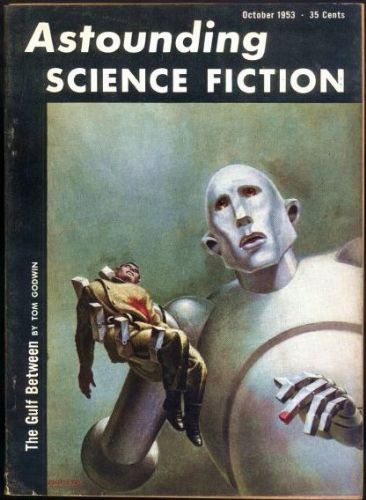
(Cover by H. R. Van Dongen. Astounding, January 1956.)
The Story So Far
John Ramsey is a gifted psychologist on an assignment from Bu-Psych, to play the role of the new electronics officer for the Fenian Ram, a subtug that’s out to raid oil in enemy territory, just off Siberia. This is the 21st century, and not only has the Cold War gotten a bit warmer, but oil has become an increasingly precious resource. The last twenty subtug missions have ended in failure, with the higher-ups suspecting there are “sleepers” aboard these submarines—spies who are sabotaging things from the inside. Ramsey’s job is twofold: to sniff out a possible spy among the Ram‘s small crew, and to evaluate Sparrow, the Ram‘s captain. Sparrow has been shown to be an incredible captain, but he also seems to have a bit of a screw loose, being a Bible-spouting borderline psychotic who expects nothing less than the utmost devotion from his crew. The other crew are Bonnett and Garcia, who’ve been on the Ram for many months by now. Ramsey is an outsider here, which already puts him at a disadvantage, never mind that he has to keep his real profession a secret.
Another problem is that being in a submarine means there’s no such thing as a minor accident, especially when it comes to dealing with enemy patrols. Of course the Ram is totally outmanned and outgunned against the wolf packs that are patrolling the Pacific, so the only option is evasive action. After a close call with the enemy, Sparrow falls ill from radiation sickness for a time, meanwhile the rest of the crew are unsure as to where they stand with each other. There’s the growing sense that somebody here is a spy, and the cards are stacked against Ramsey since he’s fresh meat. For better or worse Garcia has also figured out that Ramsey is a psychologist who has some ulterior motive for hopping aboard the Ram. The two have a kind of mutual respect, if also ambivalence mixed with paranoia. The last installment ended with Bonnett, having misconstrued Ramsey helping with the ship for planting a “spybeam,” jumping the gun and beating Ramsey within an inch of his life. Does this mean Bonnett is really the spy? Is everyone a little too tightly wound with this mission? I would know the answers, considering I’ve read the final installment or else I wouldn’t be here.
Enhancing Image
Surprise! Turns out Garcia is the spy, although how this is revealed is a bit odd; I don’t mean this in a bad way. Prior to the actual reveal Garcia implies, in a conversation with Ramsey, that he’s become tired of working for the Soviets, or more accurately he’s become tired of being a spy, but also knows that it’s too late to turn back now. If he’s caught then he would be tried and most likely executed for espionage. Interestingly, Herbert would’ve written Under Pressure in the wake of the Rosenbergs being tried and executed as spies, which in the age of McCarthyism was a major blow to civil liberties in the US. There was a crackdown on those suspected of having Soviet or generally leftist sentiments, and while Herbert was not a leftist at all, he held a long-standing disdain for government. Garcia is technically the closest thing the novel has to a villain, by virtue of being on the Soviets’ payroll, and yet Herbert writes him sympathetically. I’m not totally sure how this flew over John W. Campbell’s head, given that Campbell was a committed hawk during the Cold War and Under Pressure is evidently ambivalent about the conflict. It’s not unusual to find SF from the era that takes a rather neutral or ambivalent stance on the Cold War, but that’s usually reserved for stuff published in other magazines, and there’s a moral greyness here that is not often seen in SF published in Astounding at the time. I have to admit I didn’t expect that from Herbert.
Of course, stuck between either dying in the Ram or being taken back to the States for the gas chamber, Garcia opts for the former, dying from a heavy dose of radiation, with the wish that his family at least be provided for after his death. Sparrow, a man who prays for the souls of his enemies even as he goes up against them in battle, takes Garcia up on this, although we’re told at the end that the government killed two birds with one stone by giving Garcia’s widow a position so that they can keep an eye on her. There’s a touch of cynicism in what is otherwise a happy ending—just enough to satisfy Herbert’s own tendency toward cynicism, but not enough to scare Campbell. As for Sparrow, there’s a curious insight about how he’s psychologically unfit to live on land, but perfectly adapted to life in a submarine, in the sense that he’s married to the job. What counts as being mentally unfit? It’s a matter of perspective. Sparrow is so attached to the Ram that it’s like a second skin, or like his natural environment. I’ve noticed that in the years leading up to the space race escalating, there was some speculation in SF about the psychology of the astronaut, and how an astronaut might be changed mentally by life in a tin can, in zero gravity; but Herbert posits the same question about people who work in submarines, a question that has only become more pertinent with the invention of long-range nuclear subs. You don’t see this specific kind of speculation often in fiction.
A Step Farther Out
Only been, what, a couple weeks since I last posted here? Feels like it hasn’t been that long on my end. Then again, I was posting every few days here up until recently, and since I can look at the numbers, I can tell you that I’ve written a lot for this site. A fair bit of time and effort with relatively few returns, except of course the pleasure of (sometimes) reading fiction that is in itself enjoyable. I’m nothing if not a compulsive reader; in fact while I’ve mostly taken a break this month from writing, I never stopped reading, say, two or three books at a time.
Well, Under Pressure is a pretty decent serial, to the point where I can see how reviewers in 1956 saw it as an impressive debut from Herbert. For his part Herbert wouldn’t properly follow up Under Pressure (or The Dragon in the Sea as it’s also called) for nearly a decade, but when he did it would be the beginning of maybe the single most famous SF book series of all time. I do recommend Under Pressure if you’re into old-school hard SF that has also aged better than a lot of stuff from that time period, although your mileage may vary with regards to Herbert’s writing quirks, some of which are very much present here.
(Cover by Frank Kelly Freas. Astounding, December 1955.)
The Story So Far
John Ramsey is a gifted psychologist, part of the Bureau of Psychology, who’s given the unenviable assignment of surveying the crew of the subtug Fenian Ram, and especially its captain. Captain Sparrow is on the one hand the master of his ship, and his performance on the job has been off the charts; but he’s also a Christmonger, and the higher-ups fear he might be a little too unhinged. Meanwhile there’s also the suspicion that there’s a spy aboard the submarine, which is a bit odd considering the crew (minus Ramsey) is a total of three men, all of whom have known each other for months. Still. Ramsey takes a crash course in a submarine’s layout and becomes the fourth crewman, as the new electronics officer. (The last one had lost his mind.) Of course, Ramsey’s job as psychologist is kept secret from the others, as well as the fact that he’s here to sniff out a potential rat. You have Captain Sparrow as well as Bonnett and Garcia, with Bonnett being Sparrow’s right-hand man and Garcia being a practicing but rather pessimistic Catholic. Sparrow is fond of spouting prayers and Bible verses, to the point where if I were in Ramsey’s position I would just assume the man was totally psychotic. But that’s just me. There is indeed a whiff of religious mania in the air, but rather than immediately cause problems this instead constributes to a kind of synergy among the three crewmen. Ramsey is the odd one out; his contributions to the team add a degree of tension presumably not there before, and what’s worse is that at one point Ramsey comes to the realization that he’s afraid of being underwater.
While set in the 21st century, actually around the same time as [current year], Under Pressure takes place in a world where the Cold War has gone a bit hot and East and West and battling under the seas for control of oil. Frank Herbert seems to have a fondness for narratives about factions fighting over a precious resource. The Fenian Ram is a top-performing subtug, and she’ll need to be considering the previous twenty subs that have been on this raid have failed—indeed destroyed. We’re in the depths of the sea, off the coast of Siberia, in enemy territory, where Soviet wolf packs have been picking off American subs and, the top brass suspects, there may be a spy sabotaging these subs. For some reason damn near every SF writer in the business at the time thought the Cold War would go on for a century or more, with the exception of John Brunner and one or two others. Sure, the Cold War lasted a while, but it seems nobody had speculated that the Soviet Union would dissolve as early as it did.
Enhancing Image
Much of the first installment is concerned with setting up the context for this undersea voyage, as well as the crew. Now that we’ve become acclimated it’s time for some sweet submarine-on-submarine action, of the sort you may have seen watching Das Boot. (I’m sorry that I’ve mentioned that movie more than once at this point, but in my defense, it is the gold standard for the niche subgenre that is submarine media.) The second installment is a lot heavier on action, which ironically means there’s a lot less for me to talk about. If you’ve been reading my posts for at least a few months then you know I’m not very good at writing about action, nor am I even good at recapping what happens. When it comes to reading fiction I’m about ideas, characters, dialogue, and individual moments, which is probably why I’ve been a Thomas Pynchon fan since college. (Try not to hold that against me.) Thankfully, while he does have weaknesses as a writer (his tendency to jump from one character’s internal monologue to another without pause can be grating at times, and he was by no means a poet), Herbert has a talent for giving what is at least on paper a simple scenario a layer of complexity. Think about it: we’re stuck in this submarine for most of the novel, and with a small set of characters the whole time, none of whom are all that likable. Like sure, Ramsey is not as suspect as the others, but that’s because a) he’s the protagonist, b) he really does wanna do the right thing, and c) he’s not a Jesus freak. Even while these characters are prone to bickering and having tirades, it’s a setting that perfectly calls for such things. When a close call with some enemy subs leads to Sparrow getting a case of radiation sickness and lying in the infirmary for a time, you get the sense that while it wouldn’t happen at this point, if only for the sake of the plot, it’s very possible that a freak incident can leave this little ship without a captain. Everything can go to hell in a second, and it nearly does.
Things are tense while Sparrow is recovering, and even when he resumes control the situation doesn’t lighten any. It becomes apparent to everyone that one of them is probably out to sabotage the subtug, so that there are always two people awake to keep watch on each other. (It does not occur to them, of course, that there could be two spies.) The first revelation is that Garcia has somehow found out that Ramsey is a psychologist and not really an electronics officer by trade, even calling him a “head thumper.” This sparks an uneasy agreement between them, because it would be inconvenient for Sparrow especially to discover that Ramsey’s been sent here to check his head. The second revelation comes at the very end of the installment when Bonnett, having been roused into zealotry by Sparrow and convinced Ramsey is suspect, misunderstands the situation and almost punches Ramsey’s lights out before the latter can even get a word in. Something I have to say about Under Pressure that I usually don’t get to say about SF of this vintage is that I’m really not sure how this is supposed to play out in the final act. All three men are suspect in some way, and of course Ramsey himself could be secretly working for the other side, although I would be much peeved if that were the case considering we’ve been given insight into his thought processes. At that point I’d feel like Herbert was cheating. This also goes for Sparrow, to a lesser extent, since he’s the other character whose internal monologue we’re let in on throughout the novel. Herbert is rather inconsistent about how much attention each man’s internal monologue gets and at what points we’re allowed to read their thoughts, which is a problem that would haunt Herbert for decades.
A Step Farther Out
I had actually read this installment about a week ago, but didn’t feel motivated to write about it until recently. You’d think giving myself time to focus on other things would mean that at some point I’d be really itching to hop back on the horse that is writing, but this is not so. The problem with writing is that in order to be effective you have to work at it at least somewhat regularly or else you will lose the touch, so in that way it’s like how you ought to hit the gym at least a few days a week. I also seem to have not gained any extra insight into what Herbert’s doing with this novel, which I might add is looking to be a pretty solid debut novel, since I finished this installment. My initial thoughts and feelings didn’t change or expand, which disappointed me. It was just a matter of sitting down for a couple hours and pushing out some words. Don’t worry, I’ll have finished reviewing this serial by the end of the month.