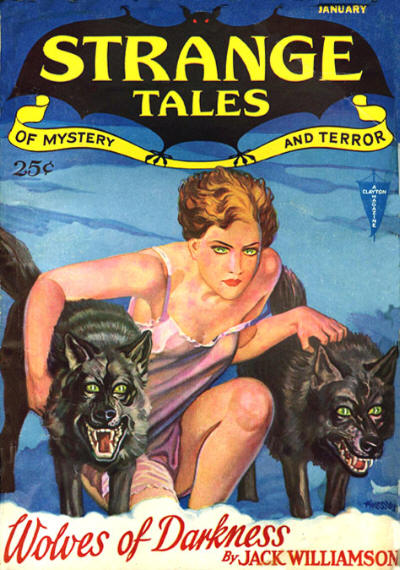
(Cover by H. W. Wesso. Strange Tales, January 1932.)
My schedule is not what it used to be, although I’m not sure if that’s my new living conditions, work slowly growing down on me, the real-world turmoil happening just outside of view, or some combination. I used to run this blog as a way of escaping temporarily from the drudgery of my everyday existence, between my job and living with my parents; but since I moved out four months ago, the scales have shifted in balance quite a bit. Writing for this blog no longer feels like an escape, but just more work that I have to do. I must write every couple days or else… what? What would happen if I took a break for, say, a month? Most likely my skill at writing would wither, if only a bit. Writing is like any other skill in that if you don’t do it for long enough then you sort of forget how to do it in the first place. It’s why I always find it amazing whenever an artist, be they a writer, filmmaker, musician, or whatever, takes a hiatus from the craft, then returns years later, seemingly out of hibernation, as if nothing had happened. Do you think Terrence Malick had to remember what it’s like to direct a movie when he was making The Thin Red Line, or if Robert Fripp, after not playing guitar for a couple years, had to refamiliarize himself with the damn thing when recording for David Bowie’s “Heroes”? Really this mindset can be applied to any skill, even one as worthless and solitary as writing.
I just remembered a depressing thought I had the other night, during one of my shifts, which is that I might be witnessing the death of human creativity in my lifetime. I’m not talking about creativity on an individual level, since I think it’s obvious that so long as humankind exists there will be artists, probably living on the margins, for the same reason there will always be Palestinians and Kurds and Chechens and what have you. I’m talking about a collective resentment towards creativity that has, at least in the US and UK, been building up since the Reagan and Thatcher years, if not earlier. Fascism, be it Christofascism or neo-liberalism of the Reagan-Clinton sort, is at its core a rejection of the human mind’s ability, indeed its incessant urging, to grow and progress. There is a Freudian return-to-the-womb desire inherent in fascism, except on a systemic level. The fascist wants to stop the future from happening—not a good or bad future, but the future as a concept. You can at least give the Chinese credit for envisioning a future, although if we’re being honest it’s a rather bleak one. In a more just world “AI” would be used only to make soul-crushing labor easier to stomach for human workers, but instead the right-wing technocrats who have increasingly gotten a stranglehold on government and commerce think such incredible technology should rather be used for kneecapping the human imagination. It’s possible that in just a decade or two the artist will be treated like how drug addicts and the homeless are treated today, which is to say the artist will be treated in the mainstream as at best a nuisance and more often as a threat to “the status quo.” We are undoubtedly on the path to that conclusion, and really it’s been a long time coming.
So what can I do? I talk a lot about art and artists, because I’m of the firm belief that without art human existence is really not worth it. Evelyn Waugh said that without God human existence is “unintelligible and unendurable.” I mostly agree with that sentiment. I write about art, even bad art, even the pulpy stuff, because I think there must be some value in it, and because God knows there isn’t much value elsewhere. Speaking of which, I decided it’s been too long since I last covered material from the pre-Campbell years that isn’t from the pages of Weird Tales. (I can’t help it that on average Weird Tales aged a lot better than its SF contemporaries.) So, I’m doing something a bit different this month. The serial, along with both novellas, will be from the pre-Campbell ’30s. I’m also finally checking the E. E. Smith box off my list, although not by reading a Skylark or Lensman novel but a standalone that caught my eye if only because of its convoluted publication history. The two short stories are from lady writers, one of whom you might’ve heard of if you’re really into crime fiction, while the other is totally obscure. See, the news is not all bad. Spring is finally here, and while my allergies may be kicking in I’m no longer freezing to death.
I’ve done enough yapping. What will I be reading? We have three stories from the 1930s and two from the 1950s.
For the serial:
Triplanetary by E. E. Smith. Serialized in Amazing Stories, January to April 1934. Smith was immensely popular in SF fandom during his lifetime, and yet despite a few attempts to resurrect his reputation he has since then been relegated to something of a sideshow attraction. Along with Edmond Hamilton he was one of the pioneers of space opera, with his novel The Skylark of Space especially laying the groundwork for future entries in that subgenre. The magazine version of Triplanetary was a standalone novel that Smith later retooled so as to make it a prequel in the Lensman series.
For the novellas:
“Proxima Centauri” by Murray Leinster. From the March 1935 issue of Astounding Science Fiction. I actually don’t remember if I’ve read this one before, so I’m counting it as a new read. Anyway, Leinster is curious if only because he’s one of the few writers from the Gernsback era to survive the coming of Campbell; not only that, but he actually hit his creative peak in the ’40s and ’50s.
“Wolves of Darkness” by Jack Williamson. From the January 1932 issue of Strange Tales. Williamson had one of the longest careers of any writer, inside or outside of SF, debuting in 1928 and remaining active until his death in 2006. “Wolve of Darkness” stands out as, if I remember right, getting Williamson his single biggest paycheck for a story up to that point, as he says in his autobiography.
For the short stories:
“The Pilot and the Bushman” by Sylvia Jacobs. From the August 1951 issue of Galaxy Science Fiction. This is now the third time I’ve nabbed a story from this issue of Galaxy. I unfortunately have next to nothing to say about Jacobs since we know basically nothing about her, not even when and where she was born. She wrote a handful of SF stories in the ’50s and ’60s and then vanished.
“The Muted Horn” by Dorothy Salisbury Davis. From the May 1957 issue of Fantastic Universe. This is a case where looking at an author’s ISFDB page can be deceiving, since going by it one would think Davis wrote very little; but actually she was a prolific crime novelist, and was even President of the Mystery Writers of America when she wrote this story, which is apparently horror.
Let’s talk about where genre SF was at in 1950, because this year, perhaps more than any other year in the field’s history barring maybe 1926 (the launch of Amazing Stories) and 1953 (the year the magazine market reached critical mass). Changes in the field tend to come gradually; it’s not like, for example, one day you have a market that’s 95% WASPs and then the next it’s much more racially diverse. These things happen in movements, like the rest of history, or indeed like the waxing and waning of the tide. There really was a profound difference between how genre SF looked at the beginning of 1950 and how it looked by the end of the year. There were multiple changes happening at once, and not all of them were good. The less said about Dianetics the better. But you also had the publications of Isaac Asimov’s I, Robot and Ray Bradbury’s The Martian Chronicles, two “novels” (they’re really short story collections) that not only garnered acclaim from the usual suspects but even managed to break into the mainstream. This was practically unheard of at the time, to have science fiction that “normal” readers admitted to caring about. 1950 also saw the publication of other major SF books, like Robert Heinlein’s Farmer in the Sky, Theodore Sturgeon’s The Dreaming Jewels, A. E. van Vogt’s The Voyage of the Space Beagle, Asimov’s Pebble in the Sky, and the book version of Hal Clement’s Needle. Notice that with the exception of the van Vogt book, all the ones I just mentioned were aimed at younger readers—as in teenagers, those who might grow up to be SF enthusiasts.
A revolution, of a sort, was happening.
In the world of the genre magazines, things were shaking up at least much, even putting Dianetics aside. The Magazine of Fantasy and Science Fiction, which had launched in the fall of 1949, was finding its footing. There were signs of the coming deluge of new magazines, on top of the current rivals to Astounding, and the biggest of these new arrivals, by far, was Galaxy Science Fiction. Galaxy first hit newsstands with its October 1950 issue, which means it would’ve been available in September. Under the editorship of H. L. Gold, who had already proved himself a capable writer, this was a magazine that would do what Astounding could not, namely be socially conscious, with a focus on science fiction that was rather urbane and literate, while still being very much focused on science. But whereas Astounding was all about the hard sciences, Galaxy would focus just as much on the soft sciences, such as psychology and sociology. Being more socially conscious, there would also thus be much more of a focus on social satire, and one stereotype that would come to haunt Galaxy in the ’50s is that too many of its story would be misanthropic hehe-haha comedy pieces, aimed at the middle-class urbanites it was satirizing. As with The New Yorker around the same time (and indeed The New Yorker now), Galaxy ran the risk of coming off as incessantly liberal and middle-brow. This is a legitimate criticism, but it was also a risk one had to accept when changing the field this radically. To this day a lot of SF being published seemingly either takes after Galaxy under Gold’s editorship or Asimov’s Science Fiction under Gardner Dozois’s. There’s a third, more conservative (because Galaxy was kinda “woke” for its day) brand of SF writing that wants desperately to turn back the clock to a pre-Galaxy world, to a time before white people cared about things like social justice, but you can’t put the genie back in the bottle.
I had to think really hard about what stories and authors to cover this month, because the truth is that Galaxy at its peak had individual issues whose sheer quality and star power would put whole novels to shame. Nearly every story in a given issue would be a banger, or at least a fine read. There are people who wrote for Galaxy during its first decade that I had to leave behind, at least for the moment, including Theodore Sturgeon, Margaret St. Clair, Robert Sheckley, Philip K. Dick, Isaac Asimov, Clifford Simak, Cordwainer Smith, Poul Anderson, Ray Bradbury, and many others. But still we have a mix of usual suspects, as in those who regularly contributed to the magazine during this time, as well as a few lesser known authors. Of course I couldn’t have it all be now-famous selections.
Anyway, for the stories:
“Self Portrait” by Bernard Wolfe. From the November 1951 issue. If Wolfe is little known in the field, it could be because he wrote very little SF, putting out only one SF novel and a handful of short stories. Wolfe was a trained psychologist who also was a committed leftist, specifically a Trotskyist; he even knew the man himself personally, in the years right before Trotsky’s assassination.
“The Snowball Effect” by Katherine MacLean. From the September 1952 issue. I’ve covered MacLean before, actually not too long ago, but seeing as how her most prolific era was when she wrote for Galaxy in the ’50s, why not? She lived a very long time, although she didn’t write that much, making her debut in Astounding in 1949 before (for the most part) switching over to Galaxy.
“A Bad Day for Sales” by Fritz Leiber. From the July 1953 issue. Leiber is one of my favorite writers of old-timey SF, although he was also quite skilled (maybe even more so) in fantasy and horror. He debuted in 1939, and thus was one of the old guard, but he adapted to changes in the market with a chameleon’s touch. I picked this story specifically on a friend’s strong recommendation.
“The Big Trip Up Yonder” by Kurt Vonnegut. From the January 1954 issue. Vonnegut is one of those few authors who needs no introduction, but here it goes. He broke onto the scene in 1952 with his novel Player Piano, which was SF, as would be about half of his other novels. Despite not wanting to be pigeonholed as a “sci-fi” writer, he also occasionally appeared in the genre magazines.
“The Princess and the Physicist” by Evelyn E. Smith. From the June 1955 issue. We don’t know a lot about Smith, which unfortunately is not unusual for women in pre-New Wave SF, and incidentally she had mostly stepped away from the field by the time the New Wave and second-wave feminism kicked in. In the ’50s she wrote by far the most prolifically for Gold’s magazines.
“A Gun for Dinosaur” by L. Sprague de Camp. From the March 1956 issue. As with Leiber, de Camp was perhaps more adept at writing fantasy than SF, but then in the ’50s there wasn’t much of a demand for the former. He too was of the old guard, and was able to adapt to the changing times. He also lived an extremely long time, indeed having one of the longest careers in the field.
“Prime Difference” by Alan E. Nourse. From the June 1957 issue. Nourse is one of the lesser known of the original “hard” SF writers, and indeed the vast majority of his short fiction appeared in the ’50s when he was a very young man. He mostly stopped writing SF probably because he got a very well-paying job as a trained physician, but his work remains to be rediscovered.
“Nightmare with Zeppelins” by Frederik Pohl and C. M. Kornbluth. From the December 1958 issue. Pohl and Kornbluth were good friends for many years, but in the ’50s they collaborated on several novels and short stories, the most famous being The Space Merchants. Sadly Kornbluth died in early 1958, making “Nightmare with Zeppelins” one of the last stories he would’ve finished.
“The Man in the Mailbag” by Gordon R. Dickson. From the April 1959 issue. Dickson was born and raised in Canada (he’s from Alberta), but moved with his family to the US when he was a teenager. He’s most known for his regular collaborations with Poul Anderson, as well as his long-running and ambitious Childe cycle. He was one of the pioneers of what we now call military SF.
We seem to be living in a world of shit, or at least it’s easy to think that way. The irony is that the people who think this the most are also probably (being queer and disabled I’m actually not sure how I’m gonna turn out) the ones most likely to come out of all this bullshit unharmed—in body, if not in soul or mind. But, the show continues. I thought I had more to say for this month’s forecast, and at this point I think it’s fair to say my Things Beyond posts have become like actual weather forecasts (I predict, but that doesn’t mean the thing will 100% happen); but still, aside from a couple things I’m sure we all know about already, the past month has been uneventful. I got my purchases for Worldcon at basically the last minute, so I’ll be seeing what I can see of the con virtually if not in person, and with any luck I’ll even be on a couple panels, as one of those inside-a-computer people. I’ve been slowly but surely moving “up” in the world of fandom.
Anyway, for decades we’ve got two stories from the 1920s, one from the 1940s, one from the 1970s, one from the 1990s, and one from the 1890s. As for the stories themselves, we have…
For the serial:
Sunfire by Francis Stevens. Serialized in Weird Tales, July-August to September 1923. Francis Stevens is the androgynous-sounding pseudonym of one Gertrude Bennett, who for just a few years wrote prolifically for the pulp magazines, apparently to help pay the bills. Once her sickly mother died, she stopped writing fiction, with Sunfire being the last story of hers published. It would take more than seventy years for this story to appear in book form.
A Story of the Days to Come by H. G. Wells. Serialized in Amazing Stories, April to May 1928. First published in 1899. Wells is perhaps the most crucial pioneer of science fiction; aside from maybe Edgar Allan Poe he stands as arguably the genre’s nucleus. This is made more remarkable since Wells wrote his most famous work over the span of only about a decade. This story comes from said decade of greatness, but I guess due to its length it remains overlooked.
For the novellas:
“The Glowing Cloud” by Steven Utley. From the January 1992 issue of Asimov’s Science Fiction. Utley was born in Kentucky, at Fort Knox (he was a military brat), before moving to Texas (Austin), and then finally Tennessee. He wrote prolifically in the ’70s, all of it short fiction, as one of the post-New Wave generation. He then fell mostly silent in the ’80s before reemerging in the early ’90s.
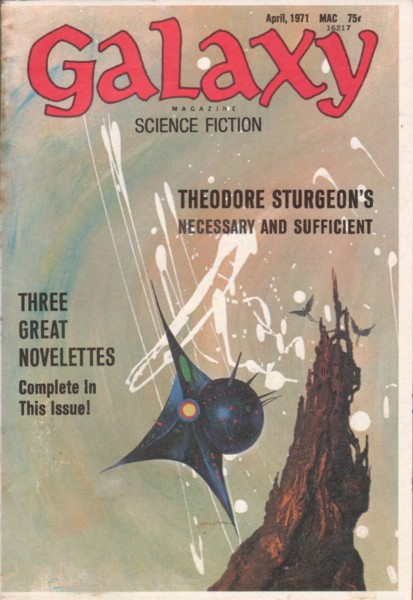
“To Fit the Crime” by Joe Haldeman. From the April 1971 issue of Galaxy Science Fiction. Haldeman, like Utley, came about during the post-New Wave era; he had spent the New Wave years in college, and then in Vietnam, where he got damn near killed. Once his wounds healed enough he got to work writing SF. This story here is the first in a loose series, starring Otto McGavin.
For the short stories:
“When the Bough Breaks” by Henry Kuttner and C. L. Moore. From the November 1944 issue of Astounding Science Fiction. Retro Hugo nominee for Best Novelette. I had missed the boat on reviewing Moore solo last month, and I can’t review Kuttner solo next month either; so together here they go. Kuttner and Moore were of course married, and they’re also two of my favorite writers.
“The End of the Party” by Graham Greene. From the December 1950 issue of Worlds Beyond. First published in 1932. Greene was famous in his day as both a serious novelist and a writer of espionage thrillers, although the two were not mutually exclusive. He also occasionally dabbled in supernatural horror, with this story being one of his own personal favorite works despite its age.
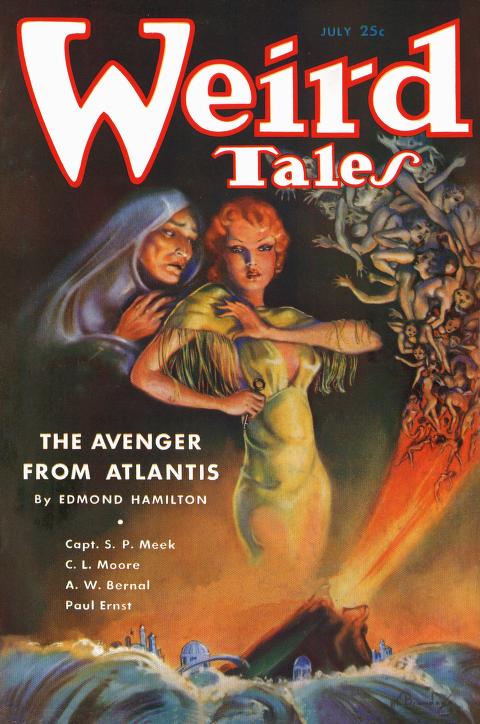
(Cover by Margaret Brundage. Weird Tales, July 1935.)
Happy New Year. Blow confetti. Get drunk. Maybe kiss and cuddle a friend or significant other of yours. Although of course you would’ve done that last night. A lot of stores are closed today, because work sucks and the reality is that with a few notable exceptions nobody really wants to work. I hope this message finds you well. There will be a couple changes to this site, which mind you does not mean bad news at all. Frankly those of you who frequent here might not even notice the one “negative” change, that being the fact that given my current life circumstances I can no longer guarantee that a post will be finished on the date I expect it to be. For two years I kept to a pretty strict release schedule with my posts, but after moving into my own place, with all the pros and cons that come with that, I would expect more posts to get delayed by, say, a day, if I were in your position. Occasionally I might not even be able to post a review that I said I would; this happened a few times actually, since November, and I think it’s time to acknowledge that while I try to be prolific, I can only do so much, from a mix of life changes and depression. Also that’s why I’m reviewing a story I was supposed to write about in November, but never got around to even reading it, that being Eleanor Arnason’s “Checkerboard Planet.”
Now, in good news…
The serials department is back, after I had announced at the start of last year that I would only be covering short stories, novellas, and complete novels in 2024. I had thought about what would be the first serial to commemorate the department’s coming back from hiatus, and ultimately I figured it had to be something big. Thus I went with a Robert Heinlein novel I’ve not read before, and truth be told Heinlein’s juveniles are a bit of a blind spot for me in my knowledge of his work; I’ve read a few of them, my favorite probably being Between Planets, but I should certainly read more. It’s also been too long since I last covered Heinlein here.
In other good news, we have another magazine to pay tribute to this year, albeit not on quite the same scale as what I did with F&SF. As you may or may not know, Galaxy Science Fiction launched with the October 1950 issue, making October (or September, depending on how you look at it) of this year its 75th anniversary. Along with F&SF, Galaxy played a pivotal role in reshaping who and what got published in genre SF following Astounding‘s near-stranglehold on the field the previous decade. Especially in the ’50s, a disproportionate number of now-classic stories and novels first saw print in the pages of Galaxy, under the ingenious (if also tyrannical) editorship of H. L. Gold. Unfortunately Galaxy had a bit of a rough history after its first decade, going through a few editors and experiencing declining sales before finally being put out of its misery in 1980. It only lasted thirty years, which admittedly is still better than what most SFF magazines get, but during that time it was arguably the finest magazine of its kind. So, in March, July, and October, as with last year, I’ll be reviewing only short stories, this time from the ’50s, ’60s, and ’70s respectively, and all from Galaxy. I’ll also be reviewing one short story, novella, or serial from Galaxy every month apart from that. This should be a good deal of fun.
Now what do we have on our plate?
For the serial:
Citizen of the Galaxy by Robert Heinlein. Serialized in Astounding Science Fiction, September to December 1957. Heinlein is that rare author who really needs no introduction, but who no doubt deserves one. He made his debut in 1939, at the fine age of 32 but having already entered the field more or less fully formed as a writer; it helps that he had already written a novel, albeit one that had initially gone unpublished, at this point. From the late ’40s to the end of the ’50s he wrote a series of “juveniles,” which helped lay the groundwork for we would now call YA SF. Citizen of the Galaxy was one of the last of these juveniles, and as far as I can tell its serialization occurred more or less simultaneously with its book publication.
For the novellas:
“The Organleggers” by Larry Niven. From the January 1969 issue of Galaxy Science Fiction. Reprinted thereafter as “Death by Ecstasy.” One of those old-fashioned planet-builders who appeared just as the New Wave was getting started, Niven very much follows in the footsteps of Poul Anderson and Jack Vance. “The Organleggers” is the first in a series of SF-detective stories starring Gil Hamilton.
“In the Problem Pit” by Frederik Pohl. From the September 1973 issue of The Magazine of Fantasy and Science Fiction. Pohl is one of those people who can claim to have taken part in pretty much every aspect of SF publication, from author and editor to literary agent. He edited Galaxy and If in the ’60s, to much acclaim, but in the early ’70s he gave up editing returned to writing fiction regularly.
For the short stories:
“Checkerboard Planet” by Eleanor Arnason. From the December 2016 issue of Clarkesworld. Judging from her rate of output you might think Arnason a more recent author, but in fact she was born in 1942 and made her debut back in 1973. She’s been an activist for left-liberal causes since the ’60s but did not start writing full-time until 2009, hence her recent uptick in productivity.
“Jirel Meets Magic” by C. L. Moore. From the July 1935 issue of Weird Tales. Moore might not be a mainstream figure in genre fiction, but she and her first husband, Henry Kuttner, have a strongly passionate following among older readers. With justification. She’s a favorite of mine. It’s been almost two years since I reviewed the first two Jirel of Joiry stories, which is far too long a wait.
I wish I could say the past month has been better for me, but it has not. A big thing is happening in my life, in that today is actually the move-in date for my first apartment. Wow, imagine, at 28, my first apartment. Been taking care of the practical side of things, with assistance: furniture, stuff for the kitchen and bathroom, and of course signing up with utilities. This has been a long time coming, and truth be told I’ve become immensely tired of living with my parents. And yet I’m not happy. Moving into my own place might prove only marginally better than my previous living situation. I don’t make enough to pay for rent so I’ll be bleeding my savings for the following months. The only reason my application even got accepted is my credit score is good. I’ll be living by myself in this one-bedroom apartment. It’ll be very lonely here, as none of my partners live close enough to move in with me, and anyway, with one exception we don’t know each other that well yet. Surely the lack of my parents breathing down my neck will do me some good, but this will be a solitary existence.
Honestly I’ve been tired all the time as of late. My work schedule as of right now is erratic and I find myself going to sleep at six in the morning and waking up after noon. As you may know I have anxiety and depression, and while the former has not been as bad lately, the latter has been worse, or rather more persistent. I’m tired of everything. I’m tired of my job. I’m tired of my imperfect body, and the fact that I can barely sleep. I’m tired of being tired. The US election is in less than a week and honestly I’m sick of this fucking immoral country, and its authorities who have been spending the past couple centuries murdering socialists, queer people, ethnic minority groups, etc. We’re only a quarter into the 21st century but already I feel like almost everything that could go wrong has already gone wrong. And will get worse. I’m normally a pessimist, so take all this with a grain of salt, but I don’t see conditions improving much.
So, go backward or forward, but don’t stay here. I hate it here. I do this blog for fun, and according to stats have written 186,000 words (or about equivalent to Great Expectations in word count) this year alone; but I also do it as a coping mechanism. I don’t do it for readers, or money, because not enough people read this blog or even know about it, despite my spreading word on a few social media platforms. Maybe when I hit 200 subscribers I’ll start a Patreon. Just know I’ve been going at this for two years now because it gives me some degree of emotional security. If not for all these words I would surely have given up a minute ago.
Now, what do we have for reviewing? We have two stories from the ’40s, three from the ’60s, one from the ’80s, one from the ’90s, and one from the 2010s.
For the novellas:
“Attitude” by Hal Clement. From the September 1943 issue of Astounding Science Fiction. Retro Hugo nominee for Best Novella. Feels like it’s been a while since we last talked about Clement, who was one of the first hard SF authors as we now think of the term. Not only was Clement a pioneer, he had a pretty long life and career, remaining active into the beginning of the 21st century. His prose is workmanlike and his human characters tend to be little more than abstractions, but his lectures-as-stories can be enthralling.
“Last Summer at Mars Hill” by Elizabeth Hand. From the August 1994 issue of The Magazine of Fantasy and Science Fiction. Nebula and World Fantasy Award winner for Best Novella. Over the past four decades Hand has taken a kind of jack-of-all-trades approach to writing, tackling SF, fantasy, and horror seemingly with equal relish, with even the occasional movie novelization to her credit. (She wrote the novelization of the infamous 2003 Catwoman movie.) “Last Summer at Mars Hill” is one of her most decorated stories.
For the short stories:
“Beyond the Threshold” by August Derleth. From the September 1941 issue of Weird Tales. Derleth was correspondents with H. P. Lovecraft and could be argued as the person most responsible for preserving Lovecraft’s legacy, as he co-founded Arkham House with Donald Wandrei in 1939 firstly to reprint his mentor’s fiction. He also wrote quite a bit of fiction in his own right.
“The Scar” by Ramsey Campbell. From the Summer 1969 issue of Startling Suspense Stories. One of August Derleth’s biggest discoveries as editor was Ramsey Campbell, whose work Derleth had discovered when he was but a teenager. Campbell’s first collection was published when he was only 18, so that he got his start in weird fiction very early. He would later become a prolific horror novelist.
“Nomansland” by Brian W. Aldiss. From the April 1961 issue of The Magazine of Fantasy and Science Fiction. Aldiss debuted in the 1950s and would remain active pretty much until his death, which was not too long ago. He would win a Short Fiction Hugo for Hothouse, which is sort of a novel but also a collection of linked stories. We already covered the first story, and now we’re on the second.
“Flowers of Edo” by Bruce Sterling. From the May 1987 issue of Asimov’s Science Fiction. Sterling debuted in 1977 when he was barely out of his teens, but he would become one of the defining SF writers of the ’80s. While typically labeled as cyberpunk, Sterling has a surprising versatility, with even early novels like Schismatrix and Islands in the Net being very different from each other.
“Soft Clocks” by Yoshio Aramaki. From the January-February 1989 issue of Interzone. First published in 1968. Translated by Kazuko Behrens and Lewis Shiner. Seeing as how the Sterling story takes from Japanese culture, I thought it only right (and perhaps a neat gimmick) to follow up with a story from a Japanese writer. Yoshio Aramaki has been active since the ’60s as an author and critic.
“Checkerboard Planet” by Eleanor Arnason. From the December 2016 issue of Clarkesworld. Judging from her rate of output you might think Arnason a more recent author, but in fact she was born in 1942 and made her debut back in 1973. She’s been an activist for left-liberal causes since the ’60s but did not start writing full-time until 2009, hence her recent uptick in productivity.
Everyone has their preferences when it comes to genre, which makes sense; there are only so many hours in the day, and time plus one’s temperament equals a preference for literature that seeks to entrance, excite, and/or titillate. We also like to be scared sometimes, or at the very least uneased. I’ll be honest with you, when someone tells me they simply have no appetite for horror I’m tempted to give them the side-eye. As far as my own genre preferences go I would put horror only behind science fiction—and not by much. The key difference is that I can enjoy SF at really any length, whereas I very much believe horror is at its best at short story and novella lengths, which is an old-school belief not least because the novel has dominated horror since at least the ’80s.
The conventional narrative (and I do think this is more or less accurate) is that prior to the ’70s, horror had at most fleeting moments of mainstream recognition. There were exceptions, but they were exceptions that proved the rule. Maybe ever few years you got a horror novel that reached bestseller status. But then, in the ’70s, what had been a once-in-a-blue-moon thing became something of a trend, arguably started when William Peter Blatty’s The Exorcist and Richard Matheson’s Hell House both came out in 1971. In the film world the influx of horror can be explained by the advent of the MPAA rating system combined with independent studios like New World Pictures pumping out exploitation cinema by the truckload, but in the literary world the rise of horror is harder to explain—except for one thing. Stephen King had been writing since the late ’60s, but his debut novel Carrie became a bestseller when it was published in 1974, and the crazy part is that noy only did King (a snotty 26-year-old at the time) gain overnight success, he managed to sustain it with more hits. The meteor shower that was King in the ’70s brought a change to horror that it had not seen before, and frankly will probably never see again. Many writers (some of whom are more elegant than King) would hop on the horror bandwagon, but none can be said to have reached King’s level.
While the horror novel was in, the short story was not so much. For most of the ’70s The Magazine of Fantasy and Science Fiction was the only genre magazine to publish horror with any regularity. Magazine of Horror did mostly reprints, and by 1972 was no more, while Weird Tales had a brief revival in the early ’70s, only to go dormant again. So it was up to F&SF to pick up the slack. For the magazine’s 75th anniversary, and in covering short stories from the ’70s, we’ll be focusing more on horror, dark fantasy, and spooky science fiction. These are mostly the usual suspects when it comes to horror, but there are one or two surprises.
For the short stories:
“Longtooth” by Edgar Pangborn. From the January 1970 issue. One of the most criminally overlooked SF writers of the ’50s through the ’70s, Pangborn wrote some pretty touching fiction that went against the rather hard-headed norm of the times. He would spend the last decade or so of his life on a post-apocalyptic continuity, but “Longtooth” is both a standalone and detour into horror.
“The Smell of Death” by Dennis Etchison. From the October 1971 issue. Etchison started writing in the ’60s, but he gained more prominence in the following decade as the horror boom for film and novels had kind of a trickle-down effect. He would also later become acclaimed as an editor, on top of writing, winning the World Fantasy Award multiple times for his horror-centered anthologies.
“In the Pines” by Karl Edward Wagner. From the August 1973 issue. Wagner debuted in 1970 and would remain a mainstay of horror and heroic fantasy until his untimely death in 1994. Last time we read Wagner it was one of his Kane stories, but “In the Pines” is an early example of his mastery of scares. I believe this also marks his only appearance in the pages of F&SF.
“The Same Dog” by Robert Aickman. From the December 1974 issue. Aickman has a reputation as a writer’s writer, with good reason, being your favorite horror writer’s favorite horror writer. He debuted in the early ’50s but remained a hidden gem in the UK until the ’70s. Aickman would appear in F&SF several times throughout this decade, with “The Same Dog” being an original publication.
“The Ghastly Priest Doth Reign” by Manly Wade Wellman. From the March 1975 issue. Wellman remained a presence in American fantasy writing for six decades, and especially in the latter half worked to evoke the rural mysteries of his adopted home state of North Carolina. For better or worse Wellman’s most authentic fiction is distinctly Southern in flavor, this story being one example.
“My Boat” by Joanna Russ. From the January 1976 issue. Known much more for her SF and criticism, a fair amount of Russ’s fiction (especially early on) was horror, such that even some of her SF oozes with a certain existential dread. She even wrote a few stories set in the Cthulhu Mythos, of which “My Boat” is one. I suspect this will be a Lovecraft pastiche with a Russ-type twist or two.
“Manatee Gal Ain’t You Coming Out Tonight” by Avram Davidson. From the April 1977 issue. This will be the first time we’ll be reading a story by one of F&SF‘s editors. Davidson was already a respected writer when he took over F&SF for a few years in the early ’60s, injecting the magazine with eccentricity. This story is actually the second in an episodic series starring Jack Limekiller.
“Hear Me Now, My Sweet Abbey Rose” by Charles L. Grant. From the March 1978 issue. Grant got his start in the ’60s and would soon become one of the moodier and more experimental horror writers of the following decade, winning awards for his efforts. Truth be told, I’ve not been keen on the Grant I’ve read, but as I’ve said before, I’m usually open to giving authors another chance.
“Red as Blood” by Tanith Lee. From the July 1979 issue. This is the third consecutive time Lee’s appearing on my October slate, although this won’t be the case next year for reasons I’ll give… in due time. But for now it’s safe to say I’ve warmed up to Lee, gradually, and can see how for decades she was a mainstay of horror and dark fantasy. “Red As Blood” marked her first appearance in F&SF.
(Cover by Gerard Quinn. Science Fantasy, February 1963.)
Sometimes I get confused by my own schedule, which is to say the rotation method I used is one I’m not sure I always abide. Do I do eight reviews this month, or nine? How many days are in September? Thirty. But that doesn’t matter now. August was a pain and a half for me, for a few reasons. I went on vacation with family, which wasn’t all sunshine and rainbows (although I at least got PTO from that), not helped by there being I guess you could say a changing of the guard in my polycule. One of my partners dumped me. We’d been together about three months, and it was a pretty intense pairing. They (I say that because they’re non-binary) ultimately didn’t feel comfortable being with someone who is polyamorous. That’s the short of it. It sucks, and I’m still feeling sore from it, although I suppose this is the kind of loss you have to accept with a polycule. But it hasn’t been all bad! We did also welcome a new member recently, and she’s very cute. She’s not used to polyamory (the last polycule she was in didn’t work out), but she’s patient and so far things have been going pretty well for us.
On to shit that matters more, the Hugos happened this past month, and I actually got to vote in them—not that it mattered too much. I only felt qualified to vote in about half a dozen categories, although I did vote in Best Short Story (the #1 on my slate didn’t win :/), and I think this was also the first time I was poised to review a Hugo nominee which then went on to win by the time my review was published (Naomi Kritzer’s “The Year Without Sunshine,” a very fine pick). Next year’s Worldcon is to be held in Seattle, which hey, that’s only on the other side of the country for me. I should get to work on attending, since I can feasibly do that. Worldcon 2026 is also gonna be held in LA, so that’s… two American Worldcons in a row. That’s a bit weird. But I can’t complain too much.
As for this months reviews, we have a few birthdays! John Brunner would be celebrating his 90th birthday on the 24th (had he not died in 1995), which is crazy considering one would think he was maybe a decade older. Stephen King (who is very much alive) is celebrating his 77th birthday on the 21st. Something I’ve started to think about is the decades I’m pulling from with my story choices, because given how the magazine market has ebbed and flowed over the years there are a few boom periods that would get more attention than others. It shouldn’t come as a surprise that I’ve had to try to not pick material from the ’50s too often, and indeed there are no ’50s stories this month! We have three from the ’60s, two from the ’80s, two from the ’90s, and one from the 2020s. A couple these would be horror outings, as a prelude to next month’s shenanigans.
Now let’s see…
For the novellas:
“Green Mars” by Kim Stanley Robinson. From the September 1985 issue of Asimov’s Science Fiction. Robinson is one of the most respected living SF writers, for his hard-science credentials but also for being one of the few openly leftist writers in the field over the age of sixty. Worth mentioning that this novella has nothing to do with Robinson’s award-winning Mars trilogy, although it does apparently share continuity with a few other stories set on Mars—just not the Mars of that trilogy. And also I heard Robinson would take some ideas from this early Mars story and reuse them for the trilogy.
“Some Lapse of Time” by John Brunner. From the February 1963 issue of Science Fantasy. Low-key one of the more tragic figures in classic SF, Brunner was something of a prodigy, making his debut while still a teenager. He also wrote full-time in the ’50s and ’60s, at a time when that wasn’t considered all too viable for genre writers, and money was an issue. Brunner wrote so much that a lot of his short fiction hasn’t been collected more than once, or at least not in my lifetime. “Some Lapse of Time” has not seen print since Lyndon B. Johnson was in office, so let’s see if it’s a hidden gem or not.
For the short stories:
“The Transcendent Tigers” by R. A. Lafferty. From the February 1964 issue of Worlds of Tomorrow. Lafferty has a reputation as something of a writer’s writer, and there’s a reason for this: nobody writes quite like Lafferty. I’m not a fan of him, because I often find him overly quirky, but I’m all for giving authors another chance. I went out of my way to pick a relatively obscure Lafferty story.
“Angels in Love” by Kathe Koja. From the July 1991 issue of The Magazine of Fantasy and Science Fiction. I’ve only read short stories by her so far (I do have The Cipher, her first novel, on my shelf), but I can already say Koja is becoming one of my favorite horror writers. She’s turned more to YA in recent years, but her early stuff is vicious, snarky, and at times genuinely disturbing.
“Craphound” by Cory Doctorow. From the March 1998 issue of Science Fiction Age. Acclaimed as both a writer and commentator on the state of tech and surveillance, Doctorow has probably kept a thumb on the pulse of the post-internet zeitgeist more than any other living SF writer. “Craphound” is a very early story, but Doctorow thinks fondly enough of it to have named his blog after it.
“Crazy Beautiful” by Cat Rambo. From the March-April 2021 issue of The Magazine of Fantasy and Science Fiction. Rambo is a no-nonsense Texan who’s been active in the field for the past twenty years, more or less. They’ve been most prolific as a short story writer and editor, but have also recently taken to writing novels. Their latest novel, Rumor Has It, is due out from Tor later this month.
“Beachworld” by Stephen King. From the Fall 1984 issue of Weird Tales. Really needs no introduction, but let’s do it. King started writing in the ’60s, a fact people tend to forget because Carrie, his first novel, didn’t come out until 1974. Then the rest was history. He’s known firstly as a horror writer, but he’s also ventured into basically every genre under the sun, “Beachworld” being SF-horror.
“David’s Daddy” by Rosel George Brown. From the June 1960 issue of Fantastic. Brown made her debut in 1958 and quickly established herself as a short fiction writer; a large portion of her fiction would be published between 1958 and 1963. In one of SF’s many lost futures, Brown could’ve gone on to fit in with the New Wave feminists, had she not died in 1967, at only 41 years old.
Not much to update on for this month, although I did decide to shake things up for slightly for what I’ll be covering. See, for a while I was gonna do a whole tribute month for Clifford Simak, like I did for Fritz Leiber almost two years ago; but truth be told I’m not sure if I’ll do a whole month of reviews for one author like that again. It can be fatiguing to read a ton from one author, even one as diverse in his output as Leiber; and I can tell you Simak is not as diverse. I do have a compromise, though, since it’s gonna be the man’s 120th birthday in two days and I wanted to do something special. So instead of one Simak story we’re getting two. Not only that, but I’m making an exception for my “one story per magazine a month” rule (excepting F&SF this year, as you know) so as to pick two Simak stories from the pages of Galaxy Science Fiction. Simak was such a prolific contributor to Galaxy that I feel it’s only right to double dip here.
Another quirky choice I decided to pull was this month’s complete novel, which is not only a certified classic of “literary” fiction but a fantasy novel that people tend to not think of as such. Whether The Man Who Was Thursday “really” counts as fantasy was a point of contention even when it was printed in Famous Fantastic Mysteries, with people in the letters column loving the novel but questioning its fantasy credentials. But fuck you, I’m counting it. Aside from Simak we have a fairly diverse roster of writers, none of whom I’ve previously covered on here. We also have a few stories I would consider appropriate for summer reading, in that they take place in warm climates and/or involve aquatic life.
Let’s see here…
For the novellas:
“No Life of Their Own” by Clifford D. Simak. From the August 1959 issue of Galaxy Science Fiction. For the story I picked to cover on Simak’s birthday I figured I may as well pick a story that also had an August release date. When Simak restarted his writing career in the late ’30s he would be a regular at Astounding Science Fiction for the next decade, but in the ’50s it quickly became apparent Galaxy would be his new go-to outlet. Incidentally the ’50s also saw Simak’s most prolific period as a short fiction writer.
“Surfacing” by Walter Jon Williams. From the April 1988 issue of Asimov’s Science Fiction. Williams had started out as a “mainstream” writer in the early ’80s, but by the latter half of that decade he had moved to writing SF. His rise to prominence happened to coincide with the cyberpunk movement. Bit of a funny story: this is a semi-reread for me, since I got about halfway through “Surfacing” a year or so ago, but due to circumstances outside of my control I wasn’t able to finish it at the time. I’m correcting that now.
For the short stories:
“Retrograde Summer” by John Varley. From the February 1975 issue of The Magazine of Fantasy and Science Fiction. Varley debuted in 1974 and within just a couple years rose as arguably the most imaginative and exhilarating new writer in the field. His Eight Worlds stories especially (of which “Retrograde Summer” is one) pointed towards a writer who was a breath of fresh air at the time.
“The Voices of Time” by J. G. Ballard. From the October 1960 issue of New Worlds. Ballard would later see mainstream recognition, of a sort, with his highly controversial novel Crash and the semi-autobiographical Empire of the Sun. In the ’60s, however, Ballard was known as one of the quintessential figures in the New Wave. This story is an example of early Ballard, from before the New Wave.
“The Evening and the Morning and the Night” by Octavia E. Butler. From the May 1987 issue of Omni. Butler was a respected author in her lifetime, winning multiple awards, but her reputation seems to have gotten a second wind in the years following her death. She was a somewhat prolific novelist, but she wrote very few short stories—which didn’t mean there was a dip in quality.
“Dusty Zebra” by Clifford D. Simak. From the September 1954 issue of Galaxy Science Fiction. Simak had been with Galaxy from literally that magazine’s first issue, with the serialization of his novel Time Quarry (or Time and Again), and from there he was a constant presence. Given the subject matter, “Dusty Zebra” may or may not be a precursor to Simak’s more famous “The Big Front Yard.”
“The Year Without Sunshine” by Naomi Kritzer. From the November-December 2023 issue of Uncanny Magazine. Kritzer has been around for a while—actually way longer than you’d think, considering she only started getting real awards attention in the 2010s. This story here just won the Nebula, and is currently a finalist for the Hugo, making it the most recent story I’ll have covered.
“There Used to Be Olive Trees” by Rich Larson. From the January-February 2017 issue of The Magazine of Fantasy and Science Fiction. I remember reading a few Larson stories in the past and assuming he was older than he really was, which says something about his skill. Larson made his debut in the early 2010s while still a teenager, and has been writing at a mile a minute ever since.
For the complete novel:
The Man Who Was Thursday by G. K. Chesterton. From the March 1944 issue of Famous Fantastic Mysteries. First published in 1908. This is kind of a treat for myself, since not only is this a reread but The Man Who Was Thursday is also one of my favorite novels. Chesterton is known for his Father Brown detective series, and for being a celebrated Catholic apologist; but before his conversion he wrote one of the pioneering (and still one of the weirdest) espionage novels with this month’s pick. Interestingly this seems to be one of the rare cases of a “complete” novel in FFM actually being unabridged, the only omission being a poem at the beginning dedicated to a friend of Chesterson’s which is not part of the novel itself.
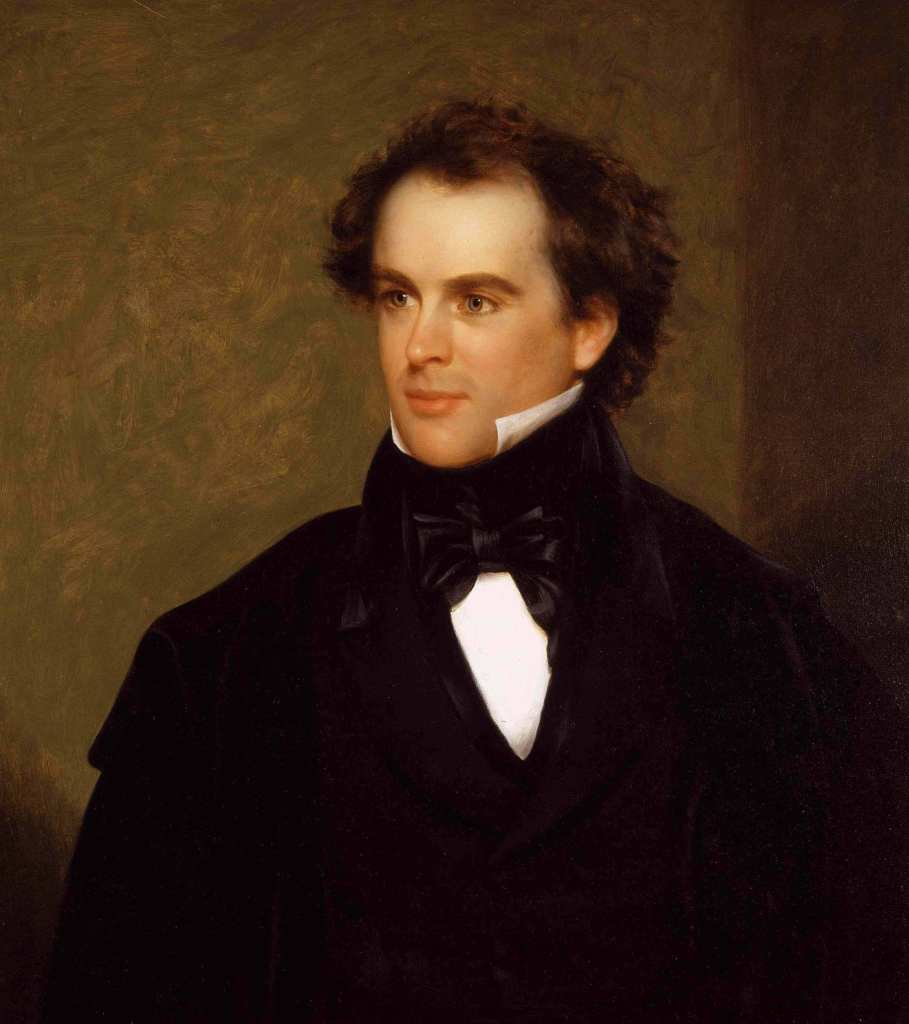
(Portrait of Nathaniel Hawthorne, by Charles Osgood. Circa 1841.)
(Contains spoilers for “The Birthmark,” “Rappaccini’s Daughter,” and “The Artist of the Beautiful.”)
Sorry I missed last month’s editorial. I don’t really have an excuse as to why I couldn’t write anything; sometimes things just turn up empty. I did already have a topic in mind for July, though, so I wasn’t worried about that. We’re here to talk about some “classic literature,” which I understand tends to fall outside genre confines for a lot of people. After all, genre SF, or indeed science fiction as a codified genre, did not exist in Nathaniel Hawthorne’s lifetime; and yet he, along with a few contemporaries, contributed massively to what we now call science fiction. Hawthorne is one of the undisputed canonical American authors, and he was also one of the first, having been born on July 4th, 1804, at a time when the US had not even started really to foster its first generation of “canonical” literature. When Hawthorne started writing his first major work in the 1830s the literary landscape in the US was basically at the stature of a toddler; and despite having already written a novel (one that nobody talks about and which Hawthorne went out of his way to disown), he would dedicate two decades of his life to mastering just the short story. The Scarlet Letter is one of the most famous (if divisive) American novels of all time, but when it was published in 1850 Hawthorne had already garnered a reputation as a master of short fiction; and like his direct contemporary Edgar Allan Poe he often wrote stories that would now be considered horror, fantasy, and/or SF. There’s a reason Lovecraft, in his “Supernatural Horror in Literature,” singled out Hawthorne as a major pioneer in weird fiction, even calling his borderline supernatural The House of the Seven Gables a masterpiece.
If I was here to talk about Hawthorne’s horror fiction then I would really have my work cut out for me, given how much of his material is horror; but today we’re here to talk about three of his short stories, all of which could be considered SF, and all of which involve some kind of mad scientist figure. The truth is that had Mary Shelley not beaten him to the punch by a few decades then the popular conception of the mad scientist would probably be much more based on Hawthorne’s conceptions—and to a degree those conceptions have still left a footprint on the popular consciousness. Had things gone a bit differently we might call a scientist who plays God a Rappaccini instead of a Frankenstein. The three stories—”The Birthmark,” “Rappaccini’s Daughter,” and “The Artist of the Beautiful”—were all published over a span of two years (1843 and 1844), and the SF Encyclopedia singles them out as masterpieces of early SF. There’s a good reason for this. While not officially connected with each other in any way, the three stories are thematically conjoined at the hip, on top of featuring variations of the same character type: the scientist in search of perfection. These are also stories that happen to show Hawthorne at the top of his game, being some of his most tightly composed and insightful work, and showing a seriousness that would be missing in the early days of genre SF a century later. Mind you that this is not a review: I very much recommend all three stories. We’re gonna be doing some analysis, specifically in how Hawthorne conceptualizes scientist characters at a time when “the sciences” as different fields of discipline were only then starting to splinter, and indeed some hadn’t been founded yet. This was a time before Darwin’s theory of evolution and our modern understanding of genetics, for example, such that “science” in 1843 might now sound like mysticism.
I read each of these stories in order of how they appeared in the Hawthorne collection Mosses from an Old Manse, so let’s talk about “The Birthmark” (or “The Birth-Mark” as it’s also written) first. This is one of Hawthorne’s most reprinted stories, and given its simplicity and economy of style it’s easy to see why it’d be one of the more popular choices. There are only two main characters (plus a singular supporting character I’ll get to in a minute), trapped together in basically one room. Aylmer is a research scientist, living at some point in the late 18th century, with his wife Georgiana, a perfectly submissive woman who nonetheless is insecure about a hand-shaped birthmark on her cheek which renders her, at least to her husband, just imperfect enough as to be tragic. We’re told Georgiana is as conventionally attractive a woman as one can think, almost perfect in her beauty—almost. This single imperfection (clearly supposed to be the hand of Nature on her cheek) is enough to make Aylmer neurotic, and to propose a series of experiments in order to remove the birthmark, which Georgiana agrees to. Aylmer’s assistant, Aminadab, suggests that the experiment would be a bad idea, but remains loyal to his master. Aminadab is a curious figure, since he has to be one of the first examples of the mad scientist’s impish assistant in SF, serving almost as a predecessor to the likes of Fritz in the 1931 Frankenstein movie and Igor elsewhere. (Remember, Dr. Frankenstein did not have such an assistant in the novel!) Of course, Aminadab is not very impish; if anything he serves as “earthy” wisdom to contrast with Aylmer’s blinding bookishness. Aylmer is not evil by any means, but he turns out to be tragically misguided, perhaps driven by the fact that he loves his work more than his wife, or as the narrator posits, he is unable to untangle his love for his wife from his love for science.
“The Birthmark” is a parable that has quite a bit going on within its almost brutally simple confines. It’s a story about man’s vain pursuit to overthrow Nature (and for Hawthorne it’s always Nature with a capital N), which will become a big of a running theme here. It’s also about the vain pursuit of obtaining perfection, which of course Aylmer and Georgiana can’t have. Aylmer’s borderline abuse of his wife and the narrative’s sympathy for Georgiana’s insecure arguably reads as proto-feminist, especially now that we’ve become much more aware of women having unrealistic beauty expectations thrust upon them; indeed the seeming “need” for perfect beauty is so prevalent that despite the quasi-Shakespearean dialogue and dense expository paragraphs, very little has aged about any of these stories in terms of their concerns. Of course Aylmer is able to remove the birthmark, but Georgiana quickly becomes ill and dies on the operating table; obviously if we’re being pedantic the removal of the birthmark shouldn’t have been able to kill her, but it’s meant to be symbolic. Prior to the climax Georgiana alluded to being connected with the birthmark in some spiritual fashion, such that if the birthmark were extinguished then her a soul might go with it—a possibility Aylmer doesn’t quite heed. For a brief moment he renders Georgiana “perfect,” but as will become apparent if one reads his other fiction, Hawthorne thinks of perfection as something that can only last for a single moment—if it’s possible at all. Aylmer is a tragic hero in that he has good intentions, or at least thinks he has good intentions, but is unable to do away with Nature’s imperfections.
Now we have possibly Hawthorne’s most famous short story with “Rappaccini’s Daughter,” which despite being a fair bit longer than either of the other stories is still very much a parable. I should probably mention that I suspect the biggest reason why more people don’t enjoy Hawthorne nowadays is that he was not a realist; he often wrote in the allegorical mode, itself having apparently gone out of fashion in recent decades. Nobody likes being moralized at, and Hawthorne did quite a bit of moralizing; but he was also very good at it, such that his skill goes undervalued now. It’s quite possible that had Frankenstein not been published a quarter-century earlier that our conception of what a “mad scientist” even looks like might’ve been more informed by Hawthorne’s Rappaccini—an ironic fact considering Rappaccini himself barely appears in his own story and we don’t even get any dialogue from him until the climax. We do, however, see a great deal of Rappaccini’s work, including his experimental botanical garden, an “Eden of poisonous flowers,” and his daughter Beatrice, who manages said Eden. We move off to Italy, where a young man named Giovanni gets caught in a rivalry between two physicians, Baglioni and Rappaccini, and Giovanni himself becomes deeply fascinated with Beatrice. I could be wrong, but this might be the earliest example of the “mad scientist’s beautiful daughter” trope in fiction; I certainly struggle to think of anything that could’ve predated it. There is a problem with Beatrice, aside from the fact that she’s socially inept: she’s poisonous, such that even her breath can kill. After years of exposure to the garden Beatrice has become immune to the poisonous plants around her—the tradeoff now being that she has become poisonous to everything else. Well, nobody’s perfect.
Of Hawthorne’s mad scientists Rappaccini is by far the most villainous and the least human, so it’s fitting he’s the only one who serves as a proper antagonist. Rappaccini’s sinister nature is amplified by the fact that we get to know very little about how this whole situation came to be. We never find out what became of Mrs. Rappaccini and we never get a clear answer as to why Rappaccini would use his own daughter as a kind of living experiment, or why he built his garden so that it would resemble a kind of inverted Eden—a place where nothing is allowed to live except that which kills. Maybe the point of making Beatrice immune to the poisonous plants of the garden was to make her, quite literally, immune to what Rappaccini considers the evils of the world—the killing things which Nature produces. Beatrice has become so perfectly immune, and herself so perfectly poisonous, that the result is idealistic—if only in a way that would strike the average person as perverse. Not that Hawthorne’s writing tends to be subtle, but “Rappaccini’s Daughter” might be one of his most overtly religious works in how intensely (and masterfully) it harks to Biblical mythology, to such a degree that even the verbose style of the prose seems to be the spawn of Milton and the King James Bible. (Of course there are also references to The Divine Comedy.) Rappaccini is a man who clearly thinks of himself as akin to God—a demiurge who has created an inverted and treacherous Eden of his own. If Rappaccini is the demiurge, a counterfeit God, then Baglioni is like the snake in Eden, but made ultimately good, such that his foiling of his rival involves making Giovanni immune to Beatrice’s own poison—an antidote that, tragically, results in her death. The villainous striving for perfection, the “paradise” of the garden, has been lost.
(Cover by E. M. Stevenson. Weird Tales, July 1926.)
The last of these stories is not as famous as the others, nor was it reprinted in genre magazines as a classic—all a shame, since it’s arguably the strongest of the bunch. I was stunned a bit when I had first read “The Artist of the Beautiful” a year or so ago, which as its title suggests is an incredibly tender parable. It must be said, though, that the protagonist of this one is not, strictly speaking, a scientist. Owen Warland is young watchmaker who has just finished his apprenticeship under Peter Hovenden, a capable but conventional-thinking watchmaker who doesn’t see the value in Owen’s idealism. Working on little machines is all well and good, but Owen wants to make something beautiful, something with real aesthetic value that will stick in the mind long after its practical function has expired. In other words, he wants to be an artist. In “Birthmark” we saw the scientist-as-destroyer, in “Rappaccini’s Daughter” we saw a villainous take on the scientist-as-creator, but in “The Artist of the Beautiful” we see the scientist-as-artist. Indeed it’s here, in this tightly constructed little story, that Hawthorne most neatly marries art with the sciences. Owen’s growing obsession with making something small and yet perfect could serve as analogous with Hawthorne’s own obsession with perfecting the short story. After all, “the beautiful idea has no relation to size.” This proves to be a very hard task for Owen, though, and he gives up a lot to achieve his vision, having lost his chance with Peter Hovenden’s daughter Annie and having become an outcast. There are false starts, and he even gives up watchmaking to focus on his secret project, mooching off an inheritance in the meantime. For all intents and purposes Owen shuts out the human world, but the same can’t be said of Nature, which he becomes more fascinated with…
The scientists of the previous two stories thought that in some way they could conquer Nature—Aylmer to remove Nature’s imperfections and Rappaccini to bend Nature to serve his own ends. If Owen is redeemed by anything it’s his willingness to acknowledge Nature’s—maybe “superiority” is not the right word, but Nature’s status as the immovable object, not to be destroyed or pushed aside by human hands. So rather than try to conquer Nature Owen instead takes inspiration from it, perhaps with the expectation that he won’t be able to reach perfection—but he can get very close, if only for a prolonged moment. Even if only a few people get to see his creation before it falls apart in their hands. The mechanical butterfly, an early example of a robot in fiction, is tiny, yet perfectly designed. It has no practical utility, but it exists seemingly for the sake of being a wonderful little work of art, not to mention what would’ve been a technological marvel. Post-industrial technology rarely comes up in Hawthorne’s fiction, partly because he actually lived through the industrial revolution and partly because his fiction tends to take place what would’ve been the distant past, even from the perspective of 1840s New England. Owen’s mechanical butterfly thus stands out as a rare example for Hawthorne of what we even today would call modern technology, but it’s also an example of science and art coming together to imitate Nature—not to replace it but to take inspiration from it. The ending is bittersweet, as Owen’s creation which he had toiled over for months crumbles, but it strikes me as a kind of spiritual victory for the “scientist” here. If Aylmer was misguided and Rappaccini villainous then Owen, the scientist-as-artist, comes out the victor.
Hawthorne wrote more SF than just these three stories, of course, although SF would still only take up a small fraction of his output, for I think at heart he was really a horror writer. There is some overlap between the genres he played with, though, and it shouldn’t be too surprising that “The Birthmark” and “Rappaccini’s Daughter” were reprinted in Weird Tales. Poe certainly wrote more SF, but far more than Poe I think Hawthorne set a standard for how we (people who, for the most part anyway, are not scientists at all) think about scientist characters in SF. Poe’s protagonists are often misfits, adventurers, schemers, and other archetypes Poe may or may not have admired; but Hawthorne’s protagonists tend to be more bookish, dour, isolated from human contact, like the man himself. No doubt Hawthorne saw some of himself in Owen Warland, and he may have even seen a bit of himself in Aylmer. More than with scientists as people, though, Hawthorne was arguably the first (after Mary Shelley, obviously) to write science fiction in which the sciences matter even close to as much as the action and themes of the story. In “Rappaccini’s Daughter” alone we have a physician who is also a botanist, and while he stays offscreen for most of the story we do see clearly the fruits of his labor. In the days before we even knew of Darwinian evolution Hawthorne had given us some ideas as to what a world ruled by scientists, by the seeking-after-knowledge above all else, might look like—and it didn’t look promising.
As I’ve said elsewhere, we’re gonna be covering the ’60s in this year-long tribute to The Magazine of Fantasy and Science Fiction this month. Picking stories to review for July proved a challenge, but in a good way. Over its 75-year history F&SF has gone through several editors, which is normal, but the ’60s were almost certainly the most tumultuous time in the magazine’s history, for a few reasons. At the beginning of the decade Robert P. Mills was editor, and for the few years he edited F&SF Mills was very capable, arguably even on par with Anthony Boucher; but Mills was an agent and publisher first, and editing wasn’t something he wanted to do as a career. So the torch was passed to Avram Davidson, which sounds like an odd choice with hindsight, but it probably made perfect sense at the time. Davidson was a well-respected writer out of the “new” generation; he was more literary than most of his contemporaries, but he was also… quirkier. For practical reasons more than anything Davidson’s editorship could not last, and so the torch was passed once again, this time to Joseph W. Ferman, with his son Edward assisting him. Joseph lasted about a year before passing the torch to Ed; and this time, by the beginning of 1966, the torch would stay in place, as Ed Ferman would remain editor for the next 25 years. By the last ’60s F&SF had found a new and comfortable niche.
The rapid changing of editors also coincided with a rapid changing of material and reader expectations at this time. The ’60s were the decade of a lot of things: the Vietnam War escalating, racial and socio-economic strife reaching a breaking point, the assassinating of left-leaning public figures, the coming of the hippies. More innocuously it saw the birth of the New Wave, which was spearheaded in the UK by Michael Moorcock and a small army of forward-thinking British writers (although, if it makes you feel better, quite a few important contributors to the New Wave were American), reinventing New Worlds to make it a boundary-pushing powerhouse of a magazine. The US scene was a bit slow to catch up. John W. Campbell and Frederik Pohl lamented the New Wave, but the rascally movement would eventually find a sympathizing magazine in the US with F&SF. Understandably the fiction published in F&SF during this time was a good deal more eclectic than what happened in the ’50s, so it also makes sense the lineup of authors for this month would be a bit eccentric. We have a few of the usual suspects, but we also have… Lin Carter? And Russell Kirk…? We have a New Waver with Brian Aldiss, although the story chosen is decidedly anticipatory of the New Wave rather than part of it. For the most part we have science fiction here, with some horror thrown in; this was not a great time for fantasy in F&SF. Still, I think it’s at least an interesting roster.
Let’s see what’s on our plate.
For the short stories:
“The Oldest Soldier” by Fritz Leiber. From the May 1960 issue. He’s baaaaack. Honestly it’s been too long—in fact it’s been exactly a year since we last covered Leiber. Of course in the interim I’ve not refrained from writing about him on a different outlet or two, and can you blame me? This time we have an entry in his Change War series, being one of the first examples of a time war in SF.
“Hothouse” by Brian W. Aldiss. From the February 1961 issue. Aldiss has a career that goes shockingly far back for someone who died fairly recently, having debuted in the ’50s and almost overnight becoming a force to be reckoned with. Hothouse is usually considered a novel, but as a series of linked stories it won Aldiss a Hugo. This first entry in the “series” is a much-needed reread for me.
“Subcommittee” by Zenna Henderson. From the July 1962 issue. There were quite a few female authors active in the early days of F&SF (more so than other SFF magazines), and one of the most prolific contributors was Henderson. Her fiction often involves families and the experiences of children, and she’s most known for her stories of “The People.” This story, however, is totally standalone.
“The Voyage of the ‘Deborah Pratt’” by Miriam Allen deFord. From the April 1963 issue. DeFord has one of the most curious careers of any old-timey SF writer, and in 1963 she was almost certainly the oldest living contributor to F&SF, being in her seventies. Prior to taking up genre writing she wrote for socialist and feminist publications, as well as conducting research for Charles Fort.
“Cynosure” by Kit Reed. From the June 1964 issue. Starting in the ’50s and remaining active until her death in 2017 (she lived to be 85), Reed’s work is often quirky, humorous, satirical, but also at times brutal. Her science was never hard, and her disposition makes one think of Shirley Jackson. Both are vicious when it comes to domestic portraits. In other words, Reed was perfect for F&SF.
“Uncollected Works” by Lin Carter. From the March 1965 issue. Acclaimed, if also controversial, as an editor, and pretty notorious as a writer, Carter is probably most responsible for reviving interest in pre-Tolkien fantasy in the ’60s and ’70s. He’d been active as a fan since the ’40s, but “Uncollected Works” was his first solo professional story, and it garnered him a Nebula nomination.
“Balgrummo’s Hell” by Russell Kirk. From the July 1967 issue. Kirk, at least when he was alive, was known more as a conservative political philosopher, and indeed Christianity is integral to both his fiction and non-fiction. But he was also a surprisingly accomplished writer of supernatural horror, and despite being very much an outsider he did sometimes appear in the pages of F&SF.
“They Are Not Robbed” by Richard McKenna. From the January 1968 issue. McKenna gained mainstream recognition with his one novel, The Sand Pebbles, but it seems he used science fiction as a training ground, such that he appeared semi-regularly in the magazines—both before and after his death. McKenna died in 1964, but he apparently had a small trove of stories waiting to be published.
“The Movie People” by Robert Bloch. From the October 1969 issue. Bloch is most known for writing Psycho, but his career started much earlier and much more embedded in the Lovecraftian tradition—indeed he and Lovecraft were correspondents when Bloch was a teenager. On top of writing bestsellers Bloch wrote for film and TV, even penning a few (horror-themed) Star Trek episodes.





 Science Fiction & Fantasy Remembrance